

Pollinator Post 4/22/23 (2)
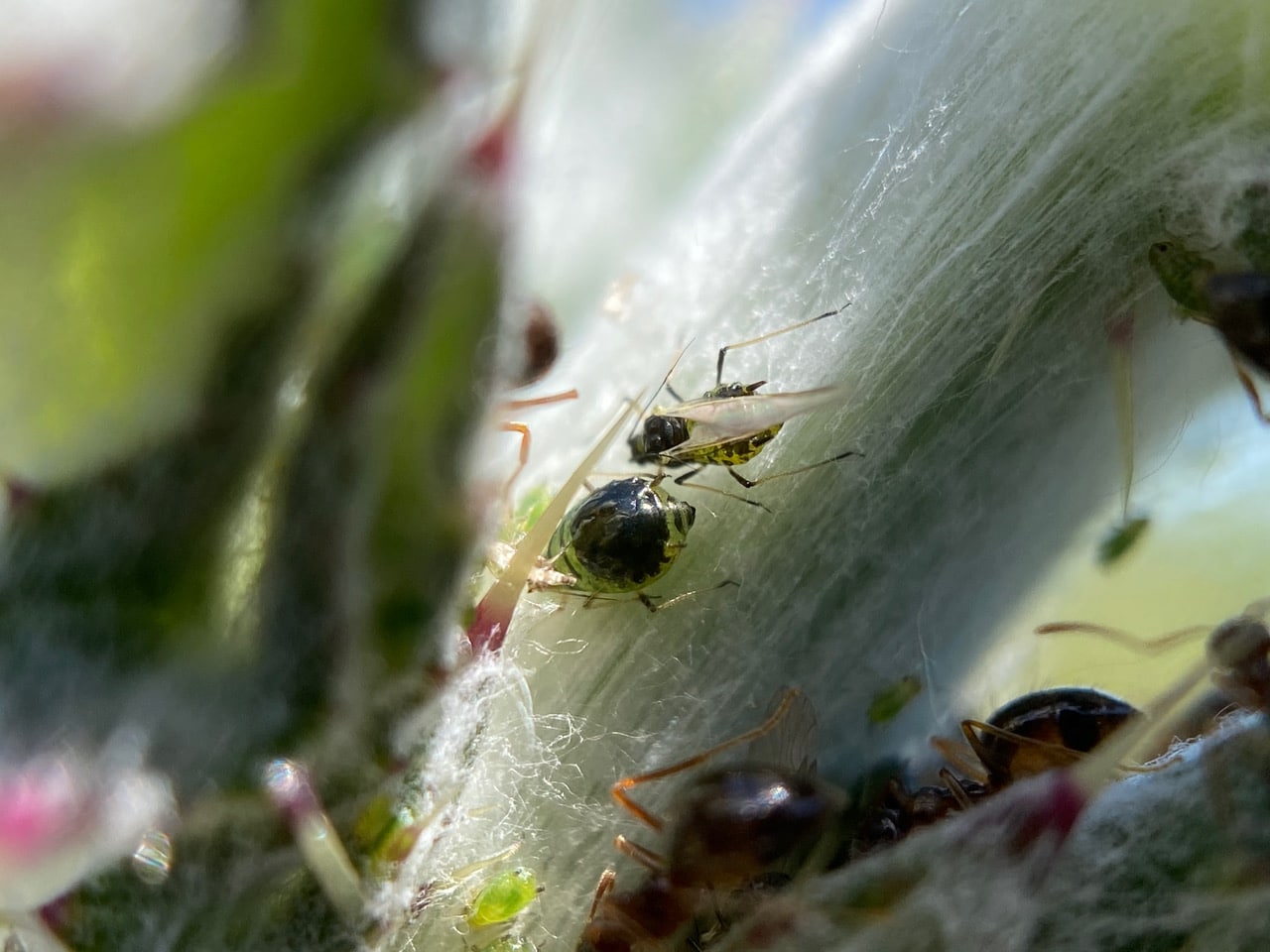
I stop by the Cobweb Thistle by the trail at the Backbone on which I have noticed intense ant activities, The plant as matured somewhat, with the young leaves peeling away from the central stem. Ahh, now it’s possible to peer into the tangled interior. Large numbers of American Winter Ants, Prenolepis imparis are crawling all over the stem and leaves. I spot two large aphids on the stem. The one on the left is a rotund adult with a large black patch on the back. The other is a similarly colored alate (winged insect).
These are the Thistle Aphids, Brachycaudus cardui (family Aphididae) with have a wide distribution in Europe, Asia, North Africa and North America. The primary host of this species is plum, cherry, apricot, or peach, but during the summer months it moves to a secondary host, often a thistle in the genera Carduus or Cirsium where it is commonly seen on the stems and flowerheads. The viviparous (live-bearing) wingless females of B. cardui have an oval or pear-shaped body and grow to a length of 1.8 to 2.5 mm. The colors varies from green, yellowing, reddish or brown. The abdomen has a dark, shining patch on the dorsal surface.
Colonies of Thistle Aphids are usually attended by ants which feed on the honeydew the aphids produce and drive away predators. Scientists have found that where there are no ants, many aphid species fail to establish colonies despite an abundance of the host plants.
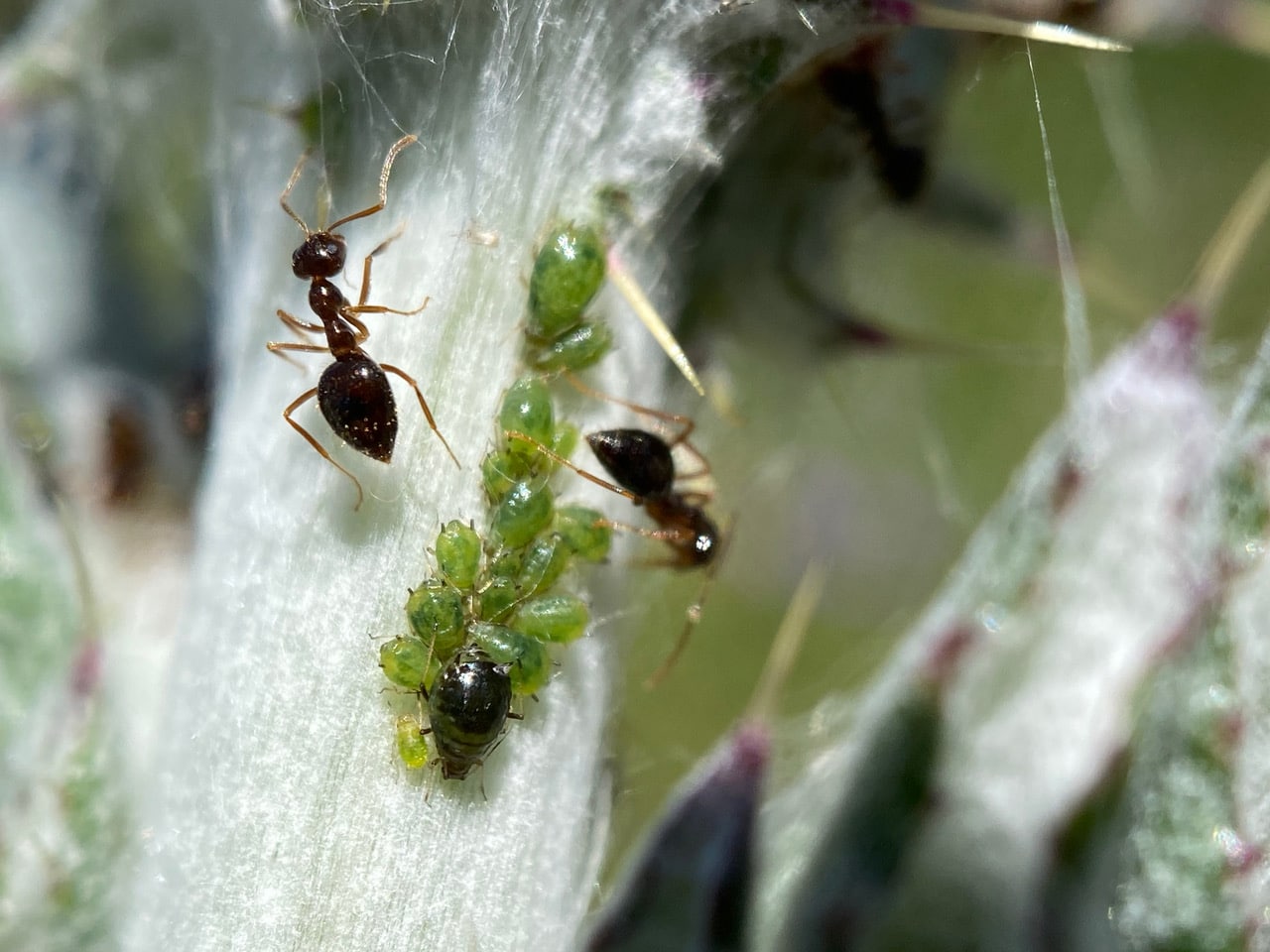
Lower down on the stem, the ants are attending a small group of aphids – what appear to be a big blackish mama aphid with her brood of green nymphs. Did the ants transfer the stem mother (mama aphid) from their own nest to the thistle at the beginning of the growing season, as a rancher would herd his cattle to new pasture?

An American Winter Ant is tapping its antennae on the adult aphid to stimulate her to produce a drop of honeydew.
Ants and aphids share a well-known mutualistic relationship. The aphids produce honeydew, a sugary food for the ants; in exchange, the ants care for and protect the aphids from predators and parasites. Some ants will “milk” the aphids to make them excrete the sugary substance. The ants stroke the aphids with their antennae, stimulating them to release the honeydew. Aphid-herding ants make sure the aphids are well-fed and safe. When the host plant is depleted of nutrients, the ants carry their aphids to a new food source. If predatory insects or parasites attempt to harm the aphids, the ants will defend them aggressively. Some species of ants continue to care for aphids during winter. The ants carry the aphids to their nest for the winter months, and transport them to a host plant to feed the following spring.

The Woolly Mule’s Ears, Wyethia helenioides is blooming beautifully along Skyline Trail. Look, there’s an insect perched on a ray ligule!
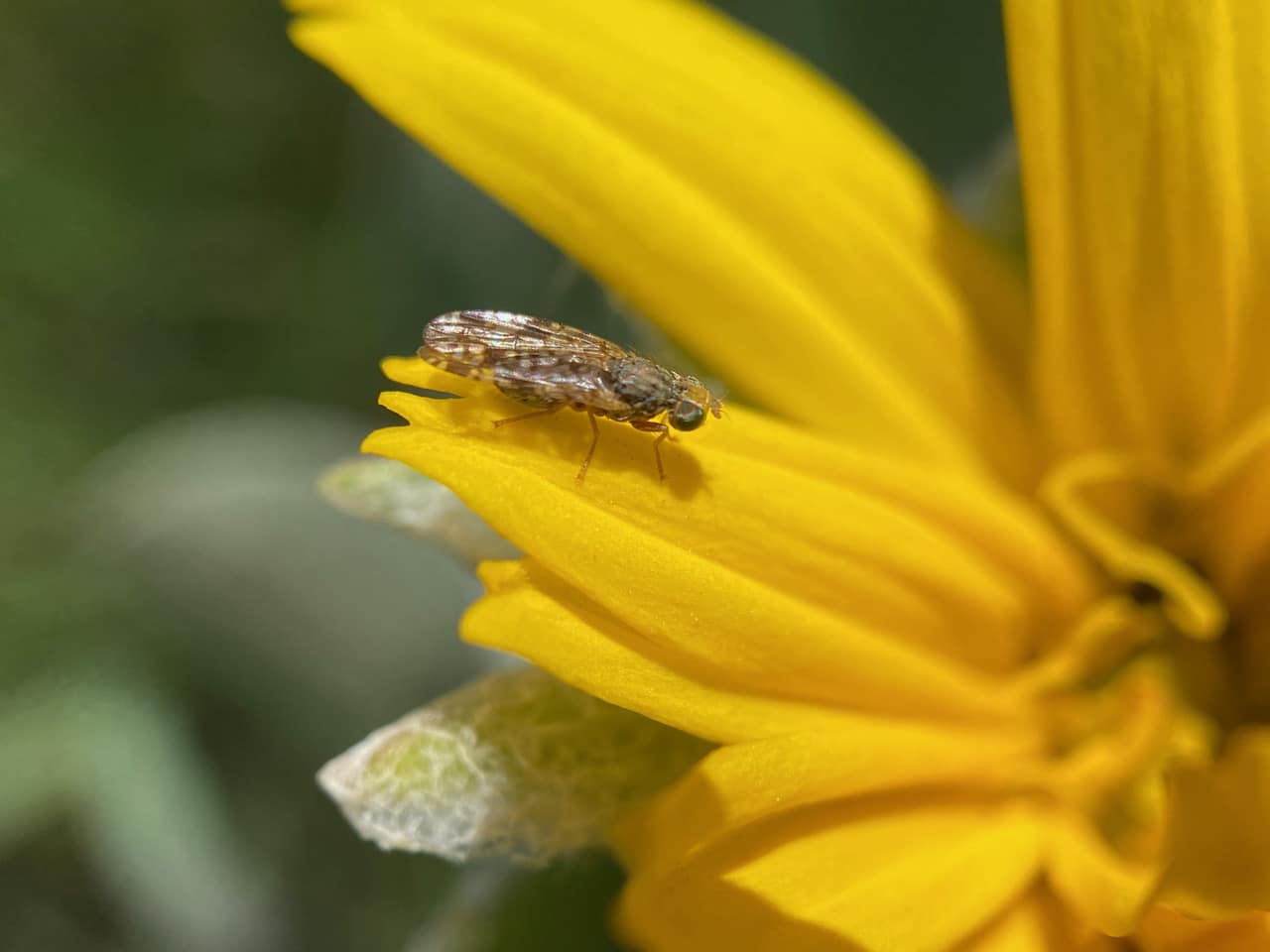
It is a Sunflower Seed Maggot, Neotephritis finalis, a Fruit Fly in the family Tephritidae. Note the intricate patterns on its “picture” wings.
Tephritids are small to medium-sized flies that are often colorful, and usually with picture wings. The larvae of almost all Tephritidae are phytophagous. Females deposit eggs in living, healthy plant tissues using their telescopic ovipositors. Here the larvae find their food upon emerging. The larvae develop in leaves, stems, flowers, seeds, fruits, and roots of the host plant, depending on the species. Adults are often found on the host plant and feeding on pollen, nectar, rotting plant debris, or honeydew. Tephritid flies are of major economic importance as they can cause damage to fruit and other plant crops. On the other hand, some Tephritids are used as agents of biological control of noxious weeds.
The Sunflower Seed Maggot is a sunflower specialist, found on over 20 species of Asteraceae. Larvae feed on immature seeds and pupate in flowerheads.

There are more of the Tephritidae on this Mule’s Ears flowerhead.
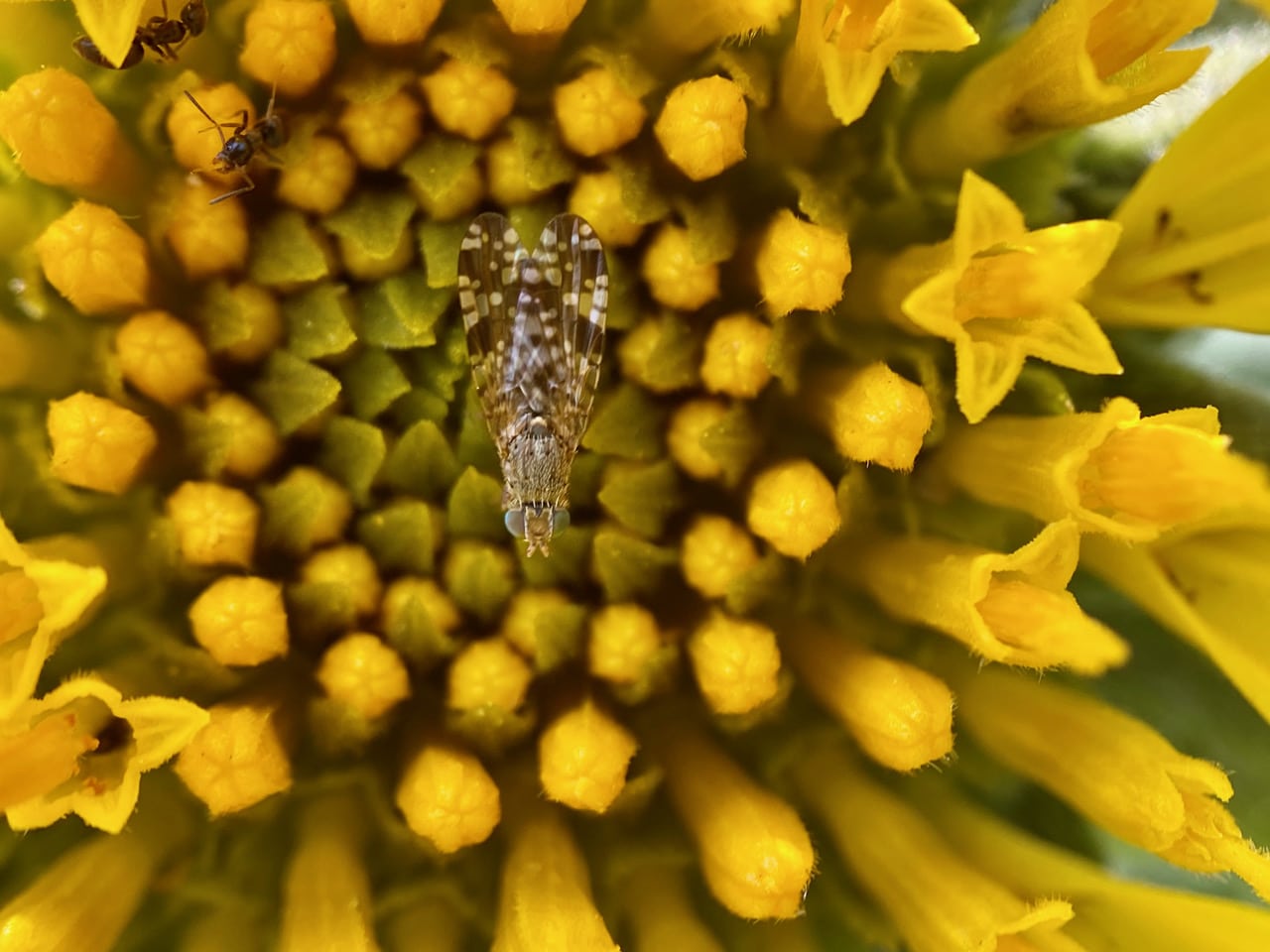
A Sunflower Seed Maggot is resting stock still in the middle of the flowerhead. Is it a female here to lay eggs in the immature flowers?

Females of the Sunflower Seed Maggot can be distinguished easily from the males by the possession of a conspicuous oviscape at the tip of their abdomen. The oviscape is the basal part of the ovipositor of some insects, typically the non-retractile sclerotized sheath that remains exposed when the telescopic ovipositor is withdrawn and not in action.

A Fairy Long-horned Moth, Cauchas simpliciella (family Adelidae) is coiling up its proboscis after taking nectar from the flowers of Fringe Pod, Thysanocarpus curvipes (family Brassicaceae). The scales on its wings are flashing bronze in the sunlight.
A tubular sucking organ, the proboscis enables a butterfly or moth to extract sweet nectar from flowers, regardless of the shape of the blossom. When not in use, the proboscis is rolled up out of the way under its head. Unlike caterpillars, adult butterflies do not have any chewing mouthparts, and therefore must obtain their nutrition from sipping liquids. Hydrostatic pressure extends the curled proboscis which is inserted deep into the tubes of flowers. At emergence from the chrysalis, the proboscis initially consists of two parts that appear like a forked tongue. Almost immediately the two tubes are “zipped” together to form the single tube. In addition to flower nectar, butterflies also use the proboscis to suck up moisture from puddles, liquids from fermenting fruits, rotting animal flesh or animal excrements.
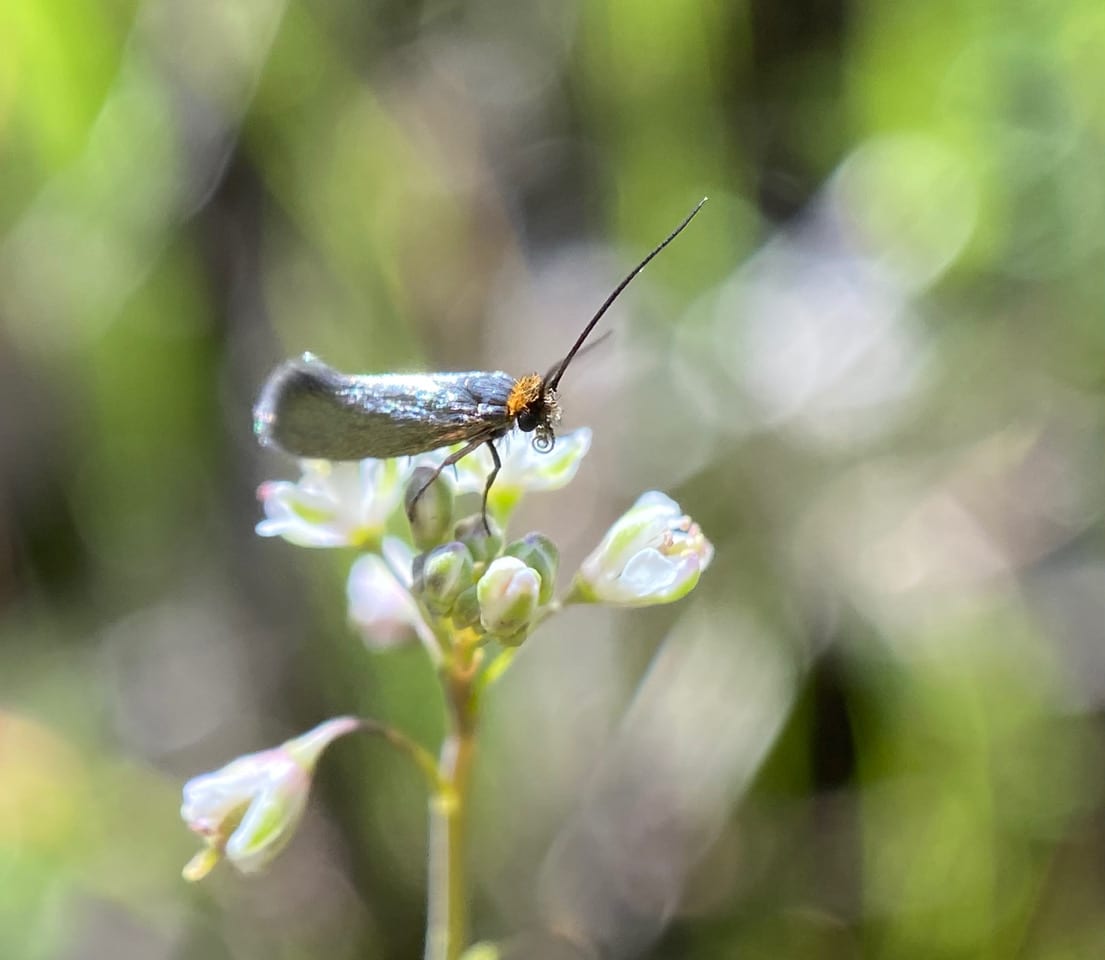
Seconds later, with the slightest shift in the moth’s position, its wings turn a silvery sheen. Is there a biological function to the flashing iridescence of these day-active moths? Is it some kind of courtship display?
The Adelidae or Fairy Longhorn Moths are a family of small diurnal moths, with wingspans of 4-28 mm, and males often have especially long antennae, 1-3 times as long as the forewing. Many species are known for their lekking behavior, where males gather to display competitively for the females for the right to mate. During lekking events, males would swam around the tips of branches with an undulating flight, their white antennae conspicuously visible. Adelidae are usually closely restricted to specific host plants. The females insert their eggs in the plant or just oviposit among leaf litter, and the caterpillars make a case, completing their development on the ground. Fairy Longhorn Moths feed in sunshine on nectar from the flowers of herbaceous plants.
Cauchas is a genus of the Fairy Longhorn Moth family Adelidae, subfamily Adelinae. Adults are small, with relatively short antennae compared with other members of the family. Wingspan about 10 mm. Forewings are rounded at the tips, dark bronze to bright purplish depending on angle of incidence. A mob of orange hairs is conspicuous on the head. The larval host plants for the Cauchas moths are all native mustards in the Brassicaceae family.

The Variable Checkerspot caterpillars on the California Bee Plant, Scrophularia californica are getting big and fat, and tend to rest curled up in a U-shape these days. Are they about to pupate? I should be looking for their chrysalids soon.

Hello, who is this on a leaf of the Calfornia Bee Plant, Scrophularia californica? It is a small Stink Bug, Cosmopepla uhleri (family Pentatomidae). It is easily recognizable – black with an orange transhumeral band with black spots. The bug uses Scropularia californica as a host plant.

Pentatomidae is a family of insects belonging to the order Hemiptera or “true bugs”. As hemipterans, the pentatomids have piercing-sucking mouthparts, and most are phytophagous, including several species that are severe pests on agricultural crops. Stink Bugs feed on plant fluids by inserting their needlelike mouthparts into stems, leaves or seed pods. While feeding, they inject materials into the plant to aid in digestion and sap removal. Penetration by the mouthparts can cause physical damage, much like stabbing the plant with a fine needle. Cosmopepla uhleri is so small that the damage is generally limited to fine stippling on the leaves of California Bee Plant.
All Pentatomids have 5-segmented antennae (hence their family name, Penta – five and tomos – section.) They generally have a large triangular scutellum in the center of the back. The adult is generally shield-shaped when viewed from above. The common name of Stink Bug refers to their ability to release a pungent defensive spray when threatened, disturbed, or crushed.
#/media/File:Heteroptera_morphology-d.svg)