

Pollinator Post 4/22/23 (1)

A not-very-well-camouflaged Crab Spider greets the morning sun on a fresh floral umbel of Cow Parsnip, Heracleum maximum.
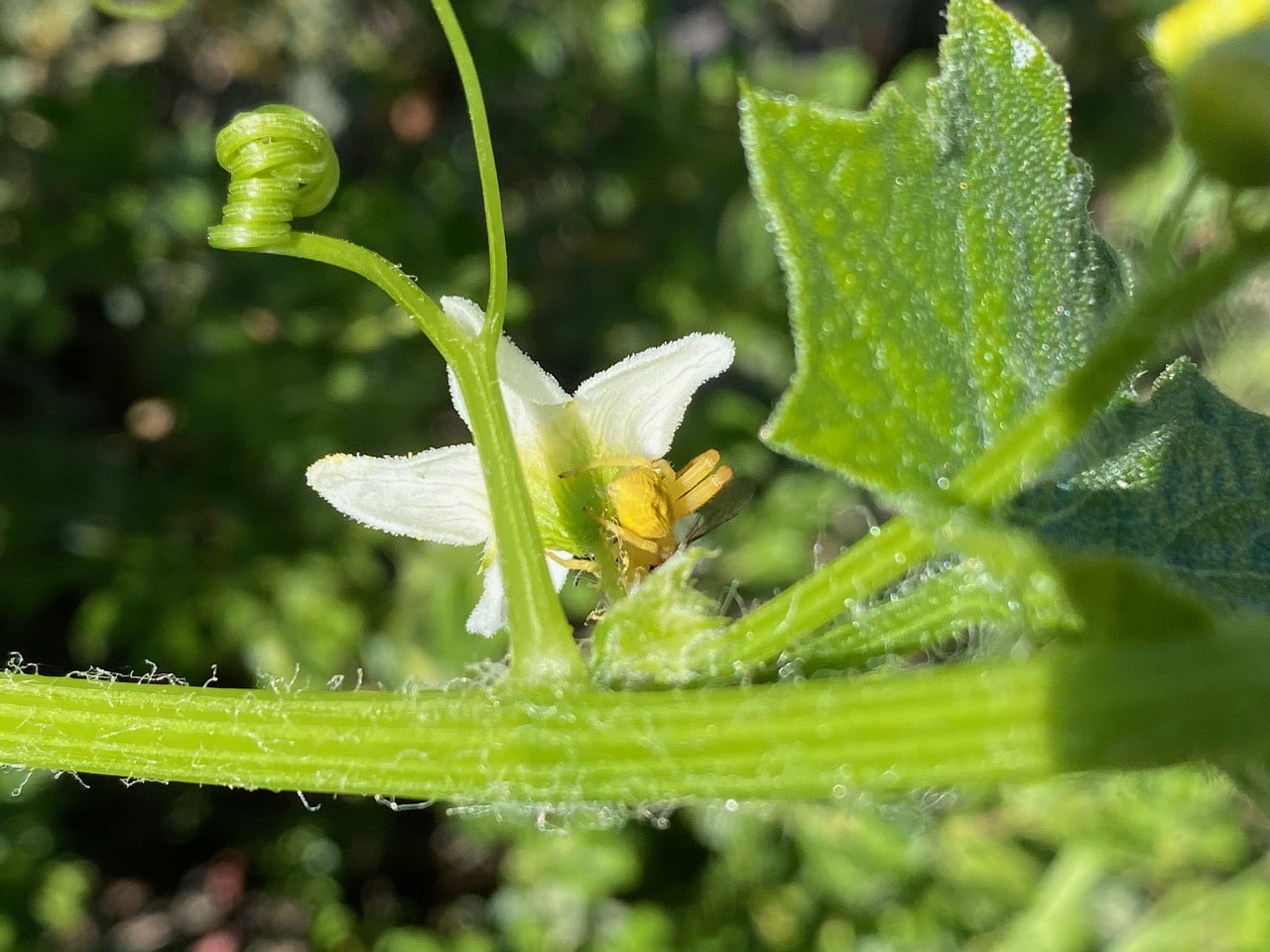

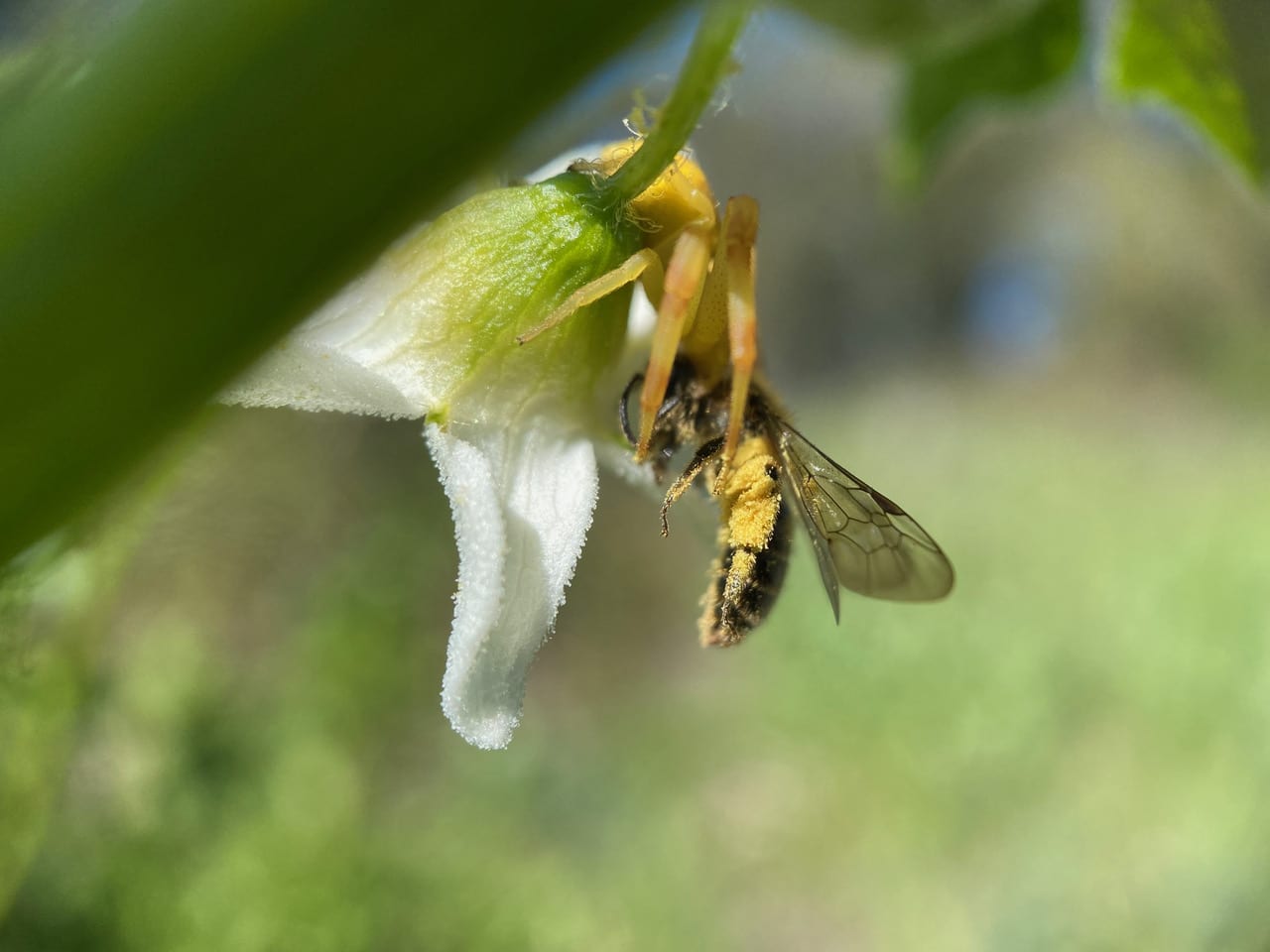






Checking for fruit set behind a female flower of Oregon Manroot, Marah oreganus, I notice something yellow. It’s a Crab Spider that has caught a winged insect!
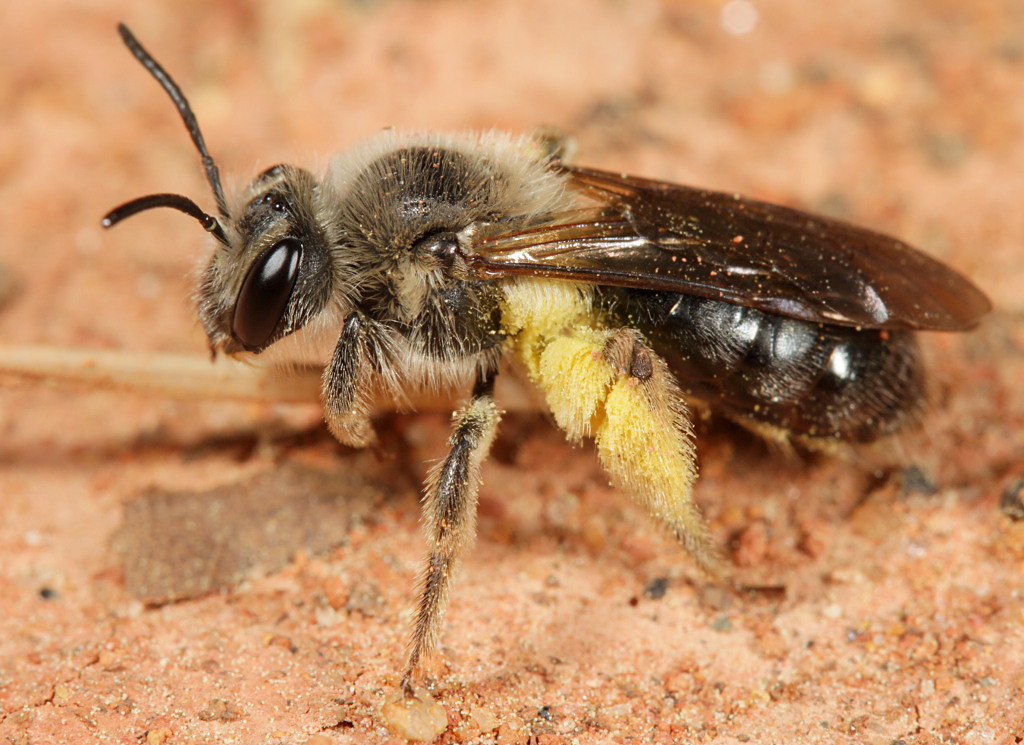
The prey is a bee with a sizable pollen load on her hind legs, and it’s no longer struggling. The spider is probably feeding on it. I wonder what kind of bee it is?
Closing in on the bee’s hind legs, I want to see how and where the bee had packed her pollen. Ah, her scopae (special pollen collecting hairs) cover both her tibia (shin-like section) as well as the femur (the thigh-like section), even extending to her propodeum, the first abdominal segment. This is typical of the extensive corbiculae (“pollen baskets”) of the Mining Bees in the genus Andrena (family Andrenidae).
Satisfied, I quietly back off to let the spider enjoy her meal in peace.
Crab spiders (family Thomisidae) do not build webs. They are ambush predators that sit and wait to grab insects that visit flowers. After a bite, their potent venom immobilizes the prey very quickly, so little struggle is necessary. The digestive juices that is injected together with the venom break down the tissues of the prey. The spider sucks up the resulting slurry through the fangs, often leaving the exoskeleton of the prey remarkably whole except for the pair of fang marks. Crab spiders are capable of tackling prey much larger than themselves.
Minutes later while climbing the steep path to the Swale, I encounter another spider. It is a Ground Crab Spider in the genus Xysticus (family Thomisidae).
Disguised in earthy browns/grays, these spiders tend to be found on the ground or on low vegetation. While similar to the “flower spiders”, they tend to have shorter, sturdier legs. Like most Thomisidae, Xysticus do not build webs. They are ambush predators that prefer to hunt near the ground. They move slowly, and commonly hunt by stationing themselves in high-traffic area and grabbing whatever arthropod passes close enough. Also like most other Thomisidae, they seize prey with their enlarged front two pairs of legs and kill it by a venomous bite.
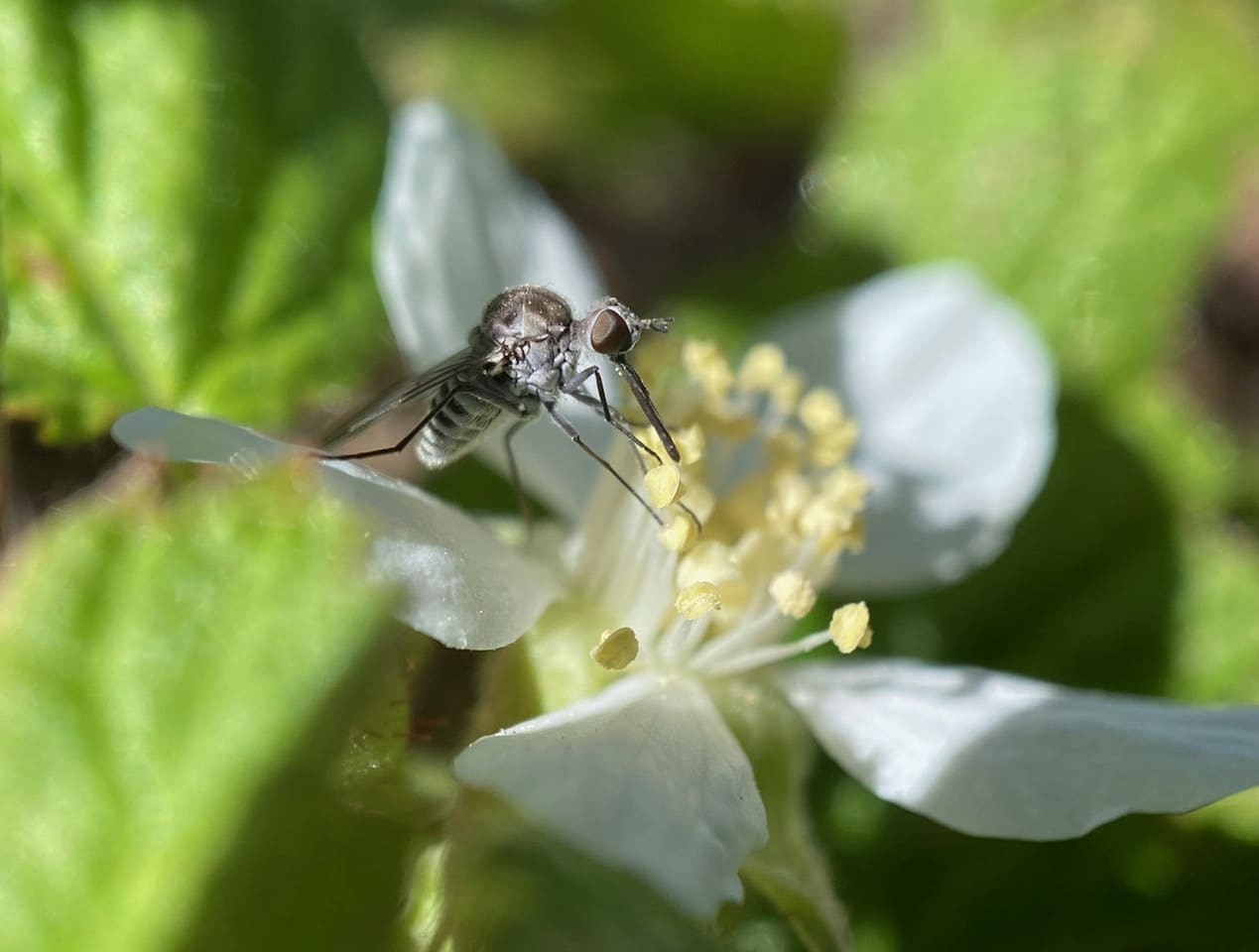
A mosquito-like insect is feeding on the pollen of California Blackberry, Rubus ursinus. It is a Bee Fly in the genus Geron (family Bombyliidae).
“Geron” is Greek for “old man” (imagine a humpbacked man carrying a cane). The fly is easily recognizable from its humpbacked appearance, conical abdomen and shiny, golden pubescence. Like many bee flies, it flies around with a long proboscis that cannot be folded up. Larvae are parasitoids of the immature stages (caterpillars) of various moths in concealed situations. Some are also hyperparasitoids. Adults take nectar at flowers, preferring members of the sunflower family, Asteraceae. Unusual for bee flies, Geron often bobs up and down above an inflorescence before landing to nectar. Males often form loose swarms.
It is hard to walk past a thistle without looking for ants attending aphids. Ahh, here’s a perfect example! An American Winter ant, Prenolepis imparis is tending to a couple of plump green aphids on the leaf axil of a Cobweb Thistle, Cirsium occidentale.
Ants and aphids share a well-known mutualistic relationship. The aphids produce honeydew, a sugary food for the ants; in exchange, the ants care for and protect the aphids from predators and parasites. Some ants will “milk” the aphids to make them excrete the sugary substance. The ants stroke the aphids with their antennae, stimulating them to release the honeydew. Aphid-herding ants make sure the aphids are well-fed and safe. When the host plant is depleted of nutrients, the ants carry their aphids to a new food source. If predatory insects or parasites attempt to harm the aphids, the ants will defend them aggressively. Some species of ants continue to care for aphids during winter. The ants carry the aphids to their nest for the winter months, and transport them to a host plant to feed the following spring.
Mother Nature has put up a spectacular floral display at the Swale on this Earth Day! For all the floral resources available, insects are surprisingly few and far in between.
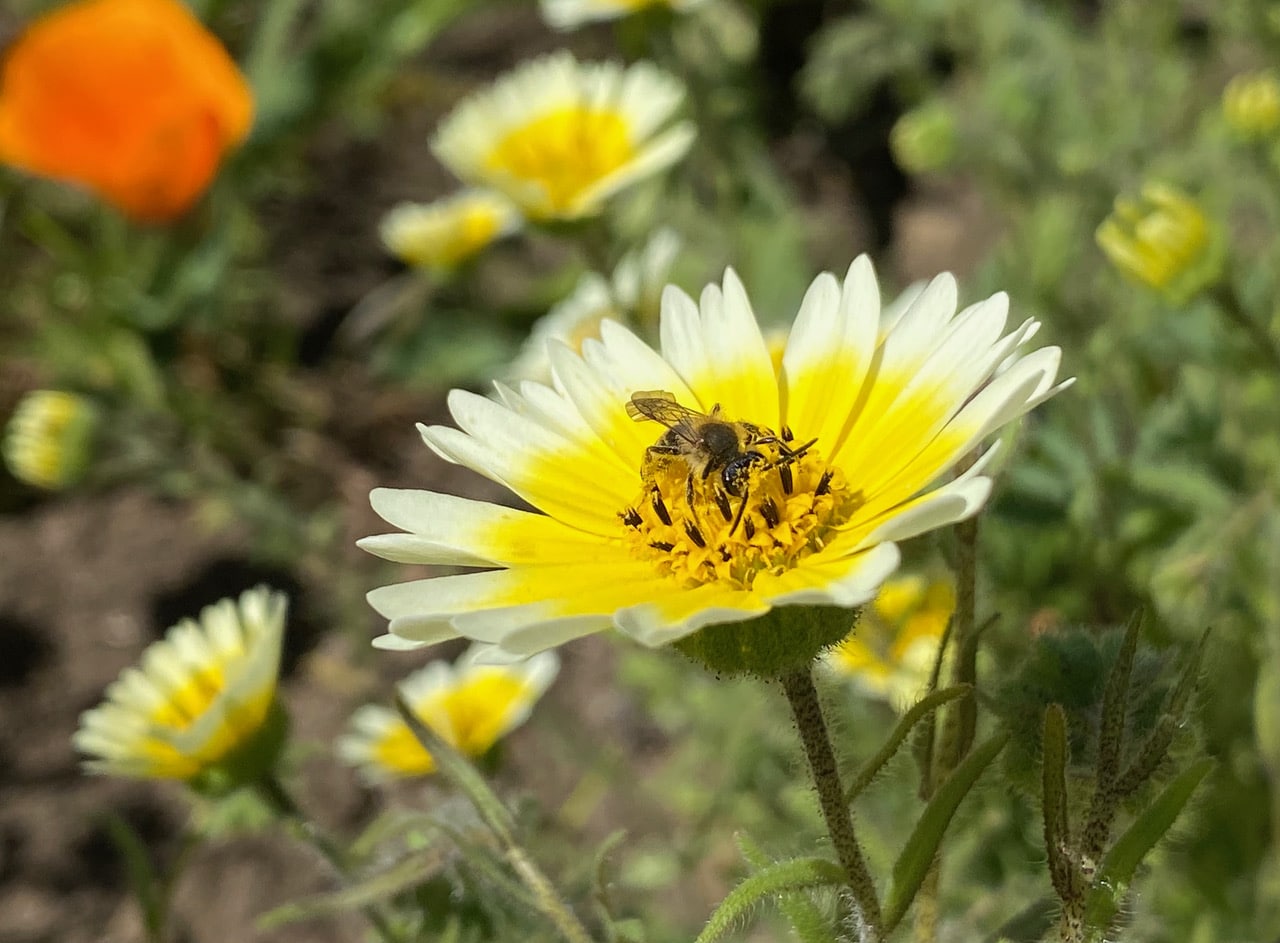
A little bee stops by for refreshments on a Tidy Tip flowerhead, but it’s too far away to make out what kind it is.
Wow, what’s with this Tidy Tip flowerhead? One of the ray flowers on the rim of the flowerhead has gone rogue, creating a funnel-shaped flower all its own!
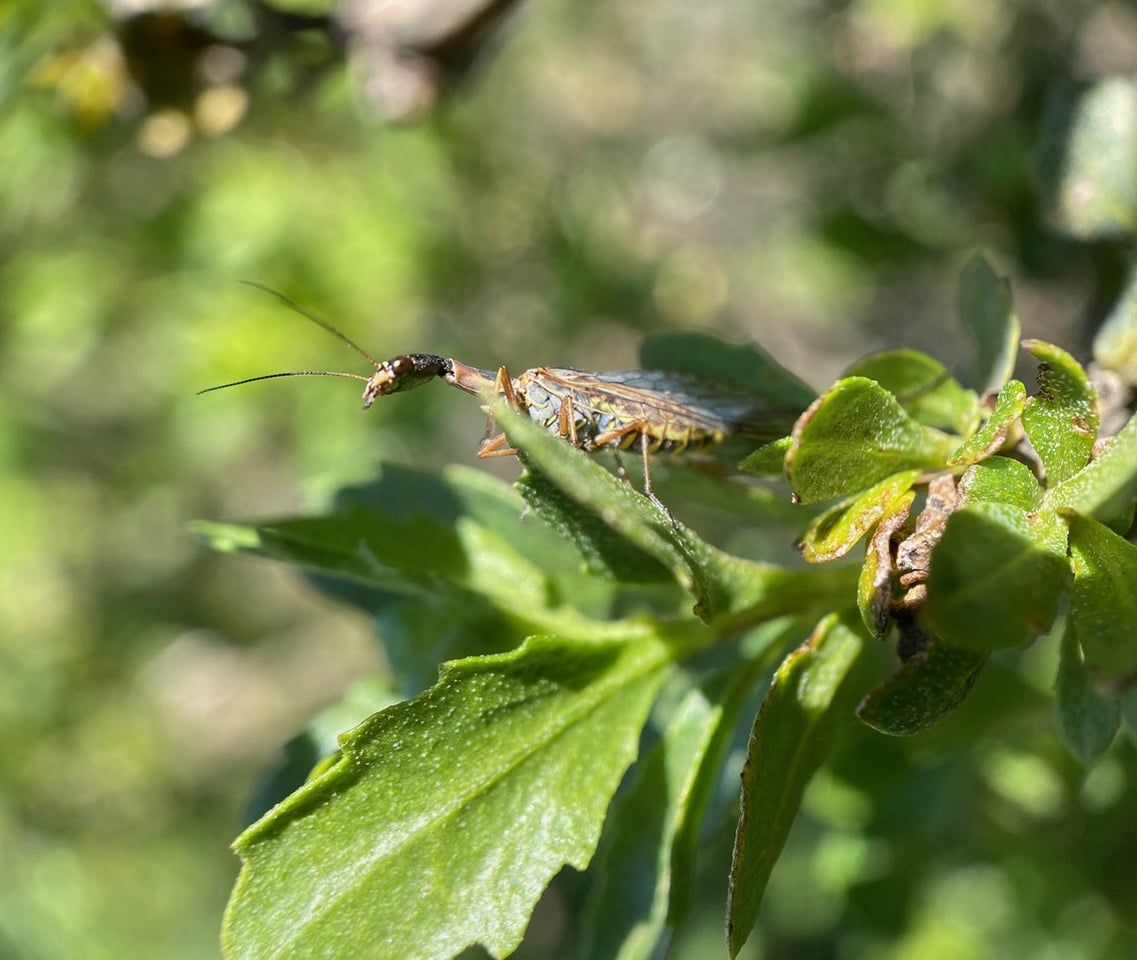
A Snakefly peers warily from behind the foliage of Coyote Brush as I approach with the camera.
Snakeflies are a group of predatory insects comprising the order Raphidioptera. They are a relict group, having reached their apex of diversity during the Cretaceous before undergoing substantial decline. Adult Snakefly has a notably elongated thorax which, together with the mobile head, gives the group their common name of snakily. The body is long and slender and the two pairs of long membranous wings are prominently veined. The head is long and flattened and heavily sclerotized. The mouthparts are strong and relatively unspecialized, being modified for biting. The large compound eyes are at the sides of the head. Females have a large and sturdy ovipositor which is used to deposit eggs into crevices or under bark. Snakeflies are holometabolous insects with four-stage life cycle consisting of eggs, larvae, pupae and adults. Both adults and larvae are predators of soft-bodied arthropods such as aphids and mites.
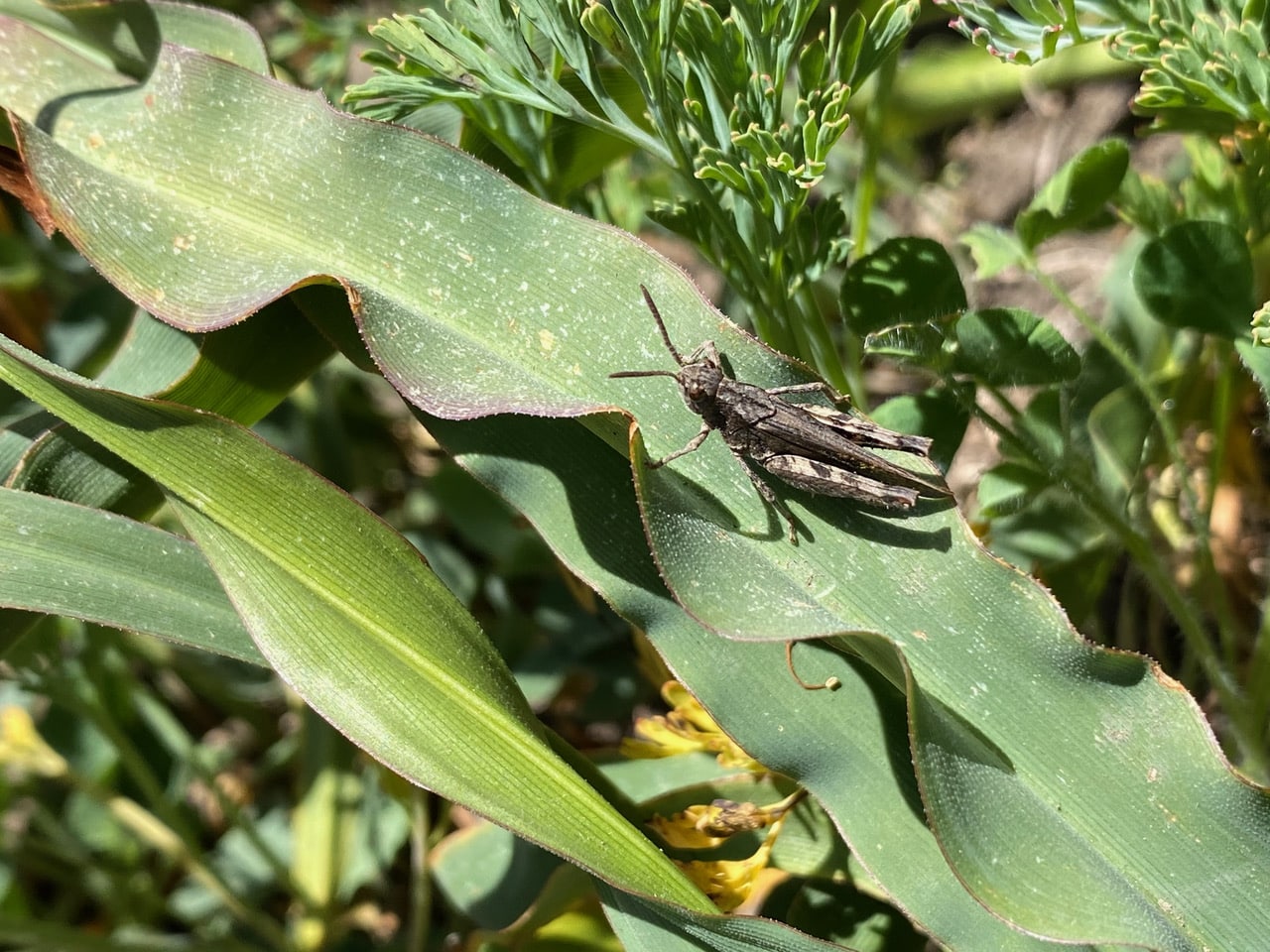
As I walk the steep rocky trail at the Backbone, a grasshopper leaps ahead of me and lands on a leaf of Soap Plant.
It is a Band-winged Grasshopper (subfamily Oedipodinae, familyAcrididae). The family Acrididae or Short-horned Grasshoppers are herbivorous and comprise some of the most destructive agricultural pests including the locusts. The hind legs are adapted for jumping with greatly enlarged femurs. Males display acoustically in courtship by rubbing the front wings together and drawing the hind legs across the edge of the wings. Most species have a pair of tympanal (hearing) organs at the base of the abdomen. A female short-horned grasshopper lays about 100 eggs in the soil. The newly hatched nymphs, miniature replicas of the adults, pass through a series of molts before they become adults.
The Band-winged Grasshoppers (subfamily Oedipodinae) produce a crackling noise during flight. When they are not in flight, their conspicuous, brightly colored hind wings are covered by their forewings, which blend into the surrounding, appearing drab. When threatened, they make sudden leaps to reveal the bold and bright colors to startle potential predators.