

Pollinator Post 4/20/24 (1)
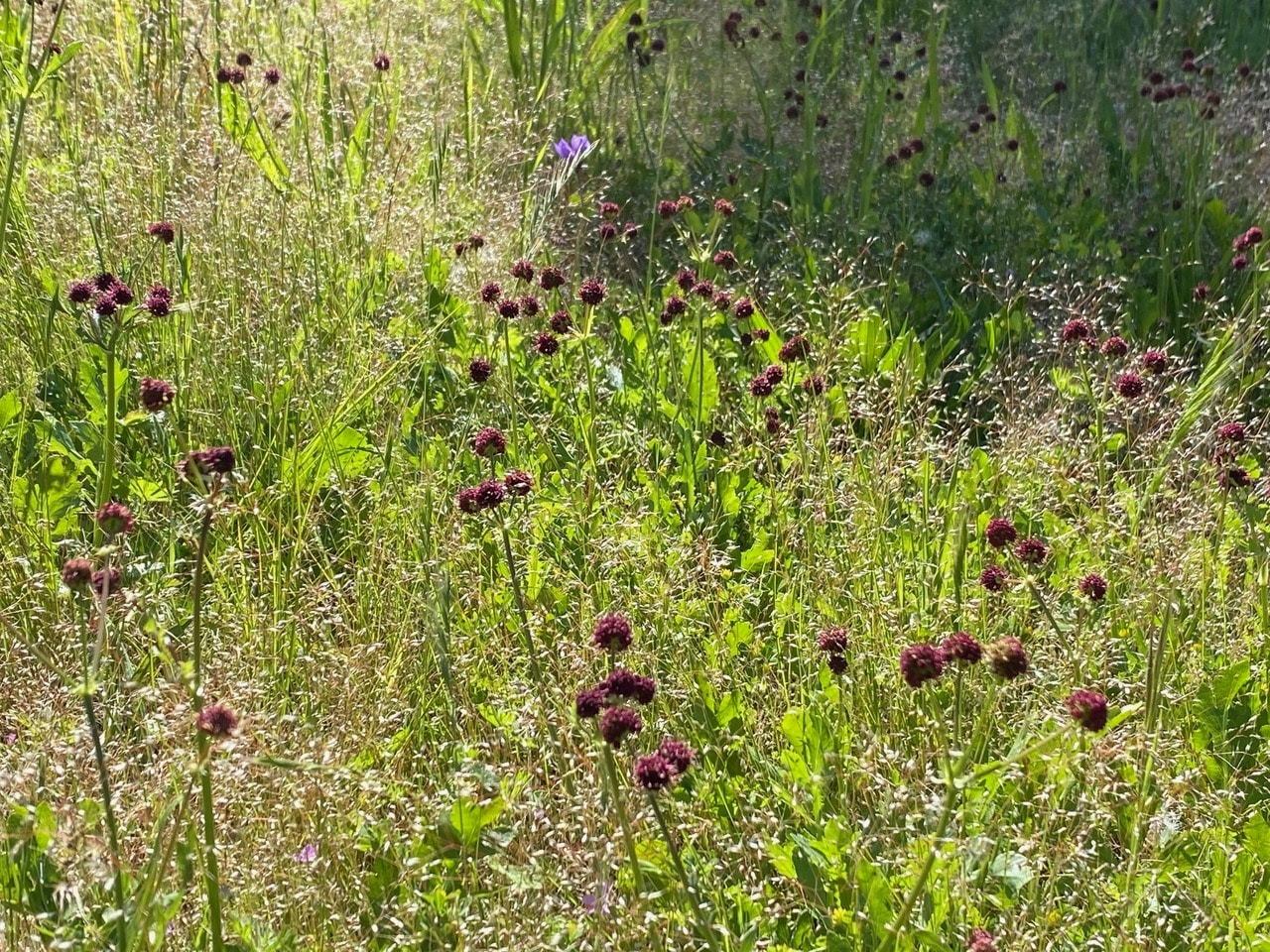
Seeking shade on a hot afternoon, I opt for the short path between the Padre and the Laurel picnic areas in Tilden Regional Park. Arriving at the Padre parking lot, I am taken aback to see that big swaths of the meadow have been mown down. Fortunately, most of the California Buttercups have been spared, together with some other low-growing wildflowers in the side strip bordering the forest.
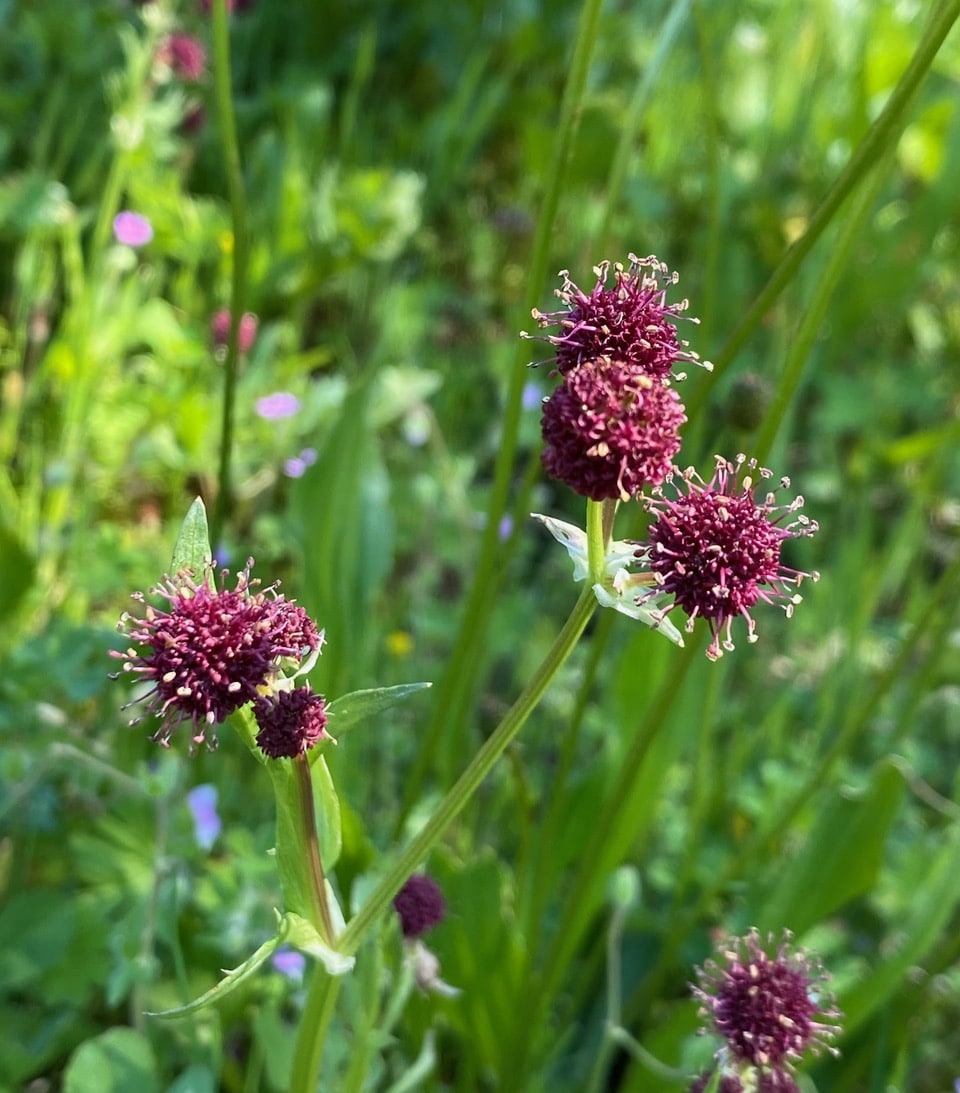
The Purple Sanicle, Sanicula bipinnatifida (family Apiaceae) is in peak bloom. Although small, the globular, reddish-purple flowerheads are eye-catching among the low undergrowths. Native to the West Coast from British Columbia to Baja California, the perennial is found in various habitats, including grasslands, meadows, chaparral, woodlands and pine forests.
The inflorescence is comprised of several to many compact headlike umbels. Each flowerhead, just under 1” in diameter has around 20 bisexual and male-only flowers. Stamens extend well beyond the 5 tiny, curling reddish-purple petals.
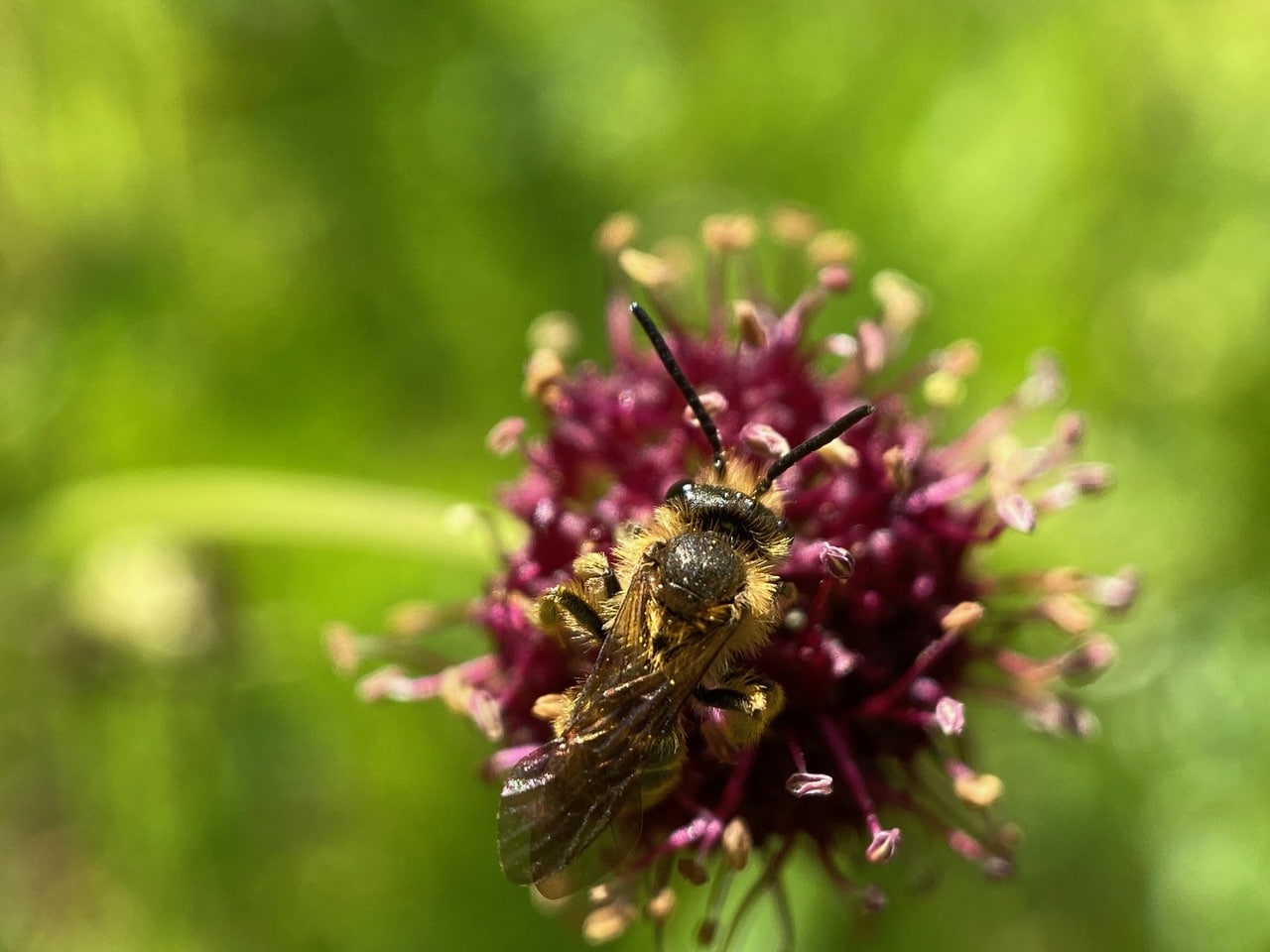
Many small insects are visiting the Purple Sanicle flowerheads. I recognize most of them as small bees of various types, but they are impossible to identify in the field. It’s only when I examine the photos at home that I can sort out some of these bees.
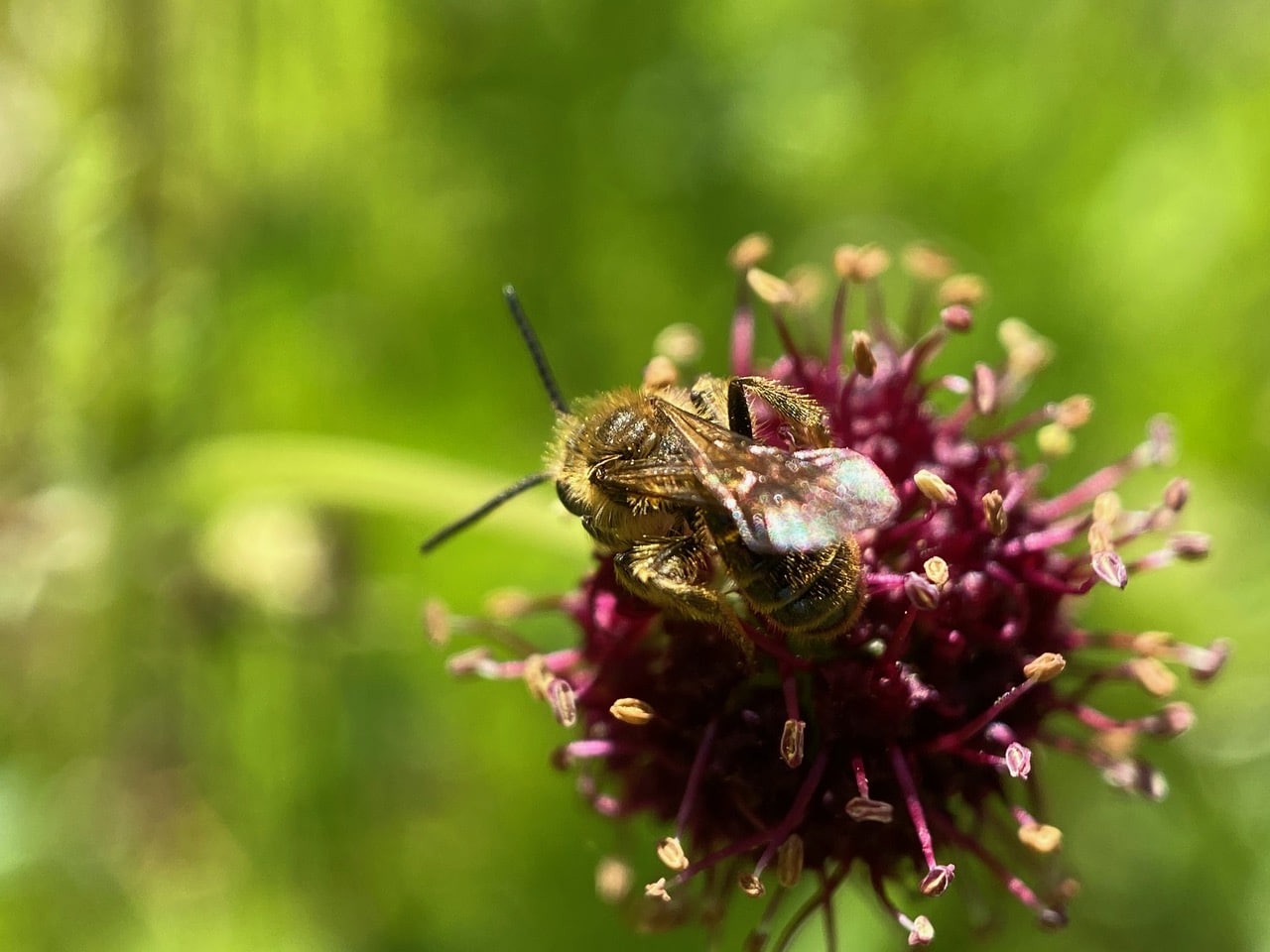
This bee is relatively easy to recognize for its scruffy appearance, with coarse hairs that reflect gold in the sunlight. It is probably the appropriately named Golden-haired Miner Bee, Andrena auricoma (family Andrenidae).
The female bees are 8-10 mm in length, and males are 6-9 mm long. The species is found in the western United States, and is relatively rare outside California. I have seen the bees visit several species of native wildflowers, so they are generalist foragers, pollinating a wide variety of flowers.
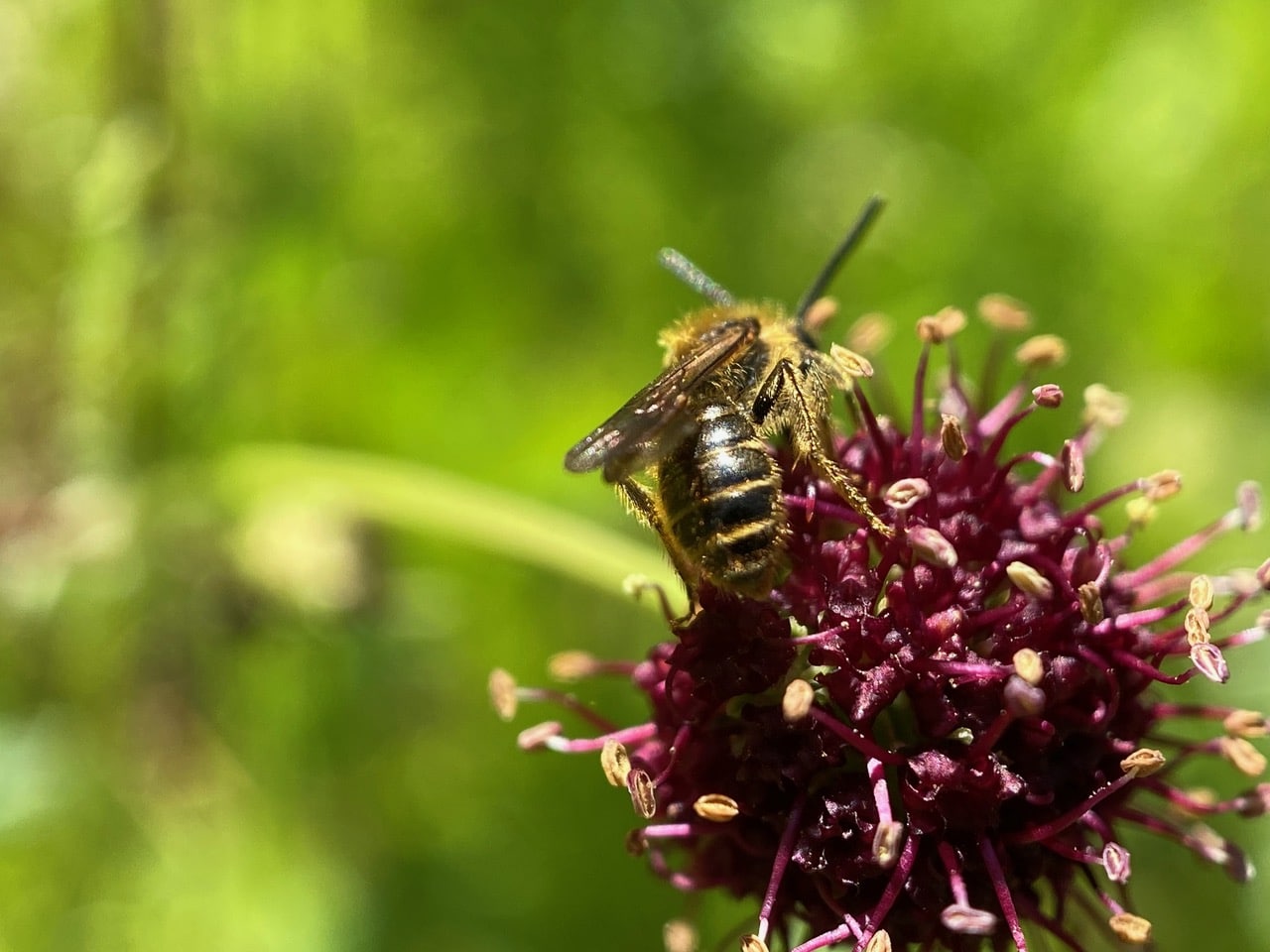
This individual is a male, with long antennae, and absence of scopae on its hindlegs.
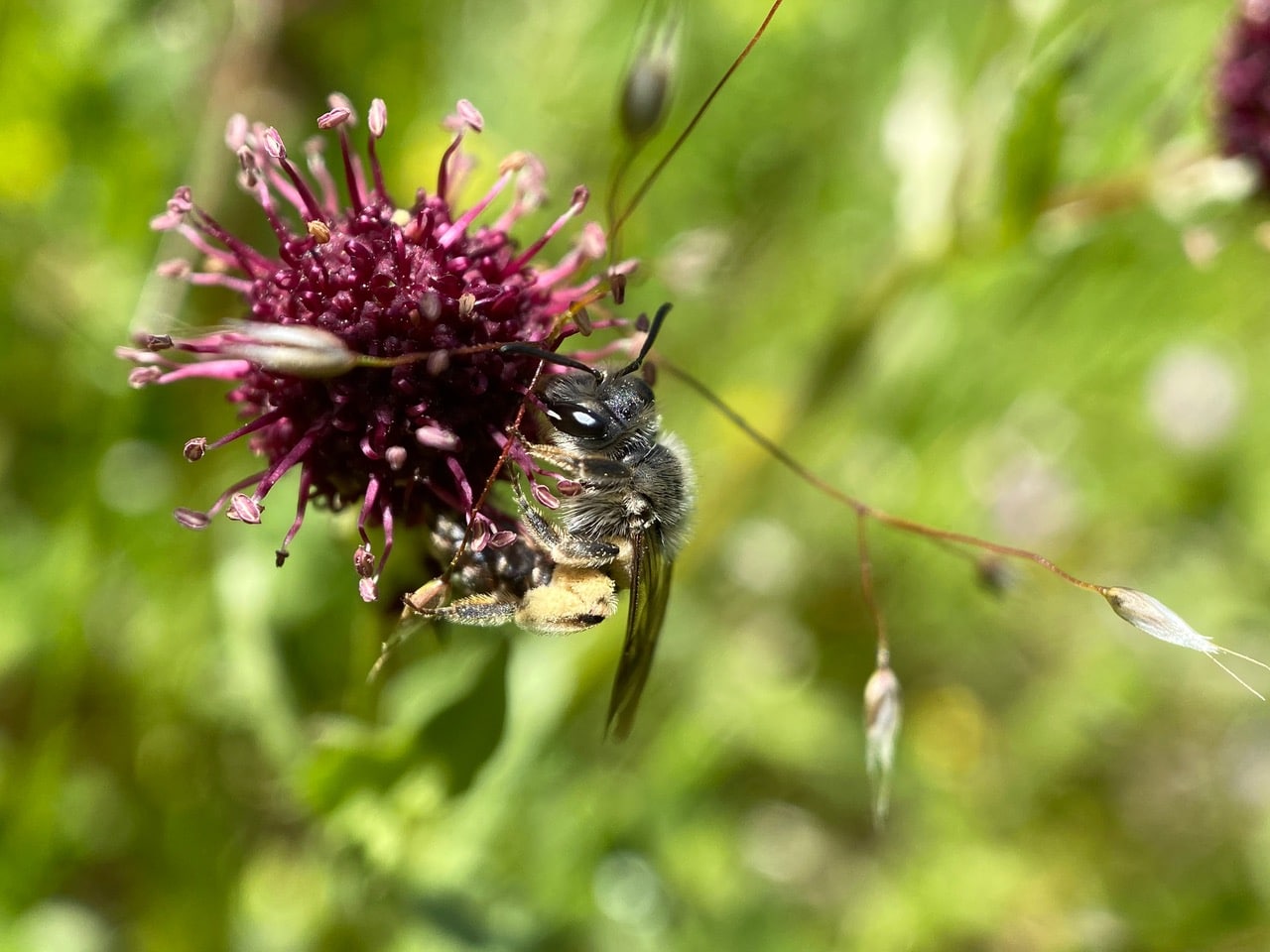
A stockier bee is taking nectar from the Purple Sanicle flowers. The bee has her scopae loaded with pollen – a sure sign that it is female. Male bees do not collect pollen. I think she might be a Sweat Bee in the genus Halictus (family Halictidae).

A tiny Crab Spider (family Thomisidae) is sitting in ambush on a Purple Sanicle flowerhead.
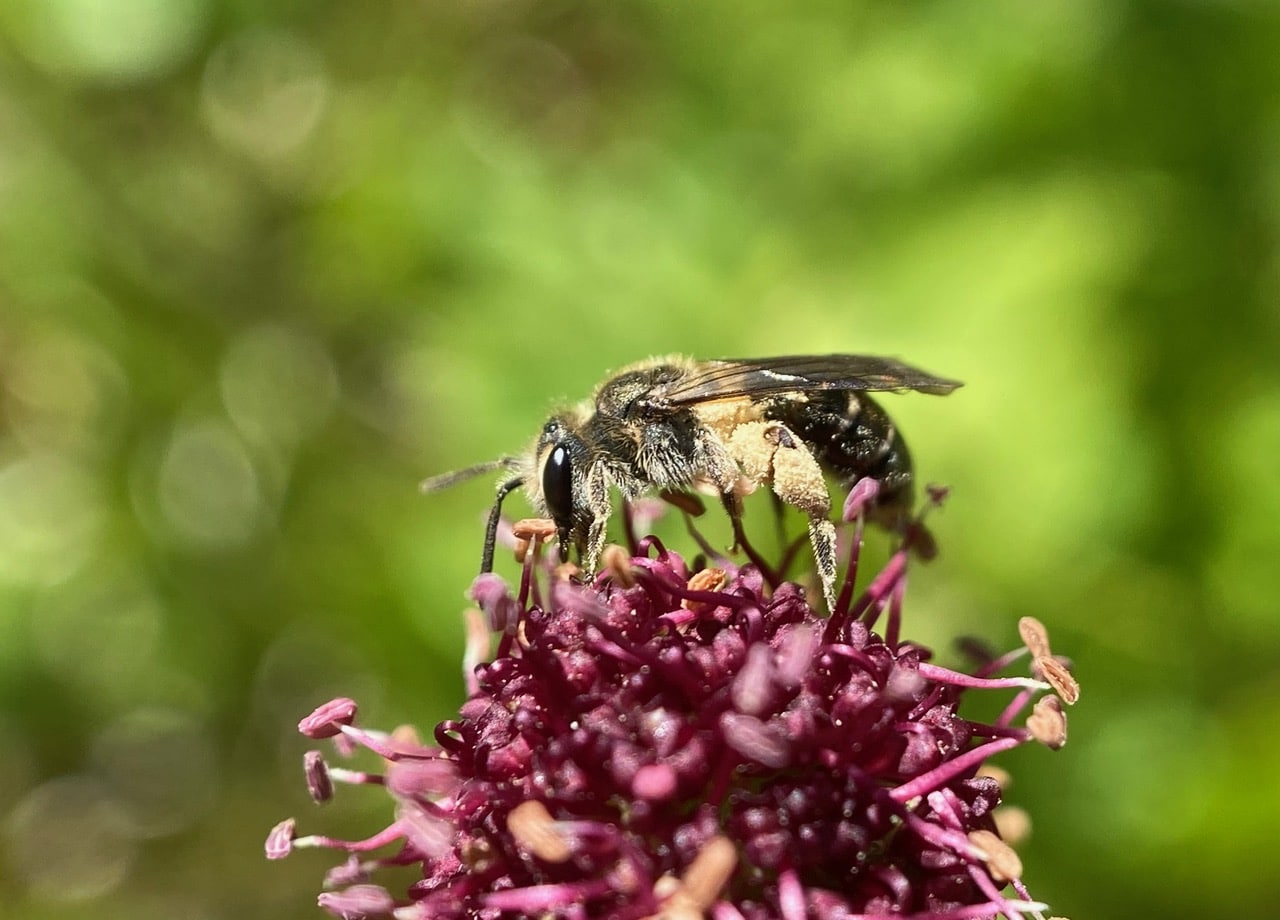
A female bee is foraging on a Purple Sanicle flowerhead. She already has a pretty full load of pollen on her hindlegs, and also in her “arm pit”, the area between the thorax and abdomen called the propodeum.
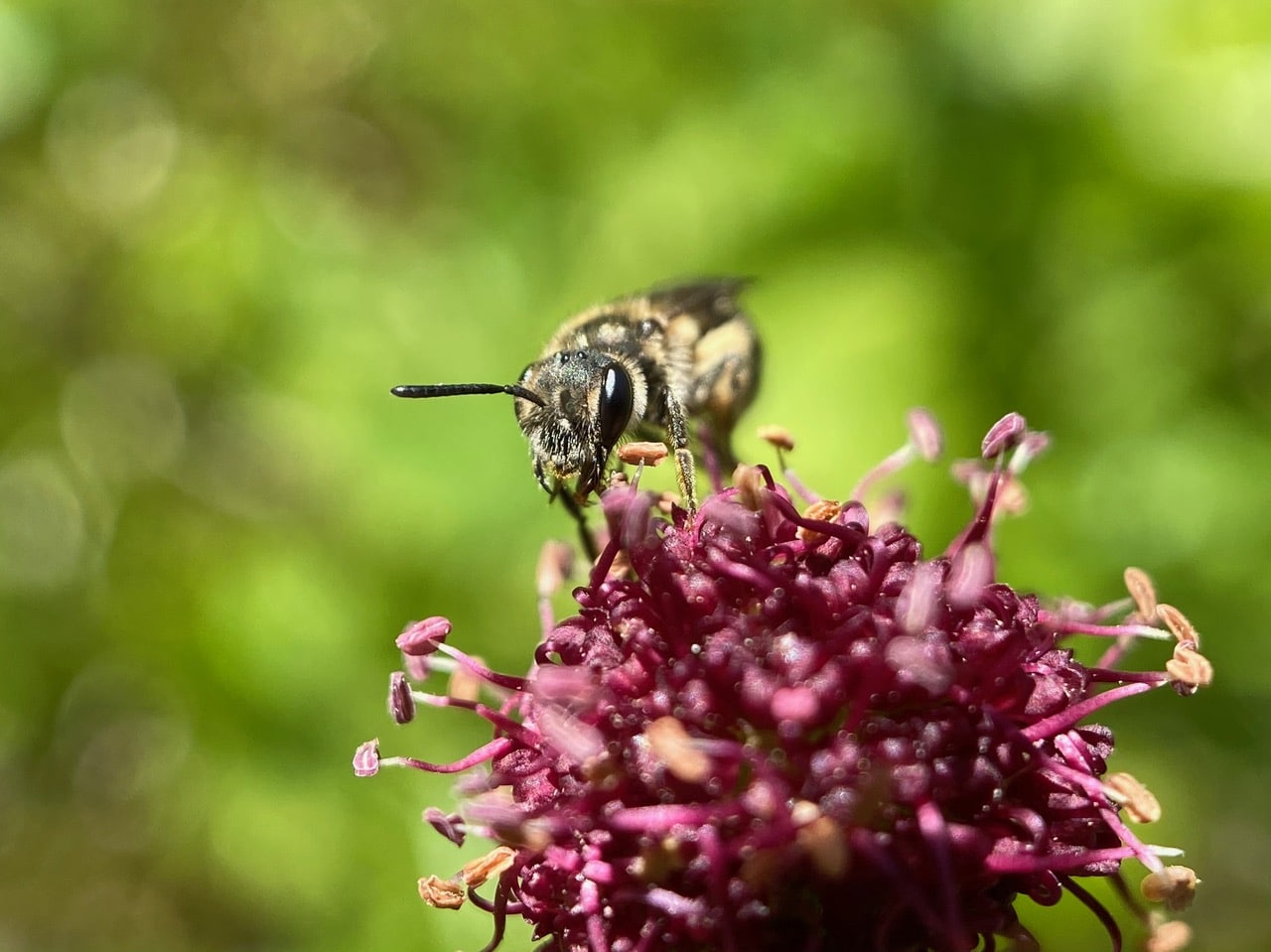
She appears to have a facial fovea. Genus Andrena (family Andrenidae)?
Facial fovea is a distinctive region on the bee’s face made up of small depressions filled with pale hairs along the inner margin of the eyes. It is a key characteristic of the Andrena spp., not found on other bees. Length and width of the fovea are important for species identification.
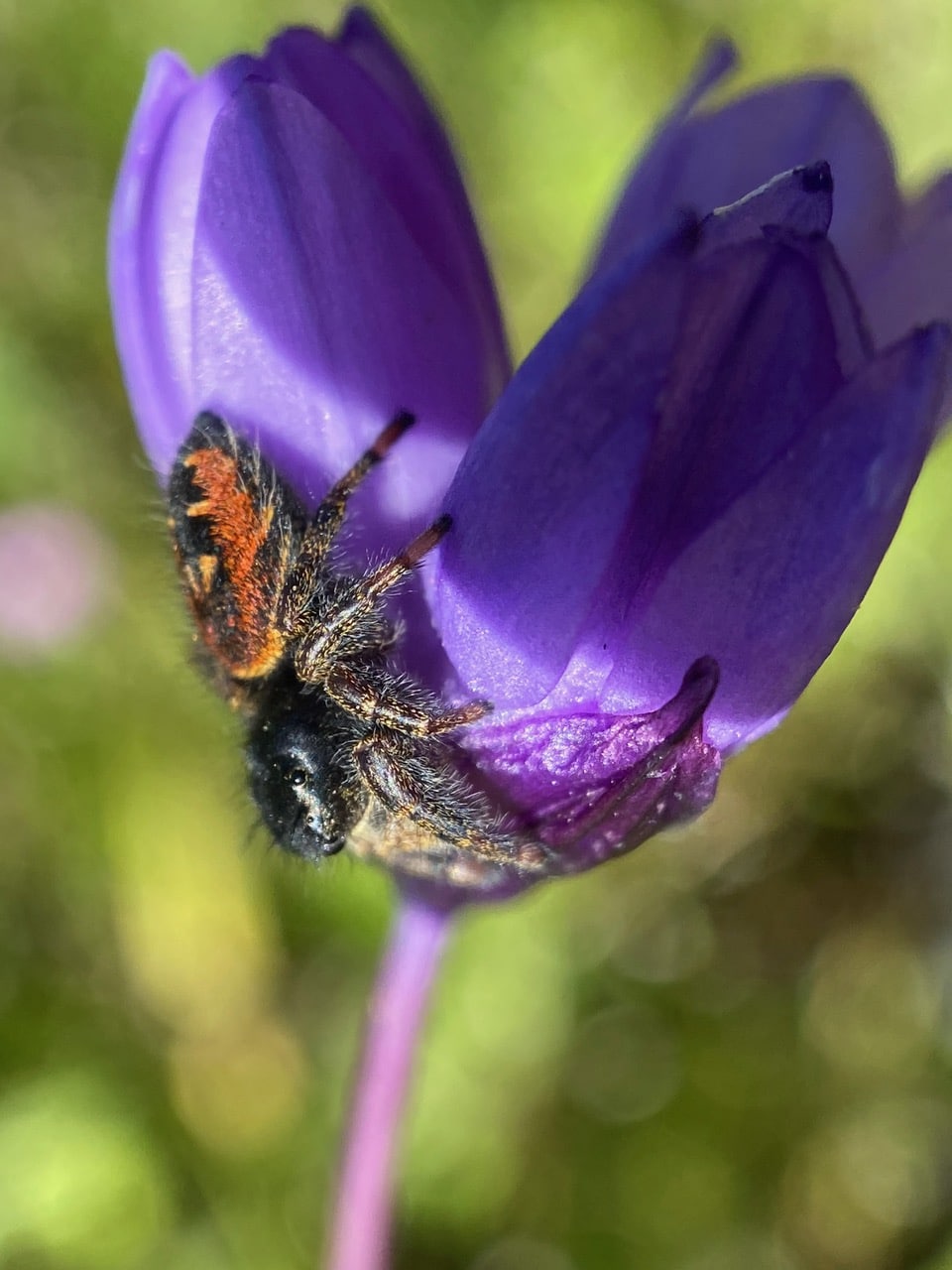
A Red-backed Jumping Spider, Phidippus johnsoni (family Salticidae) is hunting on a Blue Dicks flower cluster.
The species is one of the largest and most commonly encountered jumping spiders in western North America. This individual is a female. Males have an all-red abdomen. Salticids are free-roaming hunters. They do not weave a web to catch prey. They stalk, then pounce on their prey. Just before jumping, the spider fastens a safety line to the substrate. It can leap 10-20 times their body length to capture prey. Their movement is achieved by rapid changes in hydraulic pressure of the blood. Muscular contractions force fluids into the hind legs, which cause them to extend extremely quickly.
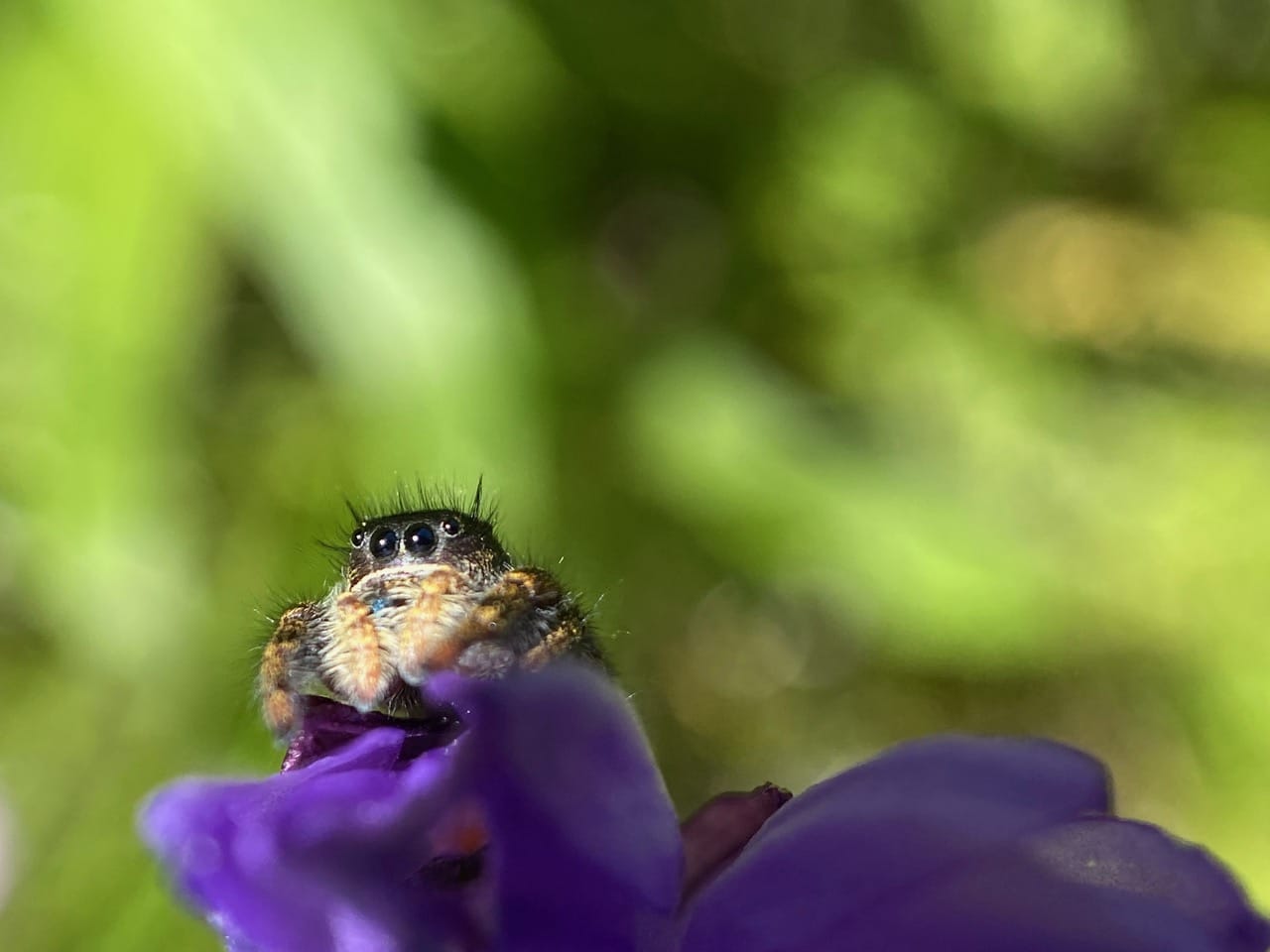
The spider runs from my camera, then turns around to face me – an endearing behavior typical of these bold and intelligent spiders.
Jumping spiders have excellent vision, with among the highest acuities in invertebrates. The 8 eyes are grouped four on the face (the two big Anterior Median Eyes in the middle, and two smaller Anterior Lateral eyes to the side), and four on top of the carapace. The anterior median eyes provide high acuity but small field of view, while the other six eyes act like our peripheral vision, with lower resolution but broad field of view. Since all eight eyes are fixed in place and can’t pivot independently from the body like human eyes can, jumping spiders must turn to face whatever they want to see well. This includes moving their cephalothorax up and down, an endearing behavior.

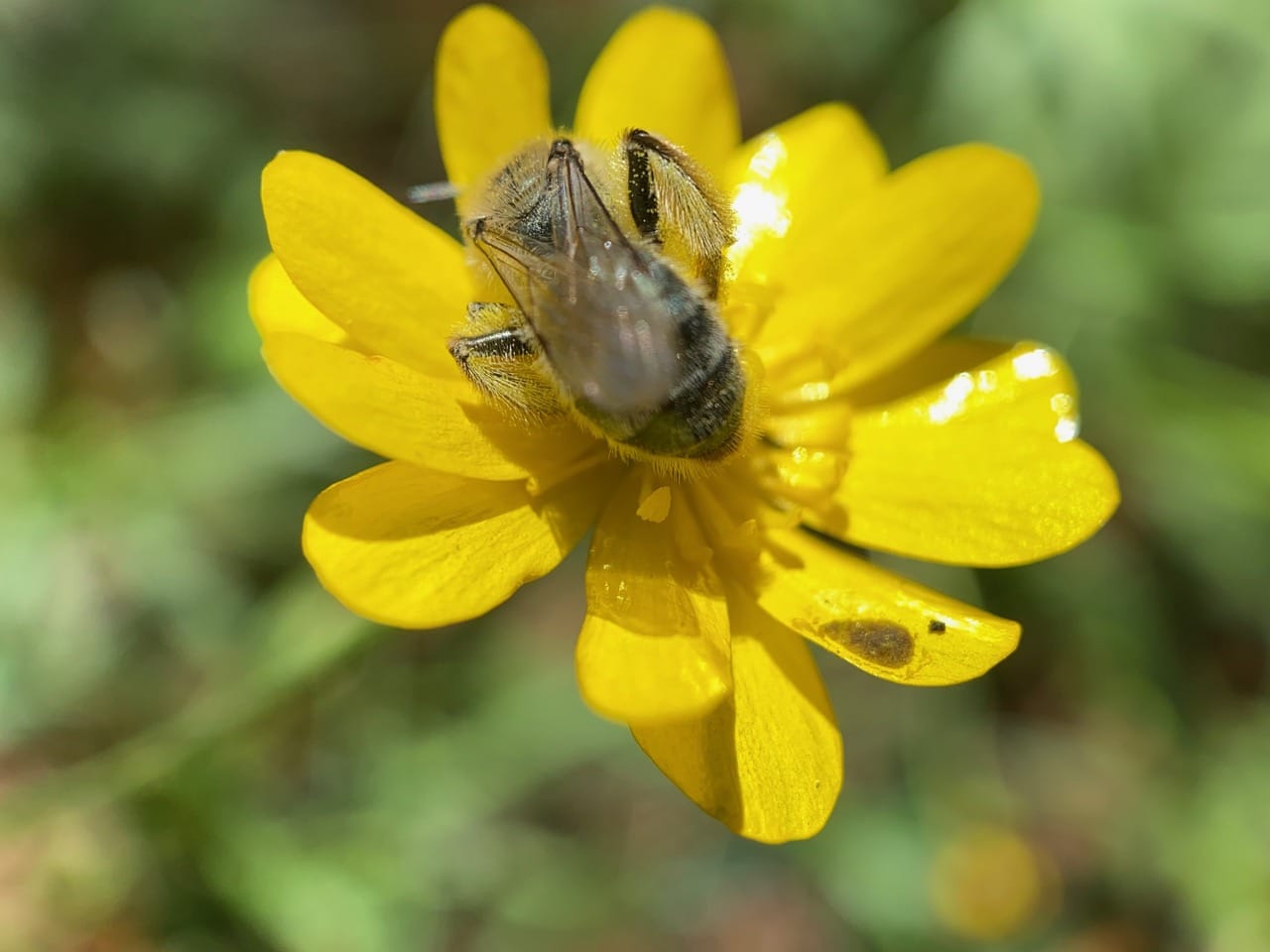 Along the narrow trail, many female Mining Bees, Andrena sp. (family Andrenidae) are busy foraging on the California Buttercup flowers, Ranunculus californicus. This is the same species that I have been observing on the buttercups for weeks now, and I am almost sure that they are specialist pollinators for the plant. There seems to be many more female than male bees today.
 Note the relatively empty scopae on her hindlegs. Scopae are brushes of special hairs used for carrying pollen. Male bees do not have these.
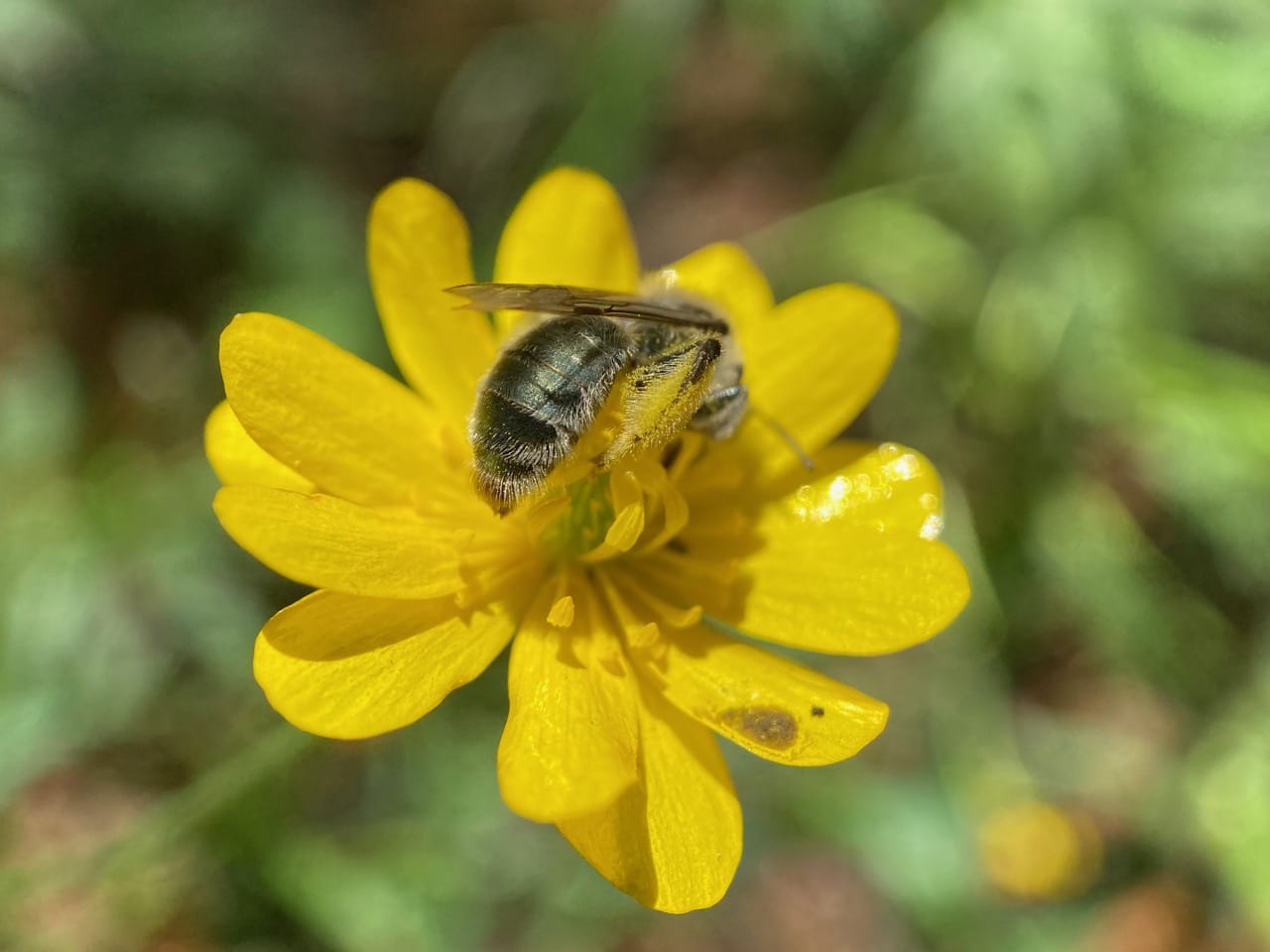
As the bee works the anthers of the flower with blinding speed, her scopae fill up with pollen. The pollen grains are held loosely to the hairs by electro-static forces.

Here’s another Andrena collecting pollen on a buttercup flower.
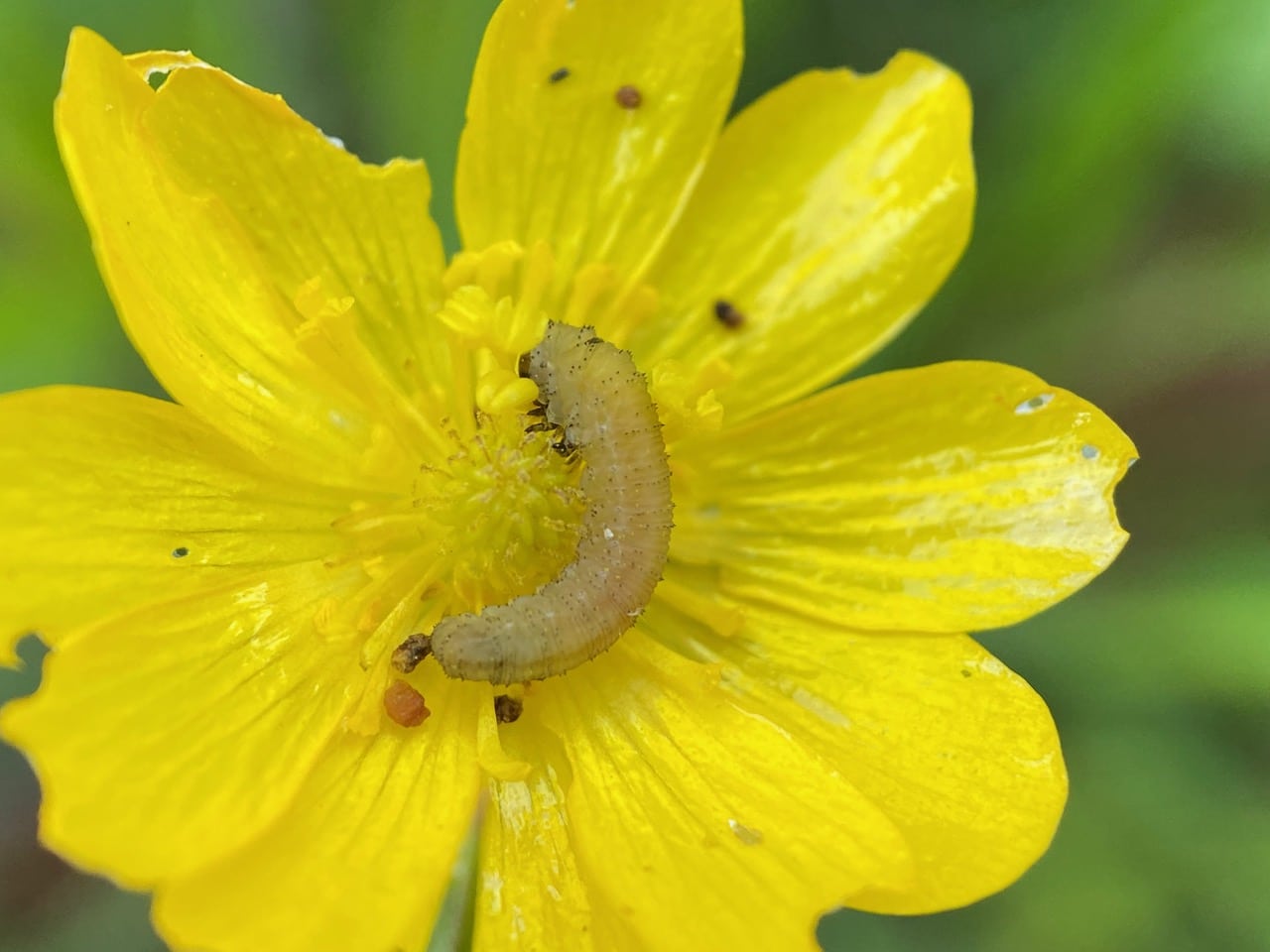
Ooh, a caterpillar feeding openly on a buttercup flower! I wonder how long a juicy caterpillar can survive in a world rife with predators and parasites.
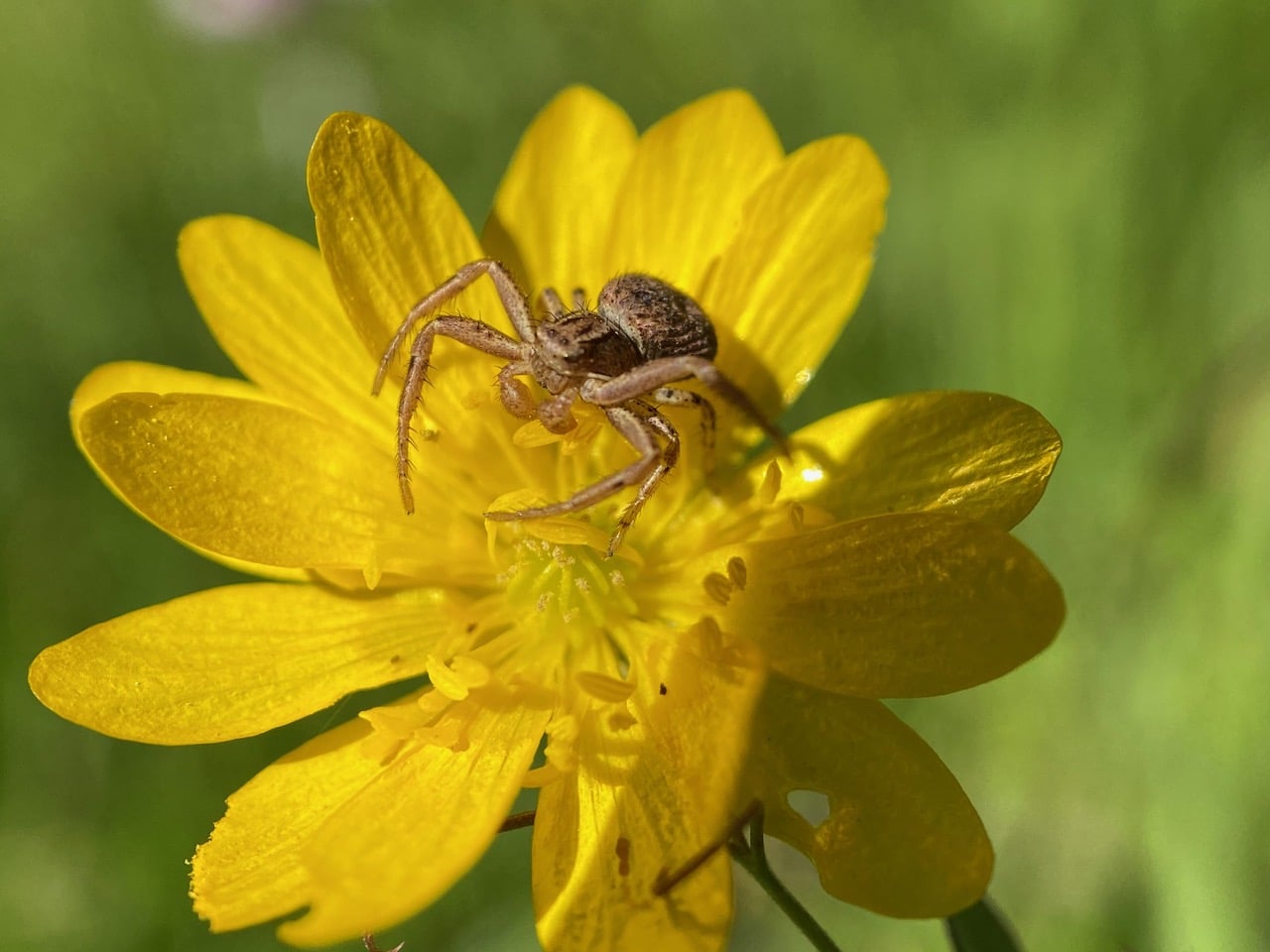
Just steps away, I spot this Common Crab Spider, Xysticus cristatus (family Thomisidae) on a buttercup flower. It is obviously a male, holding his boxing-glove-like pedipalps below his face.
The spider is native to Europe. Females can reach 6-8 mm in length, and males 3-5 mm long. Xysticus cristatus is usually found in low vegetation, often on the ground. It is shade intolerant and avoids woodland and closed canopy habitats, but it is otherwise found in almost every habitat type. Xysticus cristatus is an ambush hunter which spends much time sitting still, with its fore-legs spread wide, waiting for insects to blunder into them. When it hunts on the ground its prey tends to consist of ants, spiders and other soft-bodied prey. If often takes prey much larger than itself.
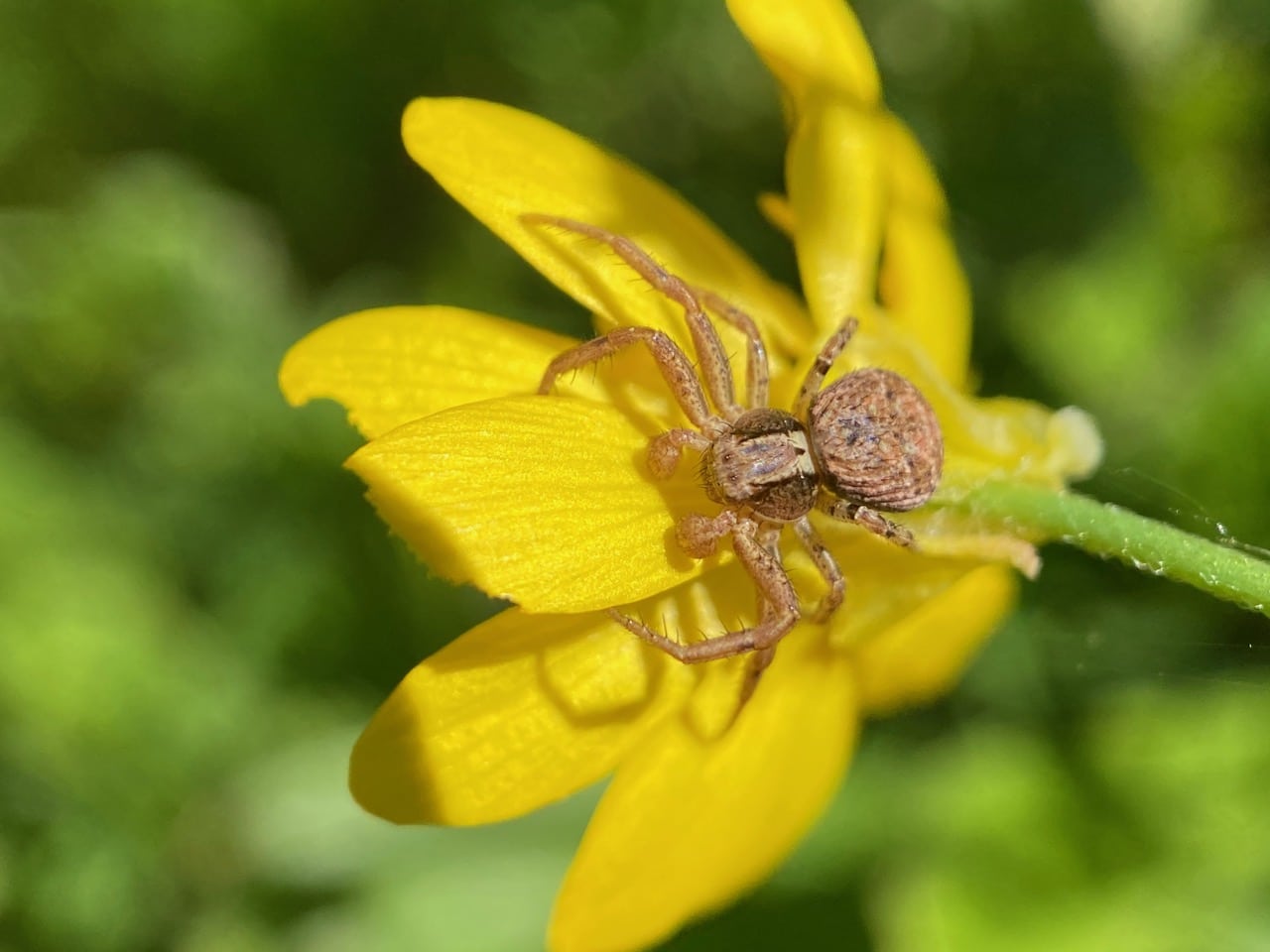
To mate, the male uses silk to tie the female down to the substrate. He then crawls under her to deliver sperm into her epigyne on her belly, using his bulbous pedipalps. After mating, the female builds a flat white ovisac containing the developing eggs, usually fixed on plants. Mama spider sits on the egg sac to protect it until the spiderlings hatch and disperse.

A female Andrena collects pollen on a buttercup flower.

Since the bee is not camera shy, I record her performance on video.

Hello, who’s that poking around for nectar on a buttercup flower? Judging by the long, slender shape of the insect, it has to be a Stem Sawfly. This individual is probably a male, with claspers instead of an ovipositor at the tip of the abdomen.
Sawflies are part of the insect order, Hymenoptera, together with bees, wasps and ants. They are considered to be the most primitive group and form the sub-order Symphyta. They differ from the bees, wasps and ants in not having a narrow ‘waist’ and in their wing venation. The common name comes from the saw-like ovipositor that the females use to cut into plant tissues to lay their eggs. Larvae are caterpillar-like and can be distinguished from lepidopteran caterpillars in that all body segments following the three bearing true legs have a pair of fleshy prolegs. Like the lepidopteran caterpillars, sawfly larvae walk about and eat foliage. In many species, the larvae feed in groups.
Stem Sawflies in the family Cephidae feed on grasses (including grain crops) and shrubs (including berries, roses, willows). The larvae bore in the stems. The genus Calameuta is found in western North America. Calameuta larvae are grass stem borers. Adults are commonly attracted to yellow flowers.
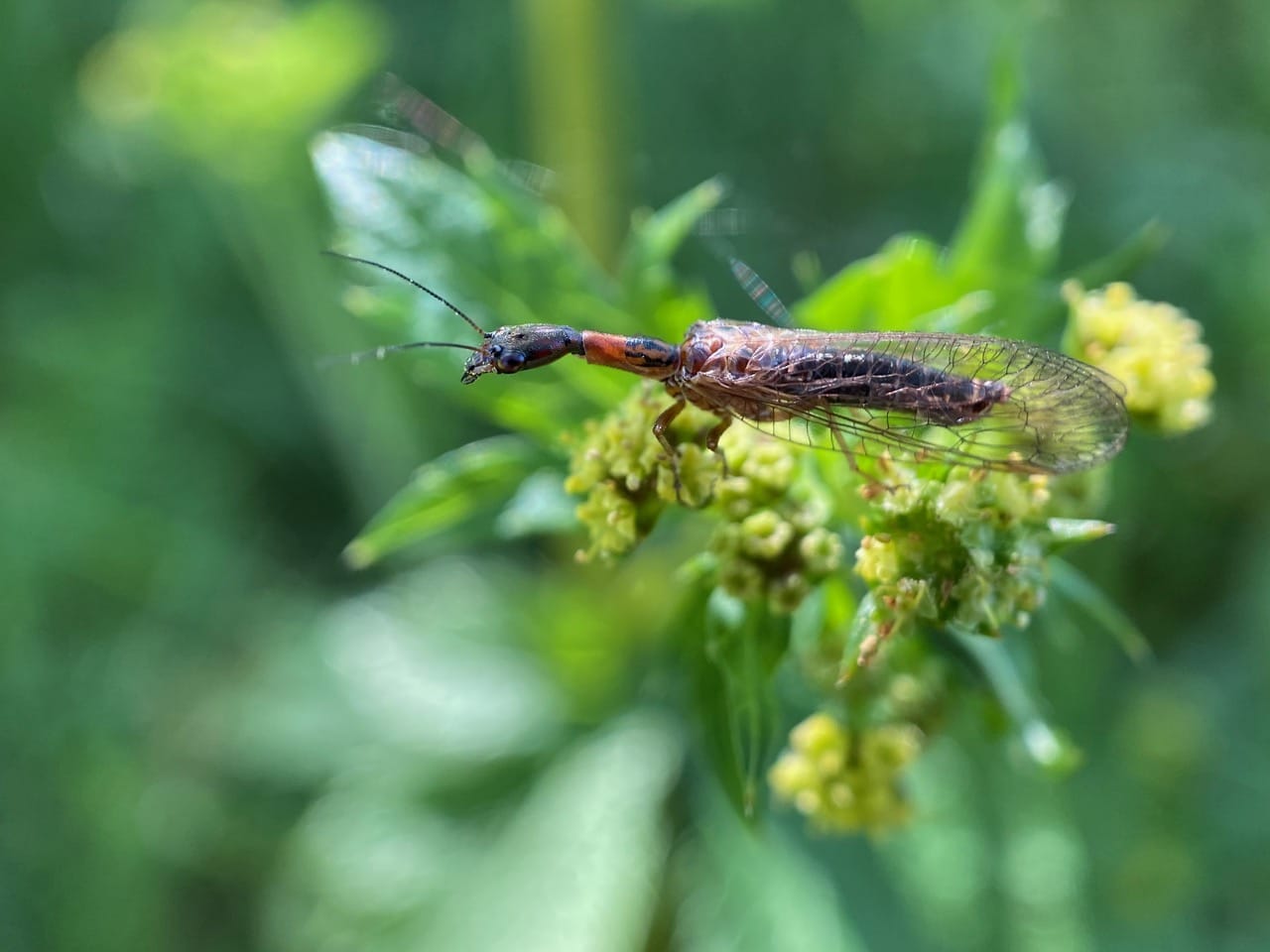
A male Snakefly, Agulla bicolor (family Raphidiidae) is perched on a flower cluster of Pacific Sanicle.
Snakeflies are a group of predatory insects comprising the order Raphidioptera. They are a relict group, having reached their apex of diversity during the Cretaceous before undergoing substantial decline. Adult Snakefly has a notably elongated thorax which, together with the mobile head, gives the group their common name of snakefly. The body is long and slender and the two pairs of long membranous wings are prominently veined. The head is long and flattened and heavily sclerotized. The mouthparts are strong and relatively unspecialized, being modified for biting. The large compound eyes are at the sides of the head. Females have a large and sturdy ovipositor which is used to deposit eggs into crevices or under bark. Snakeflies are holometabolous insects with four-stage life cycle consisting of eggs, larvae, pupae and adults. Both adults and larvae are predators of soft-bodied arthropods such as aphids and mites.
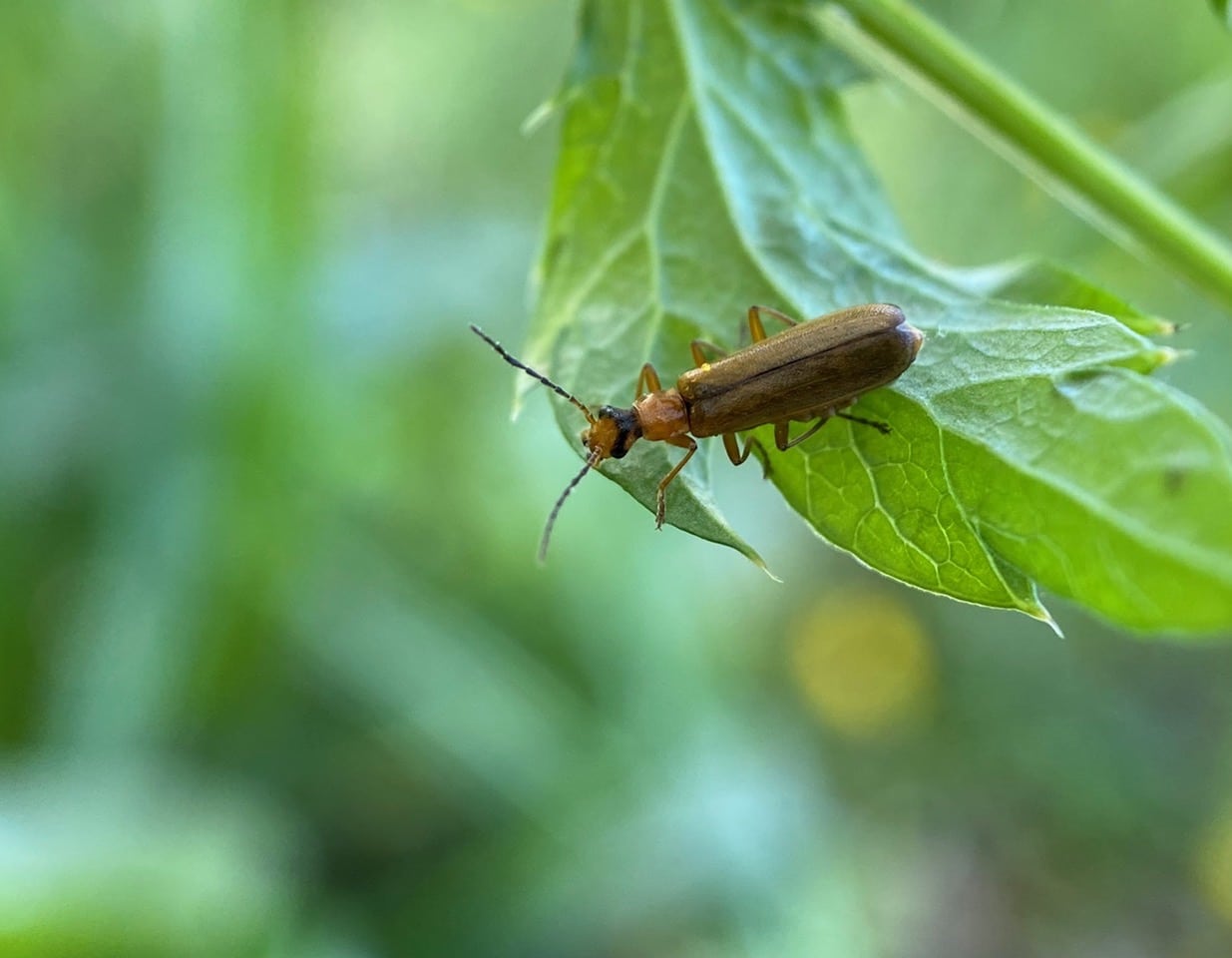
A small Soldier Beetle, Dichelotarsus cavicollis (family Cantharidae), (formerly Podabrus cavicollis) is moving around on a leaf of Pacific Sanicle.
The Soldier Beetles, family Cantharidae are relatively soft-bodied, straight-sided beetles. One of the first described species has a color pattern reminiscent of the red coats of early British soldiers, hence the common name. They are also known commonly as Leatherwings because of their soft elytra. Soldier beetles often feed on both nectar and pollen as well as predating on other small insects. The larvae are often active, and feed on the ground, hunting snails and other small creatures. Soldier beetles are generally considered beneficial insects by gardeners.

A large beetle with an iridescent green sheen is resting on a blade of grass. Its head is almost completely retracted under its thorax. It is a Leaf Beetle in the genus Chrysolina (family Chrysomelidae).
Leaf Beetles in the family Chrysomelidae make up one of the largest and most commonly encountered beetles. They are all phytophagous – both adults and larvae feed on all sorts of plant tissues. All species of Chrysolina are phytophagous, feeding on specific food plants, and some of them have been used for biological control of weeds.
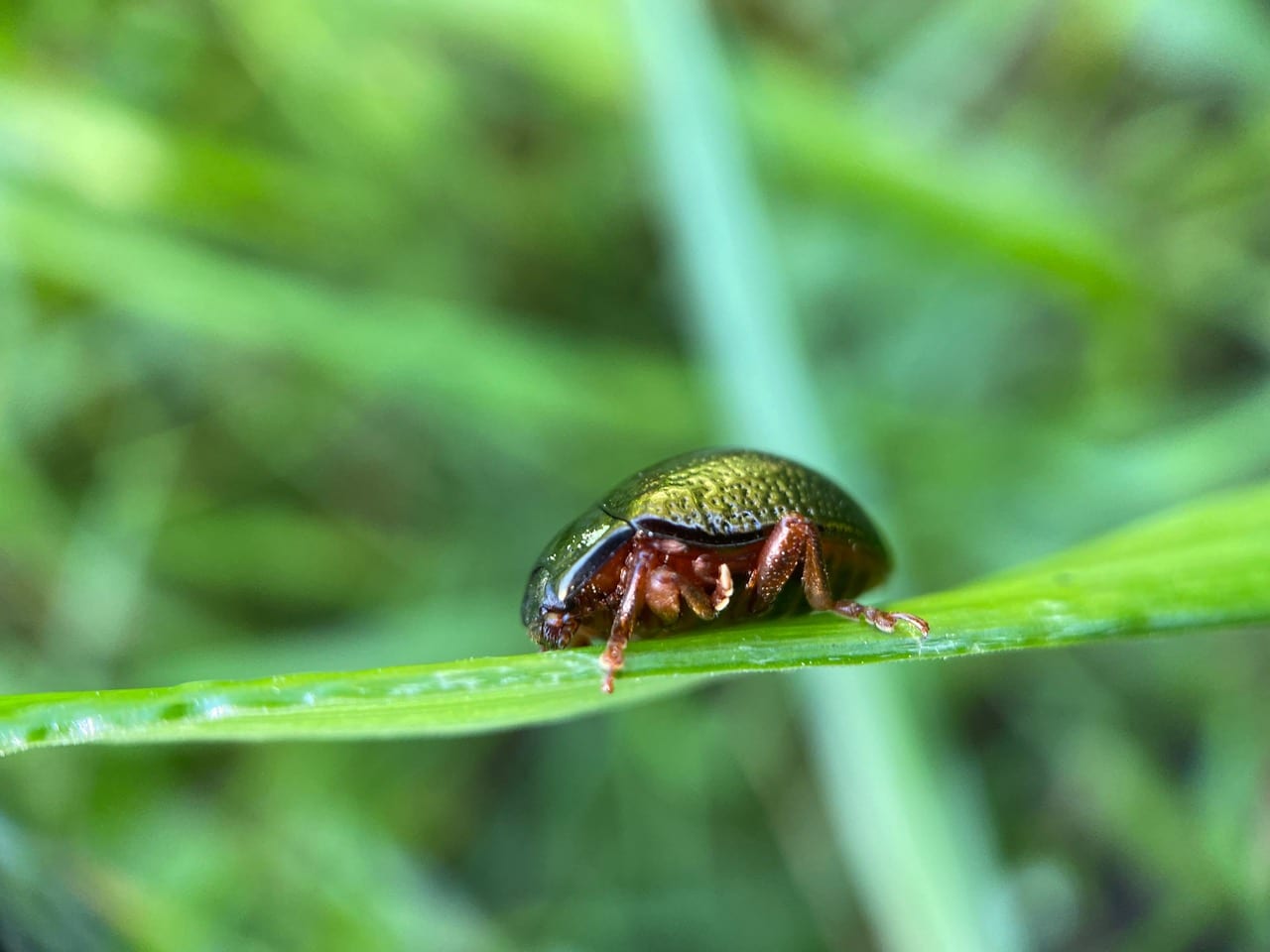 The beetle has reddish-brown legs, the middle of which is missing on its left side.