

Pollinator Post 4/2/26 (1)

Ah, first sunny afternoon after several days of cool and rainy weather! It feels wonderful to be out walking again at Bay Farm. It is windy, and I wonder if I’ll see much in terms of insects.

Spring colors have burst out along the shore since my last visit. The magenta of Calandrinia is competing with the purples of Perez’s Sea Lavender. These ornamentals are probably escapees from the neighboring gardens.

Sea Fig or Ice Plant, Carpobrotus edulis is blooming prolifically along the shoreline. The creeping plant with succulent leaves is native to South Africa. It has naturalized in many regions throughout the world, especially those with Mediterranean climate. The species has escaped cultivation and has become invasive, posing a serious ecological problem by forming vast monospecific zones, competing with native plants for nutrients, water, light, and space.
The flower of Sea Fig is a large, showy, daisy-like yellow blossom with numerous narrow, elongated petals and a central, dense cluster of yellow stamens. The flowers open in the morning in bright sun and close at night. The aromatic flowers are pollinated by bees and beetles, leading to the development of edible, fleshy yellow fruits.
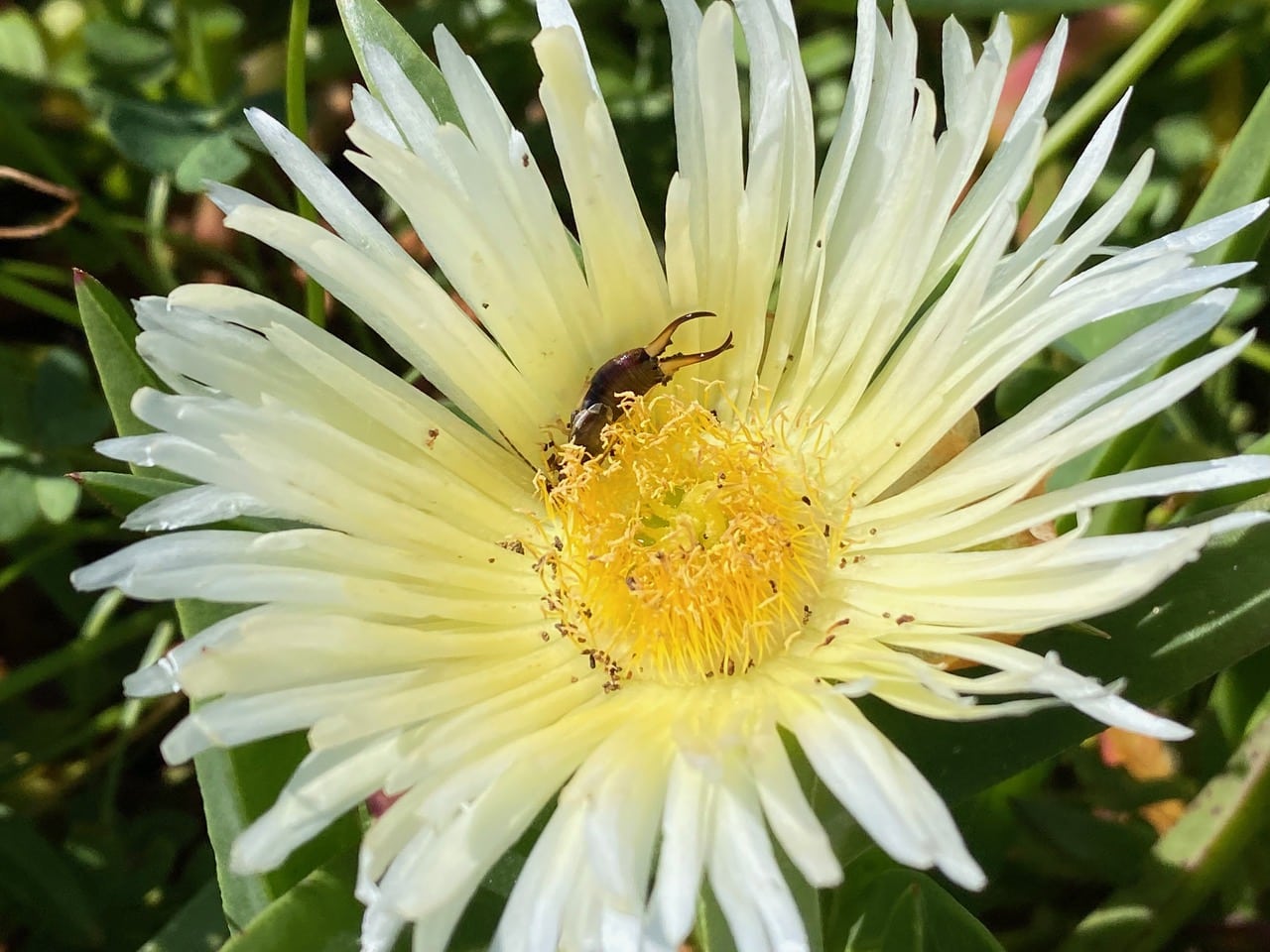
Even from a distance, it is easy to tell that those distinctive pincers belong to an Earwig. iNaturalist has helped identify the insect as a Western Earwig, Forficula dentata (family Forficulidae, order Dermaptera).
Earwigs are rather cryptic, small to medium sized insects distinguished from other insects by a pair of forcep or pincer-like cerci at the end of the abdomen. The name Dermaptera refers to the thickened leathery forewings and is derived from Greek with “derma” meaning skin and “ptera” meaning wings. Earwigs have an elongated and flattened or cylindrical body. They can be winged or wingless, and they have chewing mouthparts. The abdomen is long, flexible and telescopic. The two forcep-like cerci on the end of the abdomen are heavily sclerotized (hardened) and vary in shape and size between species. The forewings, called ’tegmina’, are short and lack veins. The large, membranous and semicircular hindwing fold up fan-like under the tegmina and can be unfurled or folded very quickly. Females can be readily distinguished from males as they are usually smaller, and have simple, straighter cerci.
Earwigs may be found in protected, moist environments in leaf litter and all kinds of debris on the ground, under bark, under stones. The insects are usually nocturnal. They are mostly omnivorous eating a wide variety of live and decaying plant and animal material. They undergo incomplete metamorphosis. Nymphs molt 4-5 time before becoming adults. Female earwigs care for their eggs and young nymphs, an unusual trait in non-social insects.
Forficula dentata is a cryptic species closely related to the European Earwig, F. auricularia. They are found in temperate climates across Europe and North America. The species is nocturnal, and prefer moist, dark places, including under bark, leaf litter, or in crevices. Forficula dentata is omnivorous, feeding on foliage, fruits, fungi, and small insects like aphids.
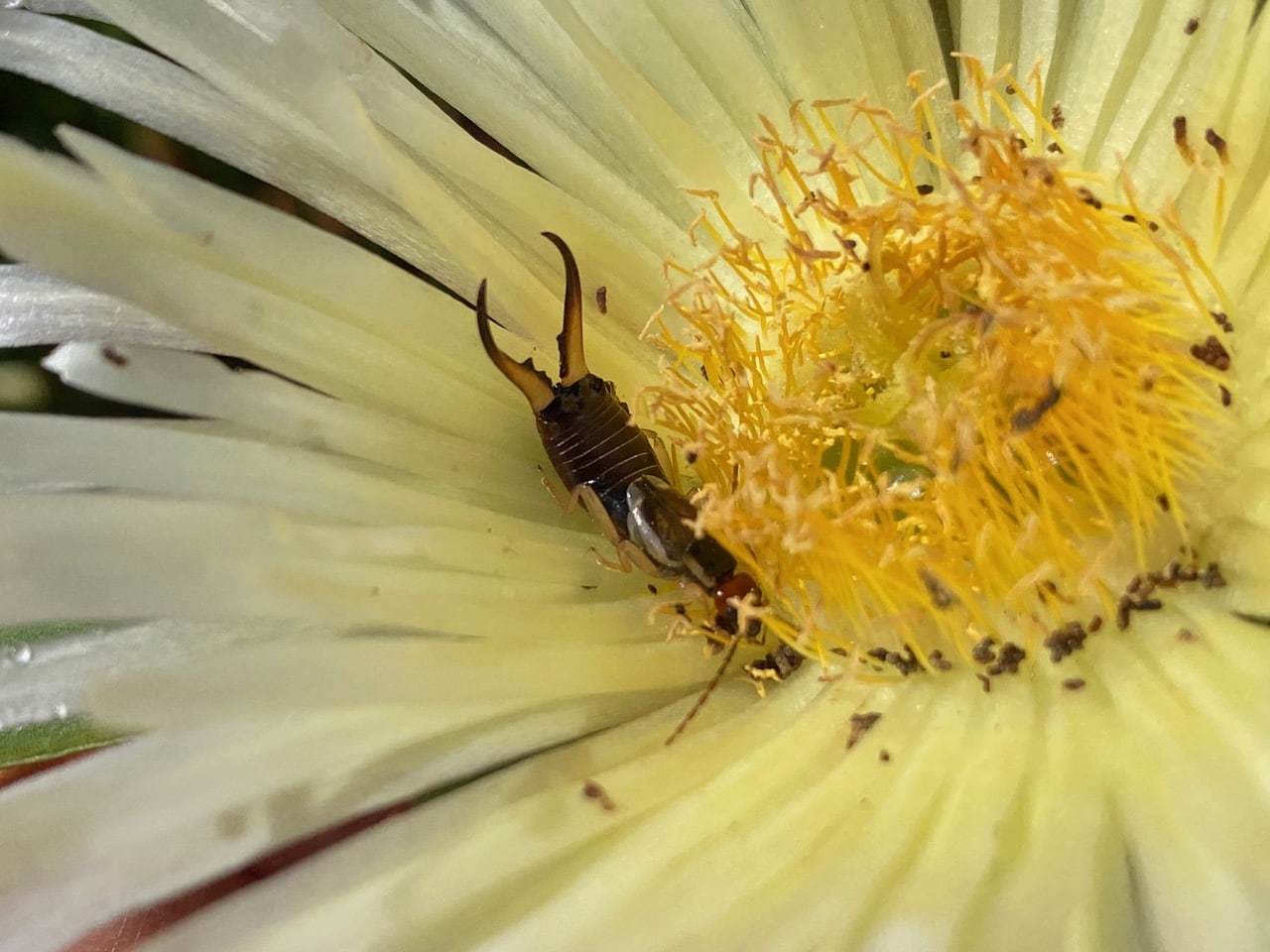
Earwigs possess uniquely complex, origami-like hind wings that fold to 10-15 times smaller than their open size, enabling storage under tiny, hardened forewings. The mechanism is a passive, energy-efficient process driven by protein-rich resilin joints that snap into place without muscle power. These wings are foldable via 20-40 creases and often managed by the abdominal forceps.
While earwigs are often seen as ground-dwellers, their complex wings allow for efficient flight. The folding ensures the delicate hind wings are protected under the leathery forewings (tegmina), allowing the earwigs to navigate tight, narrow spaces.

A Fiery Skipper, Hylephila phyleus (family Hesperiidae) is taking nectar on a flowerhead of Trailing African Daisy, Dimorphotheca fruticosa.
Skippers are a family, the Hesperiidae, of the order Lepidoptera (butterflies and moths). They are named for their quick, darting flight habits. Most have the antenna clubs hooked backwards like a crochet hook. They also have generally stockier bodies and larger compound eyes than the other butterflies. Their wings are usually small in proportion to their bodies. When at rest, skippers keep their wings usually angled upwards or spread out, and only rarely fold them up completely. Californian species are mostly brown or tan, with black, orange, or yellow markings.
Skipper caterpillars are usually green or brown, sometimes yellowish, never brightly colored. They have a distinctive “collar”, a narrow ring around the body right behind the head. Caterpillars are camouflaged and often hide during the day. Many species make nests of leaves and silk for additional protection. Most North American species feed on grasses, but some common species eat shrubs and trees, especially in the bean family. Most species are limited to a single group of food plants. Adult skippers are only active during the day, but Skipper caterpillars feed mainly when it is dark or partly light.
Fiery Skippers, Hylephila phyleus (family Hesperiidae) is a small butterfly, with a wingspan of 1.25 to 1.5 in. It can be seen from March to November. Host plants include various species of grasses.
Fiery Skipper is the most abundant grass skipper in California, mostly due to its dominance in urban areas, thanks to the ubiquity of the Great American Lawn. Originally found only in North and South America, it has been introduced into Hawaii and Bali.

A female Margined Calligrapher, Toxomerus marginatus (family Syrphidae) has landed on a petal of a Sea Fig flower, eyeing the pollen in the middle of the flower.
Toxomerus marginatus, also known as the Margined Calligrapher is a common species of hoverfly found in North America. These are small hoverflies, measuring 5-6 mm in length. The abdomen is black and yellow, and is narrowly margined with yellow. Adults are found in diverse habitats such as forests, fields, meadows, marshes, deserts, and alpine areas. They are highly adaptable and can occur is very disturbed habitats. Larvae prey on aphids, thrips, mites, and small caterpillars. Adults visit flowers for nectar and pollen.

A pair of well-camouflaged Stink Bugs is mating on a leaf. iNaturalist has helped identify them as the Southern Green Stink Bugs, Nezara viridula (family Pentatomidae). I have often seen the multi-colored nymphs of this species along this shoreline, but this is the first time I have encountered the adults!
Pentatomidae is a family of insects belonging to the order Hemiptera or “true bugs”. As hemipterans, the pentatomids have piercing-sucking mouthparts, and most are phytophagous, including several species that are severe pests on agricultural crops. Stink Bugs feed on plant fluids by inserting their needlelike mouthparts into stems, leaves or seed pods. While feeding, they inject materials into the plant to aid in digestion and sap removal. Penetration by the mouthparts can cause physical damage, much like stabbing the plant with a fine needle.
All Pentatomids have 5-segmented antennae (hence their family name, Penta – five and tomos – section.) They generally have a large triangular scutellum in the center of the back. The adult is generally shield-shaped when viewed from above. The common name of Stink Bug refers to their ability to release a pungent defensive spray when threatened, disturbed, or crushed.
The Southern Green Stink Bug, Nezara viridula (family Pentatomidae) is a plant-feeding stink bug. Believed to have originated in Ethiopia, it can now be found across the world. Because of its preference for certain species of legumes, such as beans and soybeans, it is an economically important pest on such crops.
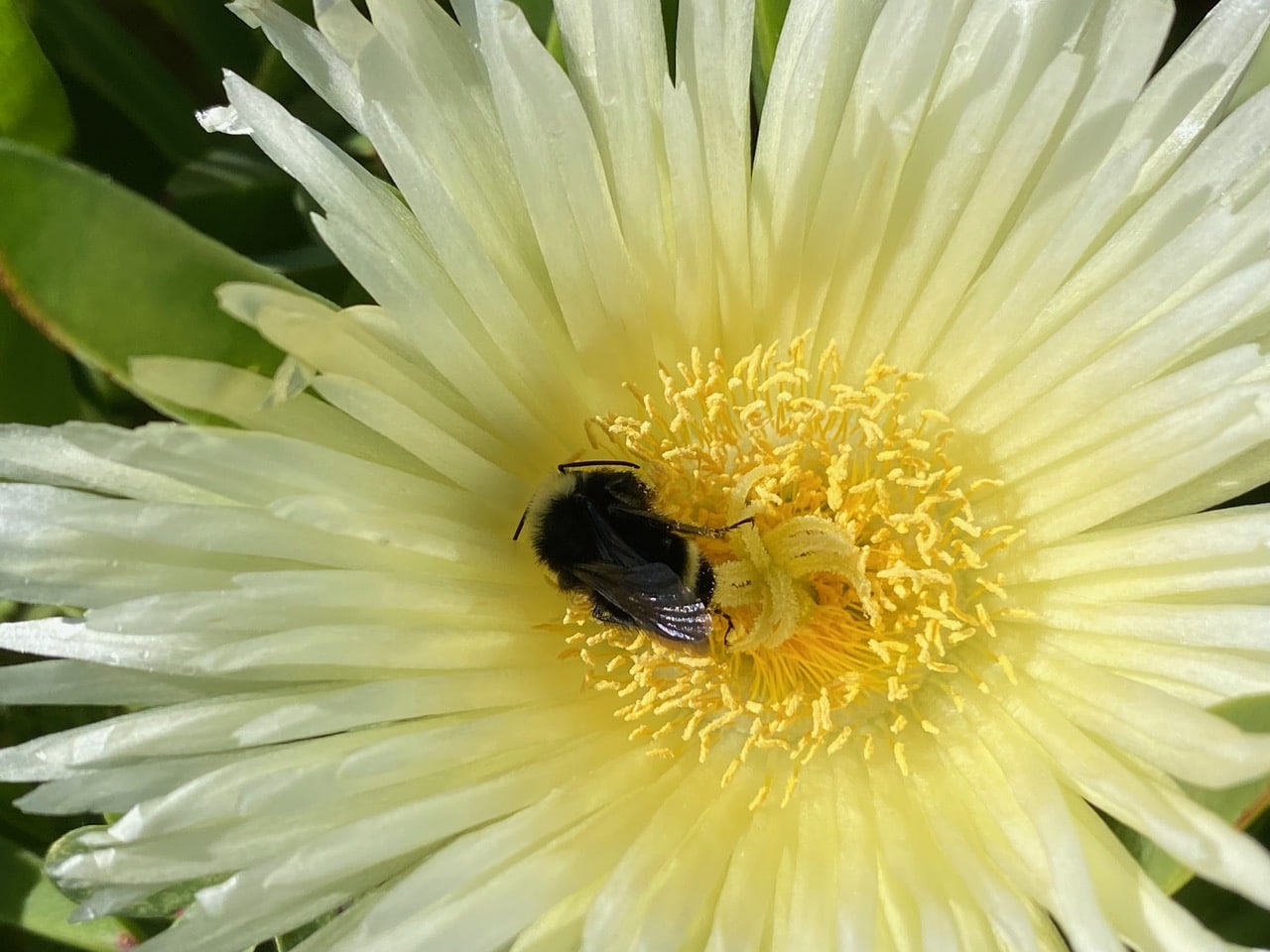
A Bumble Bee is resting motionless on a Sea Fig flower. Is it dead, or napping? It is too small to be a queen bee. I have hardly seen a worker bumble bee take a nap in the field. I encounter a few more motionless worker-sized bumble bees on the flowers, and unable to contain my curiosity, finally shake the flower. The bee wakes up and flies away. Ah, it was simply napping.

Here’s an active bumble bee on a Sea Fig flower. Male bumble bees are the last thing on my mind this time of year. Bumble Bee colonies usually produce the males and new queens in late summer through fall for reproductive purposes. For most of the spring season, only female workers are produced to enlarge the colony, take care of the queen and larvae, and forage for floral resources to feed the colony.
When I review the photos at home, I have the uneasy feeling that most of bumble bees I see here today are males. I have since consulted Emil, my local bee guru who lives in Alameda. He has confirmed my suspicions after viewing this set of pictures, adding that he himself has photographed a male bumble bee just a couple of days ago on his drive way.

Note the extra yellow band on the bee’s abdomen, the long antennae, and the skinny hind legs that lack pollen baskets (corbiculae). These are all tell-tale signs of a male Yellow-faced Bumble Bee, subgenus Pyrobombus (genus Bombus, family Apidae).

Male bees do not collect pollen to provision the nest. They, however, do visit flowers for nectar. Male bumble bees often sleep outside the hive, usually on or inside flowers. Unlike female worker bees, males typically leave the nest upon reaching maturity and do not return.

Note those long antennae.
In most bee species, male bees have longer antennae than females. Male antennae have13 segments, as compared to the female’s 12 segments, and the segments are longer as well. This difference is a form of sexual dimorphism that helps males locate mates. With up to 100x more sensors for smell, male antennae are specialized to detect the faint scent of female pheromones from a distance.

So why are we seeing male bumble bees out and about in early April? Emil and I think the early appearance of males might be due to the heat wave we had in mid-March, during the final week of winter. Temperature records were broken across the region, including at Oakland Museum (87 degrees F).
Female bees are able to determine the sex of their offspring by a system called haplodiploidy. Haplodiploidy is a sex-determination system whereby males develop from unfertilized eggs and are haploid, and females develop from fertilized eggs and are diploid. Perhaps our heat-stressed bumble bee queens failed to fertilize some of the eggs they laid in March, resulting in males emerging now. Or, more insidious, the heat wave might have misinformed the queens that it’s already summer and time to produce males for reproduction. New queens, also called gynes, share identical genes as their worker sisters, but they are fed a special, more substantial diet during their larval development, contributing to their larger size. In early spring, with typically a small work force, the colonies are certainly not equipped to rear new queens. So the males that are produced out of season are essentially a waste of the colony’s energy, as there are no gynes to inseminate, and male bees do not serve any other function in the colony.