

Pollinator Post 4/2/25 (2)

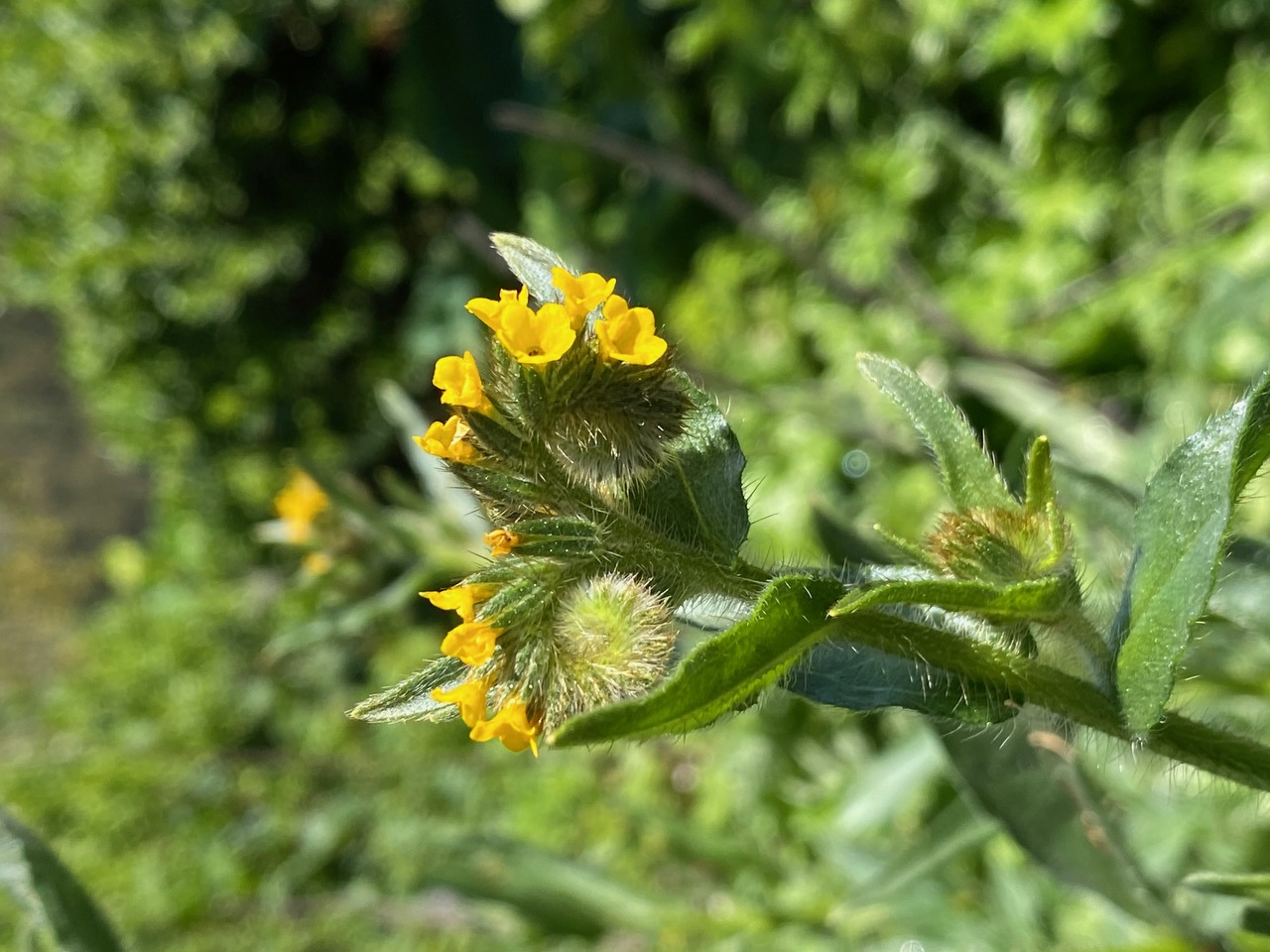
The Common or Coast Fiddleneck, Amsinckia intermedia (family Boraginaceae) has started to bloom along the upper stretch of the road.
The annual is native to western North America, and is common and widespread throughout California. Inflorescences of yellow to orange tubular flowers are borne along one side of a terminal stalk that is initially tightly coiled, unfurling as the buds mature. Flowers open near the top of the coil, and seeds develop below along the elongating stalk. The structure of the one-sided cyme resembles the end of a fiddle, hence the common name “fiddle neck”.
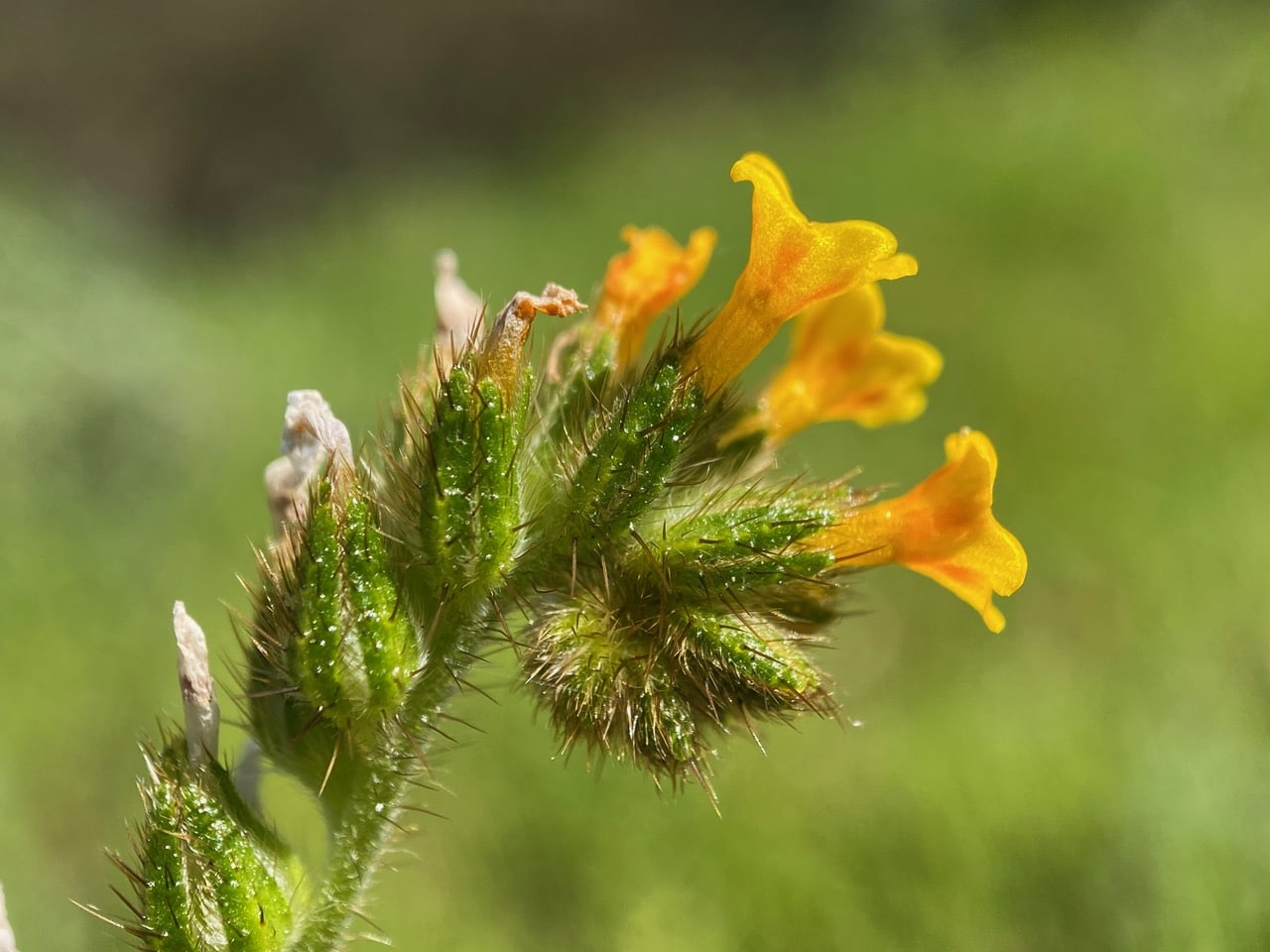
The flowers of Amsinckia are bisexual and radially symmetrical. The five petals are united into a five-lobed funnel with a flaring mouth. Each flower is less than 1/2 in. long, yellow-orange in color and usually has five orange-red defused spots near the top of the throat. The 5 stamens are fused to the corolla throat and do not extend beyond the corolla tube. There is a single pistil with a superior ovary, a single style and a two-lobed stigma. To reach the nectar at the base of the tubular flower, an insect would need a long tongue.

An insect’s eyeview down the throat of Amsinckia flower. The reproductive structures of the flowers are hidden inside the floral tube.
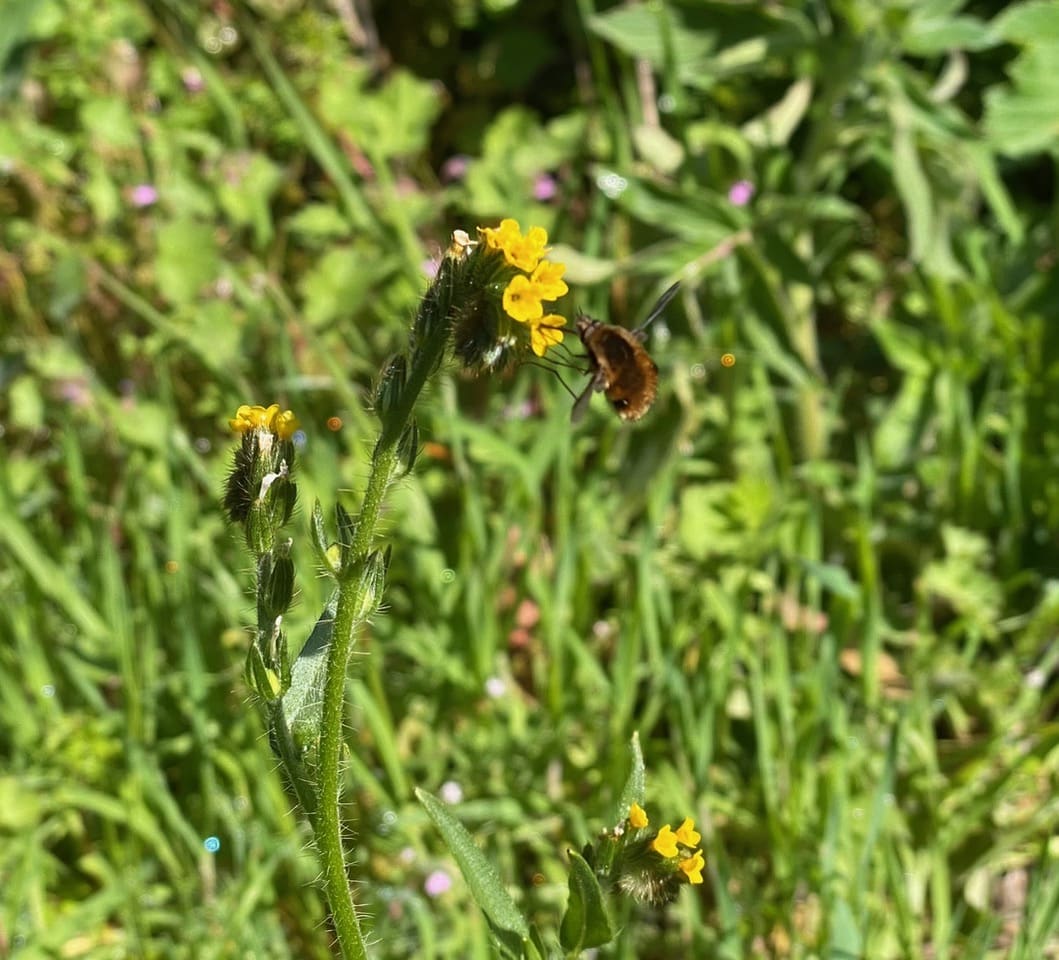
Half a dozen Greater Bee Flies, Bombylius major (family Bombyliidae) are buzzing around the stand of Amsinckia, hovering in front of the flowers to probe for nectar with their long proboscis. A Greater Bee Fly forages on the flowers of Fiddleneck. – YouTube
Bombylius major, commonly known as the Greater Bee Fly is a parasitic bee mimic fly in the family Bombyliidae. It derives its name from its close resemblance to bumble bees. Its flight is quite distinctive – hovering in place to feed, and darting between locations. The species has long skinny legs and a long rigid proboscis held in front of the head. Bombylius major is easily distinguished from the other local species of Bombylius for having wings with dark leading edge, hyaline trailing edge with sharp dividing border. This feature is visible even as the fly is hovering. Adults visit flowers for nectar (and sometimes pollen) from a wide variety of plant families, excelling at small tubular flowers, and are considered good generalist pollinators. Often the pollen is transferred between flowers on the fly’s proboscis.
The bee fly larvae, however, have a sinister side. They are parasitoids of ground-nesting bees and wasps, including the brood of digger bees in the family Andrenidae. Egg deposition takes place by the female hovering above the entrance of a host nest, and throwing down her eggs using a flicking movement. The larvae then make their way into the host nest or attach themselves to the bees to be carried into the nest. There the fly larvae feed on the food provisions, as well as the young solitary bees.
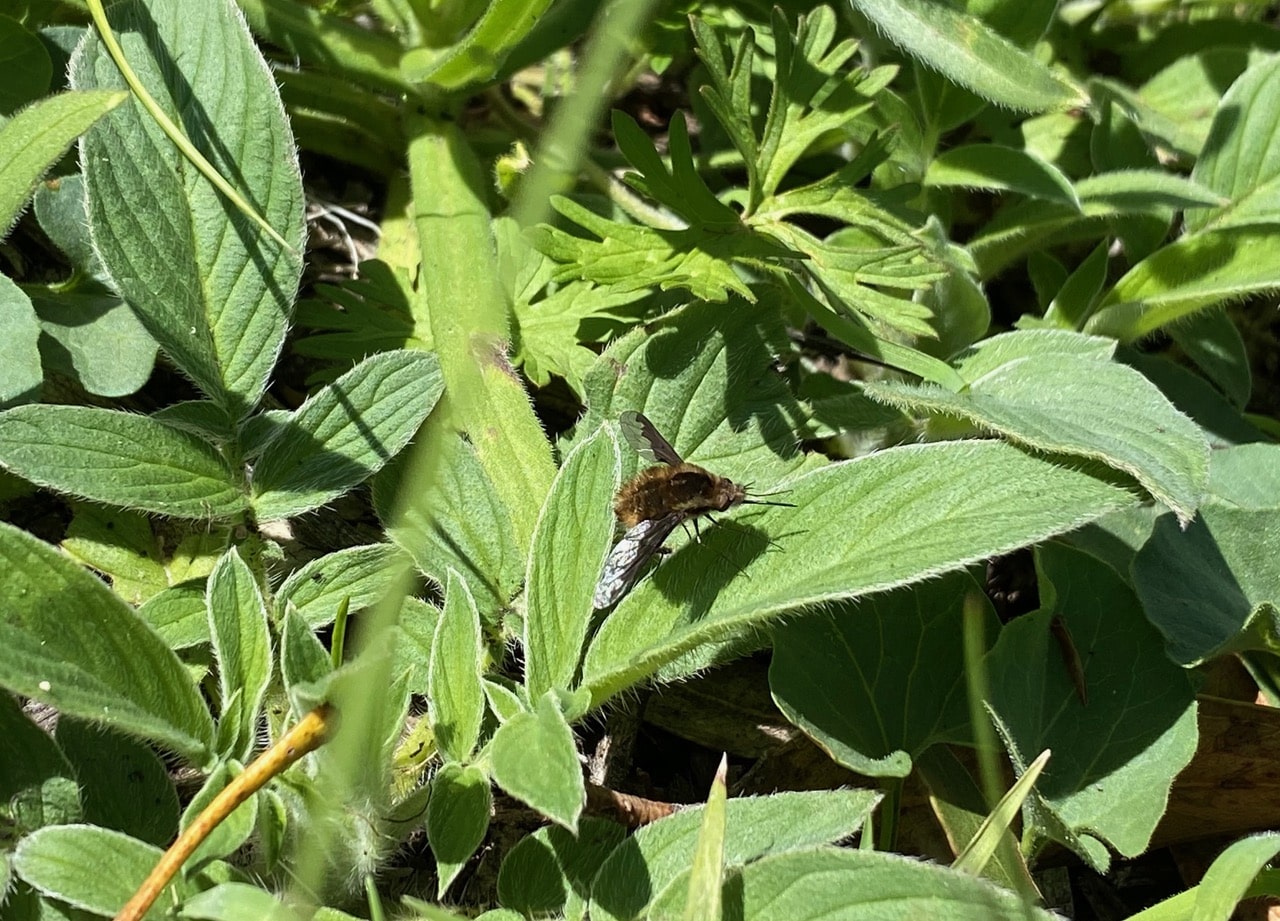
A Greater Bee Fly comes to rest on a leaf of California Phacelia. Note its long, non-retractible proboscis, and its wings with a well-defined dark leading edge.
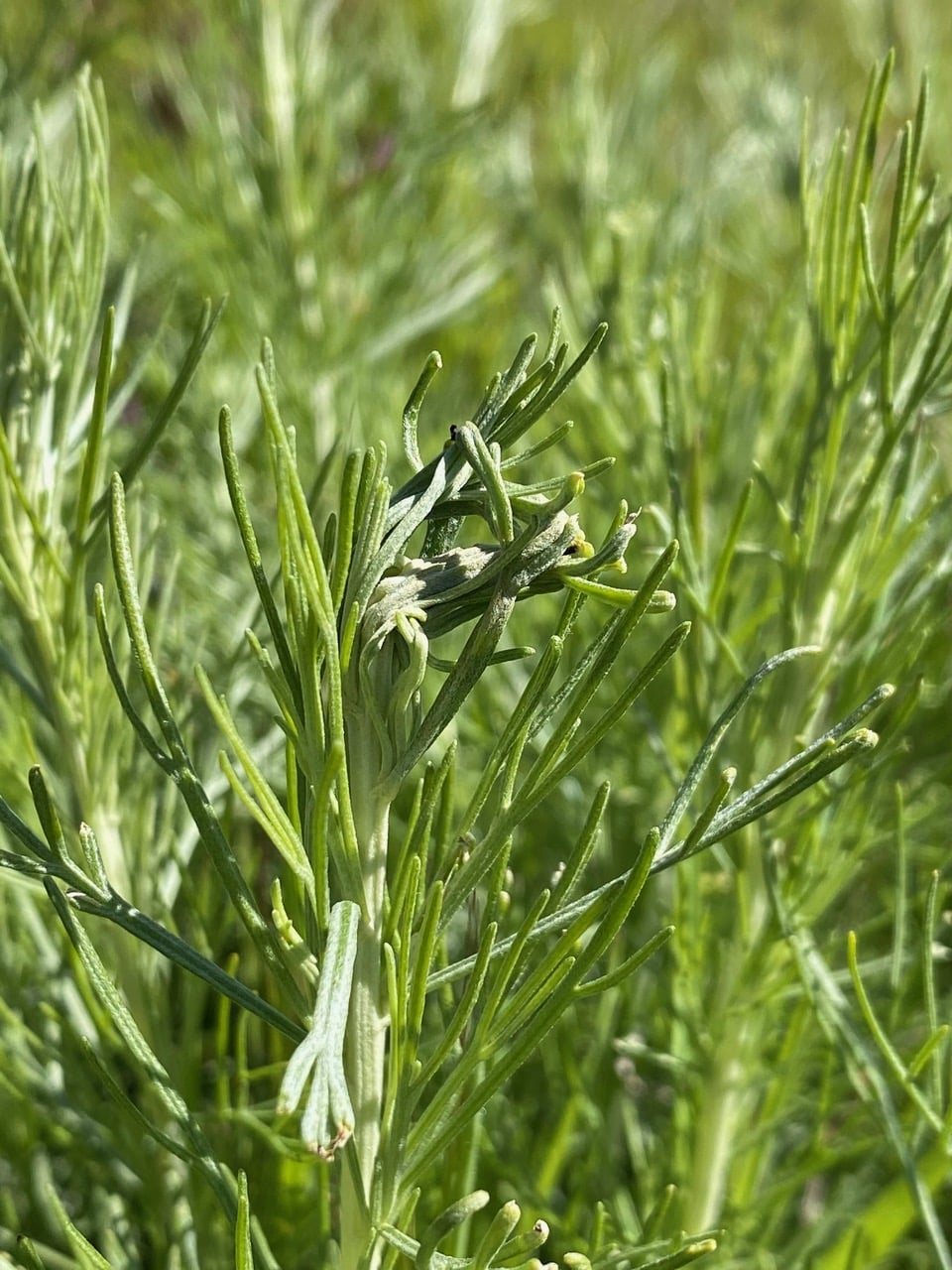
All the California Sagebrush, Artemisia californica have leaved out nicely. Several of the terminal shoots of this plant have had their leaves tied together into these messy distorted shapes. I wonder who did this? A caterpillar? Spider?
The caterpillars of the Nevada Buck Moth (Hemileuca nevadensis, family Saturniidae), the American Lady butterfly (Vanessa virginiensis) and the Painted Lady butterfly (Vanessa cardui, family Nymphalidae) are known to feed on sagebrush. The American Lady caterpillars make nests in their host plants by using their silk to tie together leaves at the tips of the stems.
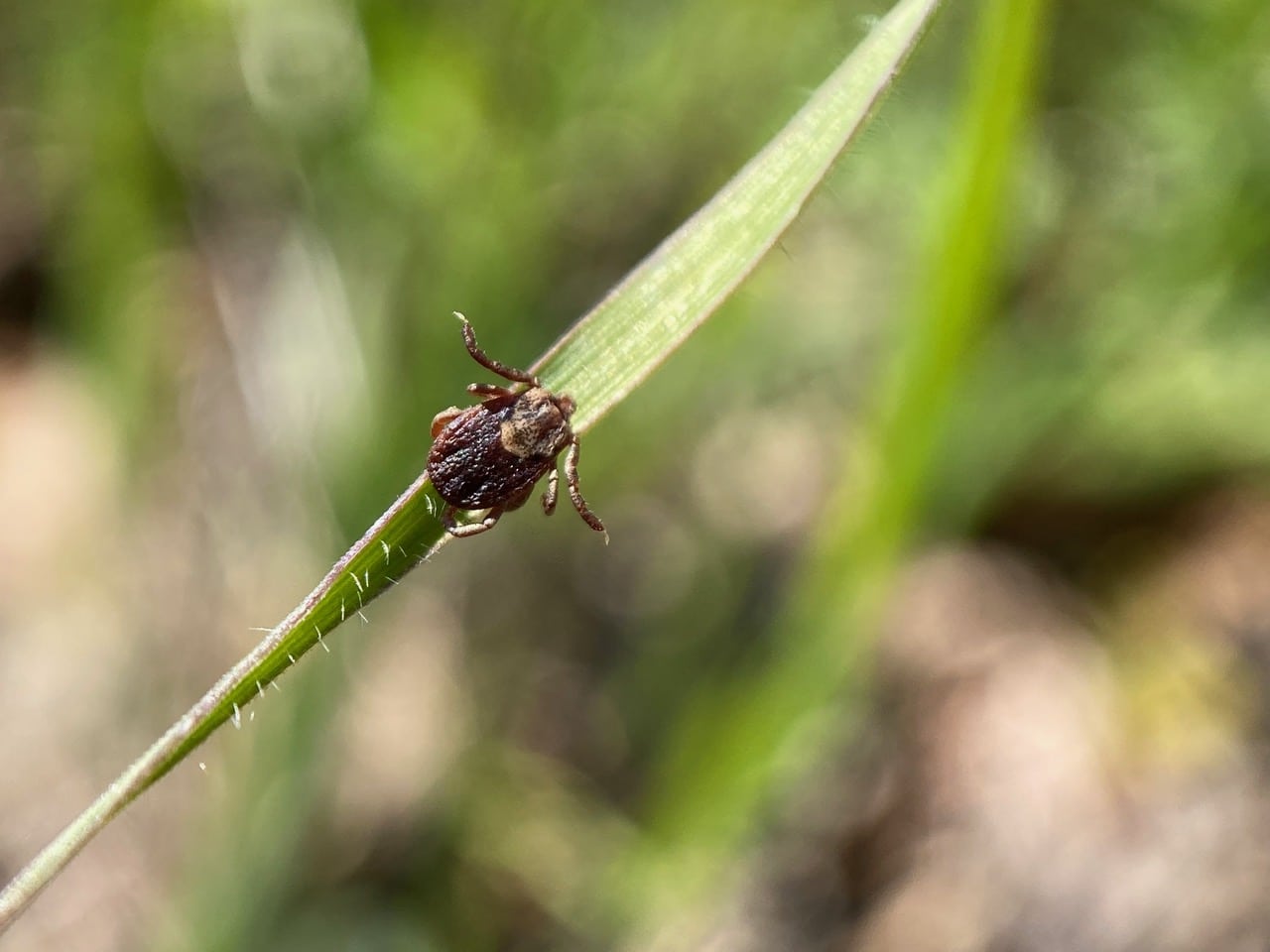
Whoa, an adult female Pacific Coast Tick, Dermacentor occidentalis (family Ixodidae) is questing on a blade of grass on the edge of the road.
Ticks pick a place to wait by identifying well-used paths, resting on the tips of grasses and shrubs. They find their hosts by detecting animals’ breath and body odors, or by sensing body heat, moisture, and vibrations. Some species can even recognize a shadow. Ticks can’t fly or jump, but many species wait in a search position known as “questing”. Holding onto leaves or grass by their third and fourth pair of legs, they hold the first pair of legs outstretched, waiting to climb on to a passing host. When a host brushes the spot where the tick is waiting, it quickly climbs aboard. Recent research has shown that ticks are significantly aided by electrostatic forces (static electricity) when attaching to their hosts, allowing them to be passively attracted across air gaps to land on potential hosts due to the natural electrical charges animals accumulate on their bodies.
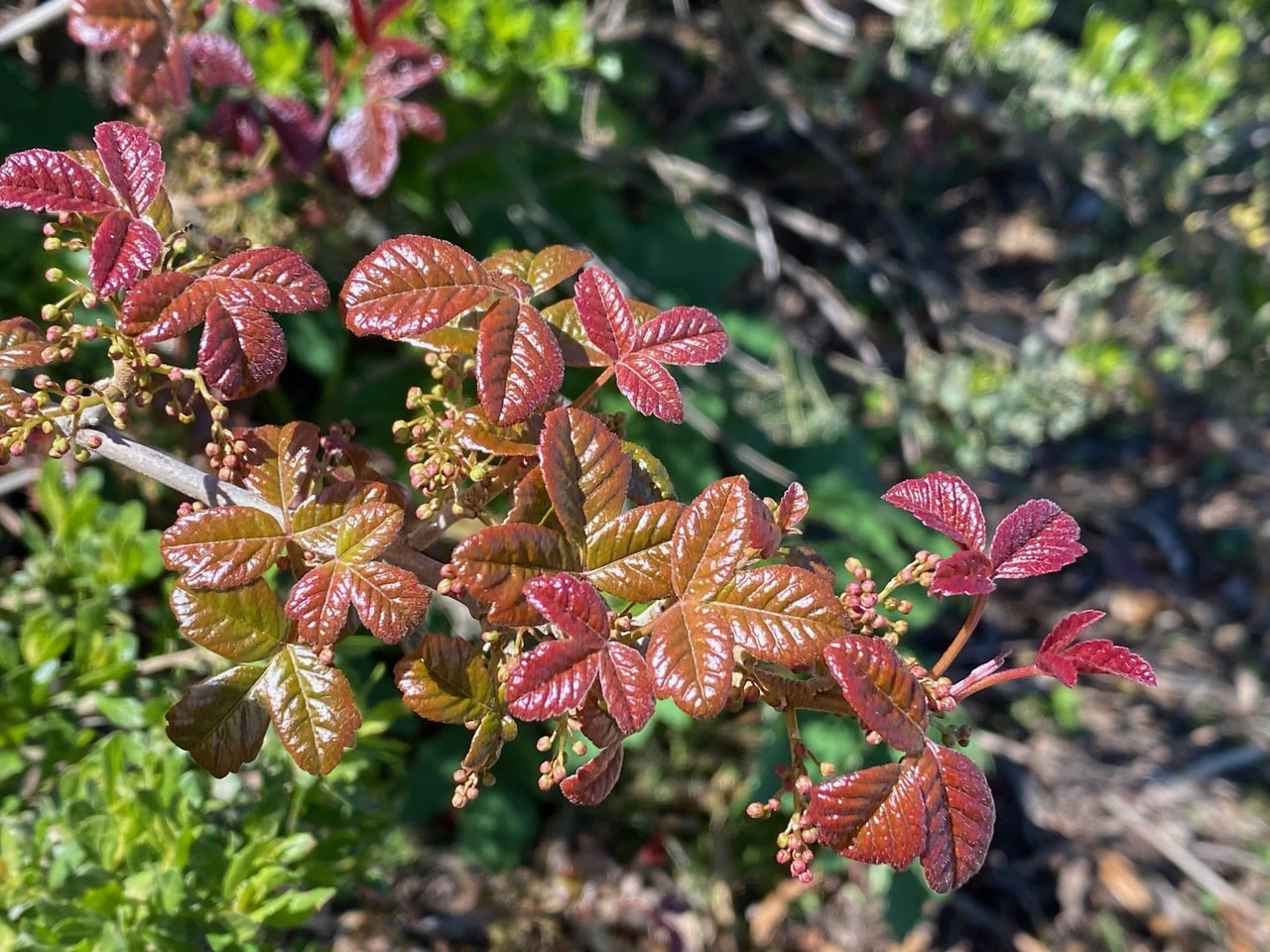
Spring is an exciting time to be out botanizing, but it doesn’t come without hazards. Poison Oak, Toxicodendron diversilobum has produced brand new leaves and flower buds on their bare stems.
Clusters of flower buds are produced as the new leaves unfold on the Poison Oak. The leaves are divided into three leaflets. They are typically glossy bronze when first unfolding in early spring. Poison Oak leaves and twigs contain a surface oil, urushiol, which causes contact dermatitis in four-fifths of humans. Hence the saying “Leaves of three, let them be.” Interestingly, native deer, squirrels, and the indigenous fauna feed on the leaves with impunity. Bird species feed on the berries, and utilize the plant structure for shelter. The plant is often used in habitat restoration projects. It can be early stage succession where woodlands have been burned or removed, serving as a nurse plant for other species.
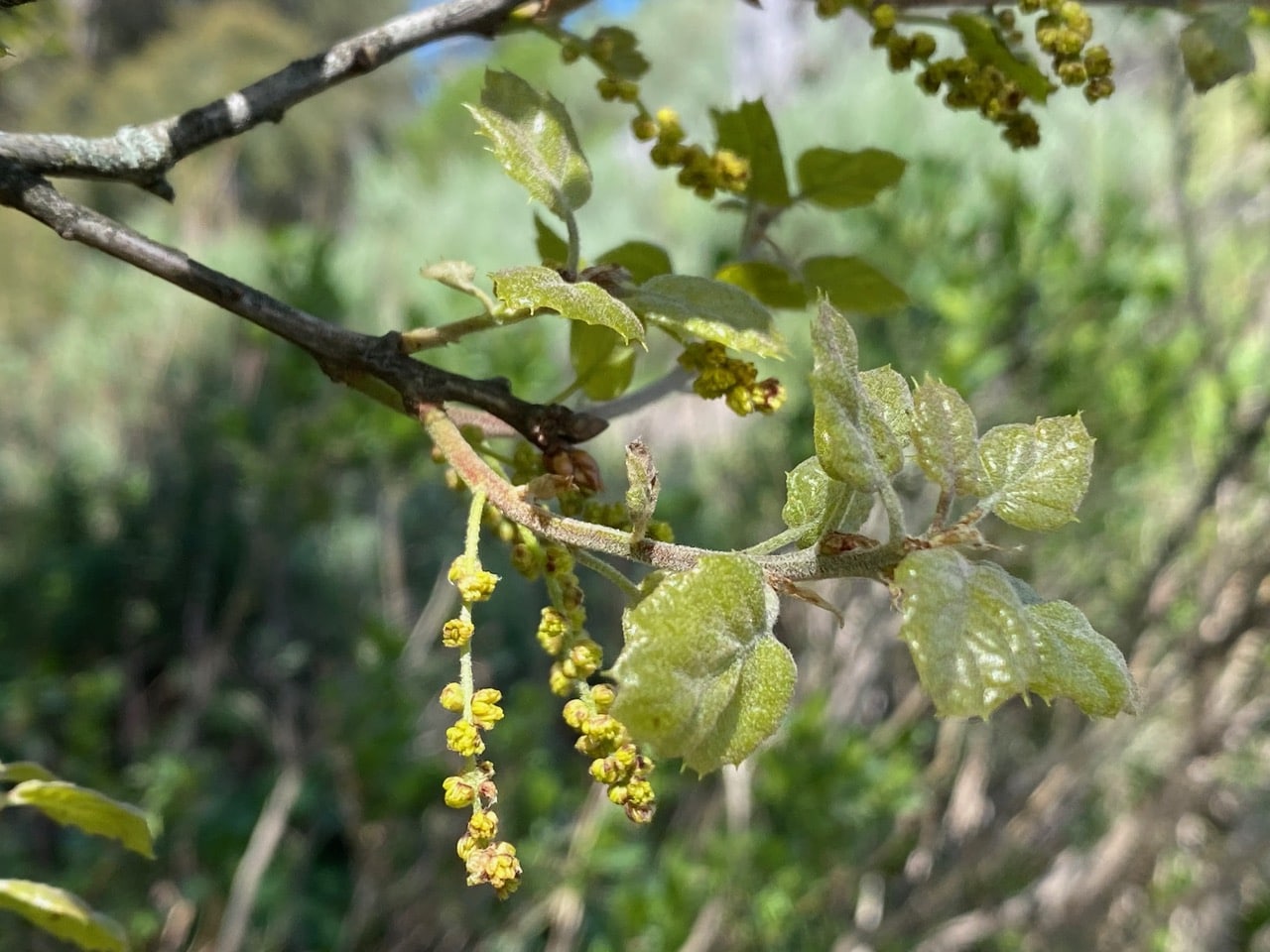
Descending to the Water Tank, I stop by a blooming Coast Live Oak, Quercus agrifolia with low-hanging branches. The tree has many tender new leaves and a few short male catkins, only about 1-2 in. long.
The Coast Live Oak, Quercus agrifolia is monoecious, with separate male and female flowers borne on the same tree. Male flowers are found on 2-4 inch long, drooping, yellow-green catkins, while the female flowers are inconspicuous reddish-green spikes in the leaf axils. The flowers are wind-pollinated, relying on the wind to carry pollen from the male catkins to the female flowers.

A red, succulent, tongue-shaped structure extrudes from a male catkin. It is a bud gall induced by the Two-horned Gall Wasps, Dryocosmus dubiosus (family Cynipidae).
Gall Wasps (family Cynipidae) are very small (2-8 mm), black wasps whose larvae induce the formation of galls in their host plants. Adults have a humpbacked profile, distinctive wing venation, and compressed abdomen with telescoped segments toward the rear. A given species of gall wasp will cause a characteristic type of gall to form on a certain part of a particular species of host plant. The gall wasps can often be identified by the galls they induce. Many Cynipid wasps attack oak trees or rose plants.
Oak gall wasps alternate between one sexual and one asexual generation each year. Male gall wasps are rare, and reproduction usually occurs by parthenogenesis (i.e. by cloning; female larvae develop from unfertilized eggs). The egg passes through the long ovipositor of the female into the plant tissue. After the egg hatches, the larva begins to secrete a substance that causes the plant tissue around it to grow faster than normal. The larva feeds on the plant tissue within the gall, pupates and eventually emerges from the gall as adult wasp. Gall wasps are naturally controlled by a complex of fungi, parasites, predators, and competing insects that live within the galls. The galls generally do not cause significant damage to trees.

Hello, who’s this tiny beetle on a tender oak leaf? Its body is covered with dense adpressed hairs.

iNaturalist has helped identify the beetle as a Fruitworm Beetle, Xerasia grisescens (family Byturidae). Yay, a new beetle family for me!
Byturidae, also known as Fruitworms, are a small family of scleroid beetles primarily distributed in the Holarctic and Southeast Asia. The larvae of some genera feed on fruit, and are known to be commercial pest of blackberries and raspberries. The adults feed on developing leaves, flowers and pollen.
Xerasia grisescens is associated mainly with oaks. The species is found throughout western North America just about anywhere oaks occur. In California they are found from sea level to >7000 ft., from wet coastal locations to very dry areas like Carrizo Plain. They are small beetles, 4-5 mm, with dense vestiture. Pronotum wide as elytra at back, narrowing toward head, which is narrower than pronotum. Adults feed mainly on fungi associated with the trees, though some may feed on oak pollen as well. Larvae feed in oak galls. Adults emerge during the cooler winter months, and may be abundant through spring. Although they are among the most common of all California’s beetles, they are often overlooked due to their small size.

I proceed to search for the cryptic female flowers of the Coast Live Oak, paying special attention to any growths at the leaf axils of the new leaves.
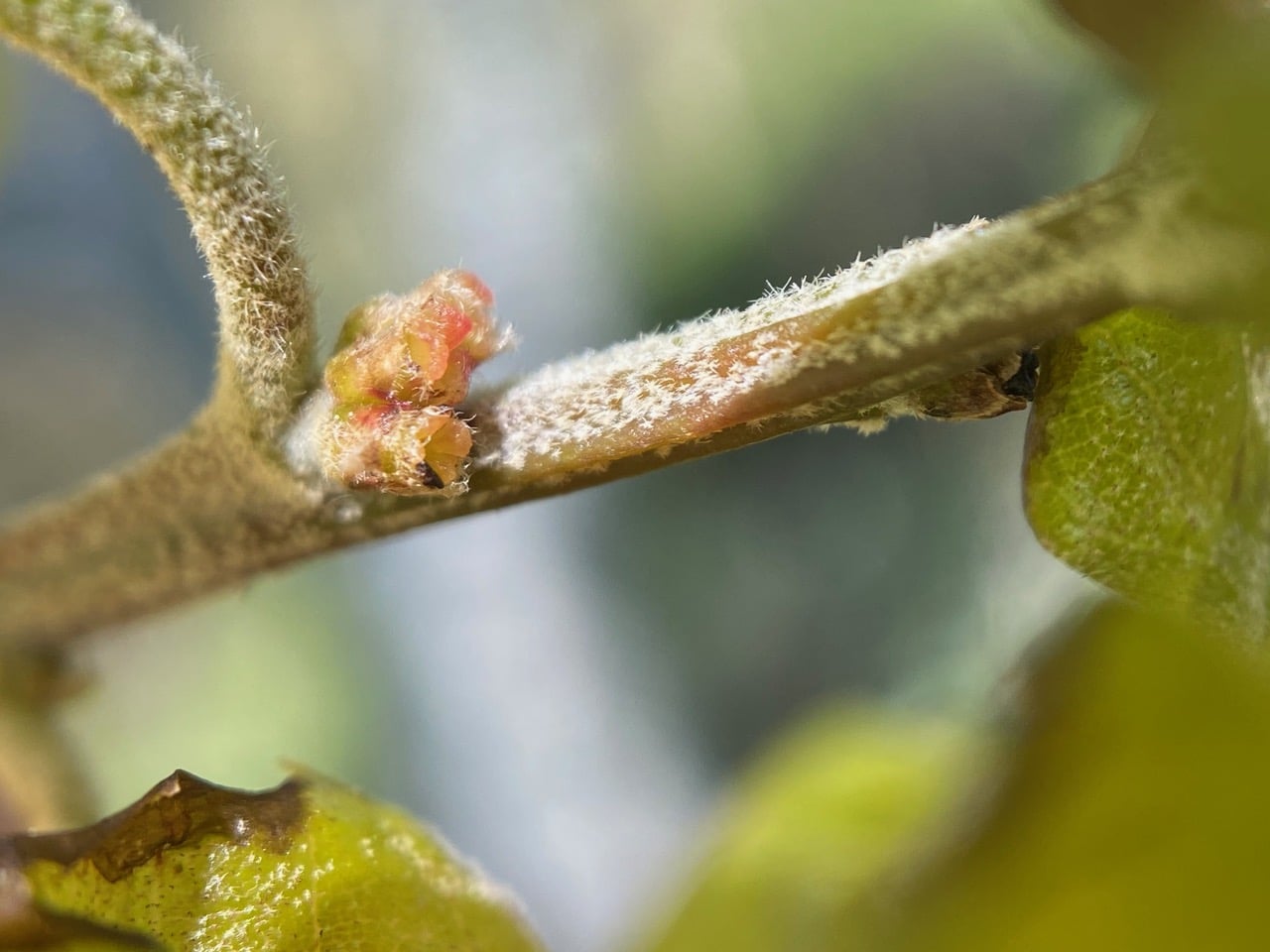
Hey, I think I have found them! There appears to be a cluster of three developing female flowers at this leaf axil, barely 2 mm each. The flower is simply a naked 3-lobed stigma emerging from hairy bracts.
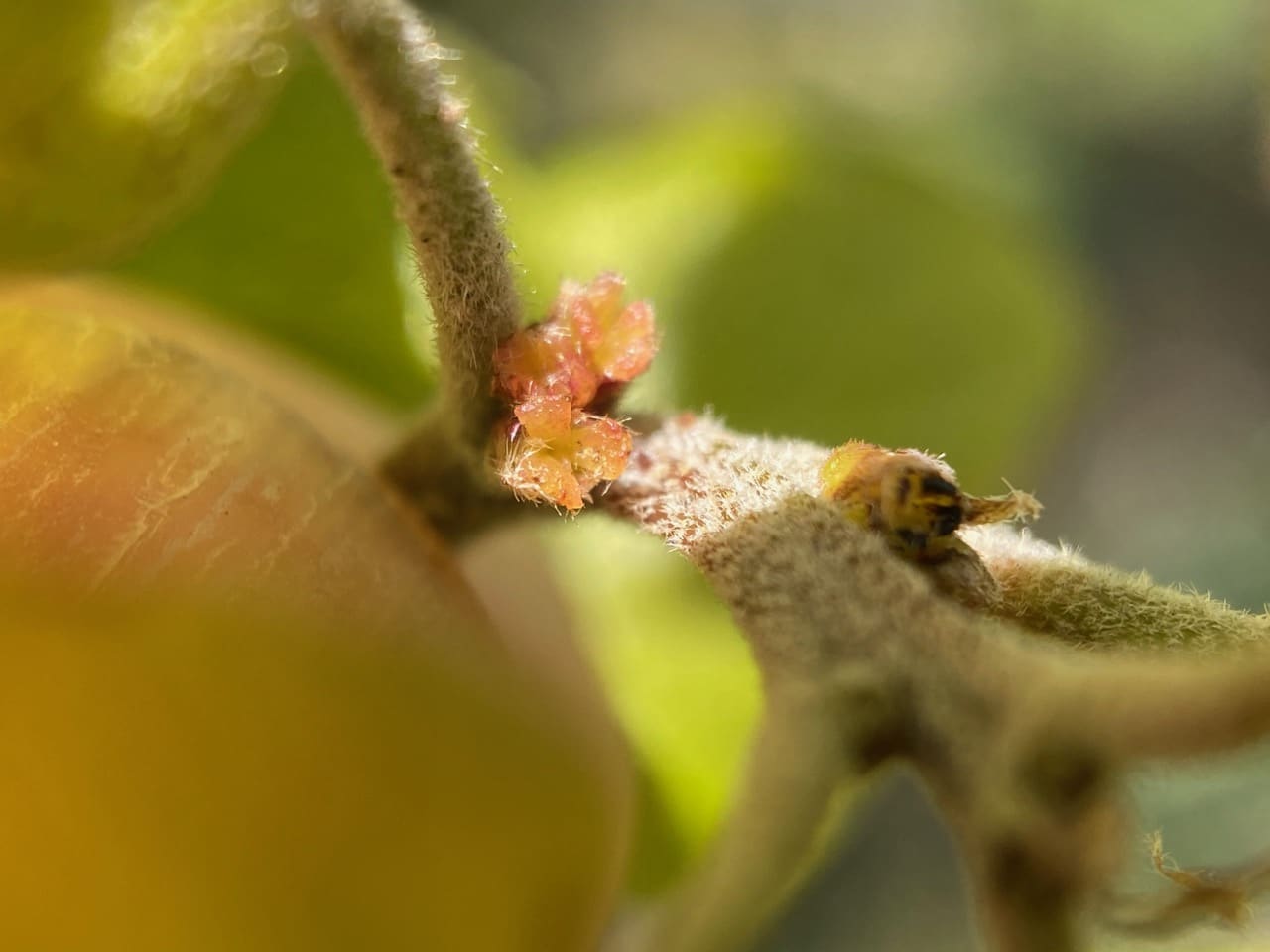
Here’s another triplet of female flowers. The one facing the camera is fully open. Wow, imagine these are the humble beginnings of the acorns we are familiar with!

Here’s another cluster of female oak flowers.
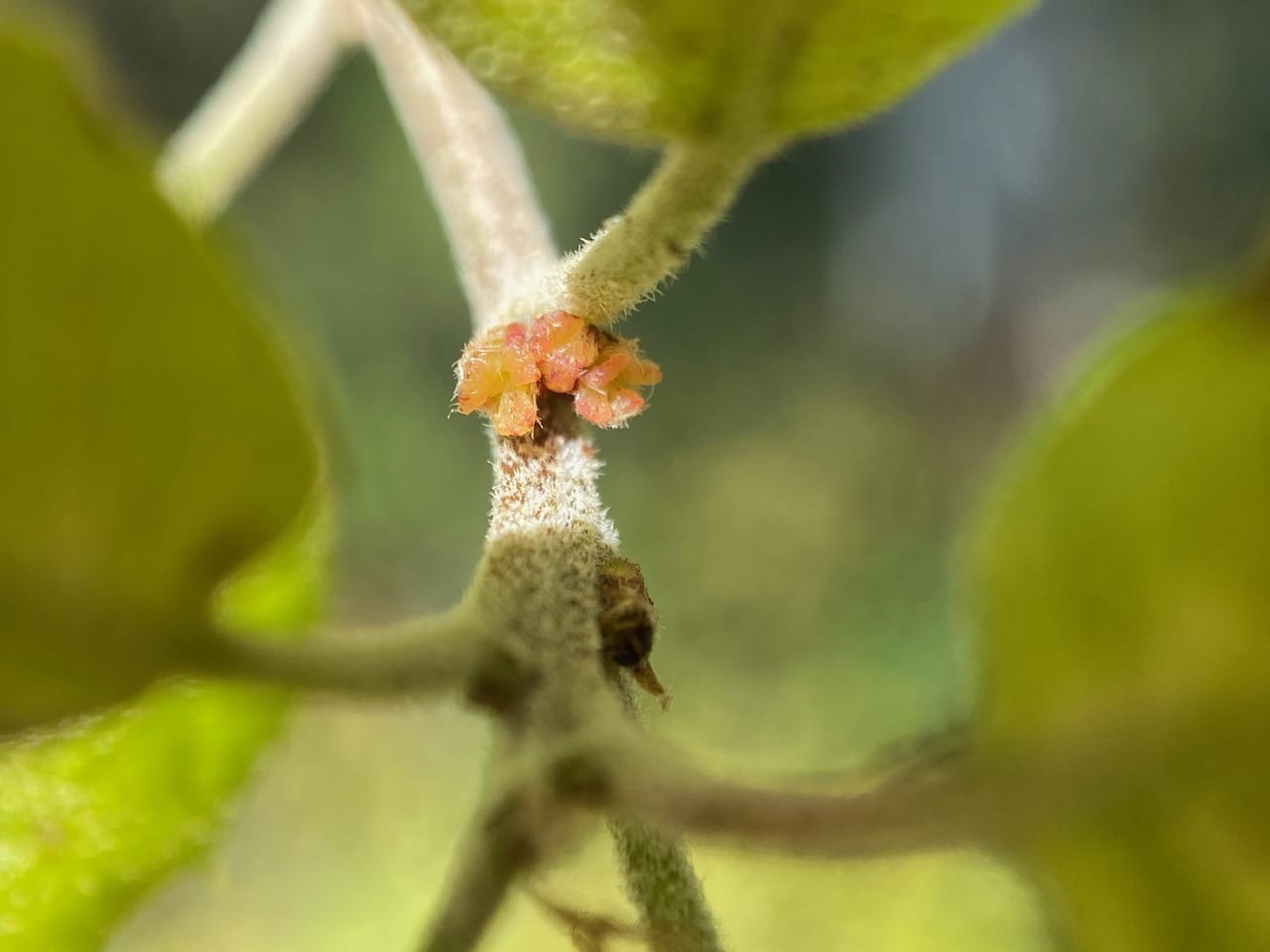
It appears the stigma may be three or four-lobed.

Once I have the search image, the search becomes easier. It is still a tedious undertaking, requiring focus and patience, and of course a macro lens. In half an hour, I found about 6 clusters of flowers on the branches that I can reach.
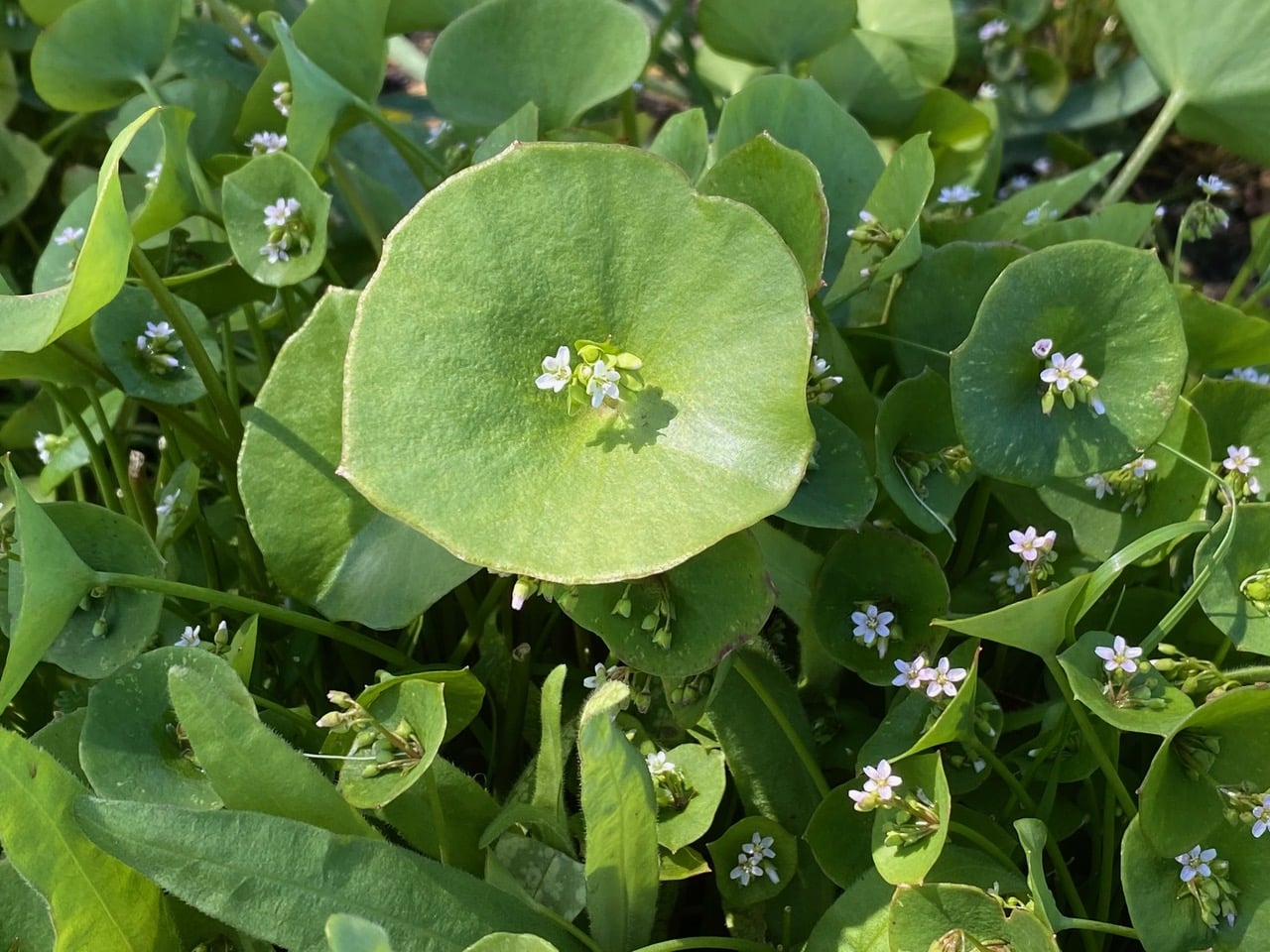
The Miner’s Lettuce, Claytonia perfoliata is blooming profusely. Surprisingly, I don’t see any insects visiting them.
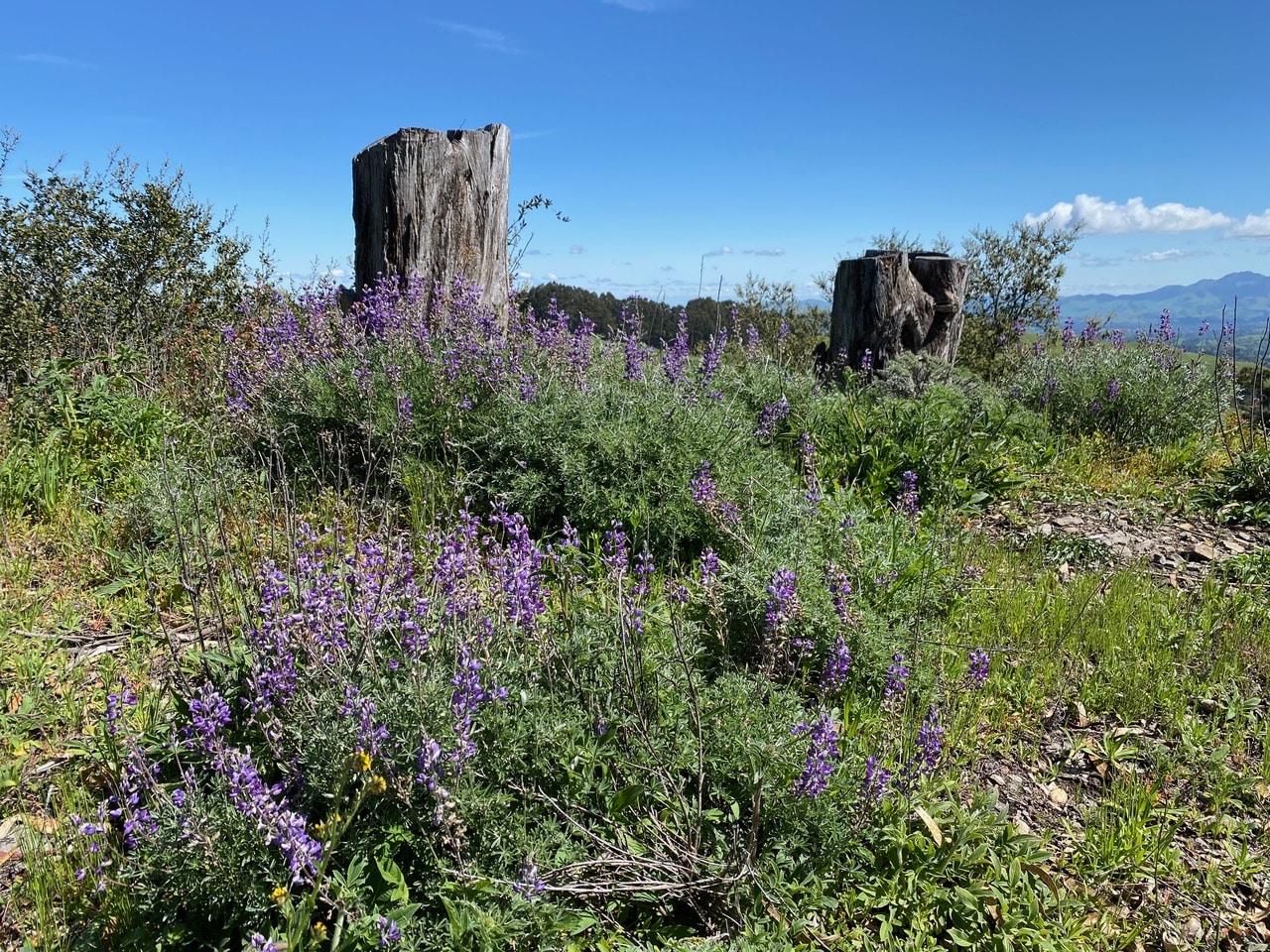
The Silverleaf Lupine, Lupinus albifrons are blooming nicely, but they too are not being visited by insects. Where are the bumble bees and the digger bees?

A fresh male flower of California Blackberry, Rubus ursinus greets the sun with a dense spray of intact anthers.
The species is dioecious, with male and female flowers borne on separate plants. Female flowers have smaller petals and a central cluster of many pistils. Male flowers have larger petals and a central cluster of many stamens. It takes close examination to distinguish the sexes.
For all the years that I have hiked past a large, healthy California Blackberry in a nature preserve where I was a docent, I have never seen a single berry on the shrub. It was only after I learned about the dioecious nature of the plant that the mystery was solved. Male flowers do not have ovaries and will never bear fruits.
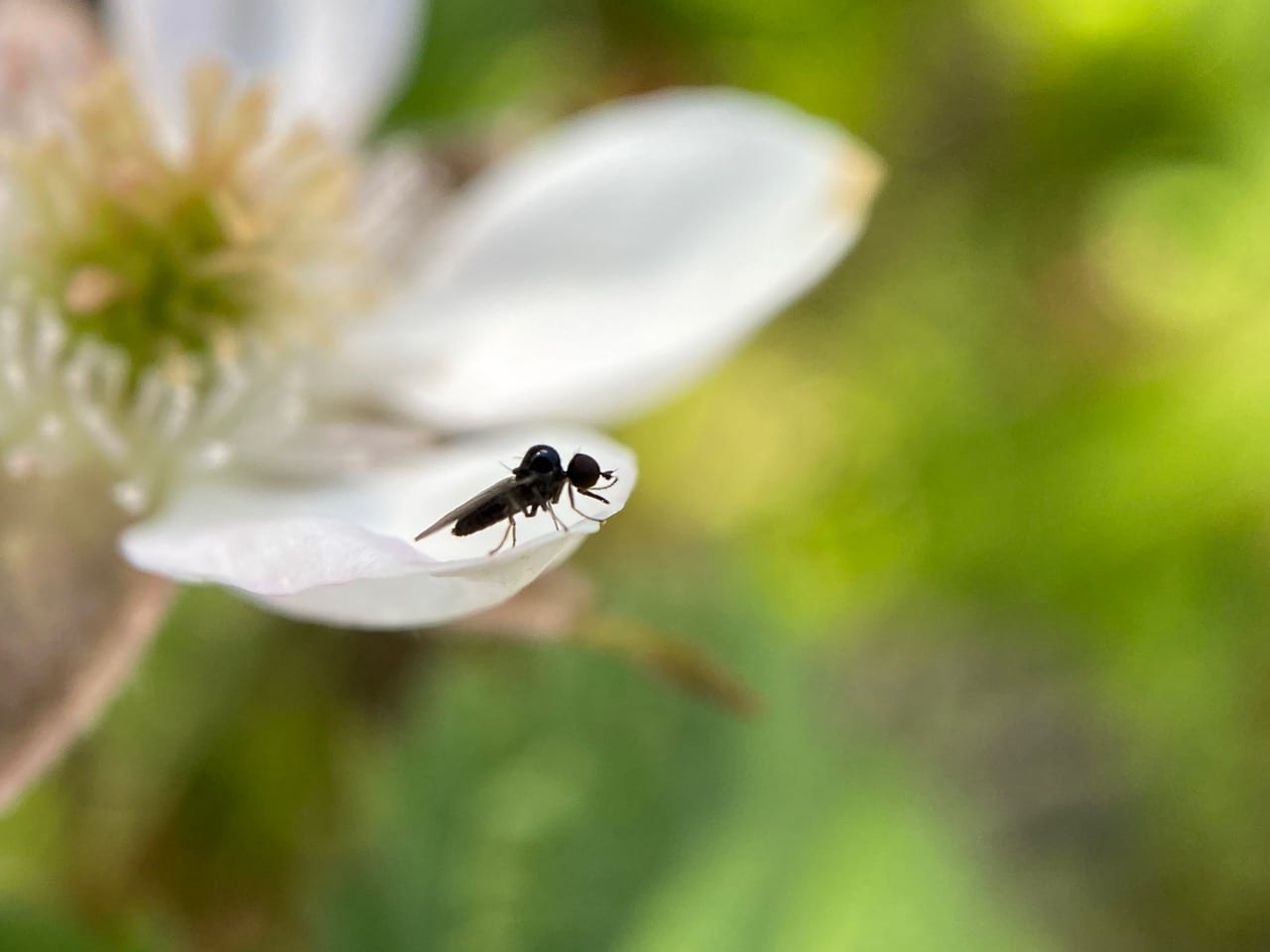
A Dance Fly, Anthalia sp. (family Hybotidae) is cleaning its mouthparts after visiting a female California Blackberry flower. The little fly has the classic silhouette of Anthalia – pronounced humped back, globular head with distinct antennae, and a short, stout proboscis that points forward diagonally from the head.
The Hybotid Dance Flies belong to the superfamily Empidoidea and were formerly included in the Empididae as a subfamily. Empididae generally have a thick beak pointing down, while Hybotidae have a thinner beak, or a thick beak pointing forwards or diagonally. Some crucial wing venation further distinguishes the two families. Precious little is known about the life cycle and biology of Hybotids because they are not considered of economic consequence. Their forelegs are generally not raptorial (for grasping prey). Some Hybotids are known to eat pollen. I have seen Hybotids visit flowers for nectar and pollen, notably on Soap Plant, Miner’s Lettuce, California Saxifrage, Wild Geranium, Hound’s Tongue and Buttercups, and I believe they may contribute to the pollination of these small wildflowers.
Why the name “dance fly”? This is derived from the mating swarms of males of many species. They gather in clouds over prominent objects, each individual seeming to bounce or “dance” in mid-air. Many other flies do this, notably midges, but the Empidids and the Hybotids got the moniker.

The shiny black fly feeding on a Woodland Strawberry flower is a Blacklet, Cheilosia sp. (family Syrphidae).
Hover Flies, also called flower flies or Syrphid flies, make up the insect family Syrphidae. The adults of many species feed mainly on nectar and pollen, and are often seen hovering and nectaring at flowers. They are important pollinators of flowering plants in many ecosystems worldwide. The larvae feed on a wide range of foods. In many species, the larvae are insectivores and prey on aphids, thrips, and other plant-sucking insects. In other species, the larvae are saprotrophs, eating decaying plant and animal matter in the soil or in ponds and streams.
Cheilosia is a rather unusual hover fly. Most Cheilosia are black or largely un-colored, lacking the bright colors and patterns of many hover fly species. Although it is one of the most species diverse genera of Syrphidae, its biology is little understood. Where known, the larvae of Cheilosia species feed in the stems of plants or in fungi.
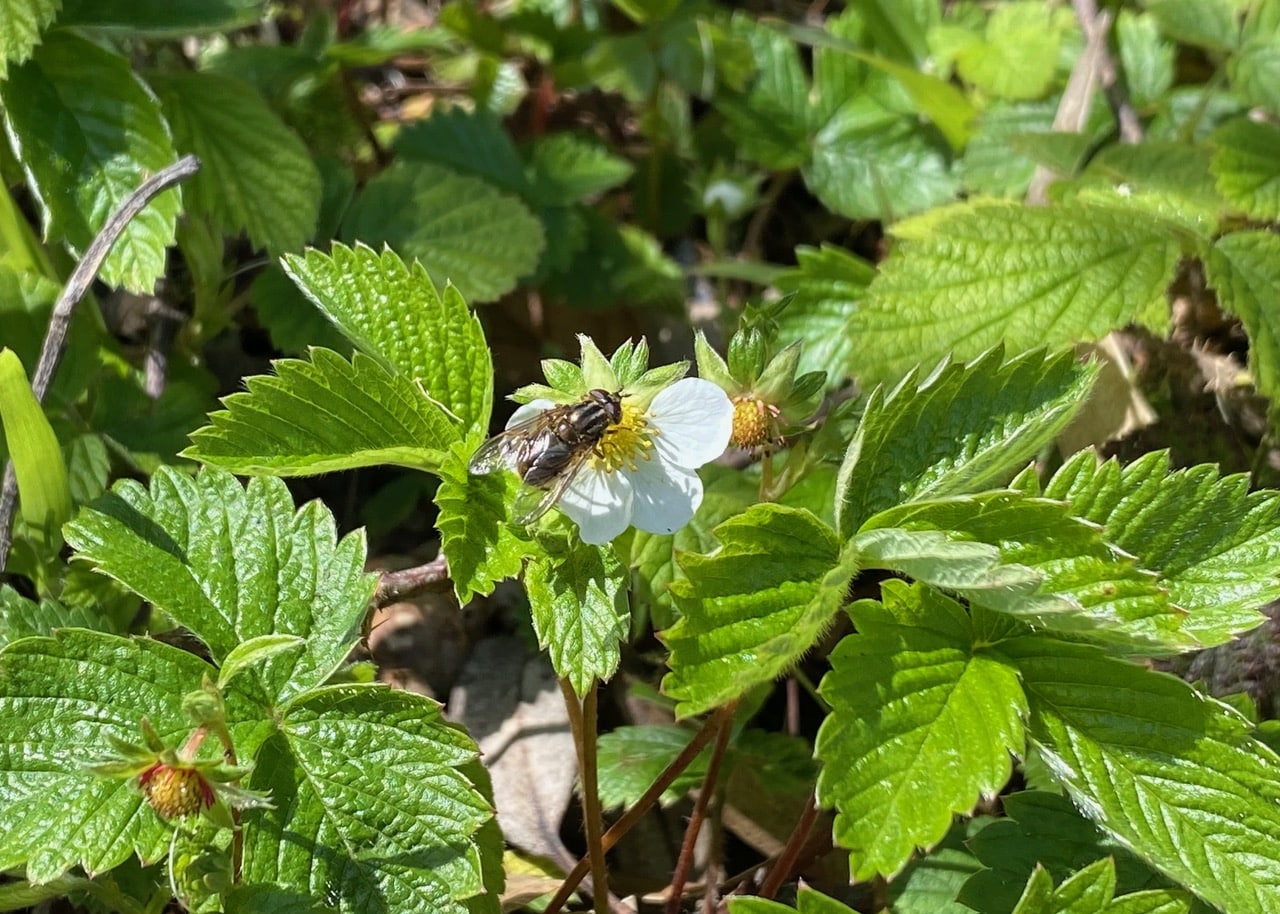
Ooh, here’s another hover fly on a strawberry flower. It has an overall metallic shine, and a thorax with dark longitudinal stripes. iNaturalist has helped identify it as a member of the Rat-tailed Maggot Flies, subtribe Helophilina (tribe Eristalini, family Syrphidae).
Eristalini is a tribe of hover flies. A characteristic feature of this tribe is the “rat-tailed maggot” with a telescopic breathing tube in the rear end, allowing the larvae to breathe while living submerged in water or mud.
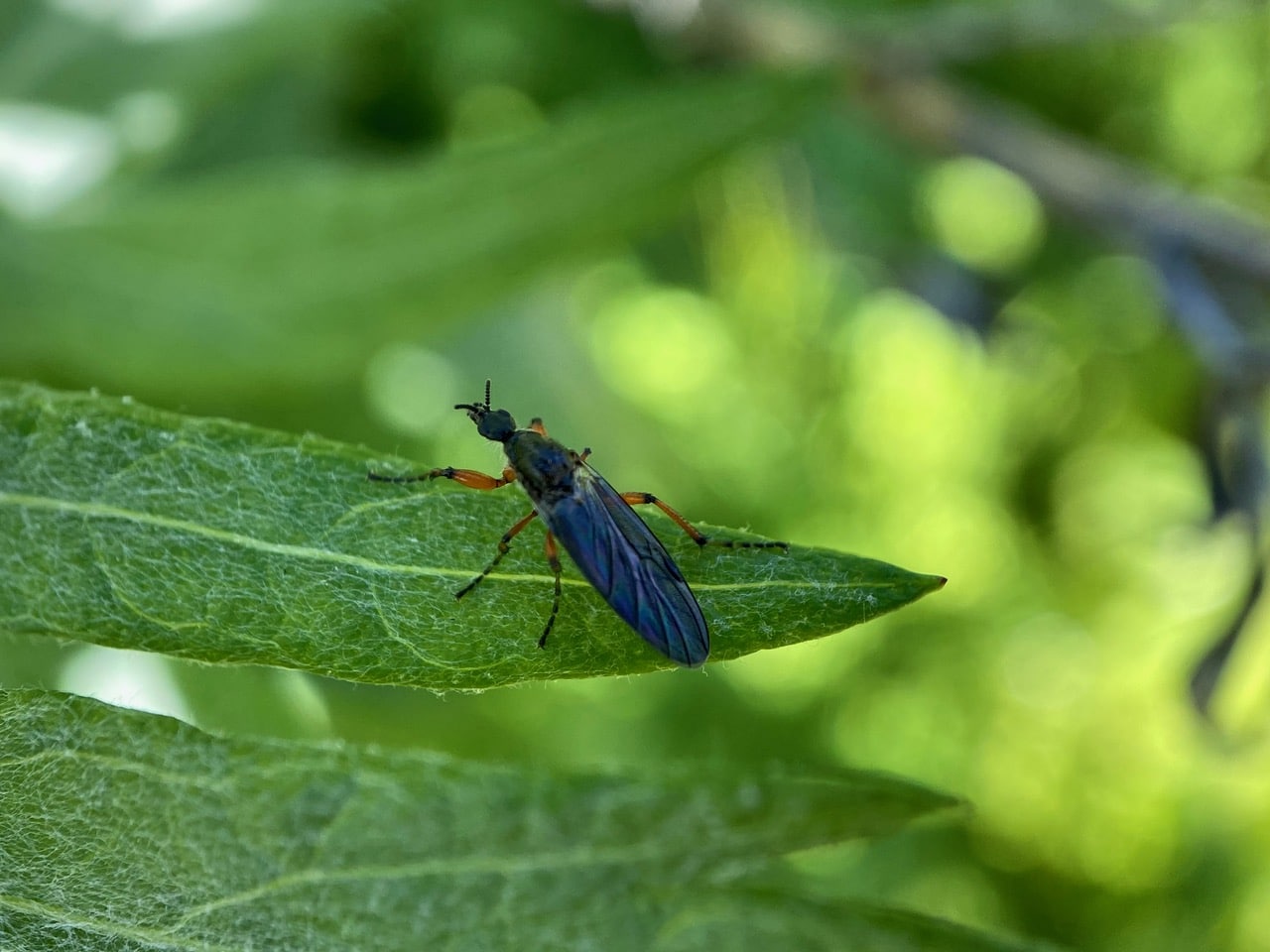
Perched on a mugwort leaf in the shadows is a female Yellow-footed March Fly, Bibio xanthopus (fame Bibionidae).
March Flies (family Bibionidae) generally live in wooded areas and are often found on flowers – adults of some species feed on nectar, pollen, and honeydew, while adults of other species don’t feed at all; and in either case, they are very short-lived. They are considered important pollinators in orchards. They are also important food for other insects and spiders. The larvae feed en masse on rotting organic material like leaves, wood, compost, and rich soil.
March flies exhibit extreme sexual dimorphism – the sexes are morphologically distinct. The female is usually more colorful, has small eyes on the sides of long, narrow head, while the all-black males have huge eyes that touch in the middle and are split in half horizontally. Scientists speculate that the split makes it easier for them to see the other males that are above and below them in a mating swarm. Males gather in swarms that can blanket the ground and low vegetation. Female are attracted to the party and select mates in the frenzy of fly bodies.
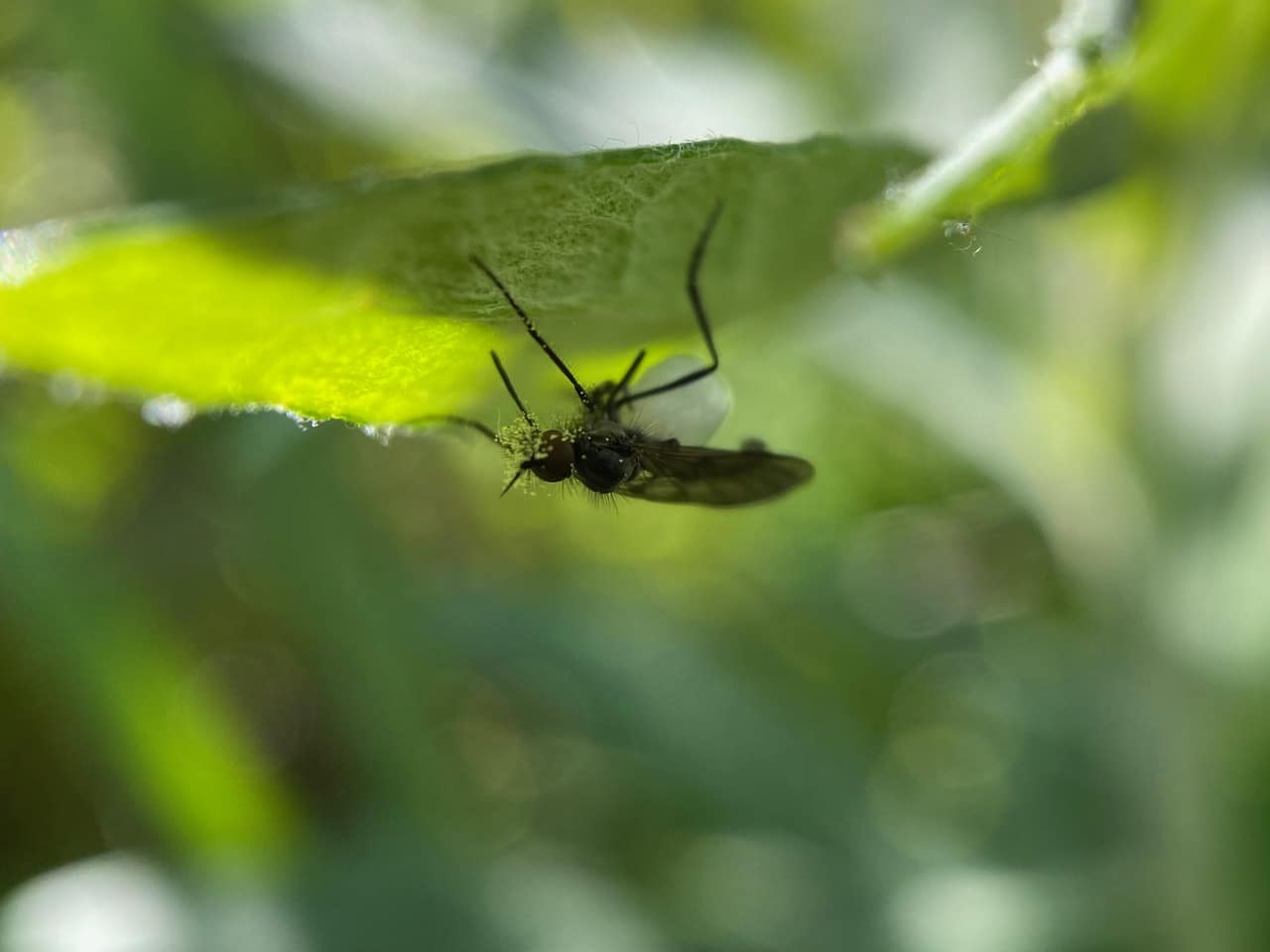
An insect is flying in with something white on it. Unfortunately it lands on the underside of a Mugwort leaf, making it almost impossible to see clearly. However it has the distinct elongate body and long legs of a Dance Fly, and it is carrying a white orb of foamy material under its body. Ah, a male Empidid Dance Fly with a nuptial gift! The fly seems to have some powdery pollen stuck to its head.
Dance Flies, in the family Empididae, get their name from the habit of males of some species to gather in large groups and dance up and down in the air in the hopes of attracting females. They are predominantly predatory and they are often found hunting for small insects on and under vegetation in shady areas. Both genders may also drink nectar. Male dance flies give their sweeties a nuptial gift to eat while they mate. The gift is thought to enable her to complete the development of her eggs. Males may wrap their gifts in balloons of silk or spit, hence the other common name of Balloon Flies.
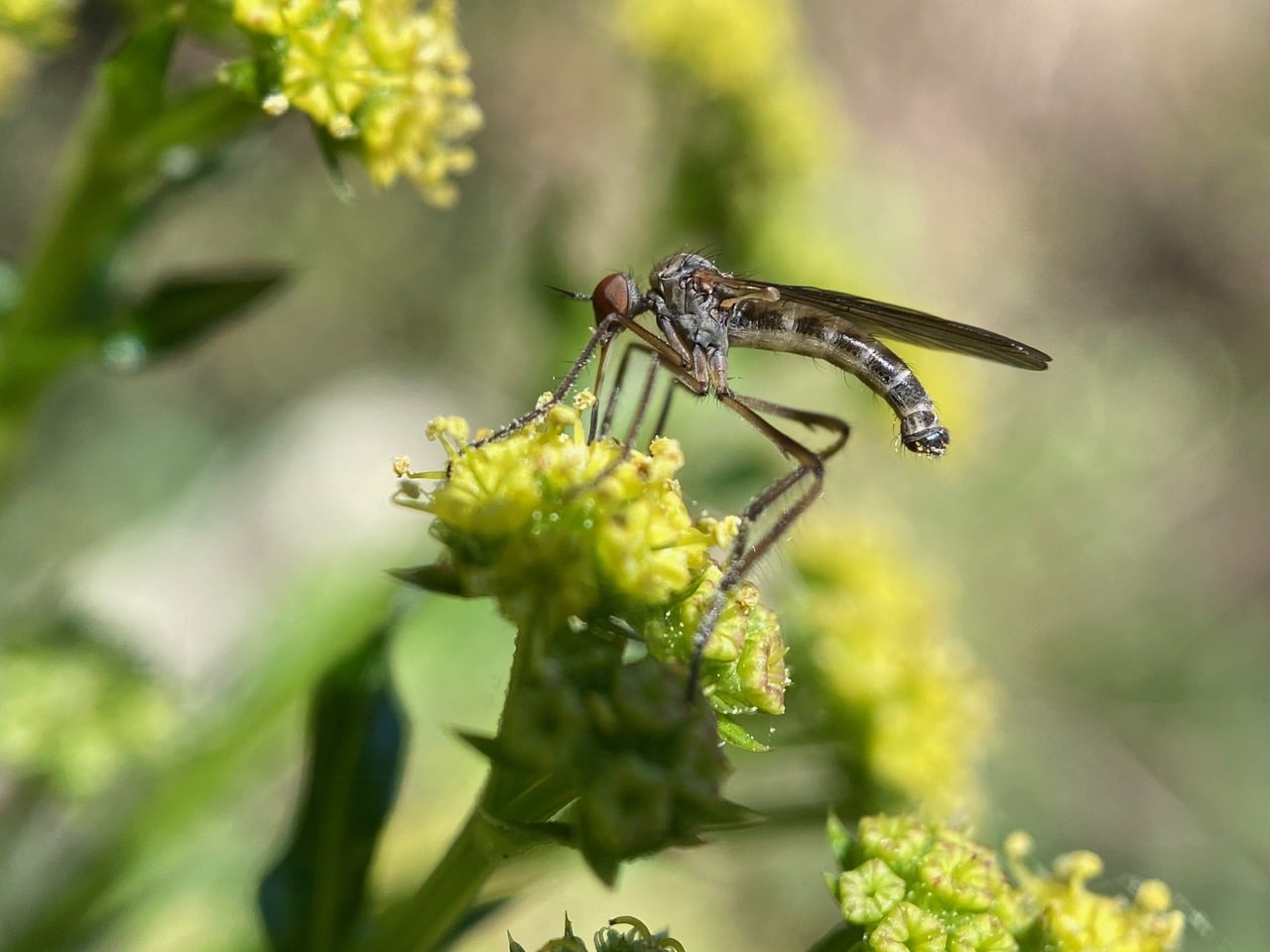
Picture of Dance Fly, Empis bova (family Empididae) on Pacific Sanicle taken on 4/2/24 at Skyline Gardens.
BTW, just a couple of days ago, a dance fly scholar contacted me through iNaturalist requesting permission to use my photograph above in a monograph he is working on. Apparently Empis bova is one of the 54 new western species he and his co-authors are covering in the extensive revision of the subgenus Enoplempis, family Empididae. Wow, who would’ve thought that the dance fly could be identified to the species just from a single photograph? One gets lucky sometimes : )