

Pollinator Post 4/2/25 (1)
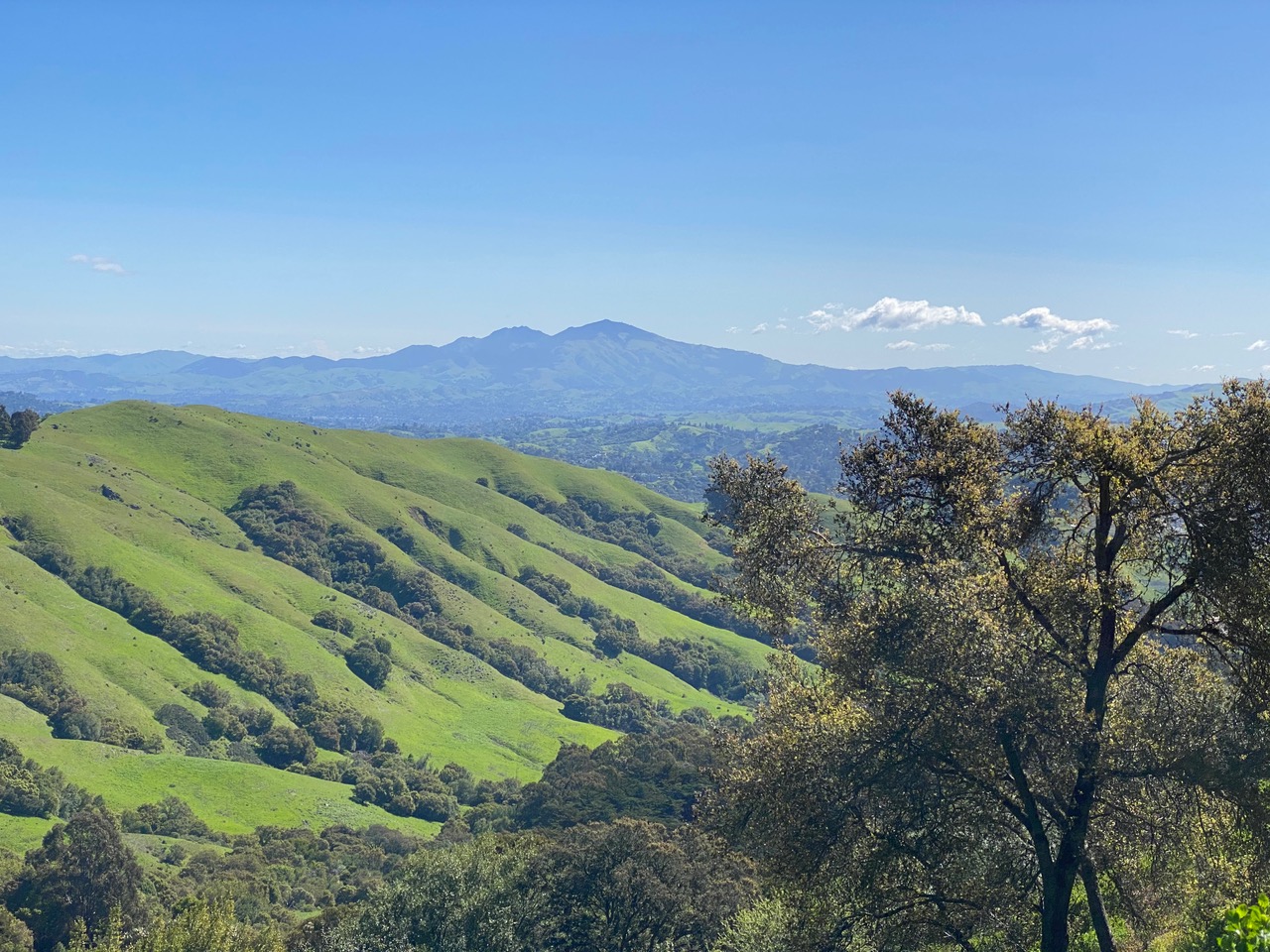
It’s been a while since I last walked the paved road at Skyline Gardens. After the series of rain, surely there must be new plant growths and insect activities?
Clear skies and green hills, looking east toward Mt. Diablo.
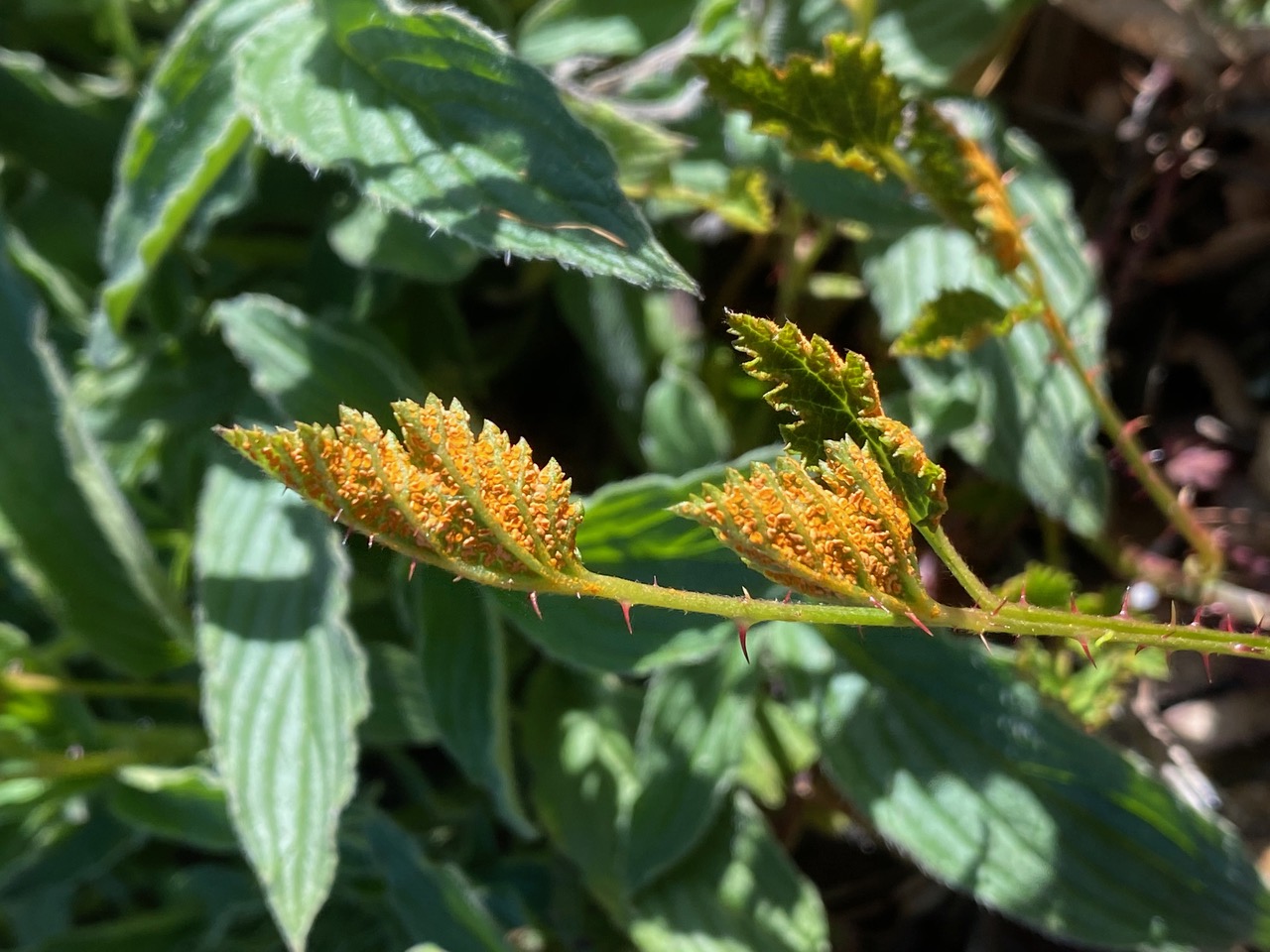
Barely a few yards up the road from Siesta Gate, I notice that several of the young, low-growing California Blackberry, Rubus ursinus are covered with orange on the underside of their leaves. The orange growths have impeded the leaves from opening up fully. The cool and wet conditions must have enabled the growth and spread of the Blackberry Orange Rust.
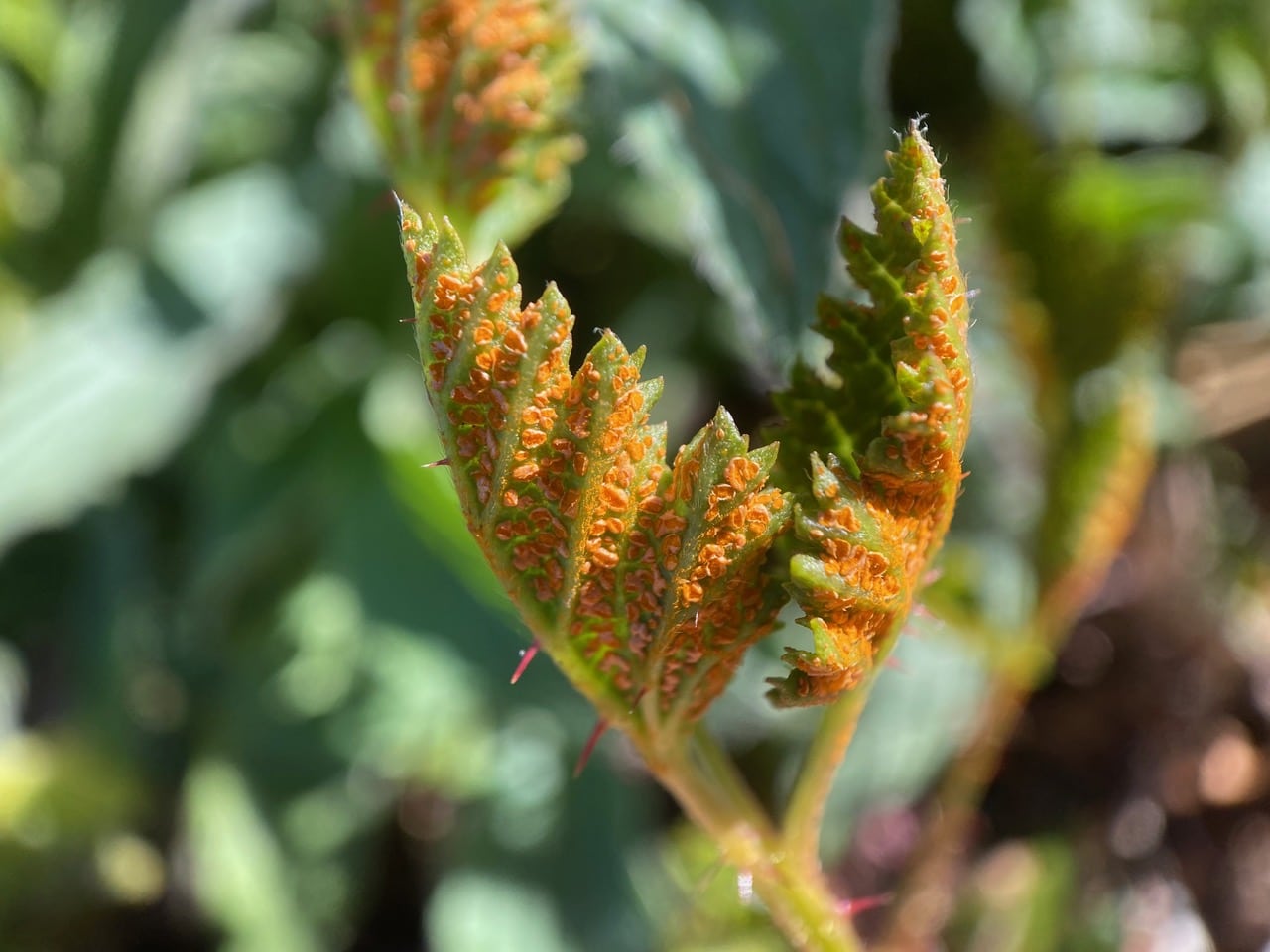


Blackberry Orange Rust is a systemic disease caused by the fungus Gymnoconia nitens. The infection is present throughout the plant for the rest of the plant’s life. Characteristic symptoms are spindly shoots with clustered, misshapen, pale green to yellowish leaves. The leaves are covered with bright orange, powdery blisters on the underside. Before the blisters burst open, they look waxy or shiny as if covered with lacquer. The orange pustules eventually release thousands of fungal spores which are carried on wind or water, and infect leaves of healthy plants during long periods of leaf wetness provided by rain or dew. Orange Rust is favored by relatively low temperatures (50-70 degrees F) and wet conditions. The fungus is systemic and overwinters in the crown and roots of infected plants.
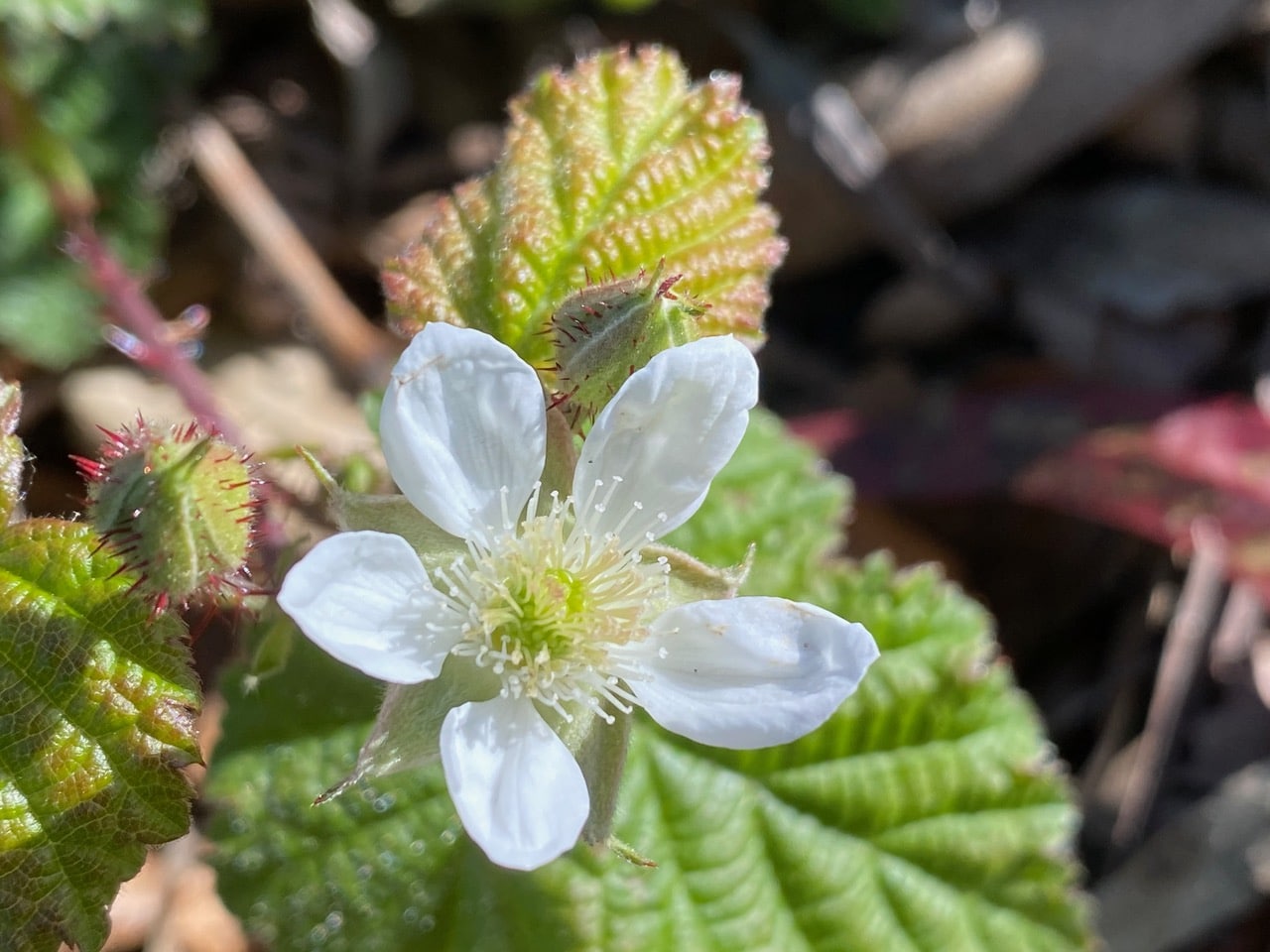
A female California Blackberry, Rubus ursinus has started to bloom. The species is dioecious, with male and female flowers borne on separate plants. Female flowers (as shown here) have smaller petals and a central cluster of many pistils. Male flowers have larger petals and a central cluster of many stamens. It takes close examination to distinguish the sexes.
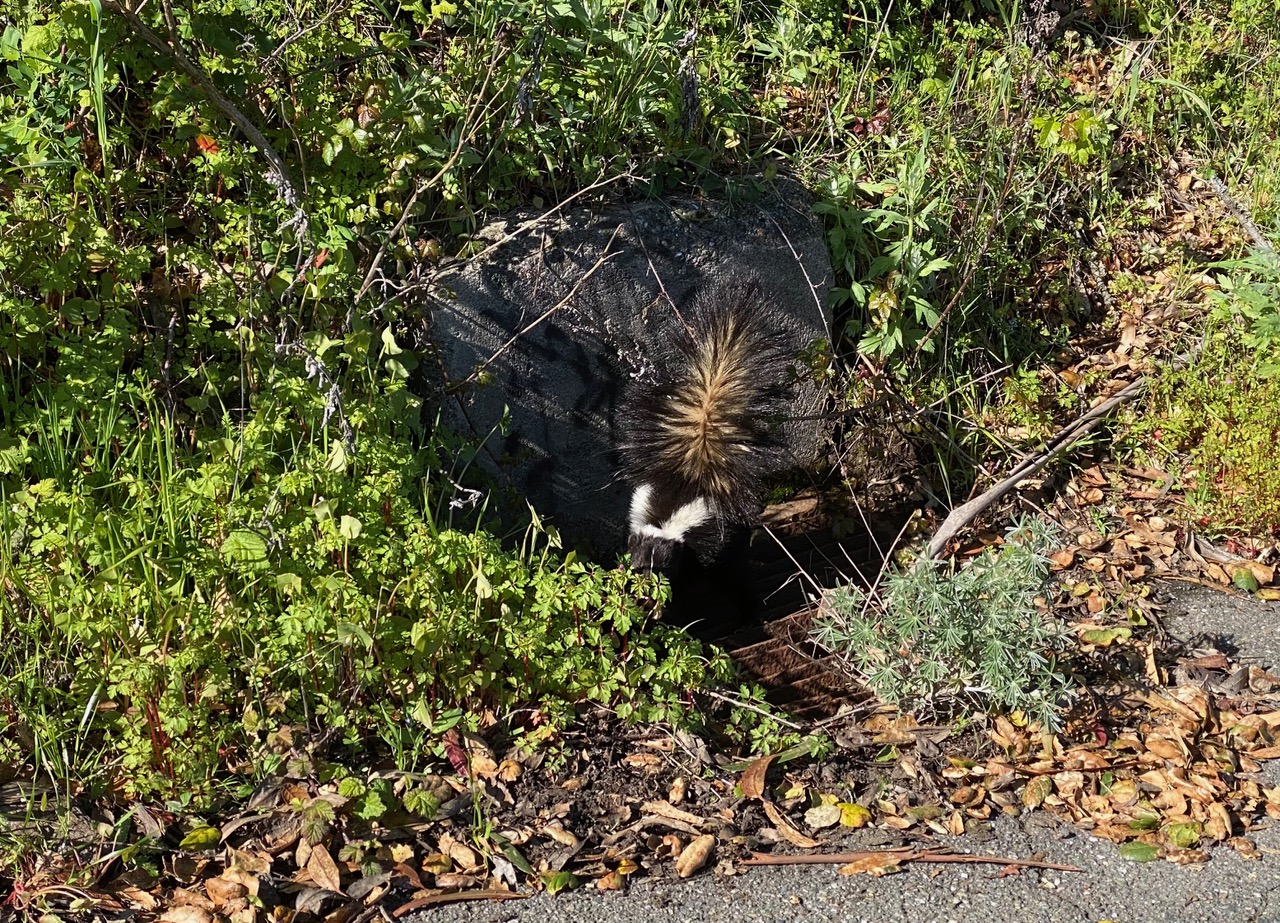
I am ready to cross the road to check on the blooming Oregon Grape when I notice some movements on the drain grate next to the plants. Its tail raised, a Stripe Skunk is scratching the ground to warn me. I quickly reroute. Lately I have encountered many skunk roadkills. The animals are actively moving around as it is their mating season (typically mid-February to mid-April). Give them a wide berth.
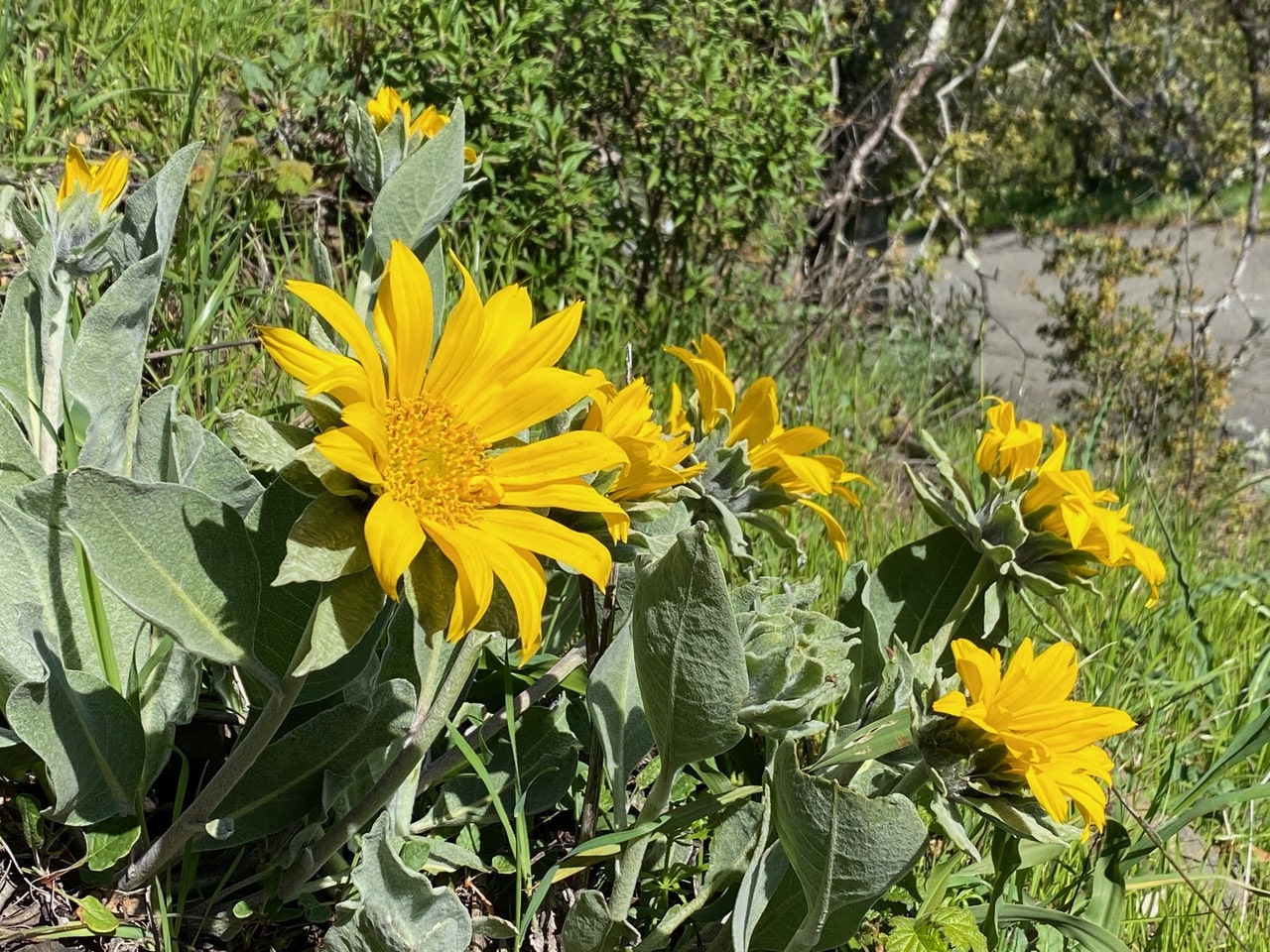
On the steep bank west of the road the Woolly Mule’s Ear, Wyethia helenioides is blooming gloriously. This species of the Asteraceae family occurs chiefly in the California Coast Ranges, and some areas of the Sierra Nevada foothills of California. It is a short, low-growing golden-rayed wildflower that resemble sunflowers. The tiny flowers on the flowerhead open from the rim towards the center as the flowerhead matures. There are still unopened buds in the middle of the flowerhead on the left.
What is commonly mistaken as a “flower” is in fact not a single flower, but an inflorescence of numerous flowers, packed in the center of the flowerhead or capitulum. The individual flowers or florets are star-shaped, and made of 5 fused petals. The flowers clustered in the middle are called disc flowers, while the ones on the rim are called ray flowers. The latter have an irregular corolla – tubular at the base but elongated on the outside into a generally flat projection, the ray, or ligule. The rays are the petal-like parts.
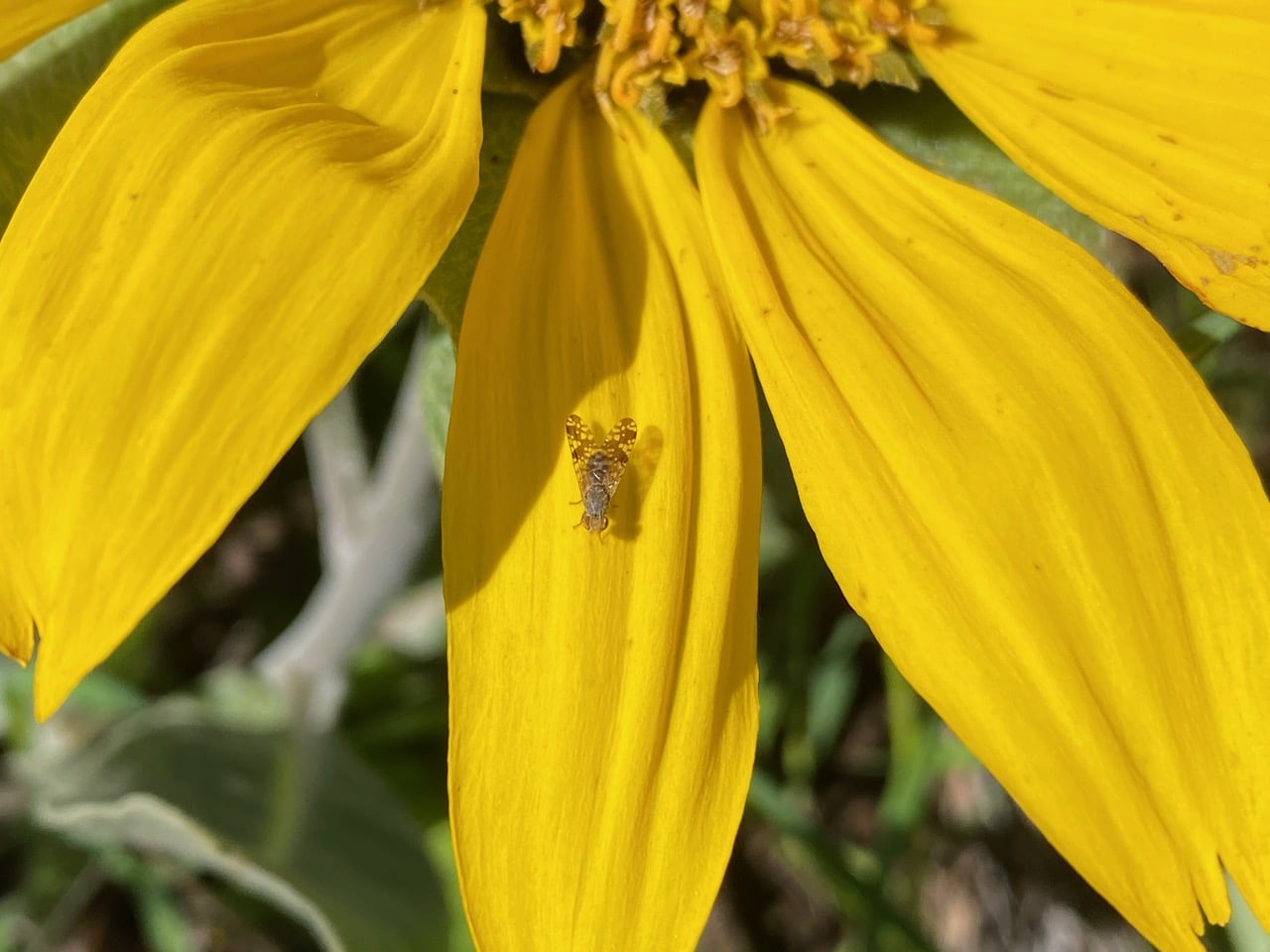
I scramble up the slope to take a better look. There’s a familiar insect on one of the ray petals that I see regularly on the Mule’s Ear when the plant is in bloom – a fruit fly called the Sunflower Seed Maggot, Neotephritis finalis (family Tephritidae).
Tephritids are small to medium-sized flies that are often colorful, and usually with picture wings. The larvae of almost all Tephritidae are phytophagous. Females deposit eggs in living, healthy plant tissues using their telescopic ovipositors. Here the larvae find their food upon emerging. The larvae develop in leaves, stems, flowers, seeds, fruits, and roots of the host plant, depending on the species. Adults are often found on the host plant and feeding on pollen, nectar, rotting plant debris, or honeydew. Tephritid flies are of major economic importance as they can cause damage to fruit and other plant crops. On the other hand, some Tephritids are used as agents of biological control of noxious weeds.
The Sunflower Seed Maggot is a sunflower specialist, found on over 20 species of Asteraceae. Larvae feed on immature seeds and pupate in flowerheads.
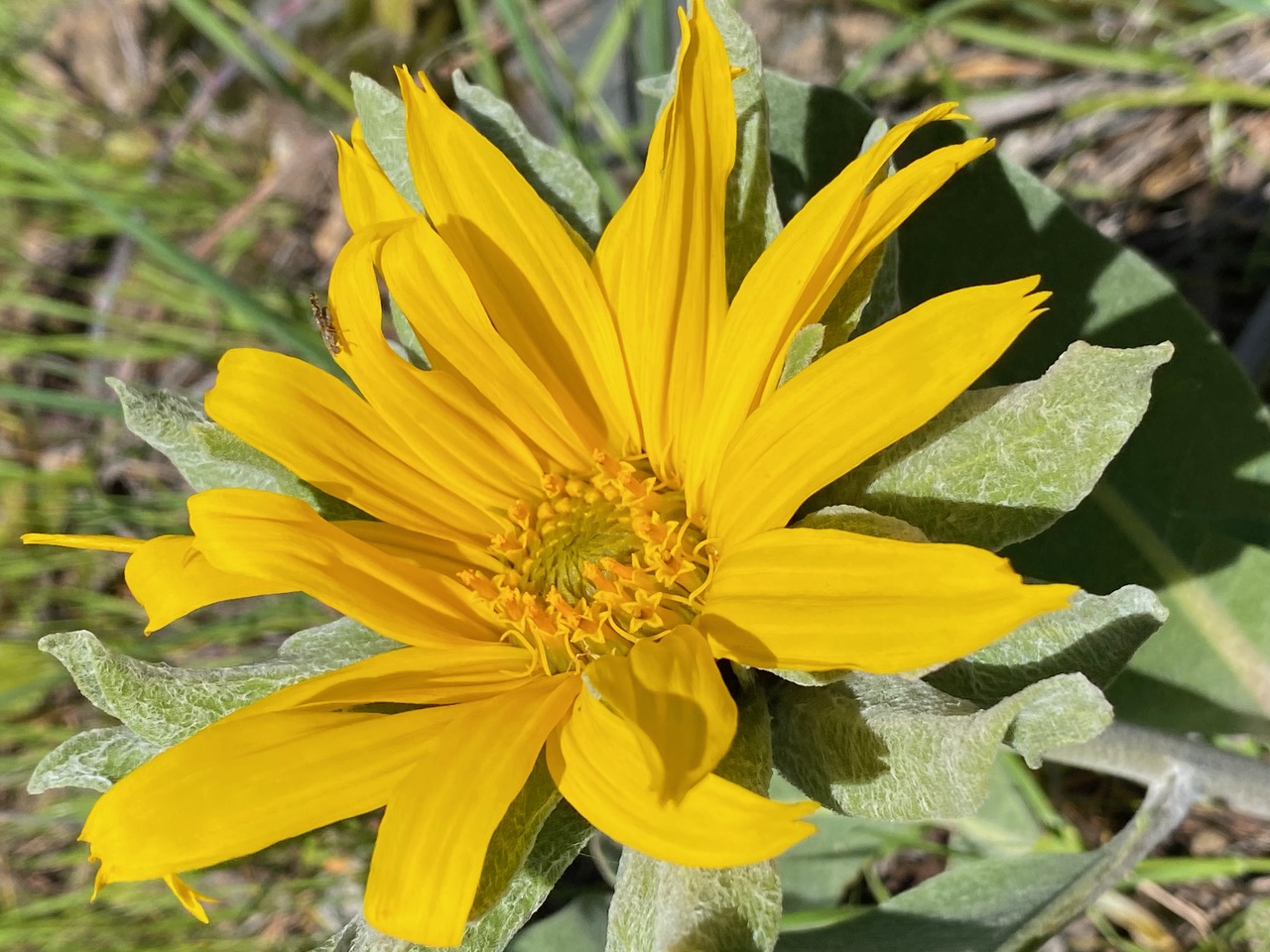
Here’s freshly opened flowerhead. It has already been claimed by a Fruit Fly – see the lone fly on the ray petal on the upper right? From past observations, I have discovered that these flies are rather territorial. Once a fly discovers an unoccupied flowerhead, it stays around persistently, performing wing displays to repel others and to attract members of the opposite sex. Often mating happens right in the center of the flowerhead, where I think the female lays her eggs among the flowers.
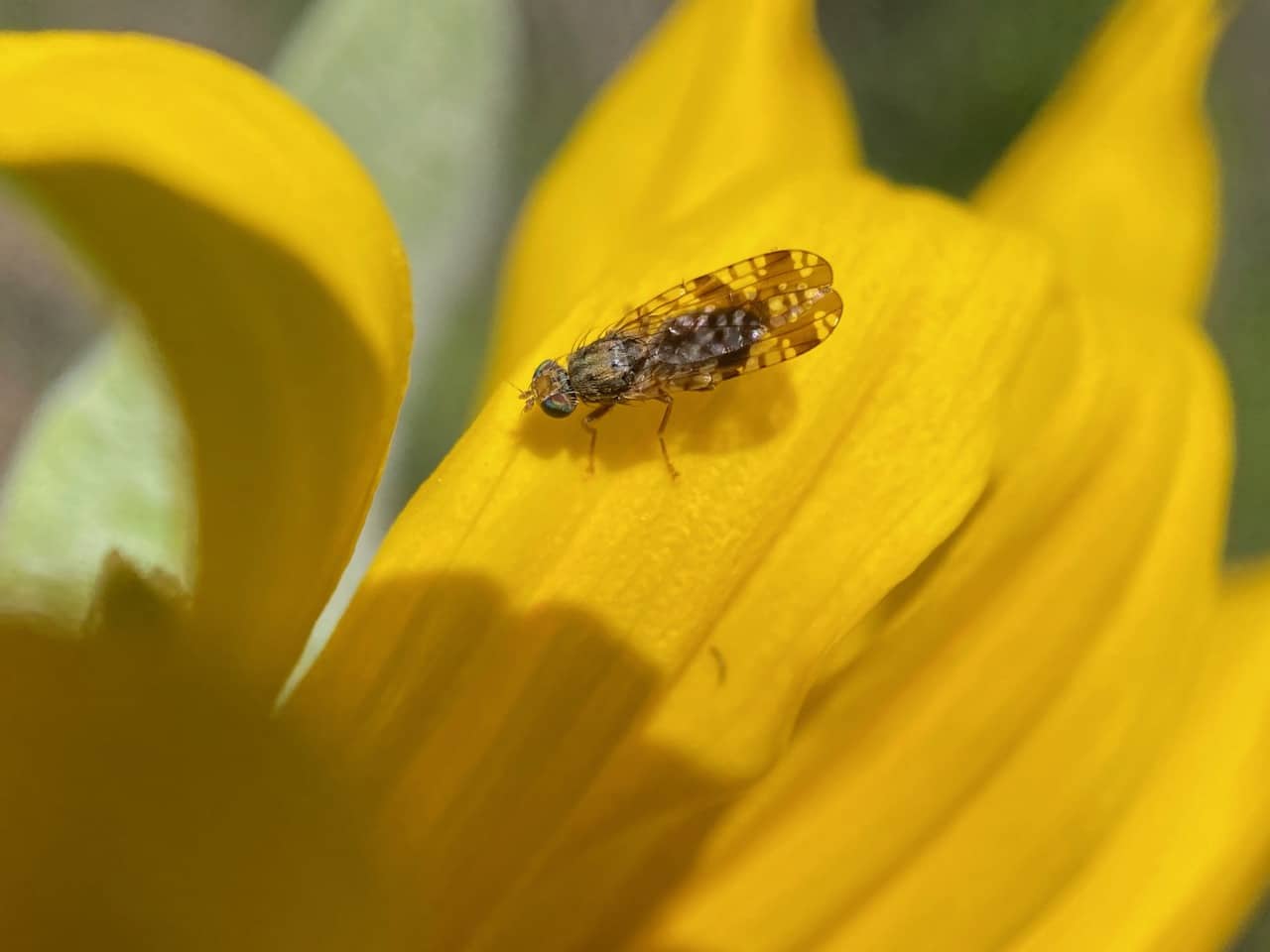
Close-up of the Sunflower Seed Maggot Fly. Since the wings are covering its abdomen, I can’t tell its gender. We’ll be seeing more of these flies as the Wyethia season progresses.
I decide to go up the hill above the road for a closer look at this spectacular display. This is likely the most showy species in this garden, with the biggest, brightest blooms.
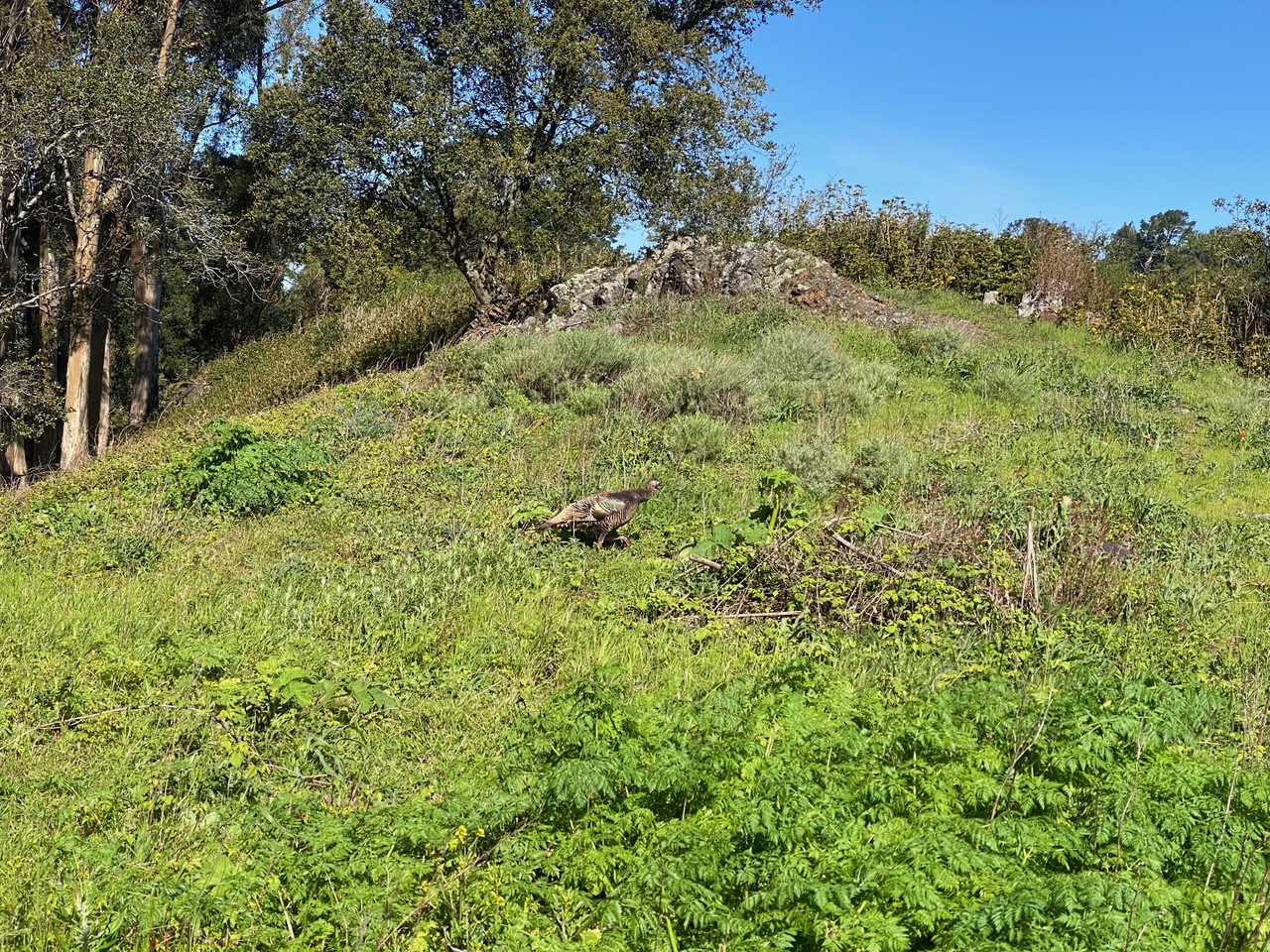
I have company up here! A female Wild Turkey is walking calmly among the plants, minding her own business. Encounters with two vertebrate wildlife species within minutes of leaving my car – it’s my lucky day!
The thorny branches of this large Gooseberry shrub, Ribes sp. is already festooned with numerous spiky berries. Alas, I have missed its charming little flowers and the bees that pollinated them. In this garden, the Gooseberry flowers are avidly visited by the Pacific Digger Bees, Anthophora pacifica (family Apidae), and sometimes a small black Mining Bee, Andrena sp. (family Andrenidae).
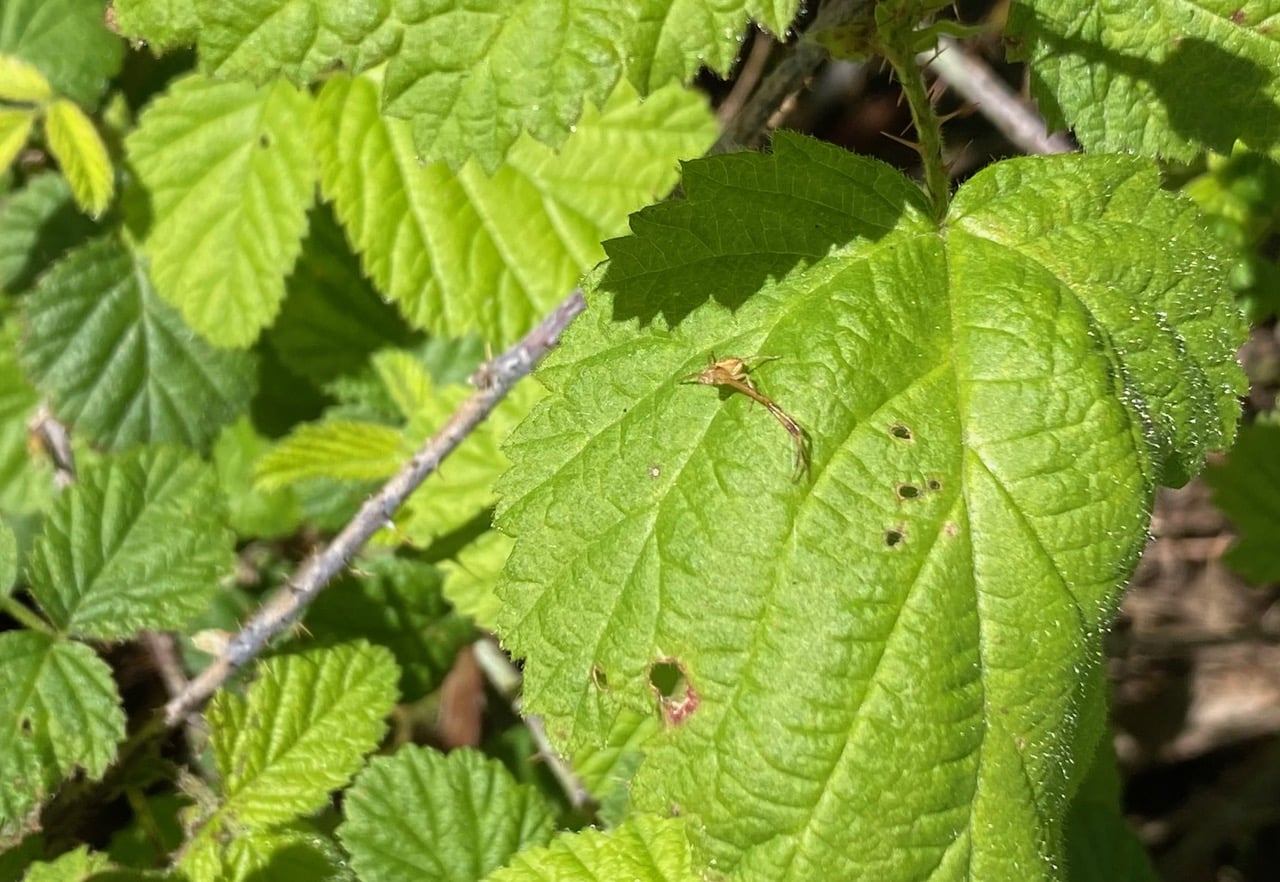
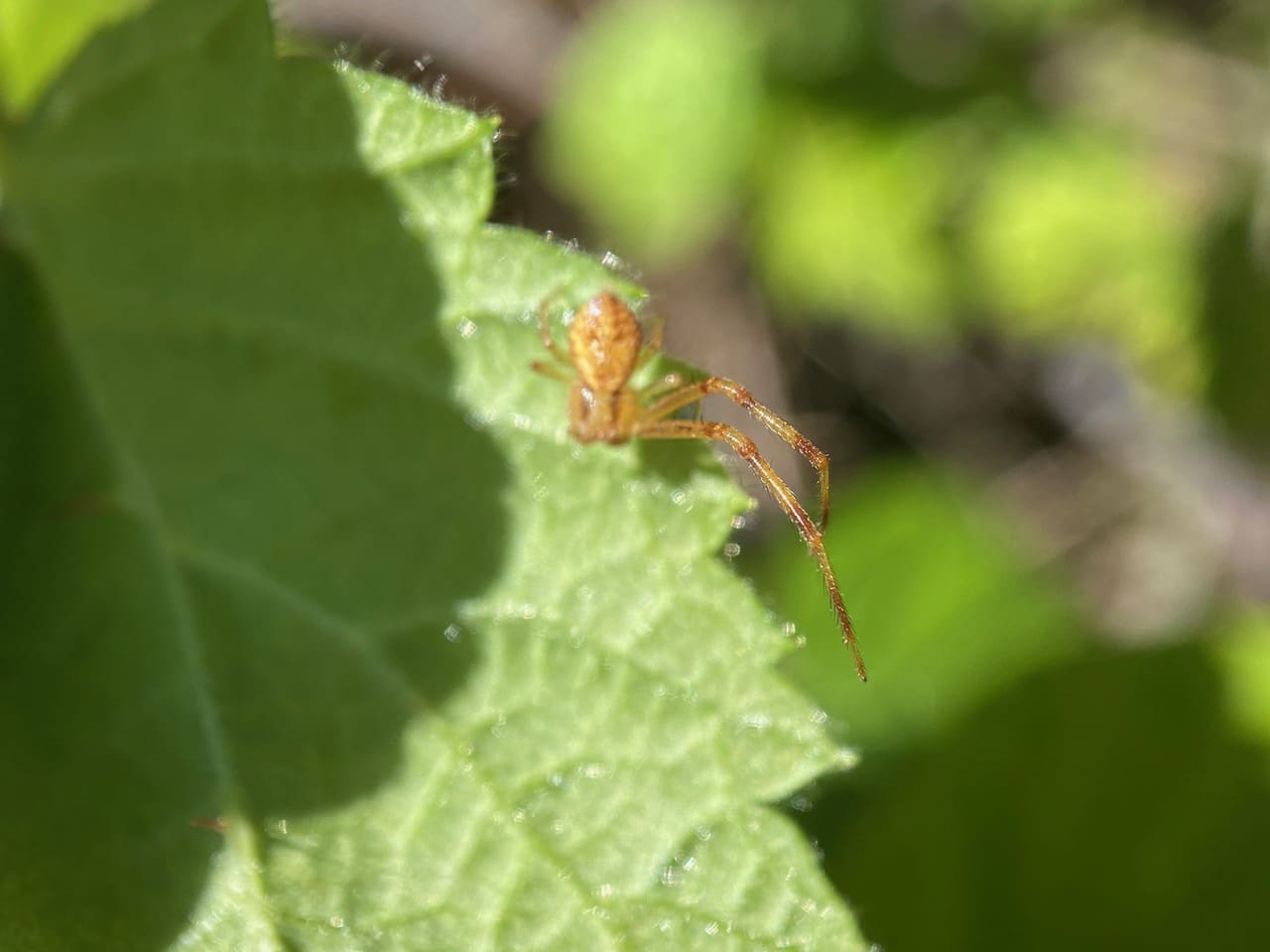
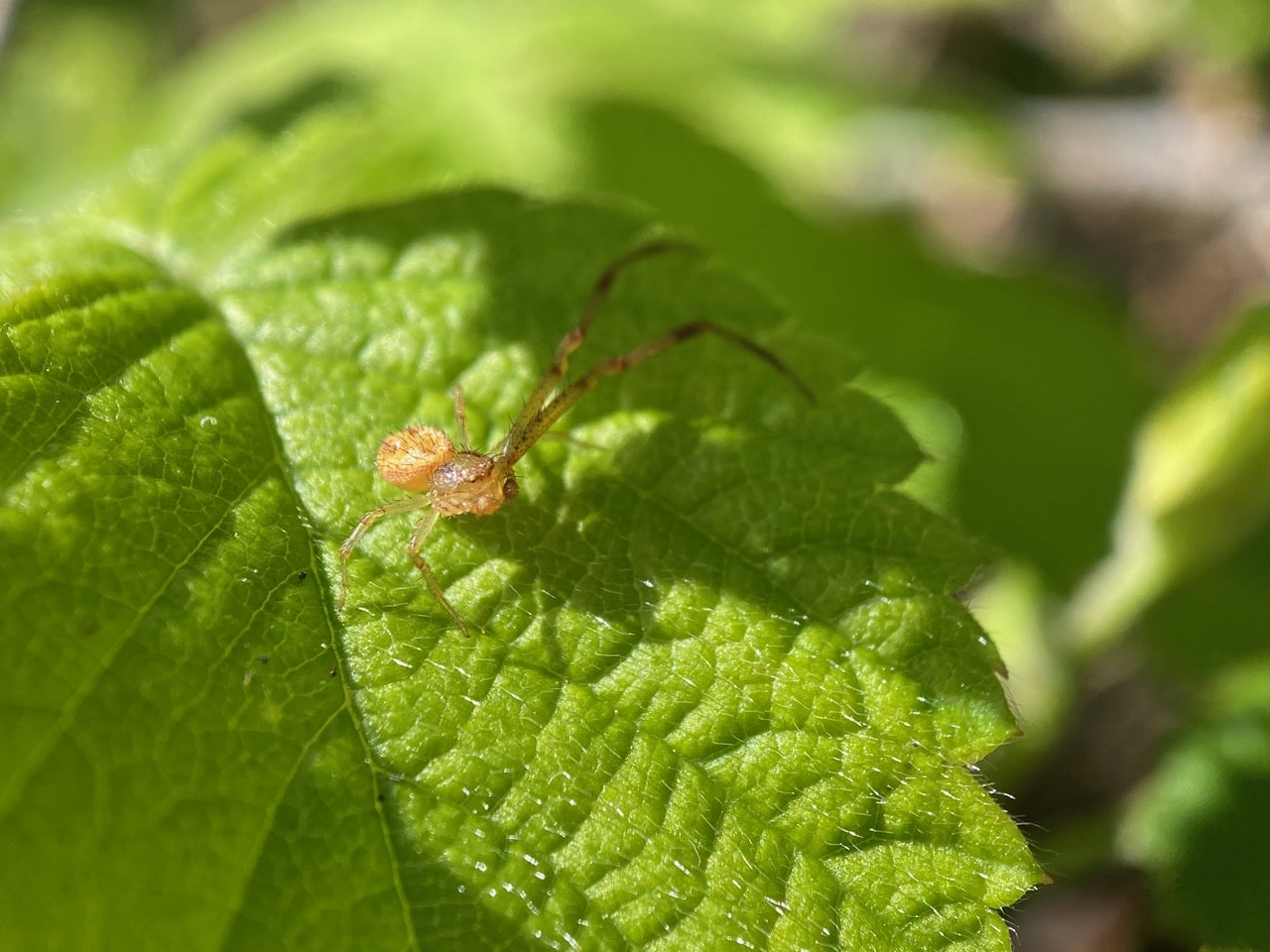
Wow, a tiny male Crab Spider (family Thomisidae) is stationed on a Blackberry leaf. What a startling and sad sight – it is completely missing its two right front legs!
Crab Spiders (family Thomisidae) do not spin webs, and are ambush predators. The two front legs are usually long and more robust than the rest of the legs. Their common name derives from their ability to move sideways or backwards like crabs. Most Crab Spiders sit on or beside flowers, where they grab visiting insects. Some species are able to change color over a period of some days, to match the flower on which they are sitting. Females are generally much bigger than the males. They are stationary and choose a flower to settle on, while males cover great distances searching for mates.
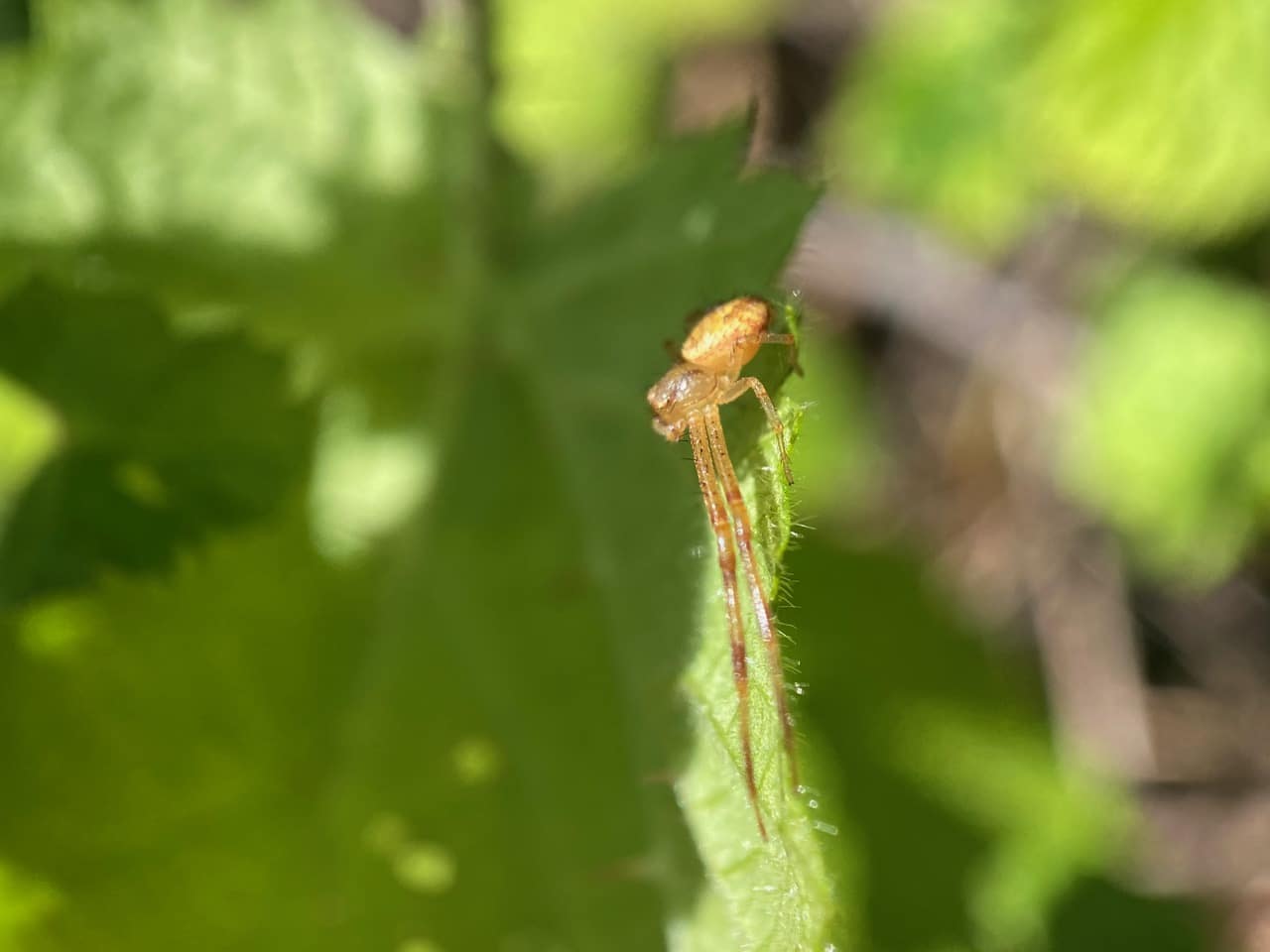
From this side view, I can see the spider’s extraordinarily long left front legs.
Ditto from this top view.
From the short bristles covering its body, I can tell that the spider belongs to the genus Mecaphesa (family Thomisidae). Will the spider be able to hunt with such a major handicap? After all, the front legs are used to grasp prey. Will he be able to regenerate those two missing front legs? Let’s pray that he is not yet an adult.
A spider’s body is covered in a hard outer skin known as an exoskeleton. As the spider matures it has to shed its skin to allow for growth. A spider can go through 20 or more molts before it reaches its full, adult size. Not only does the shedding allow for growth, but it also allows for regeneration. It a spider loses a leg, it is able to grow a new leg provided it still has at least one more molt left in its life cycle. In most species the new leg is thinner and shorter than the original leg. It can take two or three molts until the regenerated limb matches the original in appearance.
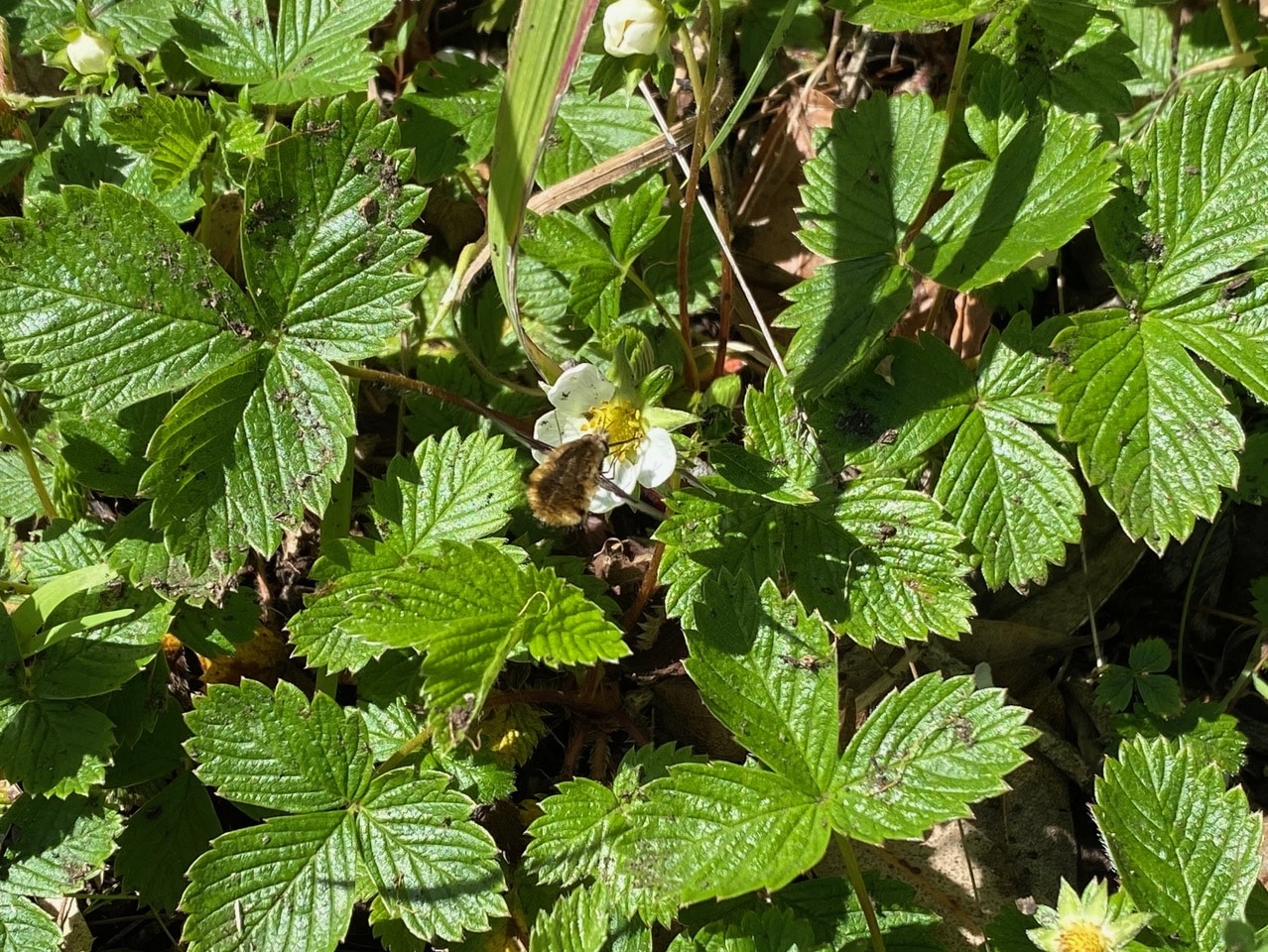
Its wings a blur, a Greater Bee Fly, Bombylius major (family Bombyliidae) is hovering over a flower of Woodland Strawberry, Fragaria vesca. I am rather surprised that it would forage on such open-faced, shallow flowers. The fly’s long proboscis is actually adapted for probing deep-throated flowers. I quickly turn on the video camera to record its behavior. Note that the fly sometimes supports itself on the flower on its long, skinny legs, while its wings are still beating. Its long proboscis is somewhat flexible while probing for nectar and pollen.
Bombylius major, commonly known as the Greater Bee Fly is a parasitic bee mimic fly in the family Bombyliidae. It derives its name from its close resemblance to bumble bees. Its flight is quite distinctive – hovering in place to feed, and darting between locations. The species has long skinny legs and a long rigid proboscis held in front of the head. Bombylius major is easily distinguished from the other local species of Bombylius for having wings with dark leading edge, hyaline trailing edge with sharp dividing border. This feature is visible even as the fly is hovering. Adults visit flowers for nectar (and sometimes pollen) from a wide variety of plant families, excelling at small tubular flowers, and are considered good generalist pollinators. Often the pollen is transferred between flowers on the fly’s proboscis.
The bee fly larvae, however, have a sinister side. They are parasitoids of ground-nesting bees and wasps, including the brood of digger bees in the family Andrenidae. Egg deposition takes place by the female hovering above the entrance of a host nest, and throwing down her eggs using a flicking movement. The larvae then make their way into the host nest or attach themselves to the bees to be carried into the nest. There the fly larvae feed on the food provisions, as well as the young solitary bees.
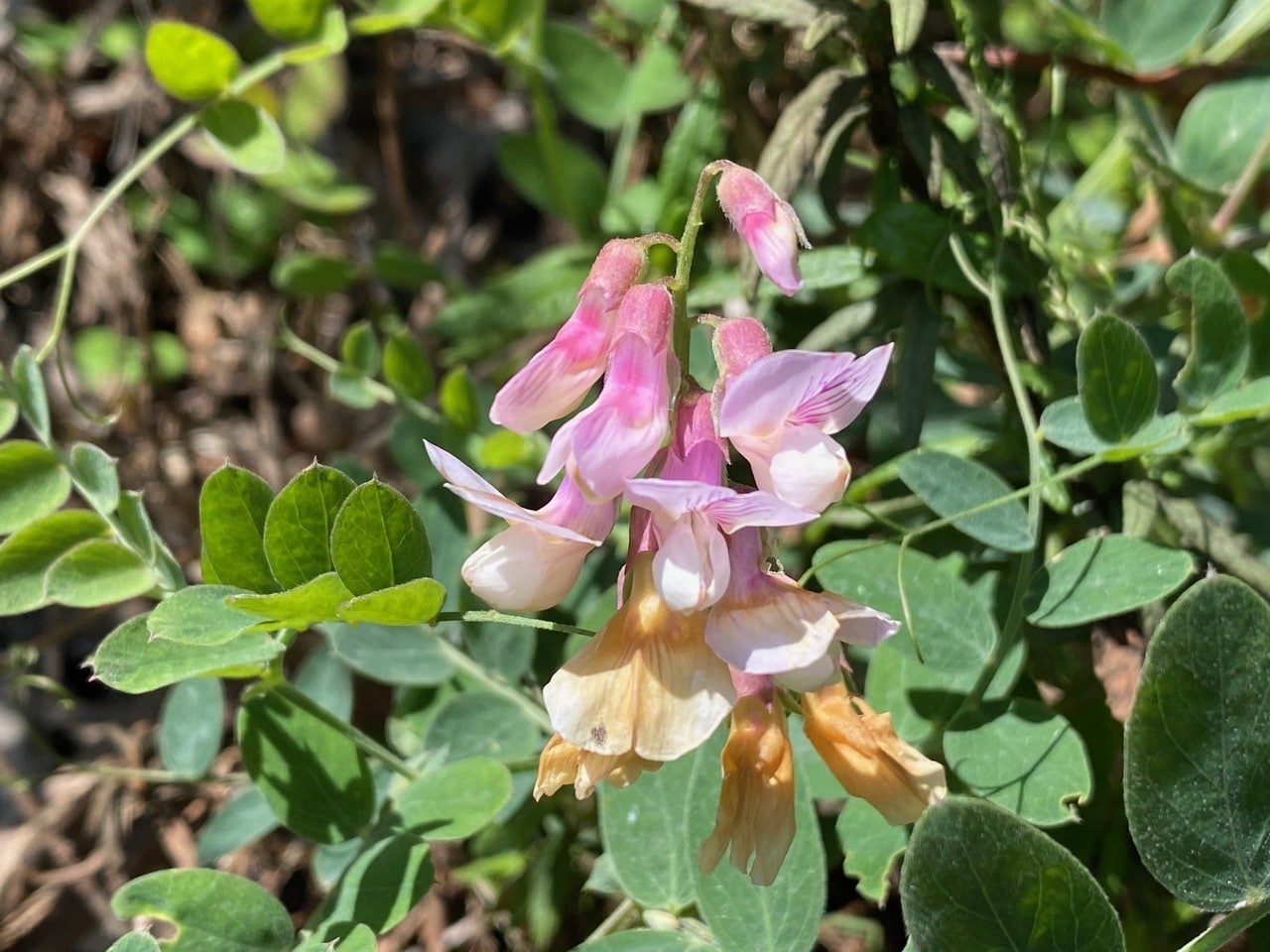
I am delighted to see an Anna’s Hummingbird probe a flower of the Pacific Pea, Lathyrus vestitus for nectar, but am not quick enough to snap a picture.
The Pacific Pea, Lathyrus vestitus is native to western North America, found mostly in the forests, woodlands, and chaparral of California. The perennial pea vine varies in appearance, ranging in color from bright violet, light to medium purple, or white. The grape-scented inflorescence is a showy array of up to 15 droopy pea flowers, sometimes densely packed together. The flower structure, with its banner, wings, and keel, is adapted to facilitate pollination by insects, notably bumble bees. Butterflies and moths who visit for nectar may also contribute to pollination. While insects are the primary pollinators, Pacific Pea can also be self-pollinated. The Pacific Pea is a host plant for certain butterfly larvae, such as the silvery blue and northern cloudywing.