

Pollinator Post 4/2/24 (1)
Another day to seek shade. The West Ridge Trail between the Waterloo and the Skyline Staging Areas in the Oakland hills beckons to me.
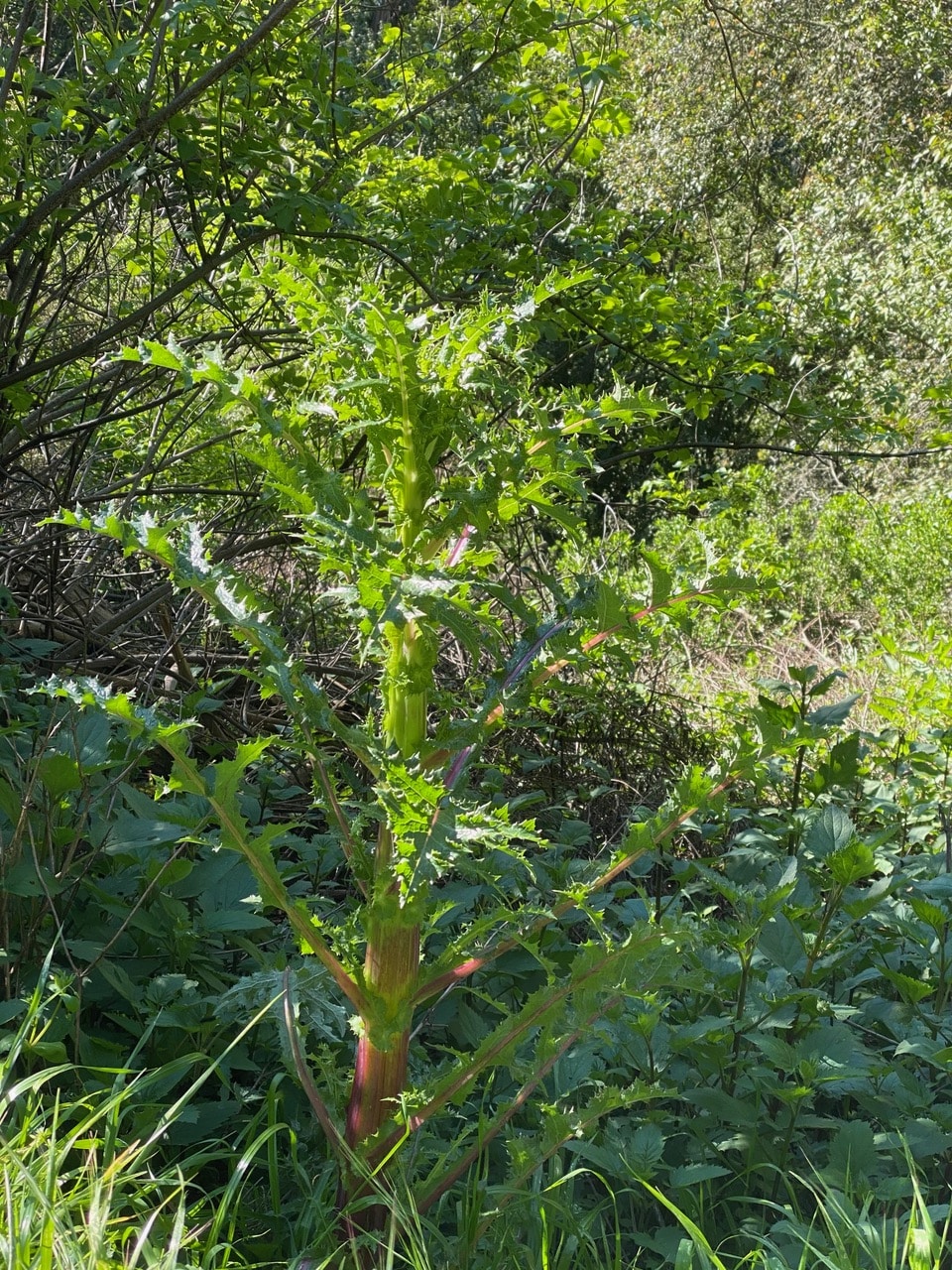
Huge Sow Thistles, Sonchus oleraceus have grown up in the areas cleared of brushes last year. Some of them have stems the diameter of my arm!



 Here’s looking at her straight on. See her pair of black chelicerae held under her face? Chelicerae of spiders are articulated fangs, hollow and connected to venom glands, used to inject venom into prey.
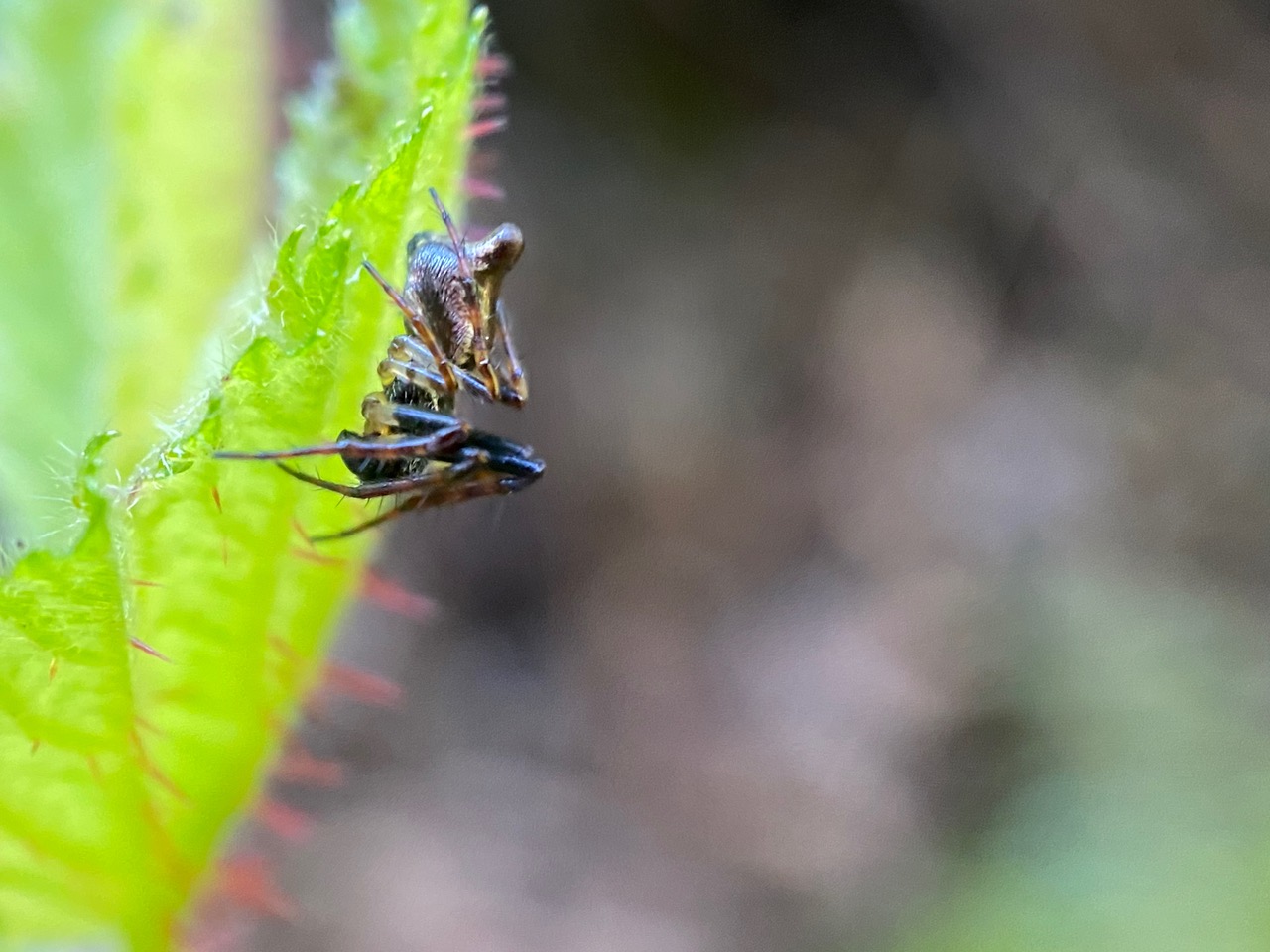 Later, I spot another male on the back of a Blackberry leaf. I have never seen so many males of this species. This must be their mating season when the males are out and about in search of mature females.


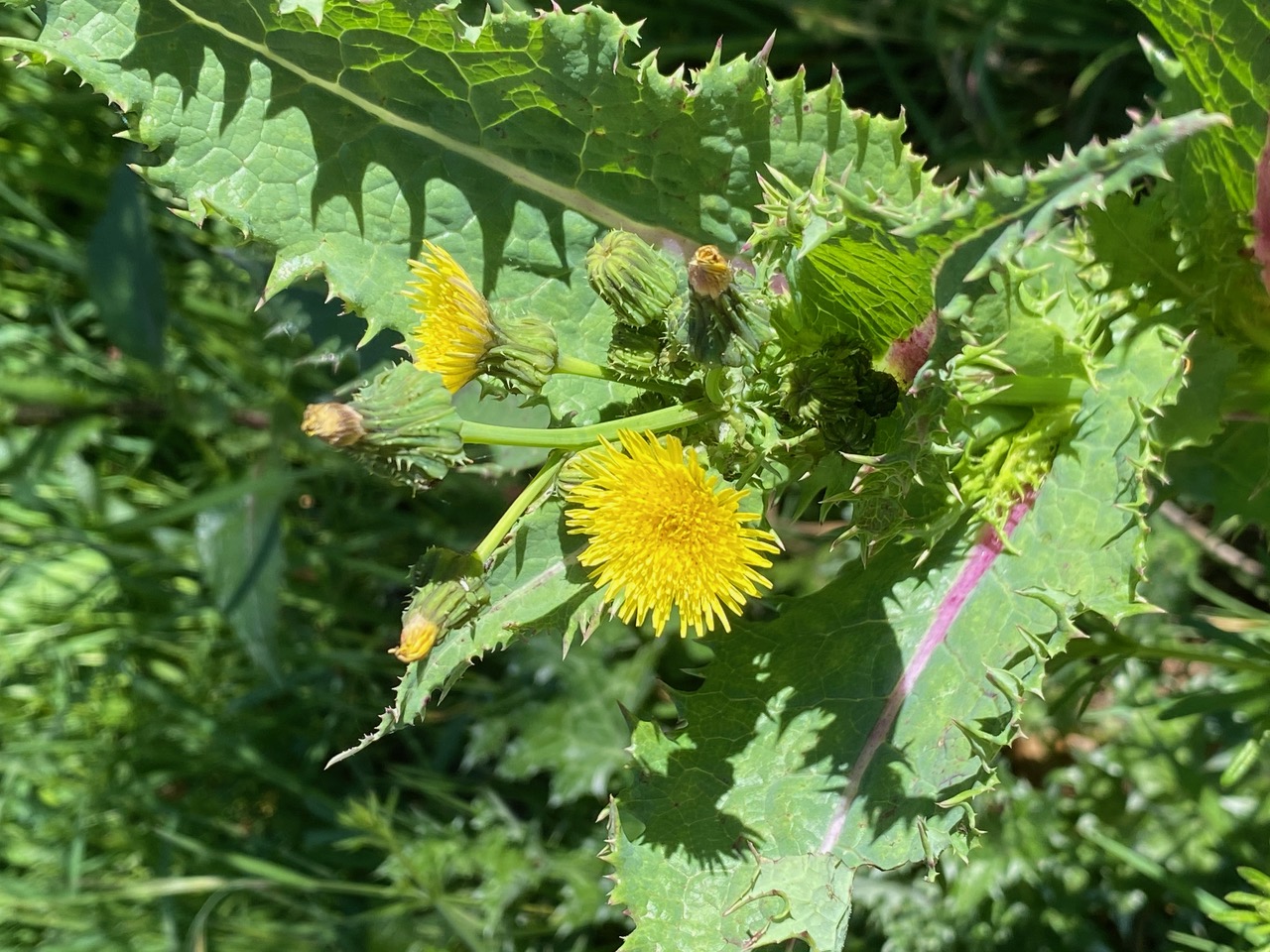
This Sow Thistle has started to bloom. The plant is not a real “thistle” – it has all ray flowers. The flowerheads look like dandelions on steroid.
The annual plant is native to Europe and Western Asia, and is considered an invasive species in many parts of the world, where it is found mostly in disturbed areas. The plant produces thousands of seeds (as much as 25,000 per plant) and each one of them has a 90% chance of germination. Eaten raw or cooked, the edible leaves are used by many traditional cultures worldwide.
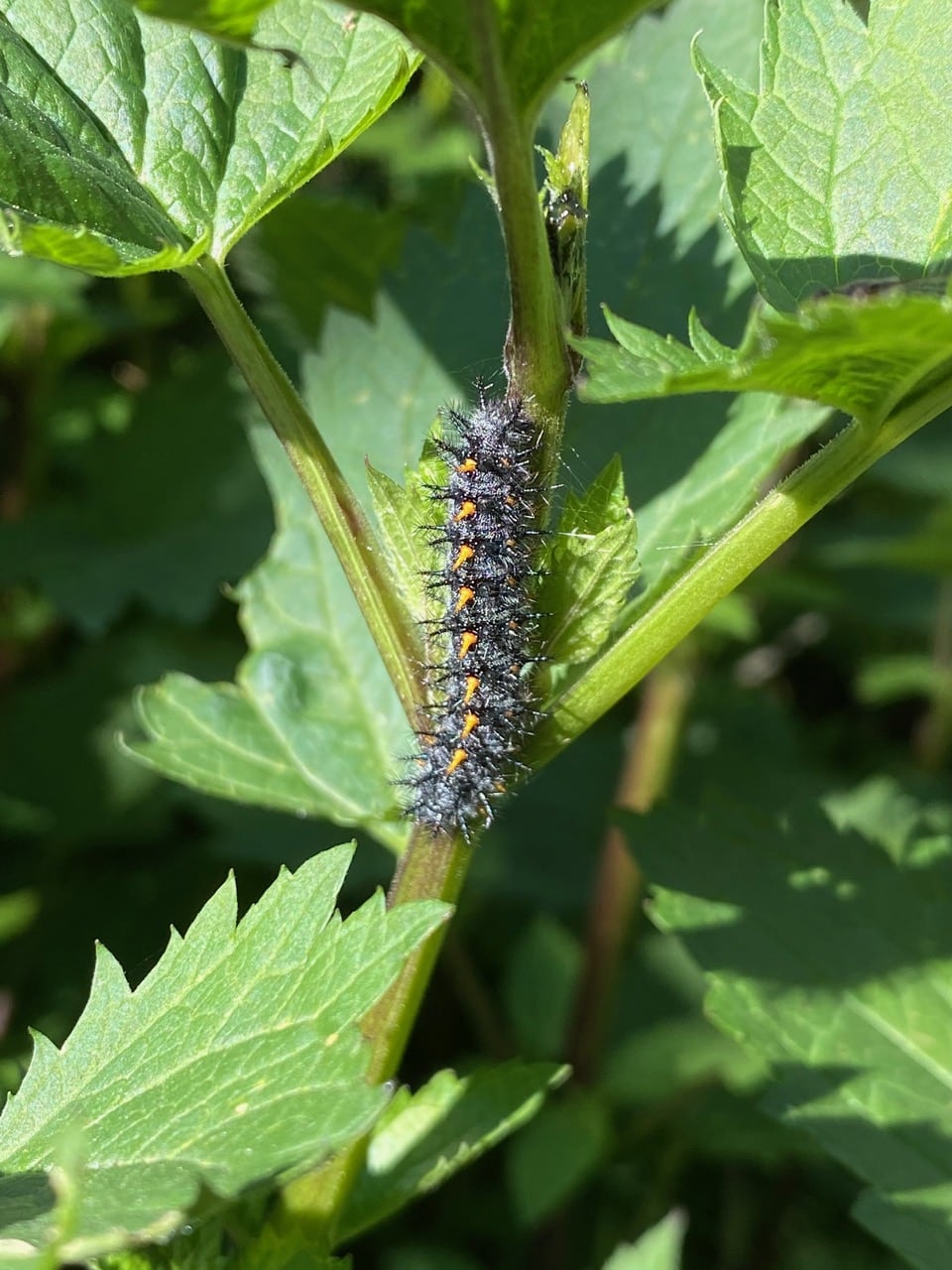
A robust stand of the California Bee Plant, Scrophularia californica is host to a few caterpillars of the Variable Checkerspot butterfly, Euphydryas Chalcedona (family Nymphalidae). These are some of the most mature caterpillars I have seen this year, almost ready to pupate.
Although the caterpillars feed on a wide range of plants, they seem to gravitate to the Bee Plants and the Sticky Monkeyflower, Diplacus aurantiacus. These plants provide the caterpillars with iridoid glycoside, a chemical that imparts unpalatable taste to birds, protecting the caterpillars from predators. Young larvae feed in large, loose groups on the host plants. They enter diapause (hibernation) in sheltered sites under bark or dead branches, in hollow stems and in rock crevices. Pupation begins in early to mid April and the adult flight season begins between mid-April and May and continues into June. The adults feed exclusively on nectar, and have a life span of about 15 days.
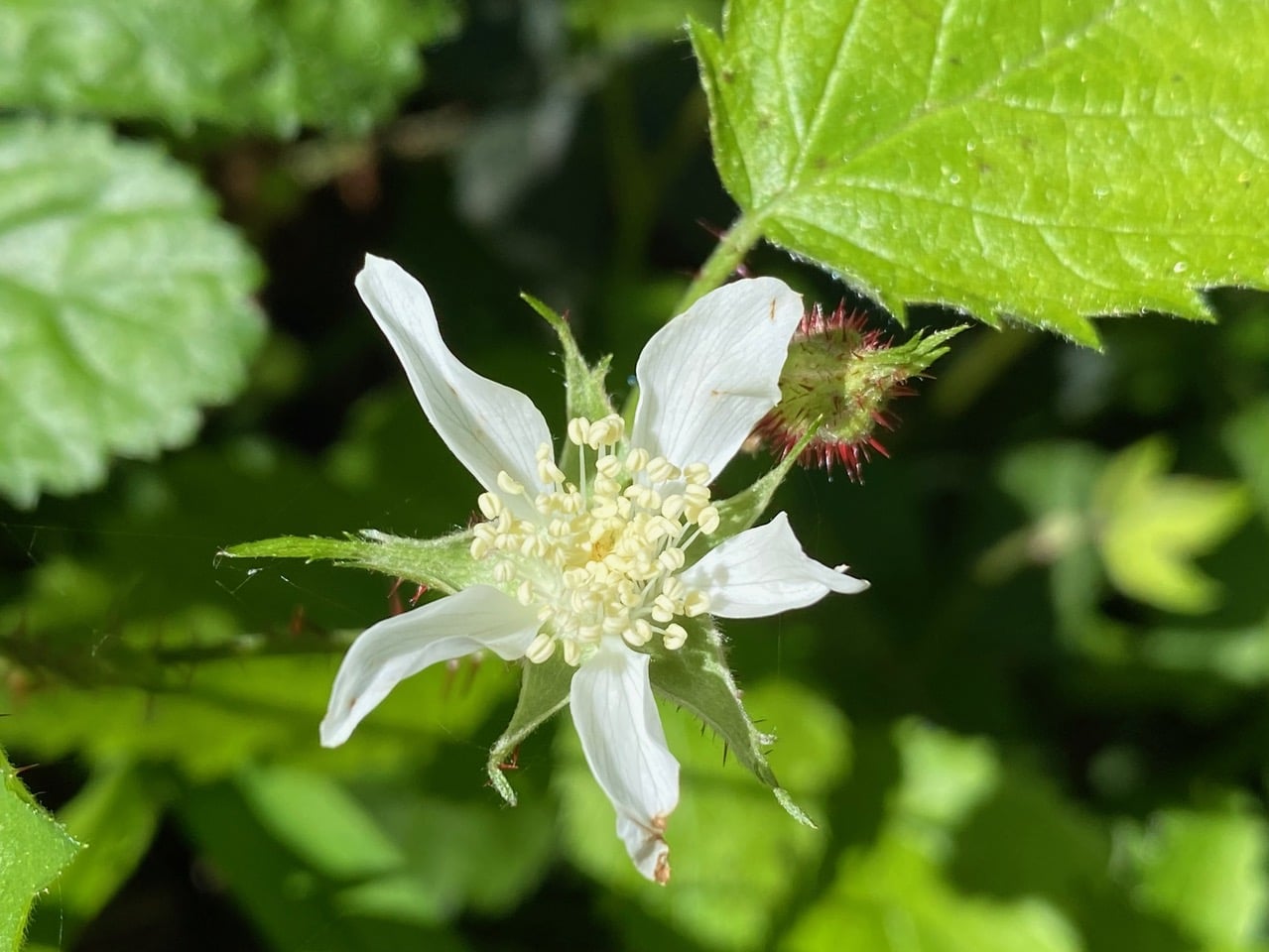
A fresh male flower of the California Blackberry, Rubus ursinus greets the morning sun. The plant is dioecious, male and female flowers are borne on separate plants. The center of male flowers is packed with numerous stamens, while the female flowers have pistils instead.
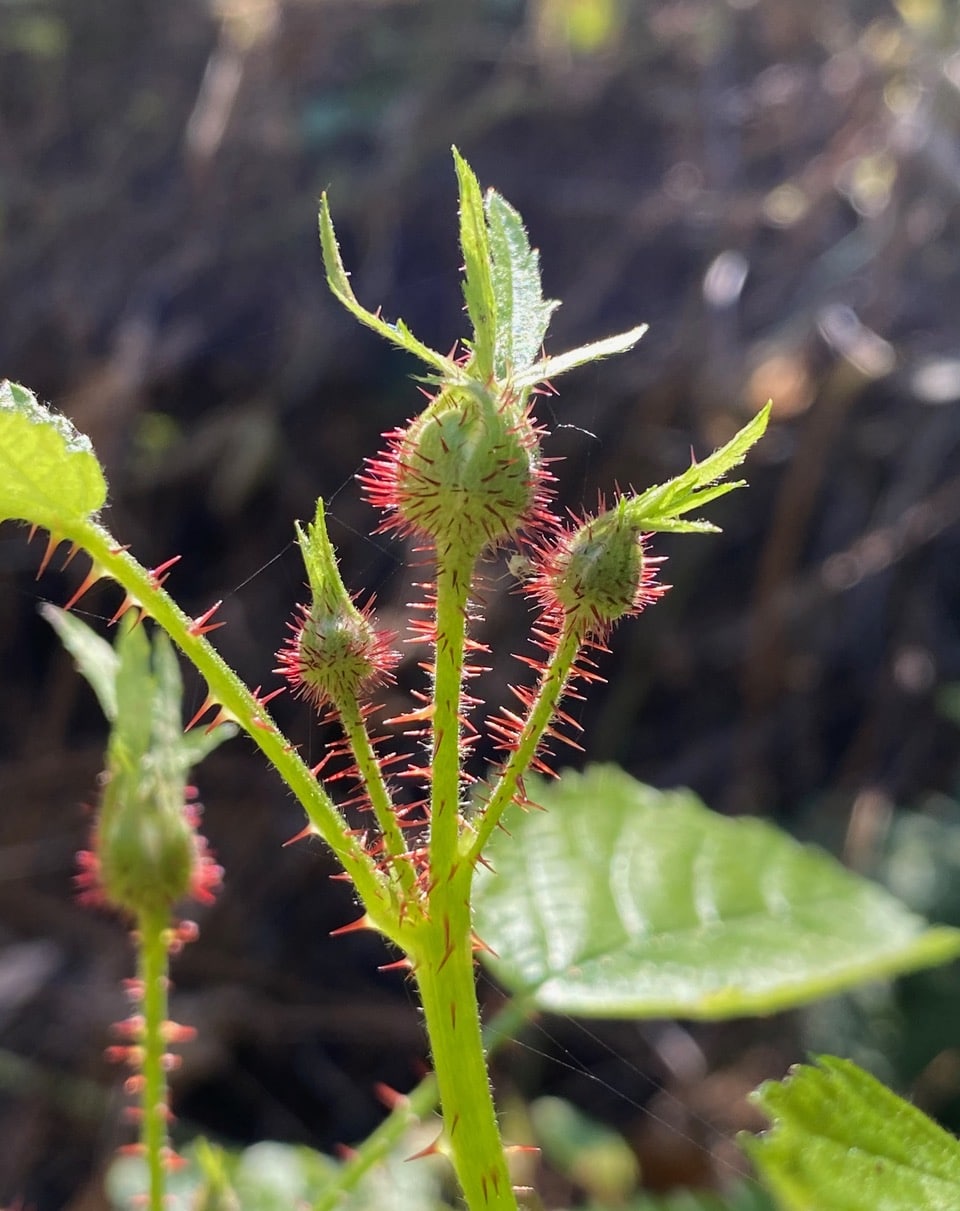
Pretty red thorns on the California Blackberry stems and flower buds are highlighted by the morning sun.
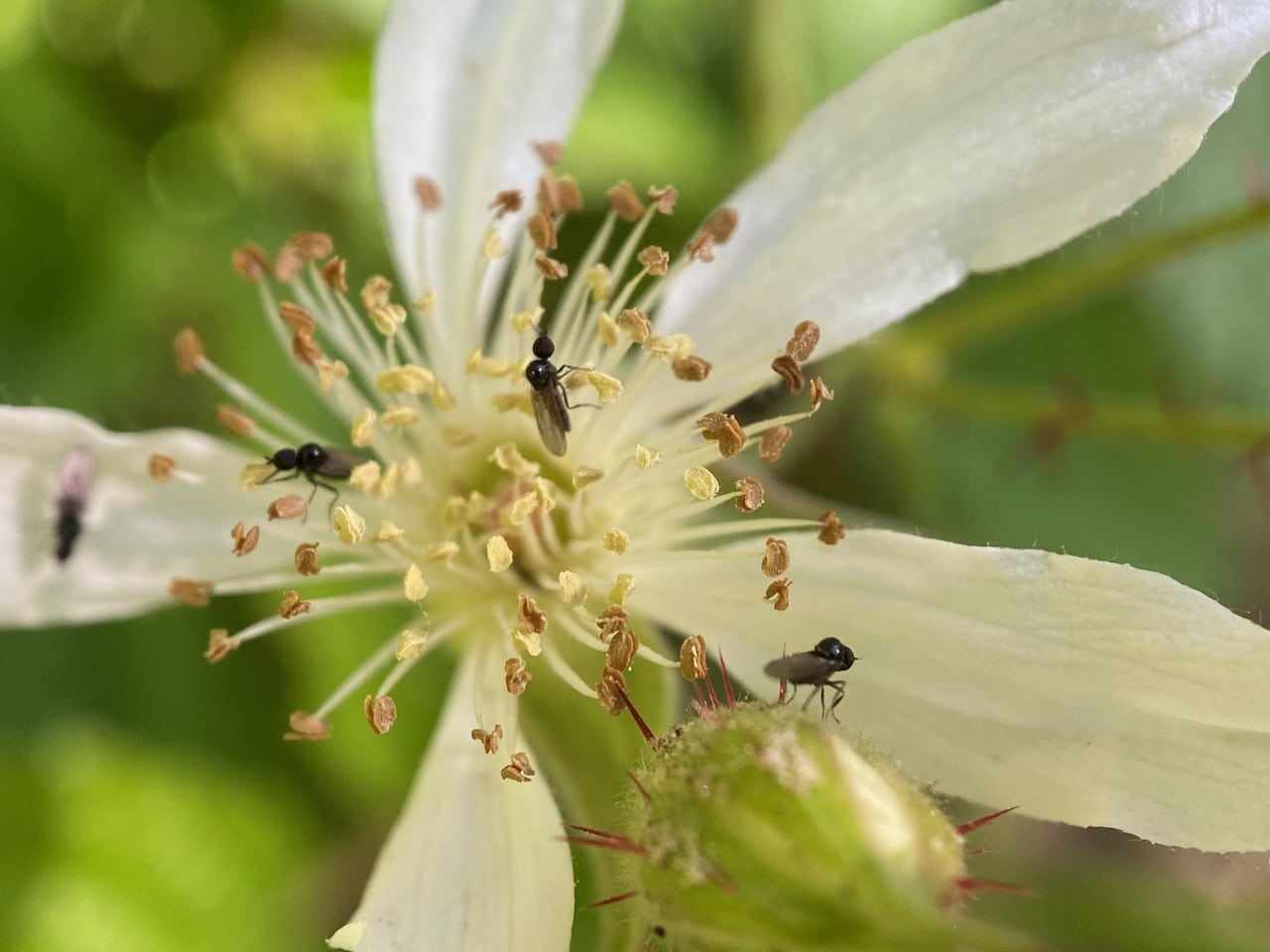
Some Hybotid Dance Flies (family Hybotidae) are foraging on a fading male California Blackberry flower. The stamens mature from the outside in, the anthers turning brown as they are emptied of pollen. Are the dance flies effective pollinators for the plant?
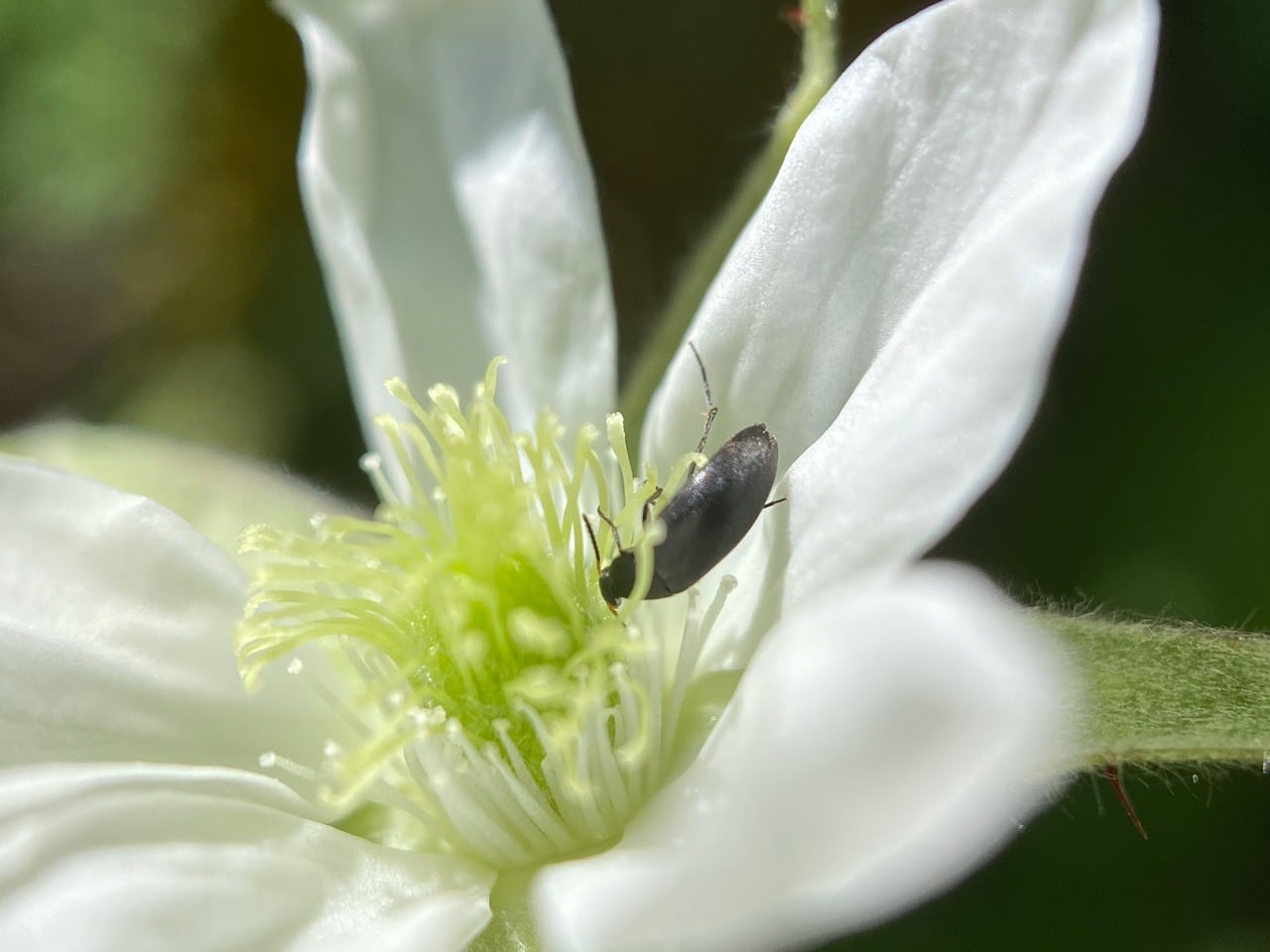
A Soft-winged Flower Beetle, Listrus sp. (family Melyridae, subfamily Dasytinae) is foraging among the pistils of a female California Blackberry. I wonder what it is looking for – there is no pollen here.
Most species of Melyridae are various shades of brown or black and just 2 to 4 mm in length. They are sometimes very abundant in spring when there is an abundance of open flowers, particularly those with an abundance of pollen. In north America, dasytine beetles are hardly represented in the east, but are enormously diverse in the west, especially in California.
11 families of Coleoptera (beetles) are known to pollinate flowering plants. In western North America, the 300+ species of the beetle subfamily Dasytinae are commonly found on flowers, where adults feed on both nectar and pollen. Their dense setae (hairs) often trap pollen grains, which are transported to other flowers during the course of normal feeding. Many dasytine beetles form large feeding aggregations.
Ooh, is the beetle feeding on the stigmas?
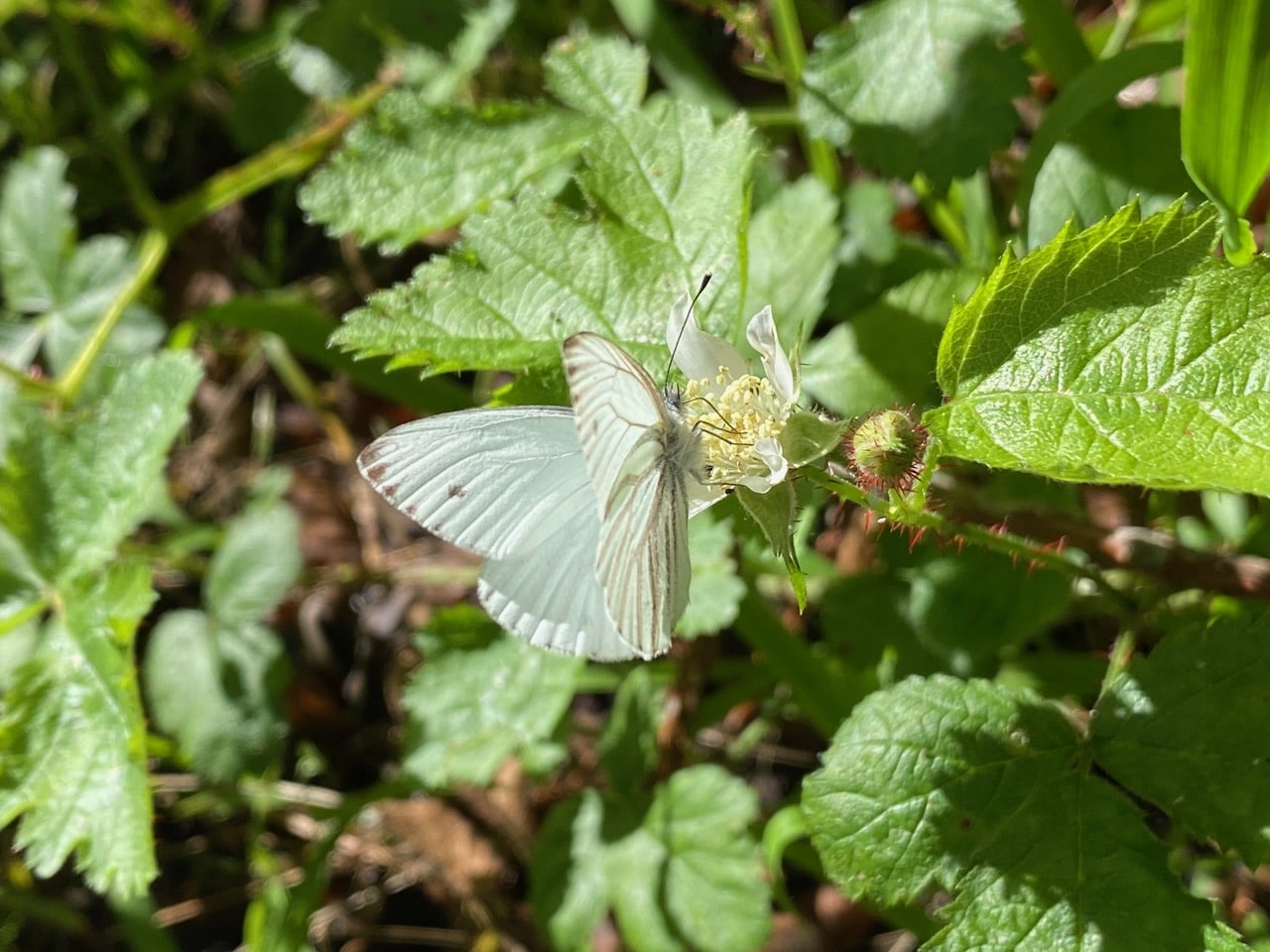
A male Cabbage White butterfly lands on a male California Blackberry flower. Note the long, flexible proboscis that it is using to probe for nectar. (The sexes of the butterfly can be distinguished by the black spots on the forewings – males have a single spot, while the females have two.)
The cabbage white, Pieris rapae (family Pieridae) was introduced to the US along with European cabbage imports in the 1860’5. The caterpillars feed on plants in the mustard or Brassicaceae family, and occasionally some in the caper family. The butterflies have a darkened, yellowish underside of the hind wings, which enables them to heat up quickly in the sun. The butterfly’s white wings reflect ultraviolet light, which we can’t see but the butterflies can. To our eyes the butterflies seem plain and drab, but to each other, females are a gentle lavender and males shine with a deep royal purple. Brighter males are more attractive to females and the color’s strength reflects the amount of protein the males consumed as caterpillars. During mating, male butterflies transfer nutrients to the females in the form of infertile sperm, a nuptial gift which will enhance the female’s life expectancy and fertility. A male with a higher quality diet can afford to be brighter and to produce bigger and more nutritious nuptial gifts.
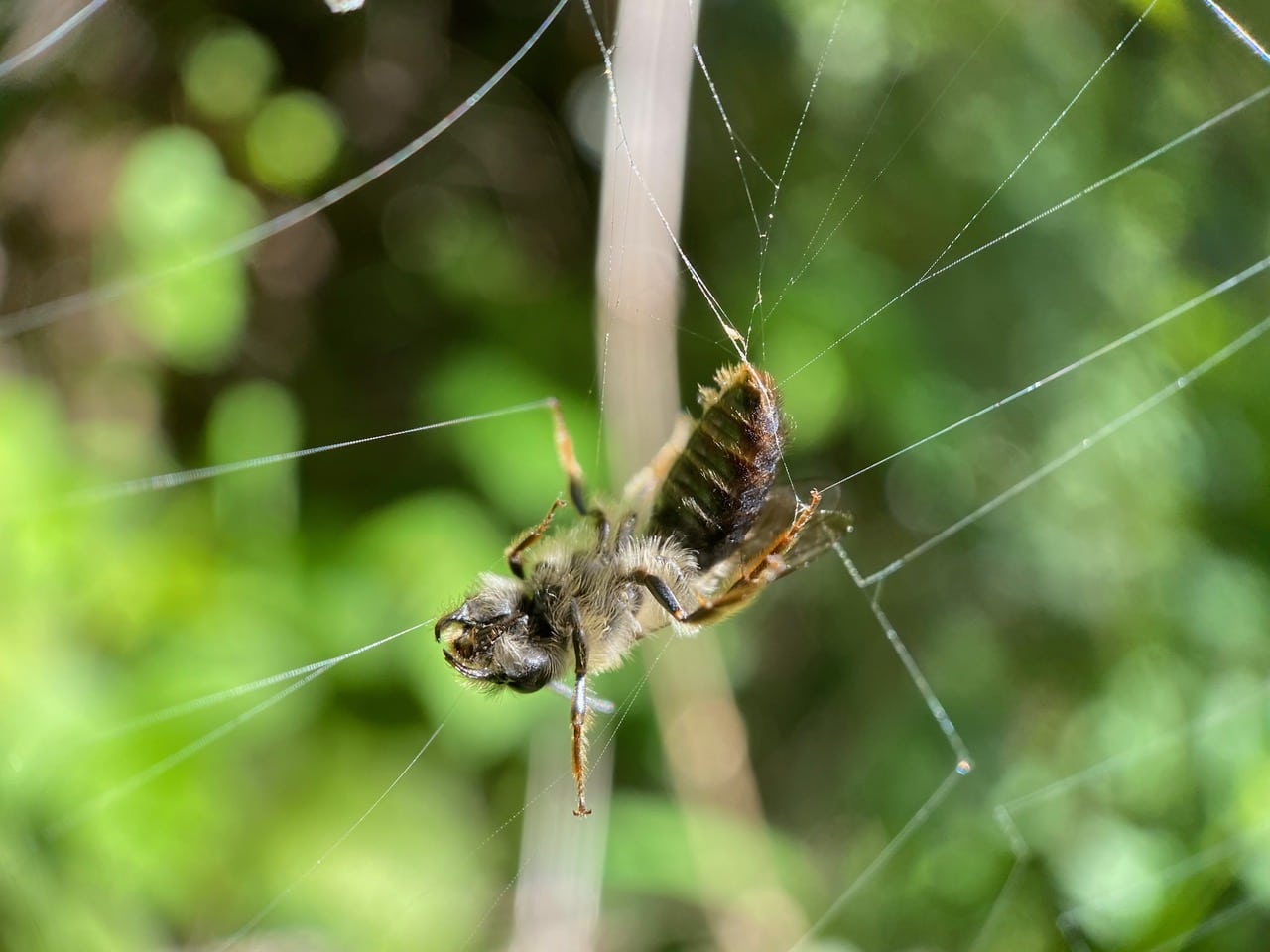
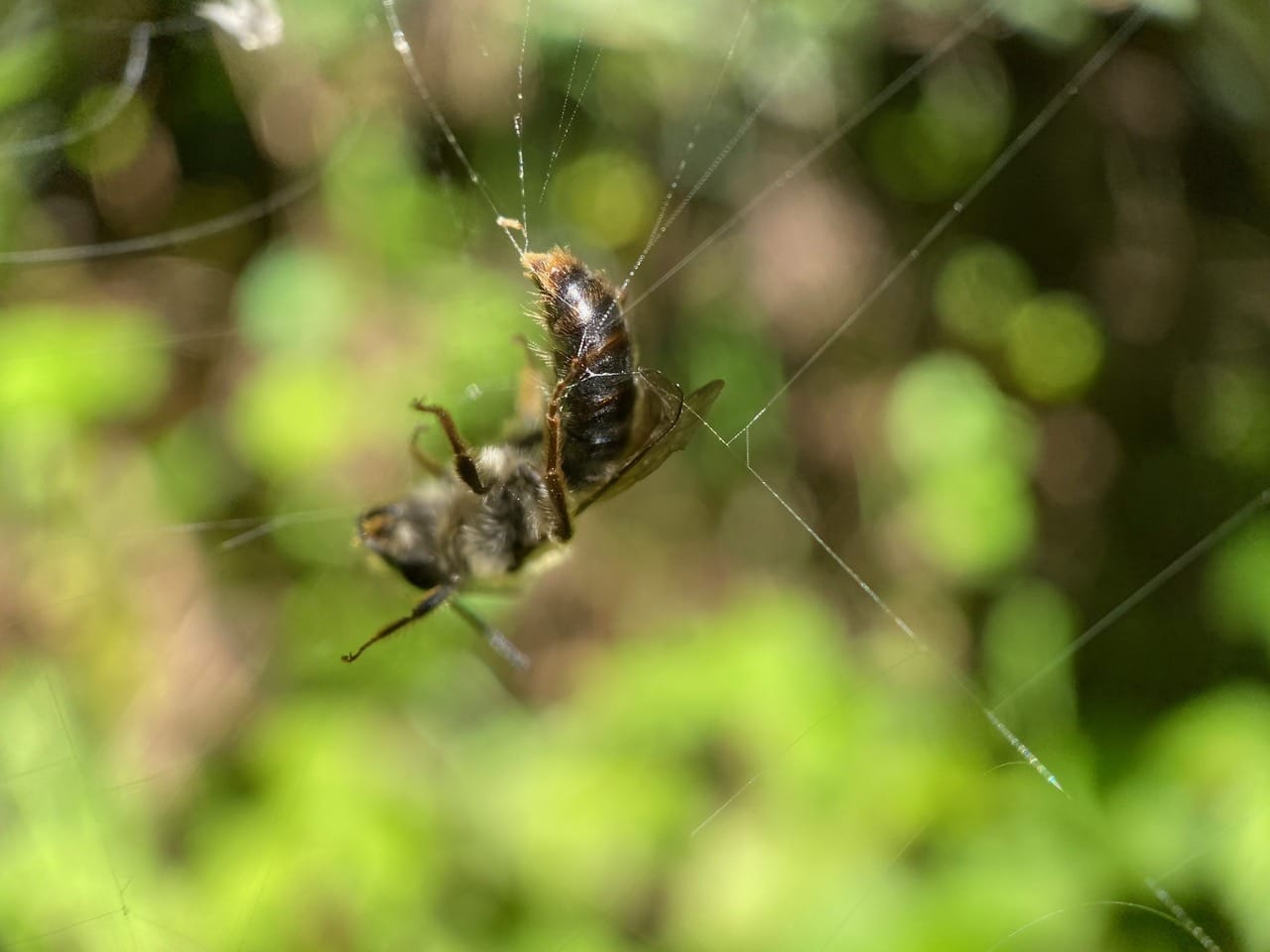
I pause at the sight of a large orb web in the brushes. There’s no spider on it. I wonder of the owner is hiding somewhere on the vegetation close by waiting to rush out when an insect is entangled in the web. Before I could finish my thought, an insect flies straight into the web.
I close in to find out who the unfortunate insect is. It is struggling mightily to free itself, but I finally manage to identify it – it is a Mining Bee in the family Andrenidae. It has a black abdomen and a buff-colored, hairy thorax.
Without much thought, and keeping an eye out for any approaching spider, I reach into the web with my finger and scoop out the little bee. It clambers onto my finger for a second, and flies off, none the worse for wear. No spider appears – good, I hate to think that I have deprived it of a meal.
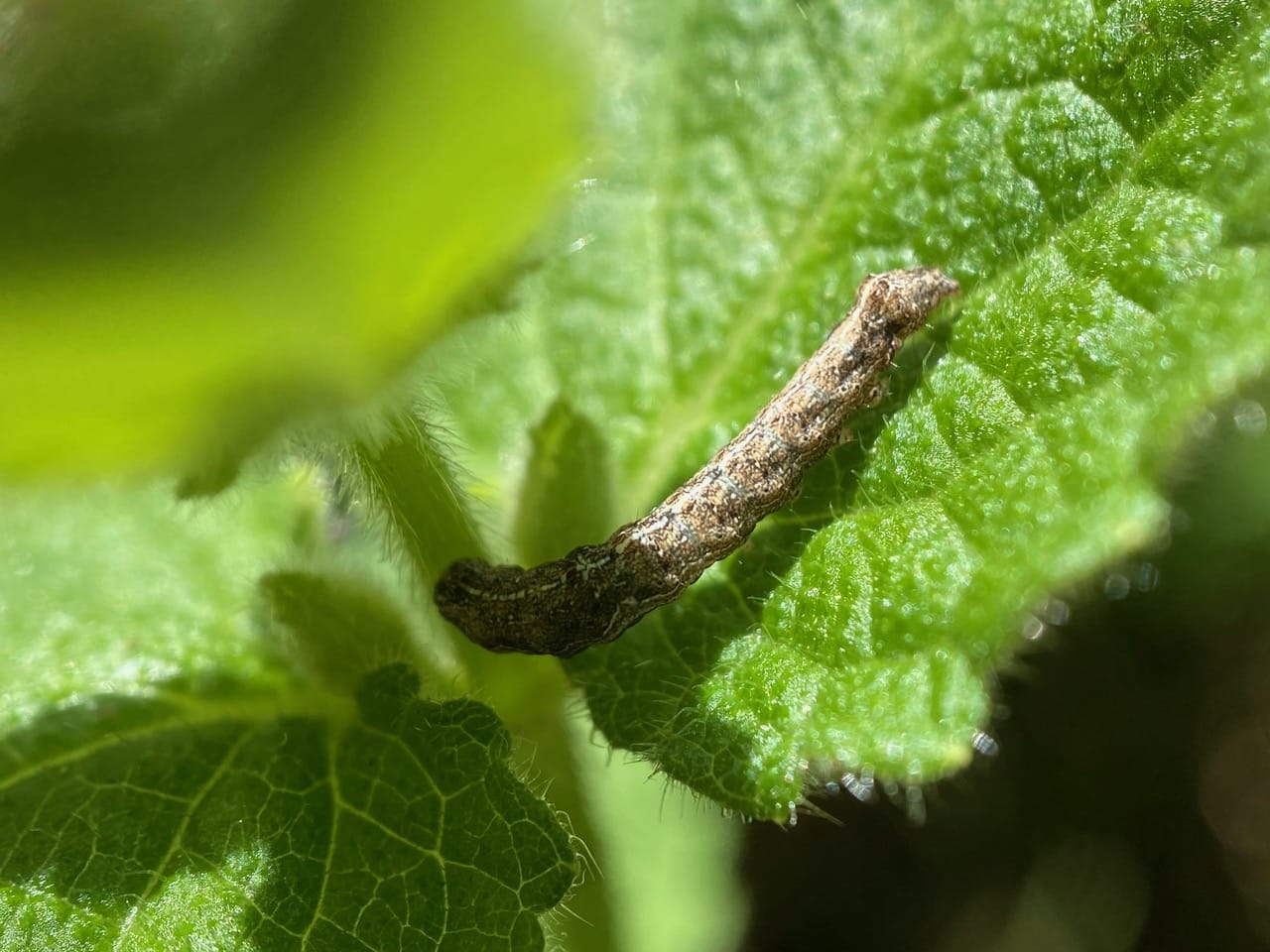
Something that looks like a bit of plant debris resting on a Wood Mint leaf turns out to be a small brown caterpillar on closer inspection. Probably some kind of moth?
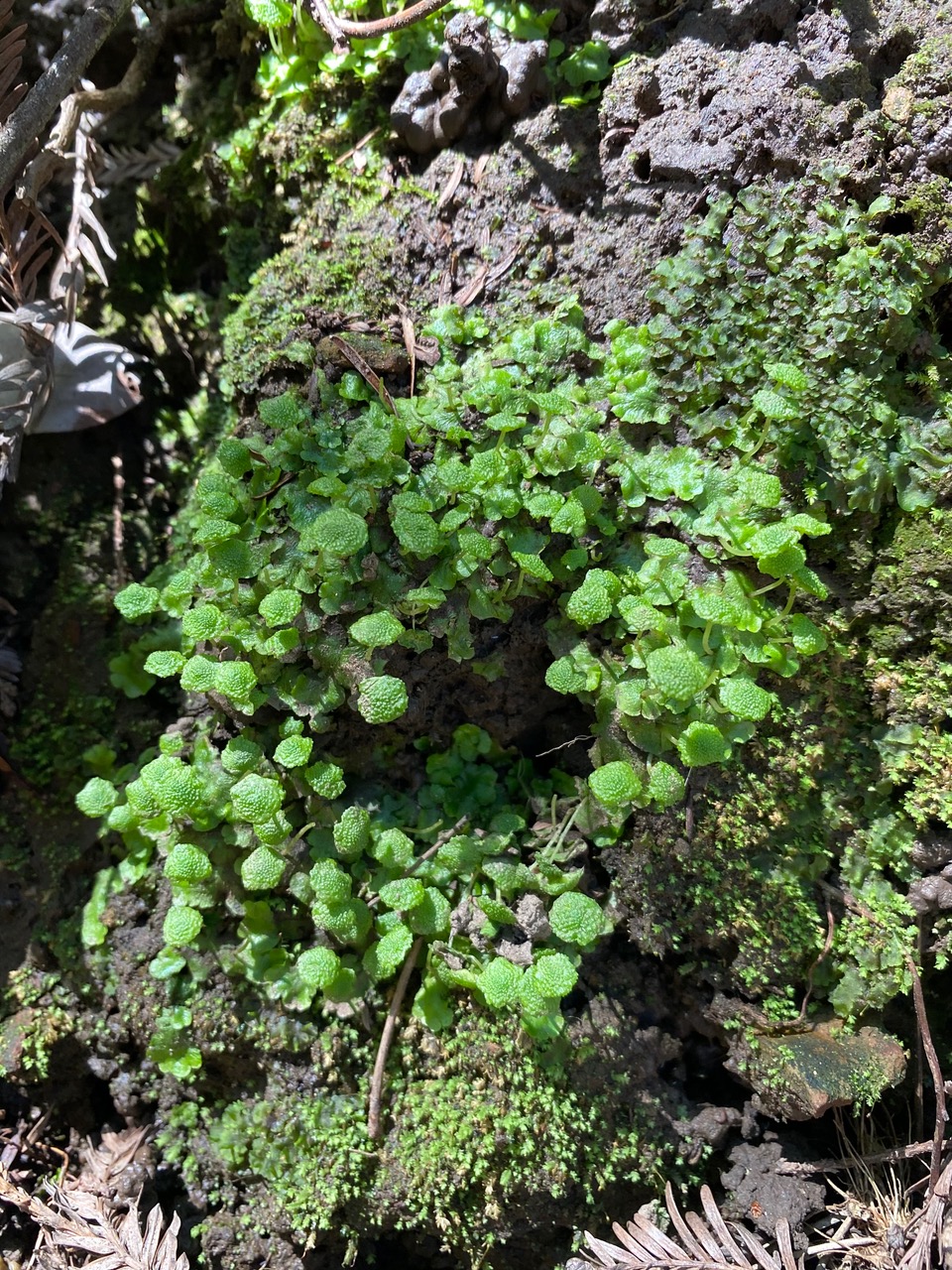
On the damp bank of the trail, I spot something whimsical – little green umbrellas growing from some tiny liverworts on the soil. iNaturalist has helped identify it as Cryptomitrium tenerum, a member of the Complex Thallose Liverworts (order Marchantiales).
The little umbrella-like structures are the sexual part of the plant’s life cycle. At certain times liverworts develop little umbrella-like structures at the edges of their flat thalli, called receptacles. About 80% of liverwort species are dioecious, having male and female receptacles on separate plants. Cryptomitrium tenerum belongs to the other, monoecious group that have both male and female receptacles on the same thallus. When a male plant’s sperm reach a female plant’s eggs, a zygote is formed, and then an embryo. The embryo then develops into a capsule filled with spores. Eventually the capsules will rupture to release spores. If a spore happens to land where conditions are just right, it will germinate into a liverwort.
Cryptomitrium tenerum is a species of liverwort native to North America. It has a flat, dichotomously branched thallus. The species occurs in Mediterranean climates with cool, wet winters and dry summers and forms small to locally extensive mats on bare and usually shaded, humid soil on hillsides, rock outcrops, and stream banks. It usually reaches its best development in February or March, depending on the amount and distribution of the winter rainfall. During the long rainless season the plants dry up, the tips reviving and giving rise to new plants with the return of the autumn rains.
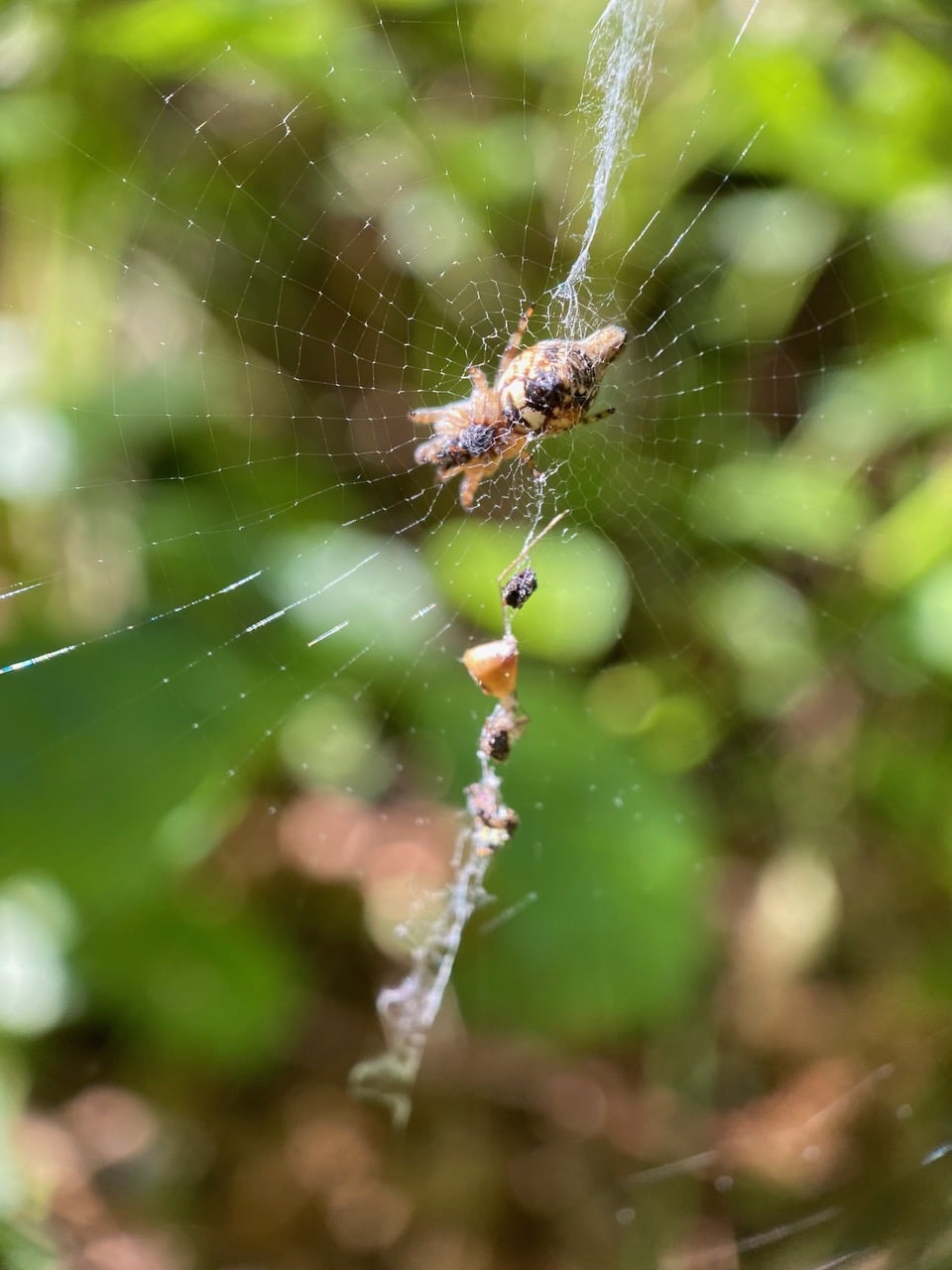
A female Conical Trashline Orbweaver, Cyclosa conica (family Araneidae) has attached a few items on the trashline on the lower half of her web – plant debris and prey carcasses. We are looking at her underside through the web.
Trashline spiders are so-called for their web decoration. Cyclosa create orb-shaped webs using both the sticky and non-sticky threads, mostly during times of complete darkness. Across its spiral wheel-shaped web, Cyclosa fashions a vertical “trashline” made of various components such as prey’s carcasses, detritus, and at times, egg cases. The trashline helps the spider to camouflage exceptionally well from predators. The spider sits in the web hub to conduct its sit-and-wait hunting, ensnaring prey at nearly any time of day; it only leaves its spot to replace the web prior to sunrise.
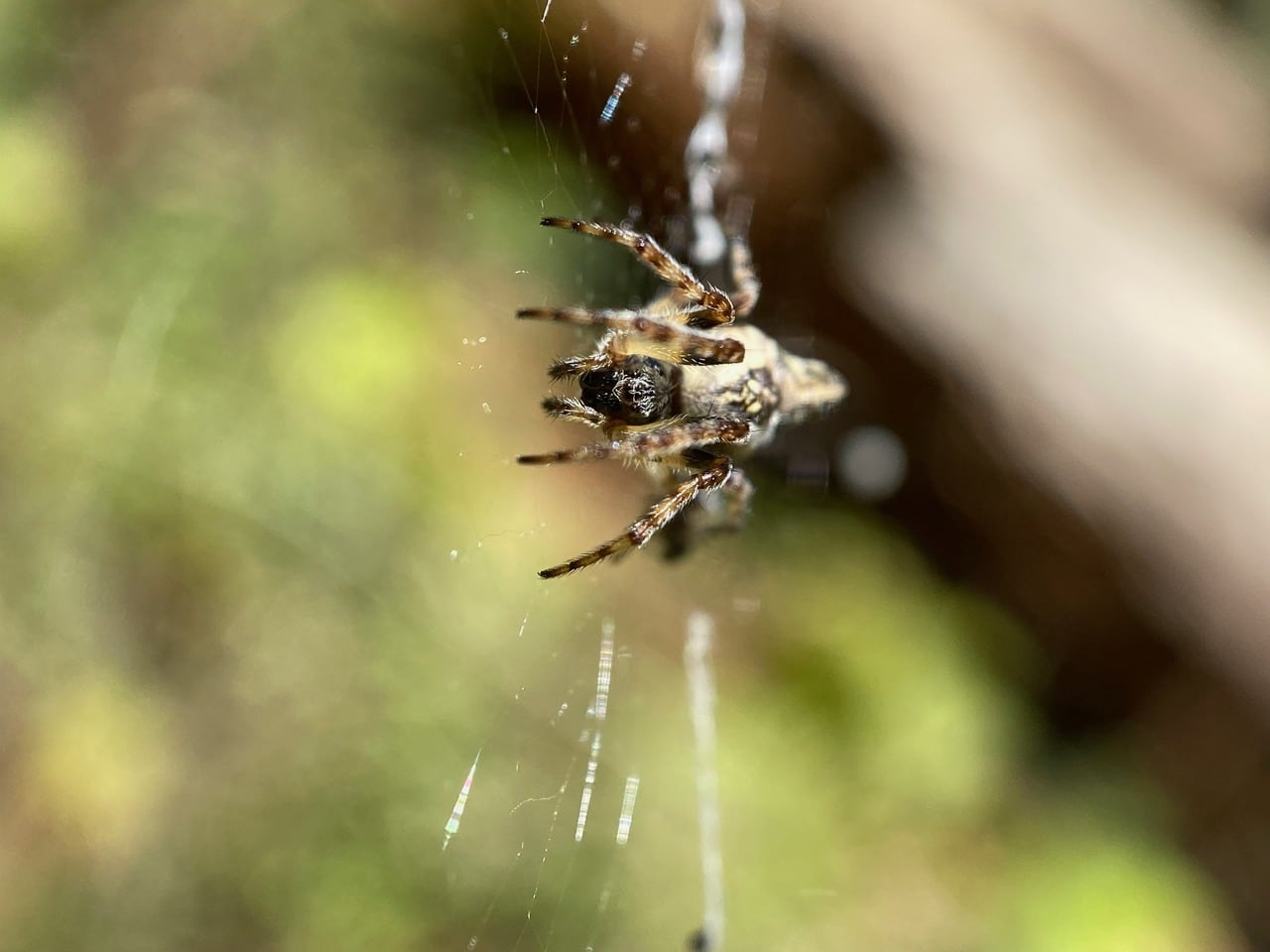
Another female Conical Trashline Orbweaver has just captured a small insect and is feeding on it. We get to see her cephalothorax that is usually covered up by her folded front legs when she is resting. Her cephalothorax is black with coarse white hairs.
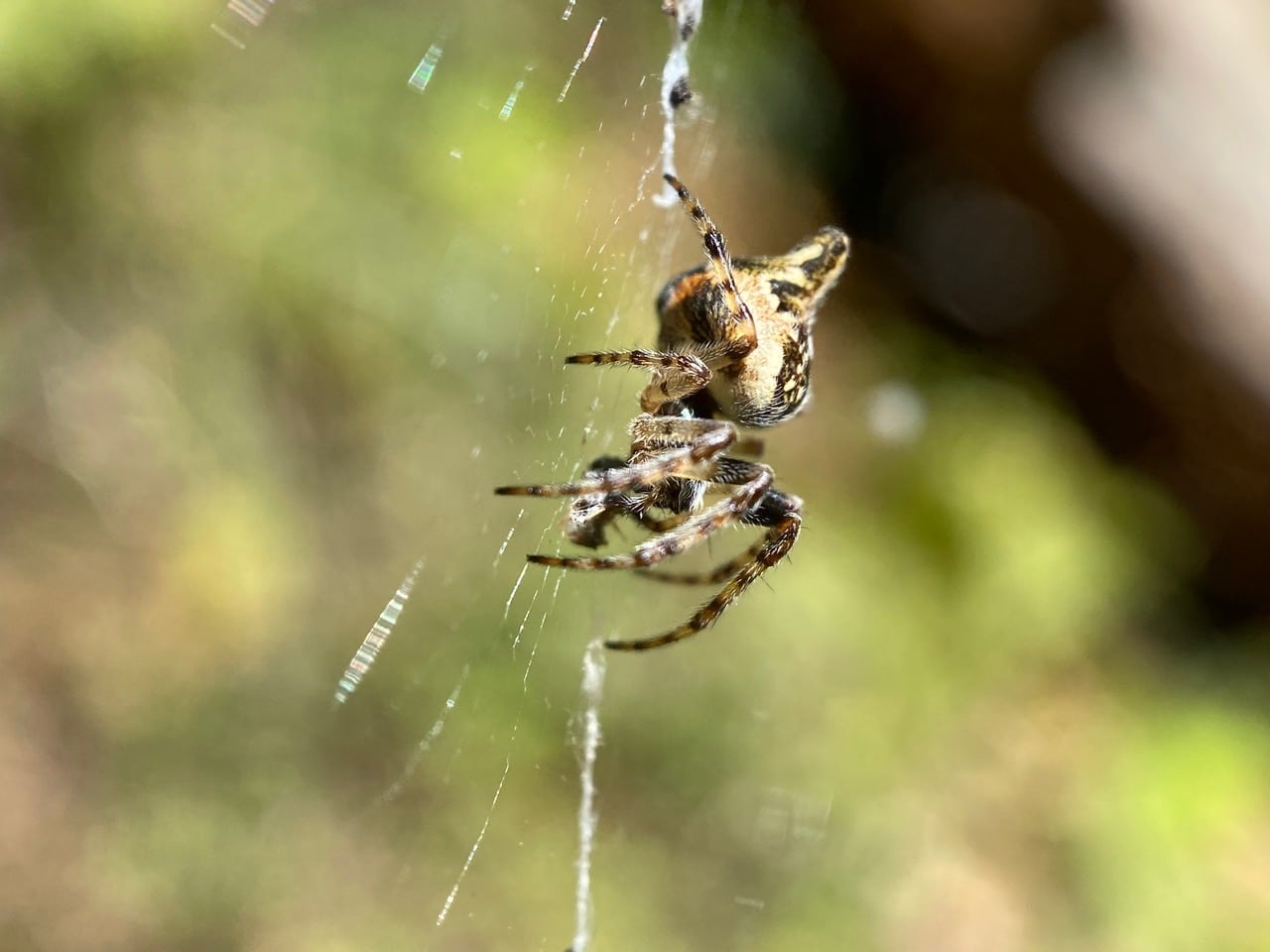
Here’s looking at her straight on. See her pair of black chelicerae held under her face? Chelicerae of spiders are articulated fangs, hollow and connected to venom glands, used to inject venom into prey.Side view of the female Conical Trashline Orbweaver shows the prominent protuberance on her abdomen that gives rise to the common name.
Females of the species have bulbous abdomen that resembles a Hershey’s Kiss.
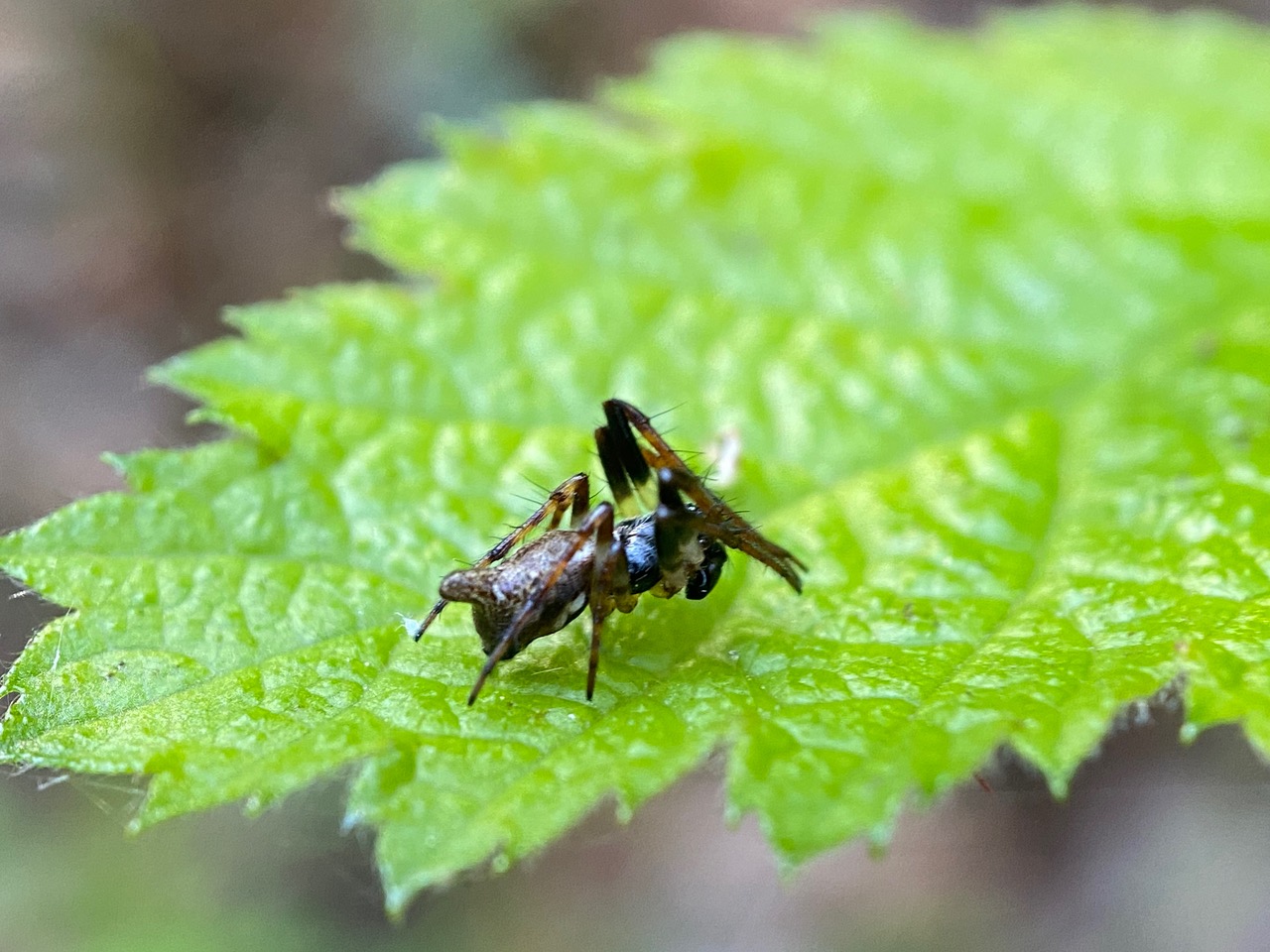
What is this male Conical Trashline Orbweaver doing on a Wood Mint leaf? Note that his abdomen is much slimmer than the female’s. Like the female, his cephalothorax is also black. The male is standing stock-still, holding his two front pairs of legs up in a cocked position. Is he displaying to a female, or threatening a rival male? It must take a lot of energy to be holding this pose for so long. There are no other spiders on the leaf. There’s so much we don’t understand about these arachnid behaviors.
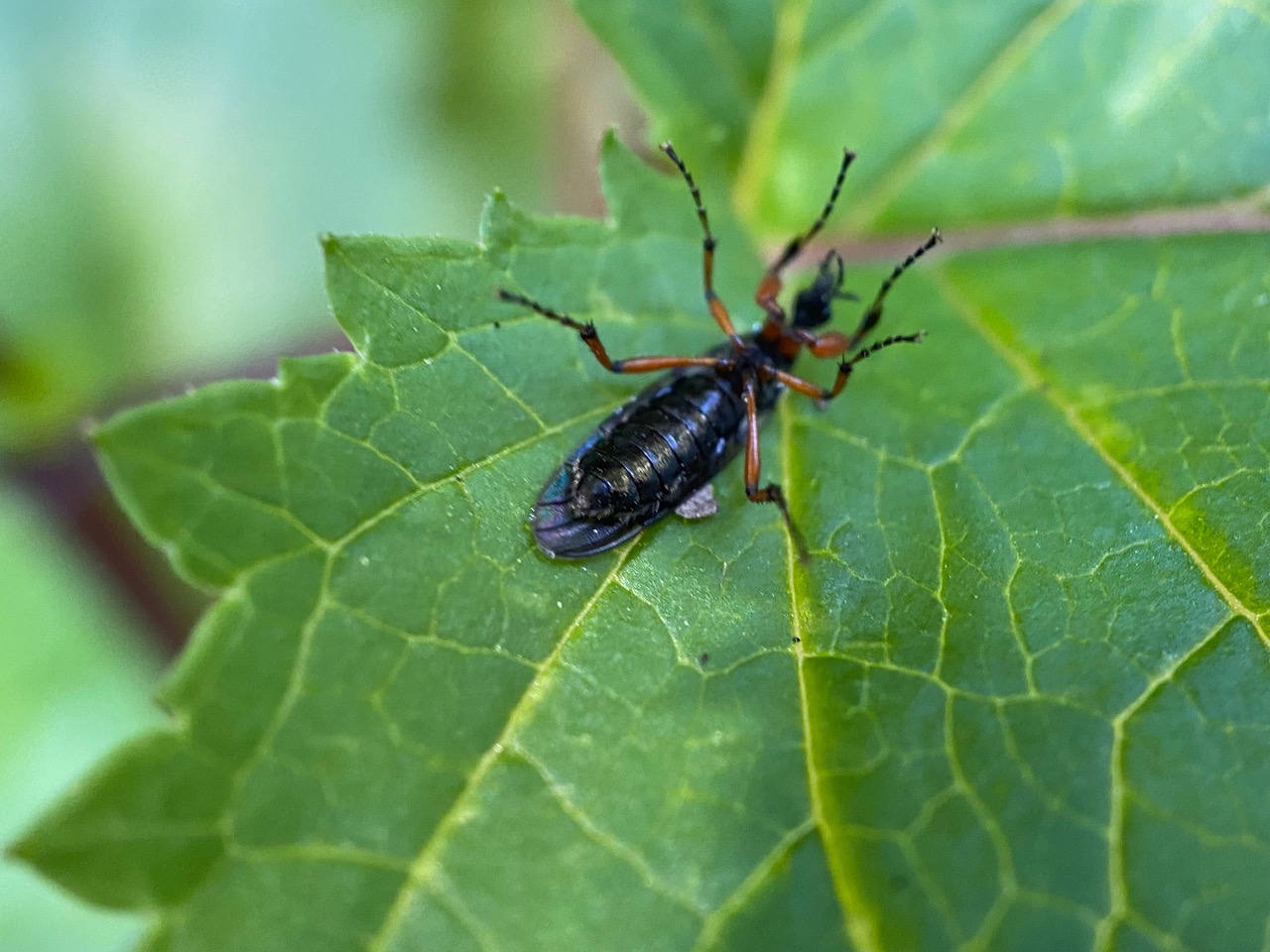
Later, I spot another male on the back of a Blackberry leaf. I have never seen so many males of this species. This must be their mating season when the males are out and about in search of mature females. A female March Fly (family Bibionidae) lies motionless on its back on Bee Plant leaf. What happened? Is she a Crab Spider victim? Crab Spiders do not chew their food. They inject venom and digestive juices into their prey through their fangs, then suck up the digested slurry through the same portal. Carcasses of their prey remain whole, except for the pair of fang marks.
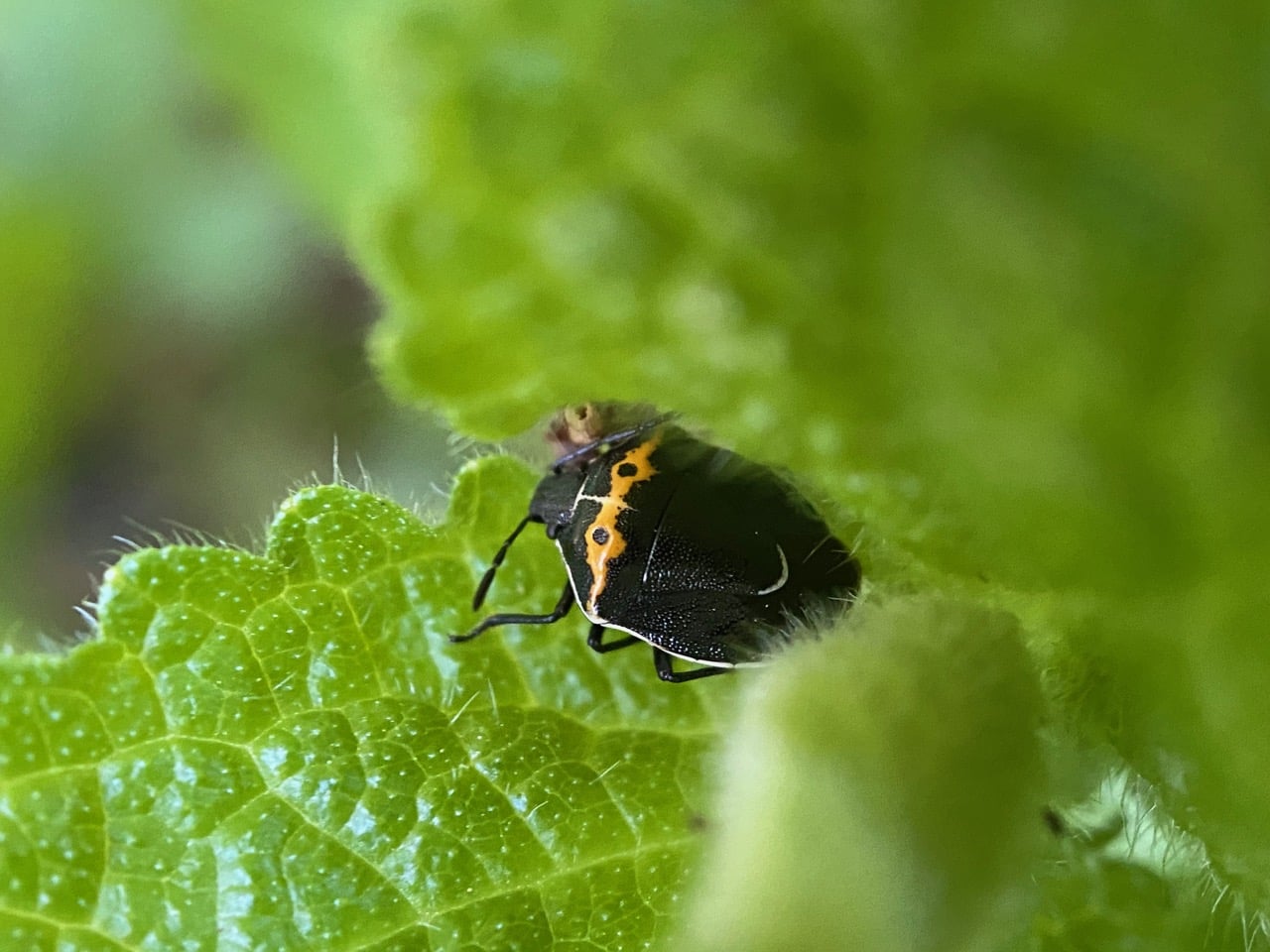
A Hedge-nettle Stink Bug, Cosmopepla conspicillaris (family Pentatomidae) is resting on a terminal leaf of Wood Mint (also known as Hedge Nettle), Stachys sp. (Lamiaceae).
Cosmopepla conspicillaris is a species of stink bug in the family Pentatomidae. It is often called the Hedgenettle Stink Bug because of its preference for plants in the genus Stachys. It is also known as the conspicuous stink bug, or happy bespectacled stink bug because of the orange “spectacles” on the dorsal thorax.
Pentatomidae is a family of insects belonging to the order Hemiptera or “true bugs”. As hemipterans, the pentatomids have piercing-sucking mouthparts, and most are phytophagous, including several species that are severe pests on agricultural crops. Stink Bugs feed on plant fluids by inserting their needlelike mouthparts into stems, leaves or seed pods. While feeding, they inject materials into the plant to aid in digestion and sap removal. Penetration by the mouthparts can cause physical damage, much like stabbing the plant with a fine needle.
All Pentatomids have 5-segmented antennae (hence their family name, Penta – five and tomos – section.) They generally have a large triangular scutellum in the center of the back. The adult is generally shield-shaped when viewed from above. The common name of Stink Bug refers to their ability to release a pungent defensive spray when threatened, disturbed, or crushed.
What a strange sight! A male Common Candy-striped Spider, Enoplognatha ovata (family Theridiidae) is resting stock-still in a spread eagle position on a Wood Mint leaf, his swollen pedipalps hanging under his face. Is he displaying to a female?
The scientific name derives from the Latin word ‘ovatus’ which means egg-shaped. The spider is up to 6 mm in length, excluding legs. It has translucent legs and the globular abdomen is extremely variable in color and pattern, often with two red stripes in a V-shape. The species is native to Europe, and introduced to North America where it is now found from coast to coast. Despite its small size, it is a formidable predator capable of preying on insects many times its size.
The web is usually a small assortment of tangled threads, found on the underside of a leaf. The edges of the leaf are usually pulled down slightly with the threads, creating a hide. The female deposits eggs in an egg sac that is hidden within a rolled-up leaf fastened with silk and the female guards it until the eggs hatch.
Ooh! it’s always a treat to find the tiny female flowers on the California Hazelnut!
The California Hazelnut, Corylus cornuta is a deciduous shrub. The species is monoecious, with separate male and female flowers borne on the same plant. Male flowers are borne on long, pendulous catkins in clusters near branch tips, appearing in the fall but opening the following spring before the appearance of leaves. Female flowers, several in a scaly bud, are tiny and inconspicuous with only bright red stigma and styles protruding from the otherwise gray-brown buds, almost completely enclosed by bracts. The flowers are wind-pollinated. The male catkins tend to mature before the female flowers appear on the same plant, ensuring that the flowers do not self-pollinate.
A male Conical Trashline Orbweaver, Cyclosa conica (family Araneidae) is resting on a leaf bud of a Calfornia Hazelnut, Corylus cornuta. He is close to the web of a female strung between the branches of the shrub. Has he come a-courting?