

Pollinator Post 4/19/24 (3)

A small bee is foraging on a flowerhead of Tidy Tips, Layia platyglossa. She has already gathered a lot of pollen and stored it away in the scopae of her hindlegs, as well as on her belly. Note that the pollen is on both her tibia and femur. This mode of pollen collection is typical of the Sweat Bees (family Halictidae).
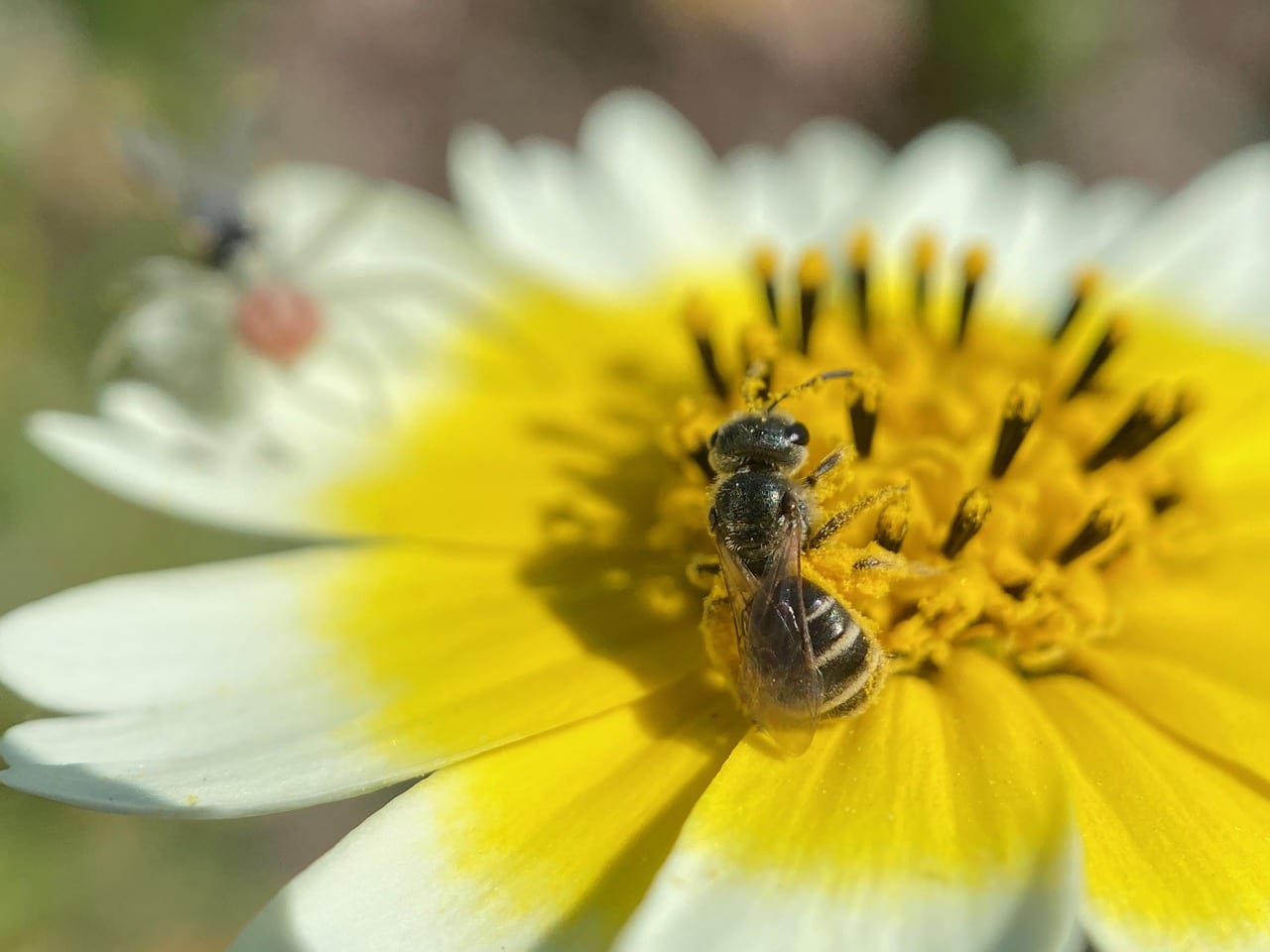

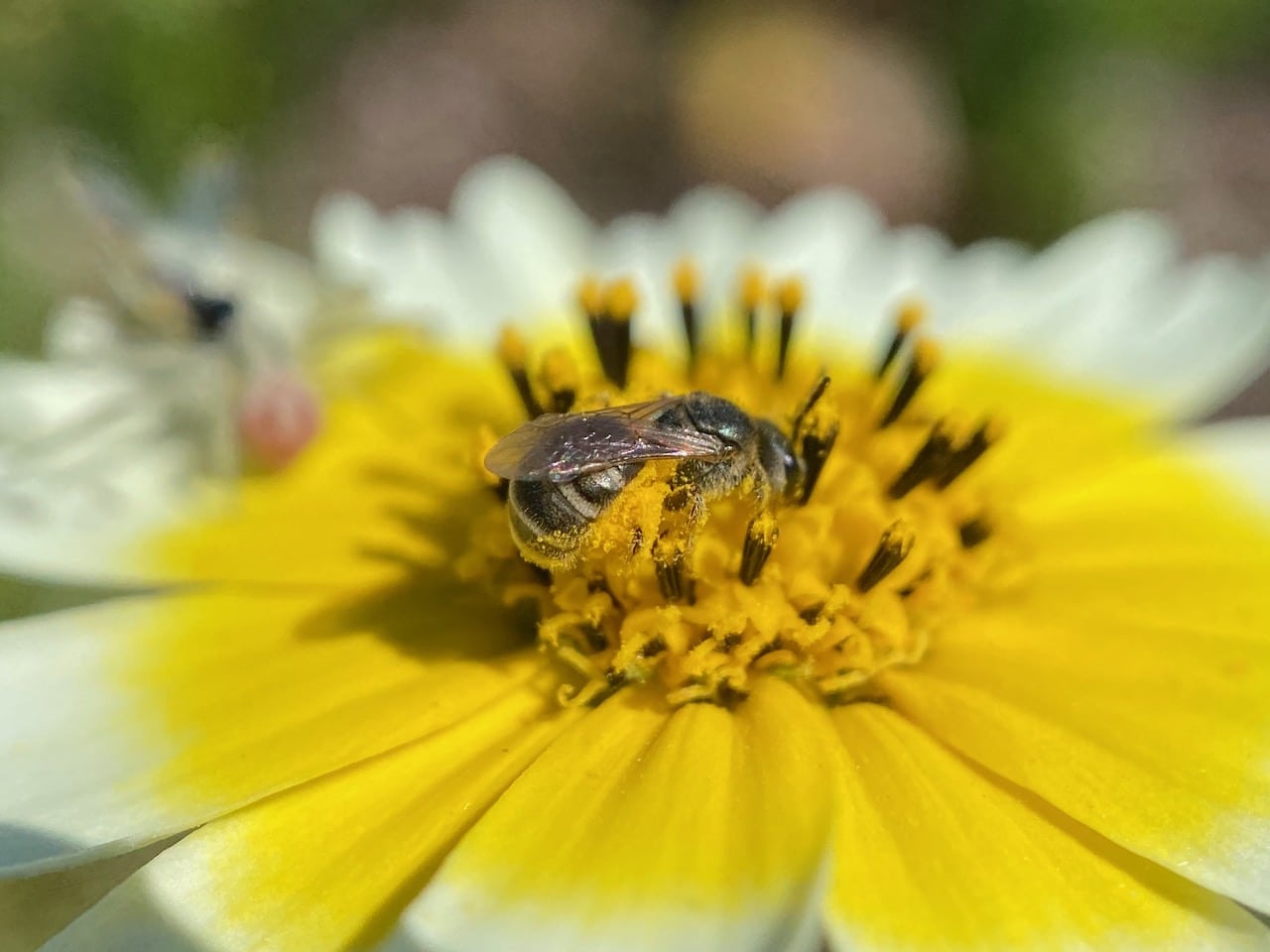 There are only a few scattered Tidy Tips in bloom in the newly planted patches. The little bee is maximizing her foraging before returning to her nest.
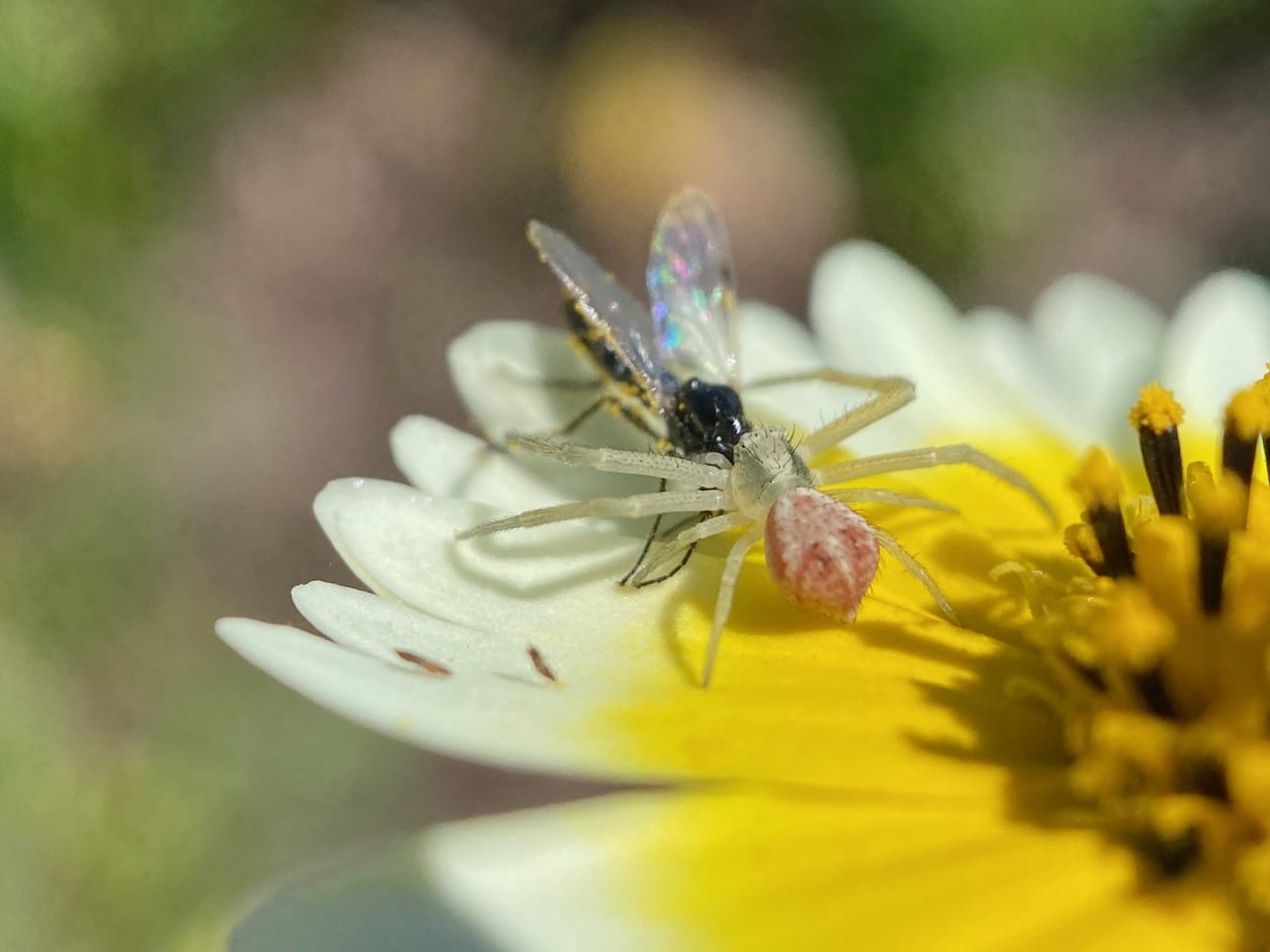 On the other side of the flowerhead, a small Crab Spider, Mecaphesa sp. (family Thomisidae) has caught an insect as big as itself. The prey might be a male March Fly (family Bibionidae). These flies are everywhere today.



Something exciting is happening on the other side of the flowerhead, but we’ll get to that later.
The bee is a Furrow Bee, Halictus sp. (family Halictidae). Halictus is found worldwide; they are most common in the Northern Hemisphere. All are generalists, foraging from a wide variety of flowering plants. Many species are social and produce several generations per year. This is not surprising as most blooming plants are season-specific; a bee that requires pollen and nectar across multiple seasons would not thrive as a specialist. All Halictus in North America nest in the ground, often in aggregations; and they may nest in the same area for decades.
As in most Asteraceae, the pollen is sticky and clumpy.
Pollenkitt is a sticky covering found on the surface of pollen grains. It is also sometimes called “pollen coat”. It is found in some plant families more often than others, but it is especially common in plants that are pollinated by insects. Because of this scientists believe that one of the major functions of pollenkitt is to help the pollen stick to the insect pollinators. The pollen from many wind-pollinated plants, such as grass, is much drier and not nearly so sticky. The insects benefit from lots of pollen that is easy to carry home. What’s more, pollenkitt contains lipids, proteins, and phenolic compounds that are important to bee health. For the plant, pollenkitt may prevent the pollen from blowing away or drying out, or it may protect the pollen from ultra-violet radiation and certain pathogens.
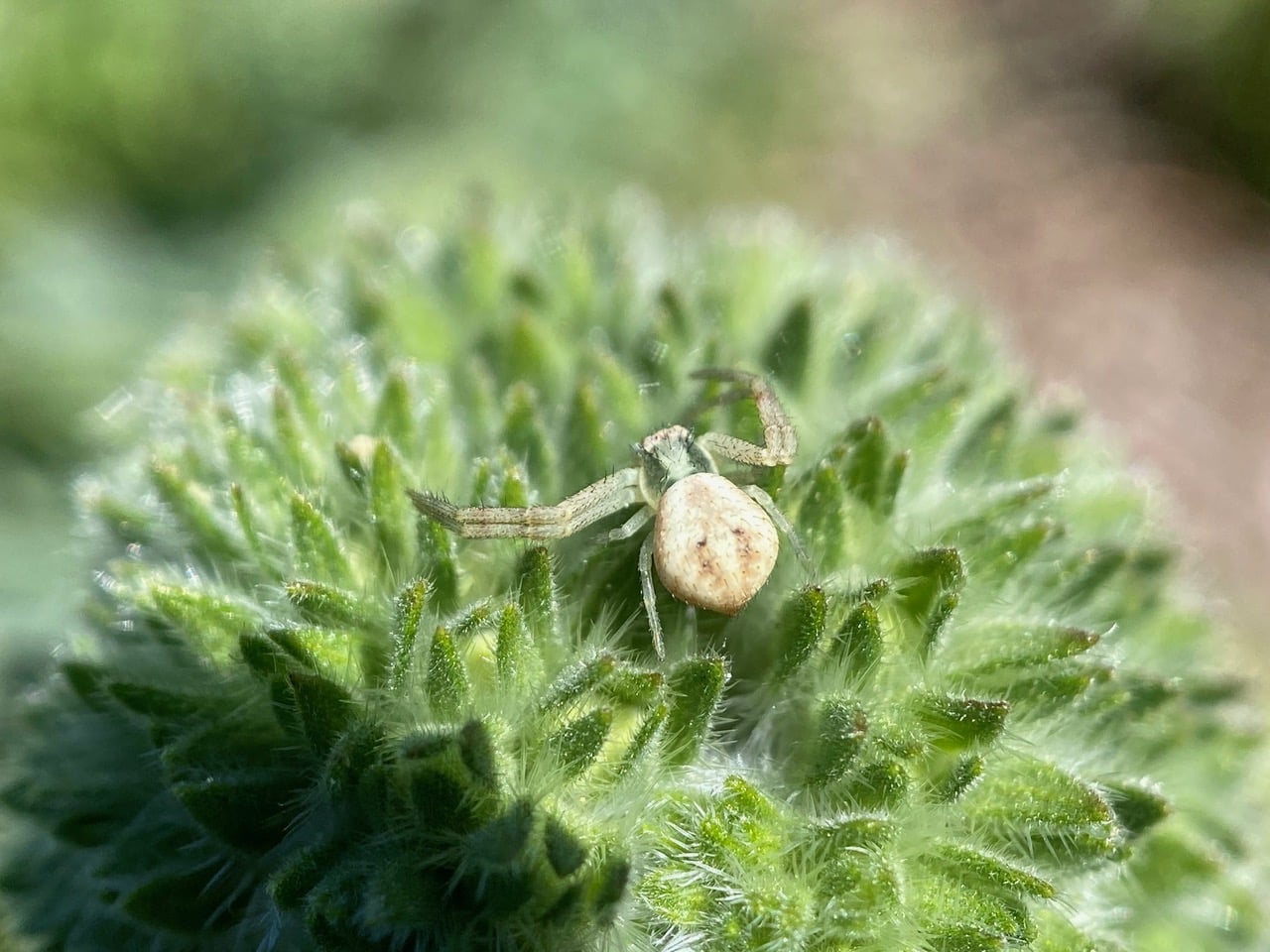
There are only a few scattered Tidy Tips in bloom in the newly planted patches. The little bee is maximizing her foraging before returning to her nest. On the other side of the flowerhead, a small Crab Spider, Mecaphesa sp. (family Thomisidae) has caught an insect as big as itself. The prey might be a male March Fly (family Bibionidae). These flies are everywhere today. A Crab Spider, Mecaphesa sp. is lying in ambush on a cluster of flower buds of California Phacelia.
Members of the family Thomisidae do not spin webs, and are ambush predators. The two front legs are usually long and more robust than the rest of the legs. Their common name derives from their ability to move sideways or backwards like crabs. Most Crab Spiders sit on or beside flowers, where they grab visiting insects. Some species are able to change color over a period of some days, to match the flower on which they are sitting.
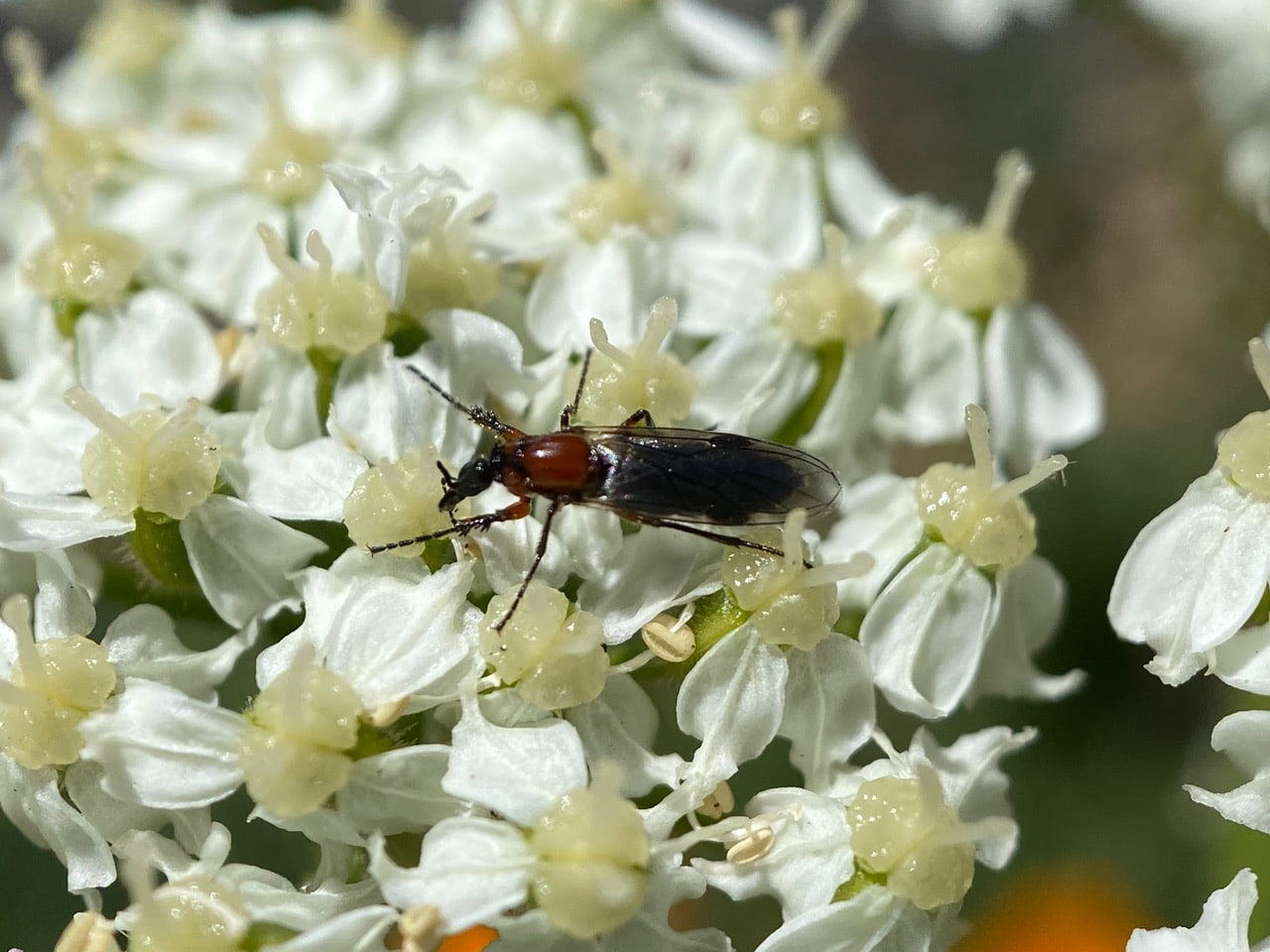
A female March Fly, Dilophus sp. (family Bibionidae) lands on a flower umbel of Cow Parsnip, Heracleum maximum.
March Flies (family Bibionidae) generally live in wooded areas and are often found on flowers – adults of some species feed on nectar, pollen, and honeydew, while adults of other species don’t feed at all; and in either case, they are very short-lived. They are considered important pollinators in orchards. They are also important food for other insects and spiders. The larvae feed en masse on rotting organic materials like leaves, wood, compost, and rich soil.
A male Dilophus sp. on the same umbel.
March flies exhibit extreme sexual dimorphism – the sexes are morphologically distinct. The female is usually more colorful, has small eyes on the sides of long, narrow head, while the all-black males have huge eyes that touch in the middle and are split in half horizontally. Scientists speculate that the split makes it easier for them to see the other males that are above and below them in a mating swarm. Males gather in swarms that can blanket the ground and low vegetation. Female are attracted to the party and select mates in the frenzy of fly bodies.
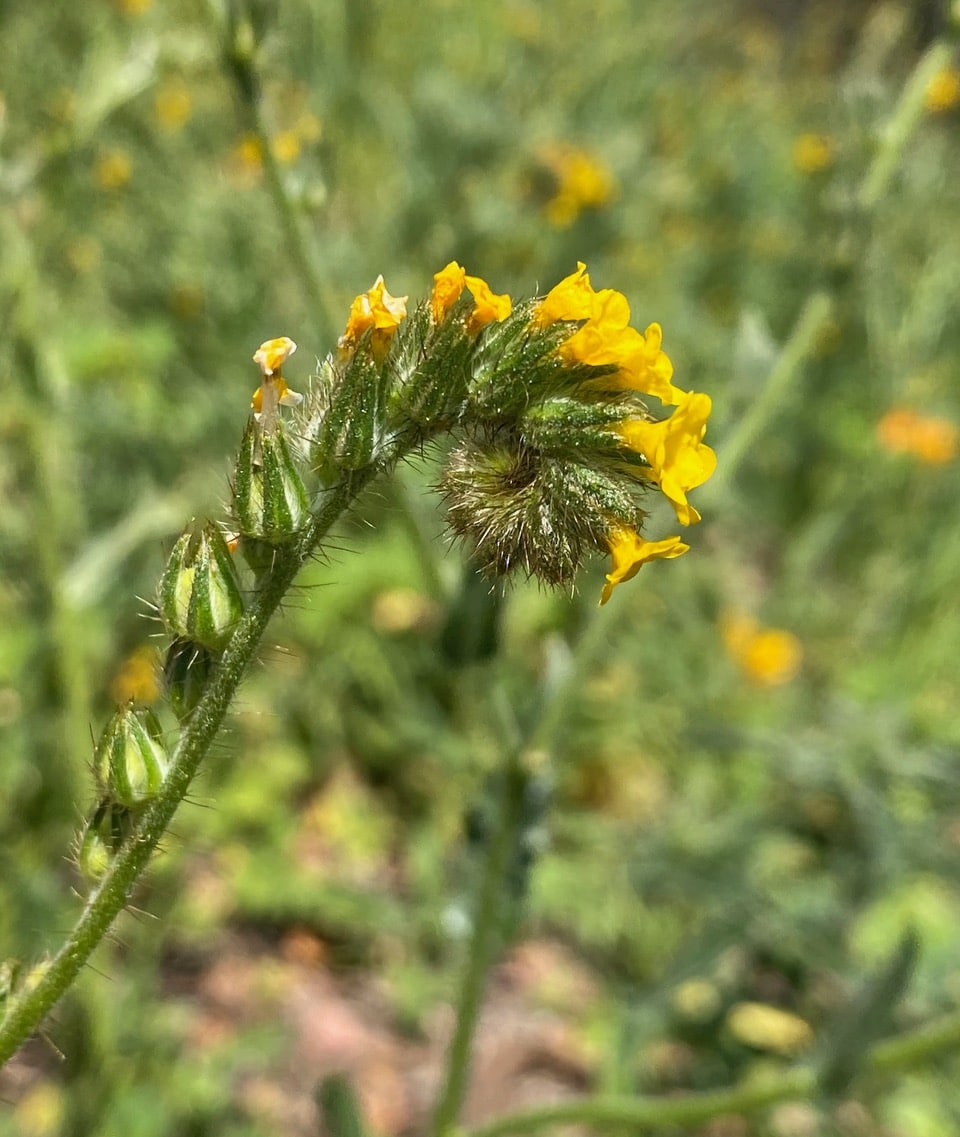
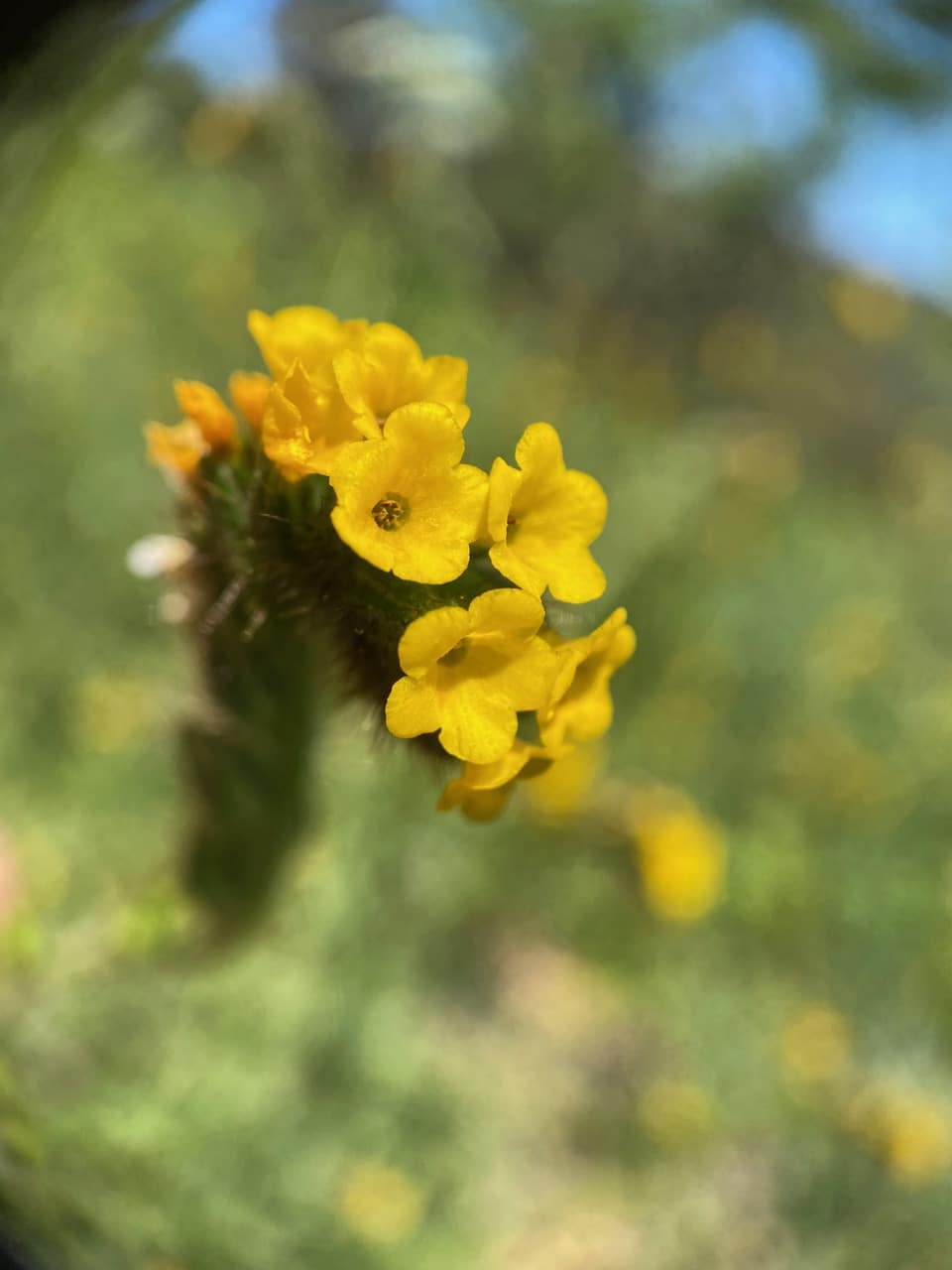
The Coast Fiddleneck, Amsinckia intermedia (family Boraginaceae) are growing tall and blooming profusely. There are already fruits developing as the flowers wither on the straightening coil.
The annual is native to western North America, and is common and widespread throughout California. Inflorescences of yellow to orange tubular flowers are borne along one side of a terminal stalk that is initially tightly coiled, unfurling as the buds mature. Flowers open near the top of the coil, and seeds develop below along the elongating stalk. The structure of the one-sided cyme resembles the end of a fiddle, hence the common name “fiddle neck”.
Interestingly, none of the Fiddleneck flowers I see today have the orange markings in their corolla. Do they lose those spots as the season progresses? The small flowers with narrow openings require precision pollination. Who better to render the services than the Greater Bee Fly, Bombylius major with a needle-like proboscis. There are quite of few of them hovering around the Fiddleneck, so I take a video of them nectaring on the flowers.
Bombylius major, commonly known as the Greater Bee Fly is a parasitic bee mimic fly in the family Bombyliidae. It derives its name from its close resemblance to bumble bees. Its flight is quite distinctive – hovering in place to feed, and darting between locations. The species has long skinny legs and a long rigid proboscis held in front of the head. Bombylius major is easily distinguished from the other local species of Bombylius for having wings with dark leading edge, hyaline trailing edge with sharp dividing border. This feature is visible even as the fly is hovering. Adults visit flowers for nectar (and sometimes pollen) from a wide variety of plant families, excelling at small tubular flowers, and are considered good generalist pollinators. Often the pollen is transferred between flowers on the fly’s proboscis.
The bee fly larvae, however, have a sinister side. They are parasitoids of ground-nesting bees and wasps, including the brood of digger bees in the family Andrenidae. Egg deposition takes place by the female hovering above the entrance of a host nest, and throwing down her eggs using a flicking movement. The larvae then make their way into the host nest or attach themselves to the bees to be carried into the nest. There the fly larvae feed on the food provisions, as well as the young solitary bees.
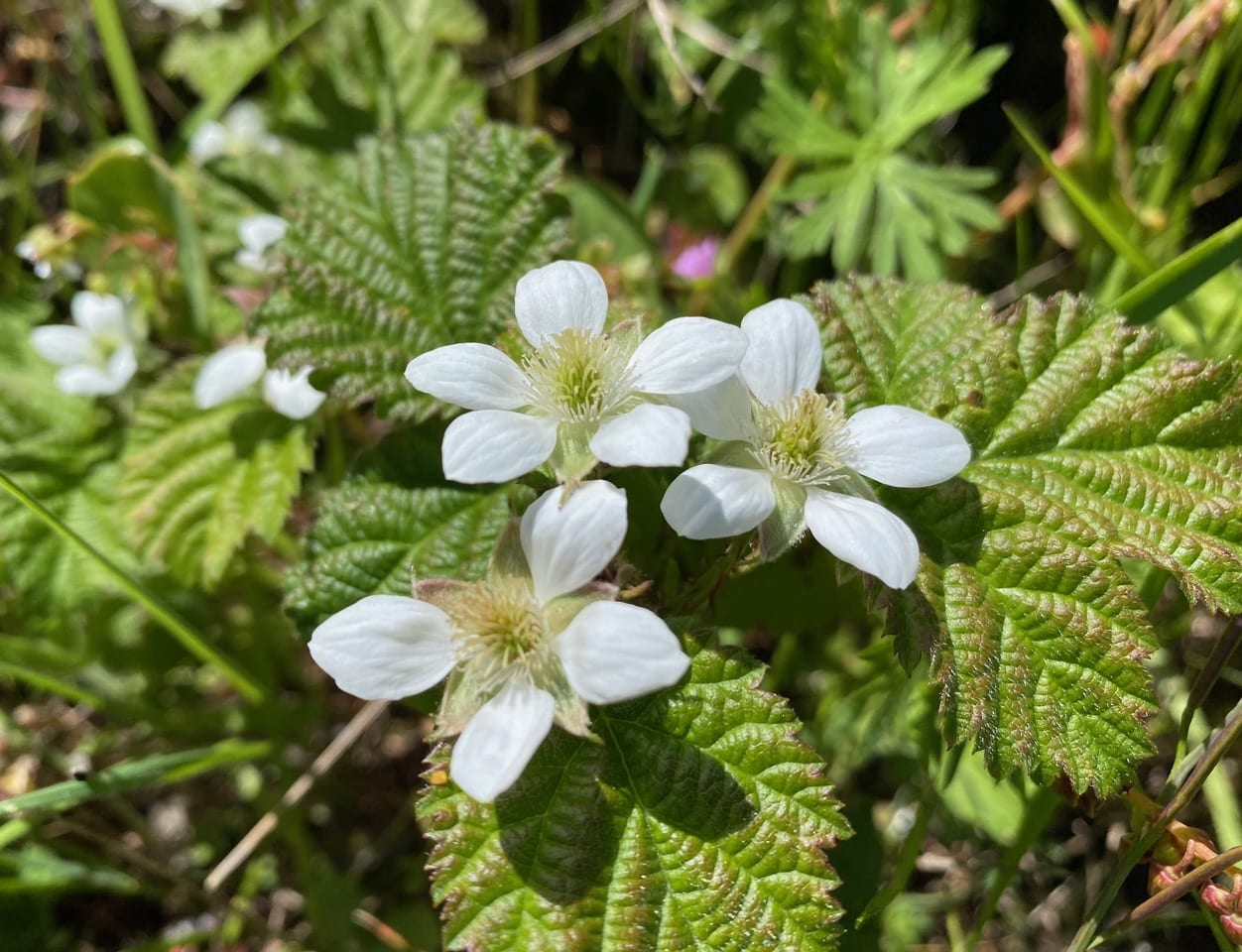
The California Blackberry, Rubus ursinus along the paved road is blooming prodigiously. Interestingly, most of the plants are female. (The specie is dioecious, with male and female flowers borne on separate plants. Hopefully there will be an abundance of berries for our wildlife in the summer.
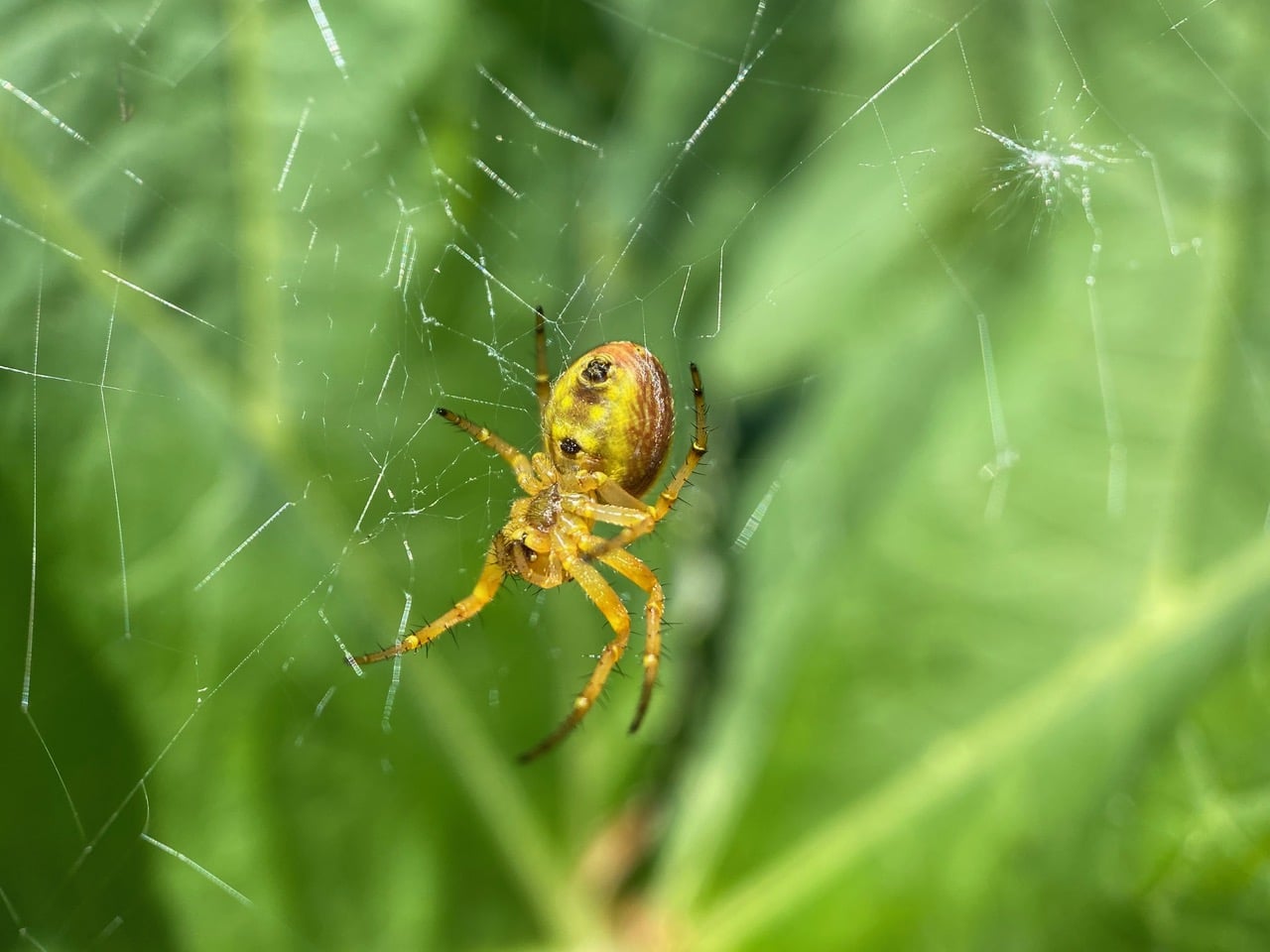
A small spider has cleverly constructed an orb web in the space between the lobes of a Cow Parsnip leaf. From the way the spider uses the space, I think it is a Six-spotted Orbweaver, although it is larger than most I have seen.
Close-up of the spider on the other side of its web. It is plump and colorful, a female. Both her spinneret and her epigyne are clearly visible as black spots on the underside of her abdomen.
The spinneret is a silk-spinning organ of the spider, located at the tip of the abdomen. Spinnerets are tubular or conical structures and silk is produced in liquid form at the tip. When exposed to the air the silk forms a filament and the spider draws out the silk into a thread. Most spinnerets are not simple structures, but consist of many microscopic spigots, each producing one filament. Spigots can be singular or found in groups, which permits the spider to combine multiple filaments in different ways to produce many kinds of silk for various purposes.
The epigyne is the external genital structure of female spiders, located on the underside of the abdomen. The primary function of the epigene is to receive and direct the palpal organ of the male during copulation. .

The spider drops onto the leaf, then bounces back onto the web very quickly with the help of her drop line. It is indeed a Six-spotted Orbweaver, Araniella displicata (family Araneidae).
The Six-spotted Orbweaver is a small cucumber spider. It occurs throughout Europe and North America and in parts of Asia. It is found on trees and shrubs in woodland habitats. It is one of the most widely distributed arachnids in North America, but often overlooked due to its small size. Adult females measure only 4-8 mm in length, males 4-6 mm. The species is distinguished by three (sometimes four) pairs of black spots along the edges of the rear half of the abdomen. There’s quite a bit of color variation within the species.
Most orb weavers spin fairly large webs in proportion to their own body size, but not so with Araniella displicata. The web of an adult spider may be only three or four inches in diameter. The spiral snare is usually built well off the ground, and often oriented in the horizontal plane, frequently spanning the edges of a single large leaf. The spider sits in the center, hanging beneath a horizontal web. Adult Araniella displicata are often mistaken for “baby” orb weavers. In late May or early June mating takes place, and females produce egg sacs that contain 80 eggs and are covered in loose, fluffy, yellowish silk. The package may be deposited in a curled leaf that also serves as the mother’s retreat on the perimeter of the web.