

Pollinator Post 4/19/23 (2)

At the edge of the trail at the Swale, a small patch of the ground-hugging Red Maids, Calandrinia menziesii (family Montiaceae) is blooming. The five-petal flowers are deep pink-magenta with a satiny shine, and white streaks leading to a white center. Formerly included in the purslane family, it is now treated as a member of the family Montiaceae. The annual herb is native to western North America where it is widespread and common. Sometimes referred to as a “poor man’s barometer”, the flowers won’t open unless there is sun. The intense pink-magenta colors of Red Maid petals are caused by betalain pigments. Betalain pigments occur only in the order Caryophyllale to which the Montiaceae family belongs. Most plants in this order produce betalain pigments and lack the more common anthocyanin pigments.
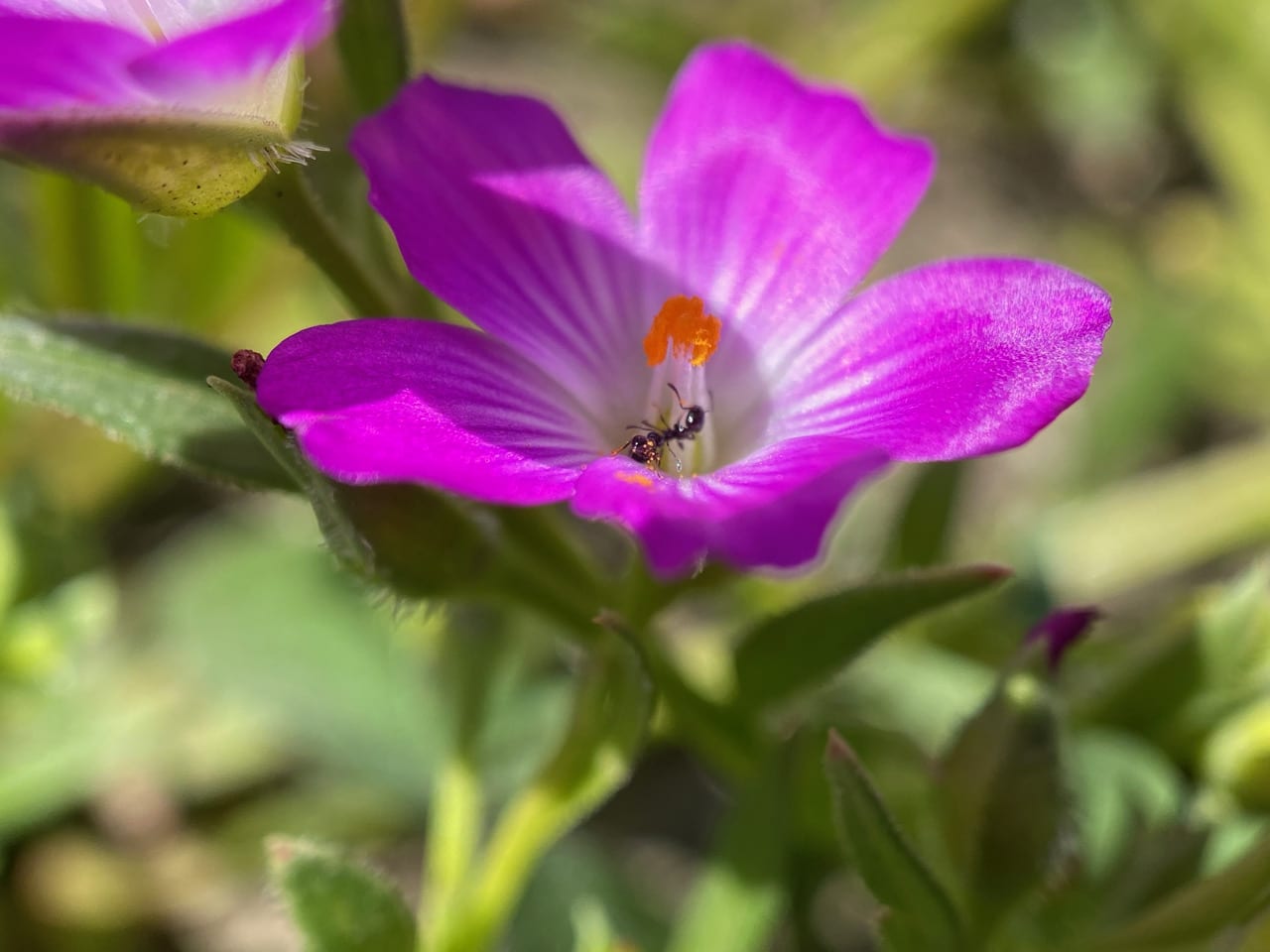
An ant is reaching up for the yellow-orange pollen of this Red Maid flower. Ants may contribute to the pollination of this low growing plant that tend to grow in clusters.
The fruit is a thin, papery capsule with 3 slits for opening. Each capsule contains 10-20 seeds, which are small, flattish and black. White, fleshy tips on the seeds are elaiosomes, nutrient-rich food packages that attract ants. The ants carry the seeds back to their colony, feed the food packet to their larvae, and discard the seed, thus aiding in seed dispersal. Miner’s Lettuce, a species in the same family also uses this strategy, called myrmecochory.
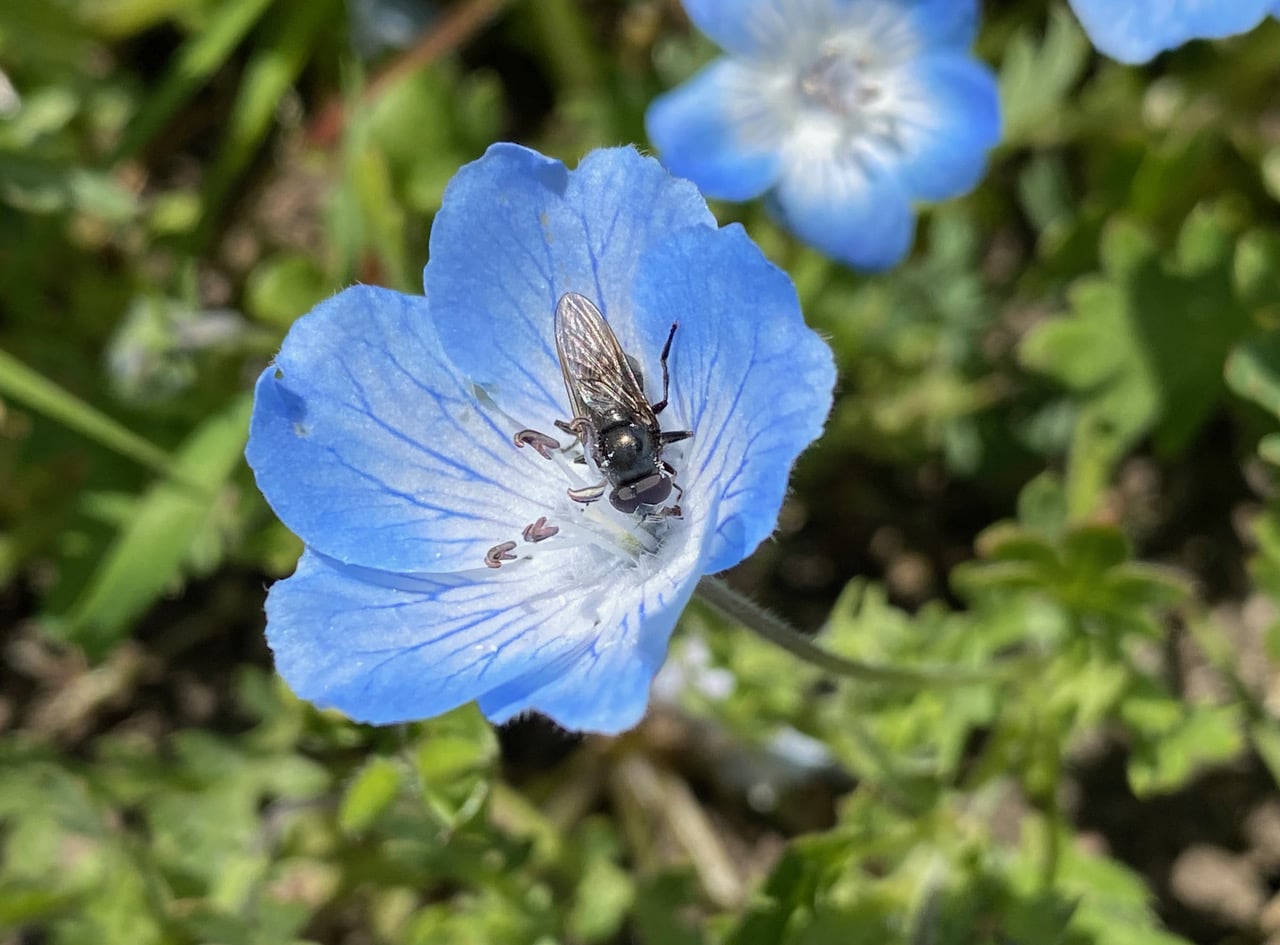
A Blacklet, Cheilosia sp. (family Syrphidae) lands on a Baby Blue Eyes flower, Nemophila menziesii and heads for nectar at the base of the flower. Note the dark blue lines on the pale background that serve as “nectar guides” to direct pollinators to the sweet reward. Most Cheilosia are black, lacking the bright colors and pattern of many hoverfly species. The larvae of some species feed in the stems of plants or in fungi. Note the white pollen that has adhered to the thorax of the fly.
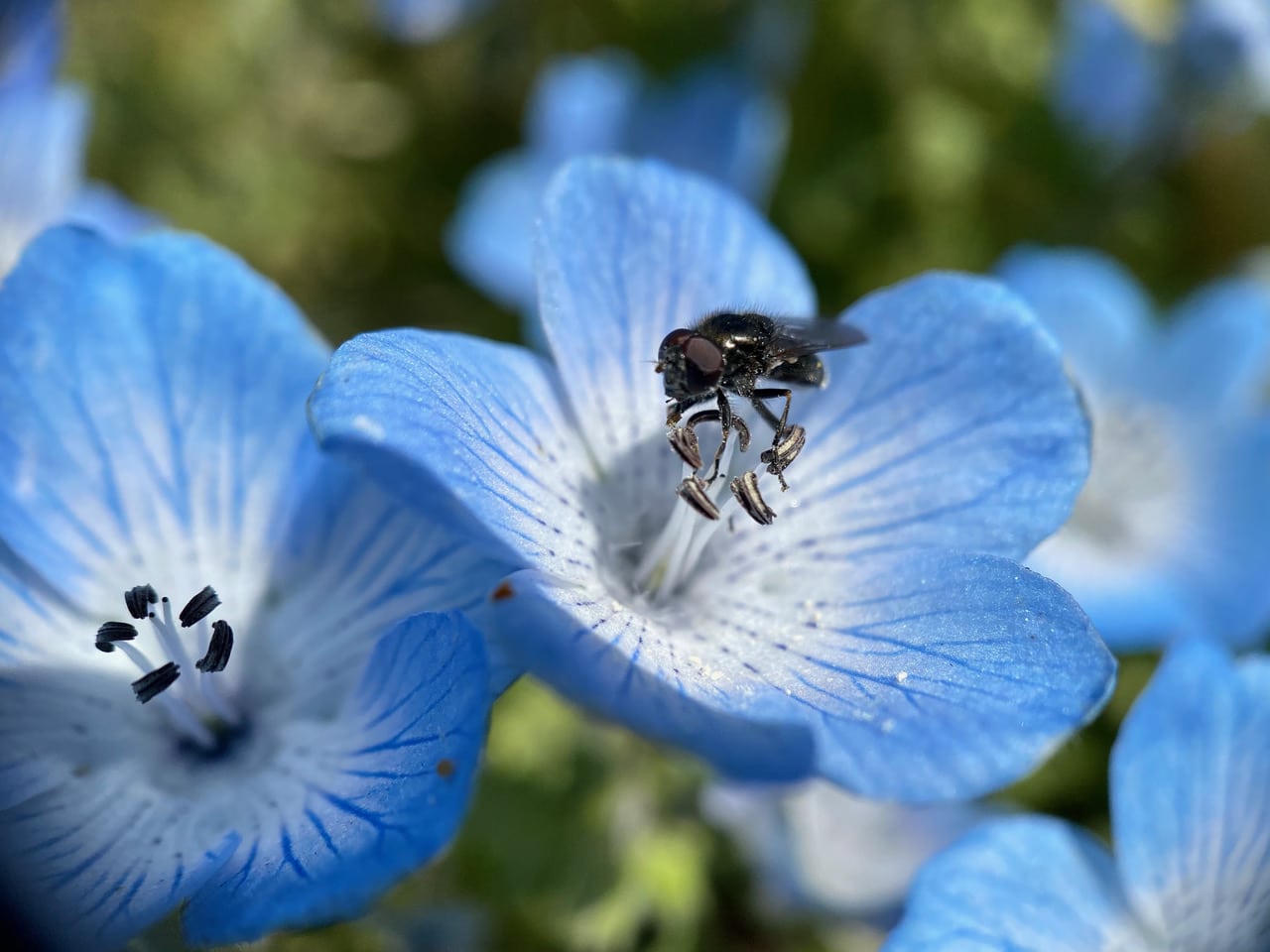




On an adjacent Baby Blue Eyes flower, another Blacklet is balancing delicately on the anthers to feed on the pollen.
The flies better watch out – there’s a Ground Crab Spider, Xysticus sp. (family Thomisidae) waiting with open arms to seize any unsuspecting pollinator.
Disguised in earthy browns/grays , these spiders tend to be found on the ground or on low vegetation. While similar to the “flower spiders”, they tend to have shorter, sturdier legs. Like most Thomisidae, Xysticus do not build webs. They are ambush predators that prefer to hunt near the ground. They move slowly, and commonly hunt by stationing themselves in high-traffic area and grabbing whatever arthropod passes close enough. Also like most other Thomisidae, they seize prey with their enlarged front two pairs of legs and kill it by a venomous bite.
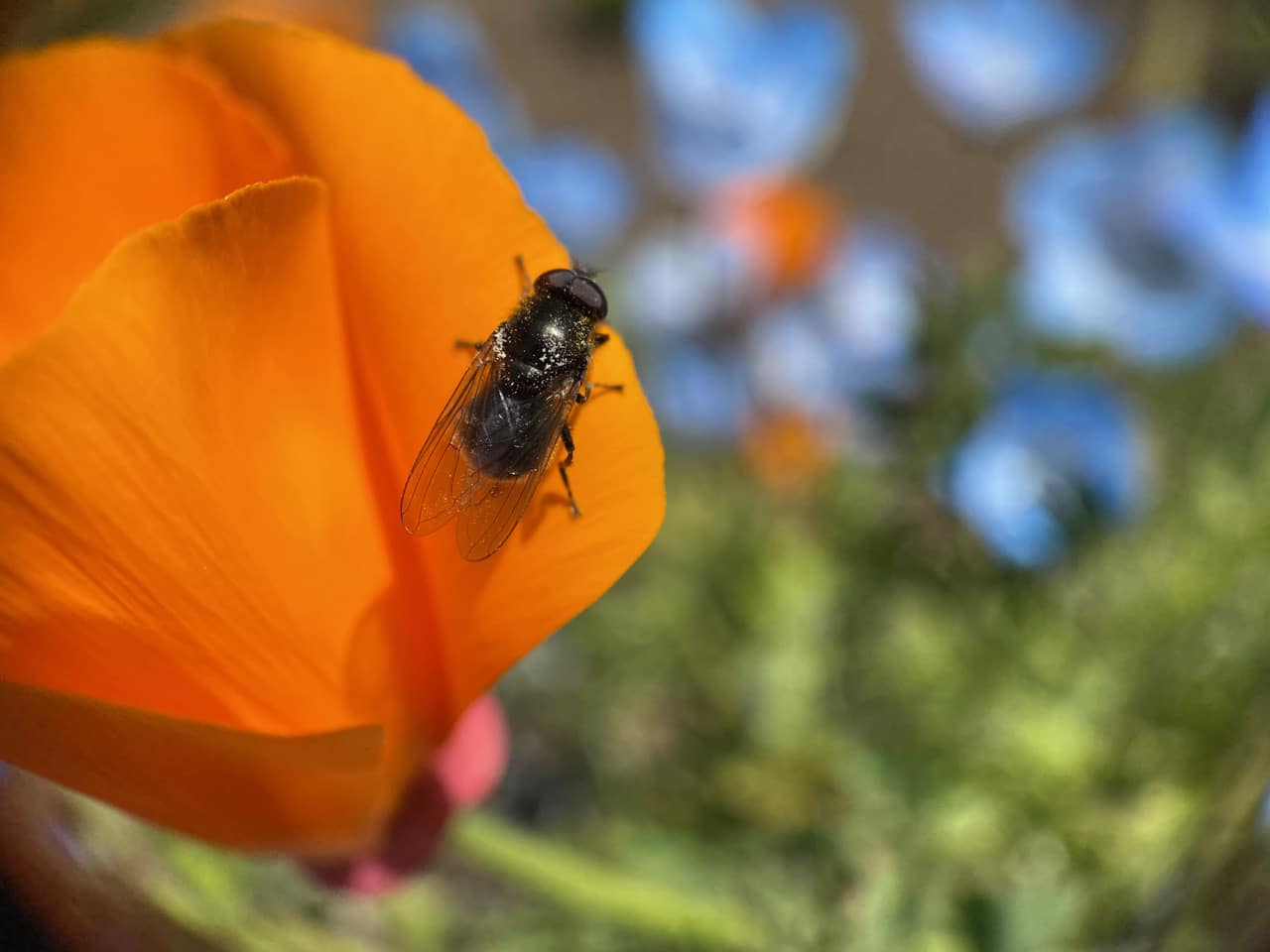
The Blacklet rests for a moment on a California Poppy before continuing to forage on the Baby Blue Eyes. It has some white pollen on it body from the flowers it has previously visited.
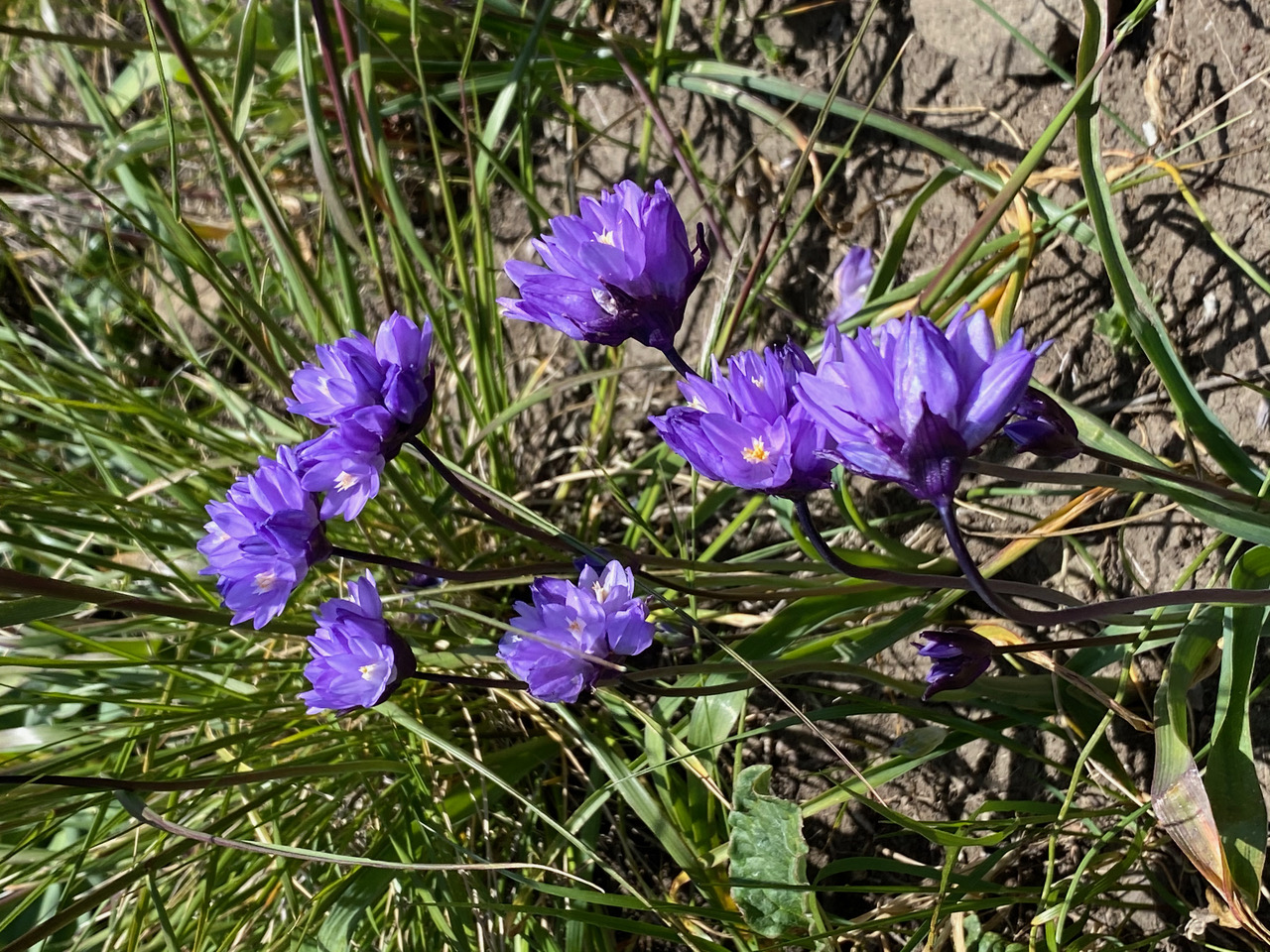
The Blue Dicks, Dipterostemon capitatus is in peak bloom, much to the delight of the Greater Bee Flies, Bombylius major which sip nectar from the flowers through their long probosces.
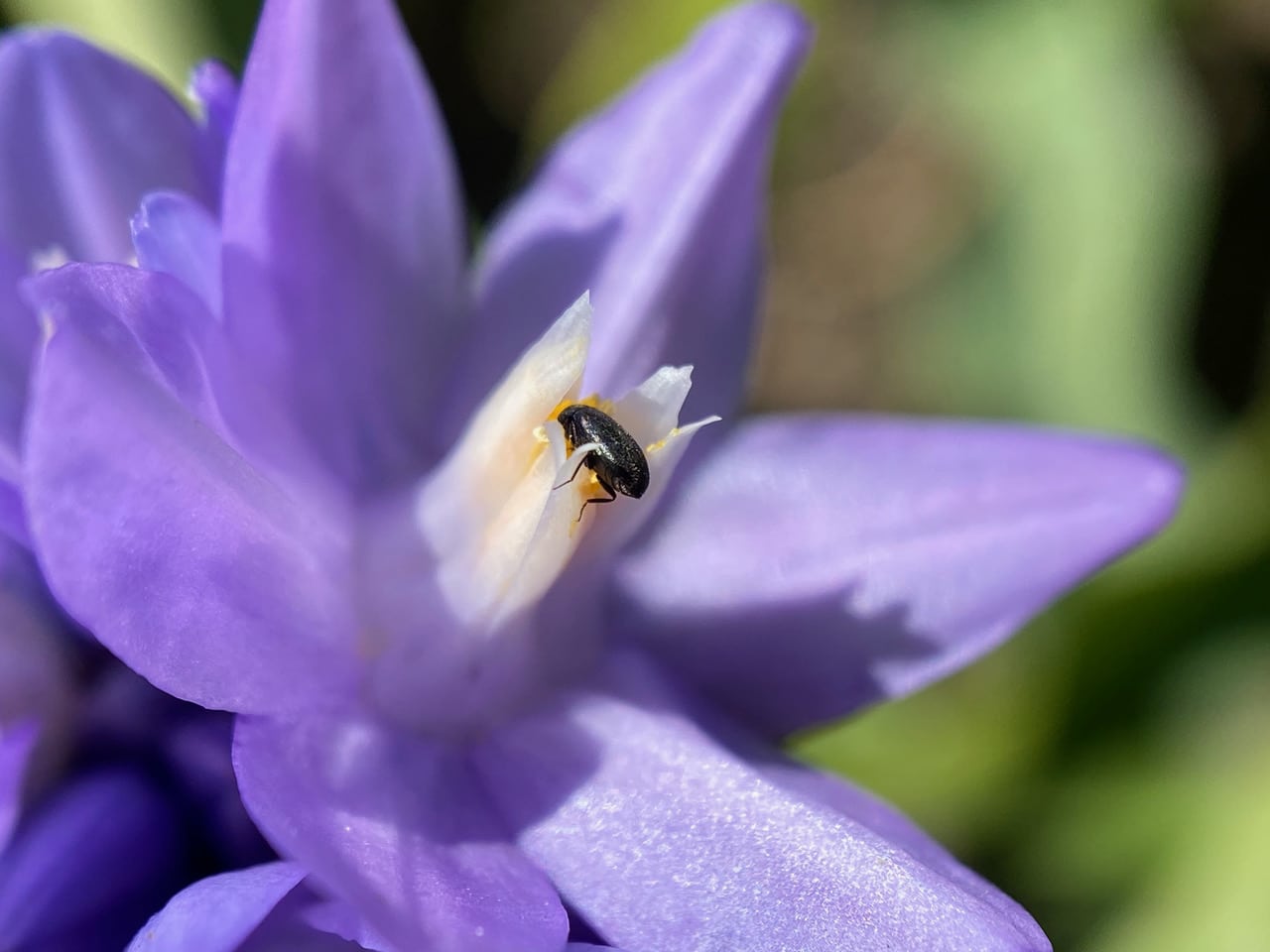
A Skin Beetle, Cryptorhopalum sp. (family Dermestidae) is feeding on the pollen of Blue Dicks by climbing up the white staminodes that surround the reproductive structures of the flower. (In botany, a staminode is a rudimentary, sterile or abortive stamen, which means that it does not produce pollen.)
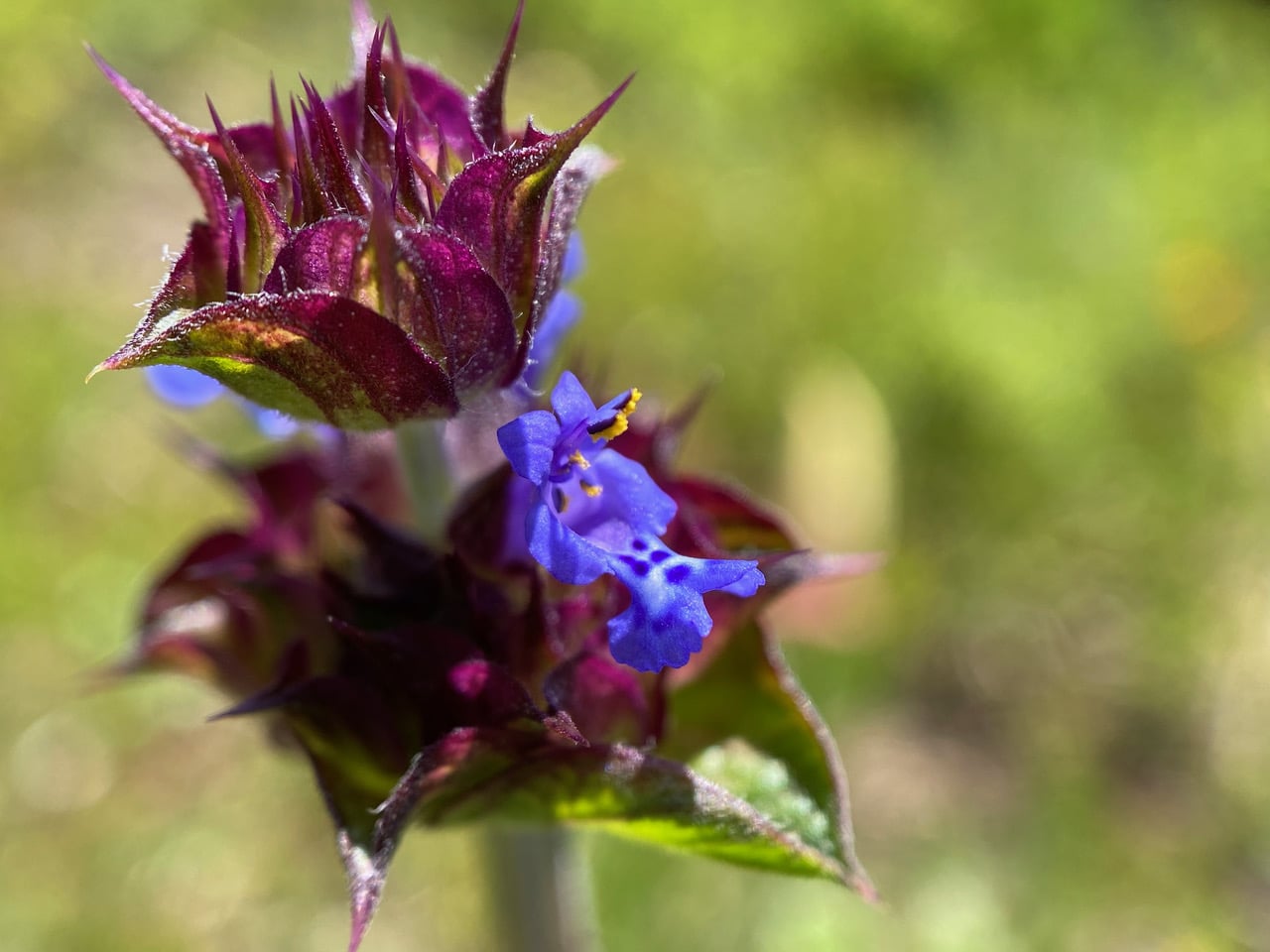
More Chia, Salvia columbariae (family Lamiaceae) have come into bloom at the Backbone. Several flowers are clustered in a tight flowerhead of Chia. The deep blue corollas are subtended by spiky dark reddish-purple calyx.
Close examination of the flower shows the typical floral structure of Salvia: bilateral symmetry with 2-lipped corolla. The lower lip has two lobes. The stamens are reduced to two short structures with anthers two-celled, the upper cell fertile, and the lower sterile. The flower styles are two-cleft (Not visible here). The fruit of Chia is a nutlet, once an important food for Native Americans.
The lower lip of the flower has dark blue spots on a lighter background, possibly signaling a landing pad for potential pollinators.
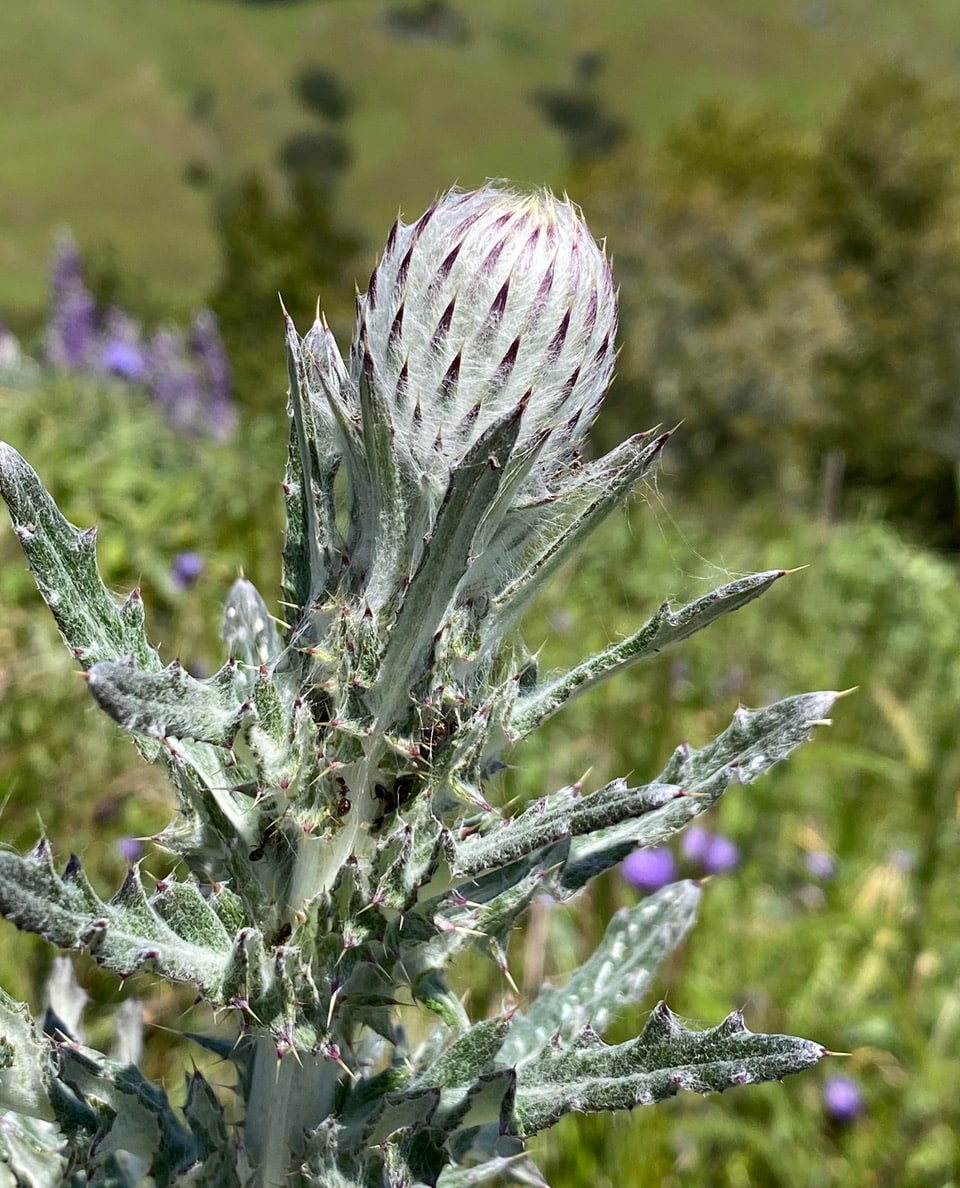
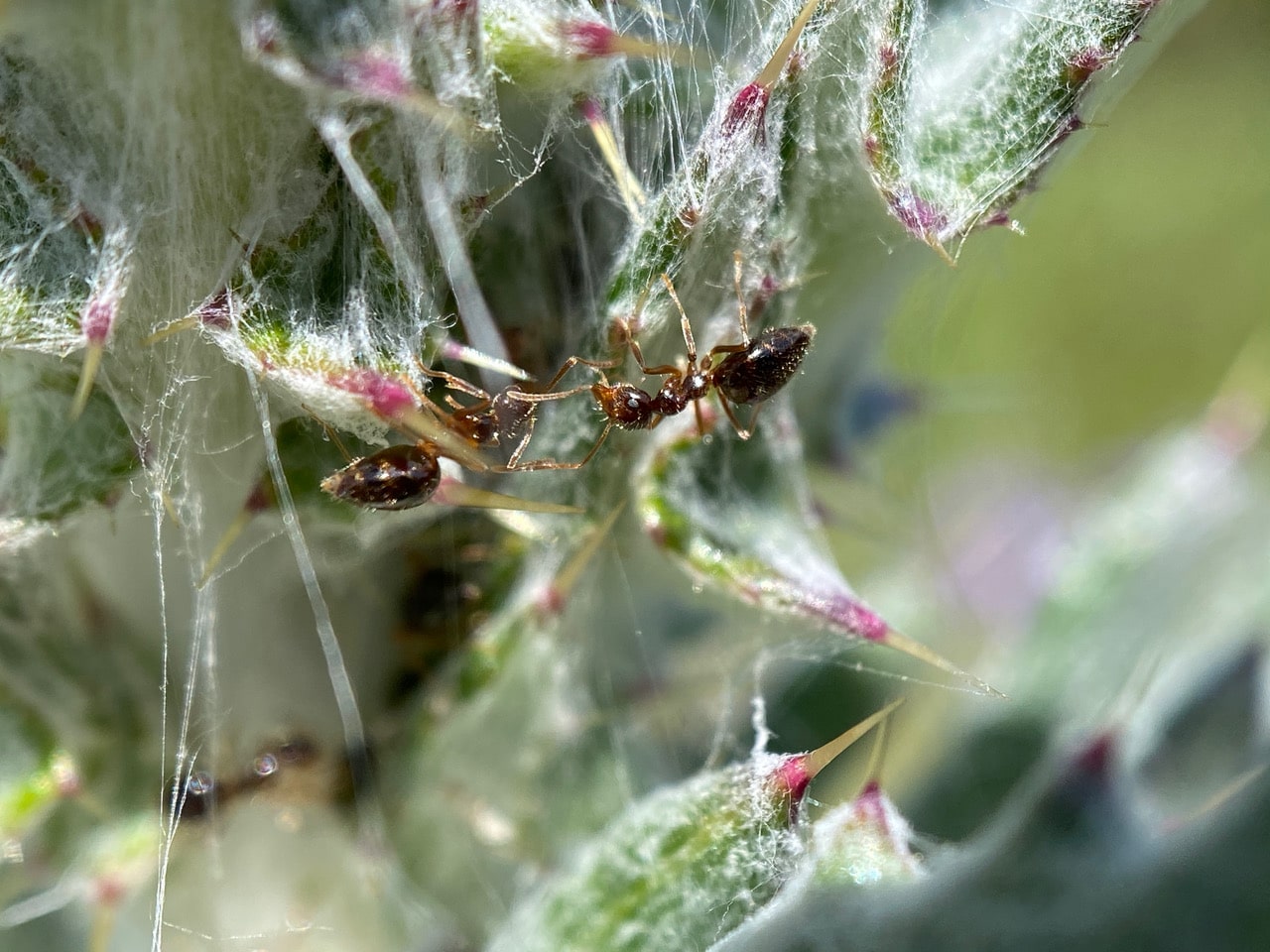
Next to the trail at Backbone, a flower bud (actually immature flowerhead) has appeared on the tip of a Cobweb Thistle, Circium occidentale. The leaves are well armored with prickly thorns, and the young flowerhead is covered with cottony hairs and spiky bracts. It would take a very brave and determined herbivore to tackle this plant, unless you are very small, like an aphid…
I notice some movements among the prickly leaves. Numerous American Winter Ants are excitedly crawling in and out of an opening in the tangles. Have they found food? Aphids?
The American Ant, Prenolepis imparis is a widespread North American ant. A dominant woodland species, it is most active during cool weather, when most other ant species are less likely to forage. This species is one of a few native ants capable of tolerating competition with the invasive Argentine Ant, Linepithema humile. They are also aggressive toward other ants and produce abdominal secretions that are lethal to Argentine Ants. Prenolepis imparis is a generalist omnivore. Foragers are known for tending to aphids or scale insects from which they consume excreted honeydew, aggregating on rotting fruit, and exploiting protein-rich sources such as dead worms. The colony enters estivation (a hibernation-like state) and becomes inactive above ground for the warmer months, during which time eggs are laid and brood are reared. Reproductives overwinter and emerge on the first warm day of spring for their nuptial flight.
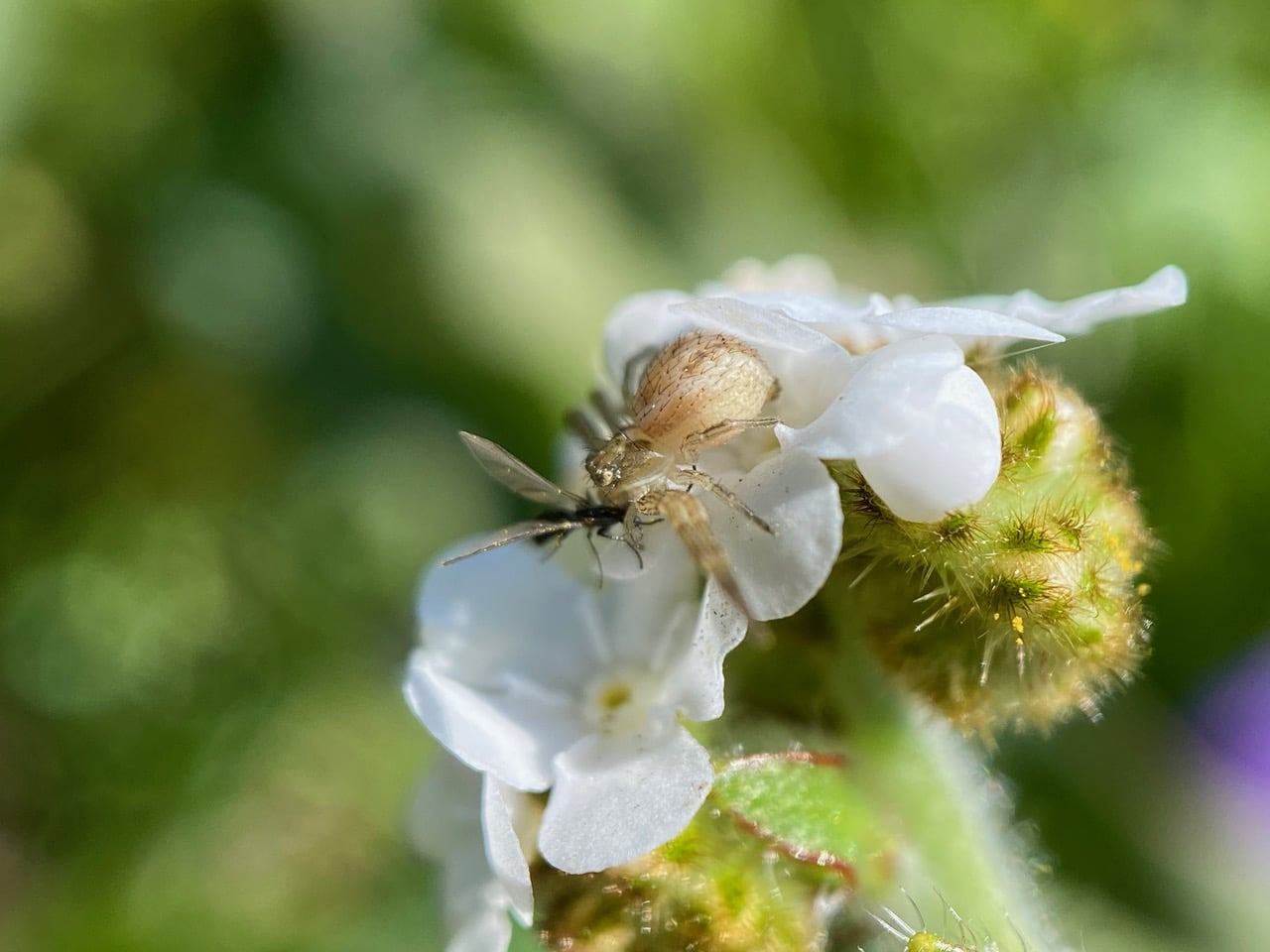
Predation in the miniature world of Popcorn Flowers! A very young Crab Spider (family Thomisidae) captures a winged insect, and holds on tightly to its prized meal even as I approach with the camera.
Members of the family Thomisidae do not spin webs, and are ambush predators. The two front legs are usually long and more robust than the rest of the legs. Their common name derives from their ability to move sideways or backwards like crabs. Most Crab Spiders sit on or beside flowers, where they grab visiting insects. Some species are able to change color over a period of some days, to match the flower on which they are sitting.
The season is progressing relentlessly. The appearance of little pea pods on the Silverleaf Lupine, Lupinus albifrons reminds me that we’re already deep into the month of April! Note the persistent styles at remain on the developing fruits.