

Pollinator Post 4/19/23 (1)
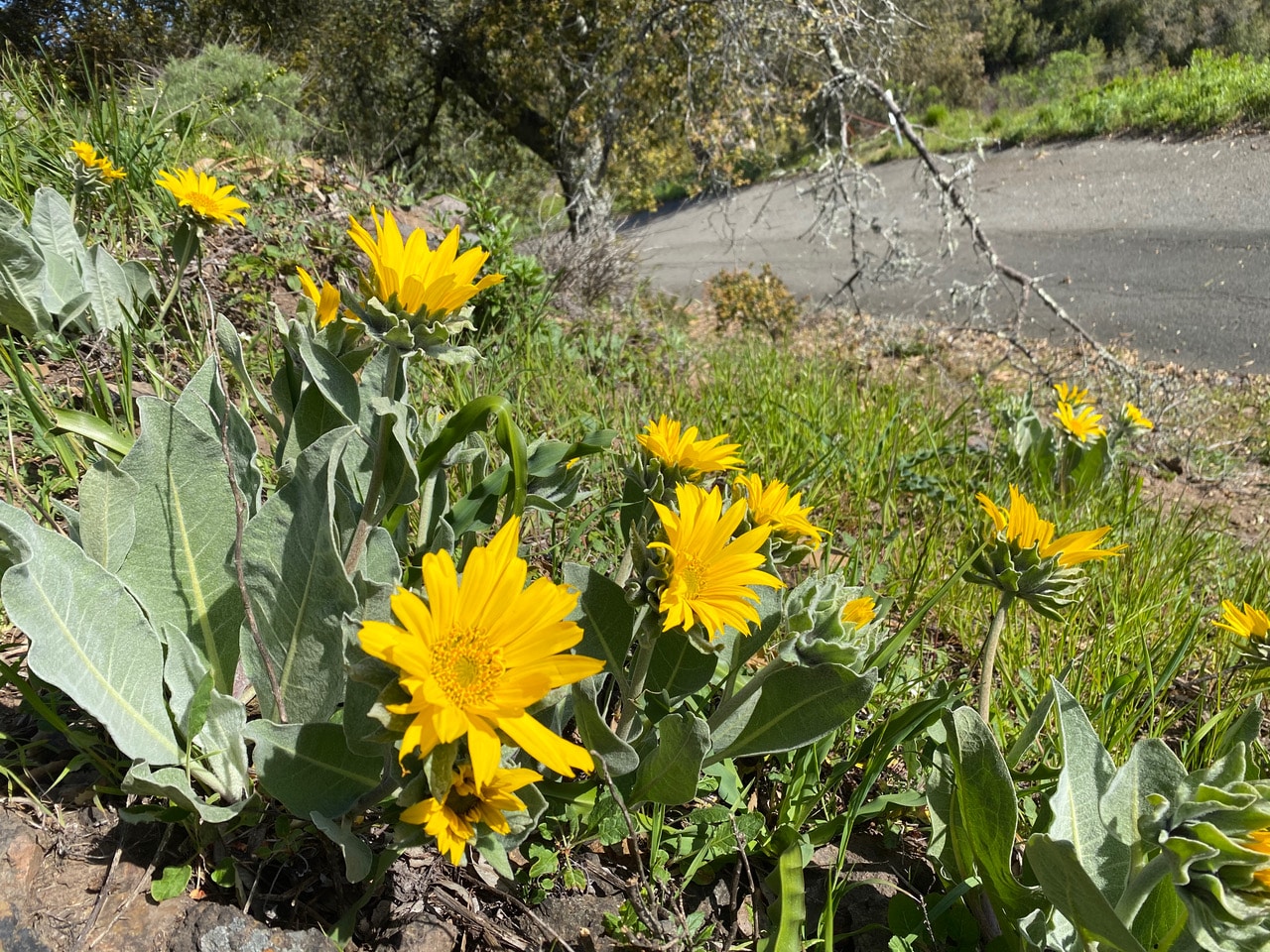
On the steep bank along the paved road to the radio tower, Woolly Mule’s Ears, Wyethia helenioides are blooming gloriously.
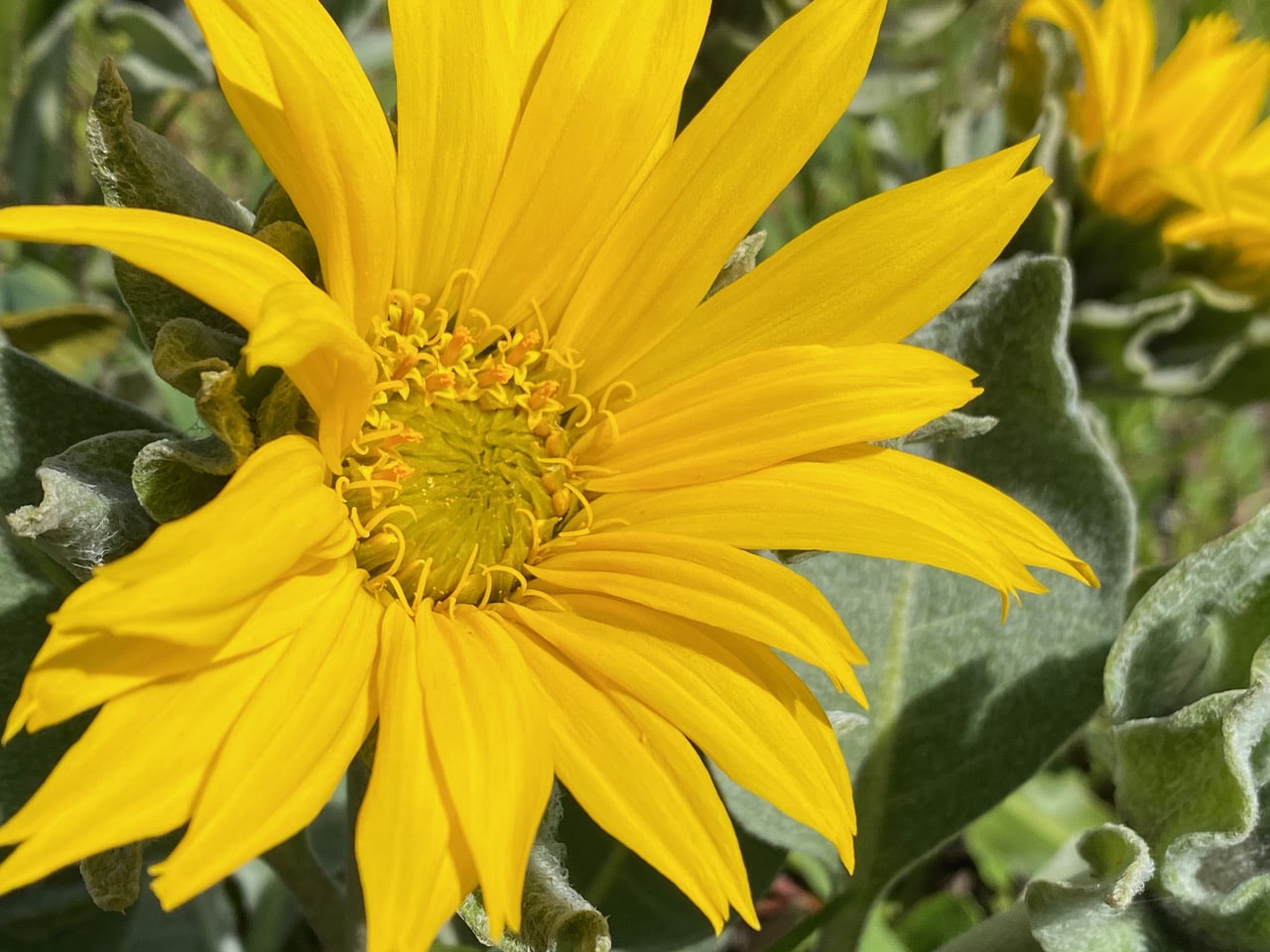
Peering into a young flowerhead, I discover something I have missed before – the ray flowers are pistillate (female), lacking stamens. The long, curly straps are the bilobed stigmas. These flowers on the rim should still be able to set seed if pollinated. The Jepson Manuel describes the flowers of Wyethia Helenioides thus: “Radiate heads have peripheral ray flowers and central disk flowers. Ray flowers are generally pistillate or sterile (occasionally lacking styles).”
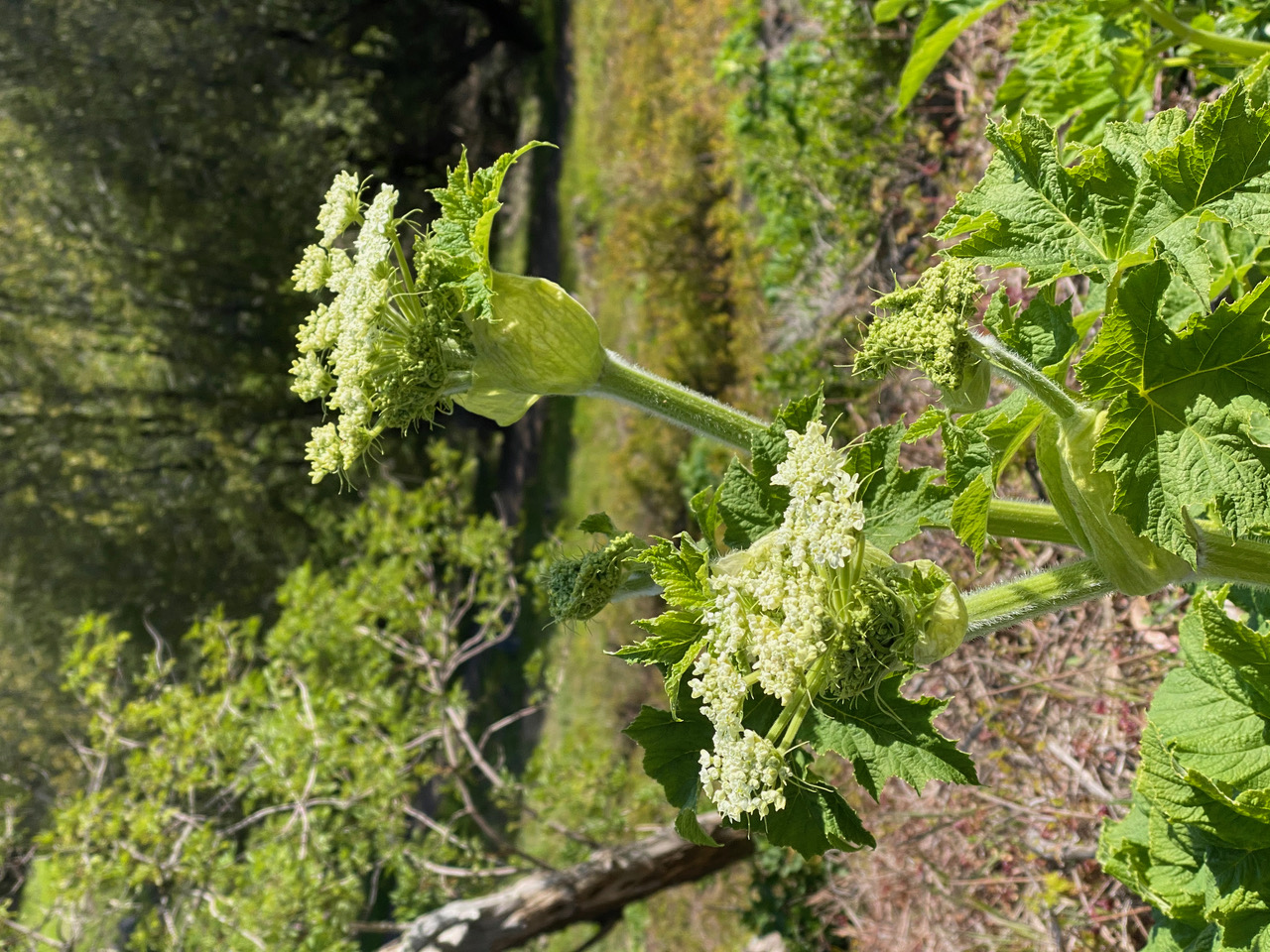
Umbels of white flowers are unfurling from the giant buds of Cow Parsnip, Heracleum maximum.
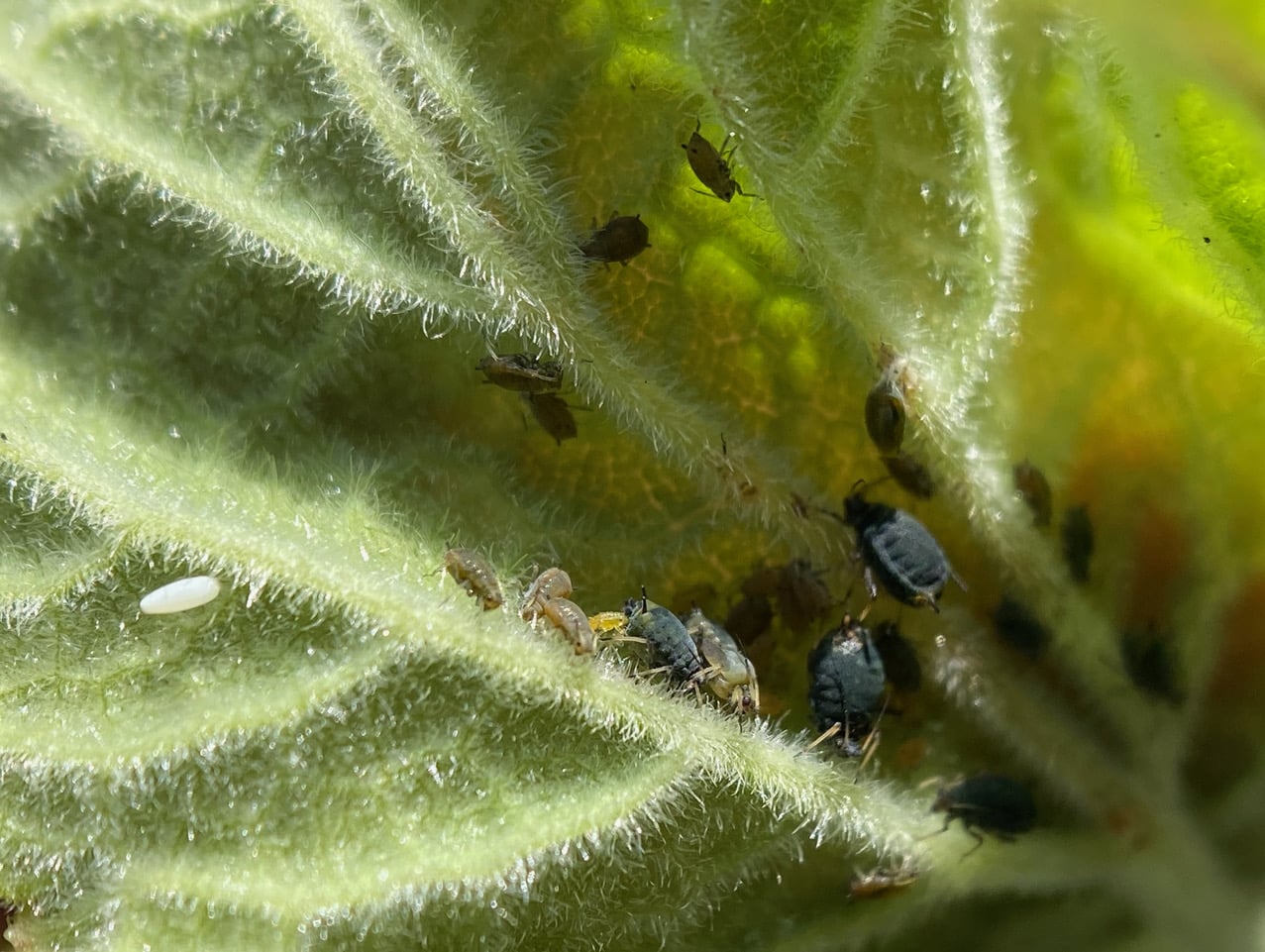
Wait, something is happening on the underside of this young Cow Parsnip leaf. A small colony of aphids has apparently gained a foothold. The adult aphids are black while the young ones are yellowish brown, grading into black as they grow. Do you see the rice grain-like egg of a Syrphid Fly to the left? A female Syrphid Fly has found the aphid colony and has laid an egg close by. Her aphidophagus larva will have plenty of food when it hatches out of the egg. Good planning, Mama!
These aphids have been identified as the Cotton of Melon Aphids, Aphis gossypii (family Aphididae). They are highly variable in size and color, varying from light yellow to dark green or almost black. Adults tend to be about 1/16 in. in length, are soft bodied and pear shaped. Aphids have piercing-sucking mouthparts and have two protrusions (“exhaust pipes”) on their rear ends called cornicles that secrete defensive chemicals when the insect is attacked.
Cotton aphid is nearly cosmopolitan, having a world-wide distribution. They can feed on a large range of host plants covering 25 plant families, including crop as well as horticultural plants. Cotton aphids will initially be found feeding on the underside of new leaves, the plant terminal and flower buds, but as the population grows will infest the underside of older leaves. As in all aphids, these feed by piercing leaves and other plant parts, ingesting copious amounts of plant sap from the phloem. Heavy and prolonged infestations can cause leaves to curl downward, older leaves to turn yellow and shed, and fruits to fail. The aphids excrete wastes in the form of a sugary substance called honeydew. A black sooty mold often grows on the honeydew and may partially interfere with photosynthesis. Cotton aphids is an important vector of many plant viruses. They are often attended by ants, which collect and feed on their honeydew.
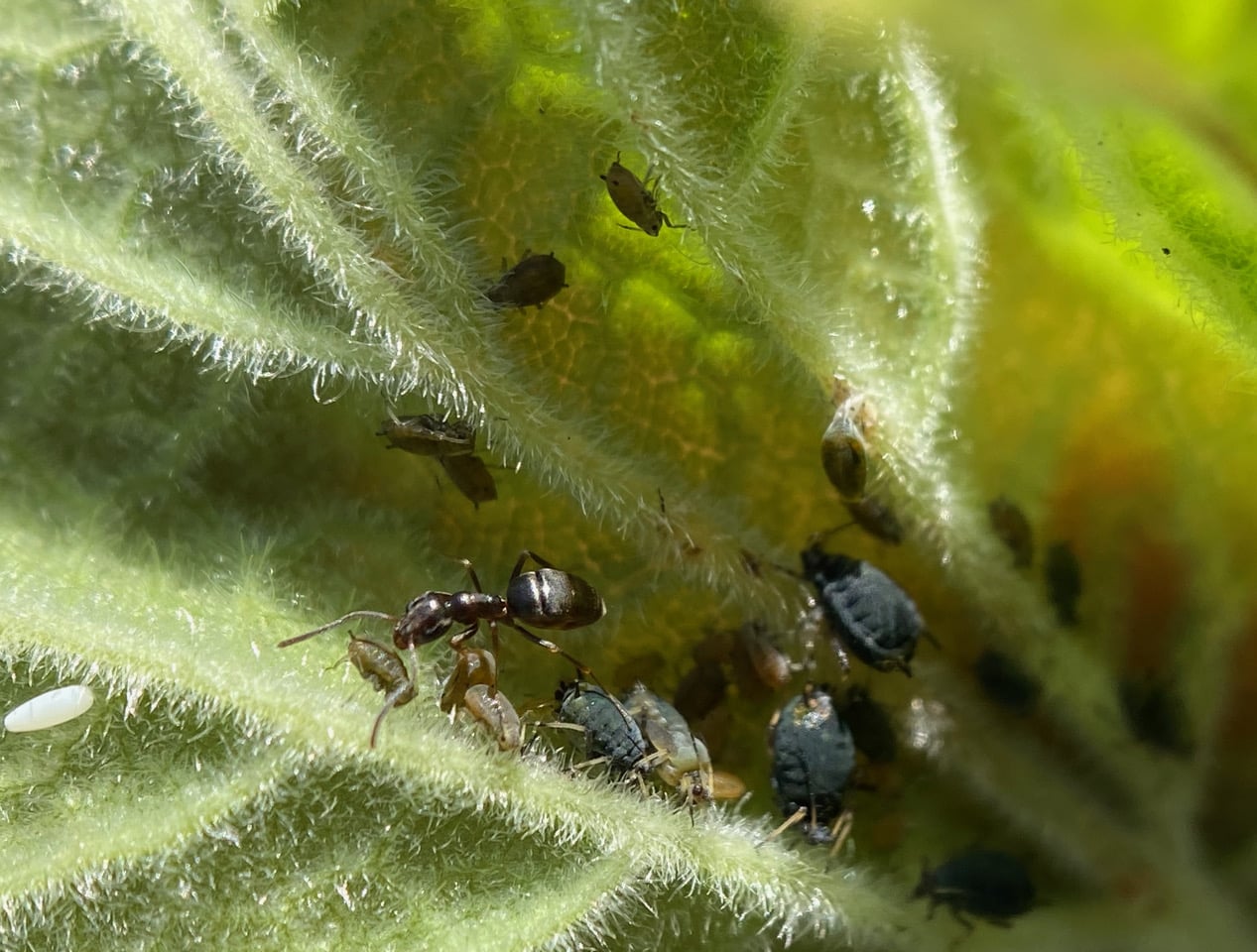
The Syrphid Fly is not the only insect that has discovered the aphids; some American Winter Ants, Prenolepis imparis are tending them!
Ants and aphids share a well-known mutualistic relationship. The aphids produce honeydew, a sugary food for the ants; in exchange, the ants care for and protect the aphids from predators and parasites. Some ants will “milk” the aphids to make them excrete the sugary substance. The ants stroke the aphids with their antennae, stimulating them to release the honeydew. Aphid-herding ants make sure the aphids are well-fed and safe. When the host plant is depleted of nutrients, the ants carry their aphids to a new food source. If predatory insects or parasites attempt to harm the aphids, the ants will defend them aggressively. Some species of ants continue to care for aphids during winter. The ants carry the aphids to their nest for the winter months, and transport them to a host plant to feed the following spring.
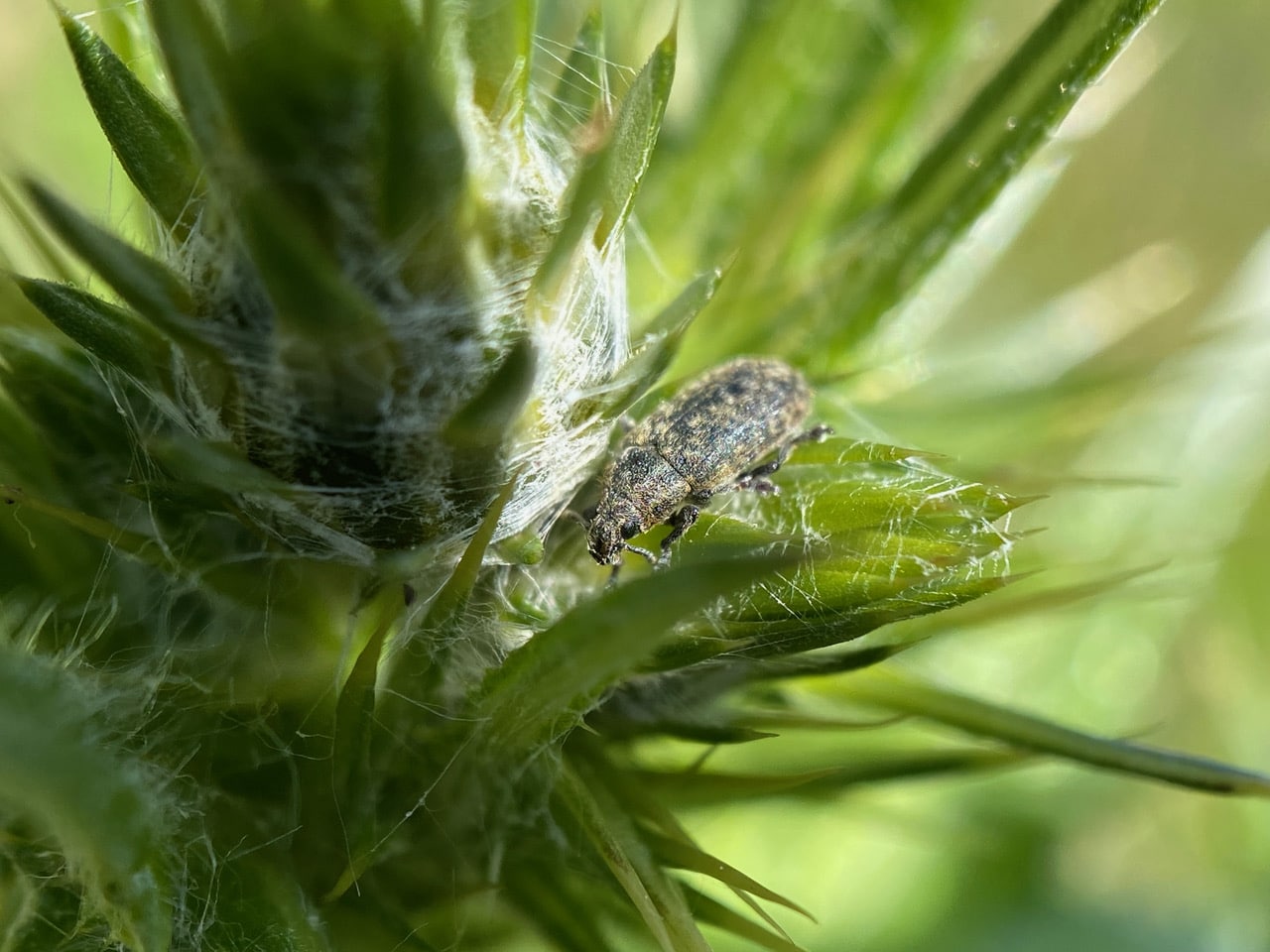
A Nodding Thistle Receptacle Weevil, Rhinocyllus conicus (family Curculionidae) is hidden among the spiky bracts of an immature flowerhead of an Italian Thistle.
The adult weevil is black and covered with a thin black and yellowish mottled coat of hairs. It is a short-snouted beetle up to 6 mm long. Eggs are laid on or near the bracts of the thistle flower head. The larvae burrow into the flower head and feed on the flower parts and developing seeds. Adults cause damage as well when they feed on the foliage.
The weevil is native to Eurasia and North Africa. Introduced to the United States for thistle biocontrol in 1969, it is now widely established in the country. The weevil is found to be very effective in reducing the spread of invasive thistles, including Italian thistles. However, the weevil will also readily attack native thistles in the genus Cirsium, in some cases contributing to population decline. For this reason this weevil is no longer used for thistle biocontrol.
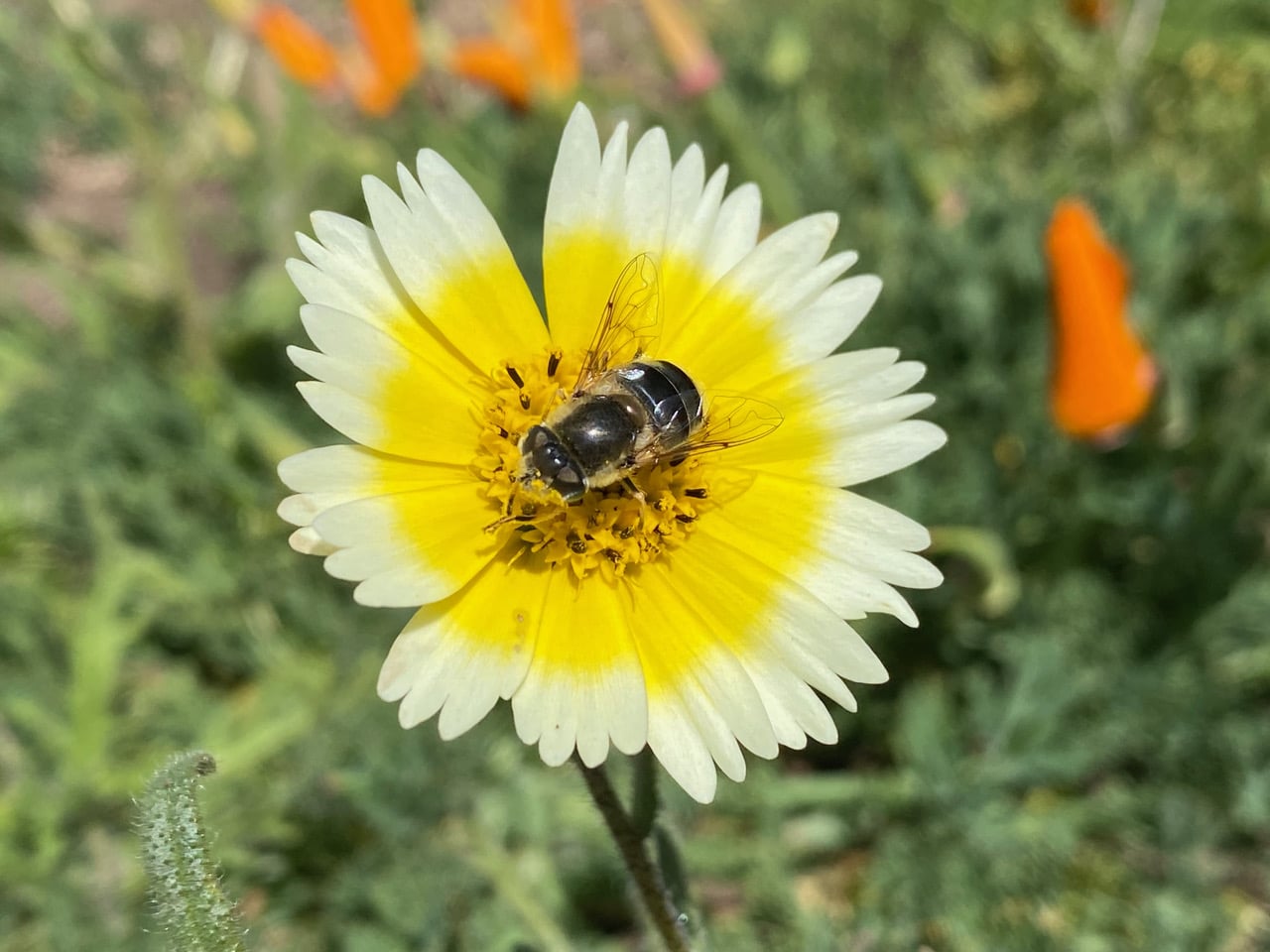
At the Swale another member of the Asteraceae or sunflower family is blooming – the Common Tidy Tips, Layia platyglossa. Several Black-footed Drone Flies, Eristalis hirta (family Syrphidae) are feeding on the flowerheads. Sticky pollen has adhered to this fly’s face as well as the hairs on the underside of its body.
Eristalis hirta is a common Western North American species of hover fly. Hoverflies get their names from the ability to remain motionless while in flight. The adults are also known as flower flies for they visit flowers for nectar and pollen. The larvae are aquatic filter-feeders of the rat-tailed type.
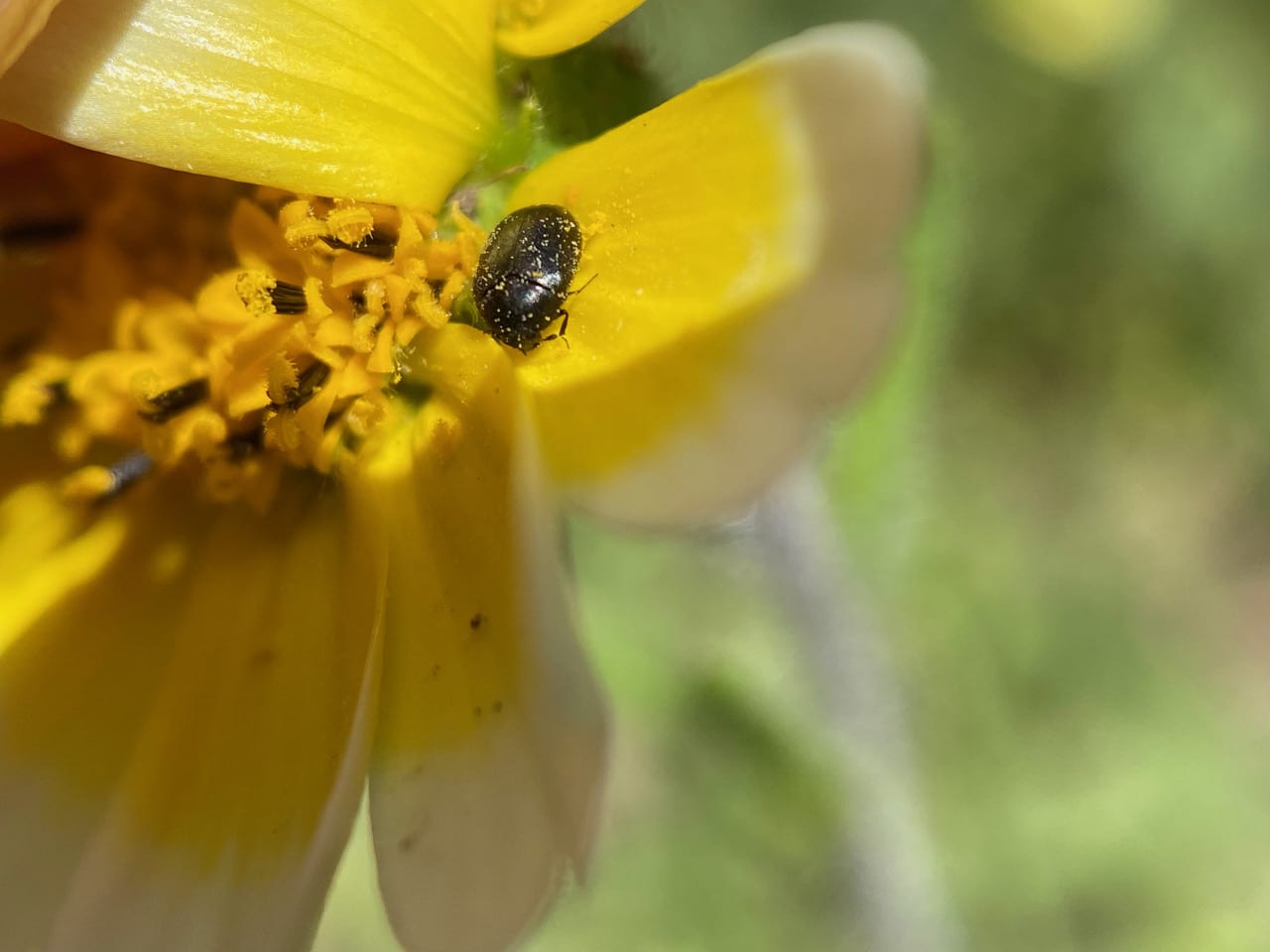
A tiny black beetle is covered with pollen on the ray flower of a Tidy Tips flowerhead. It is in the genus Cryptorhopalum in the family Dermestidae.
Dermestidae are a family of Coleoptera (beetles) that are commonly referred to as skin of carpet beetles. Ranging in size from 1 to 2 mm, the beetles typically have clubbed antennae that fit into deep grooves. Most Dermestids are scavengers that feed on dry animal or plant materials, such as skin or pollen, animal hair, feathers, dead insects and natural fibers. The larvae are used in taxidermy and by natural history museums to clean animal skeletons.
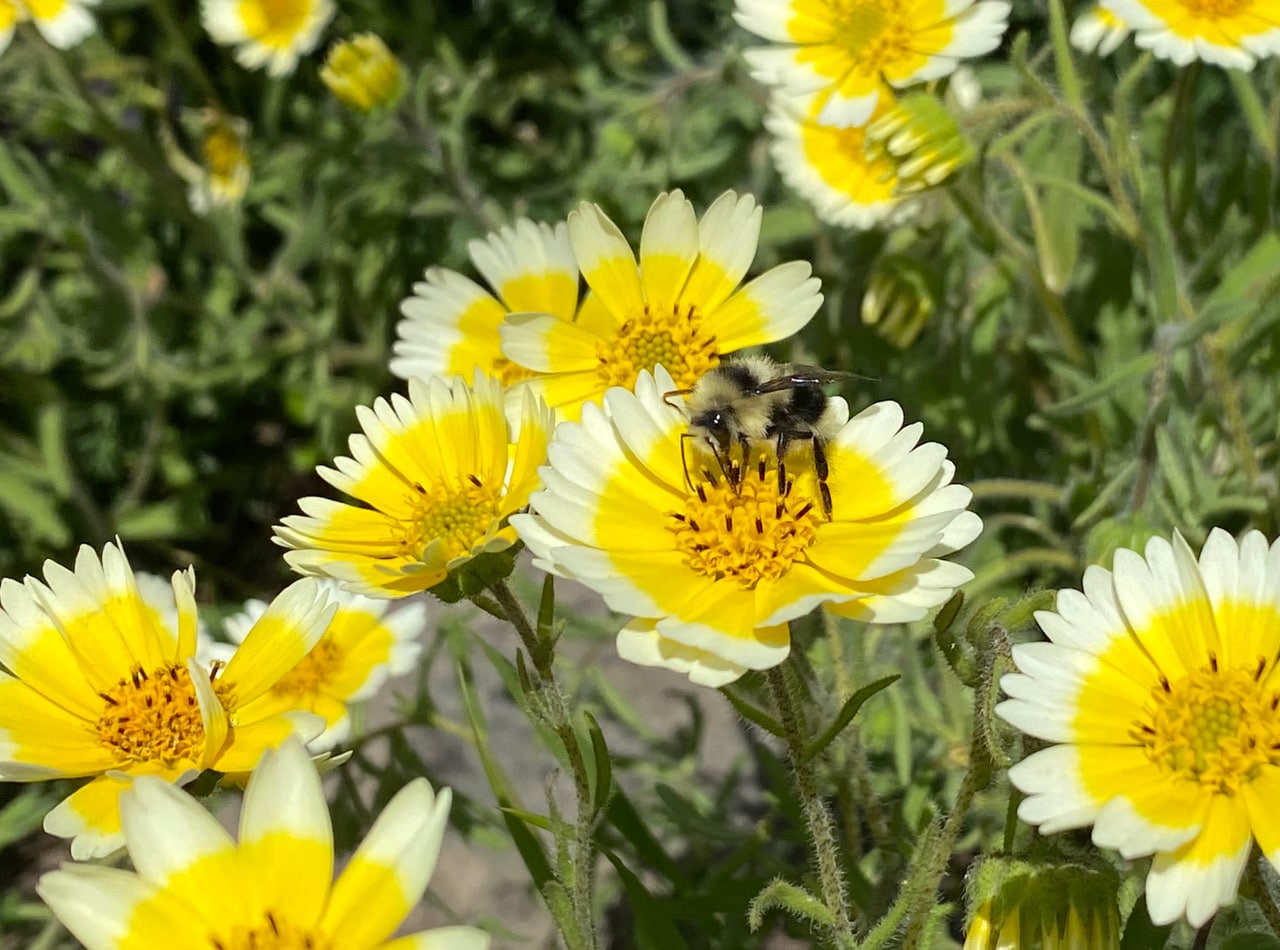
A Black-tailed Bumble Bee, Bombus melanopygus lands on a Tidy Tips flowerhead. She does not seem to be collecting pollen (her pollen basket is empty), but simply taking nectar.
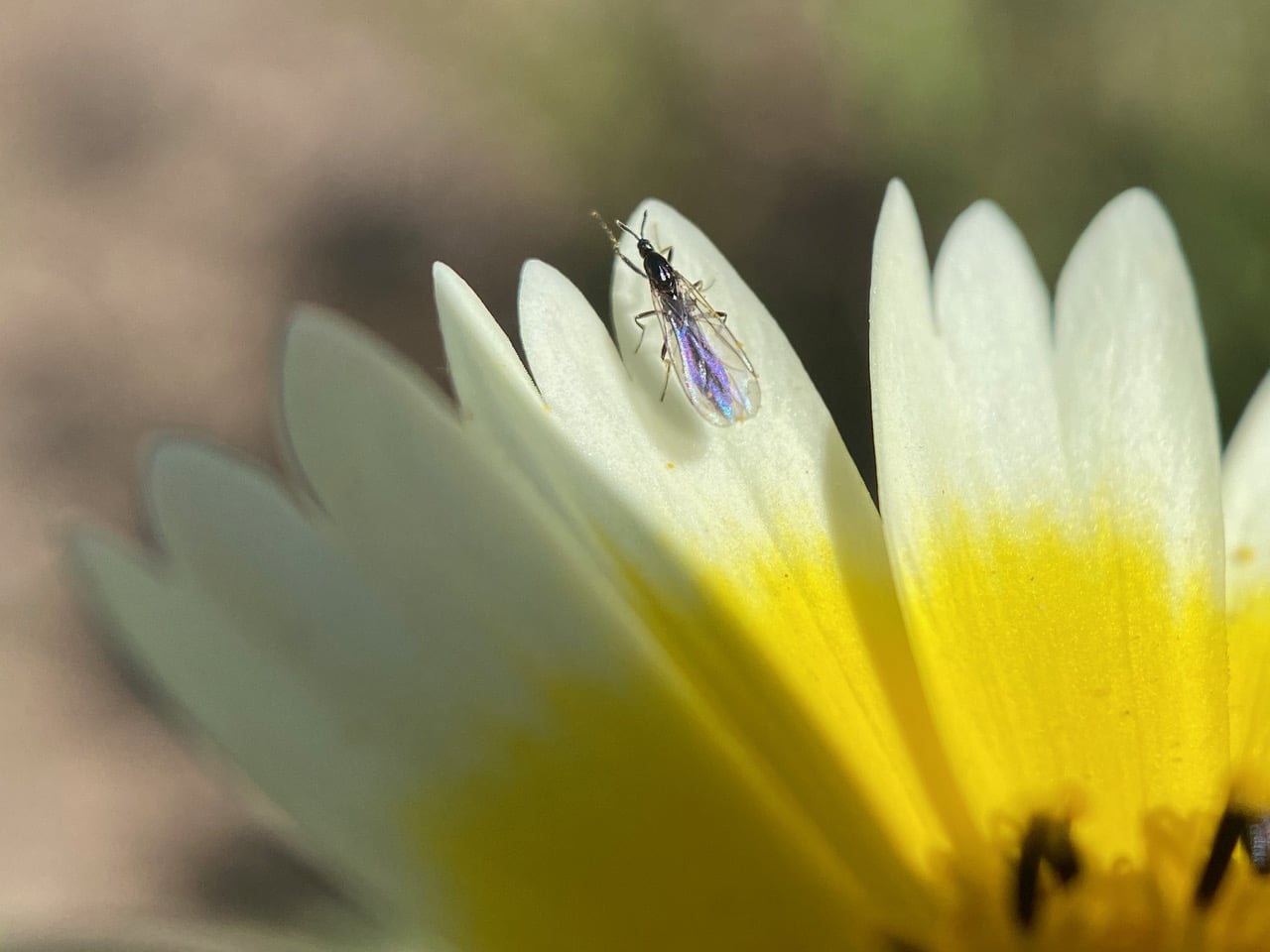
A Minute Black Scavenger Fly (family Scatopsidae) is dwarfed by the ray petal of a Tidy Tips.
As implied by the family name, these flies are also called “dung midges”. They are generally small, sometimes minute, dark flies (from 0.6 to 5 mm) with short antennae. Adults are often found on flowers. The larvae of most species are unknown, but the few that have been studied have a rather flattened shaped and are terrestrial and saprophagous, feeding on decaying plant and animal matter.
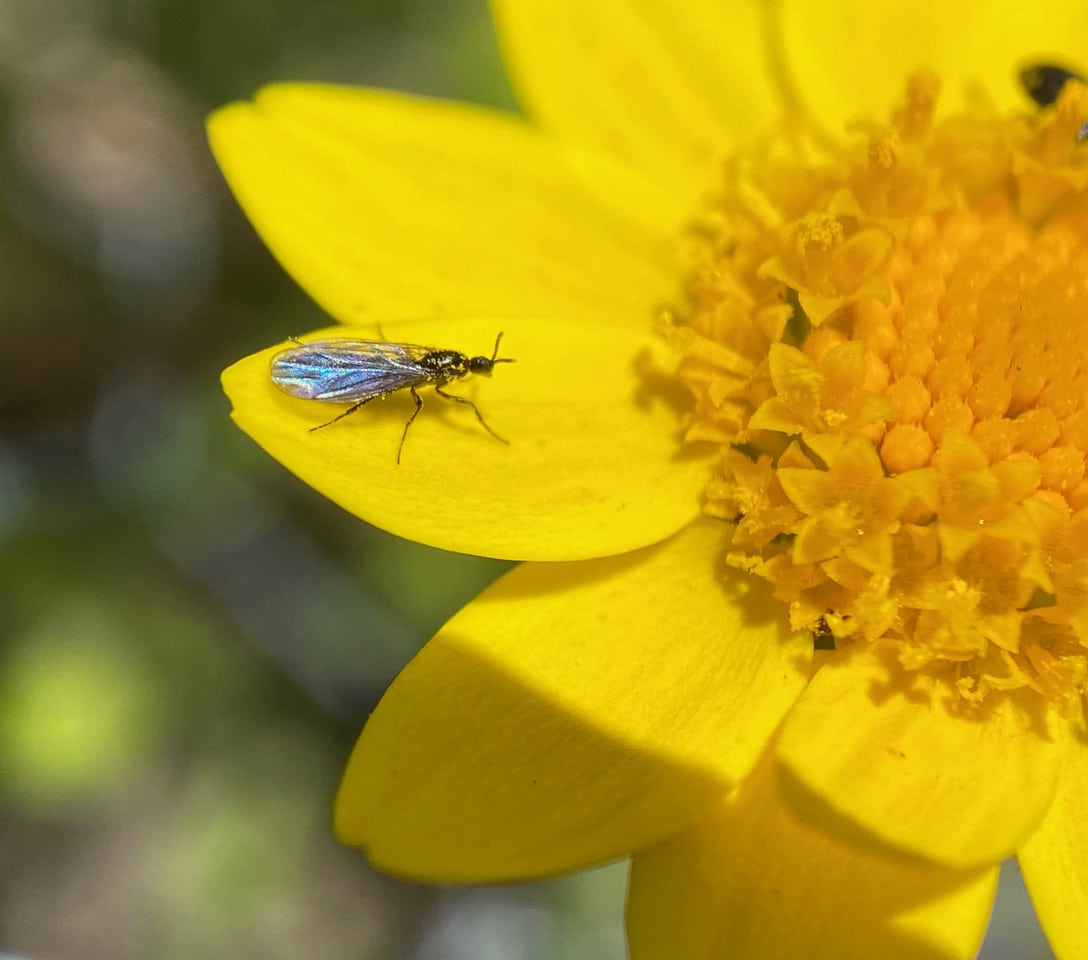
Here’s another Minute Black Scavenger Fly (family Scatopsidae) on a Goldfields flowerhead, Lasthenia sp., its body covered with pollen.
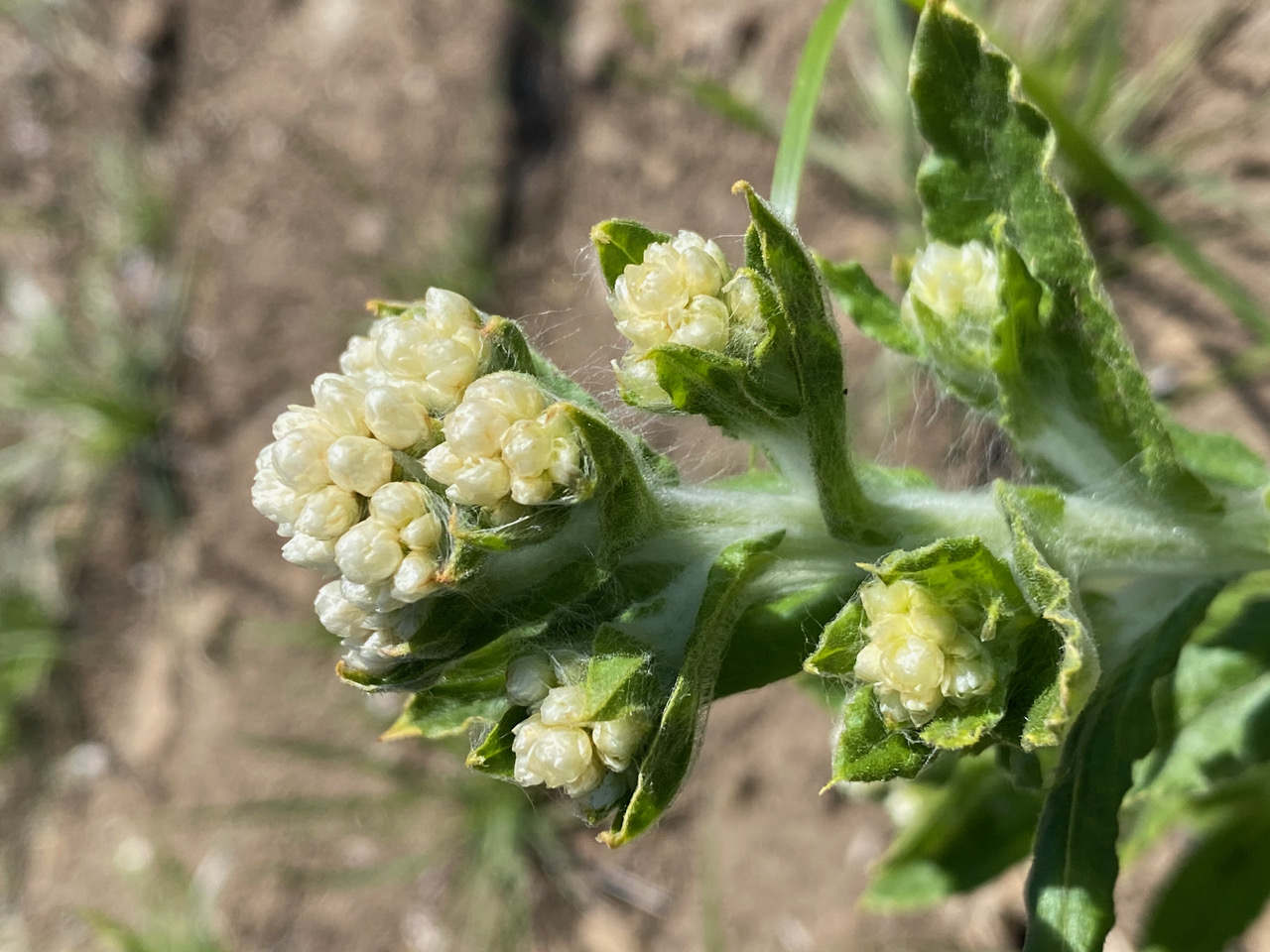
Some of the California Everlasting, Pseudognaphalium californicum are ready to bloom.
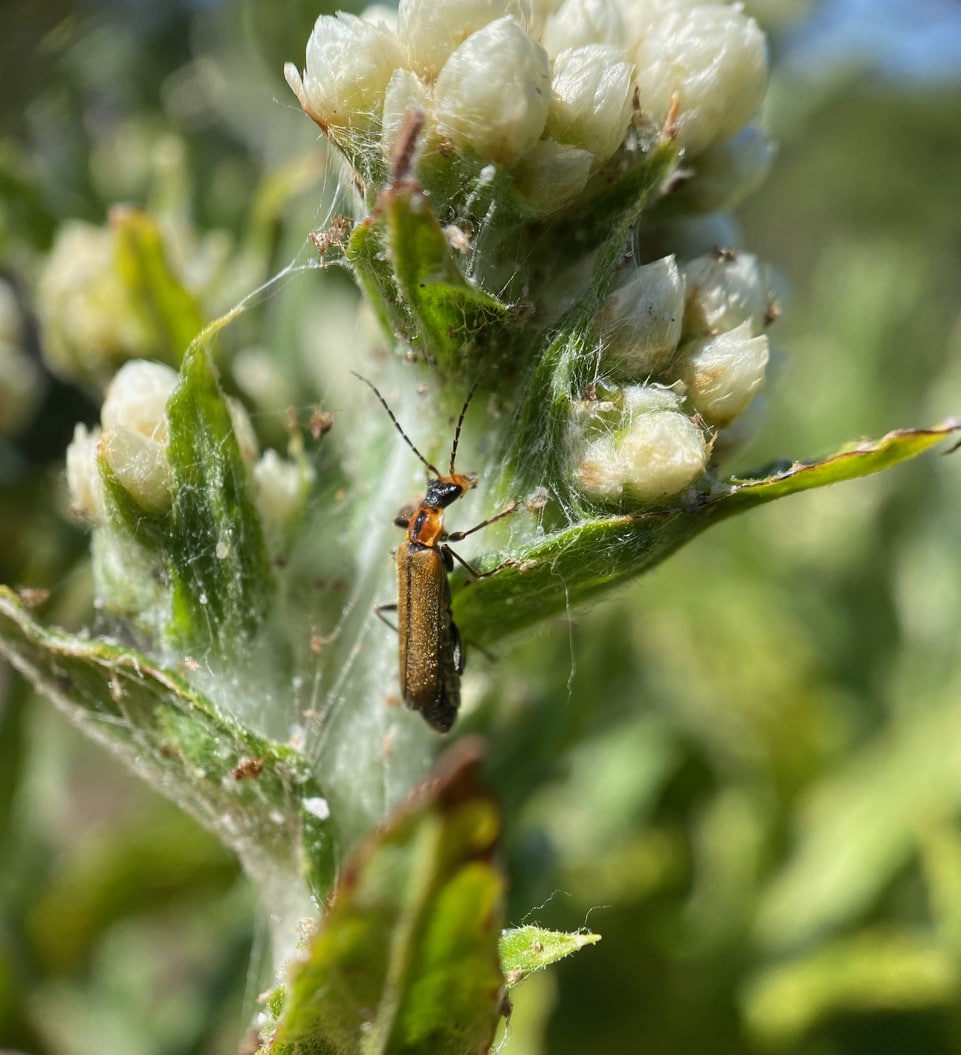
On another plant, a small Soldier Beetle, Podabrus cavicollis (family Cantharidae) is feeding on something very small.
The Soldier Beetles, family Cantharidae are relatively soft-bodied, straight-sided beetles. One of the first described species has a color pattern reminiscent of the red coats of early British soldiers, hence the common name. They are also known commonly as Leatherwings because of their soft elytra.
Soldier beetles often feed on both nectar and pollen as well as predating on other small insects. The larvae are often active, and feed on the ground, hunting snails and other small creatures. Soldier beetles are generally considered beneficial insects by gardeners.
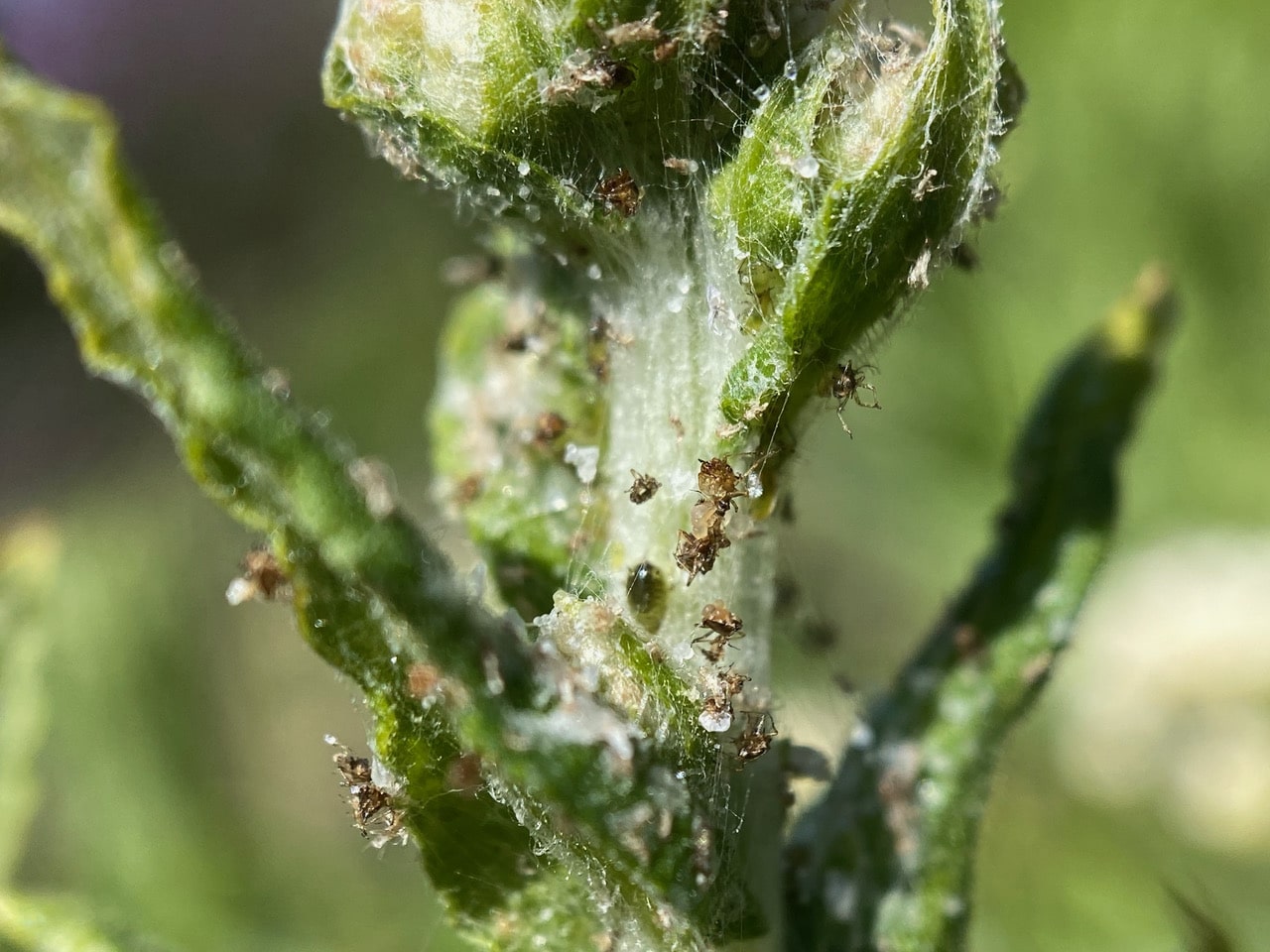
This California Everlasting seems to be heavily infested with aphids. There are milky white globs of honeydew everywhere, as well as dead aphids.
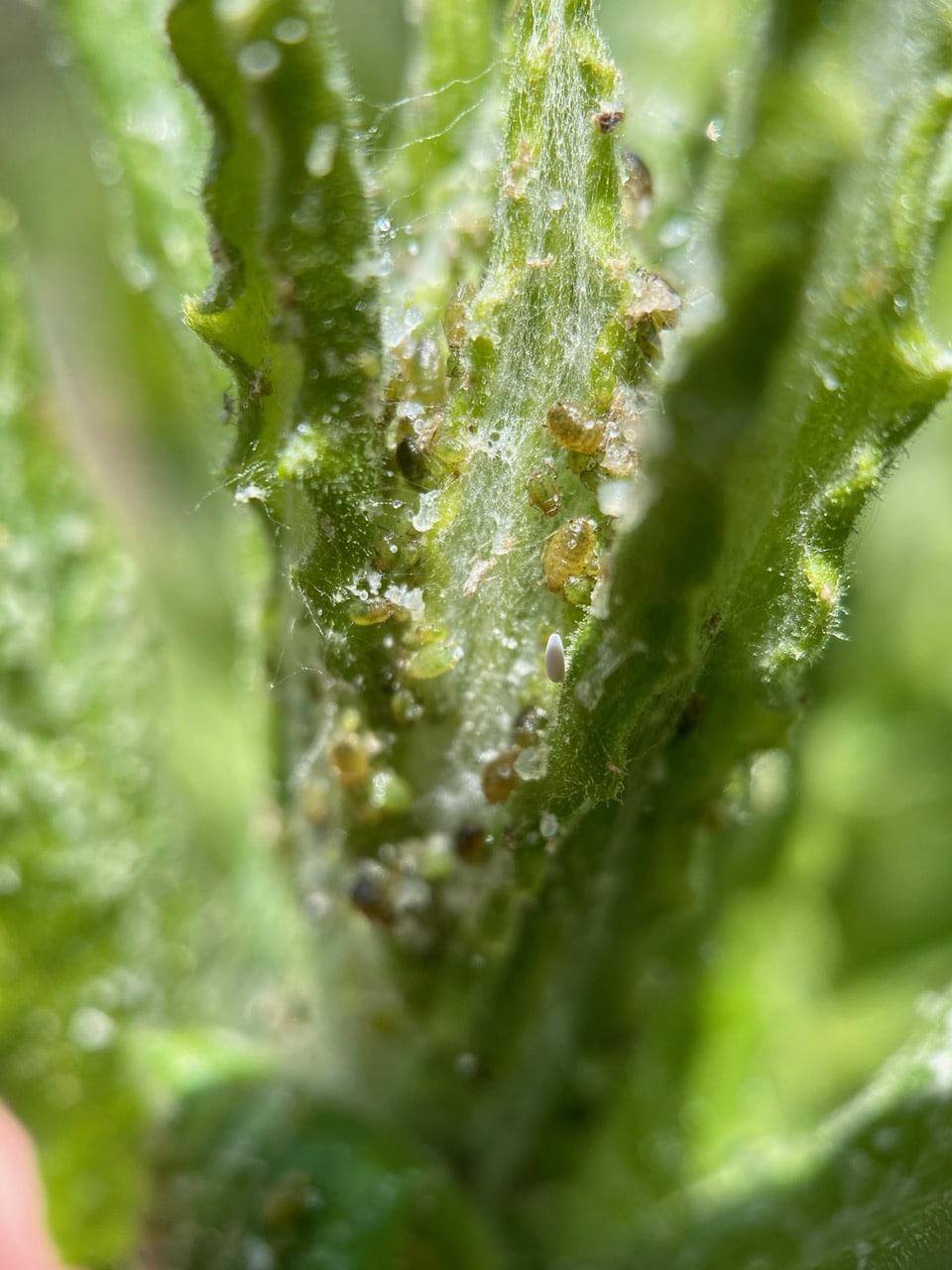
I find the live aphids at last. They are tiny and green, hidden between the leaves near the tips of the branches.
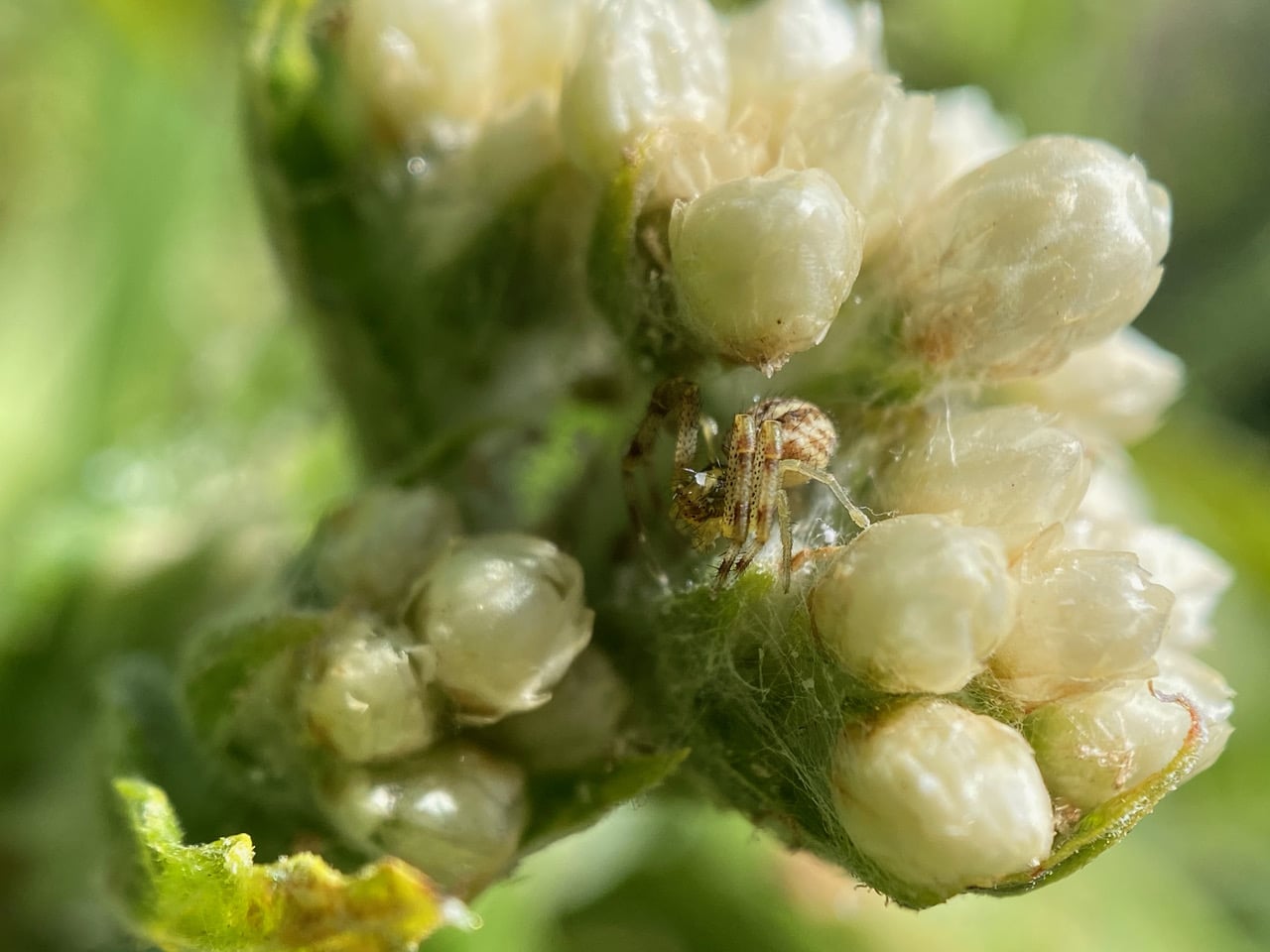
Ooh, here’s a very small Crab Spider (family Thomisidae) hiding among the flower buds.
Members of the family Thomisidae do not spin webs, and are ambush predators. The two front legs are usually long and more robust than the rest of the legs. Their common name derives from their ability to move sideways or backwards like crabs. Most Crab Spiders sit on or beside flowers, where they grab visiting insects. Some species are able to change color over a period of some days, to match the flower on which they are sitting.
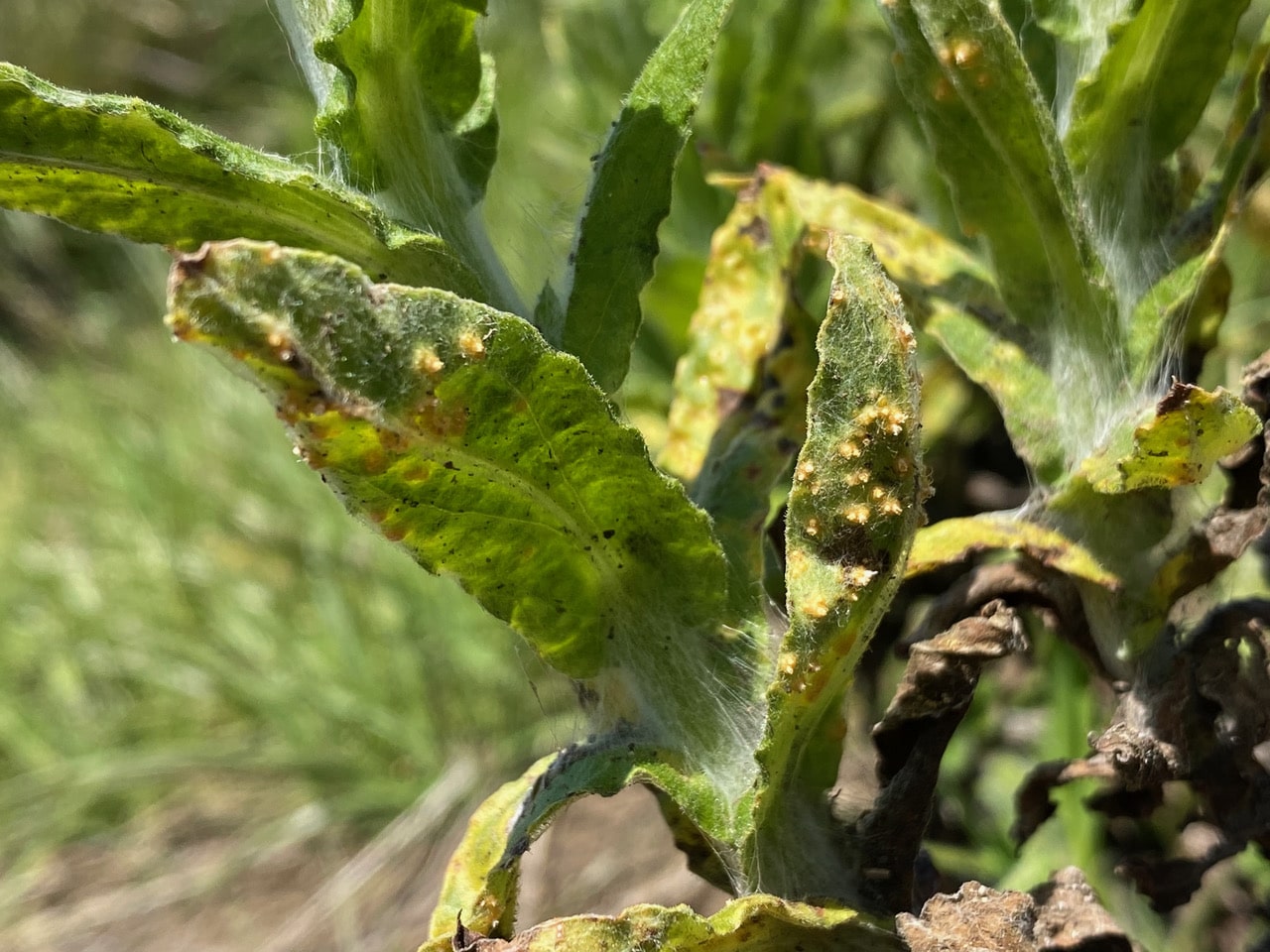
A couple of the California Everlasting look sick. At the base of the plants there are yellowish eruptions from the underside of the leaves. The upper surface is pitted.
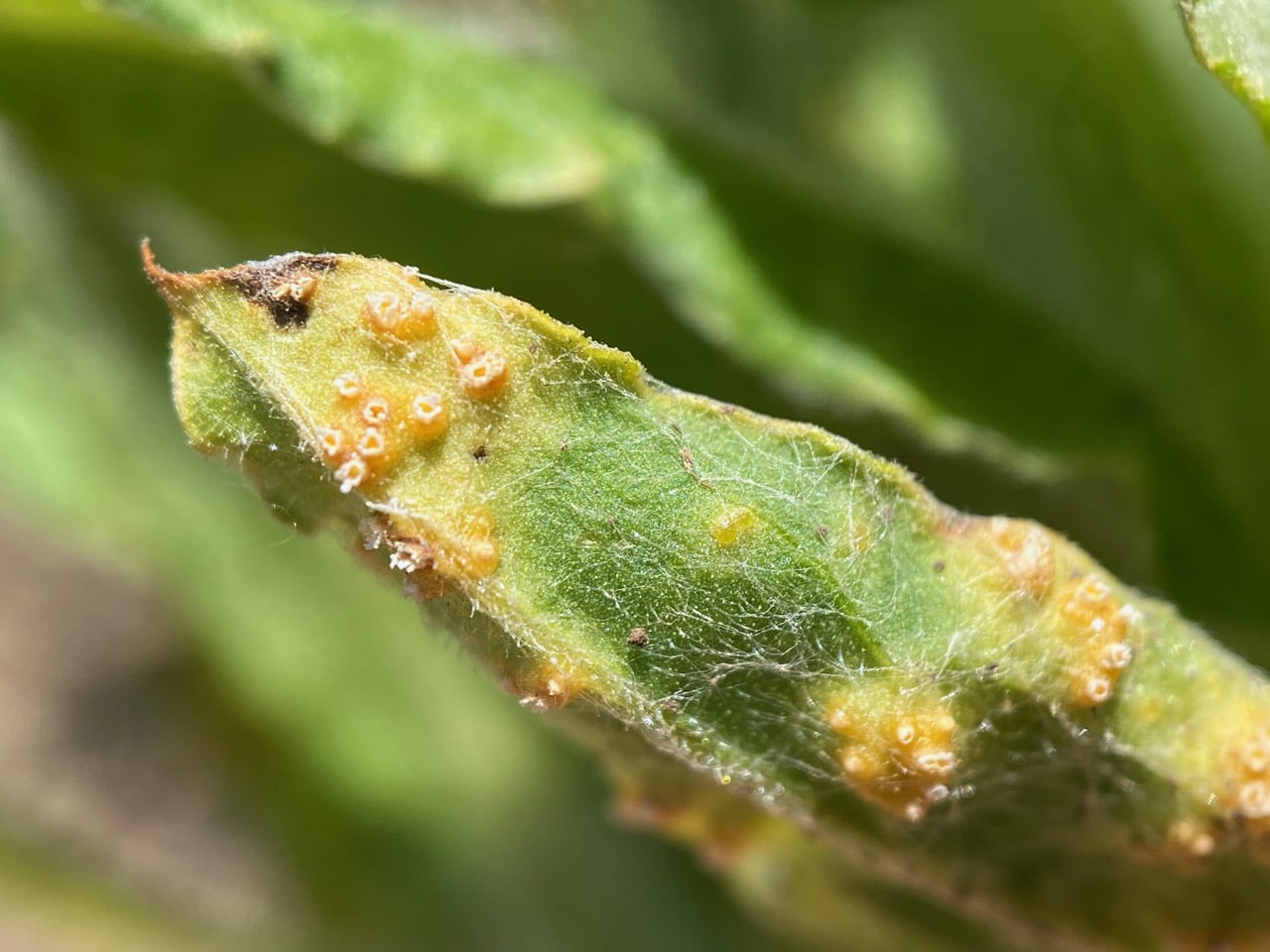
Close-up of the underside of a diseased leaf. These are galls induced by Gall Mites in the genus Aceria (family Eriophyidae)
Eriophyid Mites are translucent, cigar-shaped microscopic mites that cause deformities on many plant species. These mites are noticed when their feeding causes abnormalities of plant tissues such as perineum, galls, brooms, leaf curling, blisters, rusts, etc.
Aceria is a genus of mites belonging to the family Eriophyidae, the gall mites. Several species can cause blistering and galls, including perineum galls. A few are economically significant pests, while others are useful as agents of biological pest control of invasive plants.