

Pollinator Post 4/17/26 (1)
Closed to car traffic for the migrating newts during winter, South Park Drive is once again open, giving me a short, direct route to the Regional Parks Botanic Garden in the Berkeley hills. On the way I decide to stop by the Padre Picnic Area to check for wildflowers. Much to my disappointment, the California Buttercups have all but finished blooming, and the Checkerbloom is just starting to come into their own. There’s hardly any insects around.






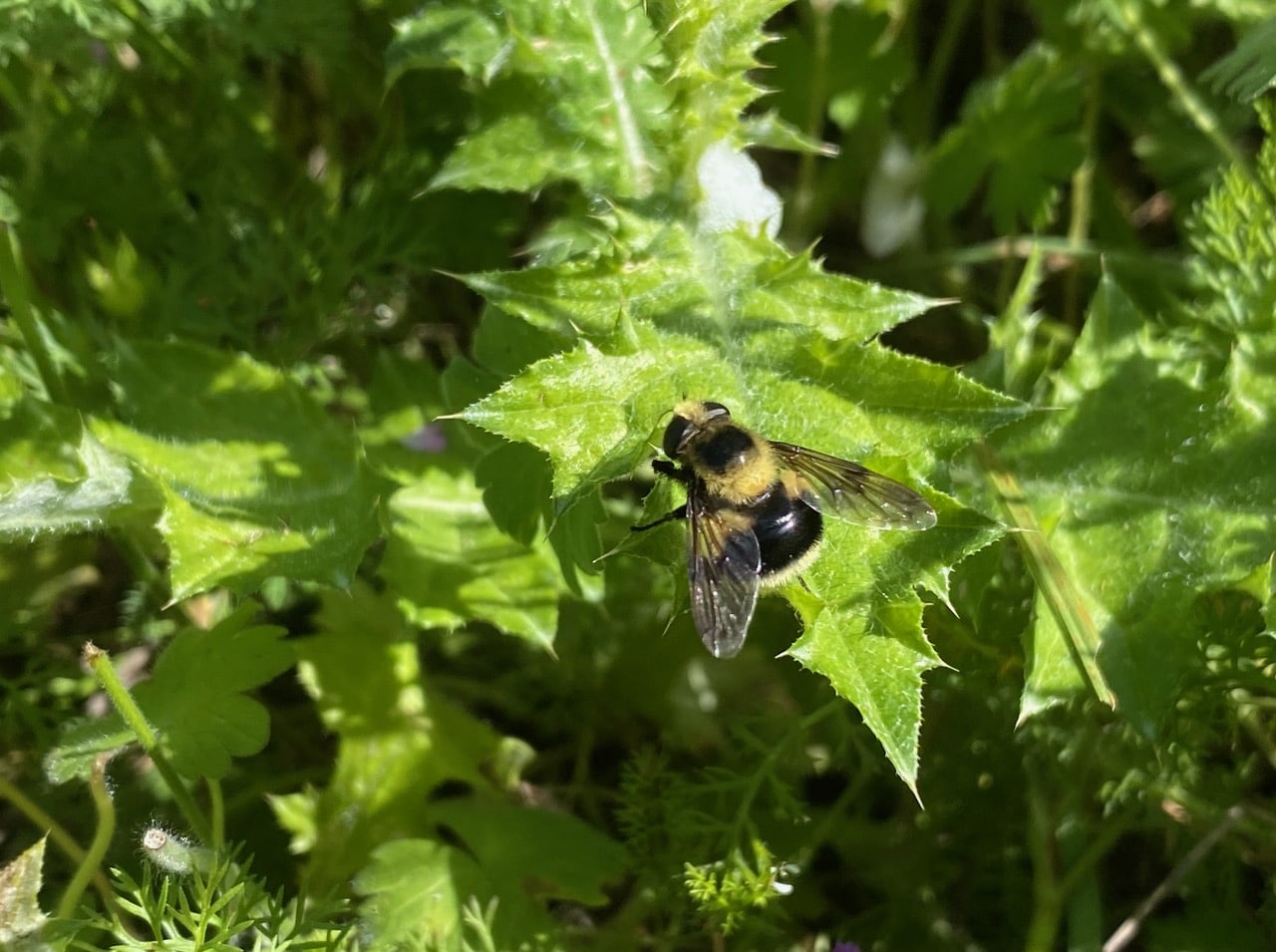
As I turn back on the trail, a large black-and-yellow insect flies past me and lands on a Thistle leaf. At first glance, it could easily be mistaken for a bumble bee, but the eyes are all wrong. It is a fly! And not just any fly, but what I like to call the ultimate “Wanna-Bee” – a hover fly that mimics a bumble bee.
The fly is a member of the Volucella bombylans Complex (family Syrphidae) which comprises numerous hover flies that are bumble bee mimics, also known as Bumble Bee Hoverflies. These flies look like a bumble bee with a furry black and yellow body, but they are given away by their heads, plumed antennae, large eyes and a single pair of wings. Fast fliers, the adults feed on nectar and pollen, with a preference for blue and yellow flowers. The females lay eggs in the nests of bumble bees and social wasps. The larvae live as scavengers on the bottom of the host’s nest, feeding on waste and dead host larvae. What an unusual niche for a Syrphid larva!
What a strange creature, with large eyes, and a hairy yellow snout. The fly is calmer in disposition than the real bees it mimics, and much easier to photograph.
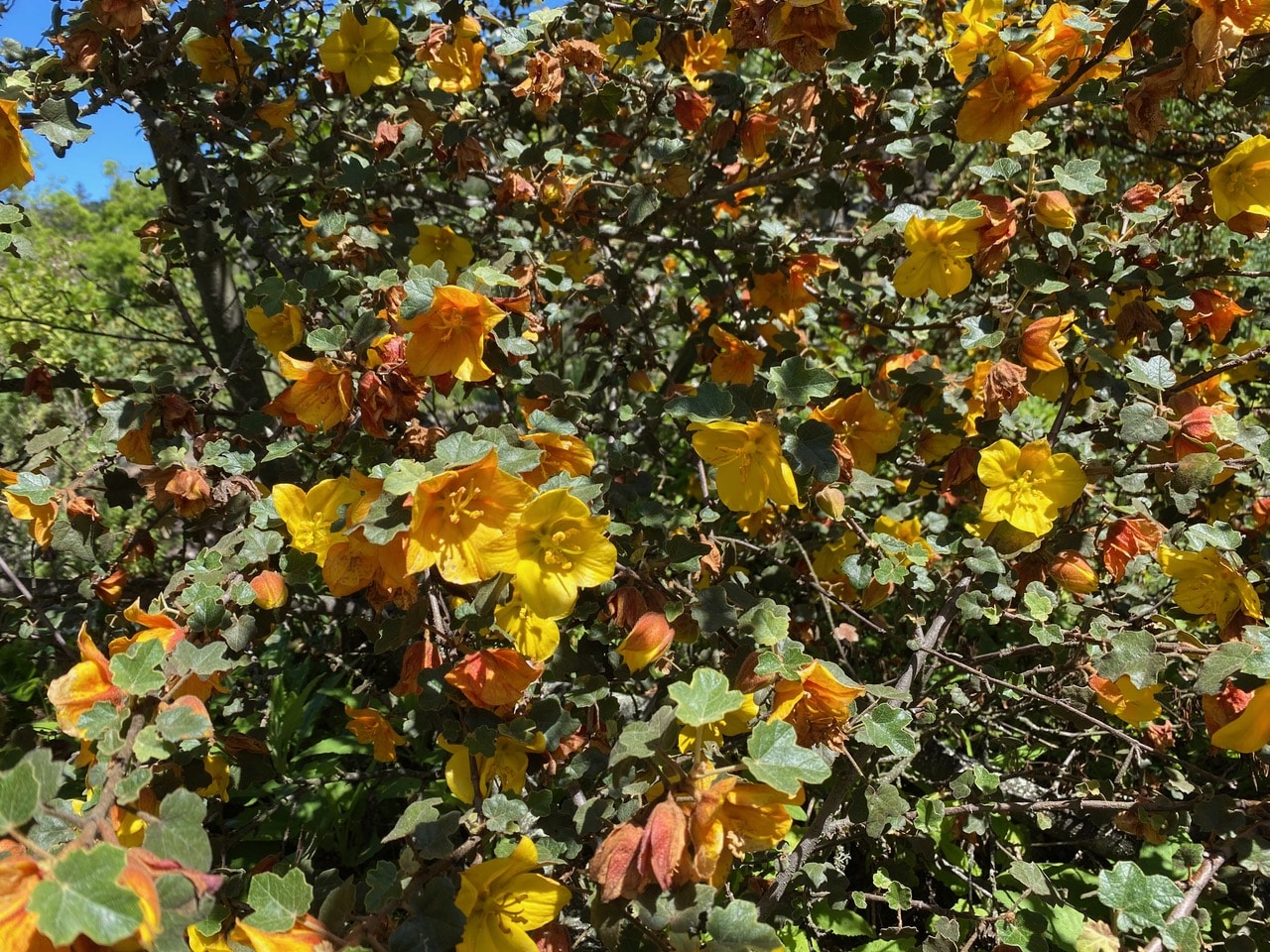
By the front gate of the botanic garden, the large Flannel Bush, Fremontodendron californicum is past its flowering prime, but there are still many fresh flowers. I wait for a while for pollinators, but everything is surprisingly quiet here.
An unfamiliar shrub is looking rather unhappy, with many leaves curled longitudinally along the stem. The label reads Temecula Honeysuckle, Lonicera subspicata var.denudata. The honeysuckle looks more like a bush than a vine. Are caterpillars responsible for rolling these leaves?
A lady beetle larva is resting on one of the curled leaves.
Lady beetles go through complete metamorphosis, which comprises four stages: eggs, larva, pupa and adult. The larva goes through four molts during their development. Often described as miniature alligators with six legs, the larvae are voracious predators of aphids. Each larva can eat about 400 aphids in the three weeks before it pupates. Besides aphids, they also feed on soft scales, whitefly pupae, thrips, and spider mites.
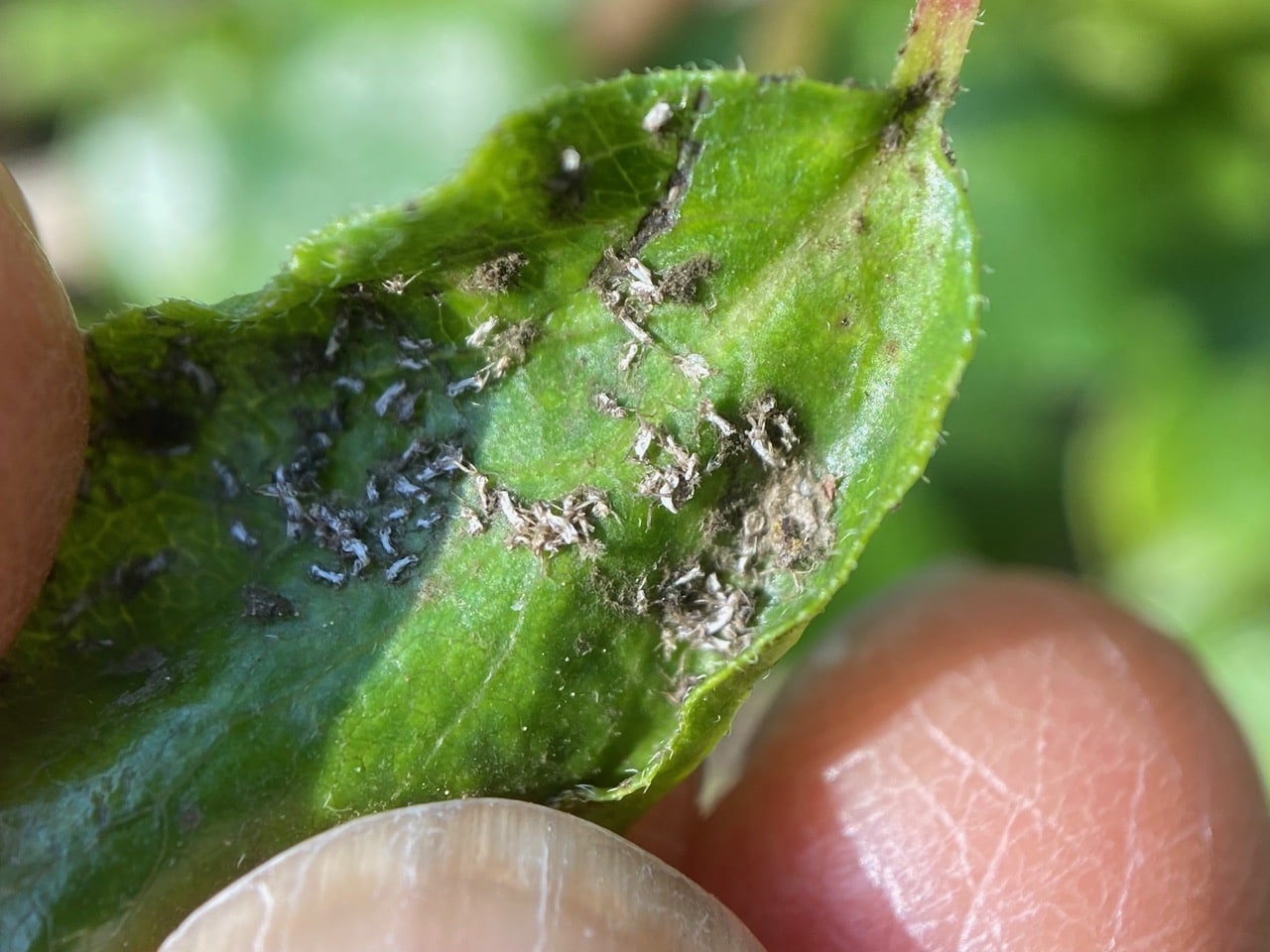
I carefully unroll a leaf. No caterpillar, but a bunch of what look like aphid exuvia (shed skin) and other debris. Hmm…
I have since learned that the Honeysuckle Aphid, Hyadaphis tataricae (family Aphididae) is the primary culprit causing longitudinal leaf curling on honeysuckle (Lonicera spp.), resulting in stunted, twisted, and “witches’ broom” growth. These aphids secrete toxins or plant growth regulators that cause young leaves to fold upward along the midrib, forming a protective shelter or pseudo-gall. The aphids are tiny, pale green to creamy, with a fine powdery waxy coating over their bodies. They are usually clustered within the curled leaves.
Native to Europe, the aphid was first detected in North America in 1976. Honeysuckle aphids overwinter as eggs in debris at the base of the host plant. At bud break in the spring, eggs hatch and stem mothers develop from these eggs. Stem mothers give birth parthenogenetically to large numbers of live young. Feeding on the upper surface of the leaves causes them to curl upward. Winged males and wingless females are found in September. Natural predators of these aphids include hover flies, lady beetles, and parasitoid wasps.
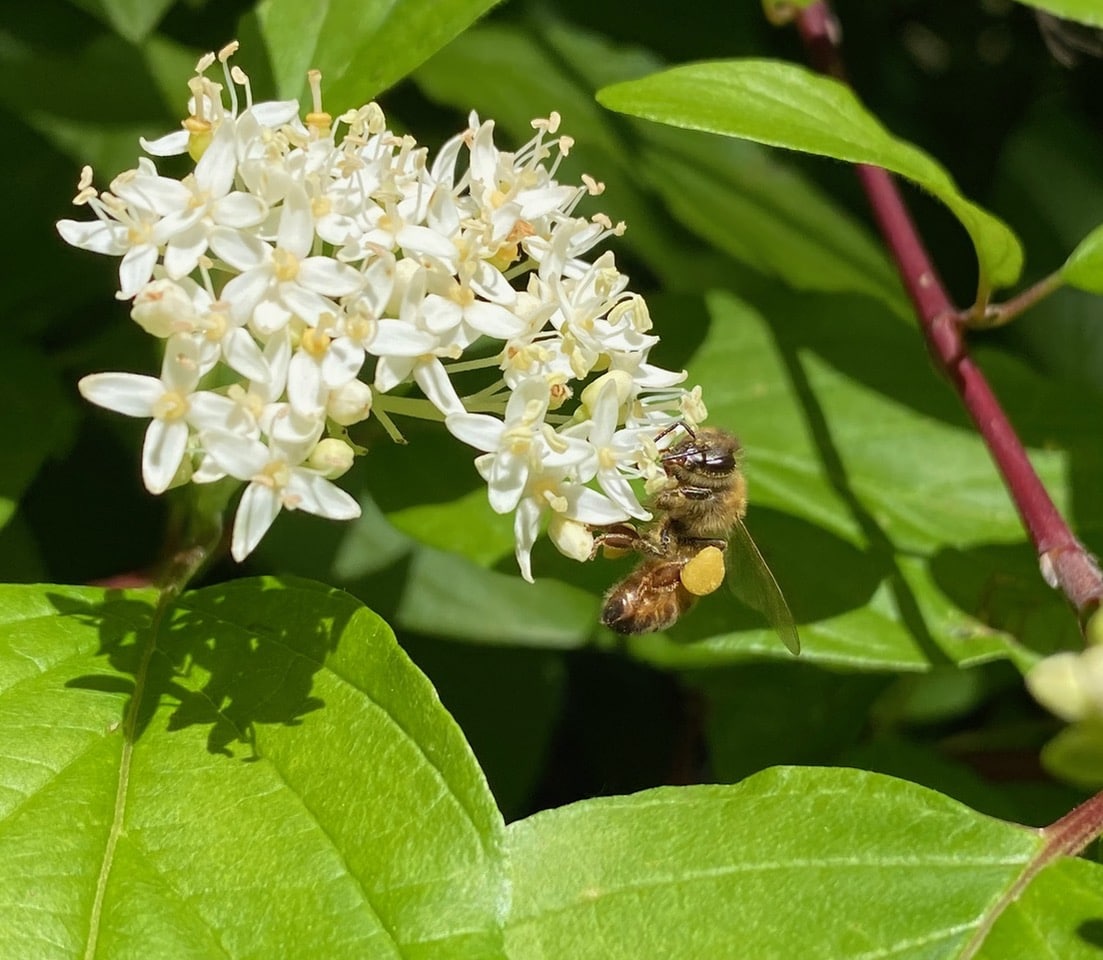
A Honey Bee, Apis mellifera (family Apidae) with a large pollen load in her pollen baskets is foraging on an inflorescence of Creek Dogwood, Cornus sericea.
The pollen collecting apparatus in Apidae bees, which include honey bees and bumble bees, is commonly called a “pollen basket” or corbicula. This region is located on the tibia of the hind legs and consists of hairs surrounding a concave region. After the bee visits a flower, she begins to groom herself and brushes the pollen down toward her hind legs and packs the pollen into her pollen basket. A little nectar mixed with the pollen keeps it all together like putty, and the stiff hairs surrounding the pollen basket hold it in place. Remarkably bees are able to fly while carrying up to a third of their body weight in pollen.
.jpg)
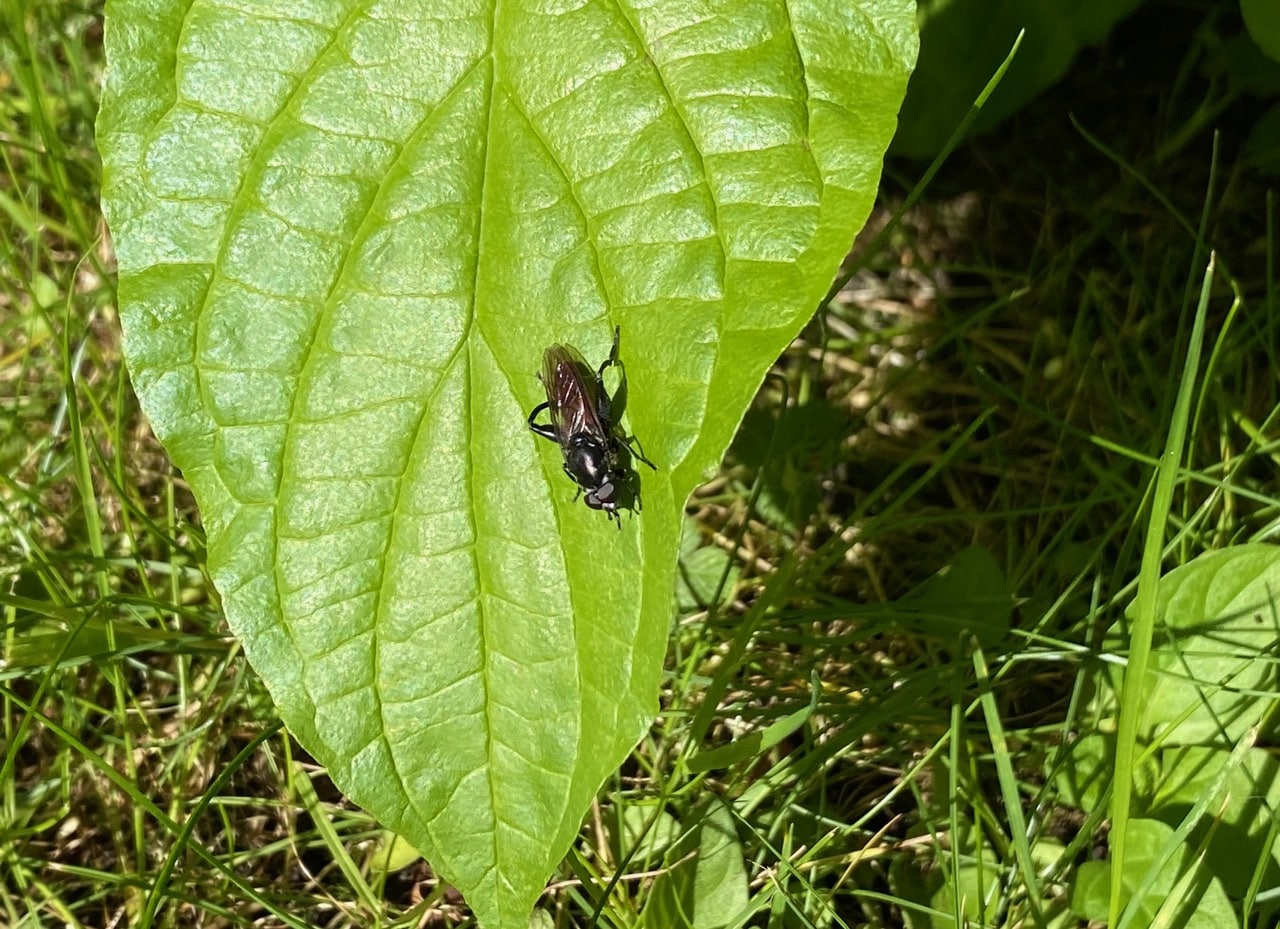
A glossy black insect lands on a Creek Dogwood leaf. iNaturalist has helped identify it as a Leafwalker, Chalcosyrphus sp. (family Syrphidae). A new species of hover fly for me!
Found throughout Europe, Asia, and North America, Chalcosyrphus is a genus of hover flies, commonly known as Leafwalkers, known for their saproxylic larvae that develop in decaying, often moist or semi-submerged wood. Adults, which frequently resemble parasitic wasps, are often seen on foliage or wood in wet forests, with some species visiting flowers. They are often small to medium-sized, with a distinctly flattened thorax and hind femora (thighs) that are often enlarged. These flies are found in wooded areas, especially near streams, log jams, or damp deciduous forests. Adults are often seen sunbathing on leaves or running on fallen timber. Larvae are “short-tailed” maggots found under the bark of logs or in rotting wood.
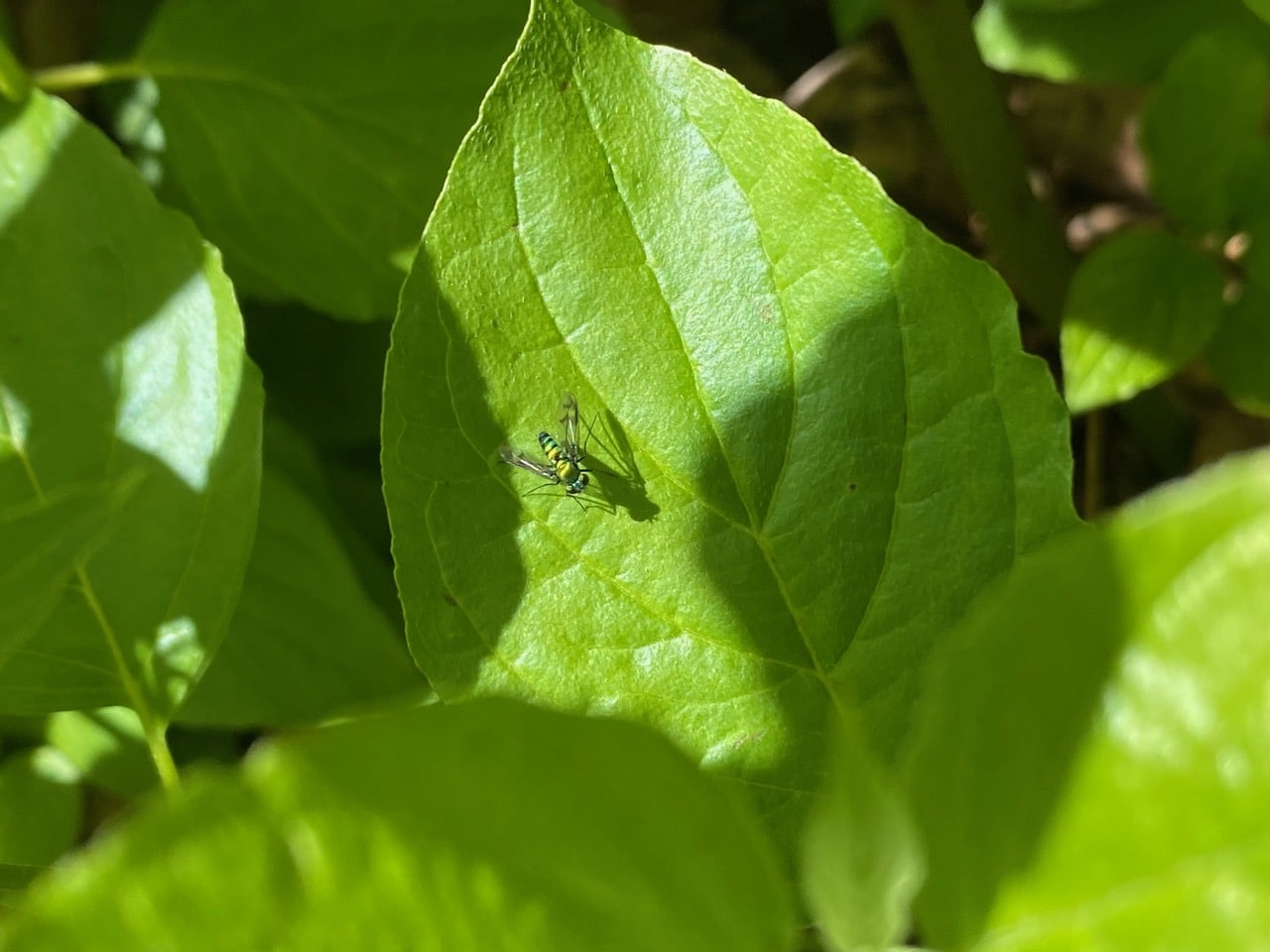
See that small, iridescent green insect on the dogwood leaf?
It takes me a while to get a close-up shot of the skittish, frenetic little fly. iNaturalist has helped identify it as a Long-legged Fly, Condylostylus sp. (family Dolichopodidae).
The Long-legged Flies, Dolichopodidae, are a large, cosmopolitan family of true flies. The name Dolichopodidae comes from the Greek dolichos (long) and podos (foot). They generally are small flies (1-9 mm) with large, prominent eyes and a green-to-blue metallic cast to their appearance. They have characteristically long and slender legs, and their posture often is stilt-like and erect. Adults live largely in grassy places and shrubbery. The flies occur in a wide range of habitats, near water or in meadows, woodland edges and in gardens. Most adults are predators, feeding on small invertebrates such as springtails, aphids, thrips, insect larvae, and mites. Studies have shown that Dolichopodidae give visual, rather than chemical or other signals during courtship. Scales, disks, flag-like hairs, or fans adorn the legs of males of many species, and they flash these at females in a ritual called “badge-waving”. The larvae occupy a wide range of habitats. Many are predators of small invertebrates in moist environments such as soil, moist sand, or rotting organic matter. The maggots pupate in cocoons they build by gluing together tiny pieces of soil.
In a sun-lit spot, a Yellow-haired Sun Fly, Myathropa florea (family Syrphidae) is foraging on an inflorescence of Creek Dogwood.
Myathropa florea is a very common European and North African species of hover fly. It is of a similar size to the Common Drone Fly (Eristalis tenax), but Myathropa are generally more yellow, with two light bands to the thorax, interrupted with a black central smudge. These flies are rather variable in size, shape and color. The species occurs in deciduous forests, farmland, parks, and gardens. Adults visit flowers of a wide variety of plants for nectar and pollen. Larvae feed on bacteria in organic waterlogged detritus, often in the shallow rot holes of tree stumps.
A Sweat Bee (family Halictidae) is collecting pollen from the anthers of a Creek Dogwood flower.
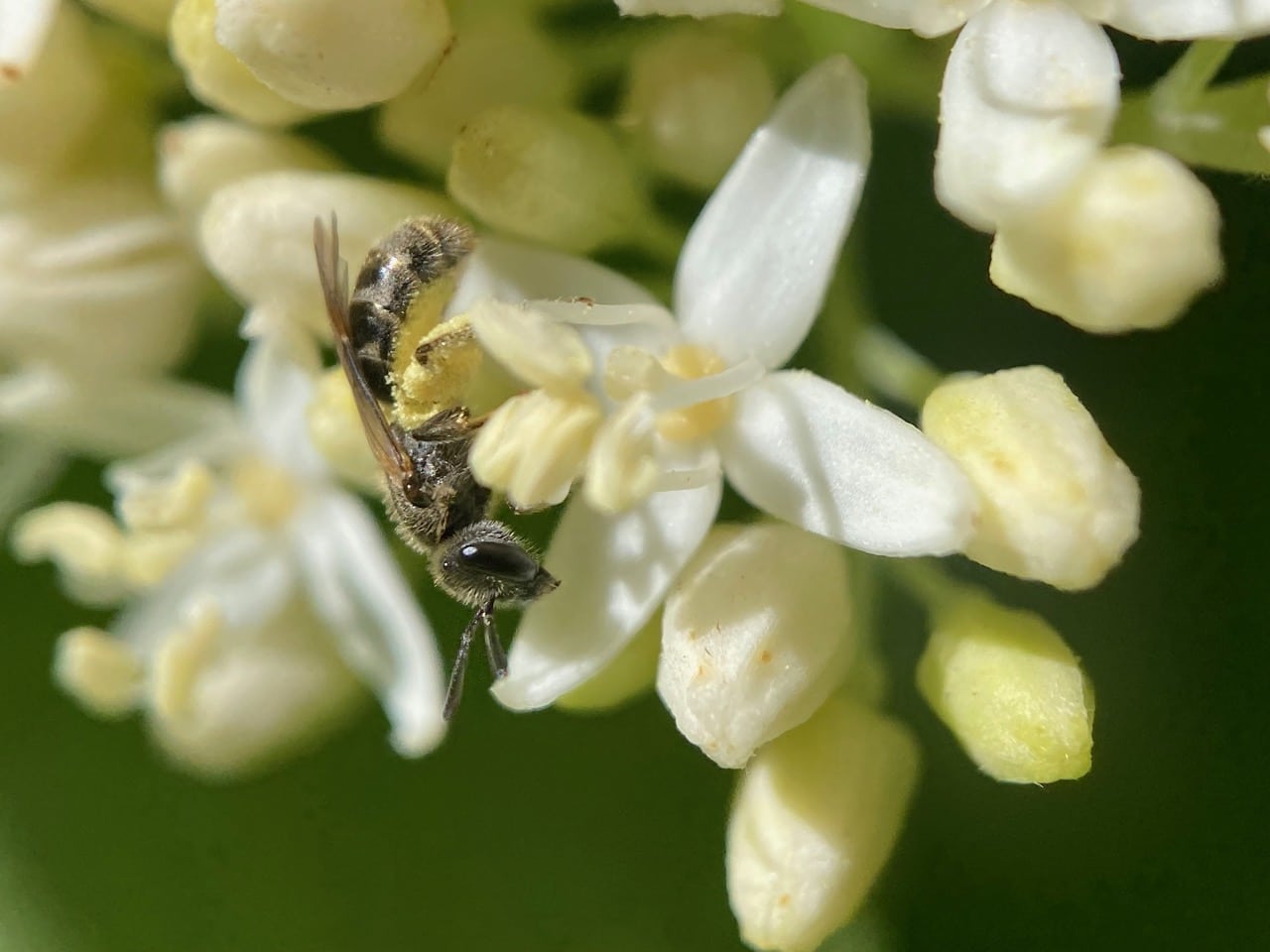
Halictidae is the second-largest family of bees, comprising nearly 4,500 species globally, often called sweat bees due to their attraction to human perspiration of salt. They are generally small-to-medium sized, often metallic or dark-colored. They are short-tongued bees. They are mostly solitary or social ground-nesters that feed on nectar and pollen. Some species are specialists, but many are generalists visiting a wide variety of flowers. They display a wide range of social behaviors, from solitary to communal and primitively eusocial (where females share a nest and tasks).
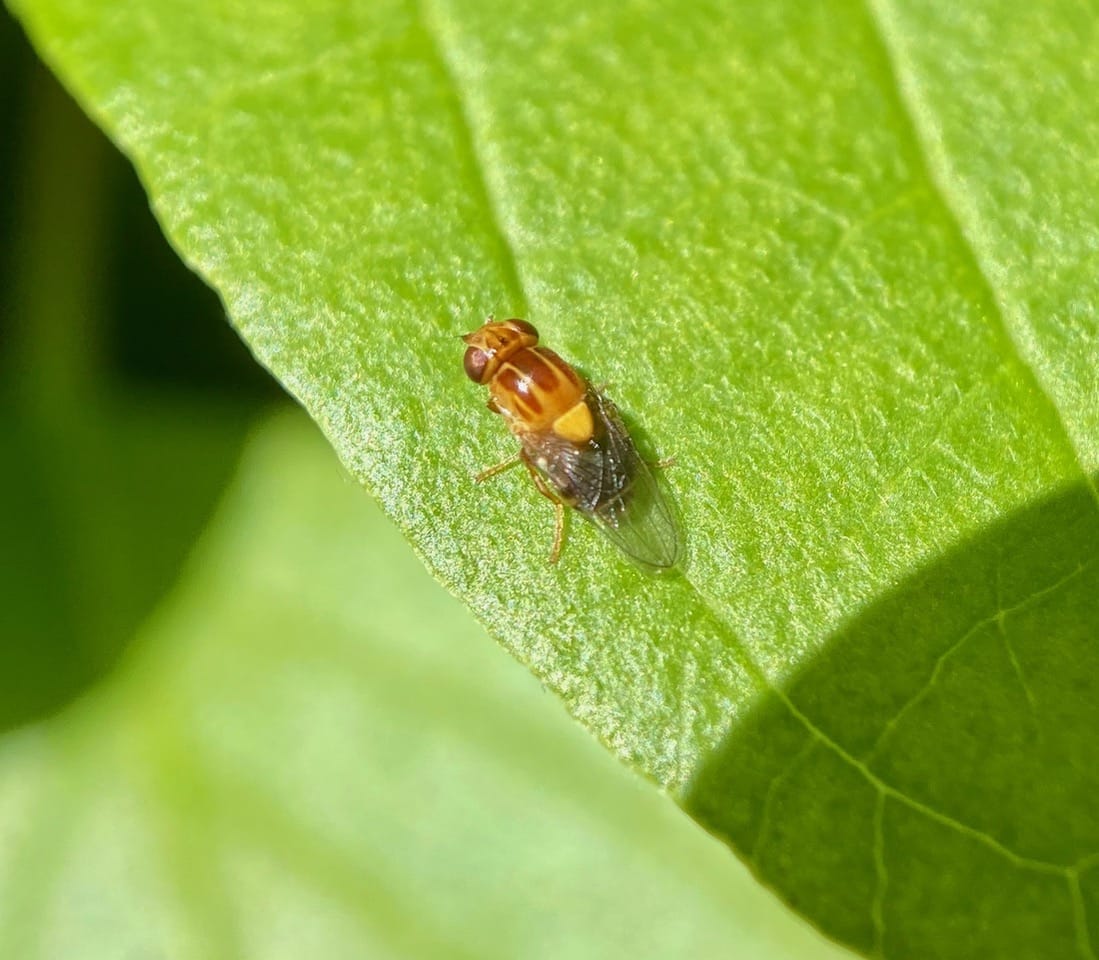
A tiny fly is perched on a Creek Dogwood leaf. That “painted” look gives it away as a Grass Fly (family Chloropidae).
Grass Flies (family Chloropidae) are minute to small flies (1-4 mm), yellow or black and appearing shiny due to the virtual absence of any hairs. The thorax often has a pattern of 3-5 dark longitudinal stripes against a light-colored background. The majority of the larvae are phytophagous, mainly on grasses, and can be major pests of cereals. However, parasitic and predatory species are known. Some species are called eye gnats for their habit of being attracted to vertebrate eyes to feed on lachrymal secretions, and can be of medical concern.

A male Western Aphideater, Eupeodes fumipennis (family Syrphidae) is basking on a Creek Dogwood leaf. How do I know it is a male? The genders are easily distinguished in the hover flies. Males typically have holoptic eyes that meet on top of the head, while the female’s dichoptic eyes are set apart on the head.
The Western Aphideater, Eupeodes fumipennis is a species of hoverfly in the family Syrphidae. The species is found in western North America, in a wide range of habitats including grasslands, chaparral, woodlands, croplands, urban and suburban gardens. Adults, measuring 10 mm in length, visit flowers for nectar and pollen. Their abdomens have black-and-yellow stripes reminiscent of wasps and bees. The mimicry provides these harmless flies with some protection from predators. As the common name implies, the larvae feed on plant-sucking insects, primarily aphids.
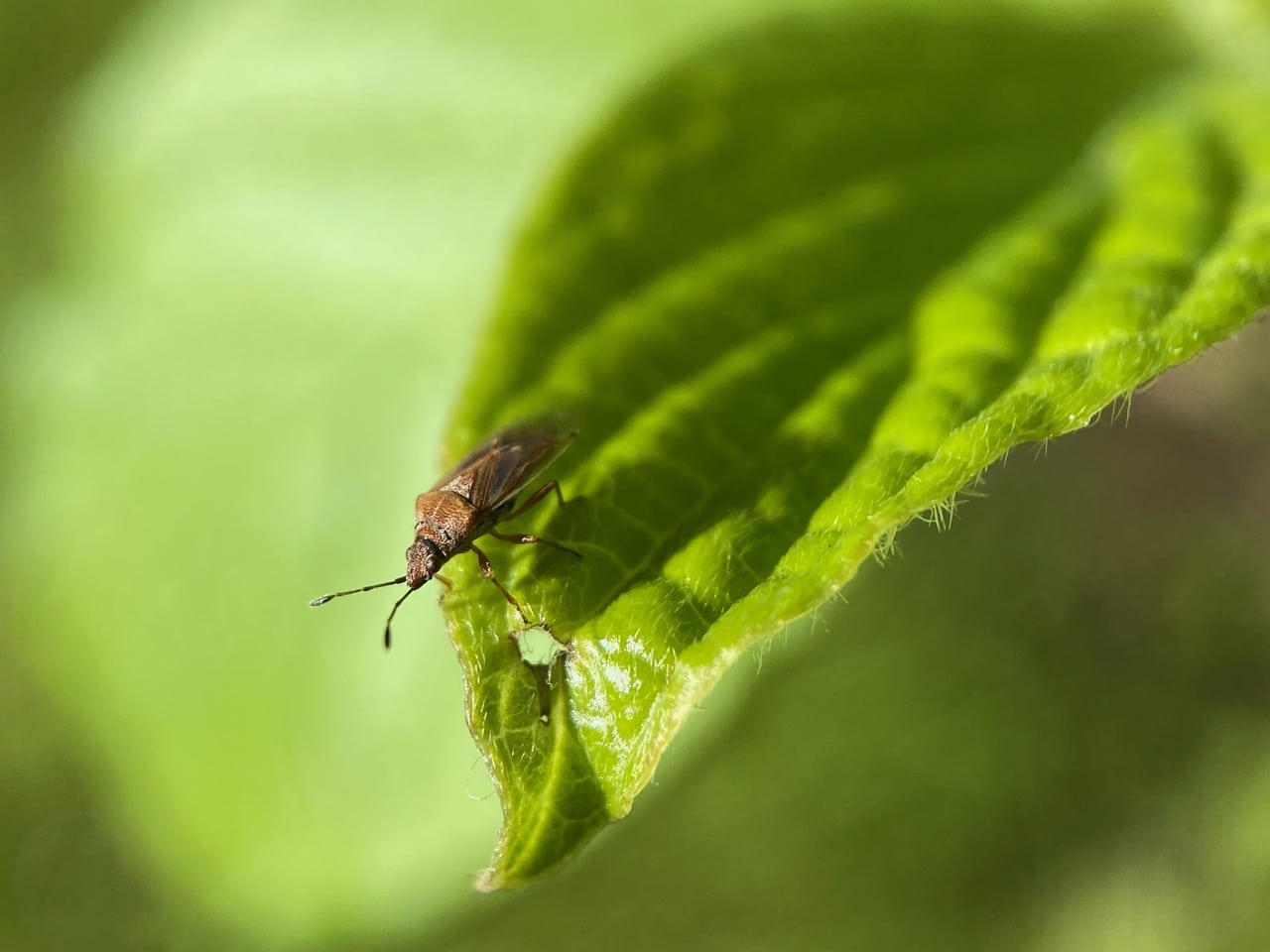
A tiny brown bug is perched on the tip of a Creek Dogwood leaf. iNaturalist has helped identify it as a Seed Bug, Kleidocerys sp. (family Lygaeidae).
The Lygaeidae are a worldwide family in the Hemiptera (true bugs), commonly referred to as Seed Bugs. Many species feed on seeds, some on sap or seed pods, others are omnivores. The most well-known example is the red-and-black milkweed bugs that specialize in seeds from the milkweed family. Lygaeidae bugs feed on seeds by using their straw-like, four-segmented mouthparts, known as a rostrum, to pierce the seed coat and inject digestive enzymes that liquify the contents. They then suck up the resulting nutrients. While primarily seed feeders, some members of this family can be opportunistic feeders on plant sap or even predators of other small insects.
Another Sweat Bee (family Halictidae) is gathering pollen from the flowers of Creek Dogwood. Note where she is carrying the pollen – in the scopae on her hind legs and under her abdomen.
A female Vivid Dancer, Argia vivida (order Odonata, suborder Zygoptera) has landed on a young Creek Dogwood leaf. The garden’s many creeks and ponds have given rise to a delightful diversity of Dragonflies and Damselflies whose larvae develop in aquatic environments.
The Vivid Dancer, Argia vivida is a species of narrow-winged damselfly in the family Coenagrionidae. The species is commonly found in springs and forests of Central America and North America. Males are a rich blue color with transparent wings, while the adult females are tan and gray. Males tend to perch on rocks or vegetation in shoreline areas awaiting females. Copulation is lengthy with extended flying in tandem afterward. Tandem pairs oviposit usually below the waterline in the stems of aquatic plants. Because the larvae are aquatic, they typically feed on small invertebrates found in the water, such as larvae from mosquitoes and mayflies. The adult Argia vivida typically feed on a variety of soft-bodied, small flying insects including mosquitoes, flies, mayflies and even small moths.

A Variable Checkerspot with an injured right hind wing has landed on the well-watered lawn. While the butterfly has lost quite a bit of scales on its wings, its body appears intact, and it is able to fly without much problem. It was probably attacked by a bird.
The Variable Checkerspot, Euphydryas chalcedona (family Nymphalidae) is found across western North America. The butterfly occupies a wide range of habitats, including sagebrush flats, desert hills, prairies, open forests and alpine tundra. Males perch or patrol around larval host plants to encounter females. Eggs are laid in large groups on underside of leaves of host plants. Host plants include California Bee Plant, Scrophularia californica, and Sticky Monkeyflower, Diplacus aurantiacus. These plants provide the caterpillars with iridoid glycoside, a chemical that imparts unpalatable taste to birds, protecting the caterpillars from predators. Larvae feed in large, loose groups on the host plants. Individuals overwinter (enter diapause or hibernation) as third or fourth instar larvae in sheltered sites under bark or dead branches, in hollow stems and in rock crevices. Pupation begins in early to mid April and the adult flight season begins between mid-April and May and continues into June. The adults feed exclusively on nectar, and have a life span of about 15 days.