

Pollinator Post 4/16/24 (1)
As I approach Skyline Gardens from the Steam Train parking lot this morning, I decide to make a quick stop to check on the California Buttercups, Ranunculus californicus in the picnic area across the street.
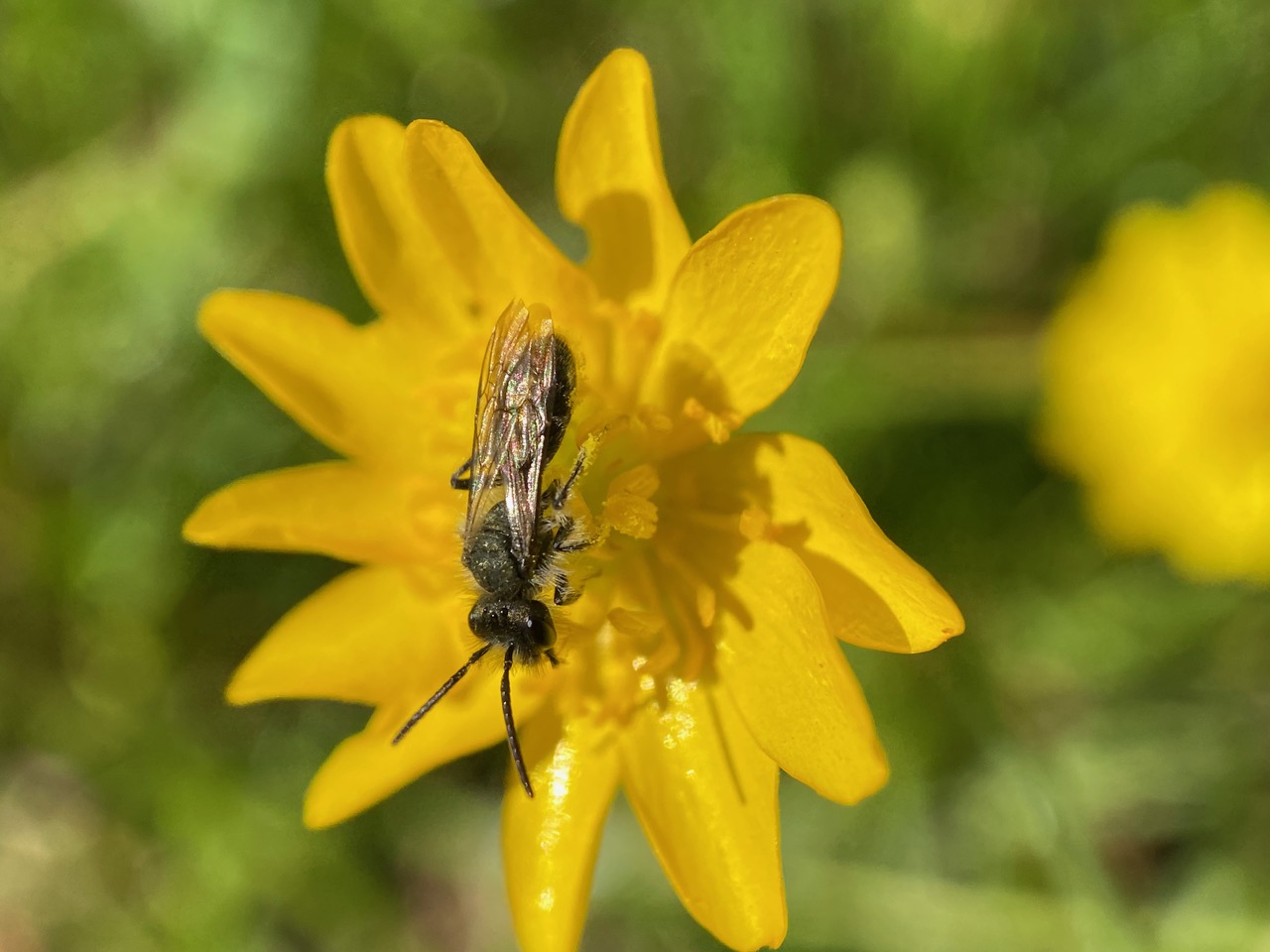
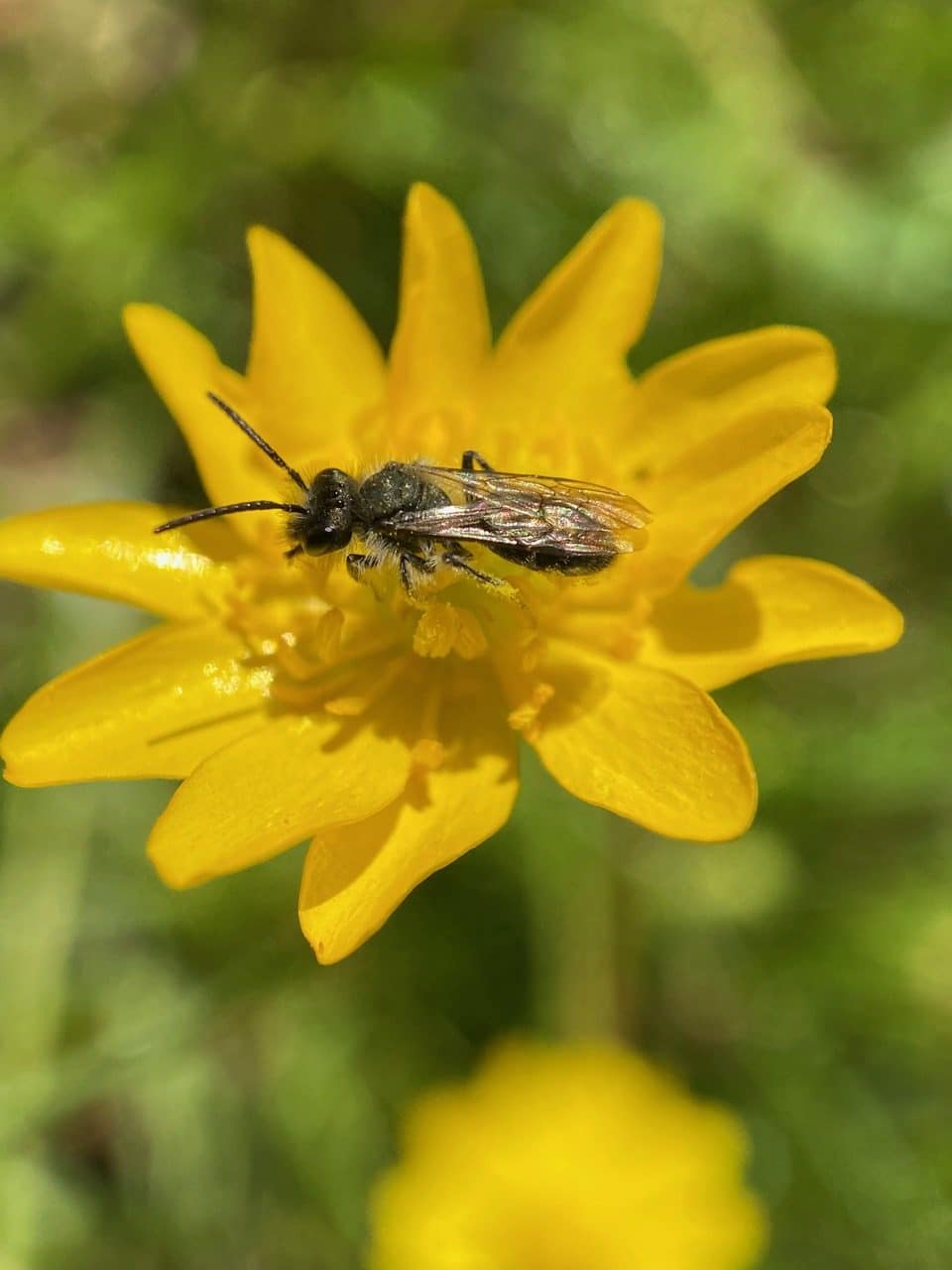
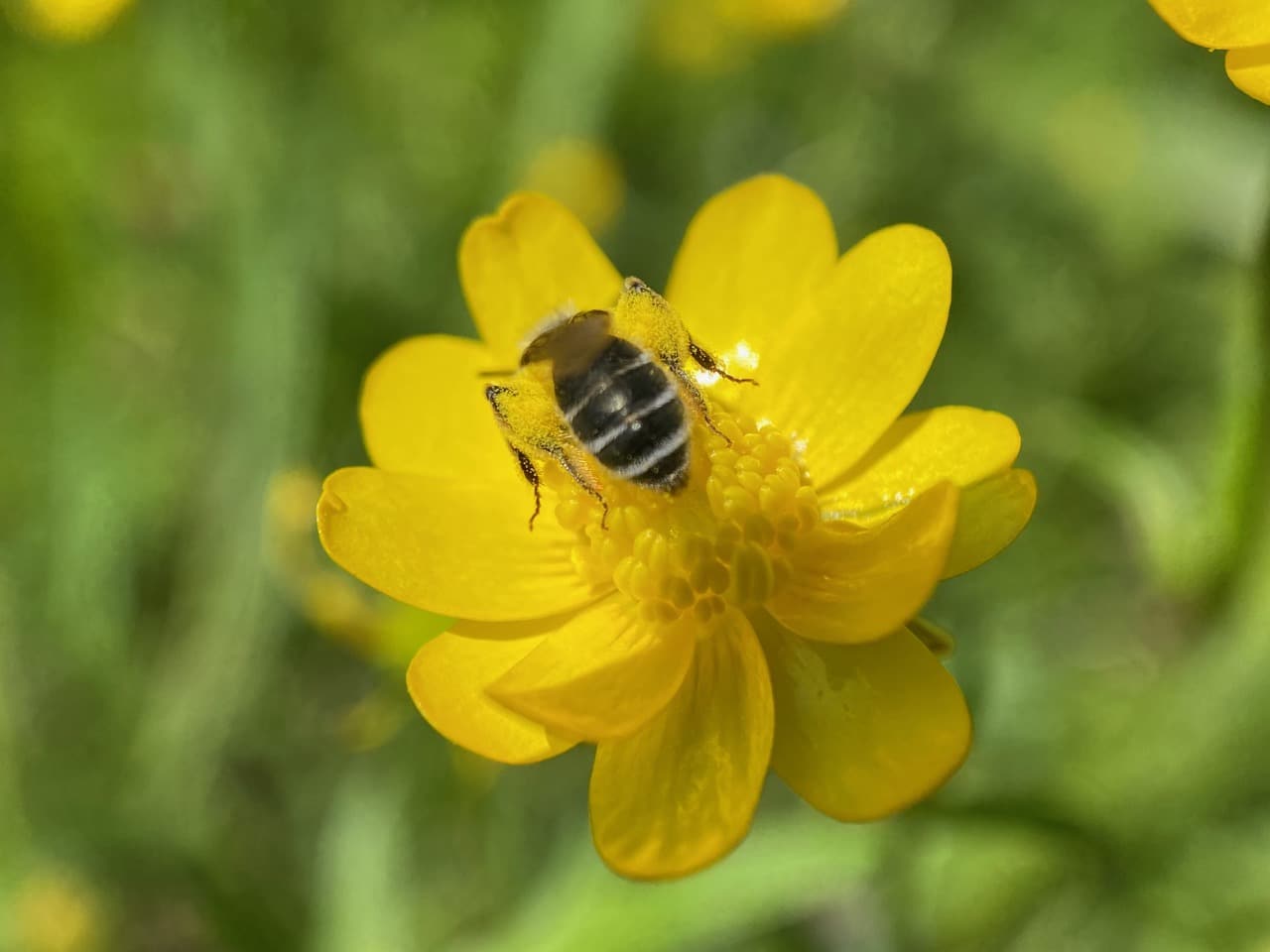
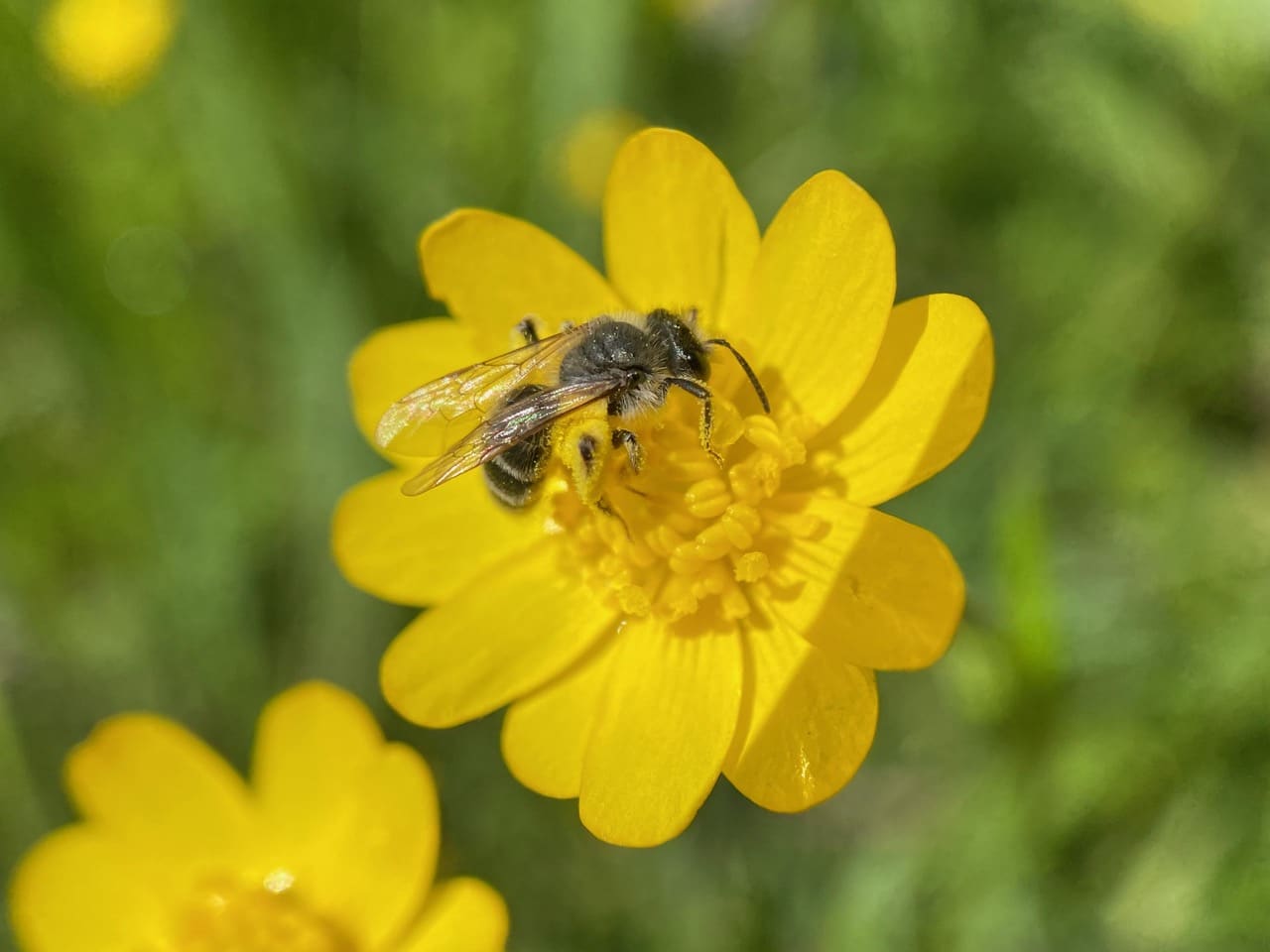
As I have expected, there are a few male Mining Bees, Andrena sp. (family Andrenidae) still asleep on the buttercup flowers. Most of them are found in a small patch in the back of the park, at the edge of the forest.


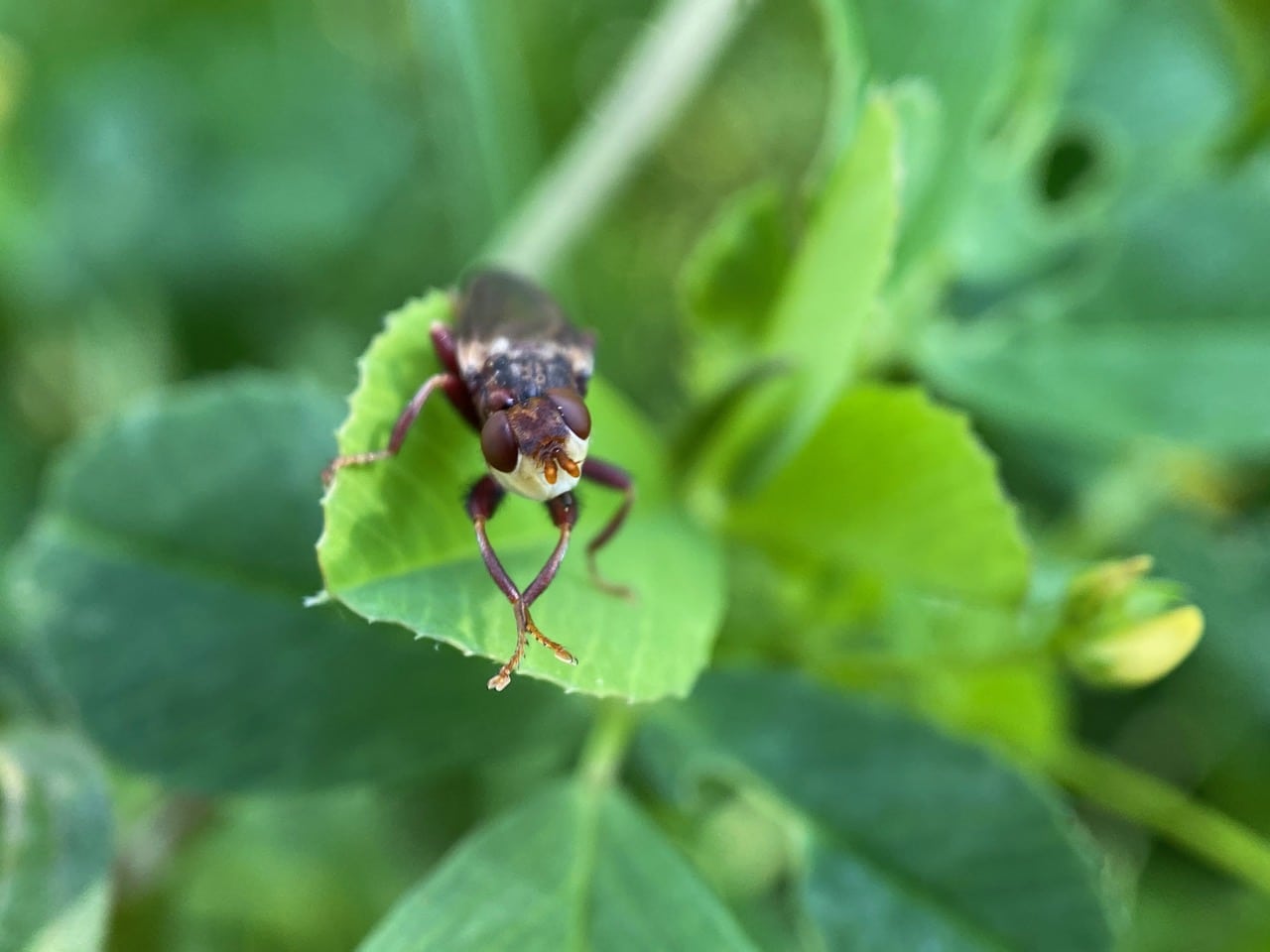 Myopa species are parasitic on Honey Bees (Apis mellifera), Mining Bees (Andrena spp.), and Digger Bees (Anthophora spp.) Ah, this is why it is here – among the Andrena and their buttercups.






 Here’s another fly, a Root Maggot Fly (family Anthomyiidae) that has cream-colored pollen all over its undersides. Most of the insects on the umbel are aiming their mouthparts at the succulent, swollen style bases of the flowers, probably where nectar is produced.

Some of them are already waking up to a warm, sunny day. Temperatures are forecast to reach into the 70s F today.
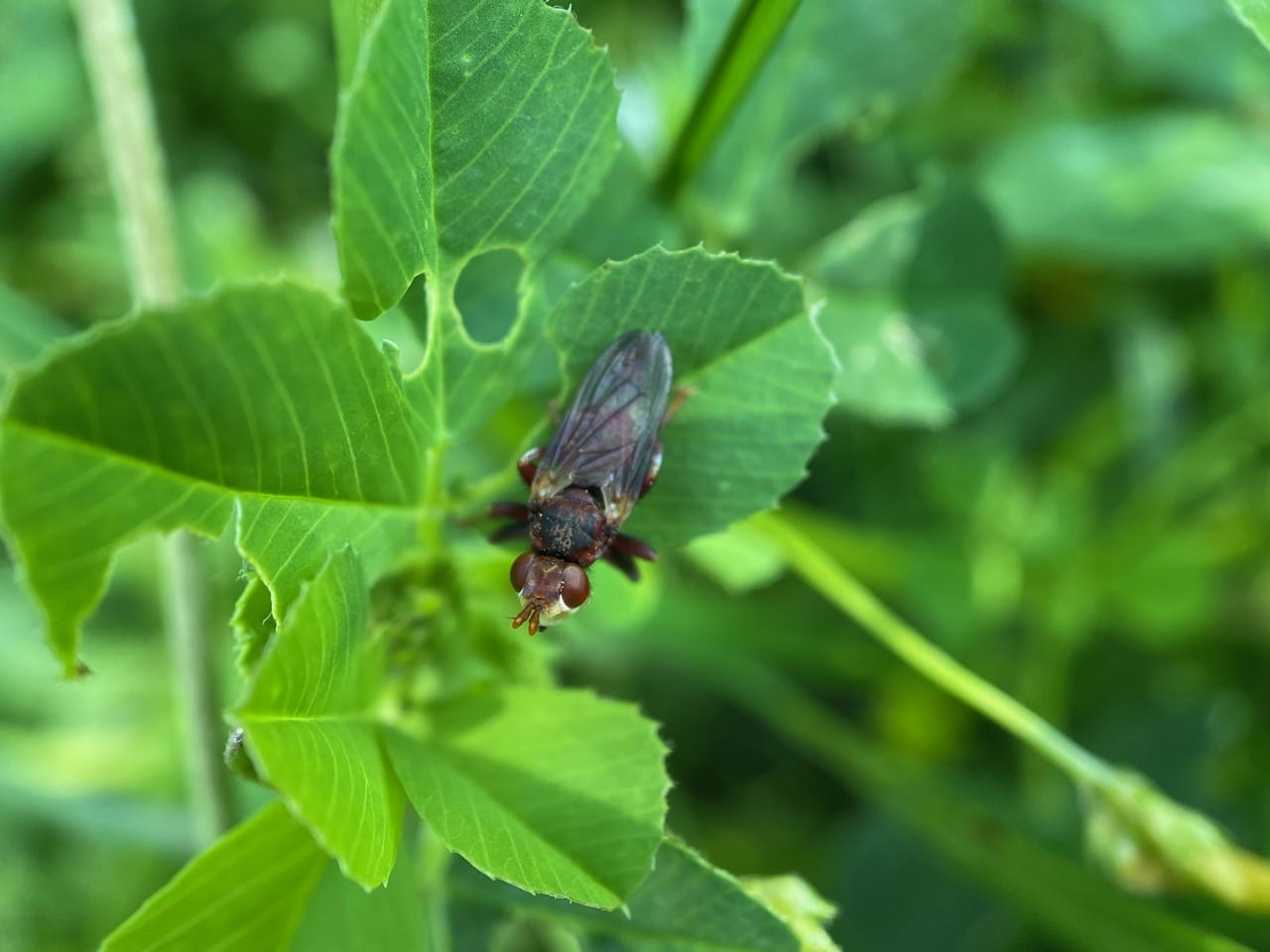
A brownish fly perched on a clover leaf among the buttercups catches my eye. I don’t often see flies this color. Surprisingly, the fly does not budge as I approach for a closer look. Is it sleeping?
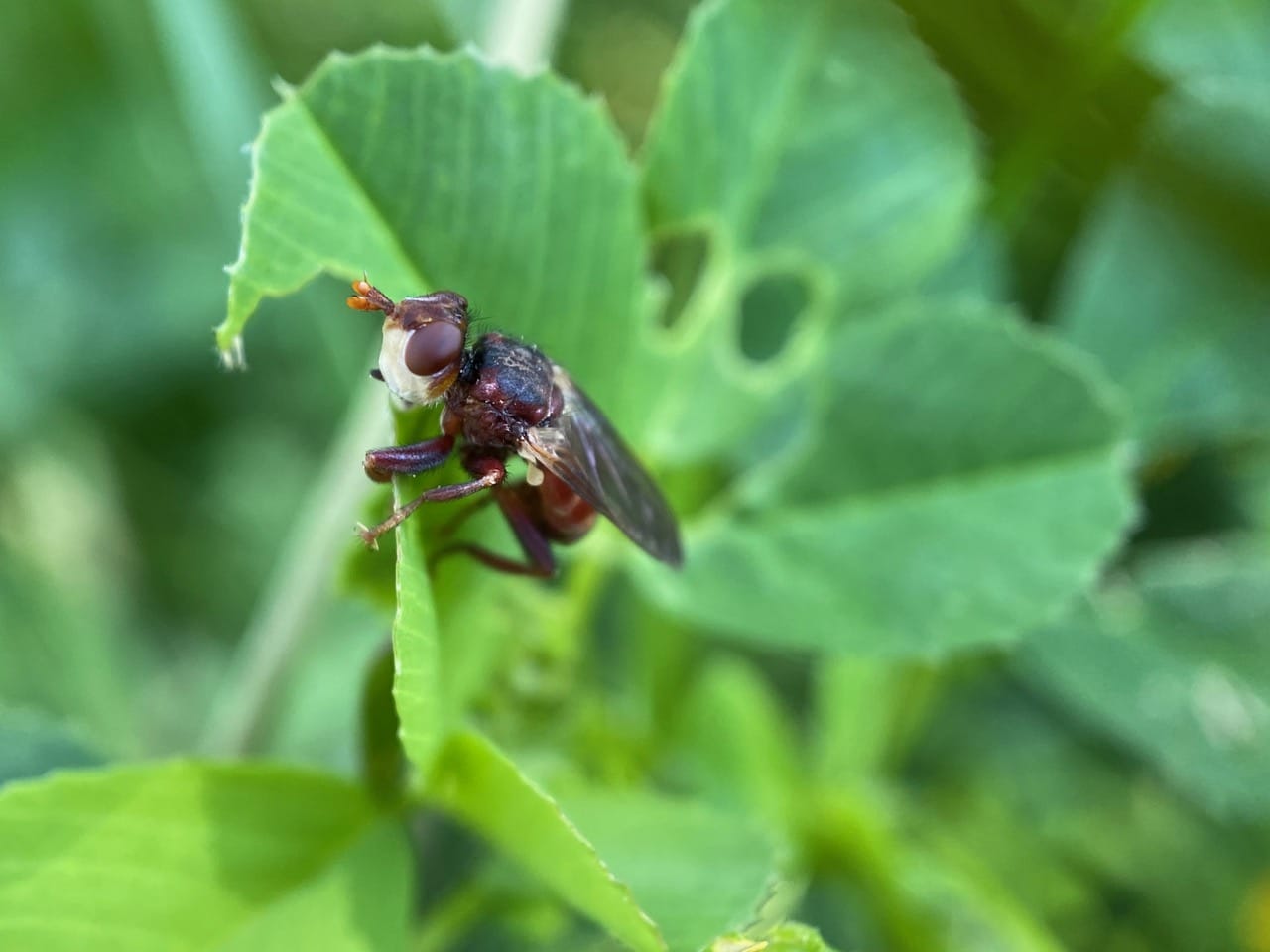
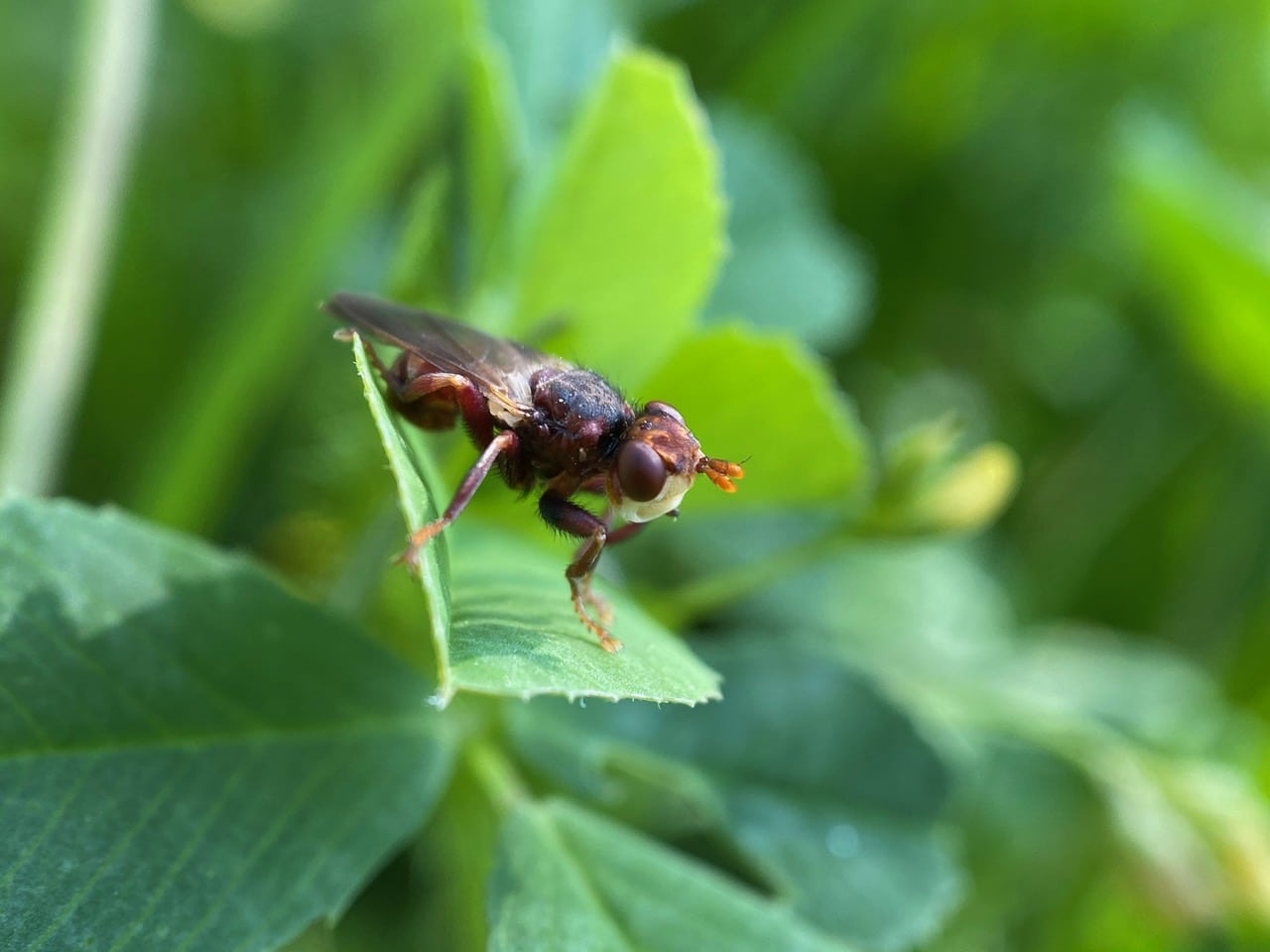
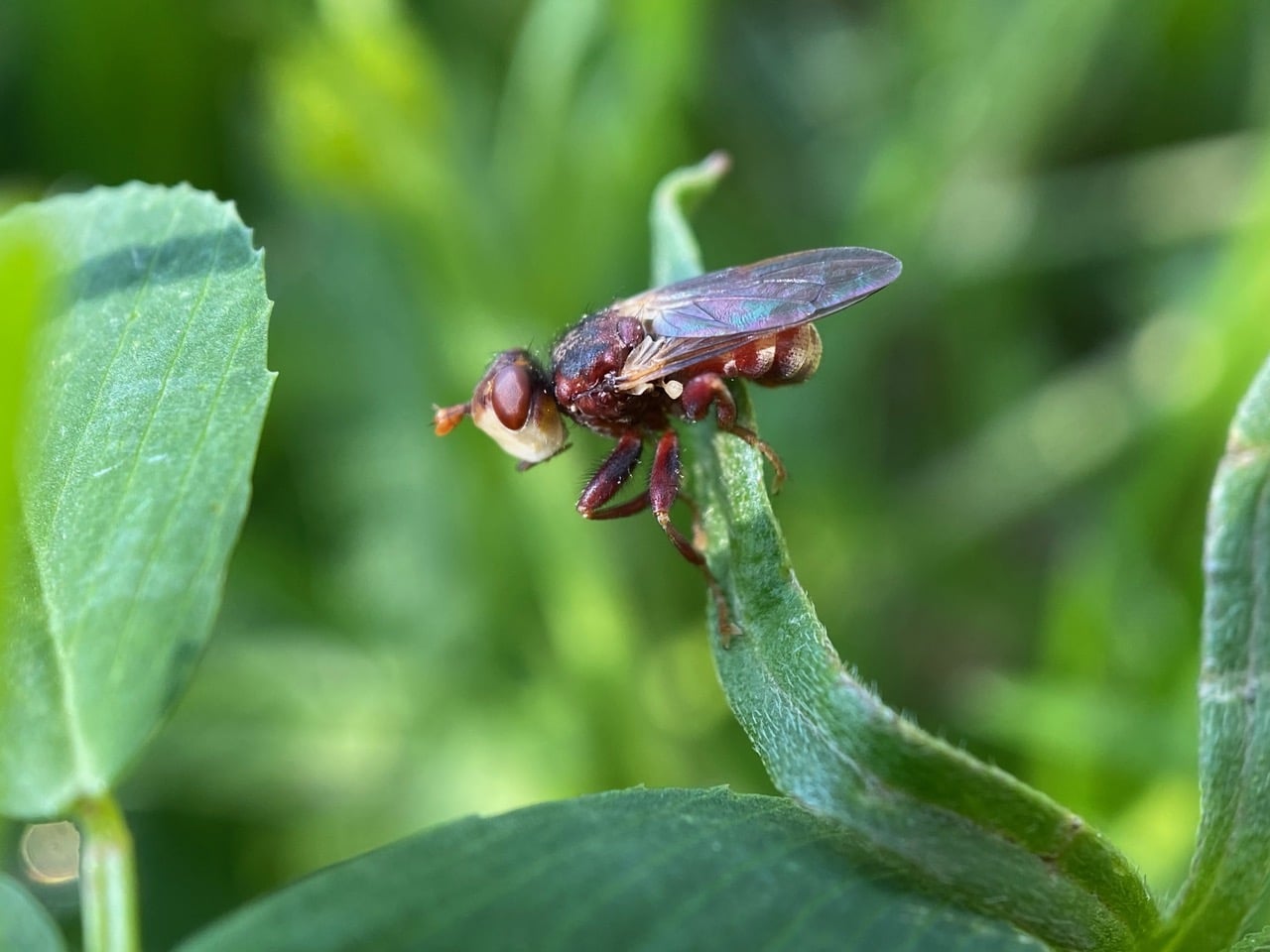
My heart misses a beat as I see the fly from the side. Wow, look at the white, puffy face! It is a Thick-headed Fly, Myopa clausa (family Conopidae)! Despite its cute puppy-like appearance, the fly sends chills down my spine.
The small and little-known family of Conopidae, commonly called the Thick-headed Flies, are distributed worldwide. Remarkable mimics of wasps and bees, the flies are frequently found at flowers, feeding on nectar with their long probosces. The head is broad; the oral opening is large and the proboscis is long, slender and often geniculate (elbowed). The larvae of all Conopids are internal parasitoids, mostly of aculeate (stinging) Hymenoptera (wasps, bees). Adult females aggressively intercept their hosts in flight to deposit eggs. Vulnerable foraging bees are likely the most susceptible to parasitism by Conopids. The female’s abdomen is modified to form what amounts to a “can opener” to pry open the segments of the host abdomen as the egg is inserted. The fly larva feeds on the host from the inside out. The vast majority of parasitized bumble bees bury themselves by burrowing into the ground right before they die. This behavior does not matter to the bees – they are doomed. But it is critical for the flies – if the host dies underground, the fly is sheltered from the elements, predators and parasites.
The fly begins to stir and moves around the the clover leaf slowly
Myopa species are parasitic on Honey Bees (Apis mellifera), Mining Bees (Andrena spp.), and Digger Bees (Anthophora spp.) Ah, this is why it is here – among the Andrena and their buttercups.Myopa is one of the Conopid genera that has a doubly-bent proboscis (one bend at the base, another near the middle).
Myopa clausa occurs from coast to coast in North America. Adults are 7-9 mm in length. The species is parasitic on Honey Bees (Apis mellifera), Mining Bees (Andrena spp.), and Digger Bees (Anthophora spp.)
Adults perch on the lowest twigs of shrubs, on grass stems, and on flowers, usually no more than 16” above the ground. They are active in sunny conditions, inactive when cloudy and overcast. Males aggregate on hilltops and wait for females to fly there and mate with them. Adults nectar on flowers, but females have an ulterior motive for being there – they are looking for hosts for their offspring. The female pounces on a host bee while in flight. She inserts a single egg between two abdominal segments of the bee. The larva that hatches out feeds within the abdominal cavity, eventually killing the host. Myopa overwinters as a pupa in its host’s body, and emerges as adult fly the next spring in synchrony with the host bees.
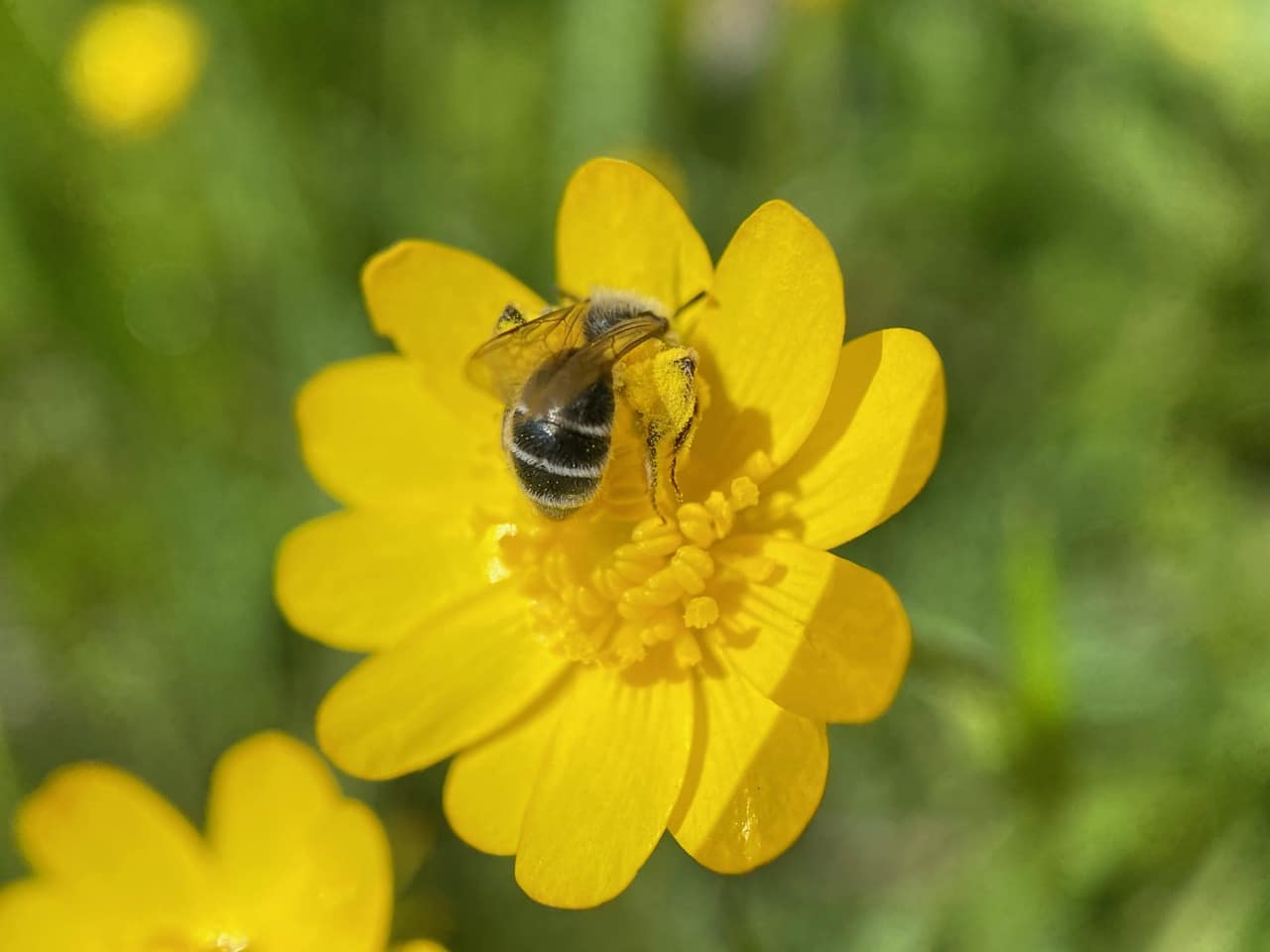
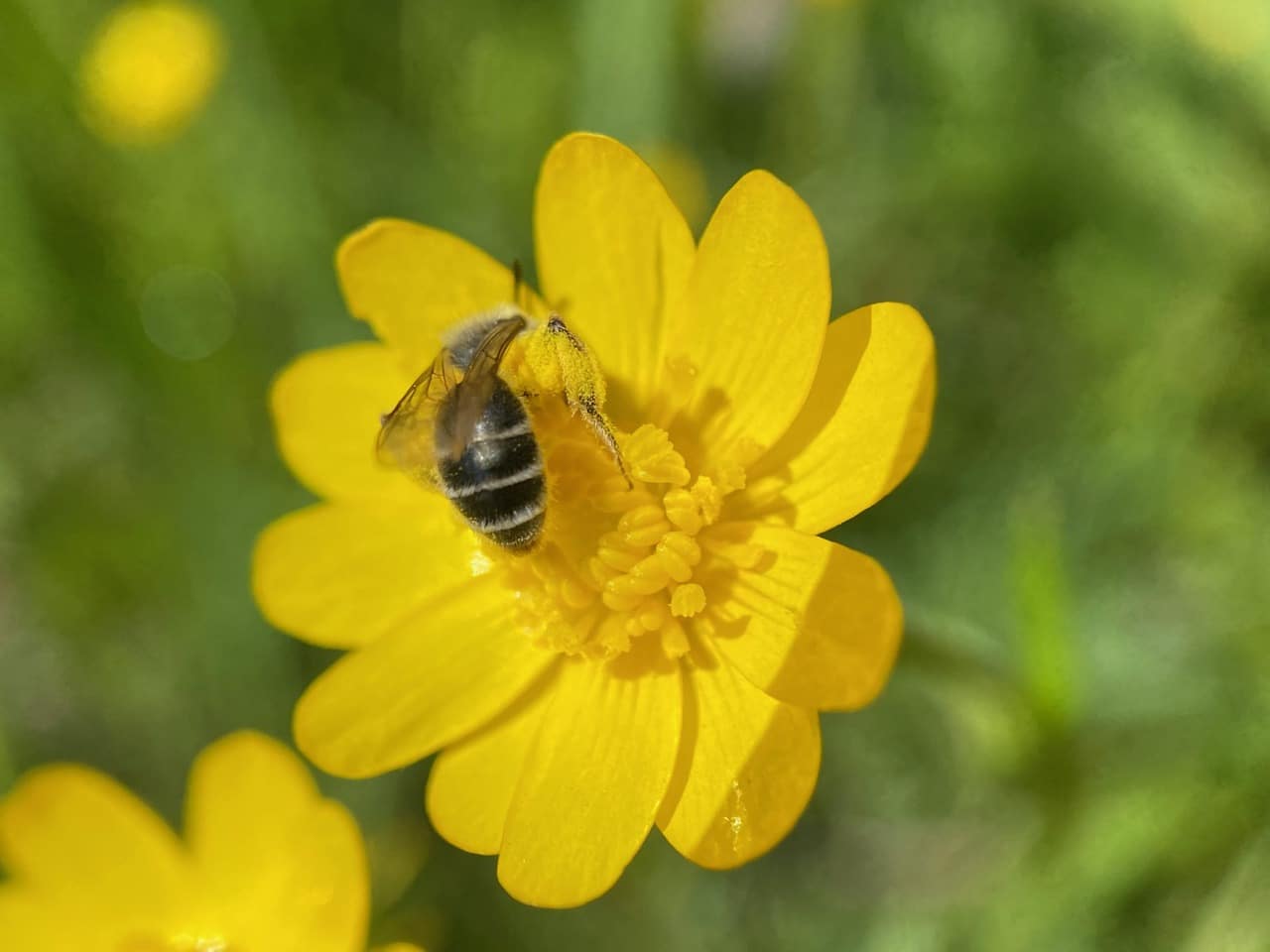
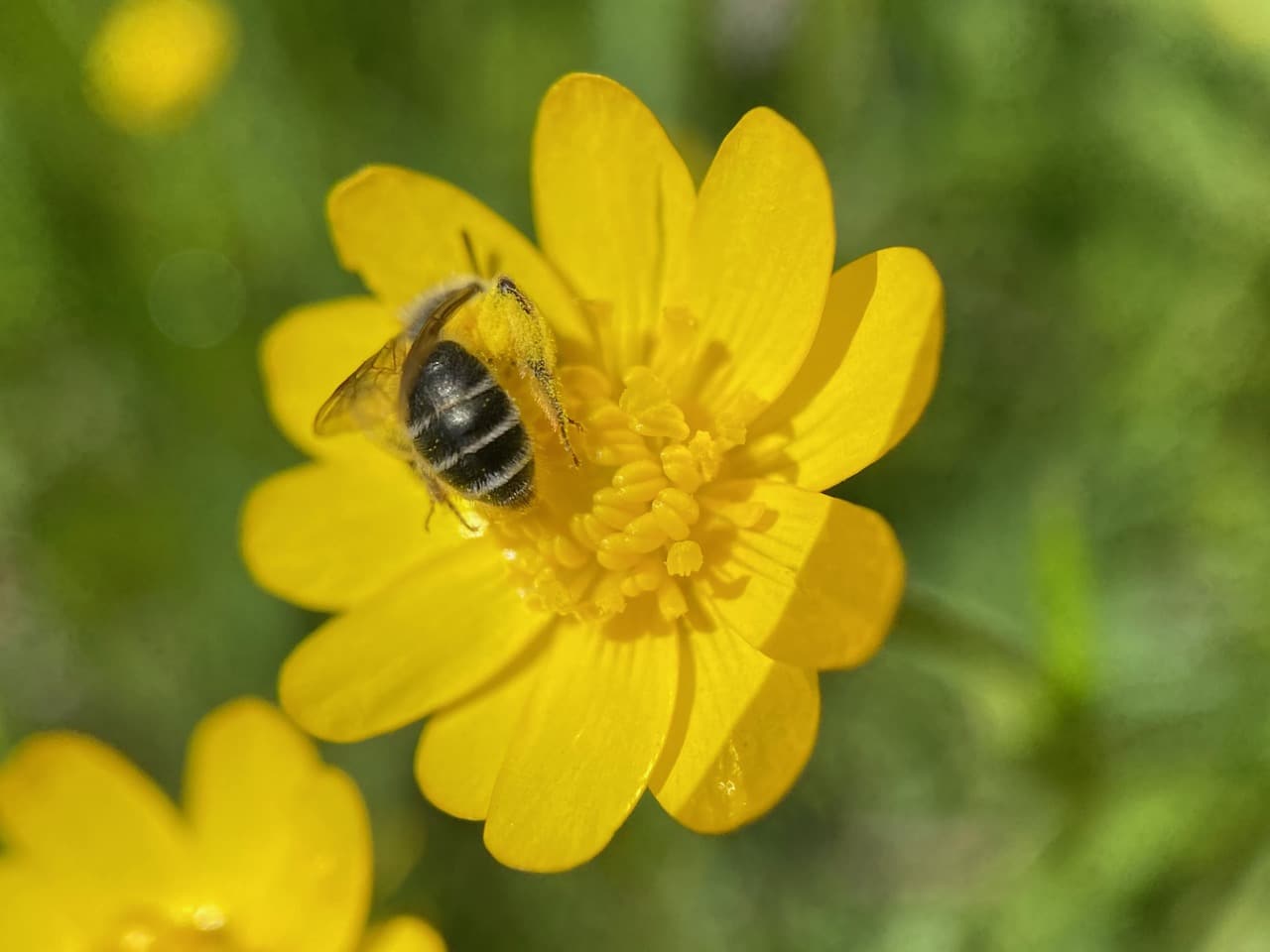
I have barely entered Skyline Gardens through the cattle gate when I spot female Andrena bees foraging on the flowers of California Buttercup, Ranunculus californicus. It is delightful to see so many in this small patch of buttercup.
This female’s scopae on her hind legs are fast filling up with pollen. Note that the pollen grains are not compacted or moistened. They simply adhere loosely by electro-static forces to the hairs.
Female Andrena also have special long hairs in the space between their thorax and abdomen (called the propodeum) for carrying pollen. The filled propodeal corbicula is visible in this view of the bee.
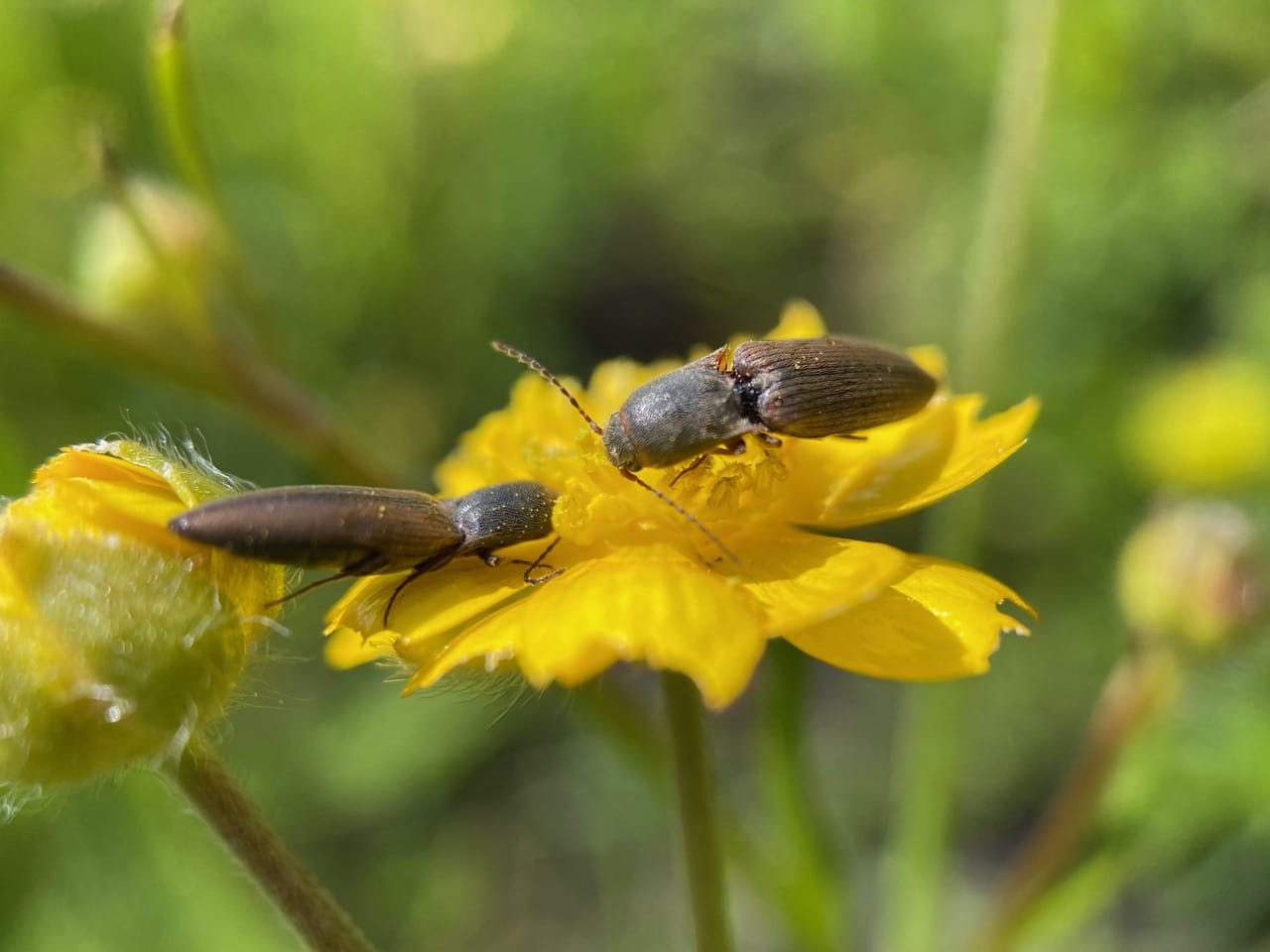
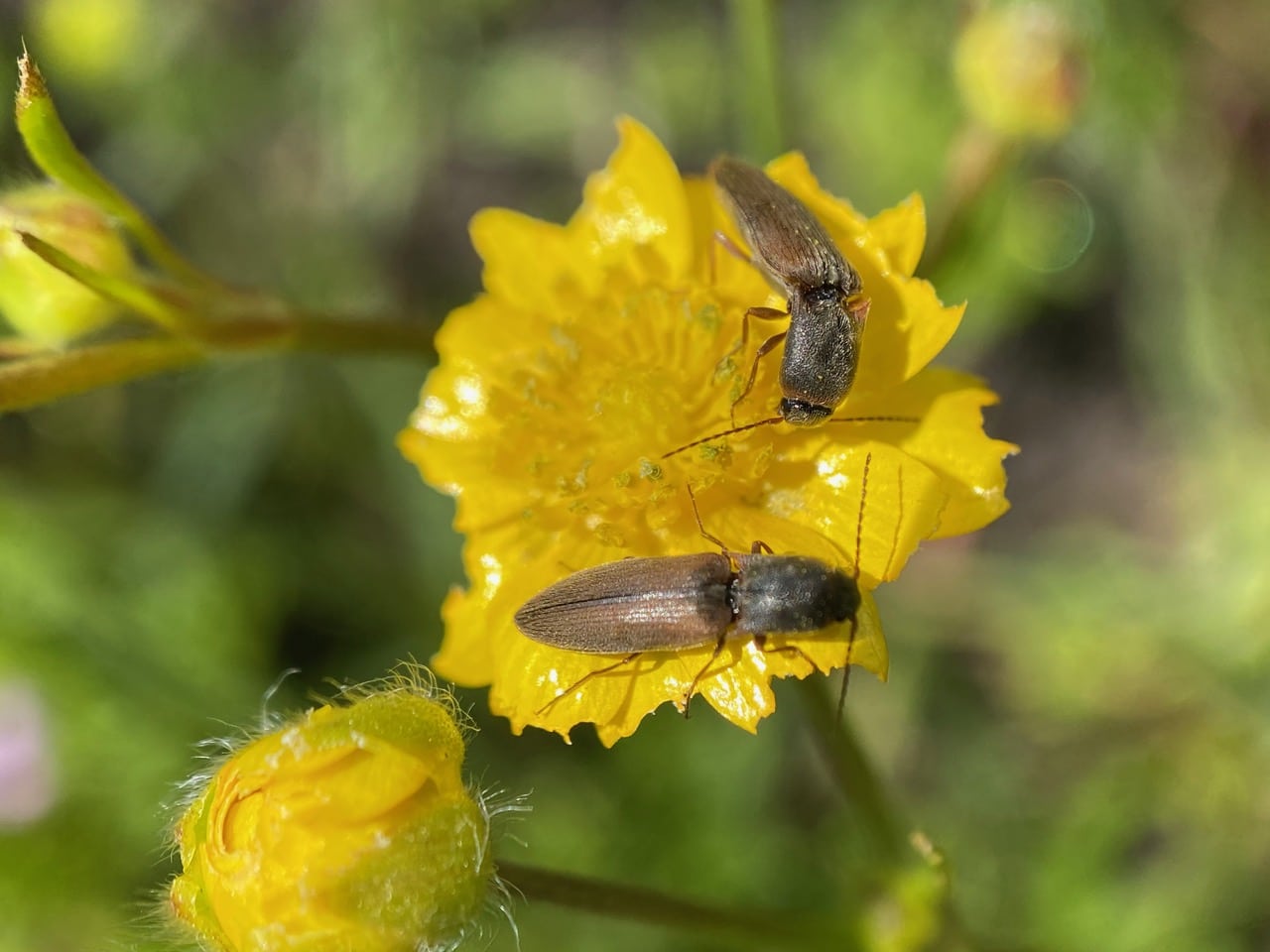
A Click Beetle (family Elateridae) is feeding on a buttercup flower.
Elateridae or Click Beeltes are a cosmopolitan beetle family characterized by the unusual click mechanism they possess. A spine on the prosternum can be snapped into a corresponding notch on the mesosternum, producing a violent “click” that can bounce the beetle into the air. Clicking is mainly used to avoid predation, although it is also useful when the beetle is on its back and needs to right itself.
Adult Click Beetles are typically nocturnal and phytophagous (feeding on plants). Their larvae, called wireworms, are usually saprophagous, living on dead organisms, but some species are agricultural pest, and others are active predators of other insect larvae.
The Click Beetles are the most numerous insect on the buttercups today!
Two Click Beetles meet on a decimated buttercup flower. Are they responsible for chewing the petals into these jagged nubs?
That is one skinny insect! It is a Stem Sawfly, Calameuta sp.(family Cephidae).
Sawflies are part of the insect order, Hymenoptera, together with bees, wasps and ants. They are considered to be the most primitive group and form the sub-order Symphyta. They differ from the bees, wasps and ants in not having a narrow ‘waist’ and in their wing venation. The common name comes from the saw-like ovipositor that the females use to cut into plant tissues to lay their eggs. Larvae are caterpillar-like and can be distinguished from lepidopteran caterpillars in that all body segments following the three bearing true legs have a pair of fleshy prolegs. Like the lepidopteran caterpillars, sawfly larvae walk about and eat foliage. In many species, the larvae feed in groups.
Stem Sawflies in the family Cephidae feed on grasses (including grain crops) and shrubs (including berries, roses, willows). The larvae bore in the stems. The genus Calameuta is found in western North America. Calameuta larvae are grass stem borers. Adults are commonly attracted to yellow flowers.
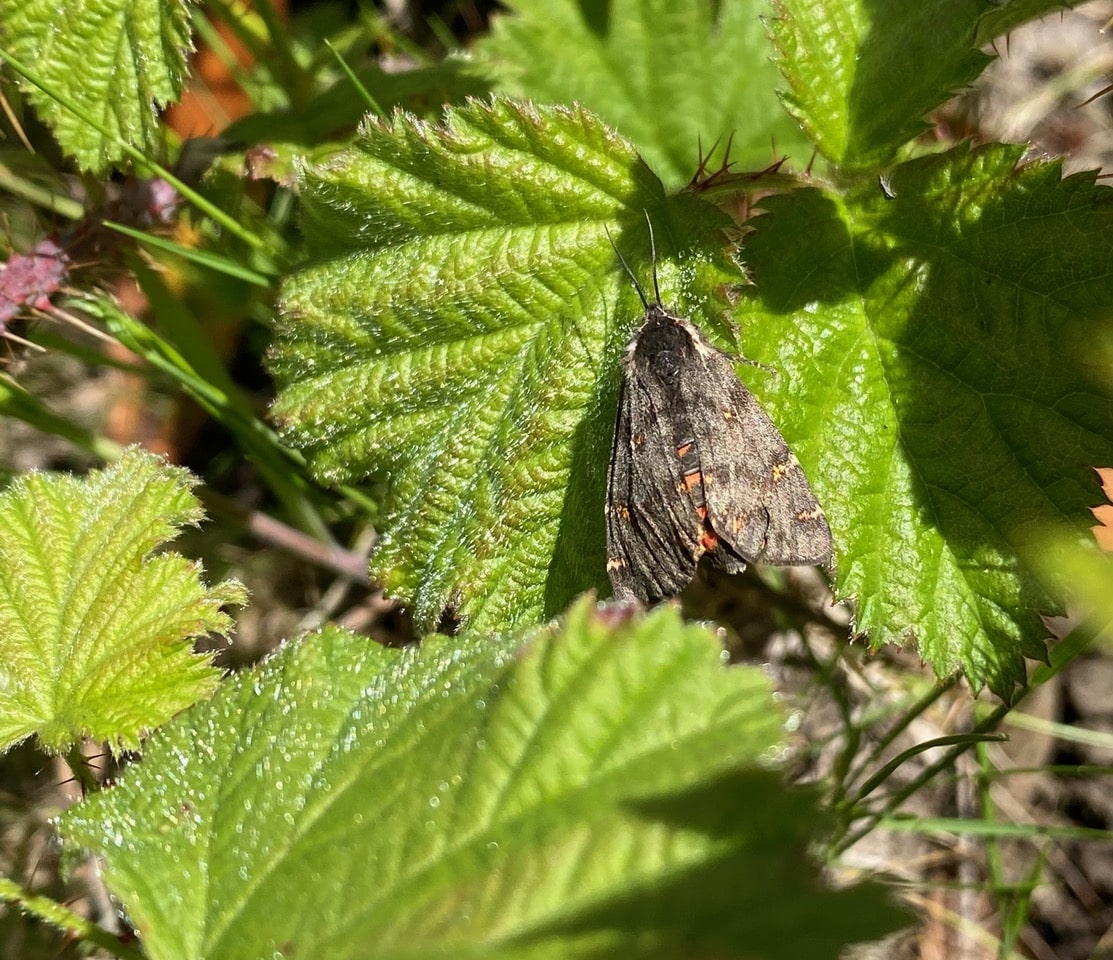
Close to the ground, a moth is resting motionless on a leaf of California Blackberry, Rubus ursinus. It has been identified by iNaturalist as a California Tiger Moth, Leptarctia Californiae (subfamily Arctiinae, family Erebidae).
The subfamily Arctiinae (formerly called the family Arctiidae) are a large and diverse group of moths that includes the tiger moths and lichen moths. Many species have “hairy” caterpillars that are popularly known as woolly bears. The most distinctive feature of the subfamily is a tymbal organ on the metathorax that produces ultrasonic sounds. They also have thoracic tympanal organs for hearing. The sounds are used in mating, and for defense against predators. Some species can jam bat echolocation.
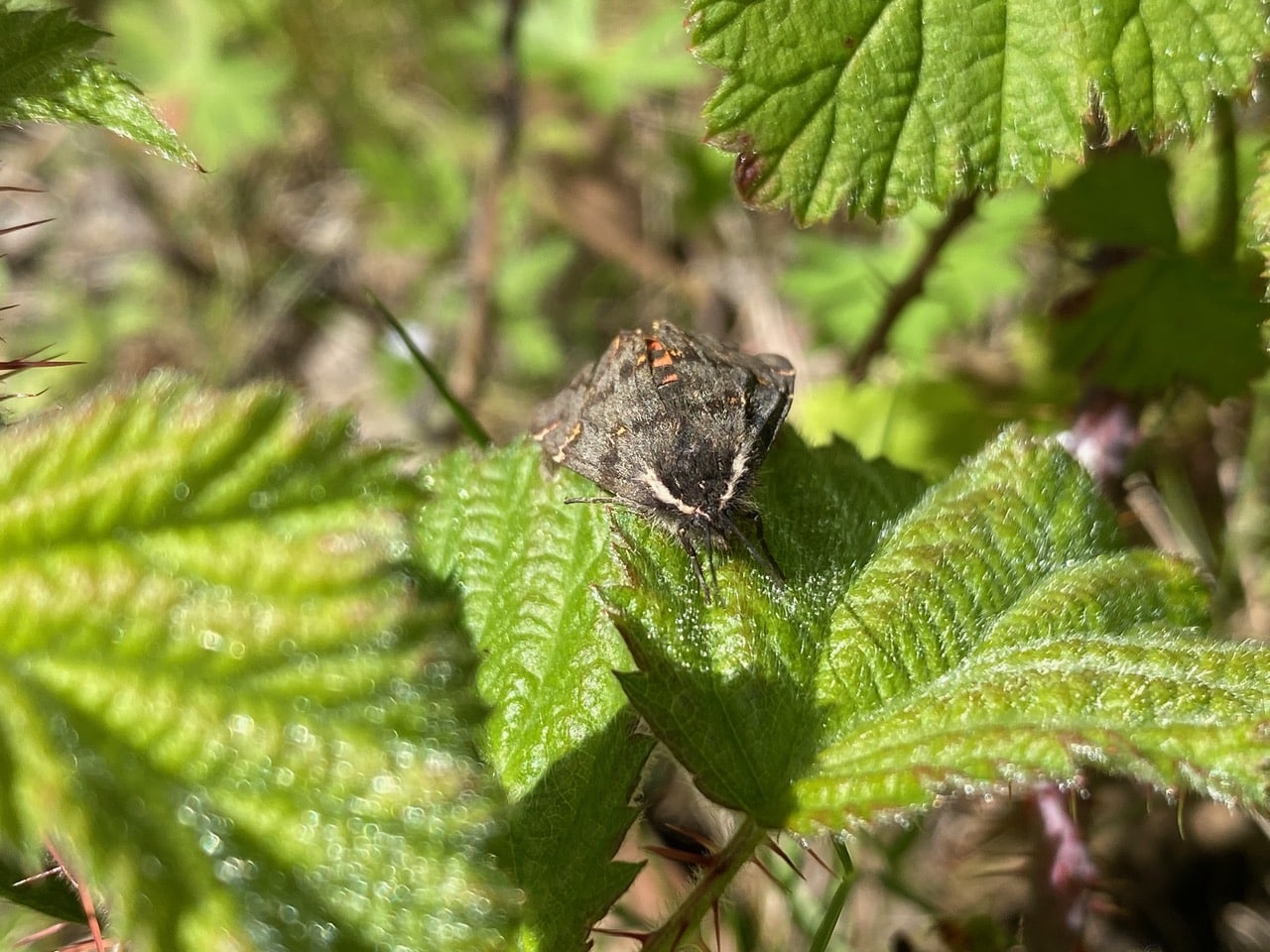
Front end of the moth.
California Tiger Moths, Leptarctia californiae are highly polymorphic, with a wide range of morphological variations between populations. The hindwing are usually bright orange or red. The species is day-active. Adult activity typically begins in early or middle of spring. The moths are most active during the warmest parts of the day and in sunny conditions. Females fly infrequently and often only short distances, spending most of their time resting on low vegetation or leaf litter. Males fly regularly and erratically in open areas or along forest edges, locating females using a combination of chemical and visual stimuli. After mating females begin laying eggs on the underside of leaves of low-lying vegetation. The larvae are highly polyphagous, feeding on a wide range of host plants. They pupate in ground litter in late summer, inside cocoons made of silk and their own urticating hairs. The species overwinters as pupae, and adults emerge as temperatures warm again in spring.
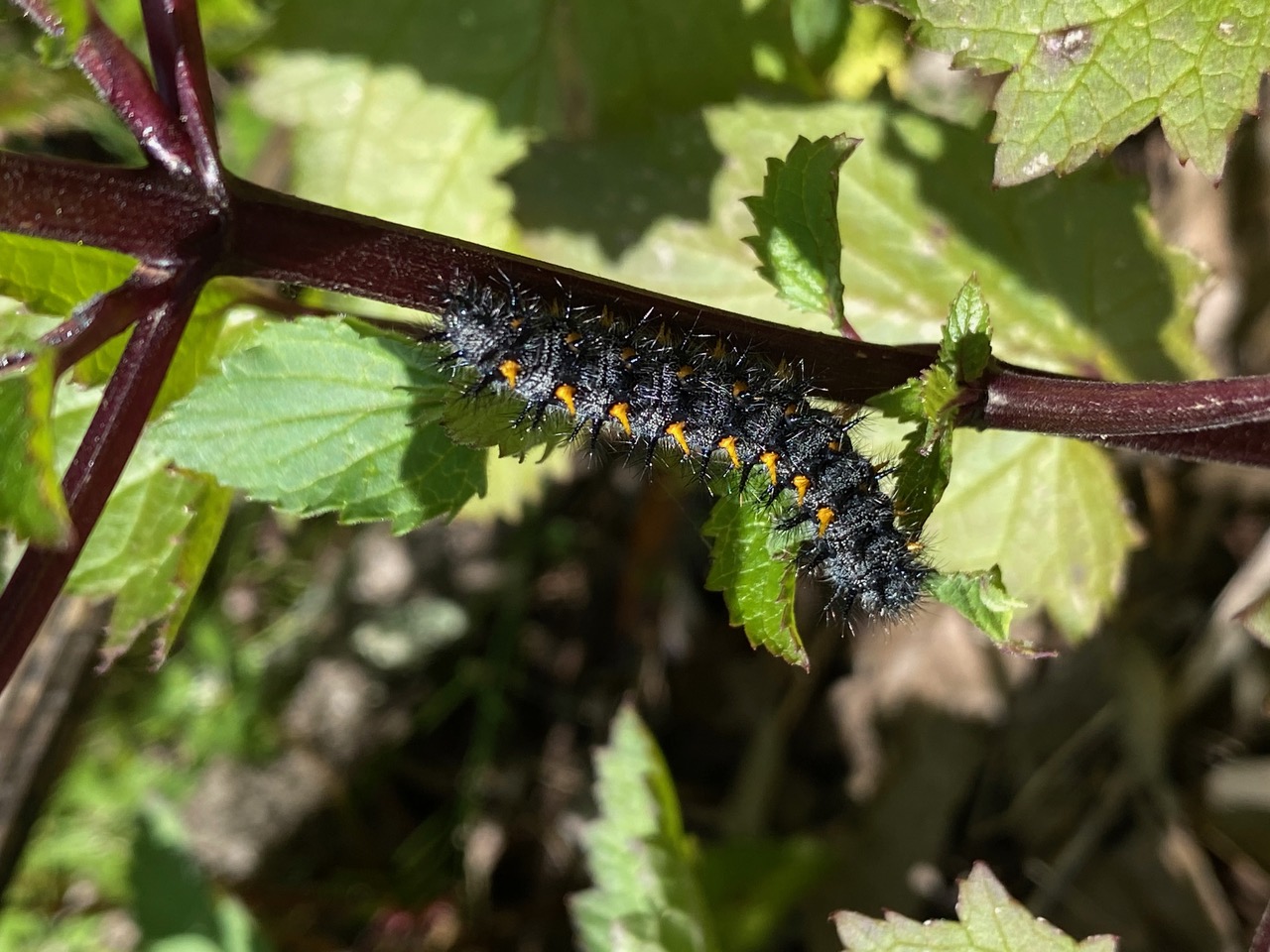
Ooh, the caterpillars of the Variable Checkerspot are getting really big! I bet some of them have already gone off to pupate out of sight.
Cow Parsnip, Heracleum maximum has started to bloom along the northern section of Skyline Trail.
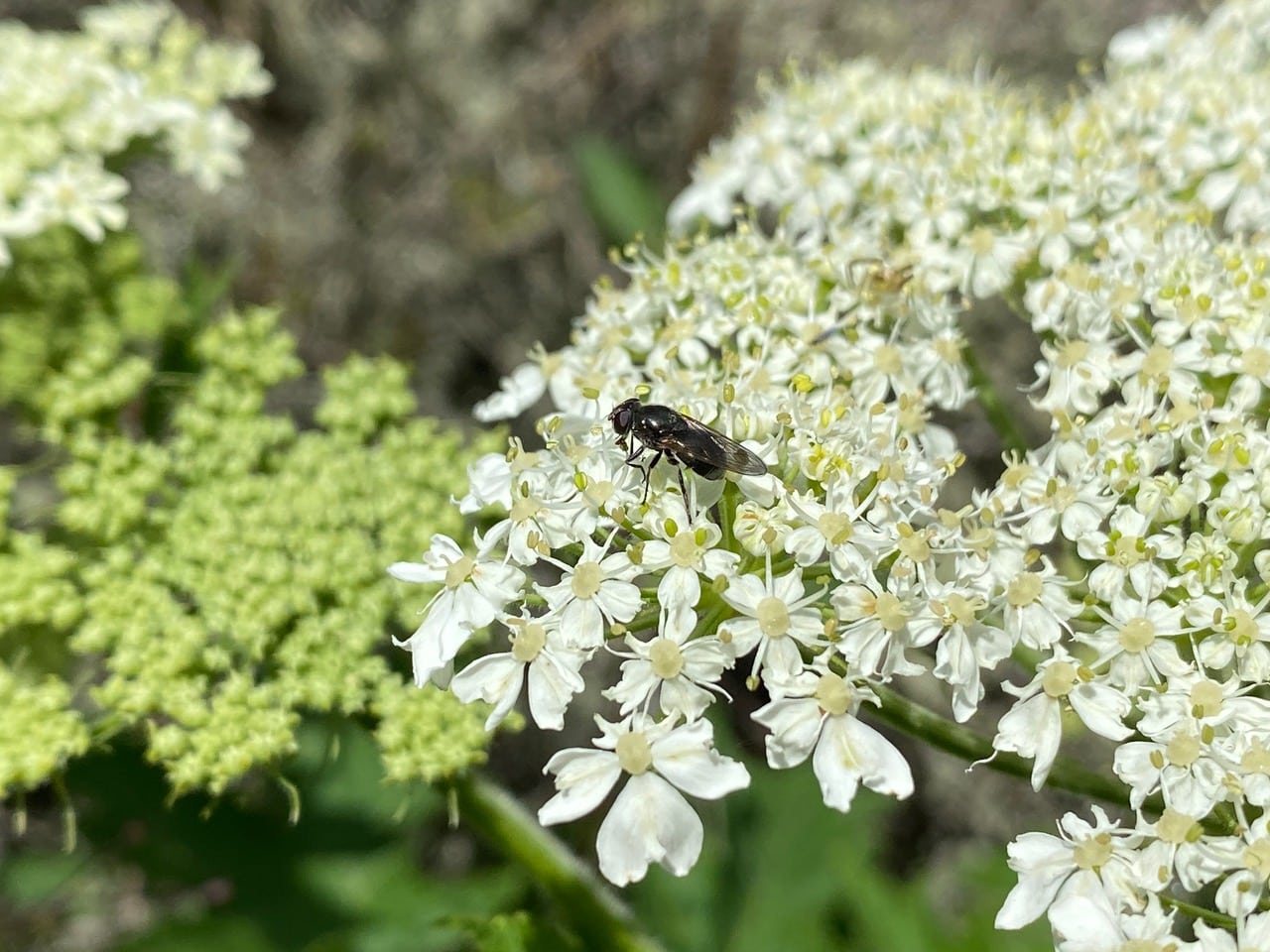
The glossy, black hoverflies, the Blacklets, Cheilosia sp. (family Syrphidae) are the most commonly seen visitors to the large umbels of the Cow Parsnip flowers today.
Blacklets are unusual hoverflies, eschewing the black-and-yellow color scheme. They also tend to hold their wings folded over their backs, instead of spread out at an angle, fighter-jet style. Although it is one of the most species diverse genera of Syrphidae, its biology is little understood. Where known, the larvae of Cheilosia species feed in the stems of plants or in fungi.
A Blacklet is feeding on the flowers of Cow Parsnip, the underside of its body smeared with the sticky white pollen.
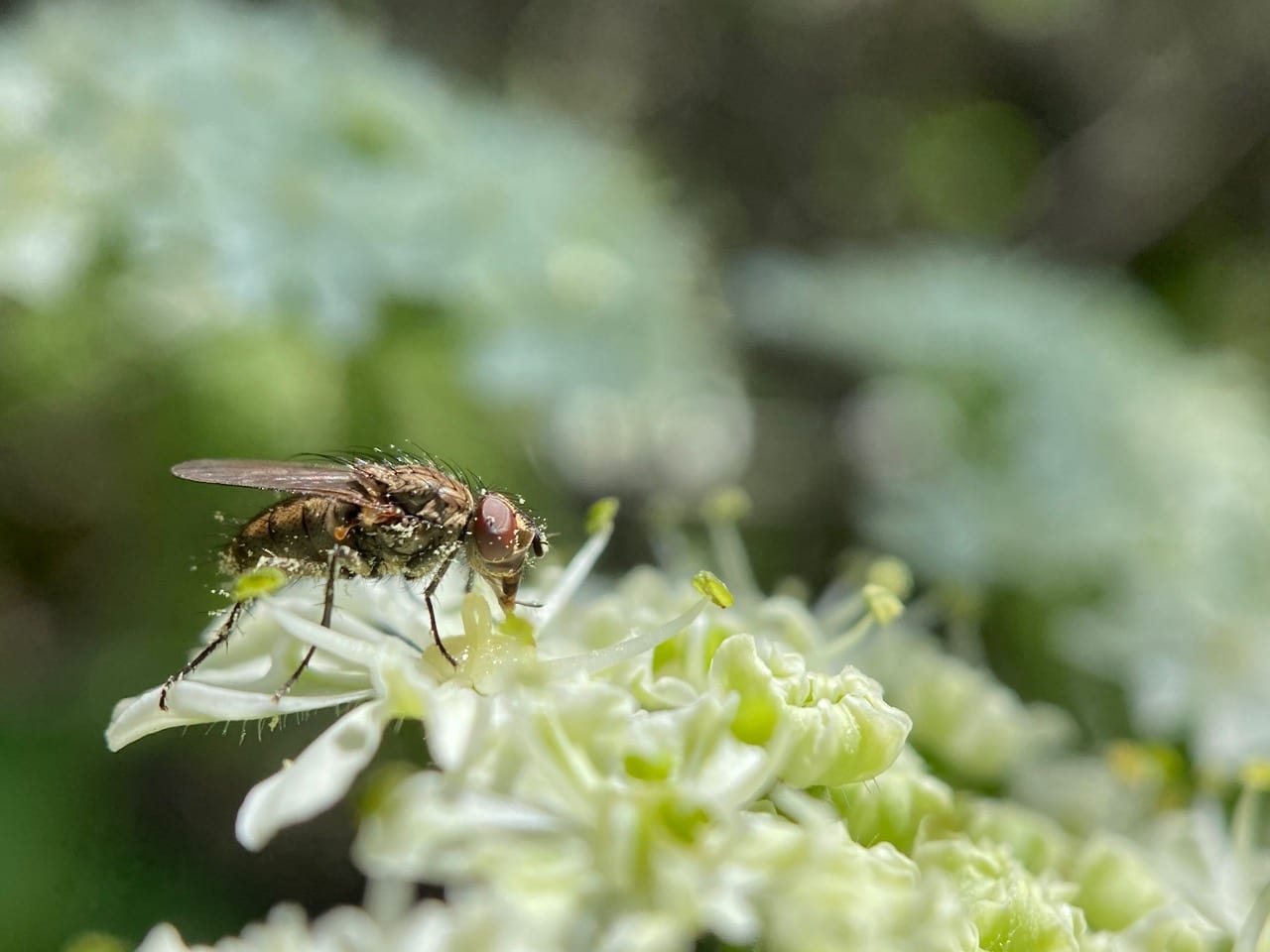
Here’s another fly, a Root Maggot Fly (family Anthomyiidae) that has cream-colored pollen all over its undersides. Most of the insects on the umbel are aiming their mouthparts at the succulent, swollen style bases of the flowers, probably where nectar is produced. Another nectar seeker, a Sulphur Tubic, Esperia sulphurella (family Oecophoridae, or concealer moths).
The species is native to Europe, but has been introduced in California. Adults have a body length of 6-8 mm, are black with yellow markings. They are on wing in spring. Larvae are black and feed on dead wood.