

Pollinator Post 4/16/23 (2)

I scramble down the steep slope at the Backbone area to get a better look at this stunning red Indian Paintbrush, Castilleja affinis.
The bright red flowers of the Indian Paintbrush, Castilleja affinis can be spotted from quite a distance. A member of the parasitic Broomrape family, Orobancaceae, the plant is a hemiparasite, meaning that although it is green and can photosynthesize, it also has the ability to sequester nutrients from neighboring plants, such as perennial grasses and sagebrush.
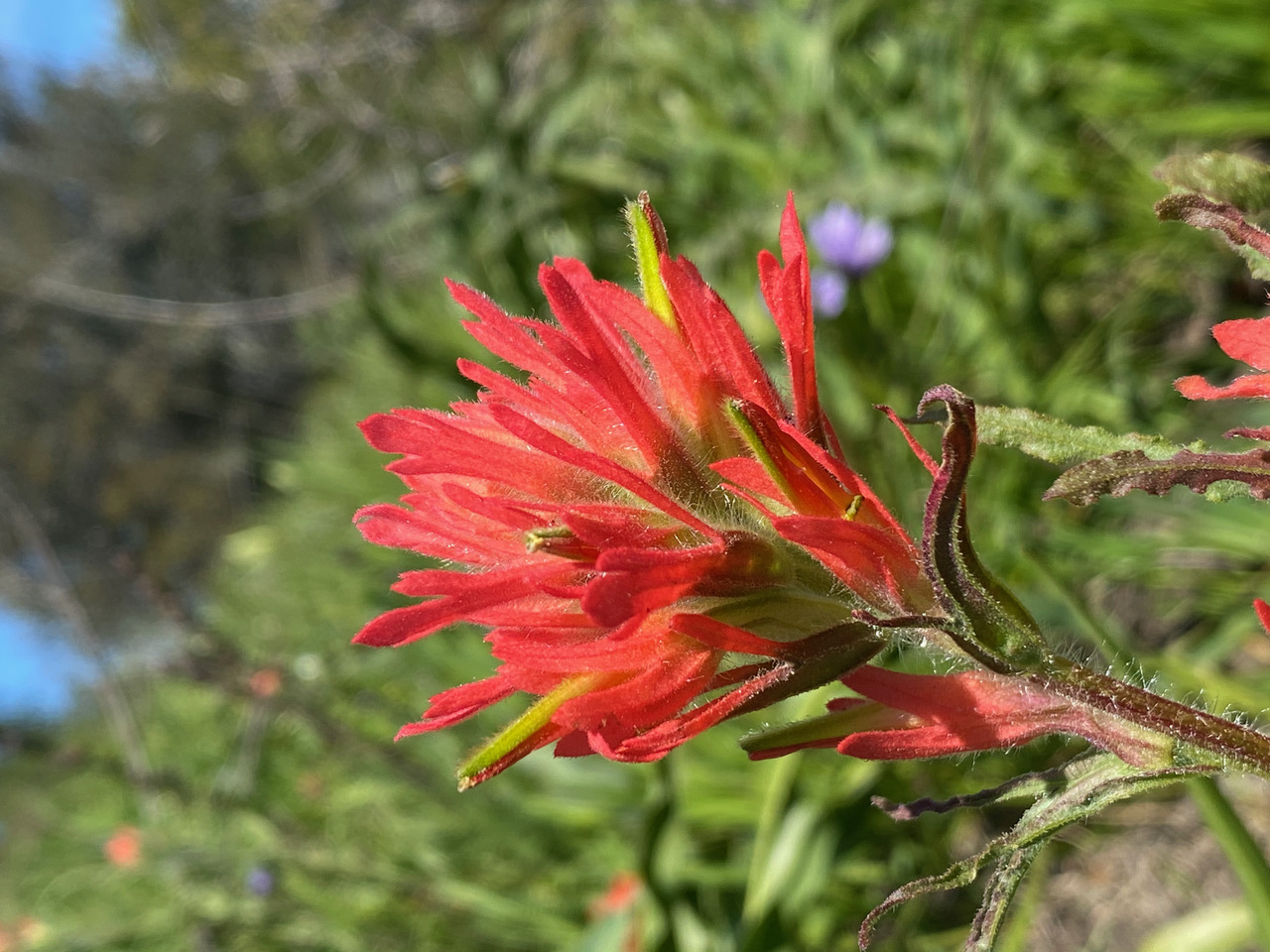
The showy red structures of Indian Paintbrush are technically not petals, but bracts, a type of modified leaf. The tip of the sepals are tinged with red as well. The petals are usually green or yellow, and curiously arranged, with the upper two extending out into a long, pointed beak that envelops the stamens and style. With tubular design and red color, the flower is especially adapted for pollination by hummingbirds. The hummers have long slender bills that allow them to reach the nectar rewards at the base of the flowers.
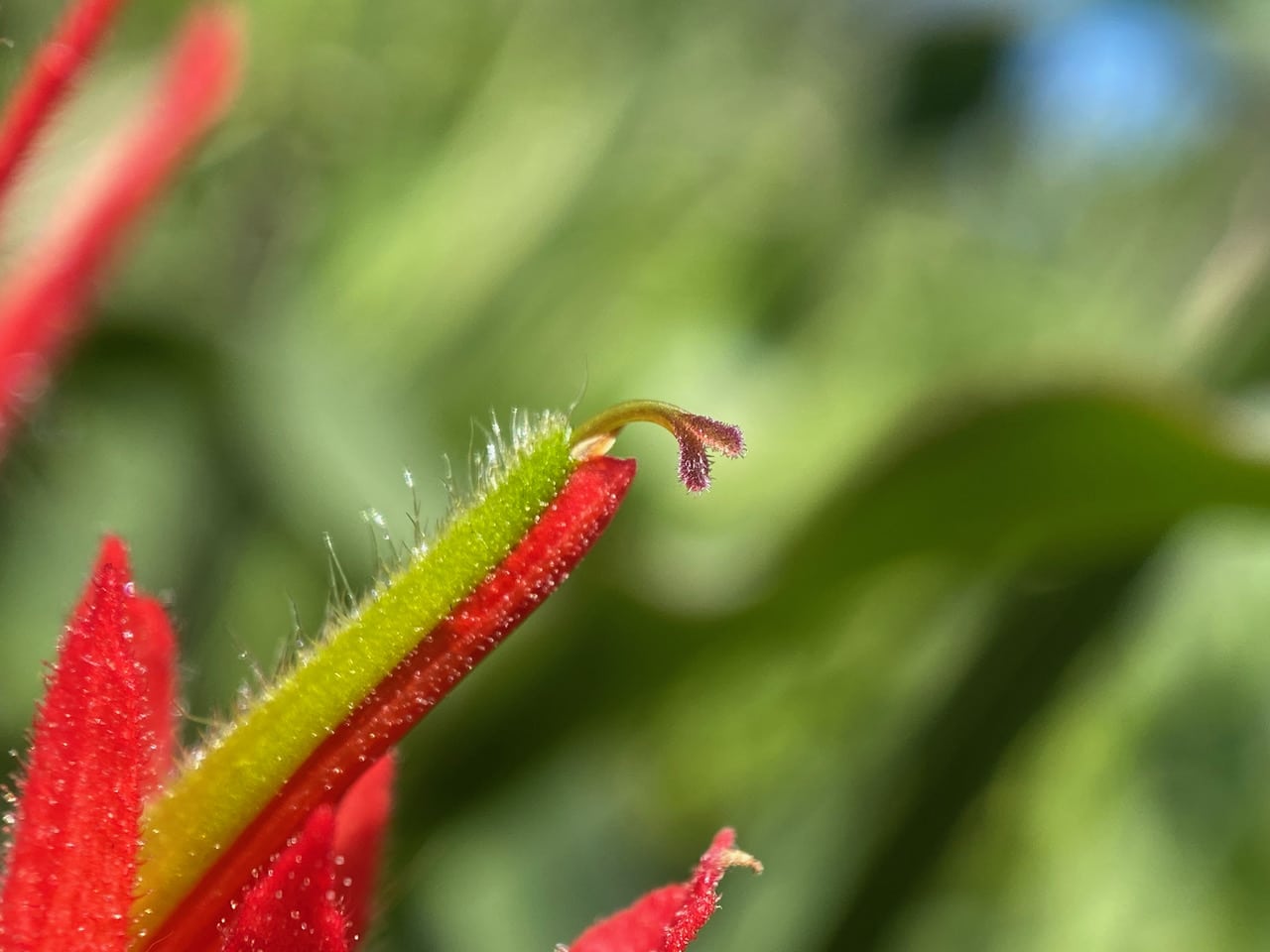
Close-up of the green flower showing the bi-lobed purplish-red stigma extending from the narrow, beak-like floral tube. There appears to be a stamen at the very entrance into the floral tube.
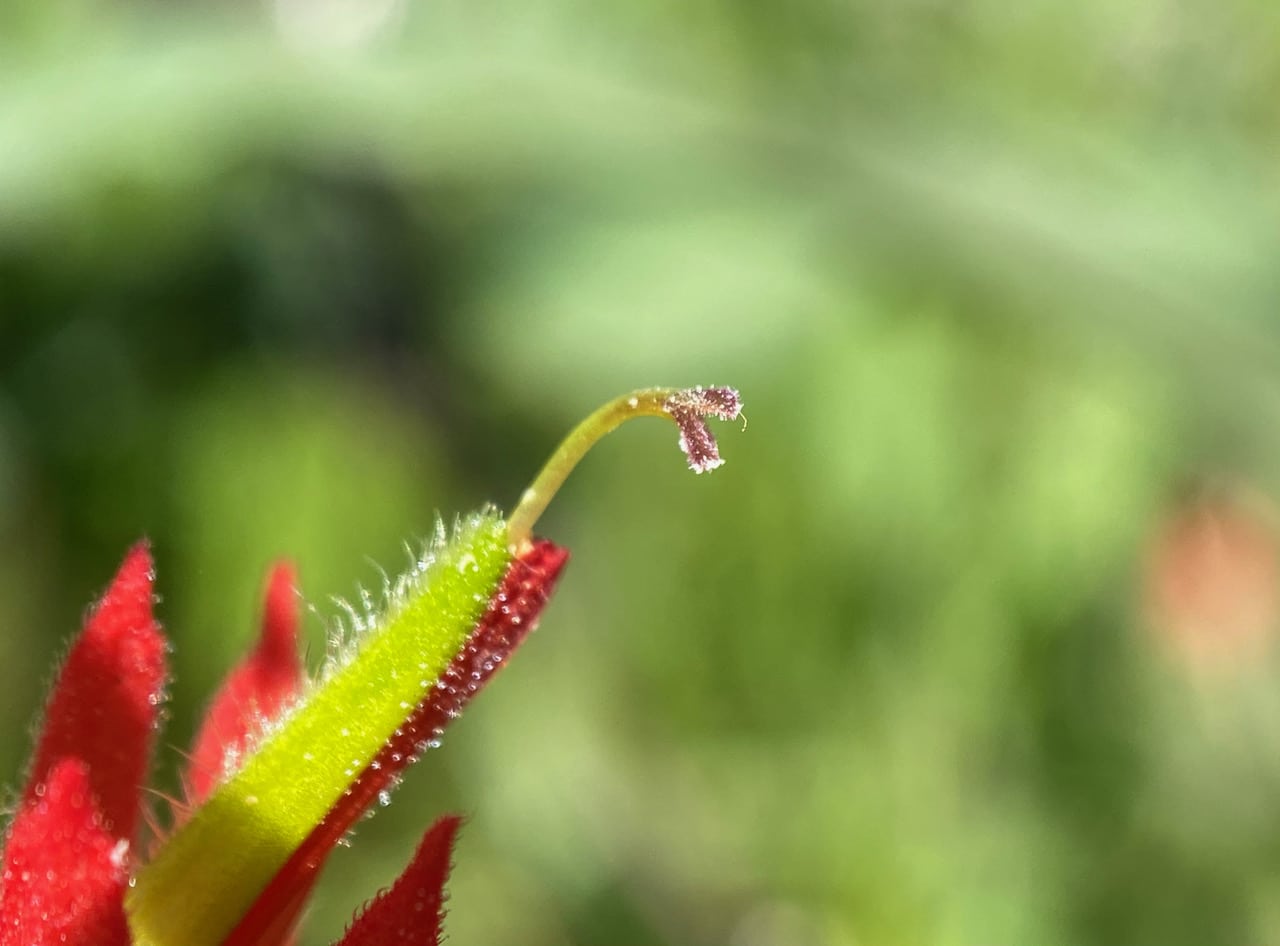
Here’s an older flower that has been pollinated, its bi-lobed stigma covered with pollen. A hummingbird must have visited the flower to sip nectar, and in the process depositing some pollen that has hitchhiked on its body from a previous flower it visited.

The colors on display are stunning. The clustered, purplish-blue flowers of Blue Dicks, Dipterostemon capitatus are much visited by the Greater Bee Flies, while I have yet to see any insect visit the tiny deep blue flowers of Chia, Salvia columbariae. The angular, square flower stalks of Chia reveals it to be a member of the mint family, Lamiaceae.

Several flowers are clustered in a tight flowerhead of Chia. The deep blue corollas are subtended by spiky dark reddish-purple calyx. Close examination of the flower shows the typical floral structure of Salvia: bilateral symmetry with 2-lipped corolla. The lower lip has two lobes. The stamens are reduced to two short structures with anthers two-celled, the upper cell fertile, and the lower sterile. The flower styles are two-cleft. The fruit of Chia is a nutlet, once an important food for Native Americans.
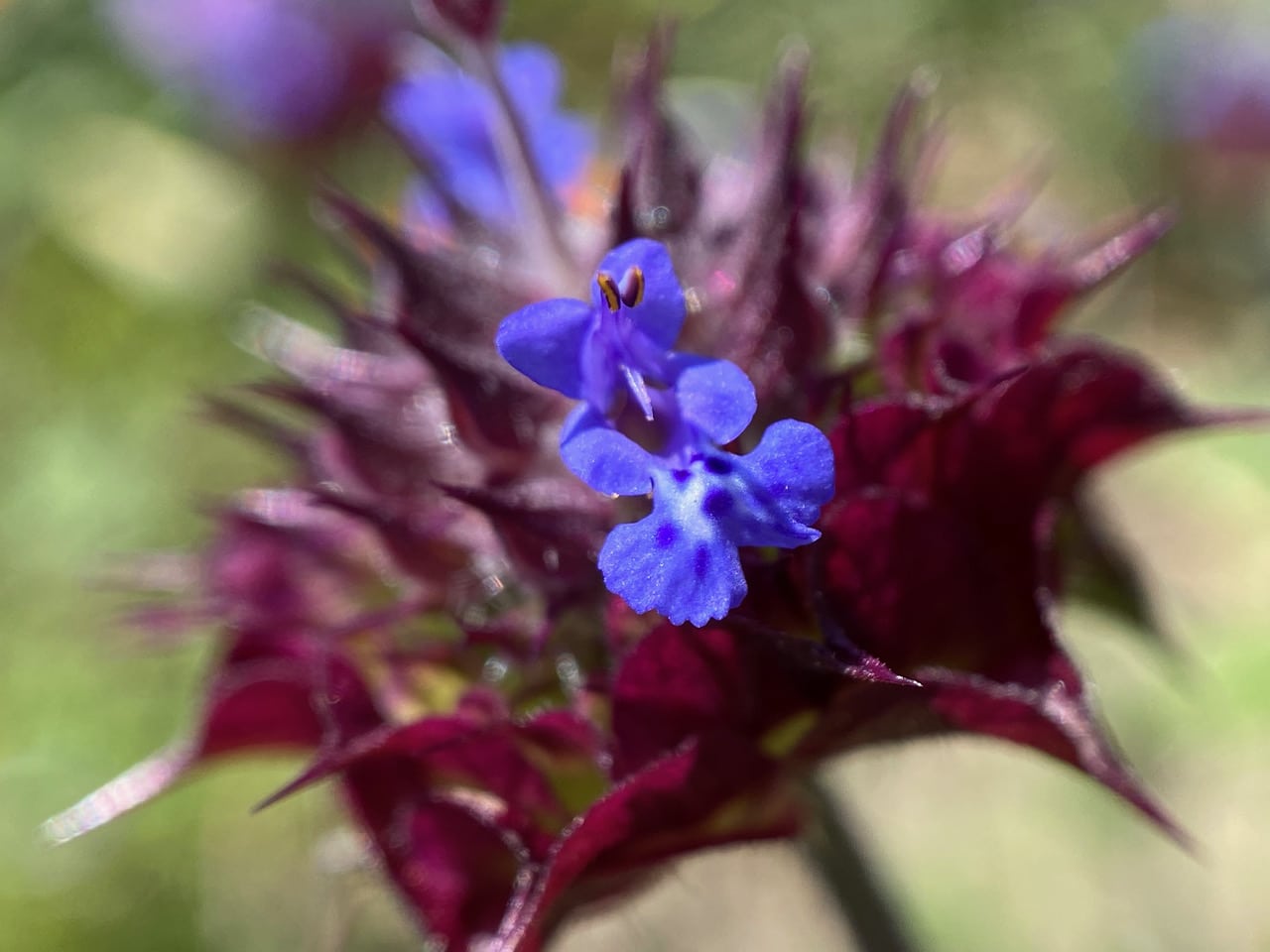
This view of the Chia flower shows the pair of fertile stamens with yellow pollen, and below them, the two-cleft style extending from the floral throat. The lower lip of the flower has dark blue spots on a lighter background, possibly signaling a landing pad for potential pollinators.
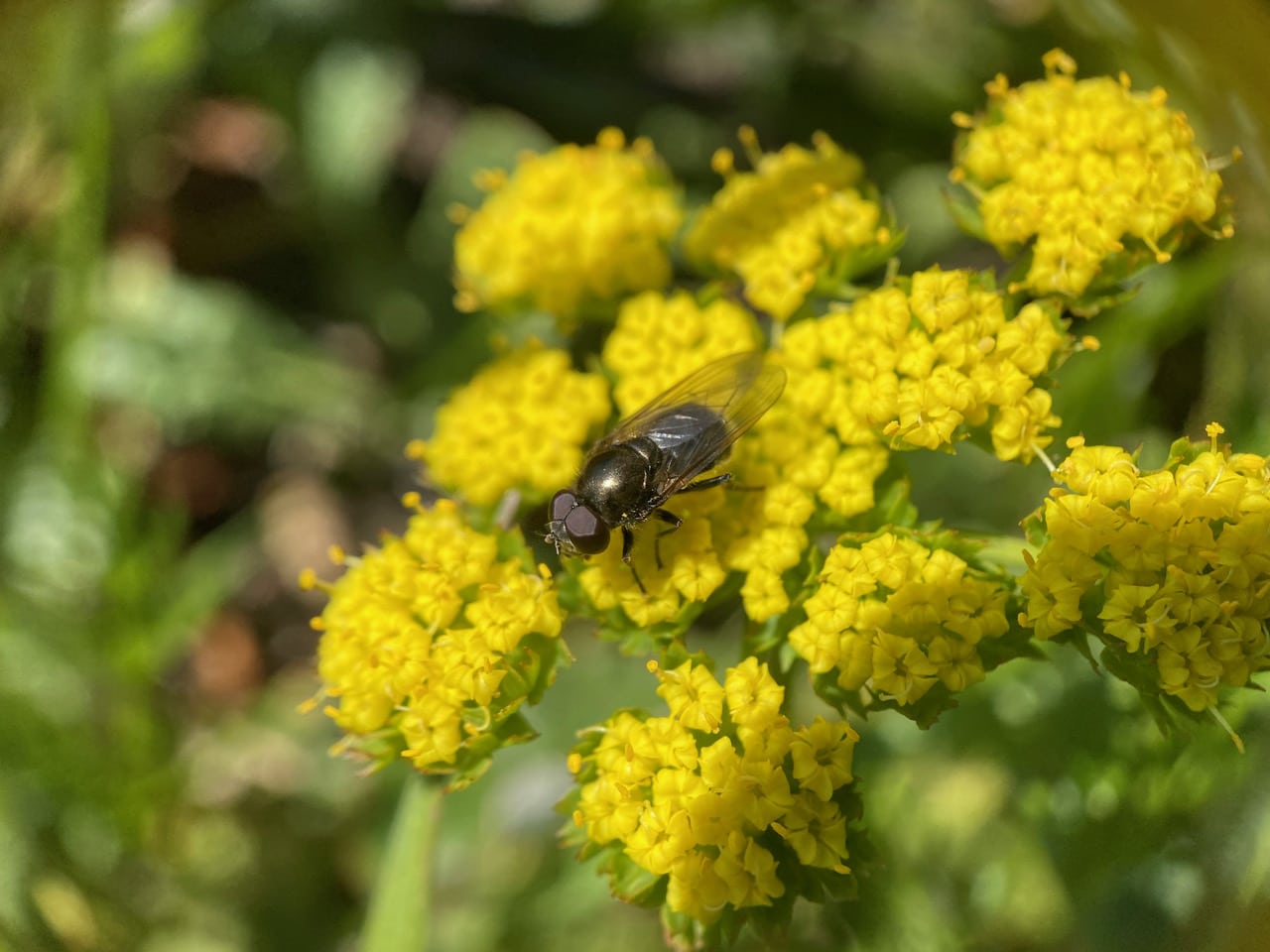
The cheery lemon yellow flowers of Bisquit Root, Lomatium caruifolium are some of the first to bloom at the Backbone. The plant is also called alkali desert parsley, belonging to the carrot family Apiaceae. The perennial herb is endemic to California, in the Central Valley and the foothills of the inner Coast Ranges and Sierra Nevada. It grows in seasonally wet grassland and riparian areas. As is typical of Apiaceae, the inflorescences are borne on umbels.
Of all the flowers available at the Backbone, the shiny black hover flies, Blacklets, Cheilosia sp. (family Syrphidae) show a strong preference for the Biscuit Root, almost to the exclusion of other flowers. I wonder why? Cheilosia larvae feed in the stems of plants or in fungus.
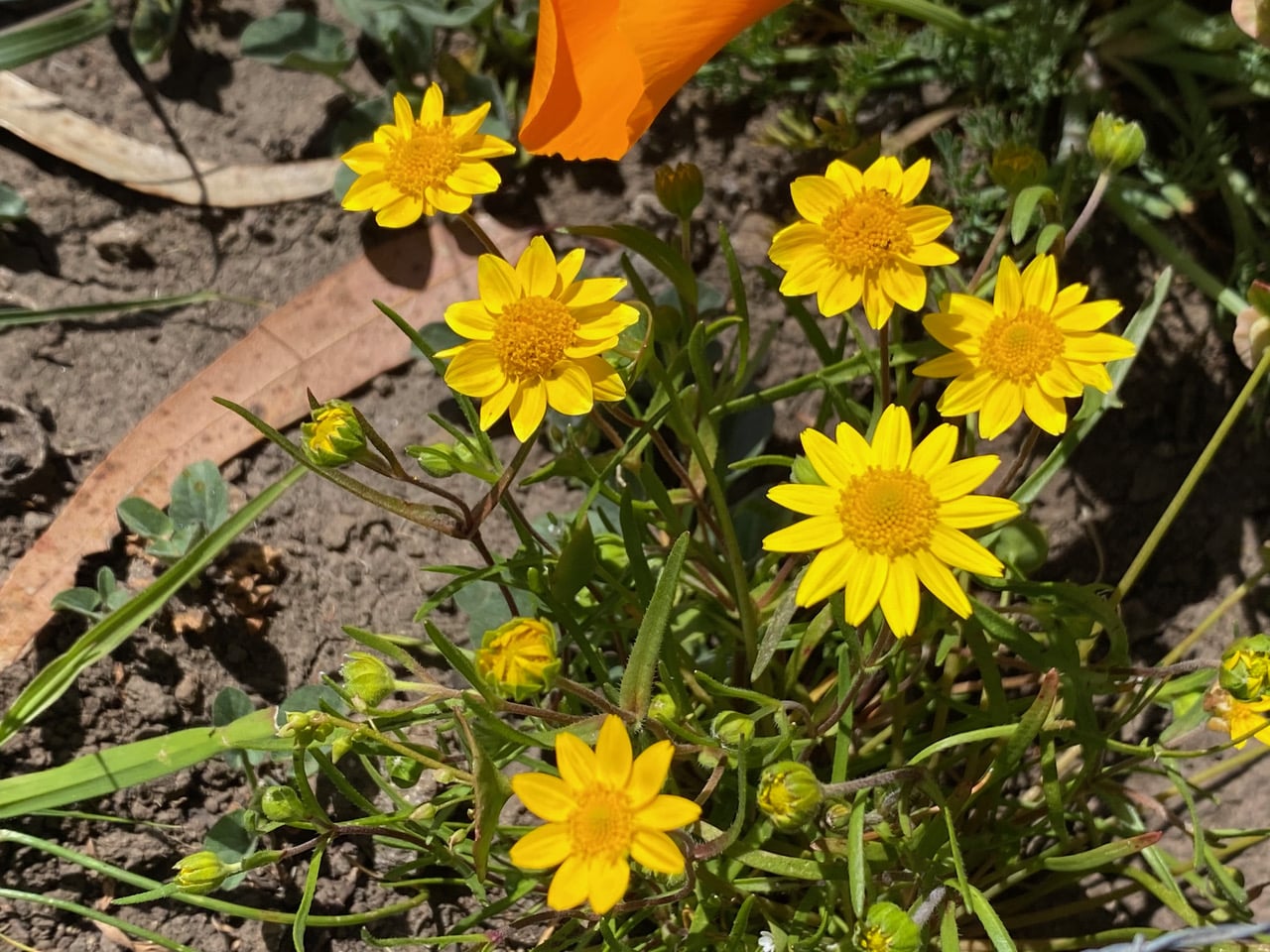
Isolated patches of Goldfields, Lasthenia sp. have shown up, brimming with cheer. Where are the pollinators?
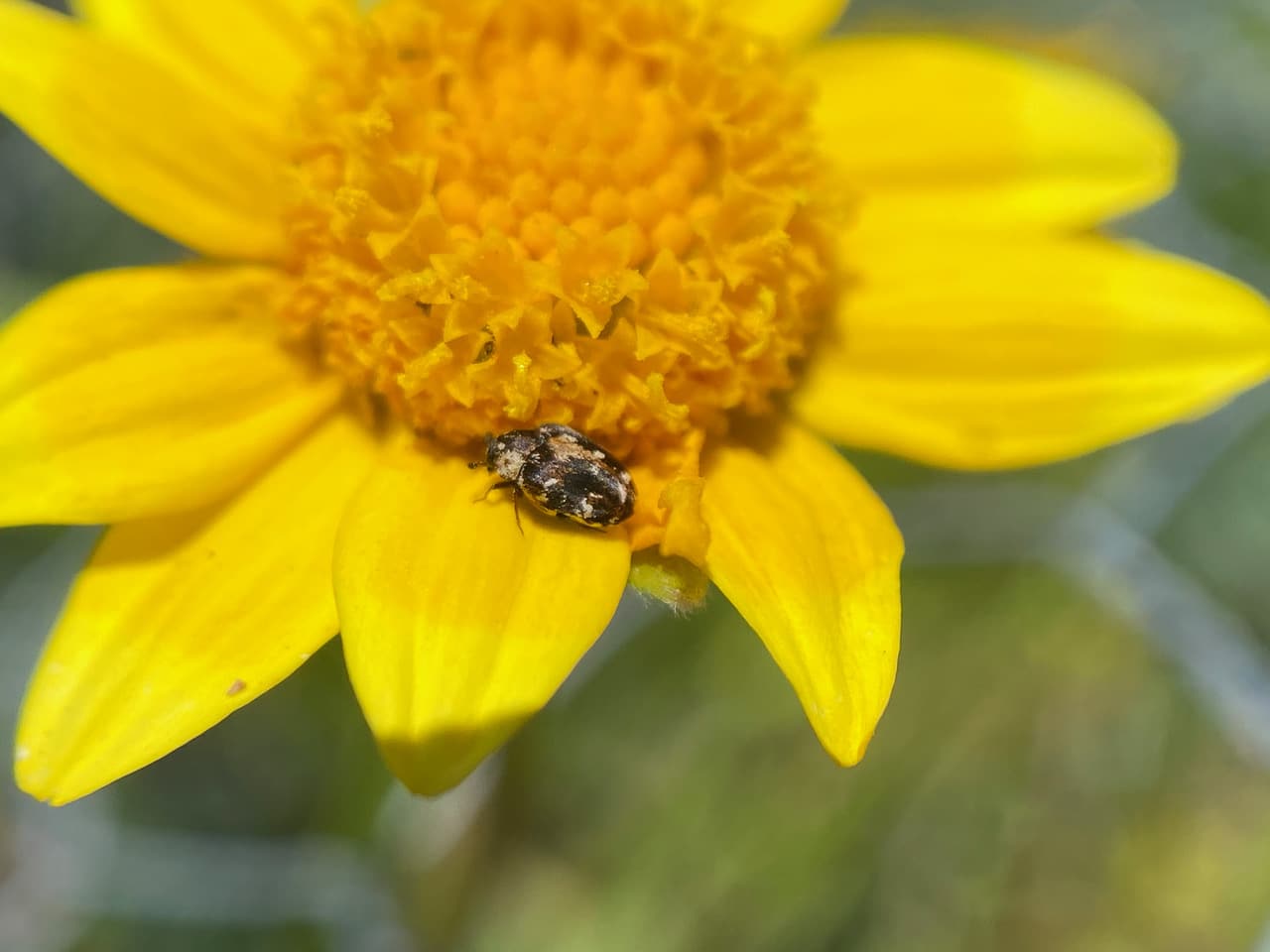
Here’s a Skin Beetle, Anthrenus lepidus (family Dermestidae) on a Goldfield flowerhead. It is probably here to feed on the abundant pollen.
Dermestidae are a family of Coleoptera (beetles) that are commonly referred to as skin of carpet beetles. Ranging in size from 1 to 2 mm, the beetles typically have clubbed antennae that fit into deep grooves. Most Dermestids are scavengers that feed on dry animal or plant materials, such as skin or pollen, animal hair, feathers, dead insects and natural fibers. The larvae are used in taxidermy and by natural history museums to clean animal skeletons.

Here’s a view of those cute clubbed antennae.
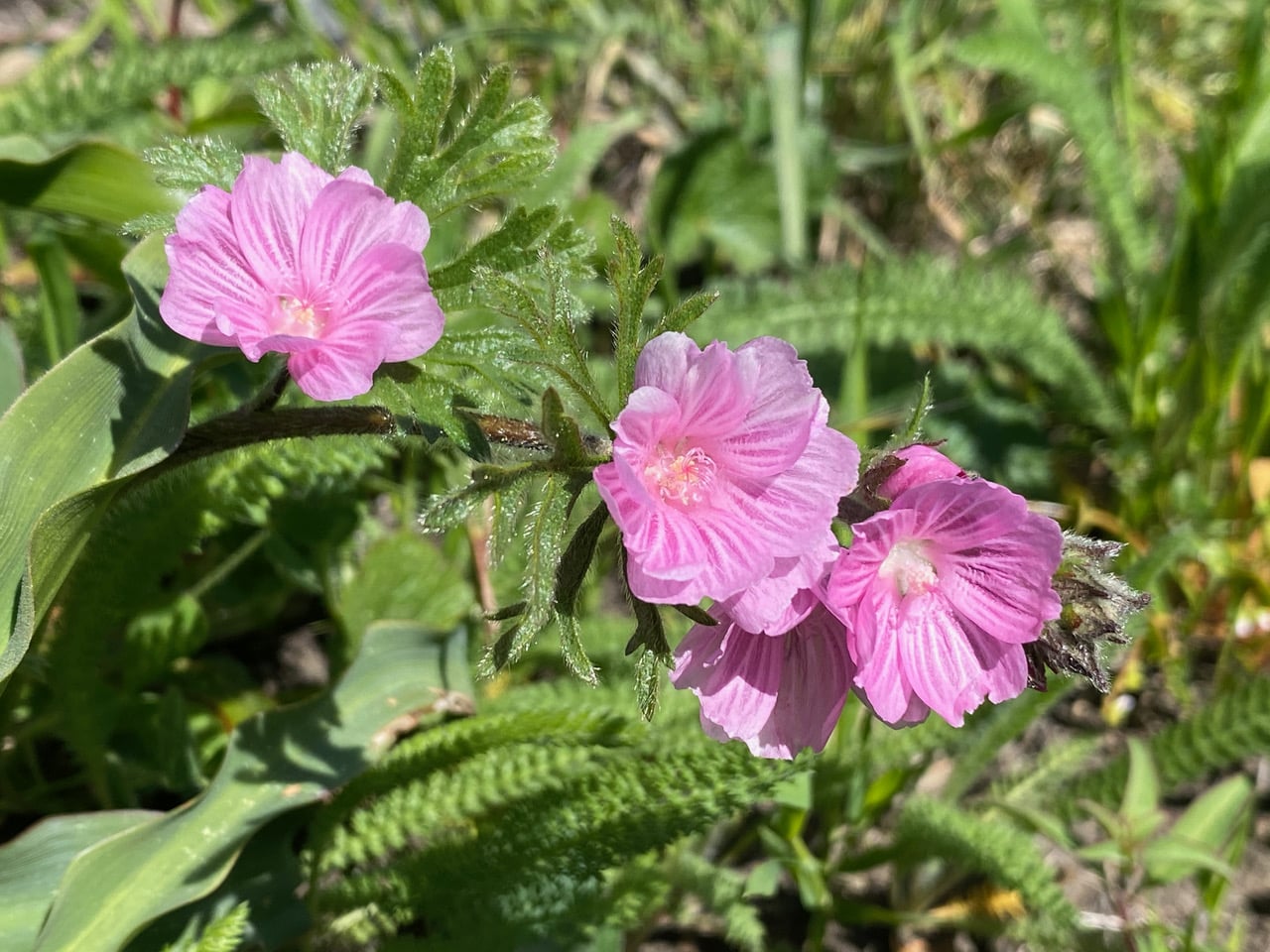
The Checkerbloom, Sidalcea malviflora is blooming gloriously, but not getting any attention from insects.
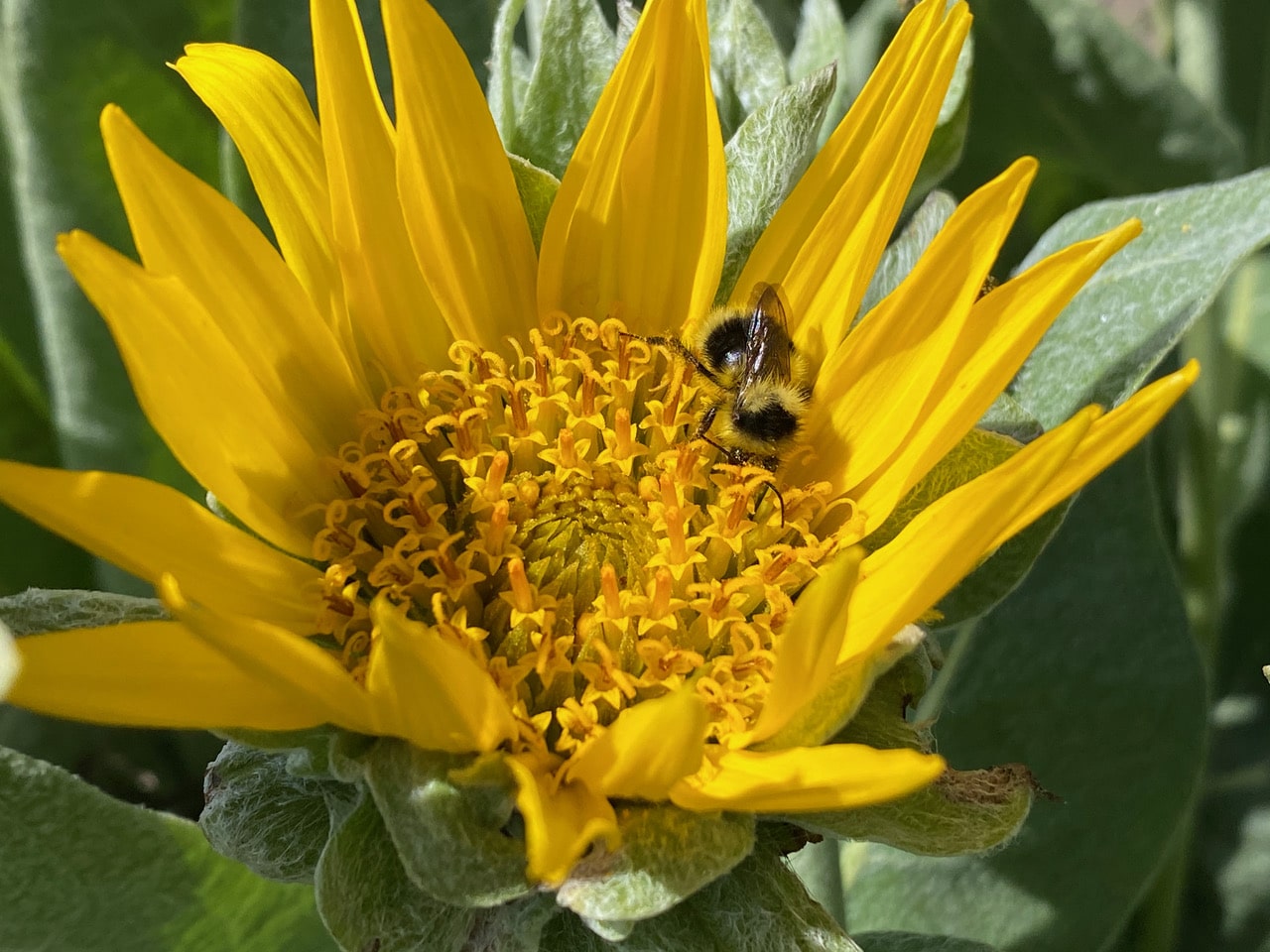
Like a lone dancer on a dance floor, a Black-tailed Bumble Bee, Bombus melanopygus is dwarfed by the huge flowerhead of the Woolly Mule’s Ears it is foraging on. There are at least 50 florets on this flowerhead. The floral resources are so rich and concentrated that the bee hardly has time to lift her head. She tends to feed along the rim of the flowerhead where the more mature flowers are located. Perhaps these give better nectar? The bee does not seem to be collecting pollen – her pollen baskets are empty.

Much smaller in size than the bumble bee, a Sunflower Seed Maggot, Neotephritis finalis, a Fruit Fly in the family Tephritidae is perched on a leaf of the Woolly Mule’s Ear. Note the shiny green eyes and the intricate patterns on its “picture” wings.
Tephritids are small to medium-sized flies that are often colorful, and usually with picture wings. The larvae of almost all Tephritidae are phytophagous. Females deposit eggs in living, healthy plant tissues using their telescopic ovipositors. Here the larvae find their food upon emerging. The larvae develop in leaves, stems, flowers, seeds, fruits, and roots of the host plant, depending on the species. Adults are often found on the host plant and feeding on pollen, nectar, rotting plant debris, or honeydew. Tephritid flies are of major economic importance as they can cause damage to fruit and other plant crops. On the other hand, some Tephritids are used as agents of biological control of noxious weeds.
The Sunflower Seed Maggot is a sunflower specialist, found on over 20 species of Asteraceae. Larvae feed on immature seeds and pupate in flowerheads.

Several similar Fruit Flies are milling around on the leaves, not seeming to do much. Is this a gathering place to meet the opposite sex? Many species of Tephritidae perform an elaborate courtship display using their picture wings, but I am not seeing any wing waving today.

Back on Skyline Trail, a tiny fly crawls out of a flower of California Saxifrage, Micranthes californica. It is a spent flower devoid of pollen. Is the flower still producing nectar at this stage?

Here’s another fly feeding on a California Saxifrage flower without pollen. With long legs and straight long proboscis, the fly appears to be a member of the superfamily Empidoidea which includes Dance Flies and Long-legged Flies. Most of these insects are predatory, often with large compound eyes (sometimes covering almost the entire surface of the head), and tend to be associated with moist, temperate habitats. Some adult Dance Flies (family Empididae) also visit flowers to obtain nectar. At least a few groups obtain all their protein needs by feeding on pollen. Larvae are generally found in moist soil, rotten wood, dung, or in aquatic habitats and also appear to be predacious on various arthropods.
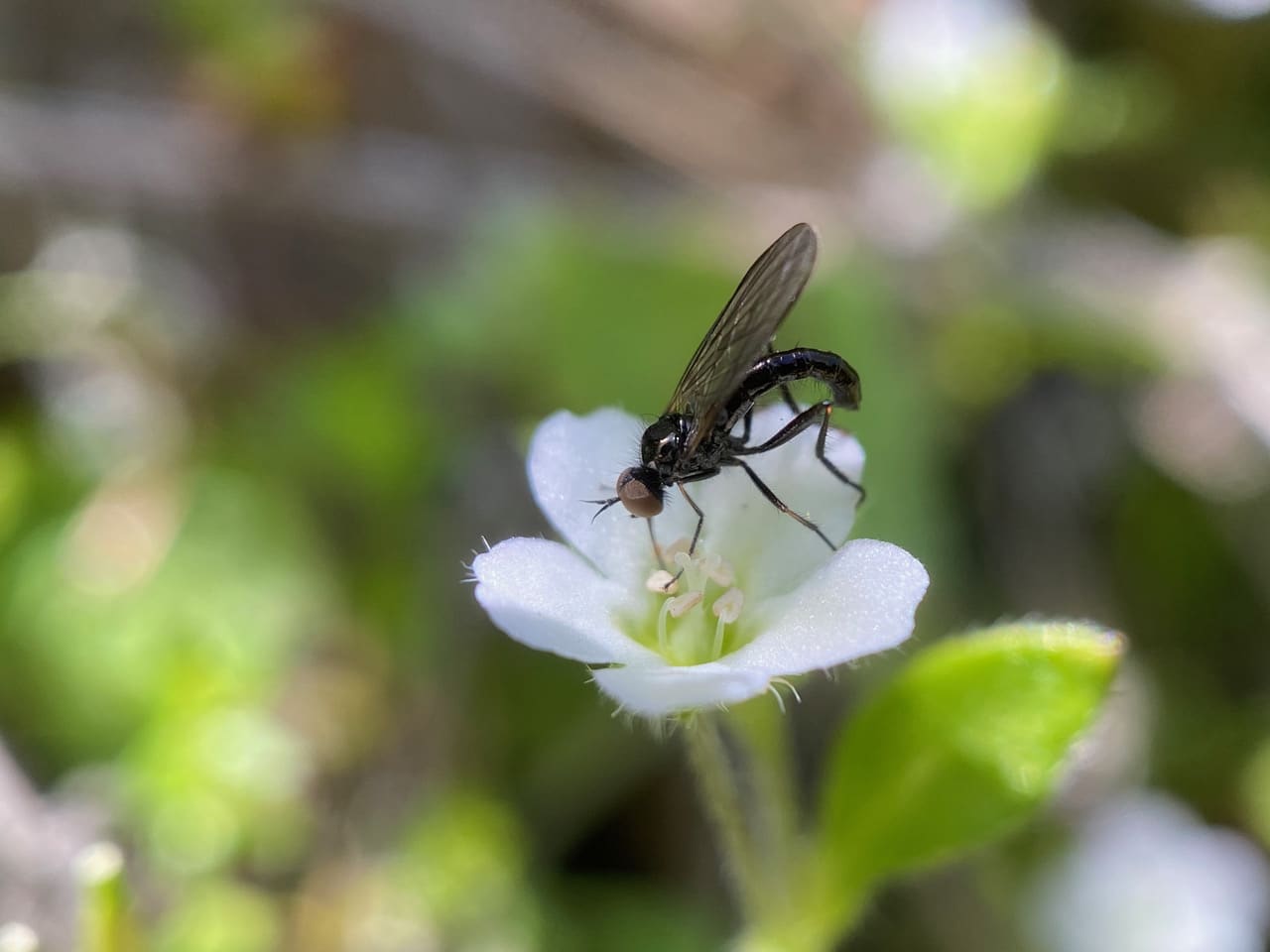
The same insect flies over to a flower of Miner’s Lettuce, Claytonia perfoliata and continues to feed there.