

Pollinator Post 4/14/24
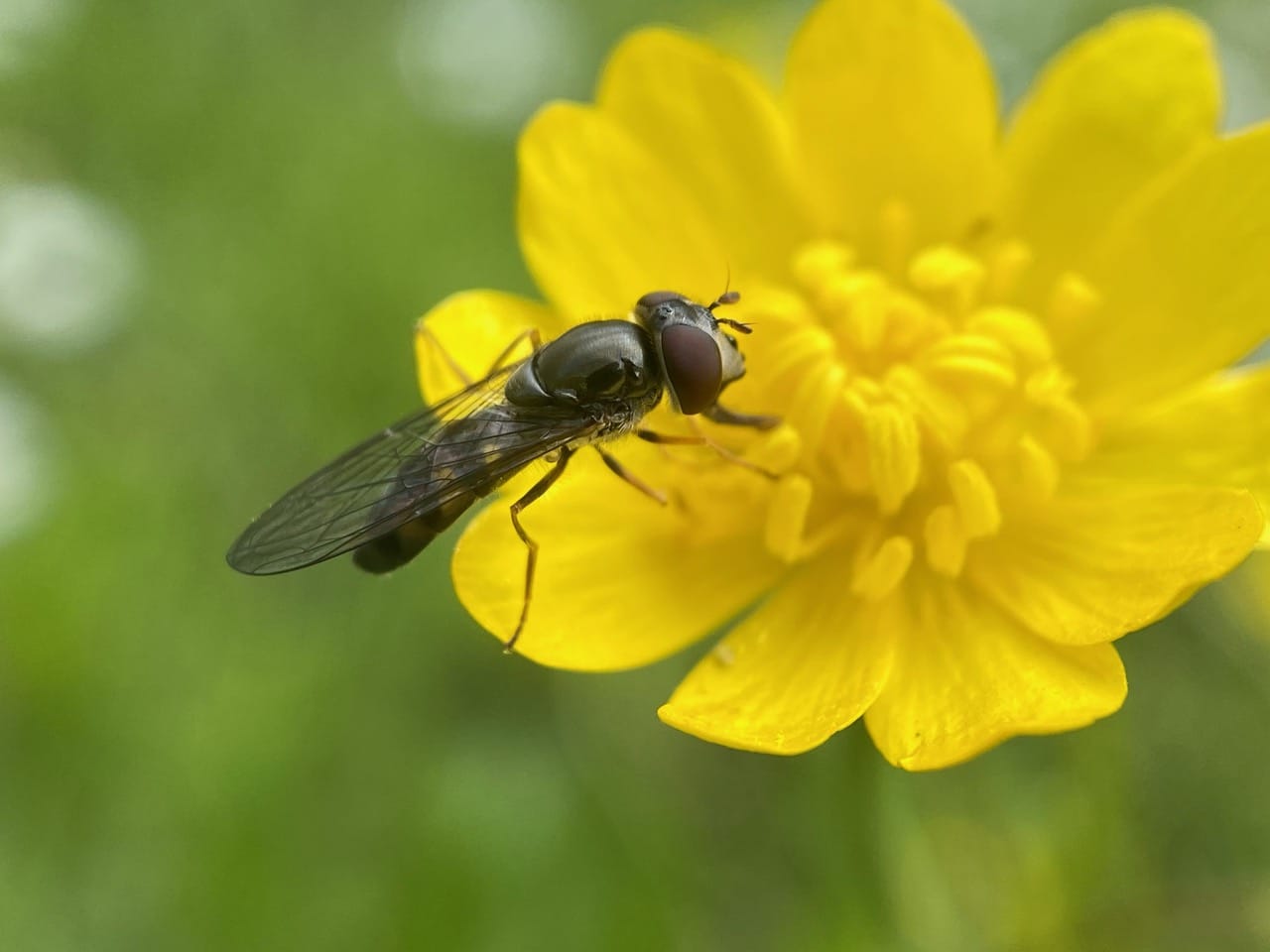
Although it is cold and cloudy, I am grateful that the rain has stopped, and I can go for a walk in the afternoon. But where? Since there won’t be much insect activity anywhere in this weather and photography is difficult in such low light (I depend exclusively on natural light), it really doesn’t matter where I go. I find myself walking the short trail between the Padre and the Laurel picnic areas in Tilden Regional Park, scanning the blooming California Buttercup, Ranunculus californicus out of habit. The place is quiet, drenched in rain.
Wow, there’s actually an insect out foraging when the temperature is hovering at the low 50s F. Not surprisingly it is a Sedgesitter, a hoverfly known for its tolerance of cold and rainy conditions.The Sedgesitter, Platycheirus sp. (family Syrphidae) is found in grass and herb vegetation. Adults of many species feed on pollen of wind-pollinated plants, such as Salix, Plantago, Poaceae, Cyperaceae, but they visit other flowers also. Many stay active during cold and rainy weather. Larvae feed on aphids.

It is a female, as its eyes do not meet on top of the head. This is a useful feature in the hoverflies for distinguishing the sexes. The males have holoptic eyes that meet along a central line on top of the head.

Tongue extended, a Sedgesitter is feeding on pollen.

It is a male with holoptic eyes.

I do a double take when I spot this small insect on a California Buttercup flower. Who is this odd-looking critter – a wasp?
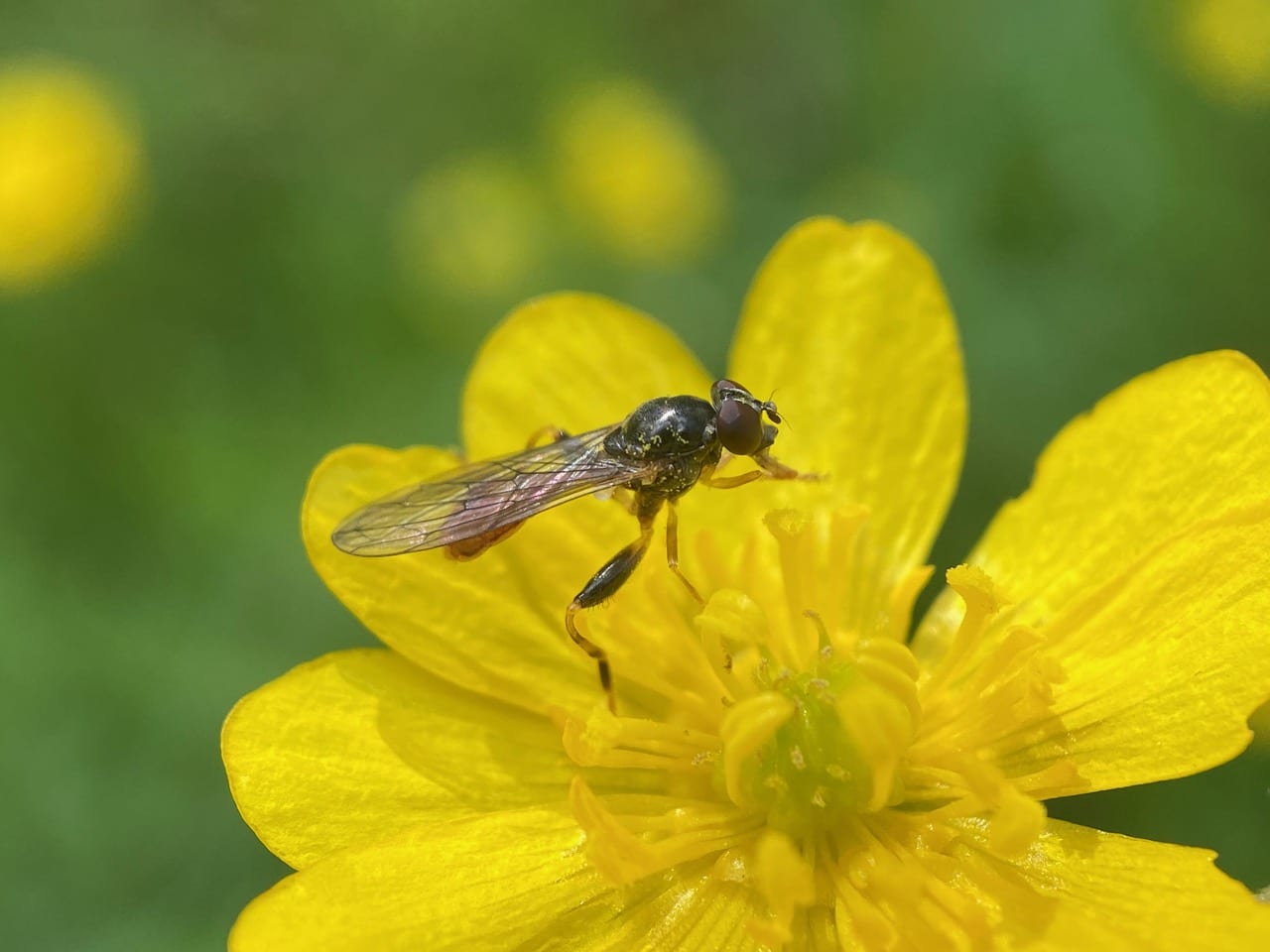
When it rises up, I see that it has an enlarged hind femur, and that it is a fly (with typical aristate antennae). Wow, a wasp-mimicking fly!
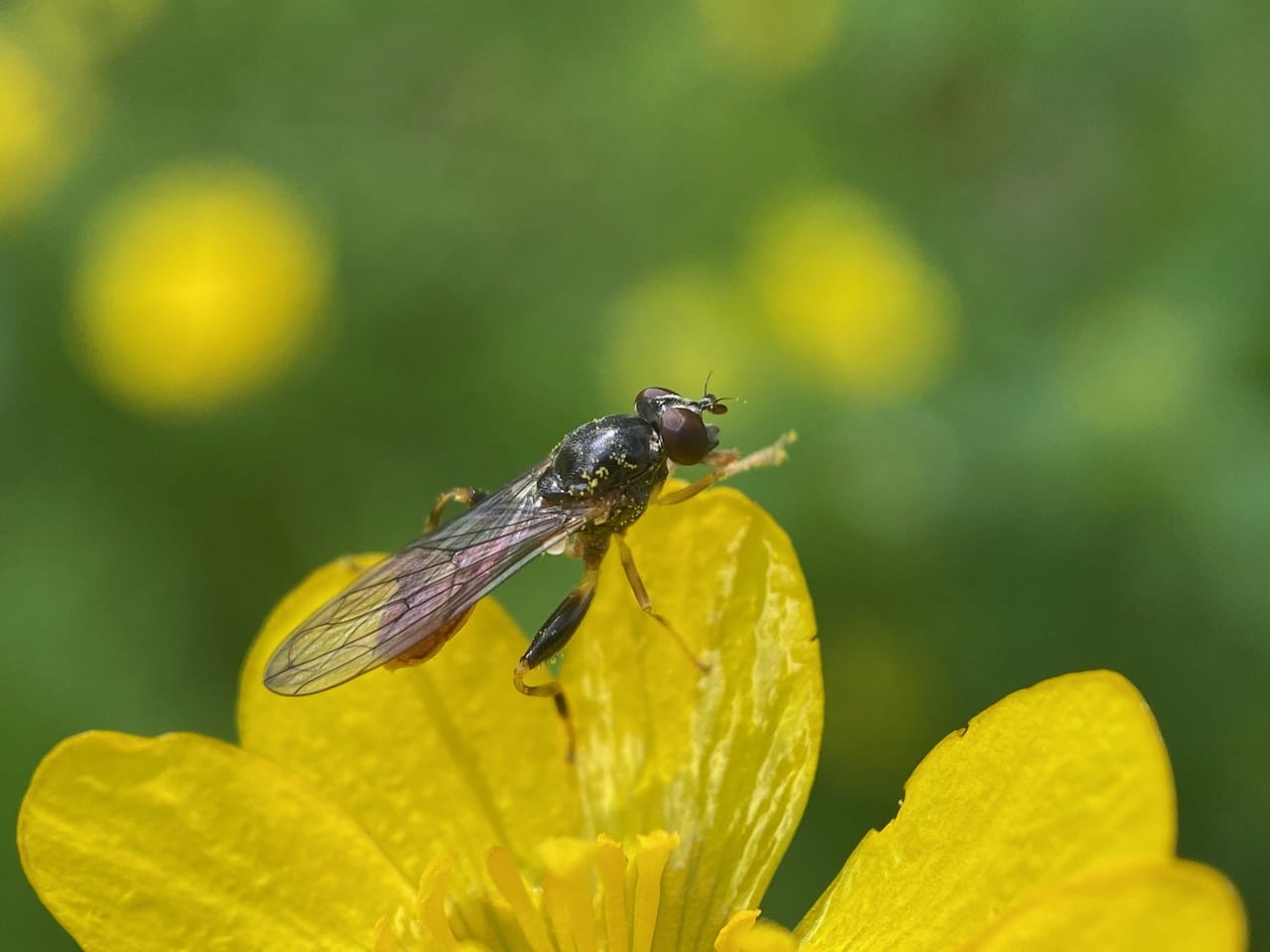
The fly is not camera-shy, so I keep taking pictures of it as it moves around on the flower.

I desperately need better light on the critter!

This view from the top shows the fly’s “wasp waist” – a narrowed or “petiolate” abdomen. And look at those thunder thighs!
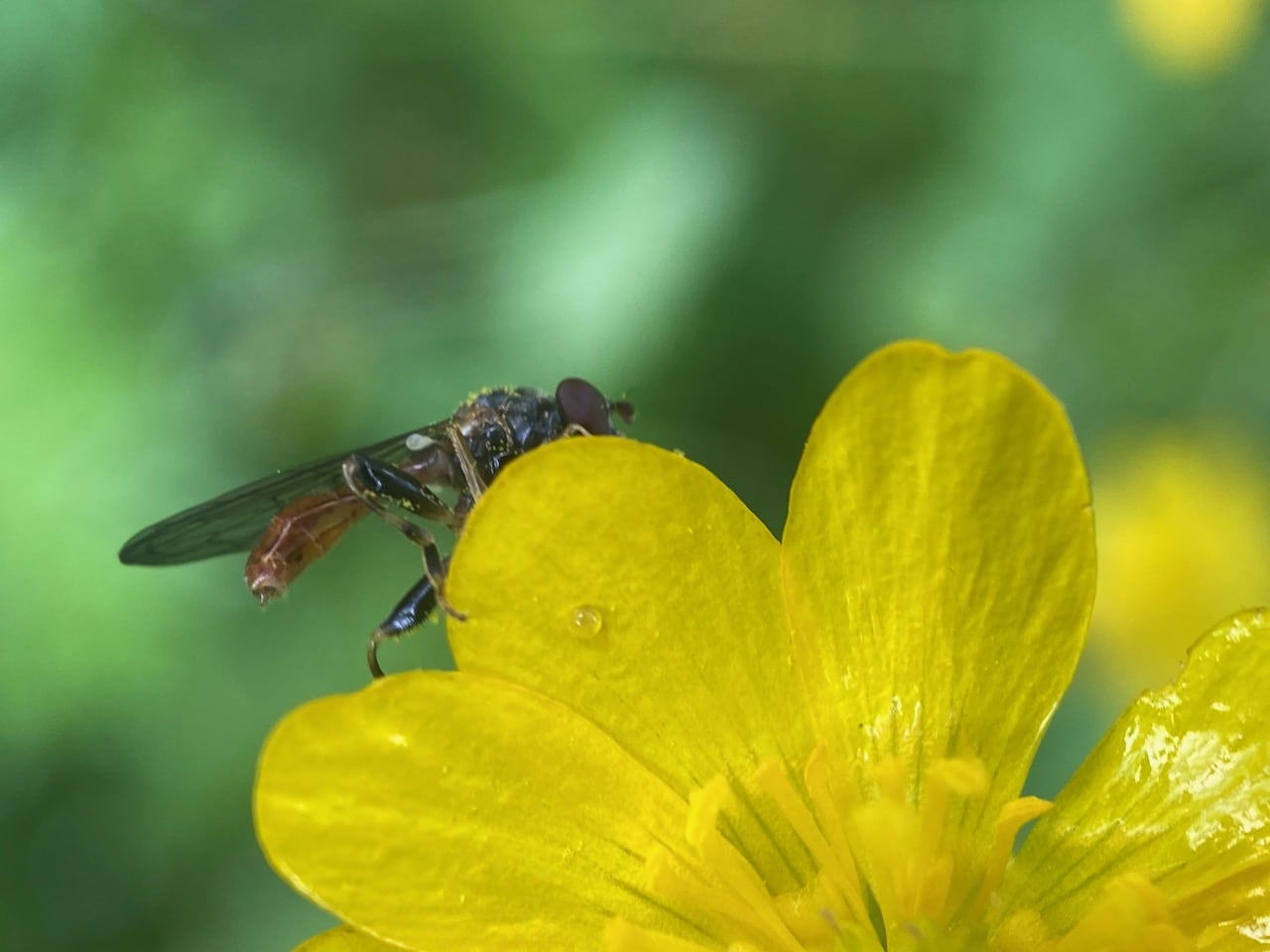
As the fly clambers on the petals, I get a quick look of its underside. The abdomen is concave.
iNaturalist has helped identify the fly as a hoverfly in the subgenus Sphegina (family Syrphidae). I shouldn’t be surprised as Syrphids are well-known for mimicking Hymenopterans (bees and wasps).
Hover Flies, also called flower flies or Syrphid flies, make up the insect family Syrphidae. The adults of many species feed mainly on nectar and pollen, and are often seen hovering and nectaring at flowers. They are important pollinators of flowering plants in many ecosystems worldwide. The larvae feed on a wide range of foods. In many species, the larvae are insectivores and prey on aphids, thrips, and other plant-sucking insects. In other species, the larvae are saprotrophs, eating decaying plant and animal matter in the soil or in ponds and streams.
Many species of Hover Flies exhibit Batesian mimicry; they are brightly colored, with bands of yellow resembling the bees and wasps. The resemblance to stinging insects provides some measure of protection for these harmless flies from potential predators.

Sphegina is a genus of small, slender hoverflies widespread throughout Eurasia and North America. They are often called Pufftails in Europe. Most have narrowed ‘waists’ and enlarged femurs. They dangle their long legs in flight, making them resemble sphecid or ichneumonid wasps. Adults are usually found in damp and shady habitats close to water in forested areas. They have a preference for white and yellow flowers of Apiaceae, Ranunculaceae, Asteraceae, and Rosacea. Larvae nest in the sap of living and dead trees or in decaying cambium under tree bark.
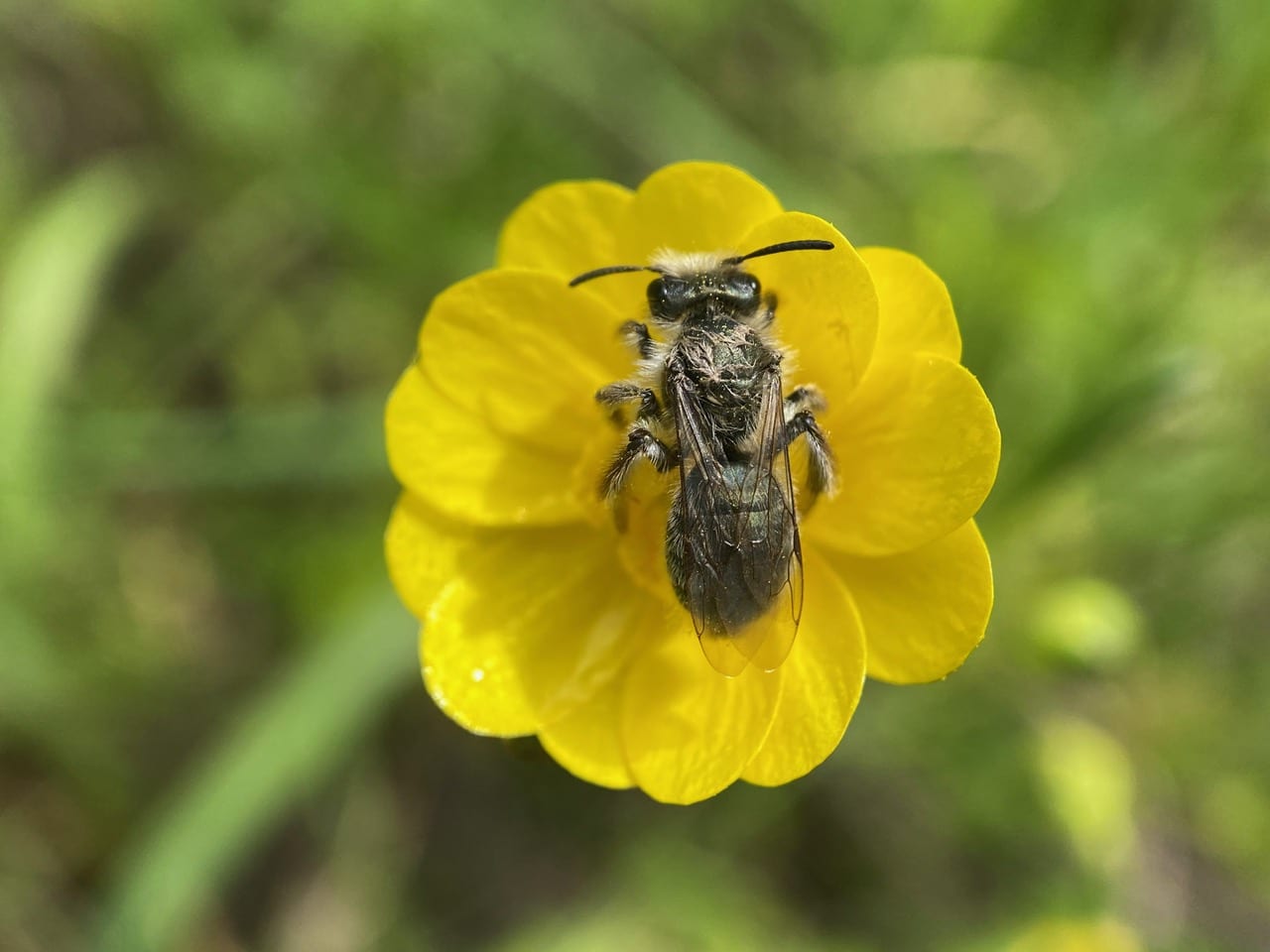
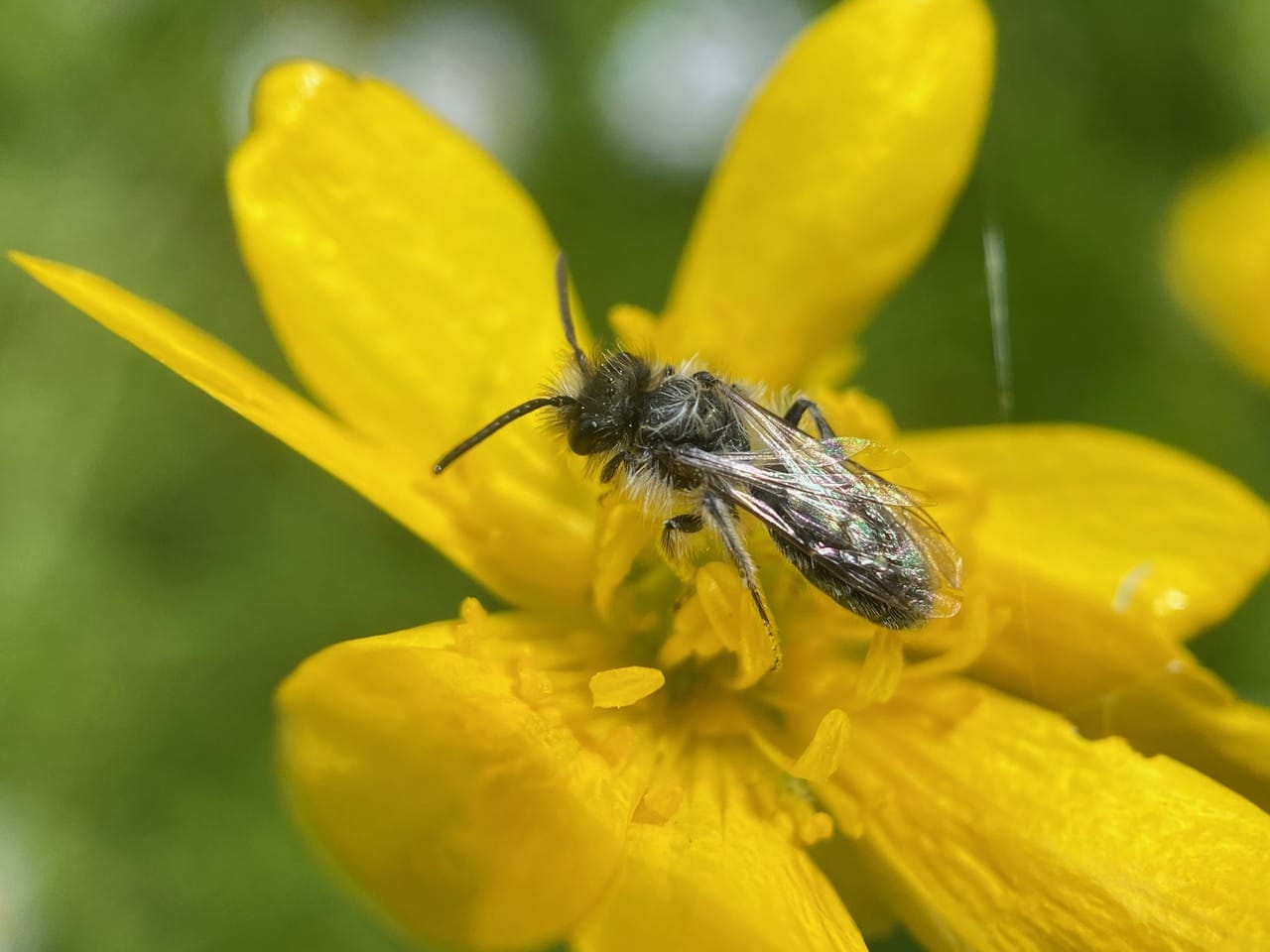 Here’s a male Mining Bee, Andrena sp. (family Andrenidae), with long antennae, slim build, and no scopa on his hindlegs. While the light is not optimal for photography, this cold and cloudy afternoon turns out to be perfect for photographing the Mining Bees on the buttercups. The bees are all posing motionless on the flowers as if in suspended animation. I can wave my hand over them, and they don’t budge. As insects do not have eyelids, it is hard to tell if they are asleep. Or are they simply immobilized by the cold?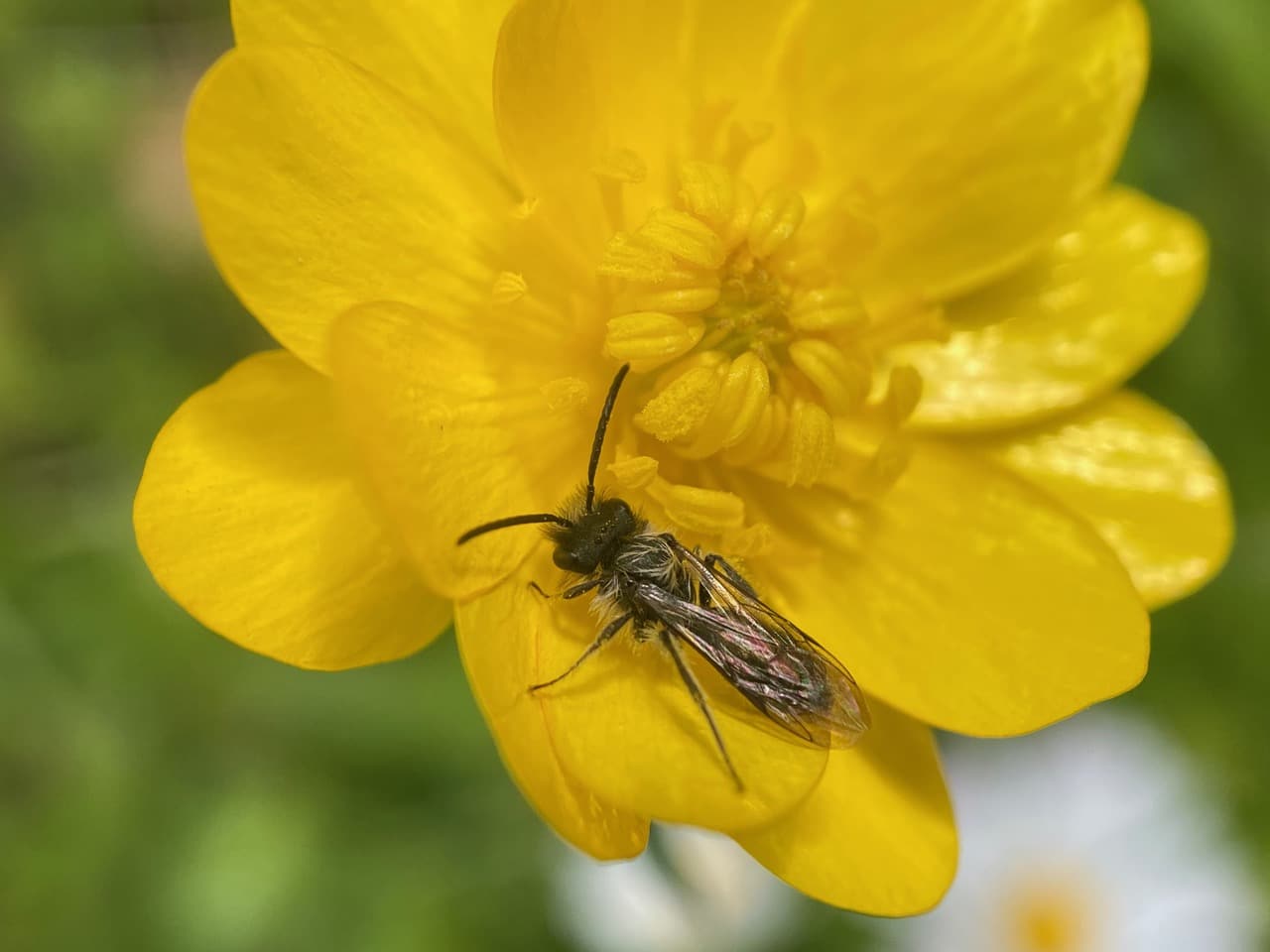
Another male.
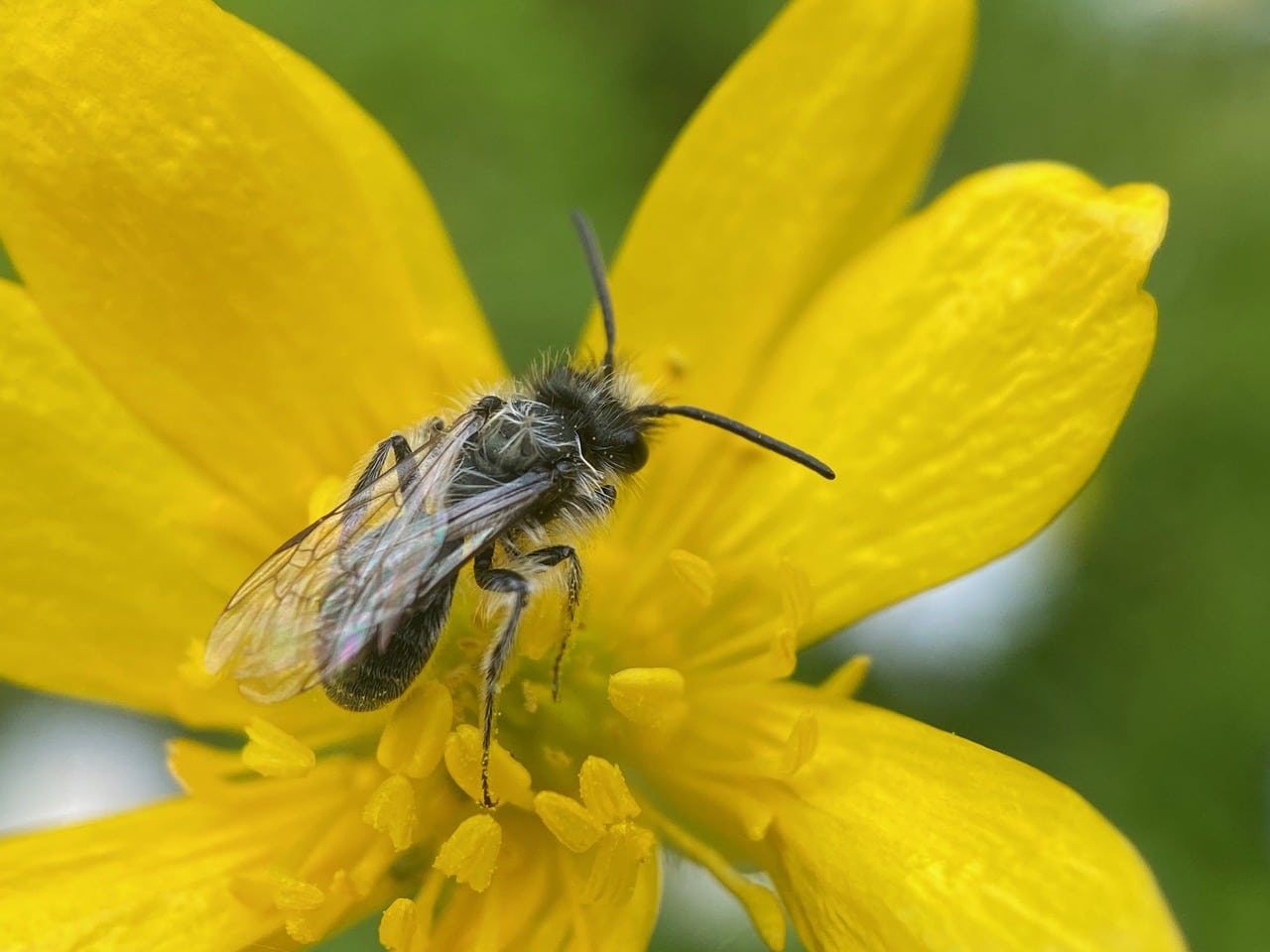
The bees look a little disheveled, probably from the rain we had yesterday.

Male.
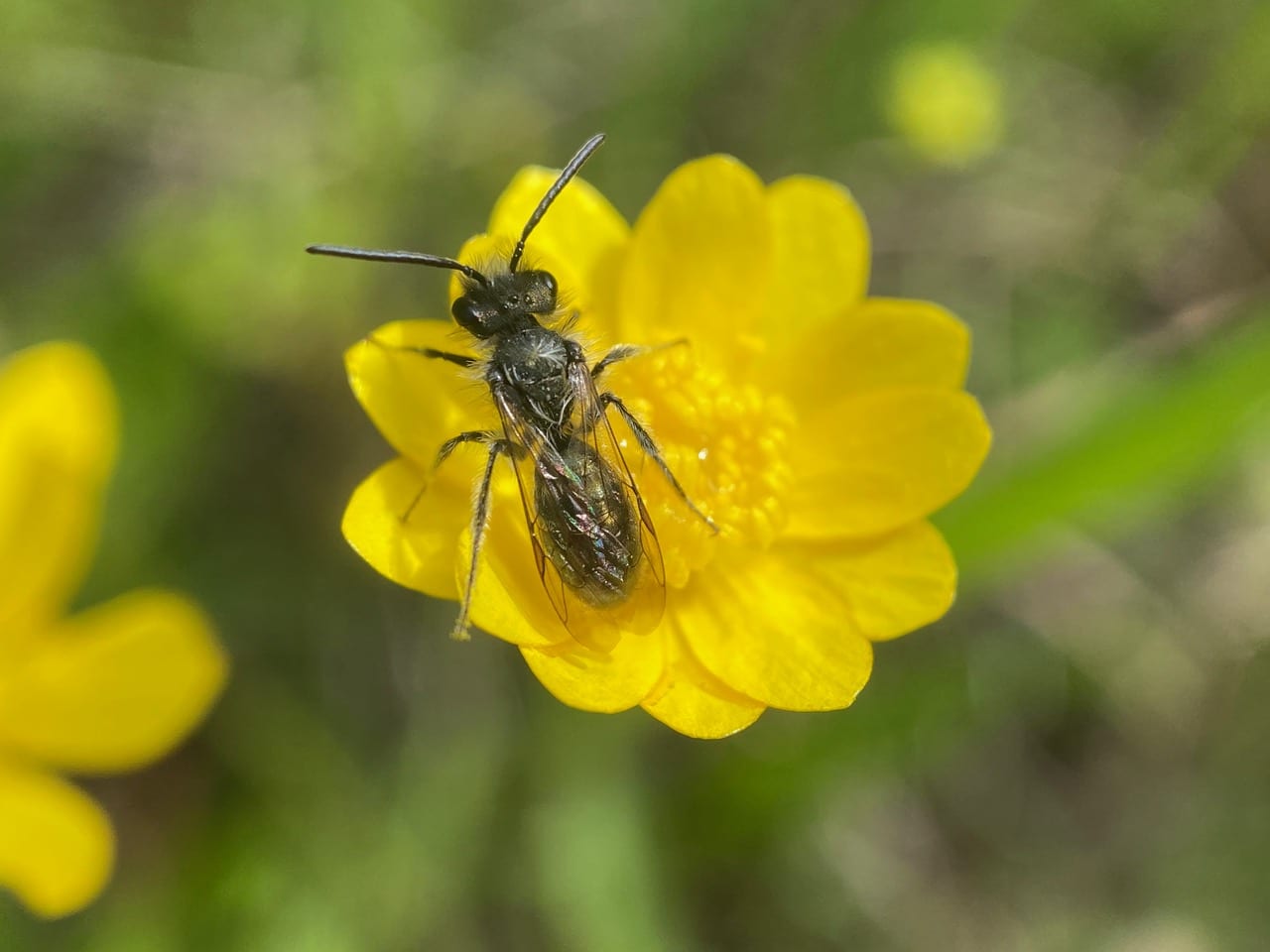
The antennae of male bees are often much longer than their female counterparts. Male antennae have an extra segment and the segments themselves are longer. This is because male antennae are specialized to pick up the subtle scent of female pheromones.
Male bees do not collect pollen to provision the nest, neither do they have the equipment for the job. They do, however visit flowers for nectar, and can be good pollinators in transferring pollen between flowers.
 There are almost as many female Mining Bees on the buttercup flowers today as the males. I am happy for the opportunity to take pictures of them while they remain stock-still. On sunnier days, they have been difficult to photograph as their bodies are in constant motion while they forage.
The females are quite a bit larger and more robust in build. They have shorter antennae, and pollen-collecting scopae on their hindlegs.

Female Andrena.
Bees in the family Andrenidae, commonly called miner bees or mining bees, are solitary ground-nesters. Andrenids are fairly small bees, usually dark-colored, and often banded. They are identified by the dense bristles (scopae) at the bases of the legs and the shin-like sections (tibias) of the legs, as well as by certain creases and grooves on the face and head and by unique wing venation. Many Andrenids resemble wasps – slender with long abdomen.
Most andrenids are specialist pollinators whose life cycle is timed to correspond precisely to the blooming of specific flowers. Because of this, andrenids are some of the first bees to emerge in spring, and many are active in March and April, as they visit early spring wildflowers.
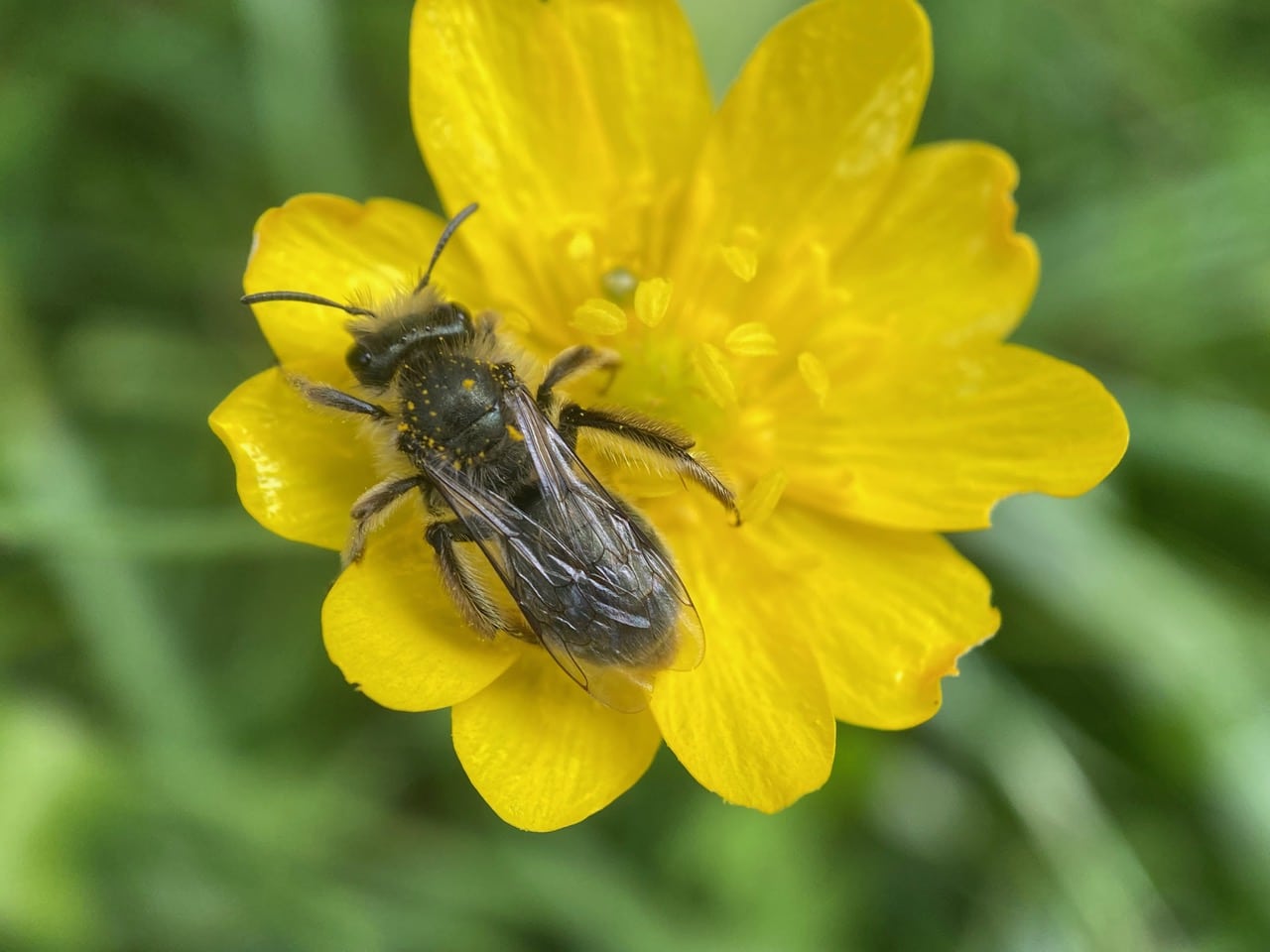
Female.
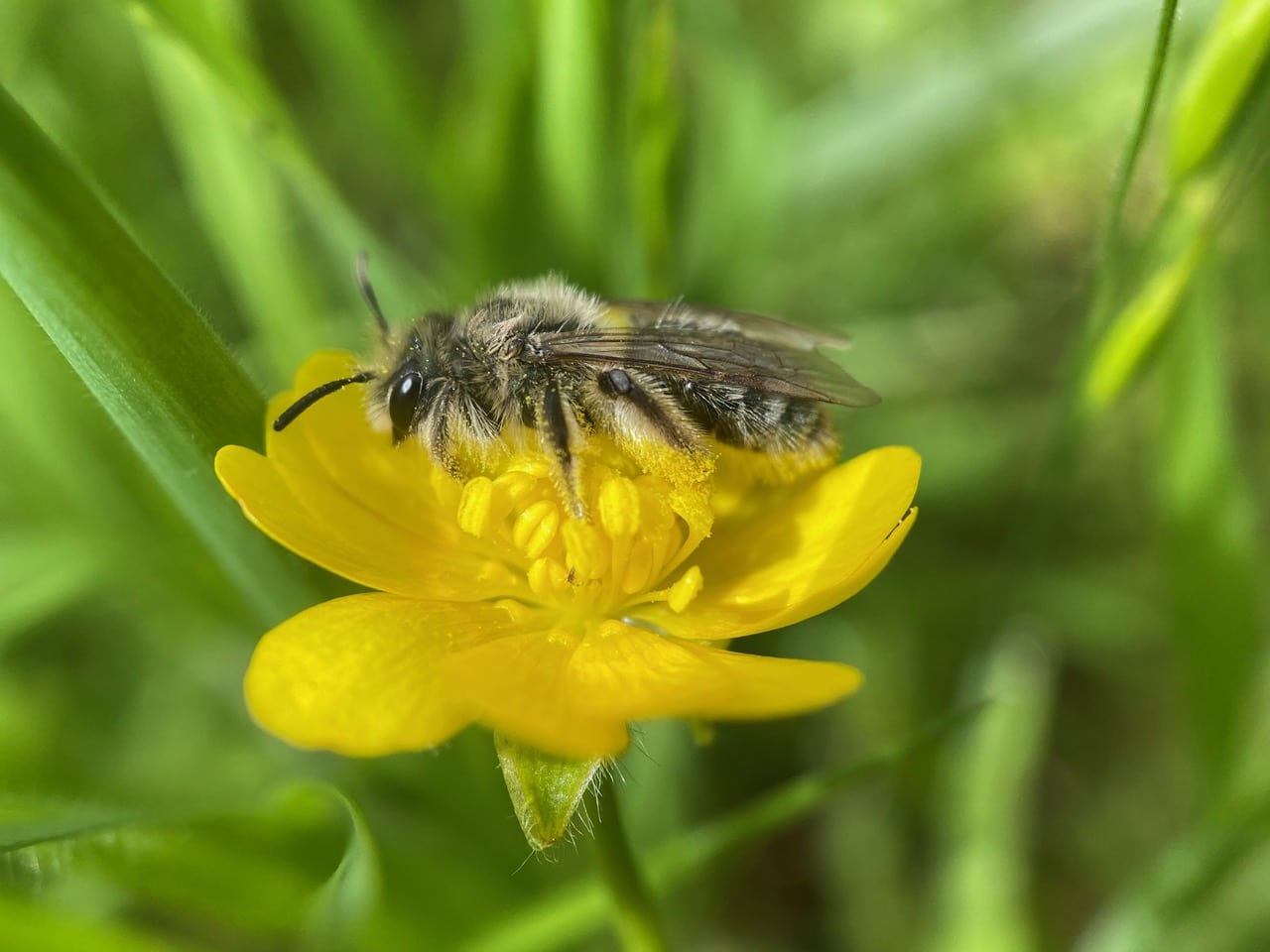
Female.
In many solitary bees, males tend to emerge from their nests before the females. The female is able to determine the sex of her offspring while she’s laying her eggs. The fertilized eggs will develop into females, while those not fertilized with sperm will develop into males. This system of sex determination is termed haplo-diploidy. Female bees tend to lay female eggs first, in the back of the nest, while the male eggs are deposited in the cells closer to the entrance of the nest. The males, usually smaller, develop faster and emerge before the females, conveniently freeing the path for their sisters.
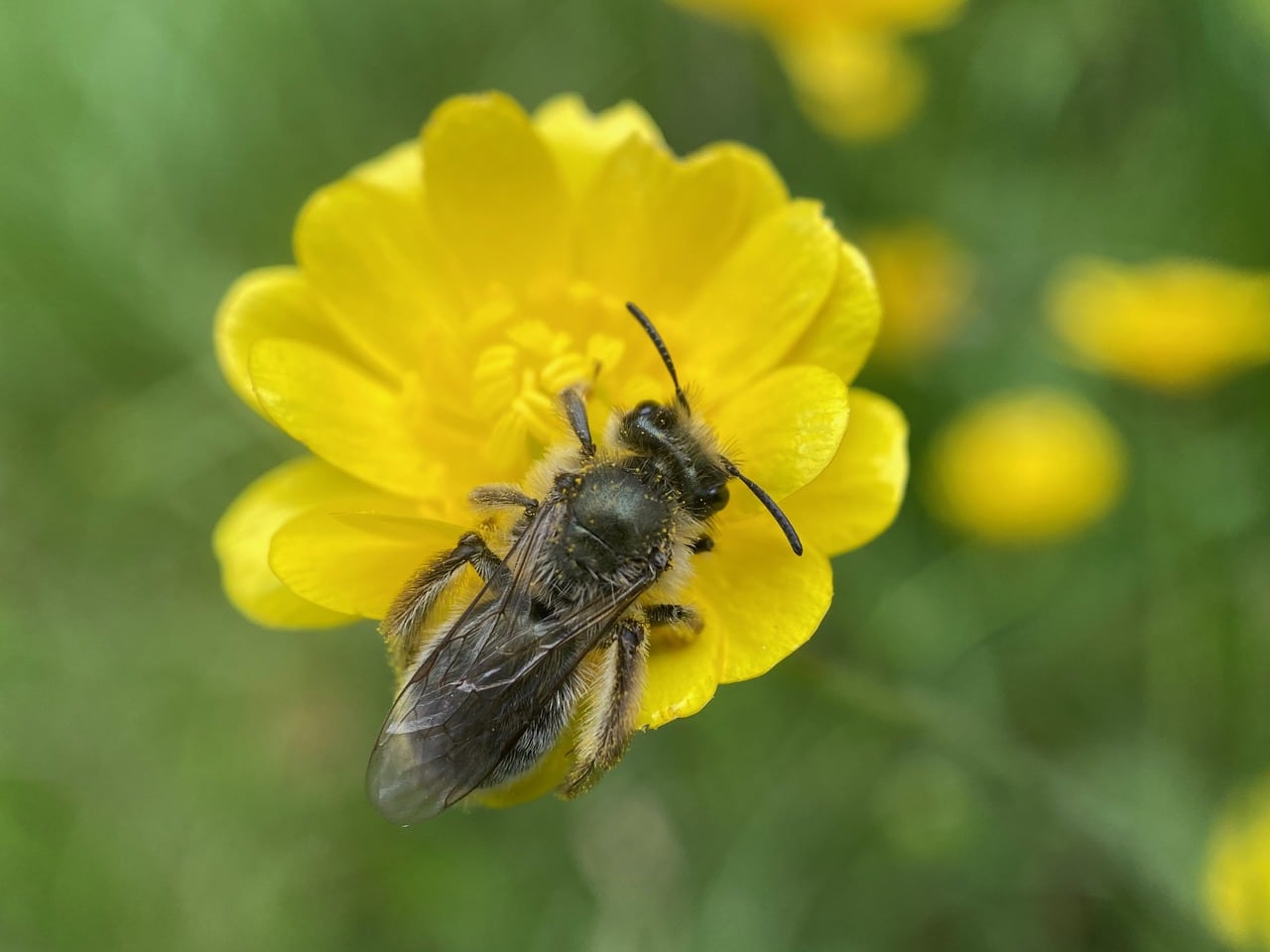
Female.
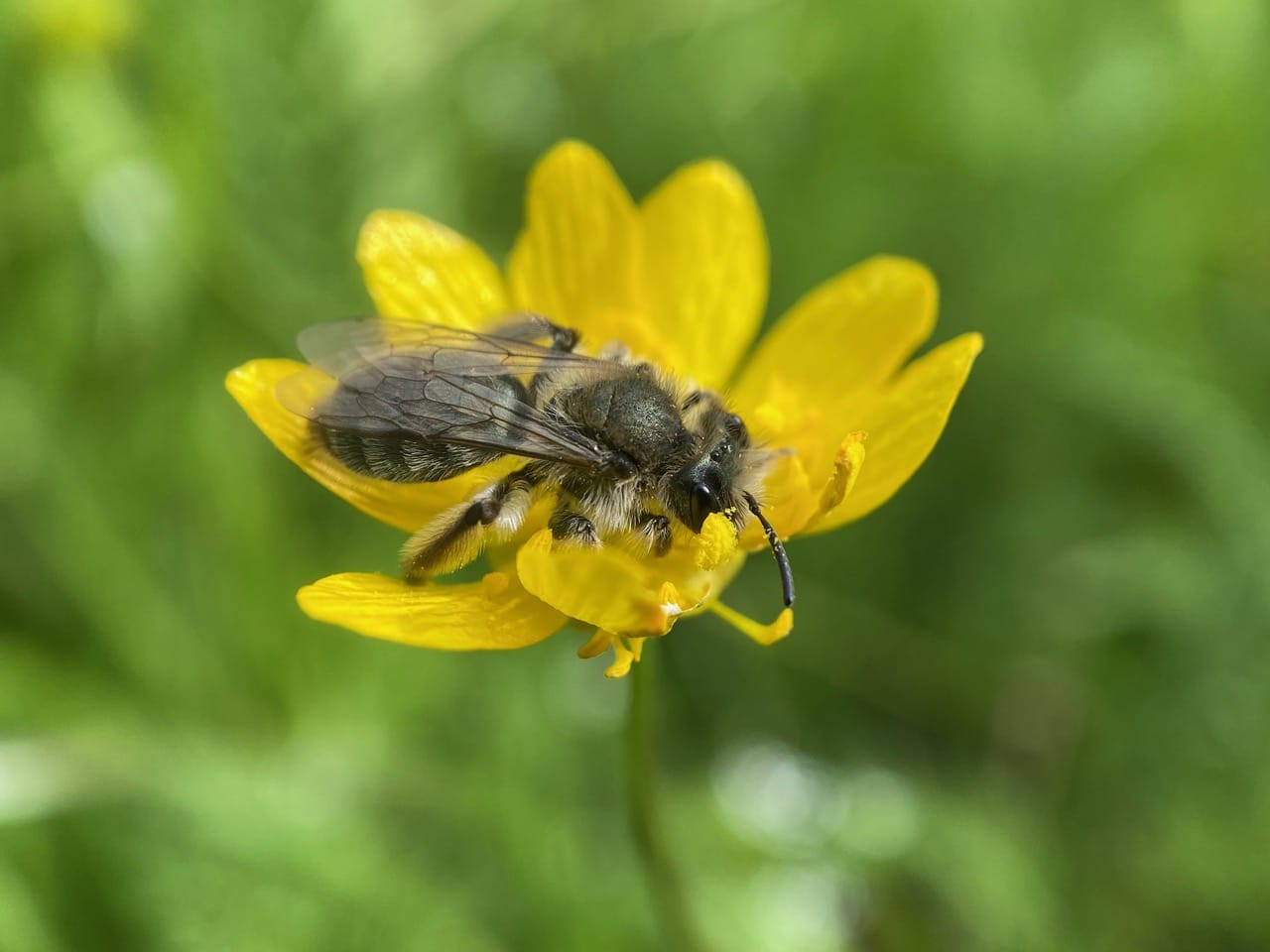
Female. Most of these females don’t have pollen in their scopae. Probably too cold to do any foraging?

Female.
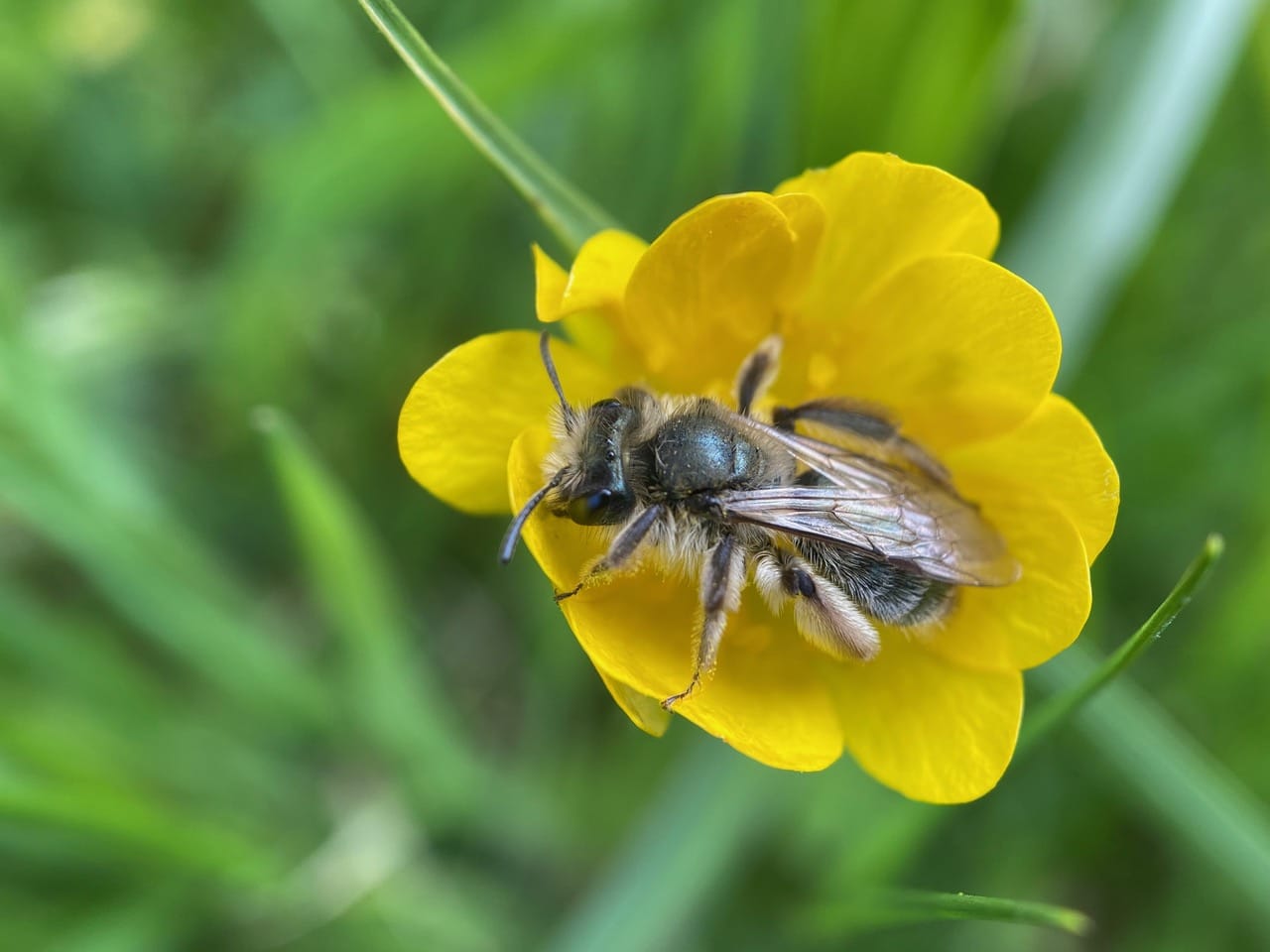
Note the luxuriant hairs on this female’s scopa. She must be quite freshly emerged from her natal nest, not having suffered the wear and tear of foraging, or nest excavation.

Hey, I think that is a different Mining Bee. It is smaller, darker with a bluish sheen, and its scopal hairs have a brownish tinge.
An expert on iNaturalist has identified it as a Cherry Plum Mining Bee, Andrena cerasifolii (family Andrenidae). The species is found in Central and North America, active early to late spring. It is larger than most other Andrena in the western North America with a metallic blue integument. The bees are generalist foragers, visiting flowers from several plant families.
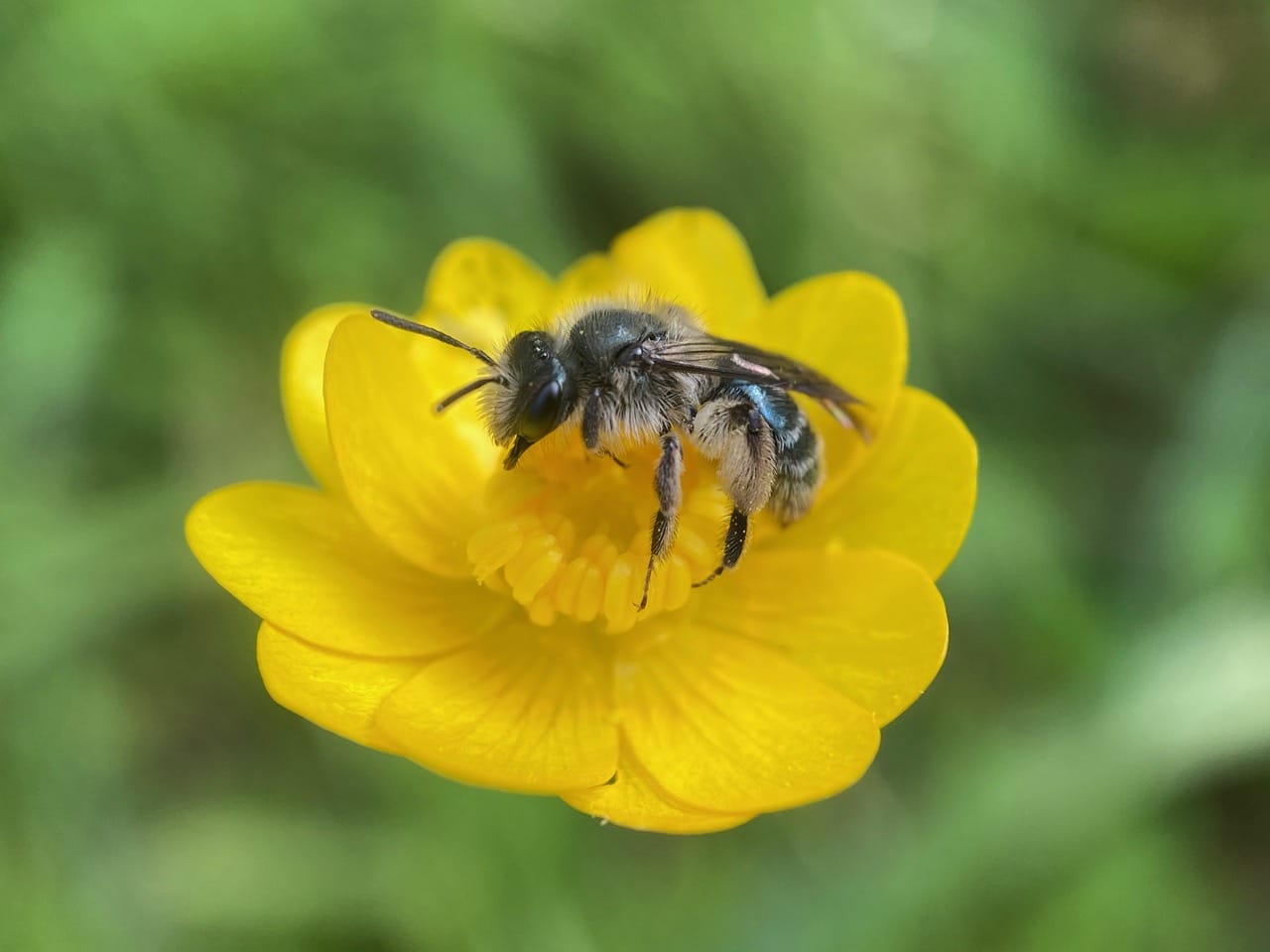
Another Cherry Plum Mining Bee?
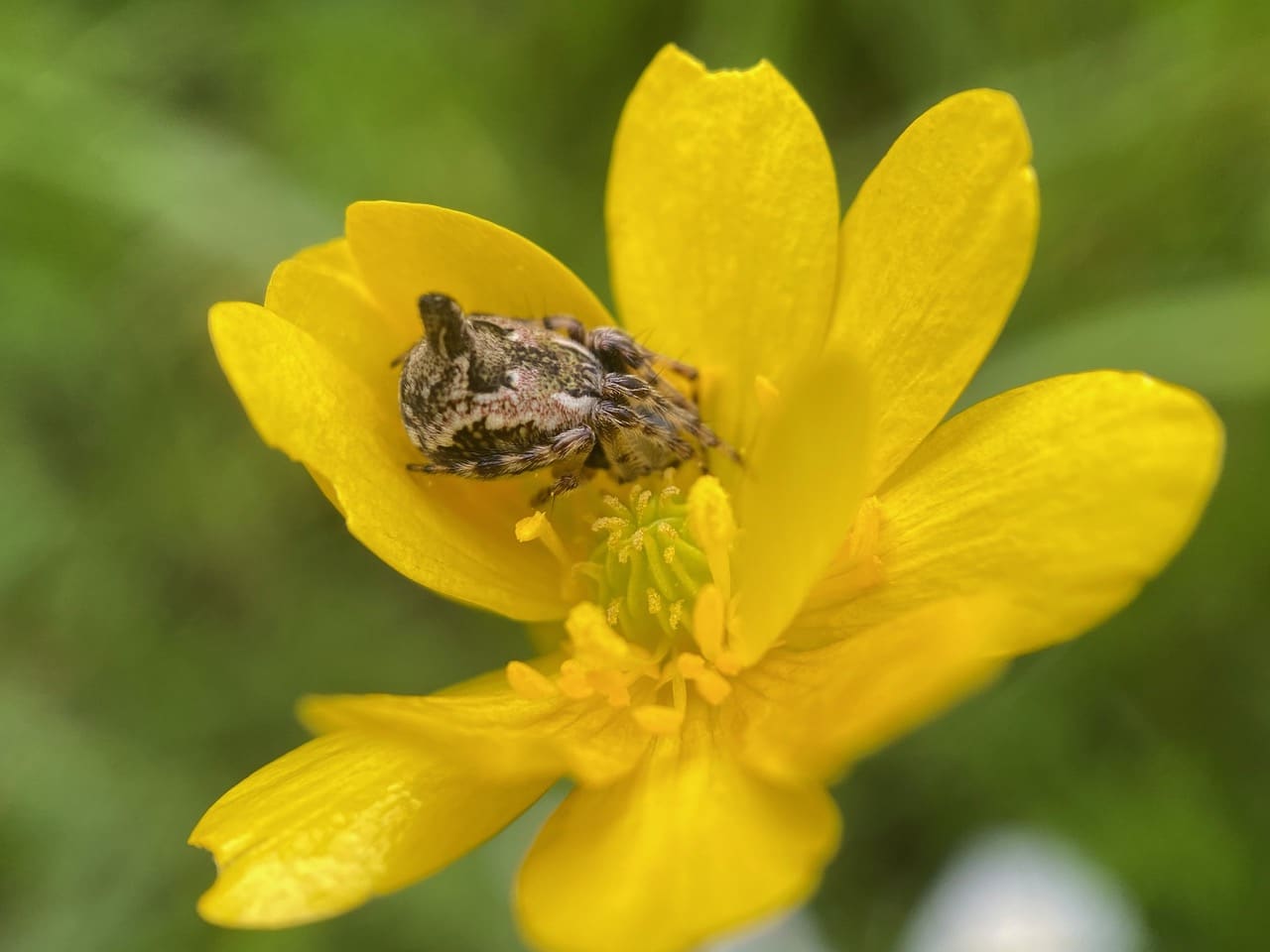 What is that strange brown thing in the buttercup flower? I put on the macro lens for a better look, and discover to my surprise that it is a female Conical Trashline Orbweaver. She is in her usual resting position, with front legs folded around her cephalothorax, hiding her face. I have never before seen the females of this species out of their web. Maybe this is what they do on rainy days when web-trapping insects is not feasible?
 Trashline spiders are so-called for their web decoration. Cyclosa create orb-shaped webs using both the sticky and non-sticky threads, mostly during times of complete darkness. Across its spiral wheel-shaped web, Cyclosa fashions a vertical “trashline” made of various components such as prey’s carcasses, detritus, and at times, egg cases. The trashline helps the spider to camouflage exceptionally well from predators. The spider sits in the web hub to conduct its sit-and-wait hunting, ensnaring prey at nearly any time of day; it only leaves its spot to replace the web prior to sunrise.

Cold weather not withstanding, the Hybotid Dance Flies, Anthalia sp. (family Hybotidae) are enjoying a pollen party on a buttercup flower.
These flies belong to the superfamily Empidoidea and were formerly included in the Empididae as a subfamily. Empididae generally have a thick beak pointing down, while Hybotidae have a thinner beak, or a thick beak pointing forwards or diagonally. Some crucial wing venation further distinguishes the two families. Precious little is known about the life cycle and biology of Hybotids because they are not considered of economic consequence. Almost all of the 11 species of Anthalia are restricted to North America. These small flies, 1-3 mm, are often found on small flowers. Adults feed on pollen.
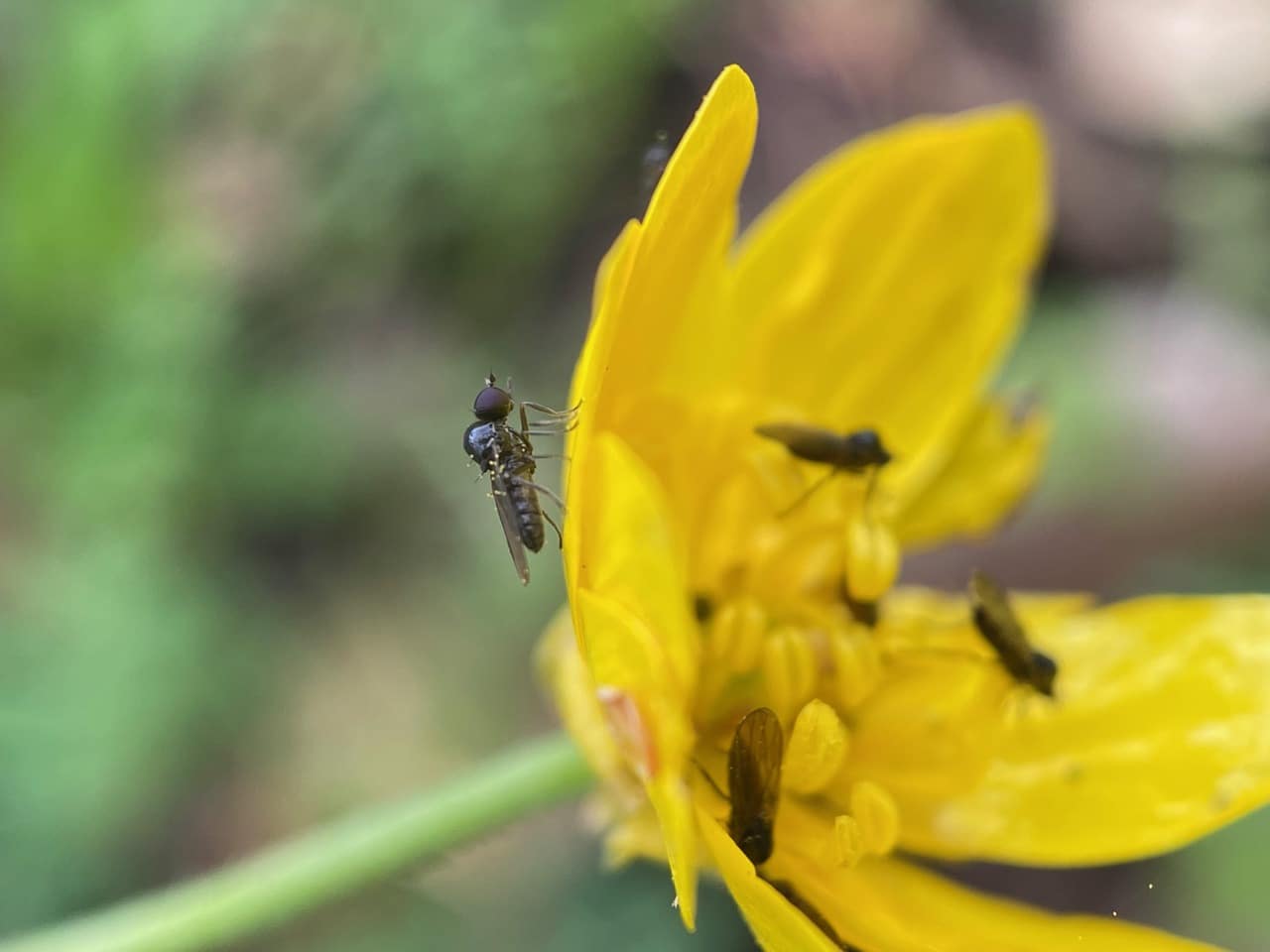
The Hybotid Dance Flies are often seen with pollen on their bodies. They are probably responsible for the pollination of many of our small native wildflowers such as Miner’s Lettuce, California Saxifrage, wild Geranium, and Soap Plant.
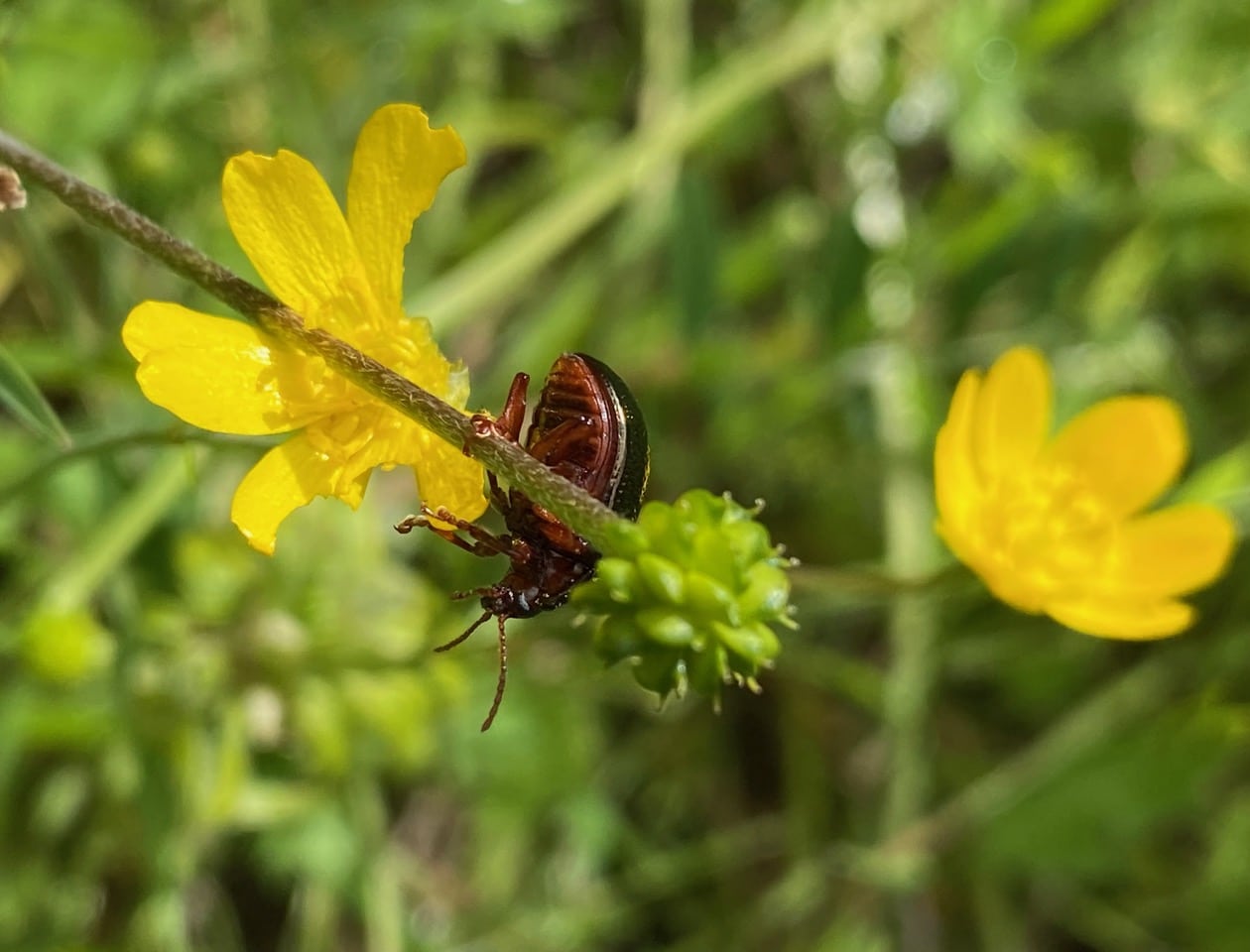
A large insect about the size of my thumbnail is flashing bronze in the occasional sunlight. As I approach, the insect drops from its perch, a common defensive strategy of beetles. It is a Leaf Beetle in the genus Chrysolina (family Chrysomelidae).
Leaf Beetles in the family Chrysomelidae make up one of the largest and most commonly encountered beetles. They are all phytophagous – both adults and larvae feed on all sorts of plant tissues. All species of Chrysolina are phytophagous, feeding on specific food plants, and some of them have been used for biological control of weeds.
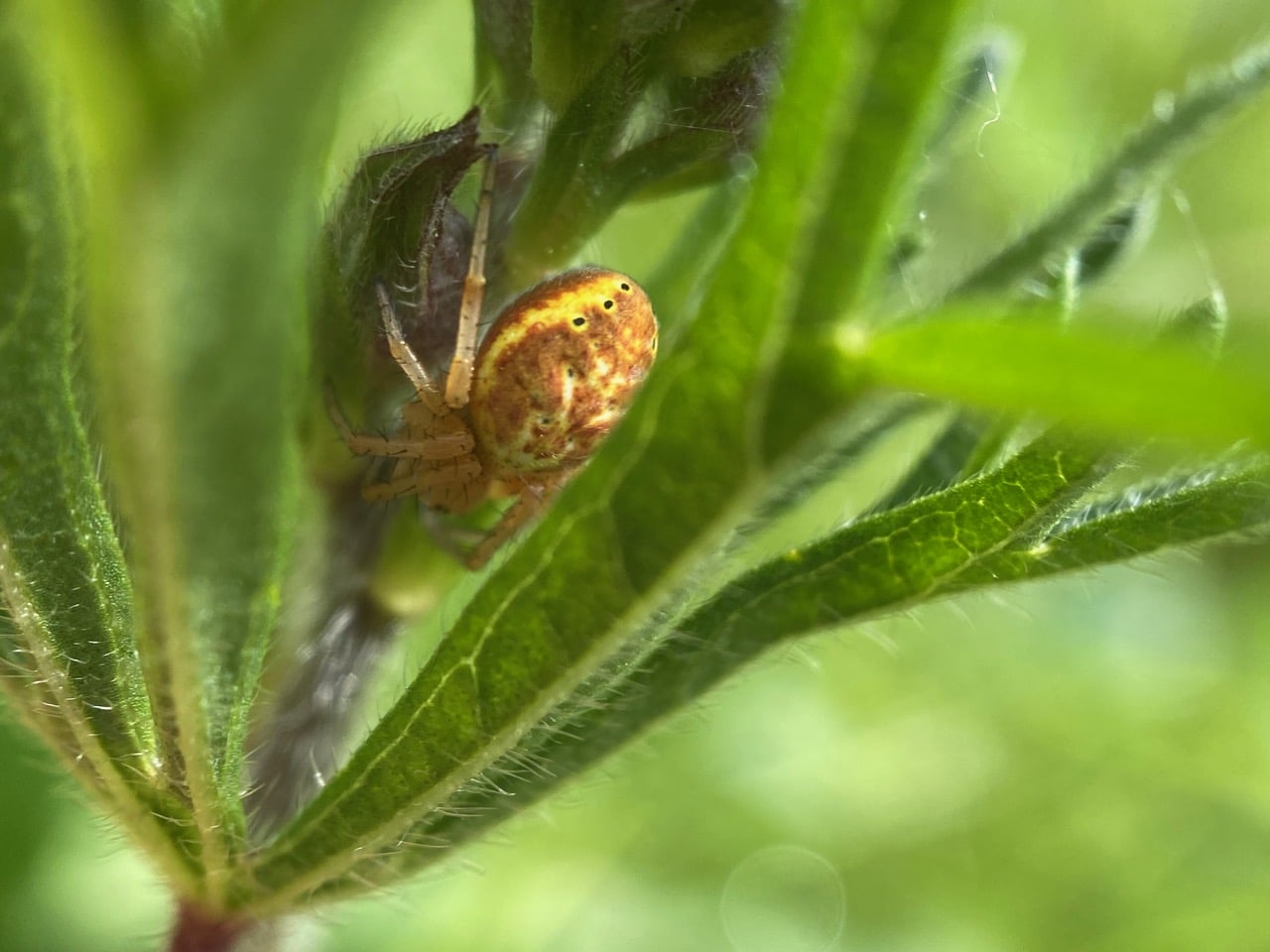
I gently part the terminal leaves of a Checkerbloom to get a better look at a spider. It is a Six-spotted Orbweaver, Araniella displicata (family Araneidae).
The Six-spotted Orbweaver is a small cucumber spider. It occurs throughout Europe and North America and in parts of Asia. It is found on trees and shrubs in woodland habitats. It is one of the most widely distributed arachnids in North America, but often overlooked due to its small size. Adult females measure only 4-8 mm in length, males 4-6 mm. The species is distinguished by three (sometimes four) pairs of black spots along the edges of the rear half of the abdomen. There’s quite a bit of color variation within the species.
Most orb weavers spin fairly large webs in proportion to their own body size, but not so with Araniella displicata. The web of an adult spider may be only three or four inches in diameter. The spiral snare is usually built well off the ground, and often oriented in the horizontal plane, frequently spanning the edges of a single large leaf. The spider sits in the center, hanging beneath a horizontal web. Adult Araniella displicata are often mistaken for “baby” orb weavers. In late May or early June mating takes place, and females produce egg sacs that contain 80 eggs and are covered in loose, fluffy, yellowish silk. The package may be deposited in a curled leaf that also serves as the mother’s retreat on the perimeter of the web.
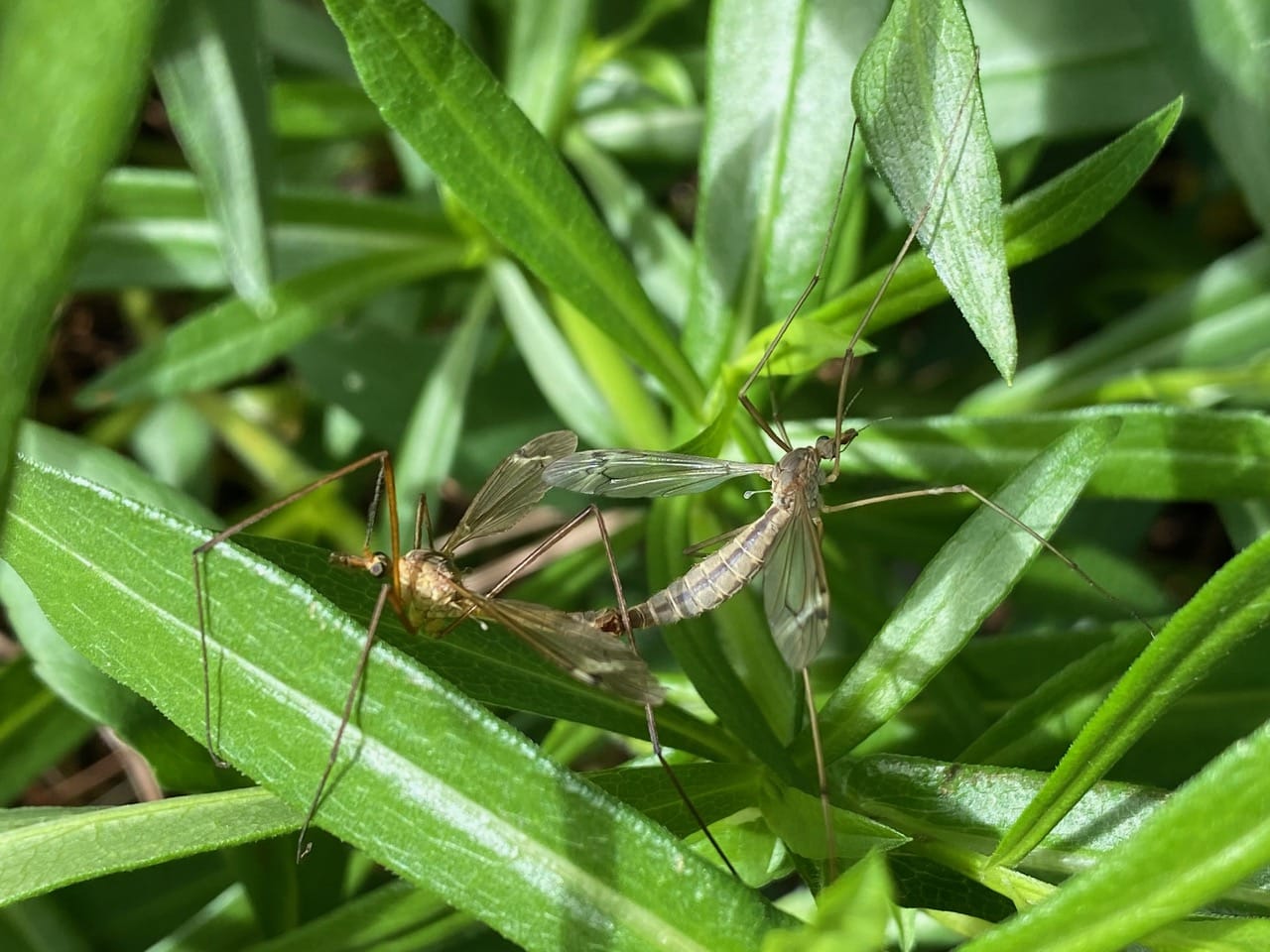 On my way home at about 4:30 pm, I make a quick stop at the Oakland residential garden to check for sleeping Cuckoo Bees. Unfortunately, no sleeping bees today either. But there’s an abundance of Crane Flies! This pair is mating on a Pacific Aster.
Large Crane flies (family Tipulidae) resemble oversized mosquitos. They typically have a slender body and long, stilt-like legs that are deciduous, easily coming off the body. They occur in moist, temperate environments such as vegetation near lakes and streams. Adults generally do not feed, but some species consume nectar and pollen. Larval habitats include all kinds of freshwater, semiaquatic environments. They generally feed on decaying plant matter and microbes associated with decomposition. Their activity is important in the soil ecosystem, as they process organic material and increase microbial activity. Larvae and adult crane flies are also valuable prey items for many animals, such as insects, spiders, fish, amphibians, birds, and mammals.
See the lollipop-like structures at the base of the flies’ wings? These are halteres, the modified hind wings in Diptera (flies). They are shaped like ‘drum sticks’ or ‘lollipops’ with a slender shaft connected to the thorax. Halteres are highly sophisticated balance organs and they oscillate during flight.
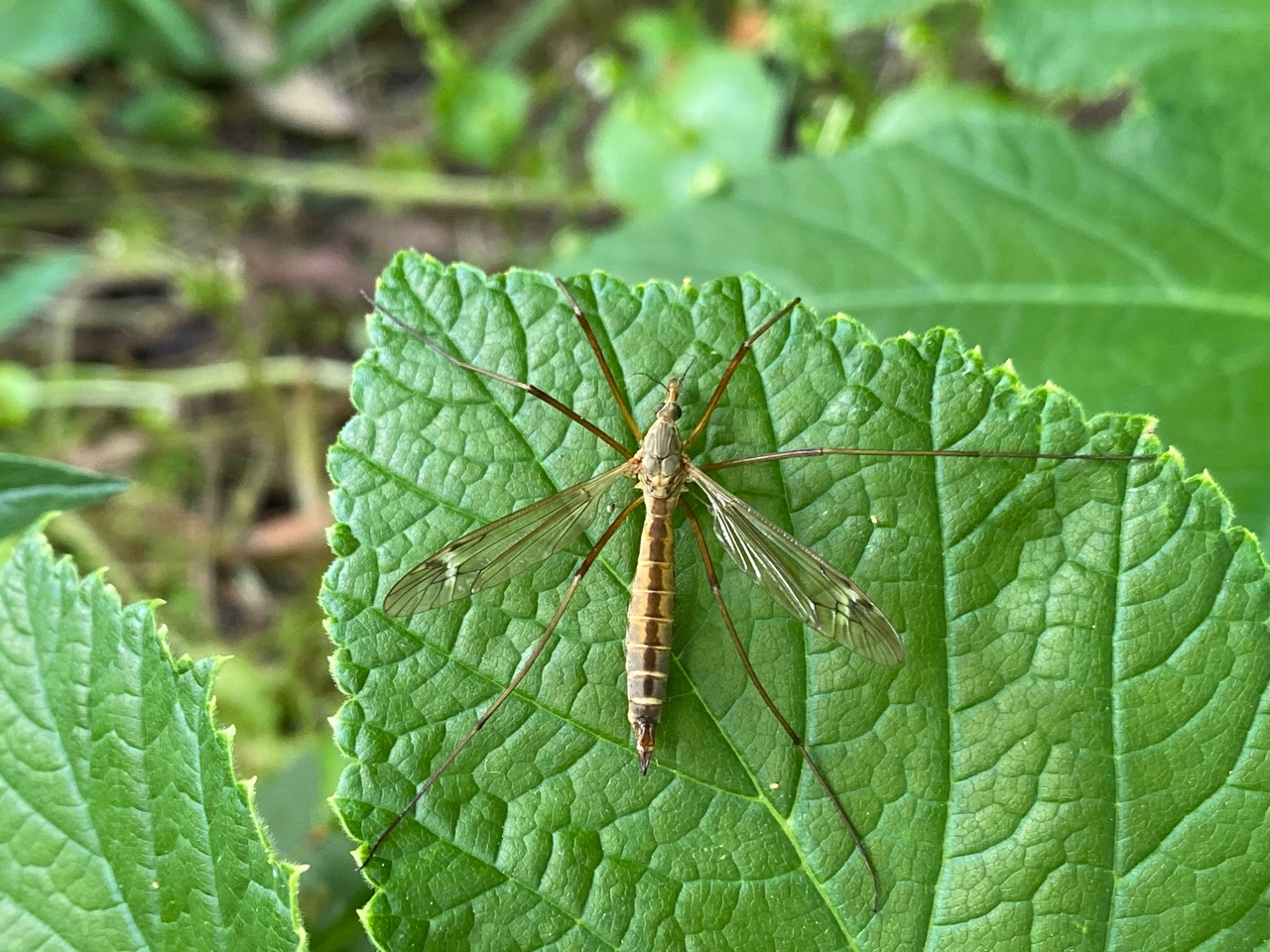
A female Large Crane Fly (family Tipulidae) lands spread eagle on the edge of a Cow Parsnip leaf.
Females have thicker abdomens, which end in a pointed tip used in egg-deposition. Males have pincerlike claspers at the tip of the abdomen.
This time of year, you may come across females laying their eggs in damp soil. Walking and balancing unsteadily on their long legs, they repeatedly stab the tip of their abdomen into the substrate.