

Pollinator Post 4/14/23 (3)

It is past noon by the time I return to the Steam Train entrance. Temperatures have risen significantly, and there’s more insect activity around the patch of California Buttercups, Ranunculus californicus.

The sun-tracking flowerheads of California Buttercups, Ranunculus californicus are mostly facing upwards now, telling me it’s around noon time.

The bee on the Buttercup flower seems to have rather long antennae, and no visible signs of a scopa (special pollen collecting hairs) on its hind legs. These are tell-tale signs that we might be looking at a male bee. What’s more, male bees tend to be more slender than the females.
The antennae of male bees are often much longer than their female counterparts. Male antennae have an extra segment and the segments themselves are longer. This is because male antennae are specialized to pick up the subtle scent of female pheromones. Male solitary bees do not collect pollen to provision the nest, but do visit flowers for nectar.
We tend to encounter more male solitary bees in early spring, as they typically emerge earlier than their sisters from their natal nests. Males develop faster, and their mother has laid the male eggs closer to the burrow entrance so that they may easily exit first.
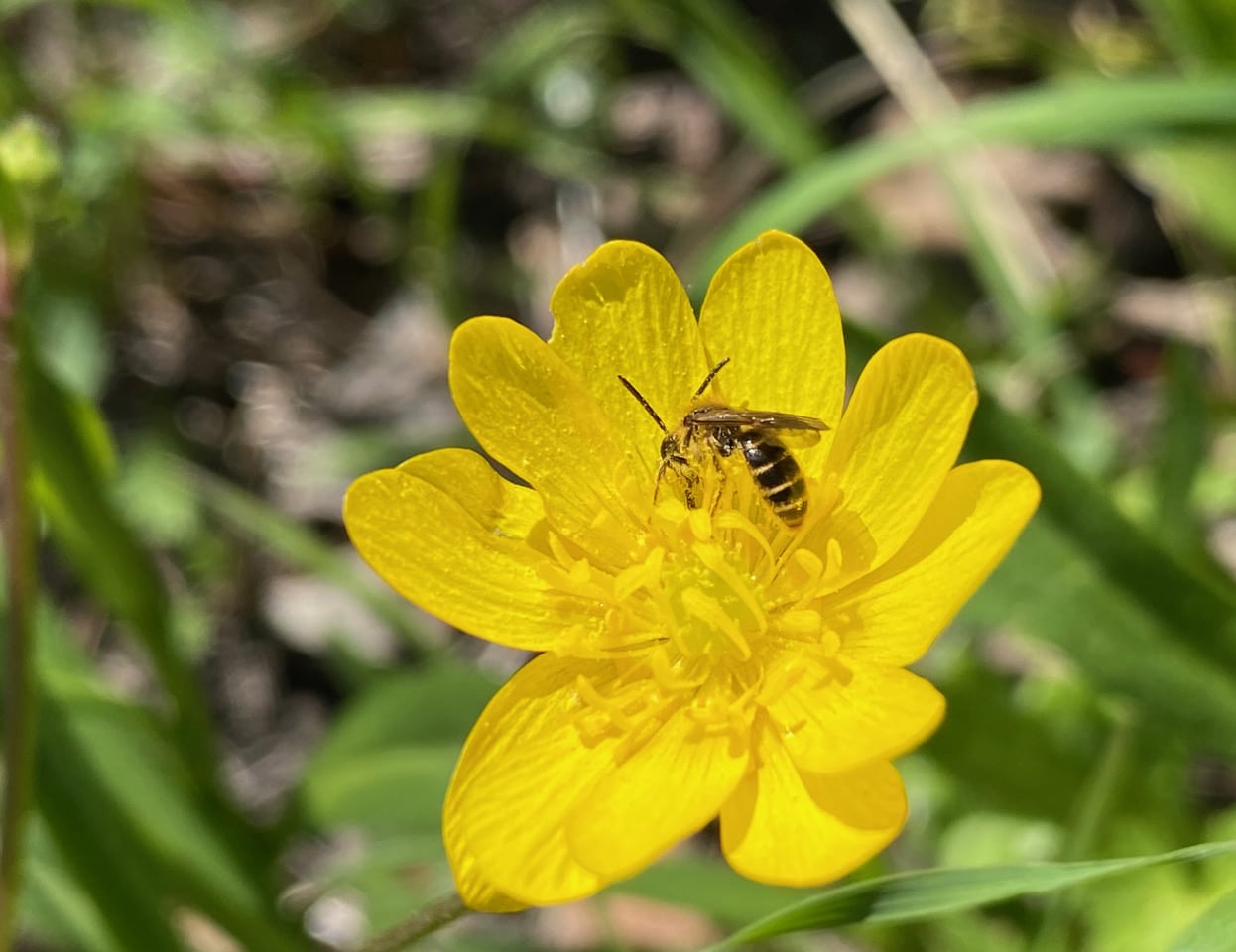
It is hard to tell whether this is a Sweat Bee (family Halictidae) or Miner Bee (family Andrenidae) without a good look at the head. Many Andrenidae resemble wasps – slender with long abdomen.
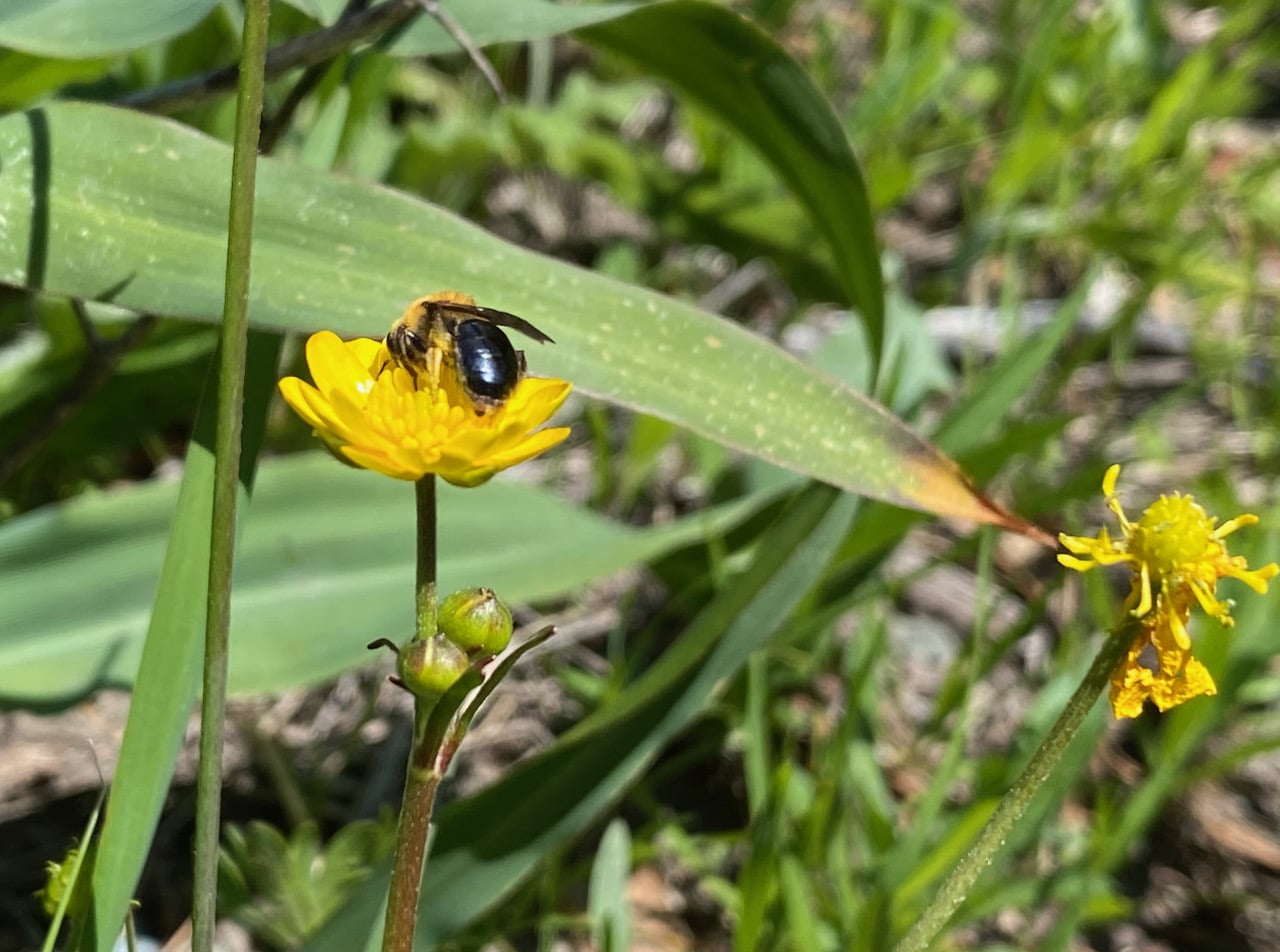
This is a larger species of Miner Bee (family Andrenidae). The female has collected some pollen in the scopae on her hind legs.
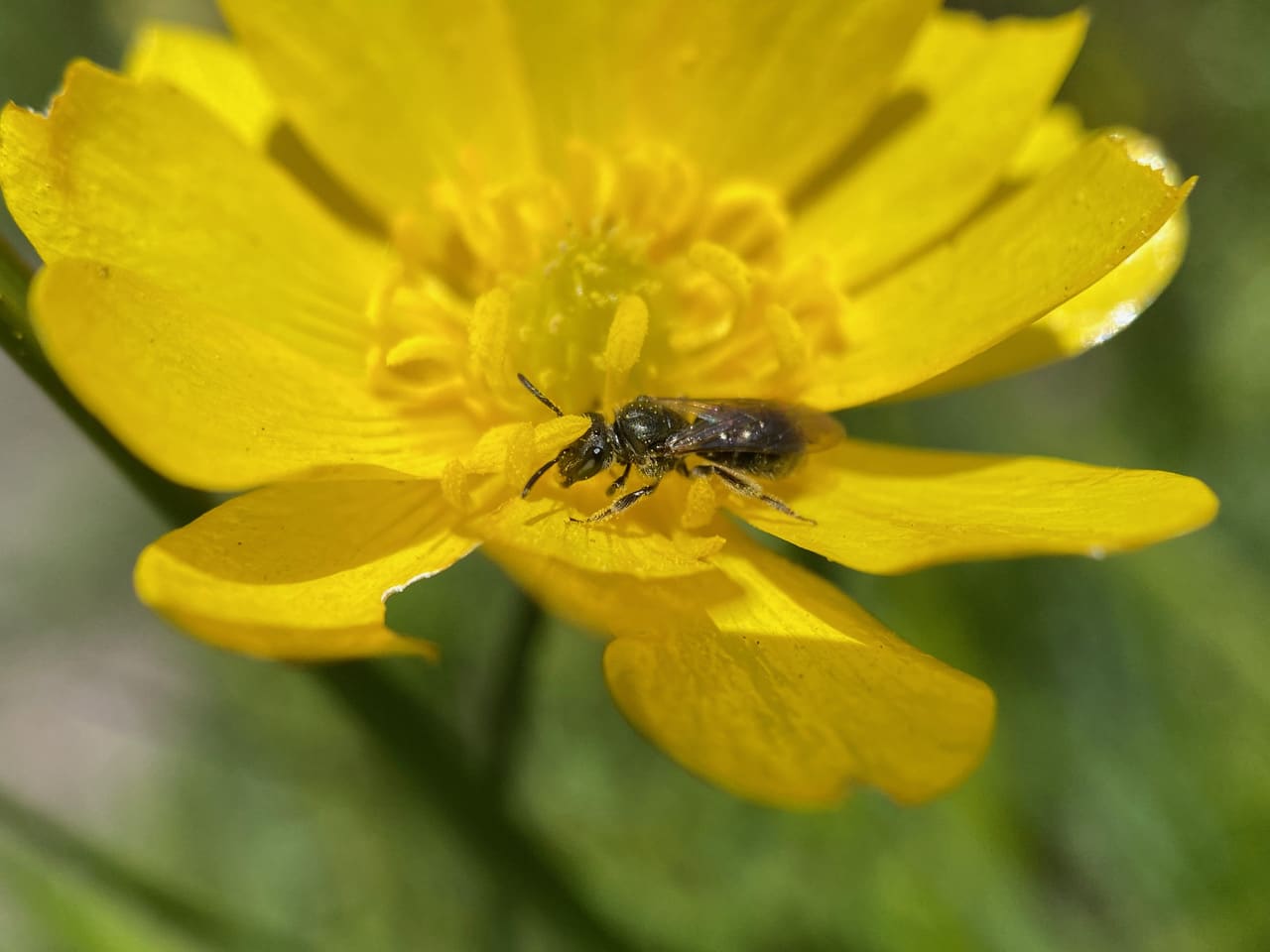
Here’s a tiny Miner Bee in the genus Panurginus. Females of this genus have sparse and short hairs on her hind legs. Panurginus has a flat clypeus (on the face) and a short tongue.
Andrenid bees, commonly called miner bees or mining bees, are solitary ground-nesters. Andrenids are fairly small bees, usually dark-colored, and often banded. They are identified by the dense bristles (scopae) at the bases of the legs and the shin-like sections (tibias) of the legs, as well as by certain creases and grooves on the face and head and by unique wing venation.
Most andrenids are specialist pollinators whose life cycle is timed to correspond precisely to the blooming of specific flowers. Because of this, andrenids are some of the first bees to emerge in spring, and many are active in March and April, as they visit early spring wildflowers.
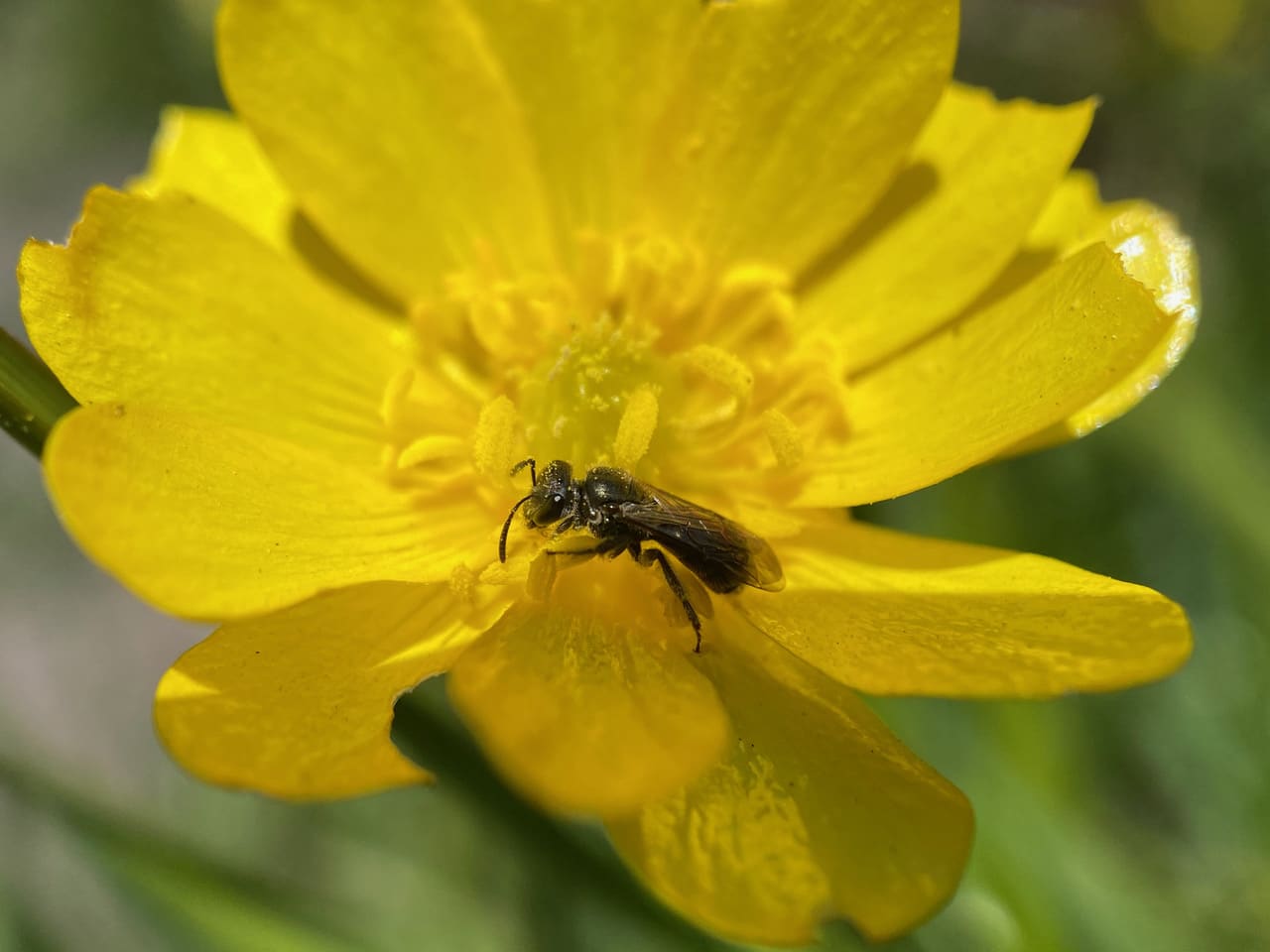
As their common name implies, Miner Bee females dig burrows in the ground. They often nest in aggregations. Each female’s tunnel typically branches, with a brood cell at the end of each branch. Some species apply a secretion to the walls of each cell to waterproof it. The female provisions each brood cell with a ball of pollen and nectar, and she lays a single egg on each pollen ball. Then she seals the cell and work on the next one.
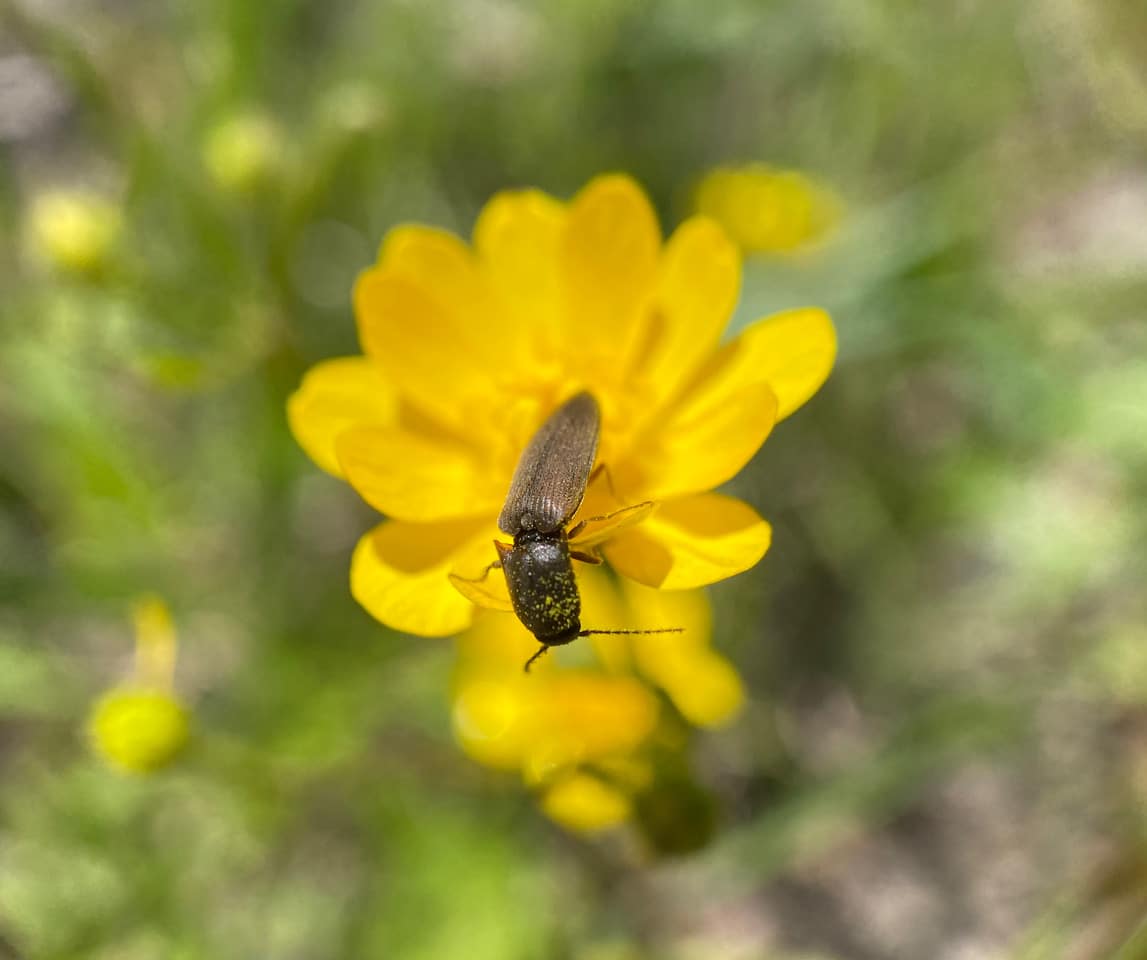
A Click Beetle looks over the buttercup flower before flying off.
Elateridae or Click Beeltes are a cosmopolitan beetle family characterized by the unusual click mechanism they possess. A spine on the prosternum can be snapped into a corresponding notch on the mesosternum, producing a violent “click” that can bounce the beetle into the air. Clicking is mainly used to avoid predation, although it is also useful when the beetle is on its back and needs to right itself. How do click beetles jump? – YouTube
Adult Click Beetles are typically nocturnal and phytophagous (feeding on plants). Their larvae, called wireworms, are usually saprophagous, living on dead organisms, but some species are agricultural pest, and others are active predators of other insect larvae.
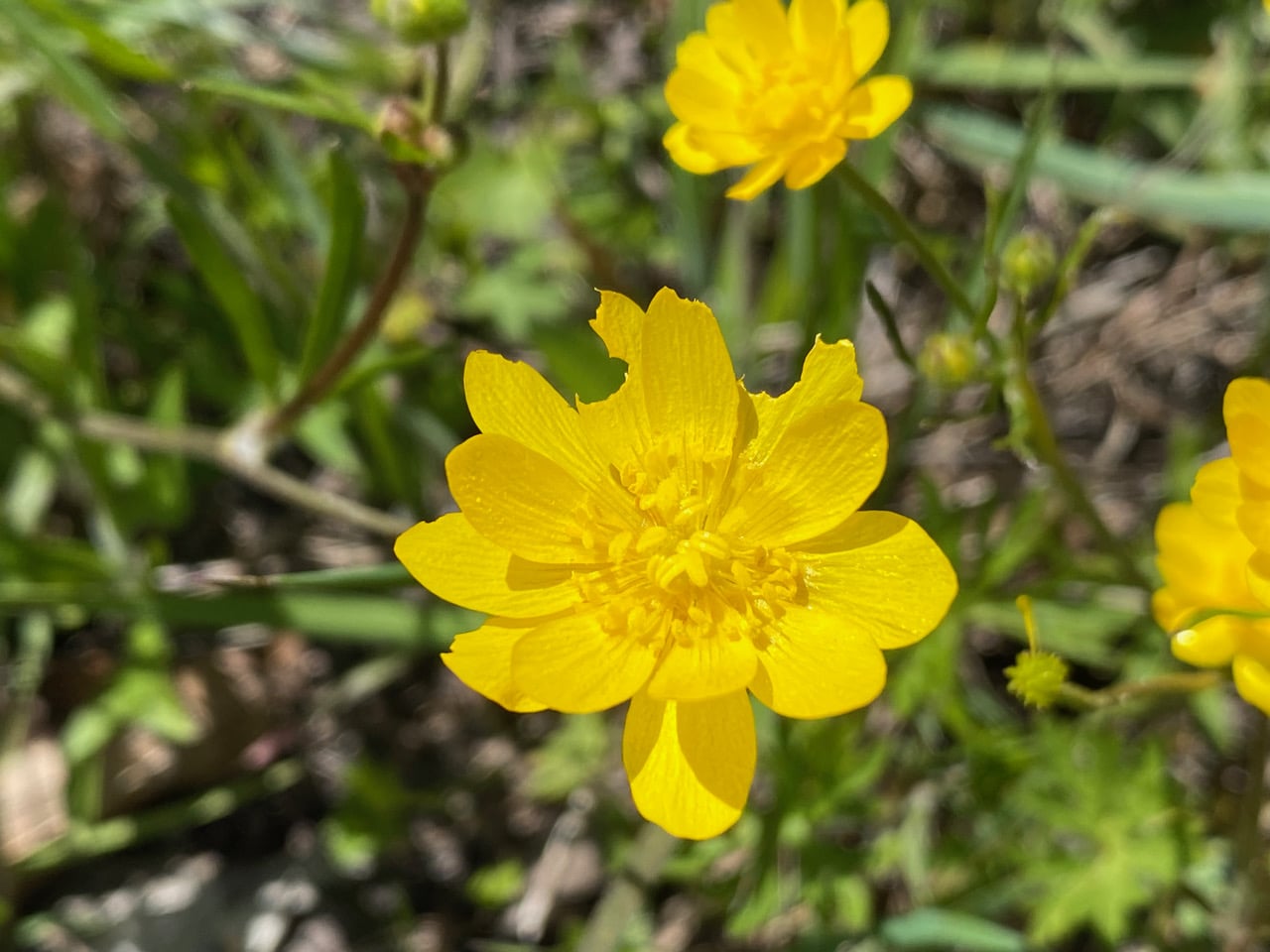
Some insect has been chewing on the petals of this California Buttercup flower. Apparently pollen and nectar are not the only attractions.
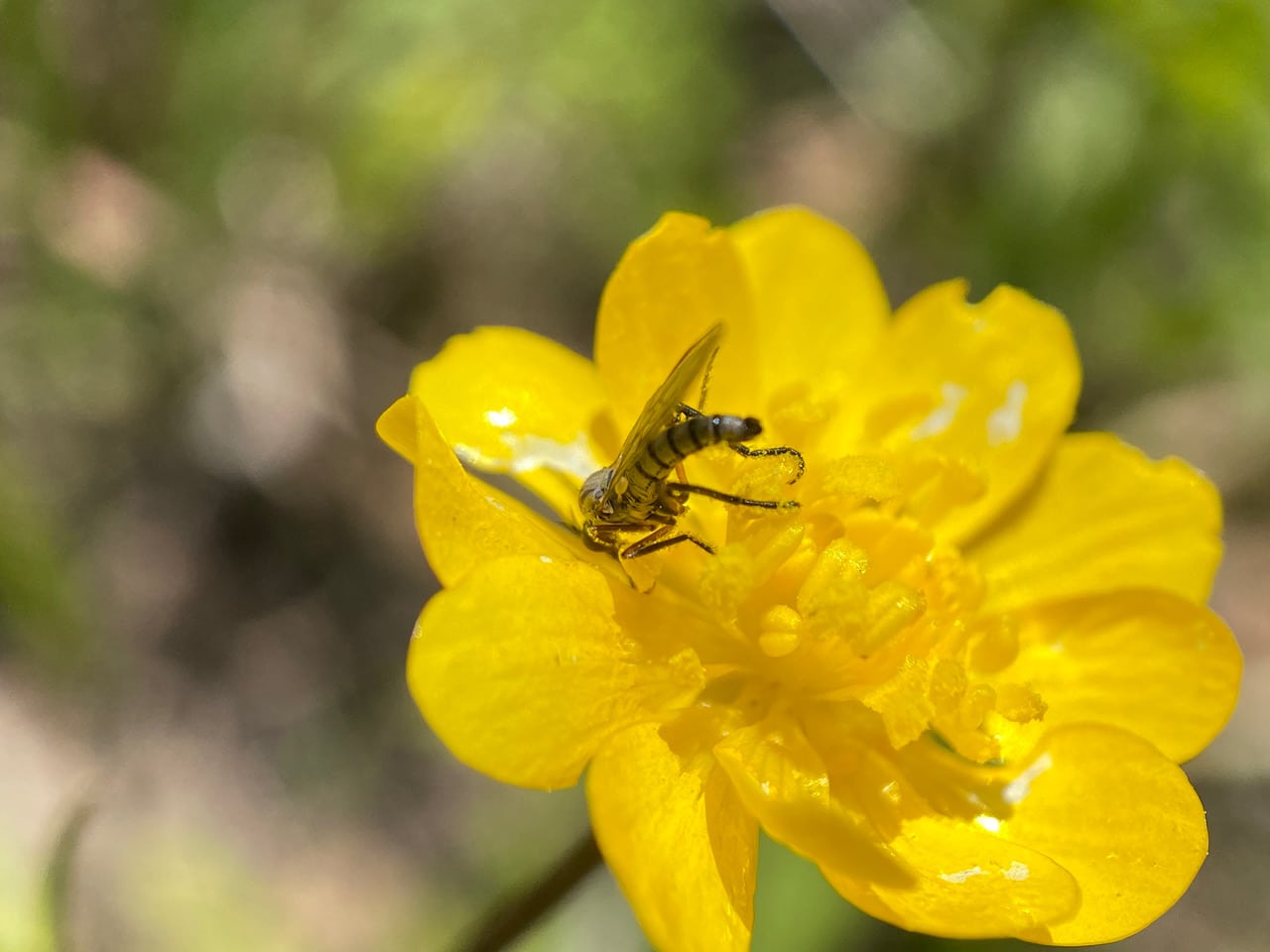
Ooh, here’s a slender long-legged fly probing a California Buttercup flower for nectar.
It might belong to the superfamily Empidoidea that includes Dance Flies and Long-legged Flies. Most of these insects are predatory, often with large compound eyes (sometimes covering almost the entire surface of the head), and tend to be associated with moist, temperate habitats.
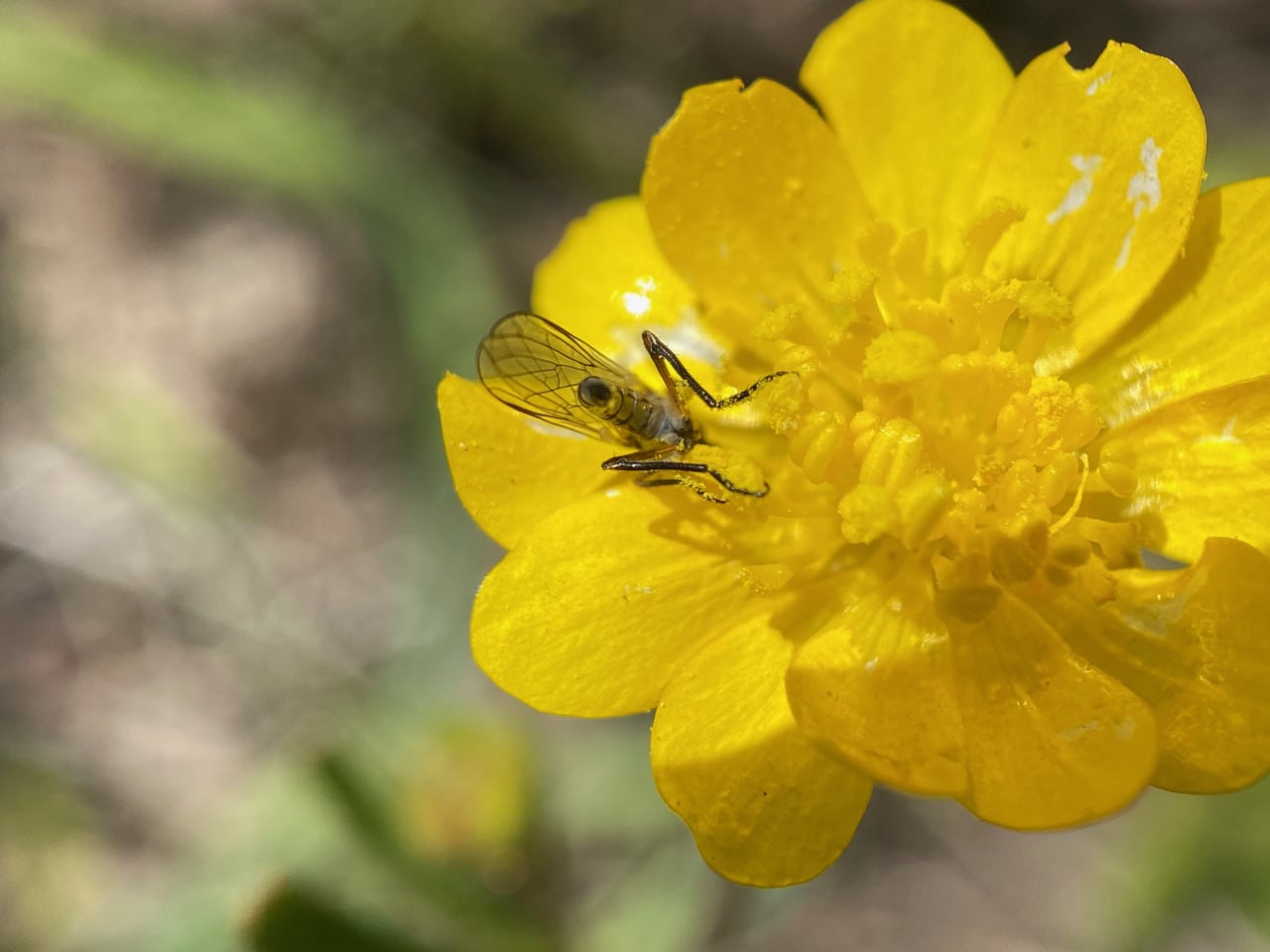
The fly works hard at accessing the nectar at the base of each petal.

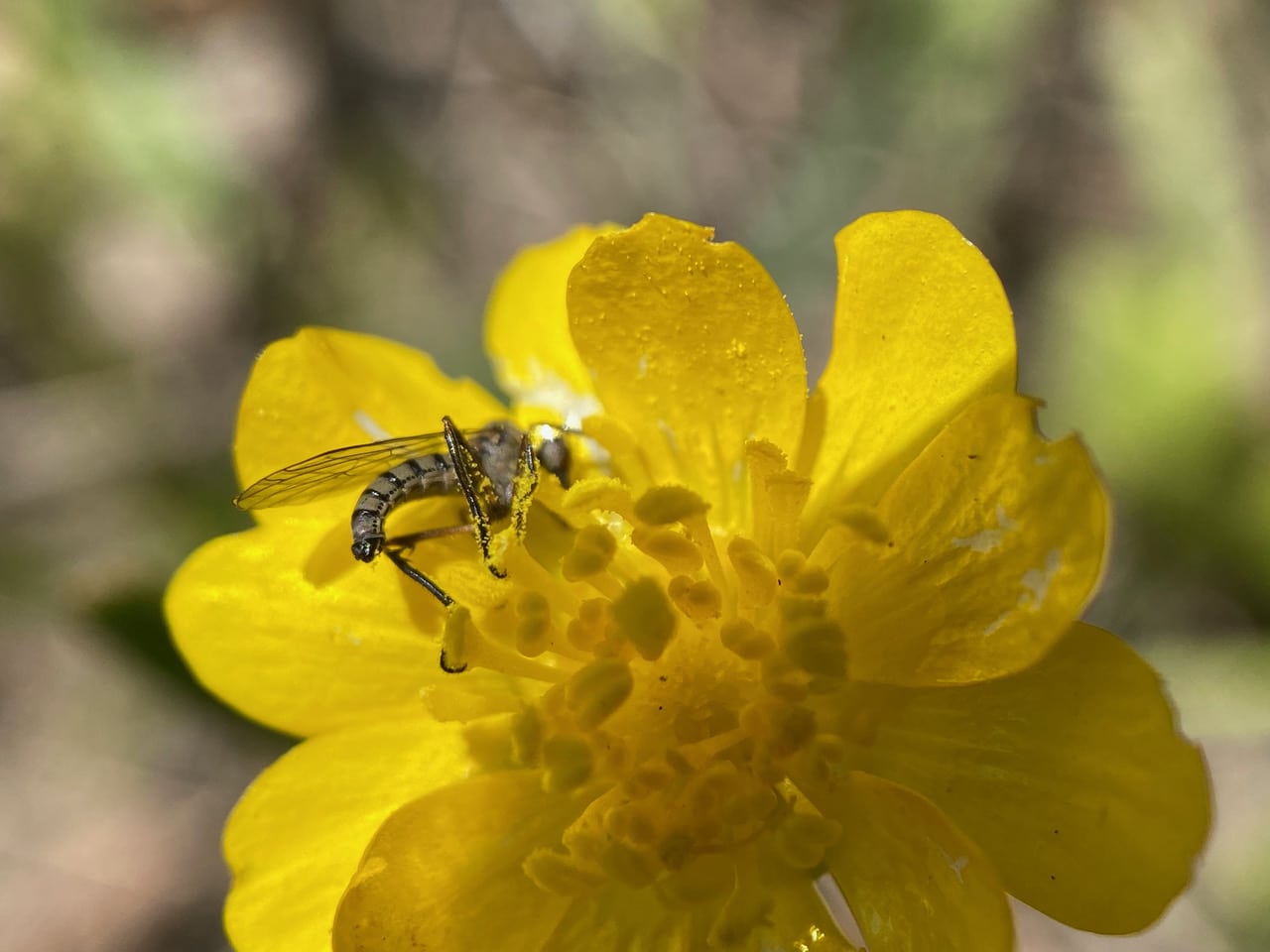
The fly’s long legs are getting covered with the sticky pollen of buttercup.
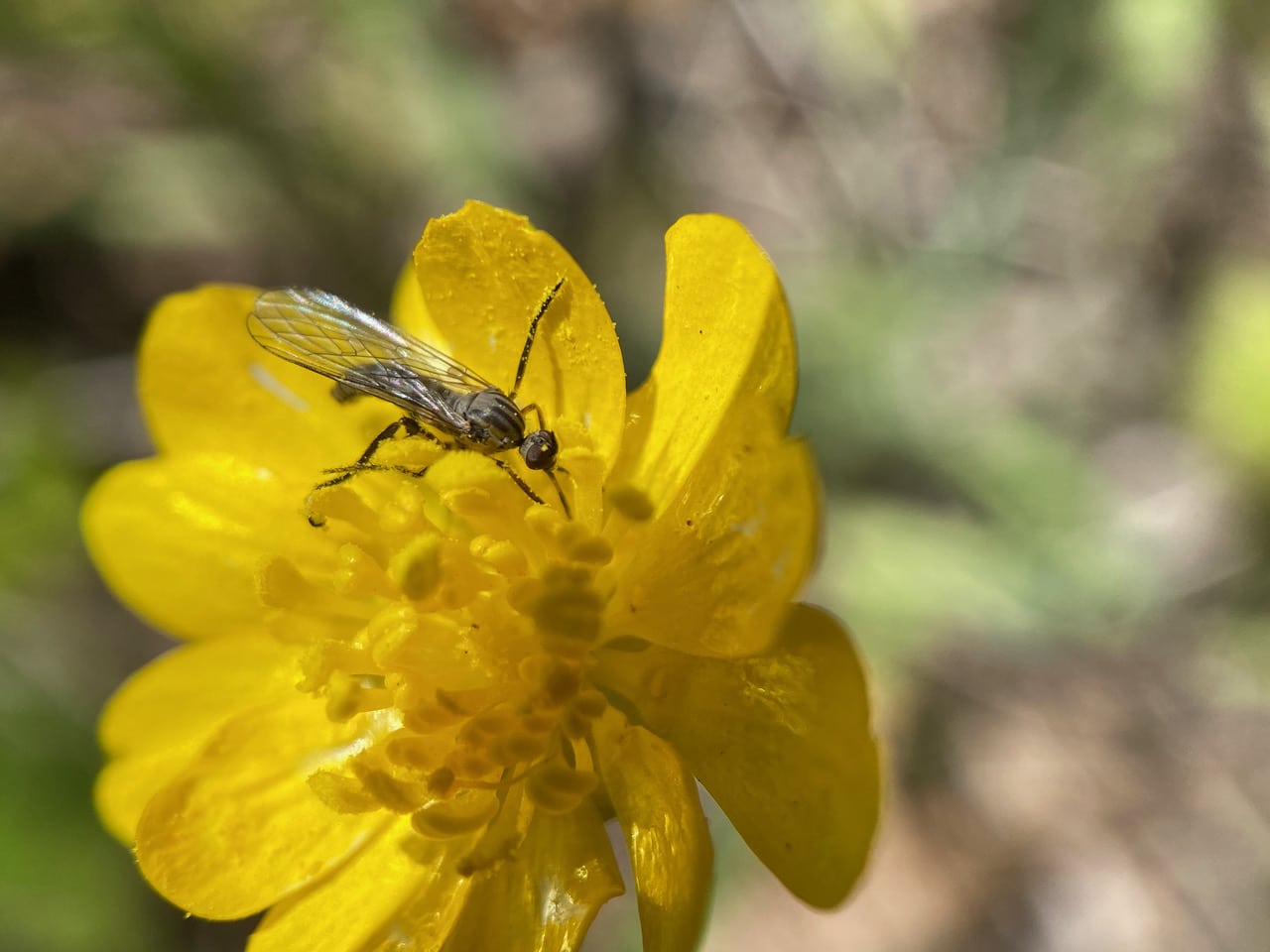
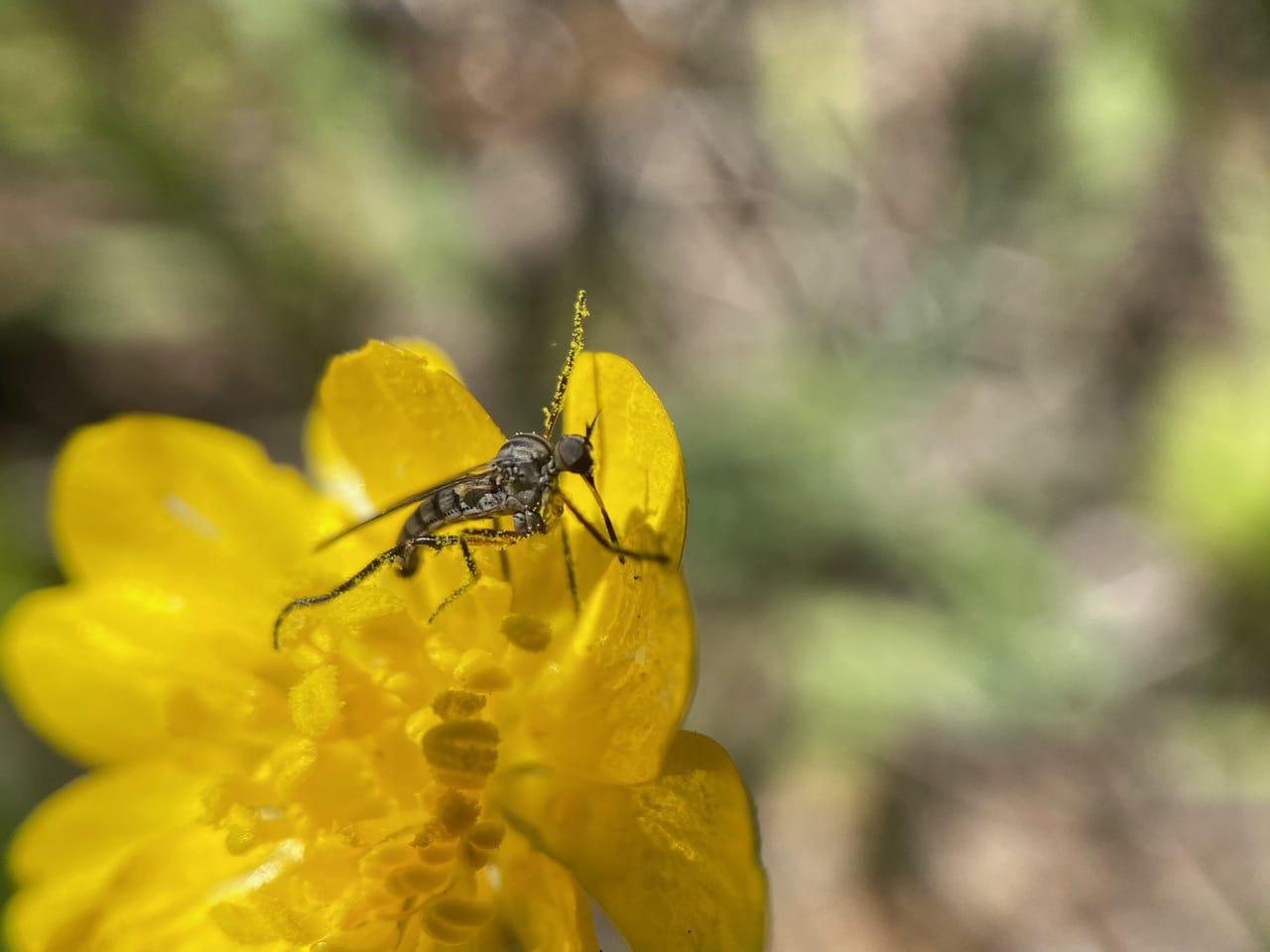
The fly emerges from the forest of stamens. Note its straight long proboscis characteristic of family Empididae. Dance Flies (family Empididae) are also known as Dagger Flies, referring to the sharp piercing mouthparts that these predators use to stab their prey. Some Empids have an elaborate courtship ritual in which a male wraps a prey item in silk and presents it to the female to stimulate copulation.
Some adult Empididae also visit flowers to obtain nectar. At least a few groups obtain all their protein needs by feeding on pollen. Larvae are generally found in moist soil, rotten wood, dung, or in aquatic habitats and also appear to be predacious on various arthropods.

The fly spends some time vigorously grooming to rid itself of the sticky pollen.
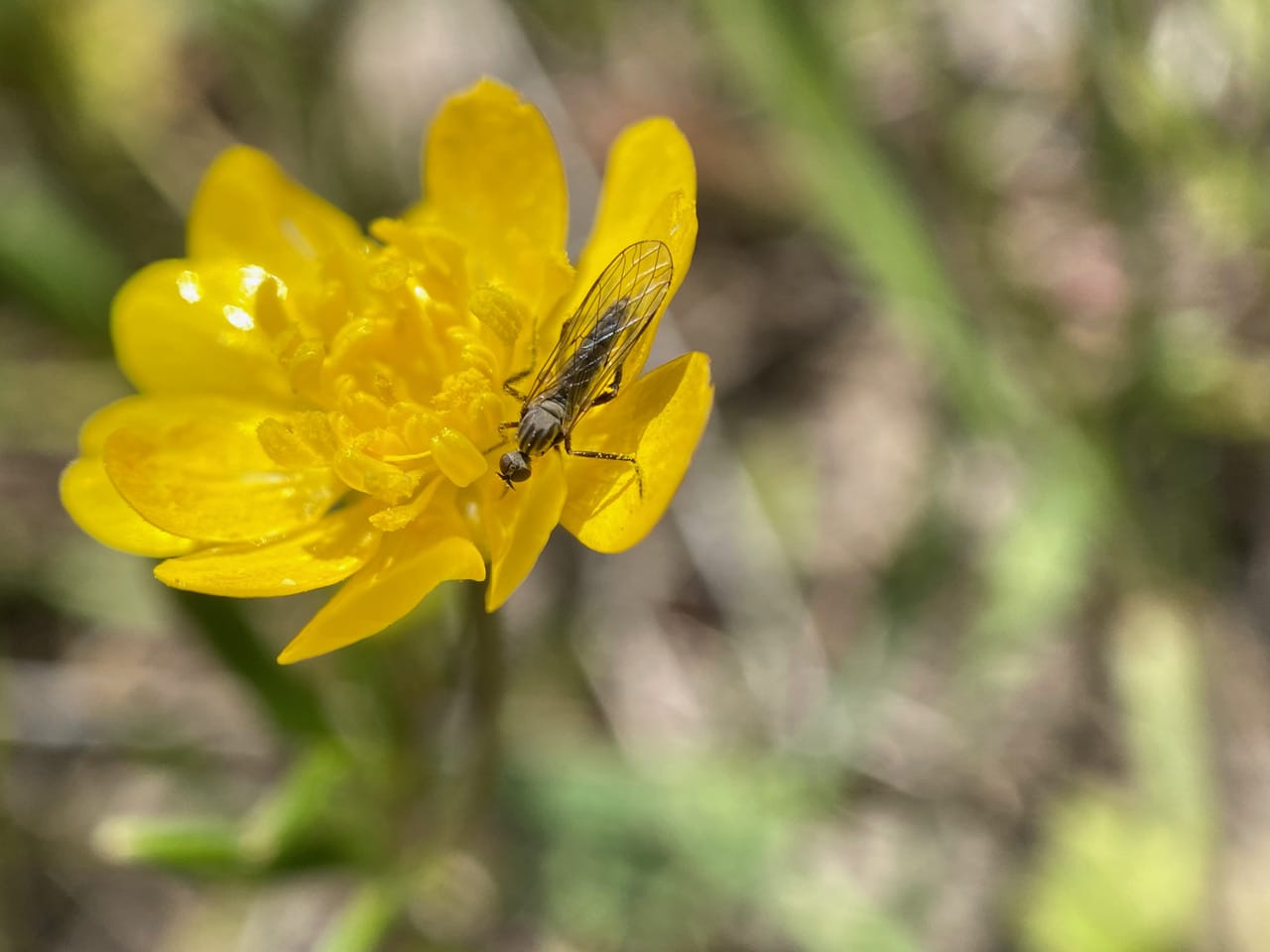
Ooh, here’s a clear view of the whole fly! Just when I think it has had enough and fly away…
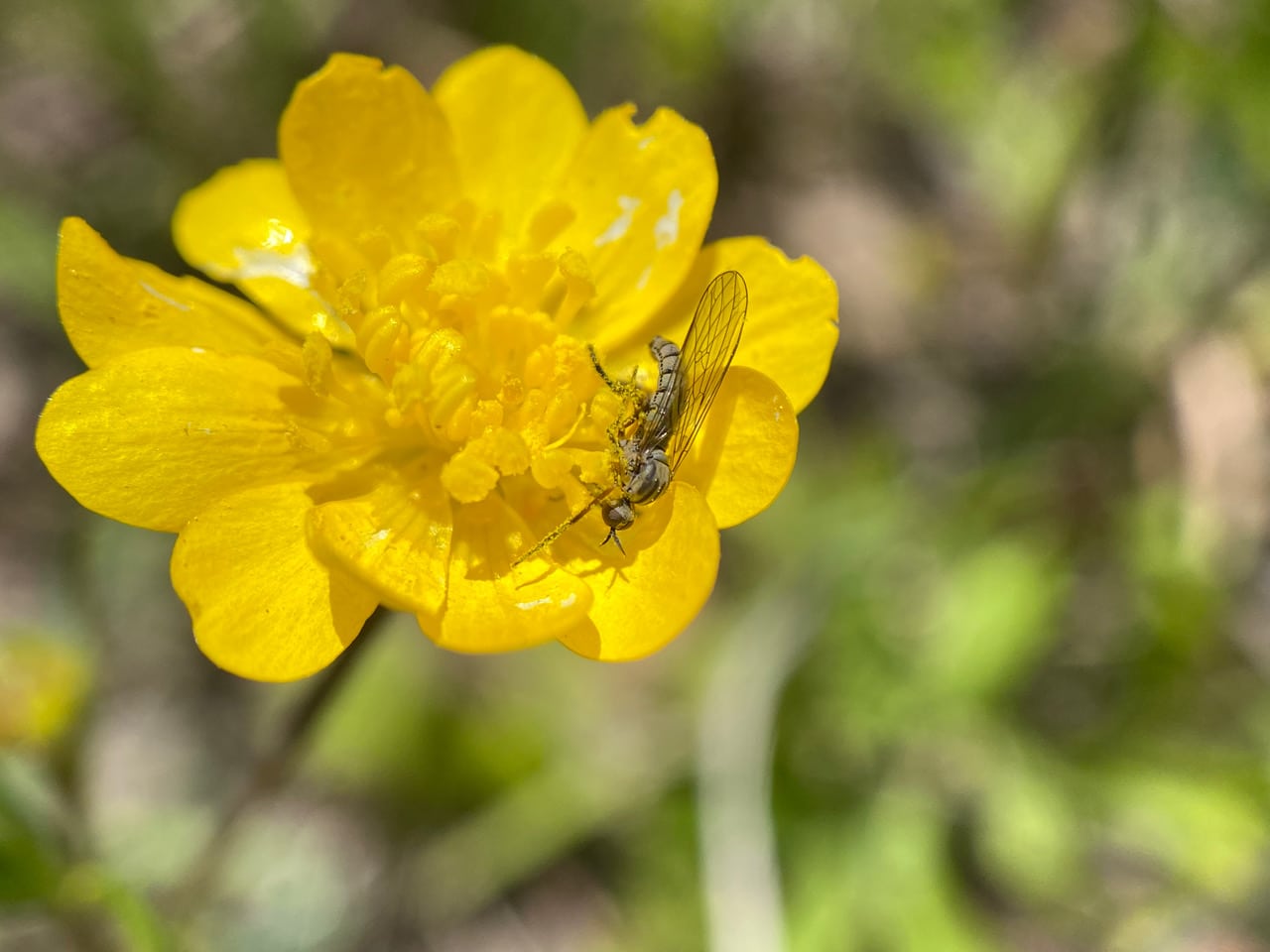
… it drops onto its side to probe for more nectar, and continues to do so until it completes a full circle around the flower! The nectar of buttercups must be irresistible.
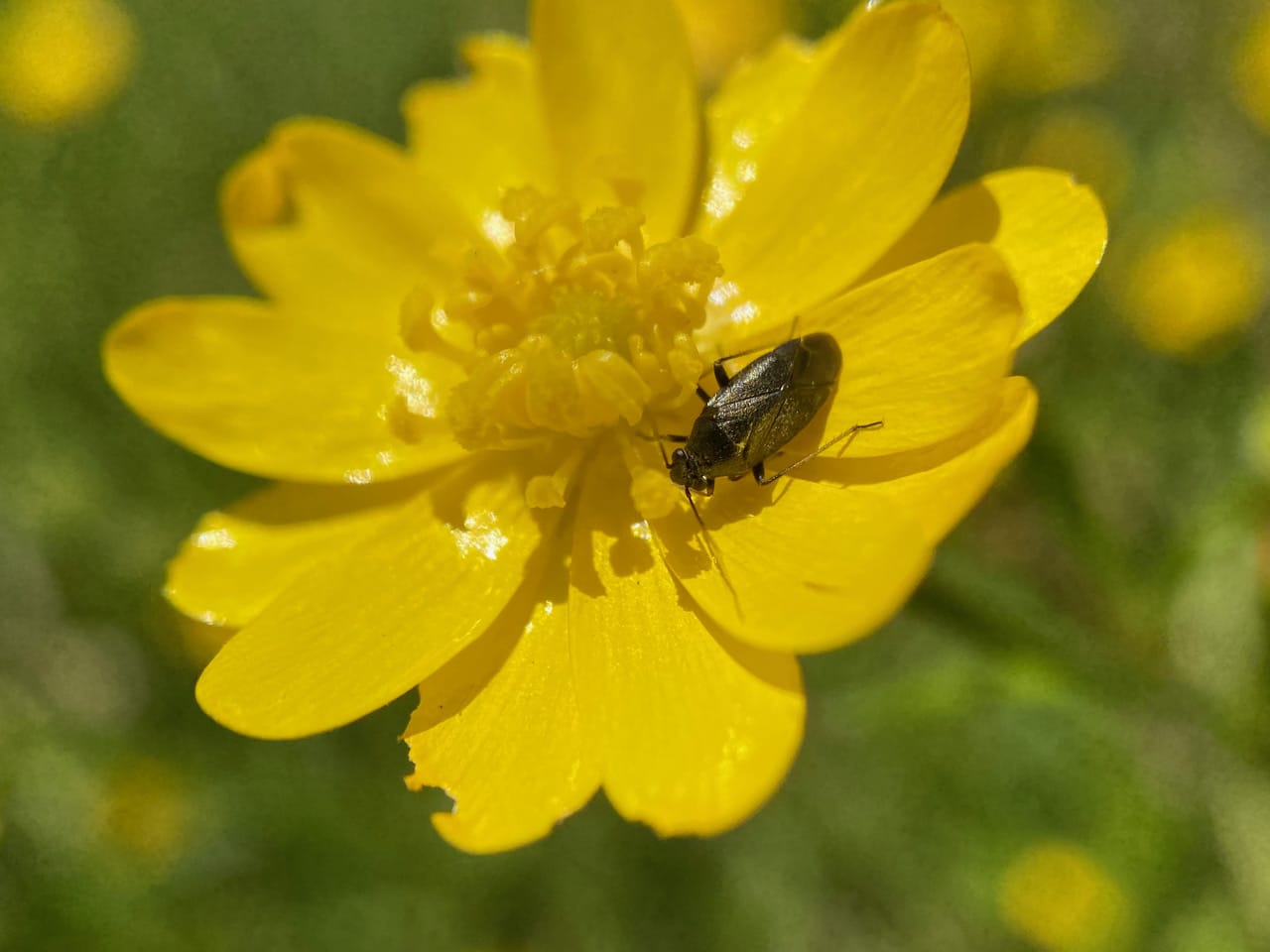
A shiny, dark Plant Bug (family Miridae) is foraging on a California Buttercup flower. Like the other members of the order Hemiptera or “true bugs”, it has piercing-sucking mouthparts. It is not responsible for the chew marks on the petals.
Mirid bugs are also referred to as plant bugs or leaf bugs. Miridae is one of the largest family of true bugs in the order Hemiptera. Like other Hemipterans, Mirids have piercing, sucking mouthparts to extract plant sap. Some species are predatory. One useful feature in identifying members of the family is the presence of a cuneus; it is the triangular tip of the corium, the firm, horny part of the forewing, the hemielytron. The cuneus is visible in nearly all Miridae.

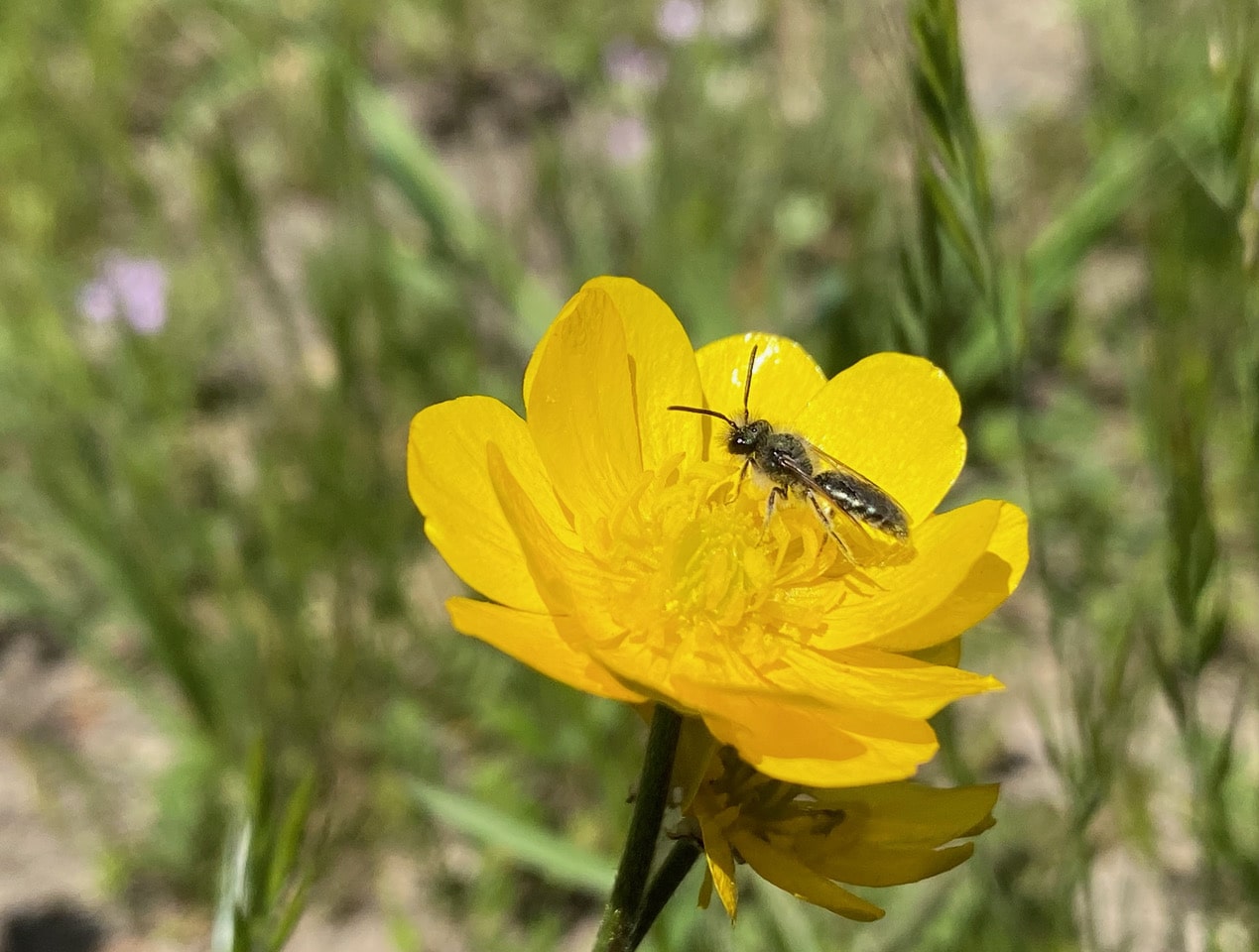
Is that another male Mining Bee (family Andrenidae)? Note its long antennae, slender body, and absence of scopae (pollen-collecting hairs) on its hind legs.
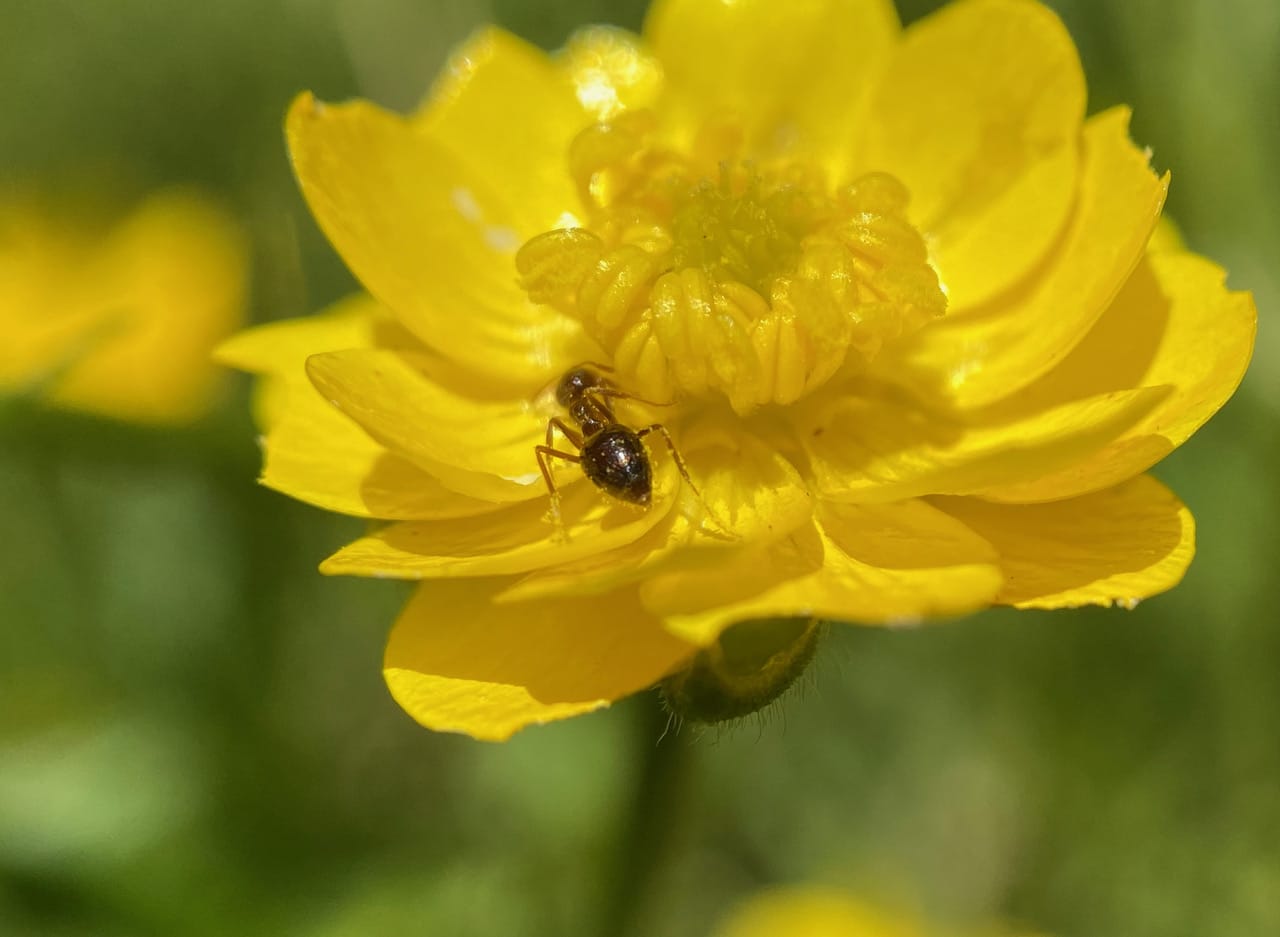
An American Winter Ant, Prenolepis imparis, approaches a fresh buttercup flower whose anthers have not opened to release pollen. The ant’s body is already covered with pollen, probably from another flower. It goes to show that even though ants can’t fly, they are capable of transporting buttercup pollen from flower to flower.
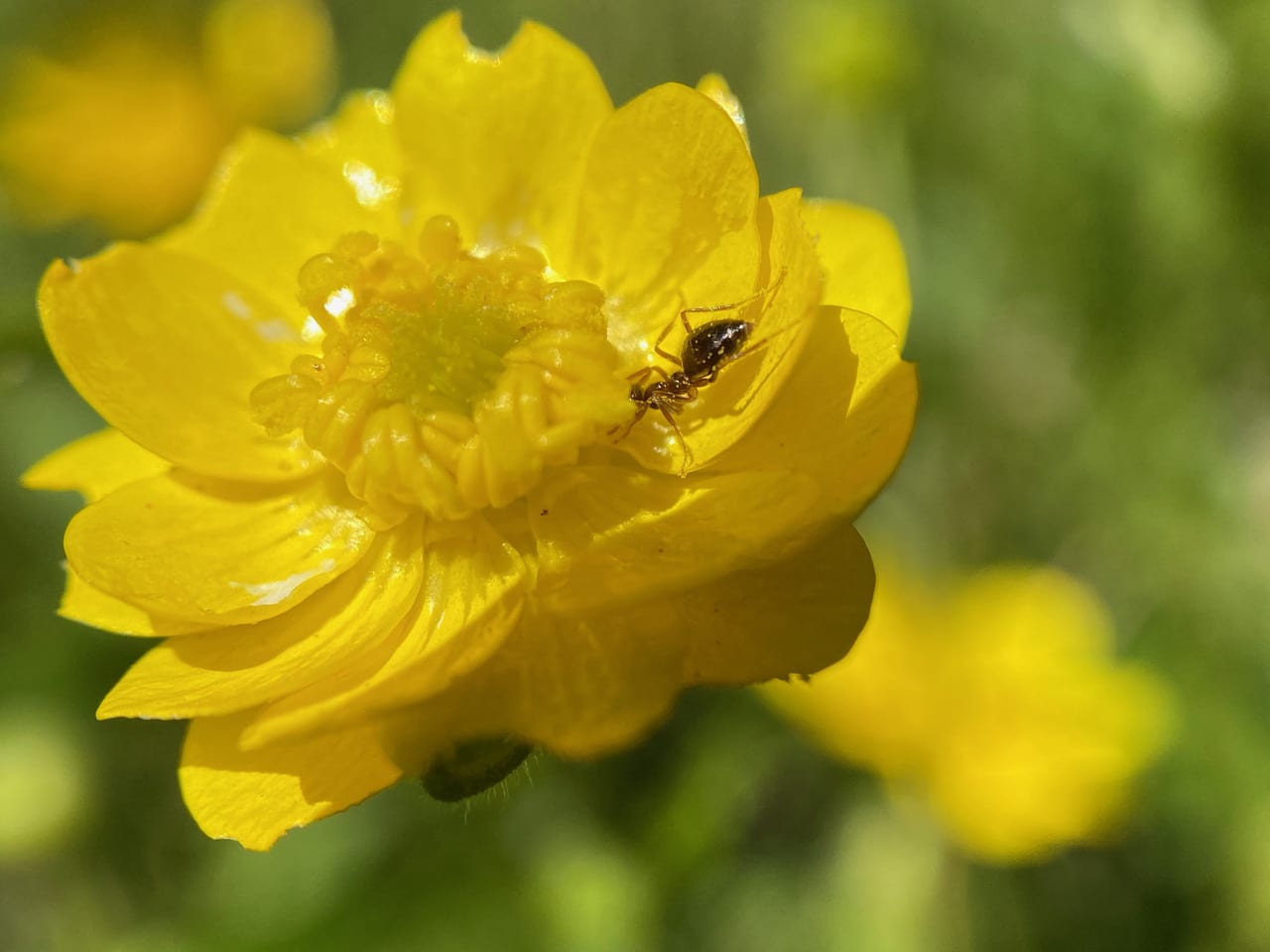
The ant is reaching for the nectar under the stamens. Unless the pollen on its body is deposited on the pistil (the greenish female parts in the middle of the flower), pollination has not been accomplished