

Pollinator Post 4/14/23 (1)


The Steam Train entrance to the Skyline Gardens is lit up with colors! The California Poppy has finally opened its flowers on this sunny morning.







Half-hidden among the lupines is a spectacular flowerhead of Woolly Mule’s Ears, Wyethia helenioides. This species of the Asteraceae family occurs chiefly in the California Coast Ranges, and some areas of the Sierra Nevada foothills of California. It is a short, low-growing golden-rayed wildflower that resemble sunflowers. The tiny flowers on the flowerhead open from the rim towards the center as the flowerhead matures. There are still unopened buds in the middle of this flowerhead.
I lean in to take a closer look at the Mule’s Ears flowerhead.
What is commonly mistaken as a “flower” is in fact not a single flower, but an inflorescence of numerous flowers, packed in the center of the flowerhead or capitulum. The individual flowers or florets are star-shaped, and made of 5 fused petals. The flowers clustered in the middle are called disc flowers, while the ones on the rim are called ray flowers. The latter have an irregular corolla – tubular at the base but elongated on the outside into a generally flat projection, the ray, or ligule. The rays are the petal-like parts.
Flowers in the sunflower family have another unusual feature: secondary pollen presentation. Each individual flower is roughly tubular in shape, and, the anthers are tucked inside the tube facing the interior of the flower. Members of the sunflower family are protandrous, meaning the male parts mature before the female parts. The flower relies on the female parts to bring the pollen out of the floral tube and into the environment where the pollinators can access it. In many cases, the style acts like a tiny piston, literally pushing the pollen out into the world. After some time, the style splits at the tip and each side curls back on itself to reveal the stigmatic surface. Only at this point are the female parts of the flower mature and ready to receive pollen. With luck, much of the flower’s own pollen would have been collected and taken away to other plants by pollinators. Self-pollination is thus avoided.
(The candle-like structure erupting from each fresh flower is the fused stamens called the anther cylinder. The two-pronged curly-cue structures that later protrude from the anther cylinder is the bilobed stigma.)
I find the symmetry of this freshly opened Mule’s Ears flowerhead mesmerizing. Only the ray flowers have opened, presenting their bilobed stigmas to the world.
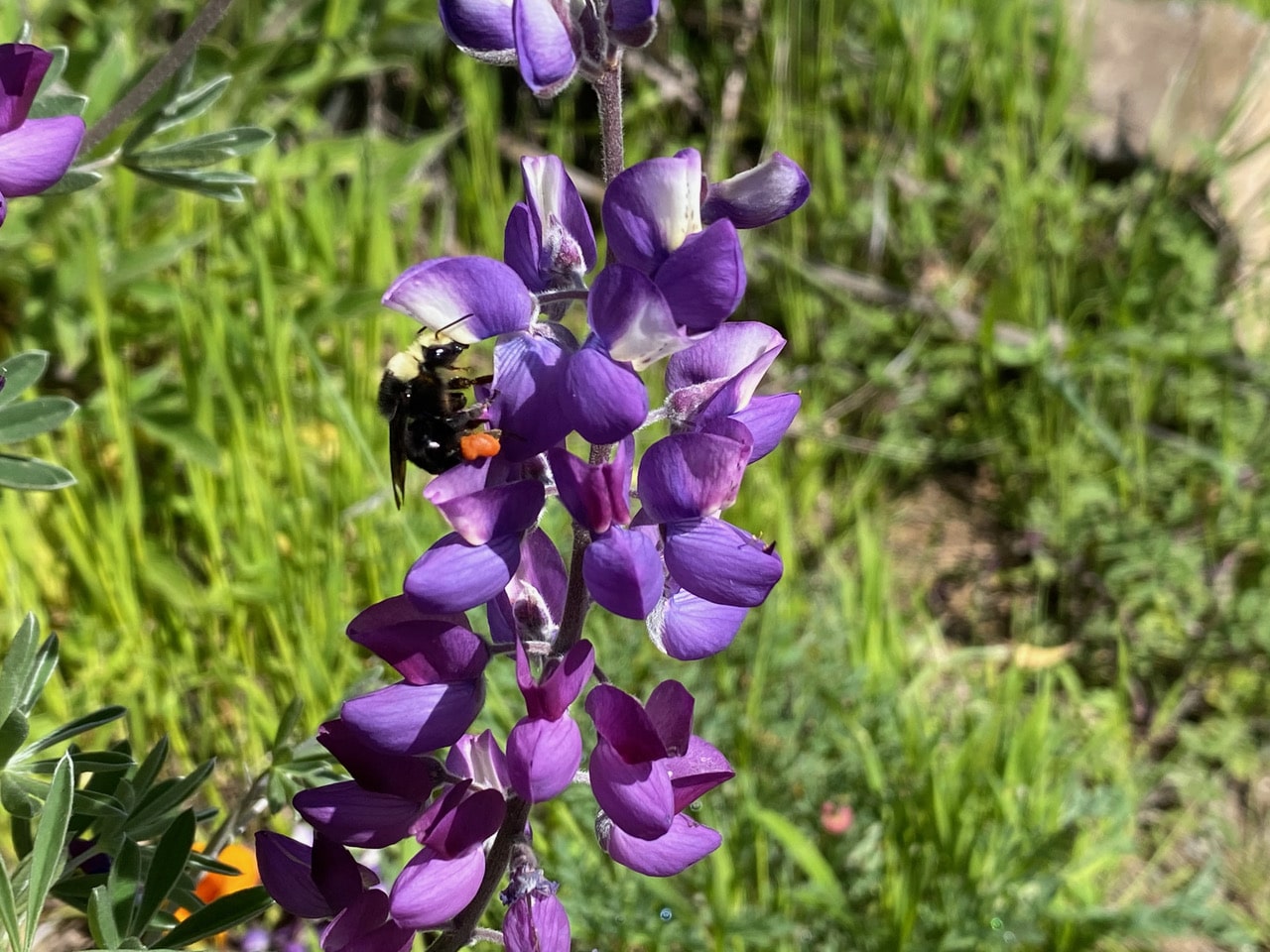
Flying with a huge load of pollen in its pollen baskets, a Yellow-faced Bumble Bee, Bombus vosnesenskii is foraging on the Silverleaf Lupine, Lupinus albifrons. The bee “trips” every flower individually to access the pollen and nectar in a quick bouncing movement on the flower.
A small patch of California Buttercups, Ranunculus californicus (family Ranunculaceae) is blooming gloriously just beyond the cattle gate. The flowers all face the same direction. Like the better-known sunflowers, buttercup flowers track the sun.
As it is still early and cold, not many insects are out foraging yet. I watch as a small fly makes its way slowly around the whole perimeter of the flower on the edge of the stamens, stopping to probe laboriously for nectar at the base of every petal. Soon its body is covered with sticky pollen from the stamens.
Buttercups have a trick for warming their flowers that may be unique to this group fo plants. Inside each flower petal, special cells create two layers of air that deflect the light reaching them sideways. This makes the petals act together like a parabolic reflector, focusing visible and infrared light on the flower center. Warming the pollen-producing stamens boost their maturation and chance of pollination. Insect pollinators prefer warmer flowers because it allows them to forage on cold mornings.
Buttercups get their bright color from yellow pigments in the petals’ surface layer. But the petals’ shiny gloss is due to the double layer of air just beneath the surface, reflecting the light like mirrors.
Photo from 4/2/21
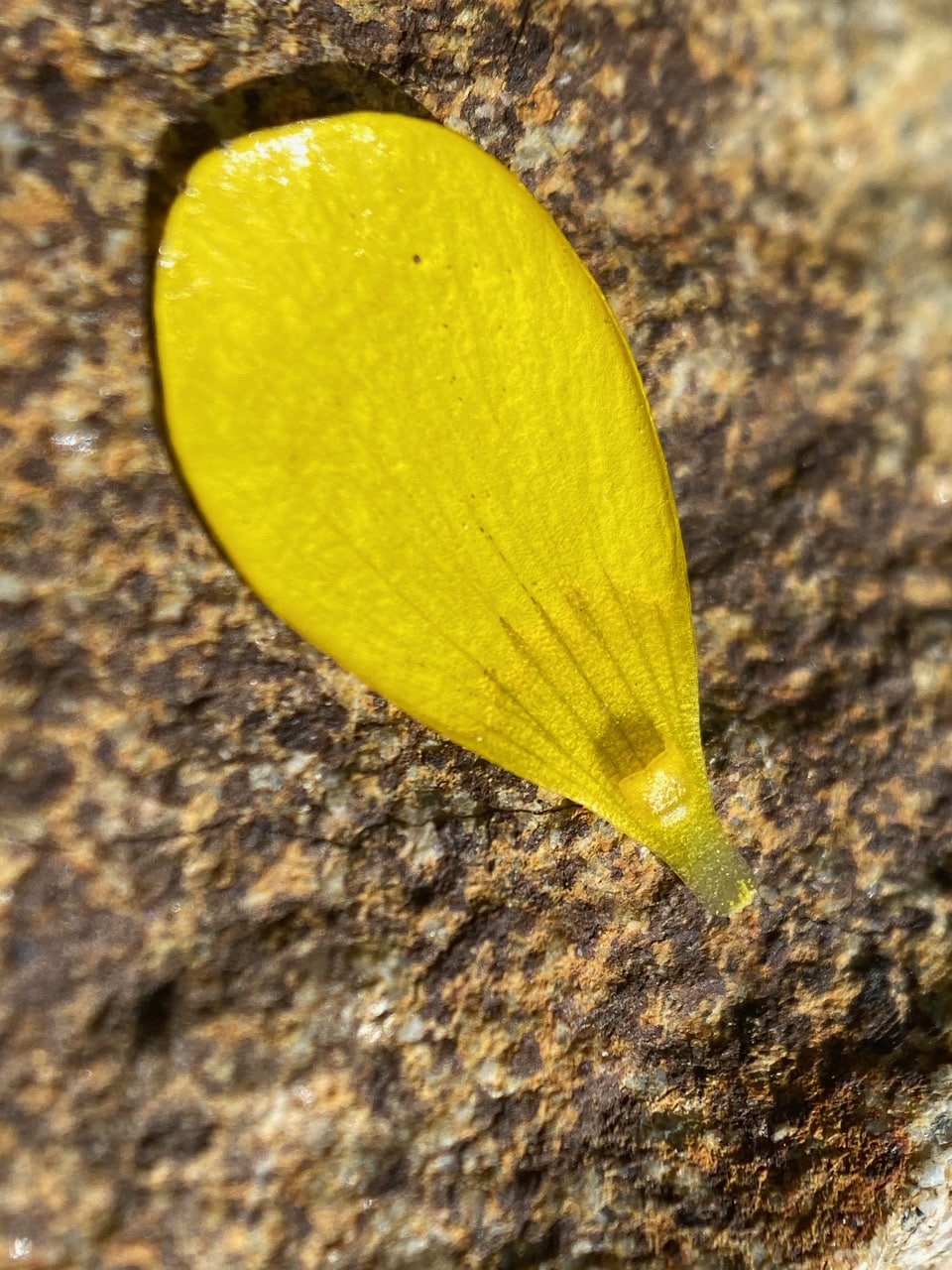
I pick a petal from a fresh buttercup flower and look for the nectariferous spot – it is a cup-like scale that holds the nectar at the base of each petal, usually hidden under the stamens. Unlike most flowers that have a pool of nectar in a single nectary, the buttercup dispenses her sweet treats discreetly in these pockets, ensuring that the visiting pollinator would probe meticulously and thoroughly around the flower, and get covered with her sticky pollen. Note the faint, greenish nectar guides, lines on the petal that direct the pollinator to the sweet reward.
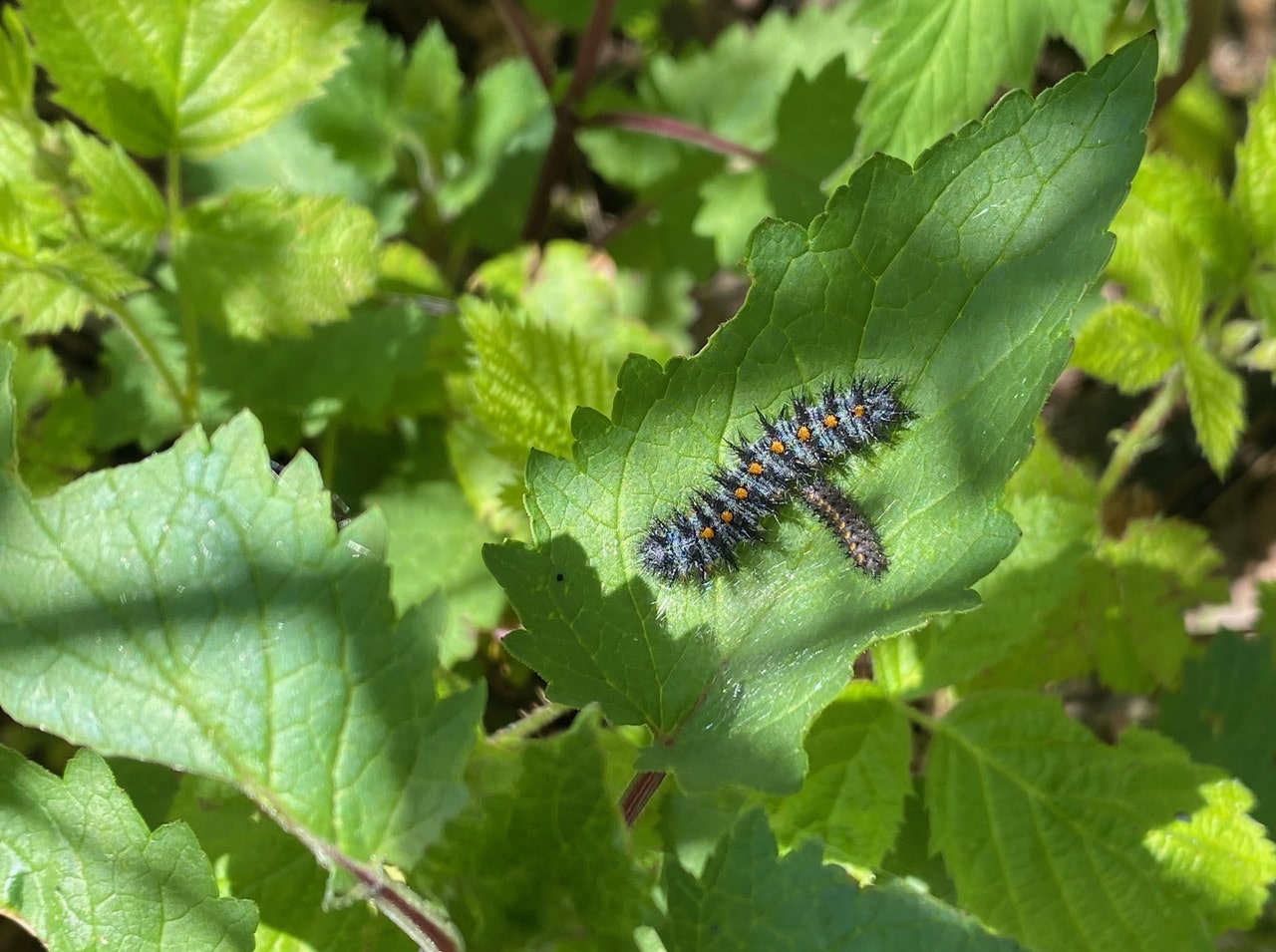
Two Variable Checkerspot caterpillars of distinct sizes are resting on the same California Bee Plant leaf. Did they hatch from the same batch of eggs laid by the same mother? Can caterpillars recognize their kin, and would they share space/food and keep company with strangers?
Alas, the Giant Trilliums, Trillium chloropetalum are fast fading. I peek futilely through every flaring corolla hoping to see an insect. I have never seen an insect visit these dramatic flowers. Wonder if any of them would set fruit?
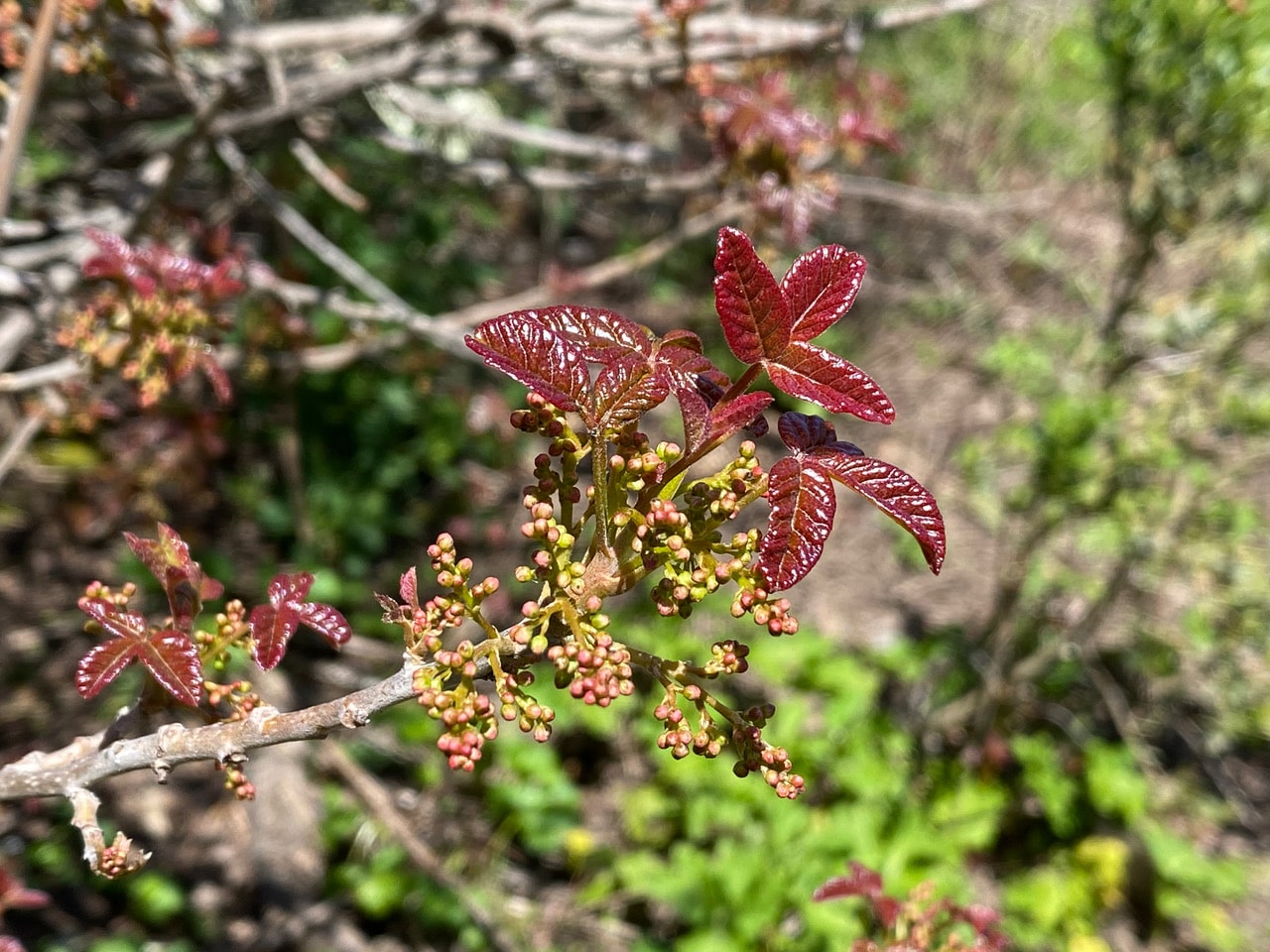
The Western Poison Oak, Toxicodendron diversilobum is reaching into the trail with brand new, glossy red leaves and developing berries.
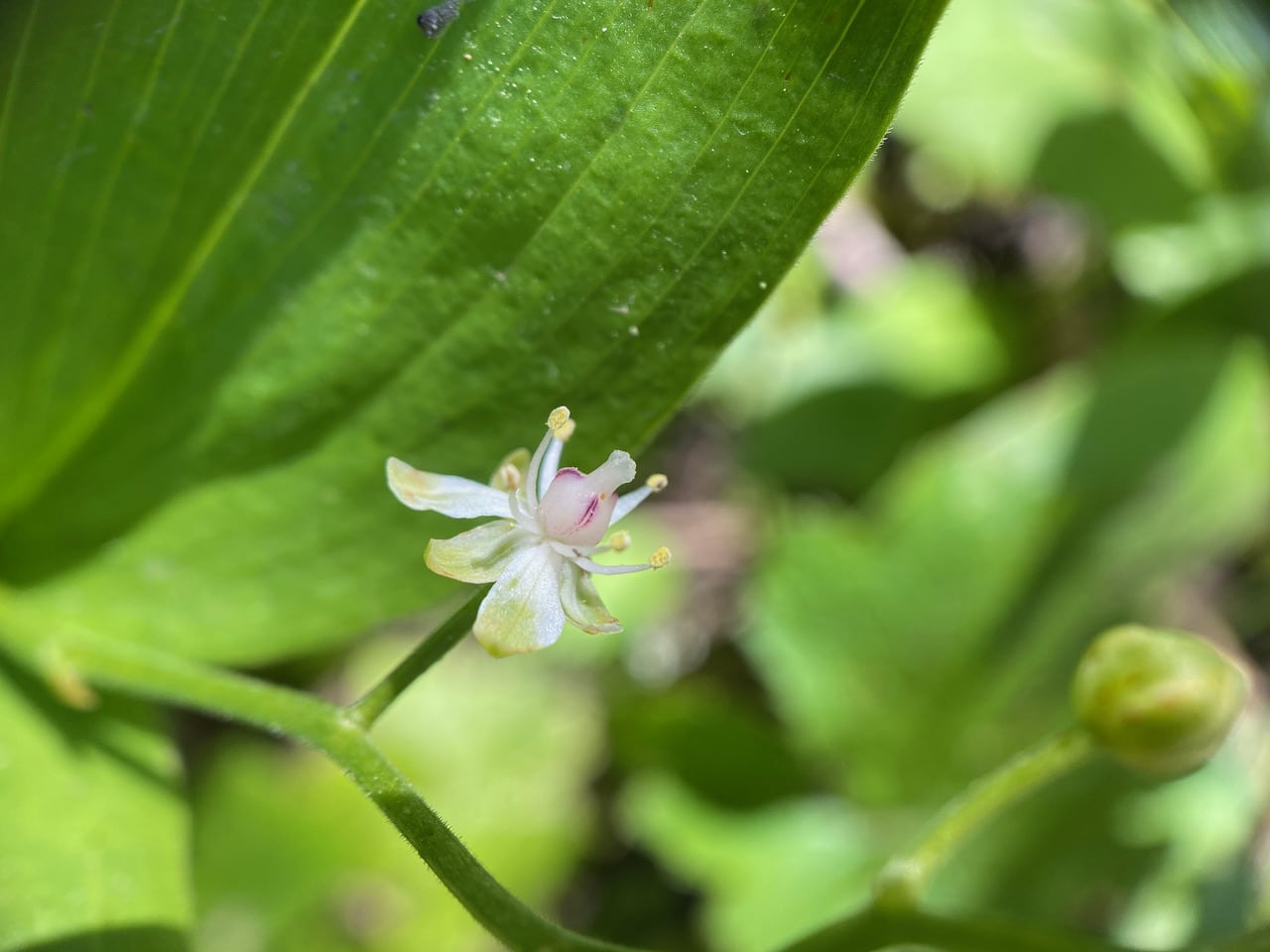
Nestled in the dappled shade in the same moist habitat as the trilliums, the False Solomon Seal, Maianthemum stellatum is bearing little white flowers.
The herbaceous perennial plant is native to North America. In California, it is primarily found in the Coast Ranges and the Sierras.
Close-up of a False Solomon Seal flower. Although the plant is in the family Ruscaceae, its flower is reminiscent of a lily, based on three-part symmetry. The delicate starry flower has a prominent pistil that will develop into a stripy berry and then deep red berry in the fall. I wonder who pollinates these flowers? Tiny midges?
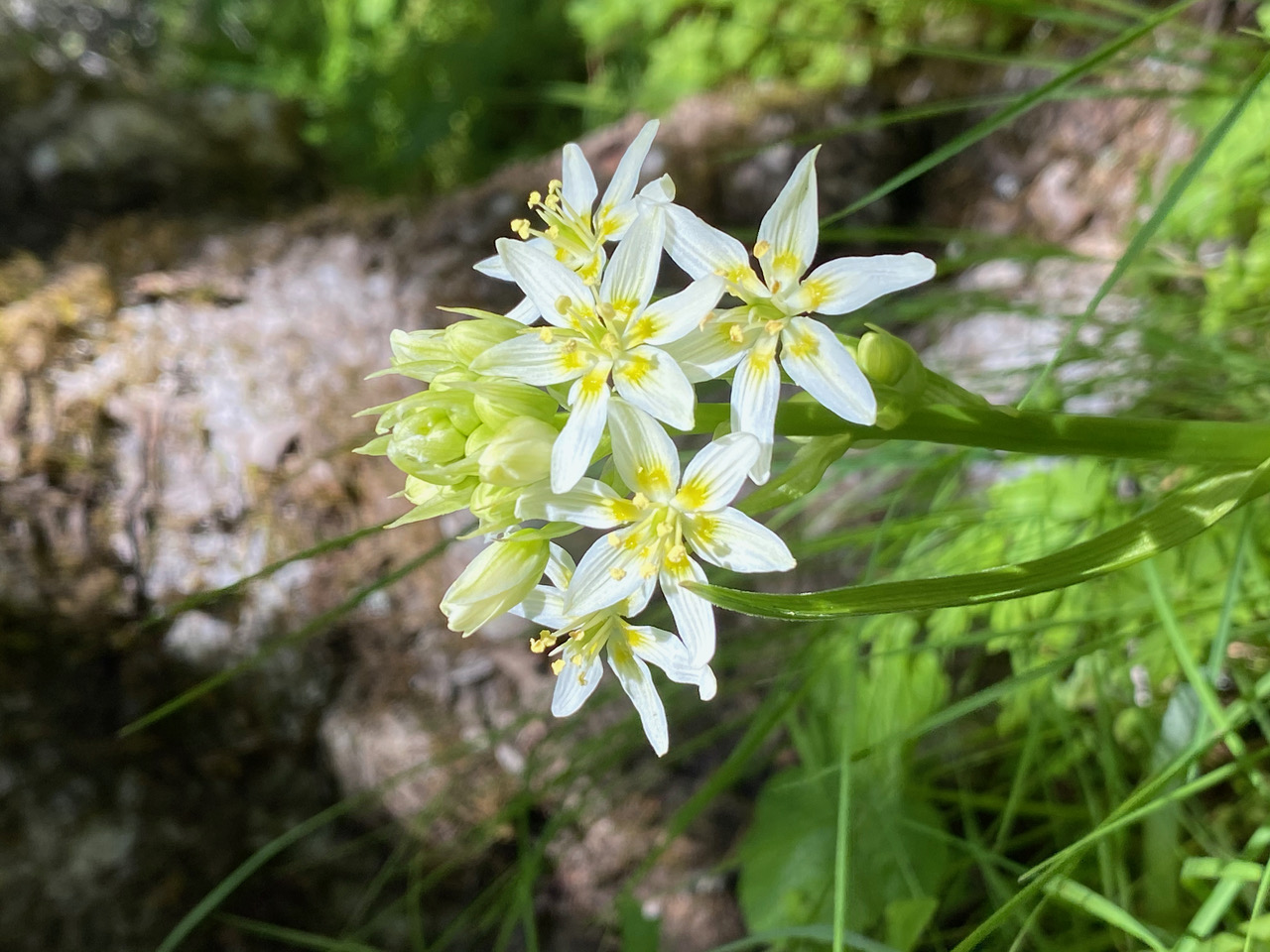
Late in blooming this year, the flowers of the Fremont’s Star Lily, Toxicoscordion fremontii (family Melanthiaceae) have finally made their appearance.
Flowers are borne in a branched cluster at the top of a single stem, up to 3 feet tall. There are three sepals and three similar petals (together called tepals). Petals are white or cream with conspicuous parallel veins.
Each of the tepal veins ends in a swollen yellow nectar gland; the glands together form a bright yellow eye near the center of the flower. These distinct glands near the base of the tepals are one of the features that set the star lilies apart from true lilies, from which the family has been split. Given the presence of nectar glands, the flowers of Fremont’s Star Lilly are obviously pollinated by insects. Which insects?