

Pollinator Post 4/12/24 (4)
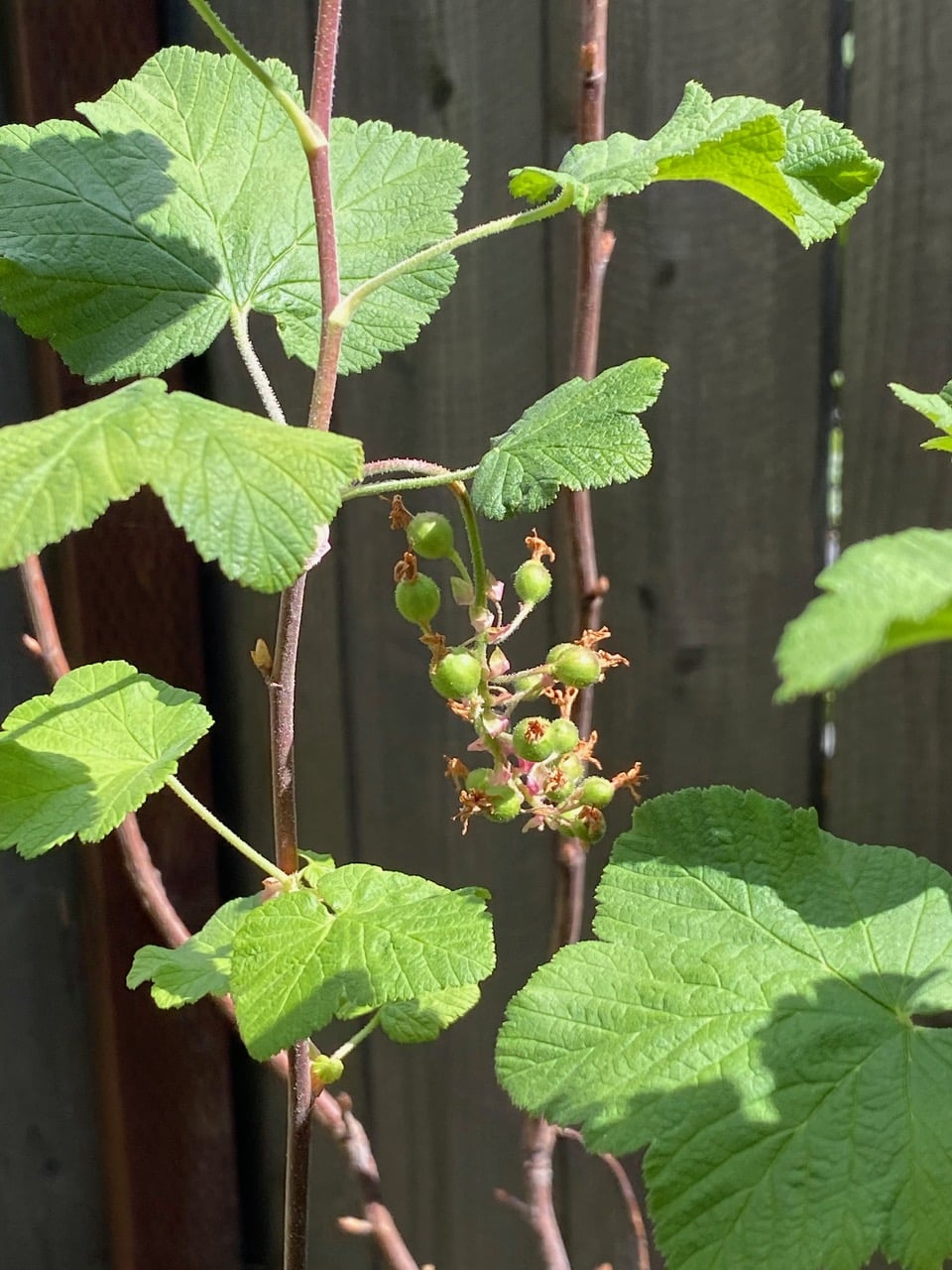
A gardener friend inquired about some small bees clinging with their jaws to the leaves of a Pink-flowering Currant, Ribes sanguinem in one of the gardens she tended. It got me really excited since that is a well-known behavior of the Nomad Bees when they sleep, and I have yet to witness it for myself! Immediately I asked Naomi to ask for permission from the owners for me to visit their garden in Oakland, which is only a few minutes drive from my house.
Full of anticipation, I arrive at 8:30 am on this cool and overcast morning, hoping to find the Nomad Bees still sleeping on the said Ribes sanguineum. Nada! Maybe they are roosting on other shrubs? I make a thorough check around the garden, but don’t see any bees. As there’s little insect activity at this time, I asked the gracious owner’s permission to return in the afternoon. After all, Naomi saw the sleeping bees between 2 and 3 pm on April 3rd.
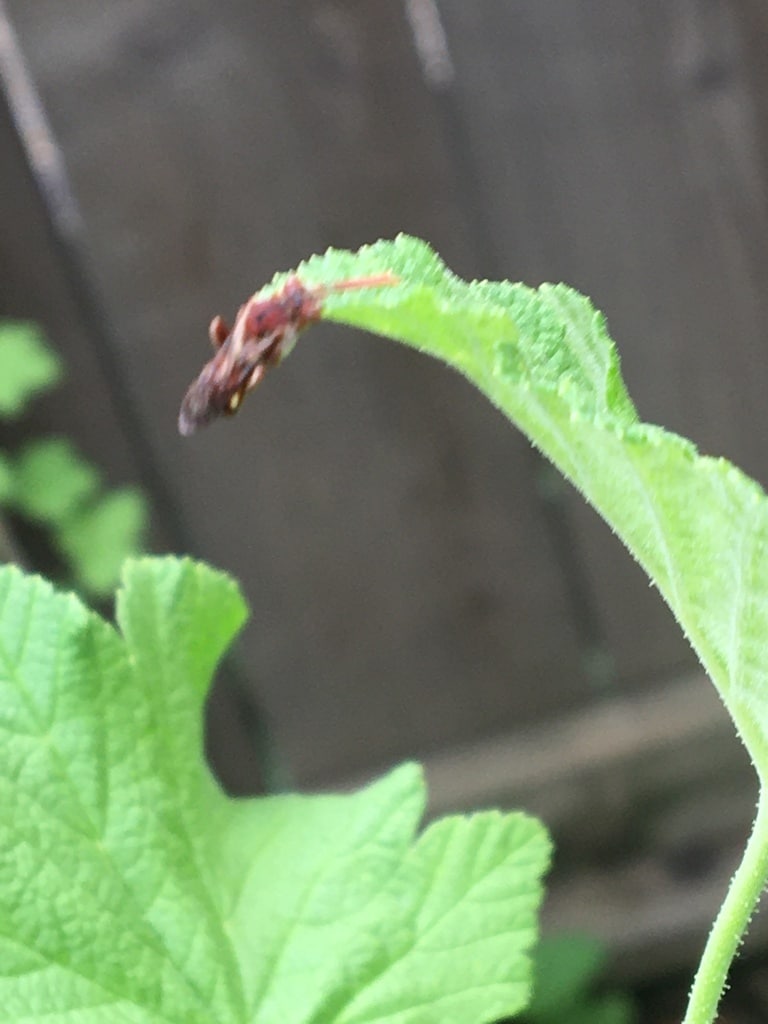
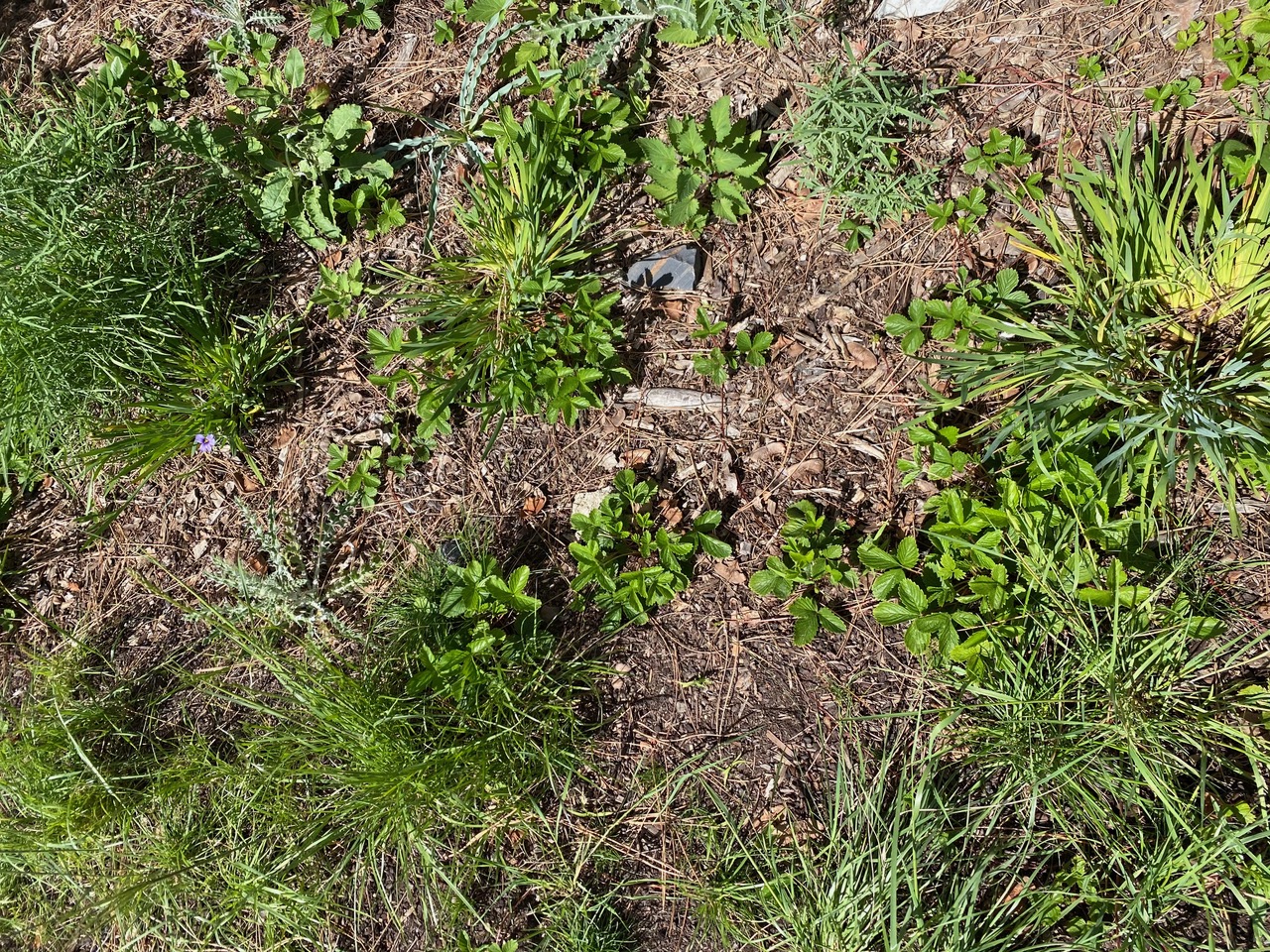
I return to the garden at 2 pm. No bees sleeping on the Ribes, but I notice several small brown bees zipping around close to the ground among the ground cover of Strawberry, native bunch grasses, and Blue-eyed Grass. Might these be the Nomad Bees I’m after? They are wary and elusive and I fail to get close enough for a photo.
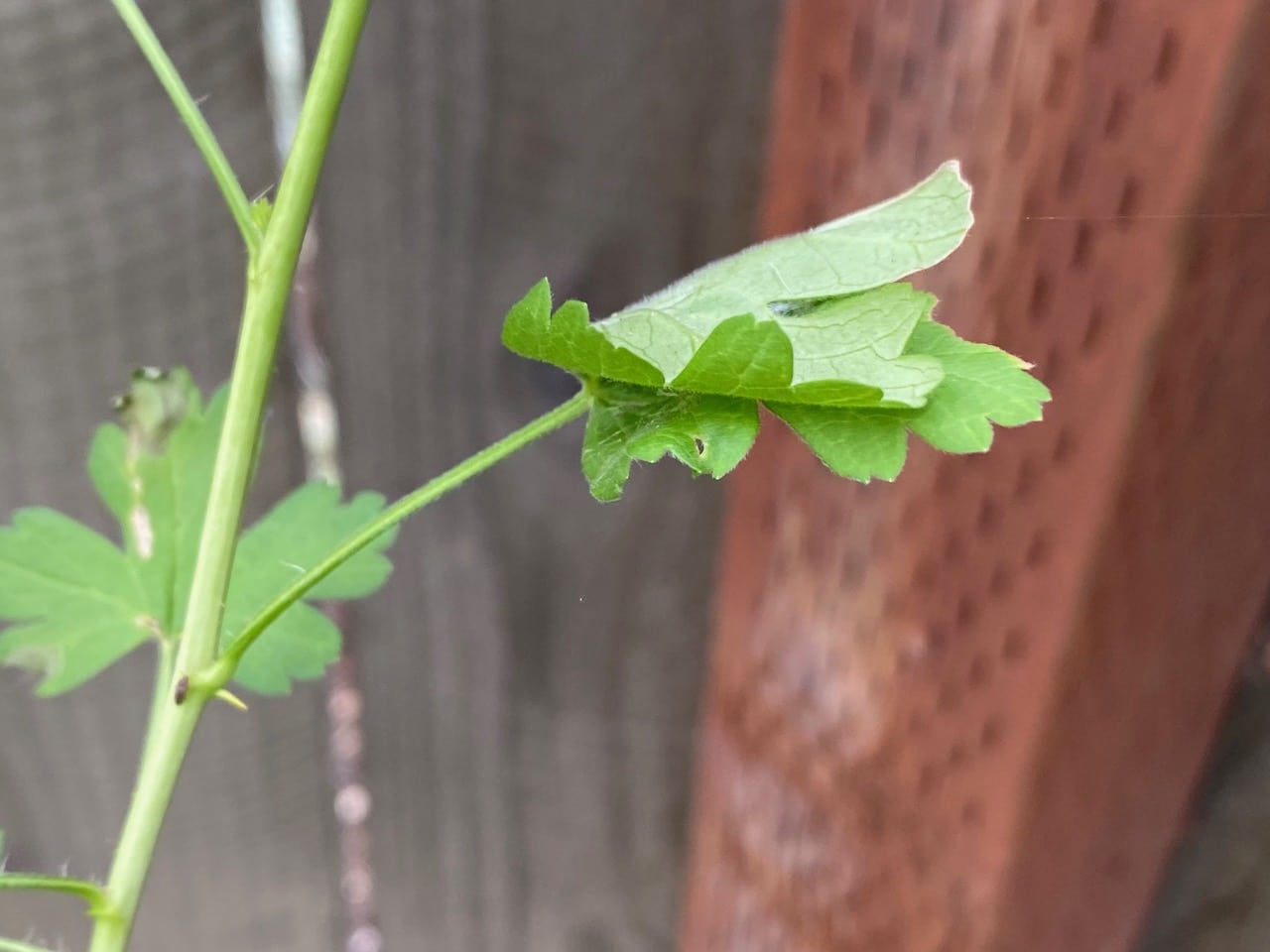
Next to the Ribes sanguineum I think is another kind of Ribes – the Golden currant, Ribes aureum. A couple of its leaves have been folded over and secured with silk. Probably the work of a Tortrix caterpillar?
Tortrix moths or Leafroller Moths are members of the family Tortricidae. Many are economically important pests. The typical resting posture is with the wings folded back, producing a rather rounded profile. Tortricid moths are generally small, with a wingspan of 3 cm or less. Many species are drab and have mottled and marbled brown colors. Larvae of some species feed by boring into stems, roots, buds or seeds. Others feed externally and construct leaf rolls.
Leaf shelter-builders, either leaf-tiers or leaf-rollers, do not manipulate leaves directly but use their silk to draw plant surfaces together. The caterpillars impart potential energy to their silk strands by stretching them beyond their equilibrium length as they are spun out. Axial retraction of the stretched strands then draws the bound plant surfaces together. Although a single stretched strand exerts only a minuscule force, the combined force generated by many such strands attached to the same opposable plant surfaces is substantial and allows the caterpillars to manipulate leaves many times their size and mass.
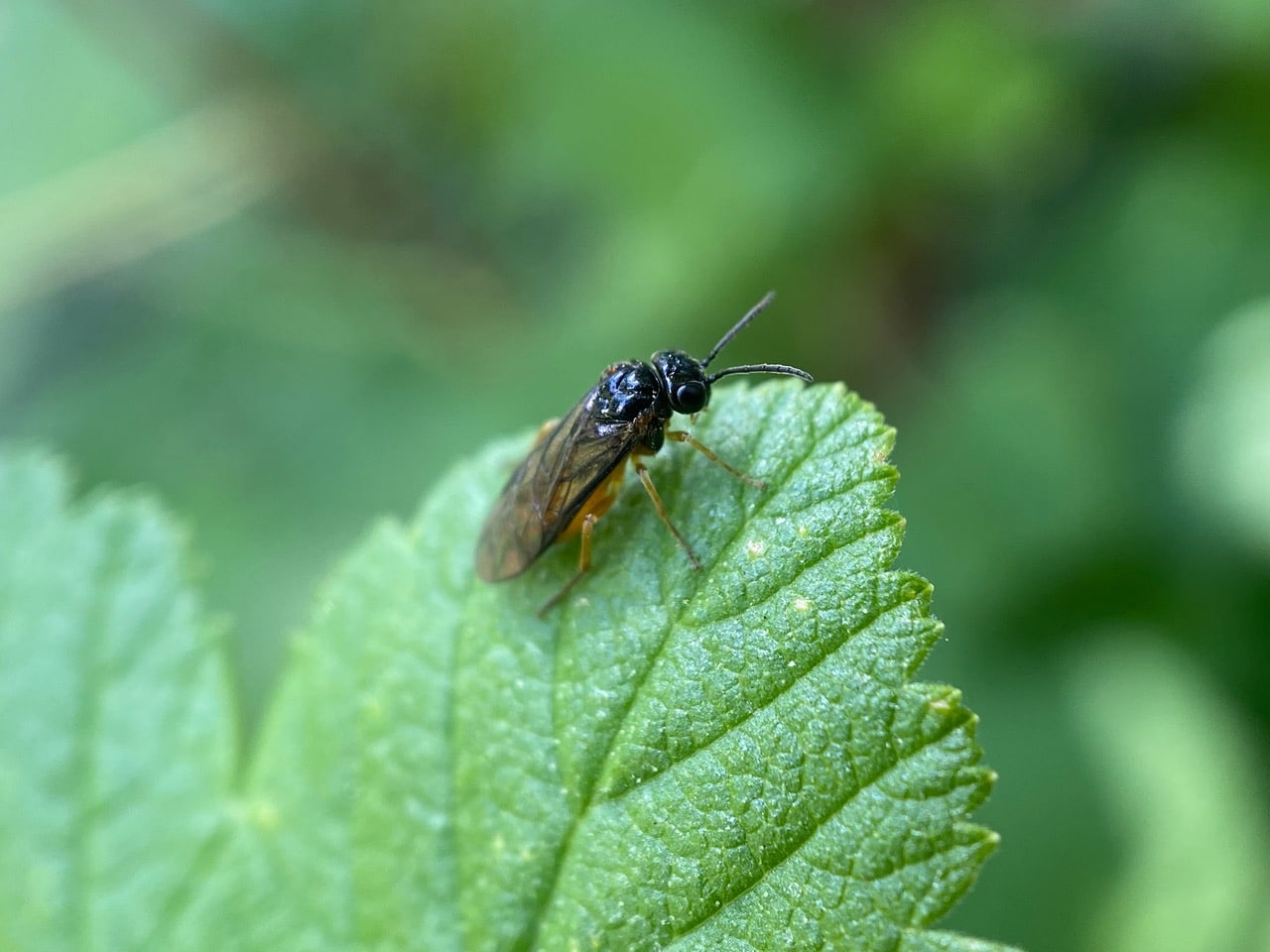
On a more mature Pink-flowering Currant under a big Pine tree, I find a wasp-like insect perched on a leaf. It is a Bedstraw Sawfly, Halidamia affinis (family Tenthredinidae).
Sawflies are part of the insect order, Hymenoptera, together with bees, wasps and ants. They are considered to be the most primitive group and form the sub-order Symphyta. They differ from the bees, wasps and ants in not having a narrow ‘waist’ and in their wing venation. The common name comes from the saw-like ovipositor that the females use to cut into plant tissues to lay their eggs. Larvae are caterpillar-like and can be distinguished from lepidopteran caterpillars in that all body segments following the three bearing true legs have a pair of fleshy prolegs. Like the lepidopteran caterpillars, sawfly larvae walk about and eat foliage. In many species, the larvae feed in groups.
The Bedstraw Sawfly is native to Europe, but is now found throughout much of the US. Larvae feed on Bedstraw, Galium sp. The sawfly is parthenogenetic in the northern part of its range, reproducing without males.
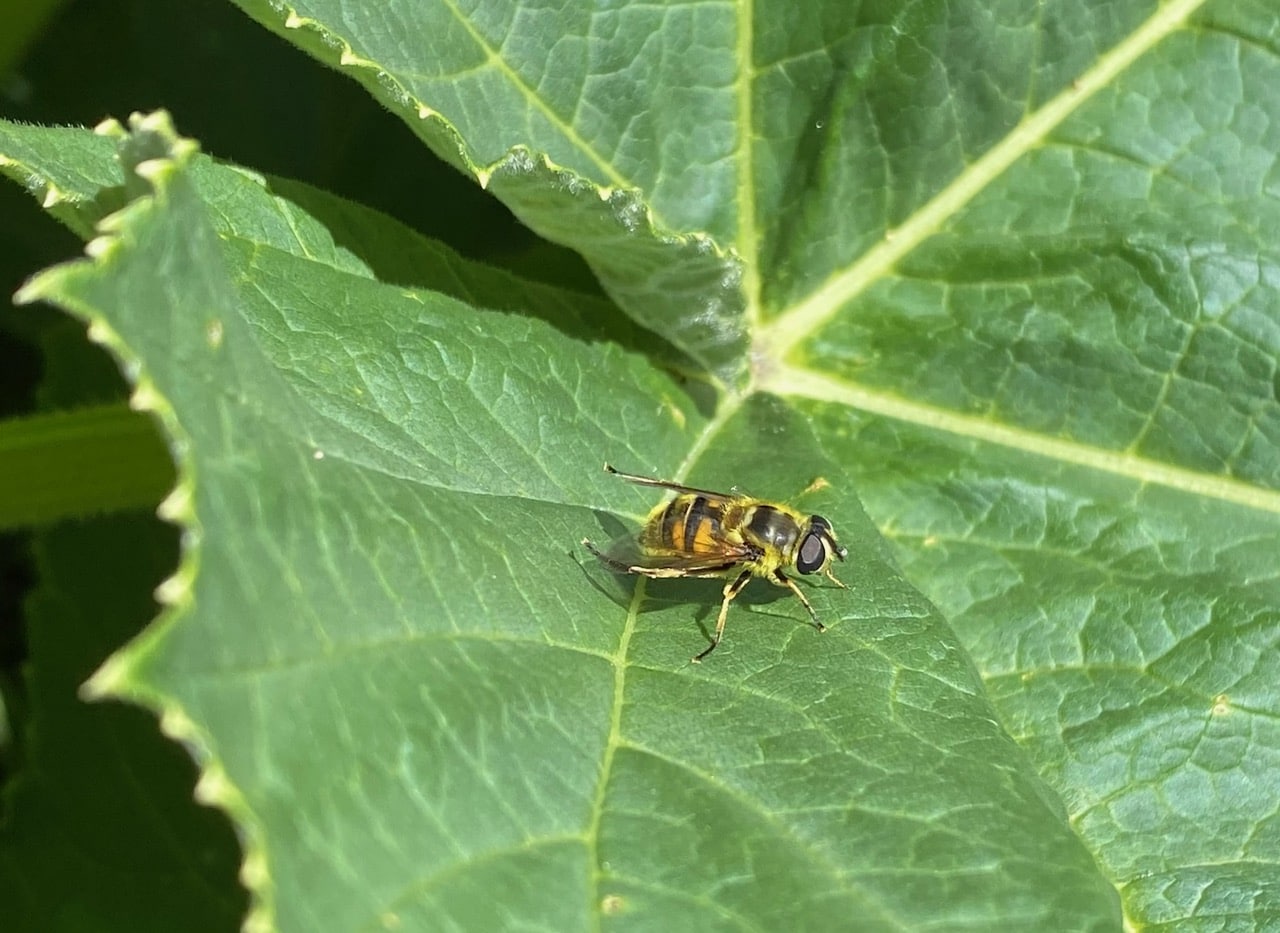
A Yellow-haired Sun Fly, Myathropa florea (family Syrphidae) is grooming itself on a Cow Parsnip leaf, using its hind legs.
Myathropa florea is a very common European and North African species of hoverfly. It is of a similar size to the Common Drone Fly (Eristalis tenax), but Myathropa are generally more yellow, with two light bands to the thorax, interrupted with a black central smudge. These flies are rather variable in size, shape and color. The species occurs in deciduous forests, farmland, parks, and gardens. Adults visit flowers of a wide variety of plants for nectar and pollen. Larvae feed on bacteria in organic waterlogged detritus, often in the shallow rot holes of tree stumps.
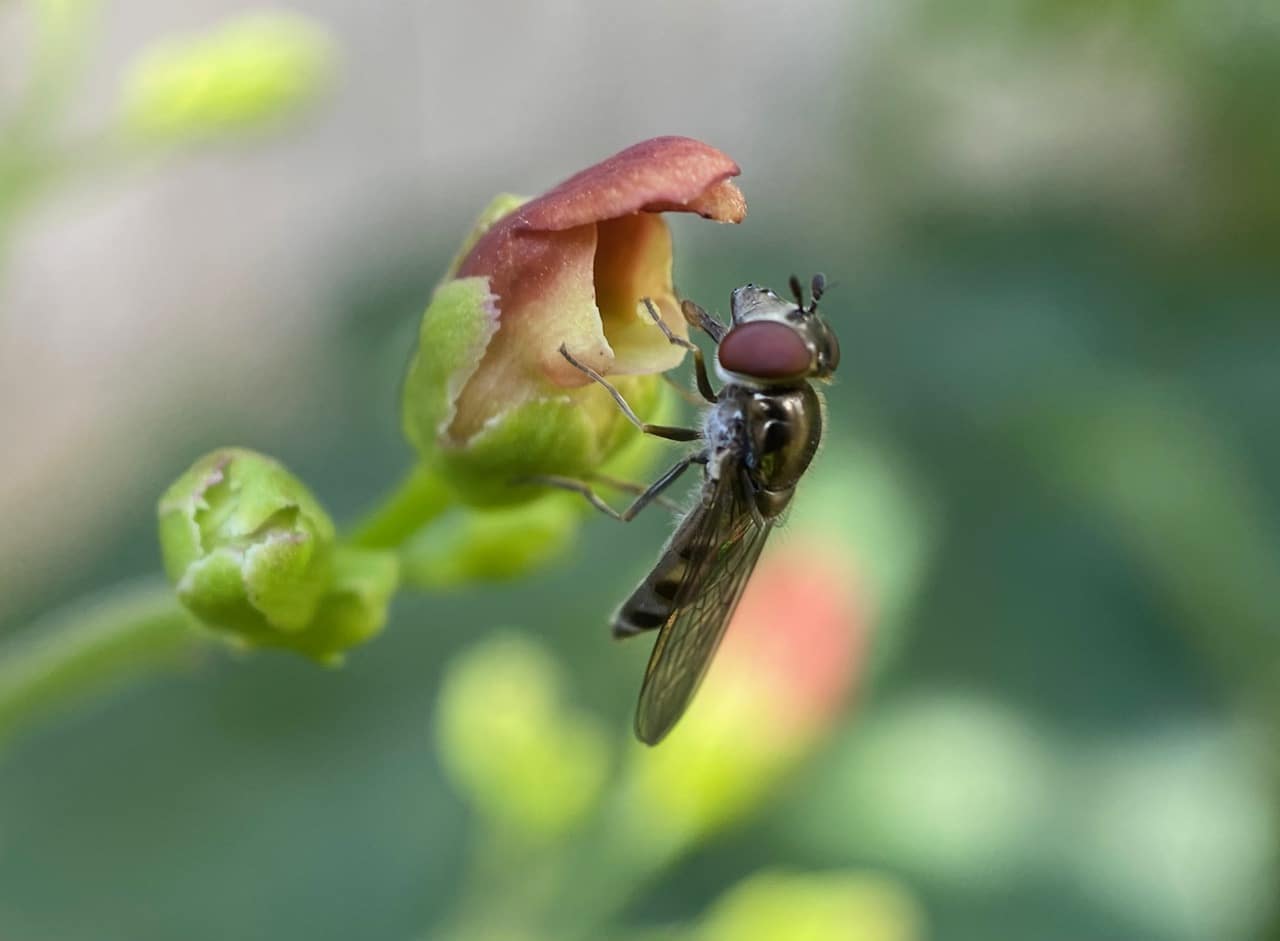
In a shady part of the garden, a Sedgesitter, Platycheirus sp. (famy Syrphidae) visits a fresh flower of the California Bee Plant, Scrophularia californica. The hoverfly is probably taking nectar, since the flower is in its female phase, not yet producing pollen. The Bee Plant is a protogynous species, with females parts maturing before the male parts. See the little cream-colored knob the fly’s front leg is resting on? That’s the flower’s stigma, the female structure for receiving incoming pollen. The temporal separation of the sexes on the same flower is a plant’s strategy for preventing self-pollination.
The Platycheirus hoverfly is commonly found in grass and herb vegetation. Adults of many species feed on pollen of wind-pollinated plants, such as Salix, Plantago, Poaceae, Cyperaceae, but they visit other flowers also. Many stay active during cold and rainy weather. Larvae feed on aphids.

A small Fire-colored Beetle (family Pyrochroidae) is roaming a leaf of Pacific Aster in the shade. Like all beetles, Fire-colored Beetles have chewing mouthparts and hardened front wings (elytra) that meet in a straight line down the back of the abdomen when closed. Most have dark elytra and many are marked with orange or red on the head, legs, or thorax. Some species are orange all over their bodies. Fire-colored Beetles have long, straight antennae, and many individuals (especially males of certain species) have distinct “pectinate” (comb-like) antennae.
Females lay eggs on decaying wood, where the larvae live underneath loose bark of decaying trees. The larvae are apparently fungivorous (feeding on fungi), sometimes becoming cannibalistic at high population densities. Adults visit flowers for nectar and pollen.
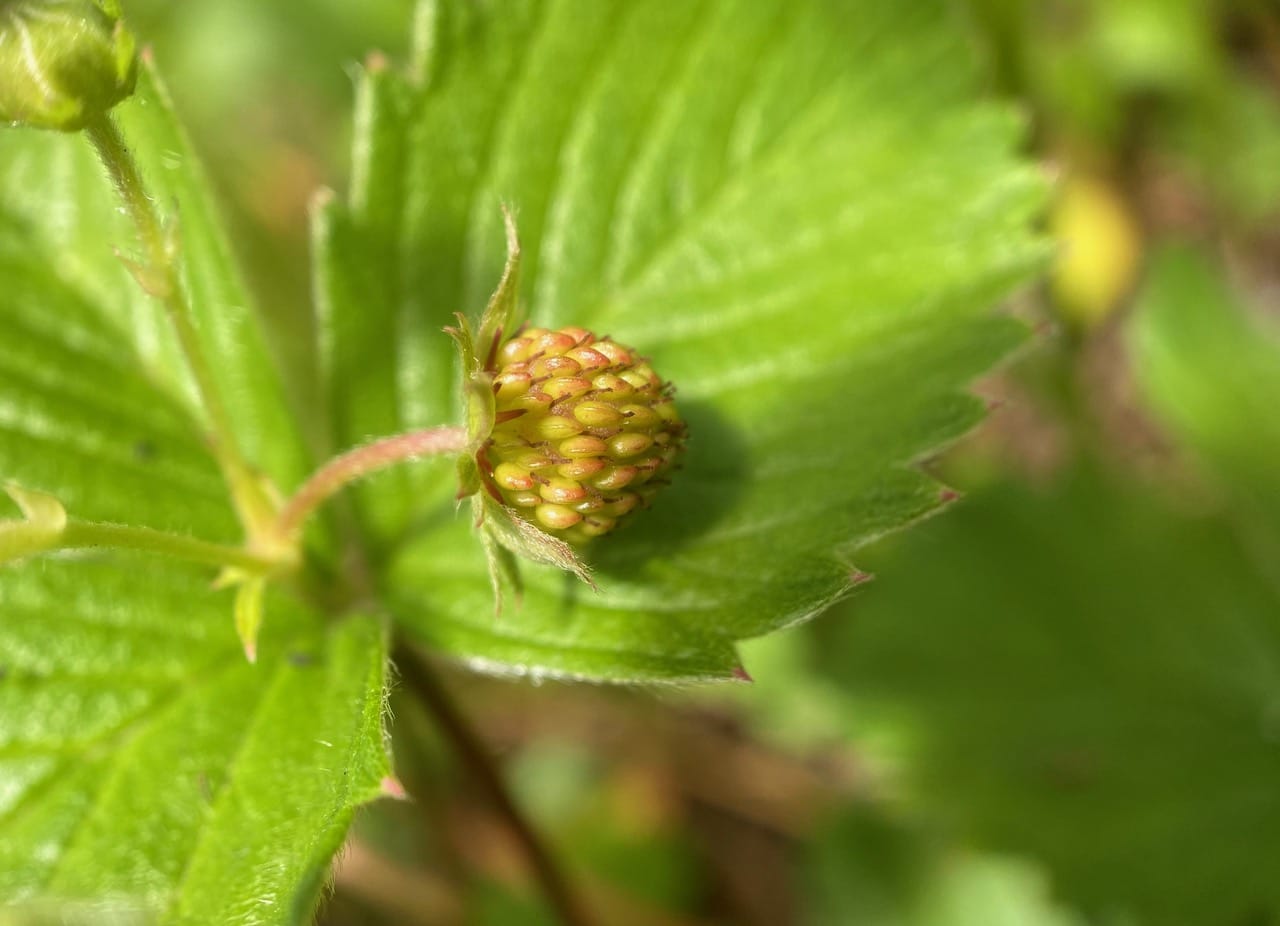
The Wood Strawberry fruits are ripening. And I mean fruits in the plural! This is not a single fruit, but an aggregate fruit. Every little bump here is a fruit, botanically speaking.
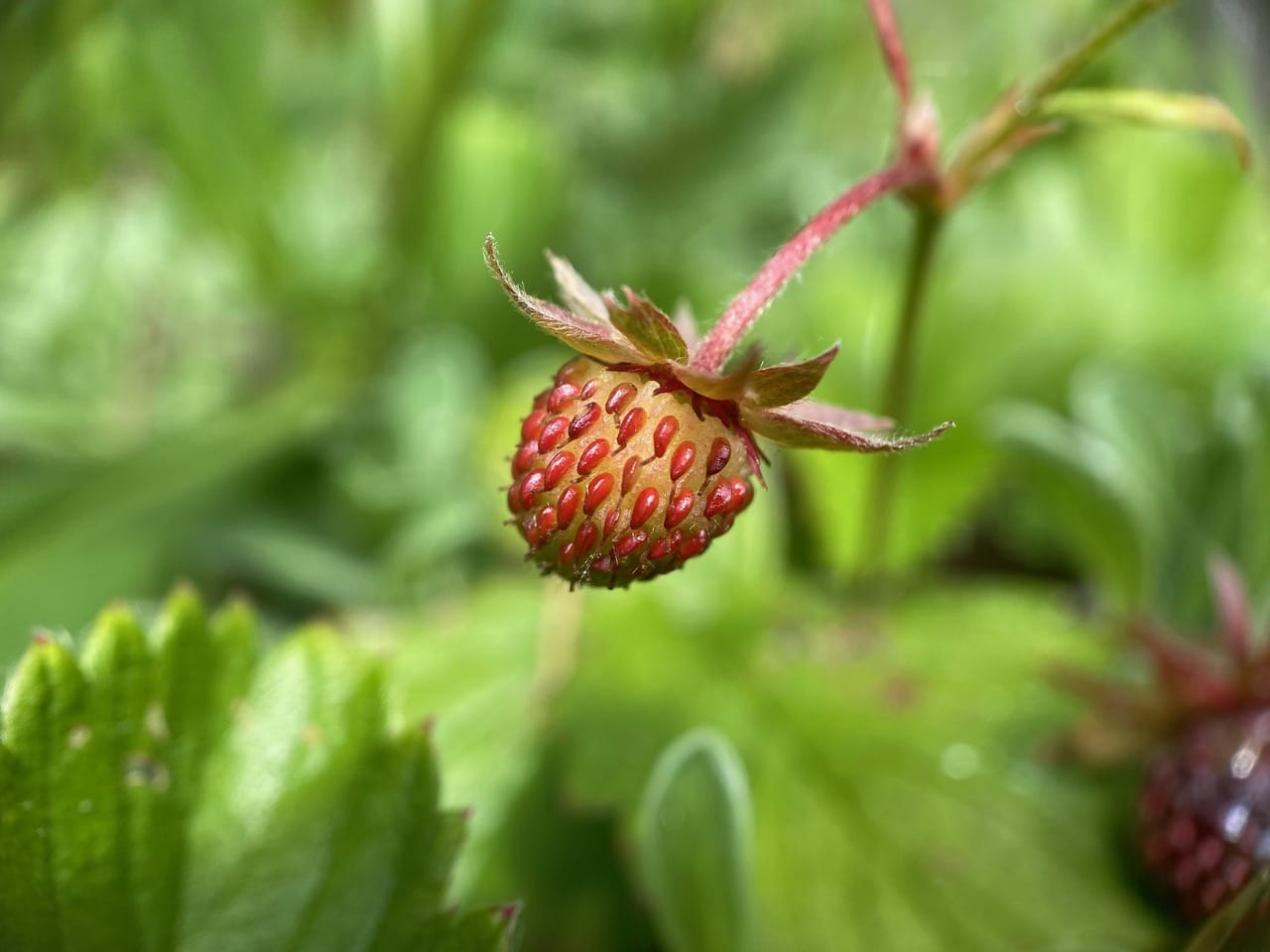
What is swelling under the fruits is the receptacle tissue of the flower. When the strawberry flower is pollinated the fruit doesn’t swell; instead, the receptacle underneath swells, while the true fruit separates into small, dry achenes, each containing a single seed.
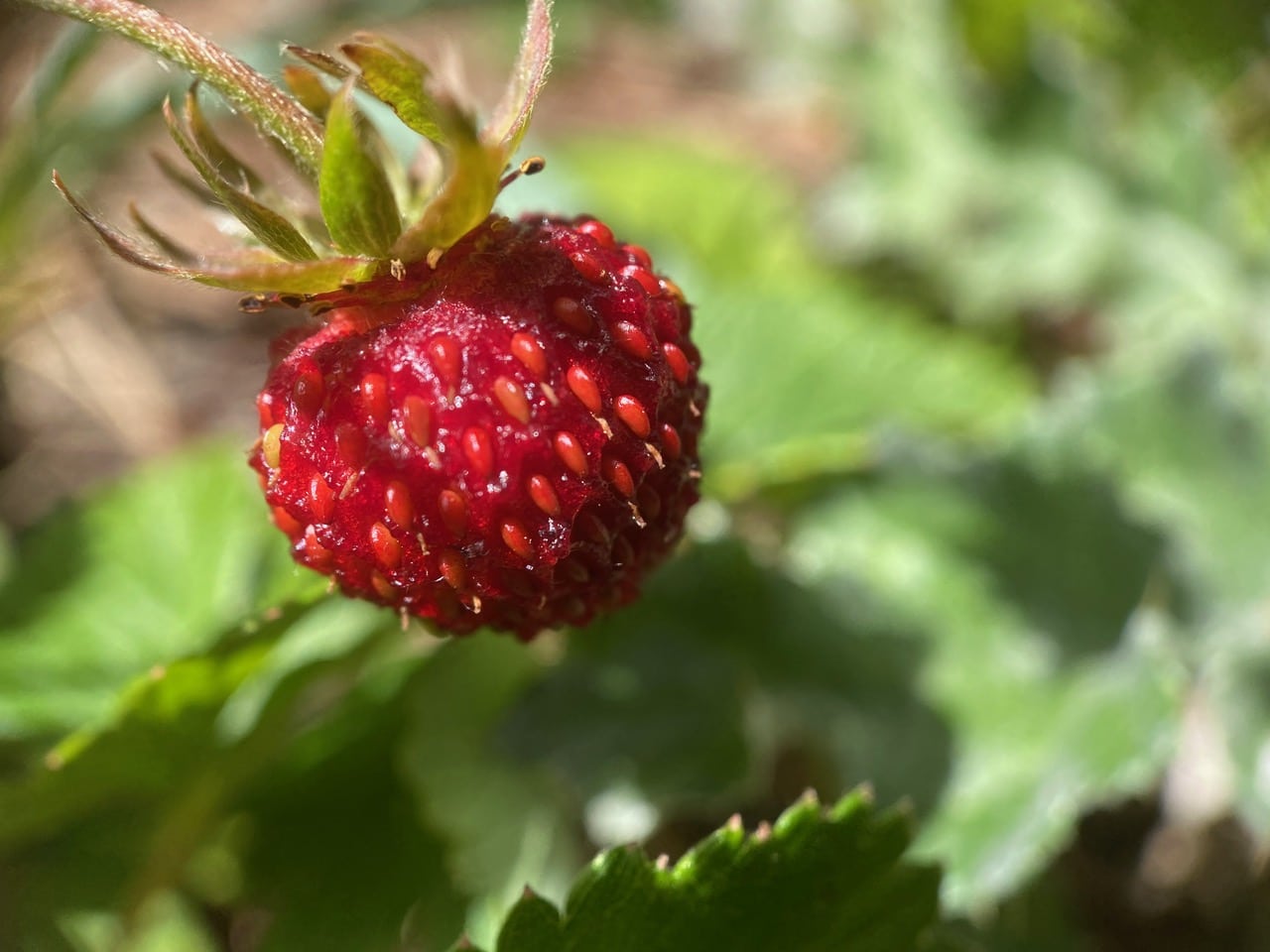
Eventually the receptacle turns red, while the fruits on the surface turn dry and white. These tiny fruits are commonly mistaken as “seeds” on the surface of the store-bought Strawberry we know.
To add insult to injury for the poor tasteless, crunchy achene fruits, most strawberry plants aren’t even grown from their seeds. Strawberry plants send out what’s called “runners” as they grow, essentially little strawberry clones that will take root when they touch the ground.

The terminal leaves of this Pacific Aster have been bound together with silk.
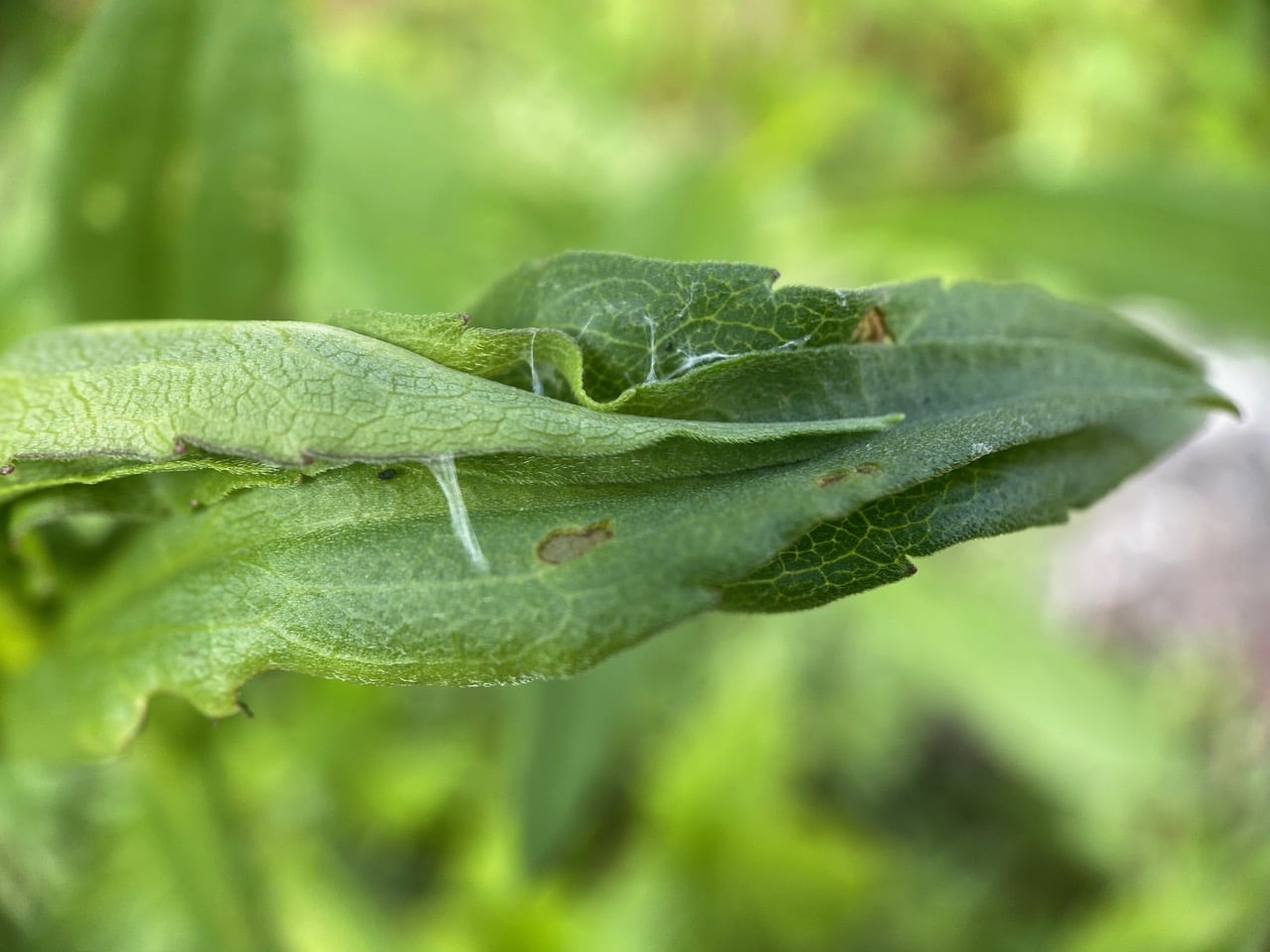
Another shelter in which a Tortrix caterpillar can feed in safety?
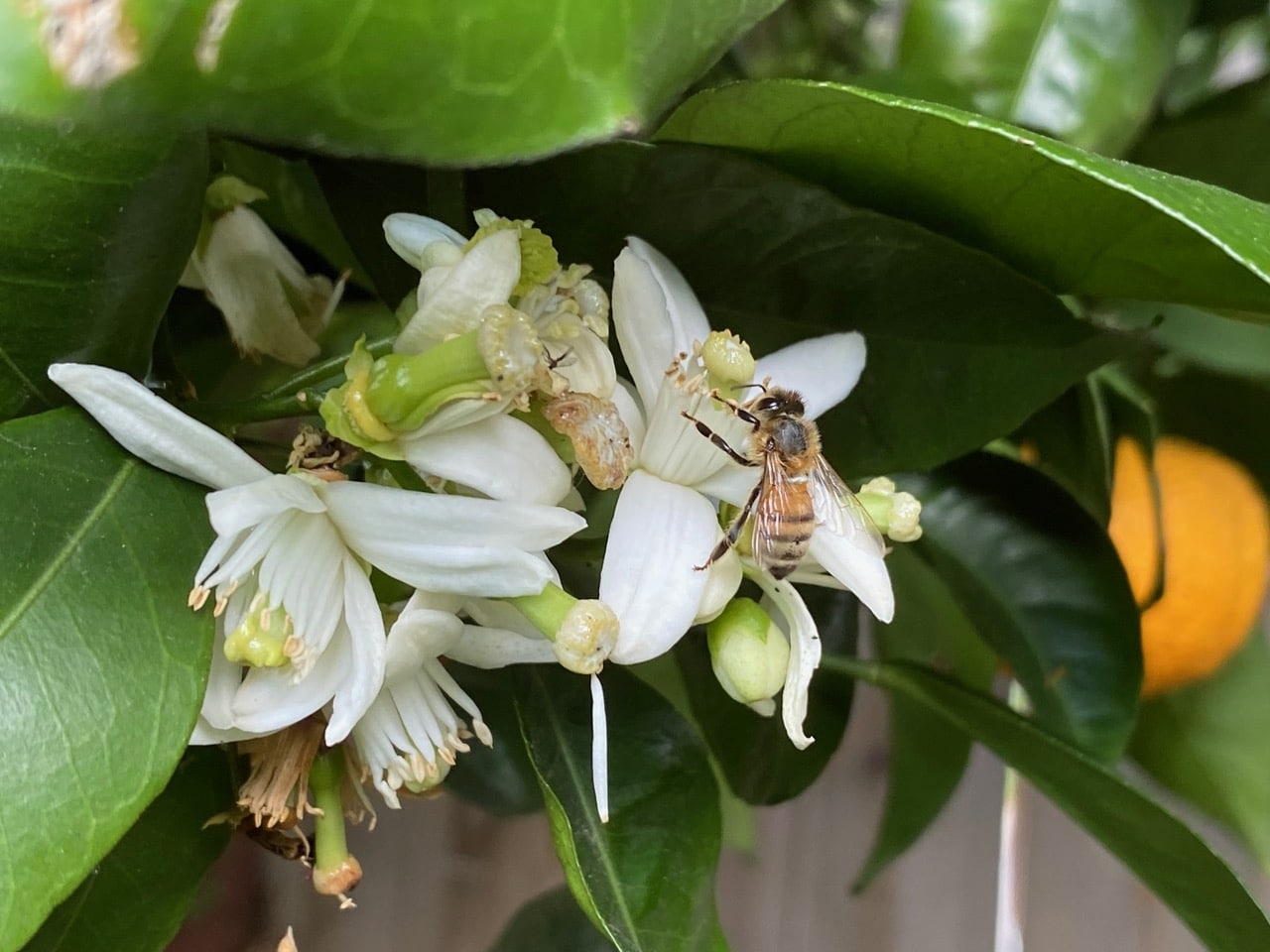 A large orange tree grows in one corner of the garden. The white blossoms release a sweet fragrance that permeates the space around it. A Honey Bee, Apis mellifera (family Apidae) is foraging among a cluster of flowers. The flowers are large, with petals thick and almost waxy. A robust pistil sits in the center surrounded by a “fence” of long, erect stamens with anthers on top like candle flames.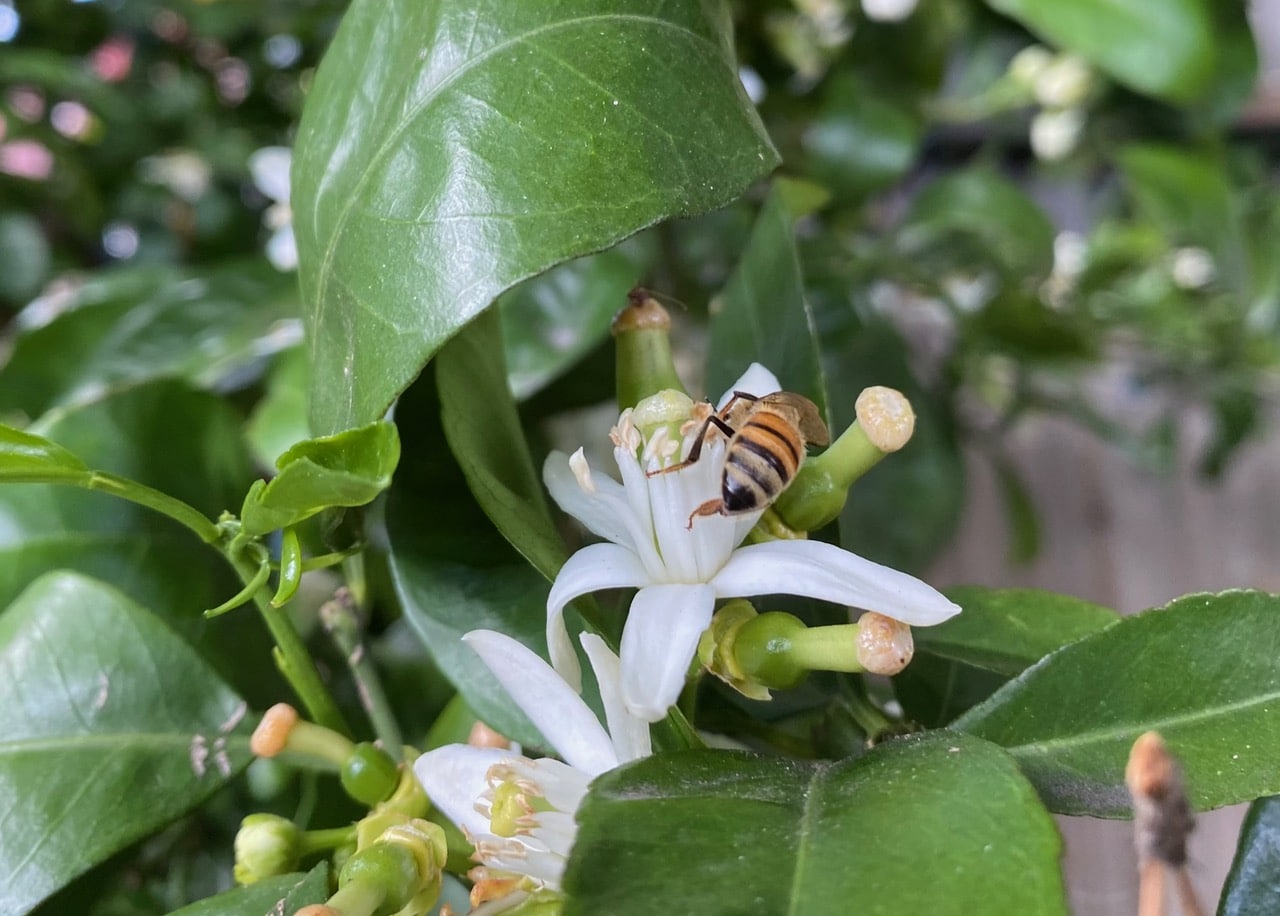
The eager bee reminds me of this cool story about the Citrus blossoms.
The flower nectar of citrus (including grapefruit, lemon and oranges), along with coffee plant flowers, contains caffeine. When honey bees feed on caffeine-containing nectar, the caffeine buzz improves their memory and/or motivates them to come back for more.
In a study reported in the journal Science, scientists from Arizona State University and the United Kingdom showed that the effect of caffeine on the bees’ long-term memory was profound, with three times as many bees remembering the floral scent 24 hours later and twice as many bees remembering the scent after three days. Caffeine is usually produced by the plants as a defense chemical against insects, and tastes bitter to many insects, including bees. But interestingly it occurs at a dose that’s too low for the bees to taste but high enough to affect their behavior.
The baiting phenomenon benefits both the honey bee and the plant. While increasing the bee’s foraging efficiency, caffeine helps the plants recruit more bees to spread their pollen, and ensures that their pollen is delivered correctly to the plants of the same species. A win-win situation.

While observing other insect activities in the garden, I am constantly on the lookout for the little brown Nomad Bees. They are flitting around near the ground, but manage to elude my camera at every turn. Then I notice one perched stock-still on a leaf of Pacific Aster in the shade. From its long antennae, I assume it is a male. The bee is about 1/4 in. long minus the antennae. (The absence of scopae on the bee is not a good trait for distinguishing the sexes of cuckoo bees, as the females do not collect pollen either.) I manage to photograph him from every angle – the chestnut-brown body with black markings are quite distinctive, those mud-colored, mottled eyes, and the dark, smokey wings. Surely iNaturalist would be able to help identify the species?
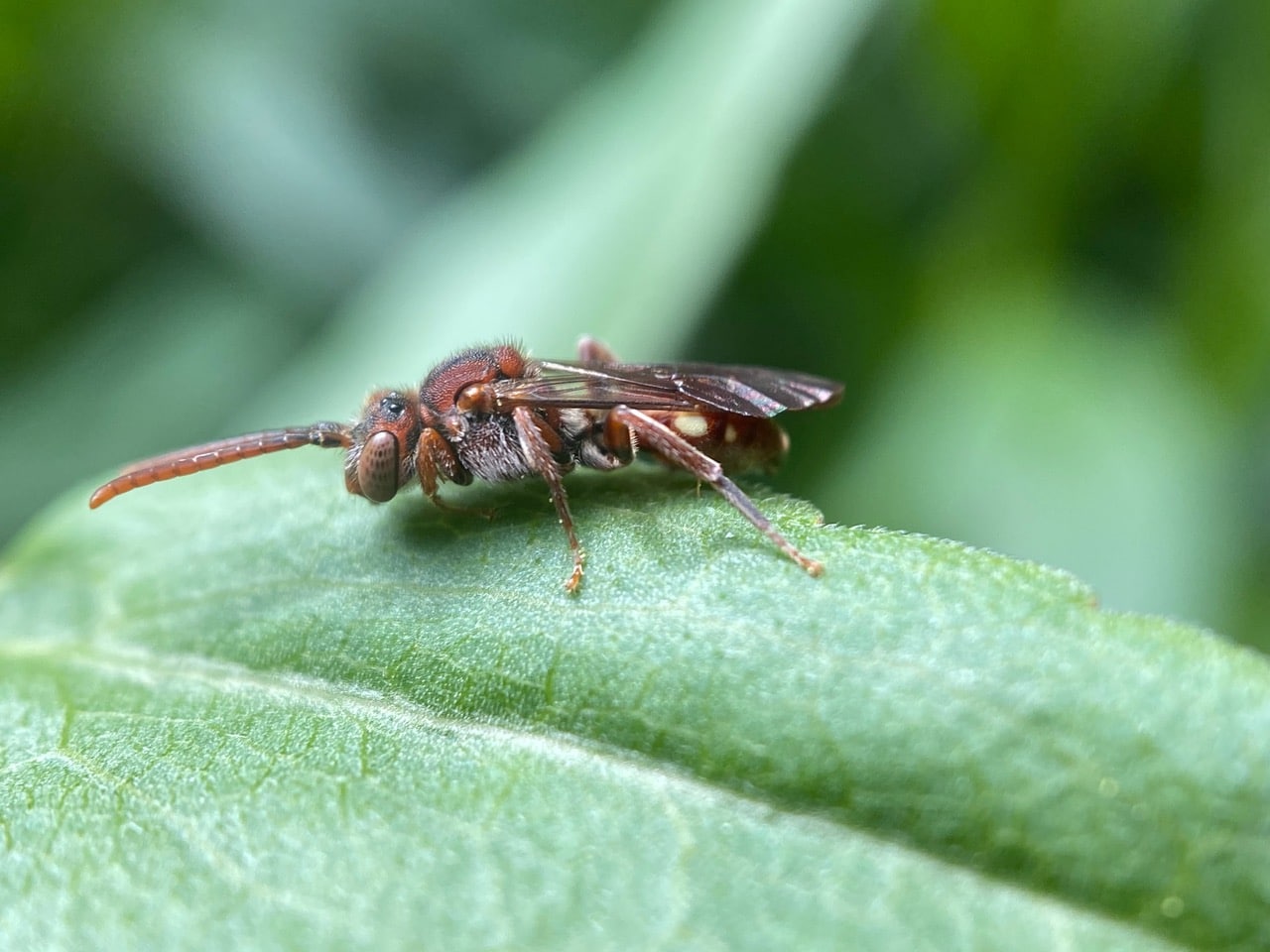
Nomad Bees in the genus Nomada is one of the largest genera in the family Apidae, and the largest genus of Cuckoo Bees. Nomada are kleptoparasites of many different types of ground-nesting bees as hosts, primarily the genus Andrena. They lack a pollen-carrying scopa, and are mostly hairless, as they do not collect pollen to feed their offspring. Adults visit flowers for nectar. The bees are extraordinarily wasp-like in appearance, often with yellow or white integumental markings on their abdomen.
Nomad Bees occur worldwide. All known species parasitize ground-nesting bees, and their habitats and seasonality correlate closely with their hosts. In early spring, females scout out their hosts, searching for nests to parasitize. The female Nomada sneaks into the host’s nest while the resident female is out foraging, then lays eggs in the nest. The parasite larva that hatches out kills the host offspring and feeds on the host’s provisions. This type of parasitism is termed brood parasitism. The parasites pupate in the host cell and finally emerge as adults the following season along with the hosts.
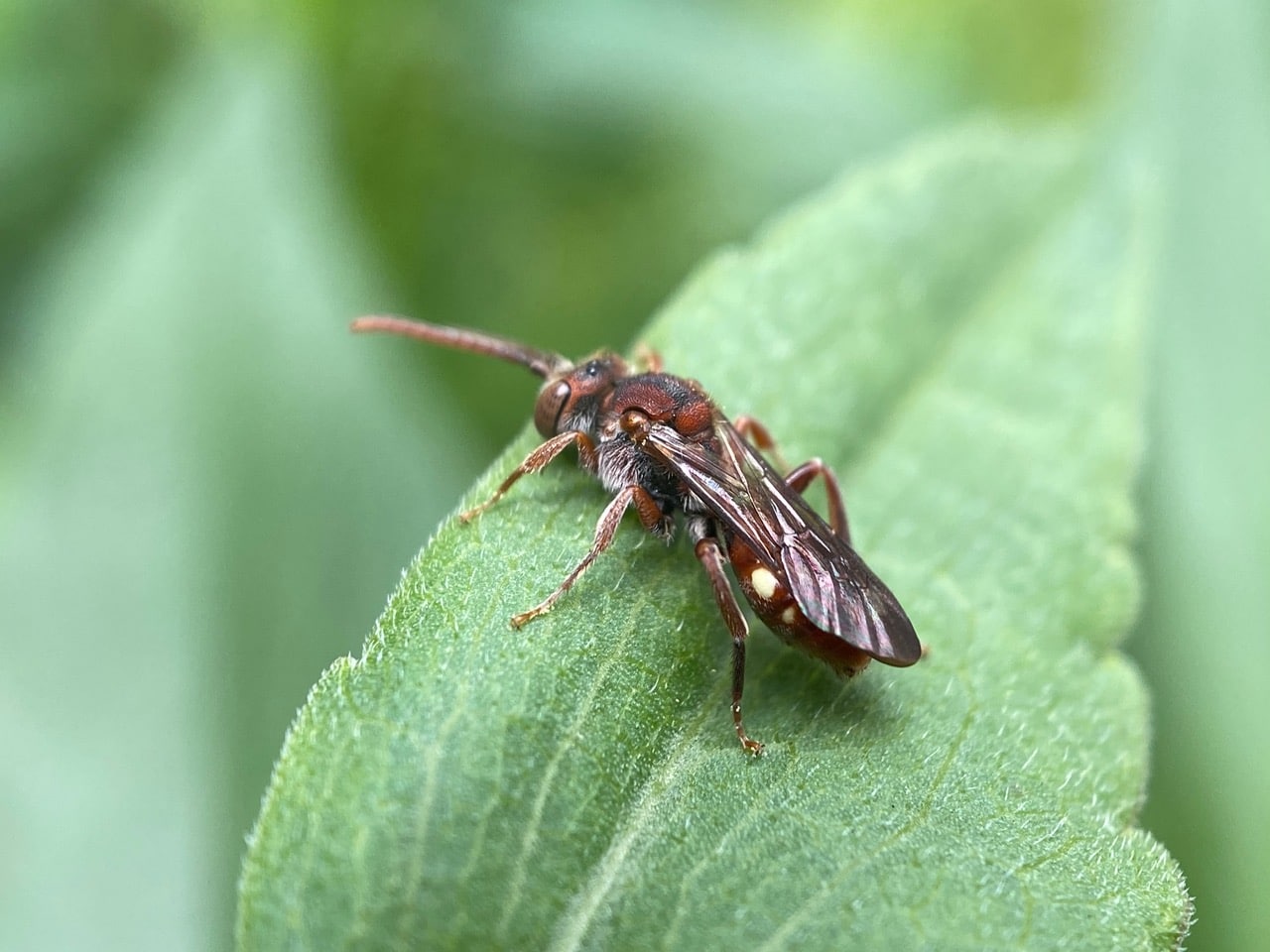
The white spots on the side of this bee’s abdomen are quite visible from the side.

A Sedgesitter, Platycheirus sp. (family Syrphidae) is taking nectar from a flower of Miner’s Lettuce, Claytonia perfoliata. Clearly the yellow pollen on its thorax is from another flower. This hoverfly is probably the most common pollinator in this garden.
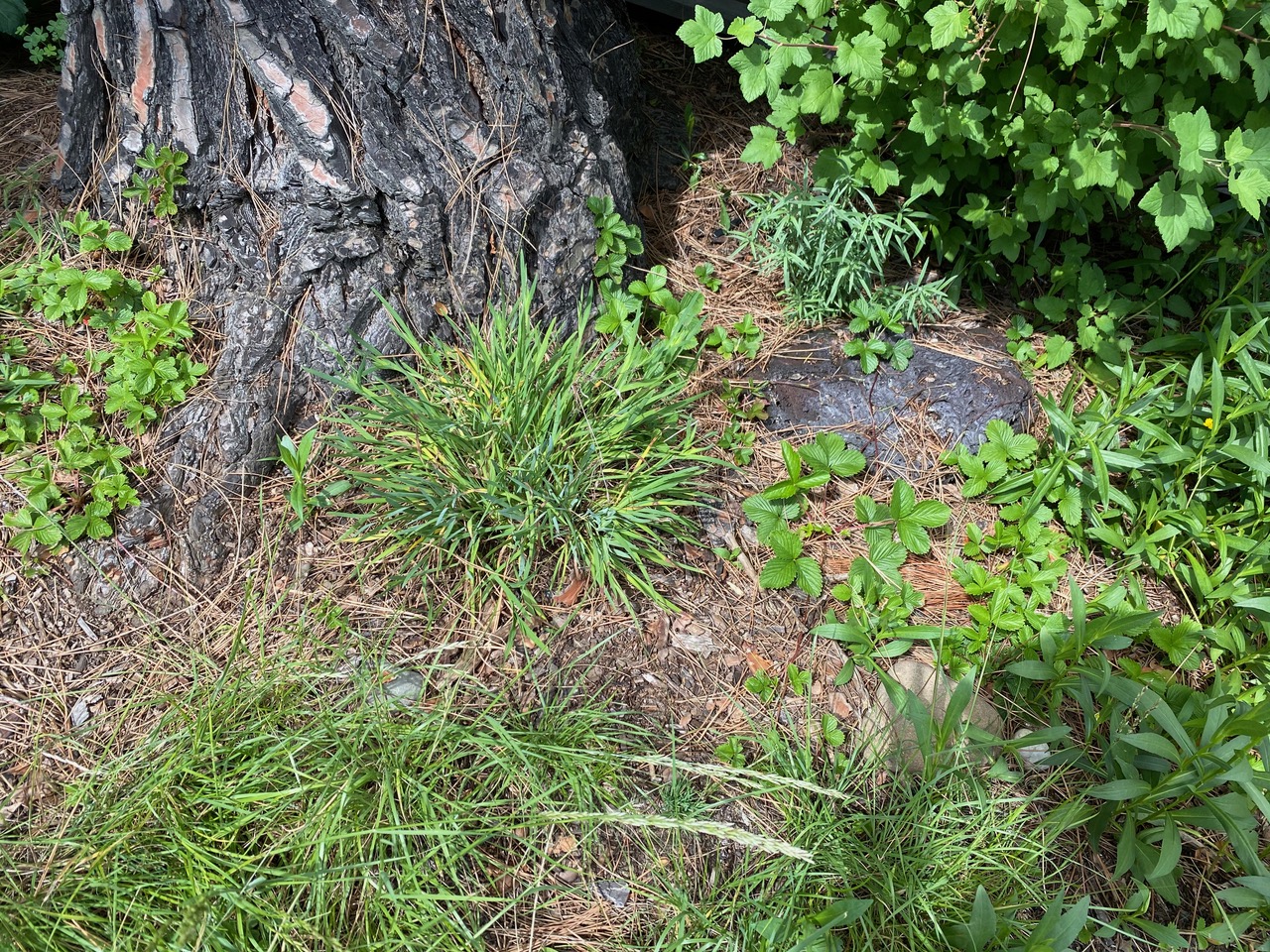
The patchy bare ground under a large Monterey Pine gets my attention. I keep seeing a little brown bee (Nomad Bee?) lurk around the mulch, sometimes on the ground, often on a nearby Pacific Aster, or under a clump of Blue-eyed Grass. Is it a female Nomad Bee scouting for a potential host nest?
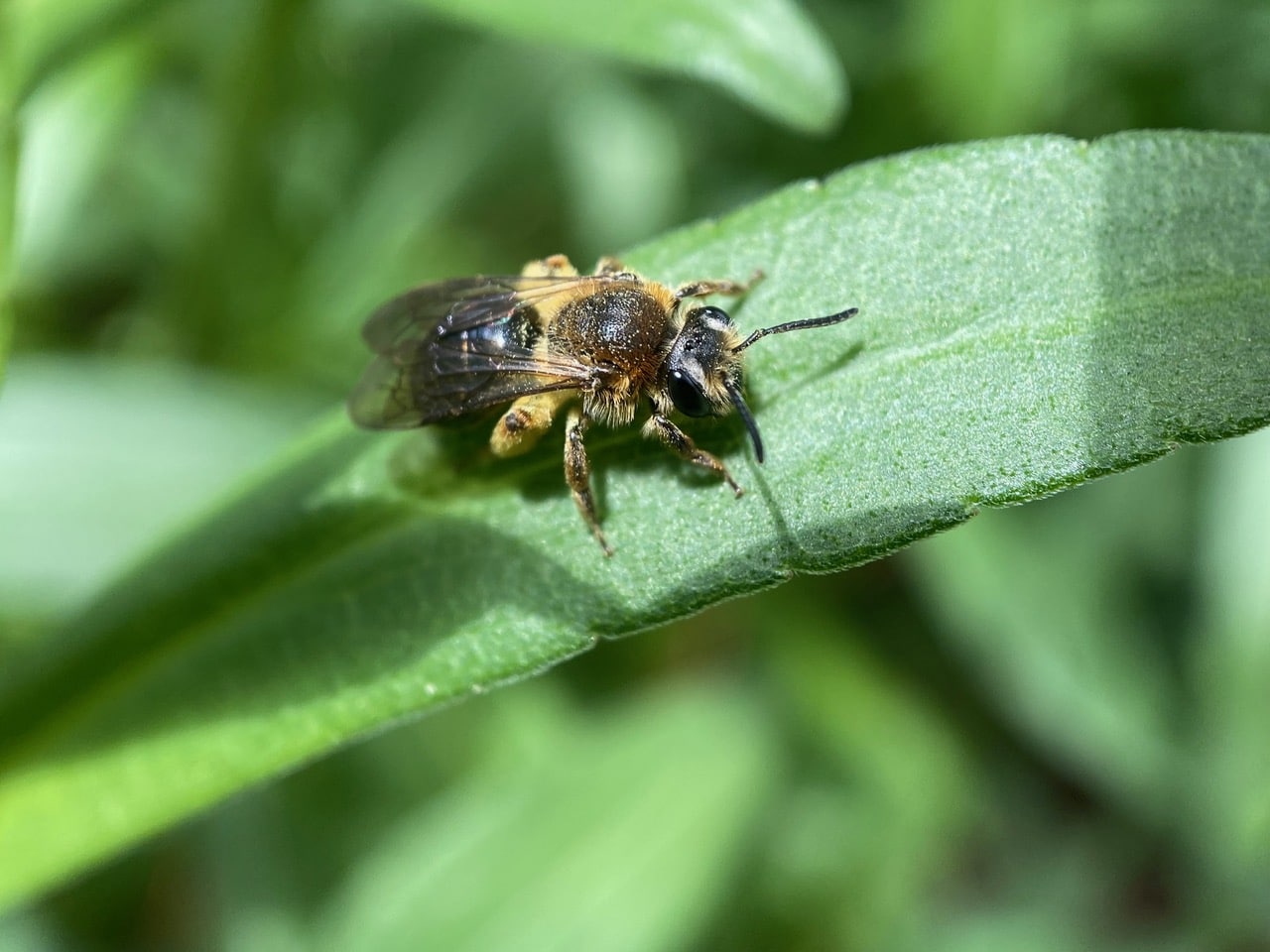 Then a robust Mining Bee, Andrena sp. (family Andrenidae) lands on the said Pacific Aster under the pine tree. She has a modest load of pollen in the scopae of her hind legs. She is portly and slow, and easy to photograph.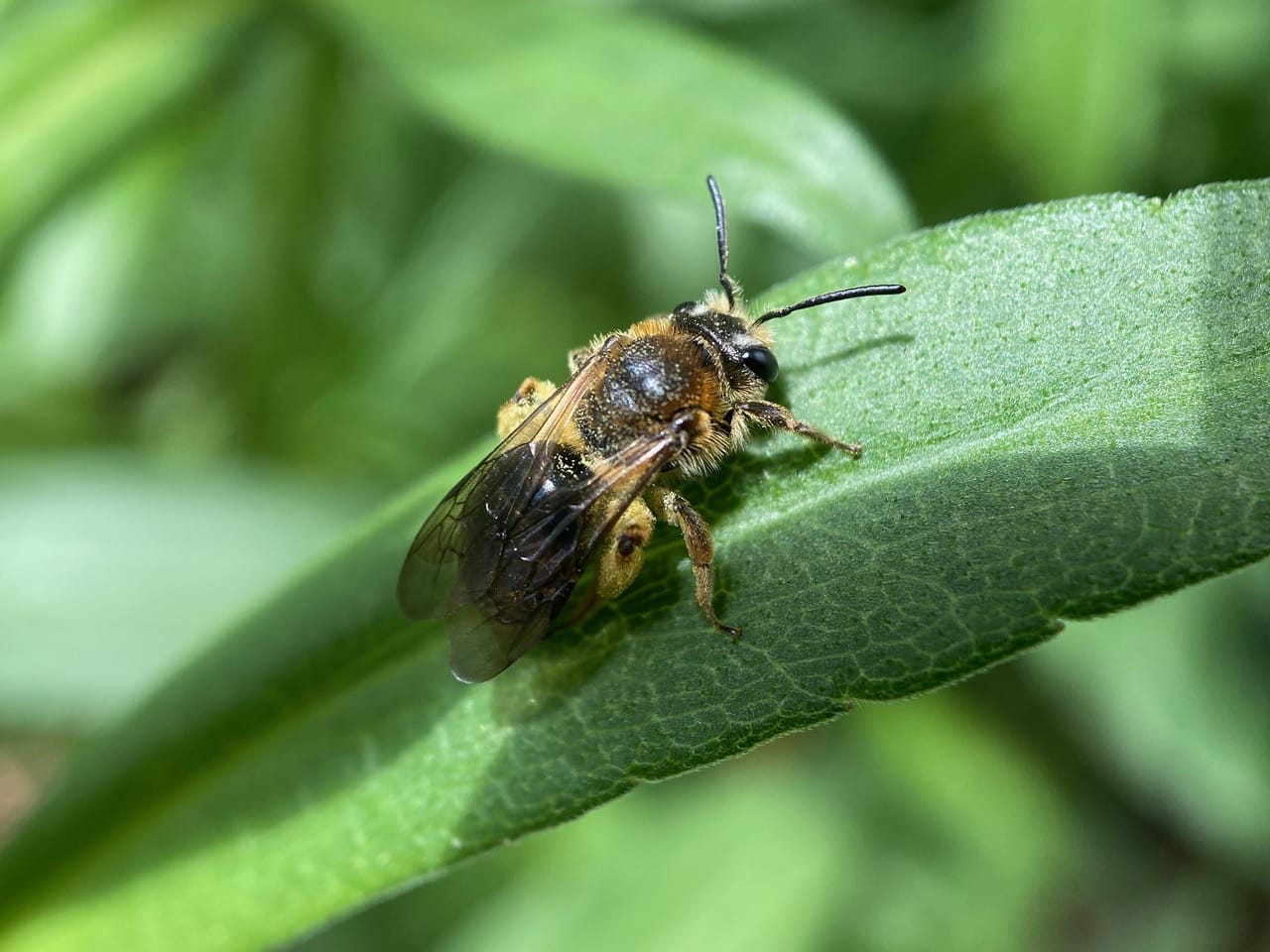
Note the long hairs that line the inner edge of her compound eyes, part of the facial fovea typical of the genus Andrena.
Andrena is likely the largest and most species-diverse bee genus in California. It is one of the largest bee genera in the world. The floral preferences of Andrena species span the range of bee diets; some are broad generalists, and a number are strict specialists. Andrena are among the first bees to fly in the spring; their ability to withstand the chill is still a puzzle to scientists. The bees can’t fly until their body temperatures reach 50-60 F. They rely on the warmth of the sun to get them to speed, and it is not uncommon to see them warming up on leaves or rocks. This cold-hardiness makes Andrena excellent pollinators of early spring wildflowers and cultivated crops.

As the bee clambers onto another leaf, I get a glimpse of her extensive scopae (special pollen collecting hairs). As in all members of the genus Andrena, her scopa extends the full length of her hind leg. In addition, Andrena bees also have a propodial corbicula (long hairs between the thorax and the abdomen) that is also used to carry pollen.
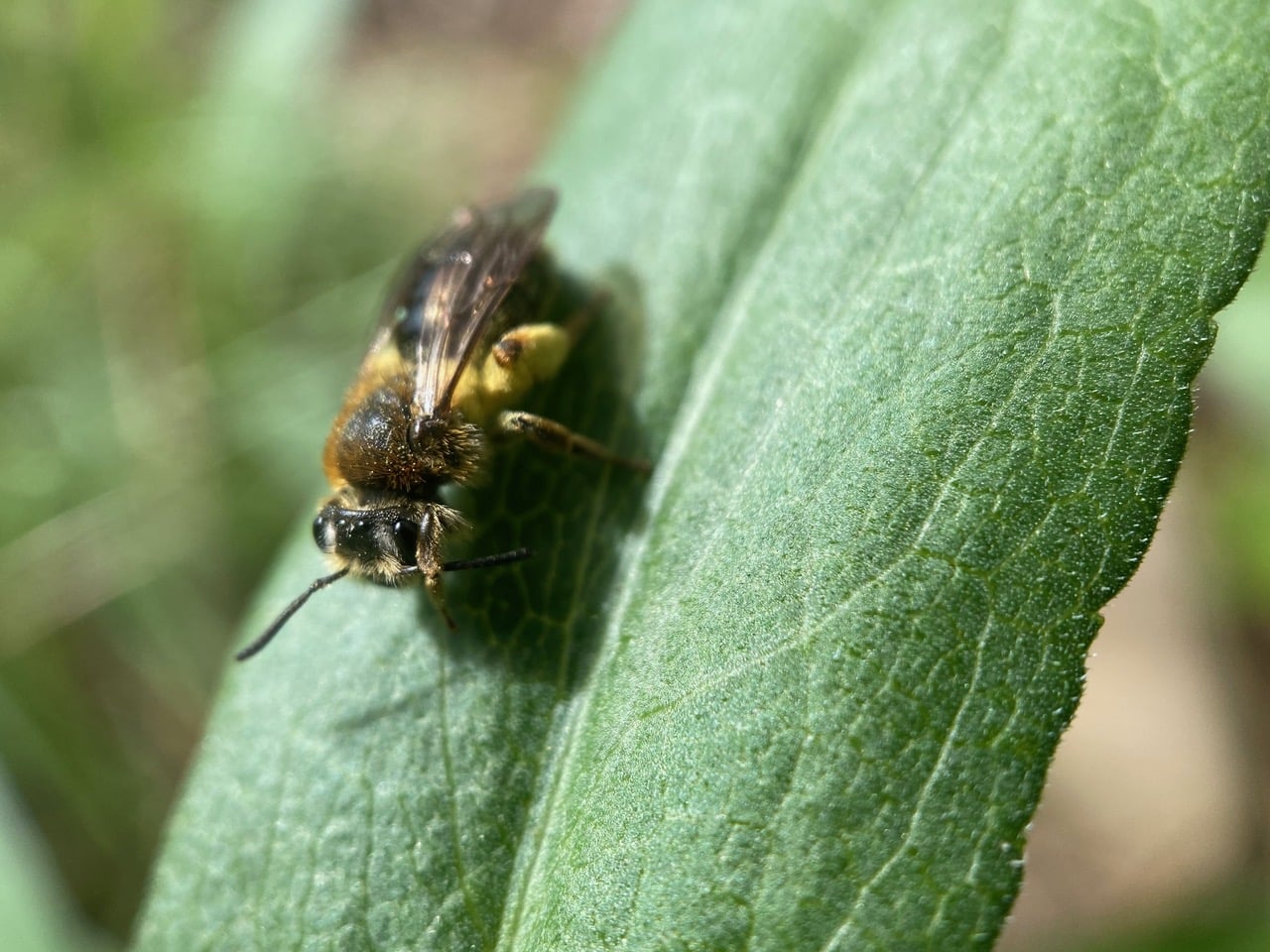
The bee takes a little time to clean her antennae with her front legs. Then off she flies, and I lose sight of her. I think she is using the aster as a staging area before going down to her nest in the ground below. The bee seems very familiar with the terrain of this plant.

Ooh, another Yellow-haired Sun Fly, Myathropa florea (family Syrphidae). These hoverflies seem to like basking on the Cow Parsnip leaves.
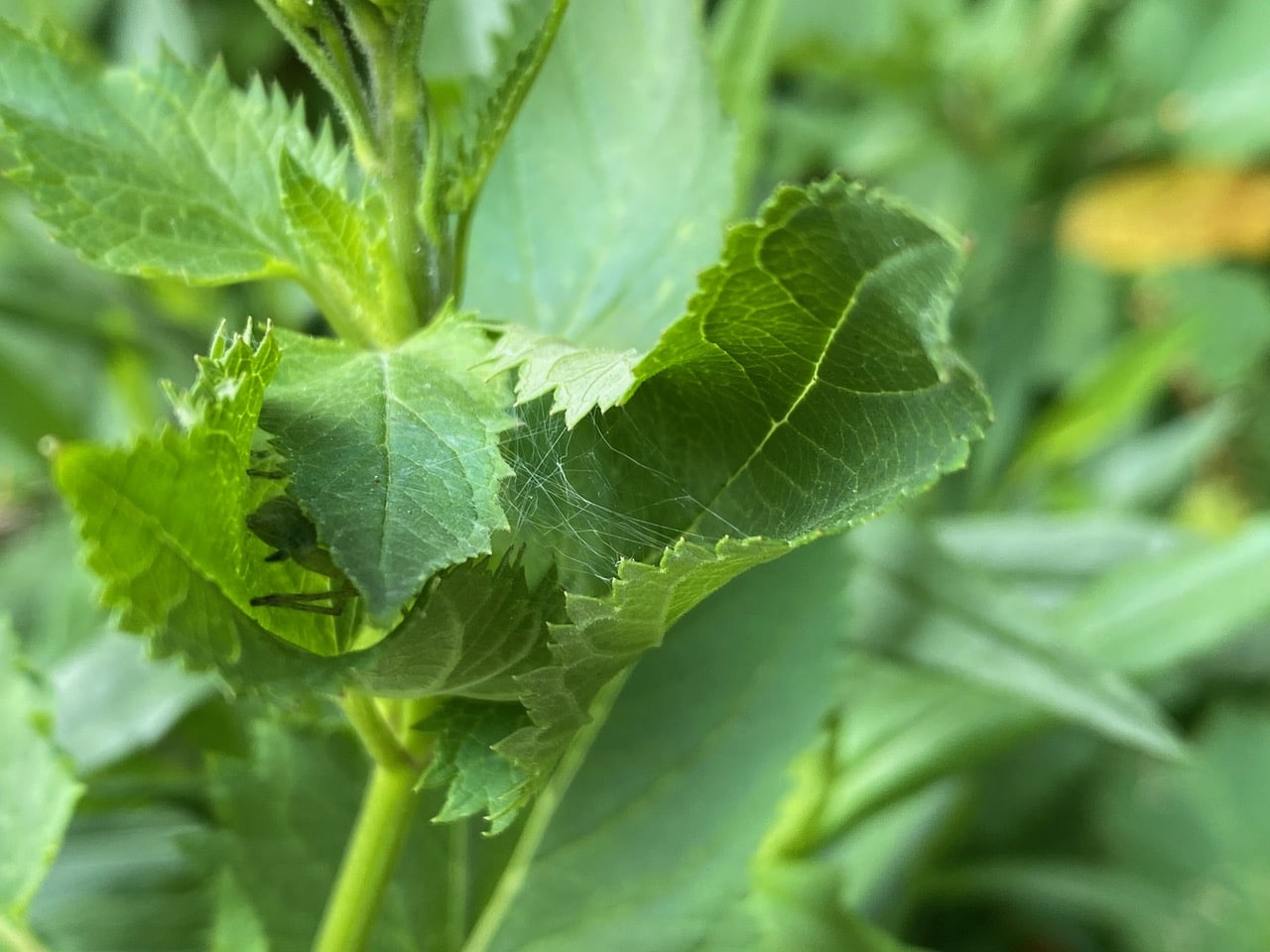
The top leaves of a California Bee Plant have been loosely drawn together with silk. I can even see the owner of the retreat – a Yellow Sac Spider, genus Cheiracanthium !
The American Yellow Sac Spider, Cheiracanthium inclusum (family Cheiracanthiidae) are native to the New World. They are most often found in trees and shrubs in forests and gardens, but may also find shelter in houses and other human-made structures. The spider is a pale yellow-beige color with dark brown markings on its palps, chelicerae (jaws) and on the ends of its tarsi (feet). The front pair of legs are longer than the other 3 pairs. Eight similarly sized eyes are distributed in two parallel horizontal rows. Since the spider is nocturnal, its eyesight is of minor importance. The spider relies more on its palps to sense its environment. Being nocturnal, the spiders feed and mate at night. C. inclusum do not make webs to catch prey; instead, they are active predators, feeding on a variety of insects and other spiders. During the day, they retreat in small silk nests. A new nest may be completely closed, open on one side, or open on both sides, is built every day, often enclosed in terminal leaves that have been drawn together.