

Pollinator Post 4/12/24 (1)

Back to the more familiar ground of Skyline Gardens. While I’m not likely to encounter new critters after two years of observation, it is comforting to greet the old friends.
Walking south along Skyline Trail from Siesta Gate, I come to the patch of California Bee Plants, Scrophularia californica under the steep vertical bank that has suffered some erosion during the wet winter. The plants are slow in coming back, and I notice that the insect life on them are slow in catching up as well. While the Variable Checkerspot caterpillars further north along the trail are ready to pupate, the ones here are few and far between, and small. This caterpillar is lying next to its exuvia (shed skin) on what looks like a silken pad it has woven for itself on the leaf.
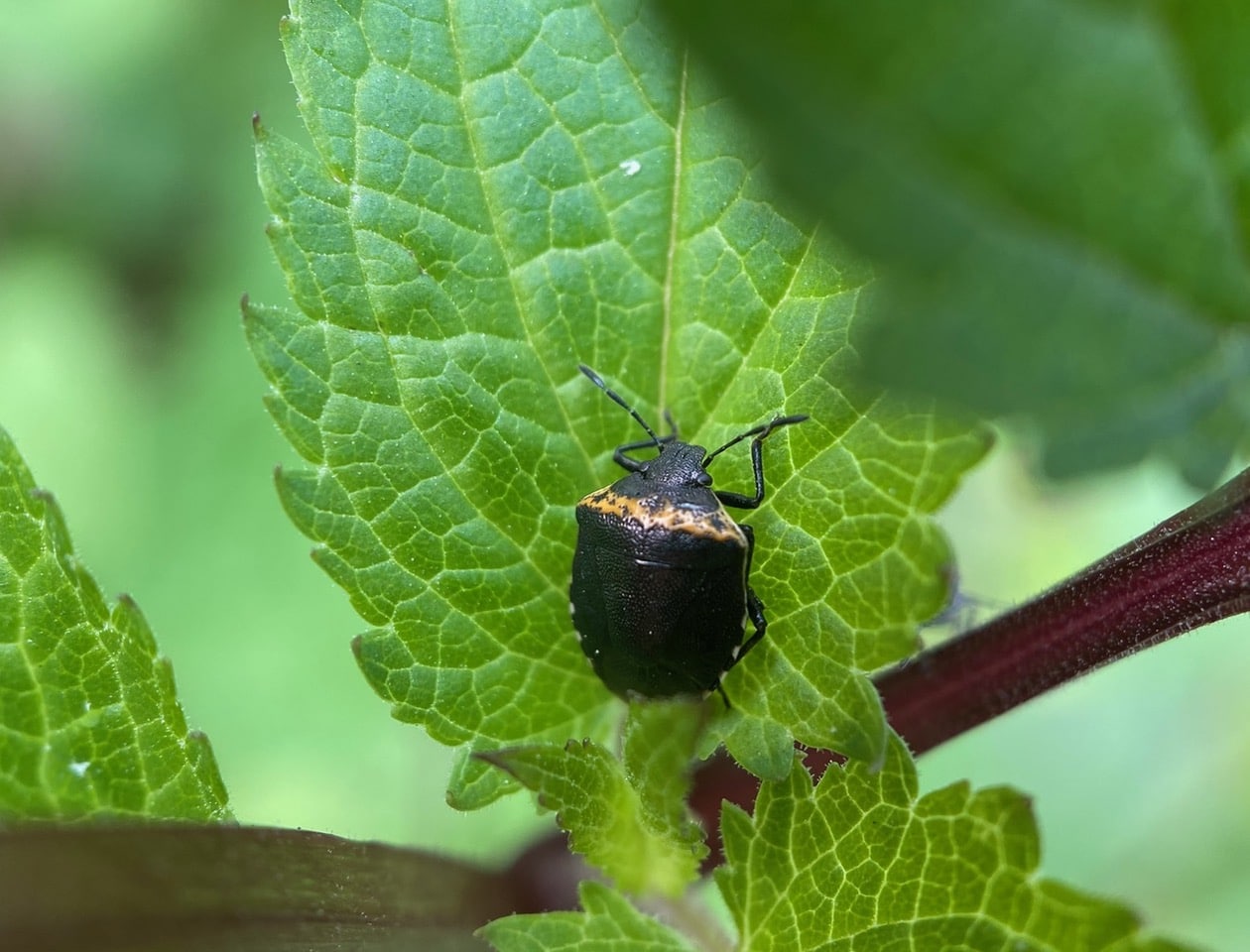
Wedged in a leaf axil, a small Stink Bug, Cosmopepla uhleri (family Pentatomidae) peers meekly at me as I part some leaves for a clear view.
The bug is easily recognizable – black with an orange transhumeral band with black spots. The bug uses Scropularia californica as a host plant.
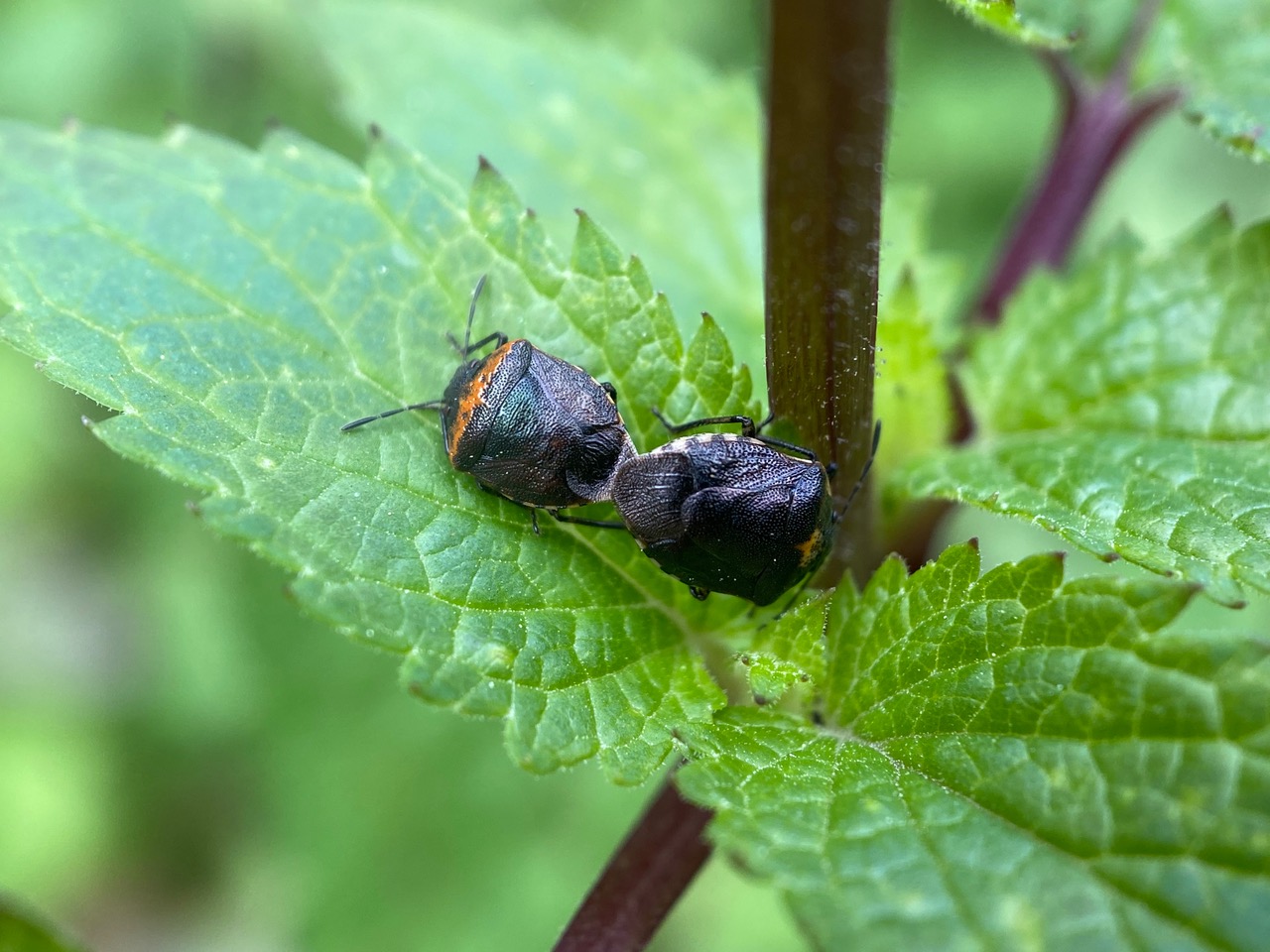
A pair of Cosmopepla uhleri is mating on a Bee Plant leaf.
Pentatomidae is a family of insects belonging to the order Hemiptera or “true bugs”. As hemipterans, the pentatomids have piercing-sucking mouthparts, and most are phytophagous, including several species that are severe pests on agricultural crops. Stink Bugs feed on plant fluids by inserting their needlelike mouthparts into stems, leaves or seed pods. While feeding, they inject materials into the plant to aid in digestion and sap removal. Penetration by the mouthparts can cause physical damage, much like stabbing the plant with a fine needle. Cosmopepla uhleri is so small that the damage is generally limited to fine stippling on the leaves of California Bee Plant.
All Pentatomids have 5-segmented antennae (hence their family name, Penta – five and tomos – section.) They generally have a large triangular scutellum in the center of the back. The adult is generally shield-shaped when viewed from above. The common name of Stink Bug refers to their ability to release a pungent defensive spray when threatened, disturbed, or crushed.
#/media/File:Heteroptera_morphology-d.svg)
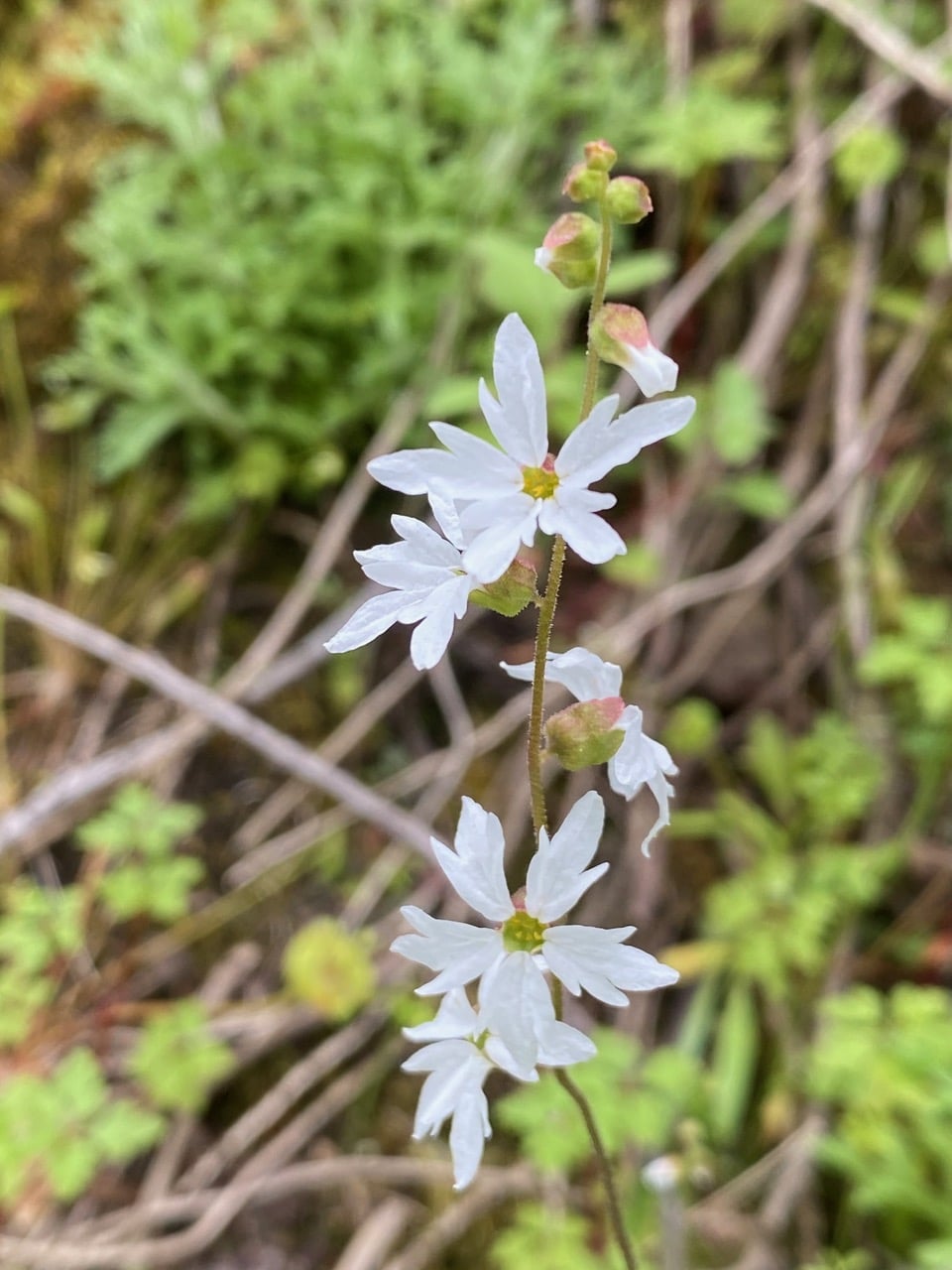
This seems to be a very good year for the Woodland Star, Lithophragma affine (family Saxifragaceae). One can find several spikes of the white flowers in the same spot on the wetter trail bank. Again, much as I try, I can’t seem to smell the flowers’s purported fragrance. I need the antenna of a moth!
The five petals of Woodland Star, Lithophragma affine (family Saxifragaceae) are bright white with deep long lobes or teeth. 5 petals connect separately to a base, with 5 green sepals connecting between them forming a cup-shaped structure holding the reproductive parts. The center of the flower holds 10 short-stemmed stamens and a central pistil. A study has found a remarkable diversity in the scent compounds produced by the flowers. Every species of woodland star produces a unique floral bouquet to attract specialized pollinators. The plant has coevolved with a group of specialized moths in the genus Greya, that pollinate and lay eggs only in woodland star flowers. It is a sort of love-hate relationship. Although the plants lose some of their developing seeds to the moth larvae, the benefits the plants receive from pollination usually outweighs the costs.
Many of us are familiar with the story of the Yucca and the Yucca Moths, a much-celebrated mutualism between the plant and its pollinators. Like the Yucca Moths, the Greya moths that pollinate the Woodland Star are in the family Prodoxidae! In both cases, the moths visit the flowers to lay eggs, not to seek food. In the process of oviposition, their bodies come into contact with the pollen of the flower. This mode of pollination is termed brood site or nursery pollination. So tight is the mutualism that every species of Lithophragma is pollinated by its own species of Greya moth! The Woodland Star and the moths have shaped each other’s evolution.
As in most moths, the Greya moths are nocturnal and navigate their world predominantly by their sense of smell. White flowers show up well in the moonlight, and scents travel just as well in the dark.
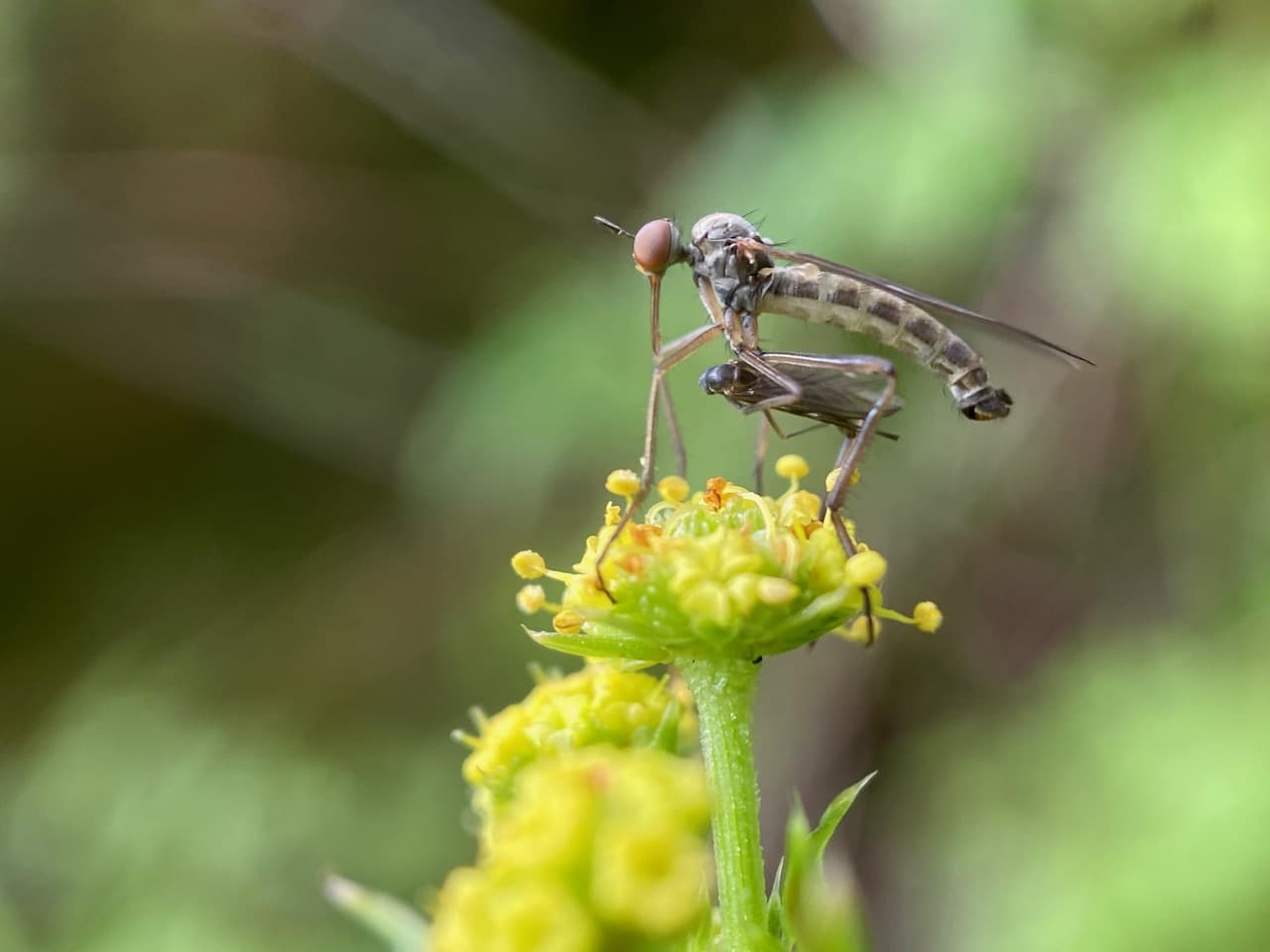
An Empidid Dance Fly (family Empididae) lands on a cluster of flowers of Pacific Sanicle, Sanicula crassicaulis. It is a male, and in his middle legs he is holding a small insect he has caught. He shows no sign of wanting to feed on the prey. Maybe he is going to use it as a nuptial gift when he goes courting a female.
Dance Flies, in the family Empididae, get their name from the habit of males of some species to gather in large groups and dance up and down in the air in the hopes of attracting females. They are predominantly predatory and they are often found hunting for small insects on and under vegetation in shady areas. Both genders may also drink nectar. Male dance flies give their sweeties a nuptial gift to eat while they mate. The gift is thought to enable her to complete the development of her eggs. Males may wrap their gifts in balloons of silk or spit.
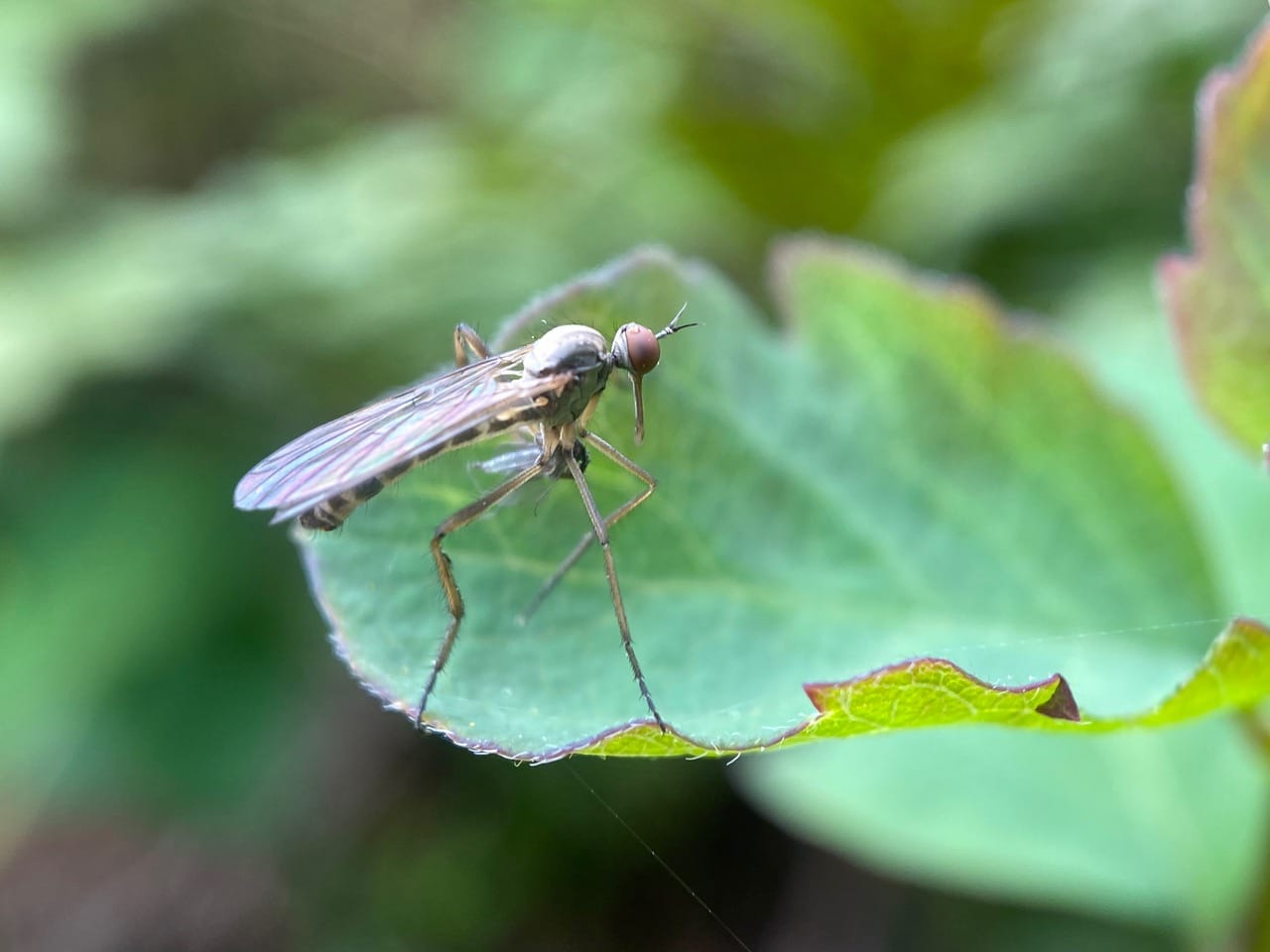
Minutes later, another male Empidid Dance Fly lands on a Snowberry leaf with his catch. Wow, the females won’t have to do much hunting this time of year!
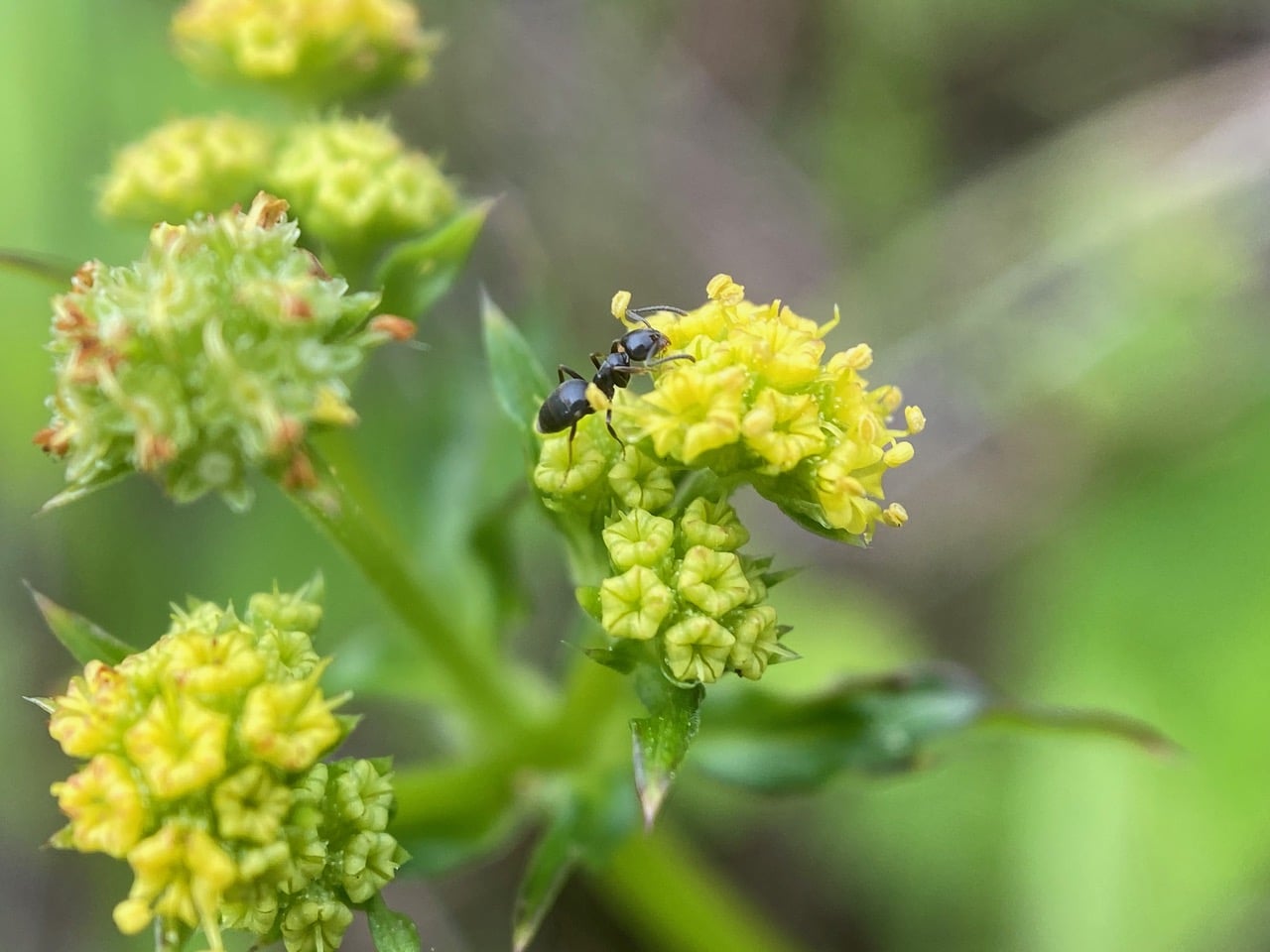
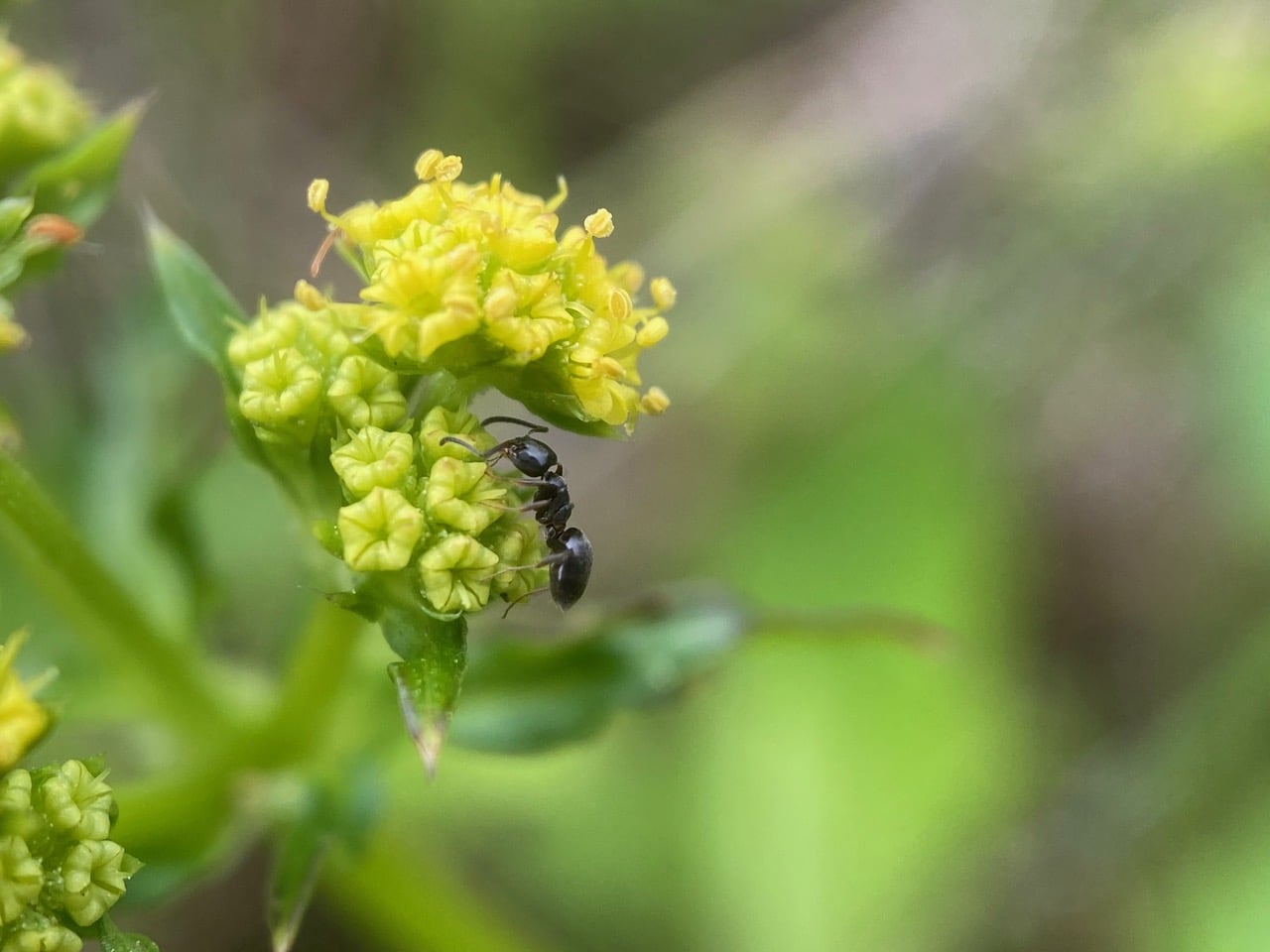
An Odorous House Ant is foraging on the flowers of Pacific Sanicle, Sanicula crassicaulis.

The Odorous House Ant, Tapinoma sessile (subfamily Dolichoderinae, family Formicidae) is native to North America, ranging from southern Canada to northern Mexico. The species is found in a vast diversity of habitats, including within houses. The ants mainly feed on floral nectar and other sugary food. They also forage for honeydew produced by aphids and scale insects that they guard and tend.
Odorous House Ants are small ants, the workers measuring 2-3 mm. As in all members of the subfamily Dolichoderinae (odorous ants), this species does not possess a sting, instead relying on the chemical defense compounds produced from the anal gland. Such compounds are responsible for the smell given off by the ants when crushed or disturbed.
T. sessile colonies are polydomous (consist of multiple nests) and polygynous (contain multiple reproductive queens). The species practices seasonal polydomy – the colony overwinters in a single nest, and forms multiple nests during spring and summer when resources are more abundant and spread out.
The Odorous House Ants are rather docile, with little propensity for attack, preferring to use chemical secretions instead of biting. For this reason they are vulnerable to the invasion of the aggressive Argentine Ants, Linepithema humile.
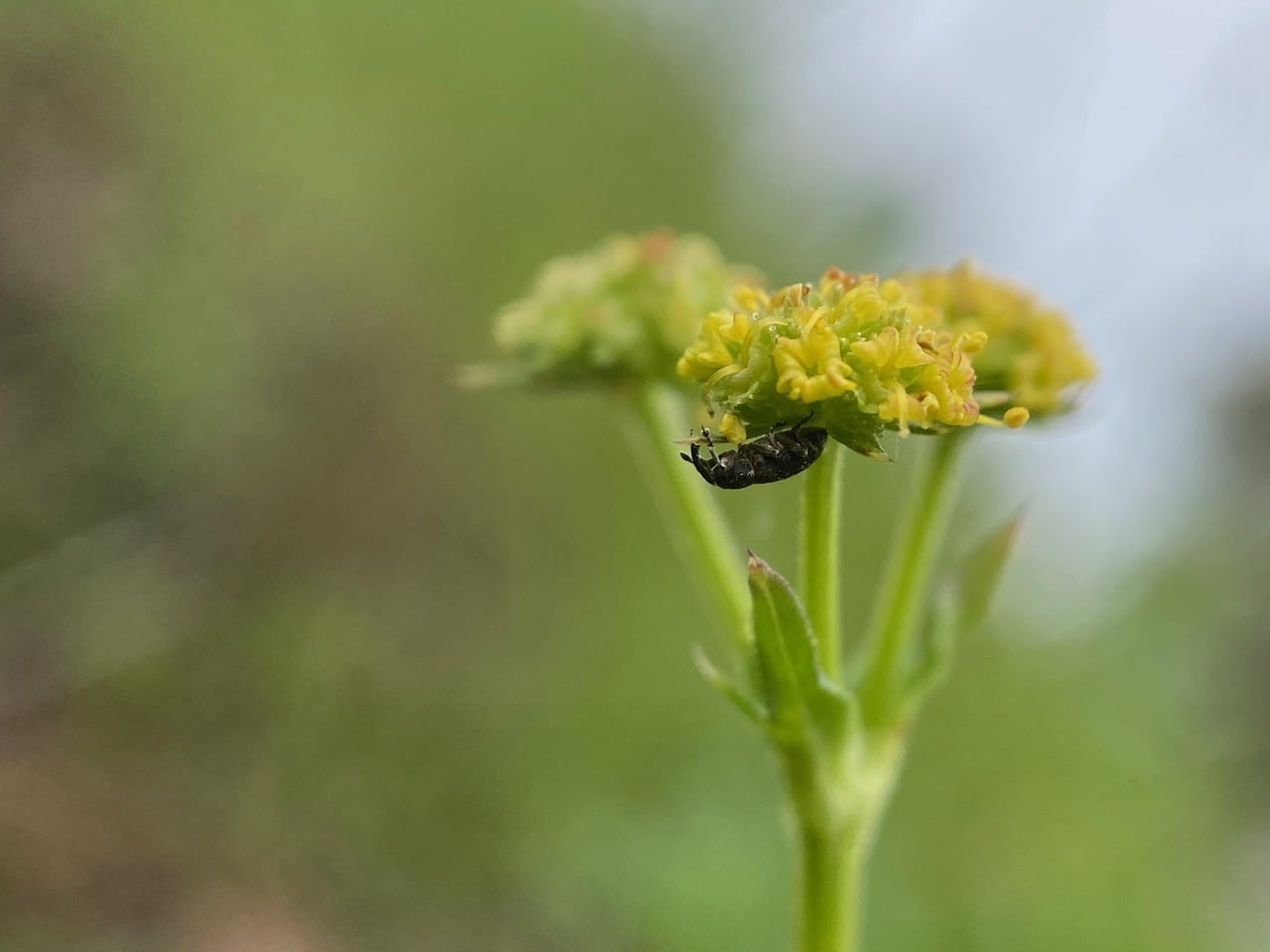
Here’s a beetle about the same size as the ant, foraging on the same flowers.
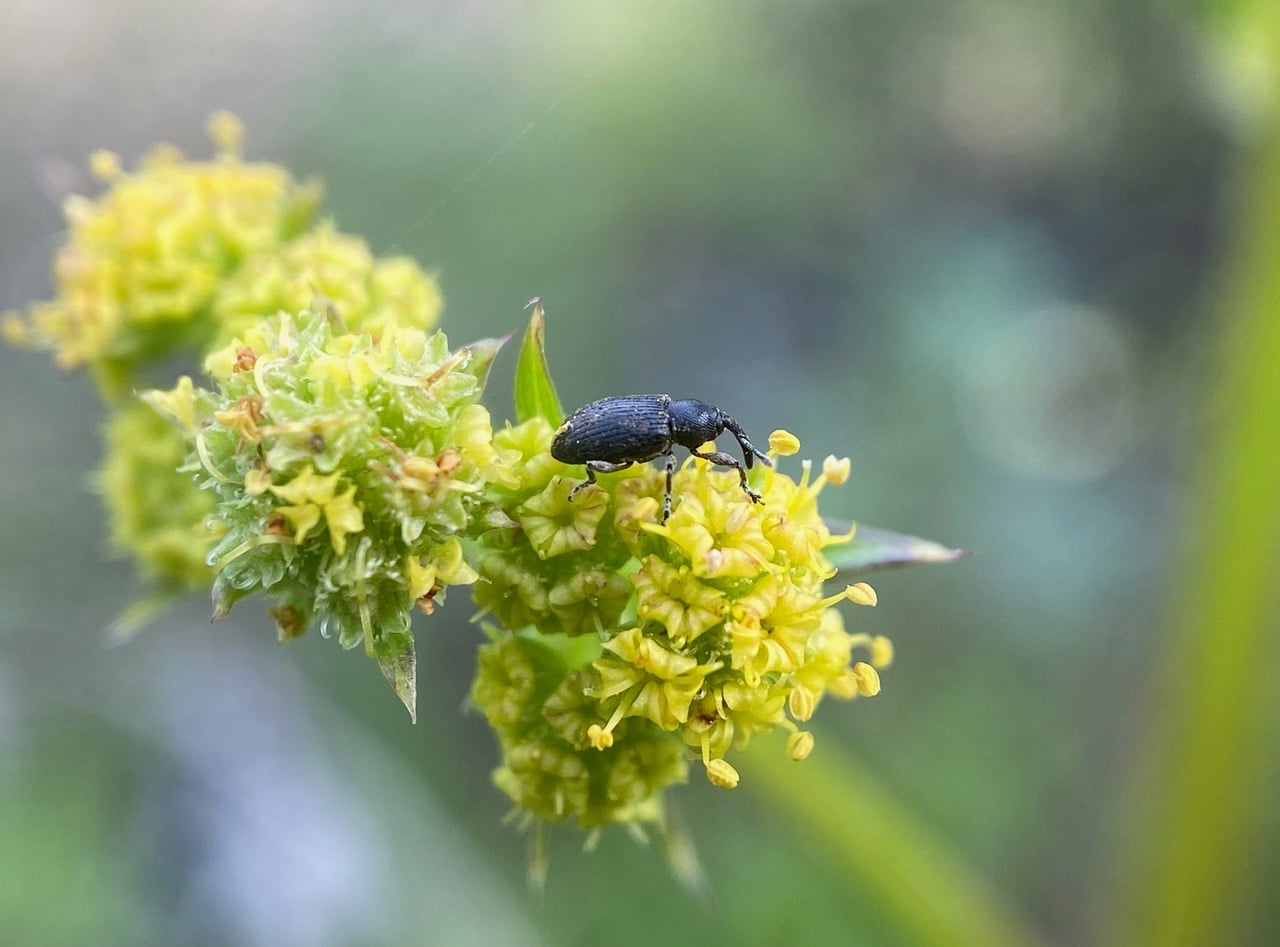
Weevils, family Curculionidae, are also called snout beetles. Curculionidae is one of the largest beetle families (about 40,000 species). Most weevils have long, distinctly elbowed antennae that may fold into special grooves on the snout. The snout is used not only for penetration and feeding but also for boring holes in which to lay eggs. The mouthparts are quite small and located at the end of the rostrum (snout), designed for chewing. Many weevils have no wings, while others are excellent fliers. Most are less than 6 mm in length. The majority of weevils feed exclusively on plants. The fleshy, legless larvae of most species feed only on a certain part of a plant – i.e., the flower head, seeds, fleshy fruits, stems, or roots. Many larvae feed either on a single plant species or on closely related ones. Adult weevils tend to be less specialized in their feeding habits. The family includes some very destructive agricultural pests.
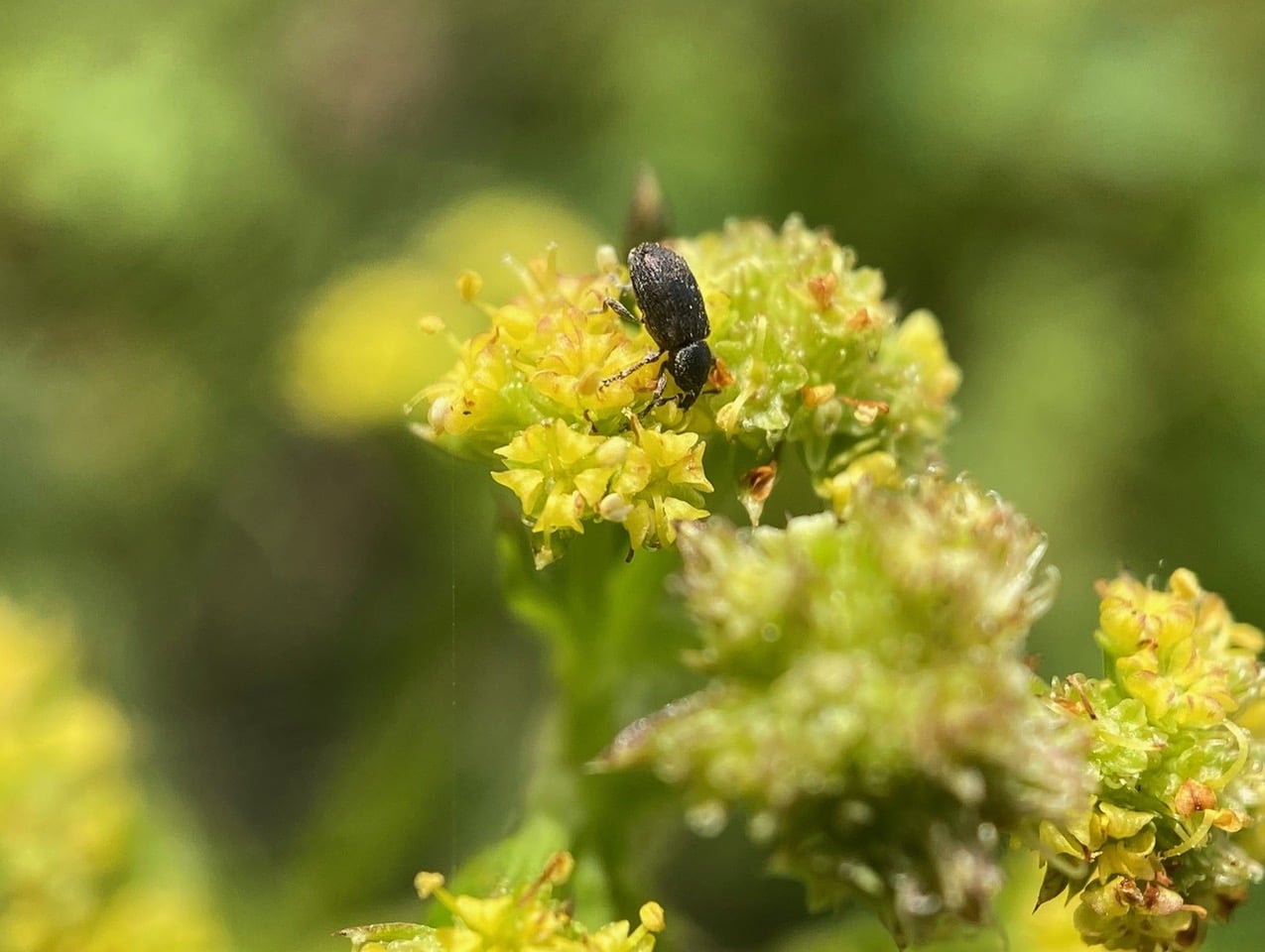

A pair of the tiny Weevils is getting it on. The life of these weevils seems to revolve around the Pacific Sanicle. I have never found them on any other plants close by. Since the female weevils lay their eggs in the flowers, the larvae probably feed on the developing seeds. Are the beetles a nuisance for the plant, or do they serve other functions? Do they help pollinate the flowers, as their body is always covered with pollen?
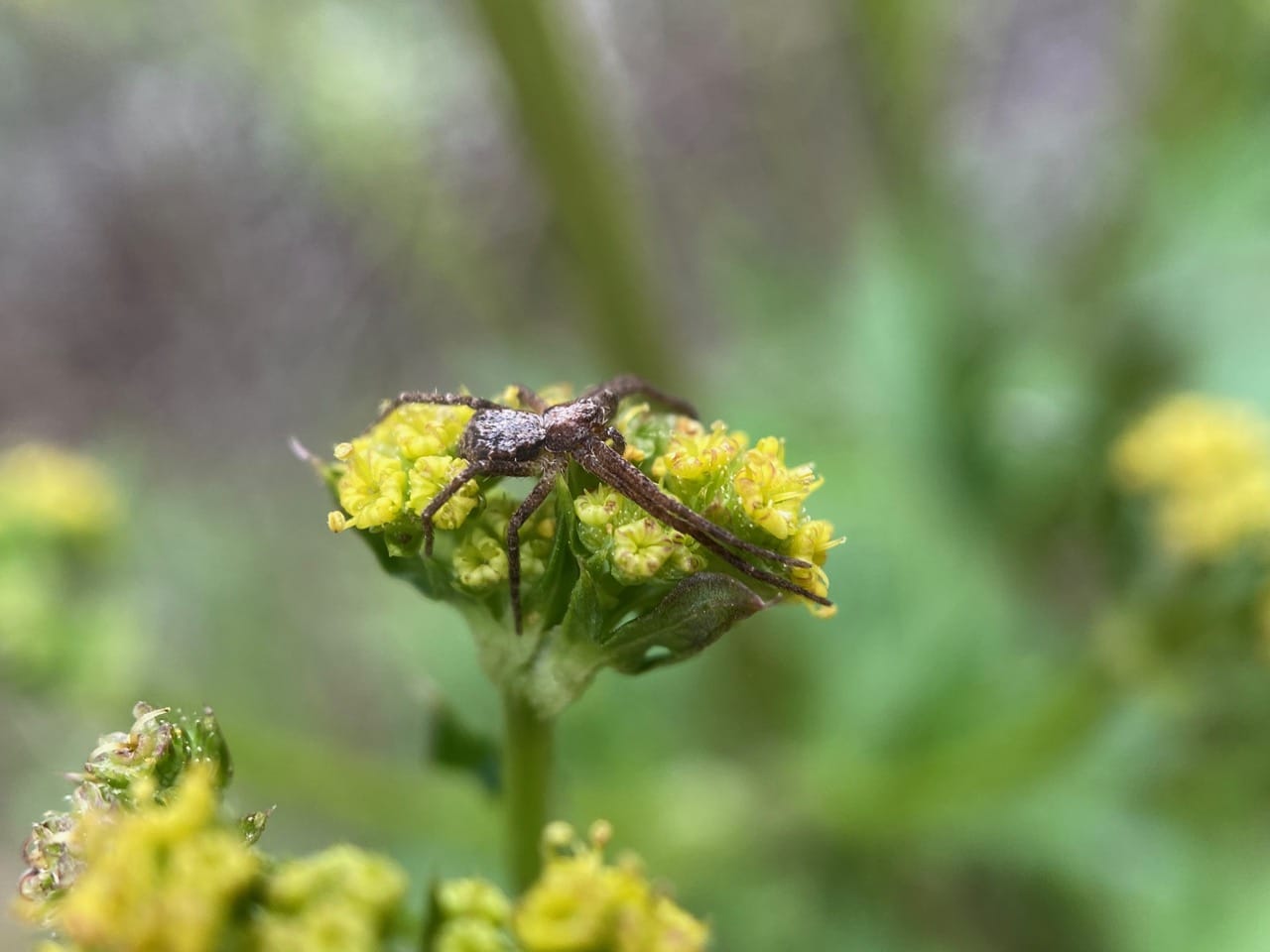
Hello, who is this strange looking spider? It looks out of place on the cluster of Sanicle flowers, its dark brown color showing up conspicuously against the yellow flowers.
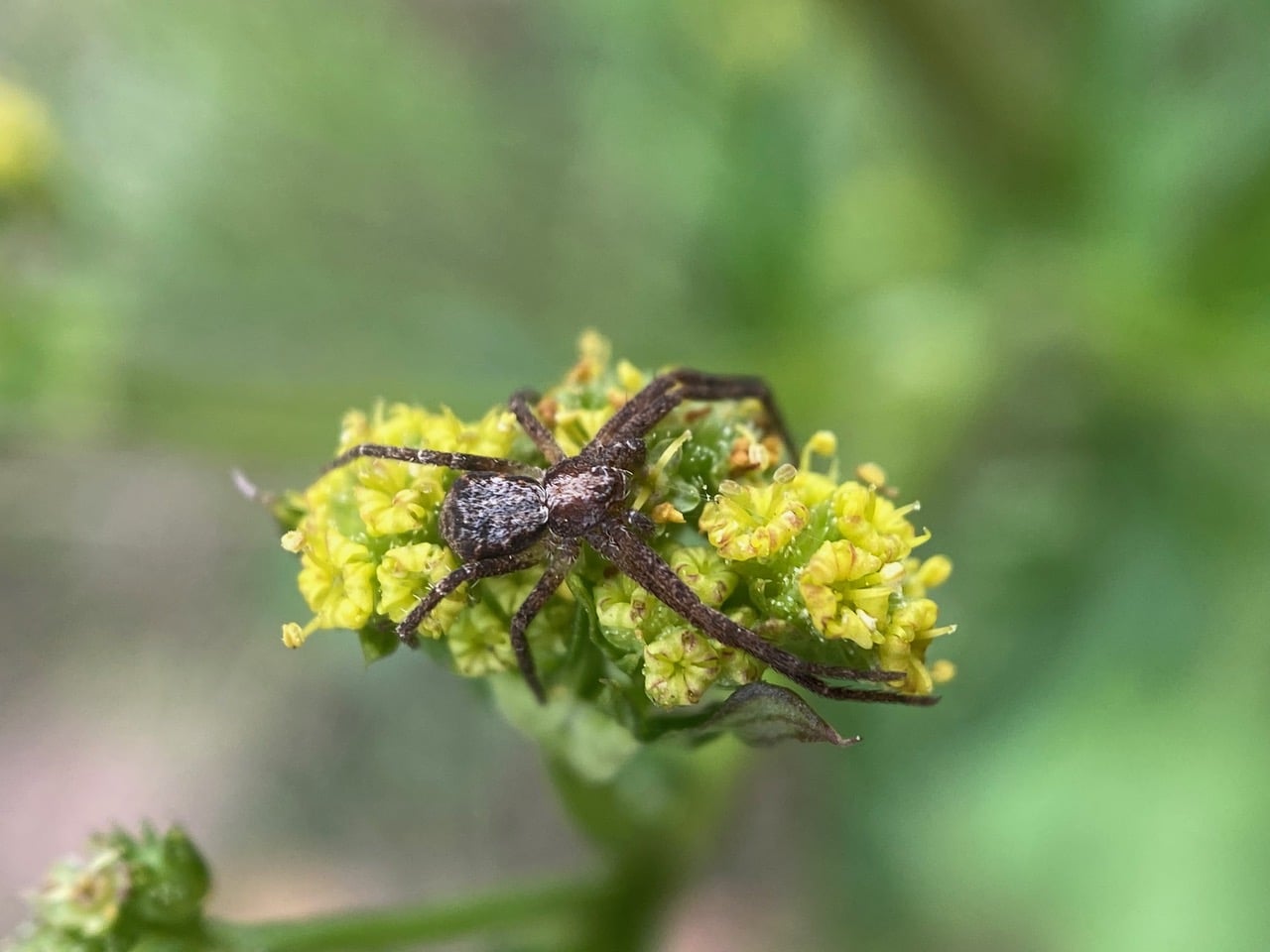
iNaturalist identifies it as a Tuberculated Crab Spider, Tmarus angulatus (family Thomisidae). A new one for me!
Tuberculated Crab Spider is small spider in the tree crab spider genus Tmarus. It occurs across the United States and southern Canada. It is common east of the Great Plains, and it occurs in California but is otherwise rare in the west. The spider is usually found on stems and twigs of plants in fields, meadows, and gardens. Females are 4.5 – 7 mm in length, males are smaller, 3-5 mm. As in all Crab Spiders, the two front pairs of legs are much longer than the other legs, and are held out forward or to the sides. The abdomen is highest in the rear and there is a conspicuous, large tubercle near the end. This is the feature that gives the spider its common name. The knobby bodies are usually well-camouflaged on bark and other vegetation, where they look like buds or broken twigs. With forelegs along either side of a stem, they wait for an insect to wander between them.
Like other Crab Spiders, Tmarus don’t spin trap webs to catch their prey; they are ambush predators. They inject their prey with venom and digestive juices to liquify the body contents, then suck up the tenderized tissues, and toss the empty carcass. They do spin silk, protecting themselves from a fall by playing out a drop line as they hunt. Females guard their eggs concealed in a chamber they create by webbing together vegetation.
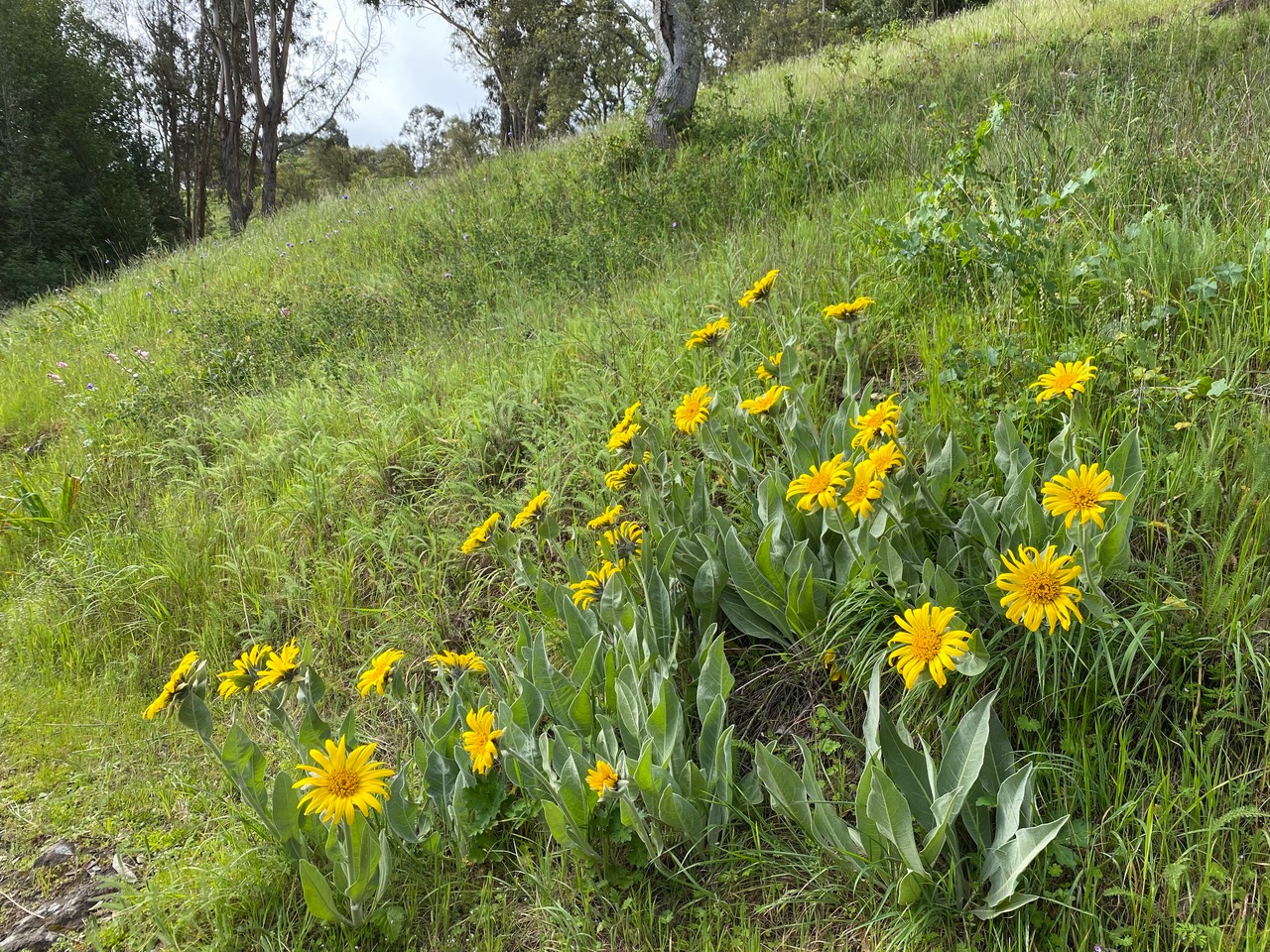
Wow! The Woolly Mule’s Ear, Wyethia helenioides is already in peak bloom! There’s a gamut of flowerheads in various stages of maturation.

The flowerheads range from the freshly opened…
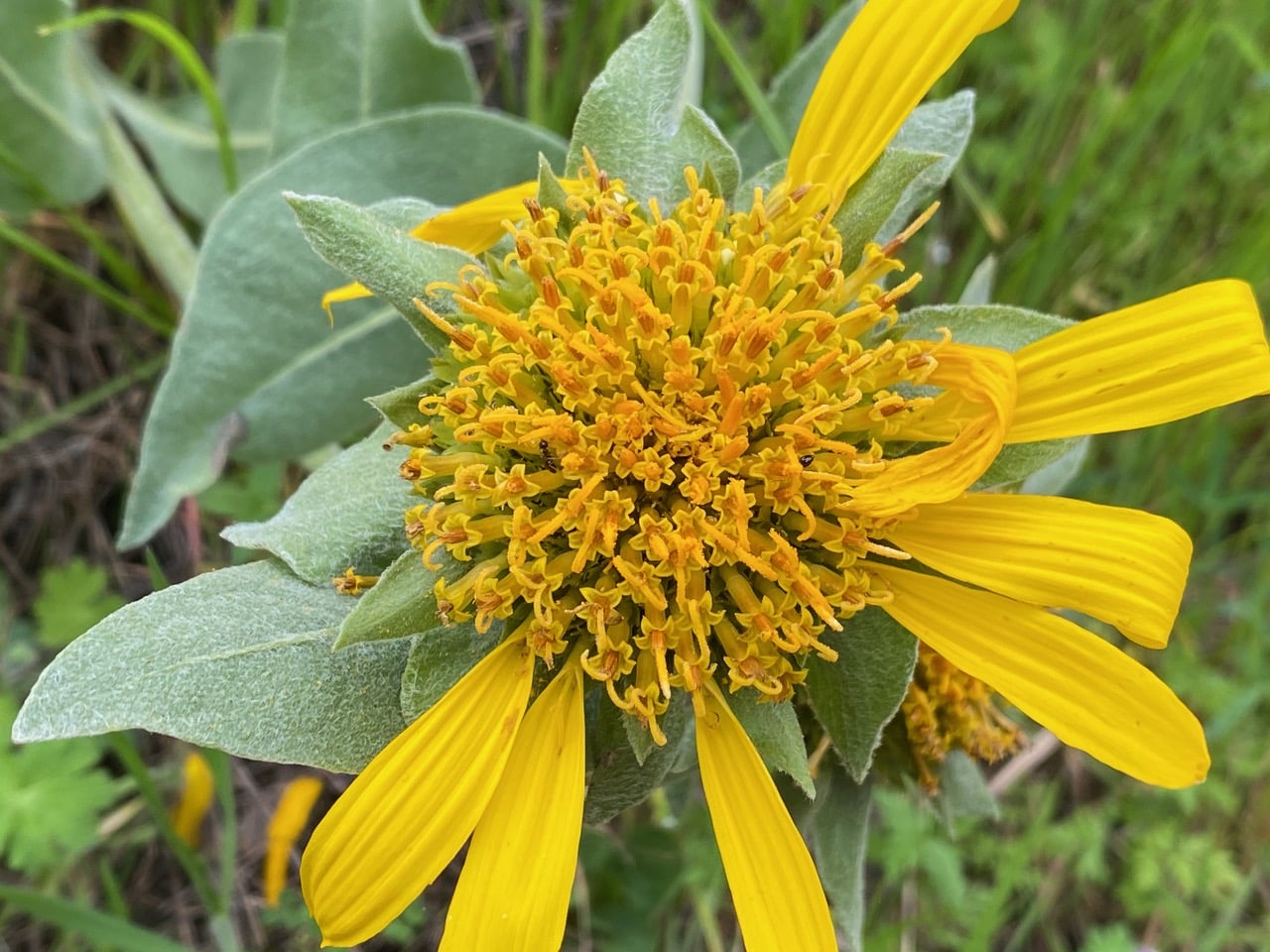
…to the fading…..
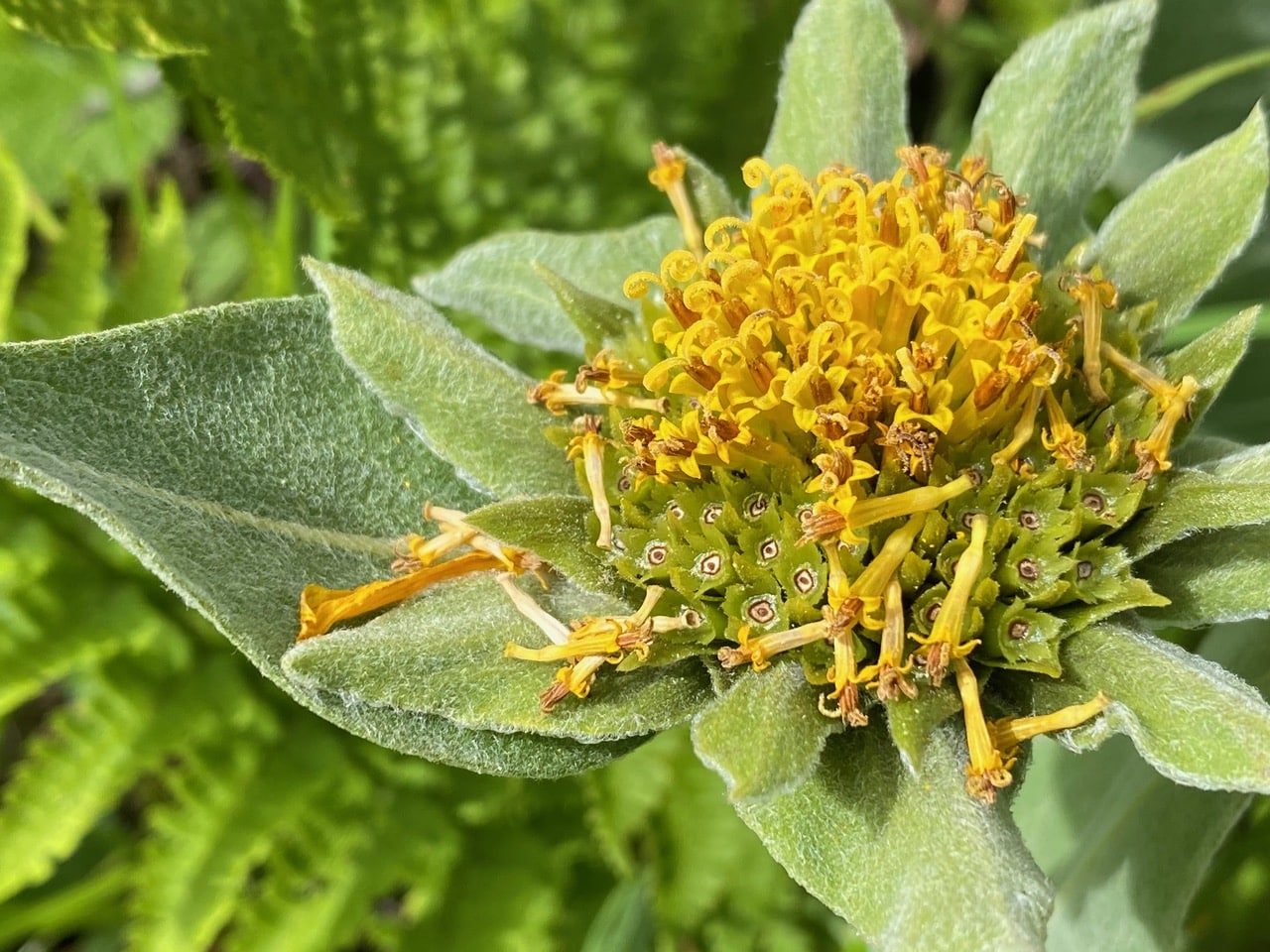
… to those balding and developing seeds.
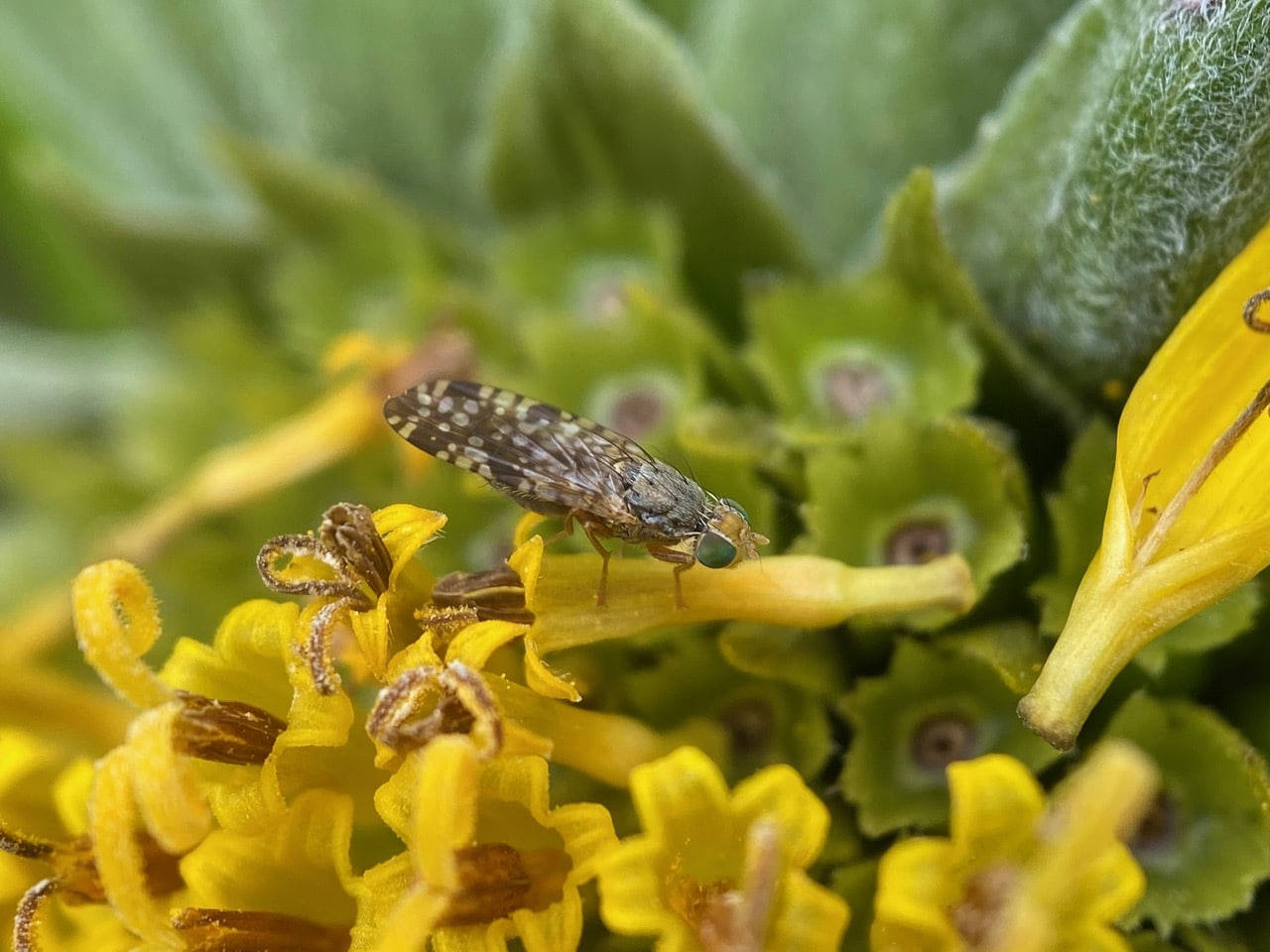
A Sunflower Seed Maggot Fly, Neotephritis finalis (family Tephritidae) is investigating the shed florets on an older Mule’s Ear flowerhead. Is it a male or a female, and what is it doing here?
Commonly called Fruit Flies, Tephritids are small to medium-sized flies that are often colorful, and usually with picture wings. The larvae of almost all Tephritidae are phytophagous. Females deposit eggs in living, healthy plant tissues using their telescopic ovipositors. Here the larvae find their food upon emerging. The larvae develop in leaves, stems, flowers, seeds, fruits, and roots of the host plant, depending on the species. Adults are often found on the host plant and feeding on pollen, nectar, rotting plant debris, or honeydew. Tephritid flies are of major economic importance as they can cause damage to fruit and other plant crops. On the other hand, some Tephritids are used as agents of biological control of noxious weeds.
The Sunflower Seed Maggot is a sunflower specialist, found on over 20 species of Asteraceae. Larvae feed on immature seeds and pupate in flowerheads.
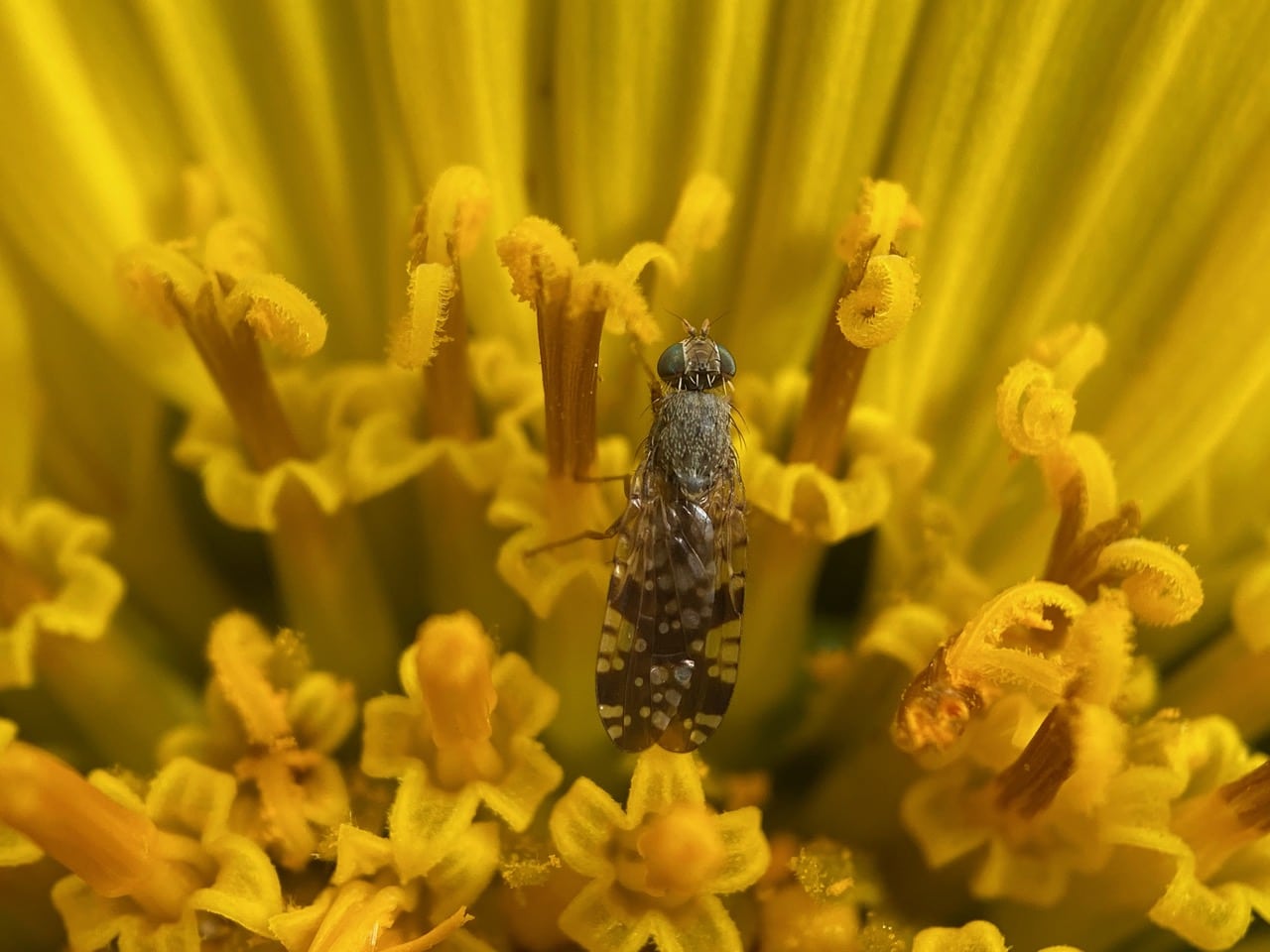
In another older flowerhead, I find a Sunflower Seed Maggot Fly exploring the interior florets. Note that near the rim of the flowerhead the fly is facing, the florets are in the female phase, showing the curlicue two-lobed styles above their anther tubes. The flowers in Asteraceae are protandrous, the male parts maturing before the female parts. Perhaps the female flies are very particular about the stage of maturity of the florets on which they deposit their eggs.
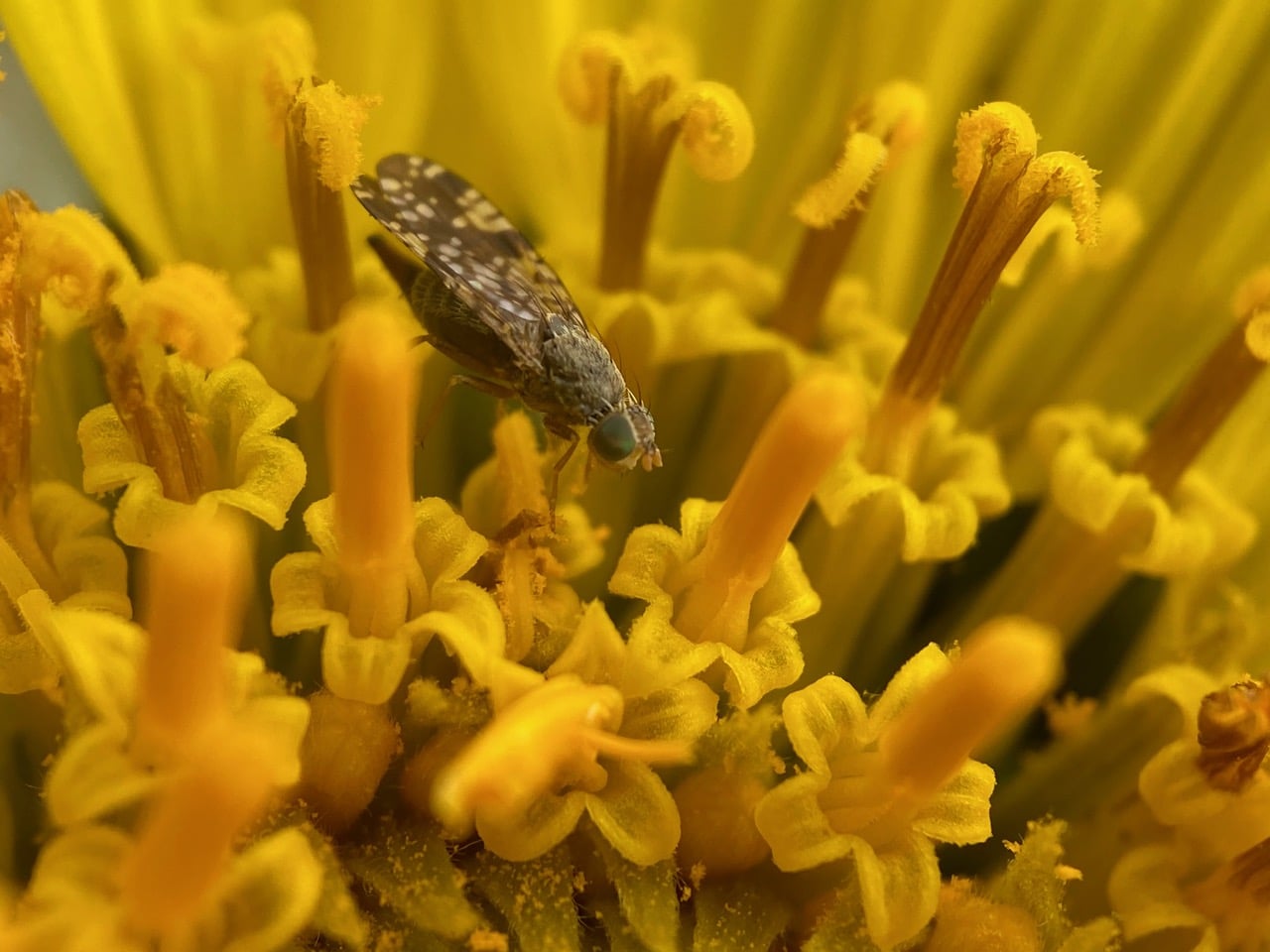
I get a brief glimpse of the fly’s pointed-tipped oviscape, so I know now that it is female. Is she here to lay eggs, to check on her eggs’ or larval development, or to check for predators? I have seen this behavior before on the older Mule’s Ear flowerheads. Parental care is rare in insects, but one never knows.
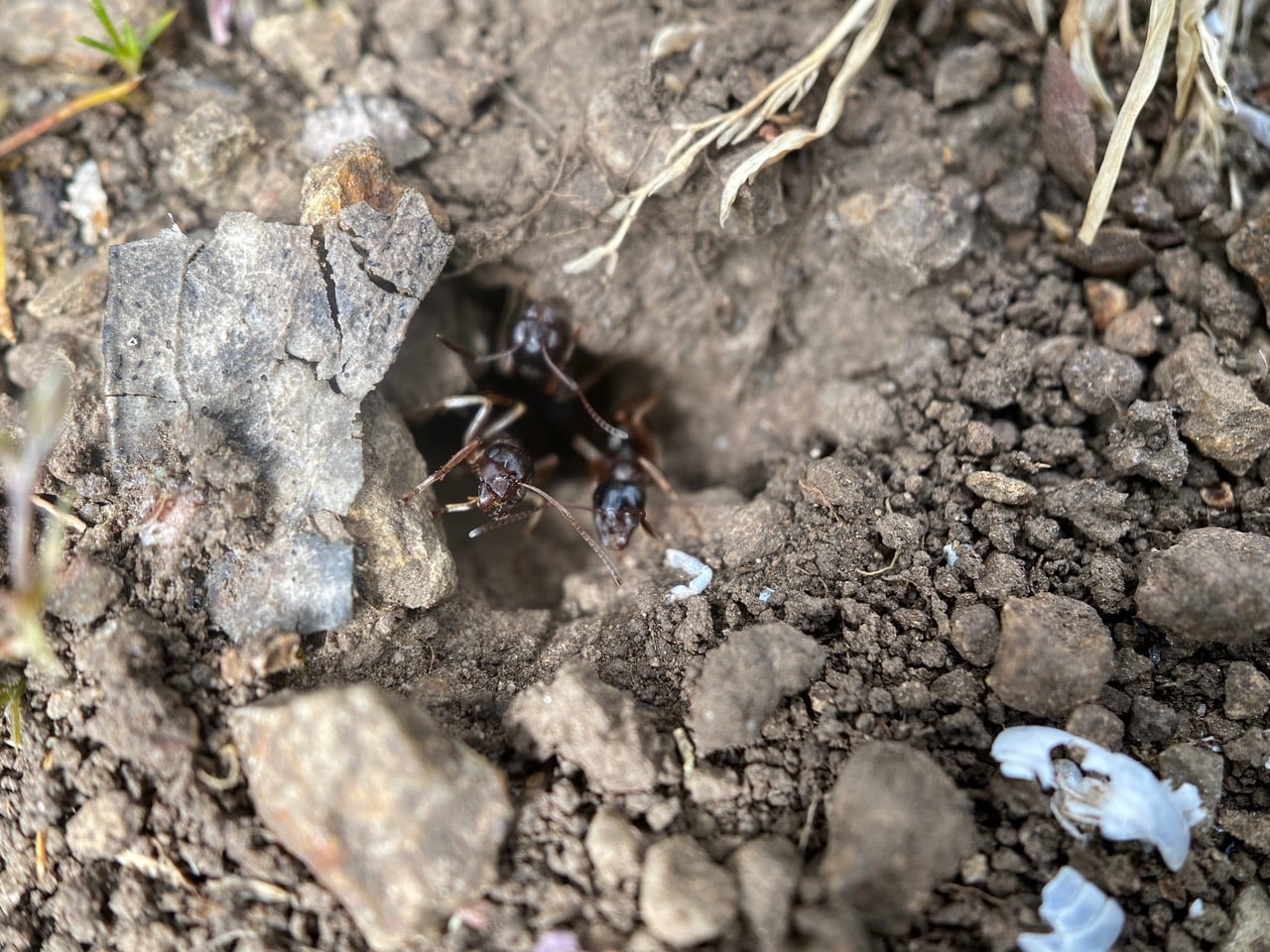
There’s some movements in a small hole in the ground in the middle of the trail. Ants are nervously peeking out from the opening, their antennae waving.
 Cautiously the ants come out of the hole.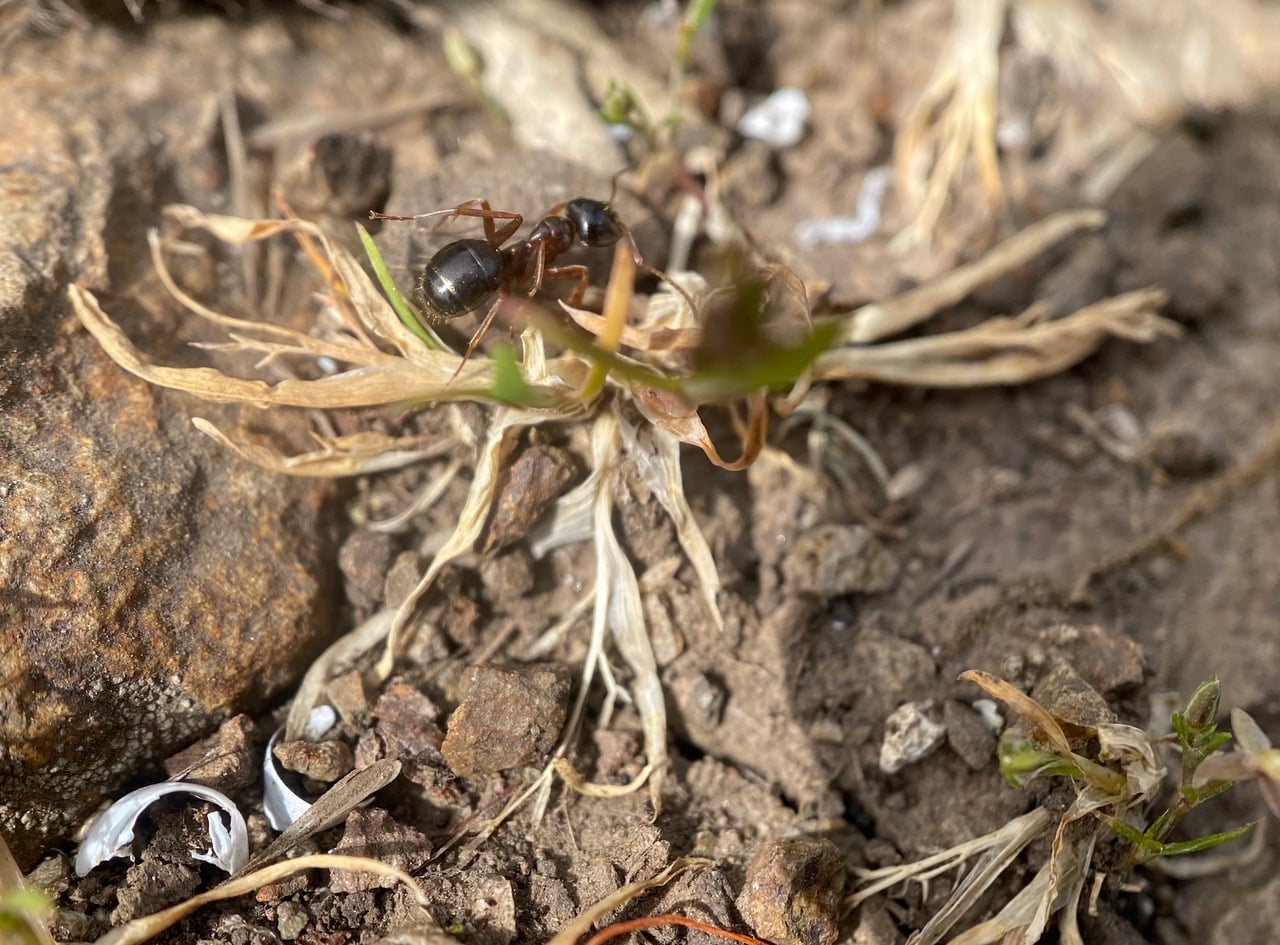
Some ants begin to clean up around the nest entrance, moving debris around. The ants are the Field Ants, Formica subpolita (family Formicidae).
Formica is a genus of ants in the family Formicidae, commonly known as wood ants, mound ants, and field ants. Many species live in wooded areas. In more suburban landscapes, they tend to nest near structures such as sidewalks, fences, or building foundations. Most Formica species are polygynous (have multiple queens per colony), and some are polydomous (have multiple nests belonging to the same colony). Unlike other ants, the genus Formica does not have separate castes, which are based on an individual’s specialization and morphology.
Formica ants actively gather honeydew from source insects, and extrafloral nectar. They also prey on insects and spiders; also scavenge small dead invertebrates, honeydew on leaf litter and plant surfaces, etc.
Formica ants lack a stinger, but instead formic acid is expelled as a defense mechanism from the tip of their abdomen. They can also bite. They may pinch skin with their mouthparts, and then squirt formic acid into the wound, which may give the sensation of a sting.
Formica subpolita is distributed in the western North America; often found in coastal forests.
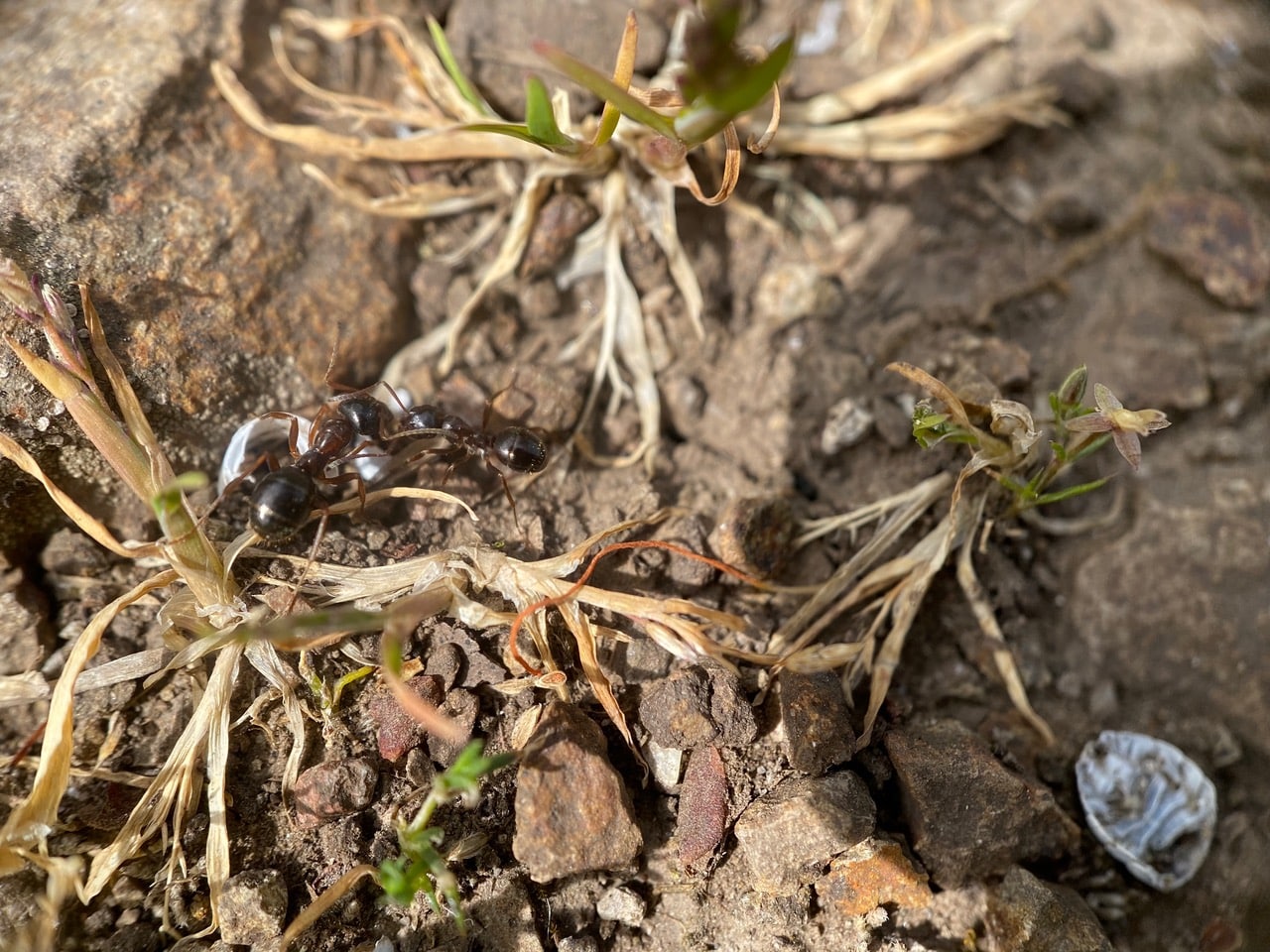
Note the marked size difference between those two ants. Despite appearances, there is no separate castes among the workers of Formica ants. They differ in size but not in anatomical details. And usually there is a whole spectrum of sizes within the colony. In contrast, other ants such as the Carpenter Ants (genus Camponotus) have two worker castes – major and minor workers. Beside size, these ants differ in their anatomy and serve different functions – the larger workers defend the nest and forage for food; minor workers tend to the young and maintain the nest.