

Pollinator Post 4/11/25 (1)

California Buttercup, Ranunculus californicus is in bloom, and I know the perfect place to see them – the undulating meadow flanked by large oak trees by the Padre picnic area in Tilden Regional Parks in the Berkeley hills.
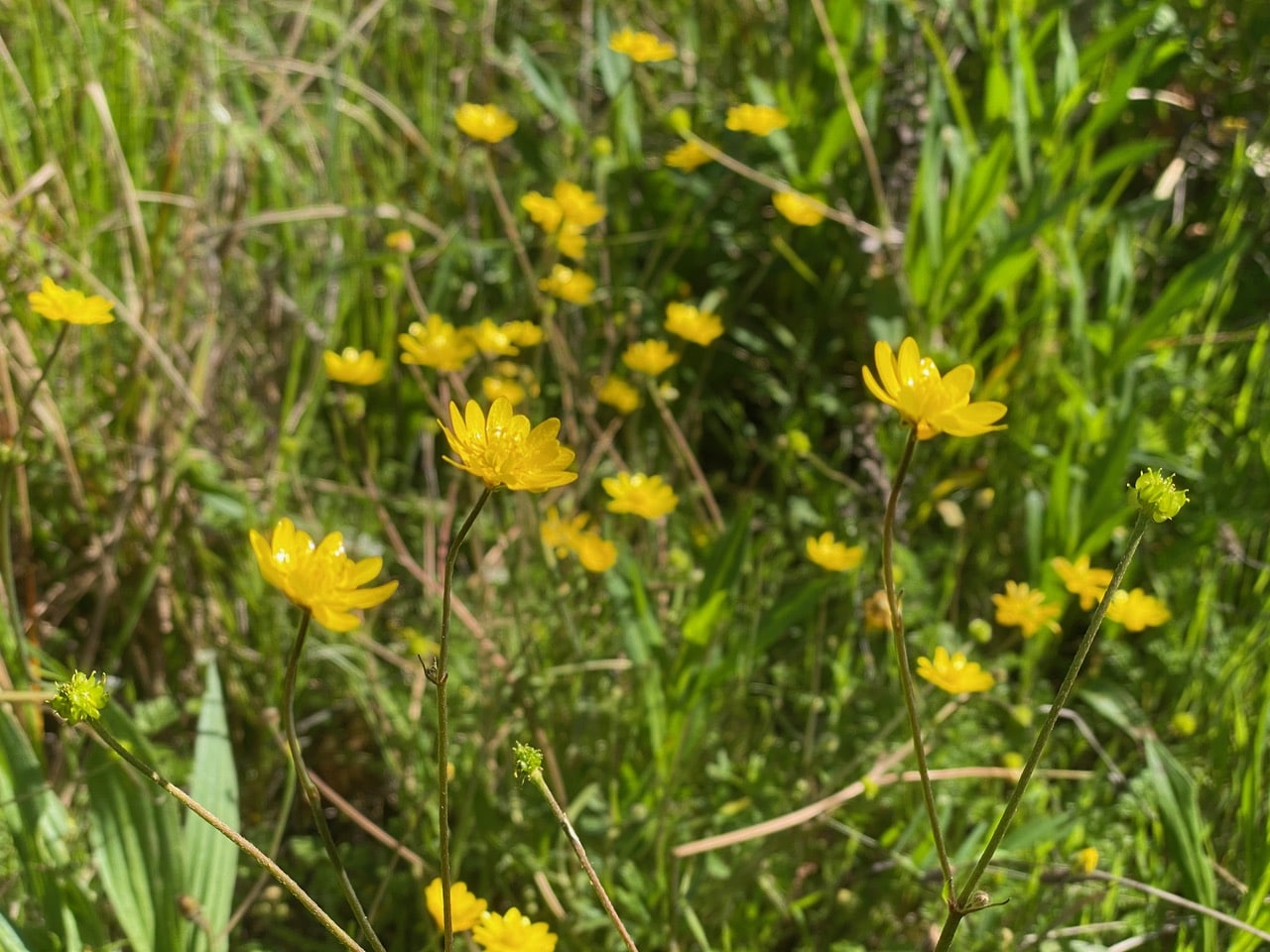
California Buttercup, Ranunculus californicus, is a perennial herb with glossy, deep yellow flowers featuring 9-17 petals. Native to much of California, Baja California, Oregon, and Pacific coastal islands, it blooms in late winter to spring, as a low ground cover. The large green swelling in the center of the flower consists of the carpels, which produce ovules. There are numerous stamens with large anthers which produce the pollen. In young flowers, the stamens wrap around the carpels.


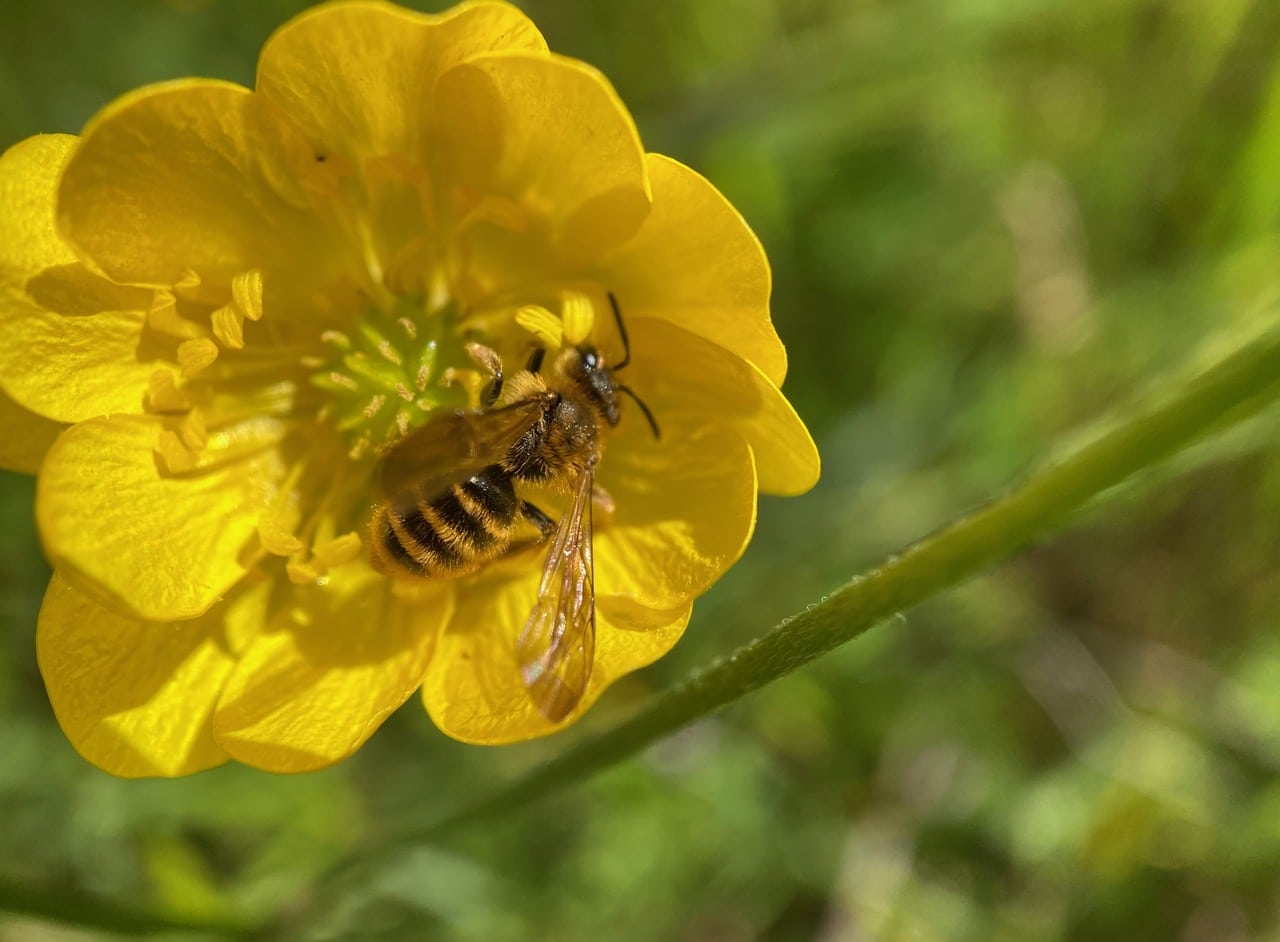
I first check the shady area behind the picnic table and drinking fountain. Sure enough, there’s a male Miner Bee, Andrena sp. (family Andrenidae) still asleep on a buttercup flower. Note his long antennae and slender build, and the absence of scopae on his hind legs.
Male bees do not construct nests, so at the end of the day they have no home to return to. They mostly sleep out in the open at night, usually on flowers, especially on flowers favored by the females This way the males can easily intercept potential mates when the females come out to forage in the morning. Male bees do not collect pollen to provision the nest, and they do not have the equipment for the job (no scopae).
The antennae of male bees are often much longer than their female counterparts. Male antennae have an extra segment and the segments themselves are longer. This is because male antennae are specialized to pick up the subtle scent of female pheromones.
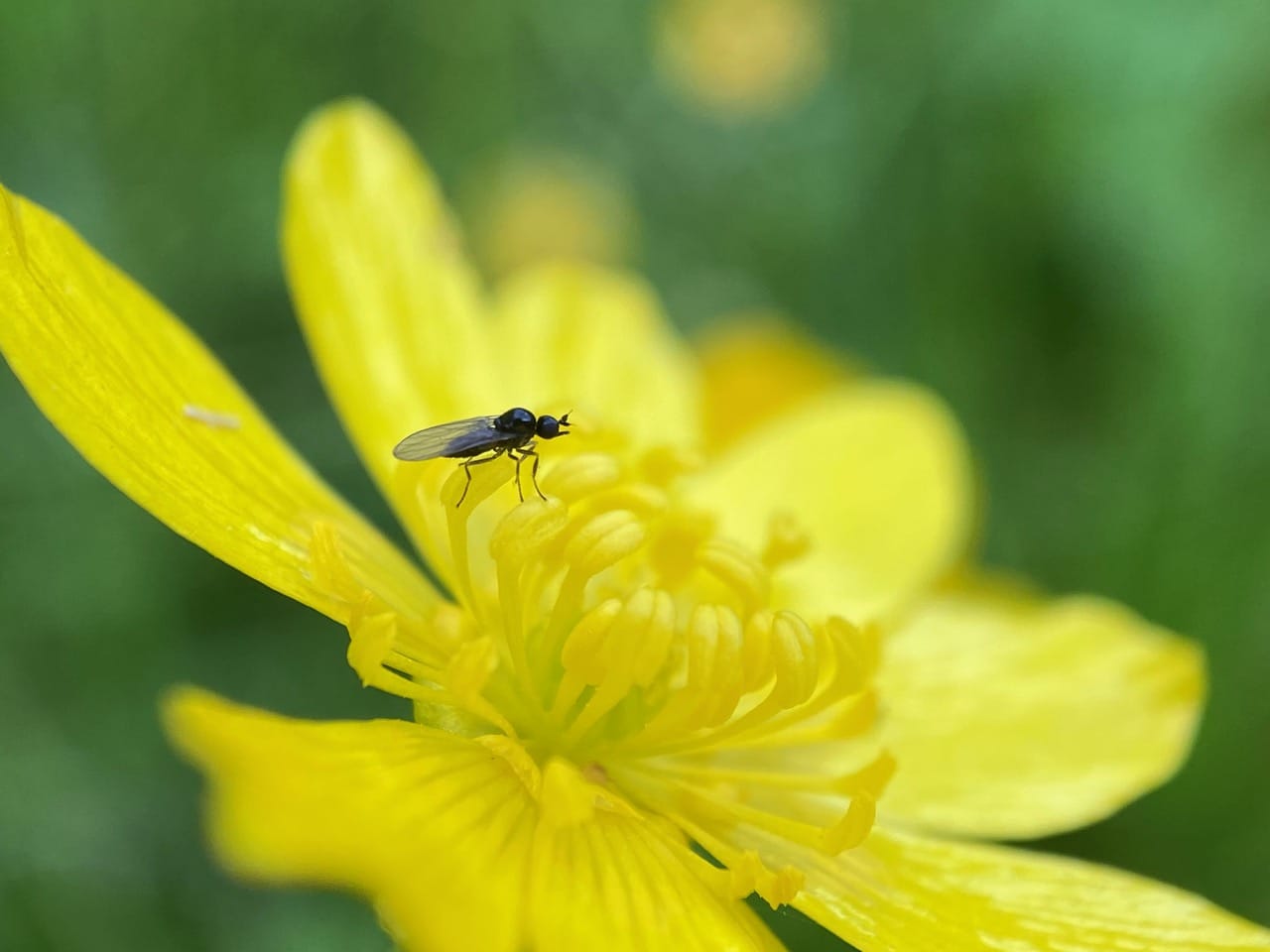
That’s the classic silhouette of a Hybotid Dance Fly, Anthalia sp. (family Hybotidae).
The Hybotid Dance Flies belong to the superfamily Empidoidea and were formerly included in the Empididae as a subfamily. Empididae generally have a thick beak pointing down, while Hybotidae have a thinner beak, or a thick beak pointing forwards or diagonally. Some crucial wing venation further distinguishes the two families. Precious little is known about the life cycle and biology of Hybotids because they are not considered of economic consequence. I have observed that members of the genus Anthalia mostly feed on nectar and pollen, and may be important pollinators for small wildflowers such as Miner’s Lettuce, Wild Geranium, California Saxifrage, Buttercups and False Lily of the Valley.
Why the name “dance fly”? This is derived from the mating swarms of males of many species. They gather in clouds over prominent objects, each individual seeming to bounce or “dance” in mid-air. Many other flies do this, notably midges, but the Empidids and the Hybotids got the moniker.
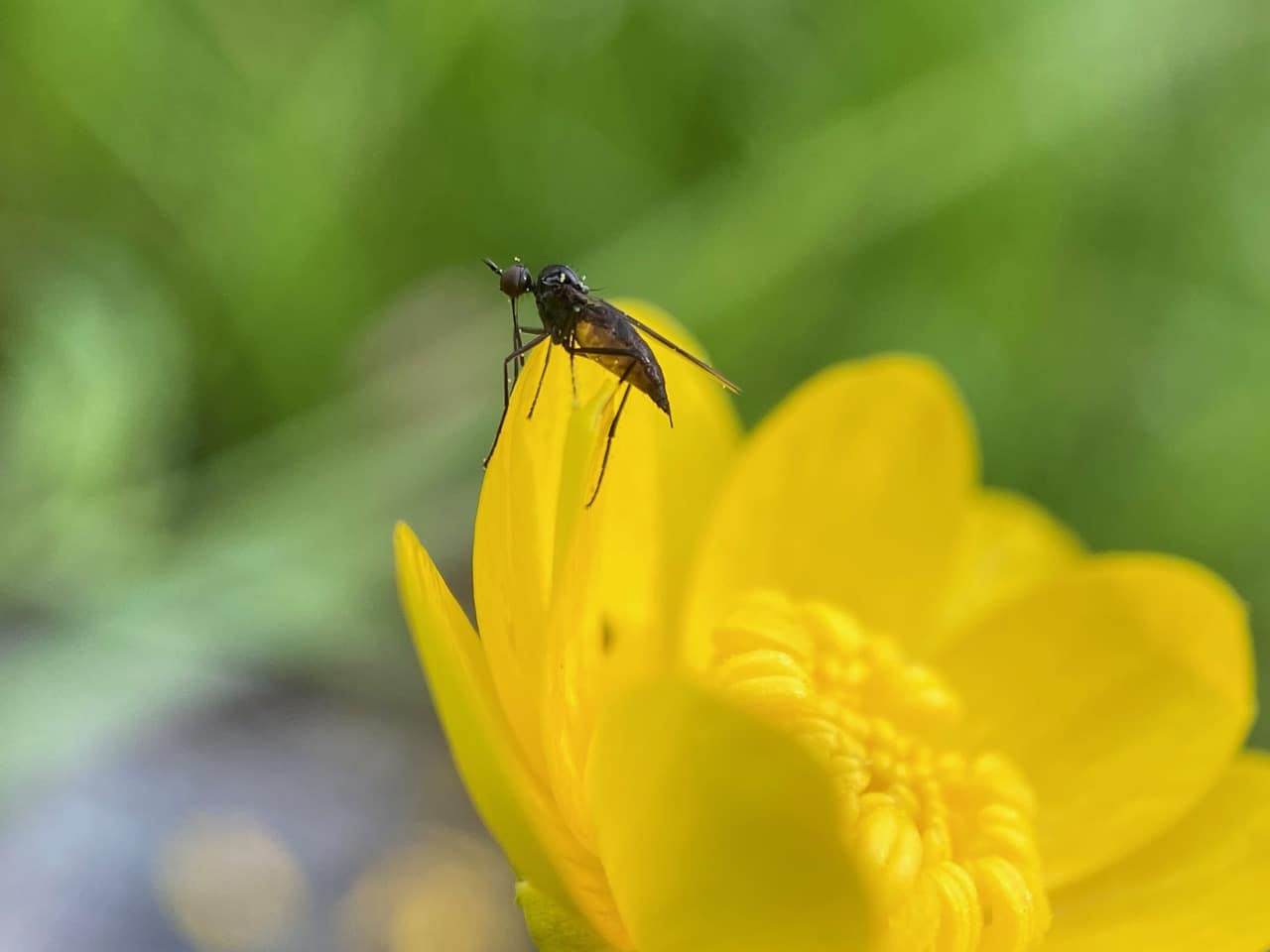
A female Dance Fly (superfamily Empidoidea) is perched at the edge of a buttercup petal. She has some pollen grains stuck to her head and thorax.
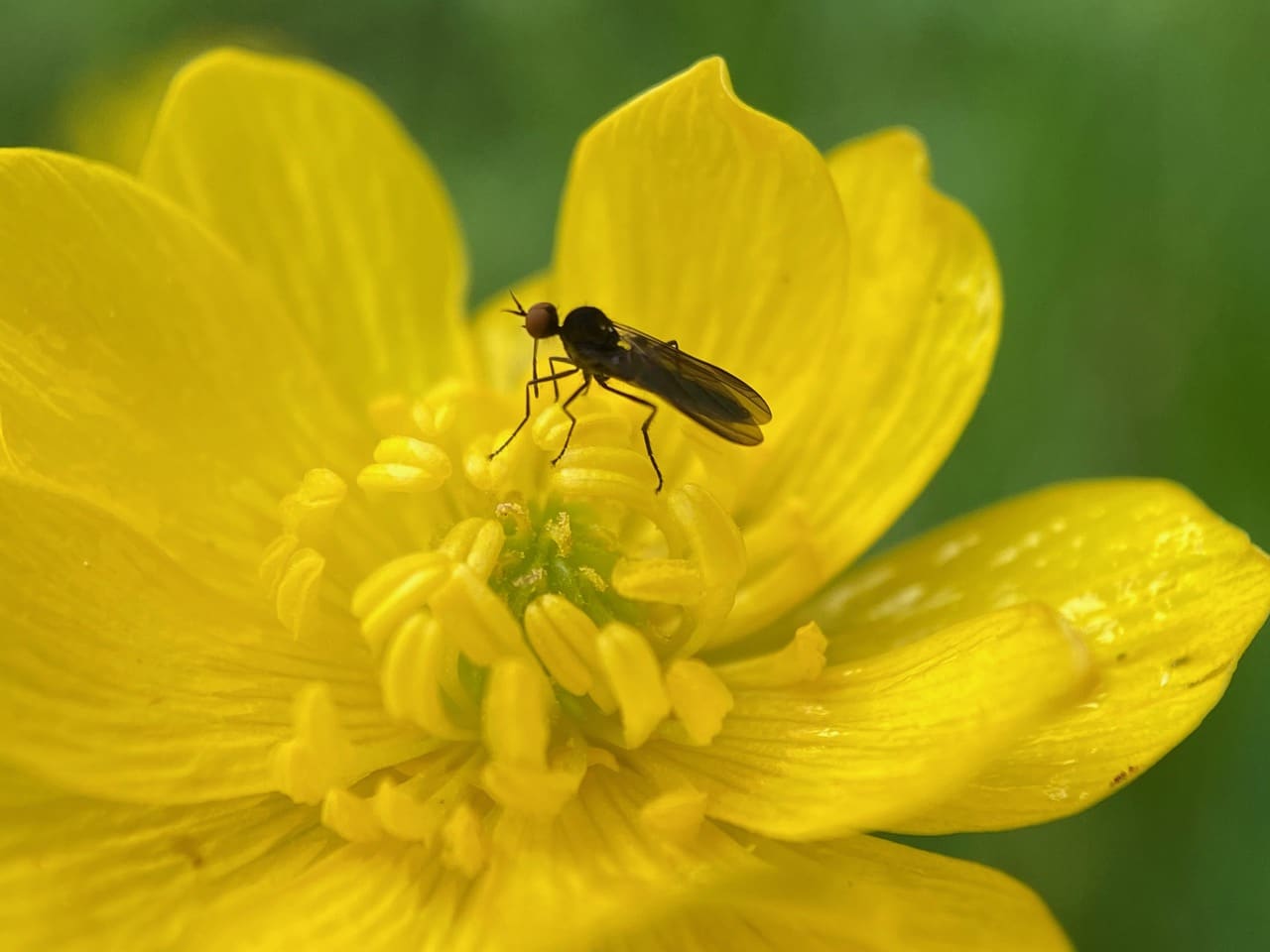
The Empidoidea are a very large, diverse group of flies consisting of over 11,000 described species worldwide. Most of these flies are predatory. Adults range in size from 1 mm to 15 mm, and are generally slender flies with long legs, beak-like predatory mouthparts, large compound eyes (sometimes covering the entire surface of the head). These flies tend to be associated with moist, temperate habitats. Some adult Dance Flies also visit flowers for nectar. At least a few groups obtain all their protein needs by feeding on pollen. Larvae are generally found in moist soil, rotten wood, dung, or in aquatic habitats and also appear to be predacious on various arthropods. Predaceous empidoid flies are important natural and biological control agents of various pest insects. Empidoids are commonly called Dance Flies for their “dancing” courtship behavior, with males often presenting prey to females as nuptial gifts.
Classification within the superfamily is still in a state of flux – many taxa require revision and few keys are available to distinguish species. Currently there are 7 recognized families, the main ones being the Empididae and the Hybotidae. Empidids normally have a thick beak pointing down. Hybotids have a thinner beak, or a thick beak pointing forwards or diagonally. The two families also differ in their wing venation.

A few Hybotid Dance Flies, Anthalia sp. (family Hybotidae) are resting on a buttercup flower, seeming to be enjoying the morning sun.
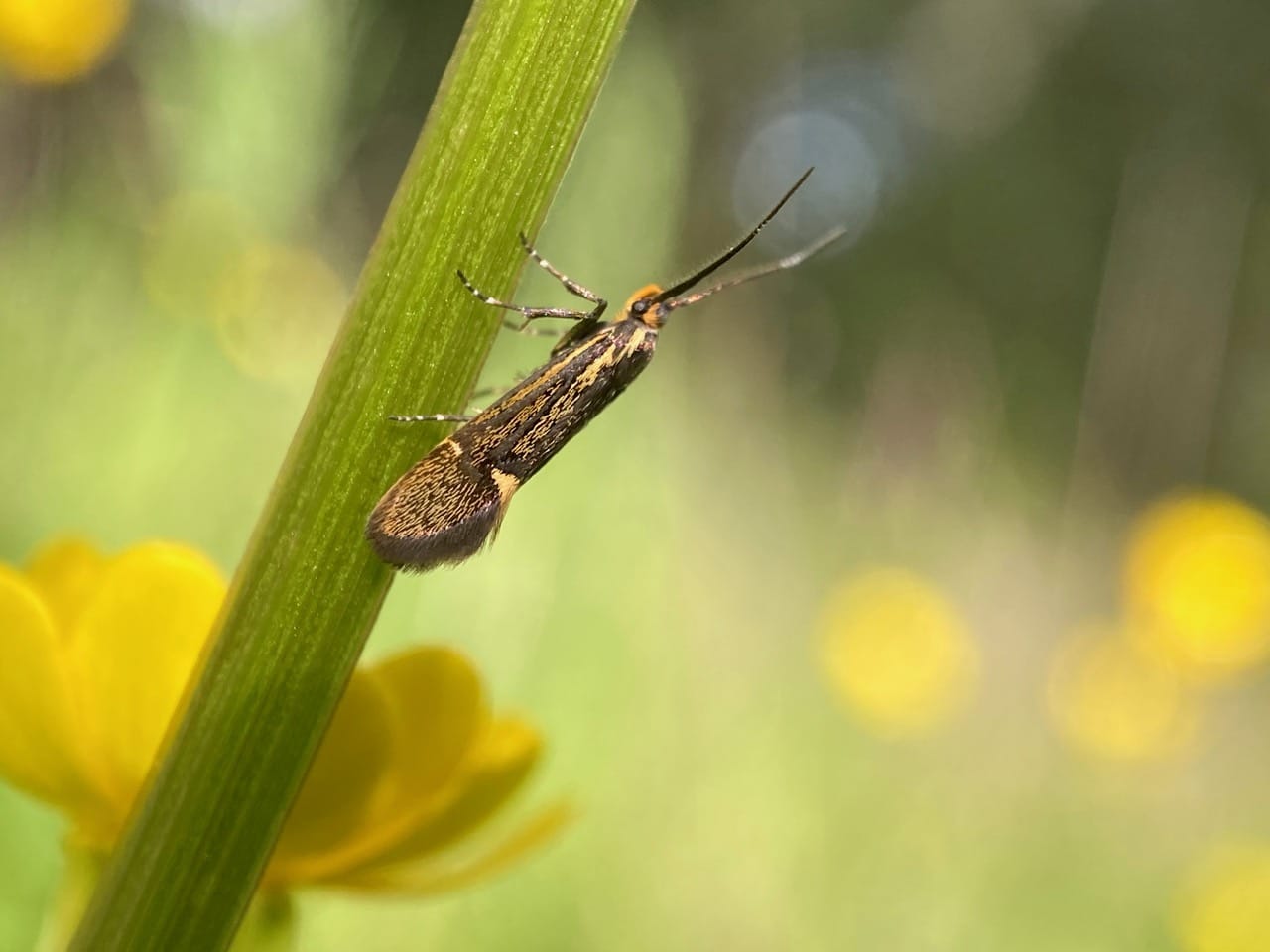
A Sulphur Tubic, Esperia sulphurella (family Oecophoridae, or concealer moths) is perched on a stem of California Buttercup in the shade. I am not used to seeing the moth in such low light. In sunshine, its scales are highly reflective and iridescent.
The species is a day-active moth native to Europe, but has been introduced in California. Adults have a body length of 6-8 mm. The moth has distinctive wing markings comprising a rich brown ground color flecked with bright yellow scales, many of which are grouped to form a triangle at the trailing edge of each forewing forming a diamond shape when viewed from above. The moth rests with its antennae held forward. Found in woodlands and gardens, they are on wing in spring. Larvae are black and feed on dead wood.
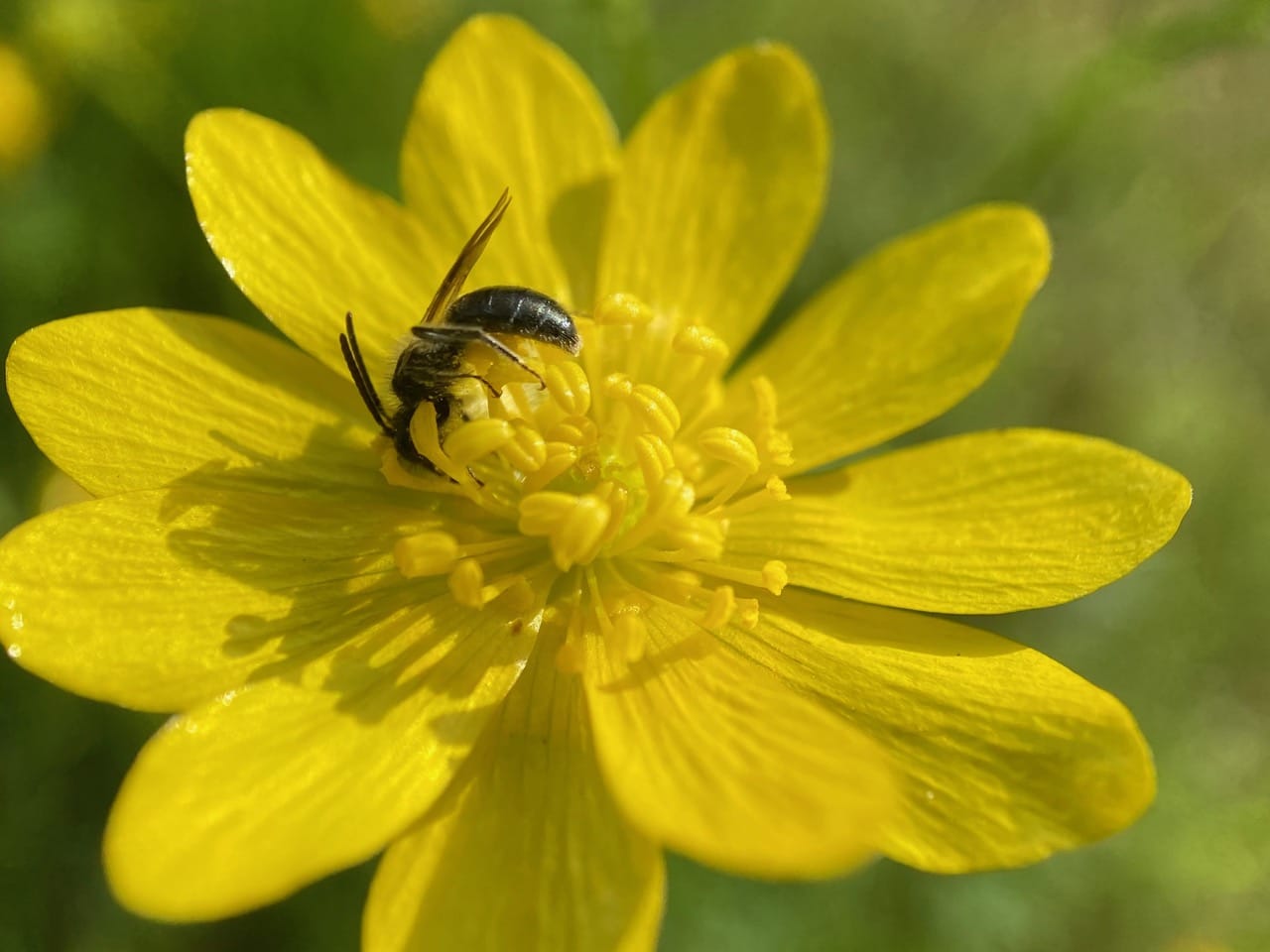
Reaching under the stamens, a male Miner Bee, Andrena sp. (family Andrenidae) is probing for nectar at the base of a petal.
Unlike most flowers that have a pool of nectar in a single nectary, the buttercup dispenses her sweet treats discreetly in little pockets at the base of each petal, ensuring that the visiting pollinator would probe meticulously and thoroughly around the flower, and get covered with her sticky pollen.

Here’s a different insect engaged in the same behavior, but probing from the periphery of the stamens.

Ah, it’s a female Dance Fly (superfamily Empidoidea).
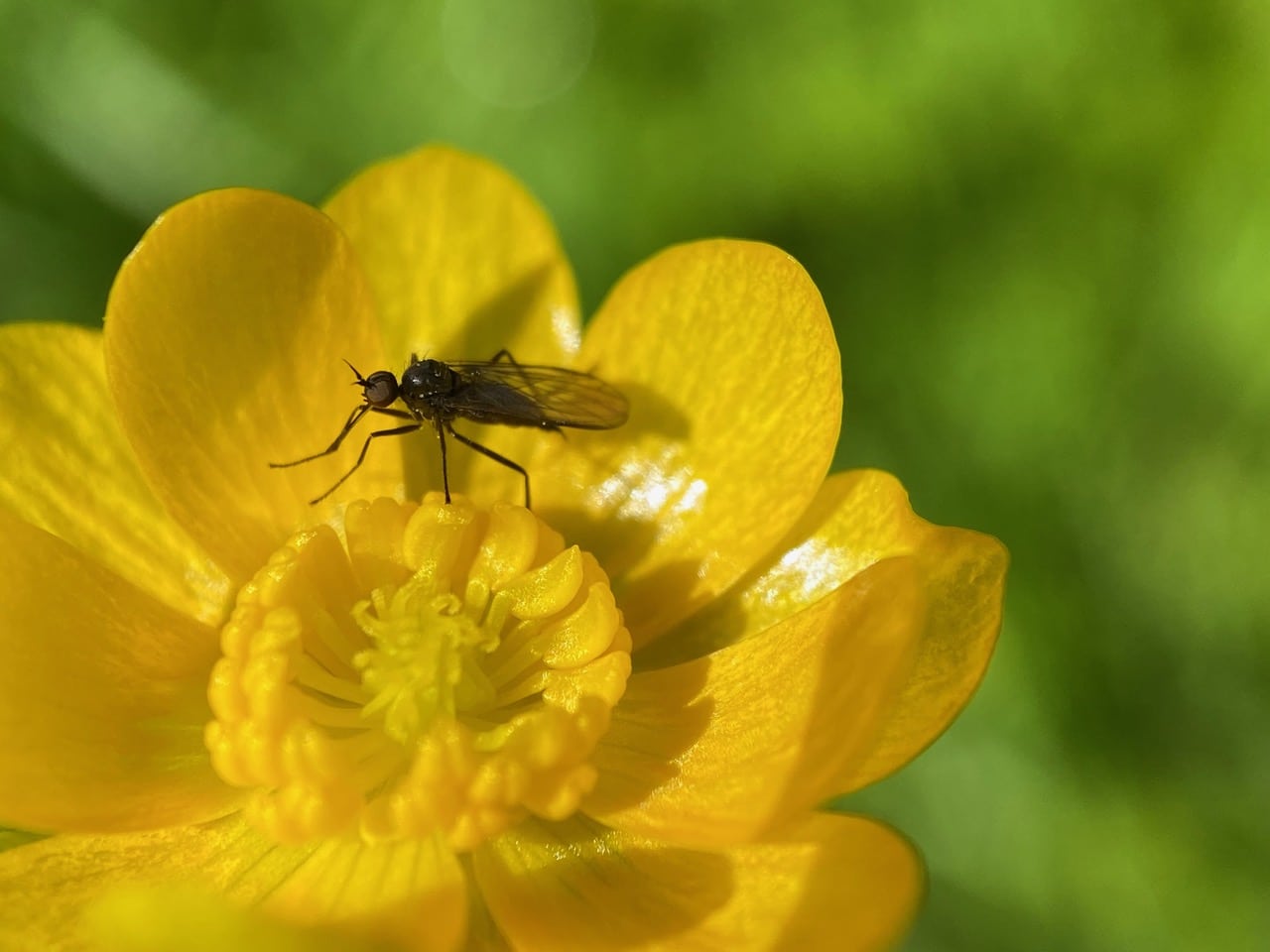
On to the next nectary on another petal.
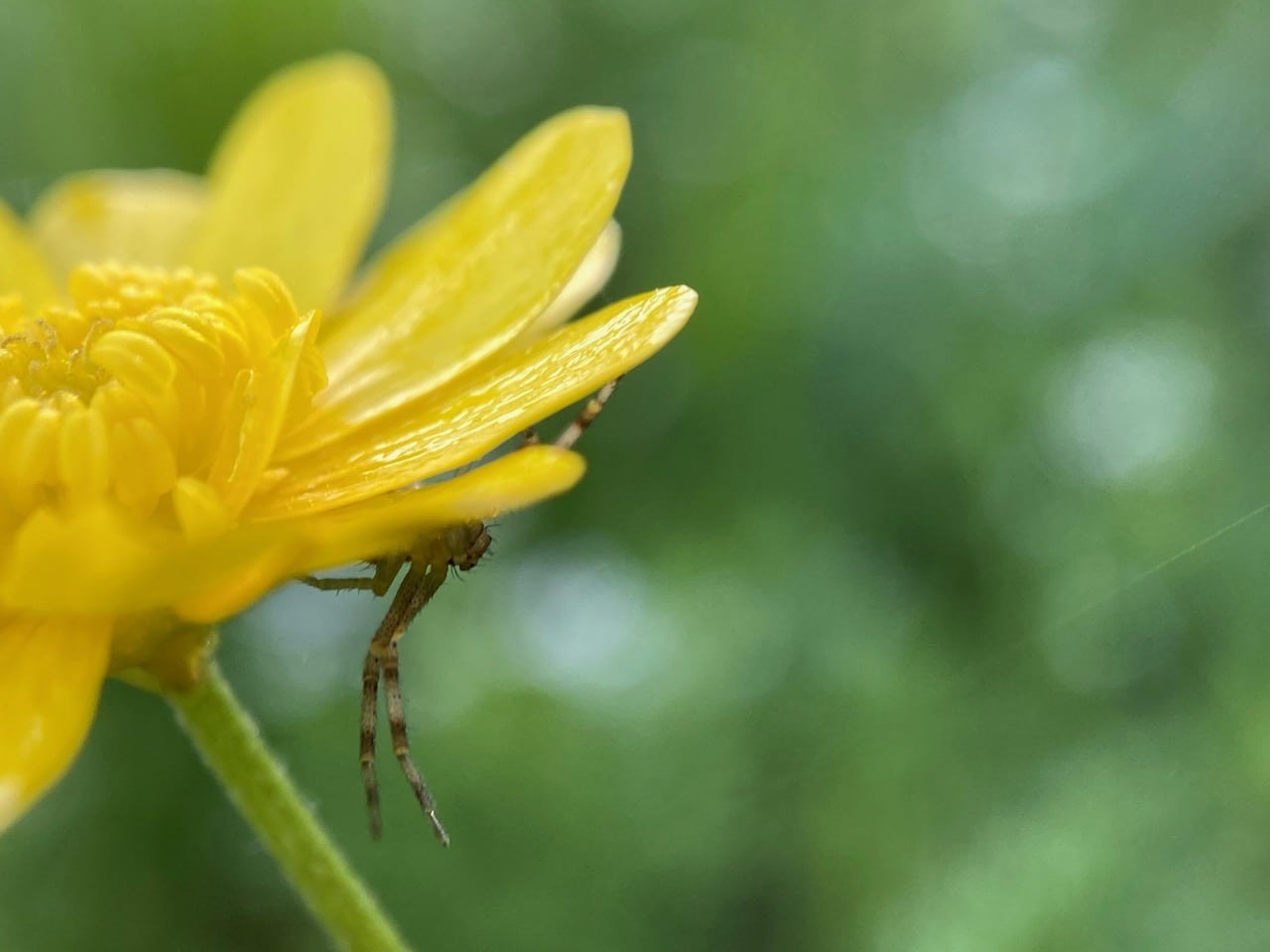
Its front legs fully outstretched, a tiny Crab Spider (family Thomisidae) is waiting in ambush under a buttercup flower.
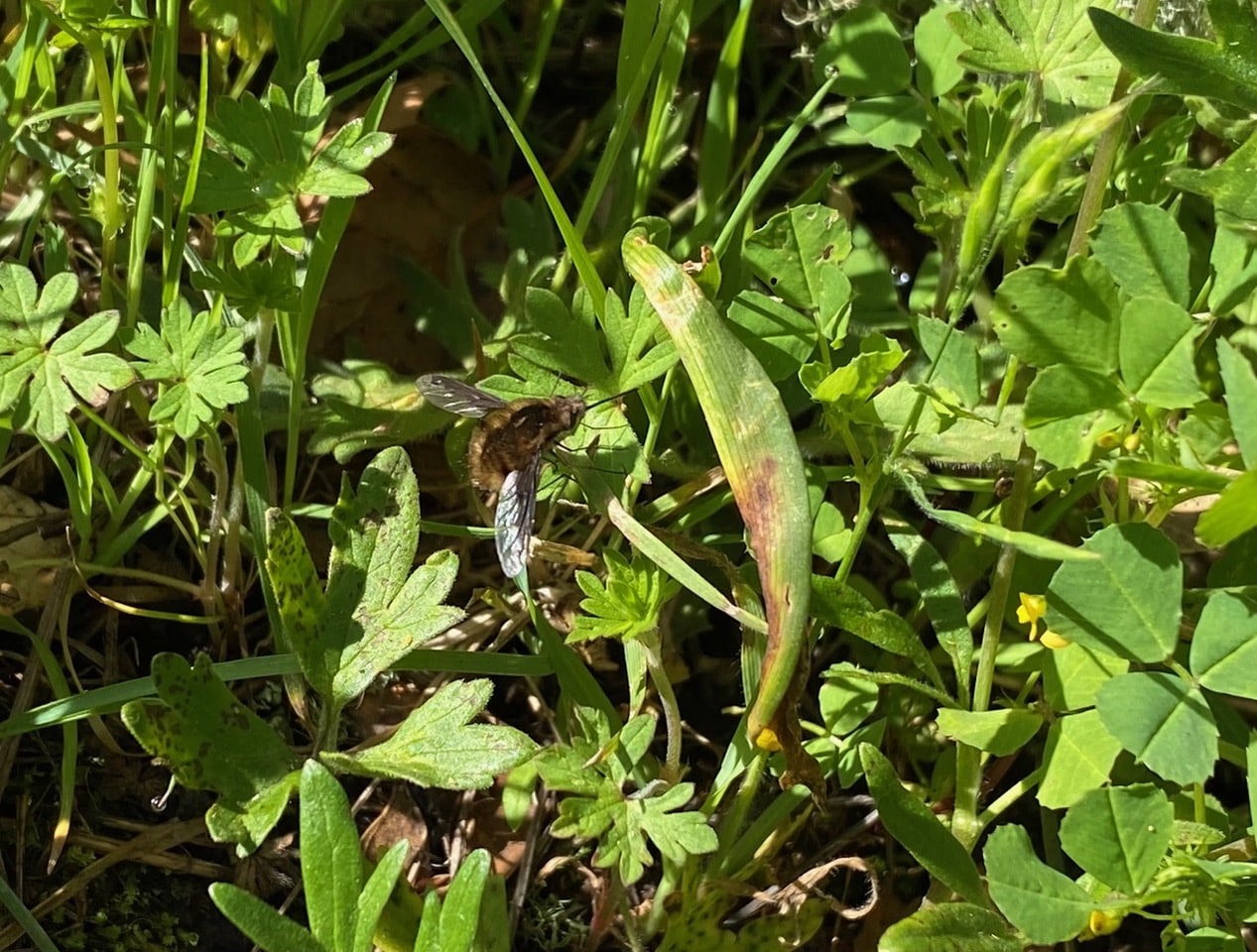
After probing for nectar from a flower of Blue Dicks, a Greater Bee Fly, Bombylius major (family Bombyliidae) lands on the vegetation in the undergrowth, almost disappearing completely.
Bombylius major, commonly known as the Greater Bee Fly is a parasitic bee mimic fly in the family Bombyliidae. It derives its name from its close resemblance to bumble bees. Its flight is quite distinctive – hovering in place to feed, and darting between locations. The species has long skinny legs and a long rigid proboscis held in front of the head. Bombylius major is easily distinguished from the other local species of Bombylius for having wings with dark leading edge, hyaline trailing edge with sharp dividing border. This feature is visible even as the fly is hovering. Adults visit flowers for nectar (and sometimes pollen) from a wide variety of plant families, excelling at small tubular flowers, and are considered good generalist pollinators. Often the pollen is transferred between flowers on the fly’s proboscis.
The bee fly larvae, however, have a sinister side. They are parasitoids of ground-nesting bees and wasps, including the brood of digger bees in the family Andrenidae. Egg deposition takes place by the female hovering above the entrance of a host nest, and throwing down her eggs using a flicking movement. The larvae then make their way into the host nest or attach themselves to the bees to be carried into the nest. There the fly larvae feed on the food provisions, as well as the young solitary bees.
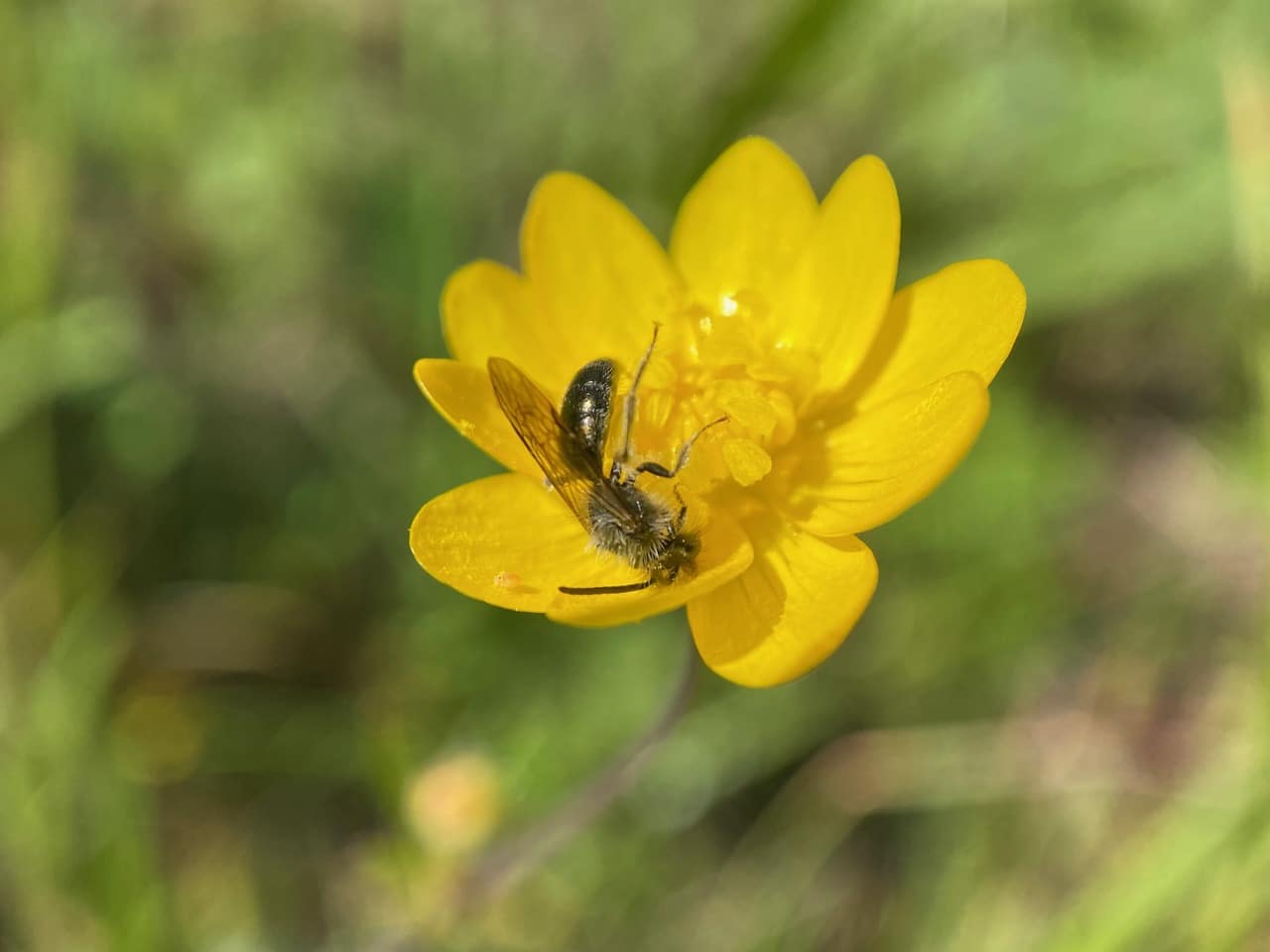
Here’s another male Miner Bee, Andrena sp. (family Andrenidae) on a buttercup flower, with its head reaching under the stamens to probe for nectar at the base of each petal, one at a time.
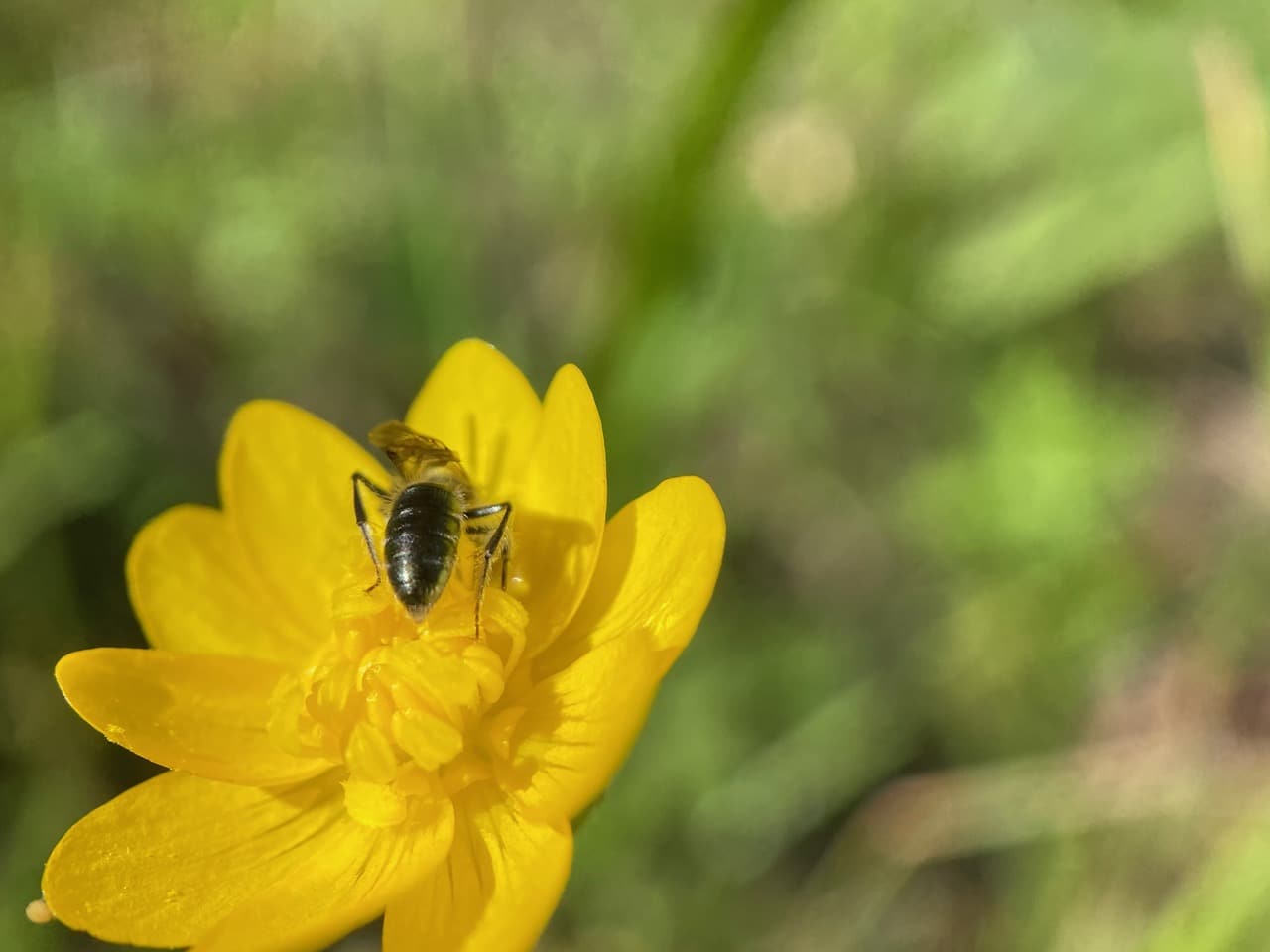
Note the male Miner Bee’s slender abdomen, and absence of scopae on his hind legs. Although male bees do not intentionally collect pollen, they can be good pollinators, as pollen can adhere to their body when they seek nectar.

Hey, there’s a very small spider on that buttercup flower.

The spider drops from the flower on a strand of silk, maneuvering quite skillfully. Is it constructing a web or just fleeing from my camera?
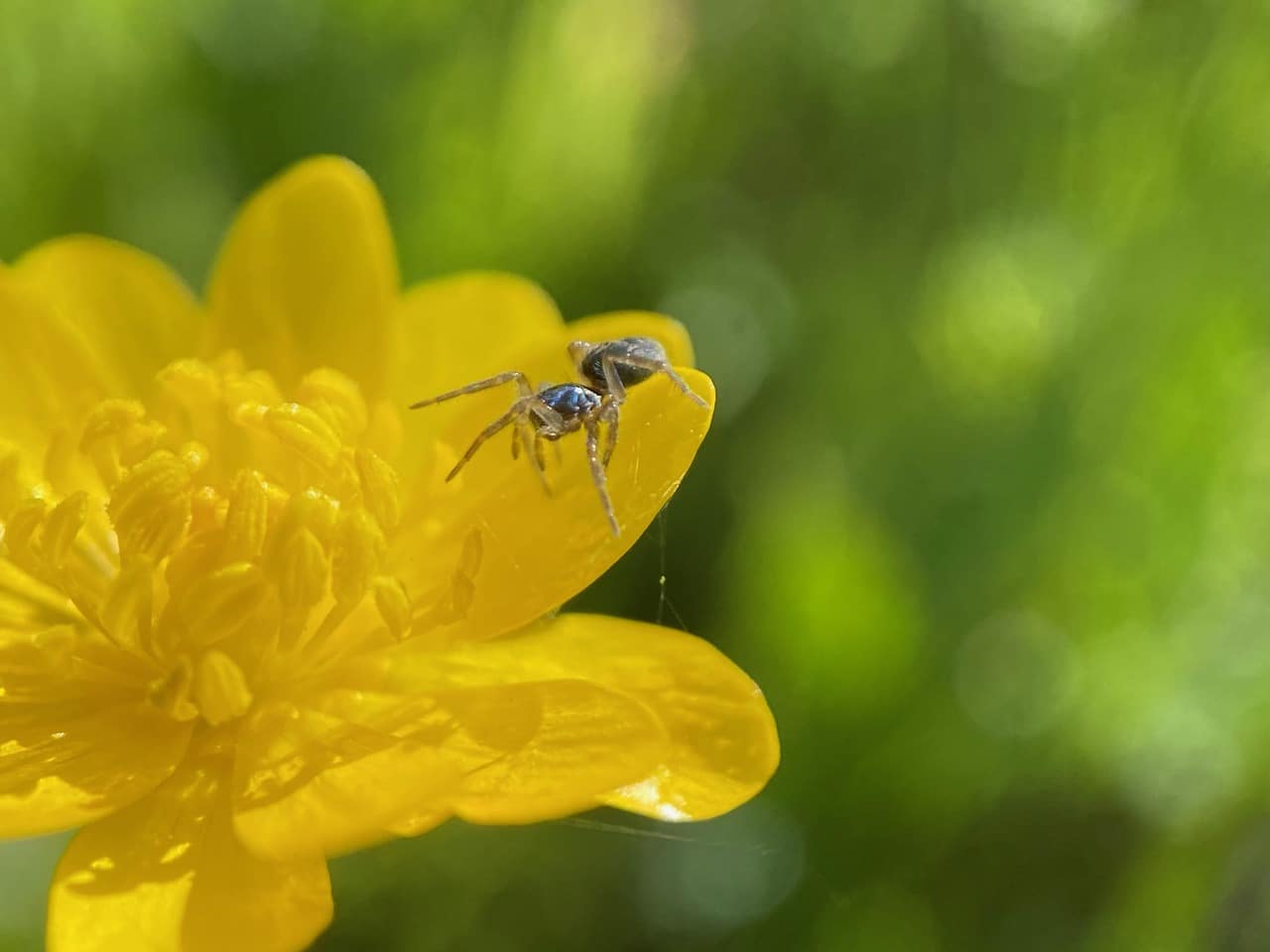
Returning onto the petal, it raises its front legs, waving them around. Strands of silk are visible between the petals.
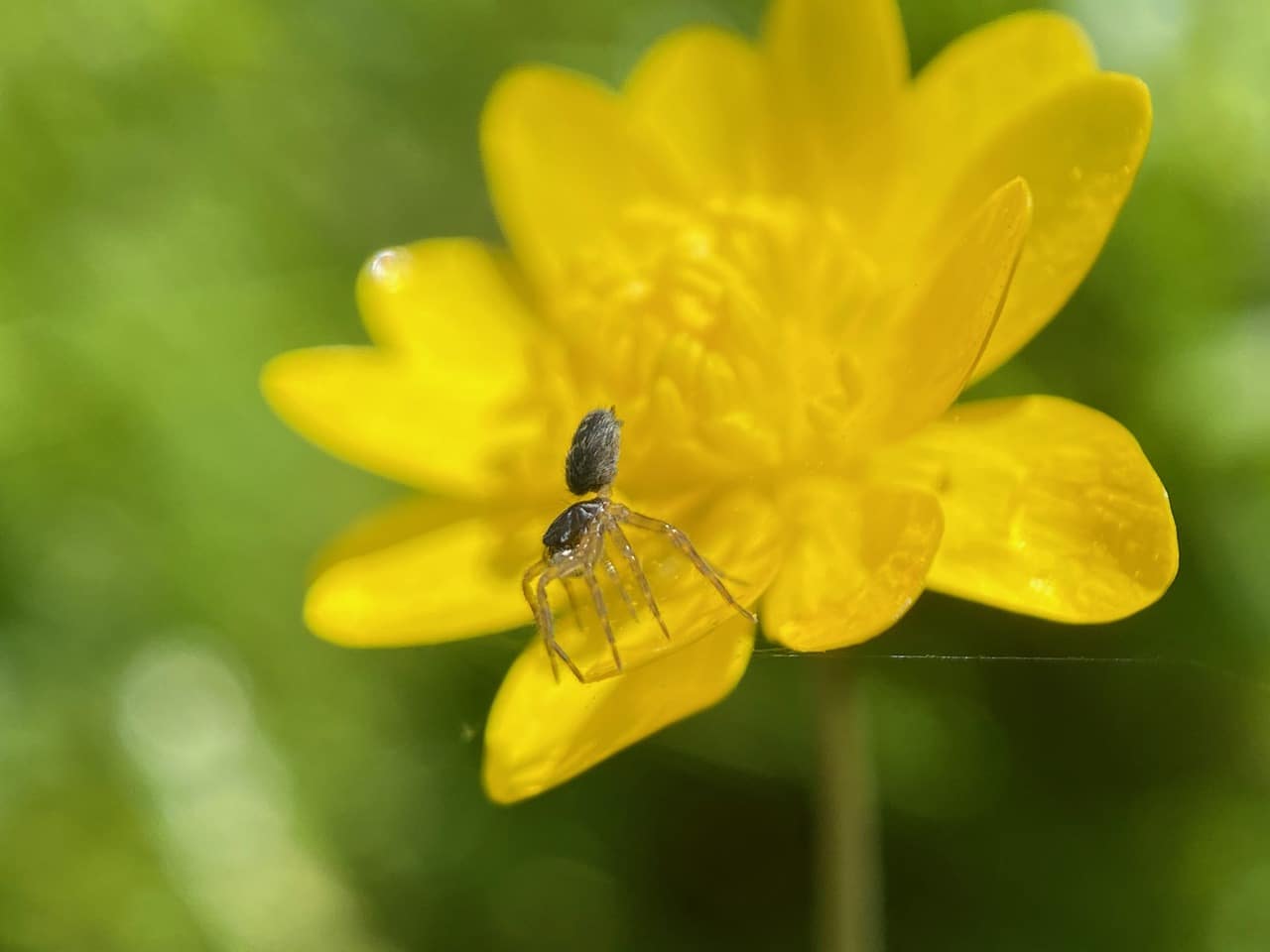
The spider then goes tippy-toe, raising its abdomen into the air, the spinnerets at the tip of its abdomen outstretched. I think it is letting out silk. Is this “ballooning” behavior?
Spider ballooning, also known as kiting, is a method of aerial dispersal where spiders release silk threads to catch the wind and become airborne. This process allows them to travel significant distances, from a few meters to hundreds of kilometers. Ballooning is primarily used by young spiders to disperse and find new habitats, often due to competition for resources or space. While the wind is the primary force, recent research suggests that electric fields may also play a role in lifting and triggering ballooning behavior. Spiders detect electric fields using trichobothria, sensory hairs that move in response to electric fields, much like how human hair stands up from static electricity.
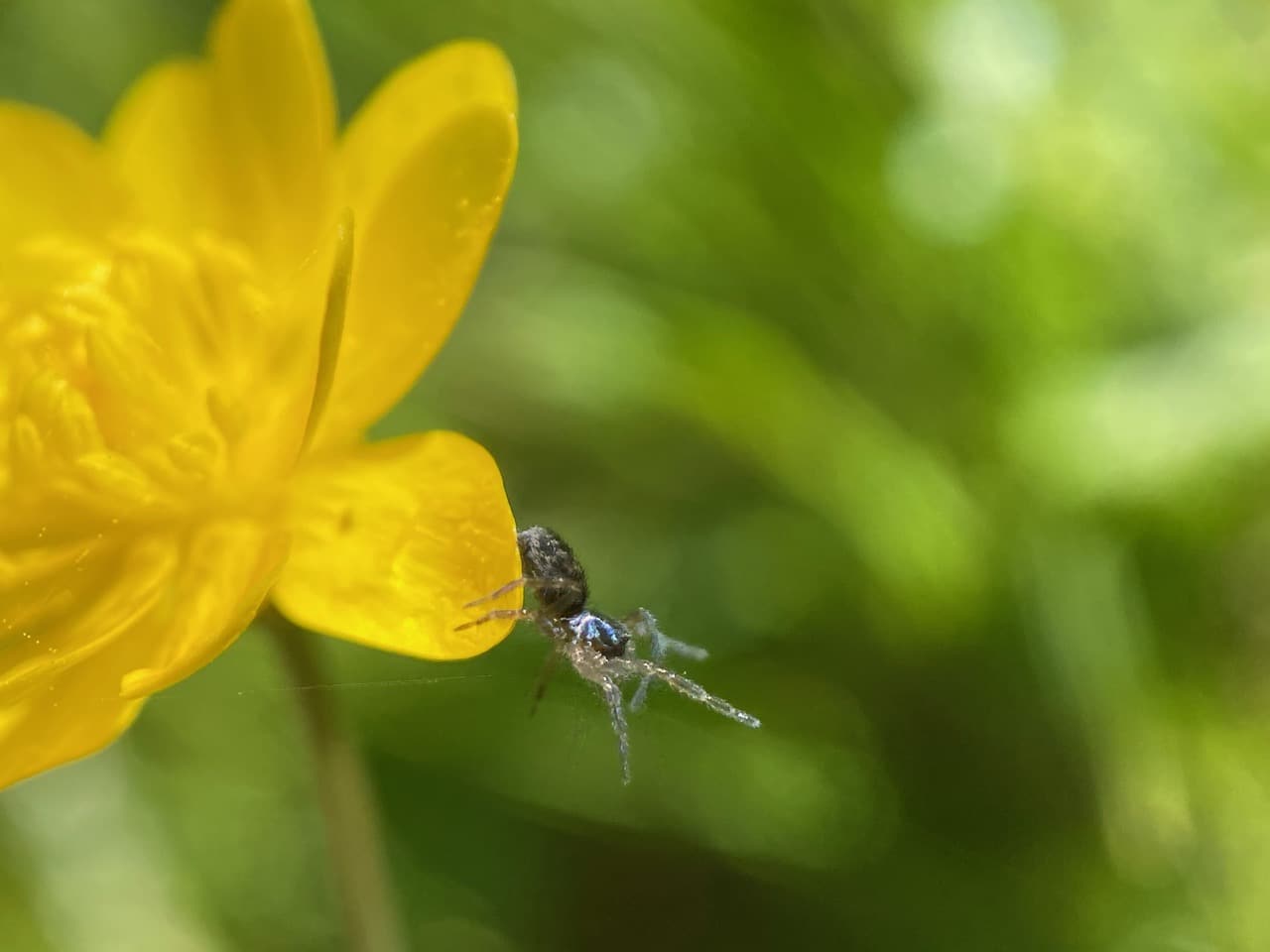
The spider appears to be going off the petal…
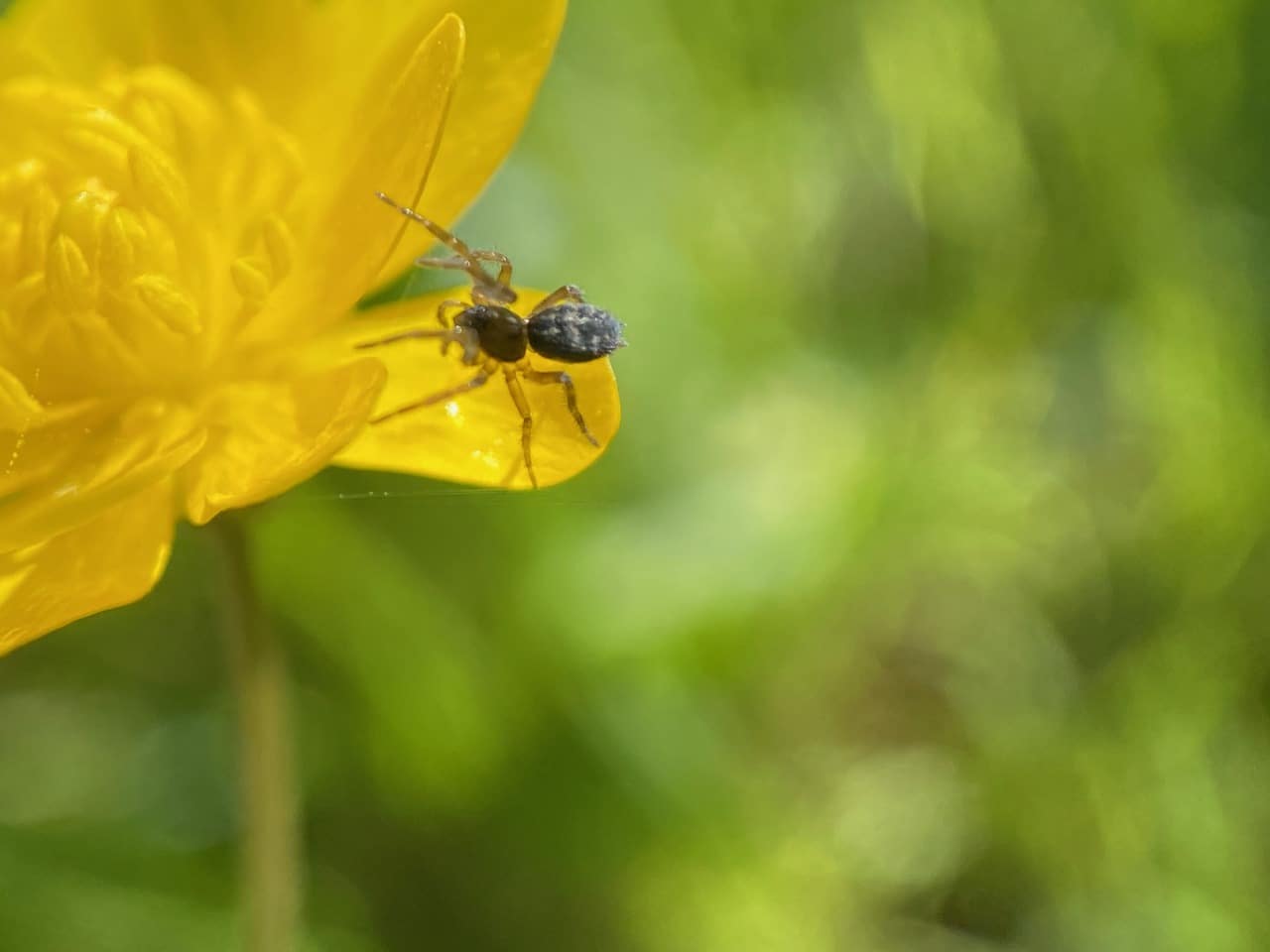
…but always returns to the flower.
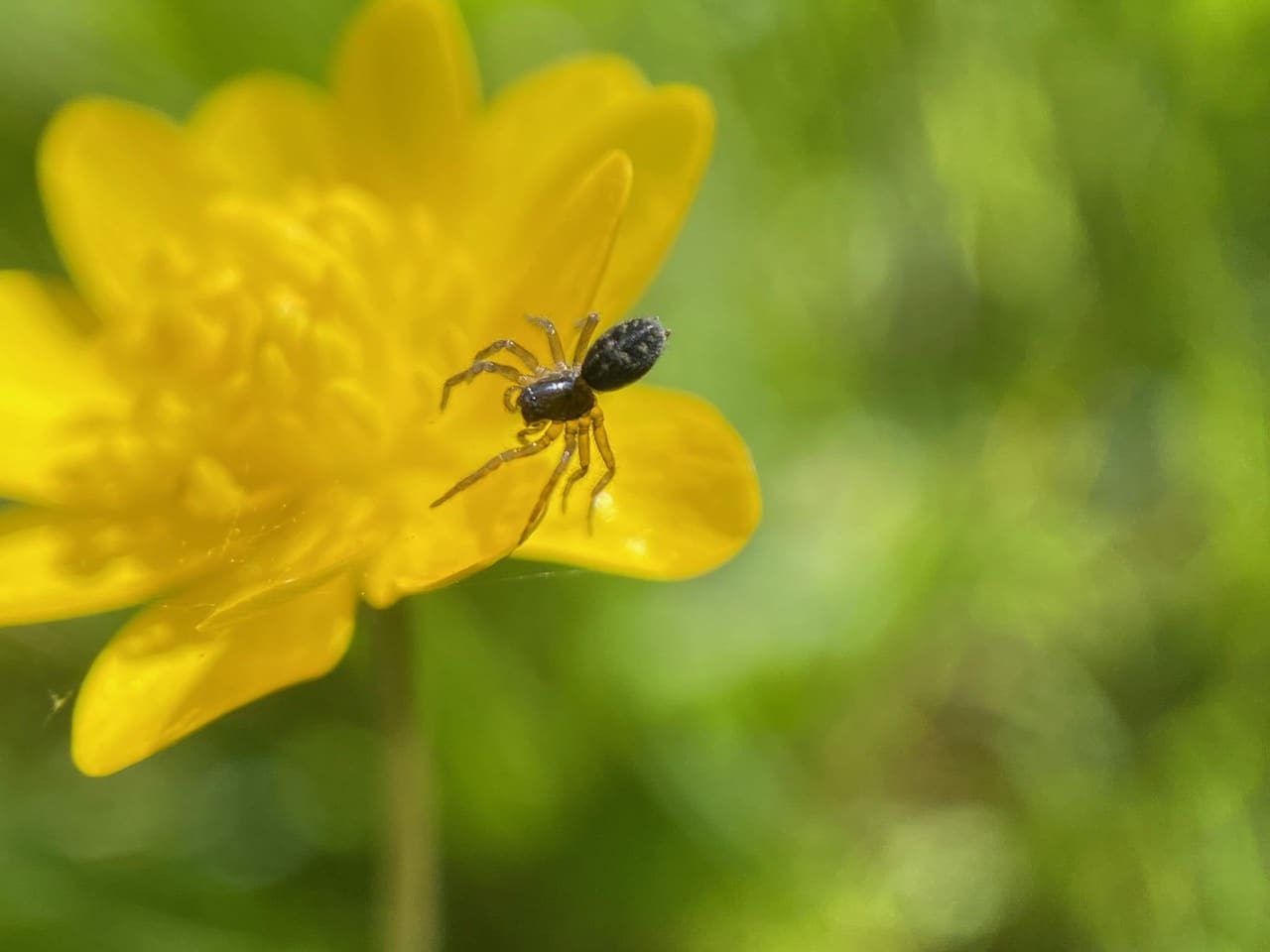
Hey, another attempt at ballooning!
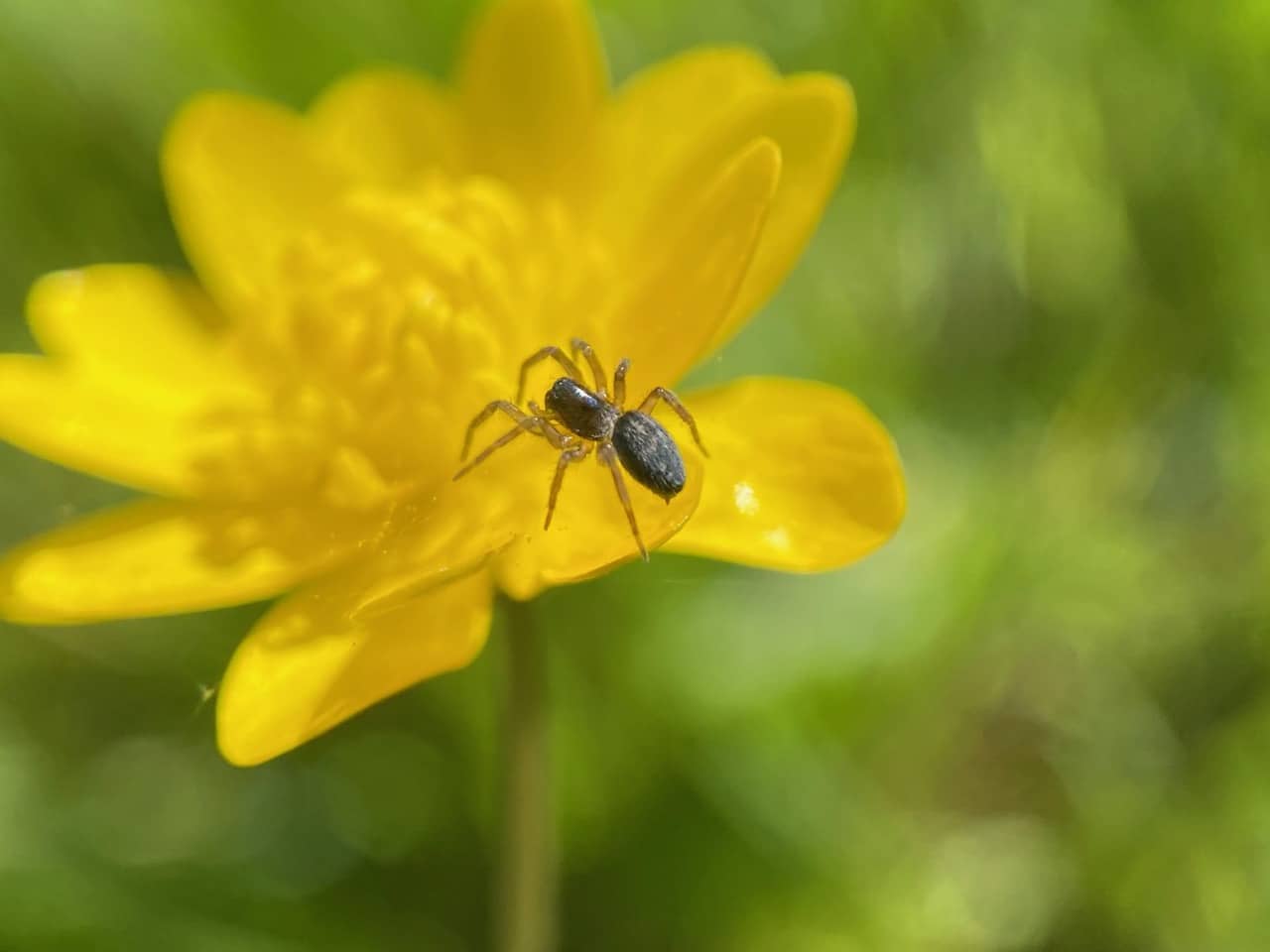
Is the spider anchoring itself to the petal by attaching a strand of silk?
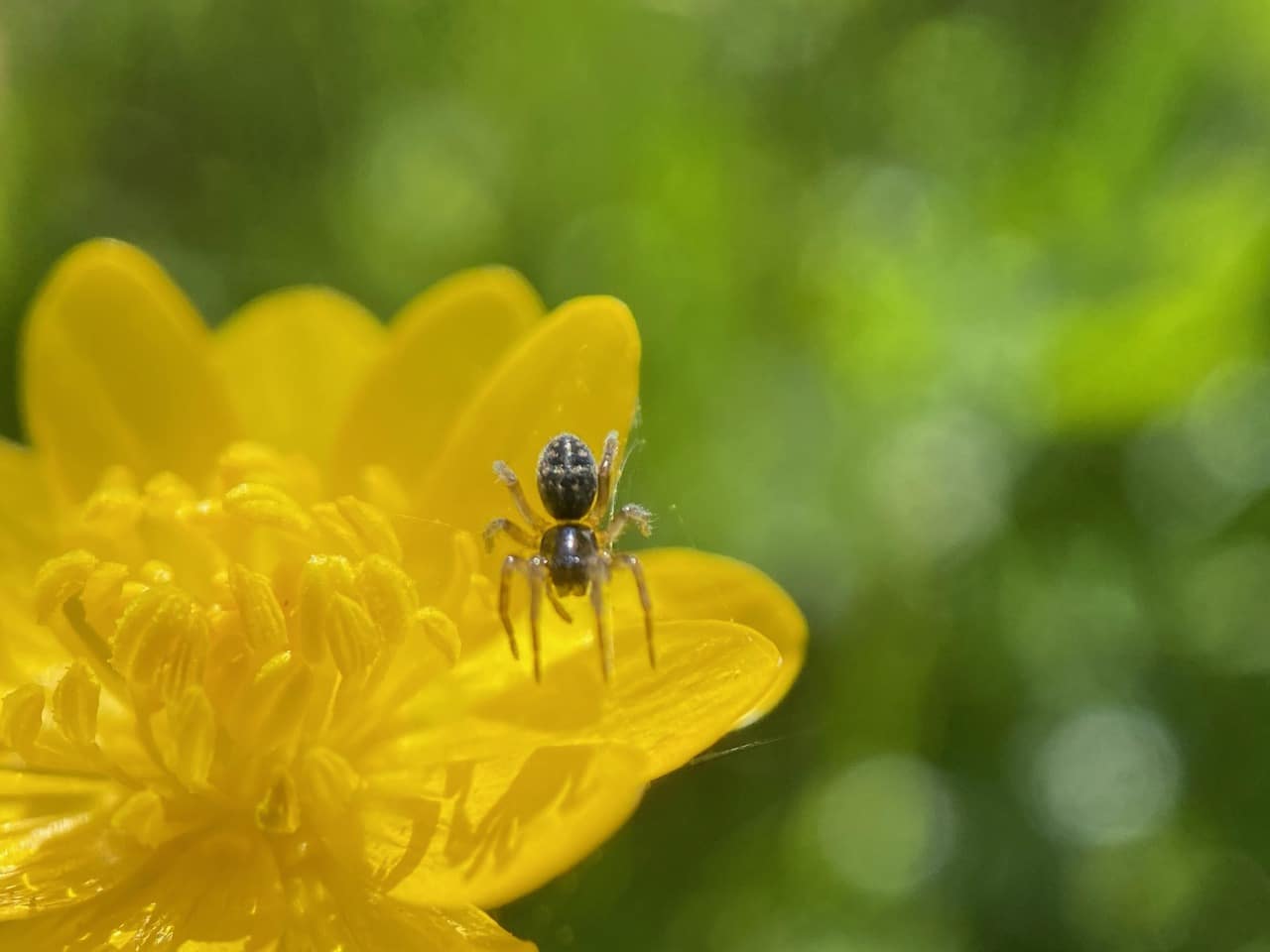
Butt up and standing tall on its toes, the little spider assumes the ballooning stance again. Wow, amazing persistence! Bon voyage to you, little spider!
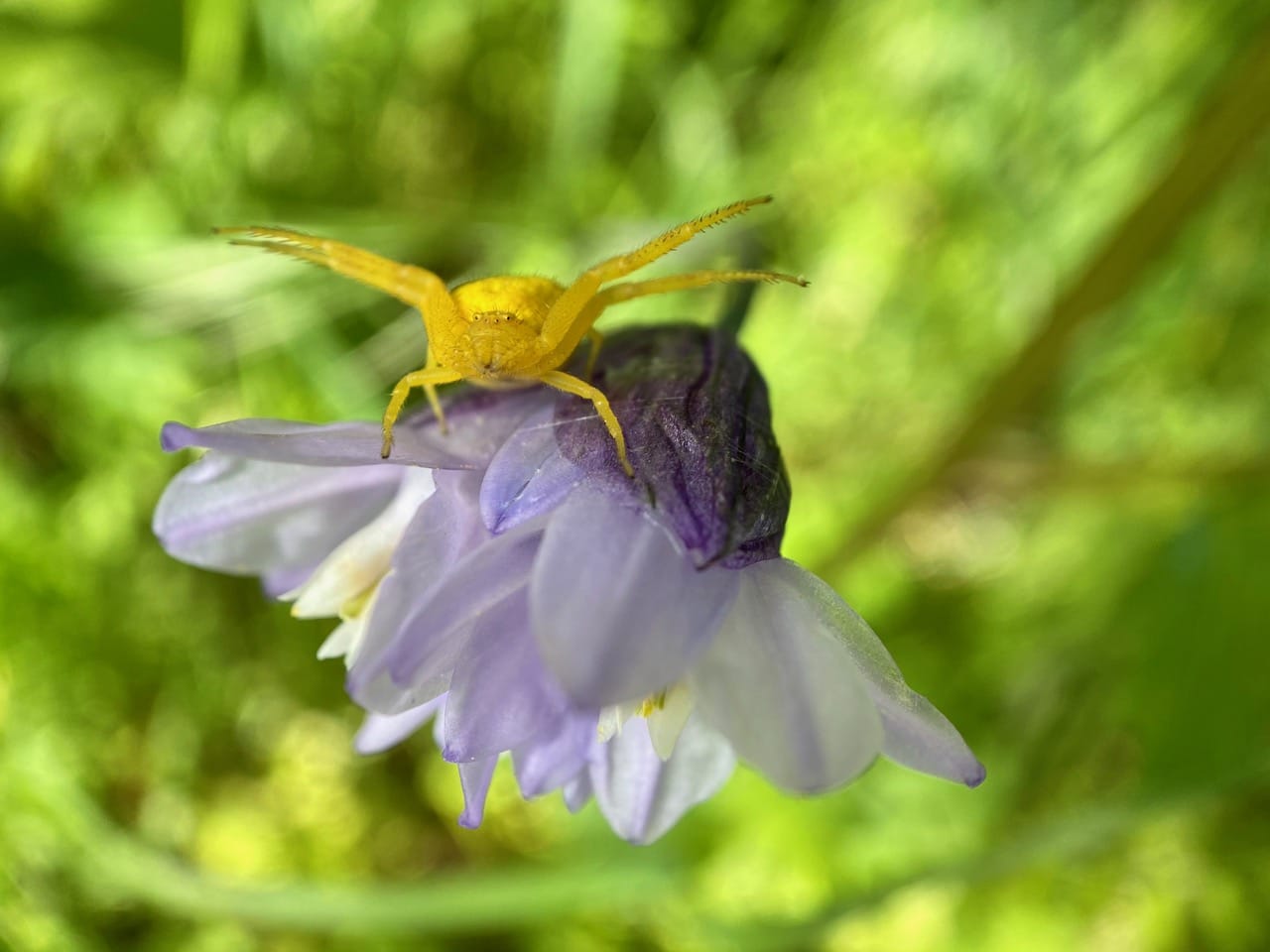
Its two front pairs of legs raised, a large Crab Spider, Misumena vatia (family Thomisidae) is on full alert on a cluster of Blue Dicks flowers, Dipterostemon capitatus. In bright yellow, the ambush predator is quite visible against the blue flowers. How does she expect any potential prey to come close?
It is often assumed that Crab Spiders change colors to blend in with their surrounding. The truth is a little more complicated than that.
The spider can change its color between white and yellow to match the flower it is sitting on. The color change takes a few days. Maybe this spider has recently moved over from a nearby yellow flower?
There’s another trick that the spider might be playing that we are not aware of because we cannot see in the ultraviolet (UV) spectrum of light. It’s been discovered that Crab Spiders reflect UV light strongly. Most insects, notably the bees, see UV well, and favor sunlit flowers while foraging. Experiments have shown that flowers that have crab spiders sitting on them actually garner more insect visits than those that don’t! It is thought that perhaps color camouflage in the visible spectrum helps the spiders avoid vertebrate predators (birds, lizards, etc.), while the UV reflectance is useful for attracting insect prey.
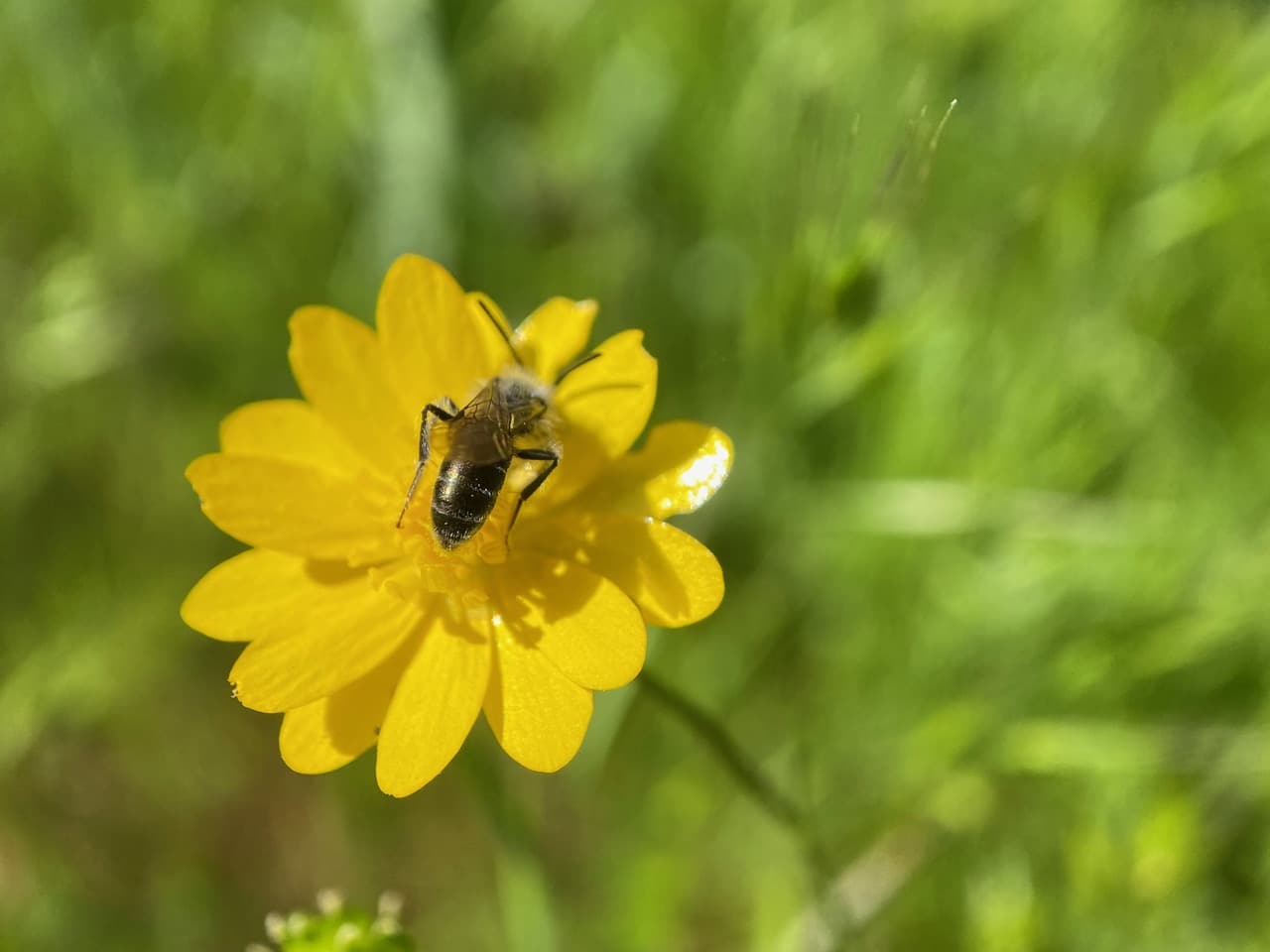
A male Miner Bee, Andrena sp. (family Andrenidae) is taking nectar from a buttercup flower. Note his slender build and long antennae, and the absence of scopae on his hind legs.
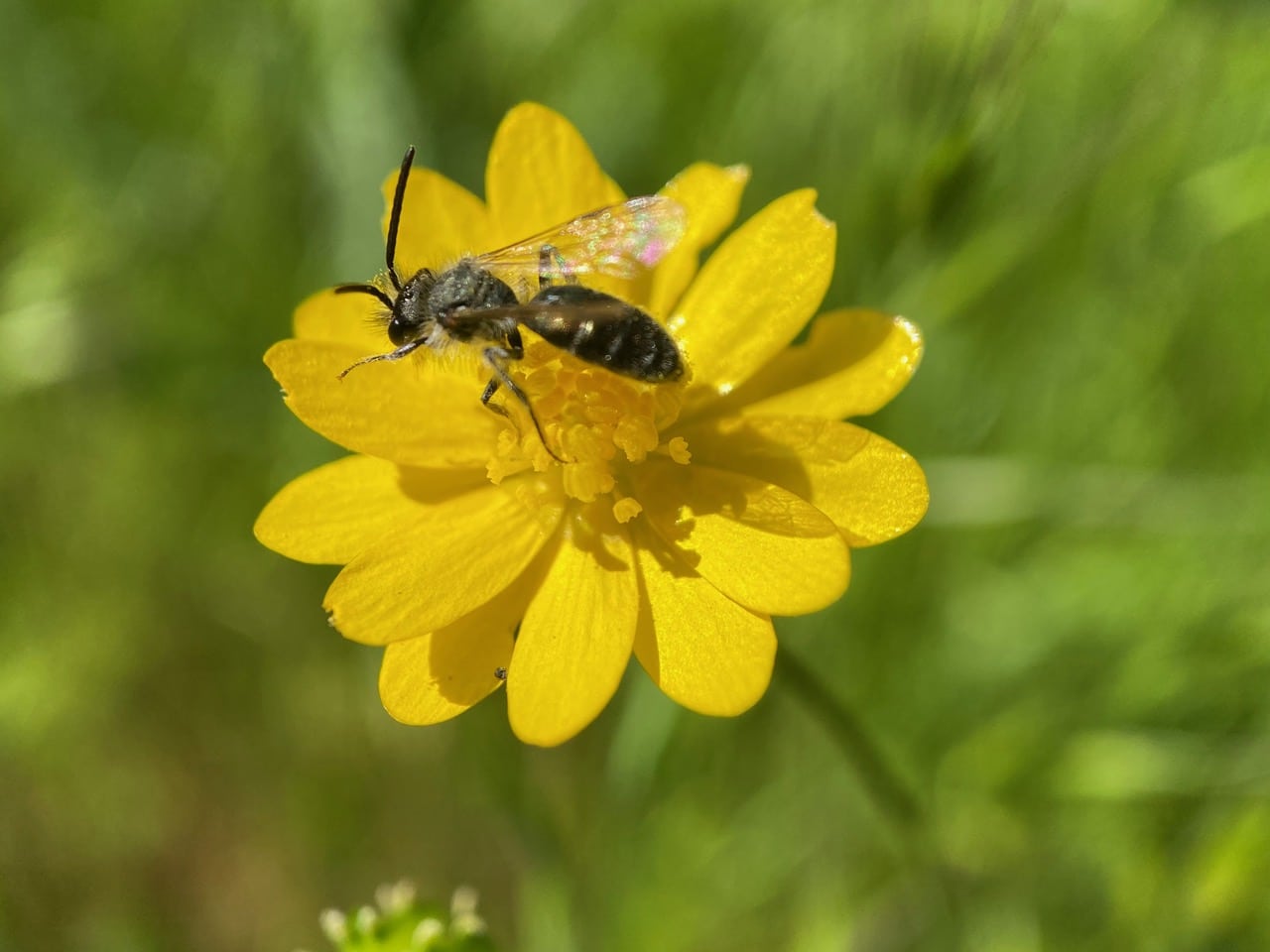
The antennae of male bees are often much longer than their female counterparts. Male antennae have an extra segment and the segments themselves are longer. This is because male antennae are specialized to pick up the subtle scent of female pheromones.
Male bees do not collect pollen to provision the nest, neither do they have the equipment for the job. They do, however visit flowers for nectar, and can be good pollinators in transferring pollen between flowers.
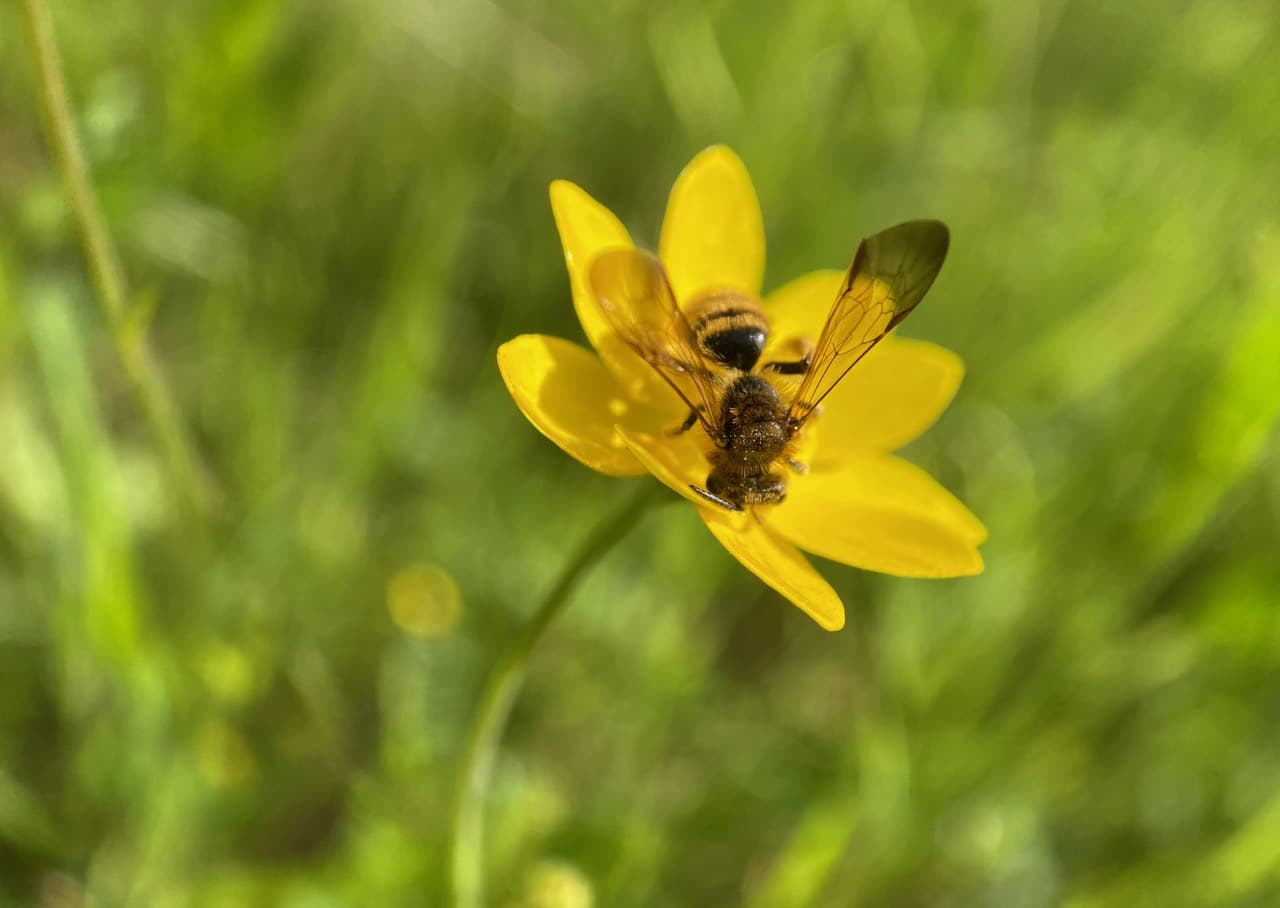 Wait, this is a different kind of bee. It is slightly larger, browner over all, and like a wasp, it holds its wings up all the time.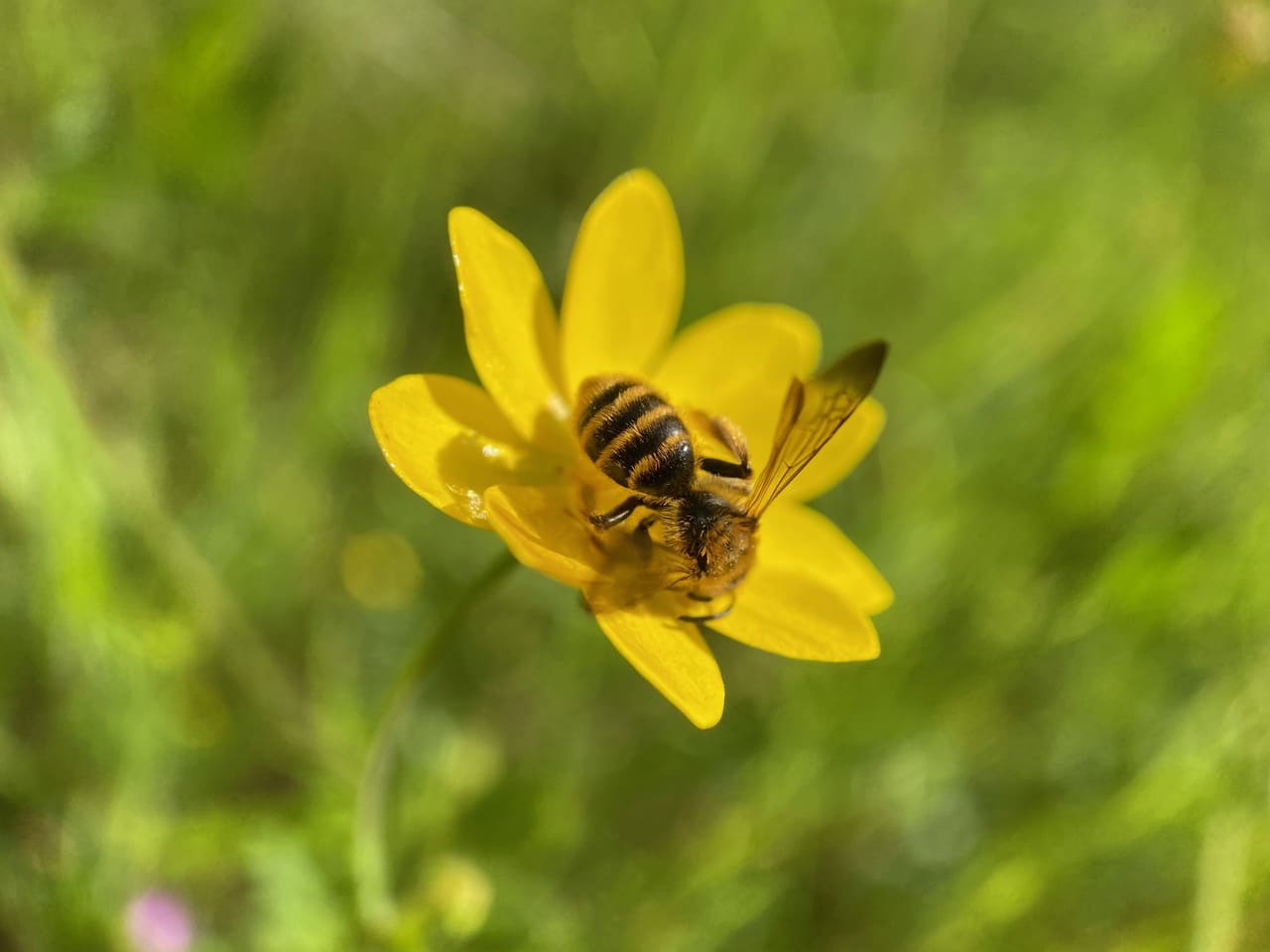
The hairs on the bee are a deep gold color. The wings are smokey brown. It is a Golden-haired Miner Bee, Andrena auricoma (family Andrenidae).

The Golden-haired Miner Bee, Andrena auricoma is a species of Miner Bees in the family Andrenidae. It is found in the western U.S., and is relatively rare outside California. The females are slightly larger, 8-10 mm long, compared to the males’ 6-9 mm. Females carry pollen in the scopae on their hind legs.
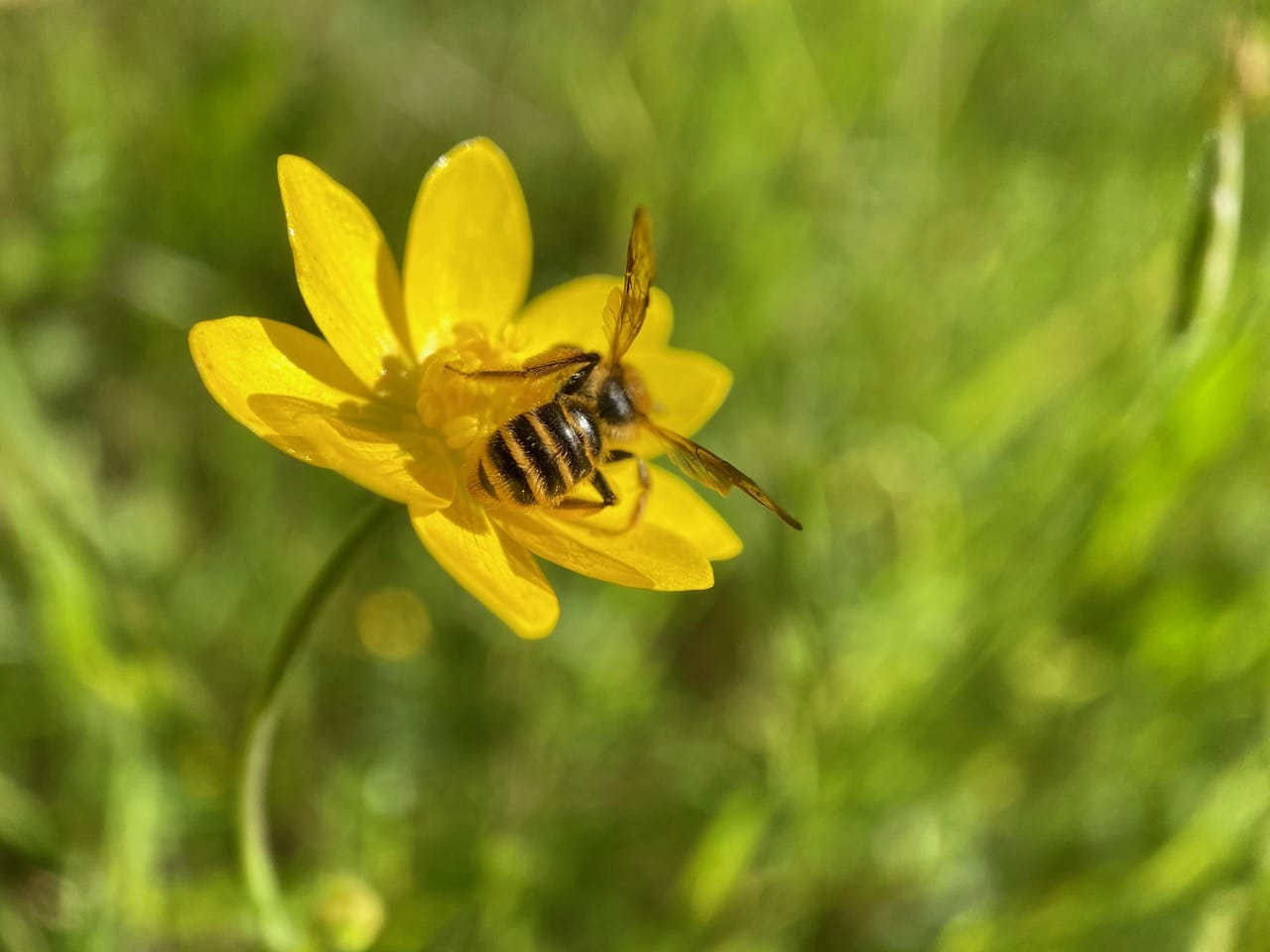
The bee appears to be female, but she has not filled her scopae yet. She is probing for nectar on the buttercup flower, not collecting pollen.
The bee next visits an older buttercup flower with spent stamens (with no pollen), and swelling green carpels in the middle of the flower.