

Pollinator Post 4/10/24
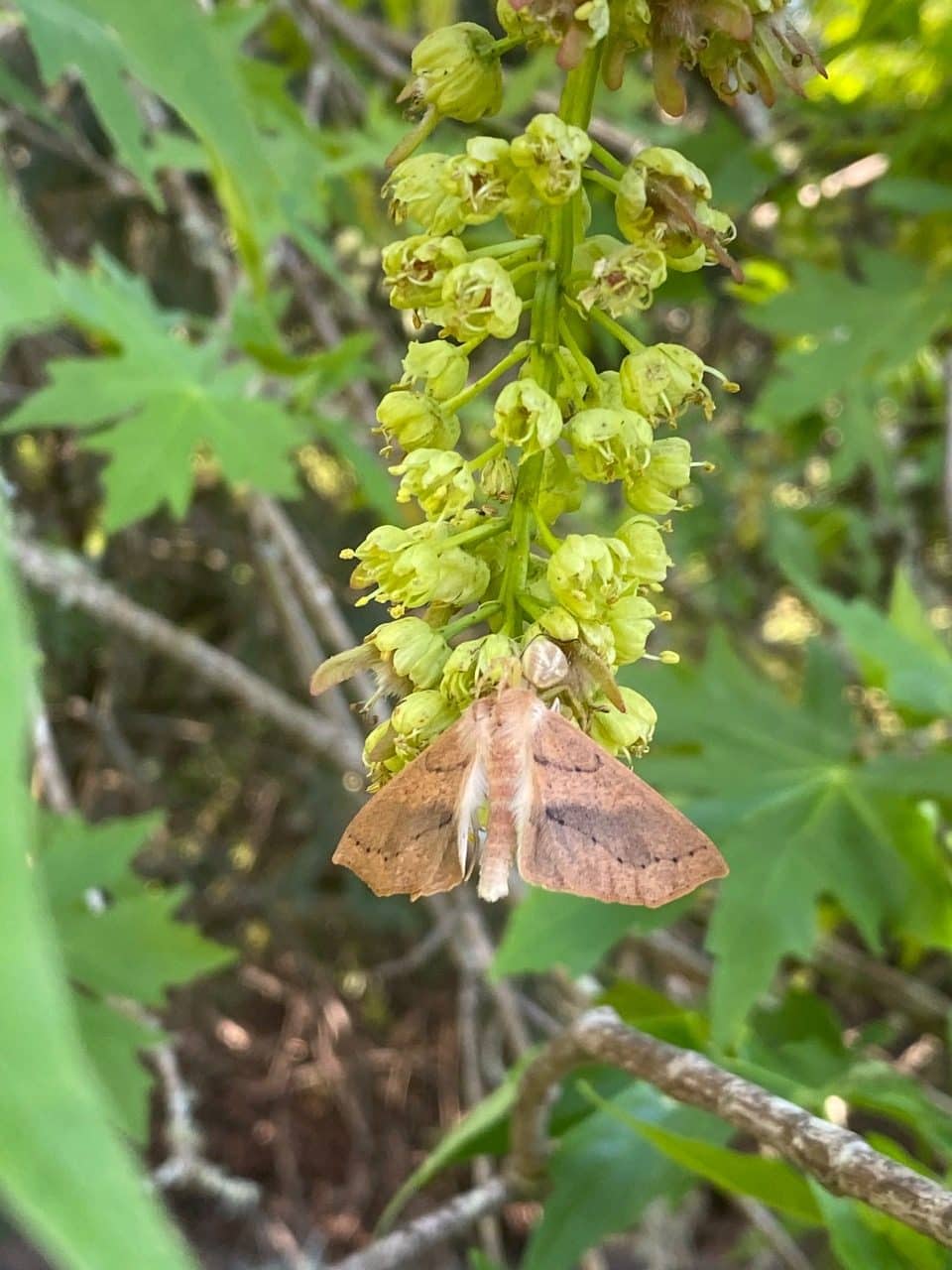
A beautiful morning at Tilden Regional Park in the Berkeley hills. I have come early as the afternoon is forecast to be hot, reaching beyond 70 F. Walking to the glorious patch of blooming California Buttercup at the Laurel picnic area, I spot something brown on a hanging flower cluster of a Bigleaf Maple, Acer macrophyllum.

I have never seen such a large Geometrid moth! Then I see the small Crab Spider, Mecaphesa sp. (family Thomisidae) that is holding the moth’s head in its jaws. No wonder the moth is not moving. Wow, it is astounding that the spider is capable of catching something so much bigger than itself!
iNaturalist has helped identify the moth as the Omnivorous Looper, Sabulodes aegrotata (family Geometridae). The caterpillars of Geometrids are “inchworms” that move in a looping gait, hence the common name Looper. S. aegrotata has earned its common name because their larvae feed on the foliage of at least 27 different families of deciduous trees, shrubs, and herbaceous plants. The list includes many agricultural crops, such as walnuts, avocados and citrus, and oddly English ivy. The color of the wings is highly variable, ranging from cream to ochraceous, brown or blackish brown. The species is found in moist mixed forests and woodlands in coastal western North America, from Baja California to Oregon. Adult moths are found year round. Eggs are laid in clusters on the leaves. Larvae shelter in a silk structure built in folded leaves or between leaves. Sabulodes is one of the few genera to fluoresce under ultraviolet light.
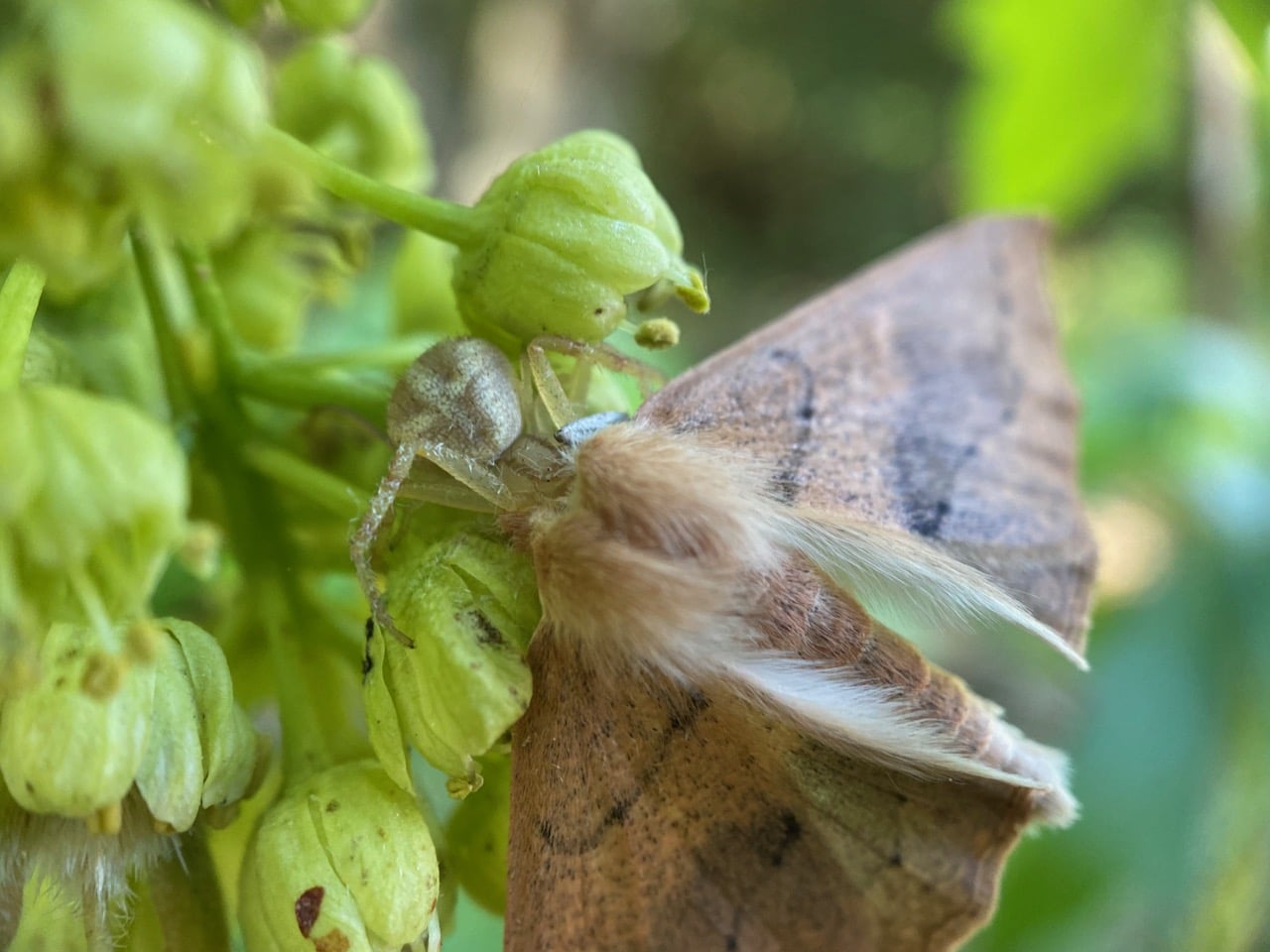
The Crab Spider, Mecaphesa sp. (family Thomisidae) is pale-colored and hardly visible among the pale green flowers of Bigleaf Maple.
Members of the family Thomisidae do not spin webs, and are ambush predators. The two front legs are usually long and more robust than the rest of the legs. Their common name derives from their ability to move sideways or backwards like crabs. Most Crab Spiders sit on or beside flowers, where they grab visiting insects. Some species are able to change color over a period of some days, to match the flower on which they are sitting. Crab Spiders are equipped with venom powerful enough to kill prey much larger than themselves. The potent venom immobilizes prey quickly so the spider, not using any silk for the capture, does not have to contend with a struggling prey.
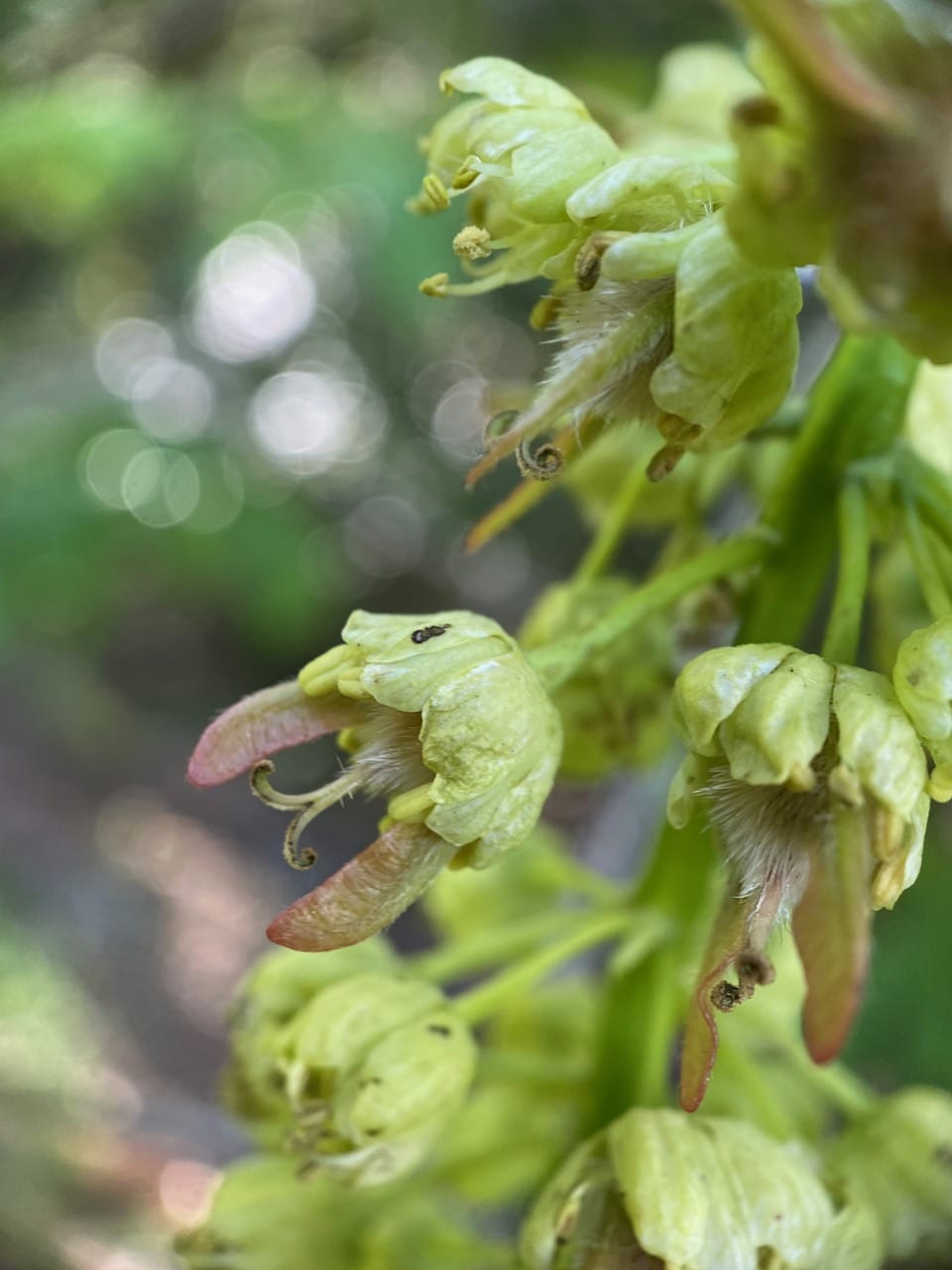
Bigleaf Maple, Acer macrophyllum thrives in wet forests and open fields. Flowers bloom in March through April before leaves appear. The tree is polygamous, bearing both male flowers and perfect flowers (with both male and female organs) in one cylindrical raceme. Ten stamens with globular, pollen covered anthers emerge from the cup-like corolla. The flowers are pollinated by insects within 2 to 4 weeks after bud-burst. The fruits are propeller-like, paired, winged samaras in the shape of a V. They emerge from the flowers looking like bunny ears popping out of a hole. Once fully developed in late summer, they travel like helicopters in the wind.
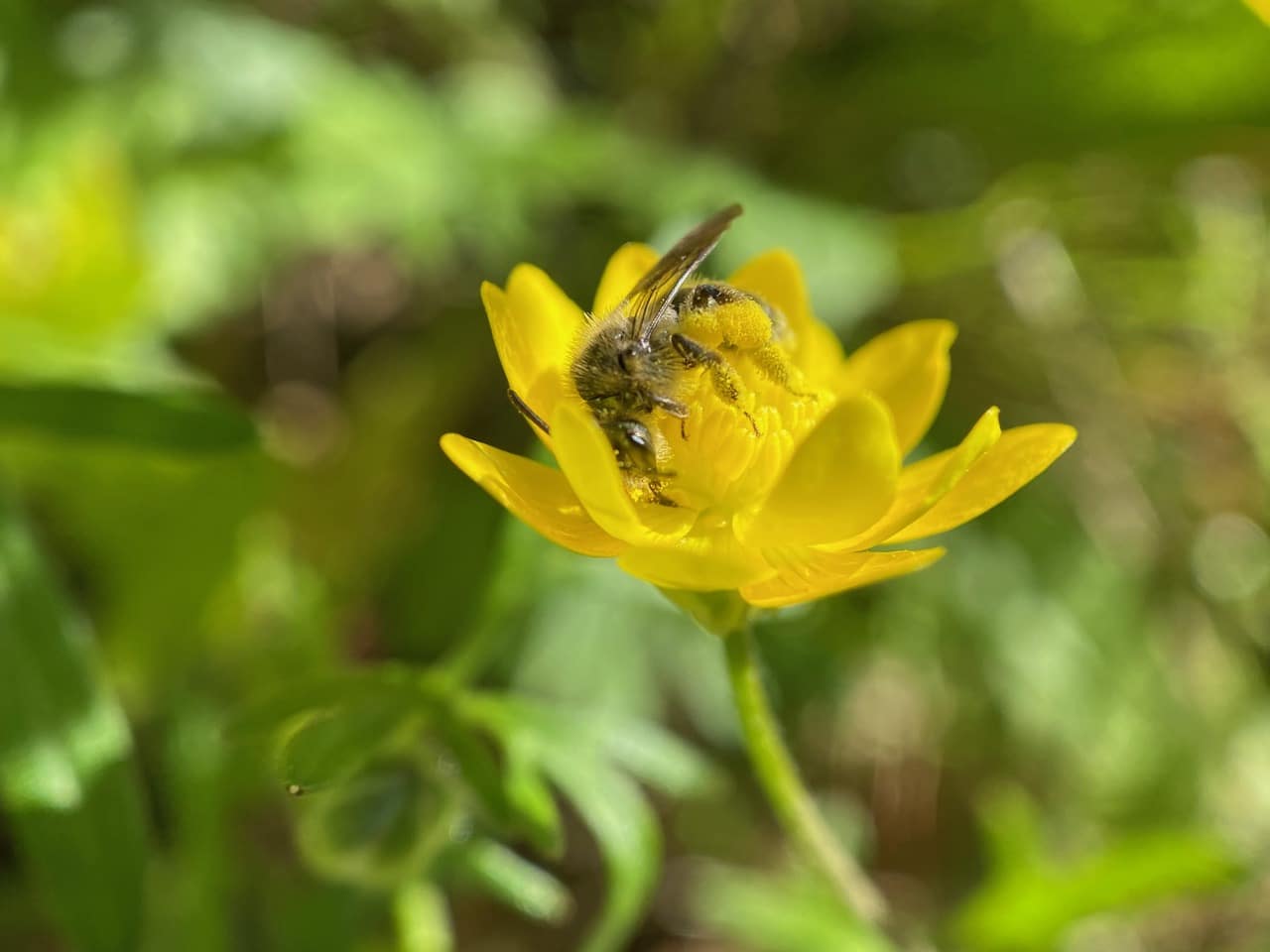
I spend most of the morning observing the female Mining Bees, Andrena sp. (family Andrenidae) foraging on the California Buttercup, Ranunculus californicus. I cherish the moment – since these bees seem to specialize on the plant, they will probably be gone when the buttercups finish blooming.
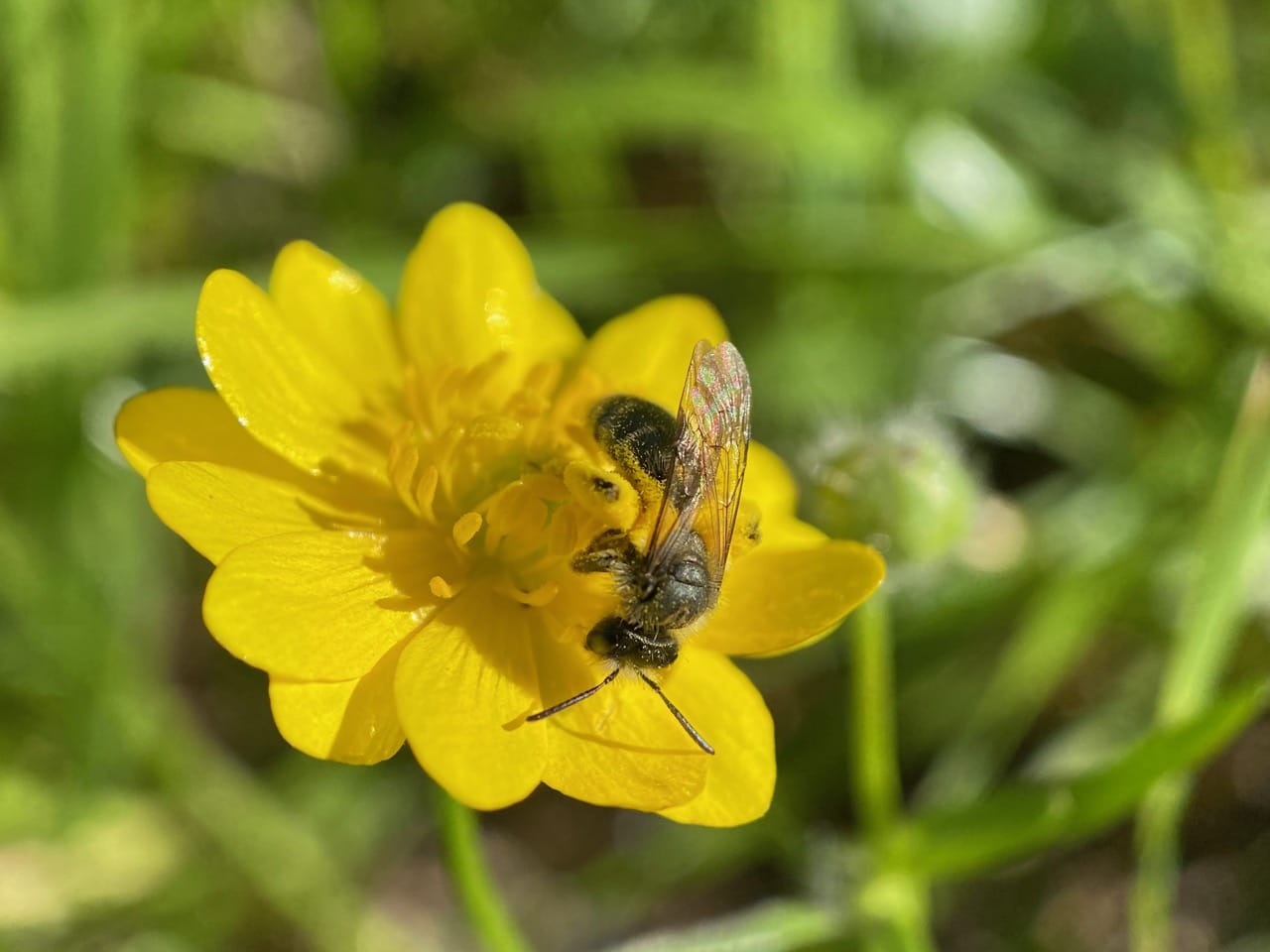
A good view of the propodial corbicula of a female Mining Bee, Andrena sp. (family Andrenidae). In addition to the regular scopae on their hind legs, Andrena females also carry pollen on the hairs of their propodeum, the first abdominal segment, the one that is attached to the thorax, their “arm pit” so to speak. A pair of full propodial corbiculae gives the appearance of a bee carrying “saddle bags”.

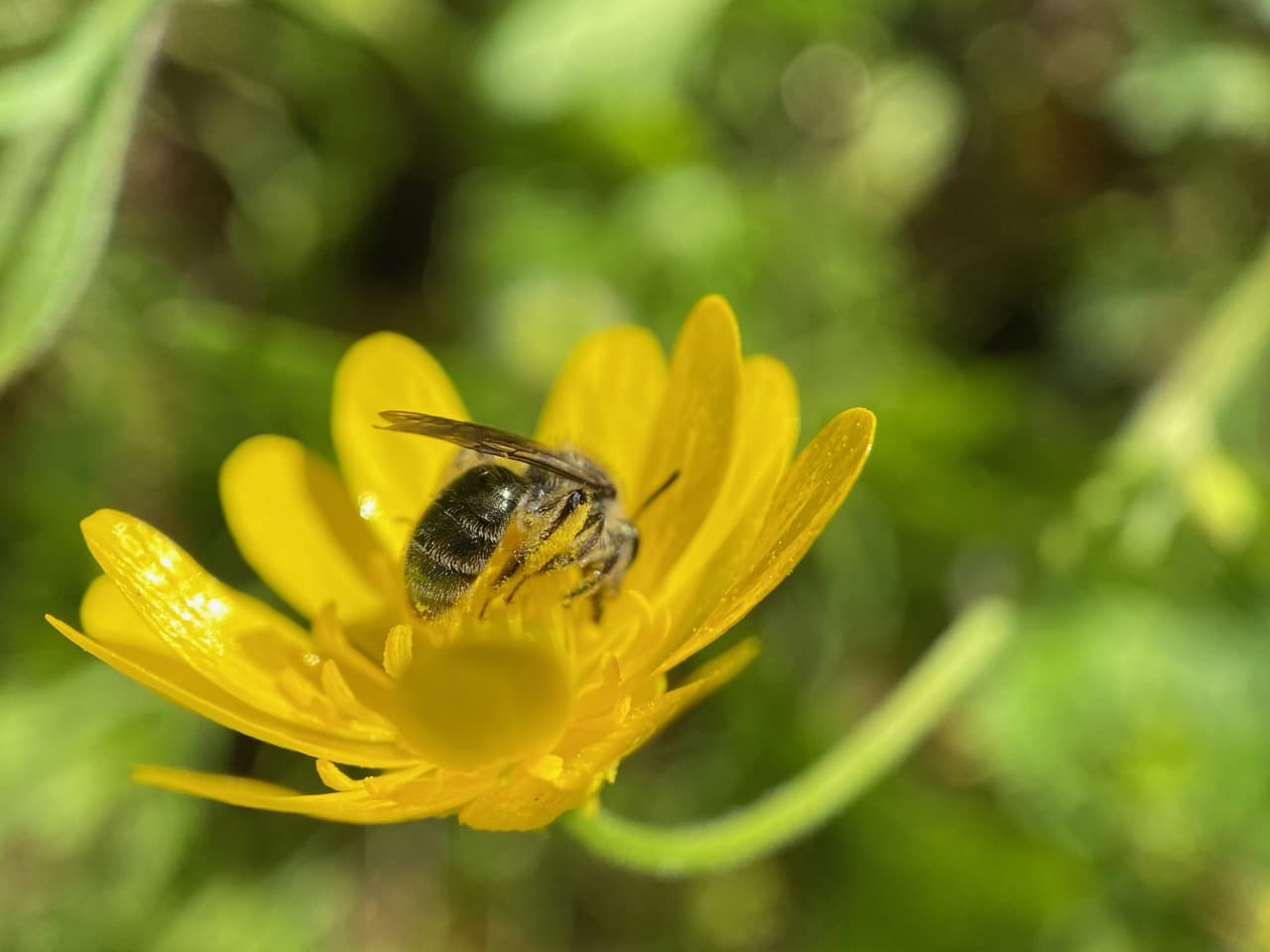
Photographing the small bees with a macro lens seems a bit easier in the morning light than yesterday’s afternoon light.
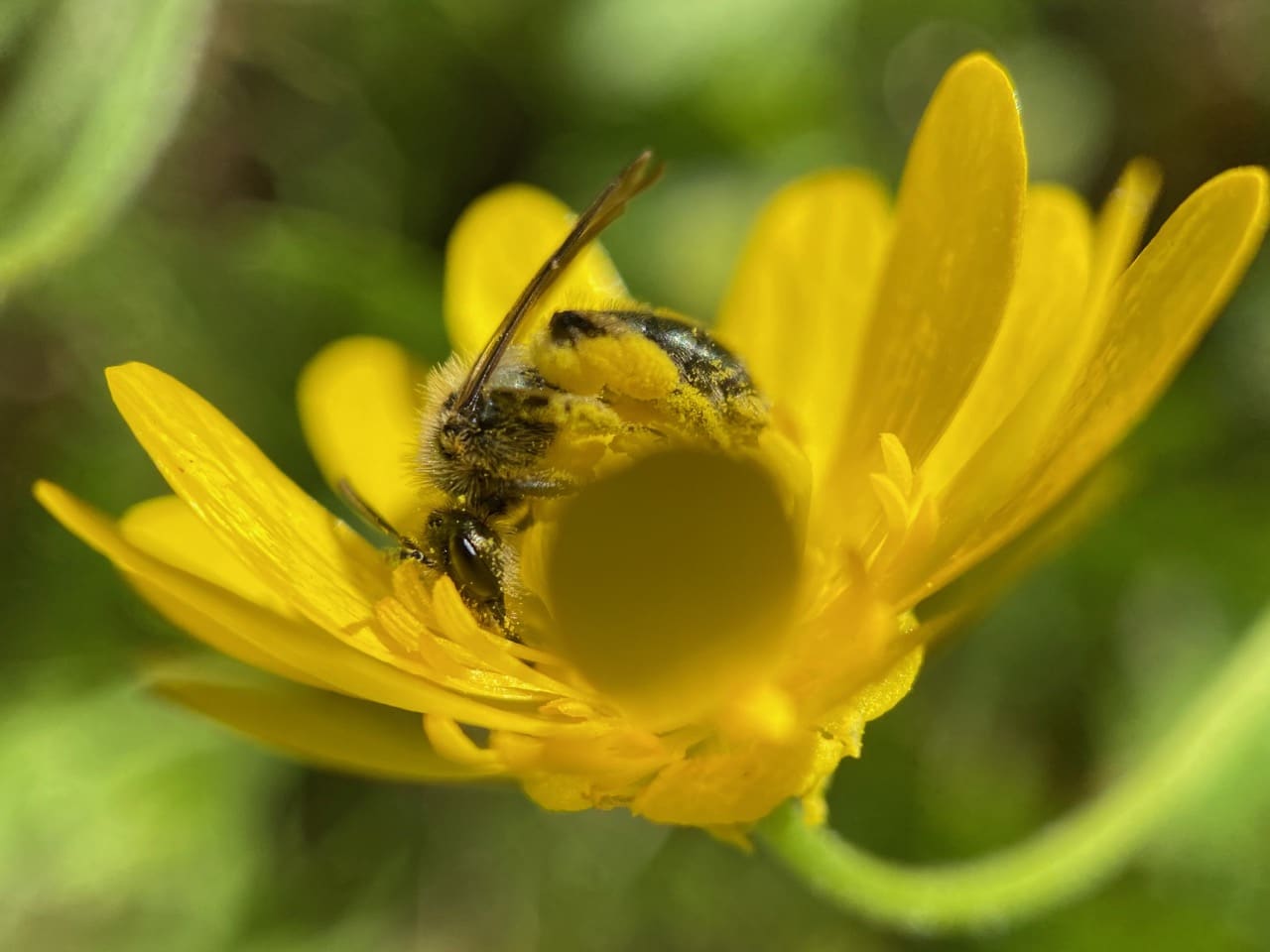
The female Andrena appears to be sipping or collecting nectar at the base of each individual petal while simultaneously gathering pollen.
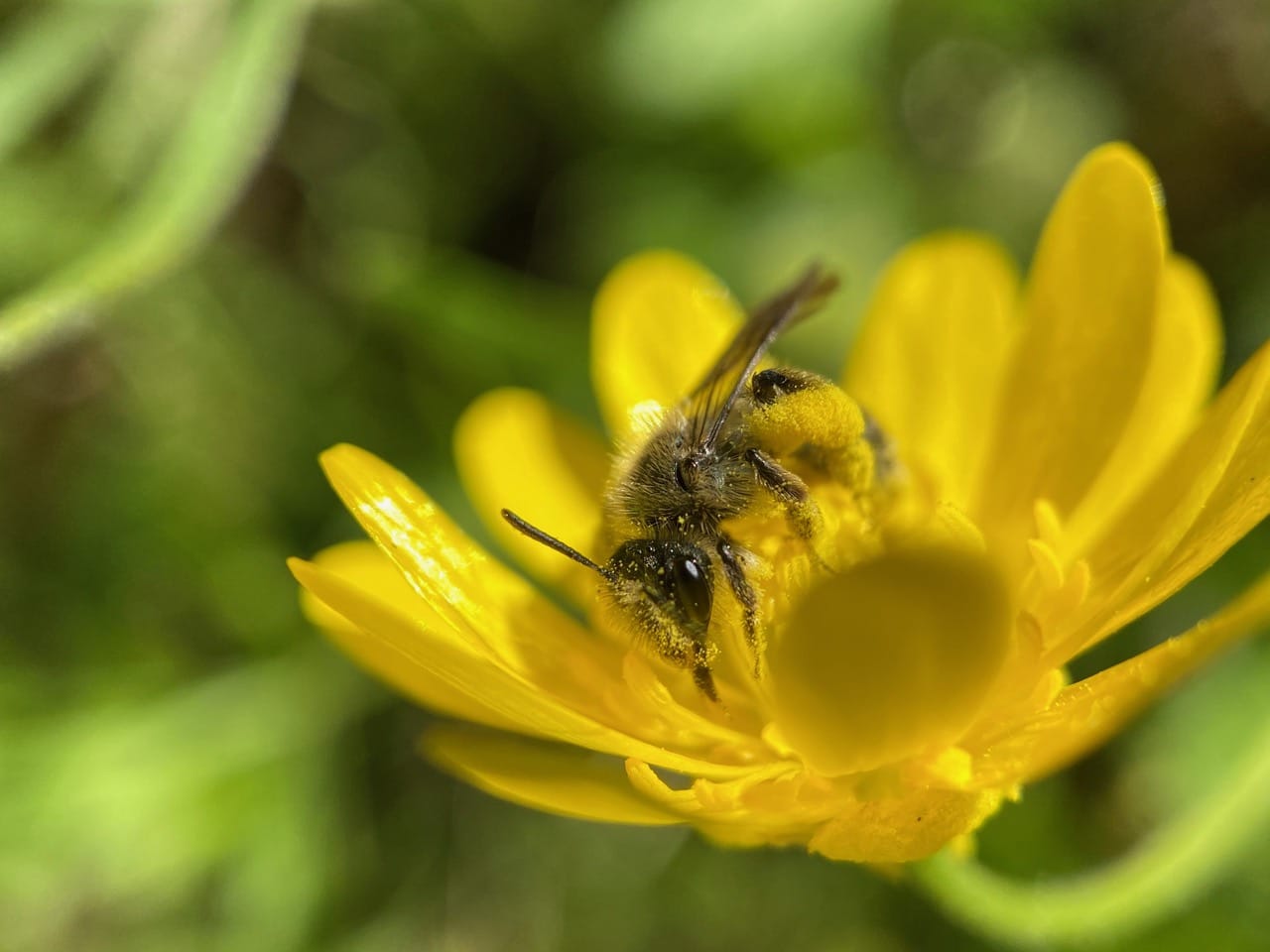
In the process, the bees are covered with buttercup pollen.

This female has yet to fill her scopae. But it’s cool to see the long, stiff setae (‘hairs’) of her scopae, down the entire length of her hindlegs.
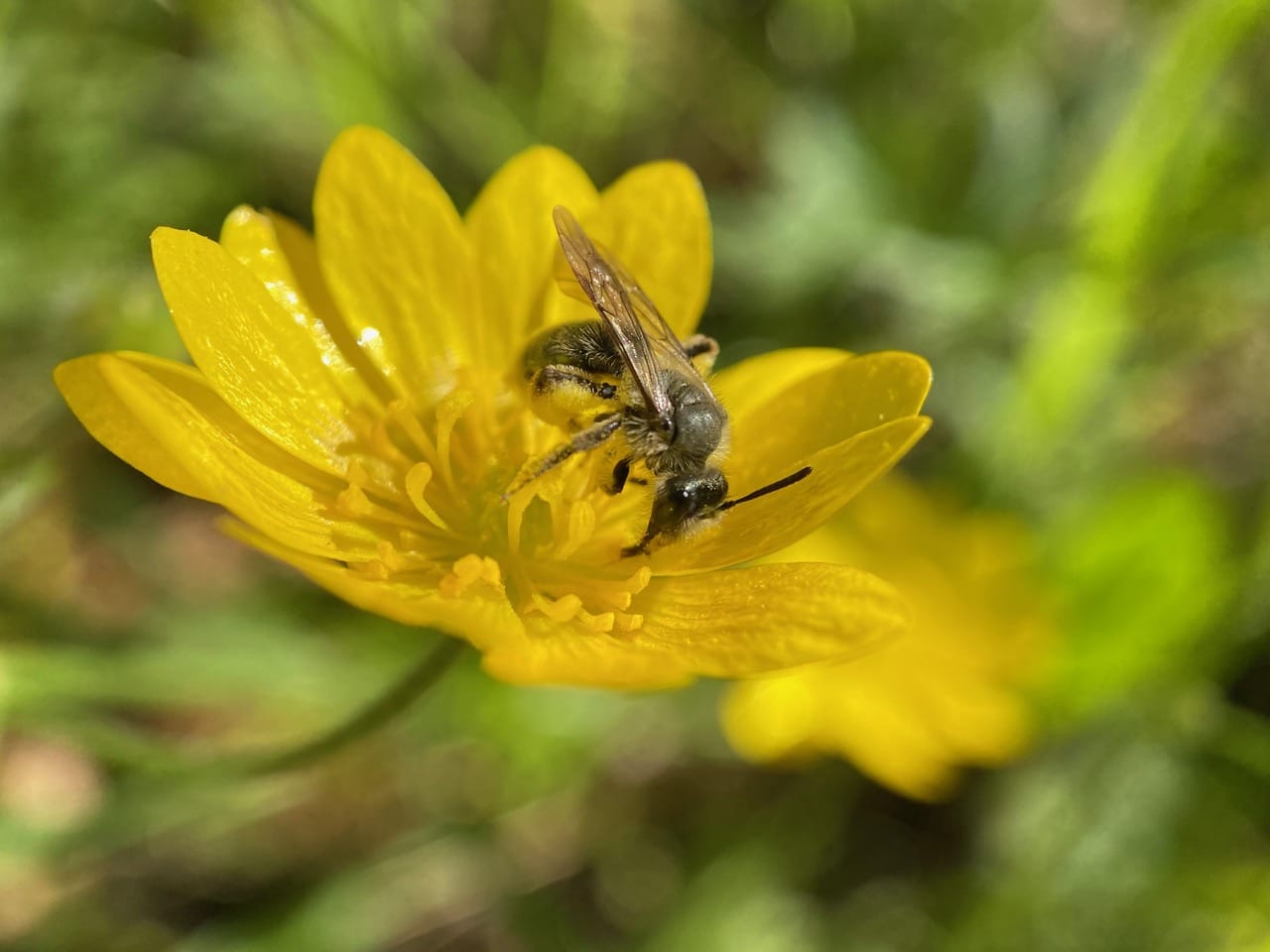
This photo is perhaps the most revealing of what the female Andrena does on the buttercup flower. She is collecting nectar and pollen at the same time. While her tongue is probing for nectar, her legs are in constant motion, scraping the anthers, transferring the pollen to the hindlegs, and packing the pollen into the scopae. Awesome Mama!
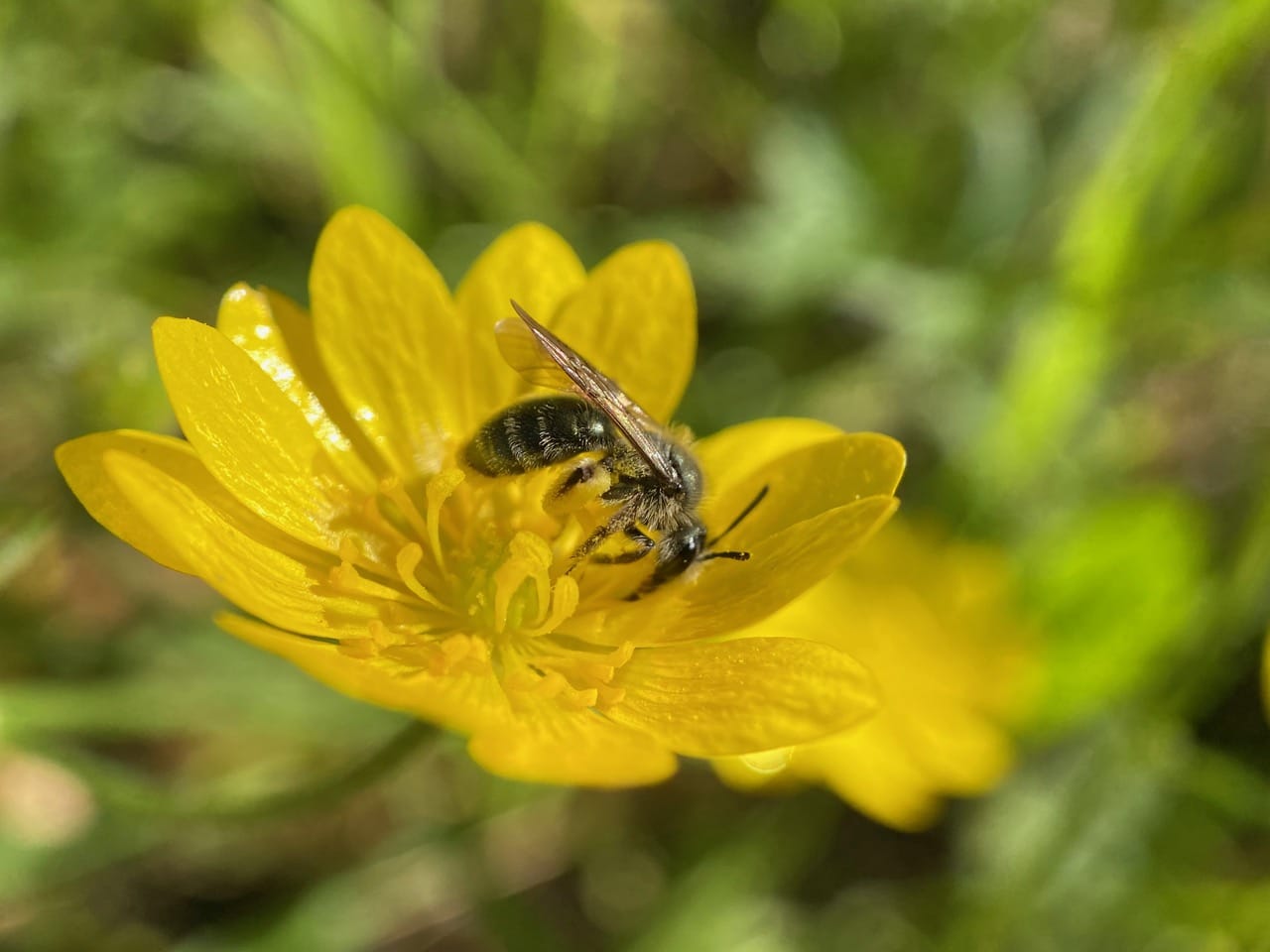
More of the same action. Her movements are so fast they appear as a blur even on video recordings. Unless we are able to analyze her movements using high speed cameras, we’ll never to be able to decipher what exactly the bee does. I am simply taking random photos of the bee at work, hoping to get some insight into her techniques.

I am blown away by her speed and efficiency at every turn.

Here’s a bit of the pollen transfer action, using the middle leg.

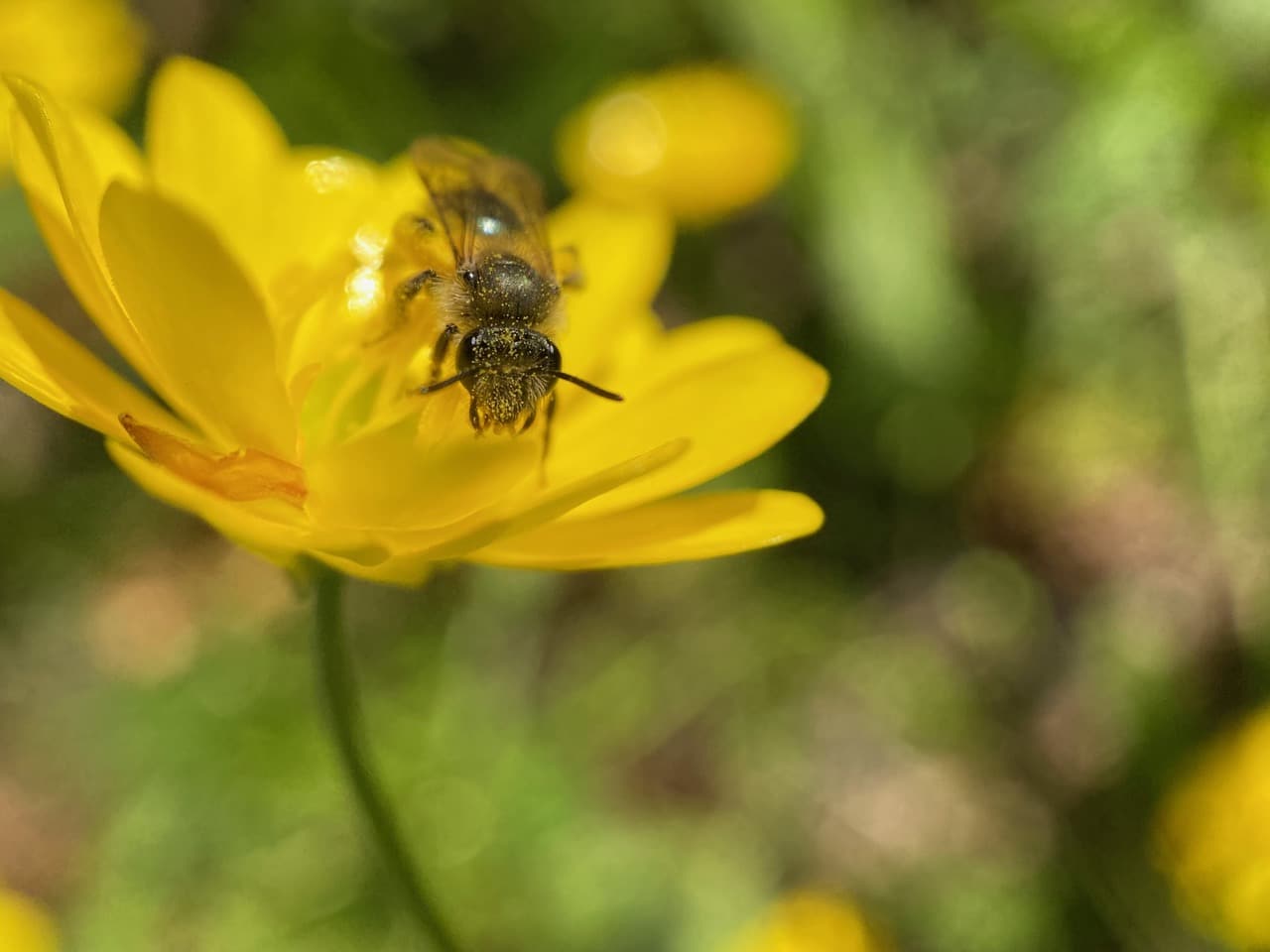
Here we get a glimpse of the bee’s facial fovea, which characterizes her as a member of the genus Andrena. The facial fovea consists of velvety patches of hairs between their large compound eyes and the bases of the antennae. Longer hairs are often seen along the inner margin of the eyes.
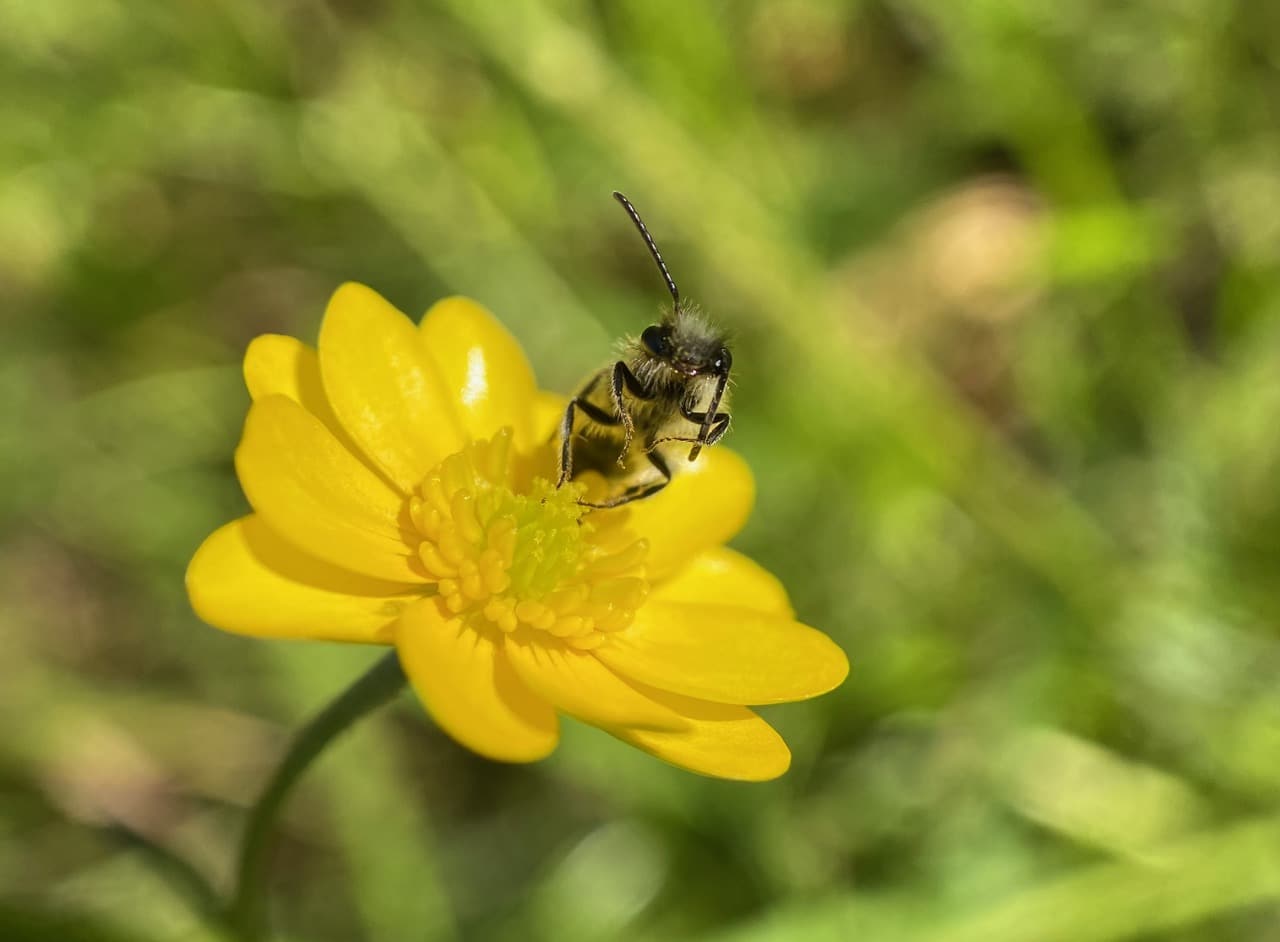
I watch as a male Andrena dive-bombs a foraging female on a flower, trying to score a copulation. His attempt rebuffed, the male lands on another flower and proceeds to clean his antennae…
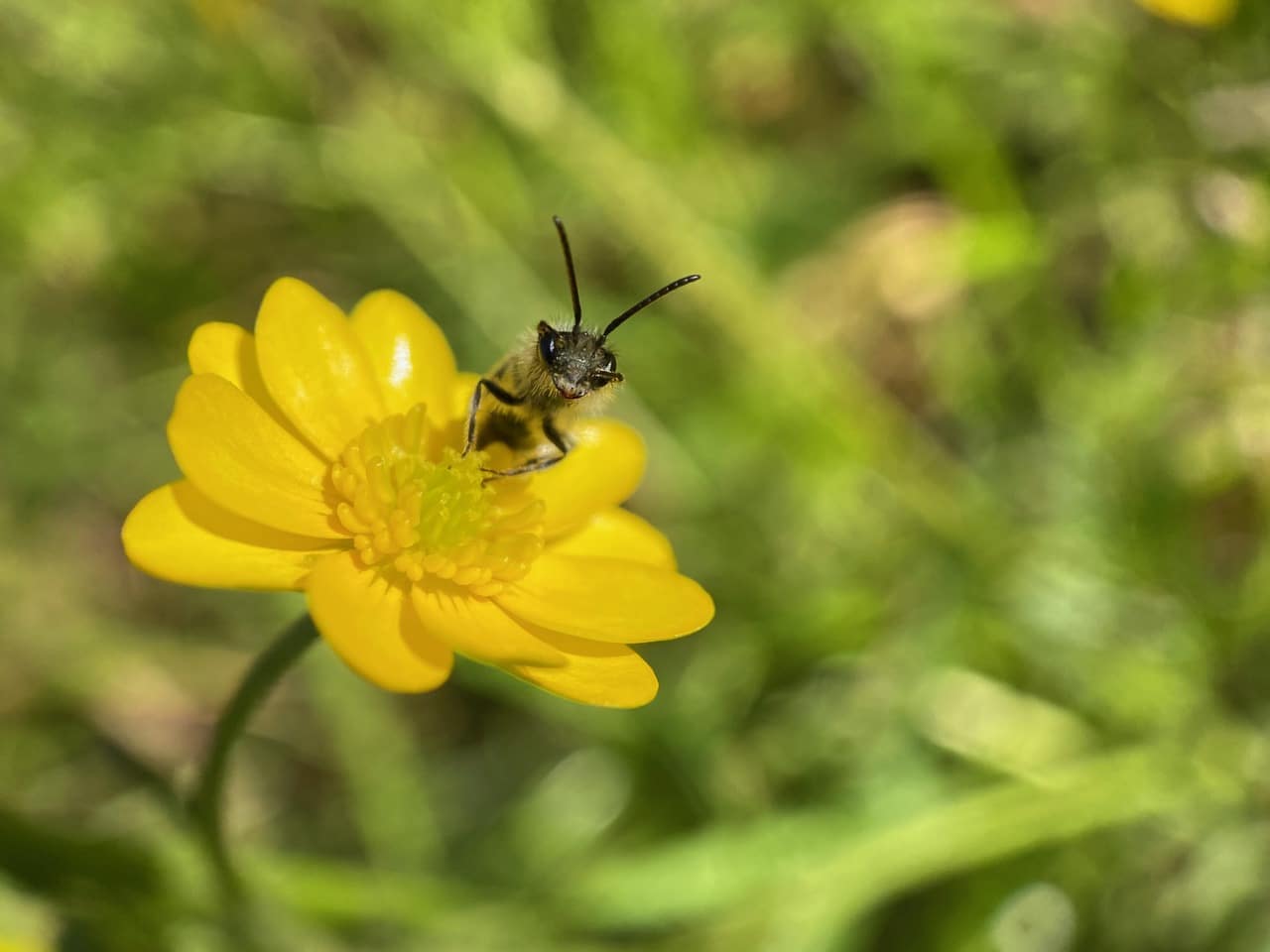
… then his face. Maybe the females would be more receptive if he looked better!
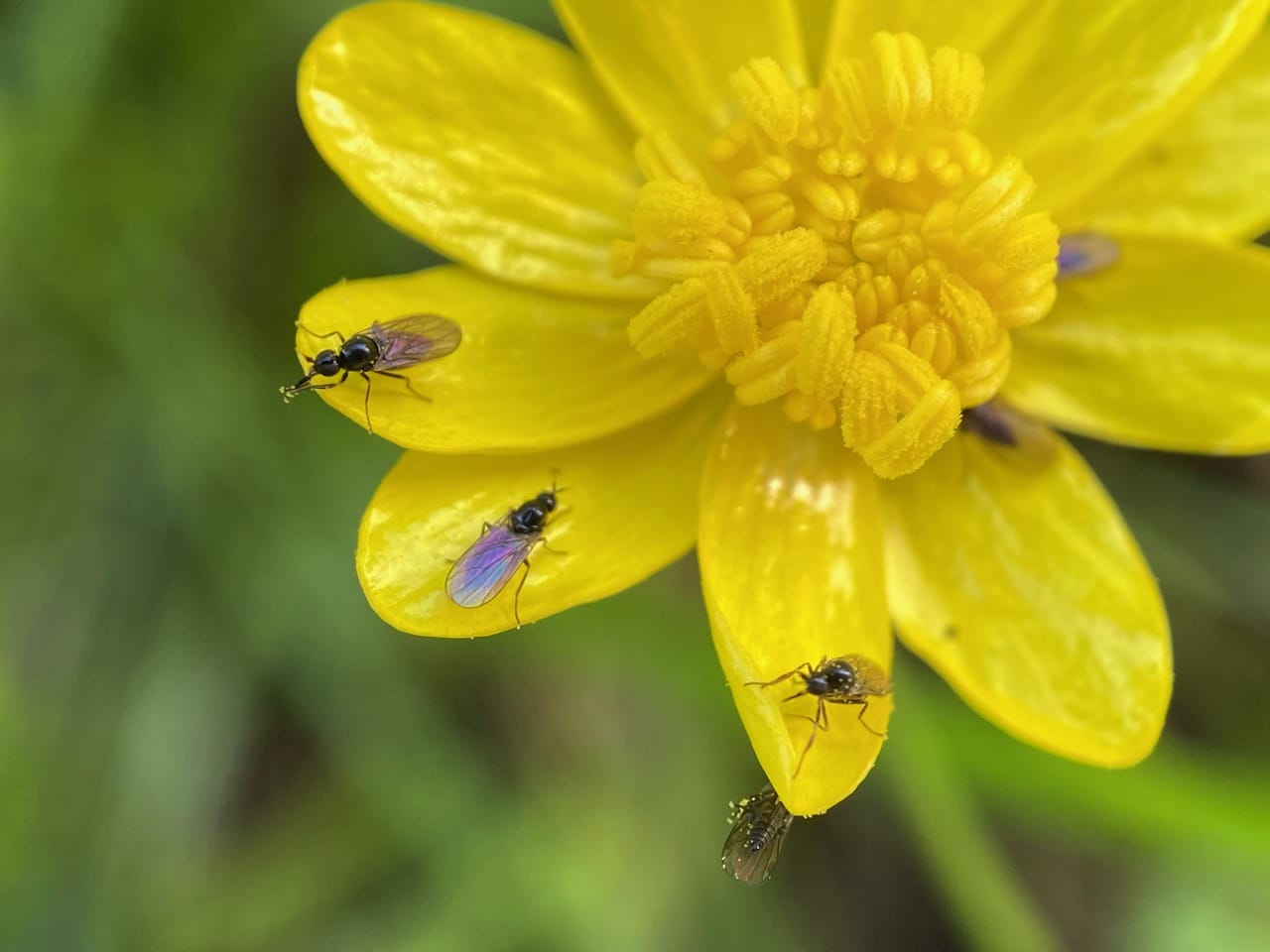
Every petal of this buttercup is occupied by a Hybotid Dance Fly (family Hybotidae).
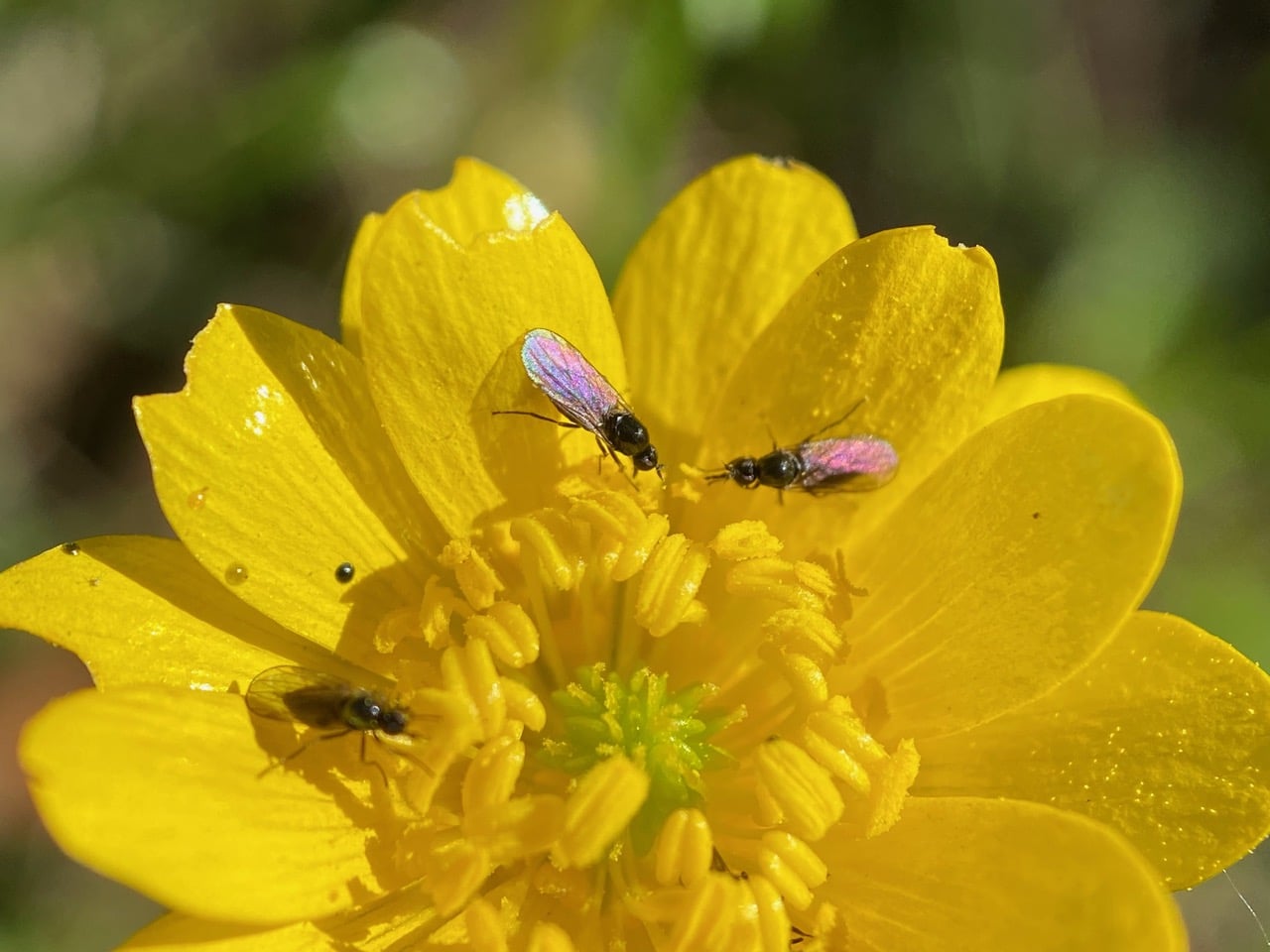
The Hybotids tend to be more numerous on the flowers in the shaded areas.

Wow, a pollen palooza on this buttercup flower! Is there any doubt that the Hybotids are fond of pollen?
iNaturalist has narrowed down the ID to the genus Anthalia, but provides little information on the flies. Bugguide states that almost all of the 11 species of Anthalia are restricted to North America. These small flies, 1-3 mm, are often found on small flowers. Adults feed on pollen. Everything seems to jive with my own observations.
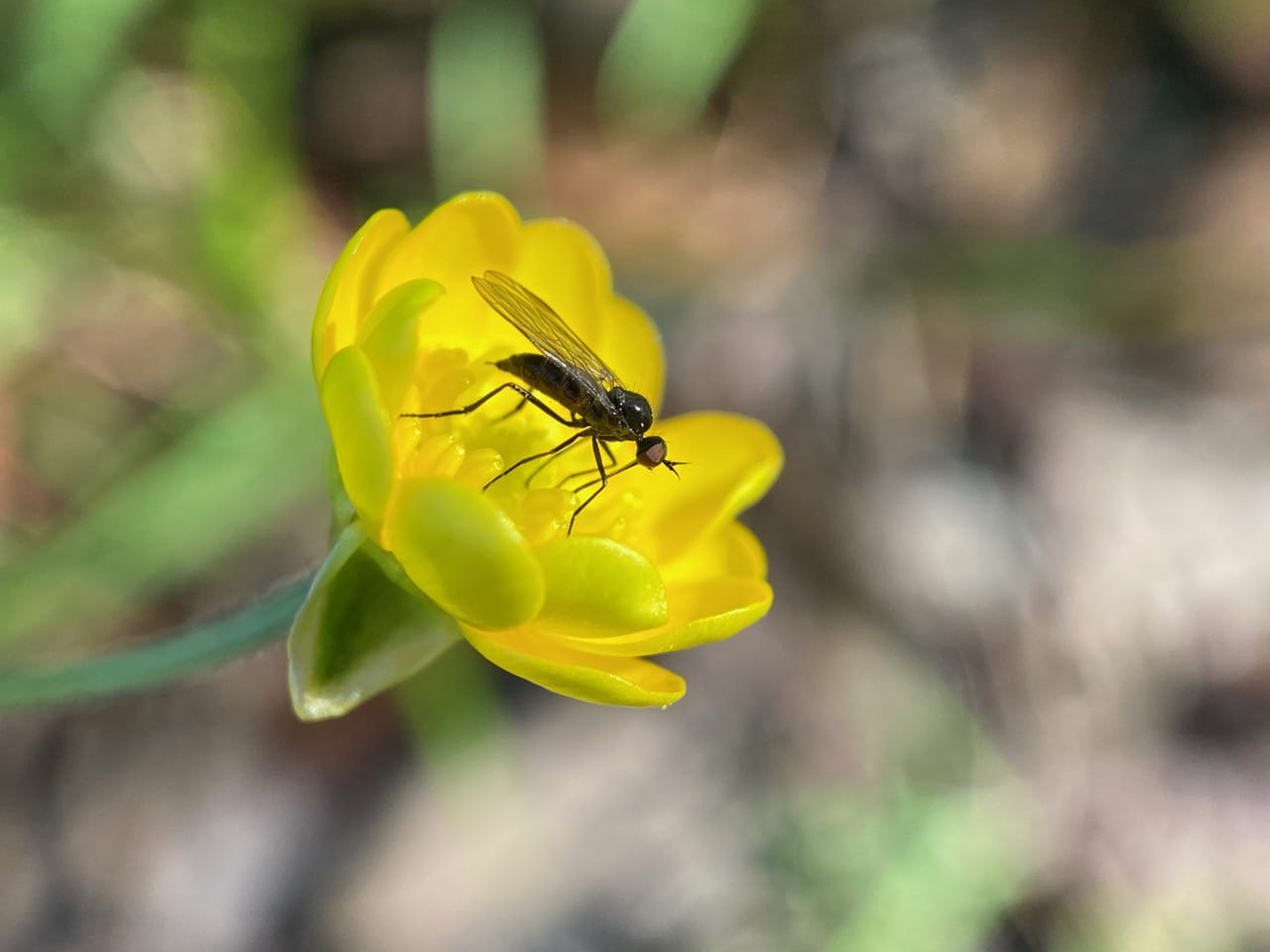
A small Empidid Dance Fly (family Empididae) is feeding on a buttercup flower.
Dance Flies, in the family Empididae, get their name from the habit of males of some species to gather in large groups and dance up and down in the air in the hopes of attracting females. They are predominantly predatory and they are often found hunting for small insects on and under vegetation in shady areas. Both genders may also drink nectar. Male dance flies give their sweeties a nuptial gift to eat while they mate. The gift is thought to enable her to complete the development of her eggs. Males may wrap their gifts in balloons of silk or spit, hence the other common name of Balloon Flies.
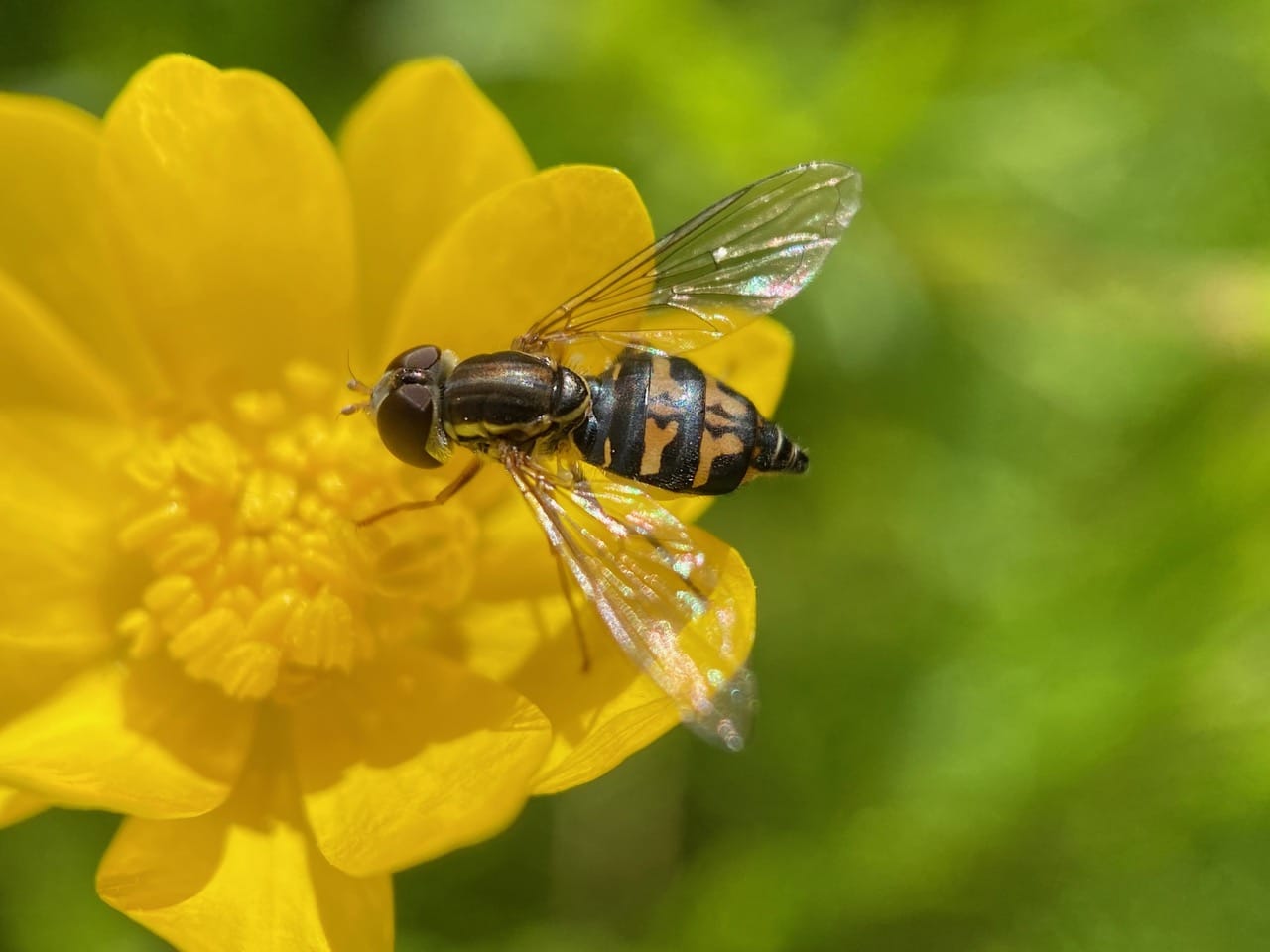
A female Western Calligrapher, Toxomerus occidentalis (family Syrphidae) visits a buttercup flower. These small hoverflies seem very fond of the buttercups, and can be found on the flowers early in the morning.
Toxomerus is a very large genus of Hover Flies. They are found in North and South America. The majority of species are only 6-9 mm in length. They are notable for their mimicry of stinging Hymenoptera to avoid predators. Their unique abdominal patterns are diagnostic at the species level within the genus. Most larvae feed on soft bodied insects, such as aphids; a few feed on pollen. Adults feed on the pollen of a wide range of flowers. A female can lay up to hundreds of eggs at a time and will place them where prey or pollen food sources are readily available. They can be found in a wide variety of habitats, often in dense ground cover.
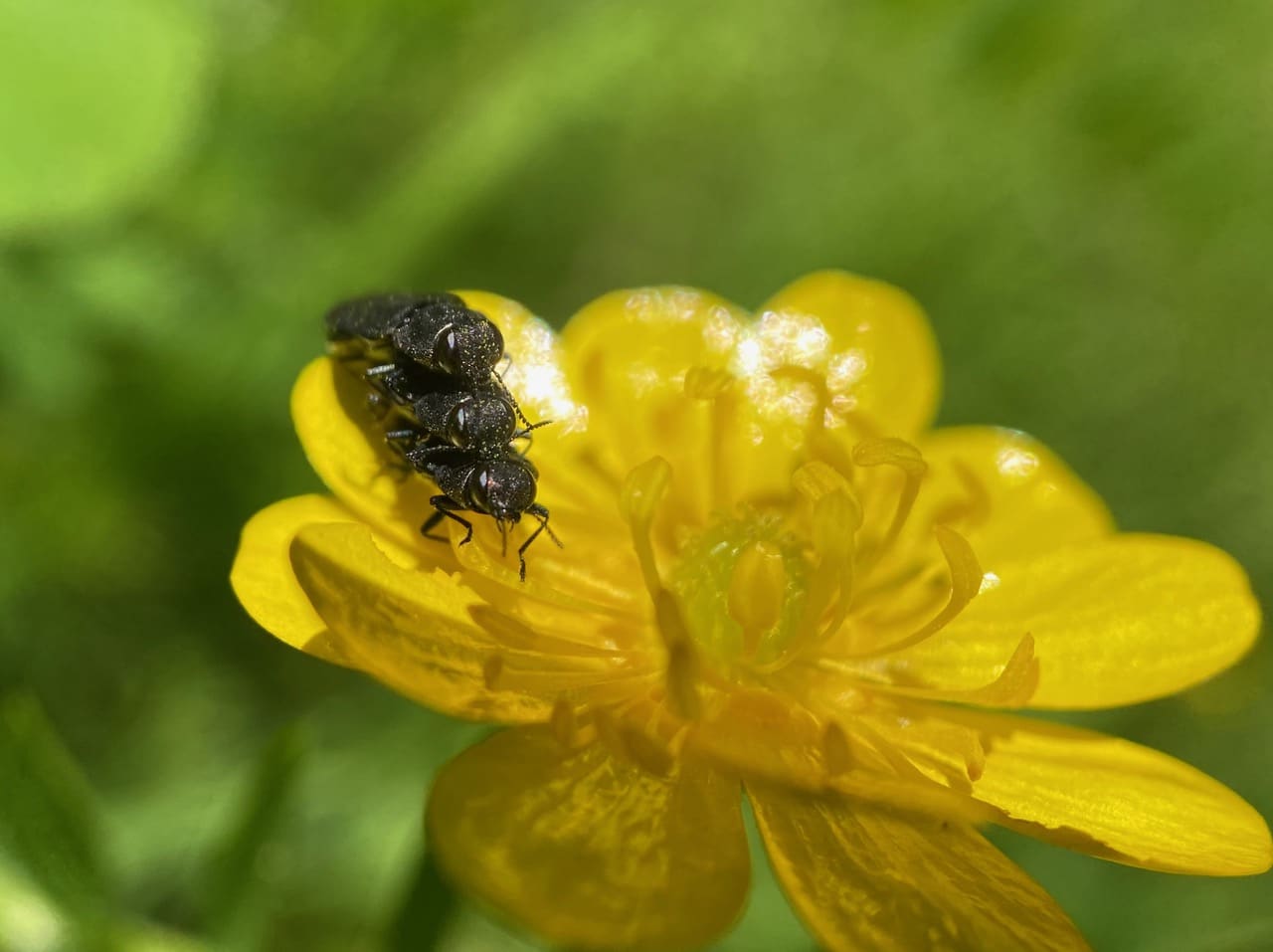
As I ready my camera to photograph a pair of mating Jewel Beetles (family Buprestidae), a third appears and promptly piles on. What a sight!
Buprestids are sometimes also called Jewel Beetles because of their glossy, iridescent colors. The larger and more spectacularly colored ones are highly prized by insect collectors. Their elytra have been traditionally used in beetlewing jewelry in some Asian countries. The iridescence common to these beetles is not due to pigments in the exoskeleton, but instead is caused by structural coloration, in which microscopic texture in their cuticle selectively reflects specific frequencies of light in particular directions. Buprestid larvae are known as flathead borers. They bore through roots, logs, stems, and leaves of various types of plants, ranging from trees to grasses. Adult jewel beetles mainly feed on plant foliage or nectar, although some species feed on pollen and can be observed visiting flowers.
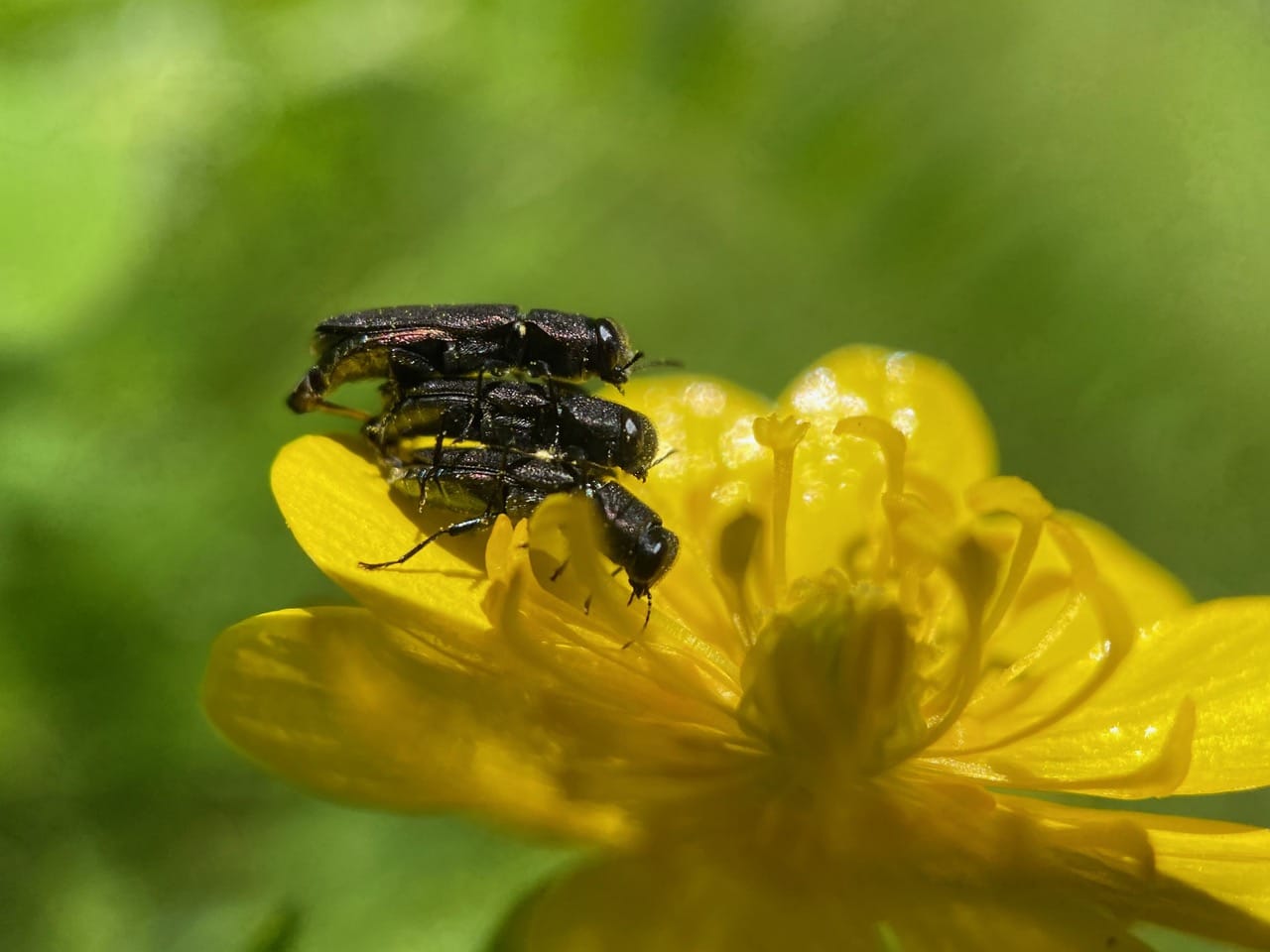
Here’s a side view of the threesome. The newcomer on top is obviously a male. He has extended his aedeagus (insect version of penis) in a misguided attempt at mating. The beetle below him is a male. Soon the interloper discovers his mistake, and wanders off, leaving the couple to mate in peace.
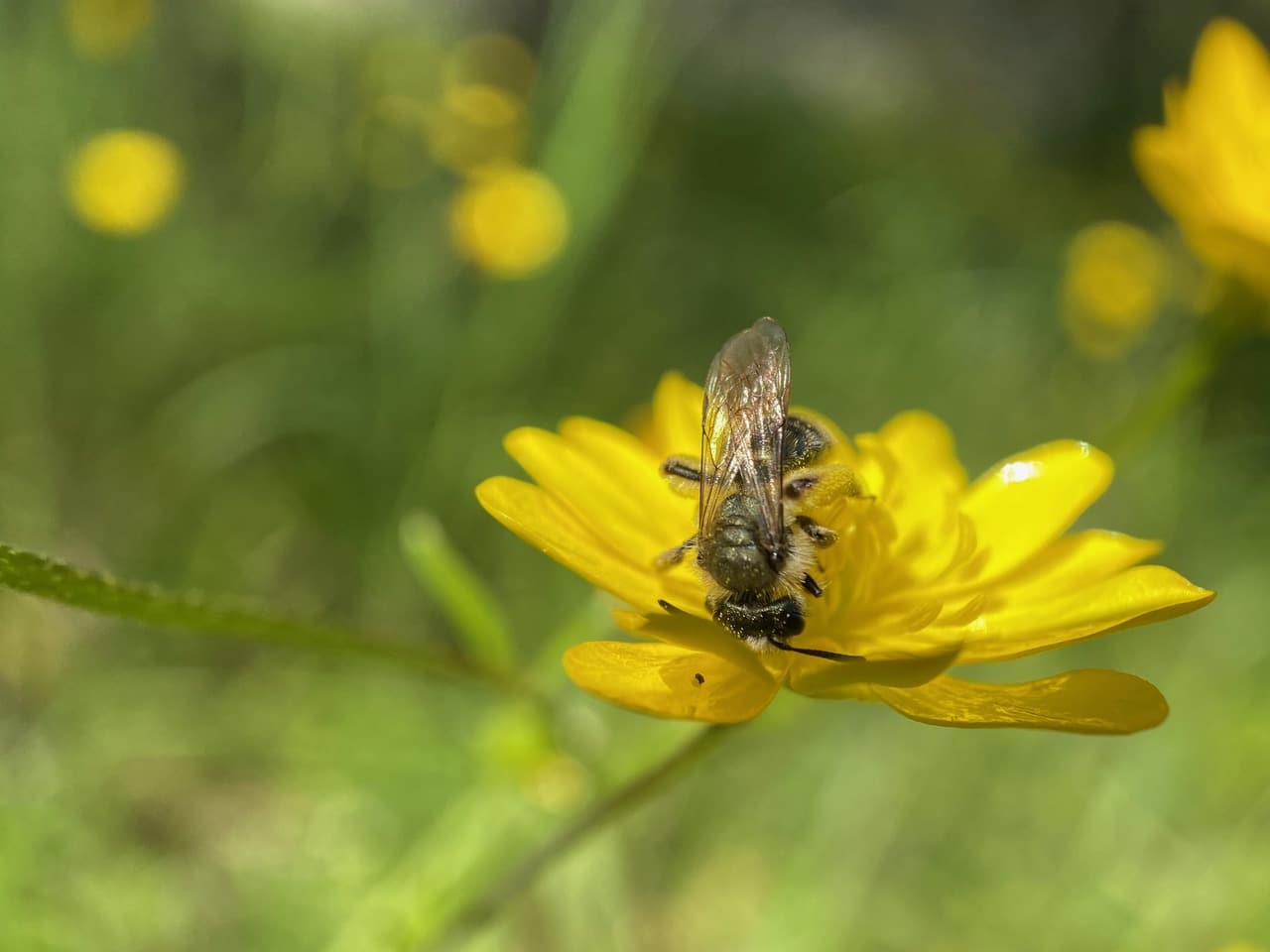
I’m back to watching Mining Bees on the flowers.
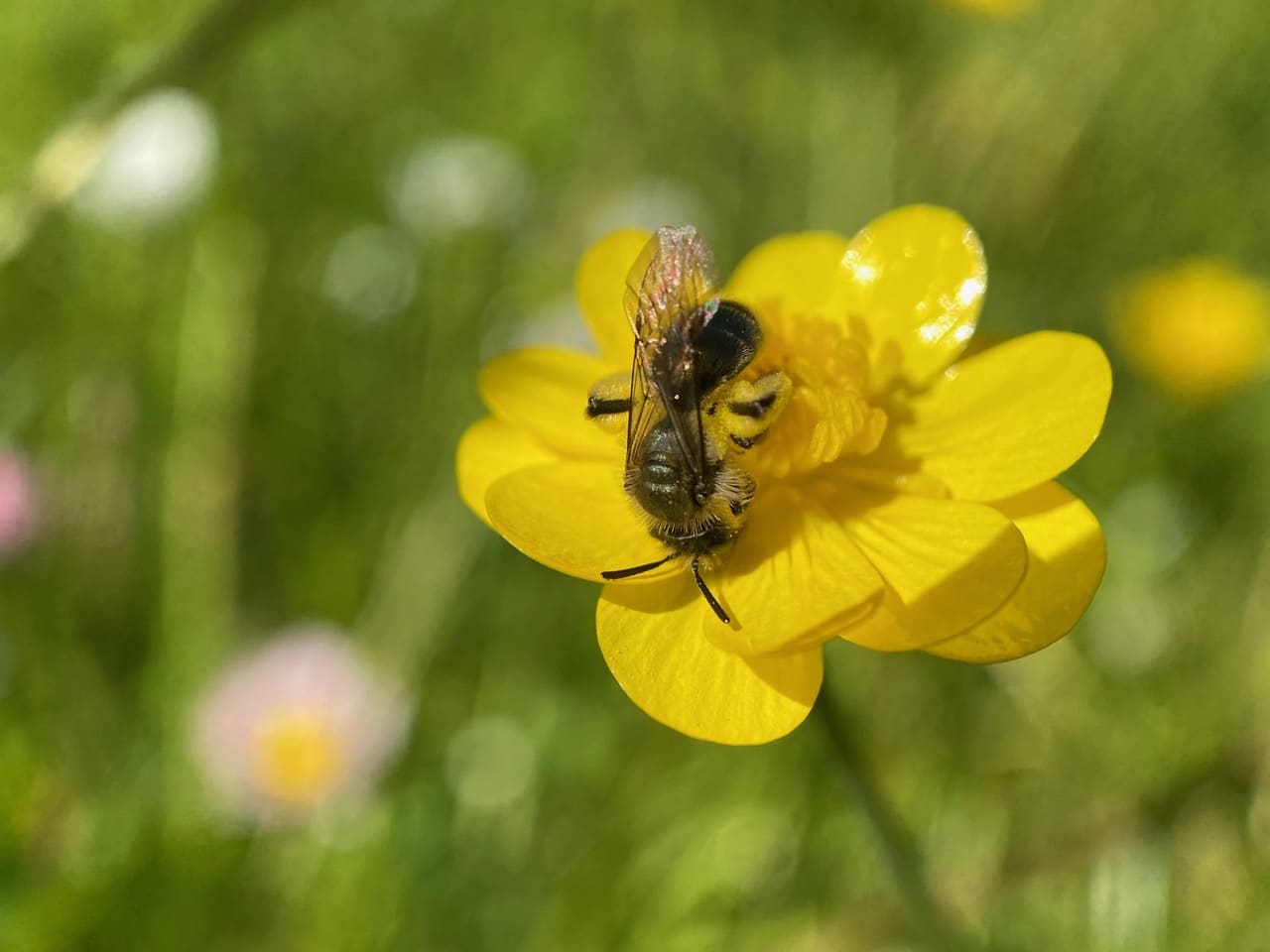
This is a different female Andrena on a different buttercup flower, in an almost identical foraging posture! The next 3 pictures show this bee going around the flower a half circle before lifting off.

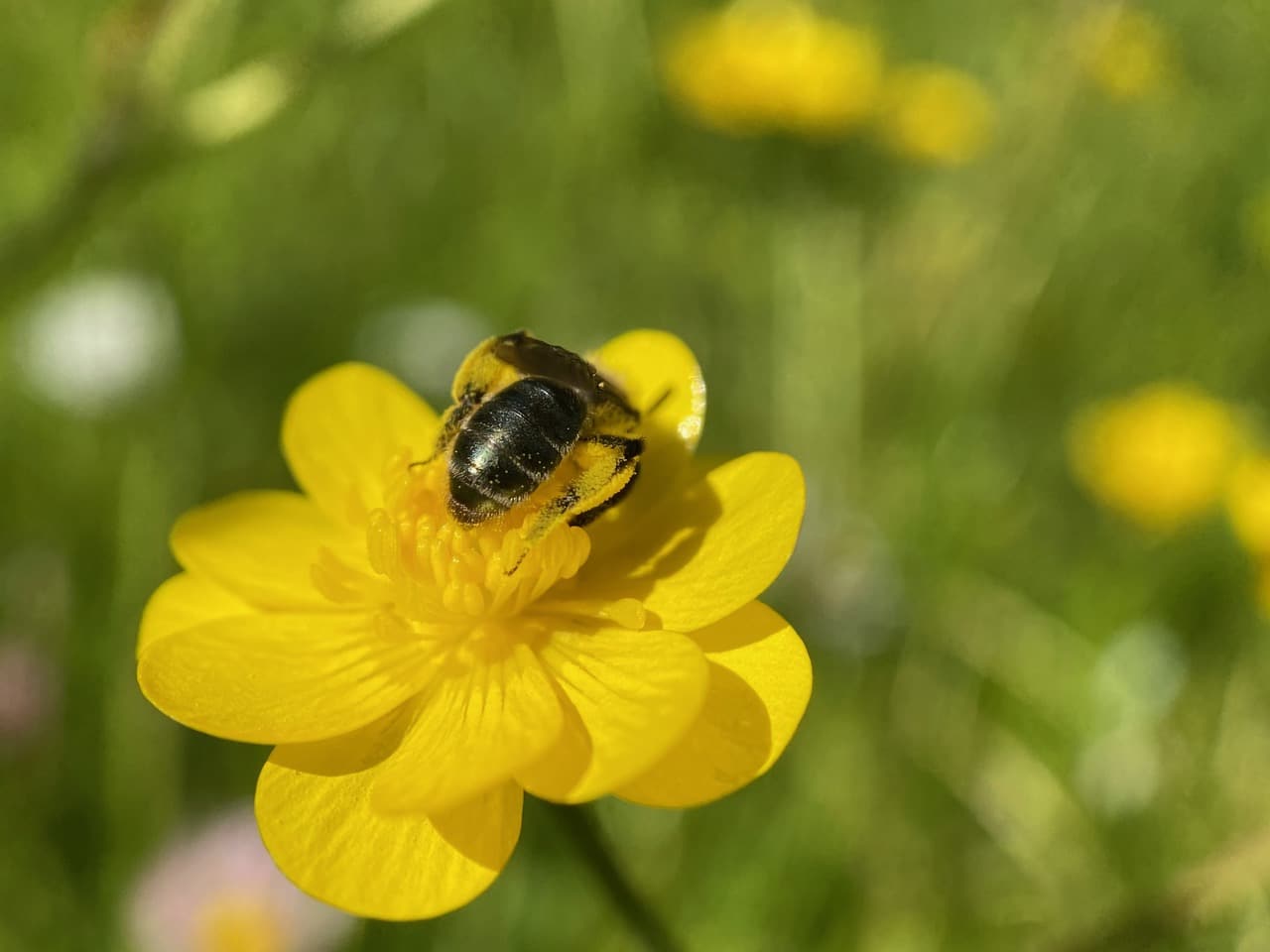
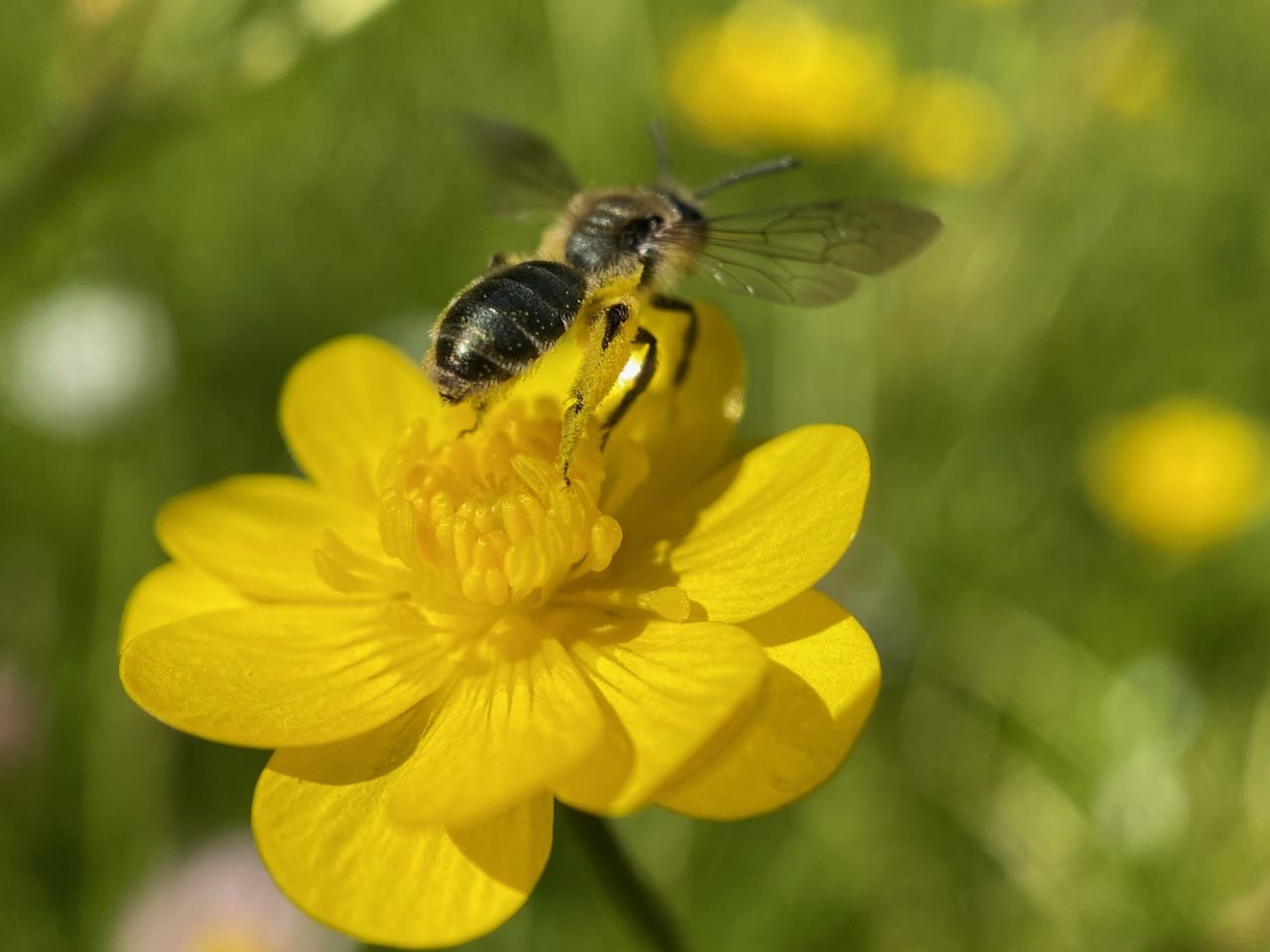
To the next flower!
I recorded a couple of videos of the female Andrena foraging on the buttercup flowers. Neither are satisfactory, as it was a little breezy out there. Besides, using a hand-held camera for recording in high magnification (about 10X here) is never easy – every little movement on my part is similarly magnified!

Ooh, that’s a different species of Mining Bee (family Andrenidae) on the buttercup flower. I think it is a male Golden-haired Miner Bee, Andrena auricoma, a generalist forager that visits a wide variety of flowers.
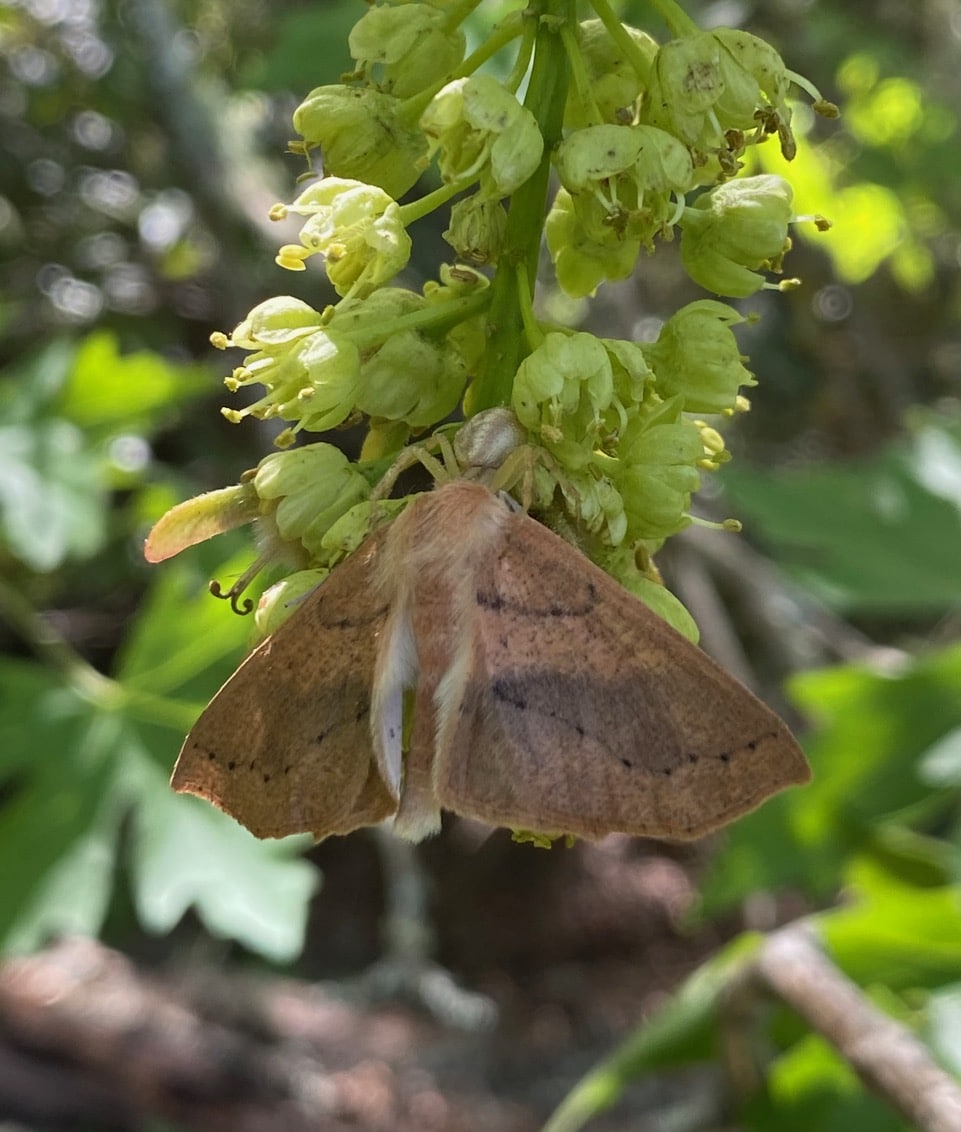
One last check on the moth and spider on the Bigleaf Maple flowers before I head home. Little has changed in 2 hours – it will take some time for the spider to finish its gigantic meal. Even then, the moth will still look the same, as Crab Spiders do not masticate their meals. They inject venom and digestive juices into their prey to digest it, then suck up the resulting liquified content through the same hollow fangs. Their prey is usually left intact in appearance, except for the pair of fang marks.