

Pollinator Post 4/1/24
The weather forecast tells of unseasonable heat today. Time to seek refuge in the coolness of the Reinhardt Redwood Regional Park in the Oakland hills.
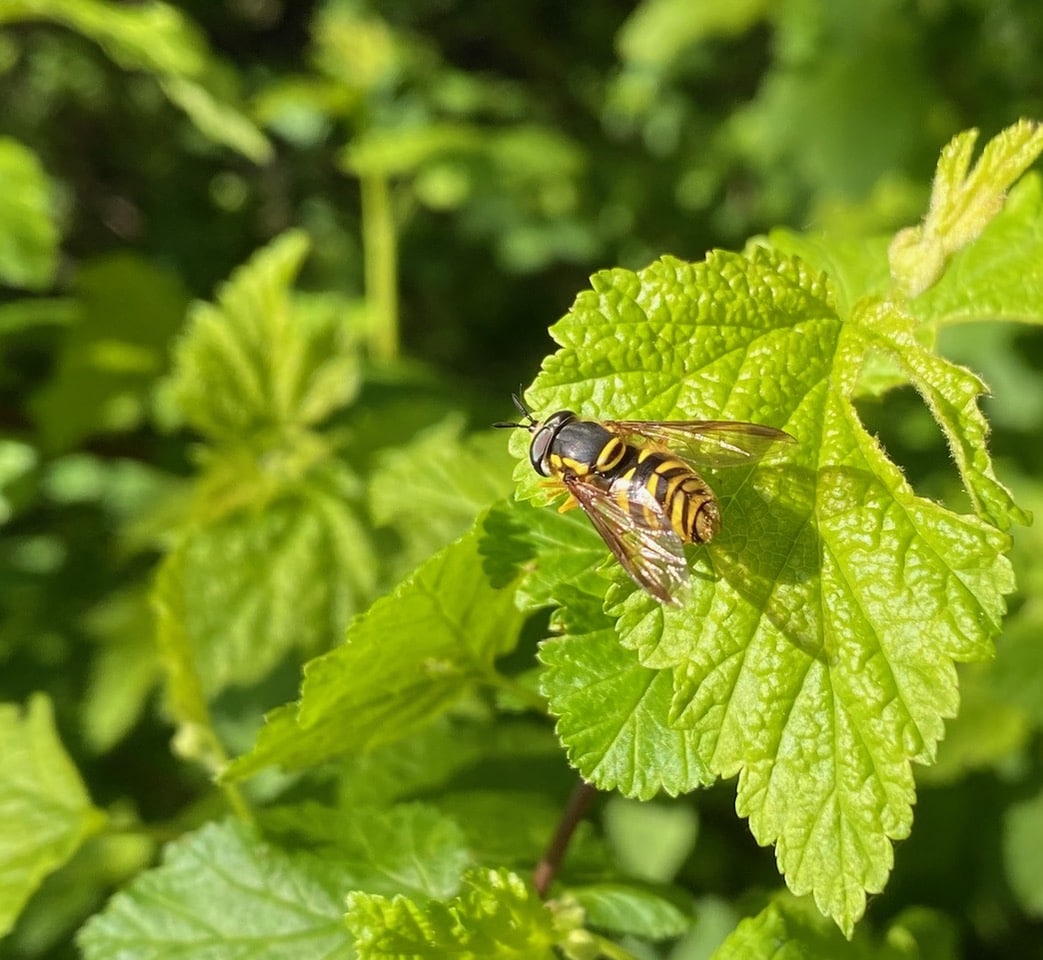
Ah, the first insect for the day is an interesting wasp mimic that has landed on a Blackberry leaf. At first glance it can be easily mistaken for a Yellowjacket wasp. But look at those eyes and the antennae! Definitely not a wasp, but a fly. Wow, the fly’s mimicry of a Vespid wasp is impressive! Note the darker leading edge of its wings. The wings of most Vespids (including paper wasps) are folded longitudinally when at rest. This creates a darker area along the leading edge and gives the appearance that the wings are half as wide as other wasps.
The imposter is a Meadow Fly, genus Chrysotoxum (family Syrphidae). The genus consists of large, wasp-mimicking species. The adults are distinguished by long antennae that are held erect, oval abdomen with yellow stripes, and yellow patterns on the thoracic pleurae (sides of the thorax). Unlike most hoverflies, the abdomen is not dorsoventrally flattened. The species of Chrysotoxum mainly occurs in the northern hemisphere. Larvae are specialized in preying upon root aphids associated with ant nests. Talk about a specialized niche!





Why are aphids found in ants’ nests?
Ants and aphids share a well-known mutualistic relationship. The aphids produce honeydew, a sugary food for the ants; in exchange, the ants care for and protect the aphids from predators and parasites. Some ants will “milk” the aphids to make them excrete the sugary substance. The ants stroke the aphids with their antennae, stimulating them to release the honeydew. Aphid-herding ants make sure the aphids are well-fed and safe. When the host plant is depleted of nutrients, the ants carry their aphids to a new food source. If predatory insects or parasites attempt to harm the aphids, the ants will defend them aggressively. Some species of ants continue to care for aphids during winter. The ants carry the aphids to their nest for the winter months, and transport them to a host plant to feed the following spring.
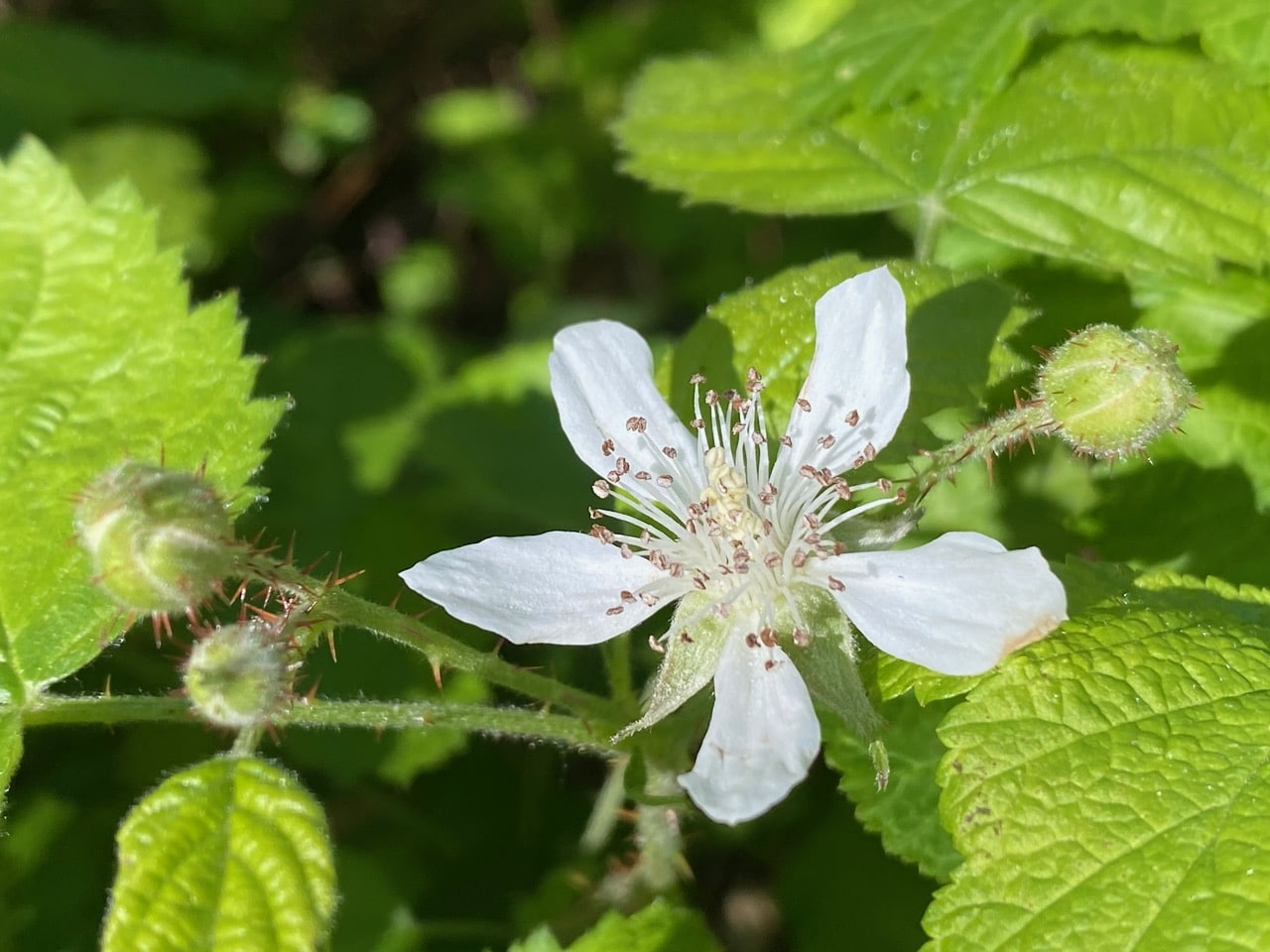
Unbeknownst to most people, the California Blackberry, Rubus ursinus is dioecious, the male and female flowers borne on separate plants. Male flowers have larger petals and a central cluster of numerous stamens. If you have a blackberry plant that never produces fruits, it’s probably a male. Note that most of the anthers have released their pollen on this male flower, and have shriveled and turned brown. There are still a few fresh cream-colored stamens left in the center of the flower.
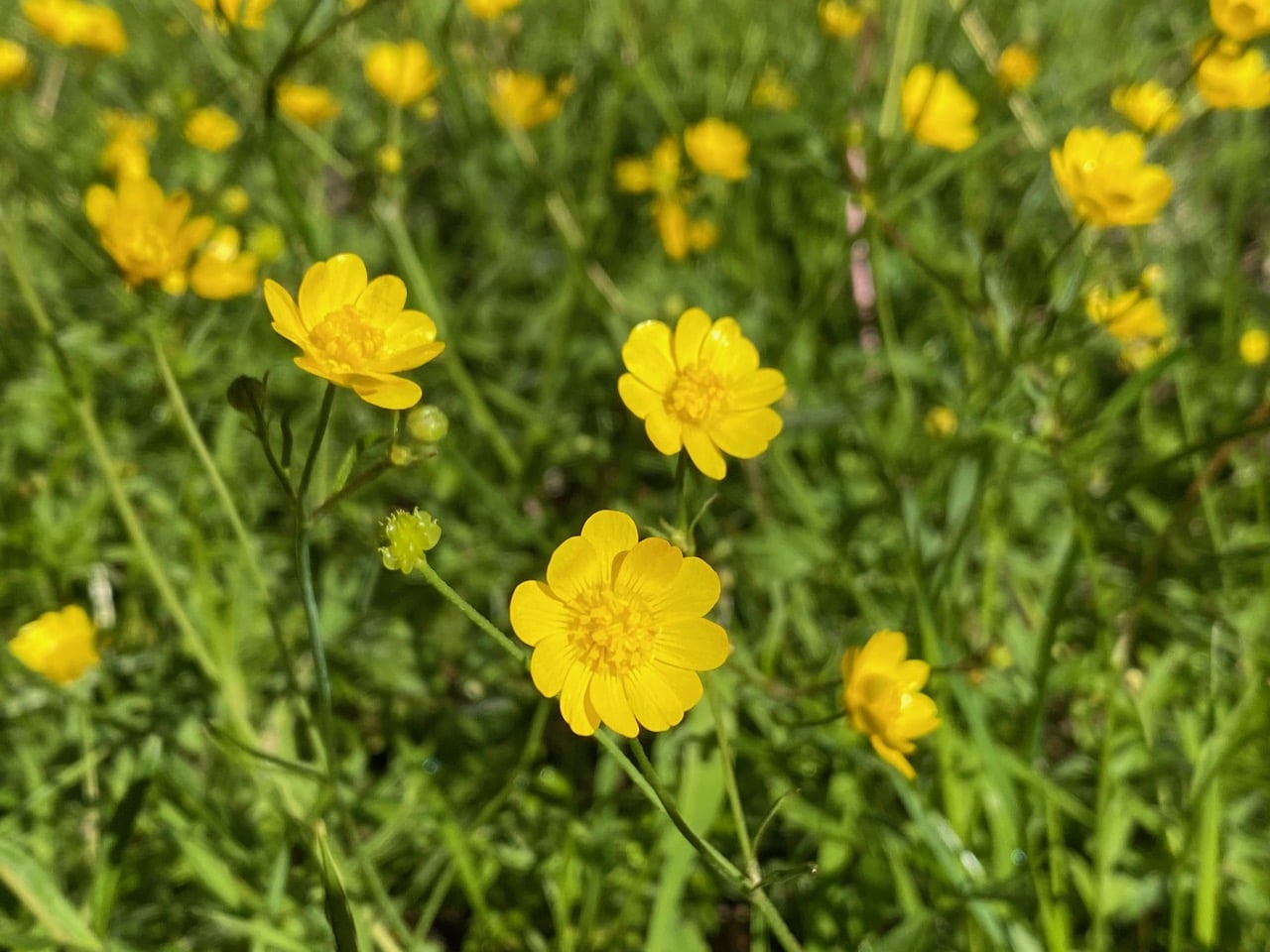 Just past the children’s playground, I am delighted to find a large patch of blooming California Buttercup, Ranunculus californicus.
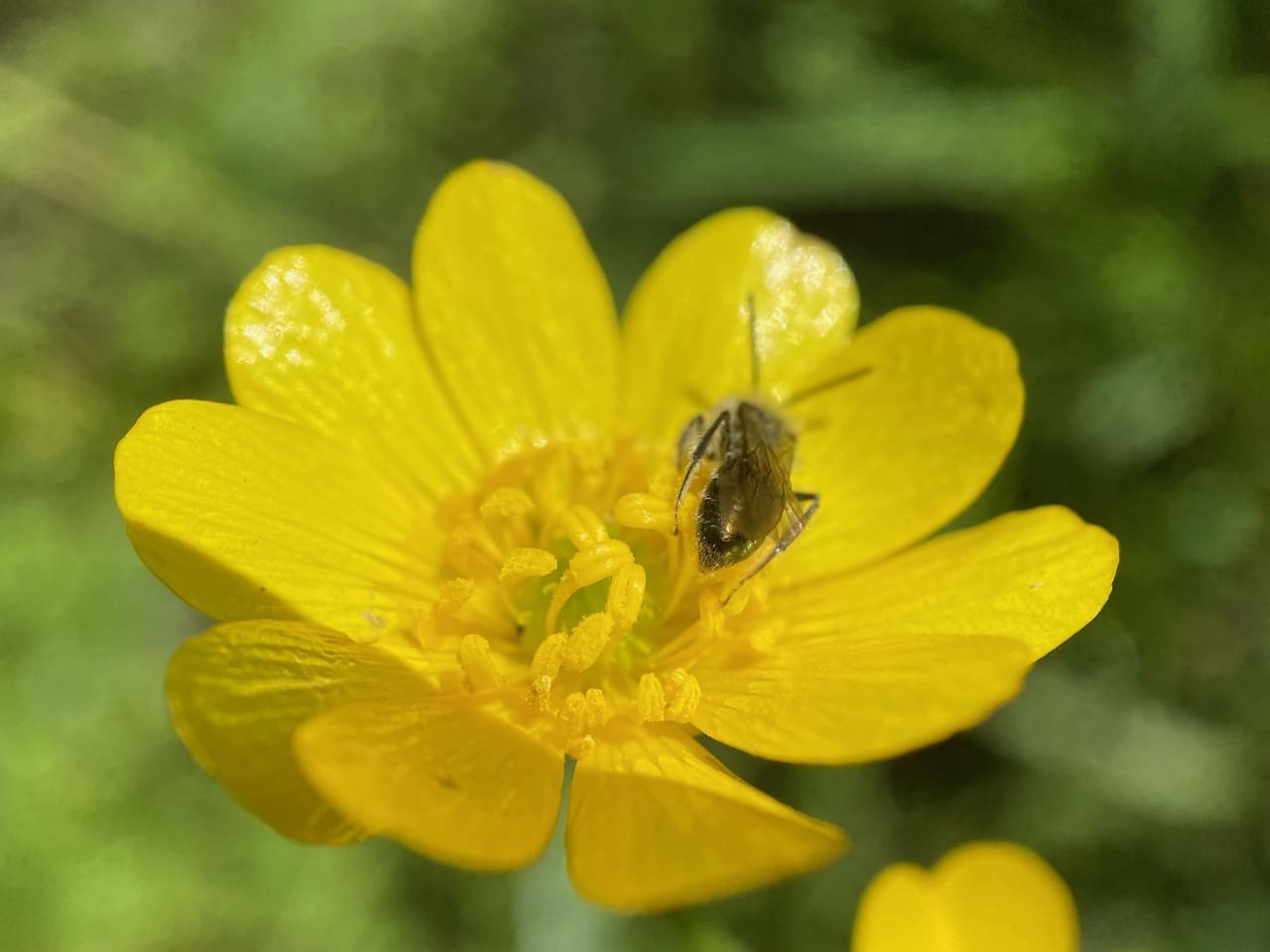
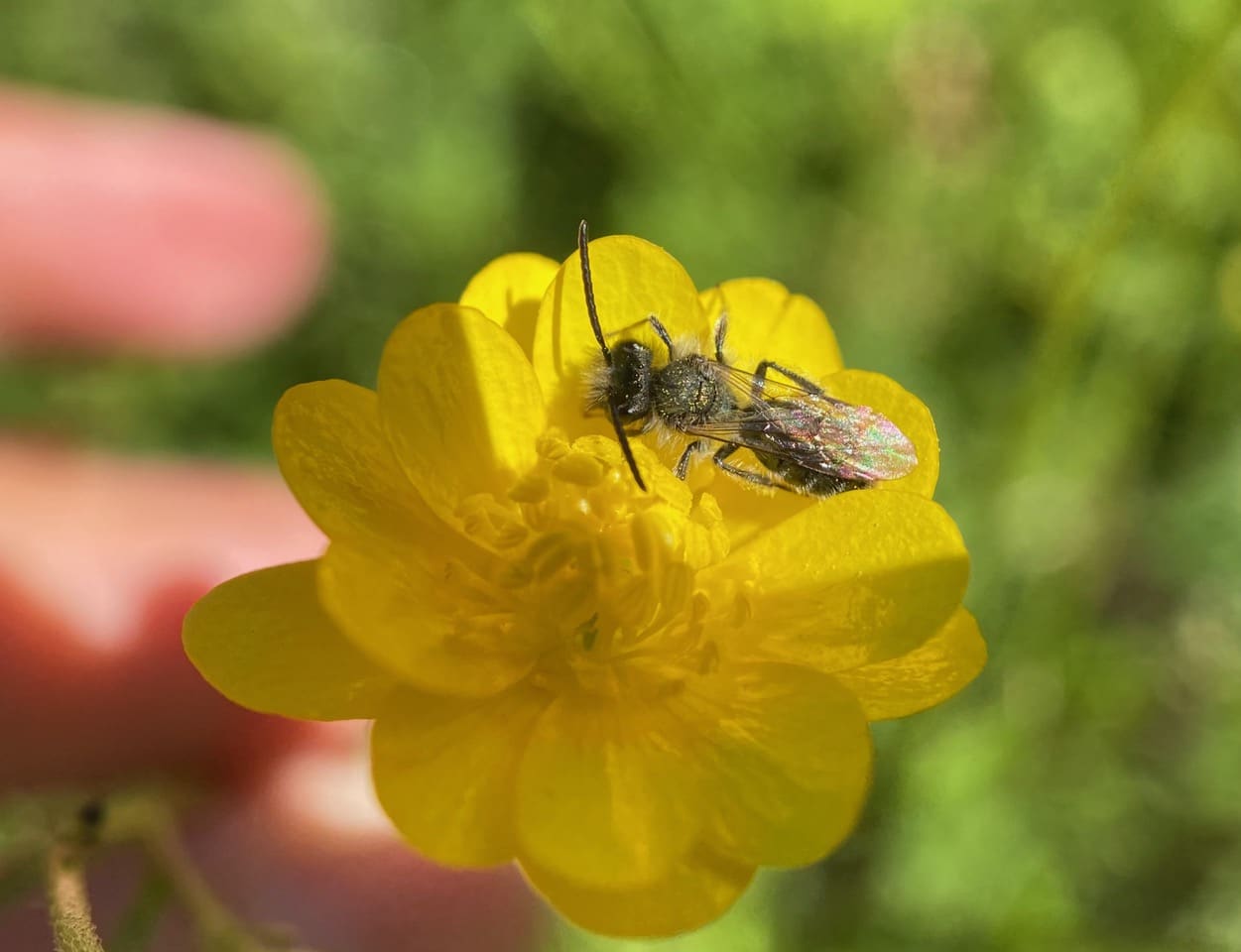
Just past the children’s playground, I am delighted to find a large patch of blooming California Buttercup, Ranunculus californicus.A slim, small bee with long antennae is foraging on a buttercup flower. My heart misses a beat – it looks like the male Mining Bee that has been visiting the buttercup flowers at Skyline Garden.
Bees in the family Andrenidae, commonly called miner bees or mining bees, are solitary ground-nesters. Andrenids are fairly small bees, usually dark-colored, and often banded. They are identified by the dense bristles (scopae) at the bases of the legs and the shin-like sections (tibias) of the legs, as well as by certain creases and grooves on the face and head and by unique wing venation. Many Andrenids resemble wasps – slender with long abdomen.
Most andrenids are specialist pollinators whose life cycle is timed to correspond precisely to the blooming of specific flowers. Because of this, andrenids are some of the first bees to emerge in spring, and many are active in March and April, as they visit early spring wildflowers.
A Greater Bee Fly, Bombylius major (family Bombyliidae) has touched down lightly on a California buttercup flower while still hovering, its wings a blur. It aims its long, straight proboscis into the base of a petal to suck up nectar. Note its long, skinny legs.
Bombylius major, commonly known as the Greater Bee Fly is a parasitic bee mimic fly in the family Bombyliidae. It derives its name from its close resemblance to bumble bees. Its flight is quite distinctive – hovering in place to feed, and darting between locations. The species has long skinny legs and a long rigid proboscis held in front of the head. Bombylius major is easily distinguished from the other local species of Bombylius for having wings with dark leading edge, hyaline trailing edge with sharp dividing border. This feature is visible even as the fly is hovering. Adults visit flowers for nectar (and sometimes pollen) from a wide variety of plant families, excelling at small tubular flowers, and are considered good generalist pollinators. Often the pollen is transferred between flowers on the fly’s proboscis.
The bee fly larvae, however, have a sinister side. They are parasitoids of ground-nesting bees and wasps, including the brood of digger bees in the family Andrenidae. Egg deposition takes place by the female hovering above the entrance of a host nest, and throwing down her eggs using a flicking movement. The larvae then make their way into the host nest or attach themselves to the bees to be carried into the nest. There the fly larvae feed on the food provisions, as well as the young solitary bees.
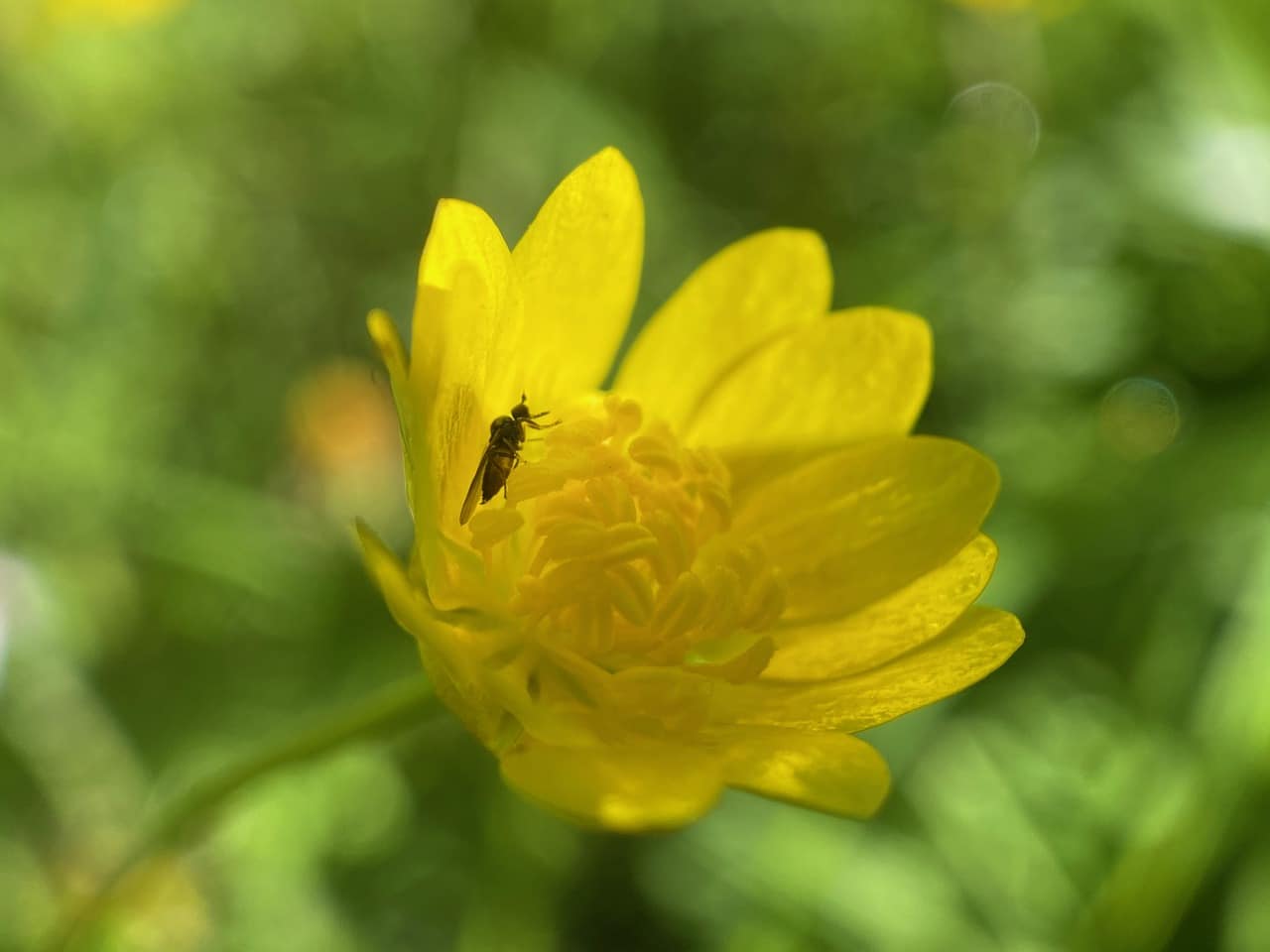
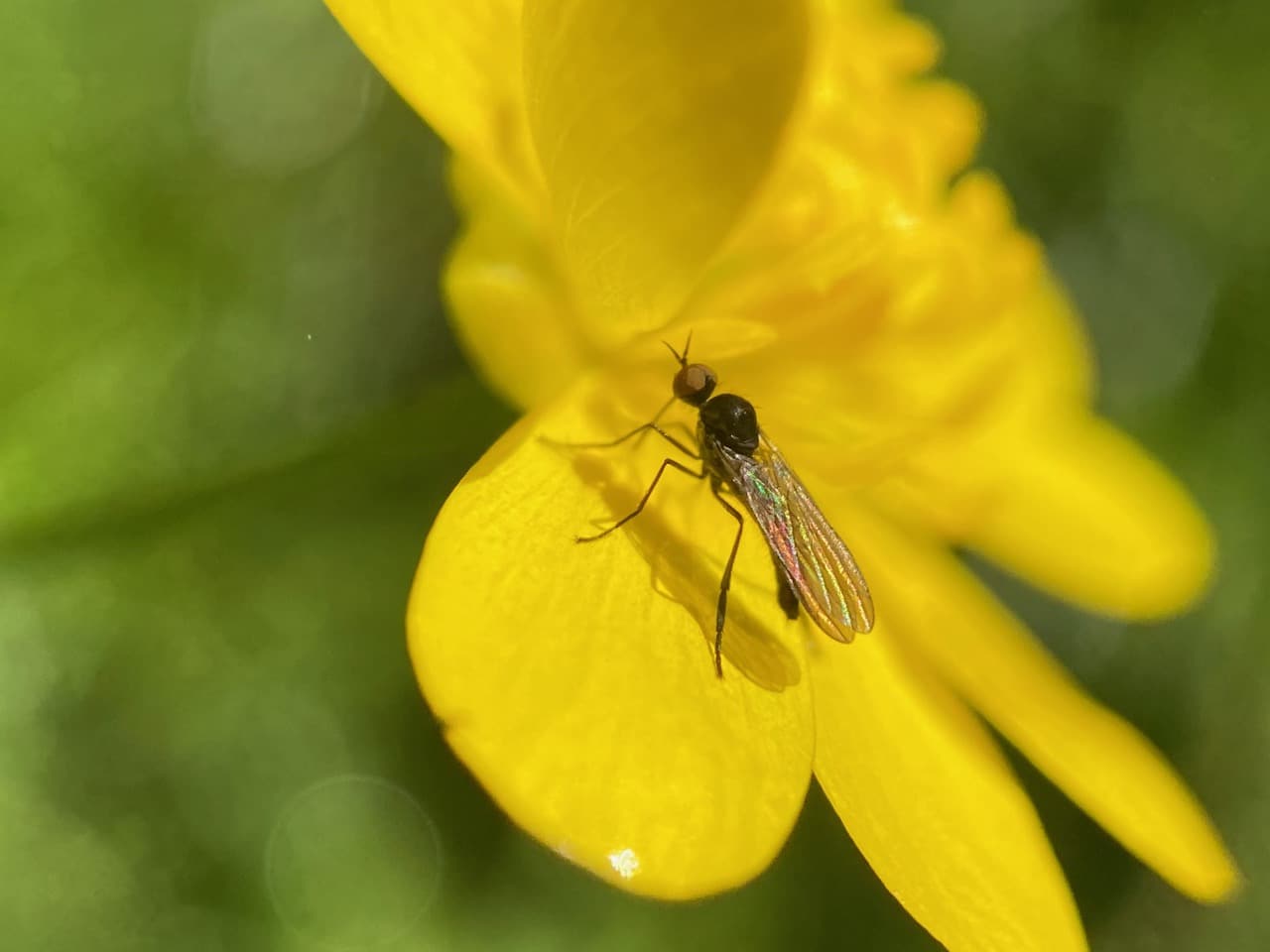
Ah, solitude. A Hybotid Dance Fly has a whole buttercup flower to itself.
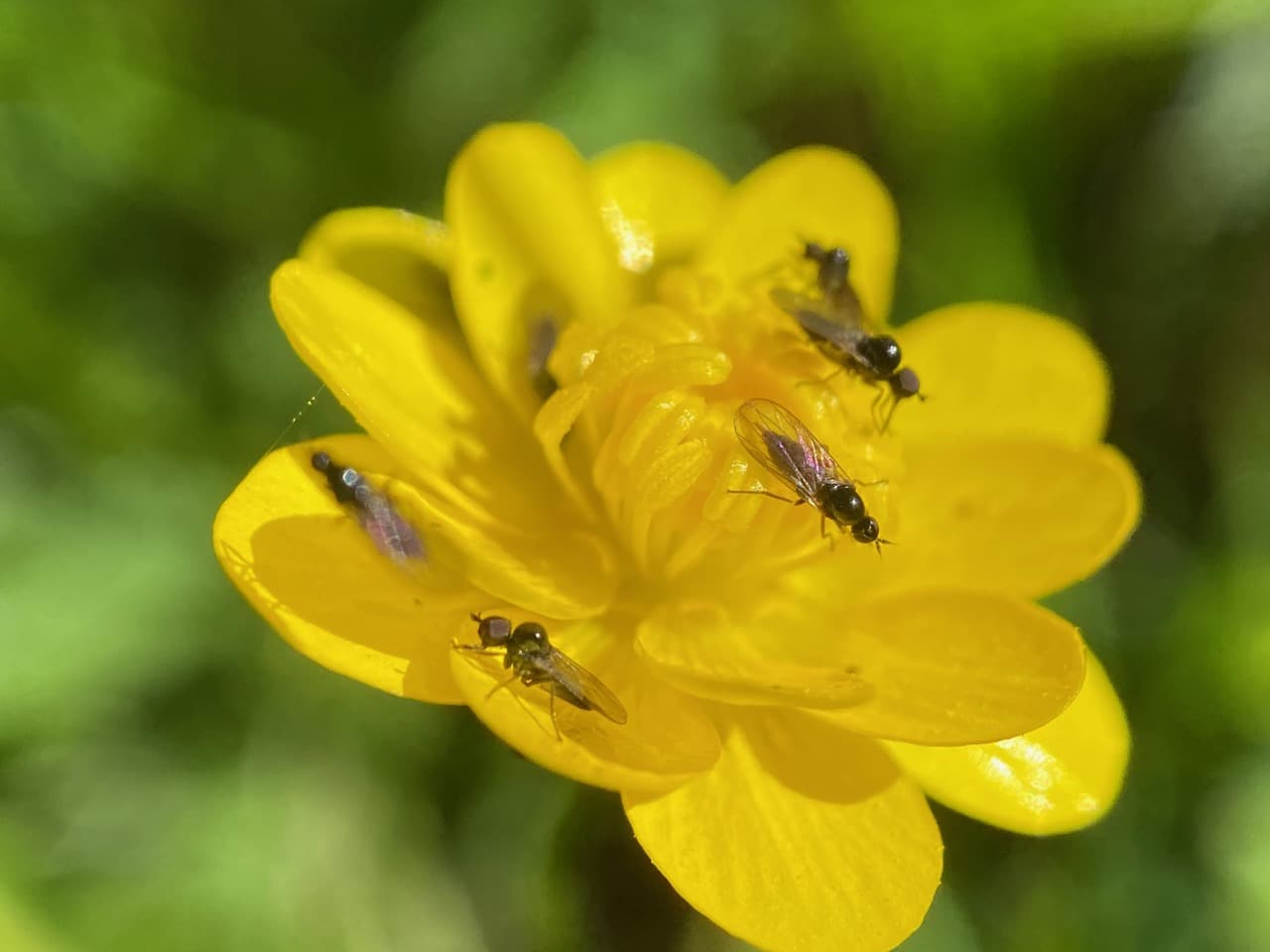
Many Hybotid Dance Flies (family Hybotidae) are perched on this buttercup flower, all oriented in the same direction. Are they feeding, or are they basking? Maybe both.
Buttercups have a trick for warming their flowers that may be unique to them. The coloration of glossy buttercup flowers is due to a rare combination of structural and pigmentary colorations. The top single-cell layer of the petal, the epidermal layer is ultra-smooth and contains pigments that reflect yellow. This layer is anchored lightly to a starch layer below. Between the epidermis and the starch are pockets of air. The interference between the epidermis and the airy layer below creates a thin-film producing a shiny, mirror-like effect. The light that is not absorbed by the pigments in the epidermis ends up passing through and hitting the starch layer below the air pockets. The starch layer has a scattering effect, sending the scattered light back through the pigment layer, intensifying the yellow color. Essentially the pigment is used twice.
Are there any evolutionary advantages to the buttercup’s intense color and glossiness? There are two likely functions. It provides a strong visual signal to insect pollinators. The petals also act together like a parabolic reflector, focusing visible and infrared light on the flower center. Warming the pollen-producing stamens boost their maturation and chance of pollination. What’s more, insect pollinators prefer warmer flowers because it allows them to forage on cold mornings.

A Balloon Fly (family Empididae) is perched on a petal of a buttercup flower. It too seems to be enjoying the warmth from the sun and the reflected heat from the flower.
Dance Flies, in the family Empididae, get their name from the habit of males of some species to gather in large groups and dance up and down in the air in the hopes of attracting females. They are predominantly predatory and they are often found hunting for small insects on and under vegetation in shady areas. Both genders may also drink nectar. Male dance flies give their sweeties a nuptial gift to eat while they mate. The gift is thought to enable her to complete the development of her eggs. Males may wrap their gifts in balloons of silk or spit, hence the other common name of Balloon Flies.
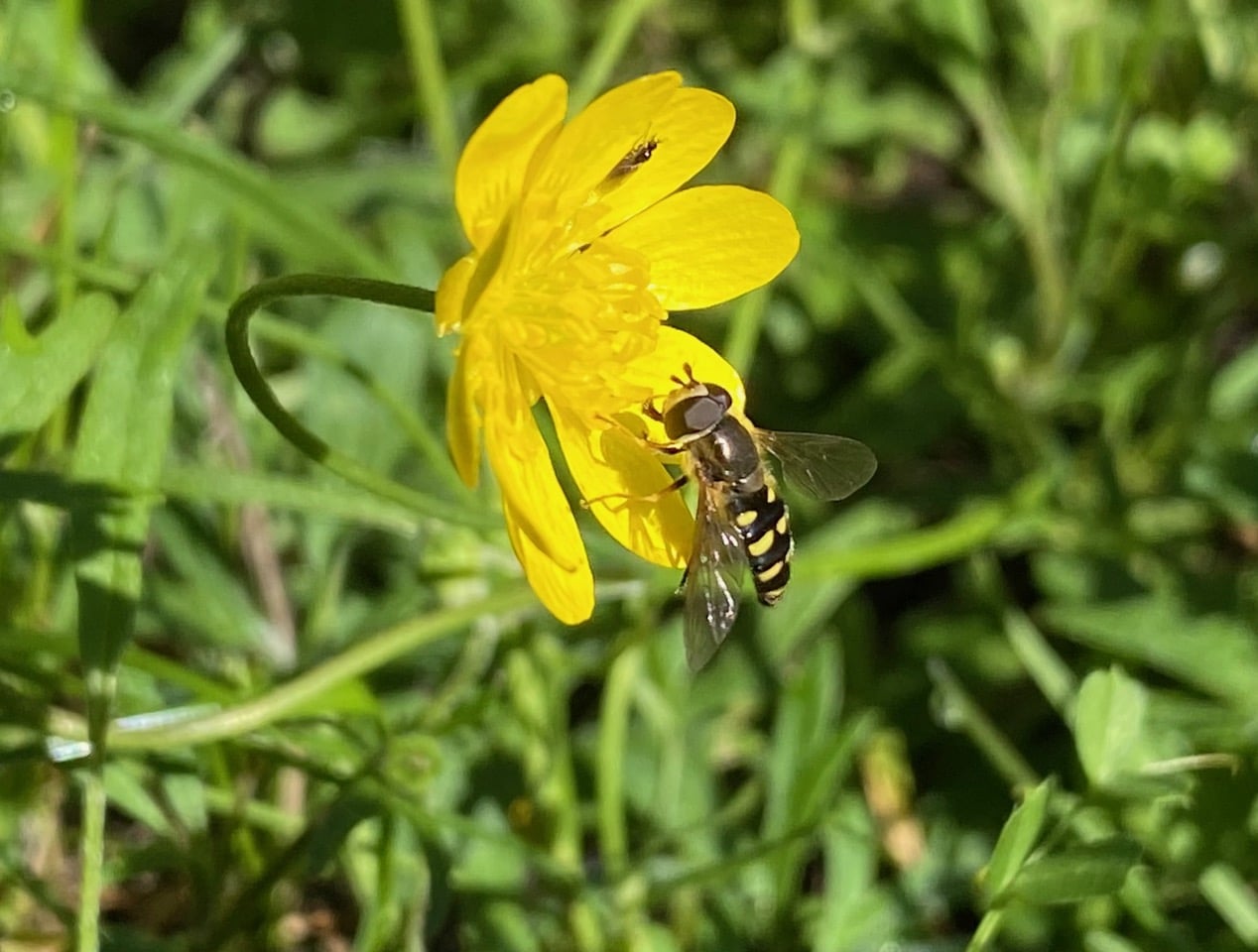
A Black-margined Flower Fly, Syrphus opinator (family Syrphidae) is feeding on pollen of a buttercup flower.
The Black-margined Flower Fly, Syrphus opinator is common in central California during winter months. It can be distinguished from similar species by the abdominal fascia restricted to the sides and isolated from the margins. It is the quintessential hover fly that mimics bees or wasps. The black-and-yellow banding on the abdomen serves to ward off potential predators that want to avoid prey with stings – a form of Batesian mimicry. Larvae of Syrphus opinator feed on aphids and other soft-bodied insects.
I have to hold this buttercup flower to steady it against the winds, and am pleasantly surprised that the little bee stays put for the photo.
The bee looks just like the male Mining Bee, Andrena sp. (family Andrenidae) that has been foraging and sleeping on the California Buttercups at Skyline Gardens. I wonder if the species is a specialist pollinator for the plant?
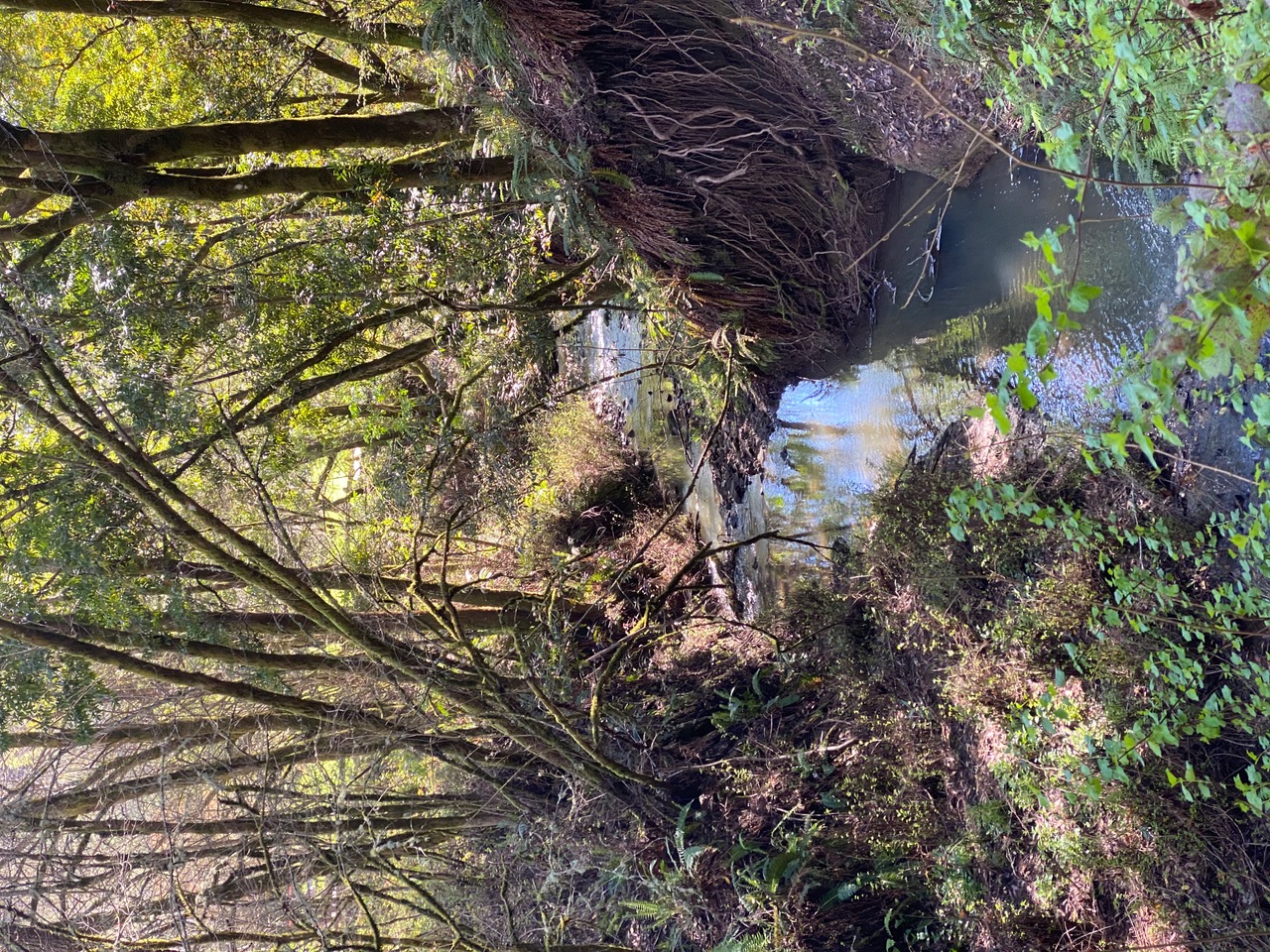
The rains have filled the creek well. It’s such a treat to take a walk accompanied by the sound of running water.
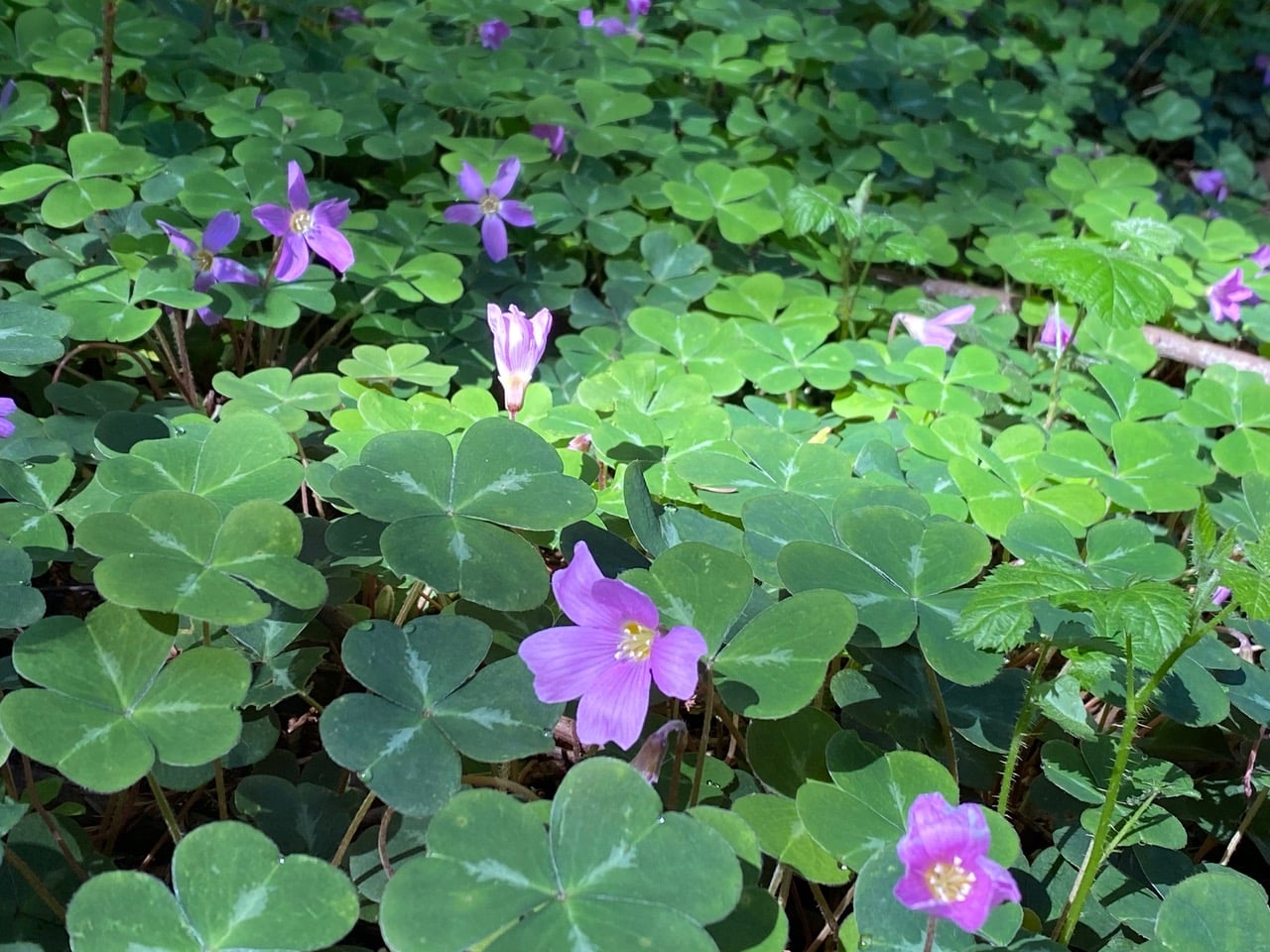
The Redwood Sorrel, Oxalis oregana (family Oxalidaceae) is blooming well under the Coast Redwood trees.
The species grows from a scaly rhizome in cool, moist Douglas-fir and coastal redwood forests of the west coast. Being adapted to shady environments, Redwood Sorrel is capable of photosynthesis at low light levels. Higher intensity light can damage the sensitive leaves. As a protective measure, leaves fold downward within several minutes when struck by direct light, a process known as nyctinasty.
I scan the sunlit spots on the carpet of the Redwood Sorrel, hoping to see some insects flying. A study to find the pollinators for the plant has discovered 14 different species of bees living in the understory of redwood forests. The small bees rest on the underside of the sorrel leaves. They wake up when sunlight strikes the leaves, then follow the meandering paths of sunbeam across the forest floor as they drink nectar and collect pollen to provision their nests. I would love to see these bees at work, but alas, it is not for today.
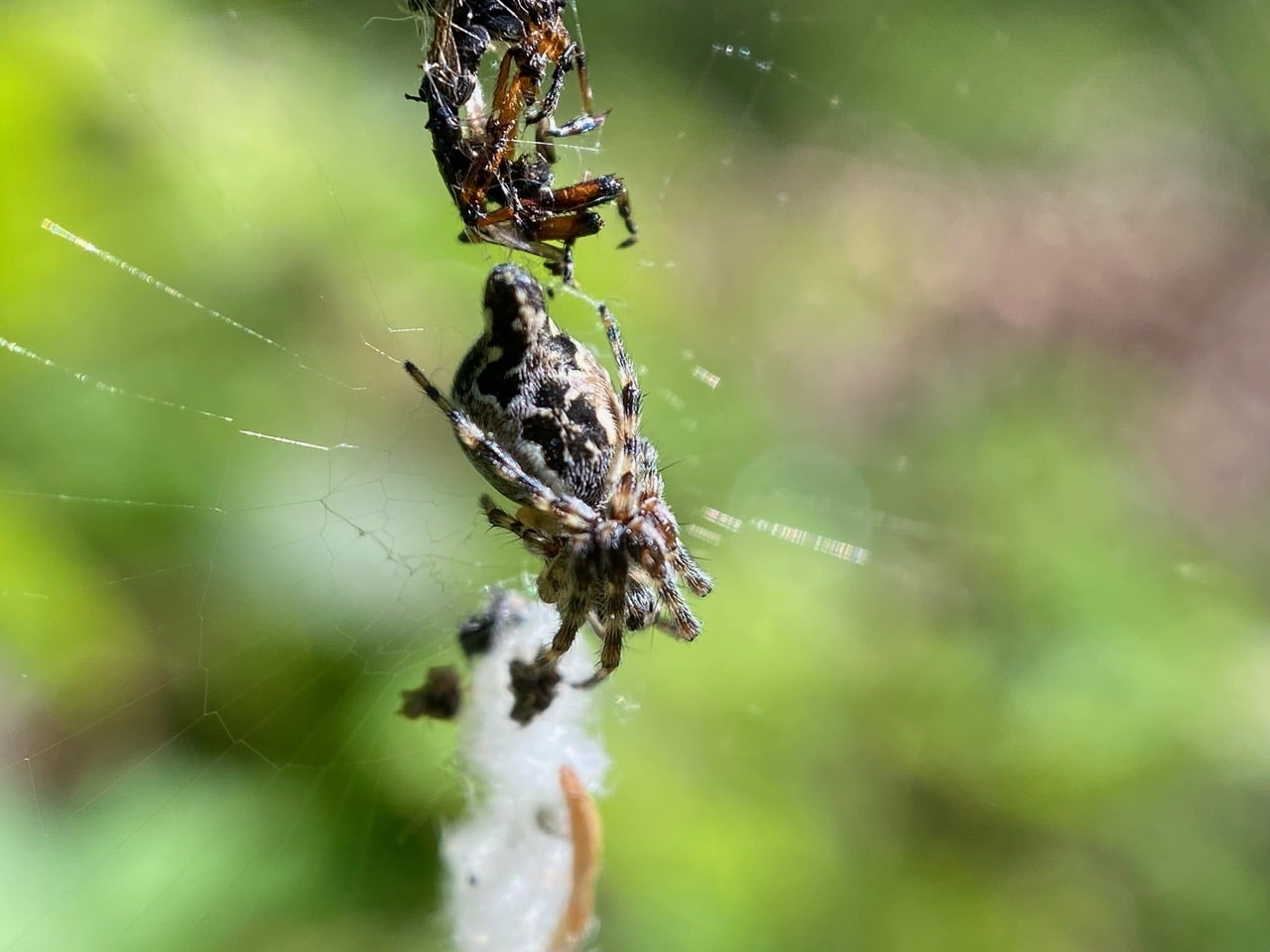
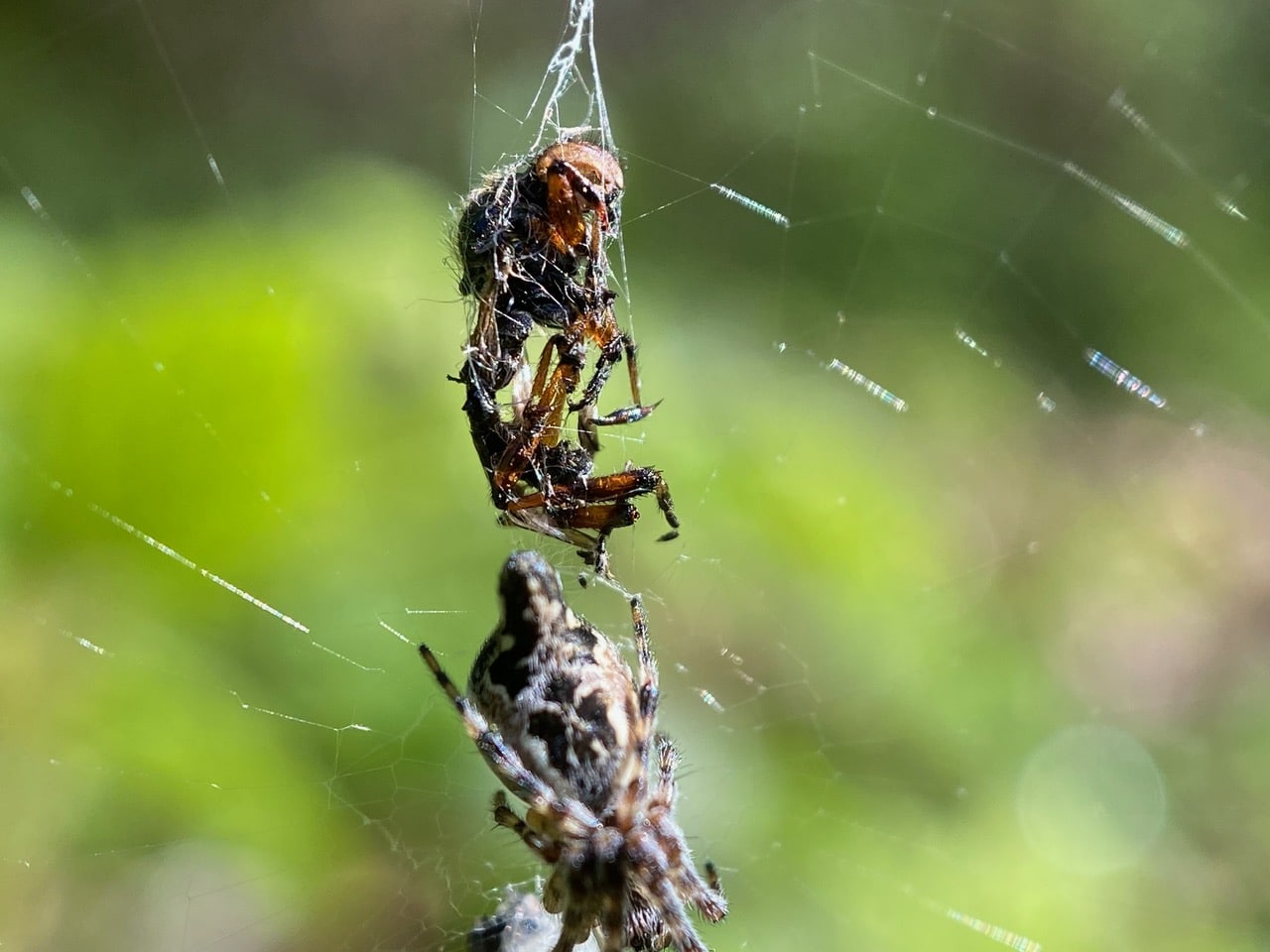
A female Conical Trashline Orbweaver, Cyclosa conica (family Araneidae) is resting in the hub of her vertical orb web. She has a big bundle hung up on the line above her, and some fluffy materials on the trash line below her.
Trashline spiders are so-called for their web decoration. Cyclosa create orb-shaped webs using both the sticky and non-sticky threads, mostly during times of complete darkness. Across its spiral wheel-shaped web, Cyclosa fashions a vertical “trashline” made of various components such as prey’s carcasses, detritus, and at times, egg cases. The trashline helps the spider to camouflage exceptionally well from predators. The spider sits in the web hub to conduct its sit-and-wait hunting, ensnaring prey at nearly any time of day; it only leaves its spot to replace the web prior to sunrise.
Zooming in, I find that the bundle above Cyclosa consists of the wrapped bodies of one or two March flies. The spider has fed well!
The spider has attached clumps of white plant fibers on the vertical trash line below her – most likely the plumes of willow seeds that are currently blowing in the breeze. To a compulsive home decorator, nothing is wasted!
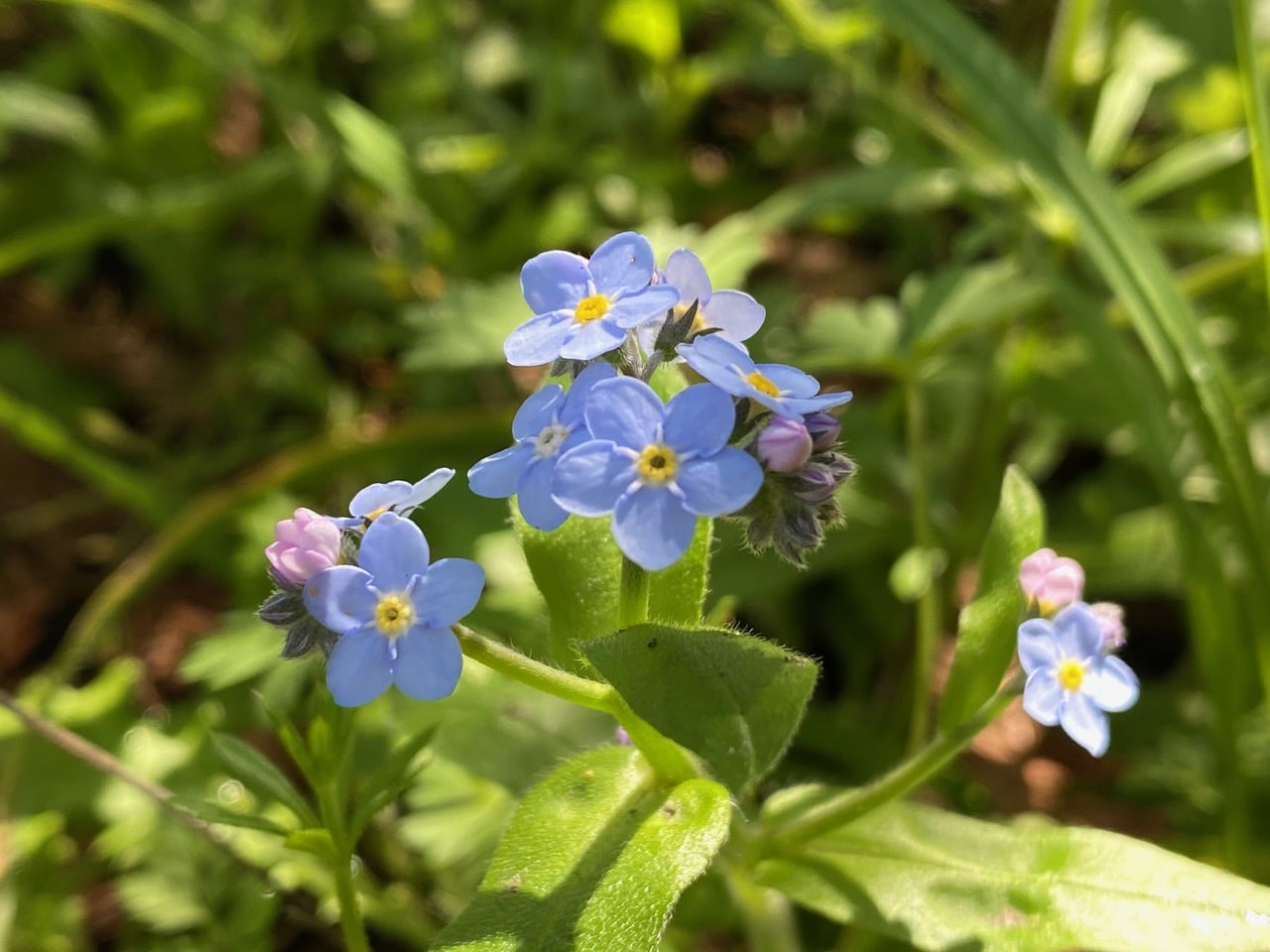
The Forget-me-not, Myosotis sp. along the shady parts of the trail are blooming profusely. I watch as a few Greater Bee Flies, Bombylius major (family Bombyliidae) hover over the flowers to take nectar. It is difficult to take a good picture of an insect that is in constant motion, so I turn on the video function of my camera, hoping for better results.
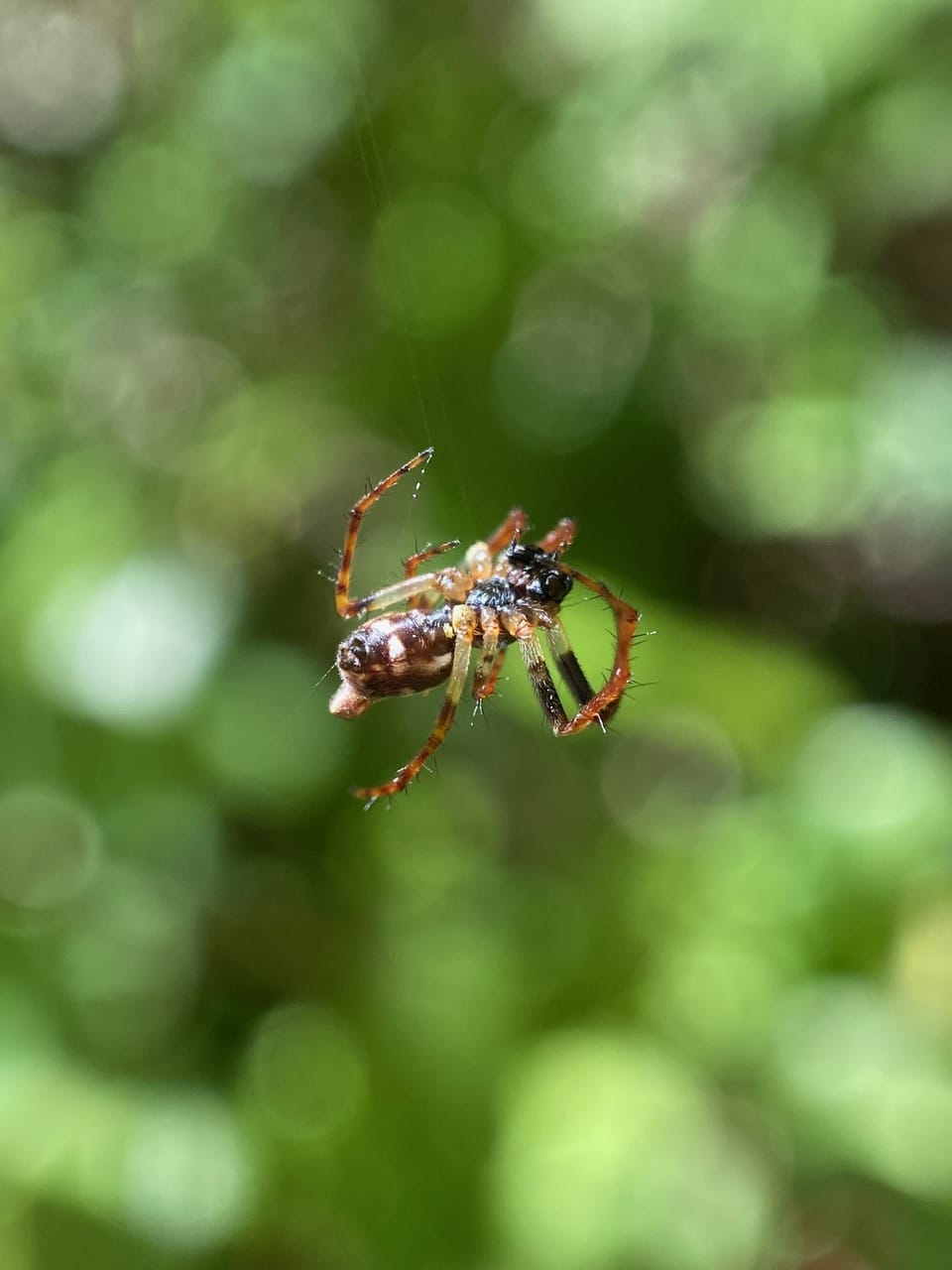
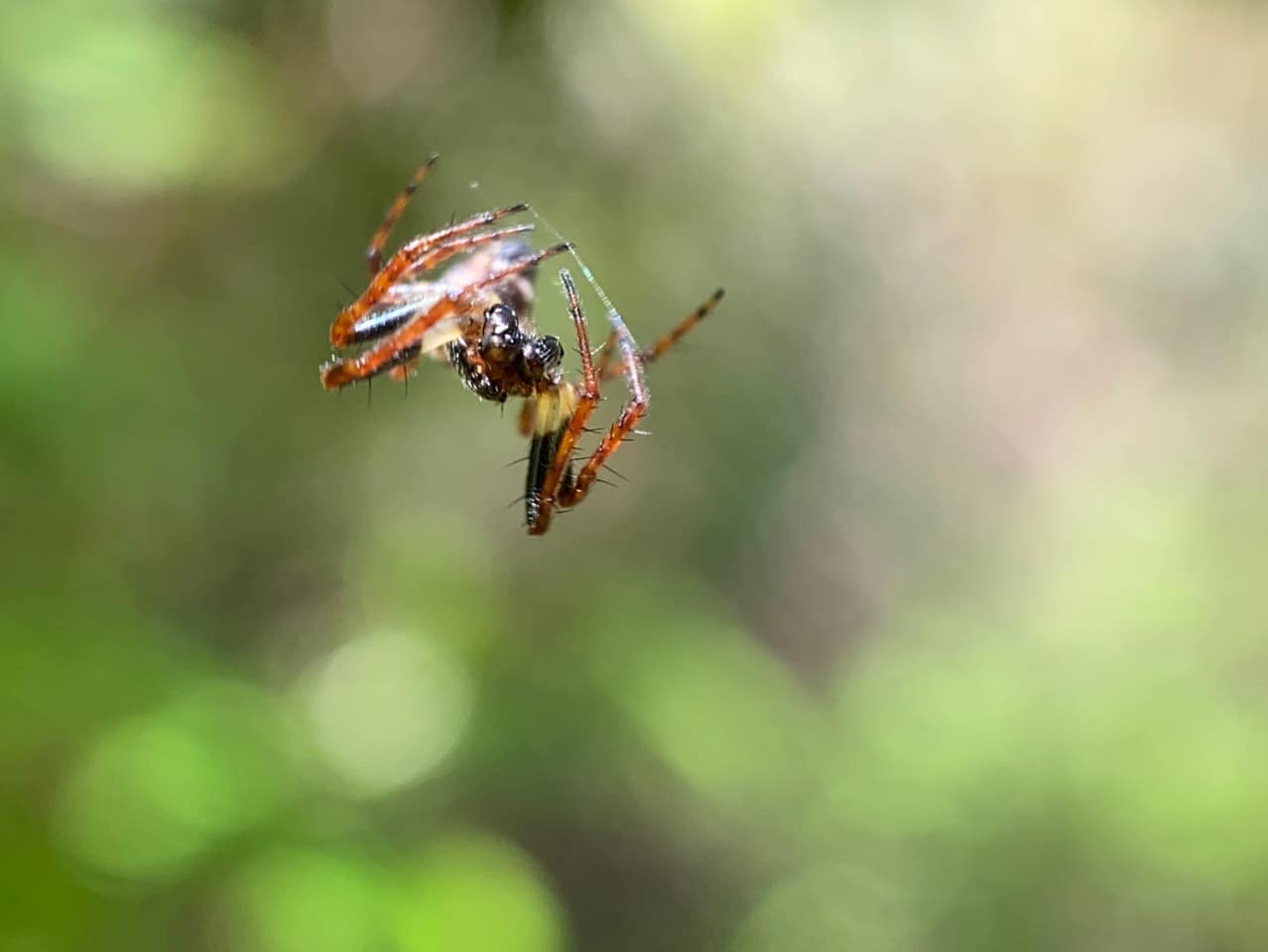
A male Conical Trashline Orbweaver is suspended on some loose silk line, not a proper orb web. He is traveling, probably in search for a mature female to mate with.
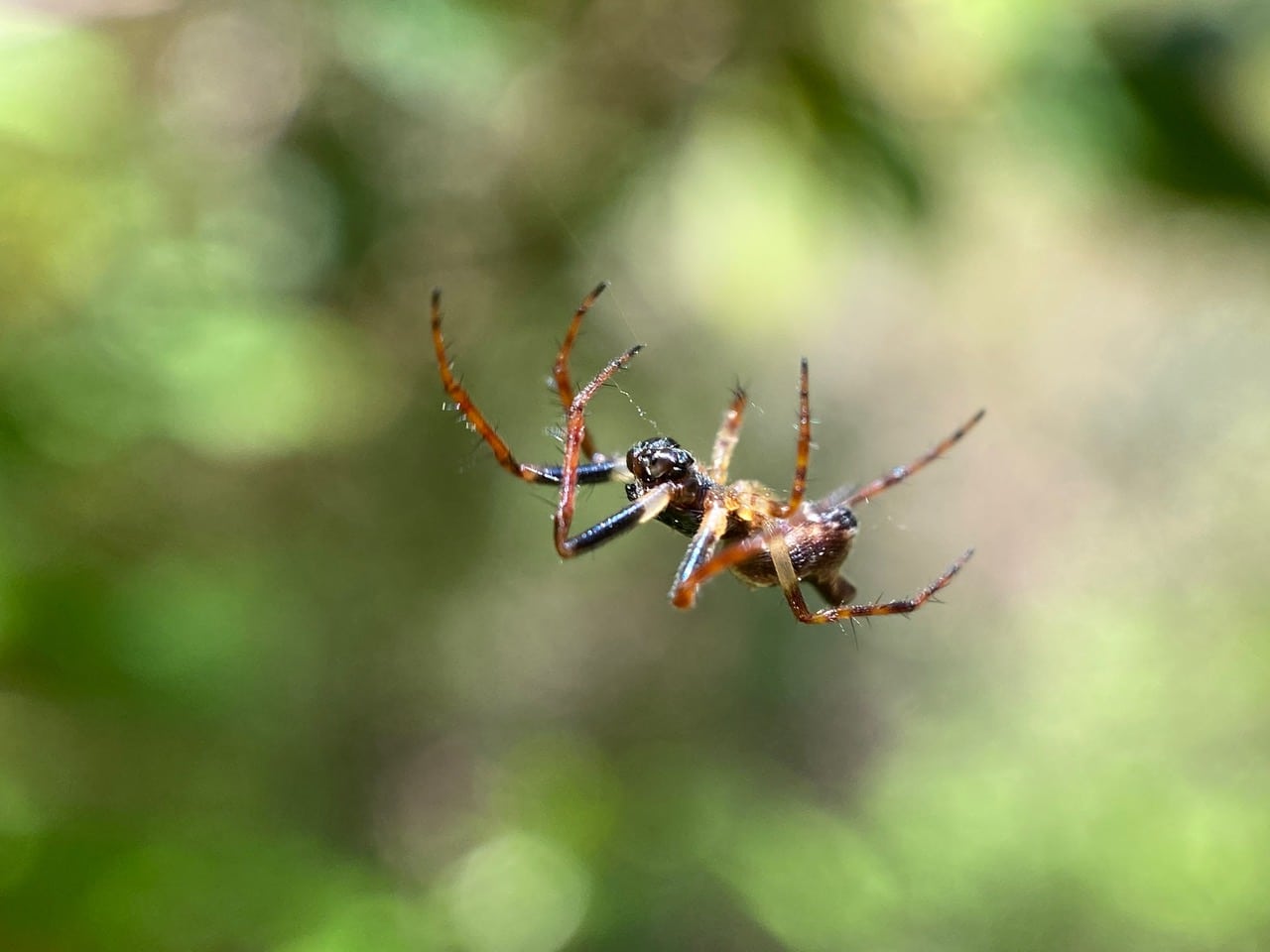
Further along the trail, another male Trashline Orbweaver is coming straight at me, descending on an invisible silk line. Note the prominent black pedipalps that he holds like boxing gloves under his face. He is probably all charged up and ready to mate.
Side view of the spider showing the blunt protrusion on its abdomen, and the dark pedipalps under its face. The pedipalps of spiders serve many functions. They are large, paired mouthparts used variously to manipulate food, as supplementary walking legs, communication devices, sensory structures and sex organs. In sexually mature male spiders, the palms terminate in bulbous tips resembling boxing gloves (a handy rule of thumb for distinguishing males and females). These are used to suck sperm from the genital opening on a male’s belly and inject it into the female’s reproductive tract during mating.

This third male has a missing hind leg on his left side. See the socket where the limb came off? The spider seems to be able to move around alright with one less leg.
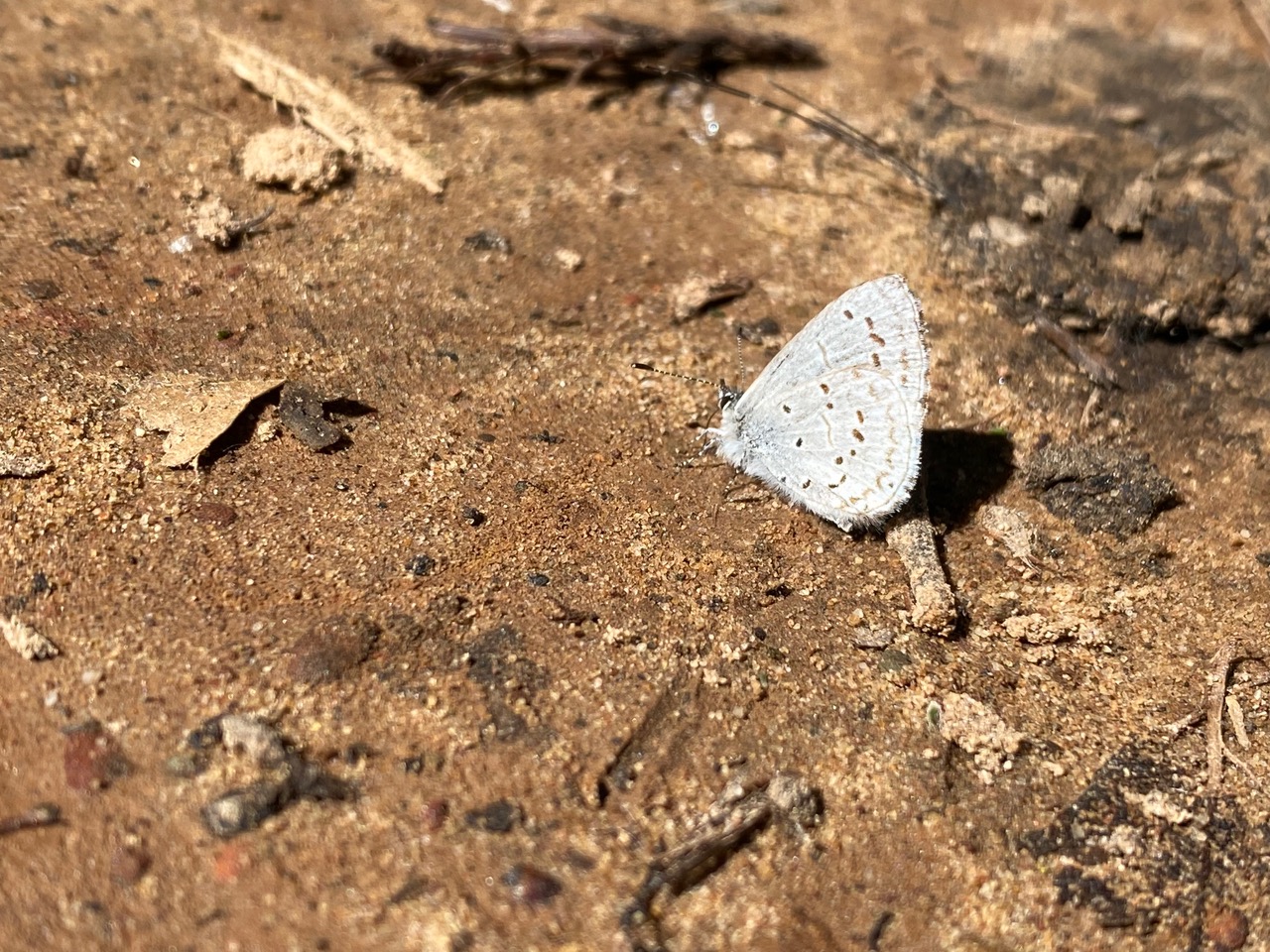
A lone Pacific Azure, Celastrina echo ssp. echo (family Lycaenidae) is puddling in the middle of the wet trail.
Puddling is a behavior many butterflies and some moths engage in. Puddling sites can include mud, dung, fermenting fruit, carrion, urine. The butterflies are specifically after the salt (sodium) and minerals dissolved in the fluids. Most of the puddlers are males who ingest the salts, minerals and amino acids that the liquified source provides. During mating, the male passes these goodies along to the female as a nuptial gift in his spermatophore. The gift provides the female with an “extra boost” that is passed along to her eggs to enhance her reproductive success.
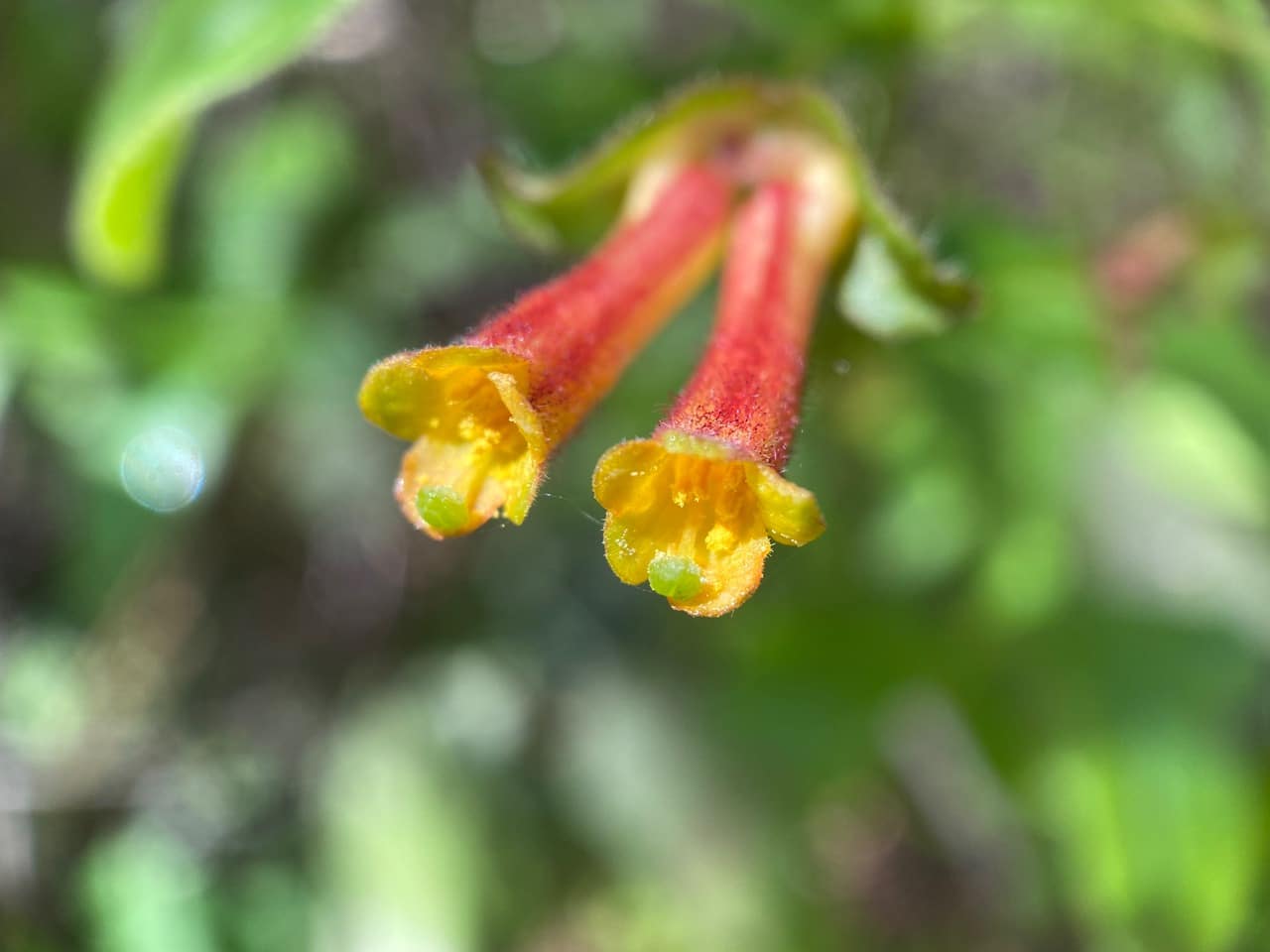
Twinberry in bloom! On the countless times I have walked this trail, I have never noticed this plant before.
The Twinberry Honeysuckle, Lornicera involucrata is a deciduous shrub found throughout western North America. The yellow-red, tubular, 5-lobed flowers are paired in leaf axils and subtended by a single, enlarged 2-lobed bract. The bracts turn from green to a striking dark red in late summer as fruits ripen.
It doesn’t take much imagination to figure out who pollinate these flowers. Red, tubular flowers are typically pollinated by hummingbirds, who are attracted to the color red, and whose long beak and tongue can access the nectar at the base of the flower. The exserted large stigma serves to receive incoming pollen when the bird’s head comes close. The anthers at the level of the flared petals dab their pollen onto the bird’s head, to be carried to the next flower.
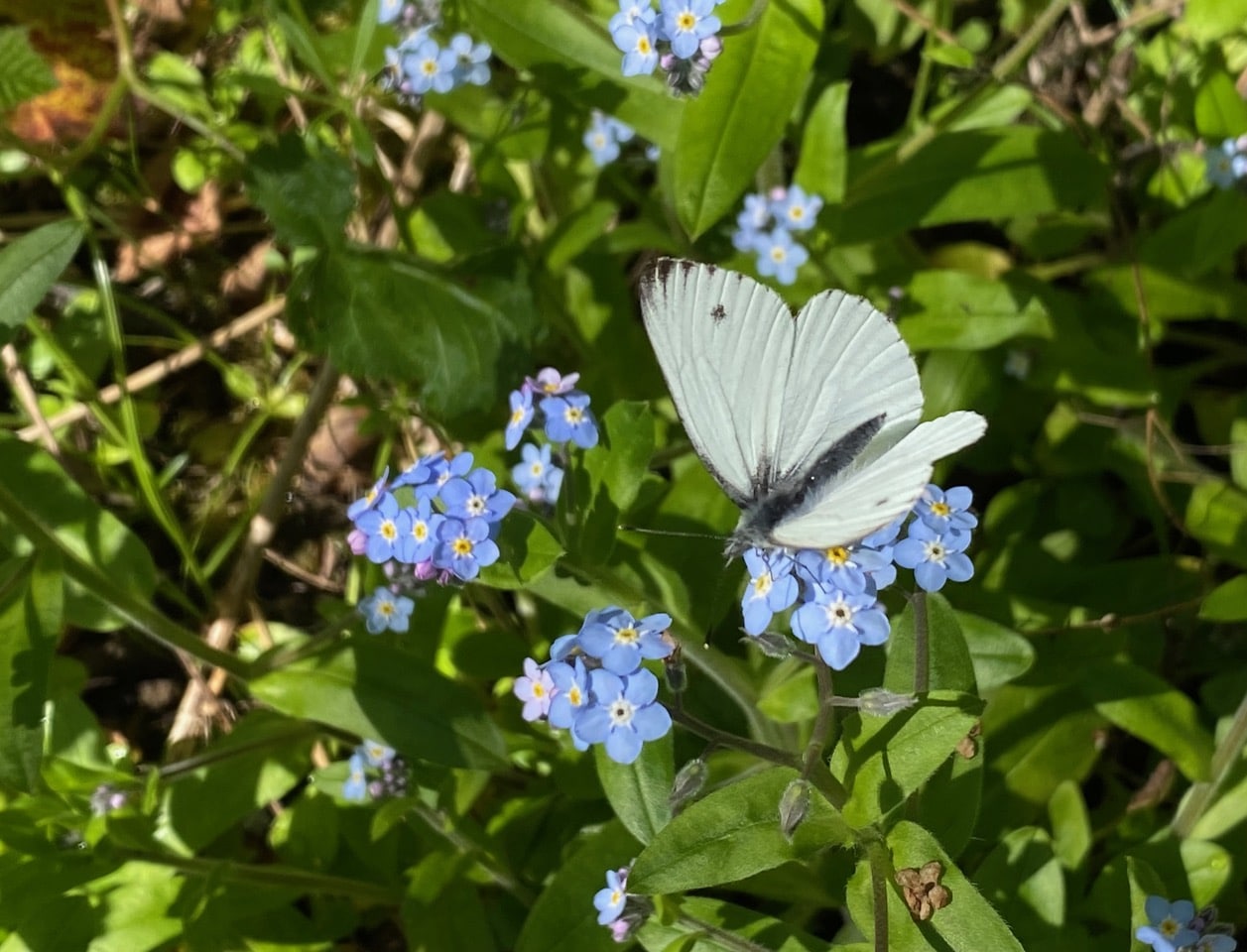
Beside the Greater Bee Fly, and the Empidid Dance Flies, another candidate pollinator for the small flowers of Forget-me-not, Myosotis sp. is a butterfly. Its long flexible proboscis can be inserted through the small opening to reach the nectar. A male Cabbage White butterfly has alighted on a cluster of the flowers to sip nectar. (The sexes of the butterfly can be distinguished by the black spots on the forewings – males have a single spot, while the females have two.)
The cabbage white, Pieris rapae (family Pieridae) was introduced to the US along with European cabbage imports in the 1860’5. The caterpillars feed on plants in the mustard or Brassicaceae family, and occasionally some in the caper family. The butterflies have a darkened, yellowish underside of the hind wings, which enables them to heat up quickly in the sun. The butterfly’s white wings reflect ultraviolet light, which we can’t see but the butterflies can. To our eyes the butterflies seem plain and drab, but to each other, females are a gentle lavender and males shine with a deep royal purple. Brighter males are more attractive to females and the color’s strength reflects the amount of protein the males consumed as caterpillars. During mating, male butterflies transfer nutrients to the females in the form of infertile sperm, a nuptial gift which will enhance the female’s life expectancy and fertility. A male with a higher quality diet can afford to be brighter and to produce bigger and more nutritious nuptial gifts.
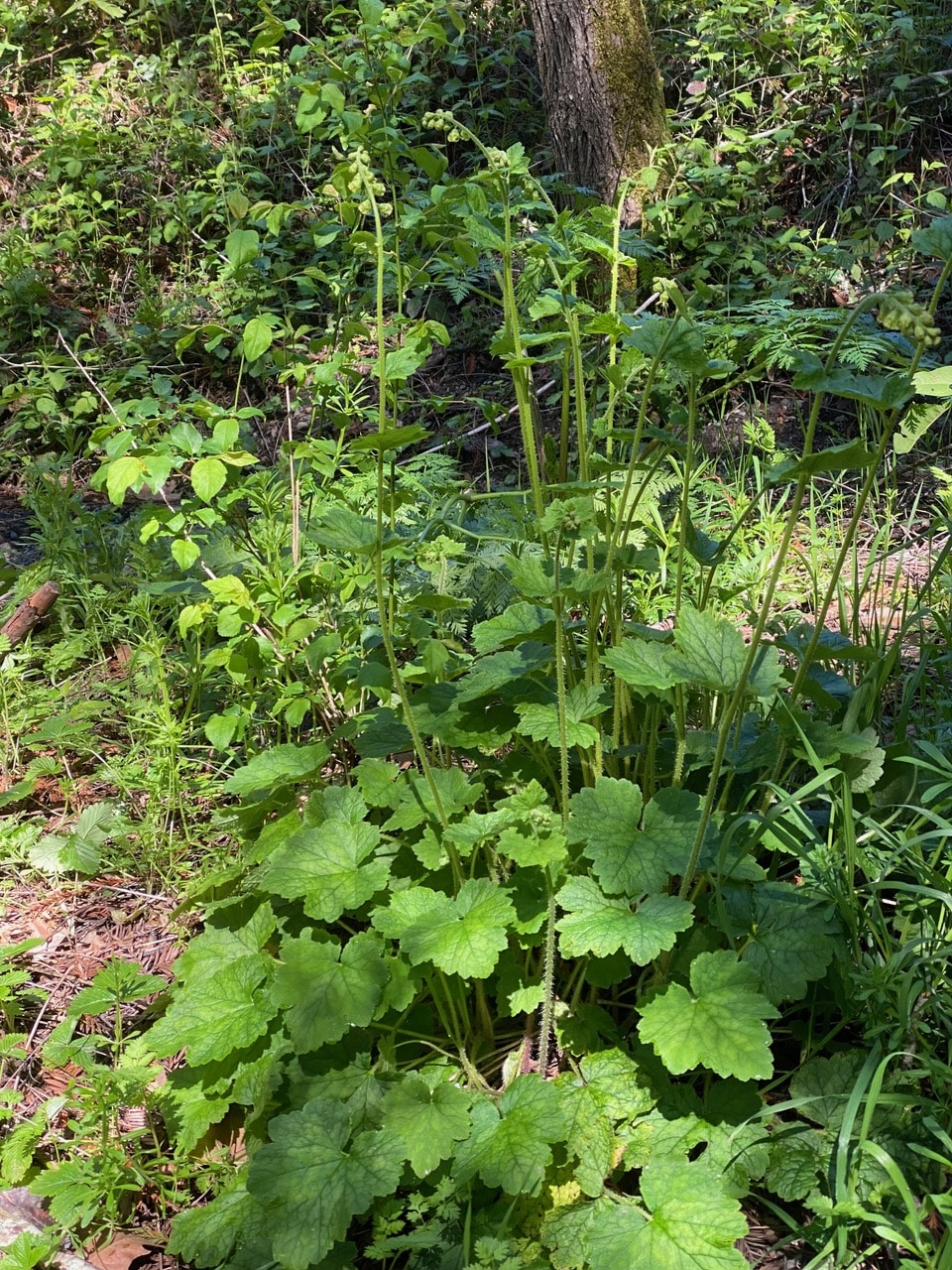
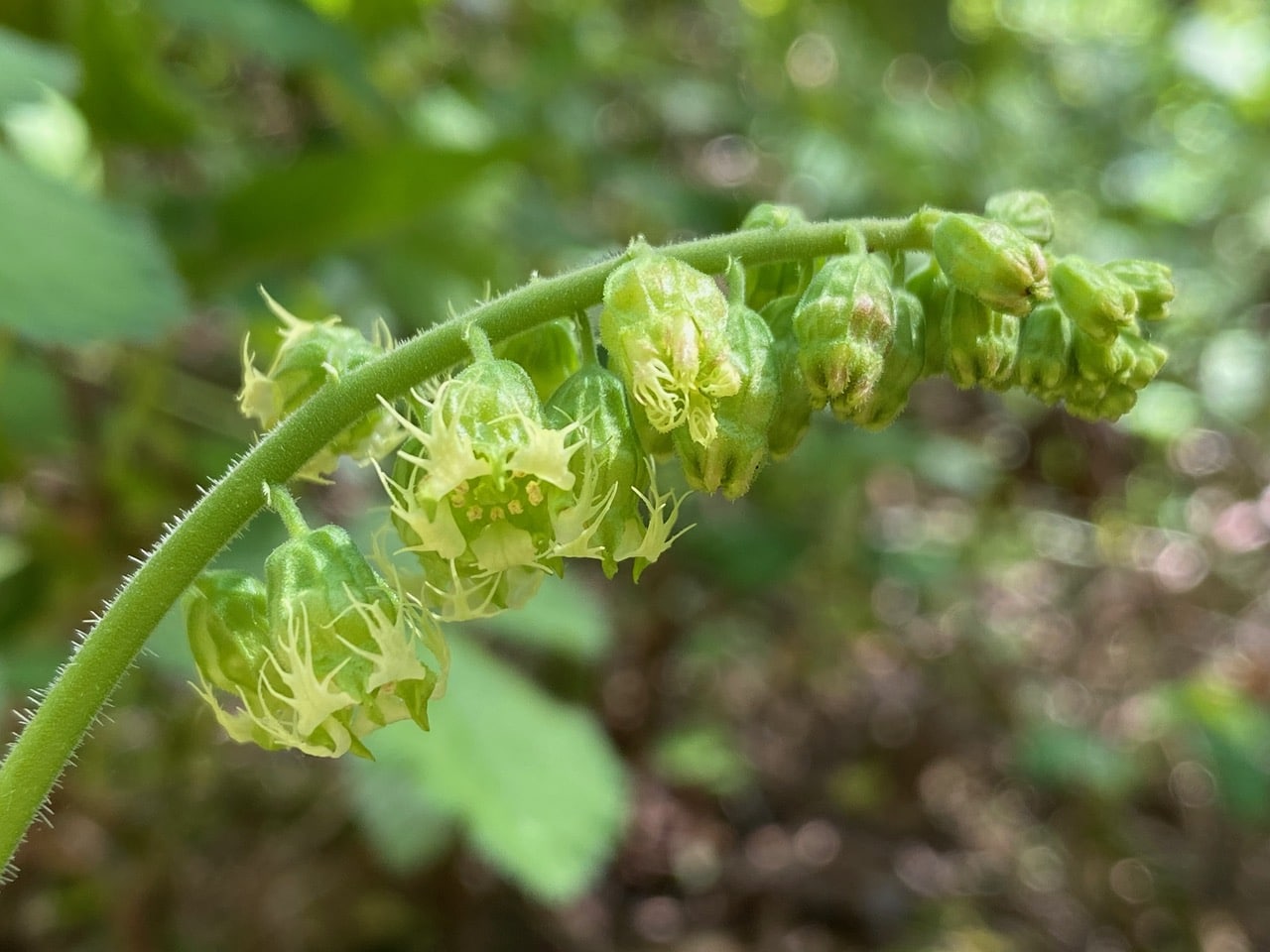
In the dappled shade, a robust Fringe Cups, Tellima grandiflora has produced tall nodding racemes of tiny flowers.
The small flowers of Fringe Cups look like a fanciful creation of Dr. Seuss. Up to 20 flowers are borne on a tall, one-sided, nodding raceme. The sepals are fused to form a cup holding 10 stamens and 2 styles. The five deeply divided or fringed petals curl back around the calyx cup. The petals begin white or green, maturing into a deep rose, usually with all the color variations occurring on the same stalk. The flowers are pollinated by bees and hummingbirds. Even after the petals have withered, the cups persists, cradling the seeds of the next generation until they spill out into their woodland world.