

Pollinator Post 3/9/26 (2)

The morning is still young after I helped Tea with her project at Crab Cove. I decide to visit the native garden at the other end of the park.
The Cleveland Sage, Salvia clevelandii is in peak bloom. Somehow the flowers are not getting much attention from pollinators. Where are the bees?
Cleveland Sage
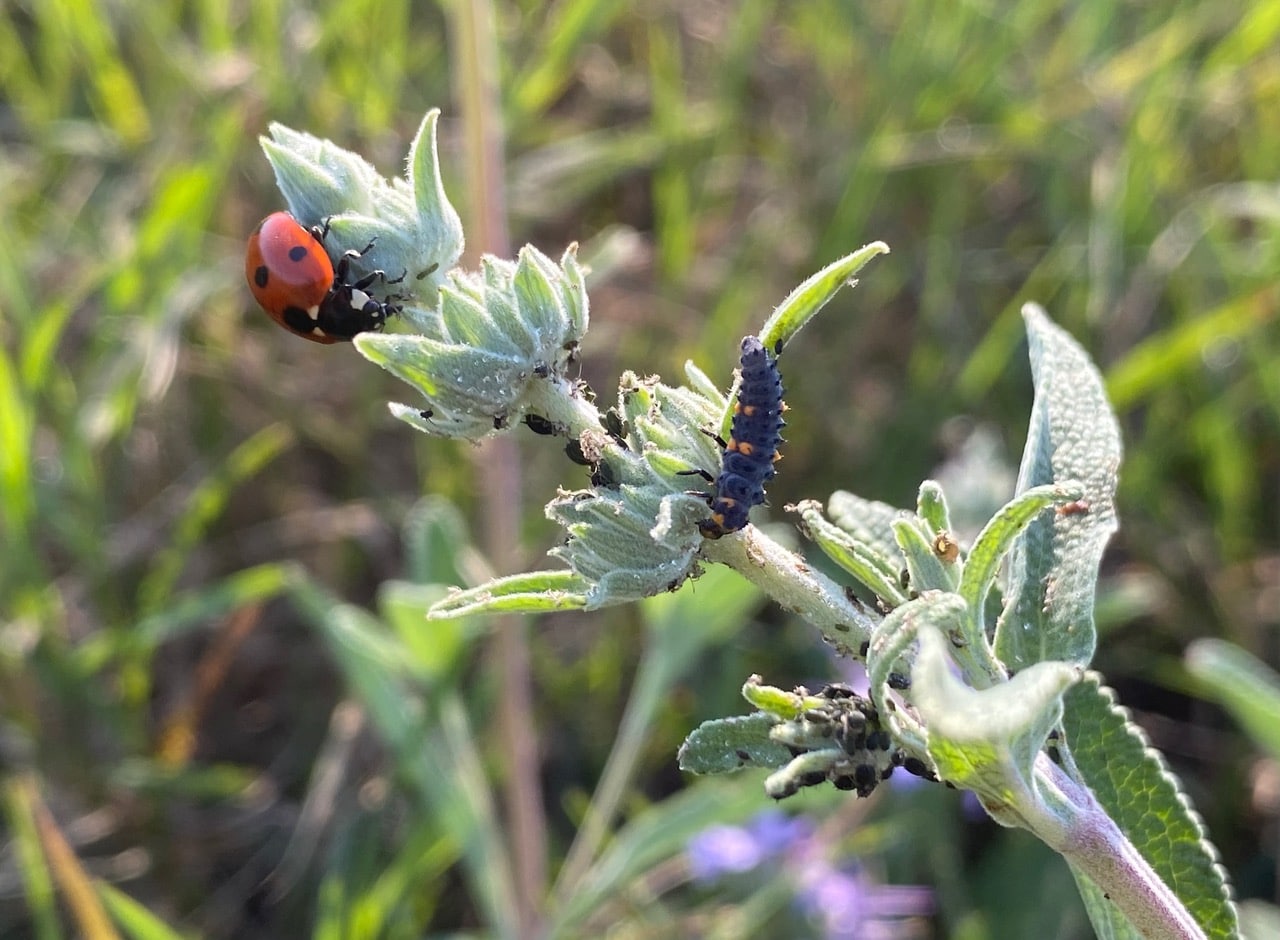



My attention is drawn to the red elytra of the Seven-spotted Lady Beetle on the top whorl of an immature flower spike of the Cleveland Sage. Then I notice a Lady Beetle larva lower down the spike. Both adult and larva are busy feeding on the tiny dark green aphids. I wonder if these were the same aphid species that I found on the White Sage on 3/3/26.
Native to Europe, the Seven-spotted Lady Beetle, Coccinella septempunctata (family Coccinellidae) has been repeatedly introduced to North America as a biological control agent to reduce aphid numbers. It has since spread to many states, where it has outcompeted some native species, including the Coccinella. The Seven-spotted Ladybeetles are large; adults may reach a body length of 0.5 in. Their distinctive spots and conspicuous colors warn of their toxicity, making them unappealing to predators. When threatened, the beetles can secrete a fluid from joints in their legs which gives them a foul taste.
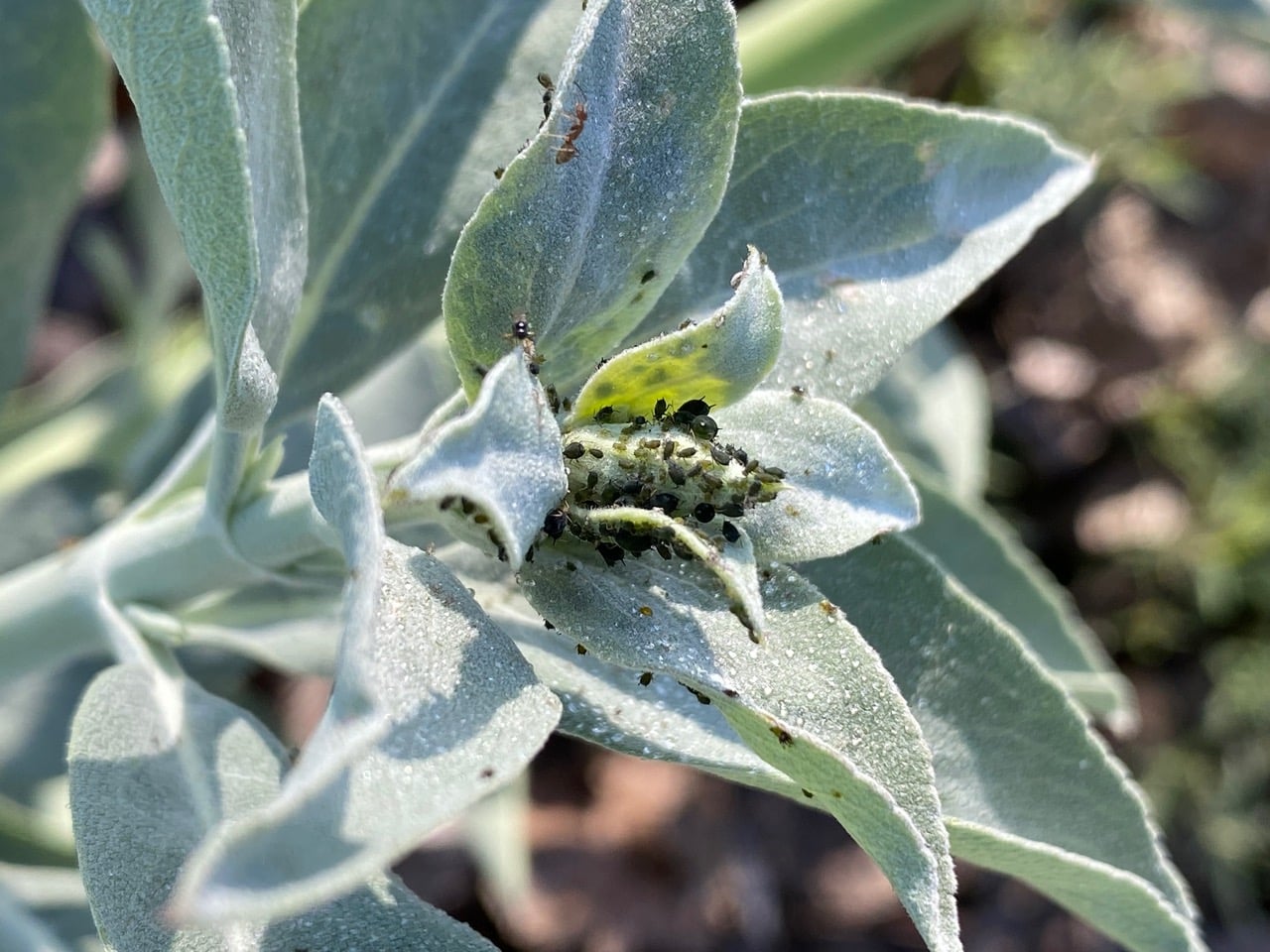
I revisit the White Sage, Salvia apiana that I have photographed on 3/3/26. The aphid colony has spread from the tip of the branch, and the affected leaves look limp and misshapen, robbed of their vigor.
Aphids are small, soft-bodied, sap-sucking insects belonging to family Aphididae (order Hemiptera). They are characterized by their pear-shaped bodies, “cornicles” (a pair of pipe-like tubes on the rear), and unique asexual reproduction. Aphids have a unique, rapid lifecycle where wingless females give birth to live, female clones throughout the summer without fertilization (parthenogenesis). In autumn, they reproduce sexually to lay eggs that overwinter. Aphids consume vast amounts of plant sap, often causing stunted growth, deformed leaves, and, by excreting sticky “honeydew”, promotes the growth of sooty mold. Some aphids are specialists that feed on specific plants, while other species are generalists that feed on hundreds of plant types. Many species alternate between different host plants throughout the seasons, often moving from woody plants in winter to herbaceous plants in summer.
The dark green aphids have also spread to neighboring branches of the White Sage. Wow, that was fast! Note this new colony consists of mostly very young nymphs.
Aphids reproduce with extreme speed via a process where females give birth to live, clonal, already-pregnant daughters without mating (parthenogenesis). This “telescoping of generations” allow nymphs to mature in roughly 10 days, with a single female producing up to 12 offspring daily. Under ideal conditions, a single aphid can theoretically produce hundreds of billions of descendants in a season. The aphid’s fecundity is their major contribution to the ecosystem, feeding a large number of organisms (mainly other insects) up the food chain.
The various Ceanothus species in the garden continue to bloom well. Spiders have set up traps between the inflorescences to intercept pollinators. I am not sure what kind of spider has created these coarse, irregular webs.
This fine-mesh sheet web is created by the Sheetweb Weavers (family Linephiidae).
The web of these spiders form a flat or curved surface suspended from vegetation or over an opening on the ground. The spiders hang beneath the web and attack prey that wander or fall onto the web surface by biting directly through the silk webbing. Most species are tiny; some are among the smallest of spiders. A few of the common and larger species build distinctive webs for which they are named, for example, the “bowl-and-doily” spider, and the “filmy-dome” spider. Many of the dwarf sheet weavers aren’t known to build a web, but wander through the leaf litter on the ground in search of prey. Linyphiids are famous for dispersing by ballooning (flying by means of silk strands carried in a breeze), and these spiders are often responsible for the sheets of gossamer which sometimes coat fields and fences.
A Greenbottle Fly (family Calliphoridae) has landed on a large Ceanothus inflorescence. The usually iridescent green insect has taken on a strange turquoise hue due to the sea of blue around it.
The Common European Greenbottle Fly is a Blowfly found in most areas of the world and is the most well-known of the numerous green bottle fly species. The lifecycle of Lucilia sericata is typical of blowflies. Females lay masses of eggs in fresh carrion. The flies are extremely prolific – a single female may produce 2,000 to 3,000 eggs in her lifetime. The larvae feed on dead or necrotic tissue, passing through 3 larval instars. Third-instar larvae drop off the host to pupate in the soil. The adults feed opportunistically on nectar, pollen, feces, or carrion; they are important pollinators as well as important agents of decomposition. Pollen is used as an alternative protein source, especially for gravid females who need large amounts of protein and cannot reliably find carrion.
While we may find the blowflies disgusting for their association with filth and carrion, they are important decomposers/ recyclers in the ecosystem. What’s more, their larvae are used in maggot therapy to clean wounds by consuming only dead and infected tissue, helping to promote faster healing and prevent infection.
It is a joy to watch Honey Bees, Apis mellifera (family Apidae) forage on Ceanothus. They are the primary bees visiting the flowers today. The large loads of pollen in their pollen baskets are a testament to their diligence and skill. The sight reminds me of a fellow docent at the Oakland Museum Natural Sciences Gallery I worked with many years ago. Bud, a retired entomologist, taught me that every honey bee worker out foraging should be treated with respect – they are all “little old ladies”. Bud was absolutely correct. All Honey Bee foragers are female, and they are the oldest of their hive mates. How do honey bees get their job assignments within their social organization?
“A bee’s job is, first of all, determined by its sex. Male bees, or drones, don’t do any work. Making up roughly 10% of the colony’s population, they spend their whole lives eating honey and waiting for the opportunity to mate with the queen. The queen mates with up to 20 drones and will store their sperm in her spermatheca for the rest of her life. That’s where male duties end. Female bees, known as worker bees, make up the vast majority of a hive’s population, and they do all the work to keep it functioning. Females are responsible for the construction, maintenance, and proliferation of the nest and the colony. When a worker bee emerges as an adult, she immediately starts cleaning the cell from which she hatched. Her first 3 days are spent cleaning cells to prepare them for the queen’s next round of eggs. Then her hormones kick in to initiate the next phase of work: nursing the young. The worker bee spends about a week nursing the brood, feeding larvae with royal jelly. Next, the worker bee enters the third phase, as a sort of utility worker, moving farther away from the nest’s center. Here she builds cells and stores food in the edge of the nest for about a week. A worker’s hormone shifts into the final phase of work at around 41st day: foraging. This work is the most dangerous and arguably the most important. It’s only done by older bees who are closer to death. As the worker bee approaches her fourth week of nonstop work, she senses her end of days, and removes herself from the hive, so as not the become a burden to the colony. If she dies in the hive, her hive mates would have to remove her corpse. Thus is the life of a female honey bee during the active seasons of spring and summer, compulsively working from the day she’s born until the day she expires.” – excerpt from an article in National Geographic by Richie Hertzberg.
The pollen collecting apparatus in Apidae bees, which include honey bees and bumble bees, is commonly called a “pollen basket” or corbicula. This region is located on the tibia of the hind legs and consists of hairs surrounding a concave region. After the bee visits a flower, she begins to groom herself and brushes the pollen down toward her hind legs and packs the pollen into her pollen basket. A little nectar mixed with the pollen keeps it all together like putty, and the stiff hairs surrounding the pollen basket hold it in place. Remarkably bees are able to fly while carrying up to a third of their body weight in pollen.
.jpg)
Honey bees fill ‘saddlebags’ with pollen. Here’s how they keep them gripped tight | Science | AAAS
Pollinators, primarily Honey Bees, are responsible for one out of every three bites of food consumed globally, playing a critical role in the production of over 90 different crops, including fruits, vegetables, and nuts. Bees are vital for pollinating staples like almonds, apples, blueberries, cherries, cucumbers, and tomatoes. As bees forage for nectar and pollen, they transfer pollen between flowers allowing plants to produce seeds and fruits. A single bee can visit thousands of flowers daily. Honey Bees account for about 85% of all pollination.
And let’s not forget where honey comes from….
Honey Bees make honey primarily to store food for the winter and periods of low food availability. They convert nectar from flowers into honey through dehydration to prevent spoilage, using it to feed the colony, including larvae, and to maintain body heat.
Honey Bees make honey by collecting sugary flower nectar in a specialized “honey stomach” mixing it with enzymes, and passing it mouth-to-mouth between workers to reduce water content. The enzymes break down complex sugars into simple sugars (glucose and fructose). The regurgitated, enzyme-rich nectar is deposited into honeycomb cells, where bees evaporate remaining water by fanning their wings. Once the nectar thickens into honey, the bees seal the cell with a fresh layer of wax for storage.
A single bee creates about 1/12 of a teaspoon of honey in her lifetime. It takes 2 million flower visits to produce 1 lb (500 g) of honey. A healthy hive can produce over 50 kg (110 lbs) of honey annually.
There’s some insect action on the Coastal Bush Lupine, Lupinus arboreus today. Very small bumble bees are flying around the shrubs, visiting the flowers. They are exceptionally small, probably the first generation of workers raised single-handedly by their queen mother. Are these workers heavy enough to effectively trigger the lupine flowers for pollination? I watch each carefully as it lands on a lupine flower.
Here comes a Black-tailed Bumble Bee, Bombus melanopygus (family Apidae). Directed by the nectar guides (purple lines on top of the wing petals), she lands on the horizontal surface provided by the pair of wing petals. On touch down, the bee’s weight lowers and spreads the wing petals apart, allowing the keel to spring up, exposing the reproductive structures within. The bee is forcefully dabbed with pollen on her belly and she grooms it into her pollen baskets while flying to the next flower.
Clinging to the lowered wing petals, the bumble bee is aiming her tongue at the base of the lupine flower, now that access to the nectar is available. She is collecting nectar and pollen at the same time. Yes, even the smallest of the worker bumble bees can pollinate these lupine flowers. The process is a well-orchestrated dance, benefiting both flower and bee.
The Sticky Monkeyflower, Diplacus aurantiacus has started to bloom. This side-by-side pair is perfect for my demonstration – a trick that I used to show kids when I was a docent at a nature preserve. First note that both flowers have white stigmas located above the entrance to the tubular corolla. Each consists of two lobes held apart when the stigma is receptive to incoming pollen.
With a soft twig, I gently tickle the stigma of the flower to the left. Almost immediately, its lower lobe moves up to join the upper lobe, closing the receptive surface of the stigma.
The stigma of Sticky Monkeyflower is thigmonastic. The flat, white, two-lobed stigma closes immediately (often within 2 seconds) when touched by a pollinator (such as bee or hummingbird) or a foreign object. The movement is designed to capture pollen carried by insects and, crucially, to prevent self-pollination as the pollinator backs out of the narrow, tubular flower. If pollen is deposited, the stigma remains closed. If no pollen is deposited, the stigma will reopen in a few minutes, allowing for future pollination attempts. The rapid, touch-sensitive movement is referred to as a “seismonastic” or “thigmonastic” response.
The Bush Poppy, Dendromecon rigida is blooming profusely, but seems to be ignored by insects.
Unlike the California Poppy, Eschscholzia californica, which produces large amounts of pollen but no nectar, the Bush Poppy, Dendromecon rigida, a California native shrub, produces nectar, which attracts bees, hover flies, butterflies, and other pollinators, claims Channel Islands Restoration.
Hey, a fly just landed on a Bush Poppy flower! One look at its spotted eyes, and I know that it is a Common Lagoon Fly, Eristalinus aeneus (family Syrphidae).
The Common Lagoon Fly, Eristalinus aeneus (family Syrphidae) is a widespread species, native to Europe and found throughout the United States. Its common name derives from its habitat, which includes lagoons, ponds, and slow-moving streams. Key features are the small, dark spots on its eyes, which tend to merge at the top. The adult flies are pollinators, feeding on nectar and pollen from flowers. The larvae are found in damp environments, often with decaying seaweed. They are also known as “rat-tailed maggots”, for the long siphon on their rear end that acts like a snorkel, helping them breathe under water. The larvae are saprophagous, feeding on bacteria in water rich in decomposing organic matter.
Common Lagoon Fly (Eristalinus aeneus) · iNaturalist
The abdomen of the Common Lagoon Fly is an unmarked dark bronze color. The hover fly is commonly found in Alameda. The island provides a perfect habitat for the species.