

Pollinator Post 3/8/26

Fred and I come to Bay Farm for our usual walk. The level paths are non-taxing, and we enjoy the wide open sky, but I wish there were more native vegetation to look at. The only plants in bloom along this stretch right now are the Bermuda Buttercups, Alyssum and Wild Raddish.

Some of our insect fauna has learned to use the non-native plants. A Margined Calligrapher, Toxomerus marginatus (family Syrphidae) is feeding on the pollen of Bermuda Buttercup flower, Oxalis pes-caprae.
Toxomerus marginatus, also known as the Margined Calligrapher is a common species of hoverfly found in North America. These are small hoverflies, measuring 5-6 mm in length. The abdomen is black and yellow, and is narrowly margined with yellow. Adults are found in diverse habitats such as forests, fields, meadows, marshes, deserts, and alpine areas. They are highly adaptable and can occur is very disturbed habitats. Larvae prey on aphids, thrips, mites, and small caterpillars. Adults visit flowers for nectar and pollen.

Another Margined Calligrapher is foraging on a flower of Wild Raddish. The female appears to be gravid, bloated with eggs.

Over the years, this big shrub of Coyote Brush, Baccharis pilularis along the trail has provided me with prodigous entertainment and learning opportunities. Unfortunately it was ravaged by a caterpillar infestation last year. Half of the shrub is now dead, but green leaves have sprouted from the surviving branches. I have reason to believe that the caterpillars that have so damaged the shrub are the Twirler Moth, Aristotelia argentifera (family Gelechiidae).
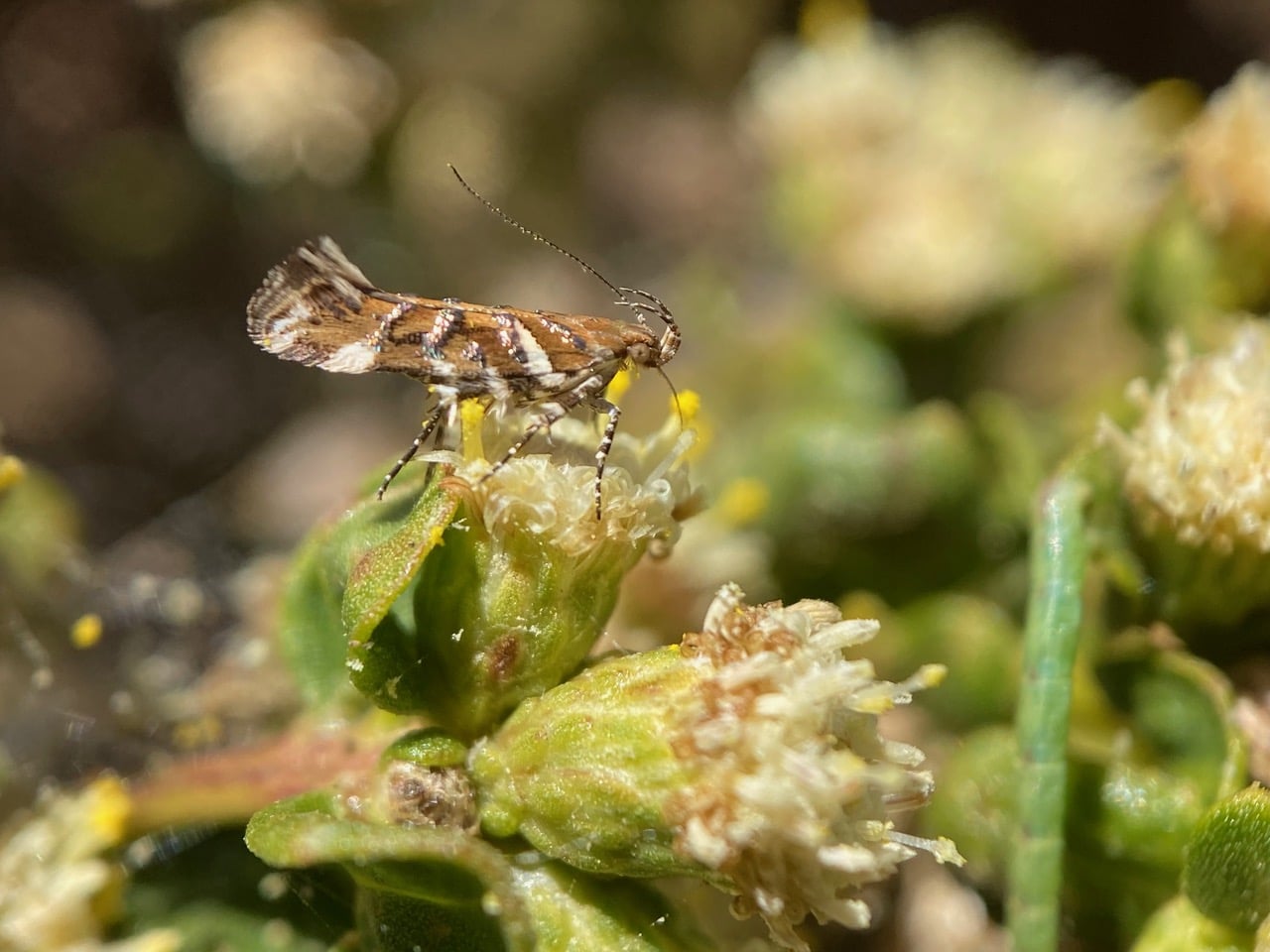
Twirler Moth, Aristotelia Argentifera (family Gelechiidae) on male Coyote Brush flowers. Photo taken on 8/24/25 at Bay Farm.
The Gelechiidae are a family of moths commonly referred to as Twirler Moths. The common name comes from their habit of spinning in circles on leaf surfaces. There are more than 40 named species of Aristotelia in America north of Mexico. These are generally very small moths with narrow, fringed wings. The moths have long labial palps (3 segments), up-curved, with third segment long and tapering. Hind tibia are covered with long hair-scales above, prominent tibial spurs. The larvae of most species feed internally on various parts of their host plants, sometimes causing galls. Many are leaf-miners, twig borers, etc. Being fecund plant-eaters, many species are agricultural pests. On the other hand, the voracious appetites of their larvae make Twirler Moths suitable for biological control of invasive plants.
Aristotelia argentifera is found in California and western Nevada. They are small moths, with forewing length of 5-7.5 mm. The specific epithet is Latin for “silver”, referring to the strongly metallic silvery and bluish iridescent scales on the wings. Known larval food plants include Coyote Brush, Baccharis pilularis, and California Goldenbush, Ericameria ericoides.

Photo taken of the moth on 9/4/25.
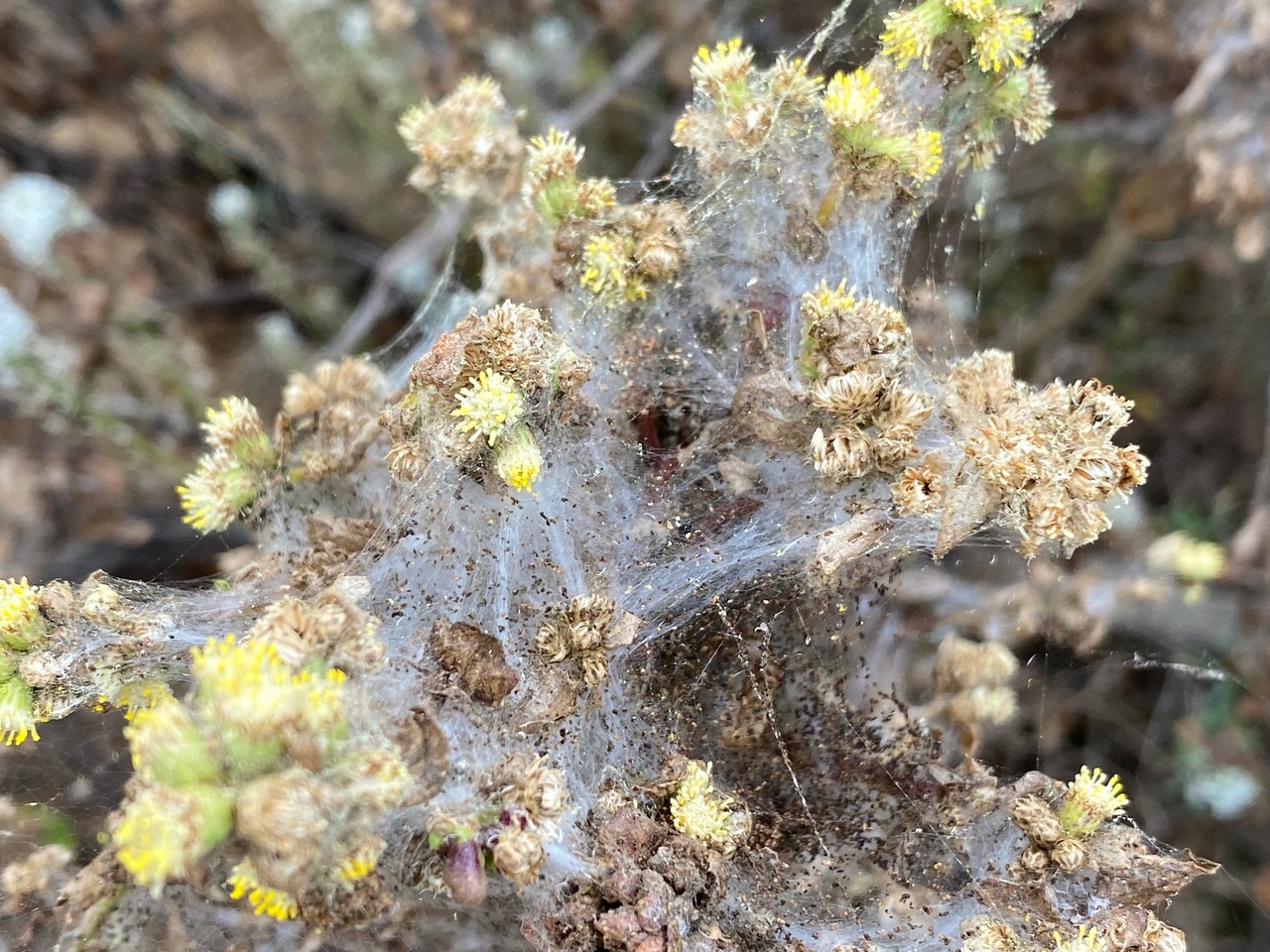
Photo taken of the Coyote Brush at the height of the caterpillar infestation, 9/4/25. This is what I have reported:
“The affected parts, dead or alive are shrouded in silk, and littered with frass (insect poop). Everything points to caterpillar activity; yet, for the life of me, I can’t find a single caterpillar.”

Although the Coyote Brush has survived, the new growths this year don’t look healthy. Many leaves are deformed, and littered with white specks.

The plant might be fighting for its life again!

Close-up of the white specks on the leaf of Coyote Brush. They look like cottony flakes of wax secreted by sap-sucking insects such as mealybugs, whiteflies, or scale insects.

Some Argentine Ants, Linepithema humile (family Formicidae) have gathered on the misshapen terminal leaves of the Coyote Brush, apparently foraging for honeydew. Honeydew is a sugary, sticky liquid excreted by sap-sucking insects like aphids, scales, and whiteflies as they feed on plant phloem. In heavy infestations, the honeydew can coat leaves, creating a shiny residue that can lead to black sooty mold growth. It is also a food source for ants and bees.
The Argentine Ant, Linepithema humile (family Formicidae) is native to Northern Argentina, but it has been inadvertently introduced by humans to many countries, and is now an established invasive species in many Mediterranean climate areas worldwide. The success of the species can be attributed to their lack of aggression between the colonies. There is no apparent antagonism between separate colonies of its own kind, resulting in “super-colonies” that extend across hundreds or thousands of kilometers in different parts of the their range. Genetic, behavioral, and chemical analyses show that introduced Argentine Ants on separate continents actually represent a single global supercolony.
The Argentine Ants are ranked among the world’s worst invasive animal species. In its introduced range, the Argentine ant often displaces most or all native ants and can threaten native invertebrates and even small vertebrates that are not accustomed to defending against the aggressive ants. This can, in turn, imperil other species in the ecosystem, such as native plants that depend on native ants for seed dispersal, or lizards that depend on native ants for food.
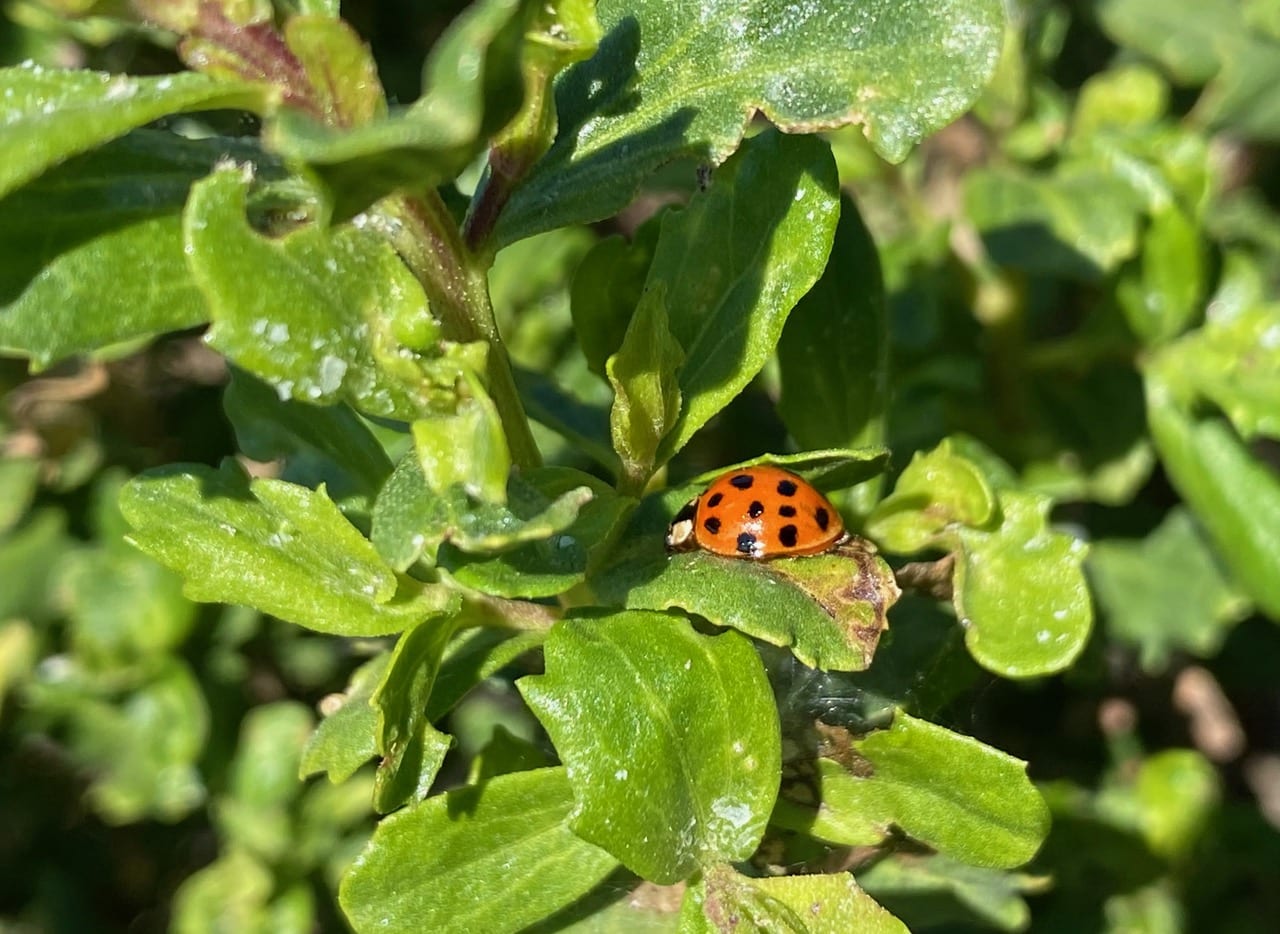
An Asian Lady Beetle, Harmonia axyridis (family Coccinellidae) is resting on the Coyote Brush, among foliage littered with flakes of cottony wax. Another sure sign that the plant is infested with aphids or other sap-sucking insects.
The beetle is a voracious predator of arthropod pests such as aphids, mites, thrips, scale and Lepidoptera eggs. Introduced from Asia for biological control of arthropod pests during the twentieth century, it has since become established all over the US. The adult beetles are highly variable in appearance, varying in color as well as the number and size of spots. It is believed that the Multicolored Asian Ladybeetles are aggressive competitors of native ladybeetles. This supposition remains to be proven scientifically. Adult beetles aggregate in high numbers to overwinter, favoring human dwellings. When threatened the beetle produces a yellow viscous, foul-smelling defensive compound, making themselves unwelcome house guests.

A male Oblique Streaktail, Allograpta obliqua (family Syrphidae) has landed on the Coyote Brush, seeking honeydew on the leaves. When floral nectar is in short supply, hover flies sometimes scavenge for honeydew excreted by sap-sucking insects such as aphids and scale insects.
Although small in size (6-7 mm long), the Oblique Streaktail is easily recognizable for the unique pattern on its black-and-yellow abdomen. It is a common North American species of hover fly. Adults visit flowers for nectar and pollen, and are pollinators. Females lay eggs on plant surfaces near aphids. Larvae feed on the aphids.

The hover fly slowly moves onto a damaged leaf, lapping up honeydew. What are those whitish egg-like things under its thorax? They appear evenly spaced, like proud medals displayed on a uniform.

I move in for an even closer look. Parasites? I have never seen anything like this – but then I’m not in the habit of peeking under a hover fly. The living world is full of surprises!

An elongate creature about 1 cm long is hanging motionless from the galled terminal leaves of the Coyote Brush. Its surface is roughly textured, reminiscent of a cotton towel. Is it a pupa of the gall maker? A Bagworm (family Psychidae)? iNaturalist has not been able to identify the creature.
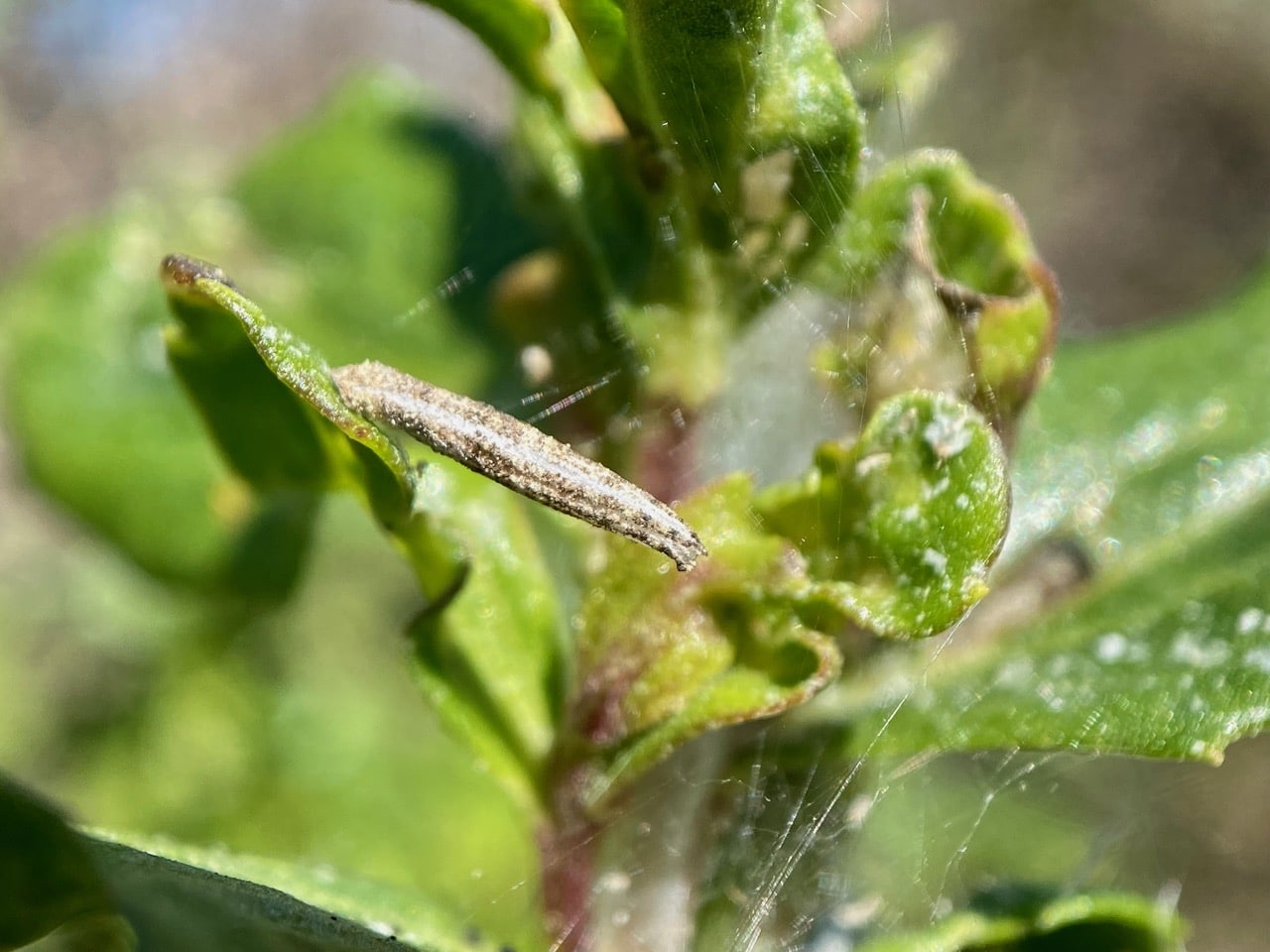
A similar creature is perched stiffly at an oblique angle from a Baccharis leaf. Nearby is a network of fine silk threads. Is the creature responsible for creating the silk web? I watch in amazement as an Argentine Ant crawls over the stationary creature. Like a piece of furniture, it doesn’t budge! Will someone please tell me what it is?