

Pollinator Post 3/7/25 (2)

It’s almost noon by the time I reach Diablo Bend. The Silverleaf Lupine, Lupinus albifrons is finally blooming. Despite the profusion of flowers, the place is surprisingly quiet. Occasionally a noisy Digger Bee, Anthophora sp. (family Apidae) would buzz by, but I don’t see much in terms of flower visitation. And where are the bumble bees?
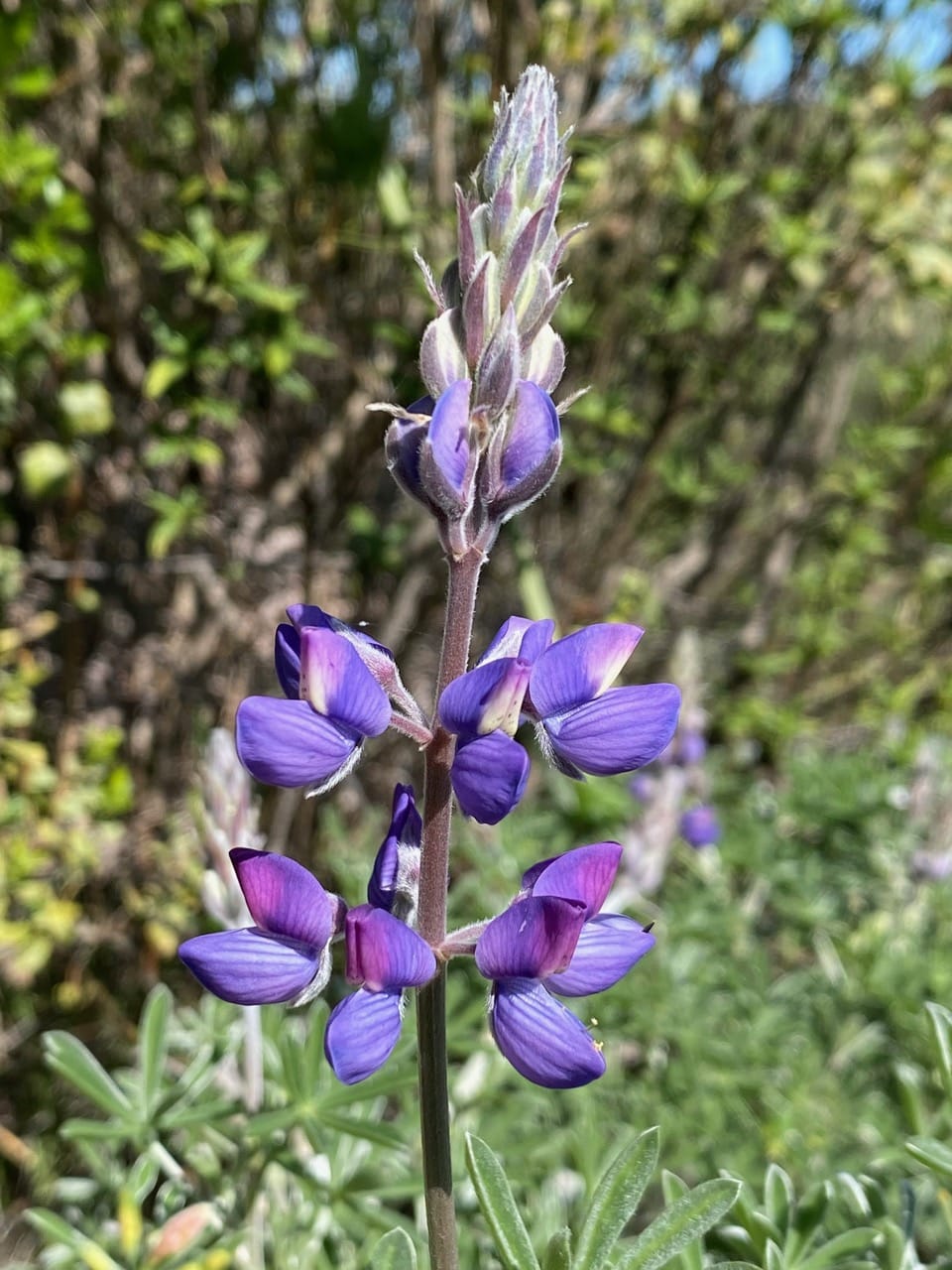
See those dark purple lines on the wing petals of the lupine flowers? They converge at the base of the flower where the nectary is located. The lines serve as “nectar guides” that direct the pollinators to the sweet reward. The bumble bee lands on the horizontal surface provided by the wing petals and aims its long tongue towards the back of the flower to access the nectar. On touch down, the bee’s heft lowers and spreads the wing petals apart, allowing the keel to spring up, exposing the reproductive structures within. The bee is forcefully dabbed with pollen on her belly and she grooms it into her pollen baskets while flying to the next flower. The pollination of lupine flowers is a well-orchestrated dance, benefiting both flower and bee.
The other thing of interest in this picture is the colors of the banners of the flowers – the top pair of petals that are held up vertically. Note that the banners on the lower flowers are a deep maroon-wine color, while the upper flowers have white banners. This is another way that lupine talks to the bees. When the flowers of Silverleaf Lupine, Lupinus albifrons first open, they have white banners (the upper, erect petals). After the flowers are pollinated, the banners turn reddish-purple when the levels of the anthocyanin pigment rises 3-5 time. The color change is a response to ethylene (a gaseous plant hormone) produced by the pistil (female part of the flower) after it has been pollinated and is no longer receptive. Bees’ eyes are sensitive to white, but are blind to red hues. Bumble Bees, who are the lupine’s principal pollinators use the color change to guide them to the fresh flowers with the biggest rewards. This arrangement benefits both the plant and pollinator, maximizing pollination efficiency.
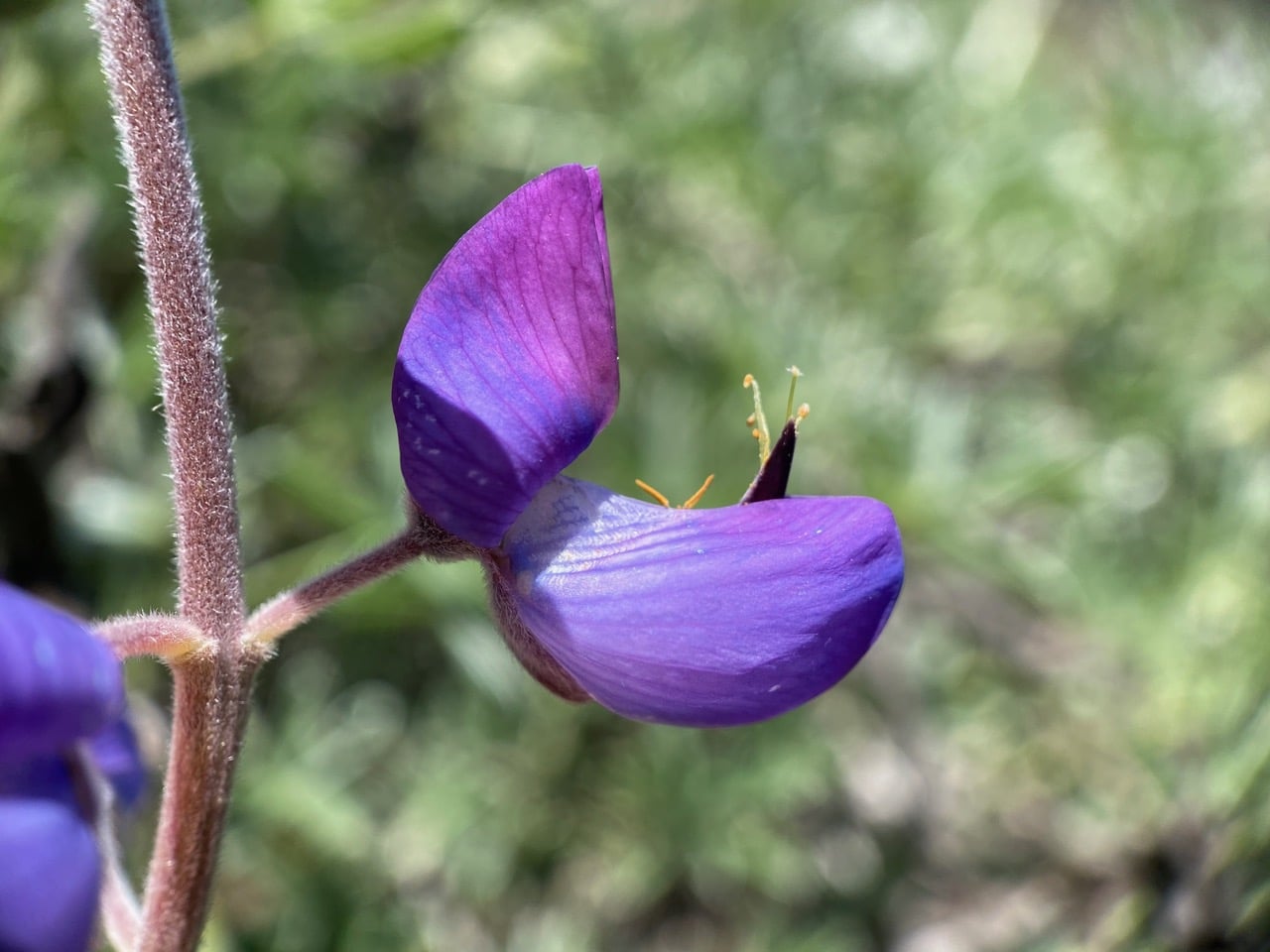
I look to the flowers for signs of pollination. Some of the lower, older flowers on the spikes have been tripped. Some heavy-bodied bee, either a Bumble Bee (Bombus, family Apidae) or a Digger Bee (Anthophora, family Apidae) must have landed on the horizontal surface provided by the pair of wing petals. The impact has caused the wing petals to be lowered to the sides, allowing the dark-tipped keel to spring up, exposing the reproductive structures hidden within.
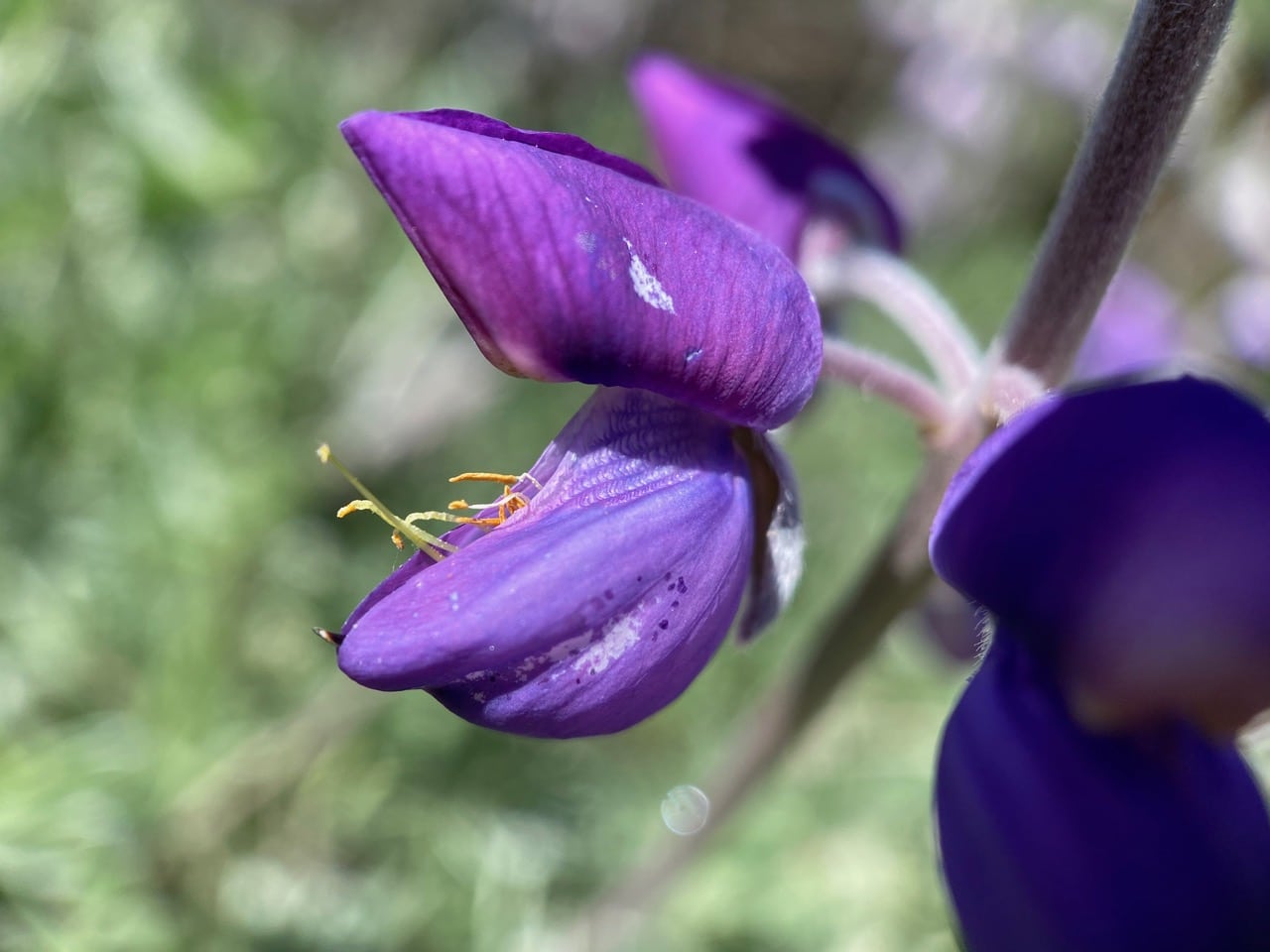
Ooh, this lupine flower has been scarred by a heavy pollinator, probably a queen bumble bee. The tripping process has been so vigorous that all the reproductive structures have been extruded. The longest structure exposed is the fuzzy-tipped style, the female part that is receptive to incoming pollen. The rest are the pollen-bearing stamens, the male parts. Pollination is instantly accomplished when the bee landed, with the stigma picking up pollen already on its belly from a previous flower visited, and the stamens forcefully dabbing the bee’s belly with pollen from this flower.

Hey, who’s that tiny insect on that lupine flower?
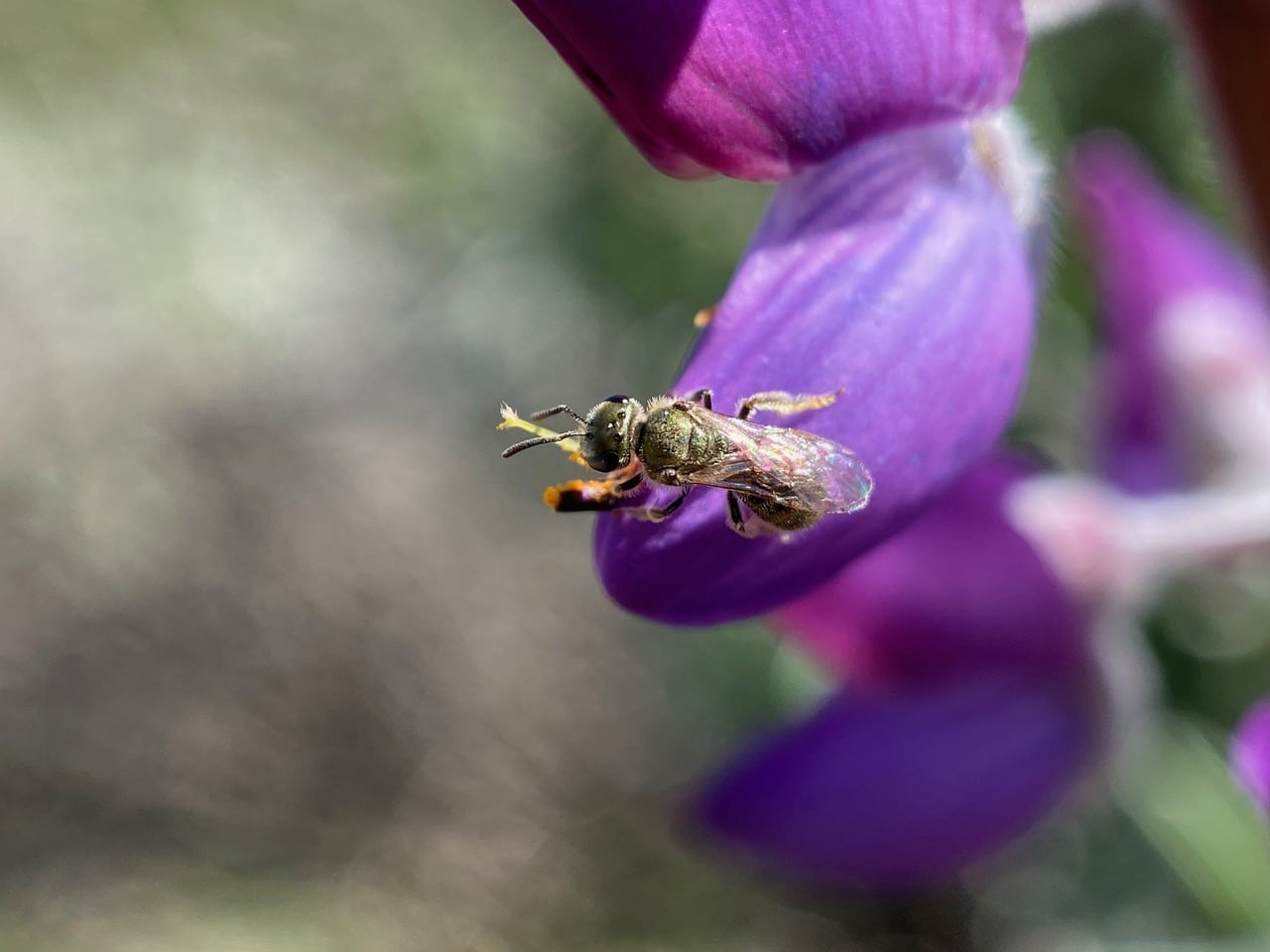
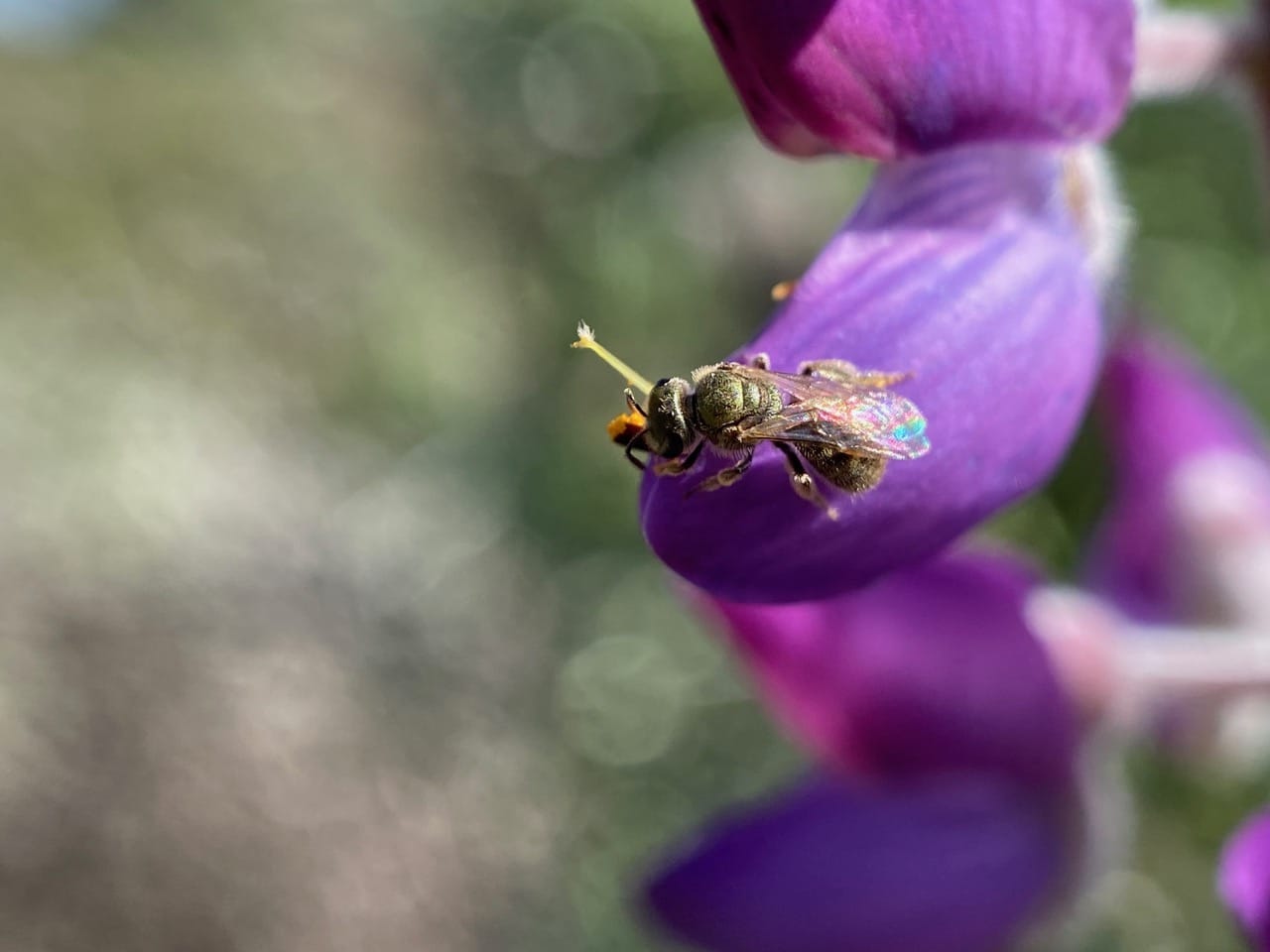

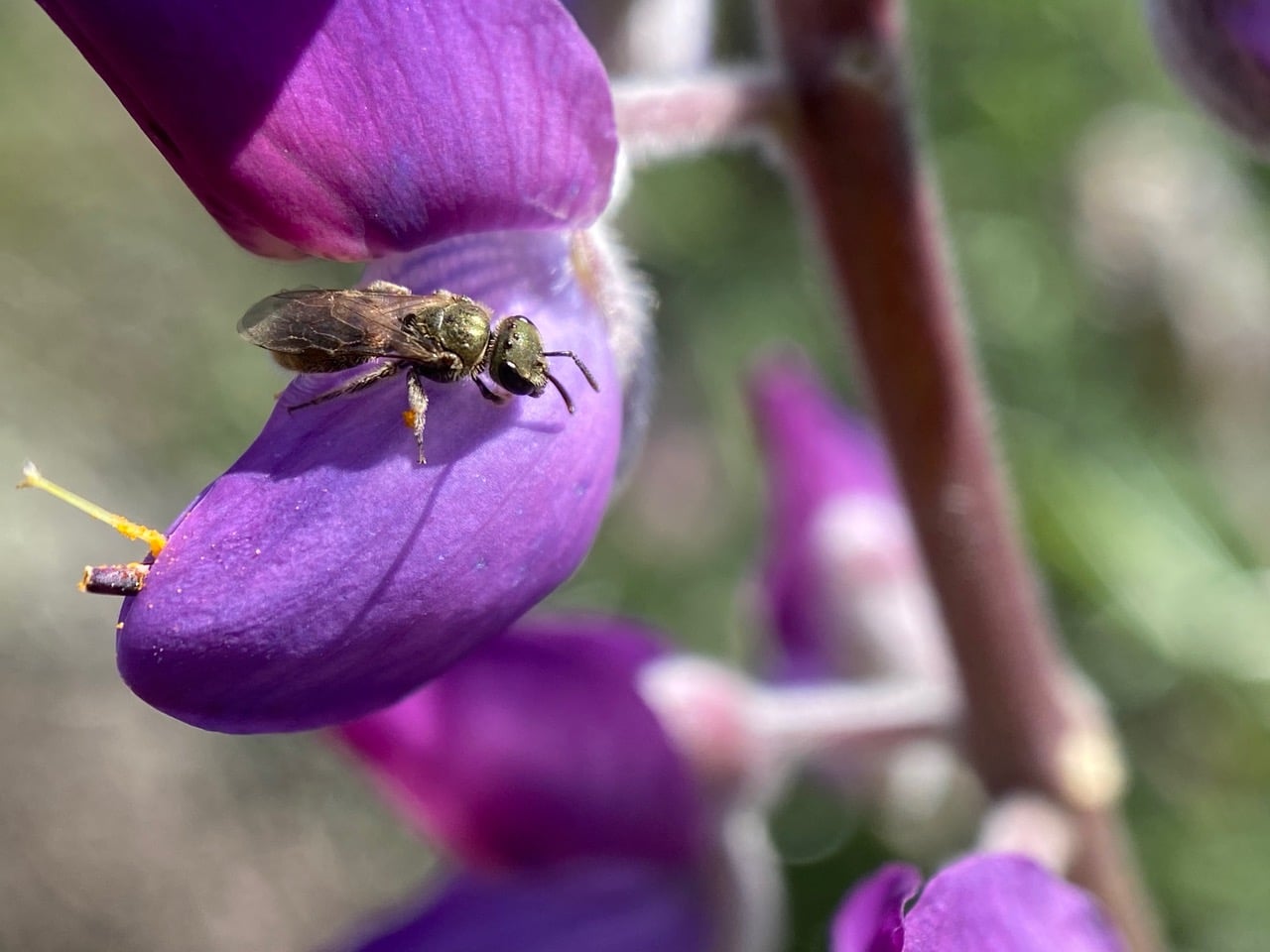
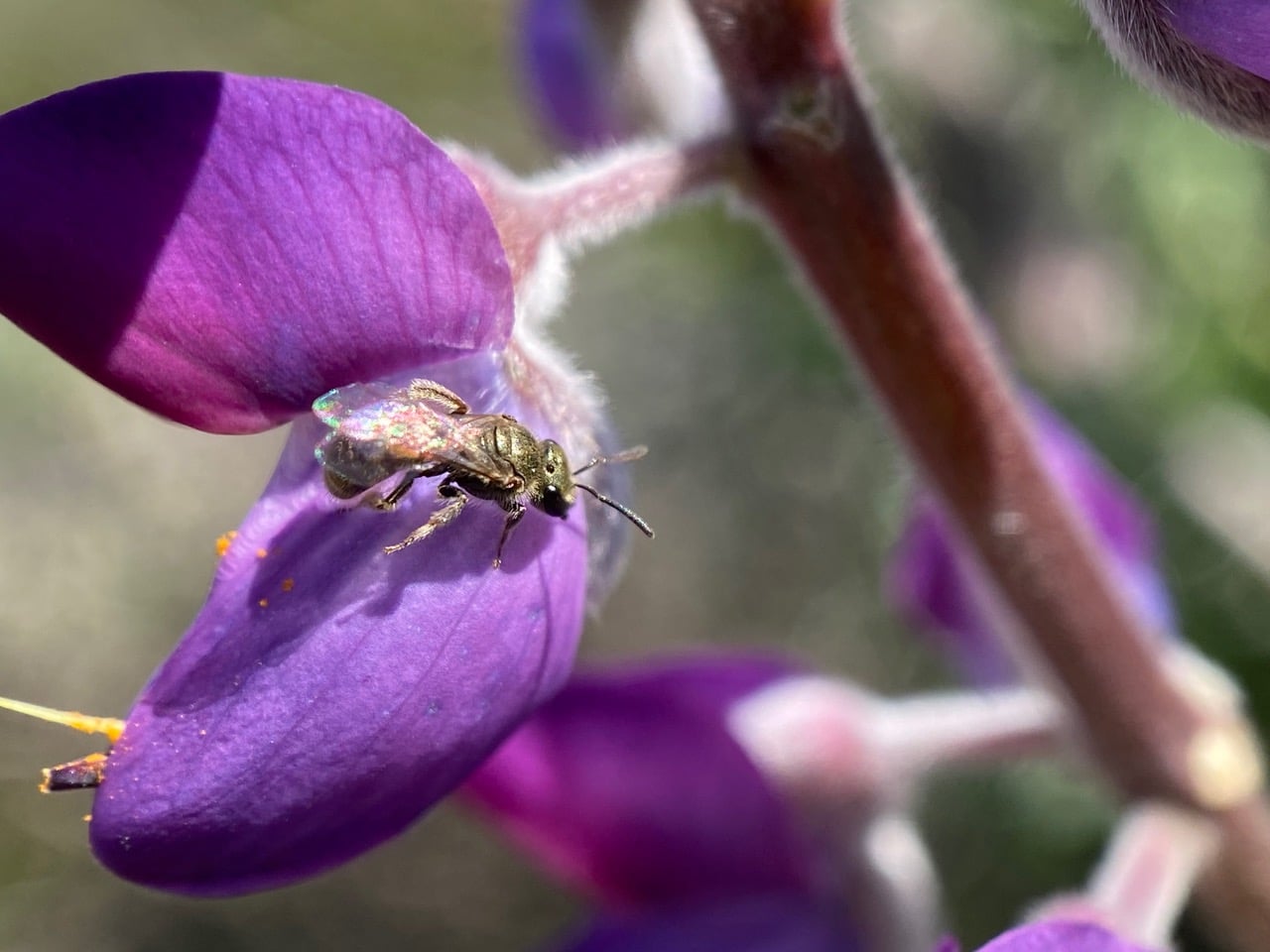

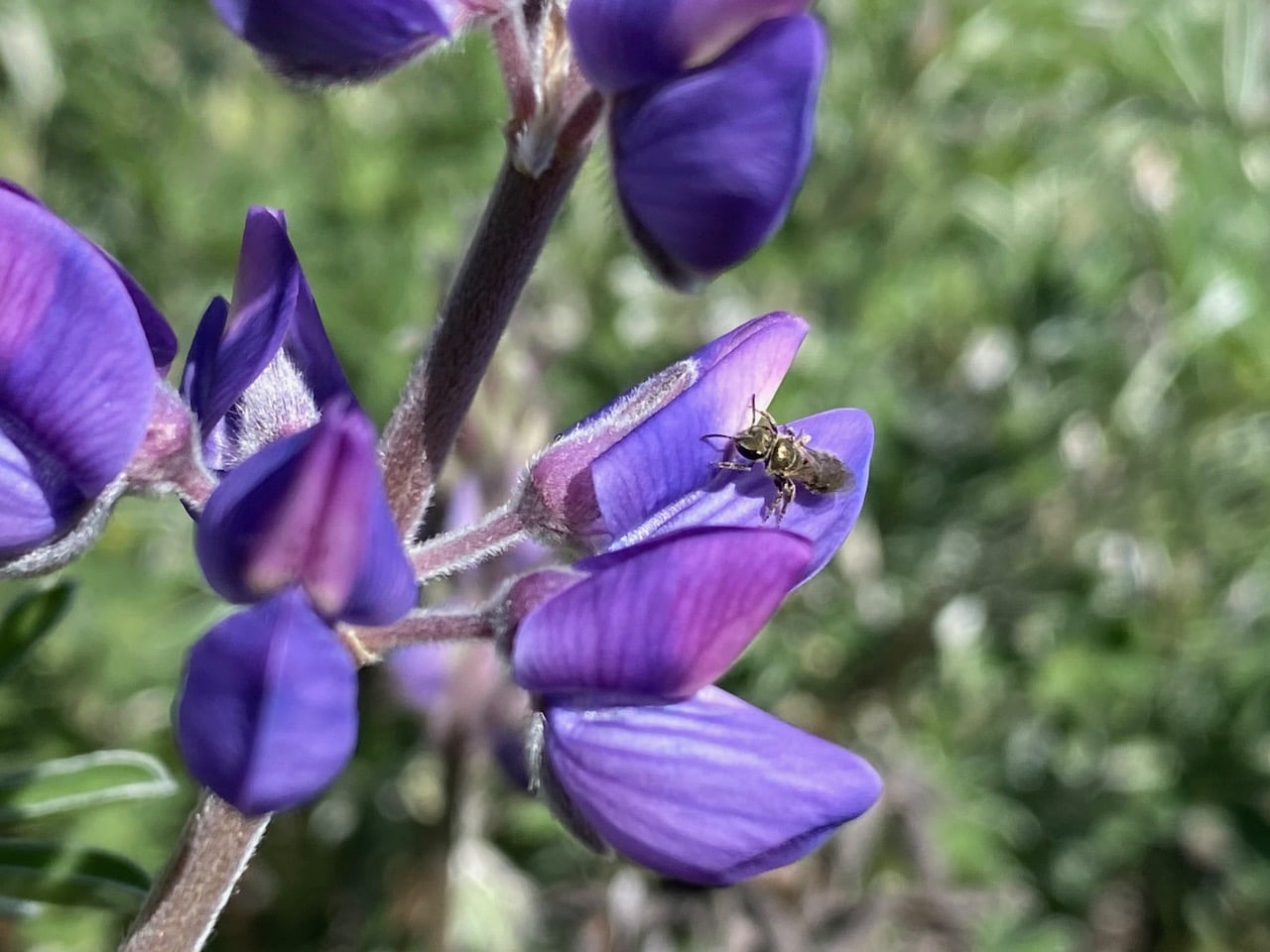
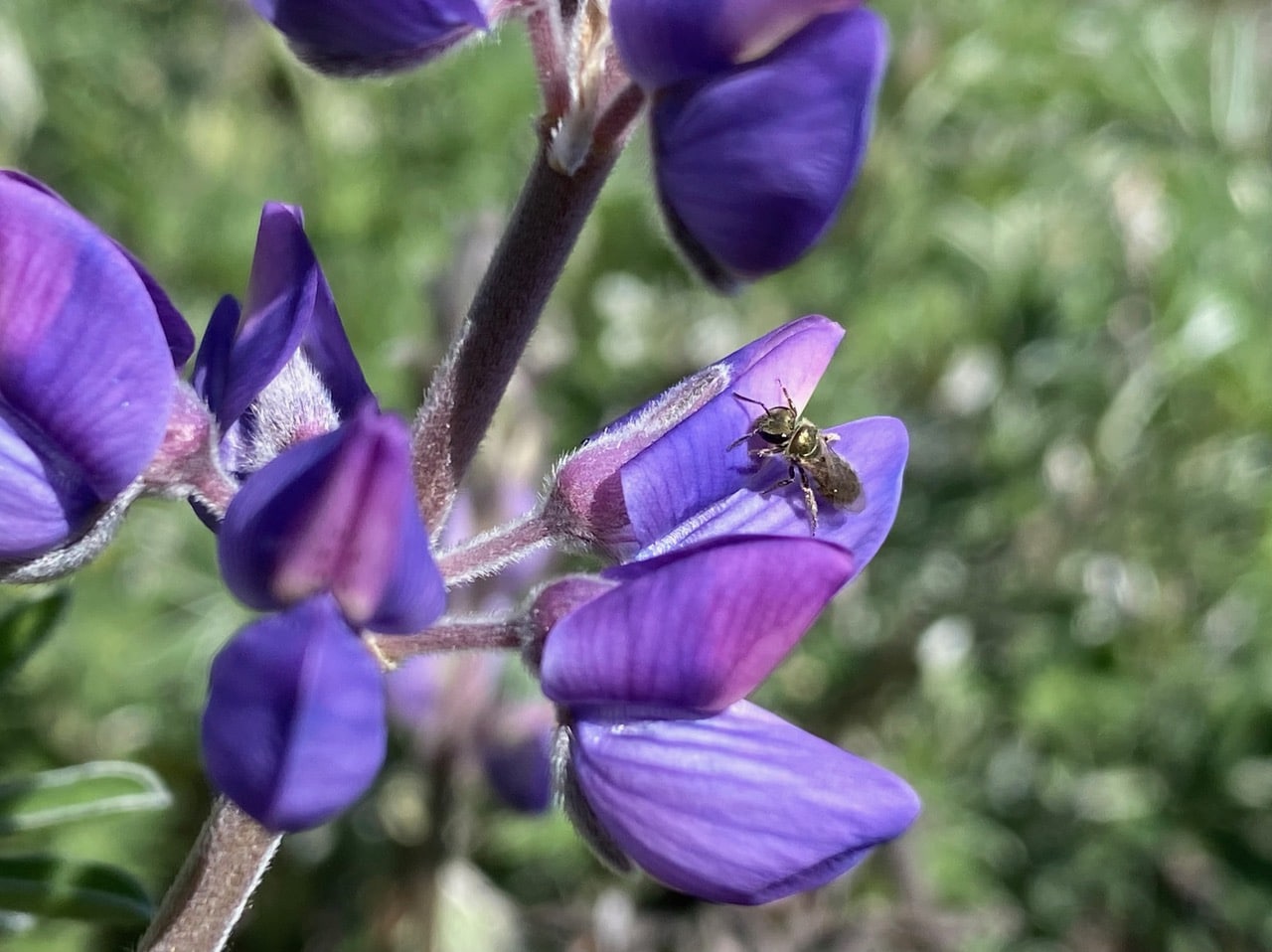
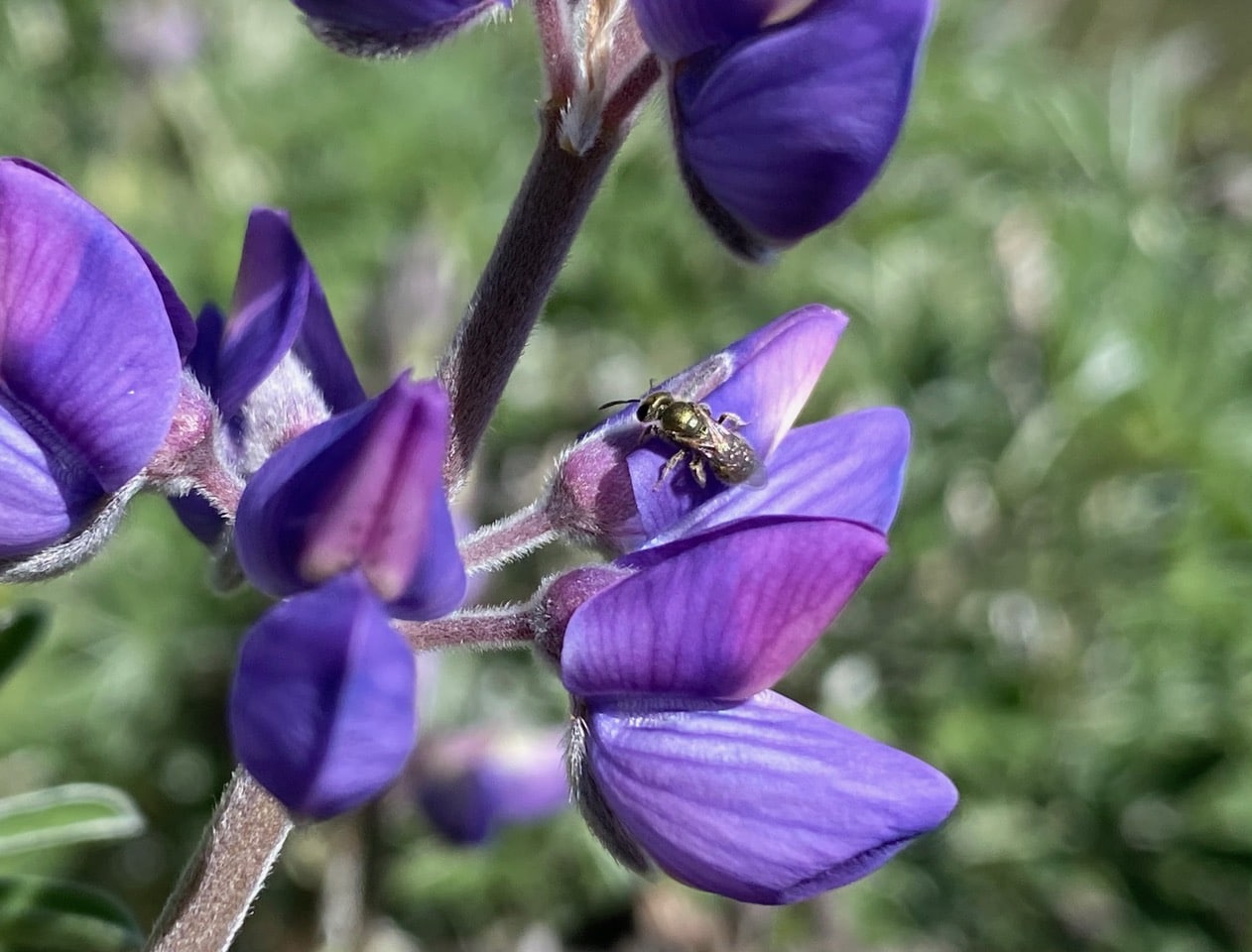


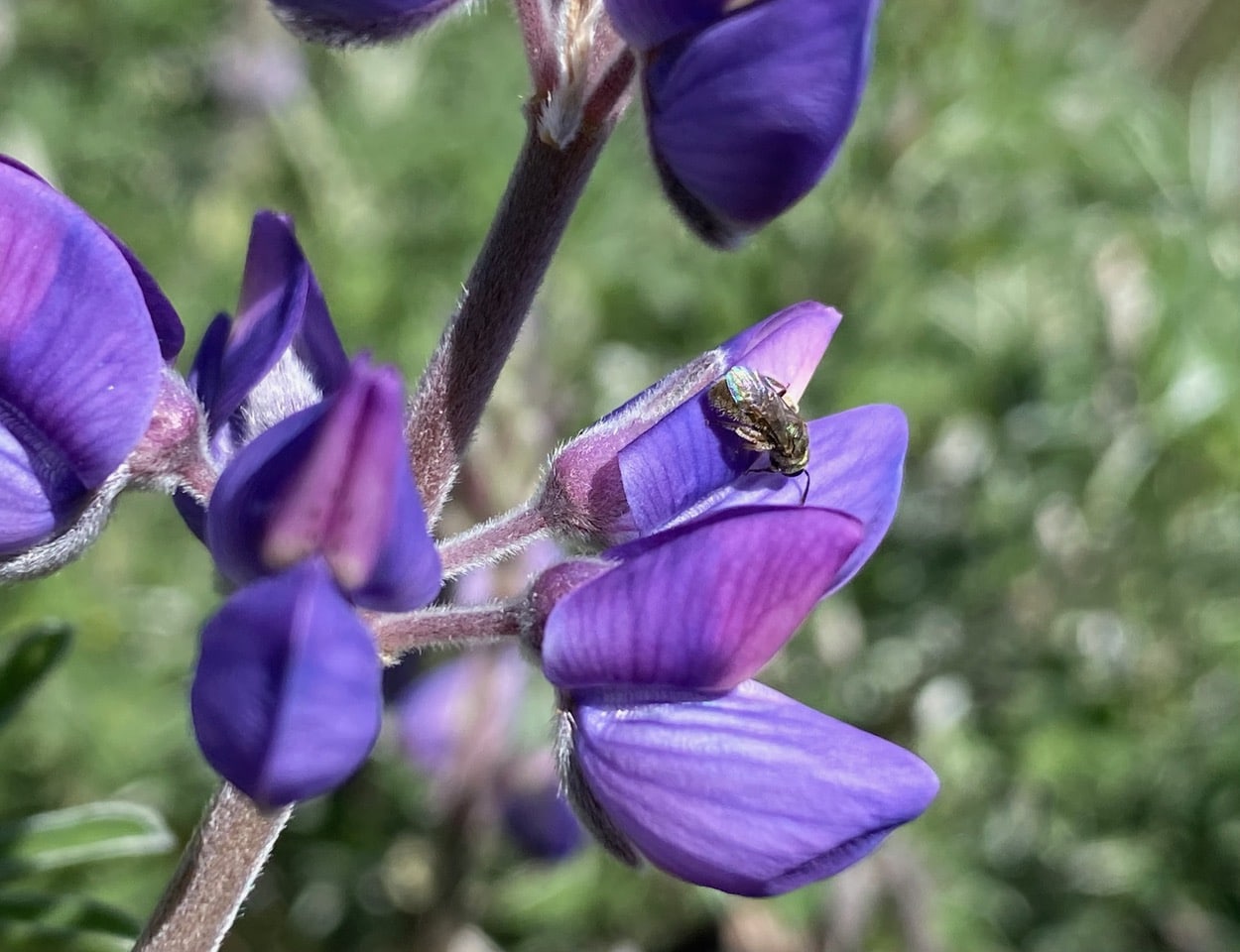


Closing in with the macro lens, I am delighted to find a Metallic Sweat Bee, Lasioglossum (Dialictus) sp.(family Halictidae).
Lasioglossum are closely related to the genera Halictus and Agapostemon. These genera are commonly called “sweat bees” because of their attraction to human sweat, which they drink for its salt content. Lasioglossum are dusky black to brown slender bees with bands of hair on their abdomen.
Dialictus is a subgenus of Sweat Bees belonging to the genus Lasioglossum. Most of the members of this subgenus have a subtly metallic appearance, and are small, about 3.4-8.1 mm in size. They are commonly found in Northern Hemisphere and are found in abundance in North America. As in the other members of the family Halictidae, the bees have very diverse forms of social structure, making them model organisms for studying the social behavior of bees.
Unable to trip the lupine flower, the little bee is hunched over scavenging the exposed pollen of the tripped flower. What a sneaky, clever behavior!
The bee goes on to check out the other exposed stamen.
Ah, we finally get to see the bee’s face. It doesn’t look like the bee has collected enough pollen to fill the scopae on her hind legs.
The bee lifts up its abdomen to grooms itself thoroughly before flying away.
This is what is left of the scavenged flower. The little bee has benefited from the labor of the larger bee that tripped the flower. Nothing in nature goes to waste.
A few minutes later, I spot another Metallic Sweat Bee on a lupine flower. It appears to be trying to figure out how to lift the banners (upper petals) of the flower to access the goodies hidden underneath. The bee might have been cued by the nectar guides on the flower as to where the nectary is located. Or maybe there are olfactory or other signals we are not privy to?
After exploring all avenues, the little bee finally gives up and flies away. Alas, lupine flowers reserve their nectar rewards only for those bees capable of tripping the flowers and transferring the pollen.
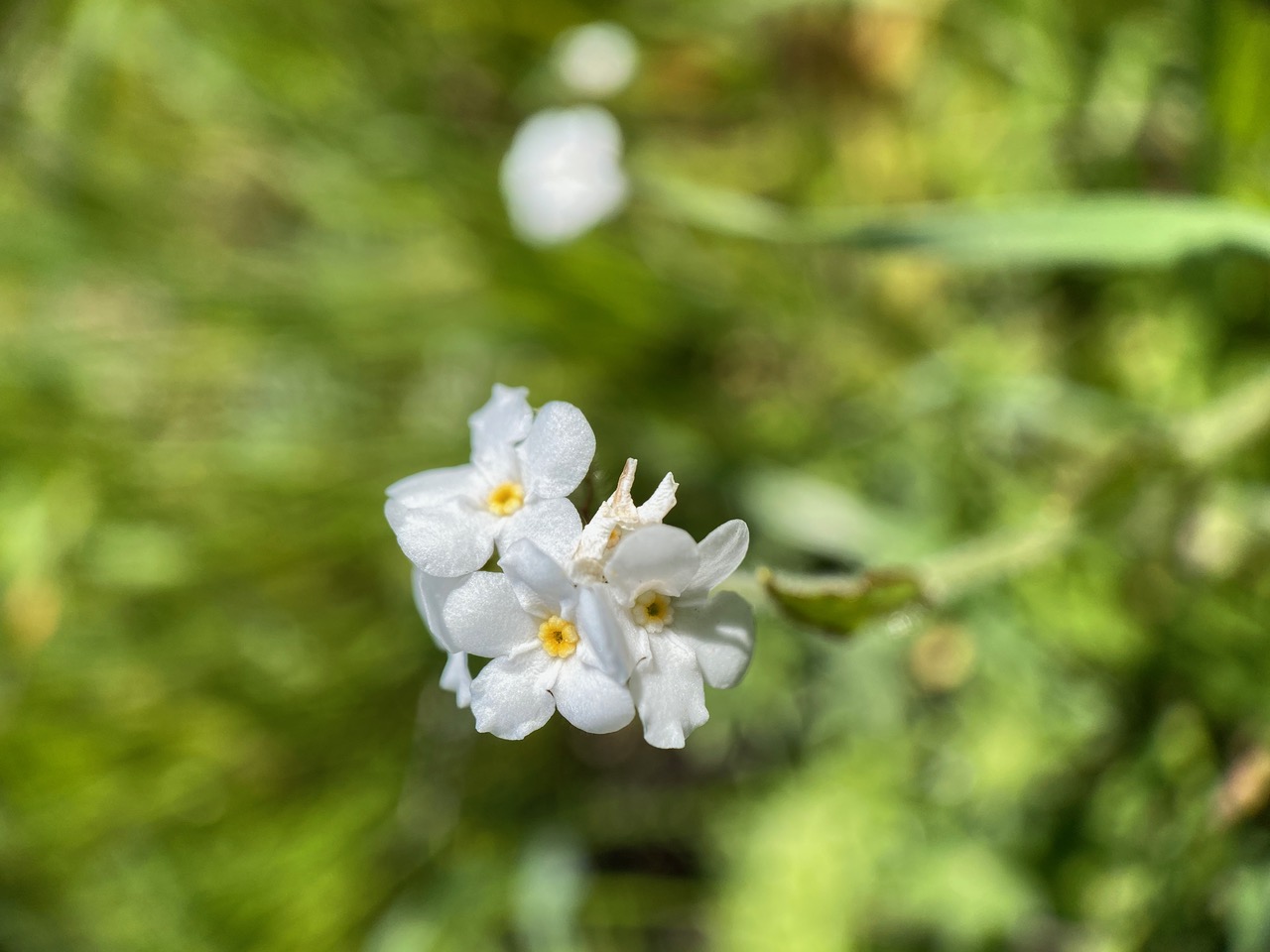
The Rusty Popcornflowers, Plagiobothrys nothofulvus are blooming on the grassy hillside under the lupines.
A Popcornflower in the genus Plagiobothrys (family Boraginaceae) has tiny, white, 5-petaled flowers on a coiled inflorescence that elongates as the fruit develops. Each flower is typically small, 2-4 mm wide, with a fused calyx at the base, and contains both male and female reproductive parts in the tubular portion of the corolla. Since the male and female structures are in close proximity, how does the flower avoid self- pollination? By dichogamy – the male and female reproductive parts maturing at different times. Popcornflowers are protogynous, meaning the female parts mature early and are no longer receptive by the time the male parts start to release pollen. The fruits are small nutlets that are often covered in hairs.
The fleshy yellow ring in the middle of the Popcornflower, sometimes referred to as the “crown”, is a nectar guide that attracts pollinators. After the flower is pollinated, the ring fades to a creamy white color, signaling to insects that there’s no more nectar.
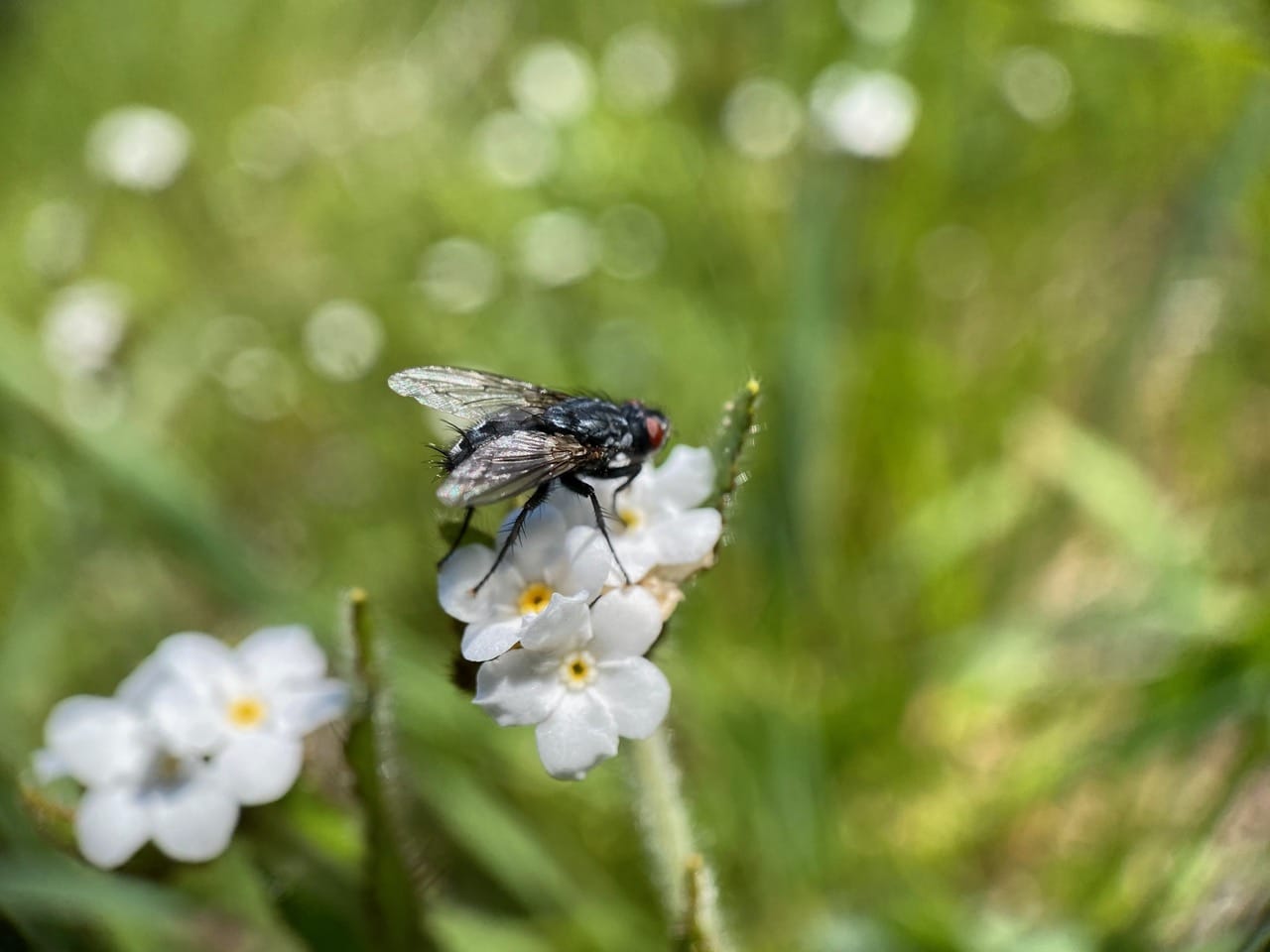
A fly lands on an inflorescence of popcornflowers.
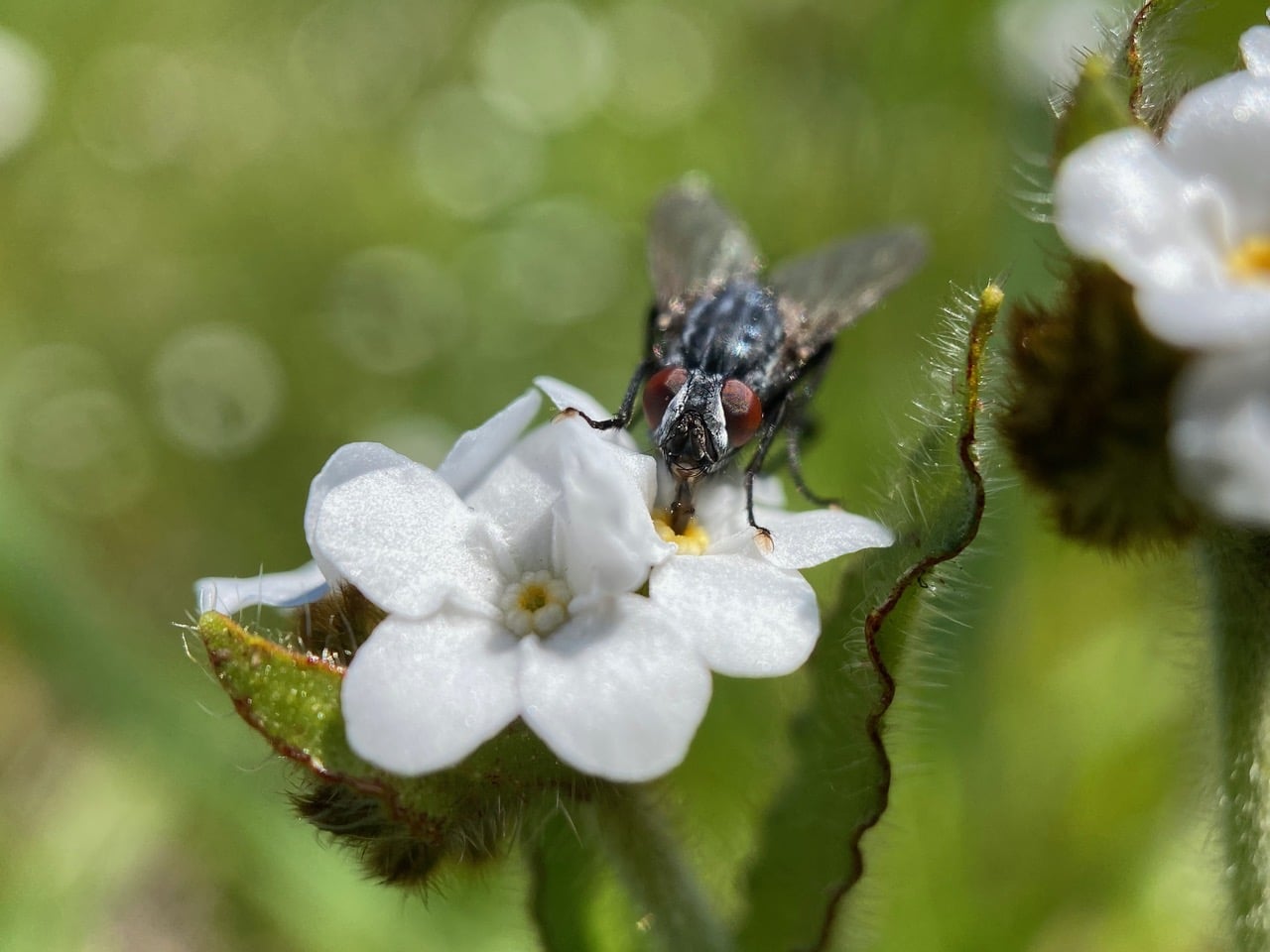
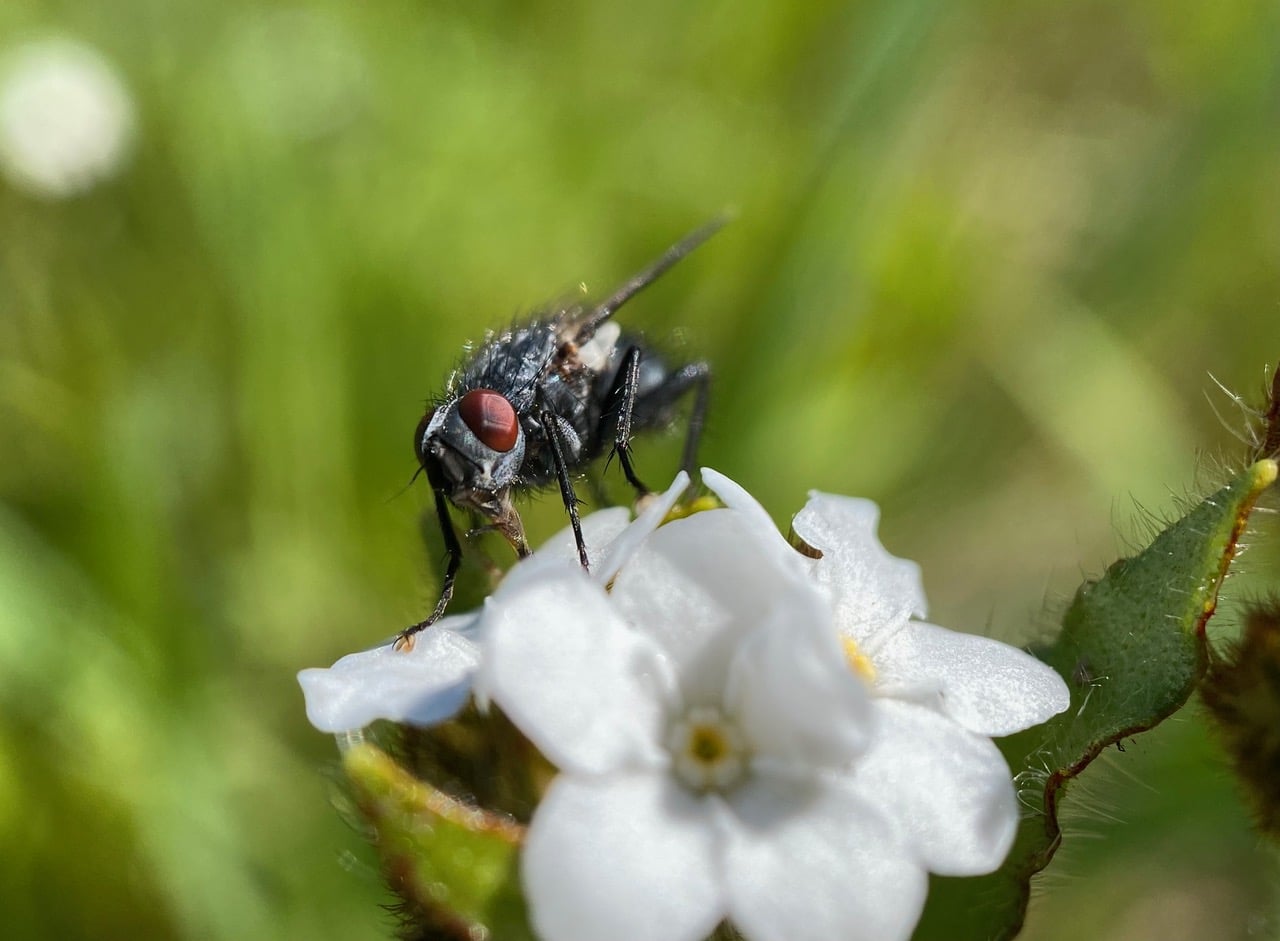
It immediately heads for a popcornflower with yellow crown and extends its proboscis through the hole. I am surprised to see that it has sponging mouthparts. I have previously seen Dance Flies (Hybotidae) and Bee Flies (Bombyliidae) take nectar from these tiny flowers with their elegant, long, sucking proboscis. iNaturalist has suggested that the fly is in the genus Muscina (family Muscidae).
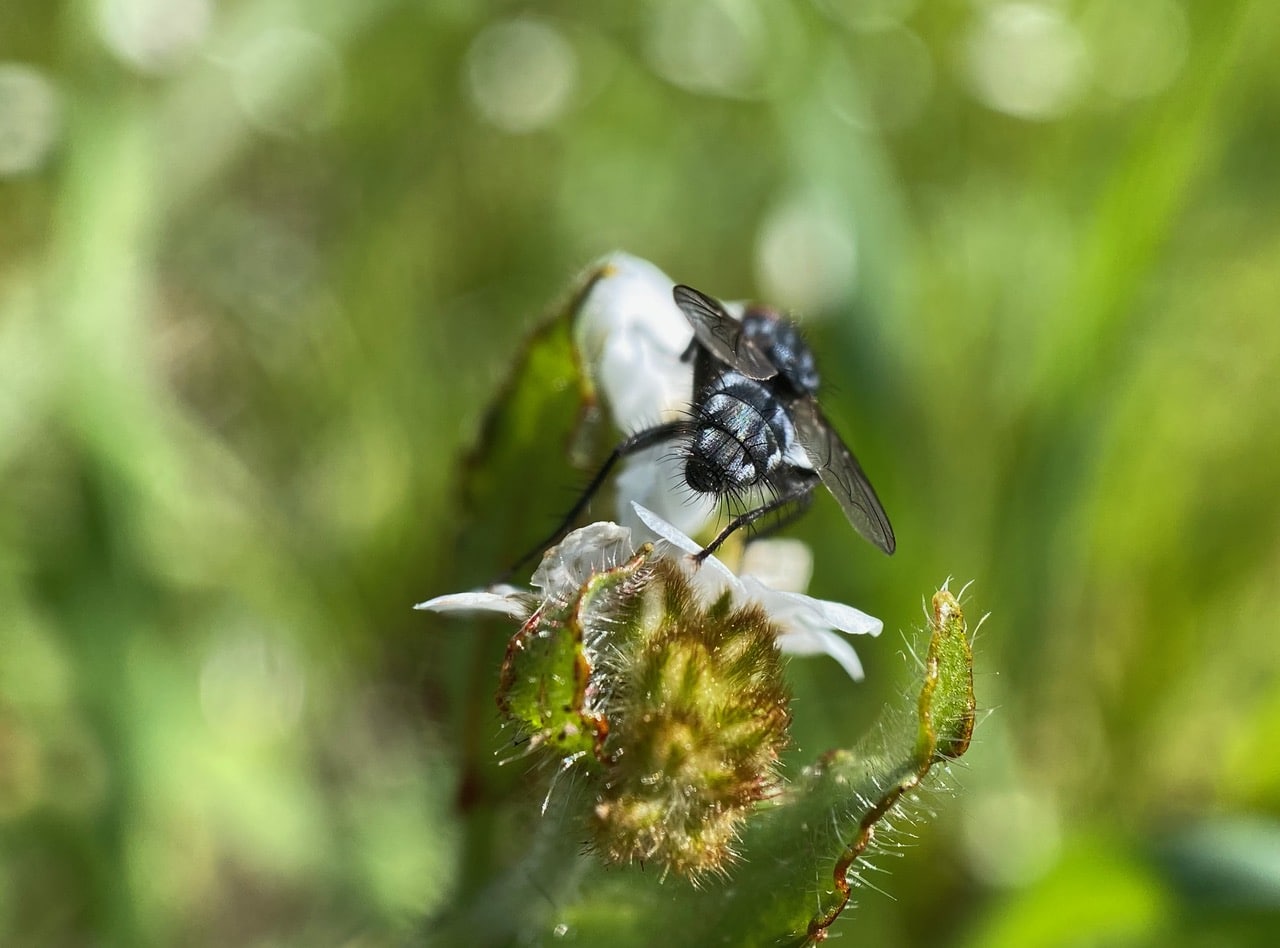
Muscina is a genus of flies that includes the false stable fly. They are a member of the Muscidae family which also includes house flies. The flies are attracted to plant juices, rotting fruits, and honeydew. Larvae develop in decaying organic matter such as carrion, dung, and garbage. Their occurrence on dead bodies has led to their use in forensic investigations for determining time of death.
Sponging mouthparts facilitate absorption of food in liquid form. Not all Dipterans have sponging mouthparts. Many predatory flies have stabbing-sucking mouthparts.
Off to another flower! Note the bristly nature of the Popcornflower leaf and flower buds.
A young Western Fence Lizard, Sceloporus occidentalis eyes me suspiciously from its hidey-hole in the trail bank. The sight of the lizard has always given me comfort. Thanks to these reptiles, my chances of catching Lyme disease from a tick bite is much reduced – so I have been taught.
A study done by UC Berkeley entomologist Robert Lane in 1998 found that a protein in the lizard’s blood kills the bacteria that causes Lyme disease. When a tick infected with this bacterium feeds on a Western Fence Lizard, this protein kills the bacterium inside the tick’s gut, after which the tick can no longer spread the disease. However, a later study conducted by graduate students at UC Berkeley showed that the relationship between ticks and these lizards is much more complex than initially assumed. In 2020 researchers removed a number of Western Fence Lizards from two areas in Marin County with the hypothesis that this reduction in the lizard population would increase the prevalence of infected ticks. Surprisingly, their findings showed that the decrease in lizard numbers actually had the impact of decreasing tick populations as not all ticks were able to find another suitable host. These conflicting findings remind us that there is still much we have to learn about the complexities of our ecosystems, and the delicate balance that each species helps maintain.