

Pollinator Post 3/7/25 (1)

I visit Skyline Garden in the Berkeley hills this morning, walking the stretch of the Skyline Trail south of Siesta Gate.
A tiny fly, no more than 3 mm long, is resting on a tender terminal leaf of a Bee Plant, Scrophularia californica. Its size, together with the little blunt extension at the tip of its abdomen tells me that it is probably a female Leaf-miner Fly (family Agromyzidae).
The Agromyzidae are a family commonly referred to as the Leaf-miner Flies, for the feeding habits of their larvae, most of which are leaf miners on various plants. They are small flies, most species in the range of 2-3 mm. Females have an oviscape, a non-retractable structure at the tip of their abdomen that protects the telescopic ovipositor when it is not in use. Agromyzidae larvae are phytophagous, feeding as leaf miners, less frequently as stem miners or stem borers. A few live on developing seeds, or produce galls. There is a high degree of host specificity. A number of species attack plants of agricultural or ornamental value, so are considered pests. The shape of the mine is often characteristic of the species and therefore useful for identification. Adults occur in a variety of habitats, depending on the larval host plants.

Just inches below on the same plant, a Convergent Lady Beetle, Hippodamia convergens (family Coccinellidae) is enjoying the morning sun. This individual must have recently dispersed from its overwintering aggregation somewhere close by, prompted by the rising temperatures. We’ll be seeing more of this iconic native lady beetle in the coming days. The species is easily recognized by the two “converging” white lines on its black pronotum. The red elytra are usually spotted, but spotless individuals are often seen. Lady beetles, both adults and larvae, are voracious predators of aphids and other soft-bodied insects.

Hey, there are numerous young caterpillars of the Variable Checkerspot butterfly resting on the leaves of the Bee Plant, Scrophularia californica. I am impressed that they have managed to gather with their kind. These young caterpillars (third or fourth instars) have been in diapause (insect version of hibernation), overwintering in sheltered spots on the ground in a sort of interrupted childhood. The warming temperatures have woken them up and prompted them to feed and continue with their development. An instar is a phase between two periods of molting in the development of an insect larva. The first instar is the larva that hatches from an egg.
The Variable Checkerspot, Euphydryas chalcedona (family Nymphalidae) is found across western North America. The butterfly occupies a wide range of habitats, including sagebrush flats, desert hills, prairies, open forests and alpine tundra. Males perch or patrol around larval host plants to encounter females. Eggs are laid in large groups on underside of leaves of host plants. Host plants include California Bee Plant, Scrophularia californica, and Sticky Monkeyflower, Diplacus aurantiacus. These plants provide the caterpillars with iridoid glycoside, a chemical that imparts unpalatable taste to birds, protecting the caterpillars from predators. Larvae feed in large, loose groups on the host plants. Individuals overwinter (enter diapause or hibernation) as third or fourth instar larvae in sheltered sites under bark or dead branches, in hollow stems and in rock crevices. Pupation begins in early to mid April and the adult flight season begins between mid-April and May and continues into June. The adults feed exclusively on nectar, and have a life span of about 15 days.
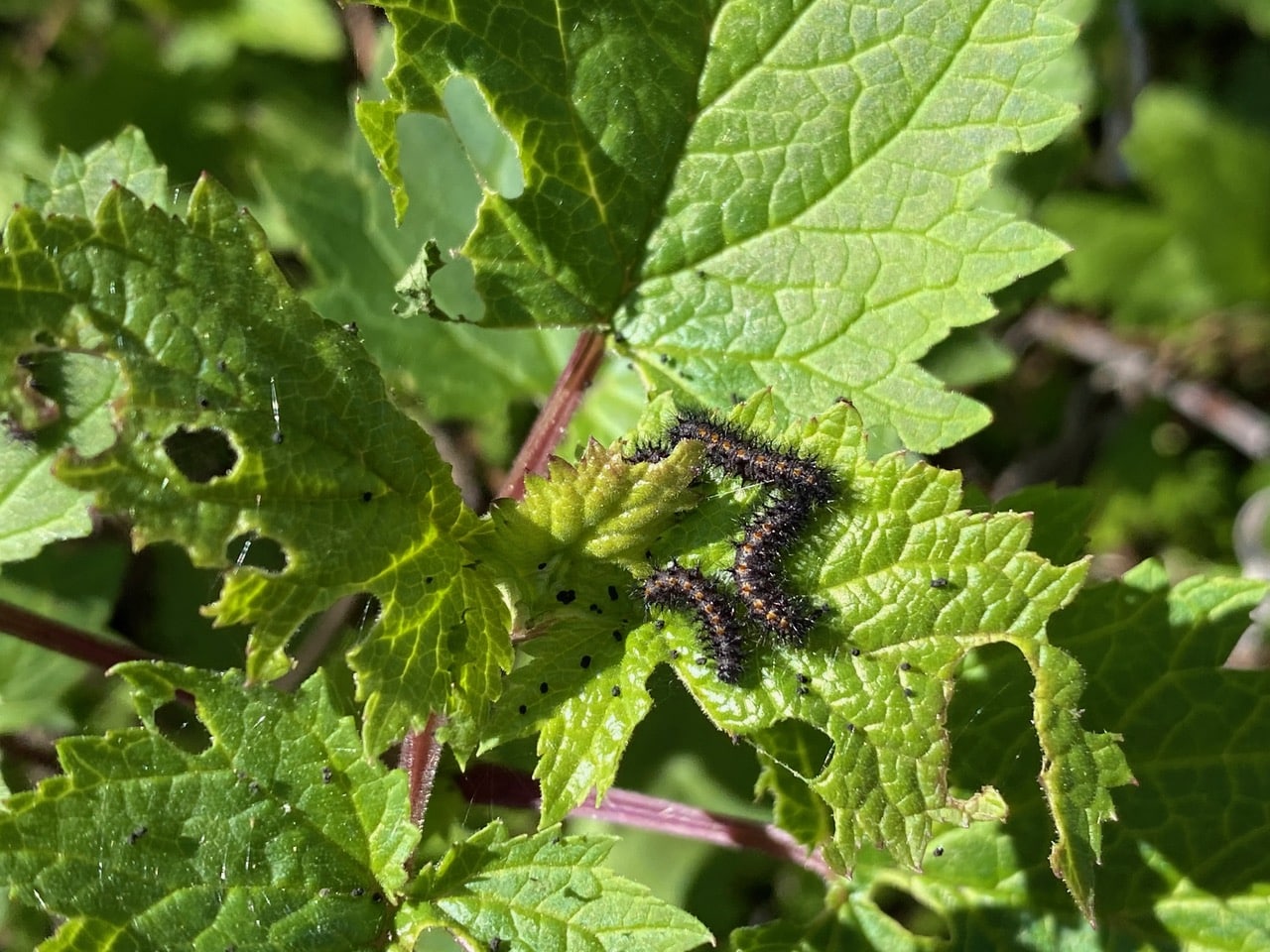
Wow, these leaves have been shredded by the caterpillars! Note the tiny pellets of frass (insect poop) that they have left on the leaves.
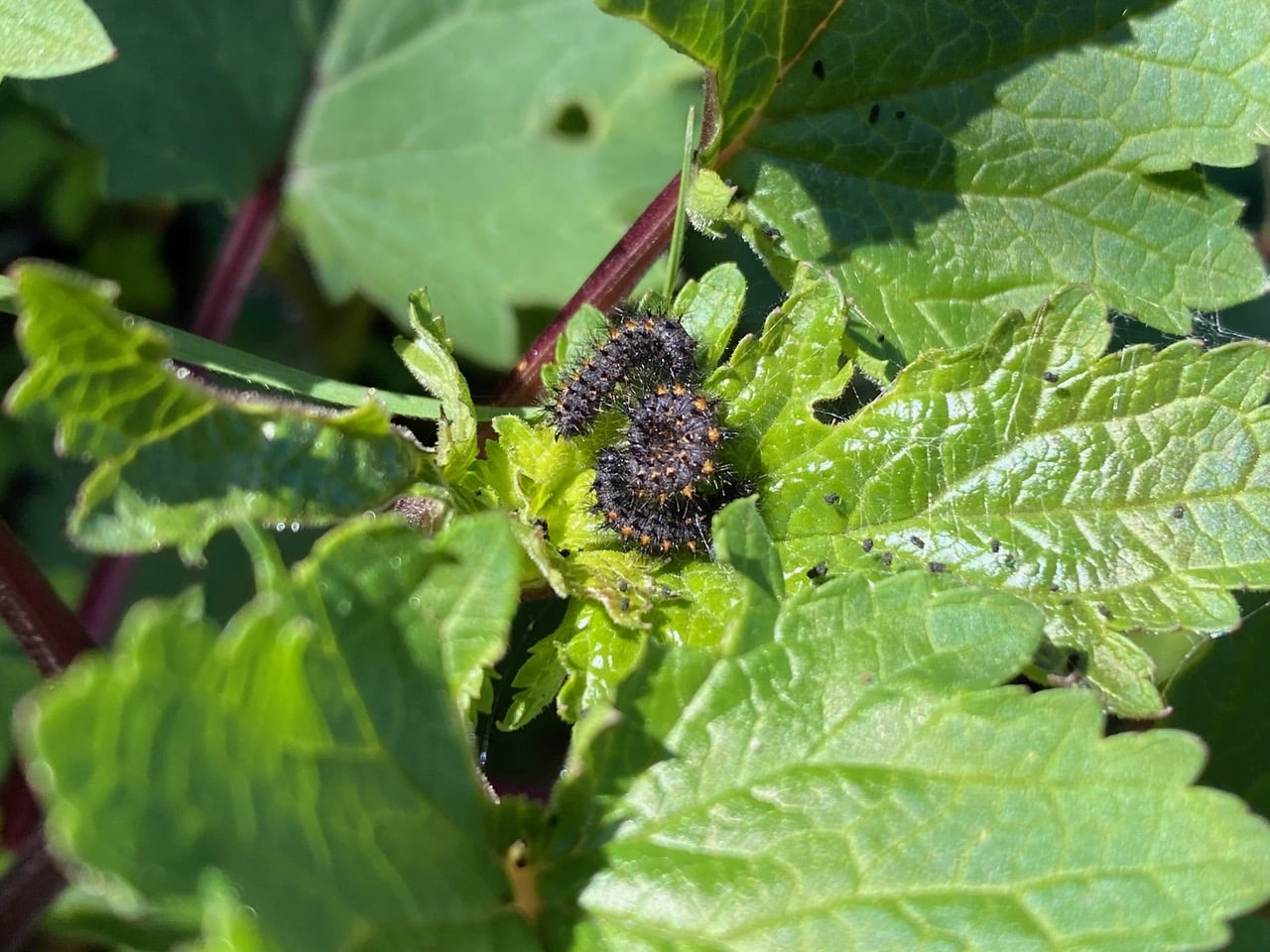
Note the silk strands woven over the leaf to the right. Many caterpillars have a habit of securing themselves to their host plant with silk as they feed, or when they molt.
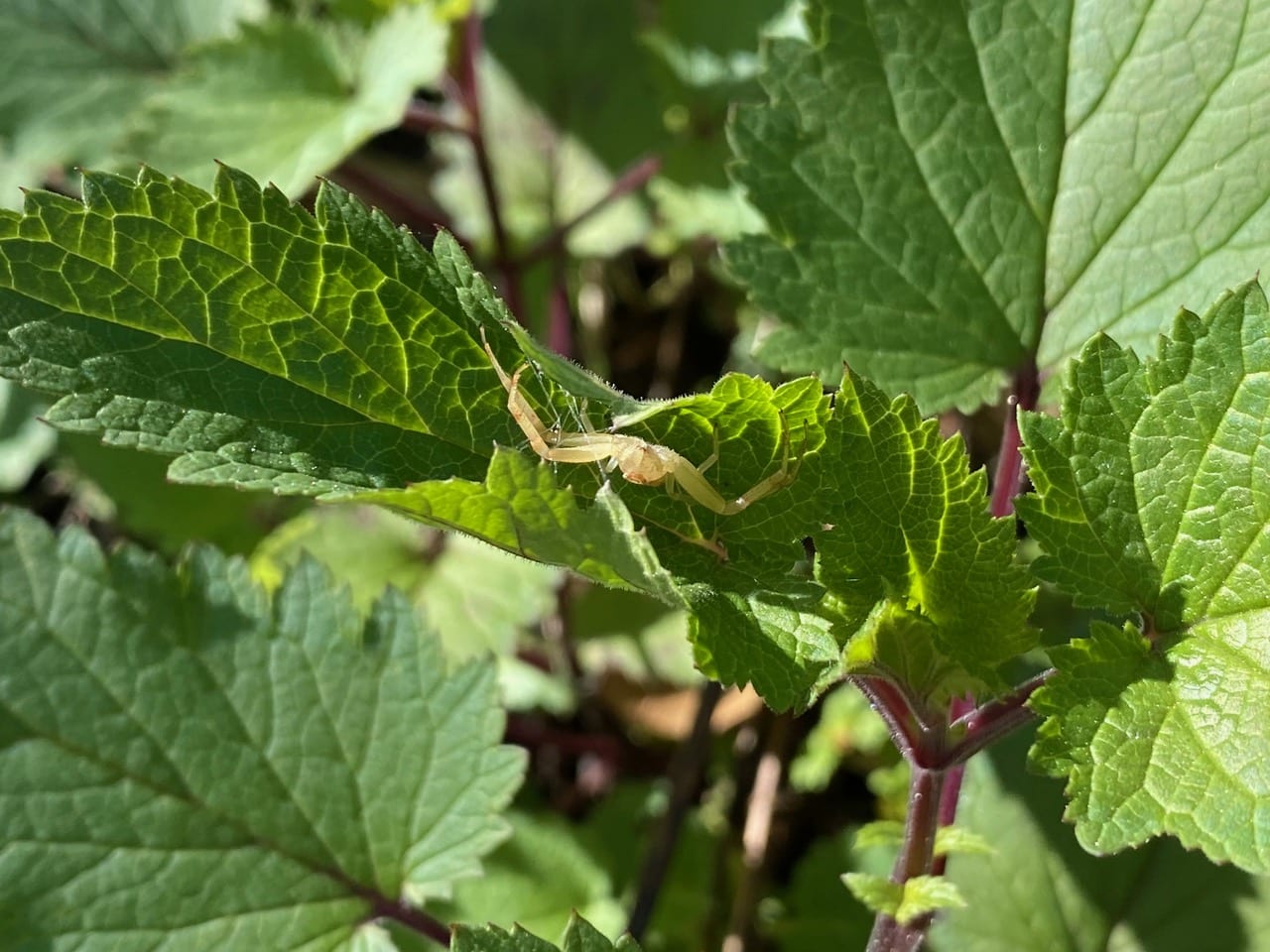
Look, there’s a Crab Spider (family Thomisidae) watching me upside down from that Bee Plant leaf! Did the spider partially fold the leaf with silk? Is that its retreat?
Members of the family Thomisidae do not spin webs, and are ambush predators. The two front legs are usually long and more robust than the rest of the legs. Their common name derives from their ability to move sideways or backwards like crabs. Most Crab Spiders sit on or beside flowers, where they grab visiting insects. Some species are able to change color over a period of some days, to match the flower on which they are sitting. While crab spiders do not build webs, they do use silk to construct retreats and wrap their eggs.

Sensing my approach, the Crab Spider rushes forward and quickly assumes an aggressive pose. Note its long and robust front legs. Crab spiders can also be identified by the arrangement of their eyes – crab spiders have eight eyes arranged in two row, forming a rectangle. The eyes on the edges of their cephalothorax are often raised on bumps so they can see in all directions.

The female Osoberry along the trail has more mature flowers now. As the clusters are naturally droopy, I have to lift the branches to look inside the flowers. Note that there are only vestigial stamens that do not produce pollen. The pistil consists of five styles that converge in the middle, sometime twisting around each other.
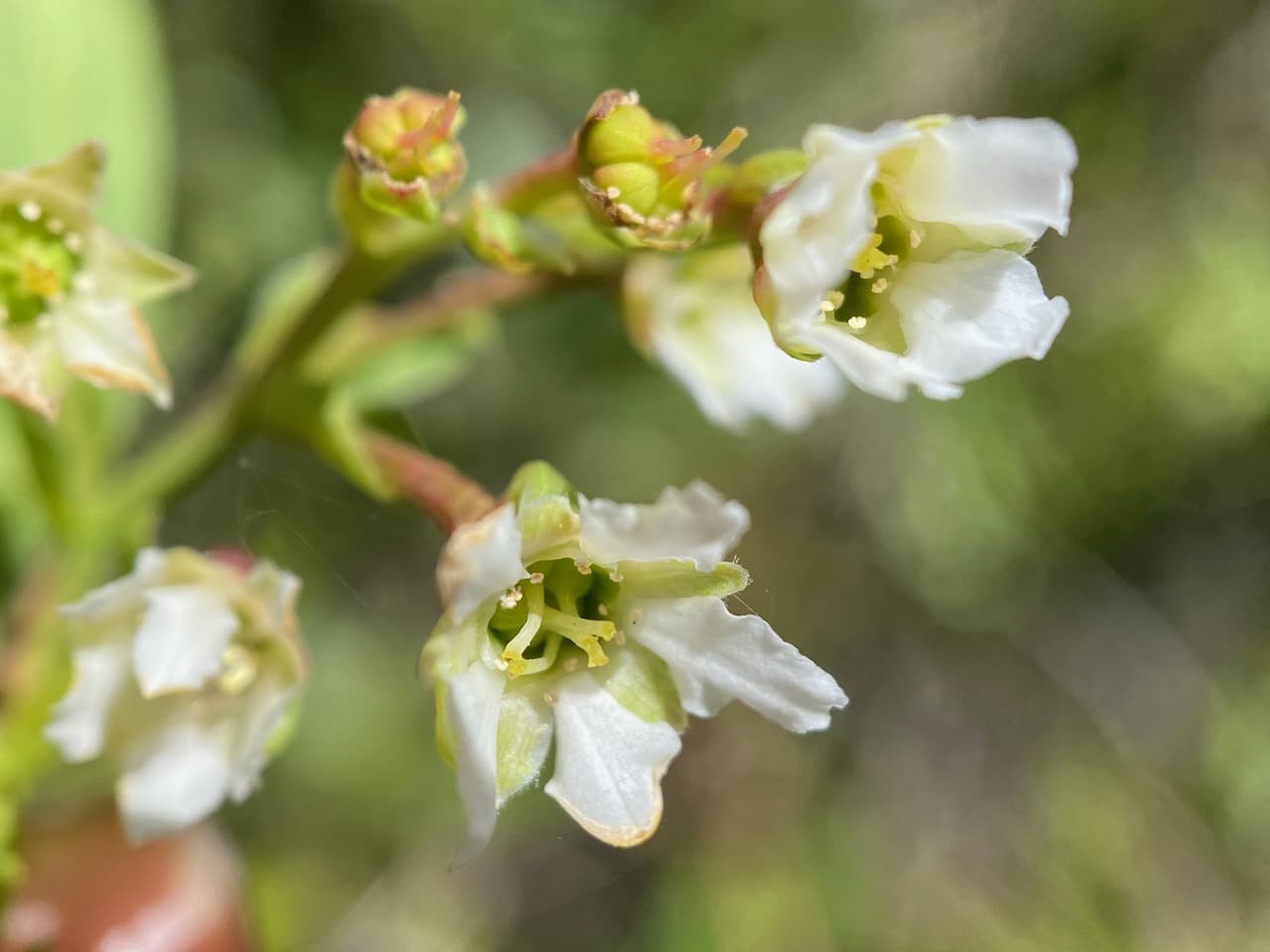
The Osoberry, Oemleria cerasiformis is dioecious – male and female flowers are borne on separate plants. There are 5 petals and 5 sepals. There are numerous stamens (15, to be exact), in 3 series in the tubular portion of the calyx. Male flowers have prominent stamens that produce prodigious pollen. Female flowers have shriveled, pollen-less stamens and prominent carpels consisting of five styles and five separate ovaries. When fertilized, the ovaries develop into drupes (stone fruits), the so-called “Indian Plums”, up to five per flower.
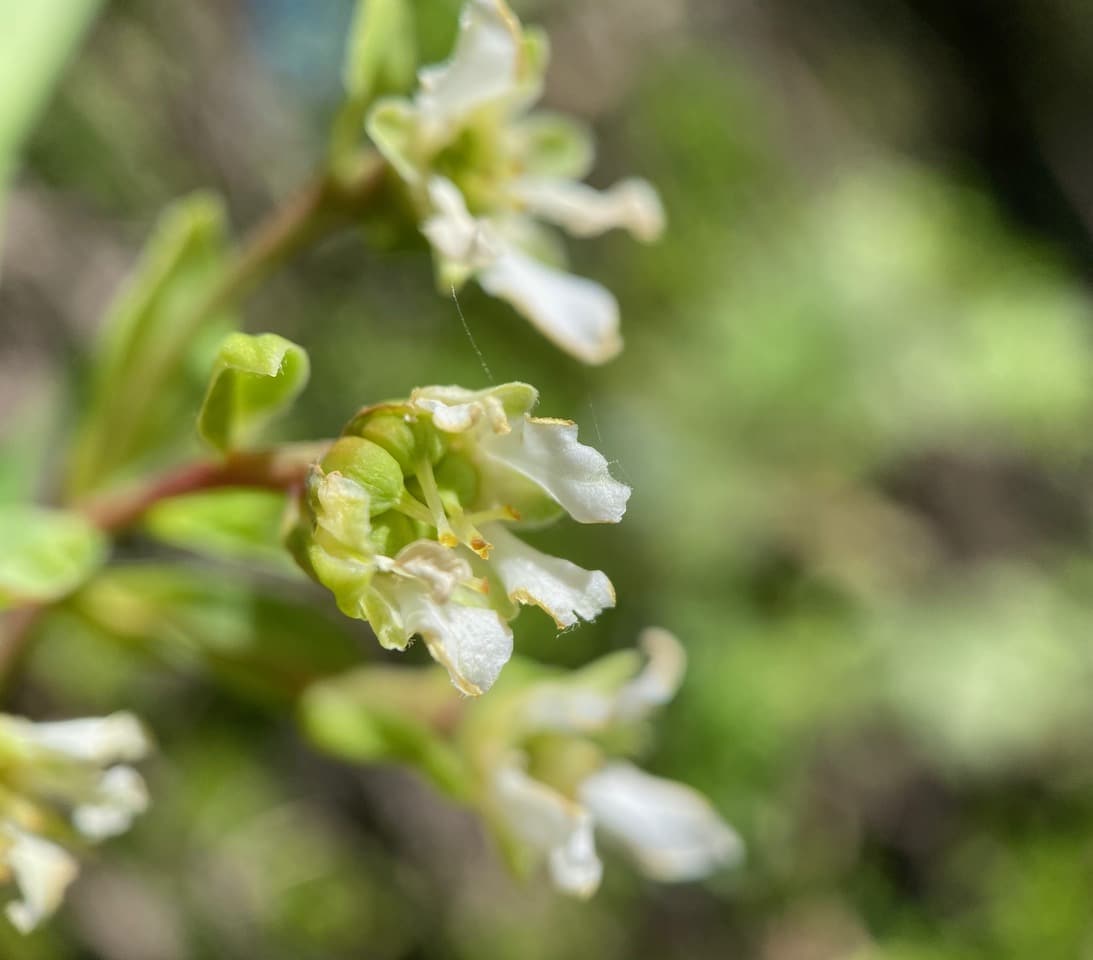
A petal has fallen off this fading Osoberry flower, revealing the developing ovaries under the styles.
Osoberry is pollinated by bees, moths, butterflies, hummingbirds, and more. The nectar in the flowers of osoberry is an important source of food for these pollinators in the early spring. Osoberry seeds are dispersed by birds and small mammals in their droppings.
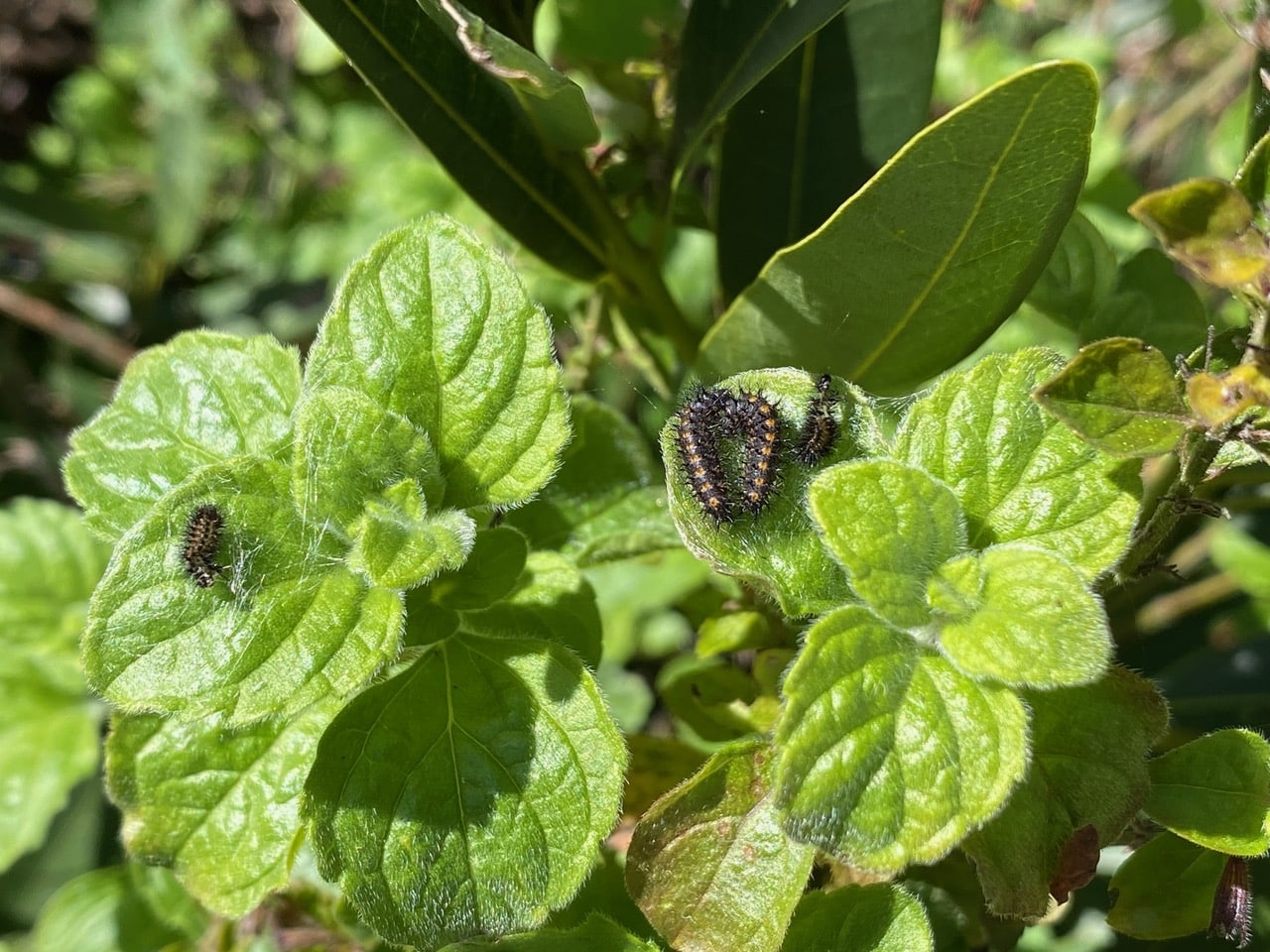
Surprise! What are these Variable Checkerspot caterpillars doing on the leaves of Calamint, Clinopodium sp.? The plant is next to a badly chewed Bee Plant. Perhaps the caterpillars have moved over because of overcrowding, and to look for fresh sources of food? Note that these small caterpillars have woven a mesh of silk around themselves. There are only two caterpillars in this view, the smaller fuzzy things are actually exuvia, the shed exoskeletons left behind after a molt.

Even more surprising – a large aggregation of the Variable Checkerspot caterpillars are resting on the leaves of a young California Bay, Umbellularia californica growing next to the Calamint. There are a few exuvia in that mix too. In addition to the Bee Plant (Scrophularia californica) and the Sticky Monkeyflower (Diplacus aurantiacus), these caterpillars are known to feed on a staggering variety of plants, but California Bay does not appear on the menu. Are they here only to molt?
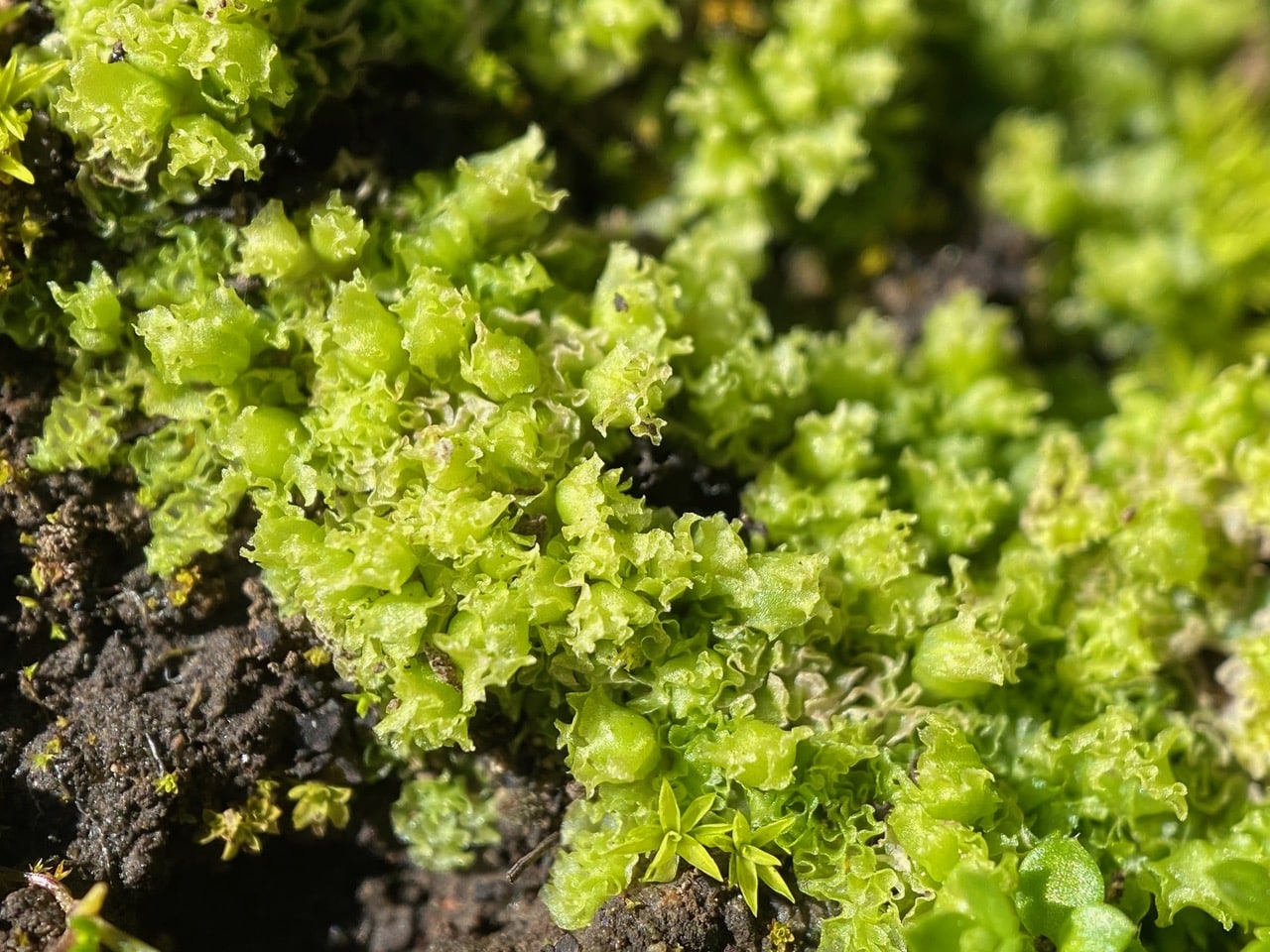
The side of the wetter section of the trail is covered with vibrant mosses. Among the mosses, I spot some lighter green patches with a different texture. A closer look through the macro lens reveals Frillworts, Fossombronia sp. These delicate, ruffled liverworts look like miniature heads of butter lettuce.
Liverworts, together with mosses and hornworts, are collectively known as Bryophytes. They are non-vascular plants, which means they have no roots or vascular tissue, but instead absorb water and nutrients from the air through their surface (e.g. their leaves). Most of them only grow a few centimeters in height, and since they don’t need roots, they can grow on the surface of rocks, walls, pavement, etc. Bryophytes thrive in damp, shady environments, but they can also be found in diverse and even extreme habitats, from desert to arctic areas. Unlike flowering plants, bryophytes reproduce by spores instead of seeds. Bryophytes play an important role in the environment. They colonize sterile soils, absorb nutrients and water and release them slowly back into the ecosystem, contributing to the formation of soil for new plants to grow on.

While photographing the liverworts, I detect a swift movement from the corner of my eyes. Not sure where that came from, I scan the surrounding moss-covered patch. Suddenly a spider appears from a hole. It hangs out at the entrance, seemingly curious about my presence. When I approach closer, it swiftly vanishes into the hole. This happens several times, a comical hide-and-seek game spurred by mutual curiosity. The hole, a little less than the diameter of a dime, is irregular in shape, and lacks silk lining. I don’t think it is constructed by the spider, but is simply a crack in the ground that the spider is using as a temporary hiding place.
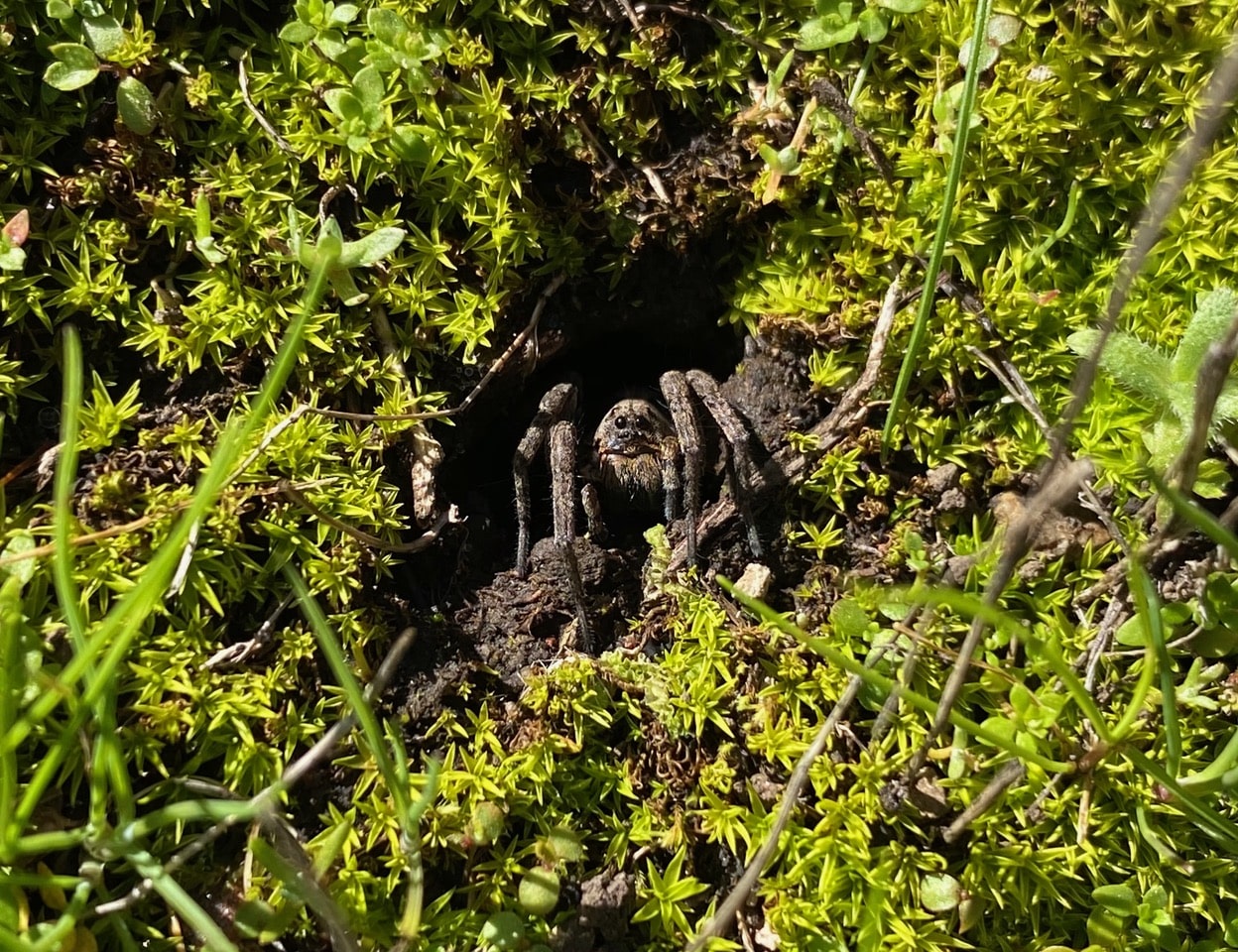
The spider does not look familiar, but from its eye arrangement, I figure it is a Wolf Spider (family Lycosidae). I have seen wolf spiders aplenty, but never from this perspective. They are commonly seen running on the ground, the females toting their egg sacs attached to their rear.
The eye arrangement of spiders can be useful for identifying spiders to family, and sometimes to genus. Wolf spiders have 8 eyes arranged in three rows: 2 large eyes in the middle row, 2 medium-sized eyes in the top row, and 4 small eyes in the bottom row. Wolf spiders have excellent eyesight, especially in low light. They are free-roaming nocturnal hunters.

The family name Lycos– derives from Ancient Greek for “wolf”. The spiders are robust and agile hunters. Rather than catching their prey in webs, these solitary hunters chase it down, typically roaming in the night, stalking prey. These spiders spend most of their time on the ground, hunting mostly ground-dwelling insects, such as crickets and other spiders.
After mating, female wolf spiders lay several dozen or more eggs and wrap them in silk, creating an egg sac. The female wolf spider carries her egg sac attached to her spinnerets at the tip of her abdomen. The abdomen must be held in a raised position to keep the egg sac from dragging on the ground. Despite this handicap, the females are still capable of hunting. The wolf spider’s maternal behavior doesn’t stop with the egg sacs. After hatching, the spiderlings climb on their mother’s back. The mother carries her offspring for several days before they are mature enough to disperse and fend for themselves.

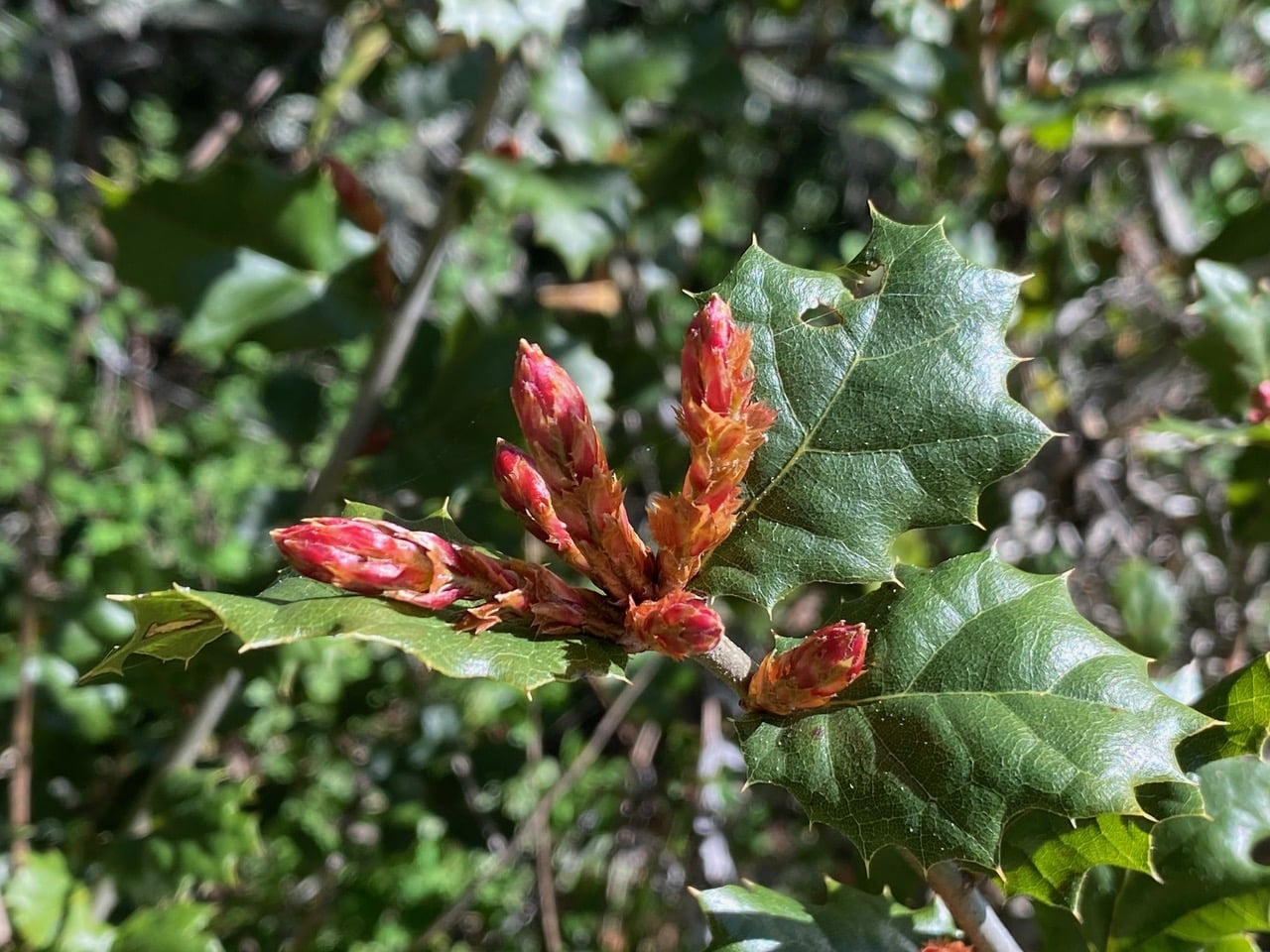
Out in full sun, the branch tips of a Coast Live Oak, Quercus agrifolia have put out new leaf buds

The terminal buds on this branch are unfurling into reddish-bronze leaves.
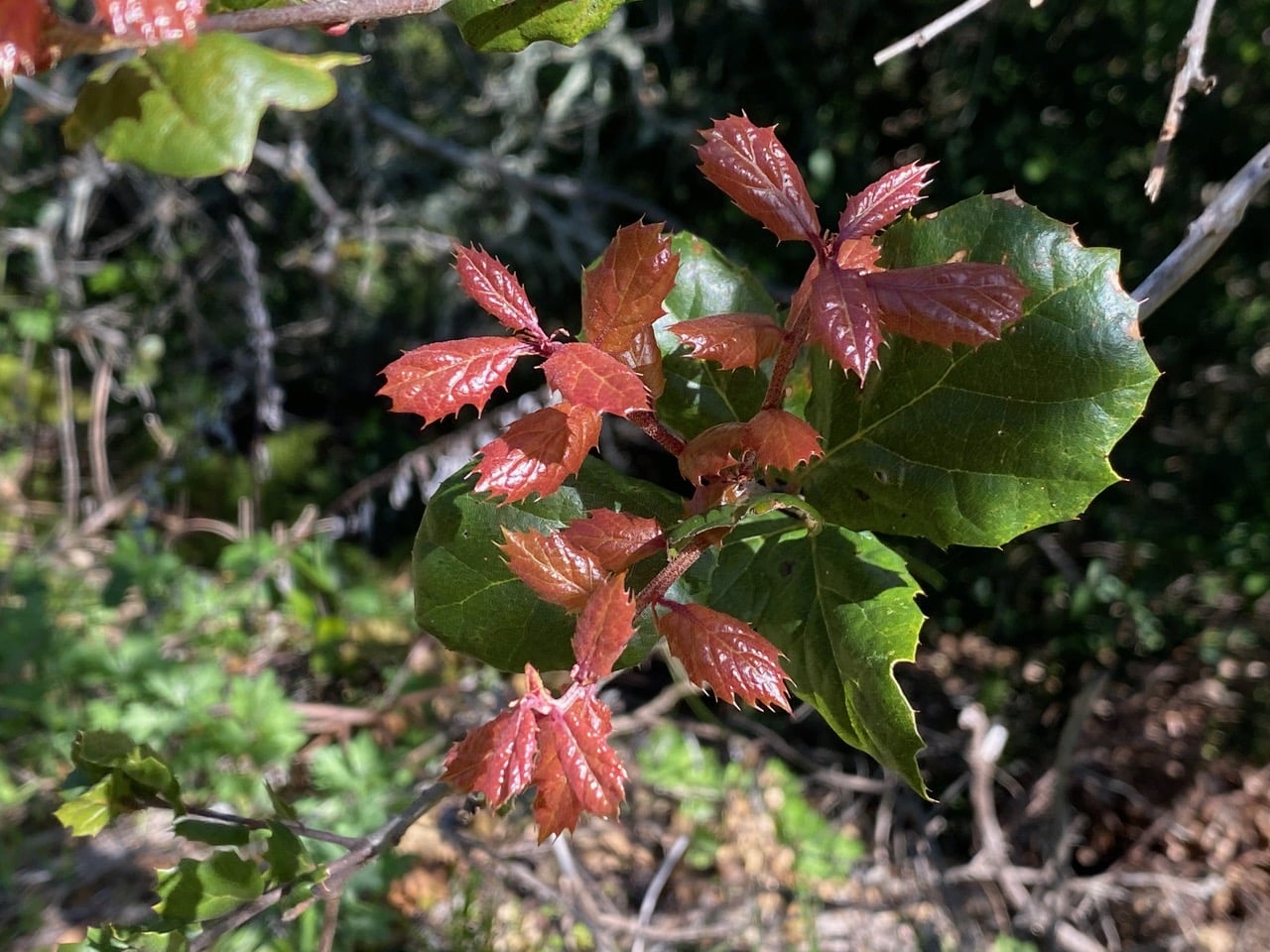
Fully unfurled, these young leaves still retain most of their reddish tint, in stark contrast to the old foliage.
The young leaves of many plants are transiently red because of the accumulation of a pigment, anthocyanin. The purple-red compounds near the leaf surface act as a sunscreen of sorts by physically shielding green chlorophyll deeper in the leaf tissue from damaging ultraviolet light.
The optical properties of the anthocyanins have been studied in relation to herbivores. Most invertebrate herbivores, such as insects, can detect colors in the blue range but not in the red range of the spectrum. Also, most mammals, with the exception of primates, essentially are blind to color in the yellow to red range, and perceive those colors as shades of gray. One theory posits that the red of the new leaves may make them cryptic or unattractive to the herbivores.