

Pollinator Post 3/7/24 (1)

Time to revisit Joaquin Miller Park and check on the stand of Ceanothus!
The Miner’s Lettuce, Claytonia perfoliata is blooming nicely. I slow my steps to check for pollinators on these minute flowers borne on charming perfoliate leaves.
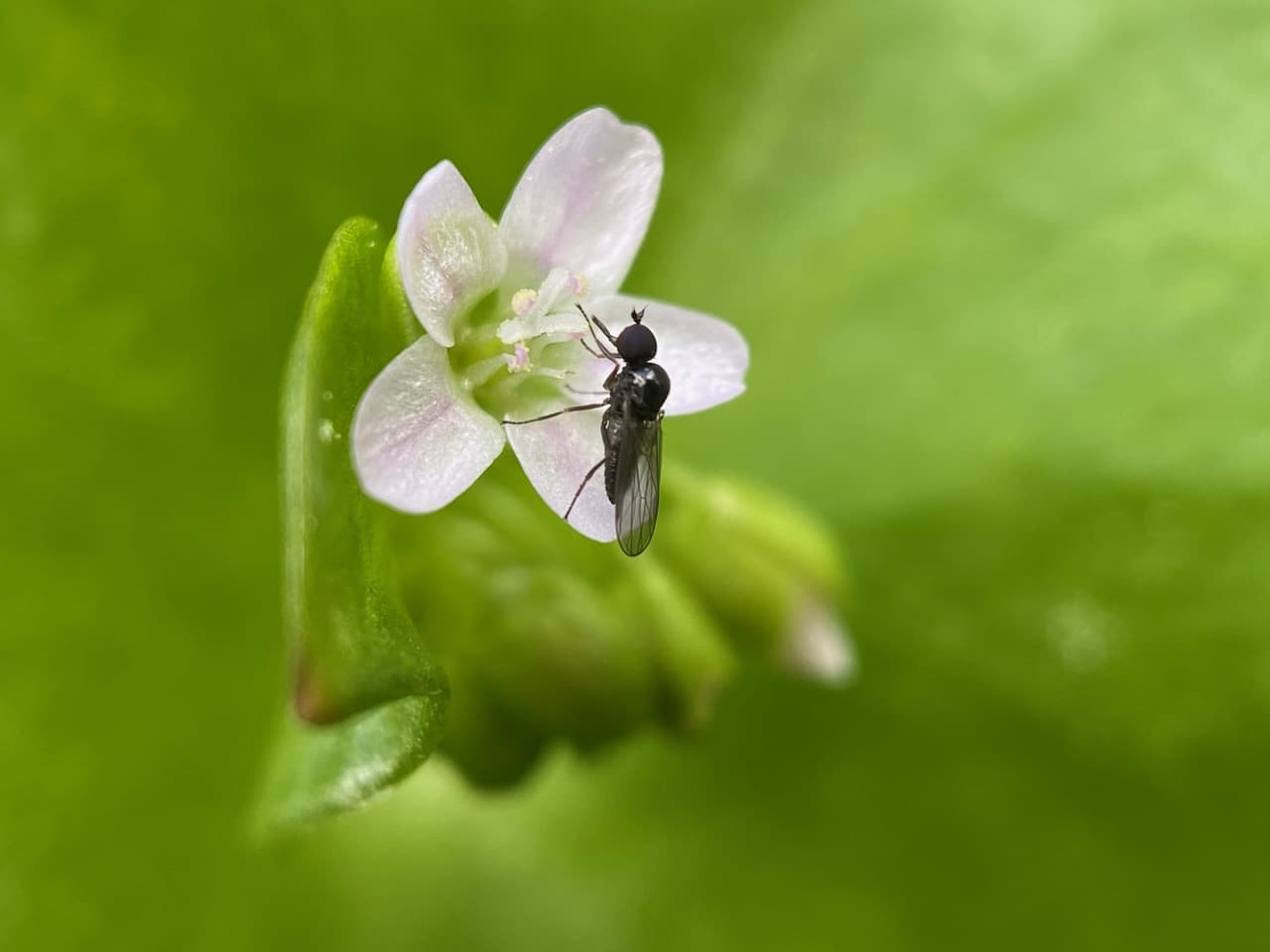
Here’s that insect I have been seeing on the Miner’s Lettuce flowers for a couple of years. The little fly has extended its piercing-sucking proboscis to feed on pollen.
The small fly, under 3 mm long has been identified as a member of the Typical Dance Flies or Hybotid Dance flies (family Hybotidae). Its compound eyes seem to take up most of its spherical head. These flies belong to the superfamily Empidoidea and were formerly included in the Empididae as a subfamily. Empididae generally have a thick beak pointing down, while Hybotidae have a thinner beak, or a thick beak pointing forwards or diagonally. Some crucial wing venation further distinguishes the two families. Precious little is known about the life cycle and biology of Hybotids because they are not considered of economic consequence. Since their forelegs are generally not raptorial, I wonder if they’re predaceous like the Empidids. I have seen the Hybotids visit flowers for nectar and pollen, notably on Soap Plant, Miner’s Lettuce, California Saxifrage, and Wild Geranium, and I believe they may contribute to the pollination of these flowers.
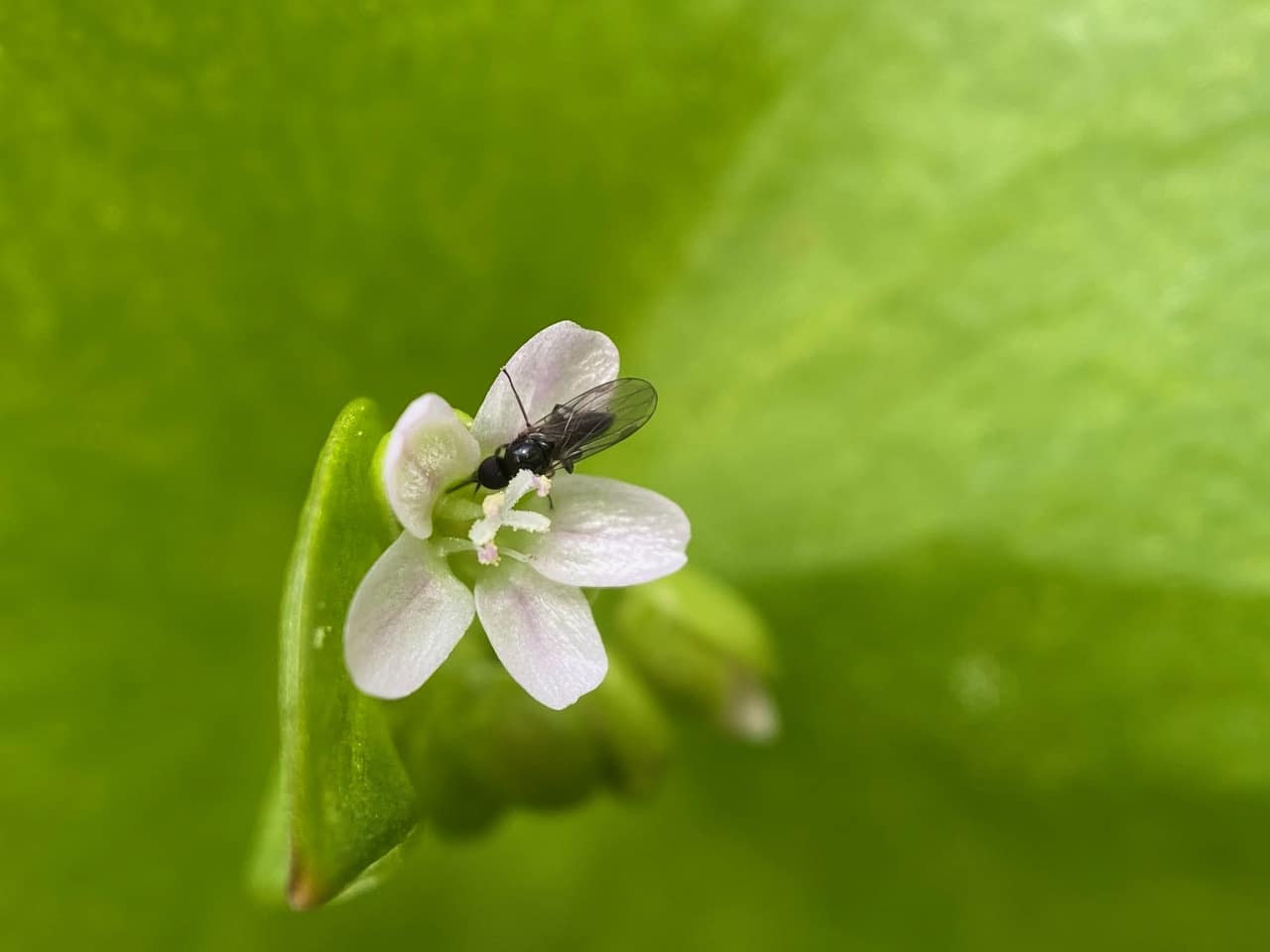





The same fly has now turned its attention downwards, reaching for nectar at the base of the Miner’s Lettuce flower.
Why the name “dance fly”? This is derived from the mating swarms of males of many species. They gather in clouds over prominent objects, each individual seeming to bounce or “dance” in mid-air. Many other flies do this, notably midges, but the Empidids and the Hybotids got the moniker.
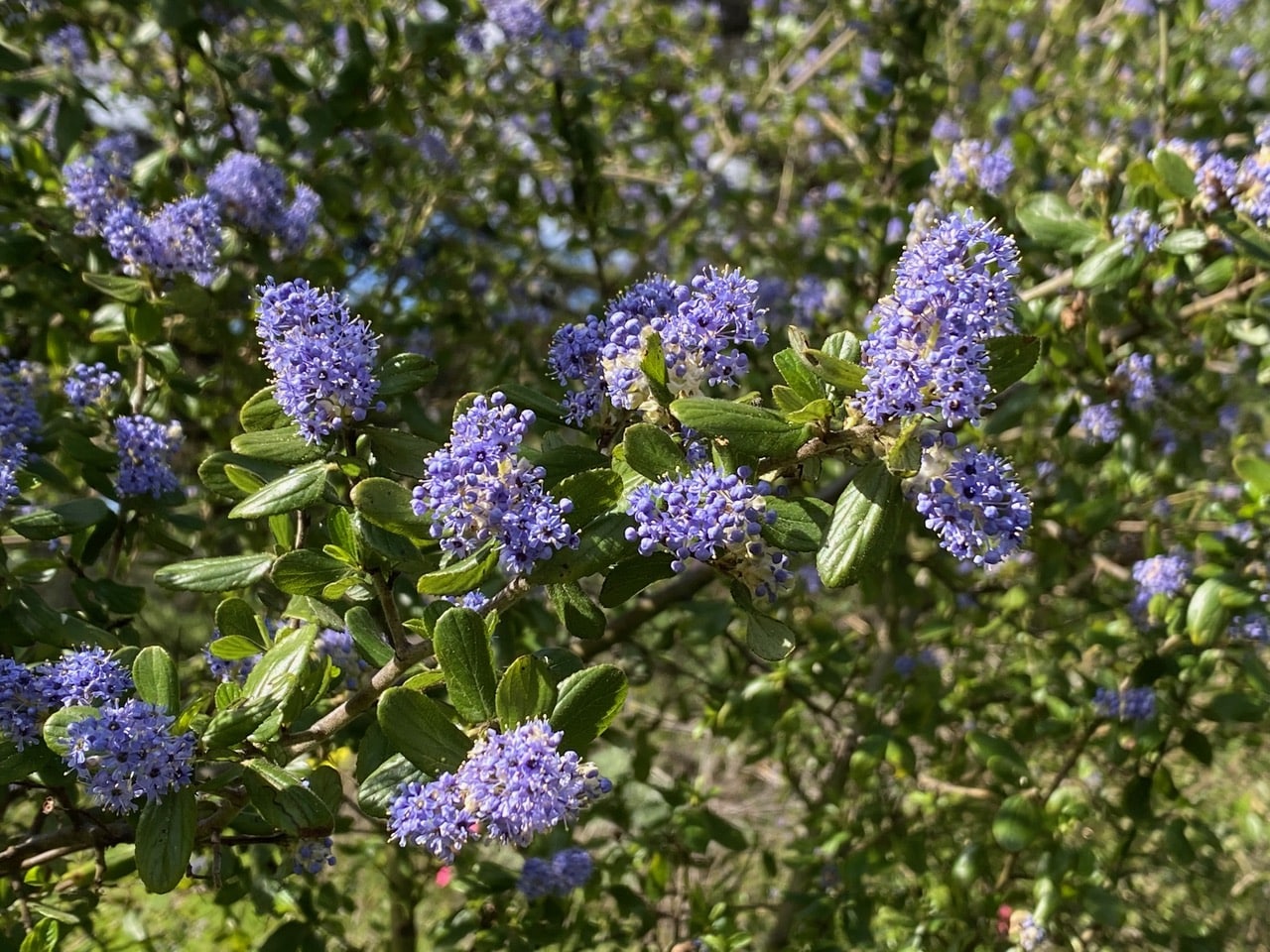
I am thrilled to find the Ceanothus, C. thyrsiflorus in peak bloom! The small flowers are closely clustered, open-faced with generous pollen released from anthers that are fully exserted, and a good source of nectar. Pollinators can gather the floral resources quickly by simply walking over the clusters.
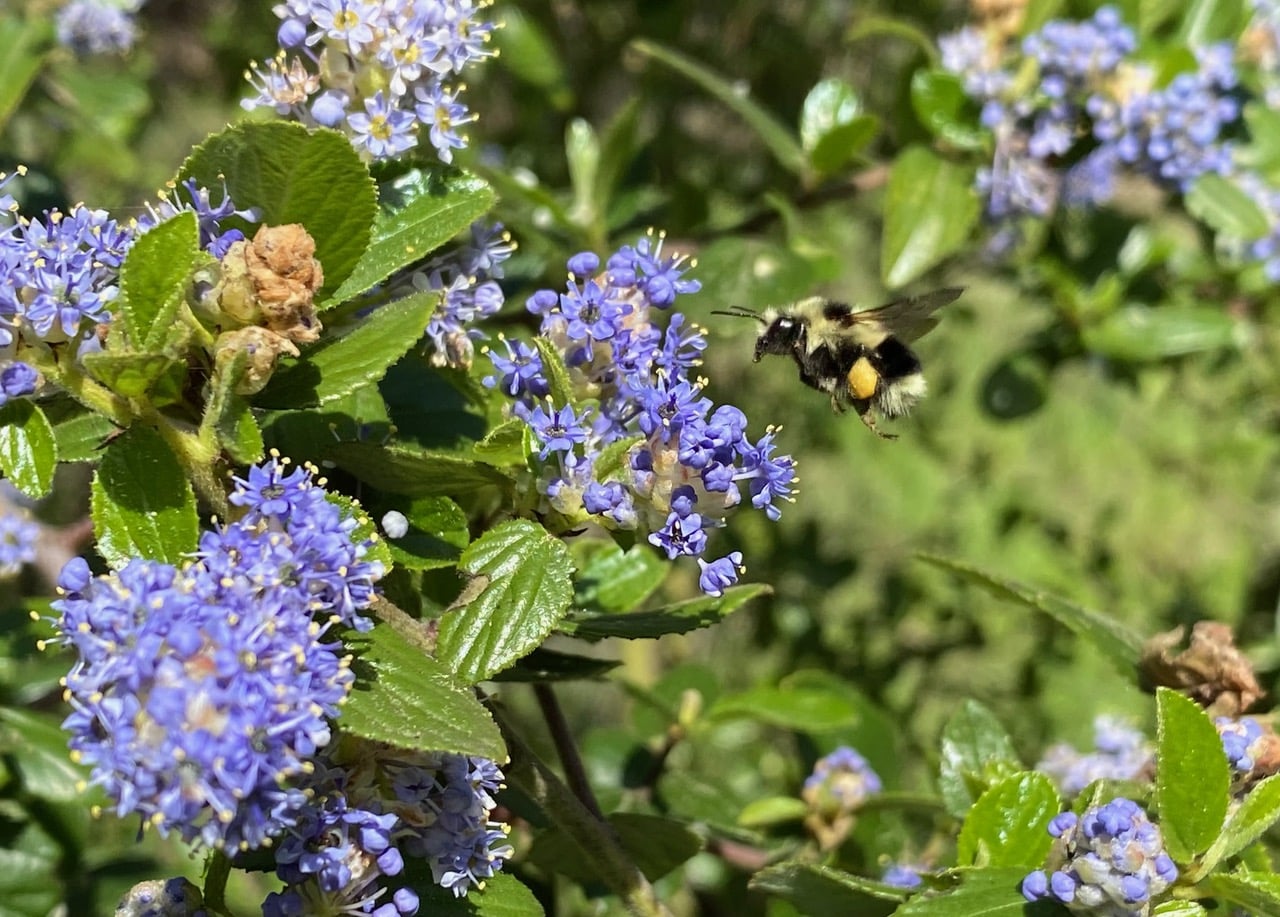
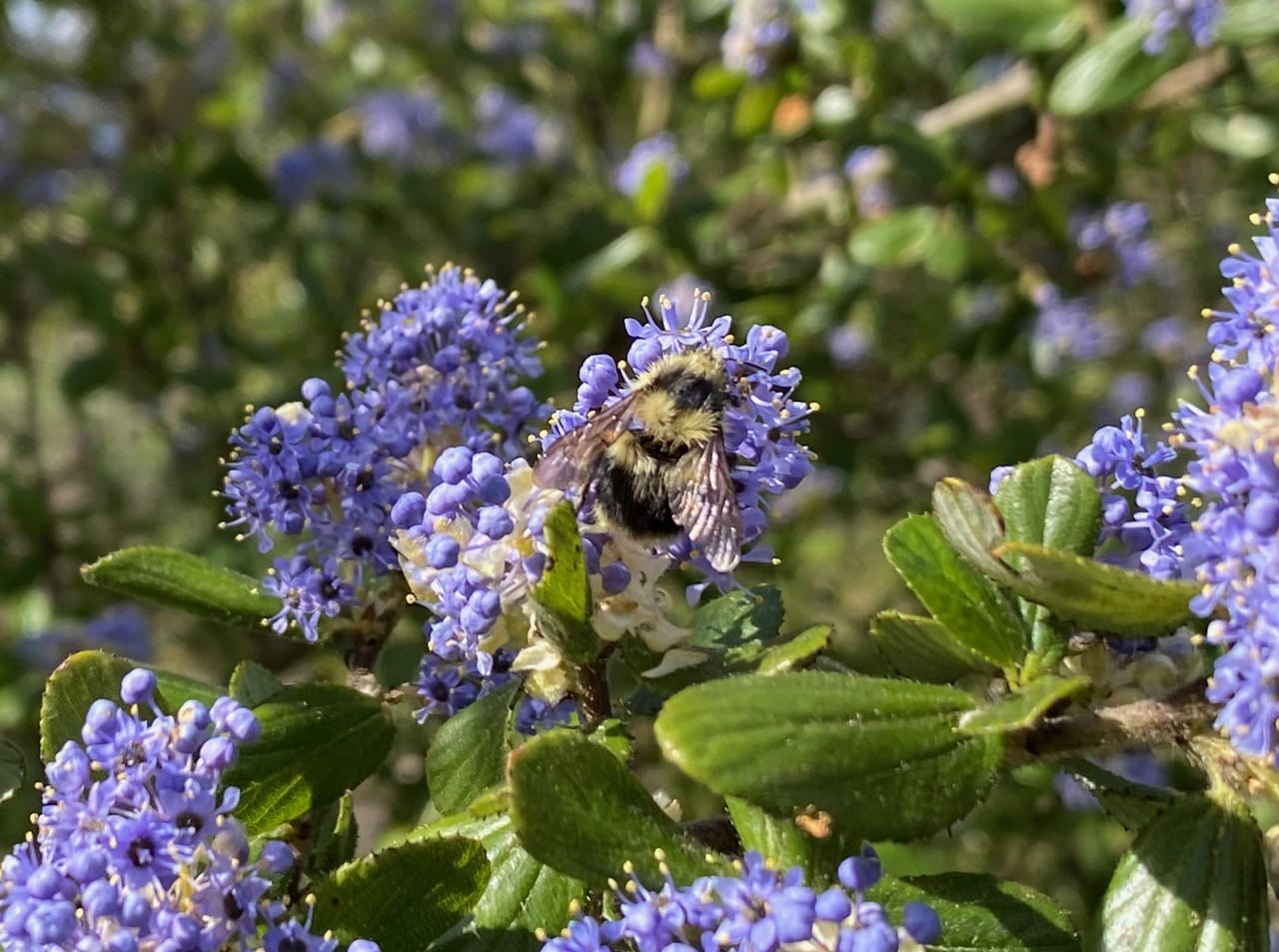
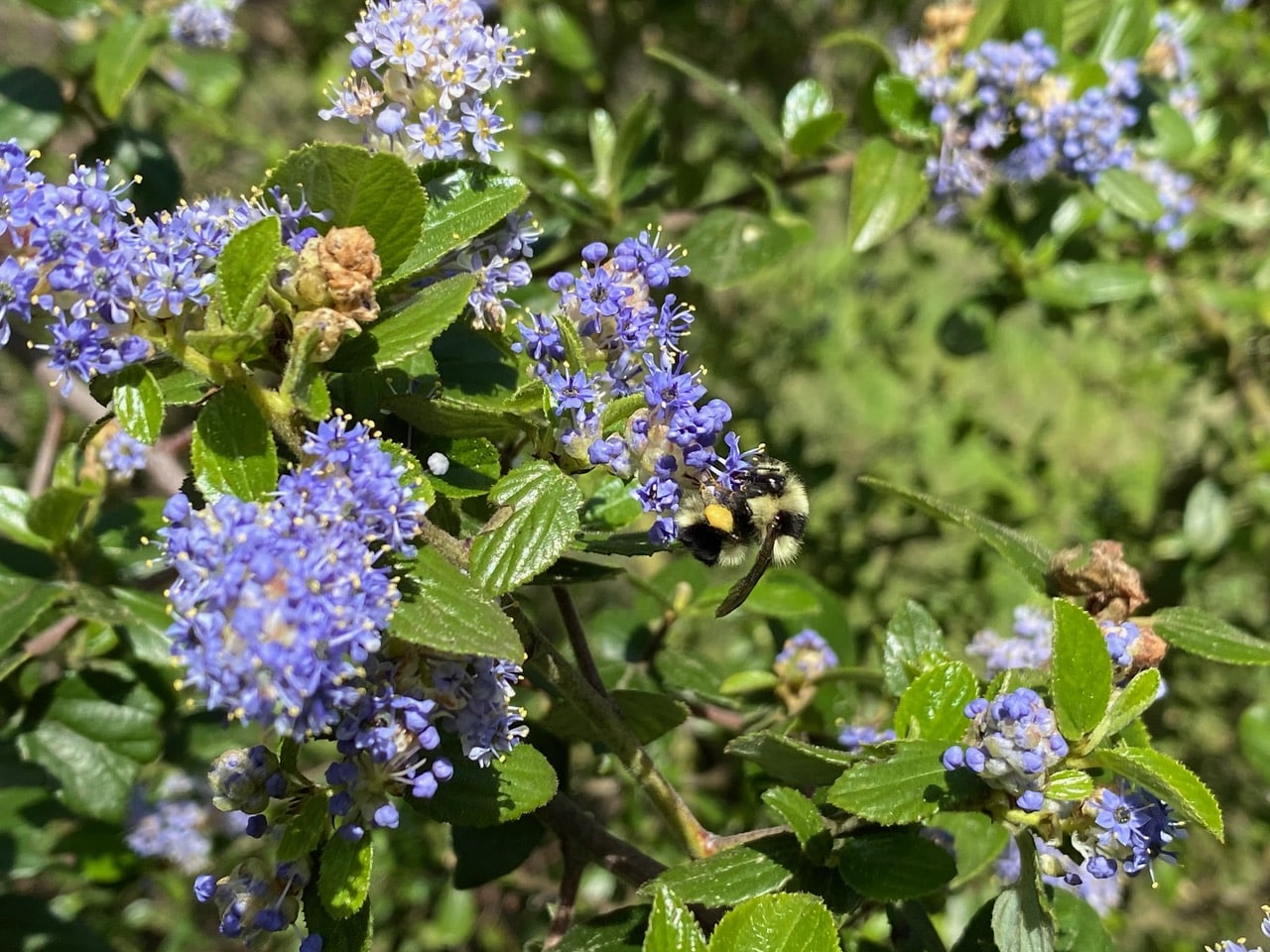
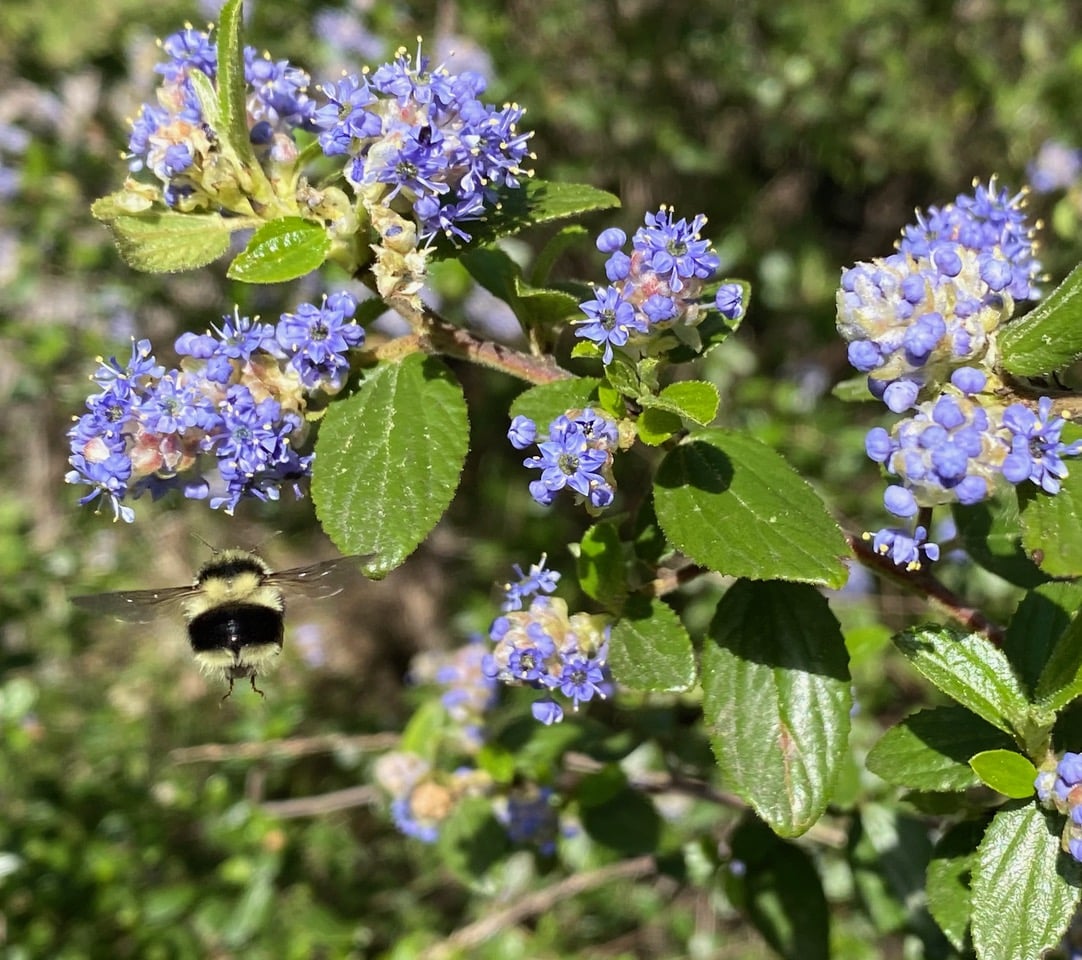
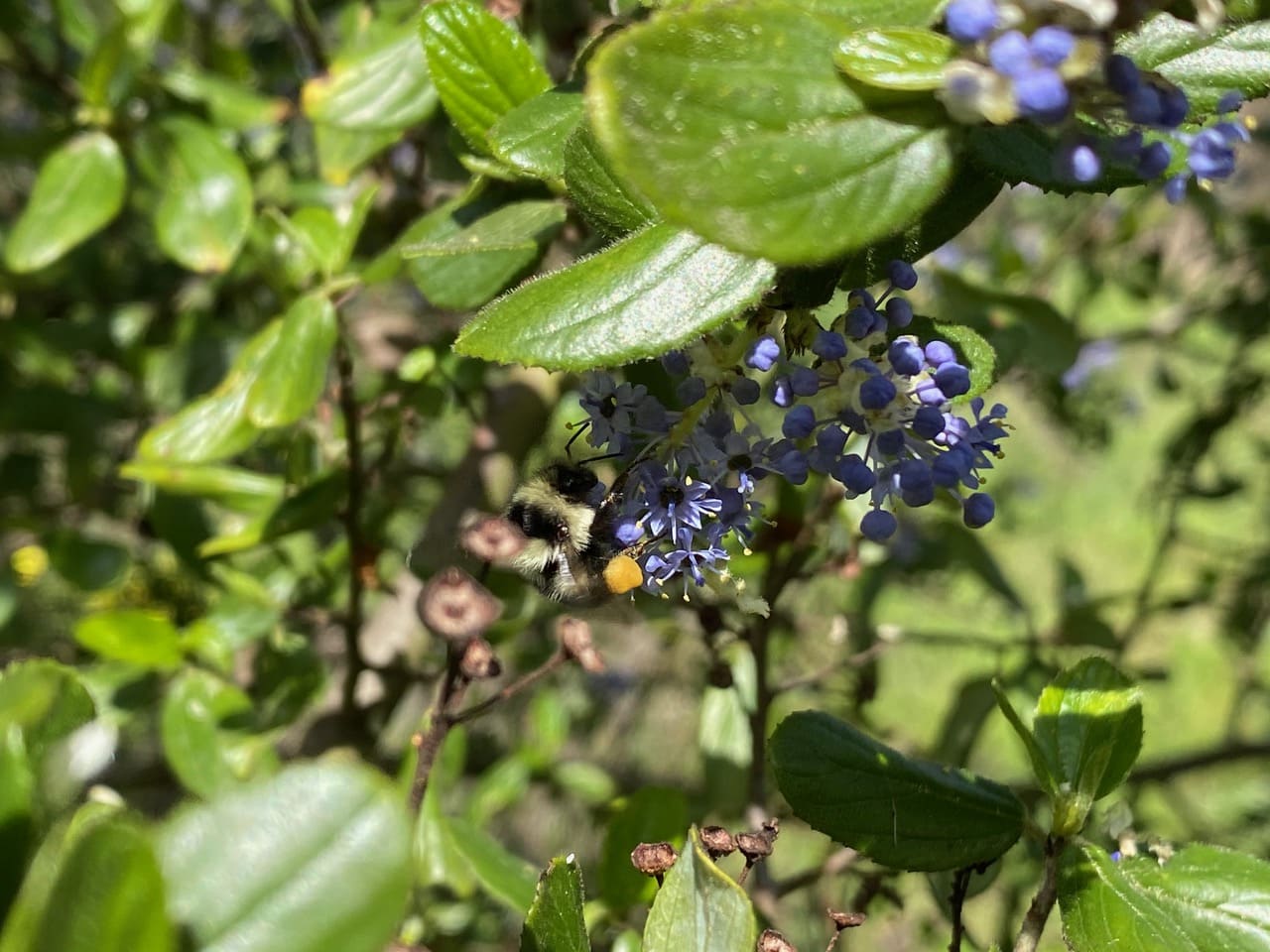
The stand of Ceanothus is abuzz with bumble bees. All of them are workers of the Black-tailed Bumble Bee, Bombus melanopygus (family Apidae). Many are carrying yellow pollen in their pollen baskets.
It is gratifying to know that the queen Black-tailed Bumble Bees have successfully established their colonies, and are no longer out foraging.
Bumble bees are social and live in colonial hives. Many of the large individuals seen early in the season are queens. They are the only members of their colony to survive the winter, hibernating until the days begin to warm and their host plants are in bloom. These queens have mated before they went into hibernation. Now their first order of business is to each find a nesting site (usually an abandoned rodent burrow), lay eggs, brood and nurture the first batch of workers. Hence forth, the queens stay behind in the hive to concentrate on laying eggs while the workers take on hive duties and foraging. Bumble bees are among the most cold tolerant bees, and are usually the first bees we see out foraging. This is why it’s important for us to plant early blooming natives to support the queen bumble bees.
Her fur damp and matted, this bee seems to have been caught in the recent rain, and hasn’t had a chance to dry out. But like the others, she’s foraging tirelessly.
There is quite a bit of size variation among the worker bumble bees. Some are comically small, maybe a quarter of the size of a queen. These are probably members of the first brood of workers hand-raised by the queen herself. They are probably a little under-nourished, being raised by a single mom.
It’s no wonder that bumble bees seem to be everybody’s favorite bees – they are simply adorable!
While there are many Black-tailed Bumble Bees foraging on the Ceanothus, I don’t see a single Yellow-faced Bumble Bee on the flowers. I do see an occasional queen Yellow-faced Bumble Bee flying low over the grassy knolls, apparently still searching for nesting sites.
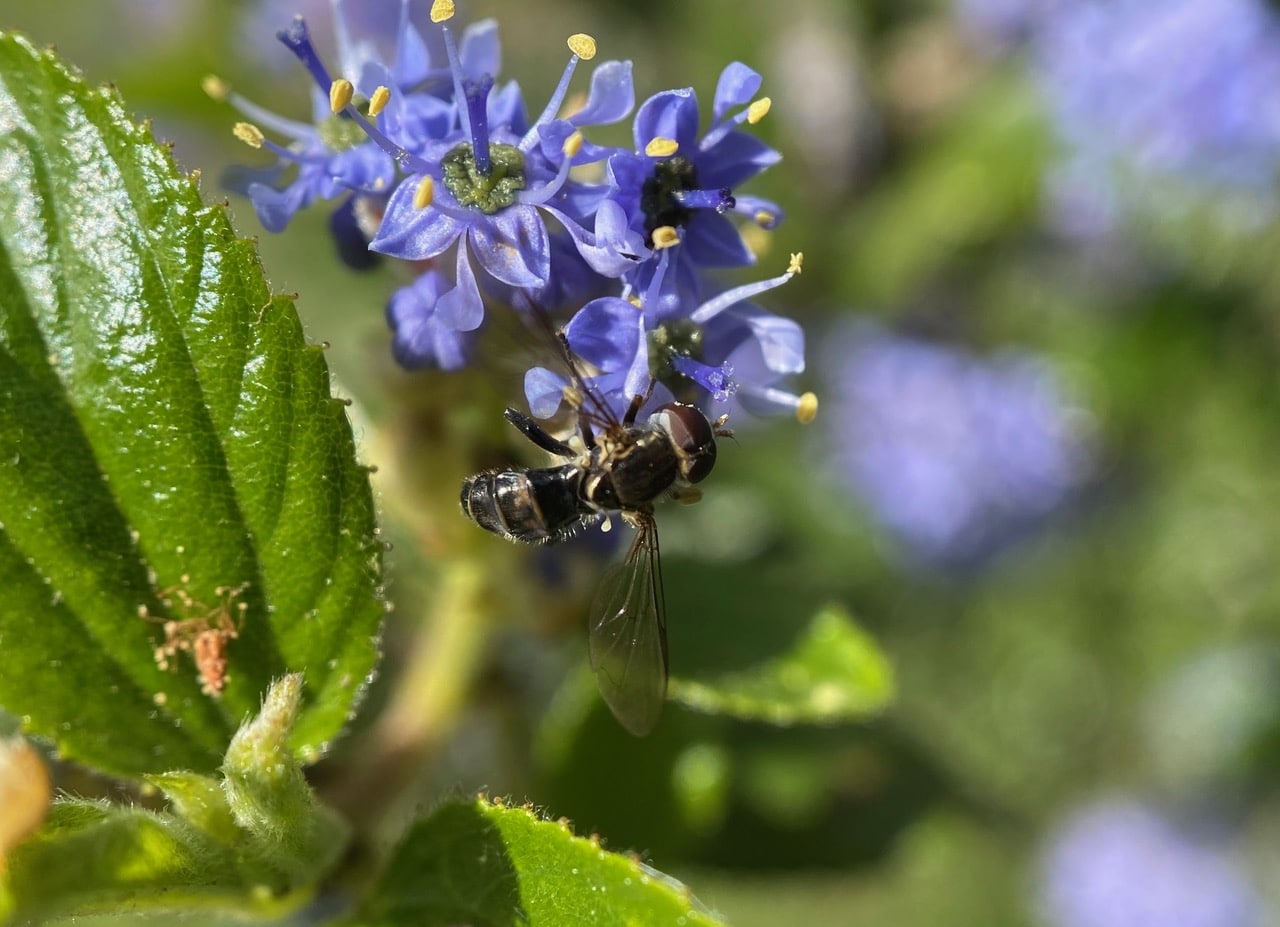
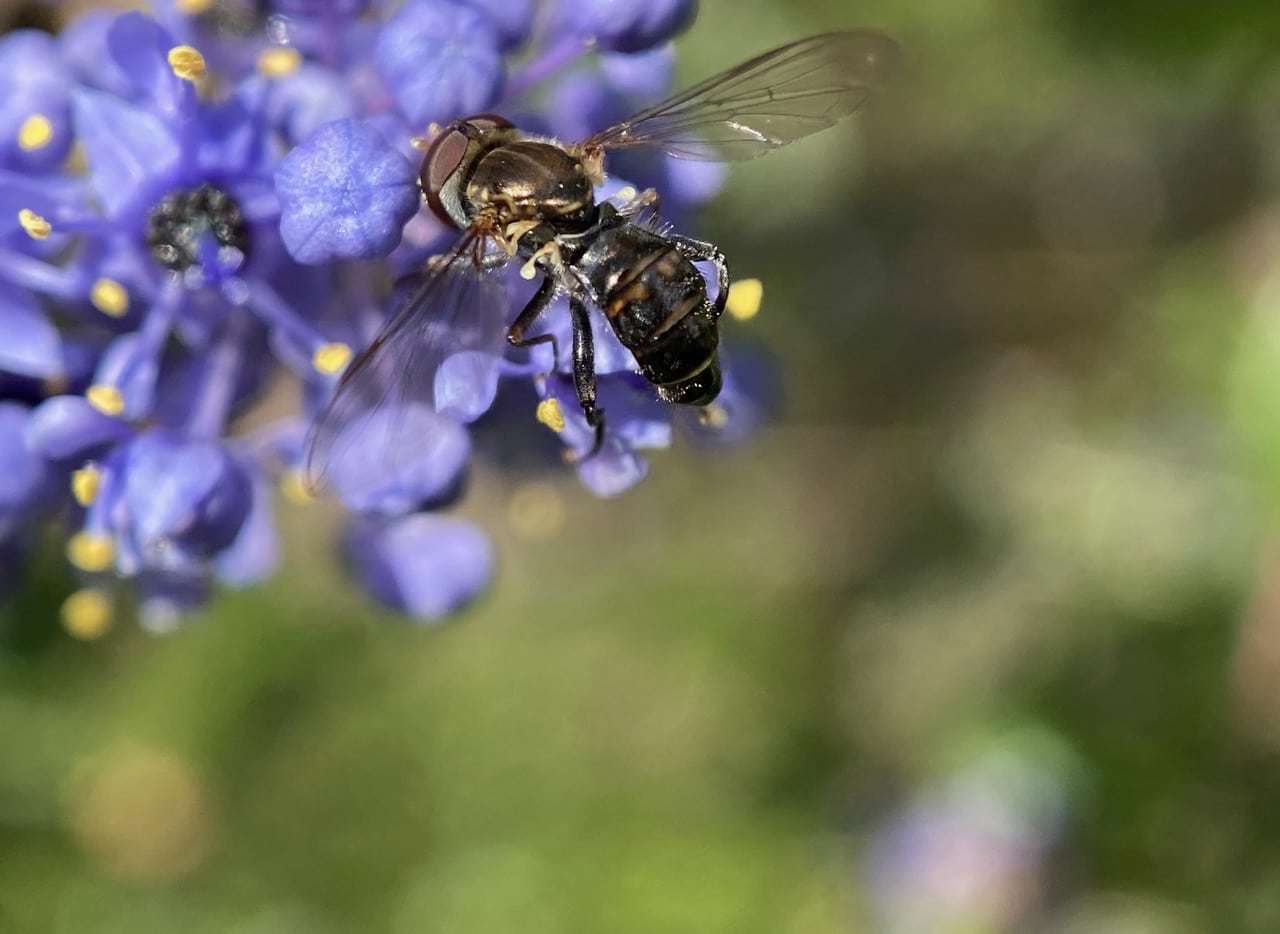
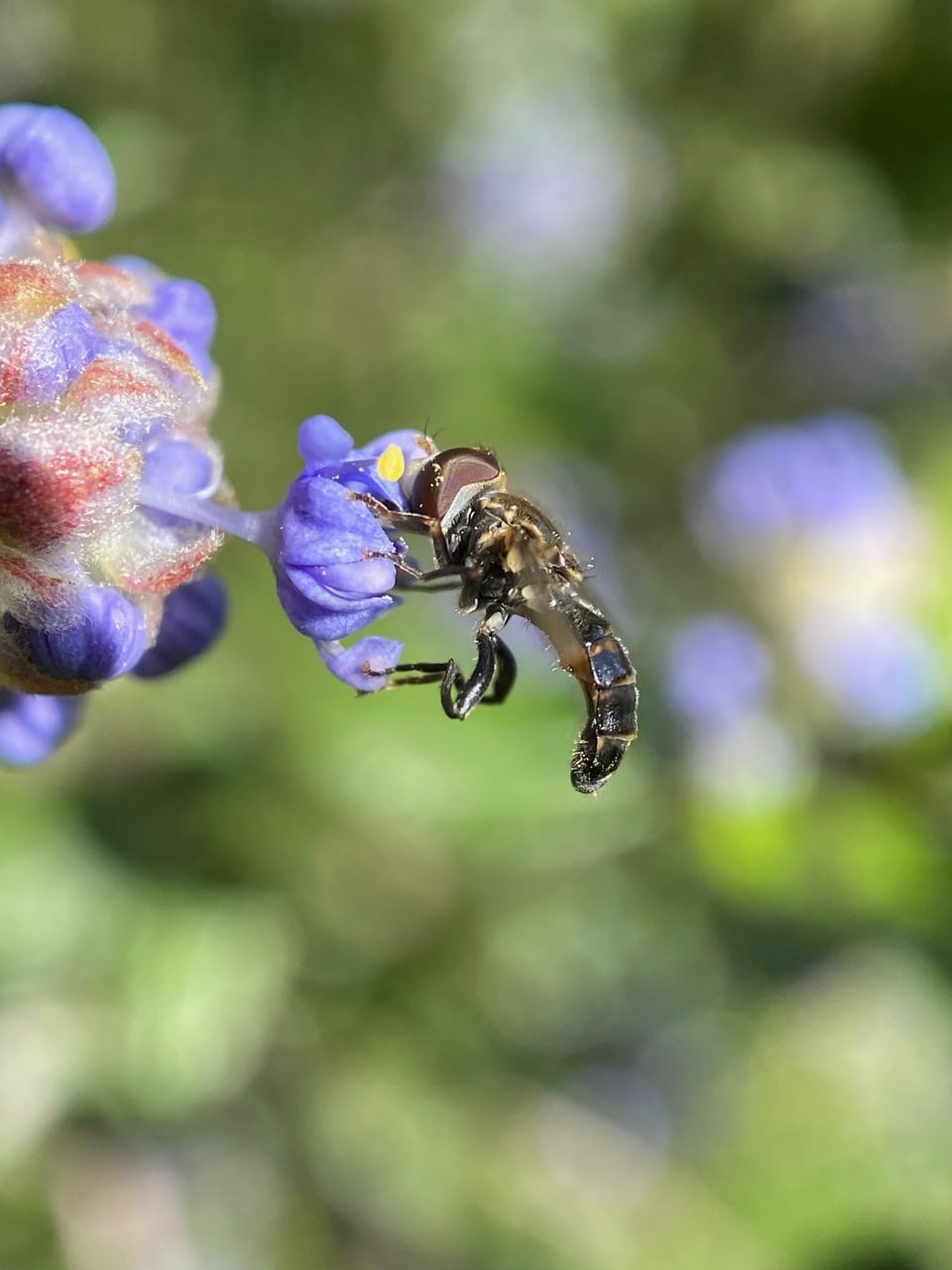
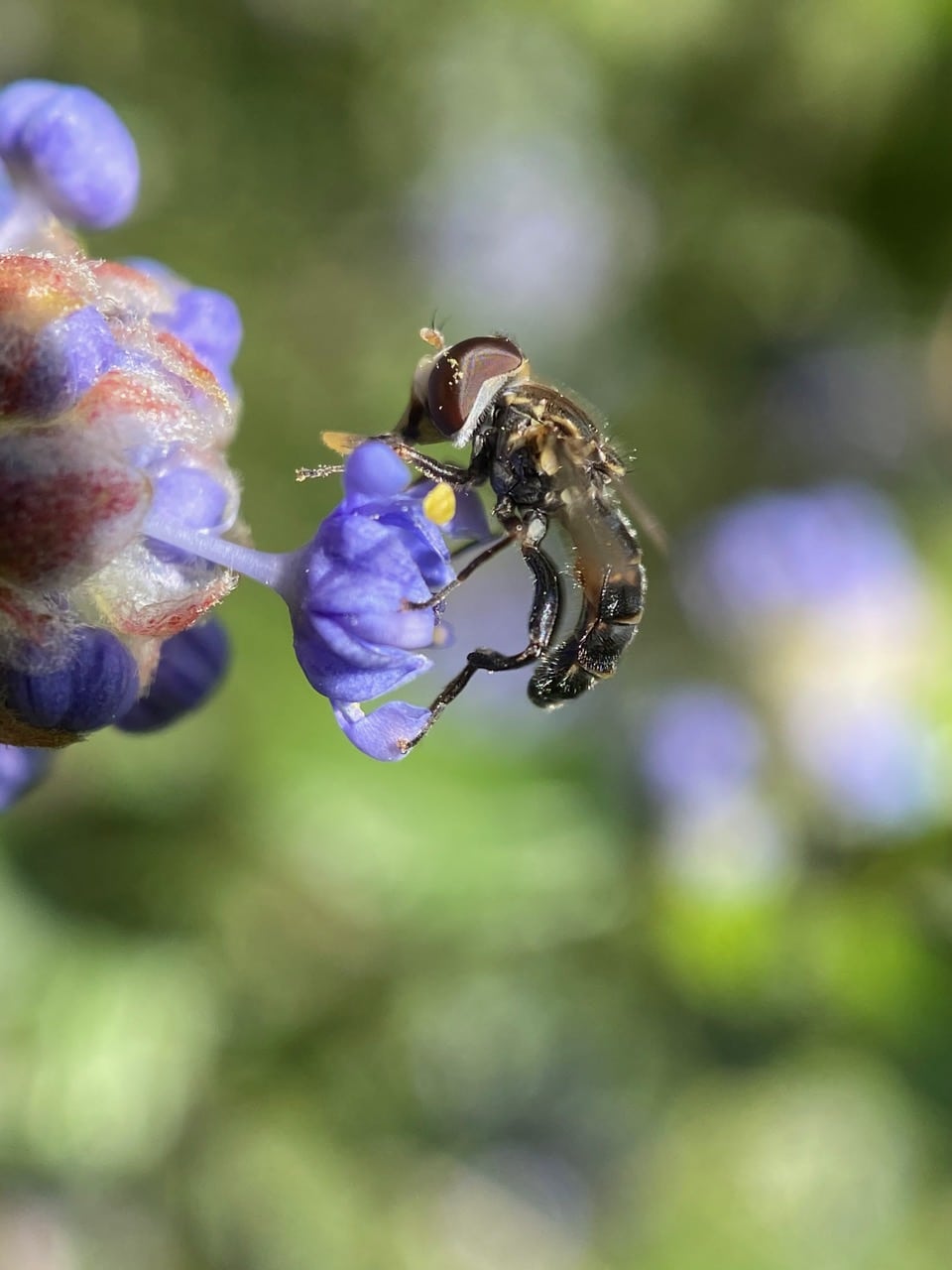
While the bees are busy zipping around, a much smaller insect is quietly working the Ceanothus flowers.
It is dark and glossy and appears to be a Hover Fly (family Syrphidae). A new species for me?
As with all new species for me, I try to take as many photos of the insect as possible for identification purposes. The fly is male, as its eyes are holoptic, meeting along a central line on top of the head.
Side view of the fly prying open a young flower. Wow, what interesting, bowed hind legs!
So far, two experts on iNaturalist have identified the hover fly as the Western Calligrapher, Toxomerus occidentalis! That’s a total surprise to me, as I have seen male Western Calligrapher before, and their abdomens were never this dark. What about those strange bowed hind legs? Live and learn!