

Pollinator Post 3/6/26 (2)
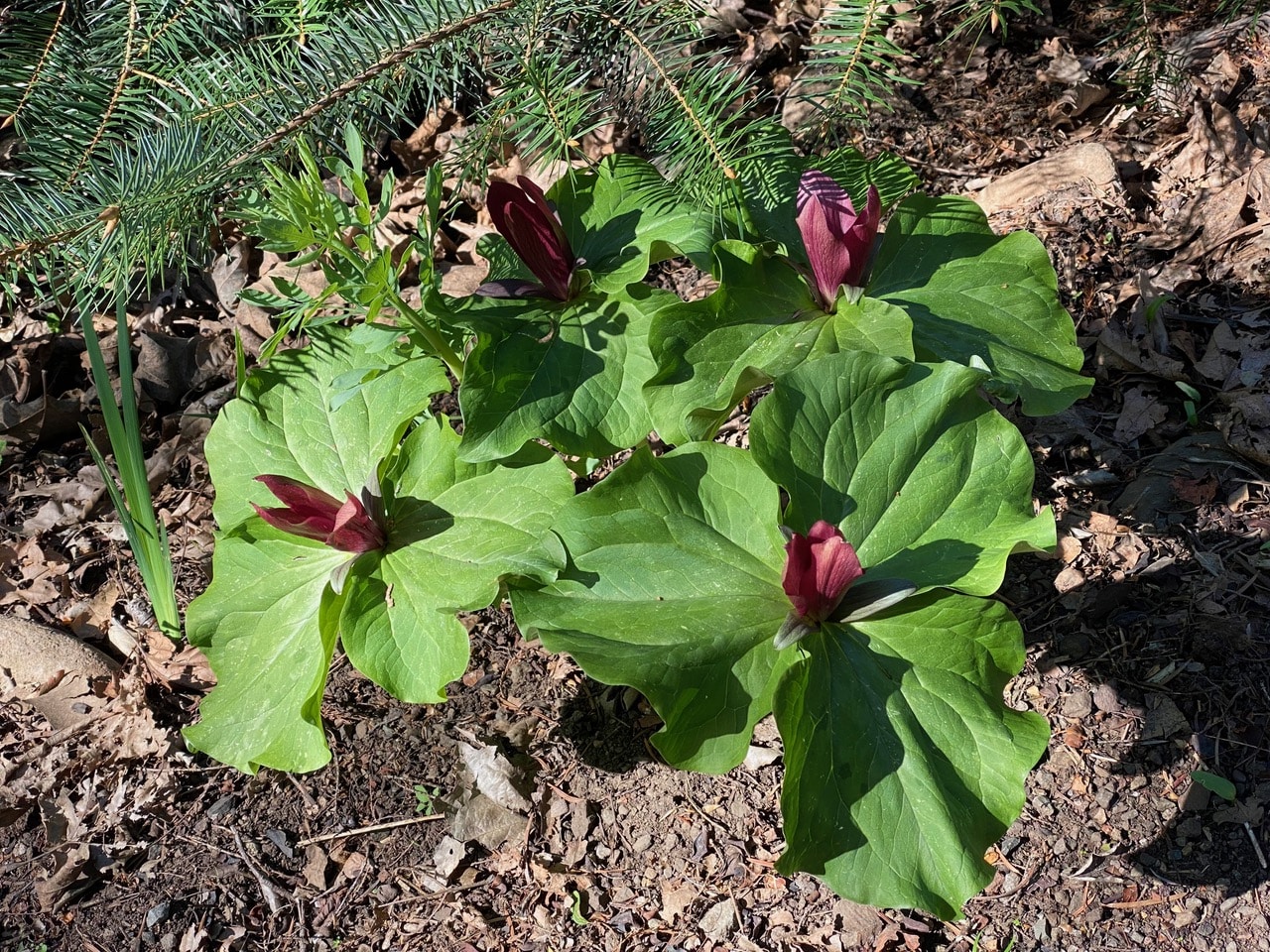
The Giant Trillium, Trillium chloropetalum are in bloom. I gently part the sturdy petals of some flowers, hoping to see insects inside. Nada. The pollination of these dramatic flowers remains a mystery to me.
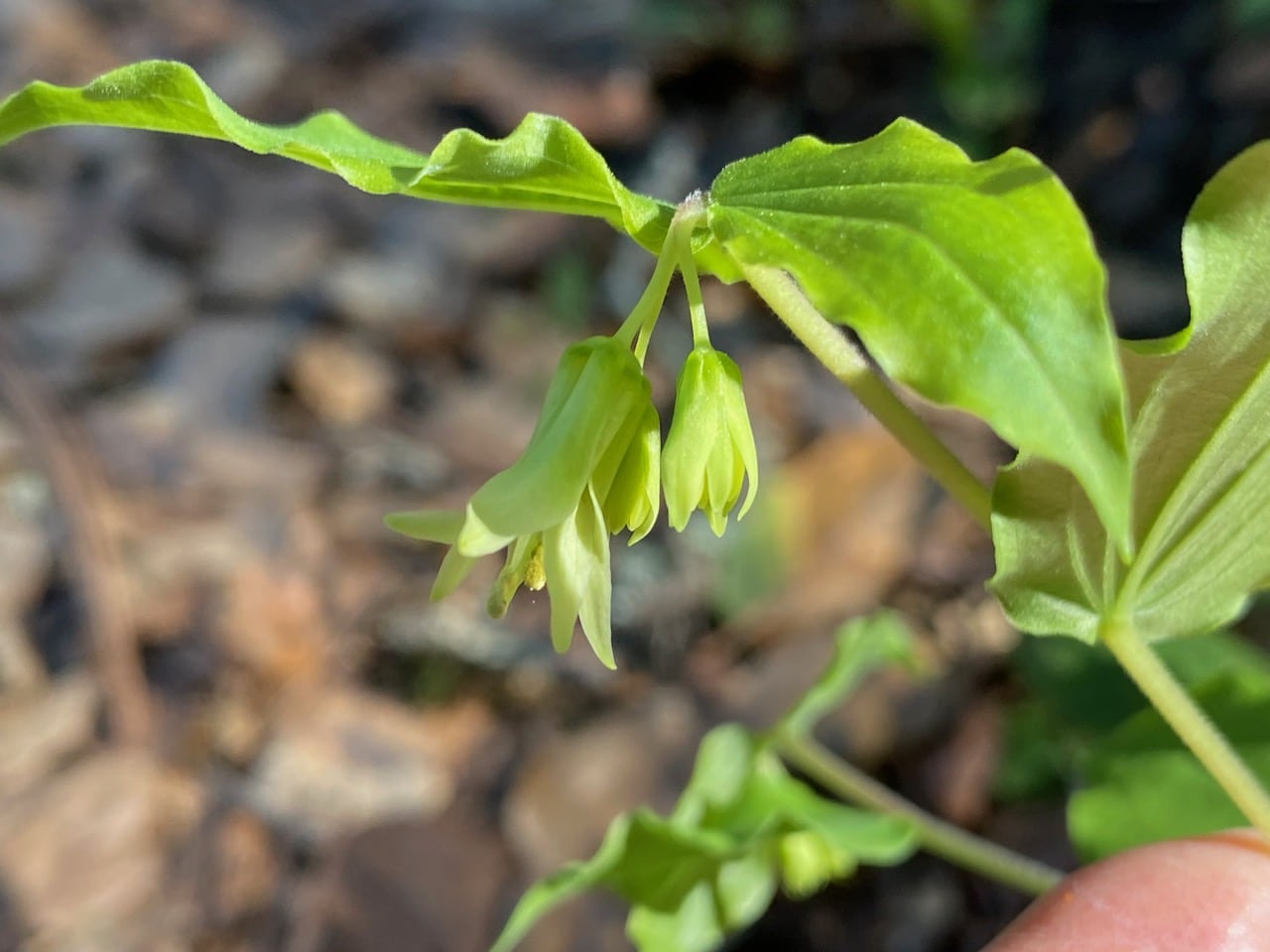
In the shady undergrowth, greenish-white flowers hang shyly under the terminal leaves of Hooker’s Fairybells, Prosartes hookeri (family Liliaceae). I have never seen any insects visit these obscure flowers, but they are reported to be pollinated by native bees and hummingbirds, which are attracted to the nectar-rich, nodding flowers that bloom from April to July. These pollinators are crucial for the development of the bright orange-to-red berries that appear in late summer.
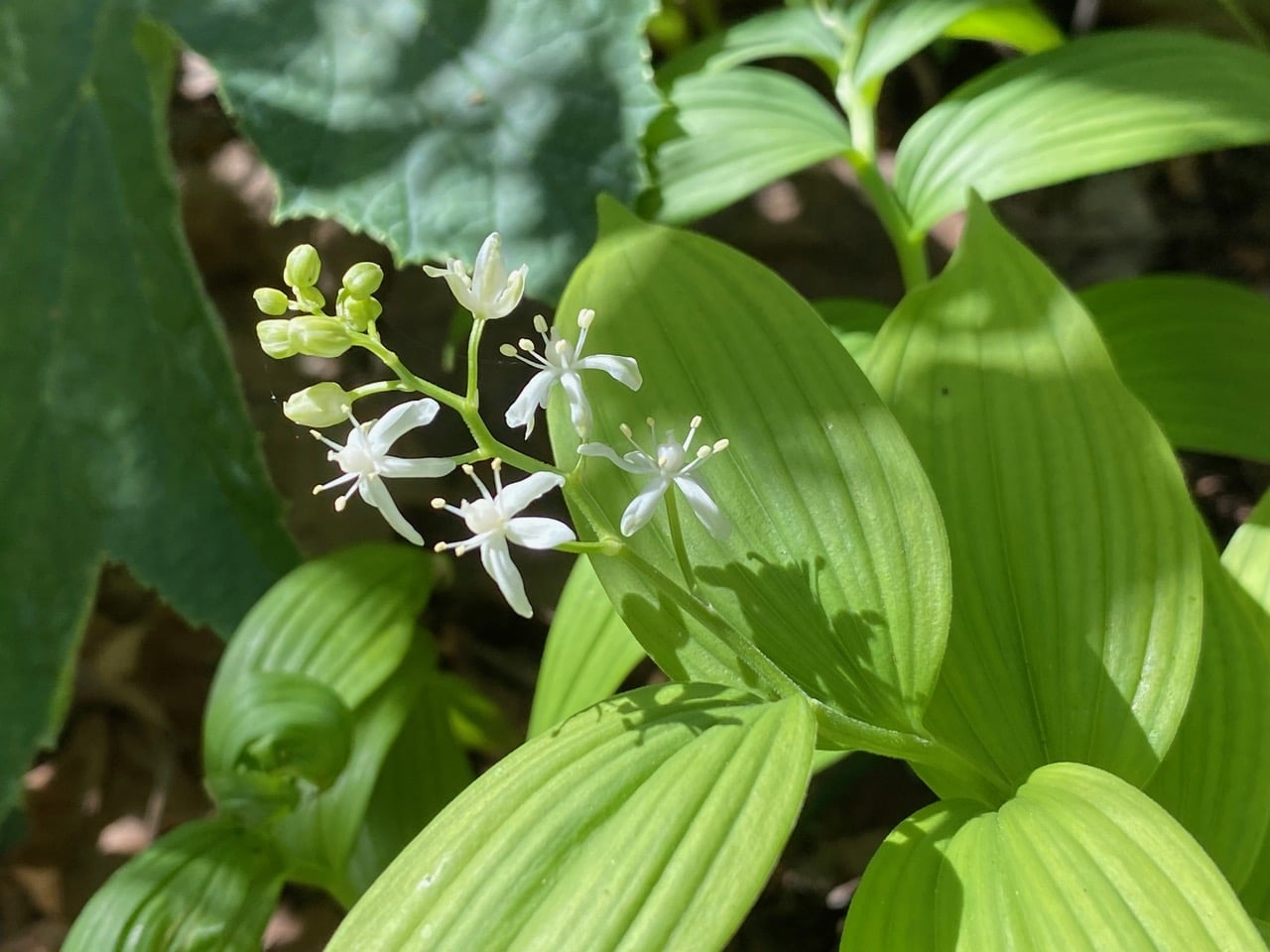
Blooming in similar shady, moist conditions in another spot is the Star-flowered Lily-of-the-Valley, Maianthemum stellatum (family Asparagceae, formerly Liliaceae). These fragrant, white, star-shaped flowers are known to be pollinated by insects, including Halictid bees, hover flies (Syrphidae), and Tachinid flies. I have also seen Hybotid Dance Flies (Hybotidae) foraging on them. The resulting berries are eaten by wildlife, such as birds and mice, which helps in seed dispersal.
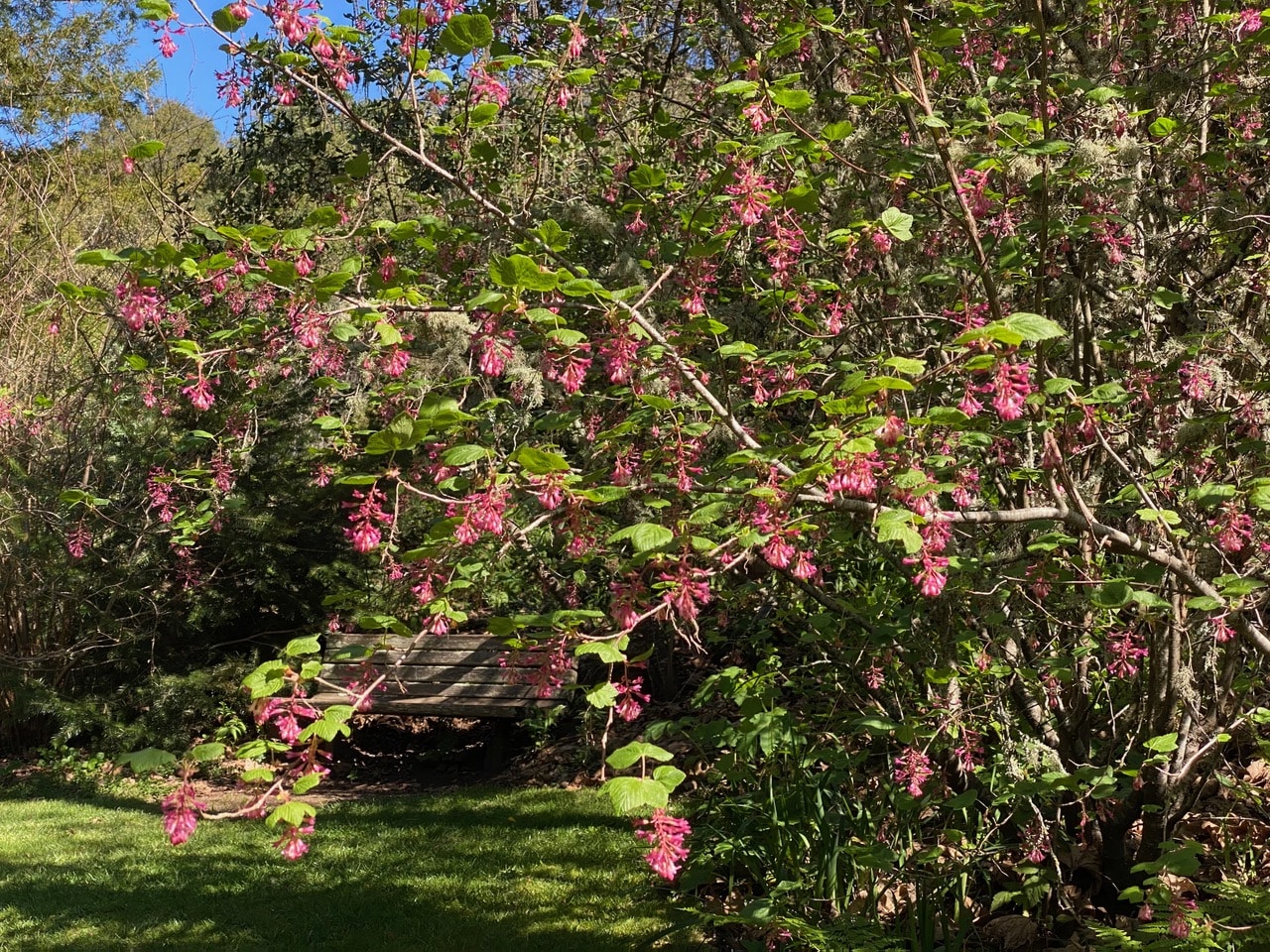
The large Red-flowering Currant, Ribes sanguineum is blooming prolifically in partial shade under tall trees.

Several Pacific Digger Bees, Anthophora pacifica (family Apidae), all females, are zipping around the Ribes flowers. Note the yellow pollen in the scopa of this female’s hind leg. Male bees do not collect pollen, neither do they possess the scopae.
Scopae (singular: scopa) are specialized, dense, and often branched hairs on the hind legs or abdomen of female bees used to collect and transport pollen, acting like a “broom” or brush. Most solitary bees have leg scopae, while Megachilidae (leafcutter/mason bees) have them on their abdomens. They are crucial for foraging, distinct from corbiculae (pollen baskets) on the bumble bees and honey bees. In the scopae, pollen grains are held loosely with electrostatic attraction, and not moistened with nectar or saliva as in pollen baskets. It is believed that bees with scopae are better pollinators as pollen can fall off more easily.
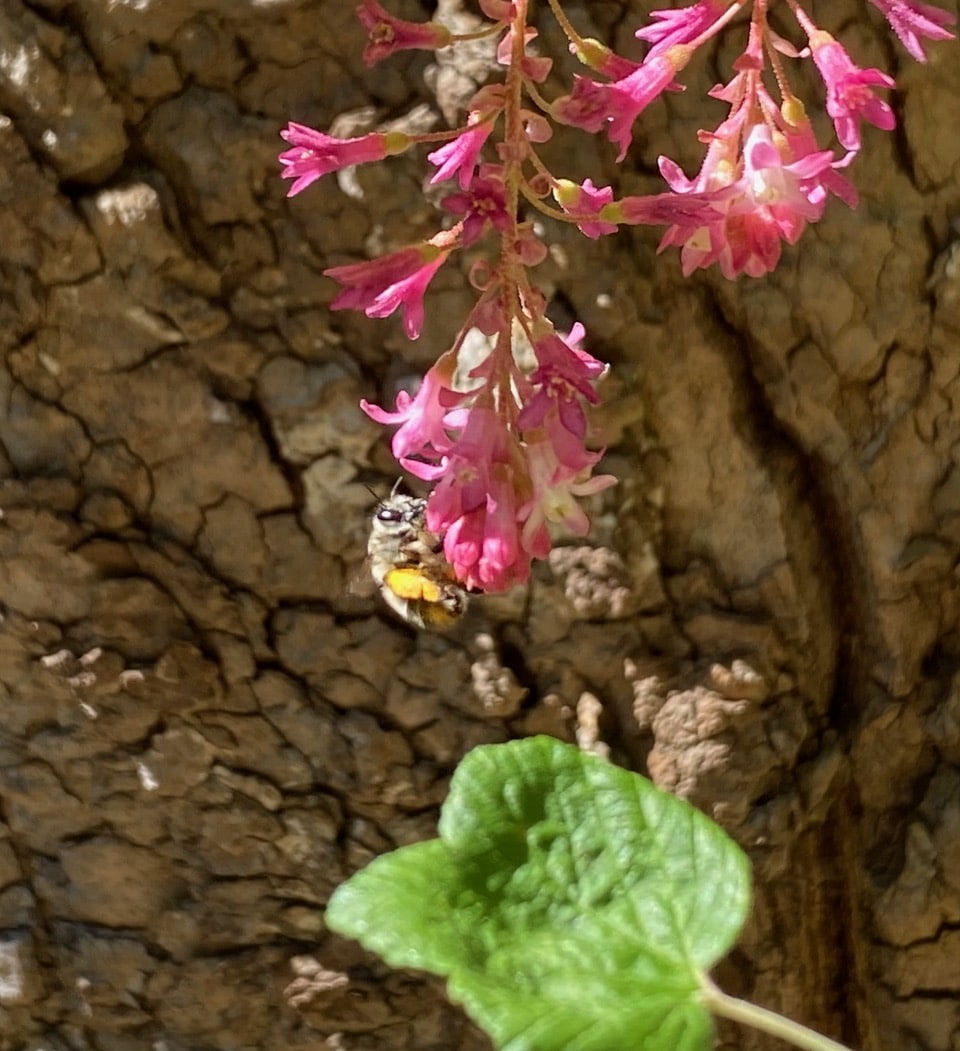
A female Pacific Digger Bee is foraging on a pendant inflorescence of Red-flowering Currant.
As their name implies, the Digger Bees nest in the ground, sometimes in huge aggregations. These fast and noisy flyers buzz around flowers, appearing to “hop” from flower to flower while foraging. The chubby, furry Digger Bees resemble the bumble bees in many ways, but are a lot noisier. They are a fearless, rowdy lot – fun to watch but a challenge to photograph. Male digger bees of many species have white or yellow integuments on their faces. Females have shaggy hairs on their back legs, used to carry pollen. Female Anthophora are capable of buzz pollination – i.e. they vibrate their wing muscles to shake pollen from the anthers of some flowers. Digger bees are generalist pollinators that visit an impressively wide range of plants. They are exceptionally effective pollinators and play an important role in maintaining wildflower diversity, in part because their long tongues allow them to pollinate deep-throated and tubular blossoms inaccessible to other bees.
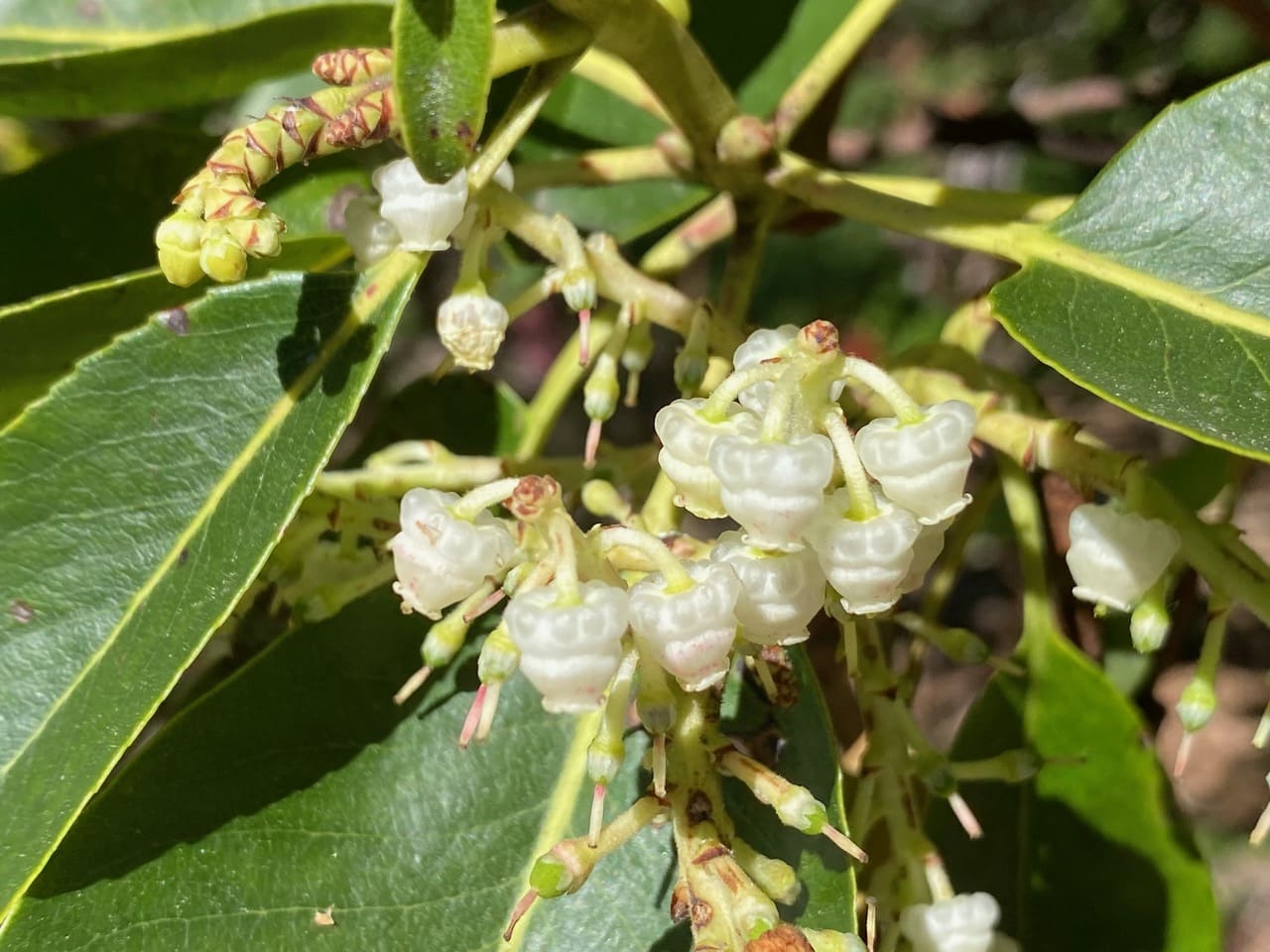
A low-hanging branch of Pacific Madrone, Arbutus menziesii provides a rare view of its flowers.
The Pacific Madrone, Arbutus menziesii features small, fragrant, urn-shaped flowers that are white to light pink and having a delicate, waxy, and sometimes translucent appearance. They are perfect (containing both male and female parts) and measure about 8 mm in size. The flowers grow in dense, terminal clusters (panicles/racemes) that droop from the ends of branches. The floral morphology is characteristic of the Ericaceae (heath) family, shared by manzanitas and huckleberries. The flowers are highly attractive to bees and hummingbirds.
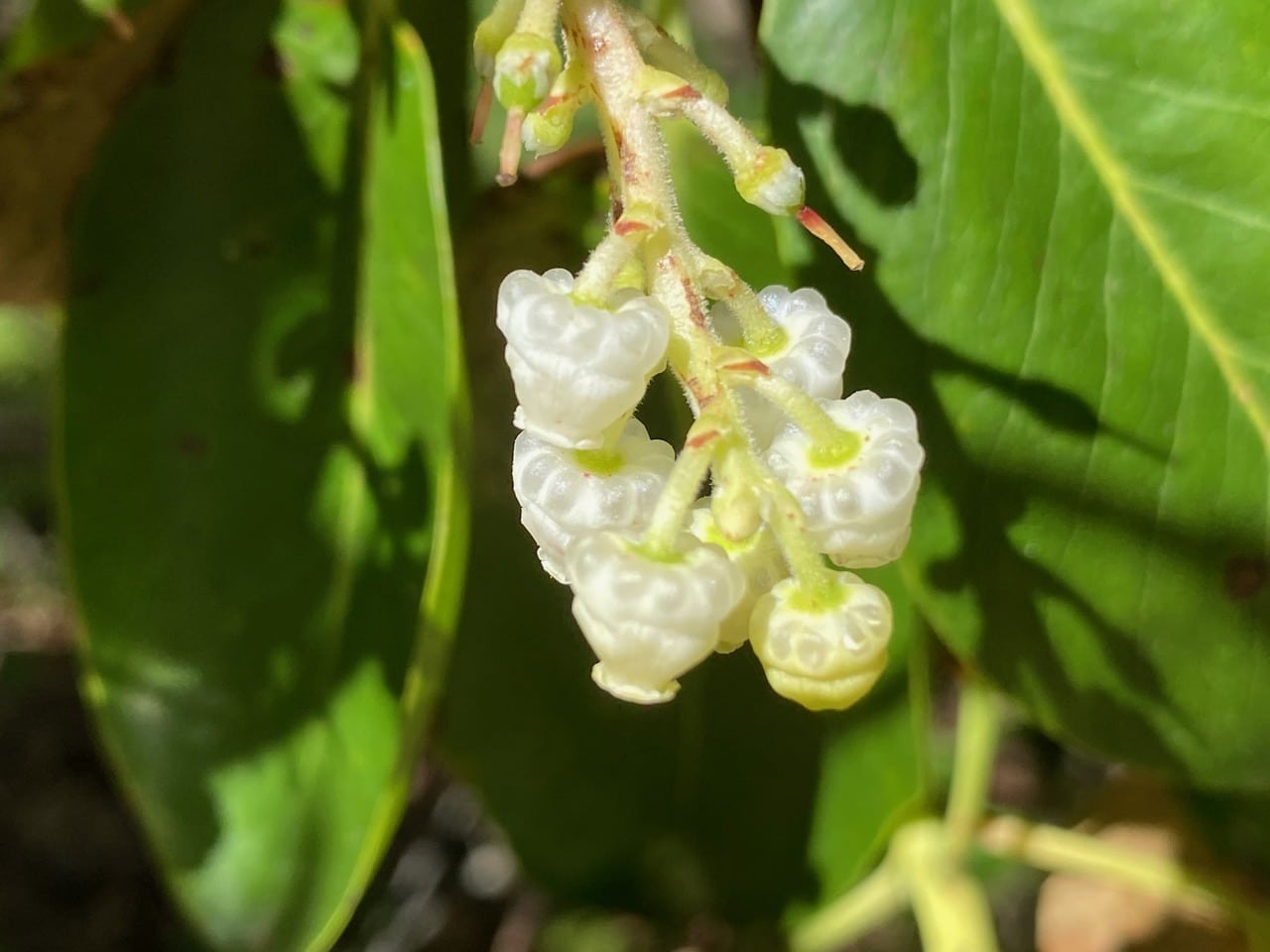
I am intrigued by the bubble-like translucent “skylights” arrayed around the top half of the Madrone flower. Many Manzanita flowers have these too, albeit less prominent. Do they allow sunlight in to lure insects toward the location of the reproductive parts? Does the extra illumination serve to warm up the interior to aid the development of the reproductive structures that never see the light of day because they are entirely enclosed within the inverted corolla? These are the same questions I have for the Manzanita flowers. Unfortunately I have not found any literature that addresses this odd floral morphology.
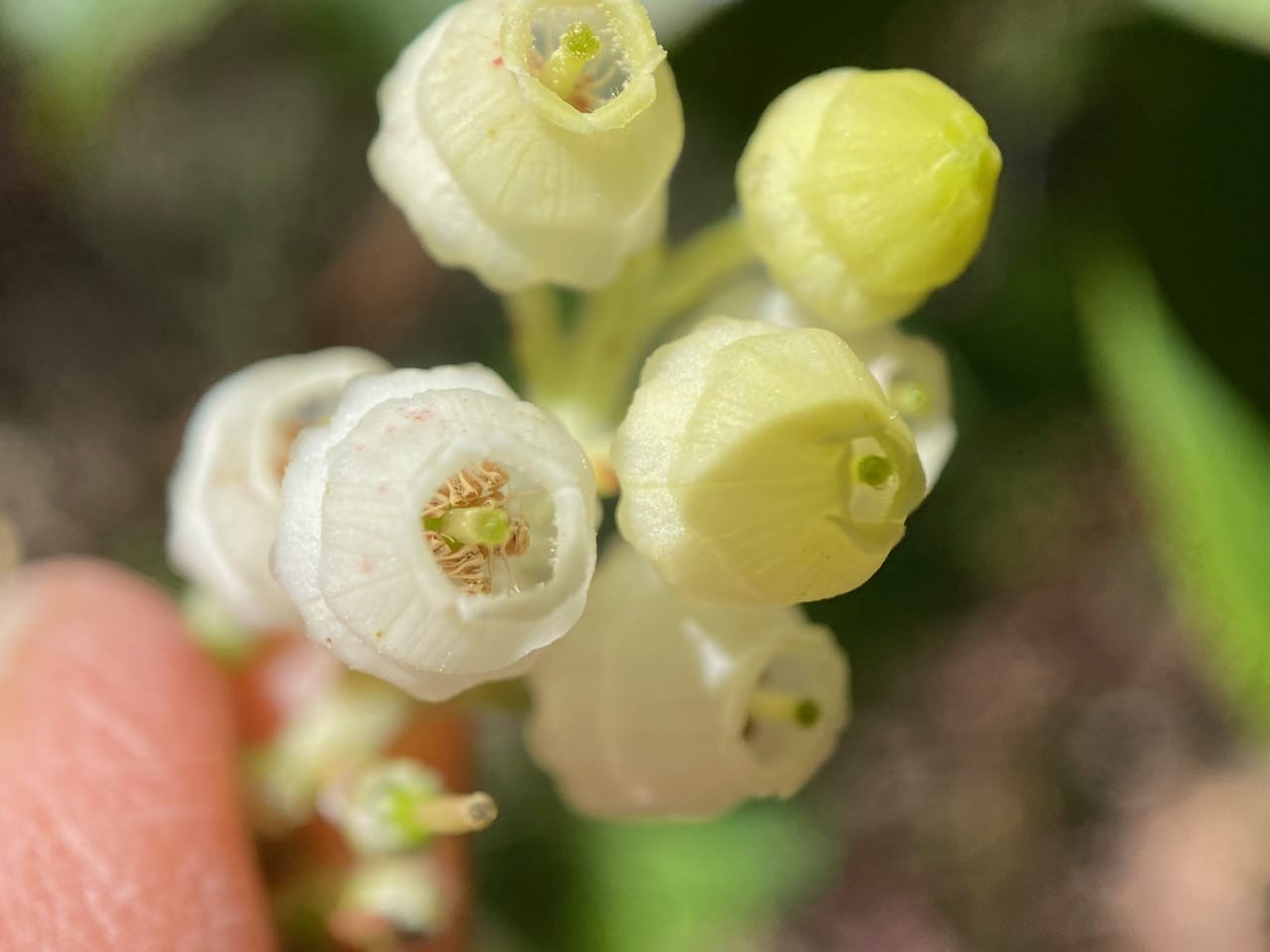
I lift the branch to look inside the small flowers. Since Madrone and Manzanita both belong to the same family, Ericaceae, I expect the two to have similar flowers that require special insects for buzz pollination. However, I don’t see poricidal anthers surrounding the central style as in manzanita flowers. What are those fibrous looking things obscuring the anthers?
I have subsequently learned that inside the urn-shaped corolla of the Madrone flower, there are ten stamens, each bearing anthers that produce pollen. The anthers are distinct, featuring two bag-like compartments that split open longitudinally to release pollen. The anthers are “awned” (bearing small, hair-like appendages) on the back. Due to the downward-hanging nature of the flowers, pollen falls through the slits in the anthers, often aided by the hair-like appendages vibrating when bees visit. In contrast, Manzanita flowers have poricidal anthers with terminal pores through which pollen is shaken out by vibrating bees.
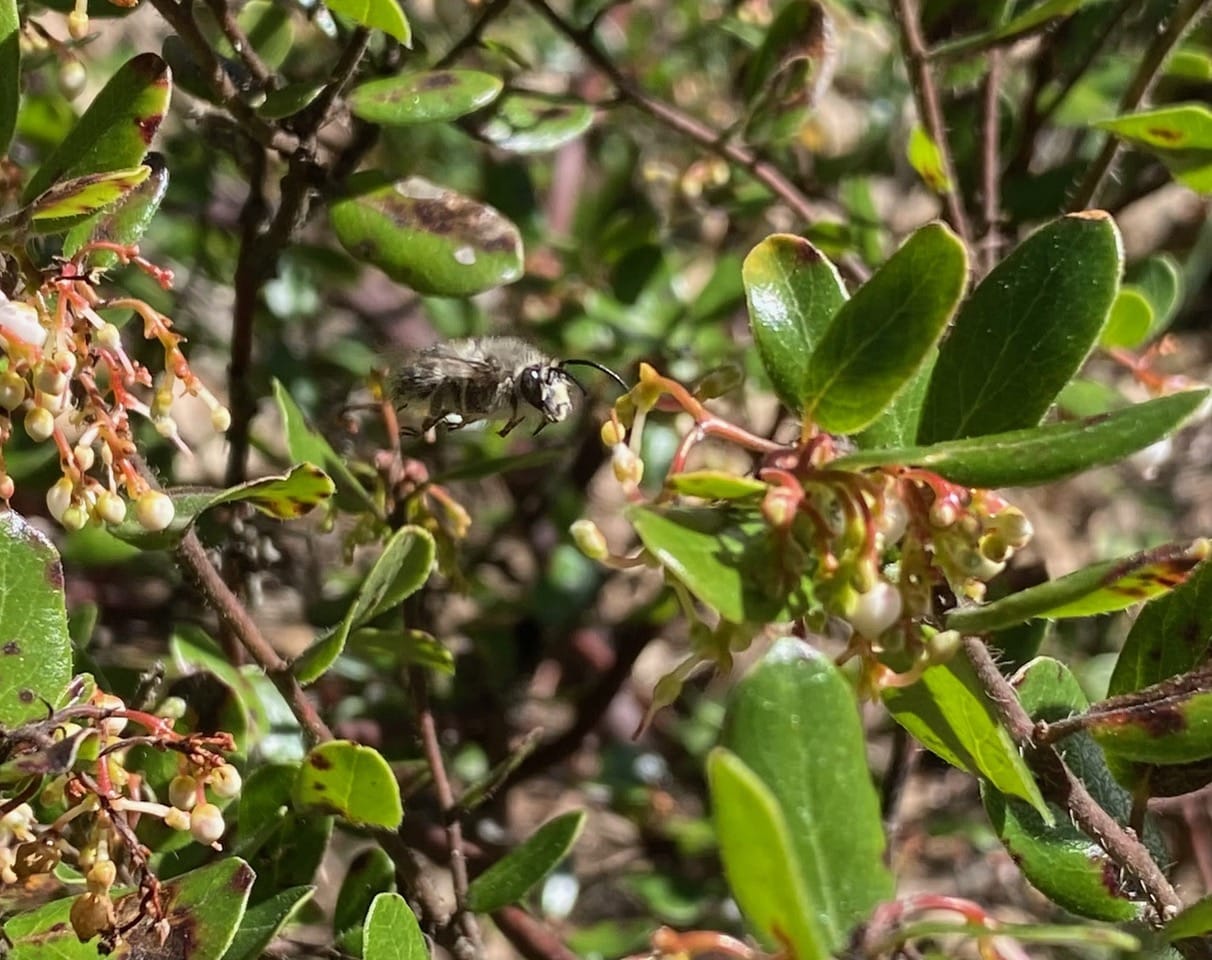
A male Pacific Digger Bee, Anthophora pacifica (family Apidae) is buzzing noisily around a manzanita shrub, stopping occasionally to take nectar from the flowers.
Male Anthophora bees are best identified by their bright yellow or white markings on the face (clypeus/labrum), often paired with longer antennae and, in many species, a more slender, fast-flying behavior. Conversely, females are more robust, possess entirely dark faces, and carry pollen on their hind legs.
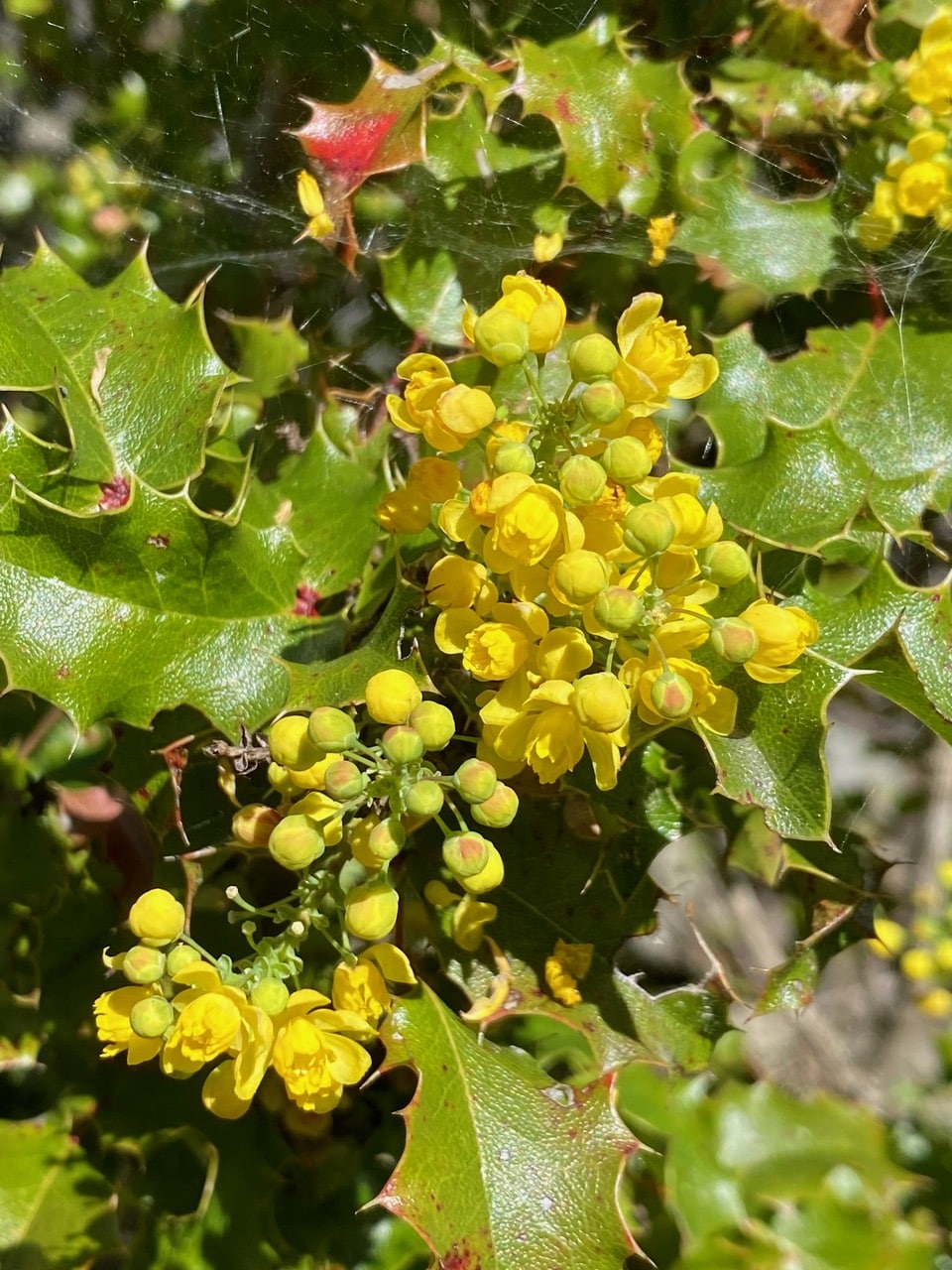
The Oregon Grape, Berberis aquifolium is blooming beautifully now. Surprisingly, there’s little insect activity on the flowers today.
Oregon Grape or holly-leaved barberry, Berberis aquifolium (family Berberidaceae), is an evergreen shrub growing up to 10 feet tall, with pinnate leaves consisting of spiny leaflets. Woody-stemmed and spreading by rhizomes, the new growth in the spring emerges in a light green to soft coppery-red color; at the other end of the year the foliage responds to colder weather by taking on shades of bright red to burgundy, brightening up the winter landscape. In early spring, the plant is topped with sprays of small, tightly clustered bright yellow fragrant flowers in a long-blooming display that attract bees and other pollinators. Following the bloom are clusters of dusky blue, round to oblong berries that are the “grapes” that give the plant its common name.
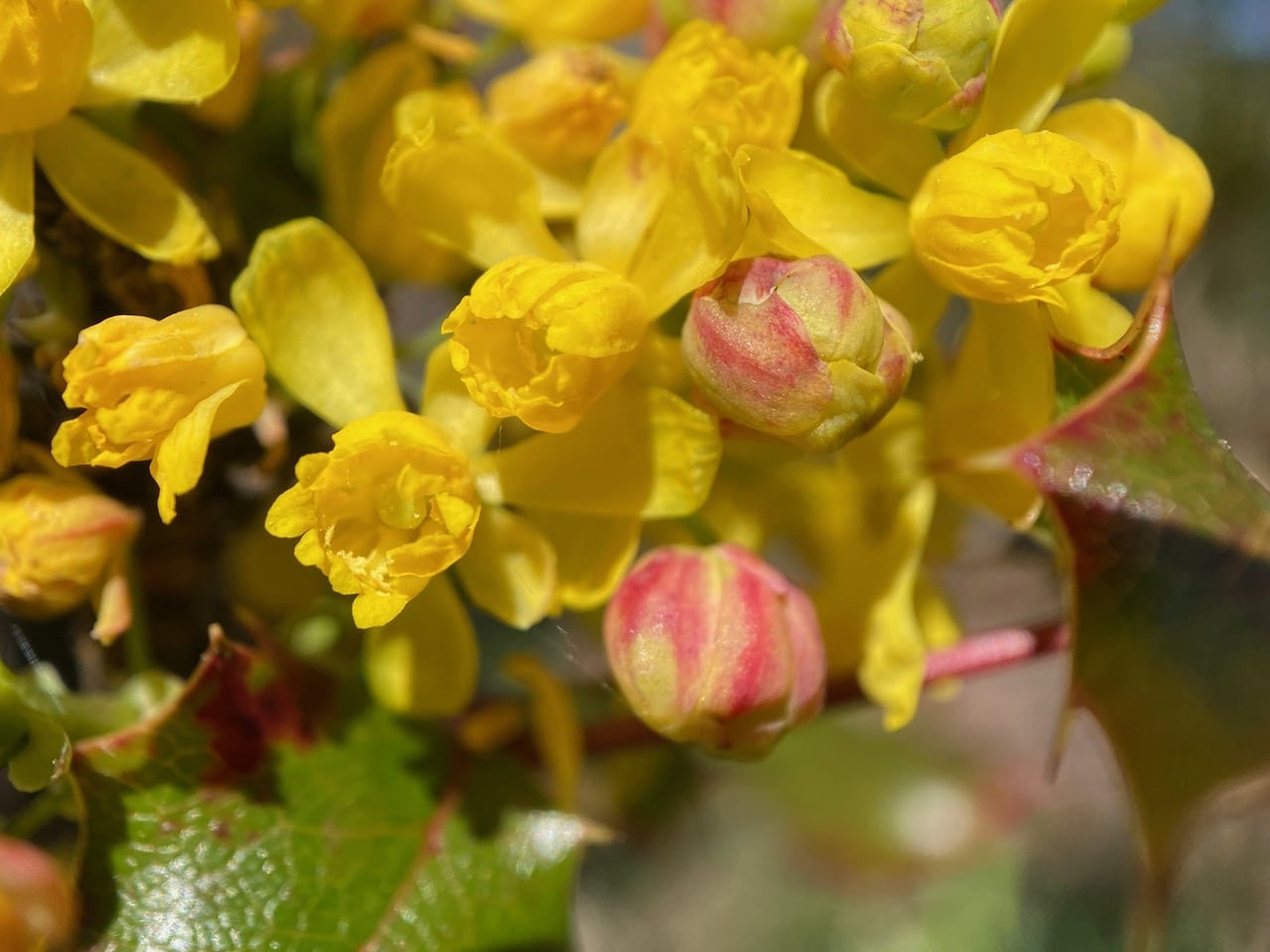
Oregon Grape flowers are borne in terminal clusters or spreading racemes. The fragrant, bright yellow flowers bloom in late winter or early spring. The 6 petals are enclosed by 6 sepals which are similar to the petals in appearance. The flower contains 6 stamens, which are opposite the petals. Each of the six stamens terminates in two spreading branches. The filaments of Berberis aquifolium are notable for having a distal pair of recurved teeth.
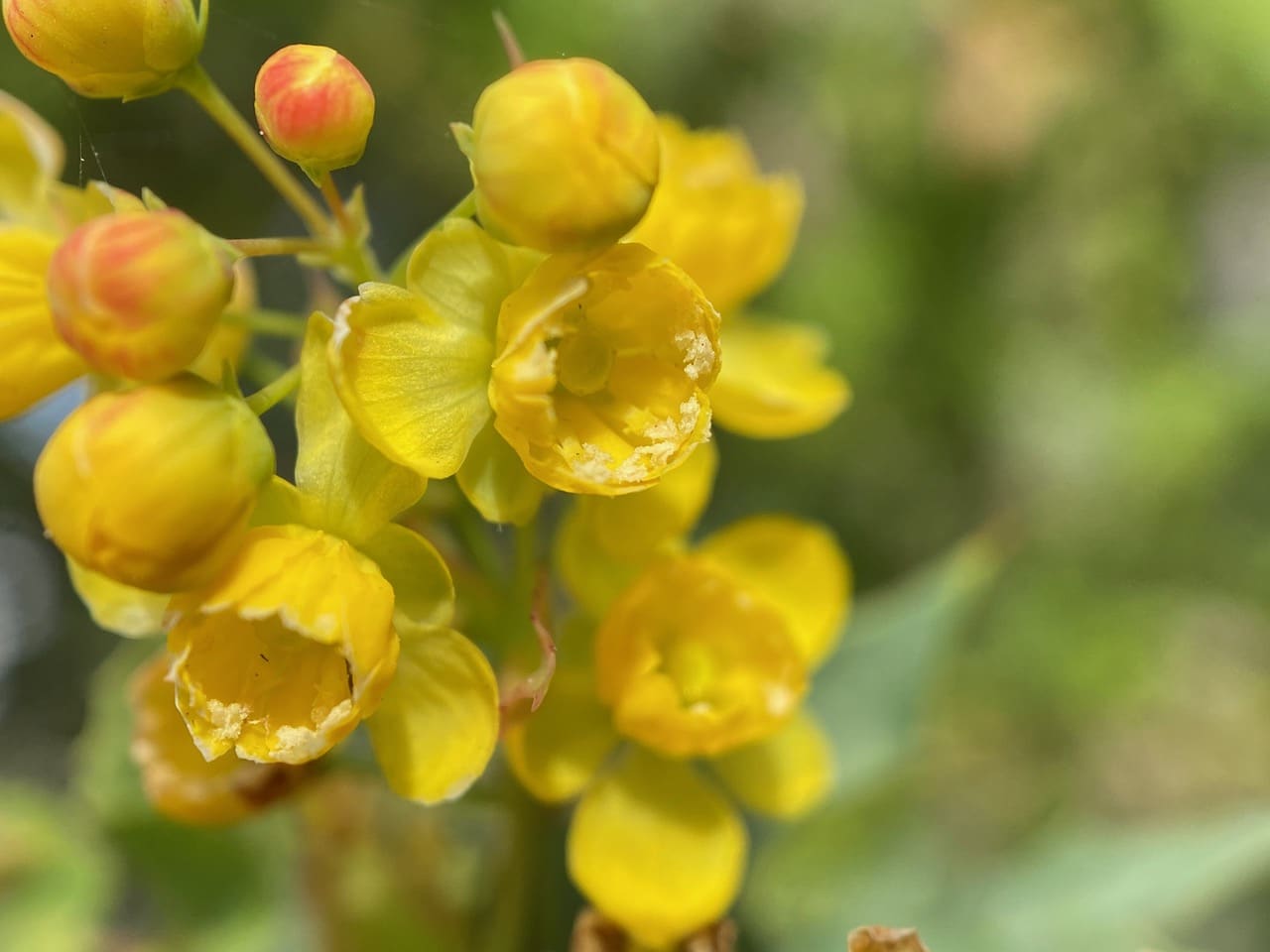
Here’s a better photo taken on 3/22/25 at Crab Cove. It shows the pollen-releasing anthers around the inside rim of the corolla.
The stamens of Berberis flowers are known for their tactile sensitivity, also called seismonasty, where upon contact, the filaments spring forward, potentially depositing pollen onto an insect’s tongue or face, aiding in pollination. When an insect probes the flower for nectar, its tongue or other part of its body may touch the base of the stamen filaments. This causes the filaments to rapidly spring forward, bringing the pollen-bearing anthers into contact with the insect. Besides enhancing pollination, the snapping mechanism is also thought to help the flower conserve its resources. By scaring the insect away the flower reduces the costs of insects lingering too long and exhausting the nectar supply.
Another remarkable feature of the Berberis flower is that the pollen is sticky, held together by viscin threads. Viscin threads are sticky, filamentous structures that are found on the surface of pollen grains in certain plant families. The viscin threads are made of sporopollenin, the same material as the pollen grain’s outer layer. They are like “ropes” that fasten pollen grains together to form clumps, and facilitate adhesion to visiting insects, enhancing transfer during the flower’s rapid, tactile stamen-snapping mechanism. They allow a high percentage of pollen to be deposited on a visitor in a single, triggered event.
Who would’ve thought these small flowers have so many tricks up their sleeve?!