

Pollinator Post 3/6/26 (1)
It’s a bright sunny morning – time to visit the Regional Parks Botanic Garden again!
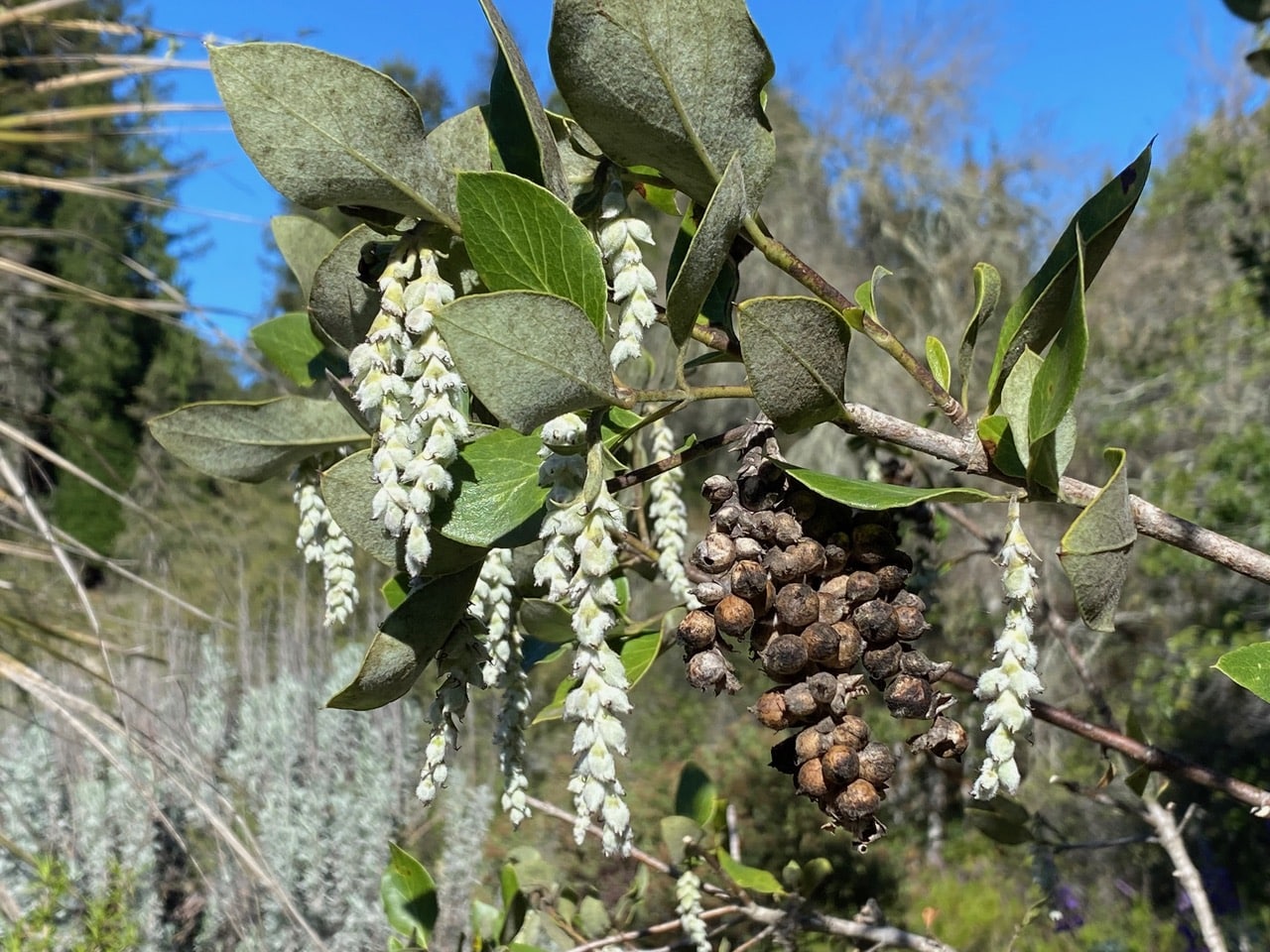
Female catkins hang gracefully from a Coast Silk Tassel, Garrya elliptica. While the bunches of brown fruits from last year tell us the plant is female, the short catkins also attest to the shrub’s gender.
The Coast Silk Tassel, Garrya elliptica (family Garryaceae) is an evergreen shrub or small tree. It is dioecious, meaning male and female flowers are borne on separate plants. Flowers appear in winter, male catkin-like clusters are yellowish to greenish then gray, 8-20 cm long (“silk tassels”), female flower clusters are shorter, 5-9 cm long.
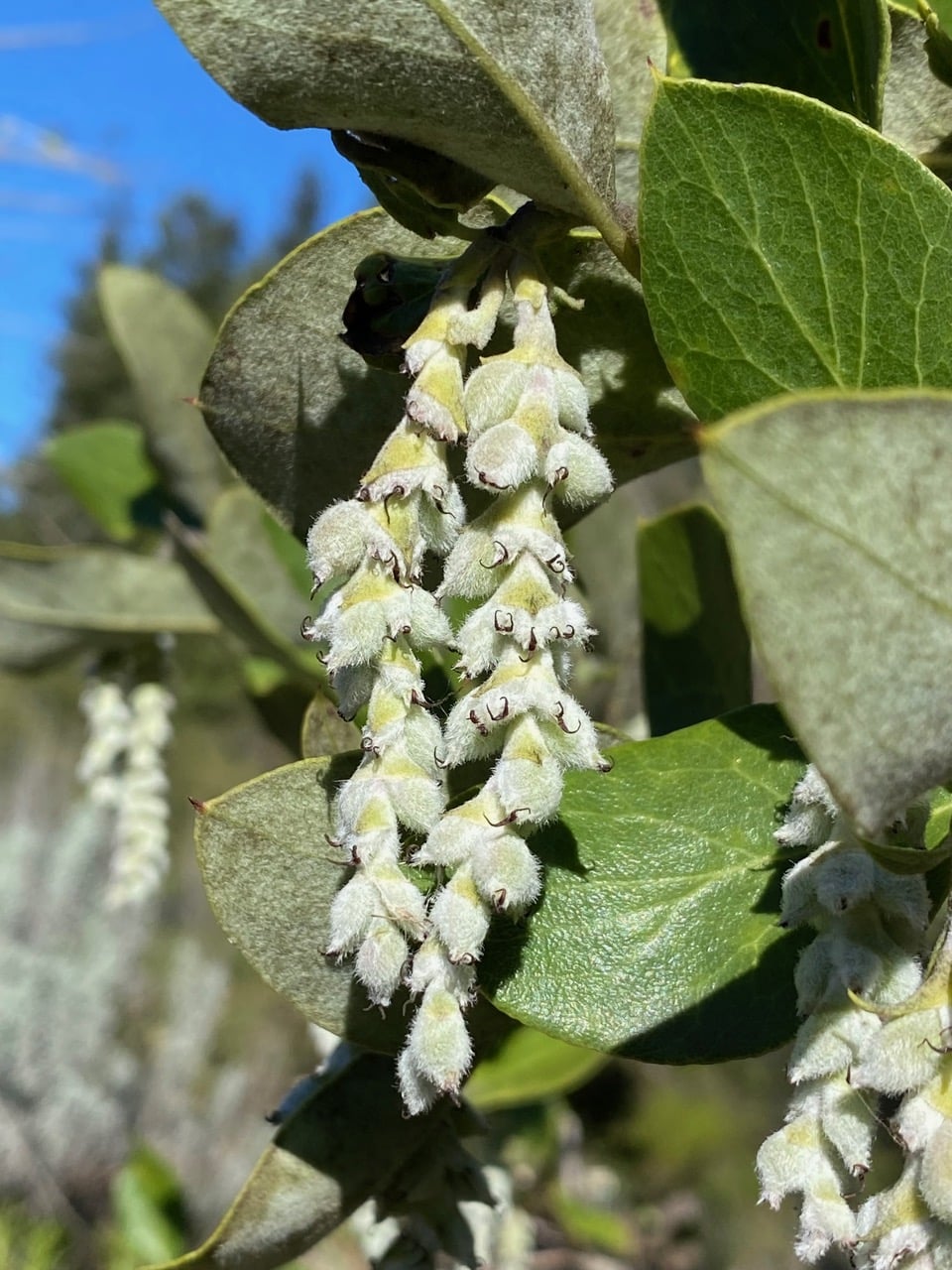
Closer examination of the female catkins of Coast Silk Tassel reveals simple styles protruding from the bell-shaped cups of the flowers in the hanging chains. The stigmas on the tips receive airborne pollen from nearby male catkins.
Coast Silk Tassel is an example of plants that are wind pollinated. About 12% of flowering plants and most conifers are wind pollinated. These plants do not waste energy on flower features that attract animal pollinators; instead, their flowers generally have these characteristics:
– Small, petalless, and unscented, with muted colors.
– No nectar
– Stamen (male flower part) and stigma (female pollen-receiving part) are exposed to air currents.
– Male flowers produce a great deal of pollen, which is very small, dry, and easily airborne.
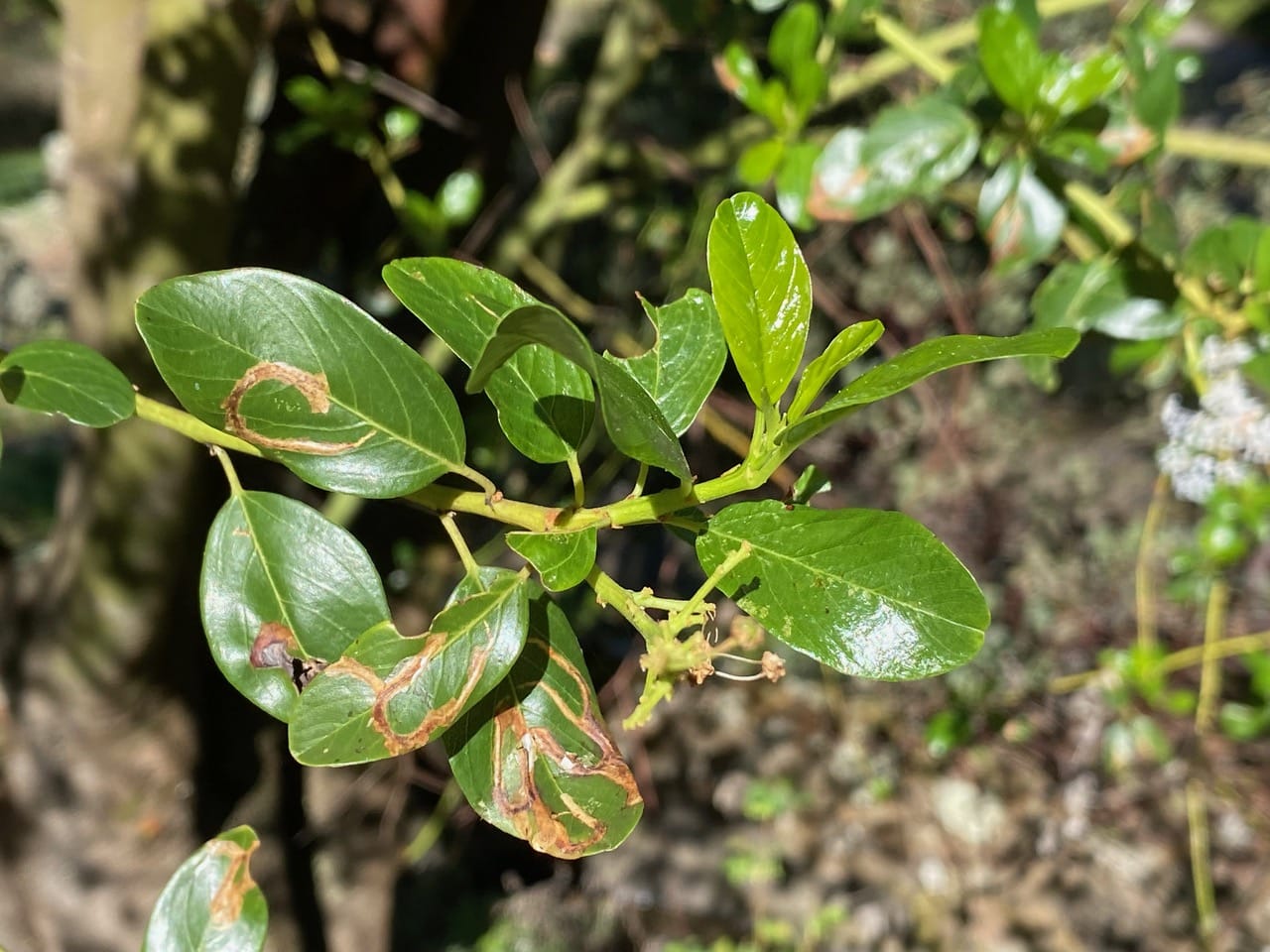
This large, pale-flowered Greenbark Ceanothus, Ceanothus spinosus has its branches reaching into the garden path. I can’t help noticing the leaves that are disfigured with brown lines. iNaturalist has helped identify them as the work of the Leaf-miner Flies, Phytomyza sp. (family Agromyzidae).
The Agromyzidae are a family commonly referred to as the Leaf-miner Flies, for the feeding habits of their larvae, most of which are leaf miners on various plants. They are small flies, most species in the range of 2-3 mm. Agromyzidae larvae are phytophagous, feeding as leaf miners, less frequently as stem miners or stem borers. A few live on developing seeds, or produce galls. There is a high degree of host specificity. A number of species attack plants of agricultural or ornamental value, so are considered pests. The shape of the mine is often characteristic of the species and therefore useful for identification. Adults occur in a variety of habitats, depending on the larval host plants.

I almost walk right past this little blue butterfly basking on a branch of Ceanothus. Its pale blue color perfectly matches the fading flowers. The butterfly is a Common Checkered Skipper, Burnsius communis (family Hesperiidae).
Because of its small size, bluish color, and spread-wing posture, the butterfly is often mistaken for one of the “Blues” in the family Lycaenidae. Skippers have the antennae clubs hooked backward like a crochet hook, while the typical butterflies have club-like tips to their antennae. Skippers also have generally stockier bodies and larger compound eyes.
Checkered Skippers belong to the subfamily Pyrginae, commonly known as spread-wing skippers, in the family Hesperiidae. Spread-wing skippers bask with their wings held wide open. The wings are held closed when they are at rest. Caterpillars make folded-leaf nests in which they live and feed on several plants in the mallow family, Malvaceae.
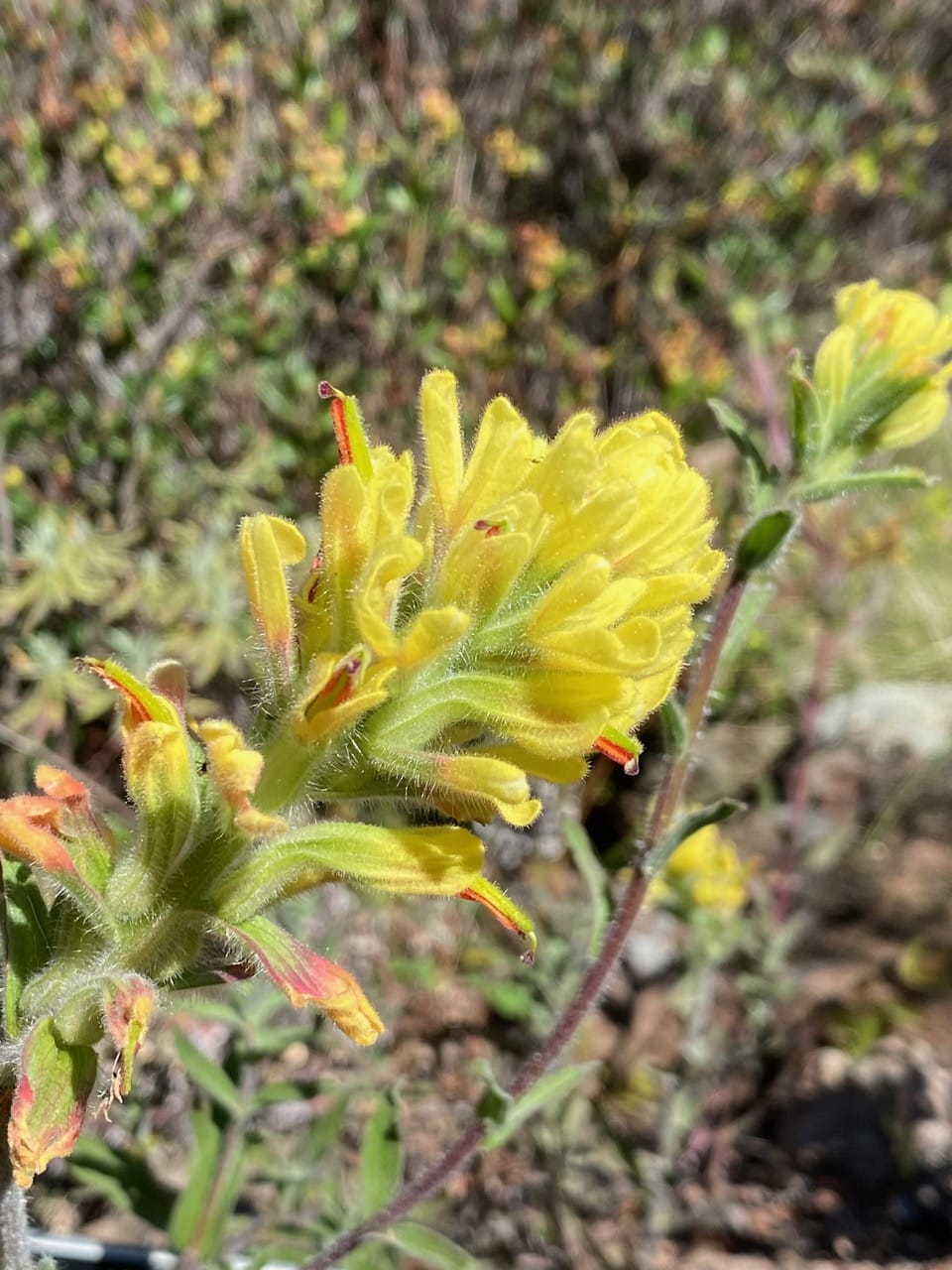
My favorite Indian Paintbrush in the garden is blooming! Although its lemon yellow bracts are not as eye-catching as the red of the more common varieties of the Coast Paintbrush, Castilleja affinis, the flowers are much more visible. The showy yellow structures on this paintbrush are technically not petals, but bracts, a type of modified leaf. The real flowers are quite visible in this view as they are partly red.
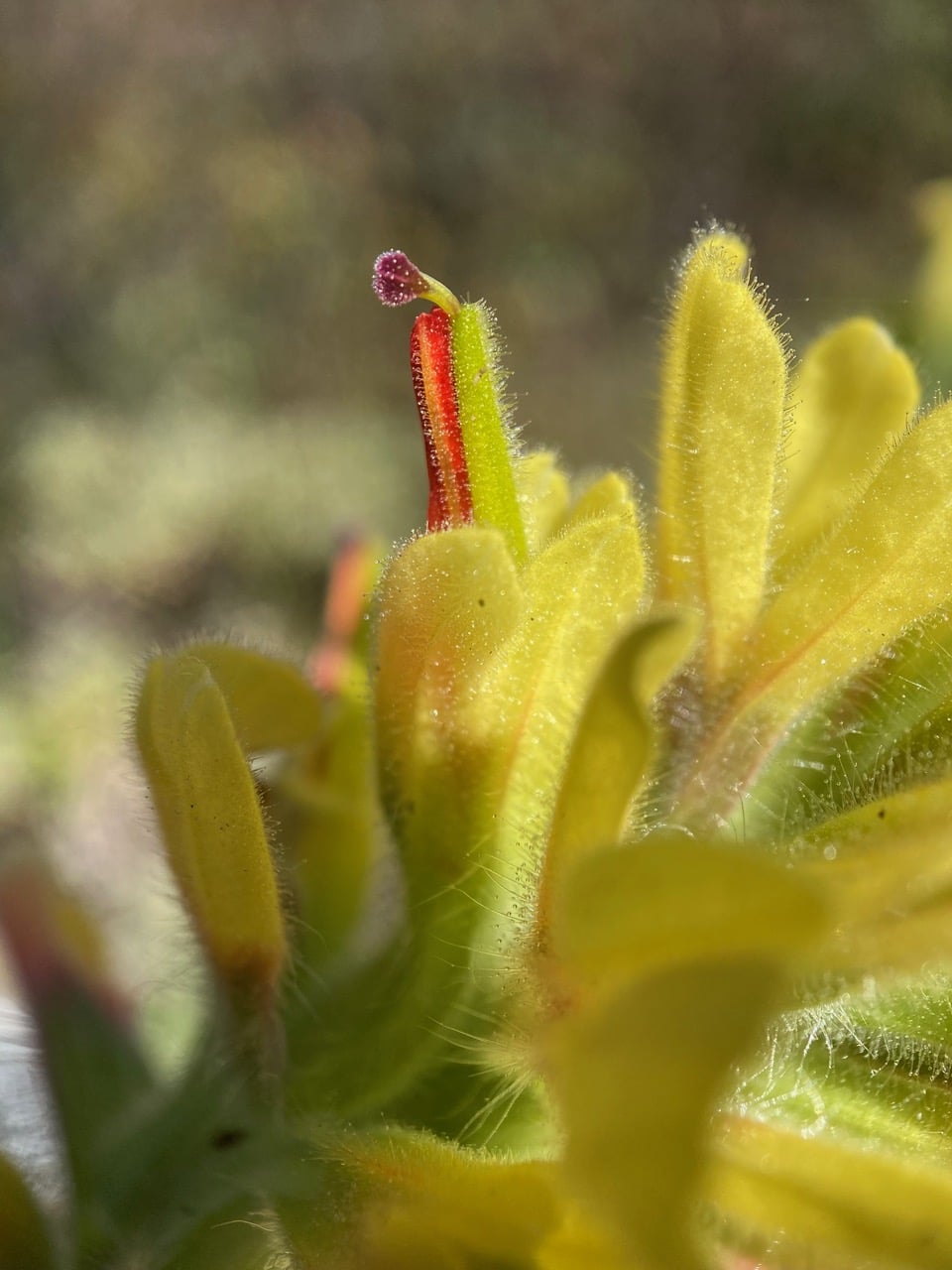
Close up of a flower of Coast Paintbrush, Castilleja affinis ssp. affinis.
The real flowers are tiny and oddly shaped. They would be inconspicuous if not for the red lower petal and maroon style. The large sepals are colored yellow similar to the surrounding bracts. The petals are curiously arranged, extending out into a long, pointed beak that envelops the stamens and style. The upper petal is green while the lower is red. The velvety maroon style protrudes beyond the corolla, while the stamens are located right behind the opening of the corolla. Indian Paintbrush flowers, typically with red bracts, are adapted for pollination by hummingbirds that have long slender bills capable of reaching the nectar rewards at the base of the flowers. It makes sense that this yellow paintbrush variety has red flowers – its yellow bracts would not attract hummingbirds who are attracted to red color. But will the birds find these tiny flowers? If I could spot them, I’m sure the hummers will have no trouble finding them.
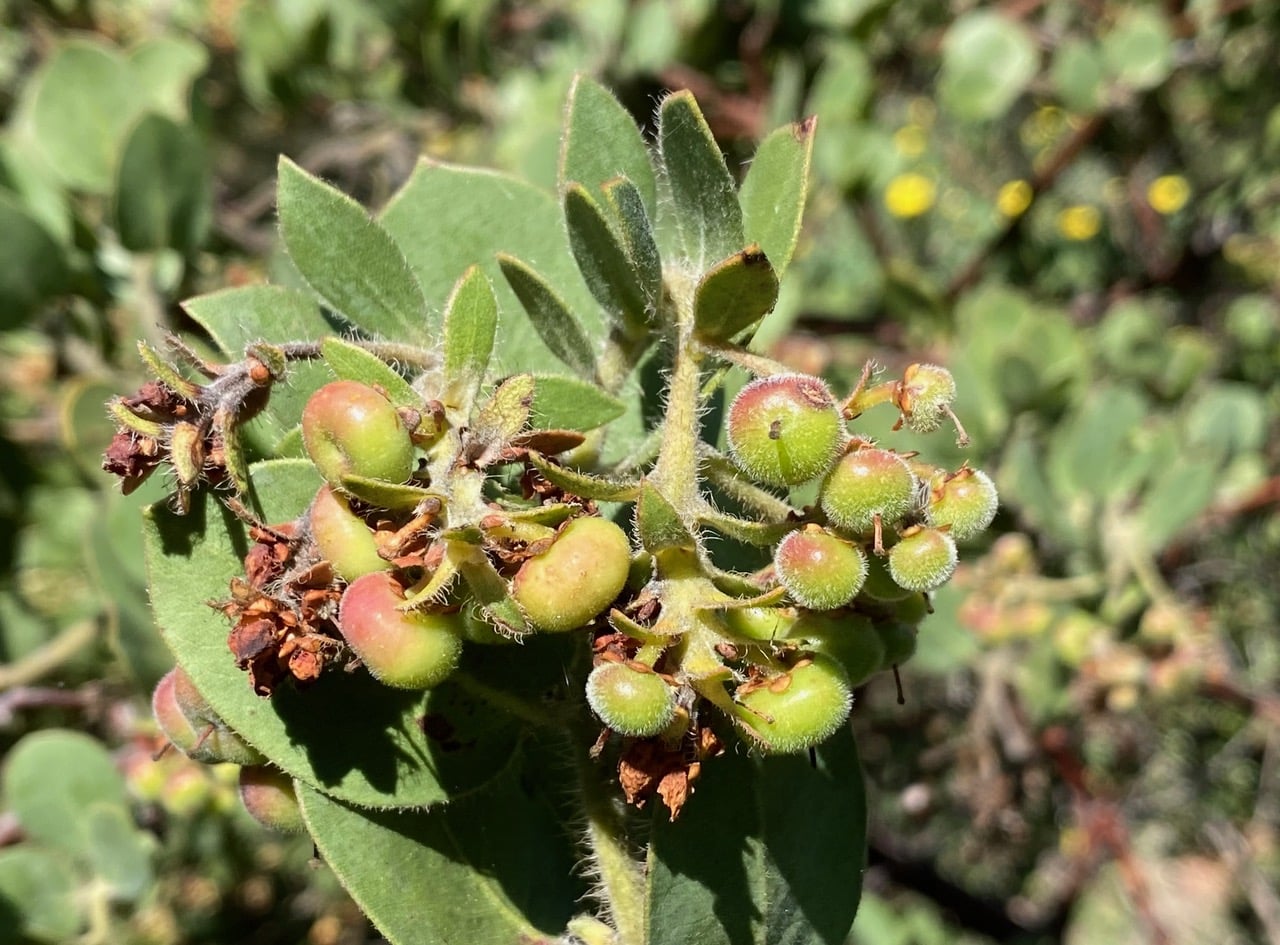
Most of the manzanitas in the garden are finished blooming, and well on their way to developing fruits. Luscious “little apples” are ripening on the tip of this manzanita branch. Manzanita is a common name for many species of the genus Arctostrphylos. The word manzanita is the Spanish diminutive of manzana meaning “little apples”. Manzanita fruit is technically a drupe, which means it has a large seed in the center surrounded by fleshy tissue and thin skin. Many animals eat manzanita fruits, including bears, deer, birds, and rodents. Coyotes and foxes help disperse the seeds in their droppings.
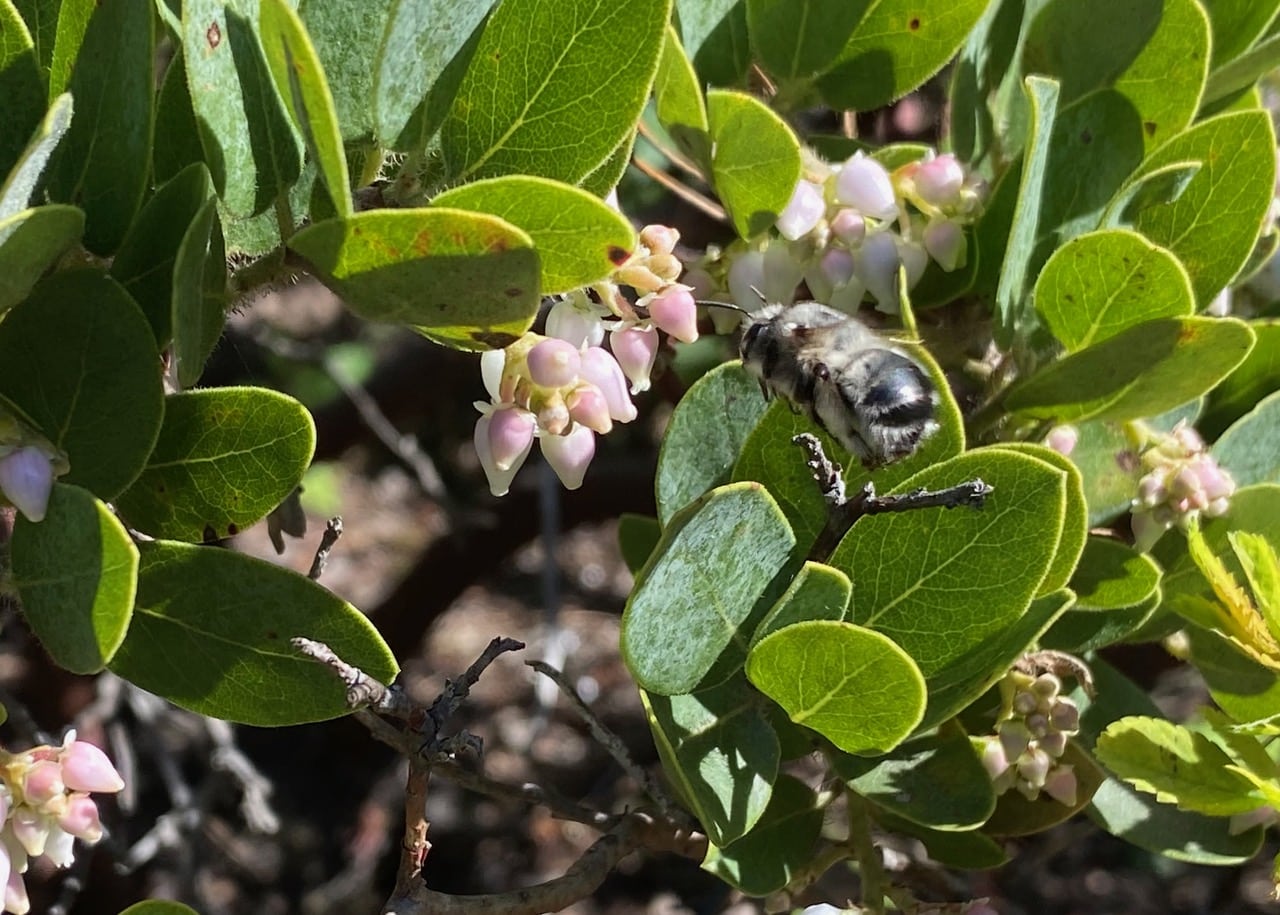
Unlike most of the fruiting manzanitas that have fallen silent of insect activity, this late-blooming manzanita is garnering a lot of attention. Numerous Pacific Digger Bees, Anthophora pacifica (family Apidae) are buzzing noisily around the large shrub. Compared to earlier in the season, there are many more females than males now. I don’t see a single Bumble Bee here – why?
As their name implies, the Digger Bees nest in the ground, sometimes in huge aggregations. These fast and noisy flyers buzz around flowers, appearing to “hop” from flower to flower while foraging. The chubby, furry Digger Bees resemble the bumble bees in many ways, but are a lot noisier. They are a fearless, rowdy lot – fun to watch but a challenge to photograph. Male digger bees of many species have white or yellow integuments on their faces. Females have shaggy hairs on their back legs, used to carry pollen. Female Anthophora are capable of buzz pollination – i.e. they vibrate their wing muscles to shake pollen from the anthers of some flowers. Digger bees are generalist pollinators that visit an impressively wide range of plants. They are exceptionally effective pollinators and play an important role in maintaining wildflower diversity, in part because their long tongues allow them to pollinate deep-throated and tubular blossoms inaccessible to other bees.

I never thought I would be fortunate enough to get this close to a Digger Bee. As luck would have it, one individual lands on a cluster of Manzanita flowers. Note the absence of yellow markings on its face, and the brush of long hairs on it hind legs. These features tell me immediately that the bee is female.
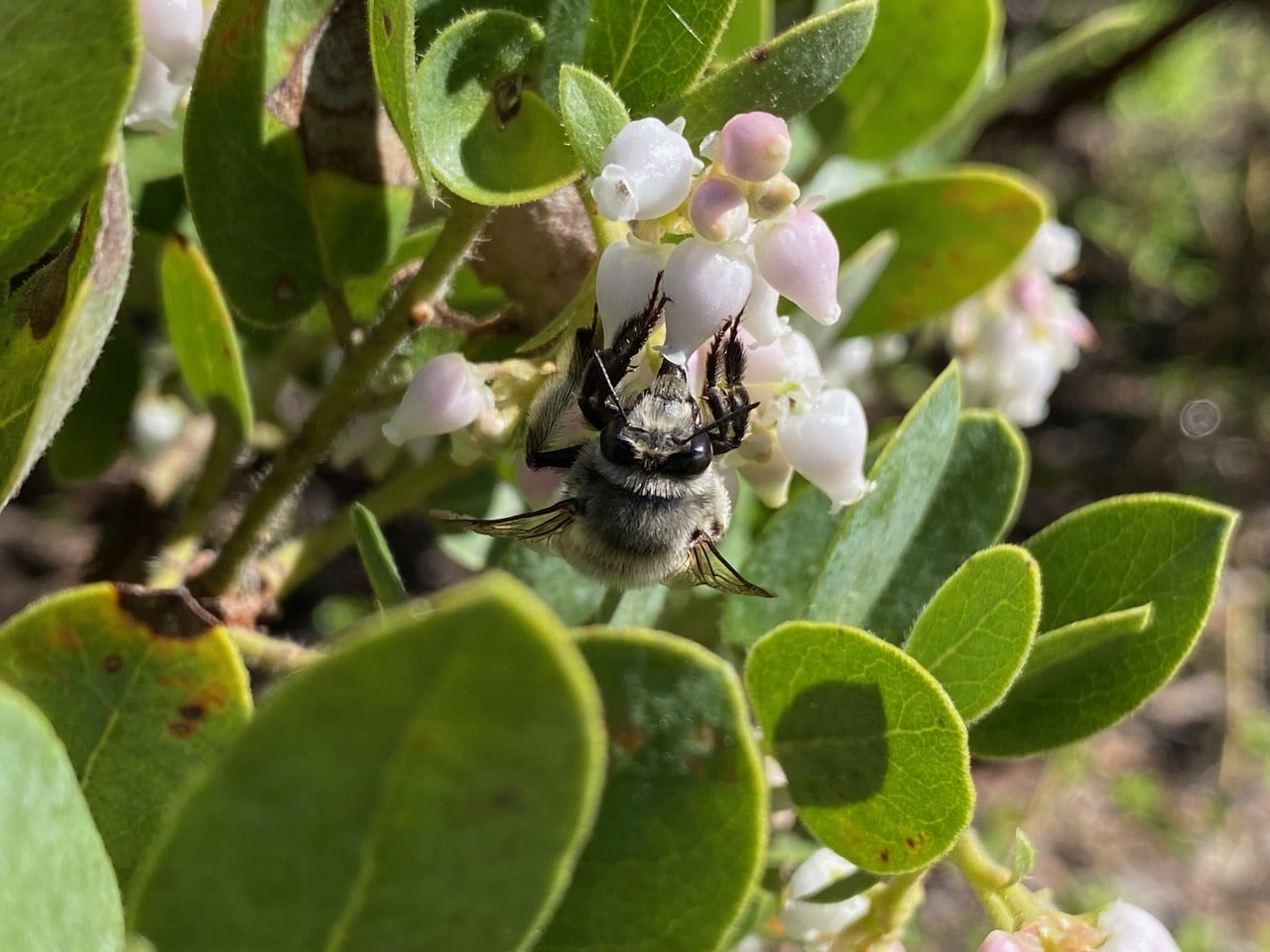
She hangs upside down from the flower cluster and probes for nectar with her proboscis. Digger Bees have long tongues that can reach deep nectar sources. The bee is not making any buzzing noise, as she is not collecting pollen.
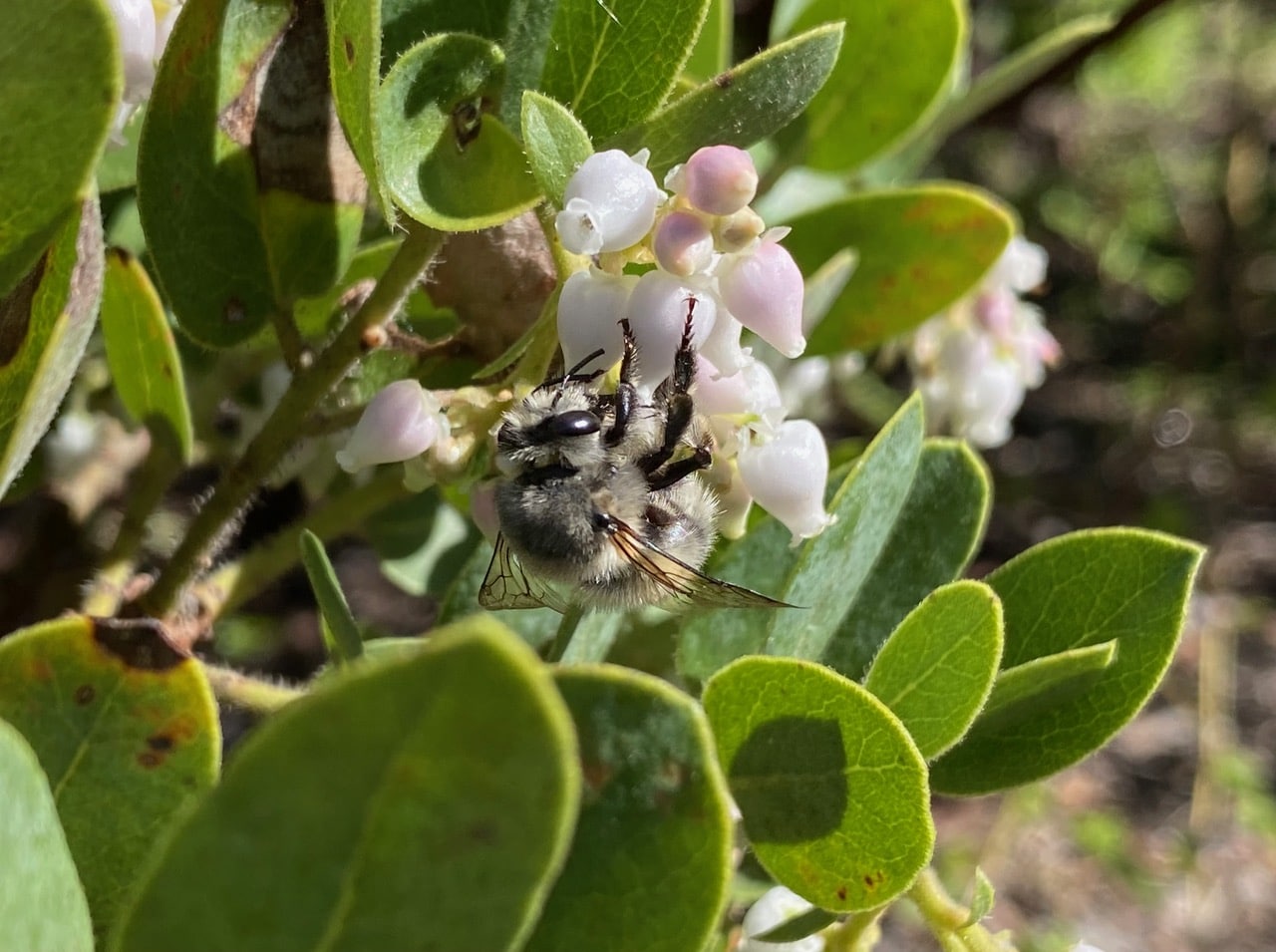
The bee is unusually cooperative, spending quite some time on the cluster, sticking her tongue into several flowers, one at a time in quick succession. This is the best close-up look I have had of a Pacific Digger Bee!
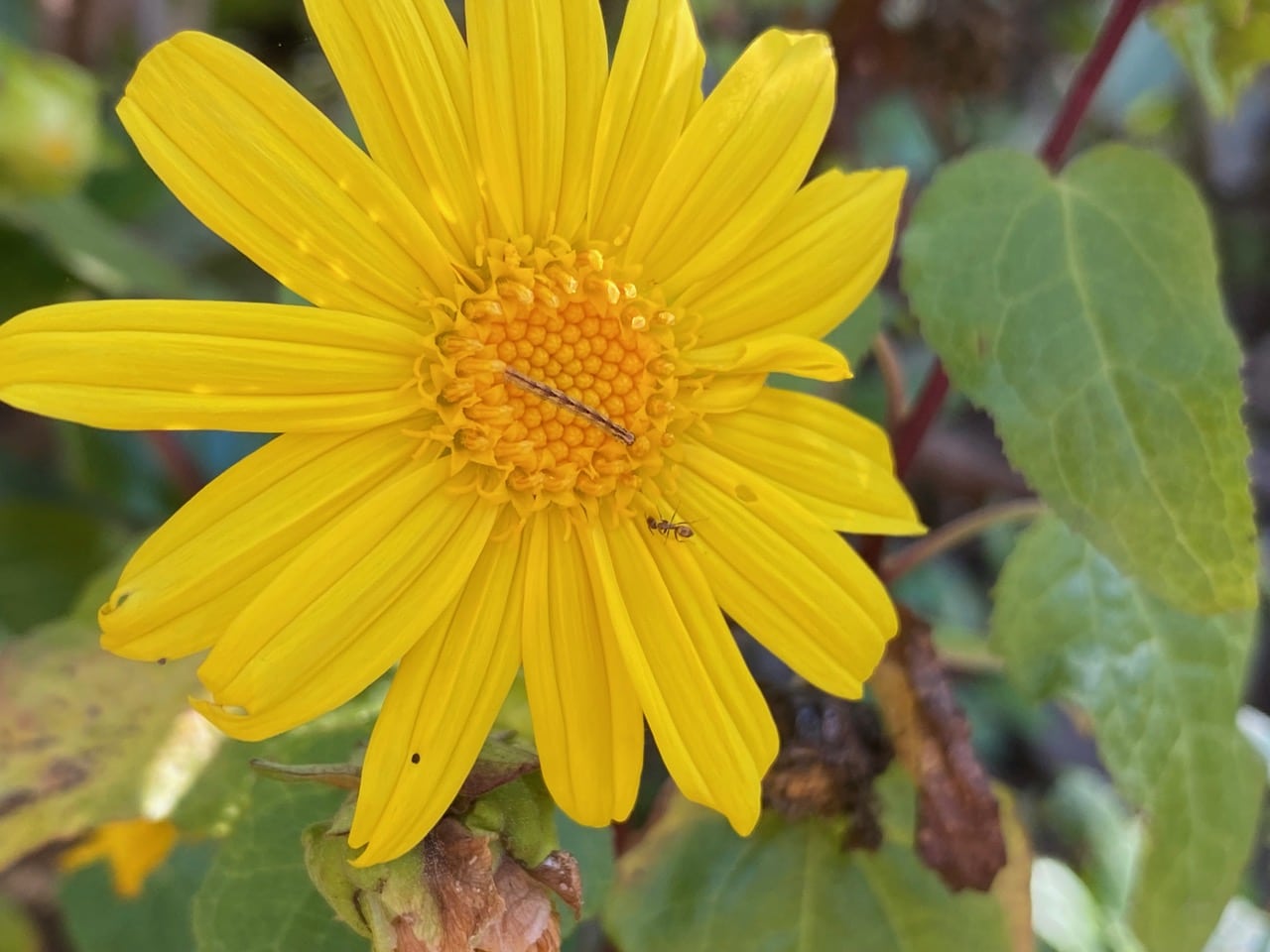
Ooh, a tiny Inchworm is stretched out on a flowerhead of a Canyon Sunflower, Venegasia carpesioides. From the maroon chevron markings along its body, I figure it is a Pug Moth caterpillar, Eupithecia sp. (family Geometridae).
Eupithelia is the largest genus of moths of the family Geometridae. Occurring worldwide except for Australasia, species in the genus are commonly known as pugs. The caterpillars move in a looping manner and are commonly called inchworms. Adults are typically small, 12 – 35 mm, with muted colors. Most species rest with forewings held flat at right angles to the body, while the hindwing are largely covered by the forewings. They are generally nocturnal. Larvae mostly feed from the flowers and seeds of their food plants rather than the foliage. Many species have a very specific food plant. Many are commonly found on Asteraceae flowers.
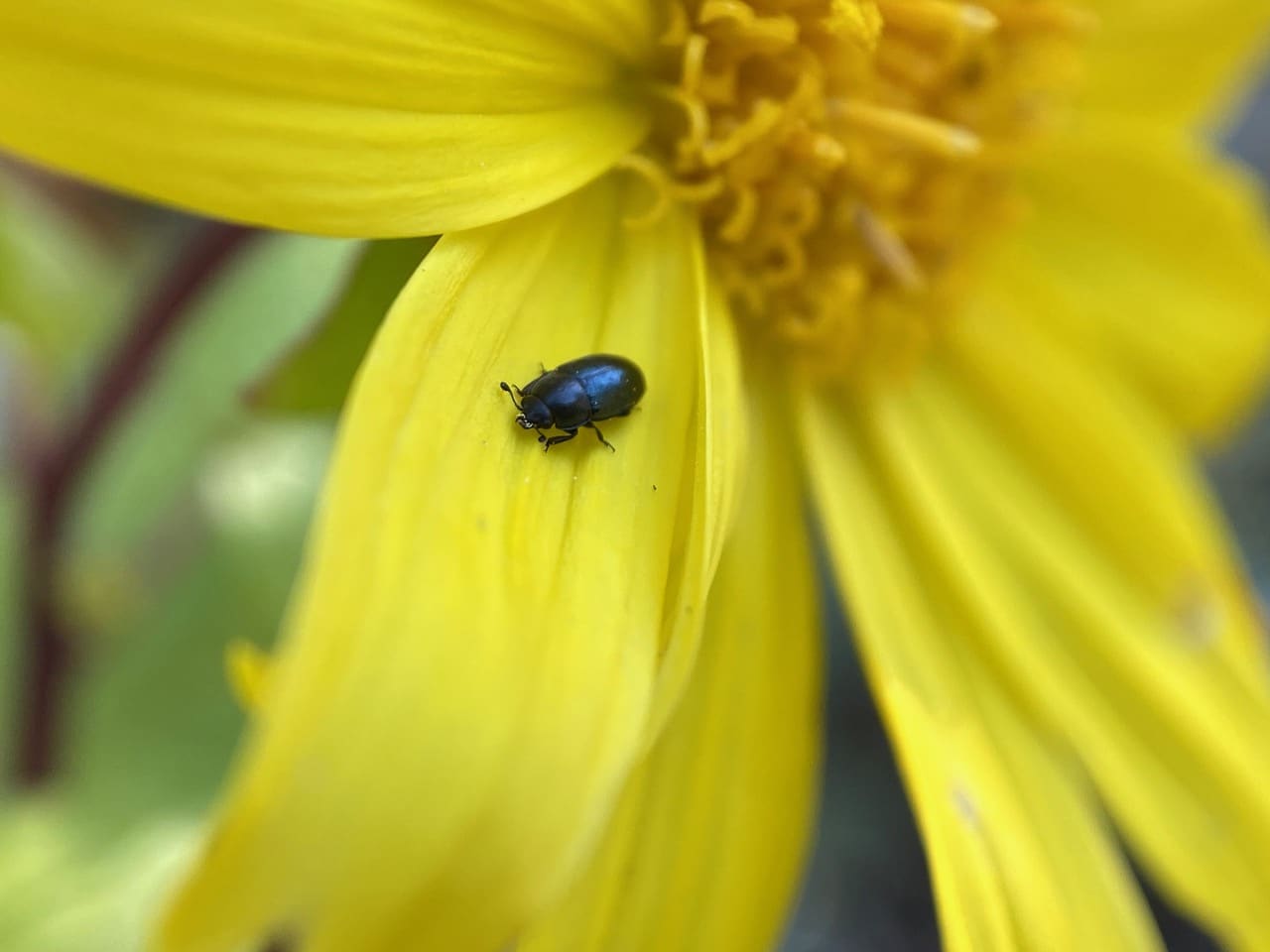
A tiny black beetle crawls onto a ray petal of the sunflower, its mandibles yellow with pollen. iNaturalist has helped identify it as a Common Pollen Beetle, Brassicogethes aeneus (family Nitidulidae).
The Common Pollen Beetle, Brassicogethes aeneus (family Nitidulidae) is found in Europe, Northern Asia and North America. Adults are 2-3 mm long, black with a hint of metallic green, and have knobbed antennae. It is a known pest of oilseed rape. It is unclear whether the beetles contribute to the pollination of the crop. The female beetle lays its eggs in the flower buds of the host-plant and the larvae develop within the flowers. Both adults and larvae feed on pollen and nectar in the flowers.
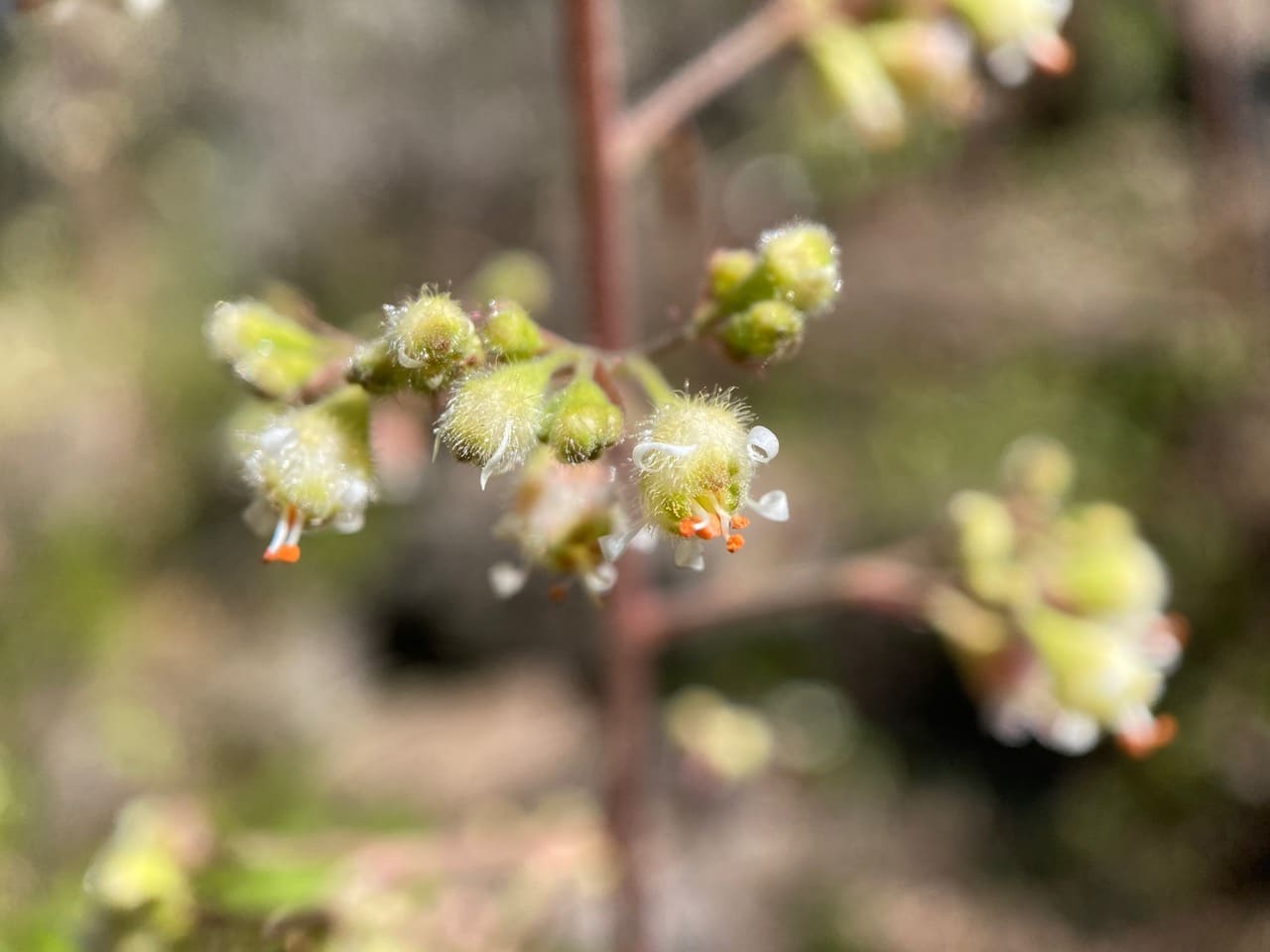
Found in various shady spots in the garden, the Alumroot, Heuchera sp. (family Saxifragaceae) is blooming profusely.
The bell-shaped flowers grow in groups of branching stalks, with four to five flowers per group (panicle). These branching stalks originate on a long leafless central stem (scape) that rises above the foliage.
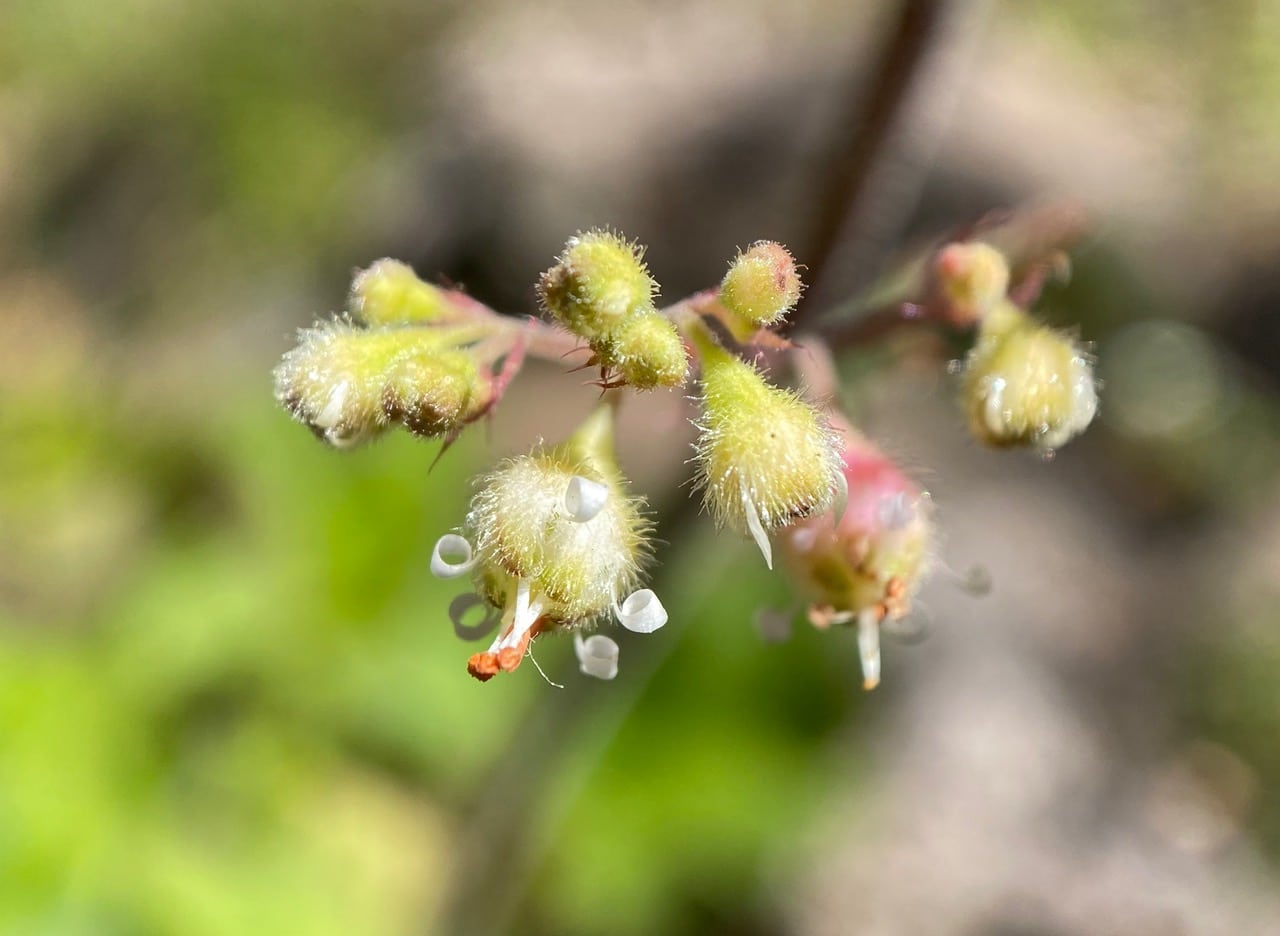
Close up, the charming flowers look like something conjured up by Dr. Seuss! The hairy flowers are bell-shaped, with five minute white petals appearing as curly straps rising between the fused calyx. Protruding from the flower are five stamens with large anthers, and a two-pronged style. Any insect that probes the flower for nectar would come away with lots of pollen as well.

It is difficult to see in this low, uneven light, but the insect on the Alumroot flower is recognizable as a Western Sedgesitter, Platycheirus trichopus (family Syrphidae).
The Sedgesitters are generally small to medium-sized flies, active from spring through autumn, frequently visiting flowers in gardens and woodland edges. Known as “flower flies”, adults are frequently found on plants feeding on nectar and pollen. They can hover almost motionless. Larvae are aphid-eaters, providing natural pest control. The hover fly is commonly found in grass, herb vegetation, and forest environments. Many stay active during cold and rainy weather. The Western Forest Sedgesitter is found in Western North America, from Alaska to California.
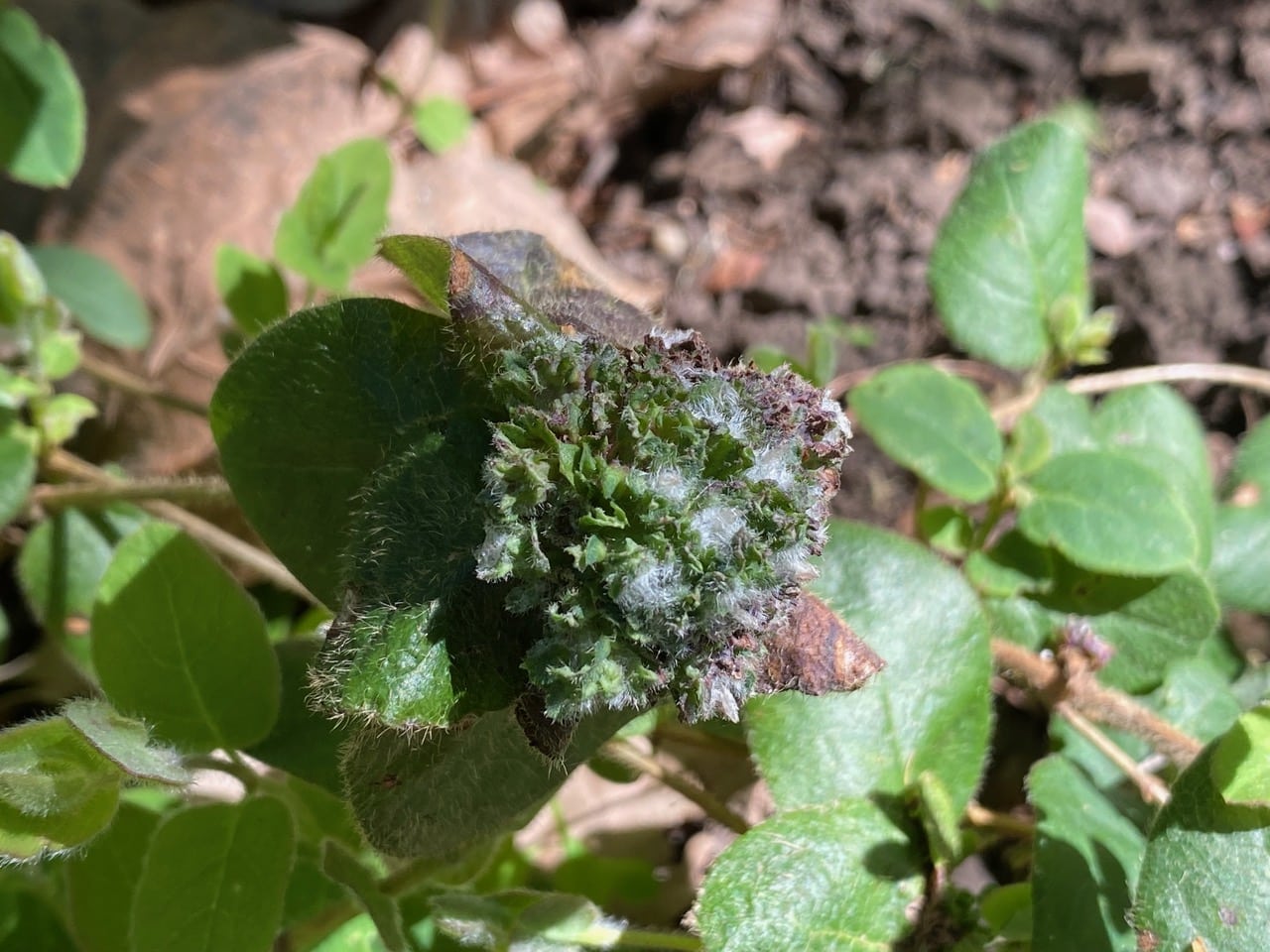
Ron Russo, plant gall guru and retired Chief Naturalist of the East Bay Regional Park District, will be pleased to learn that the gall that is named after him can be found in the Regional Parks Botanic Garden.
The Cabbage-bud-gall Midge, Lonicerae russoi (family Cecidomyiidae) induces conical, leafy bud galls on honeysuckle. While these rosette galls can occur singly, they usually appear in congested clusters that can reach 3 cm across. Each gall has a dense arrangement of white hairs filling its center, marking the entrance to the larval chamber. The galls exposed to direct sun often turn wine red. The larvae feed and eventually pupate within the galls. Adults emerge in late February and March by pushing through the hairs.
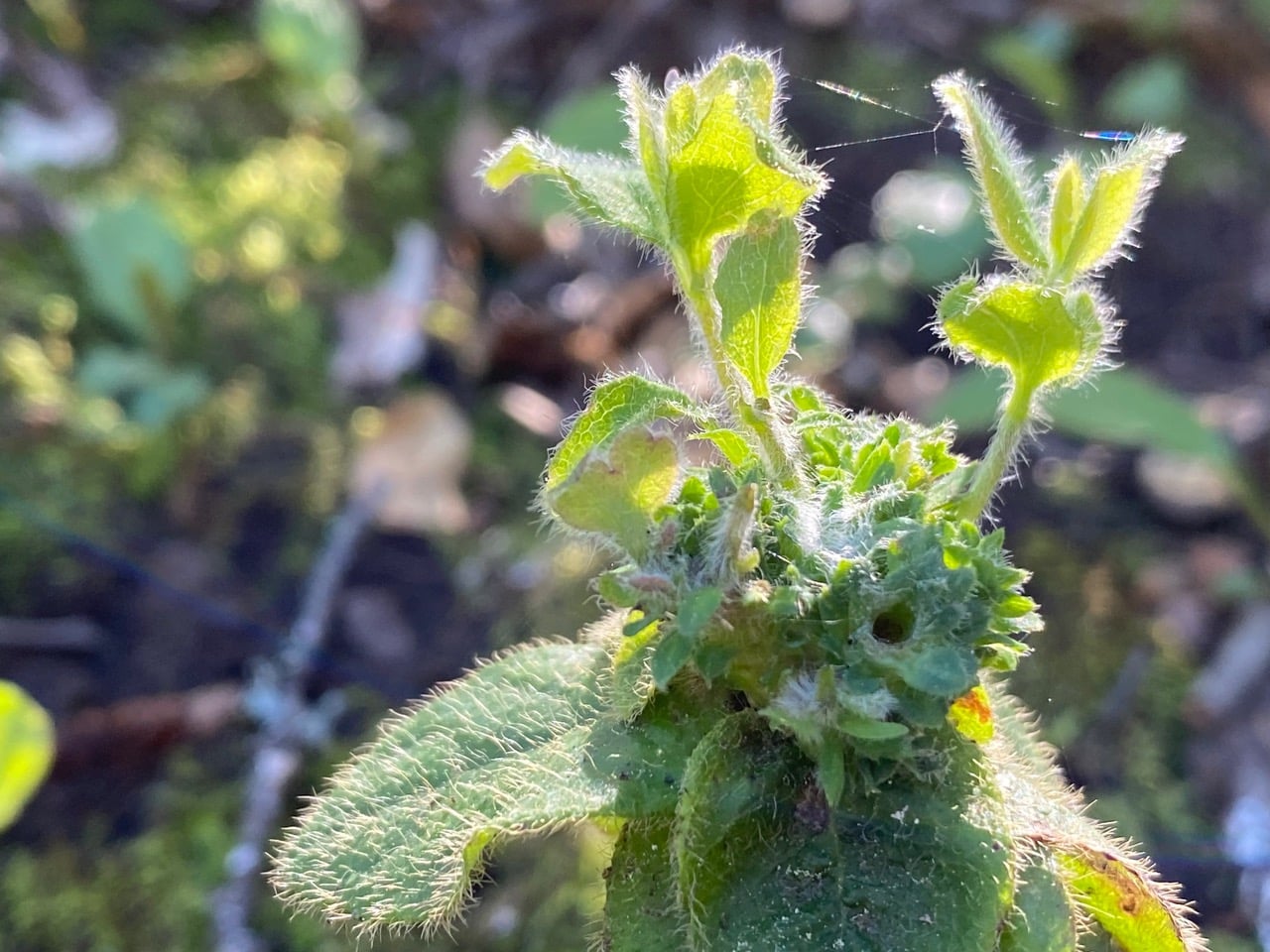
Note the gaping hole in the center of one of the galls in this cluster induced by the Cabbage-bud-gall Midge. The fly has emerged from it recently. Two buds that escaped the galling activity have grown into healthy shoots.
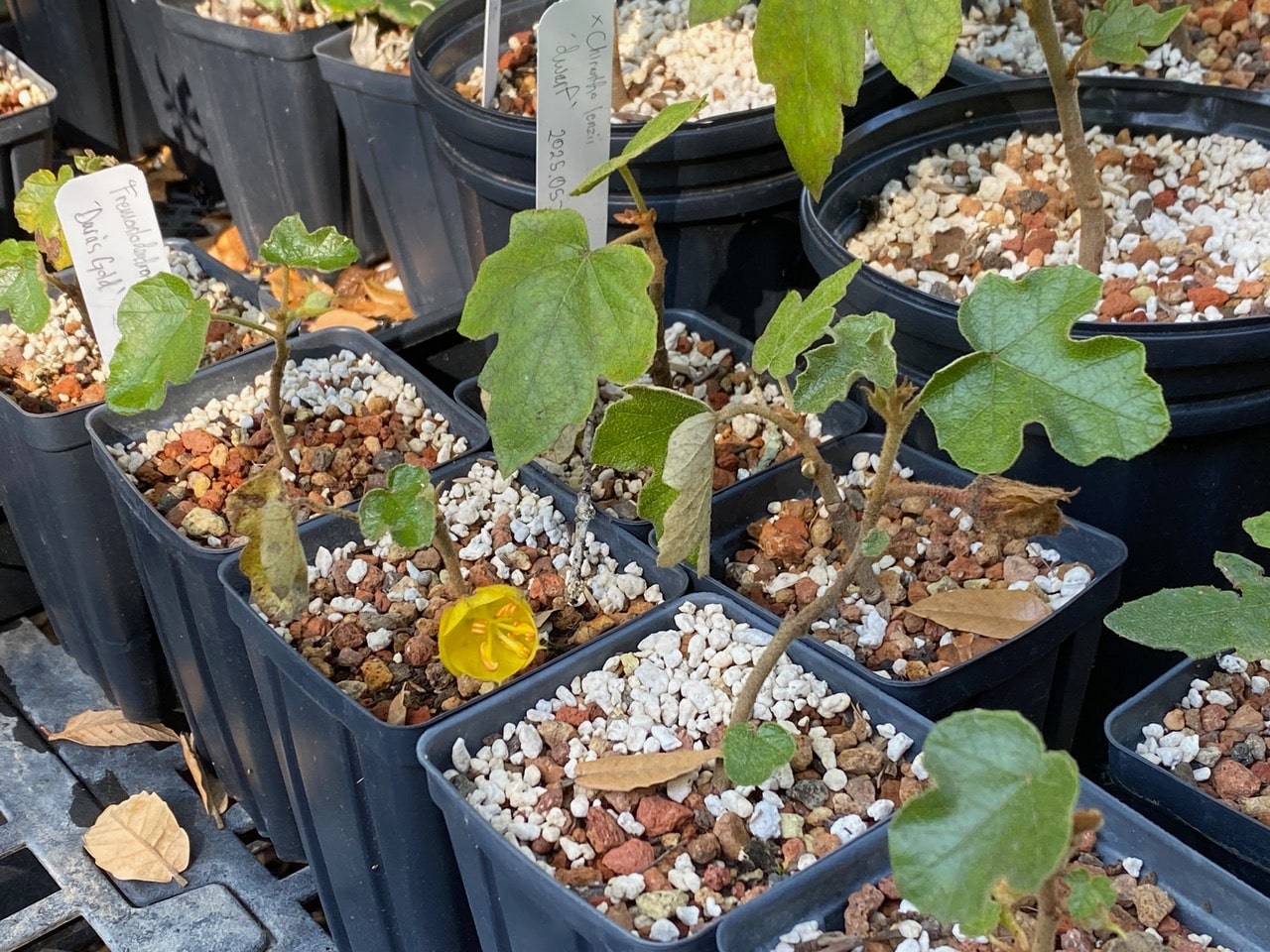
Among the potted plants outside the greenhouse, a young Flannel Bush, Fremontodendron californicum barely 3 inches tall has produced a flower – bizarre!
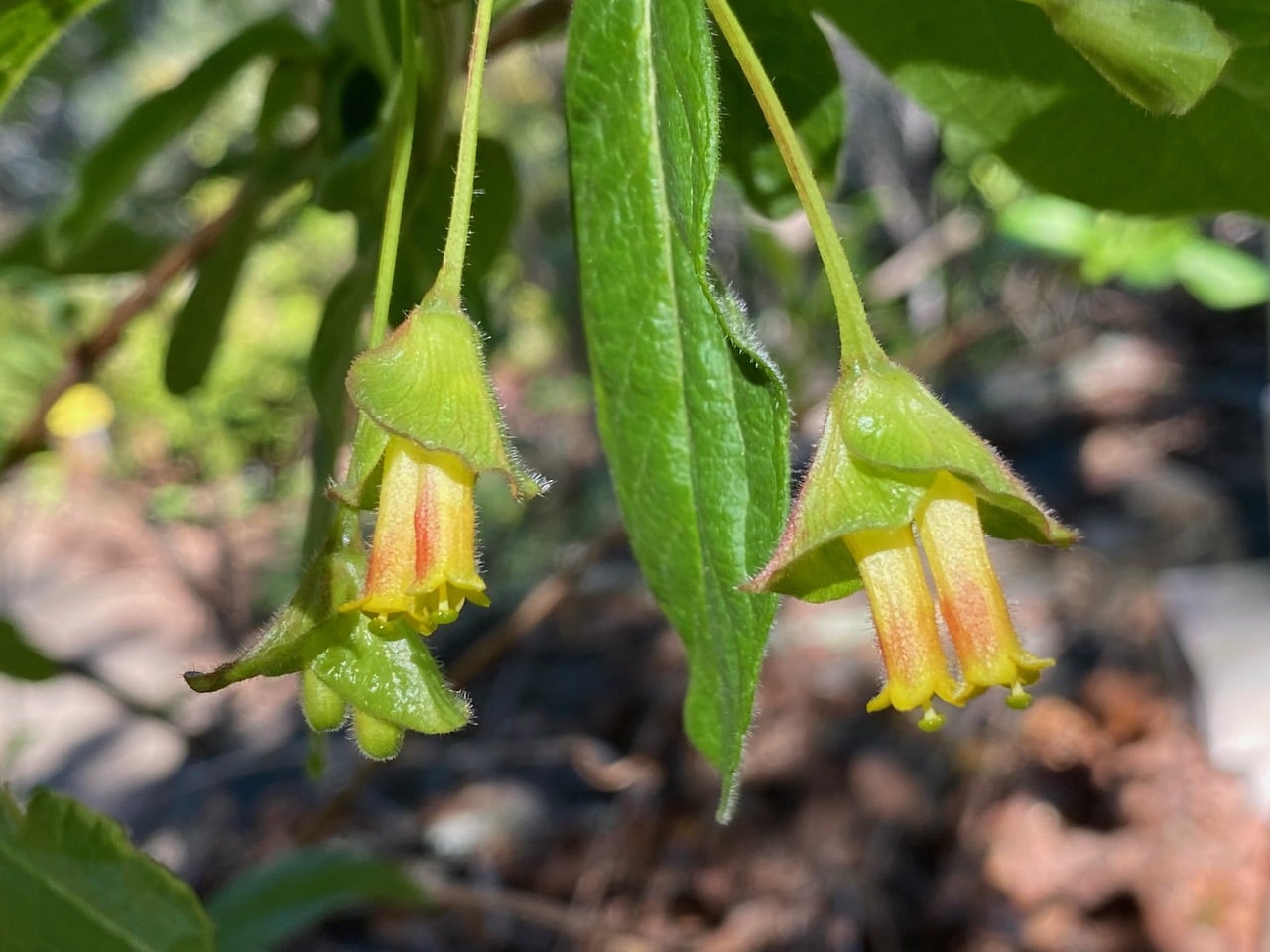
Twin flowers have appeared on the Twinberry Honeysuckle, Lonicera involucrata growing in the shade.
Twinberry Honeysuckle, Lonicera involucrata is a large, deciduous shrub found in western North America. The plant thrives in moist to wet areas, such as stream banks and forest edges. Small, hairy, tubular, reddish-yellow flowers grow in pairs surrounded by two leafy bracts. The bracts turn from green to a striking dark red in late summer as fruits ripen. The name involucrata refers to these bracts, which are collectively called an “involucre”. The paired black berries are about one-third inch in diameter and are unpleasantly bitter tasting. The flowers attract hummingbirds and other birds feed on the fruits.
Twinberry is primarily pollinated by hummingbirds and insects, including various bee species and butterflies. The plant’s tubular, yellow/red, nectar-rich flowers are specifically adapted to attract these pollinators.
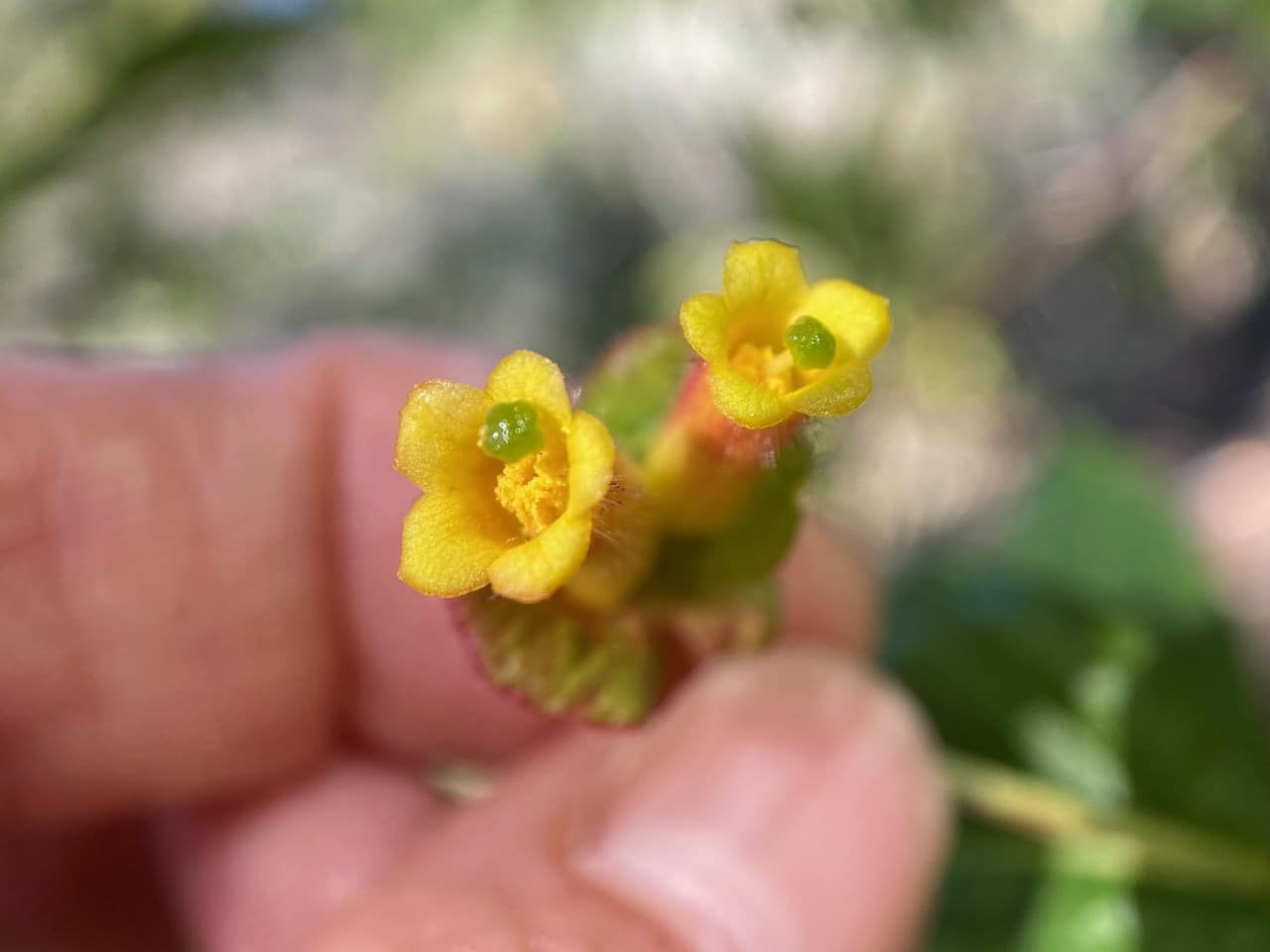
I lift up a pair of flowers to peek inside. The five stamens are crowded right behind the large green stigma near the entrance of the narrow tubular flower. The stigma is moist and receptive, and the stamens are releasing pollen. Given the proximity of the sexes that mature at the same time, how does Twinberry avoid self-fertilization and inbreeding?
Similar to other Lonicera species, Twinberry may possess physiological mechanisms that prevent self-pollen from fertilizing the flower, a phenomenon called self-incompatibility. Self-incompatibility (SI) is a widespread genetic mechanism in flowering plants that prevents self-fertilization by rejecting pollen from the same or genetically similar individuals. It promotes outcrossing and genetic diversity by triggering a biochemical reaction – often controlled by a single S-locus – that halts pollen germination or pollen tube growth.
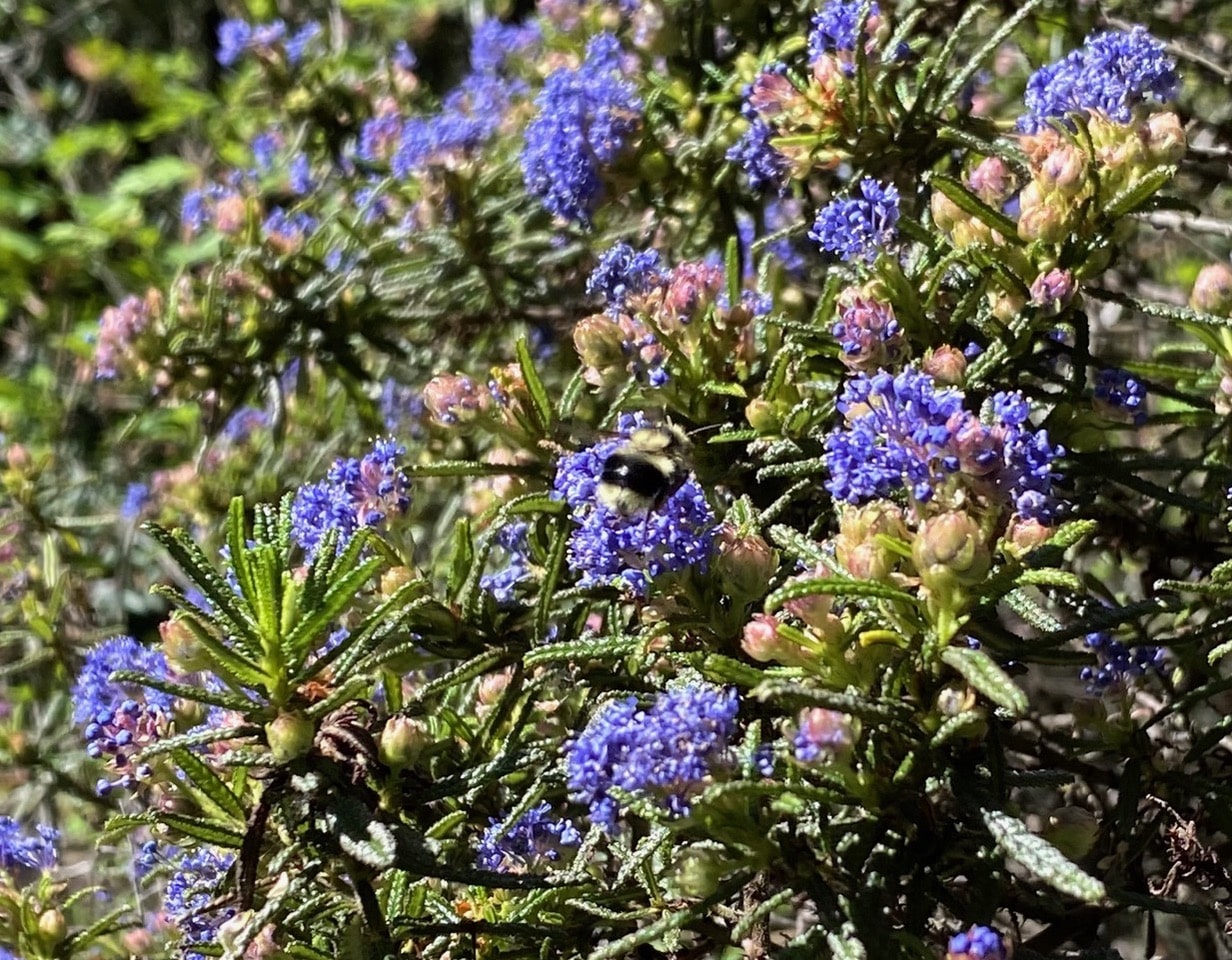
Hardly visible against the busy background, some small worker Black-tailed Bumble Bees, Bombus melanopygus (family Apidae) are busy foraging on a dark-flowered Wartleaf Ceanothus, Ceanothus papillosus.
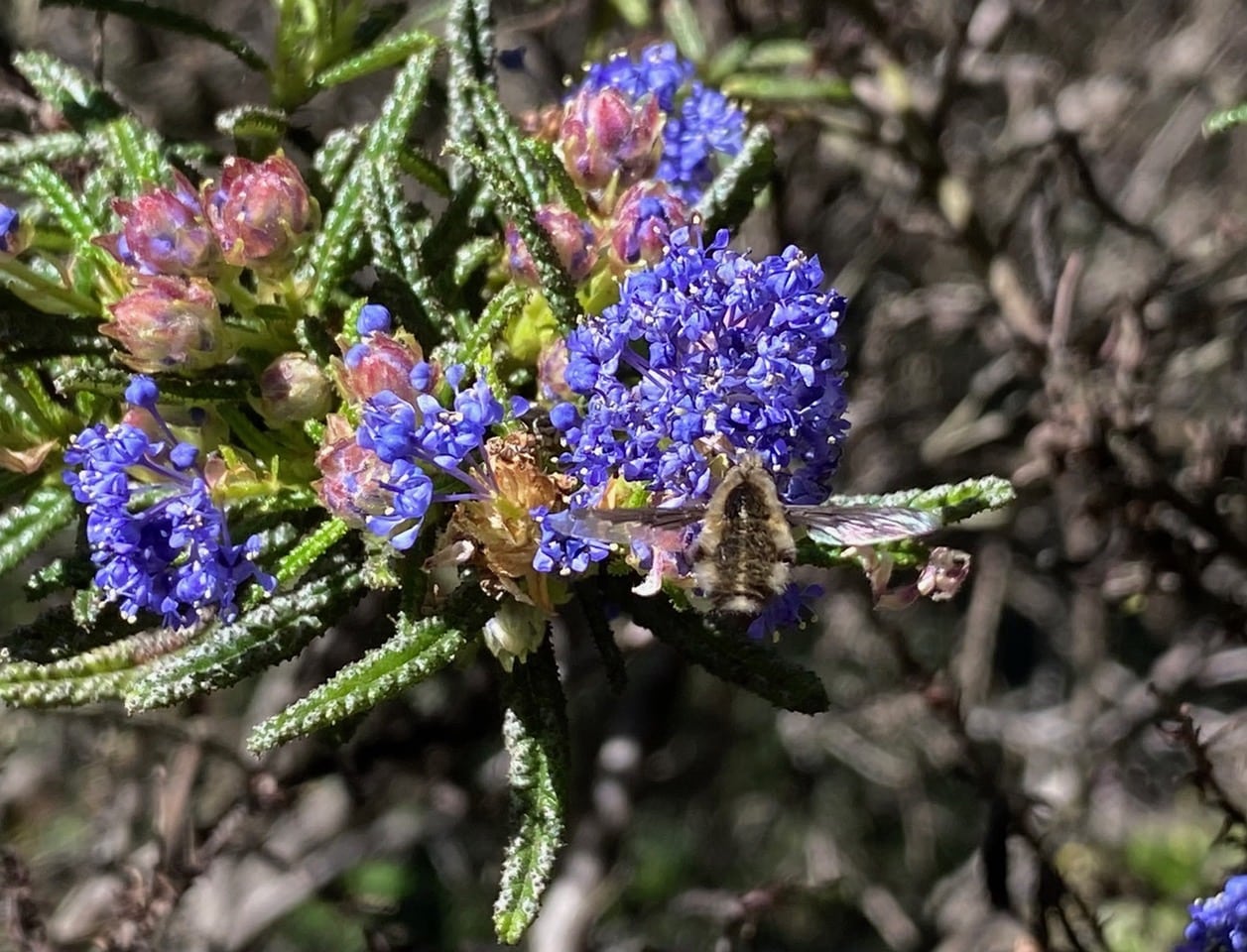
Similarly difficult to see is a Greater Bee Fly, Bombylius major (family Bombyliidae) hovering in place to sip nectar from the Ceanothus flowers, its body a blur. I quickly record the action on video, hoping it will show up better in motion.
Bombylius major, commonly known as the Greater Bee Fly is a parasitic bee mimic fly in the family Bombyliidae. It derives its name from its close resemblance to bumble bees. Its flight is quite distinctive – hovering in place to feed, and darting between locations. The species has long skinny legs and a long rigid proboscis held in front of the head. Bombylius major is easily distinguished from the other local species of Bombylius for having wings with dark leading edge, hyaline trailing edge with sharp dividing border. This feature is visible even as the fly is hovering. Adults visit flowers for nectar (and sometimes pollen) from a wide variety of plant families, excelling at small tubular flowers, and are considered good generalist pollinators. Often the pollen is transferred between flowers on the fly’s proboscis.
The bee fly larvae, however, have a sinister side. They are parasitoids of ground-nesting bees and wasps, including the brood of digger bees in the family Andrenidae. Egg deposition takes place by the female hovering above the entrance of a host nest, and throwing down her eggs using a flicking movement. The larvae then make their way into the host nest or attach themselves to the bees to be carried into the nest. There the fly larvae feed on the food provisions, as well as the young solitary bees.