

Pollinator Post 3/6/25 (2)
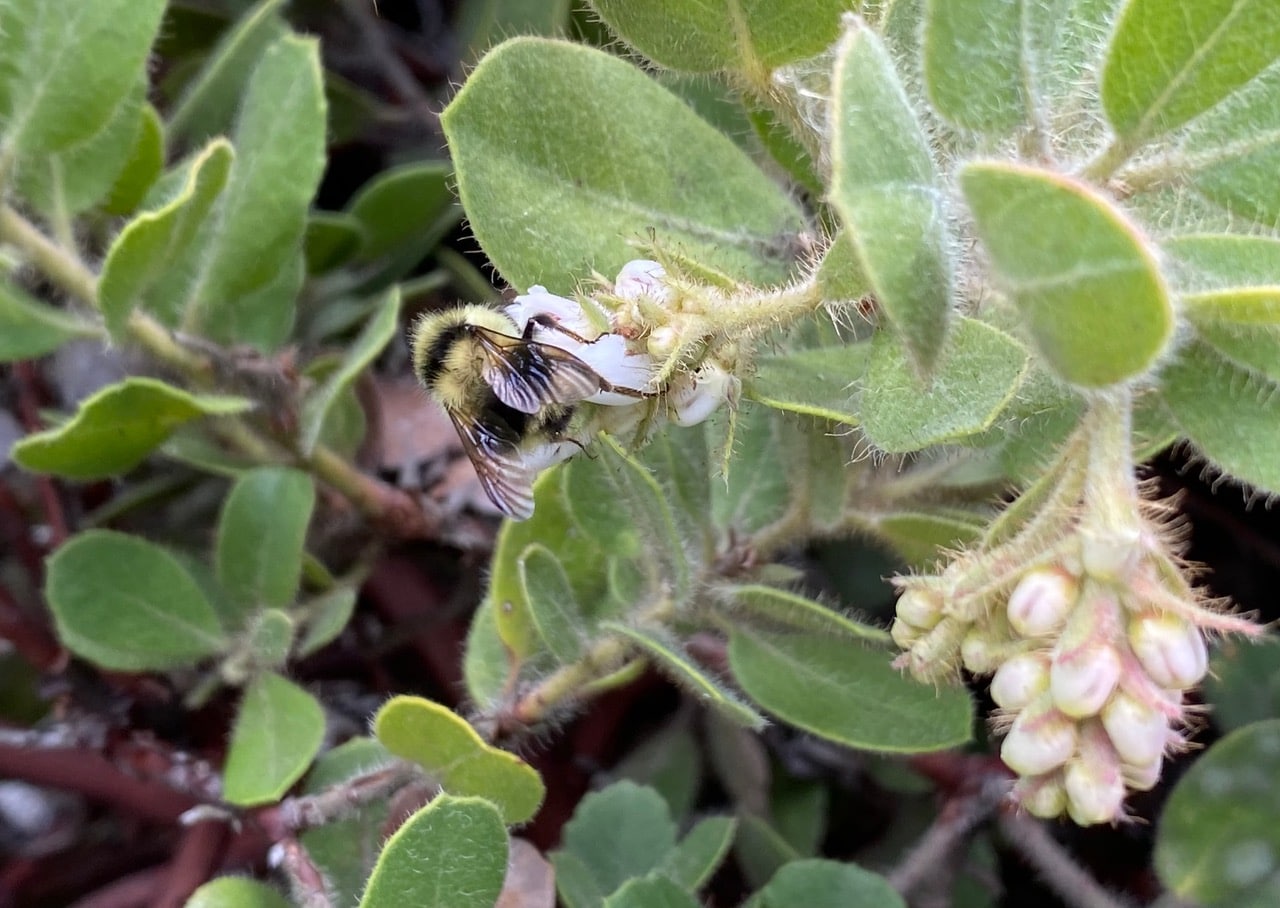
A Black-tailed Bumble Bee, Bombus melanopygus (family Apidae) has landed on a cluster of manzanita flowers.
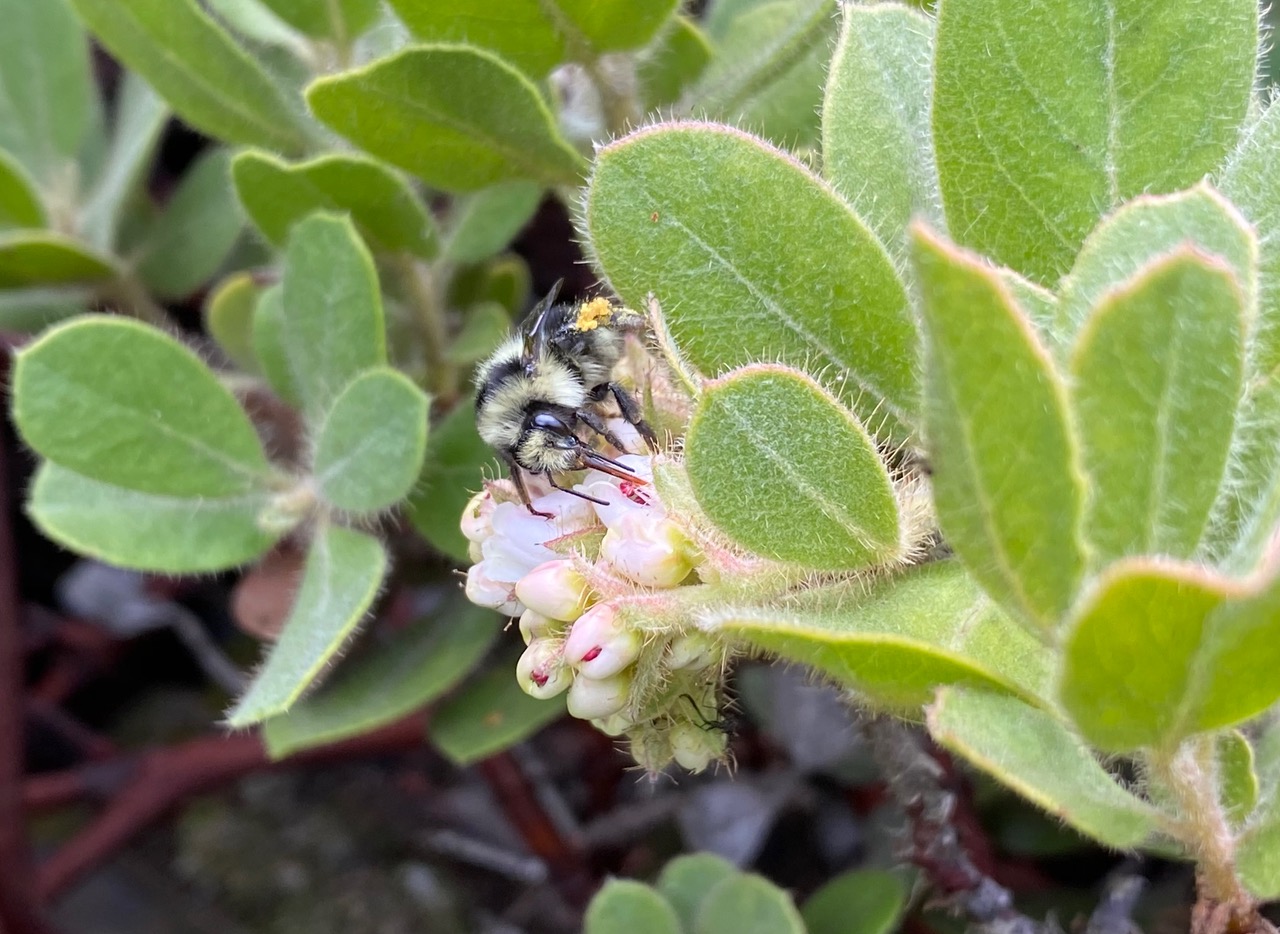
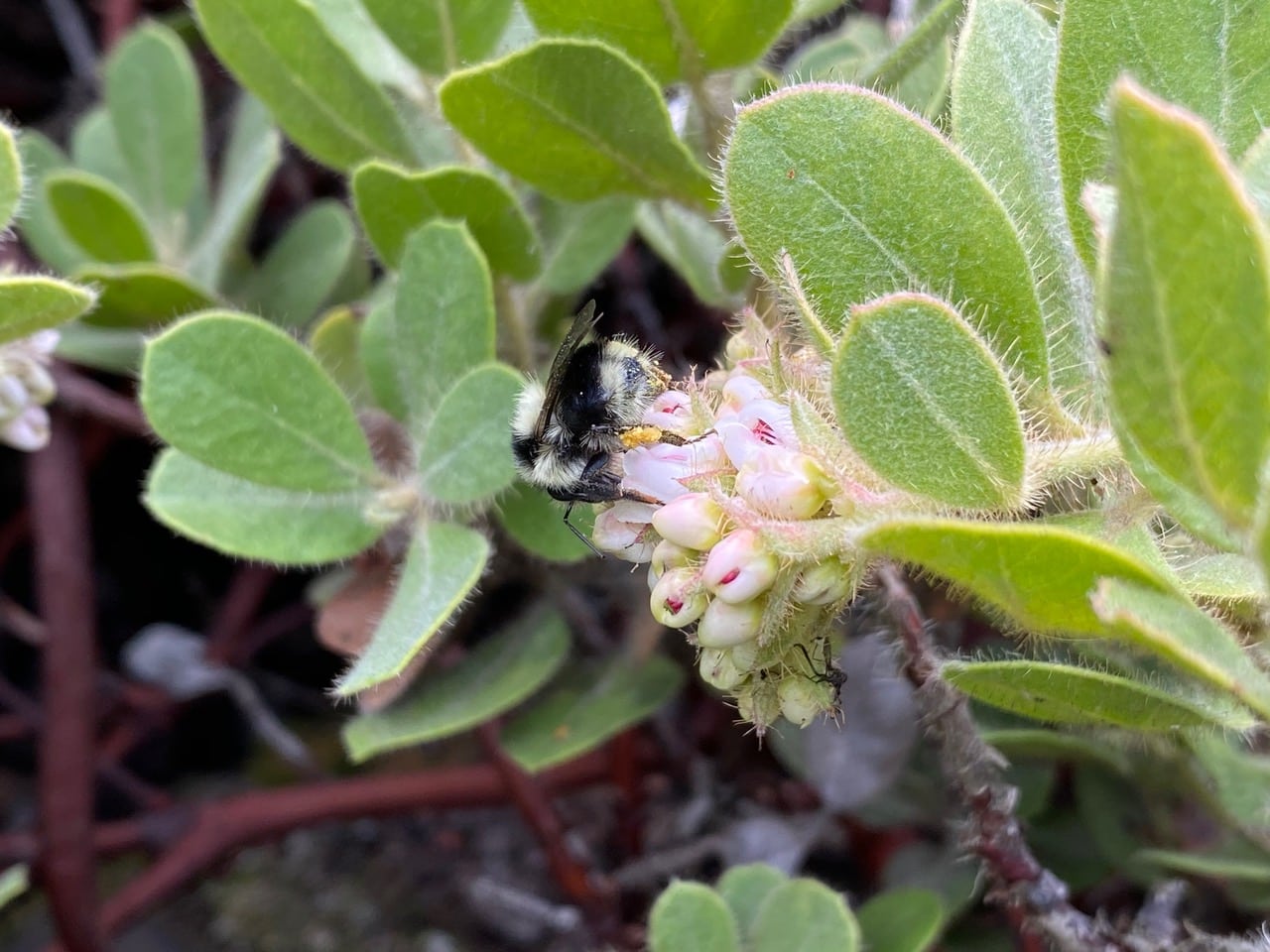
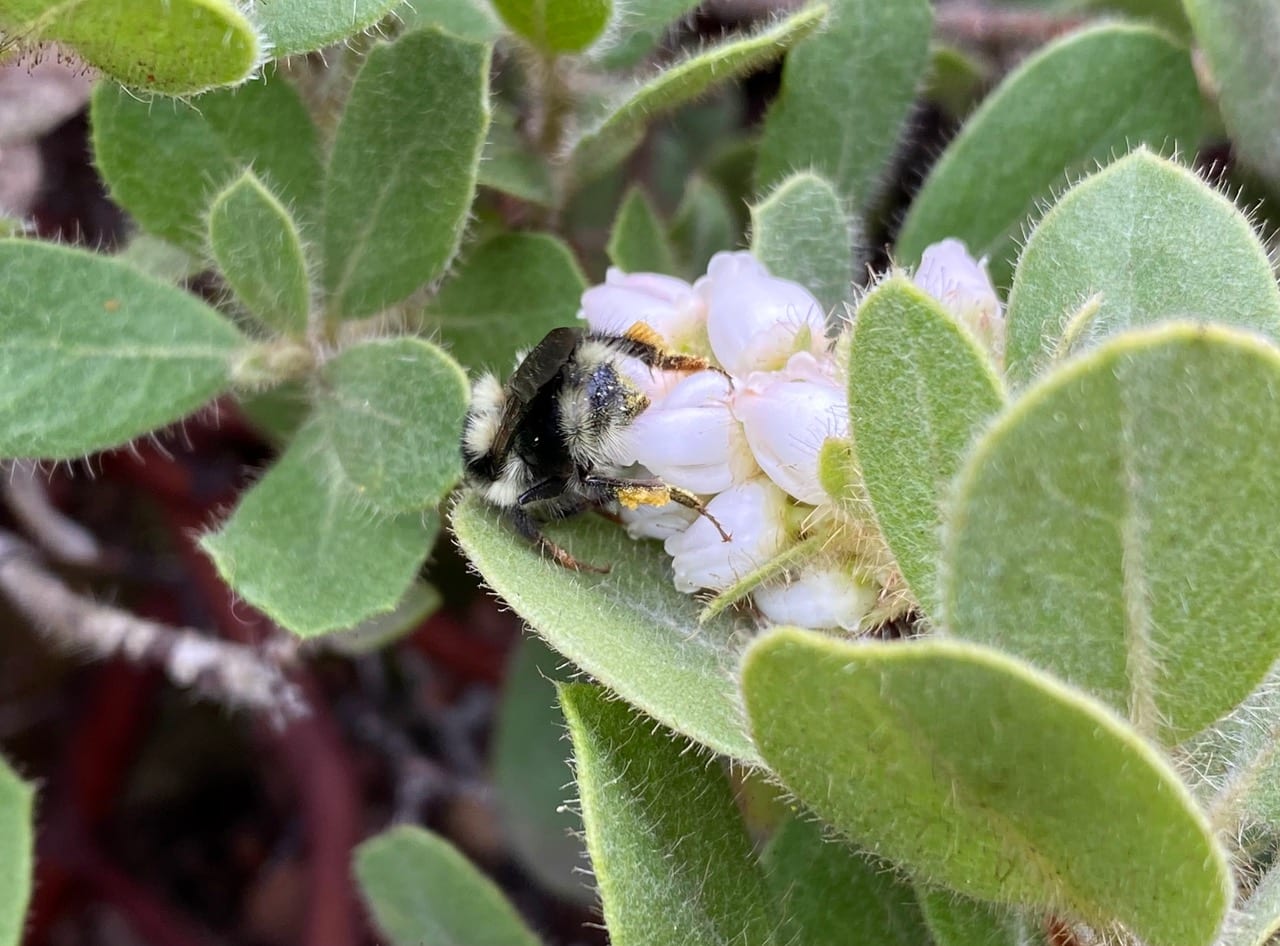


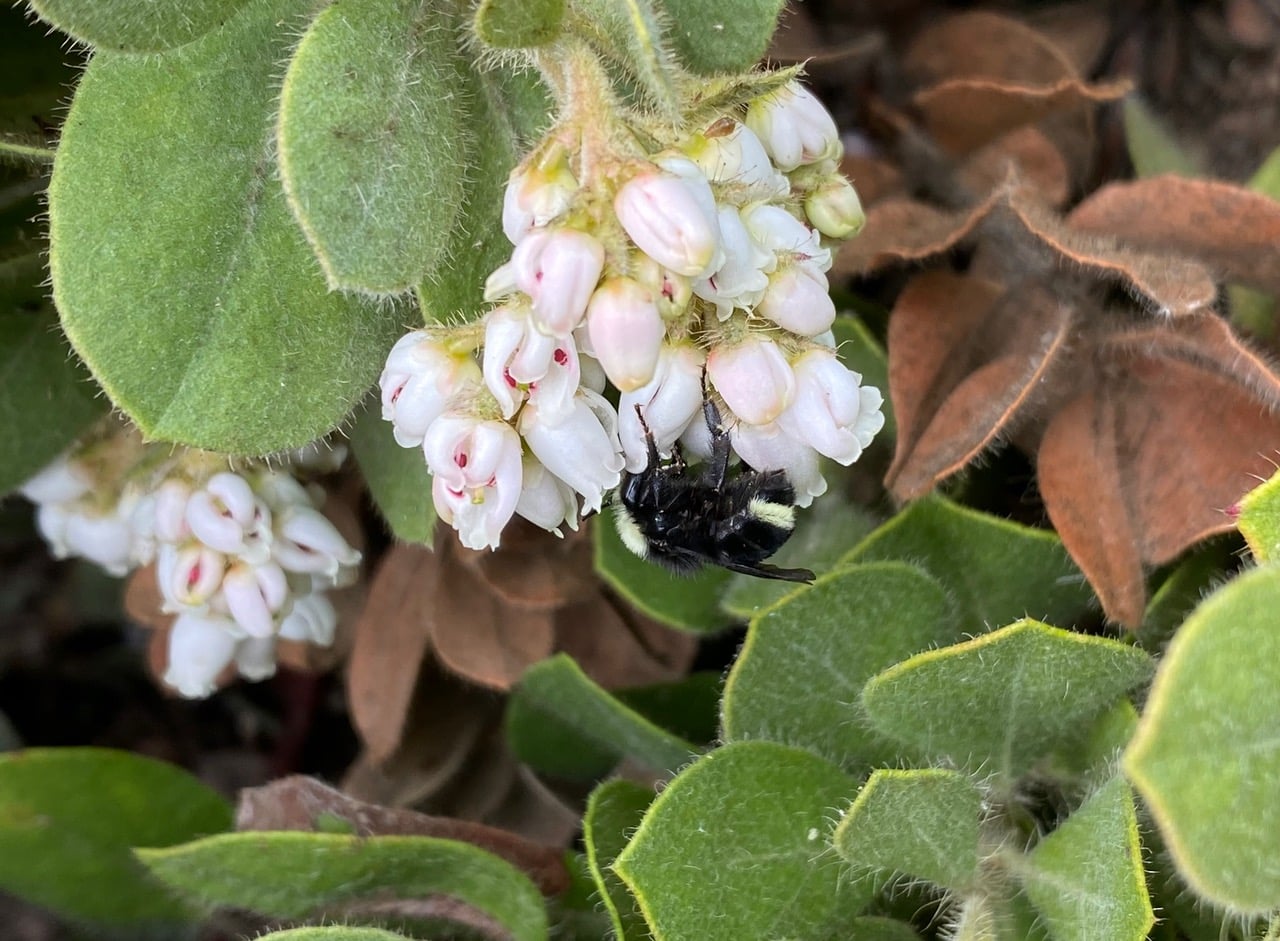



Its tongue extended, the bee proceeds to take nectar from the flowers, not from the proper opening of the corolla, but from a side slit. Hmm….
Why does the pollen in the bee’s pollen baskets (corbulae) look so dry and crumbly, and not a smooth lump?
Wow, I have never seen anything like this! Usually the bee would mix the pollen with some nectar into a paste-like consistency before packing it into the corbiculae. Are the manzanita flowers not producing enough nectar?
The pollen collecting apparatus in Apidae bees, which include honey bees and bumble bees, is commonly called a “pollen basket” or corbicula. This region is located on the tibia of the hind legs and consists of hairs surrounding a concave region. After the bee visits a flower, she begins to groom herself and brushes the pollen down toward her hind legs and packs the pollen into her pollen basket. A little nectar mixed with the pollen keeps it all together like putty, and the stiff hairs surrounding the pollen basket hold it in place. Remarkably bees are able to fly while carrying up to a third of their body weight in pollen.
.jpg)
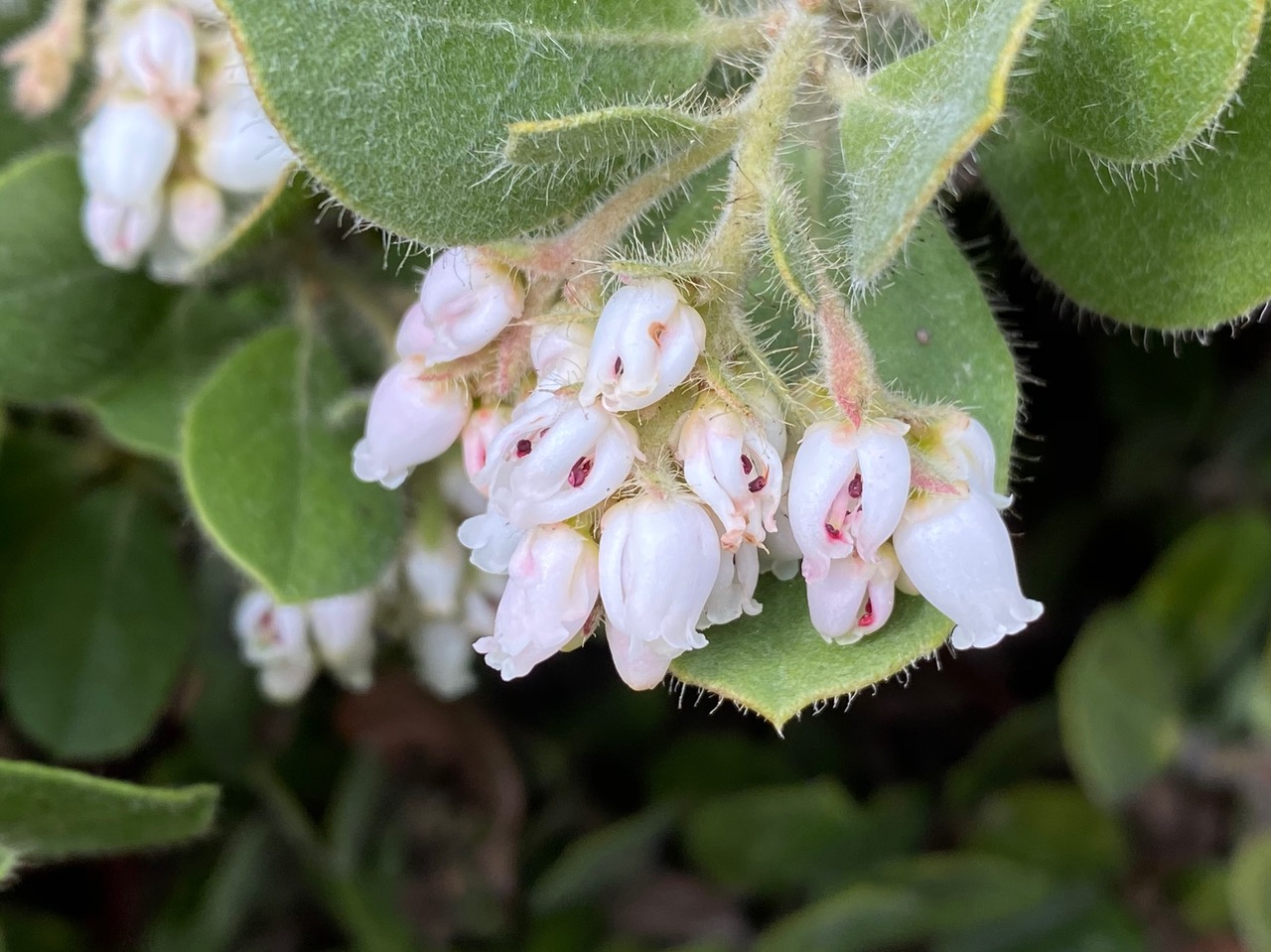
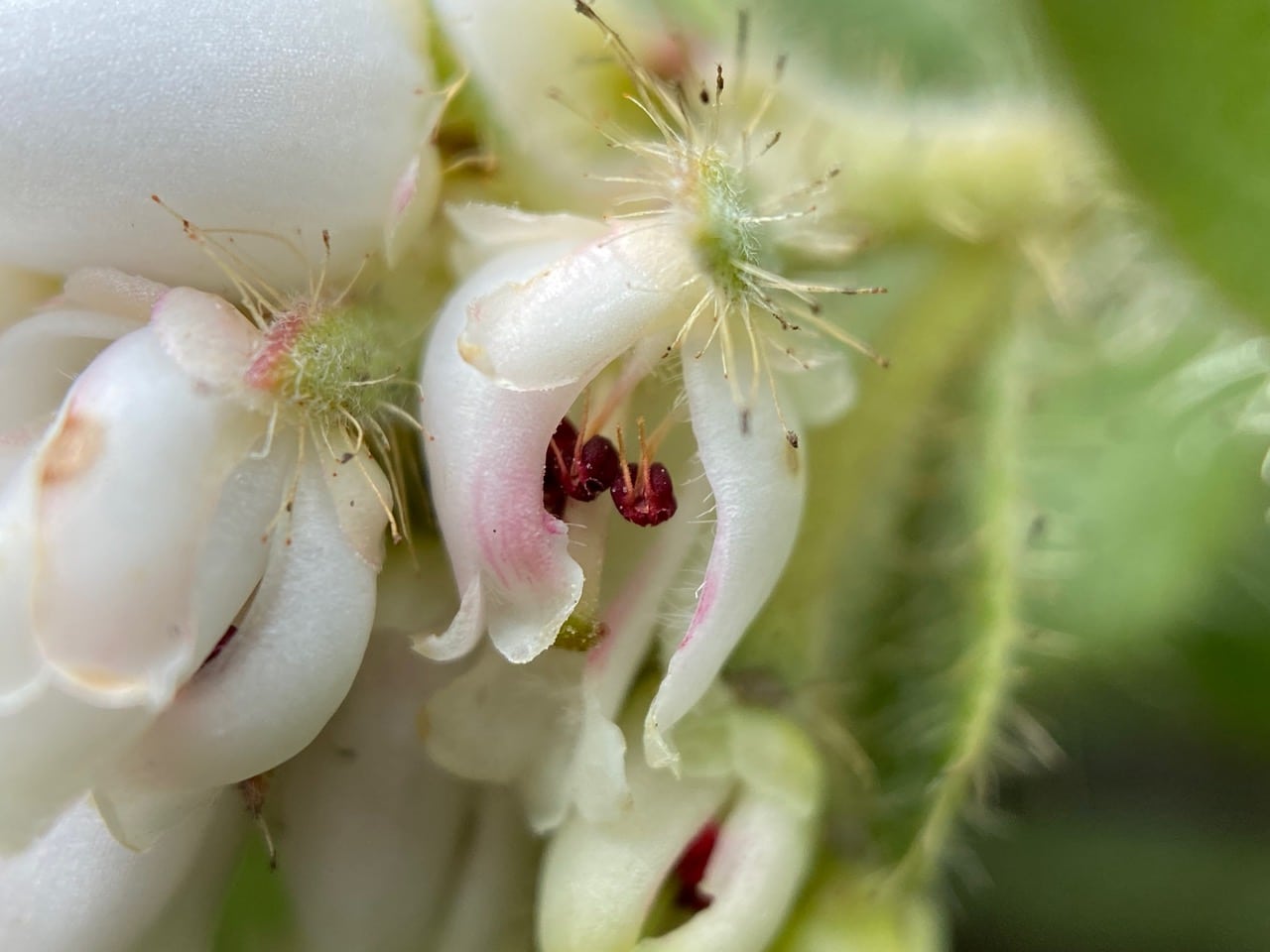
After the bee has left, I take a close look at the flowers of this mutant (?) manzanita. Interestingly the petals have not fused completely to form a closed urn-shaped corolla, but instead have remain partially separate. The reproductive structures can be seen through the gaps. Note the red anthers.
The gap between the petals of this flower is so wide we can even see the style and green stigma in the center. It is cool that I don’t even need to dissect the flower to see the details inside -not an easy task, given the small size of the flower. For an excellent sectioned view of a manzanita flower:
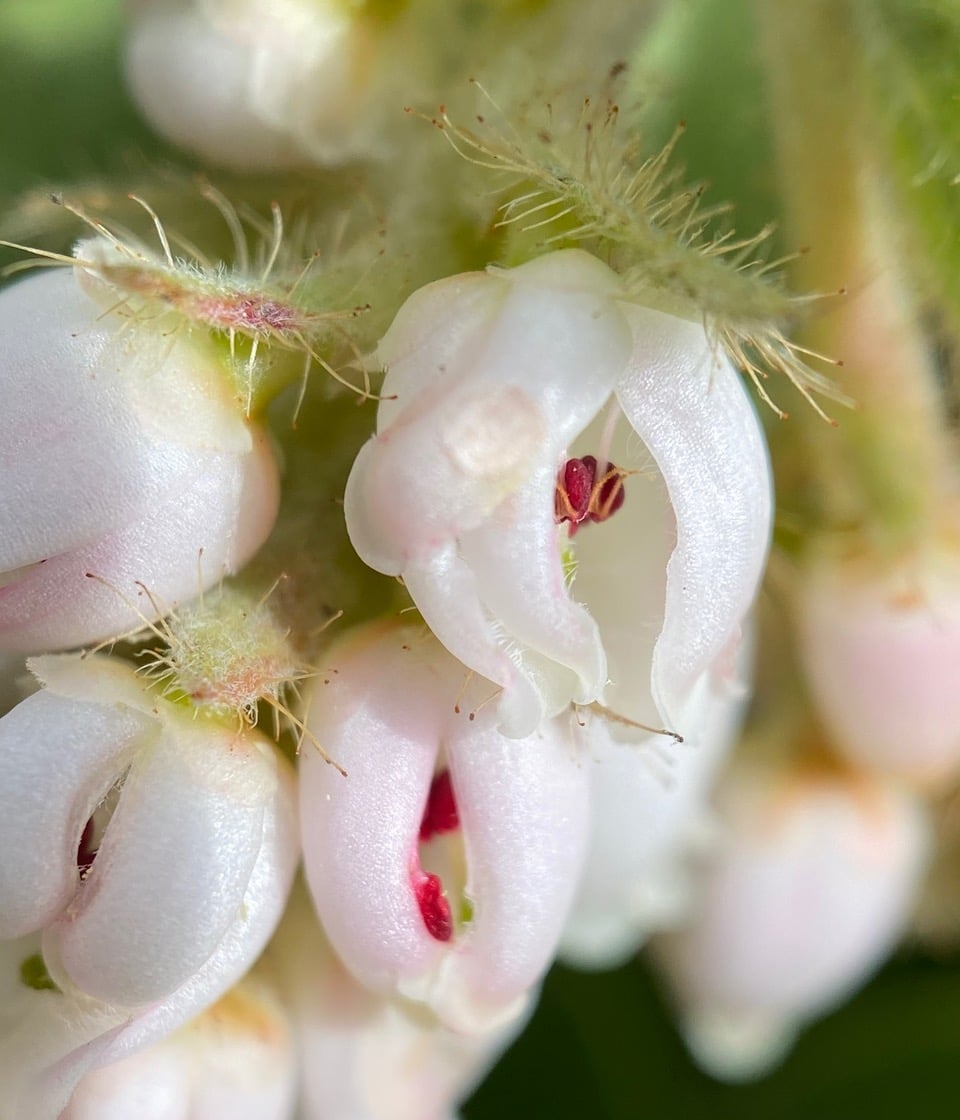
Here’s a view of the unusual anthers of manzanita flower. Each filament holds a pair of ‘poricidal’ anthers with openings or pores at the tips. What’s more, a pair of antler-like appendages extend from the back of the anther to make contact with the corolla.
Here’s a fresher flower showing red anthers and their antler-like appendages. It is believed that the long “antlers” extending from the anthers serve to accentuate the vibration caused by a sonicating bee, and transmit it to the poricidal anther. The vibrations shake pollen out of the pores, similar to the way salt is shaken out of salt shakers. Because of the inverted orientation of the flower, the downward flow of pollen is further aided by gravity.
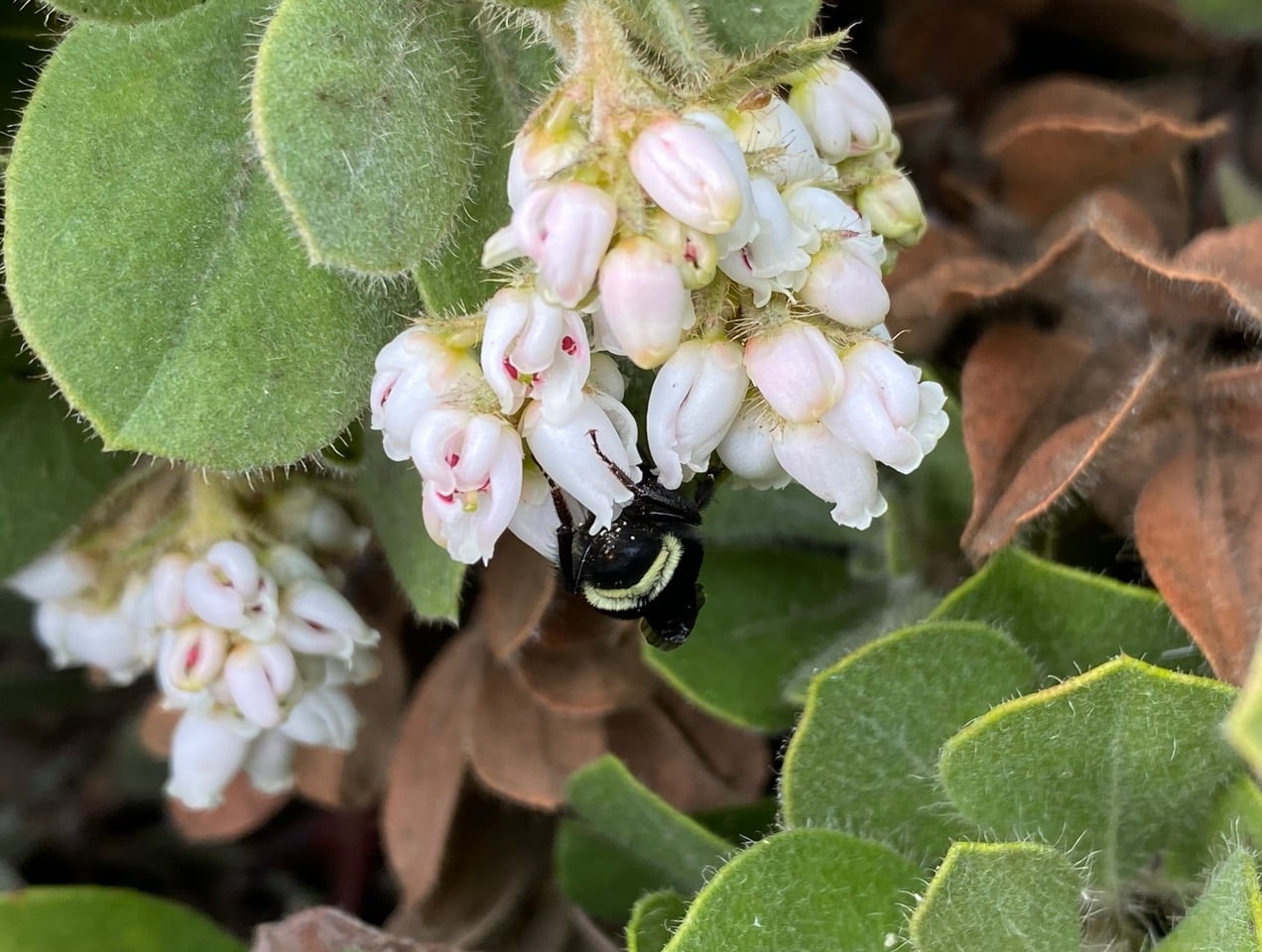
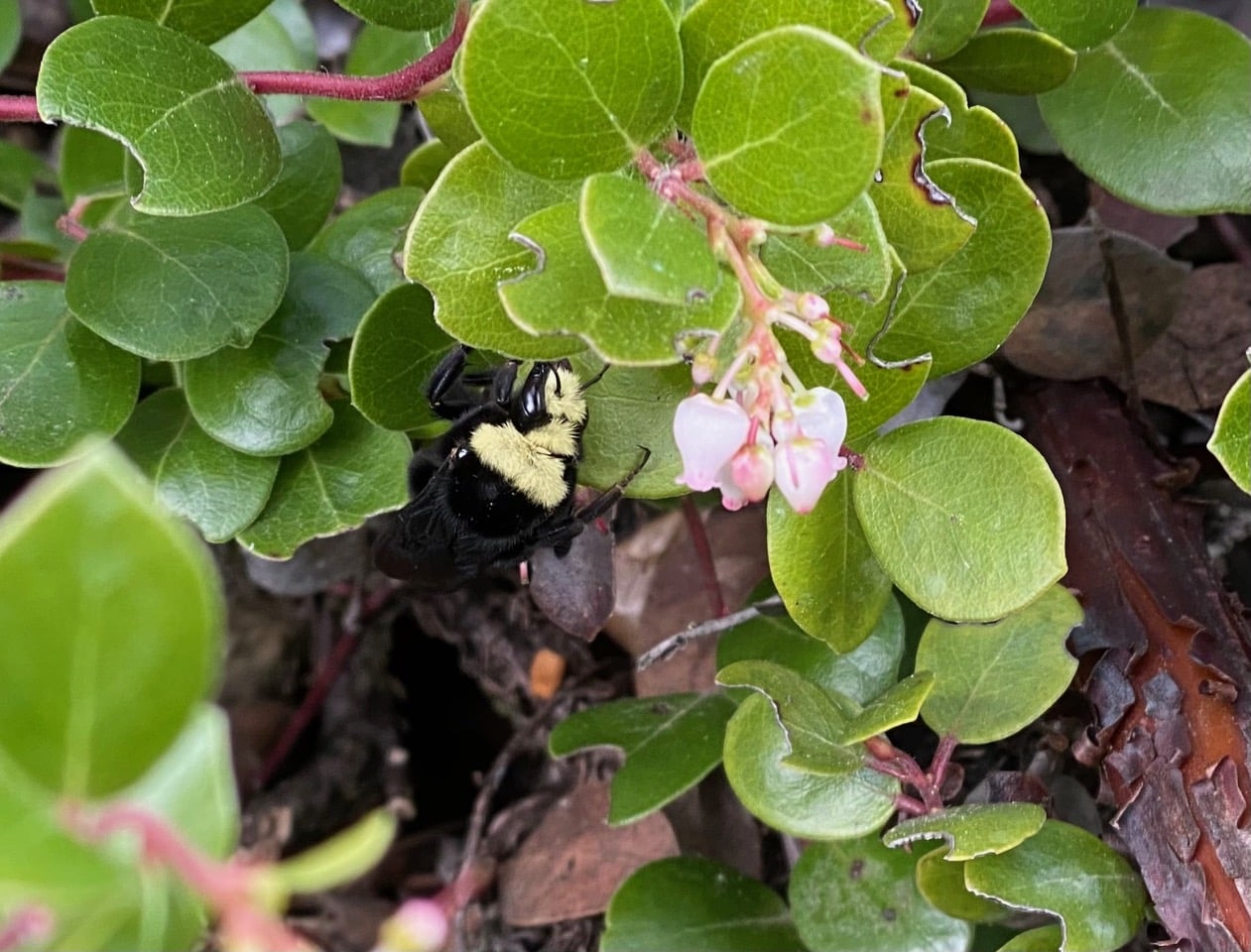
Hanging upside down from a cluster of manzanita flowers, a Yellow-faced Bumble Bee, subgenus Pyrobombus (genus Bombus, family Apidae) is probing the flowers for nectar with its tongue.
The Yellow-faced Bumble Bee is the most commonly encountered bumble bee species in our area. It is easily recognizable: besides the yellow “face” and front section of its thorax, the bee has a black abdomen with a single band of yellow in the rear. I am seeing fewer of these bees at the manzanita at the moment, compared to earlier when the plant first bloomed. The bees might have scattered to take advantage of the other plants that have since come into bloom. The Yellow-face Bumble Bee is known to select its foraging locations based on the diversity of available flora in a given region, as opposed to floral density. This means that they are willing to travel longer distances to forage from patches that have wider varieties of available floral taxa. A possible explanation for this behavior is a necessity by the bee to increase the variety of nutrients it takes by diversifying its nectar consumption. What’s more, bees which develop preferences for varied plant genera are likely to have more stable food resources over long periods of time.
A Secondary Screwworm Fly is scavenging on a manzanita.
The Secondary Screwworm, Cochliomyia macellaria (family Calliphoridae, commonly known as blow flies) ranges throughout the United States and the American tropics. The body is metallic greenish-blue and characterized by three black longitudinal stripes on the dorsal thorax. Females are attracted to carrion where they lay their eggs. These screwworms are referred to as “secondary” because they typically infest wounds after invasion by primary myiasis-causing flies. While the flies carry various types of Salmonella and viruses, C. macellaria can also serve as important decomposers in the ecosystem. In a lifetime, a female may lay up to 1000 or more eggs. Females may also lay their eggs with other females, leading to an accumulation of thousands of eggs. The larval stage of C. macellaria is referred to by the common name of secondary screwworms; this is due to the presence of small spines on each body segment that resemble parts of a screw. The larvae feed on the decaying flesh of the animal that they have been laid on until they reach maturity. Eventually the larvae fall off the food source to pupate in the top layer of the soil. Adult females will continue to feed on tissues of animals; however, now they preferentially feed off of live tissues and tissue plasma. Adult males will no longer consume tissue, but instead will eat nearby vegetation and take nourishment from floral nectar.
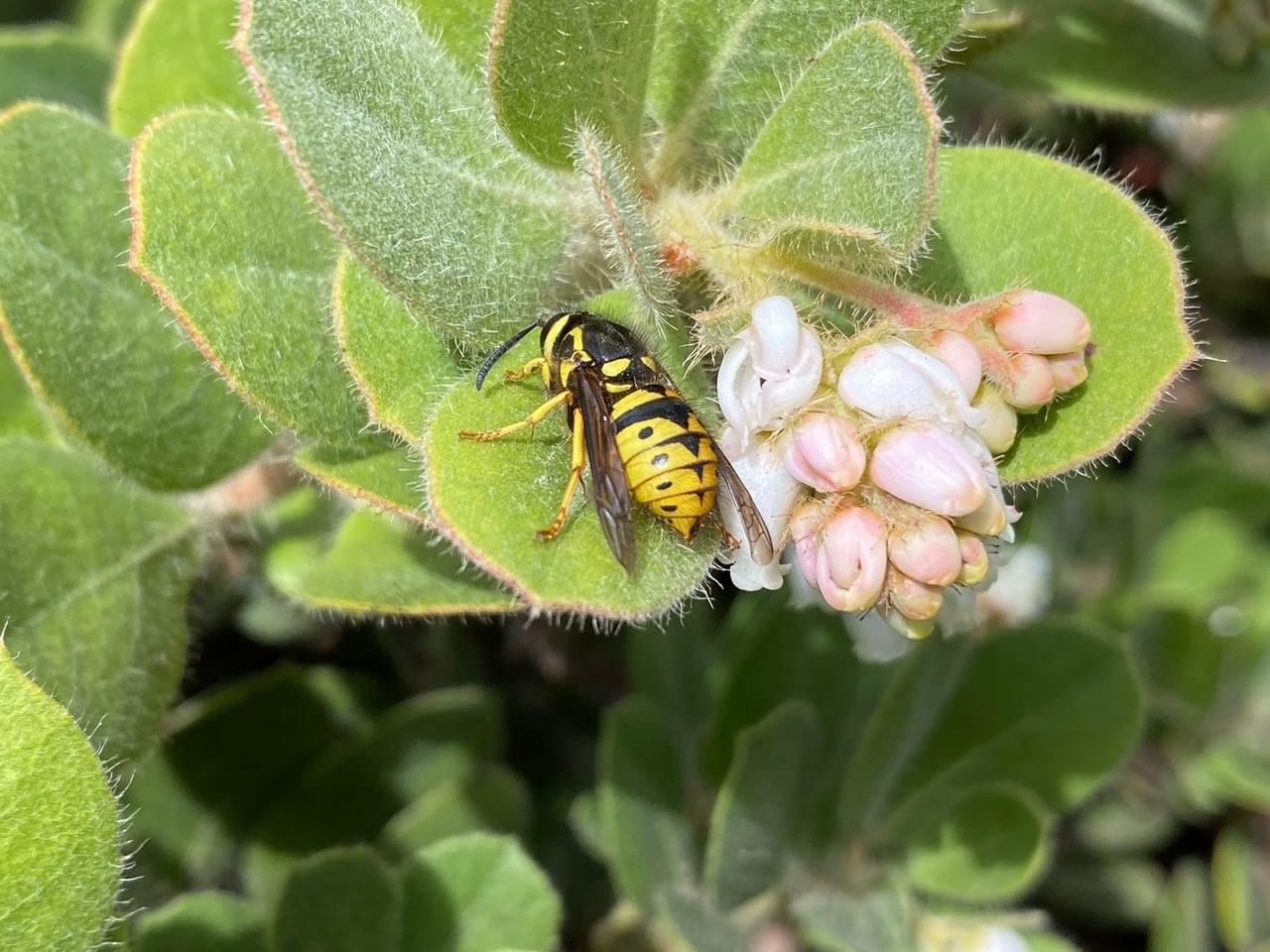
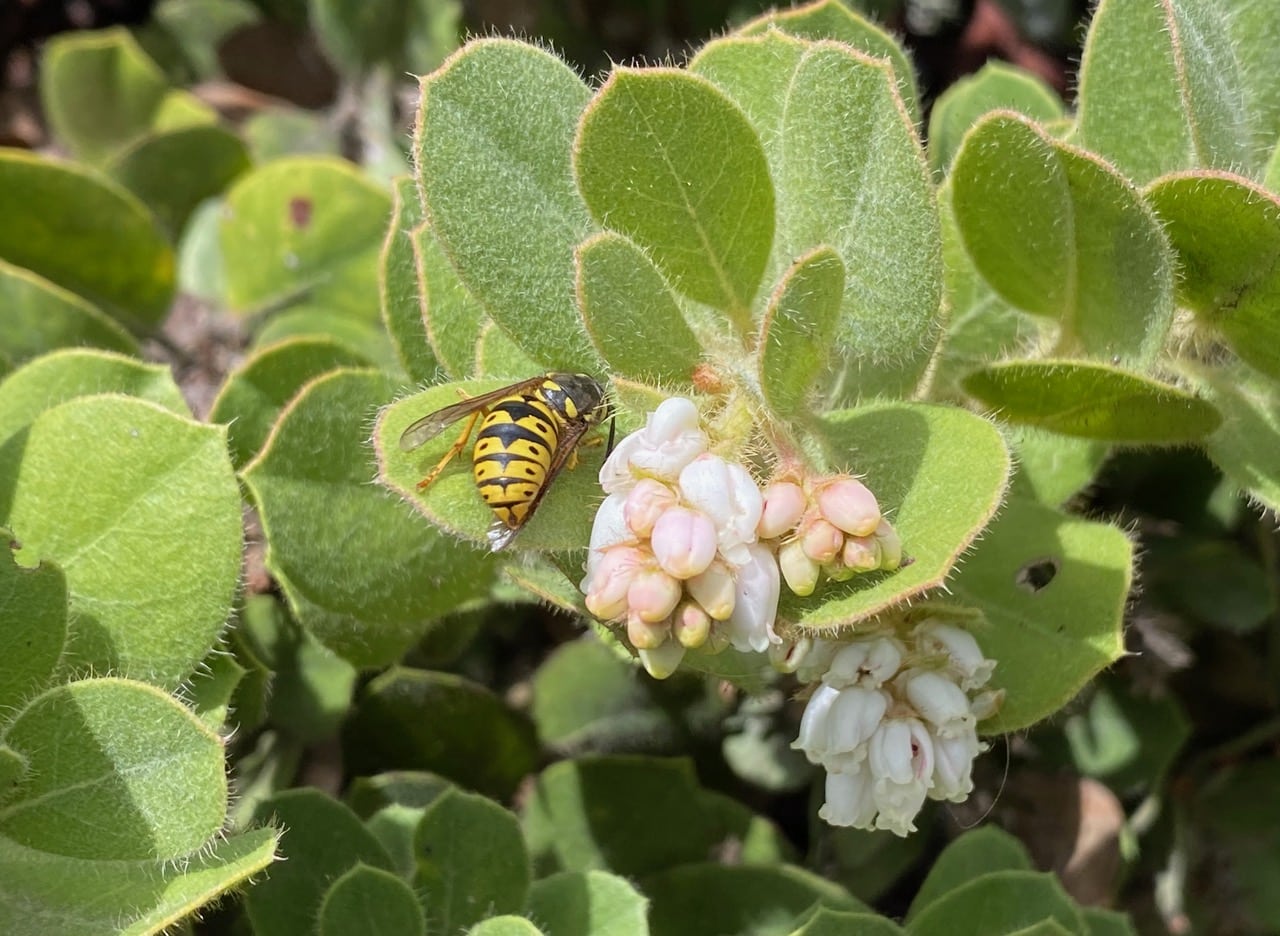
Whoa, that’s the biggest and fattest Yellowjacket I have ever seen! Antennae droopy and body relaxed, the wasp seems to be taking a nap on the manzanita leaf. Given its size it has to be a queen. Yellowjacket queen stands out by its larger size. The workers have a body length of 16-18 mm (1/2 in.), while the queens grow to 20-25 mm (3/4 in.) Why is the queen out of hibernation so early? Has she emerged prematurely from her winter rest, fooled by the unusually warm weather we have? iNaturalist has helped identify the wasp as a Common Aerial Yellowjacket, Dolichovespula arenaria (family Vespidae).
Yellowjacket is the common name for predatory social wasps of the genera Vespula and Dolicovespula (family Vespidae). Yellowjackets are social hunters living in colonies containing workers, queens, and males (drones). Colonies are annual with only inseminated queens overwintering. Queens emerge during the warm days of late spring or early summer, select a nest site, and build a small paper nest in which they lay eggs. They raise the first brood of workers single-handedly. Thereafter the workers take over caring for the larvae and queen, nest expansion, foraging for food, and colony defense. The queen remains in the nest, laying eggs. Later in the summer, males and queens are produced. They leave the parent colony to mate, after which the males quickly die, while fertilized queens seek protected places to overwinter. Parent colony workers dwindle, usually leaving the nest to die, as does the founding queen. In the spring, the cycle is repeated.
Yellowjackets have lance-like stingers with small barbs, and typically sting repeatedly. Their mouthparts are well-developed with strong mandibles for capturing and chewing insects, with probosces for sucking nectar, fruit, and other juices. Yellowjacket adults feed on foods rich in sugars and carbohydrates such as plant nectar and fruit. The larvae feed on proteins derived from insects, meats, and fish. Workers collect, chew, and condition such foods before feeding them to the larvae. Many of the insects collected by the workers are considered pest species, making the yellowjackets beneficial to agriculture. The larvae, in return, secrete a sugary substance for workers to eat; this exchange is a form of trophallaxis.
The Common Aerial Yellowjacket, Dolichovespula arenaria (family Vespidae) is widely distributed in North America. As their common name implies, the species typically builds aerial nests, from a few centimeters above ground to the tops of trees, or houses or sheds. But in some cases they build nests under rocks or even underground. The wasps may begin nest building as early as March in California. The nests are made from wood fiber that the wasps chew into a paper-like pulp. The nests are completely enclosed except for a small entrance at the bottom. The nests contain multiple, horizontal tiers of combs within. Larvae hang within the combs. Unique to D. arenaria is the spraying of venom out of their stings. The mechanism involves the contraction of venom reservoir muscles, and it allows for a greater release of alarm pheromones in the venom, which is key to elicit the attack behavior of yellowjackets.
Common Aerial Yellowjacket (Dolichovespula arenaria) · iNaturalist
In a few minutes, the queen Yellowjacket begins to stir. Grooming herself slowly, she brushes her wings and her abdomen with her hind legs.
Her royal highness turns around to take nectar from the manzanita flowers before flying away. She has a huge task ahead of her – to establish a new colony single-handedly.
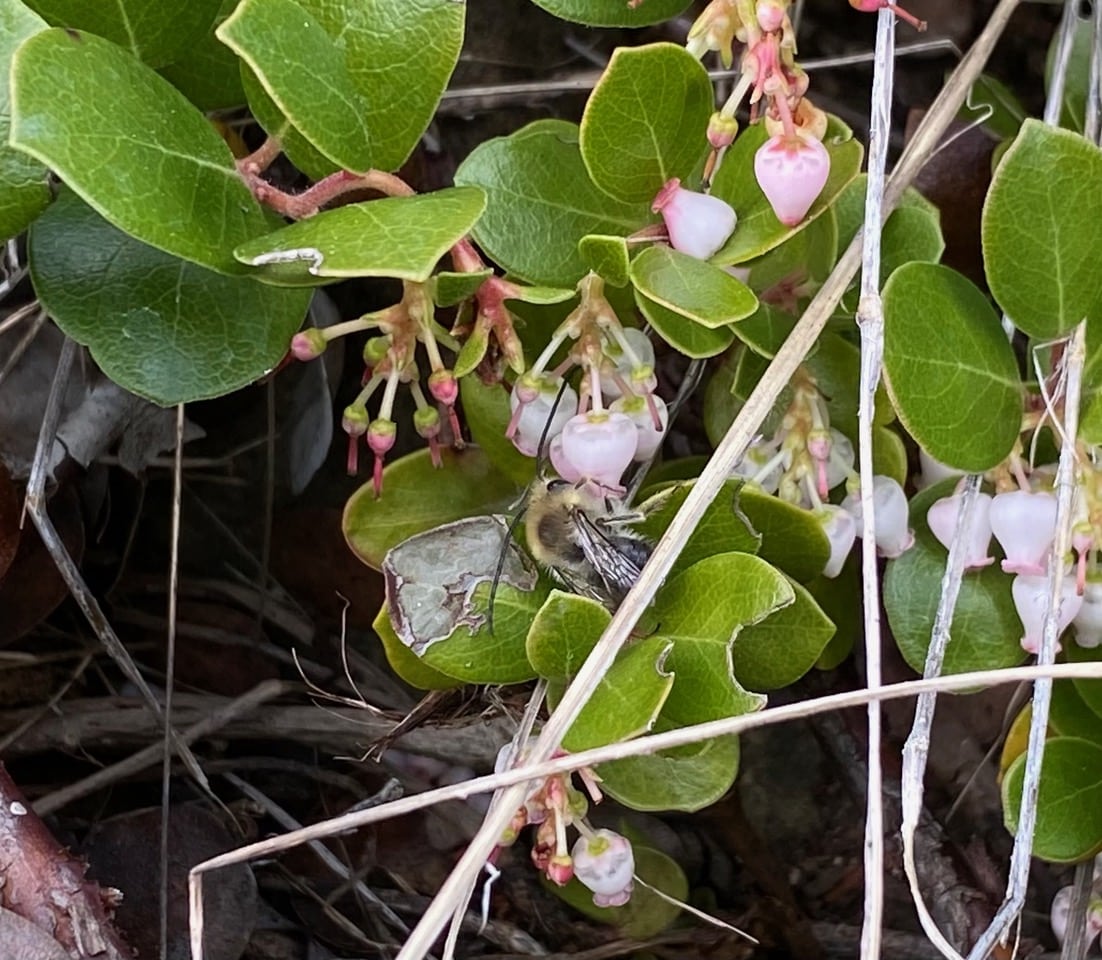
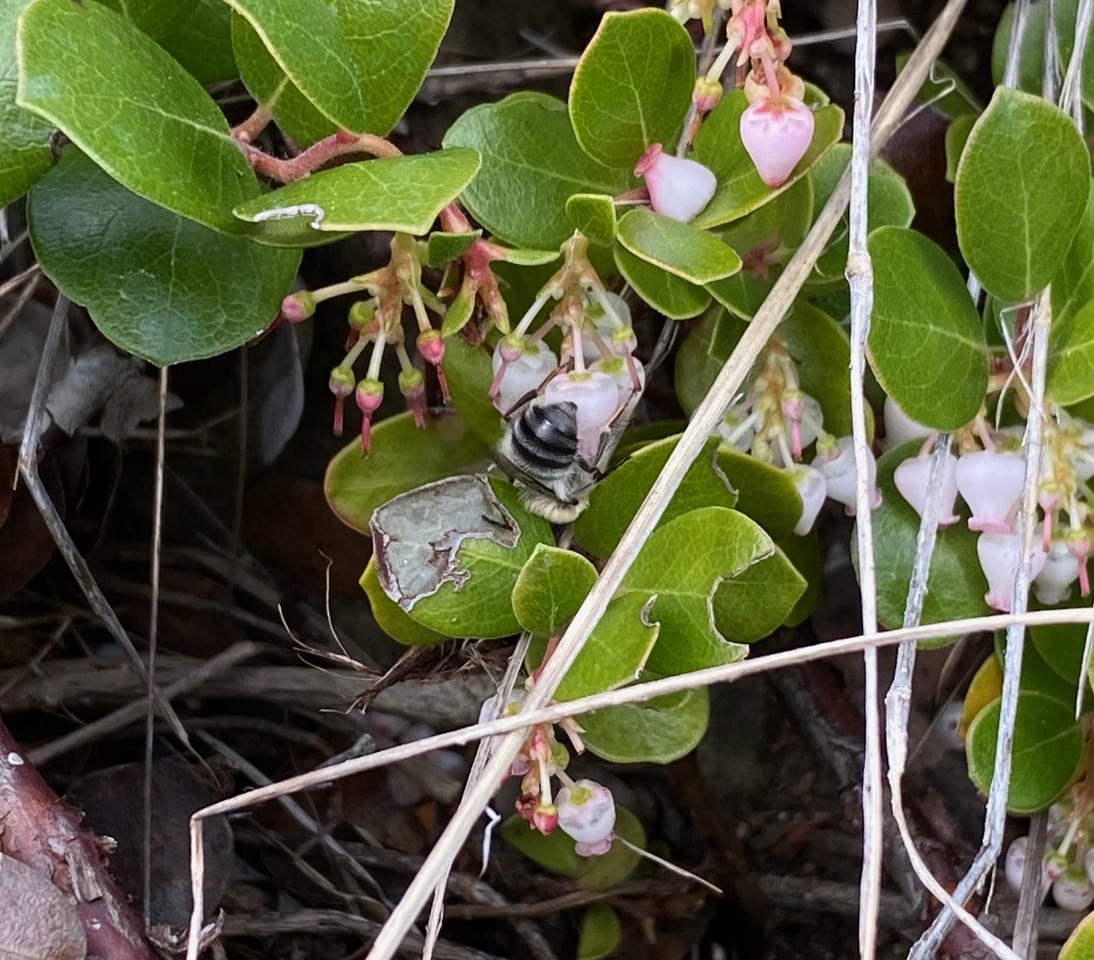
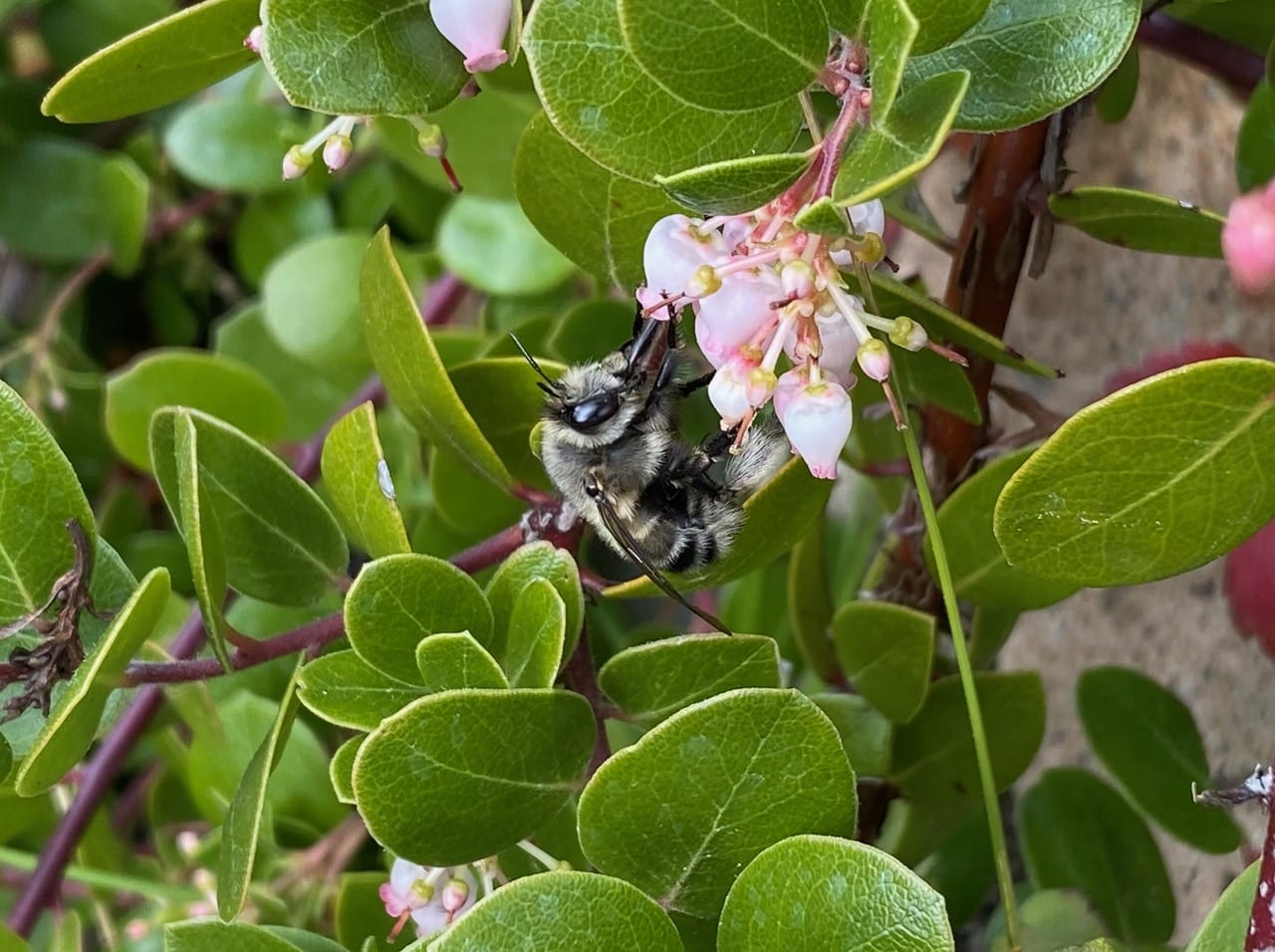
A feisty bee dives into a manzanita bush to land on a cluster of flowers. Given its extraordinarily long antennae, it has to be a male Spring Longhorn Bee in the genus Eucera (family Apidae).
The name Eucera is Greek for “well-horned”, a reference to the long antennae of the males. Only one subgenus, Synhalonia occurs in the United States and Canada, and are especially common in the west. These fast flying bees are hairy and generally large. Males have extraordinarily long antennae. Eucera includes both specialist and generalist bees. Specialists often limit themselves to the flowers of the pea family. Eucera are among the first to emerge in the spring and most fly exclusively in the spring. They are solitary ground-nesters. Each female excavates her own nest, and provides for her own young. Nest entrances have a mound of excavated soil heaped symmetrically around them. Since males do not build nests, they sleep out in the open, usually on flowers, sometimes in aggregation with other males, which help them maintain higher body temperature, or as a dilution effect against predators.
Here’s a quick view of the male Spring Longhorn Bee’s rear end while he positions himself to probe for nectar from the inverted flower.
A large Yellow-faced Bumble Bee, subgenus Pyrobombus (genus Bombus, family Apidae) lands on a manzanita. Wow, I haven’t seen a queen out foraging for a while. Most visiting the flowers now are small workers.
Queens are noticeably larger than worker bees, which is one of the easiest ways to distinguish them. Queen bees are fed a more substantial diet during their larval development, contributing to their larger size. The queen’s large size is crucial for her to store enough nutrients to lay a large number of eggs throughout the colony’s lifespan.
Bumble bees are social and live in colonial hives. Many of the large individuals seen early in the season are queens. They are the only members of their colony to survive the winter, hibernating until the days begin to warm and their host plants are in bloom. These queens have mated before they went into hibernation. Now their first order of business is to each find a nesting site (usually an abandoned rodent burrow), lay eggs, brood and nurture the first batch of workers. Thereafter, the queens stay behind in the hive to concentrate on laying eggs while the workers take on hive duties and foraging. Bumble bees are among the most cold tolerant bees, and are usually the first bees we see out foraging.
This is the closest shot I have of the Pacific Digger Bee this year. They are fast, frenetic bees that are difficult to photograph. This female is inserting her long tongue into the flower to take nectar. She appears to be wearing a pantaloon of shaggy white hairs on her hind legs – these are the special pollen-collecting hairs collectively called scopae. She lacks the males’ yellow clypeus (a plate on the insect head that forms part of its face).
As their name implies, the Digger Bees nest in the ground, sometimes in huge aggregations. These fast and noisy flyers buzz around flowers, appearing to “hop” from flower to flower while foraging. The chubby, furry Digger Bees resemble the bumble bees in many ways, but are a lot noisier. They are a fearless, rowdy lot – fun to watch but a challenge to photograph. Male digger bees of many species have white or yellow integuments on their faces. Females have shaggy hairs on their back legs, used to carry pollen. Female Anthophora are capable of buzz pollination – i.e. they vibrate their wing muscles to shake pollen from the anthers of some flowers. Digger bees are generalist pollinators that visit an impressively wide range of plants. They are exceptionally effective pollinators and play an important role in maintaining wildflower diversity, in part because their long tongues allow them to pollinate deep-throated and tubular blossoms inaccessible to other bees.
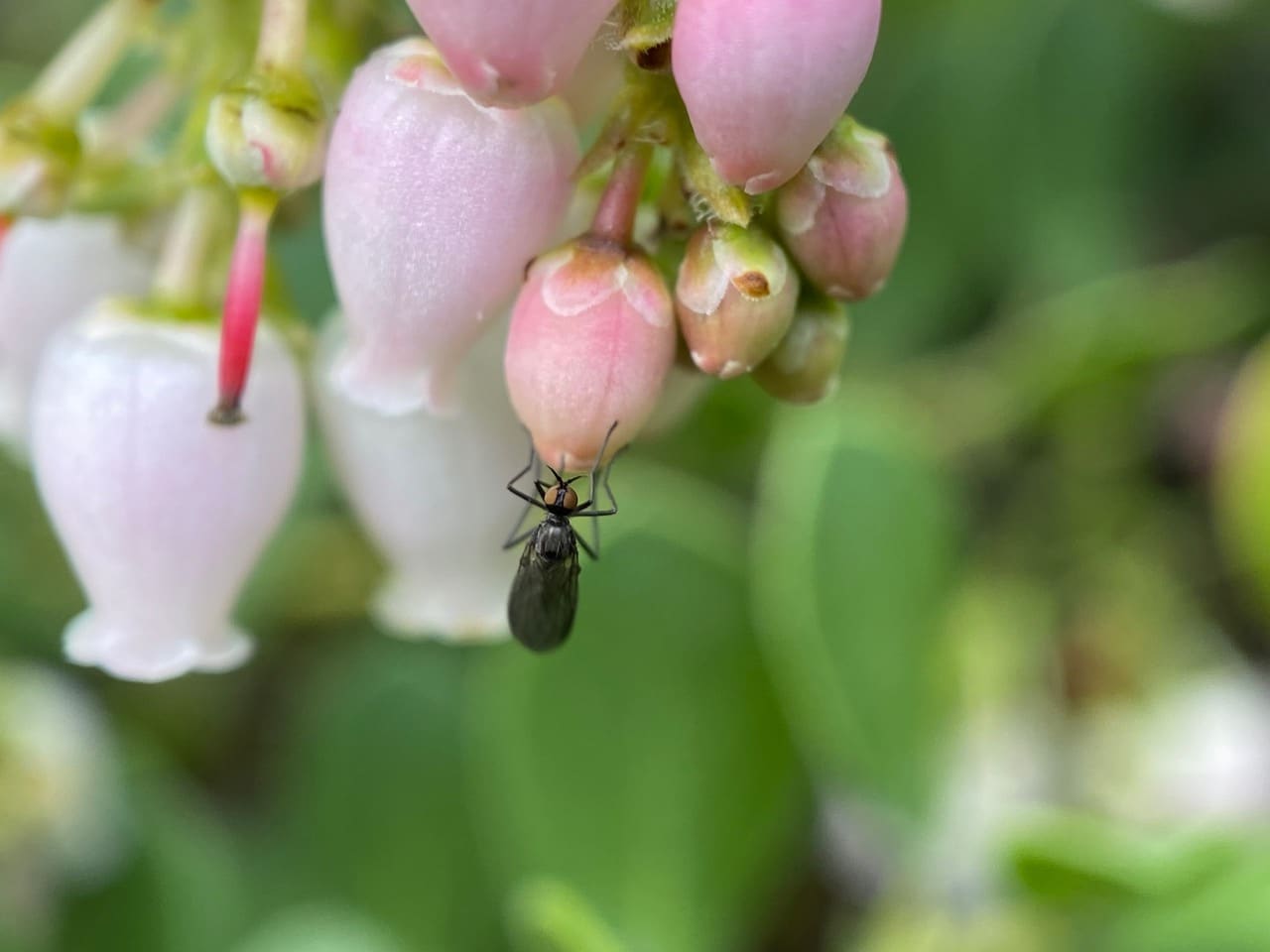
A tiny, dark, long-legged insect has just landed on a manzanita flower.
The side view shows that the fly has a long proboscis, and its large eyes occupy most of its globular head. It is a Hybotid Dance Fly (family Hybotidae).
The Hybotid Dance Flies (family Hybotidae) belong to the superfamily Empidoidea and were formerly included in the Empididae as a subfamily. Empididae generally have a thick beak pointing down, while Hybotidae have a thinner beak, or a thick beak pointing forwards or diagonally. Some crucial wing venation further distinguishes the two families. Precious little is known about the life cycle and biology of Hybotids because they are not considered of economic consequence. I have observed Hybotids visit flowers for nectar and pollen, notably on Soap Plant, Miner’s Lettuce, California Saxifrage, Wild Geranium, Hound’s Tongue and Buttercups, and I believe they contribute significantly to the pollination of these small wildflowers.
Why the name “dance fly”? This is derived from the mating swarms of males of many species. They gather in clouds over prominent objects, each individual seeming to bounce or “dance” in mid-air. Many other flies do this, notably midges, but the Empidids and the Hybotids got the moniker.
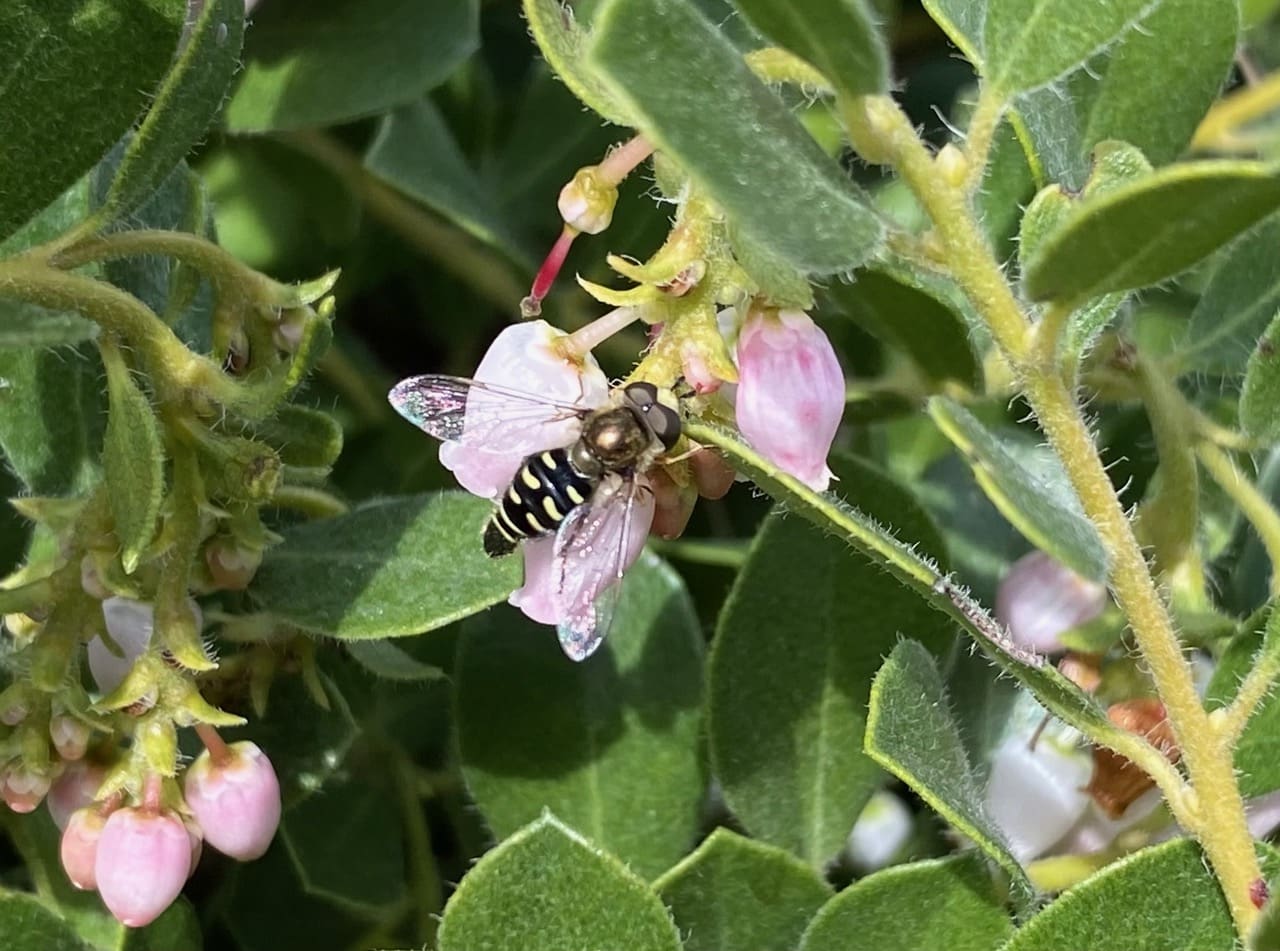
A Large-tailed Aphideater, Eupeodes volucris (family Syrphidae) is foraging on a cluster of manzanita flowers. It is one of the easiest hover flies to recognize, especially if it is a male.
The Large-tailed Aphideater, Eupeodes volucris (family Syrphidae) is found in western North America, and is active March through November. The common name of the species refers to the distinctive “large tail” or projecting cylindrical abdomen of the males. As the rest of the common name implies, the larvae of the species are voracious predators of small plant-sucking insects such as aphids. Females seek out dense aphid colonies on plants to lay eggs among them. Adults visit flowers for nectar and pollen.