

Pollinator Post 3/6/24
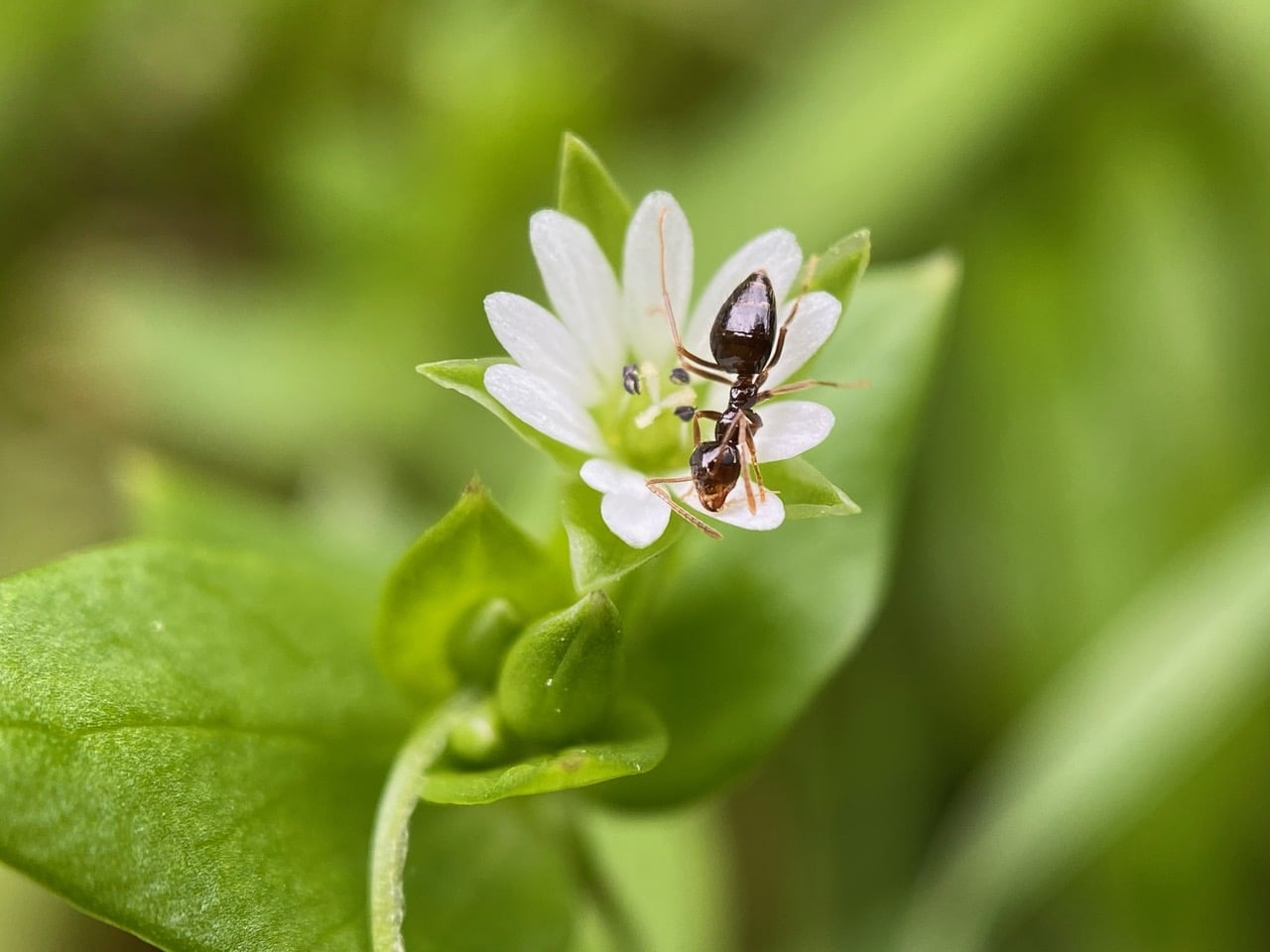
It is such a joy to be able to explore a trail again after the seemingly endless days of rain and clouds. When the sun returns this afternoon, I sprint out the door and head to the Dunn Trail in the Oakland hills.
The Common Chickweed, Stellaria media is blooming along the trail. The five petals are deeply divided, so the flower appears to have 10 petals. I catch glimpse of an American Winter Ant emerging from the base of the flower where it was taking nectar.
The American Ant, Prenolepis imparis (family Formicidae) is a widespread North American ant. A dominant woodland species, it is most active during cool weather, when most other ant species are less likely to forage. This species is one of a few native ants capable of tolerating competition with the invasive Argentine Ant, Linepithema humile. They are also aggressive toward other ants and produce abdominal secretions that are lethal to Argentine Ants. Prenolepis imparis is a generalist omnivore. Foragers are known for tending to aphids or scale insects from which they consume excreted honeydew, aggregating on rotting fruit, and exploiting protein-rich sources such as dead worms. The colony enters estivation (a hibernation-like state) and becomes inactive above ground for the warmer months, during which time eggs are laid and brood are reared. Reproductives overwinter and emerge on the first warm day of spring for their nuptial flight.
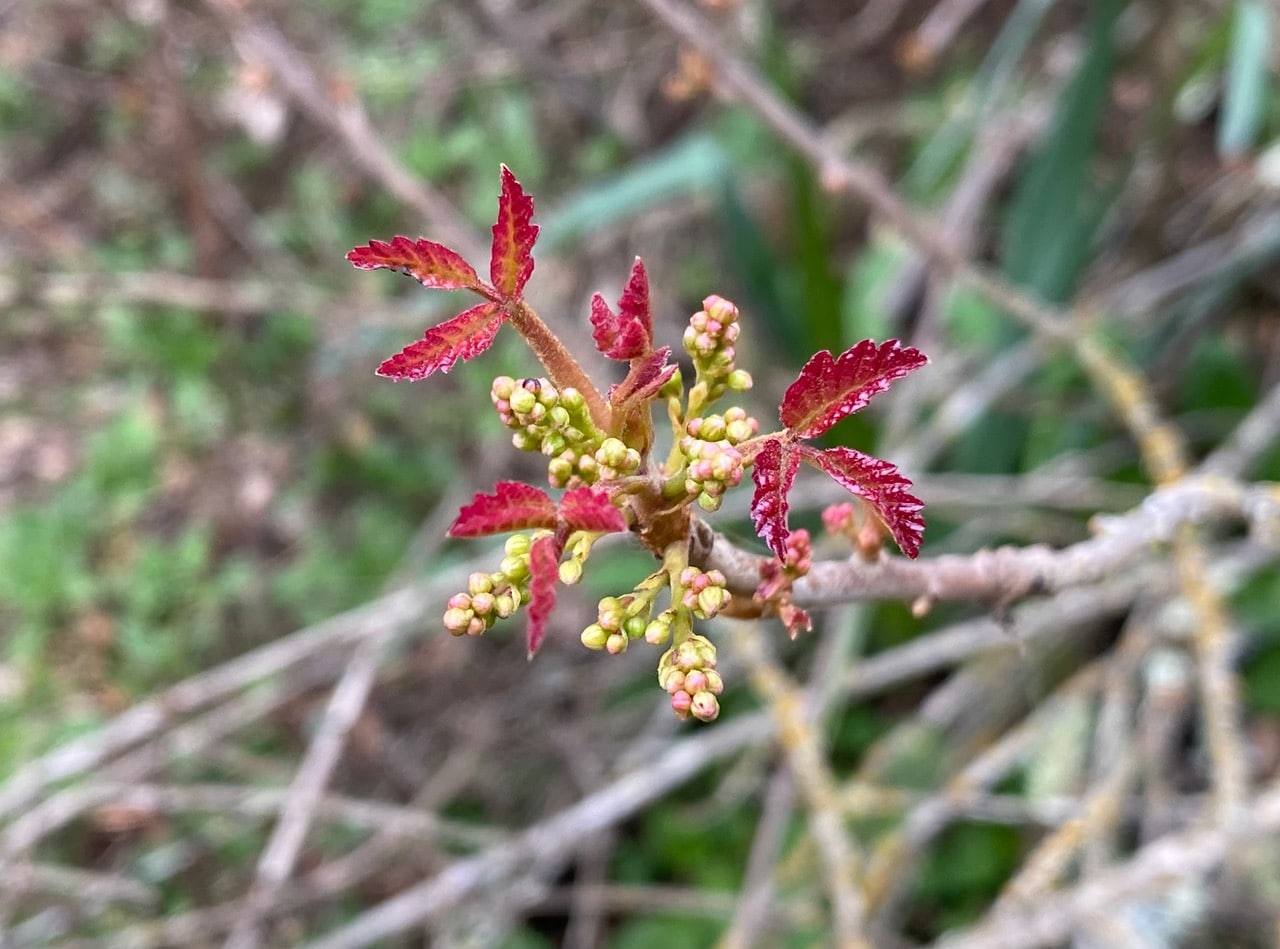
After a winter of dormant bare branches, the newly emerged glossy red leaves of Pacific Poison Oak, Toxicodendron diversilobum shouts an early warning to intrepid hikers foolish enough to venture off trail. The leaves are divided into three leaflets, hence the saying,”Leaves of three, let them be.” T. diversilobum leaves and twigs have a surface oil, urushiol, which causes an allergic reaction. It causes contact dermatitis, an immune-mediated skin inflammation in four out of five humans. Despite the inconvenience, the plant is used in habitat restoration projects. It can be early stage succession where woodlands have been burned or removed, serving as a nurse plant for other species.
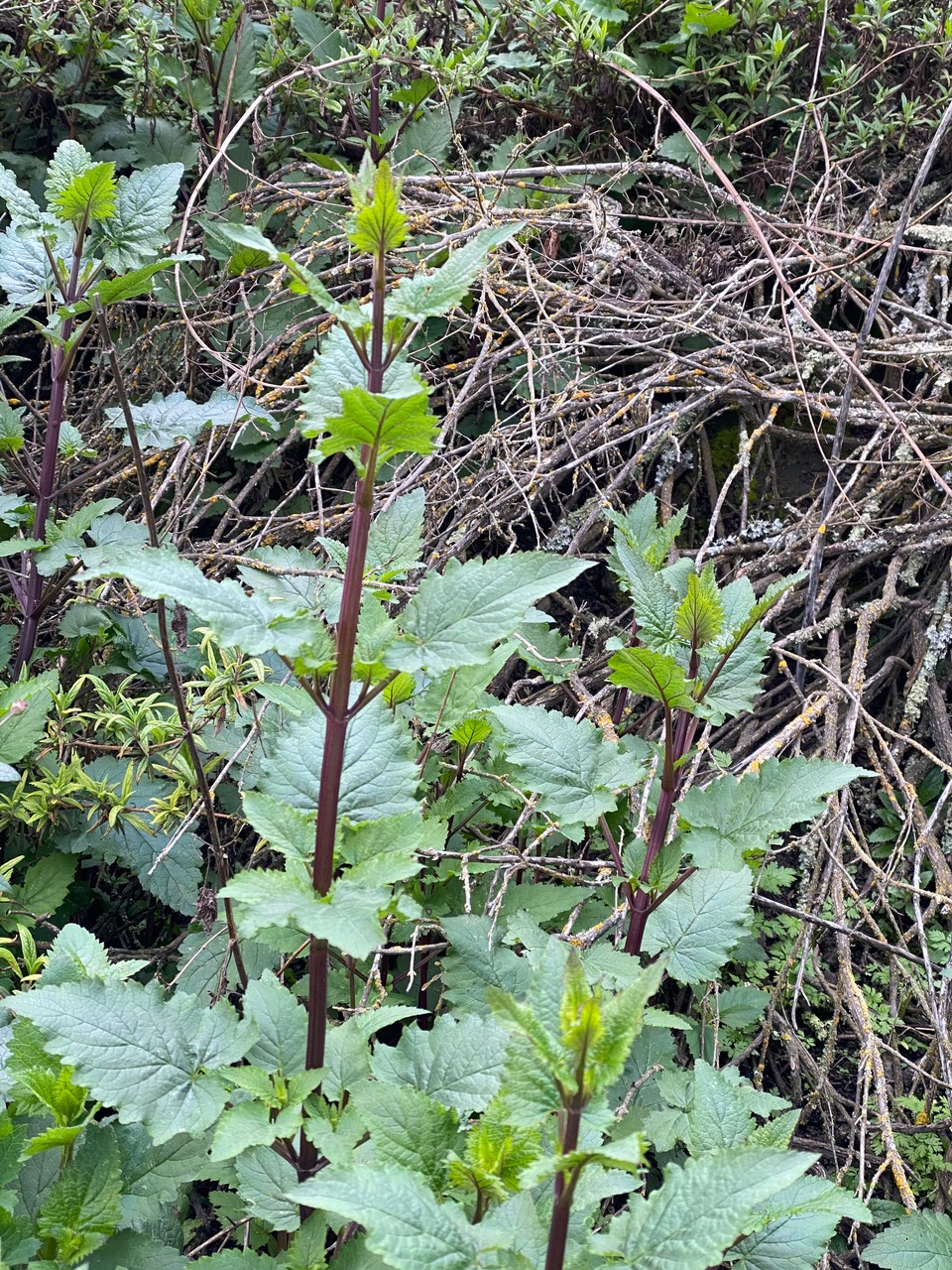
The Bee Plants, Scrophularia californica along the trail have grown big and tall since I last saw them.
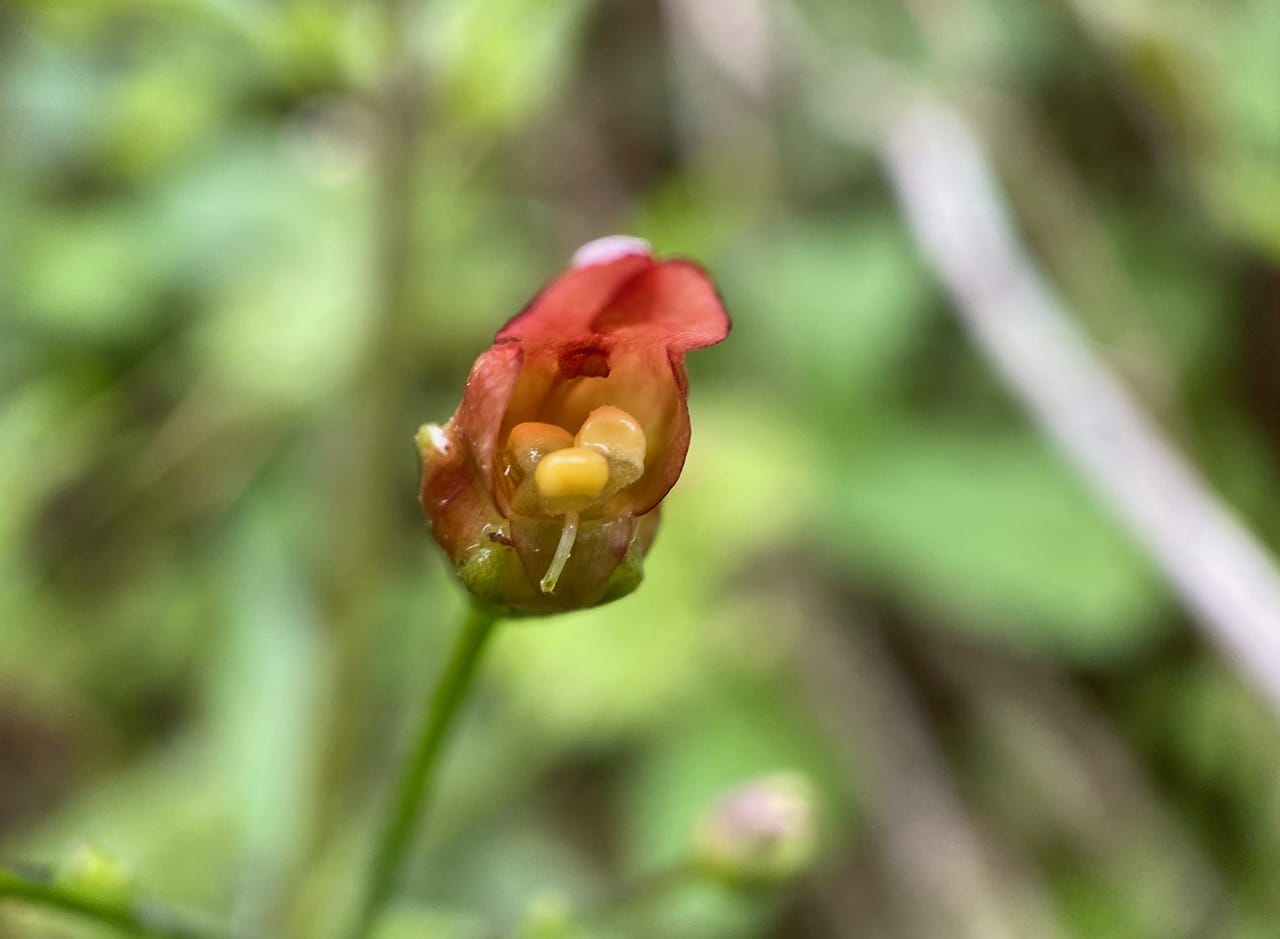
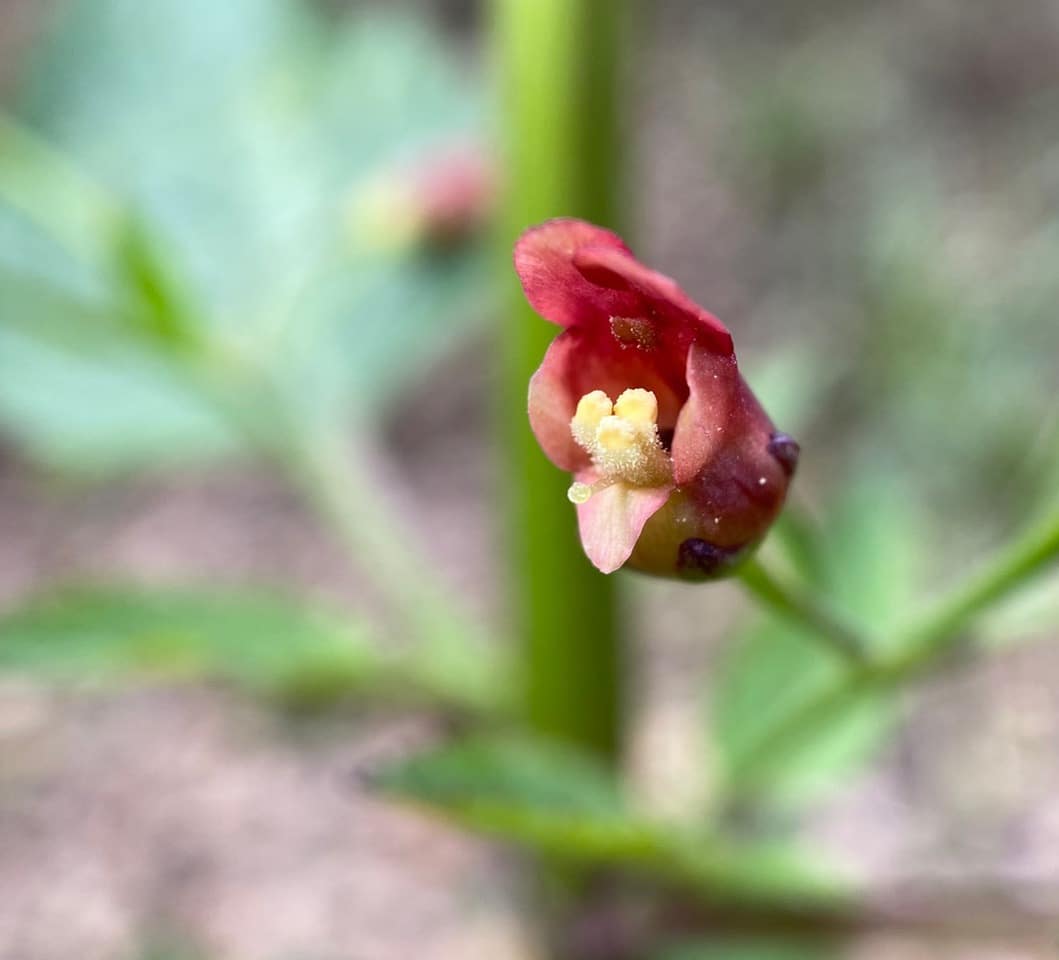
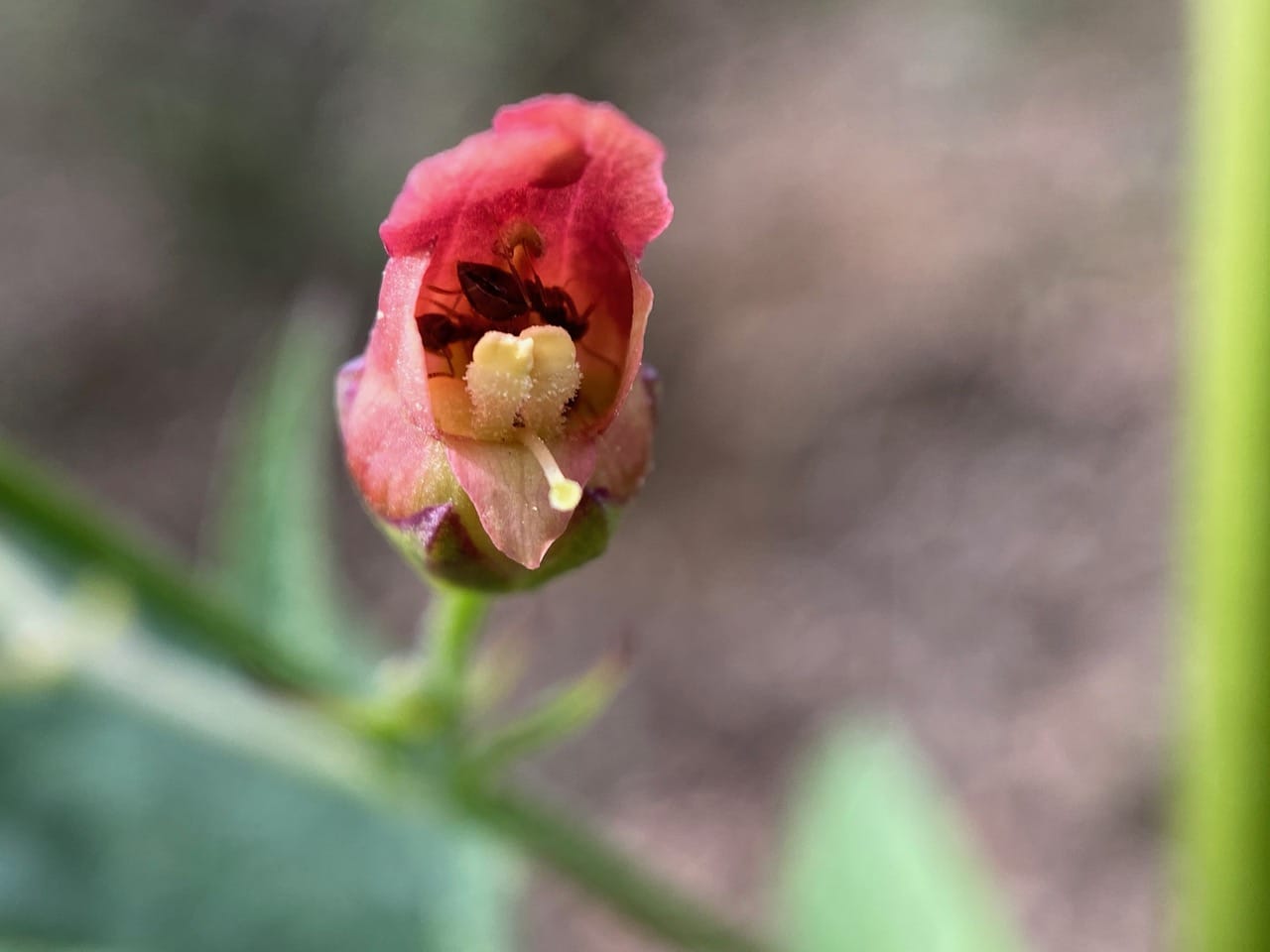


A couple of the Bee Plant are already in bloom! This rain-soaked flower is holding three of its four stamens at the front of the corolla, appearing like corn kernels. A thin style protrudes beyond the corolla, bearing a small stigma at the tip.
Hey, here’s a flower that’s not wet!
The small, inconspicuous flower of the California Bee Plant is only about 1/4 in. in length, and displays bilateral symmetry, with two petals pointing up (like Micky Mouse ears) and three down; the latter sometimes appear as two petals to the sides and one down. There are 4 fertile stamens, more of less appressed to the lower portion of the throat and extending to the edge of the lower lobes. The fertile anthers are yellow (only two are visible here). The infertile fifth stamen is dark red, and mostly fused to the upper throat. There is a single style with a capitate stigma. The style is appressed to the lower portion of the tube and extends beyond the corolla, bending downward. The flower is protogynous, meaning the female parts (pistil) mature before the male parts (stamen).
The flower pictured here is in the female phase, with a mature, receptive stigma. The stamens are not yet mature; only one of the four fertile anthers have been rolled out to the front of the throat, and is not yet dispensing pollen. Nectar is already produced to entice pollinators to visit and deposit pollen from other more mature flowers. Dichogamy (separation of genders in time) is a floral strategy for avoiding self-pollination.
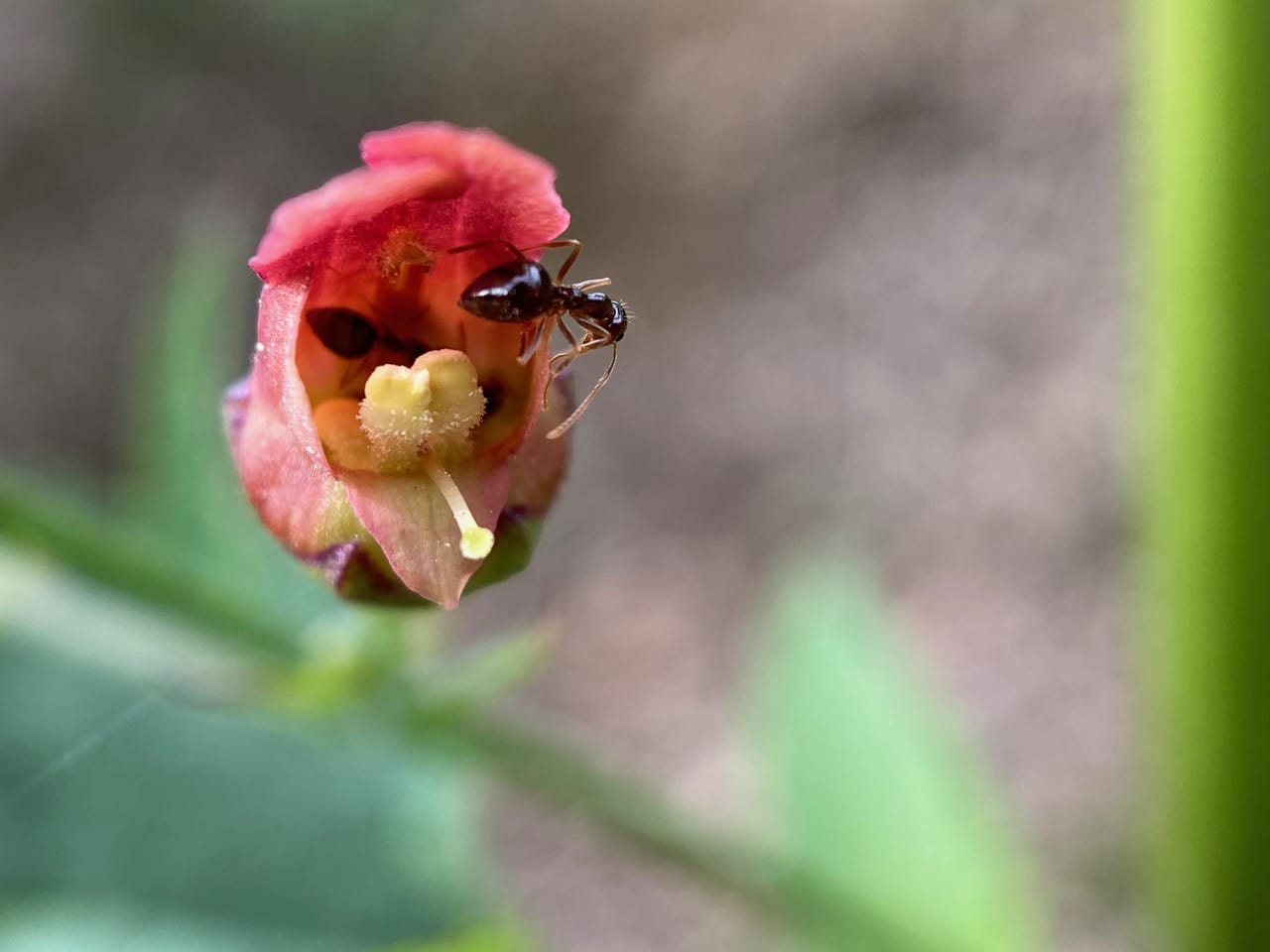
There seems to be insect activity in that Bee Plant flower. Ants? Since the flower is in its female phase, and the anthers are not yet releasing pollen, the only reward the insects are probably getting is nectar.
Ah, one of the ants finally comes out. It is an American Winter Ant. Not surprising, as few other ants are out foraging this time of year.
The American Ant, Prenolepis imparis (family Formicidae) is a widespread North American ant. A dominant woodland species, it is most active during cool weather, when most other ant species are less likely to forage. This species is one of a few native ants capable of tolerating competition with the invasive Argentine Ant, Linepithema humile. They are also aggressive toward other ants and produce abdominal secretions that are lethal to Argentine Ants. Prenolepis imparis is a generalist omnivore. Foragers are known for tending to aphids or scale insects from which they consume excreted honeydew, aggregating on rotting fruit, and exploiting protein-rich sources such as dead worms. The colony enters estivation (a hibernation-like state) and becomes inactive above ground for the warmer months, during which time eggs are laid and brood are reared. Reproductives overwinter and emerge on the first warm day of spring for their nuptial flight.
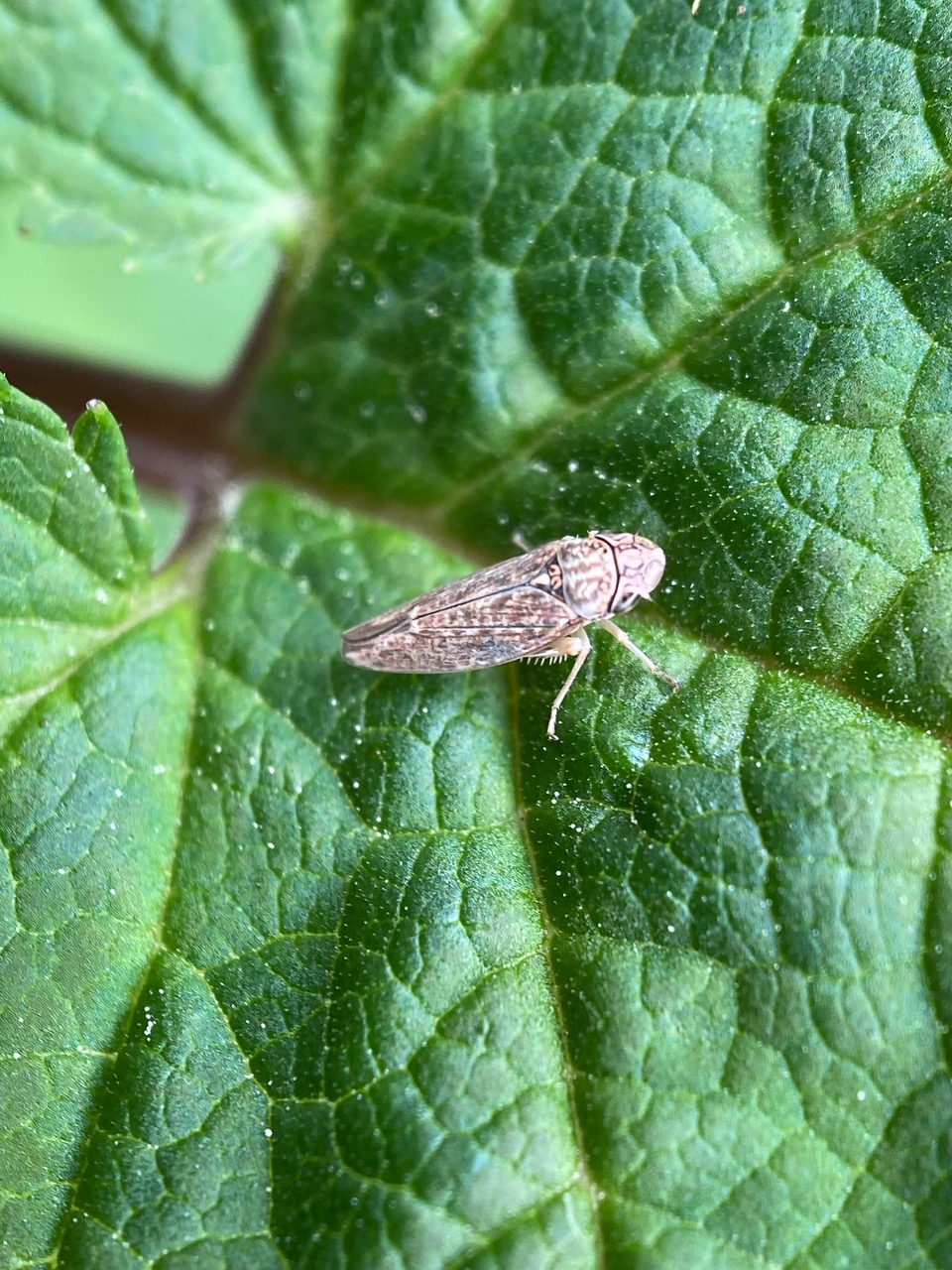
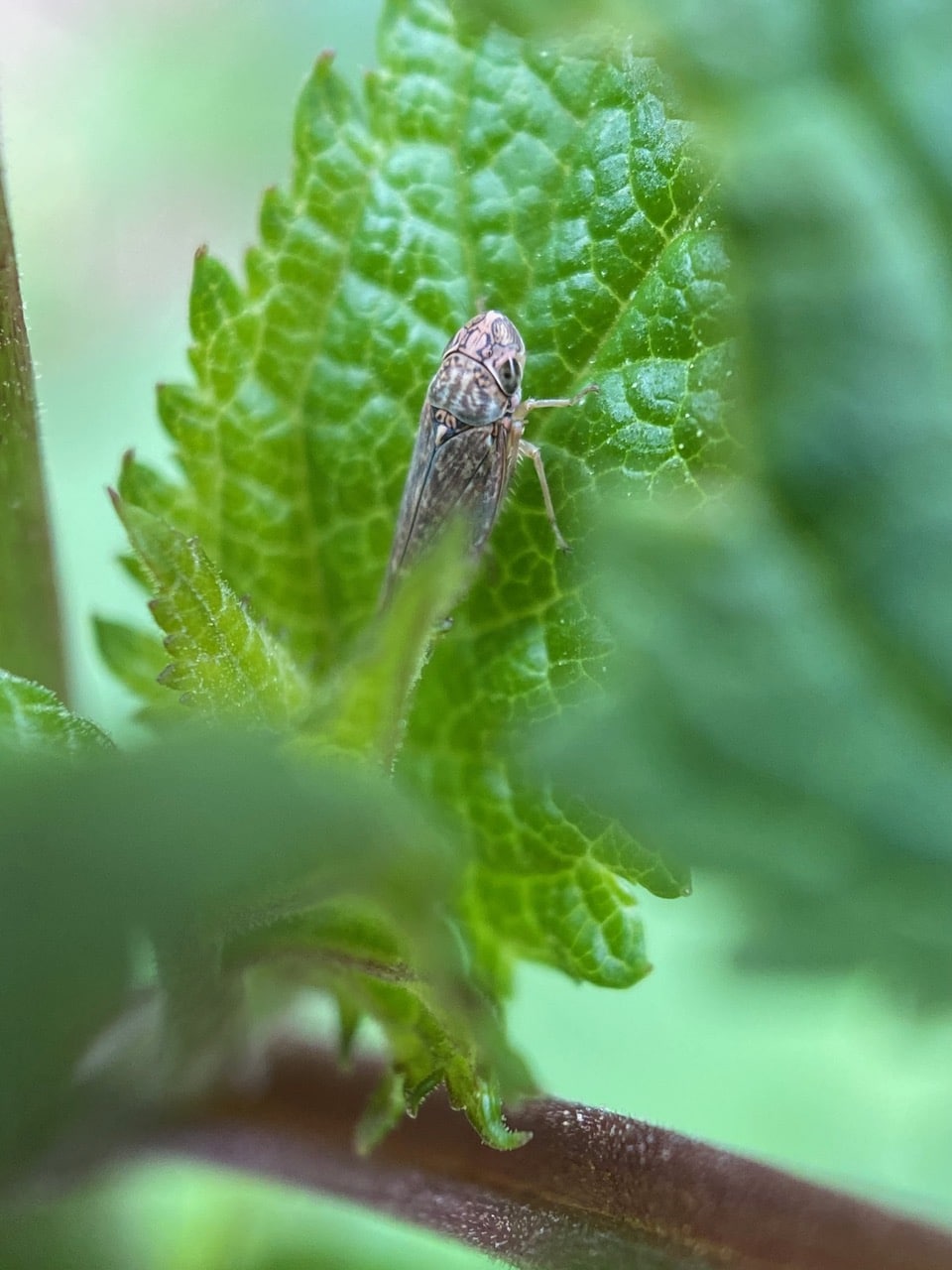
A small insect is resting on a Bee Plant leaf. From its general shape, and the neat row of spines along its hind legs, I gather that it is a Leafhopper.
Leafhopper is the common name given to true bugs in the family Cicadellidae. The bugs are plant feeders that suck plant sap from grass, shrubs, or trees. Their hind legs are modified for jumping, and are covered with hairs that facilitate the spreading of a secretion over their bodies that act as a water repellent and carrier of pheromones. They undergo partial metamorphosis, and have various host associations, varying from very generalized to very specific.
While sucking the sap of plants, these insects excrete any extra sugar as a sticky liquid commonly called honeydew. This is a serious hazard for small insects, possibly sticking the insect to a leaf, or gluing its body parts together. Some bugs deal with this problem by shooting the waste away from their bodies at high speed. Leafhoppers have a unique solution – they make brochosomes, a proteinaceous material within a special gland in their guts, and secrete them by the billions in a milky anal fluid, and spread them over their bodies using their legs. When the fluid dries, the brochosomes form a powdery coating, and the leafhoppers spread them even further using comb-like hairs on their legs. The brochosomal coat is superhydrophobic, and acts as a water-repellent, non-stick coating protecting the leafhoppers from their own sticky exudates.
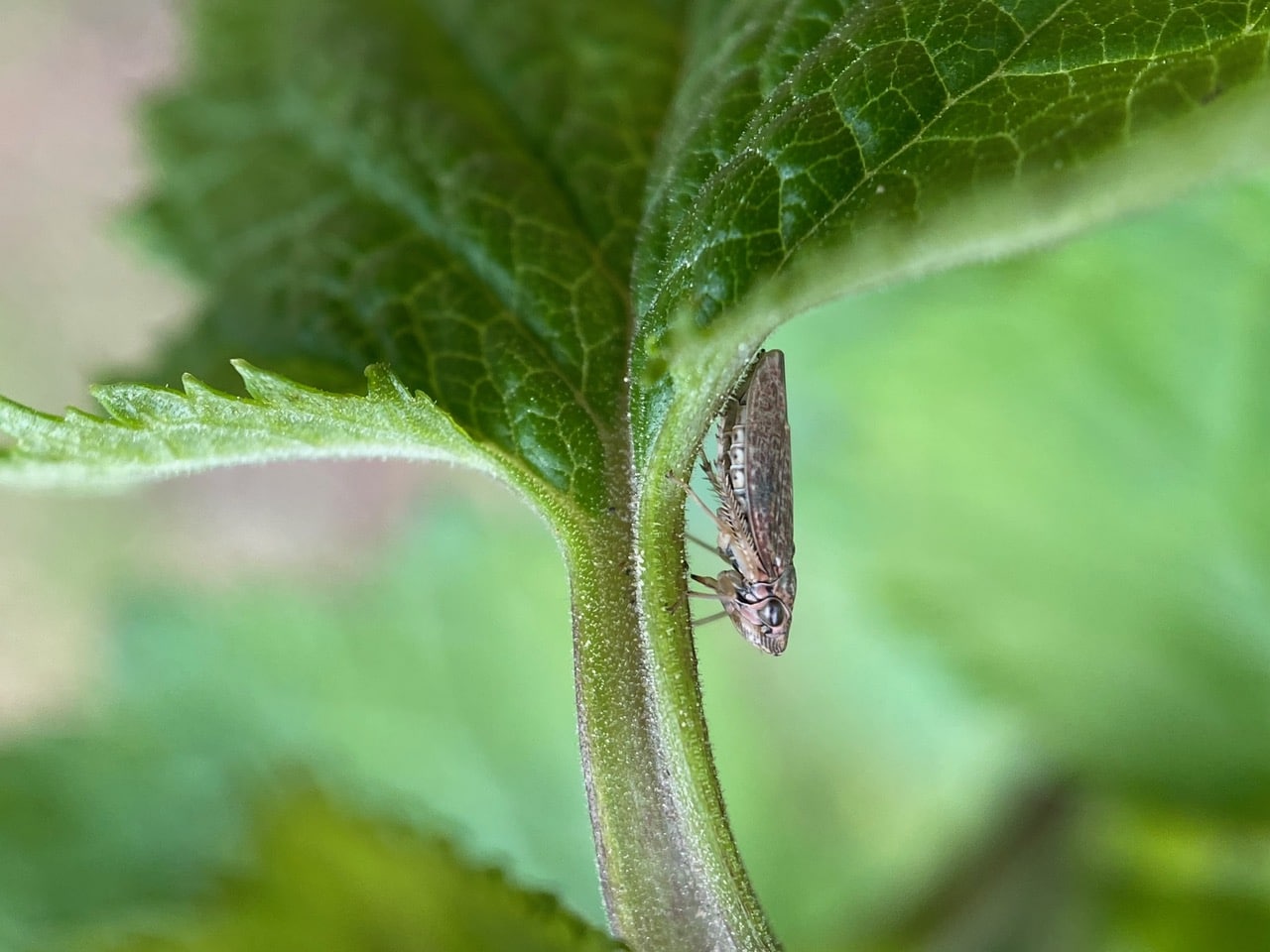
Pleasantly surprised that the leafhopper does not immediately leap off the plant, I am thrilled to get this side view of the insect showing its short but stout piercing-sucking mouthpart, the rostrum.
iNaturalist has helped to identify the bug as Amphigonalia bispinosa, a member of the Sharpshooters (subfamily Cicadelinae).
Sharpshooters feed on the plant’s xylem, extracting small amounts of nutrients in large volumes of water, forcing them to eliminate up to 300 times their body weight in liquid waste each day. To accomplish this, the sharpshooters employ an energy-efficient mechanism called super propulsion to expel their urine using an anal catapult.
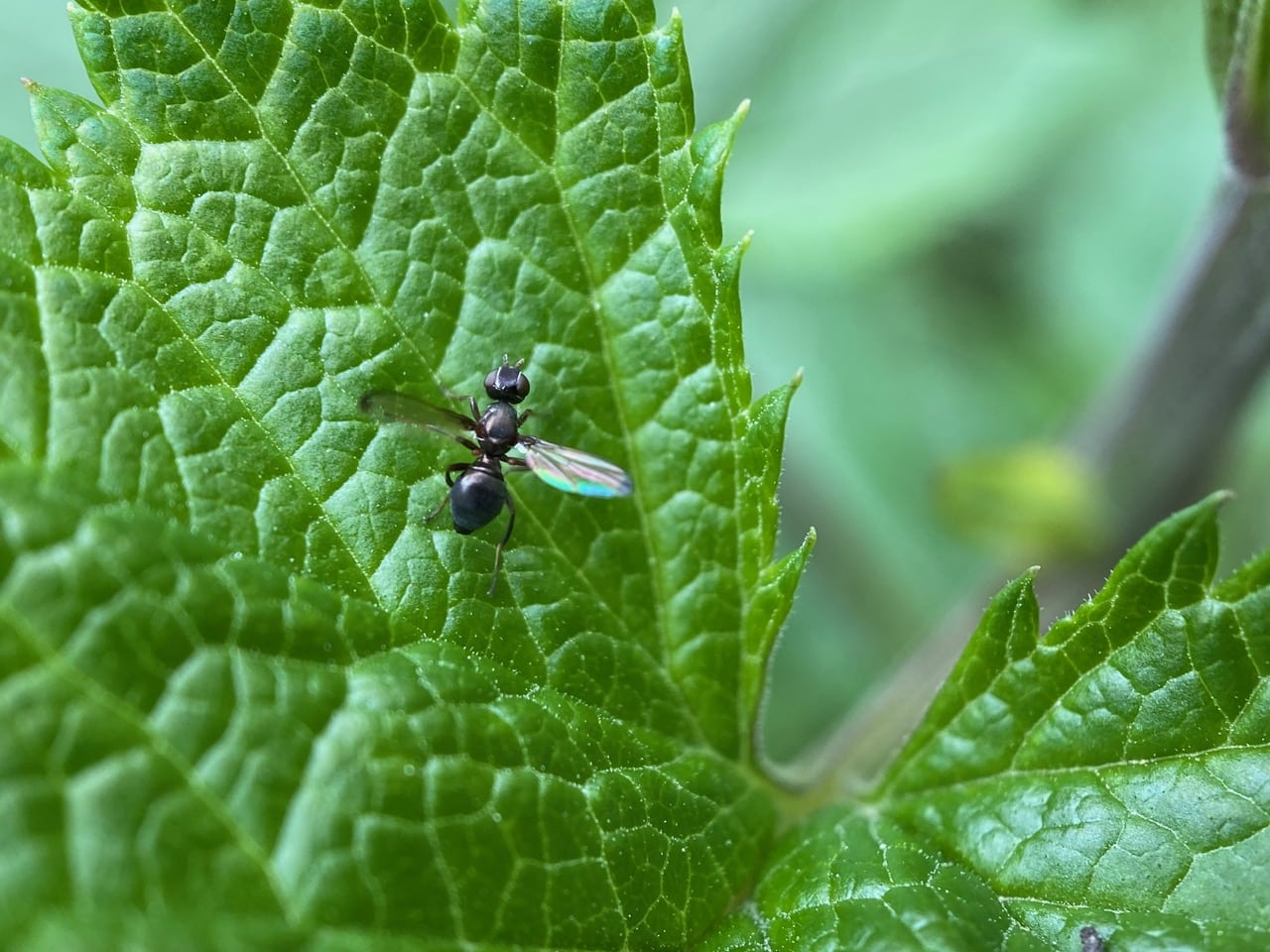
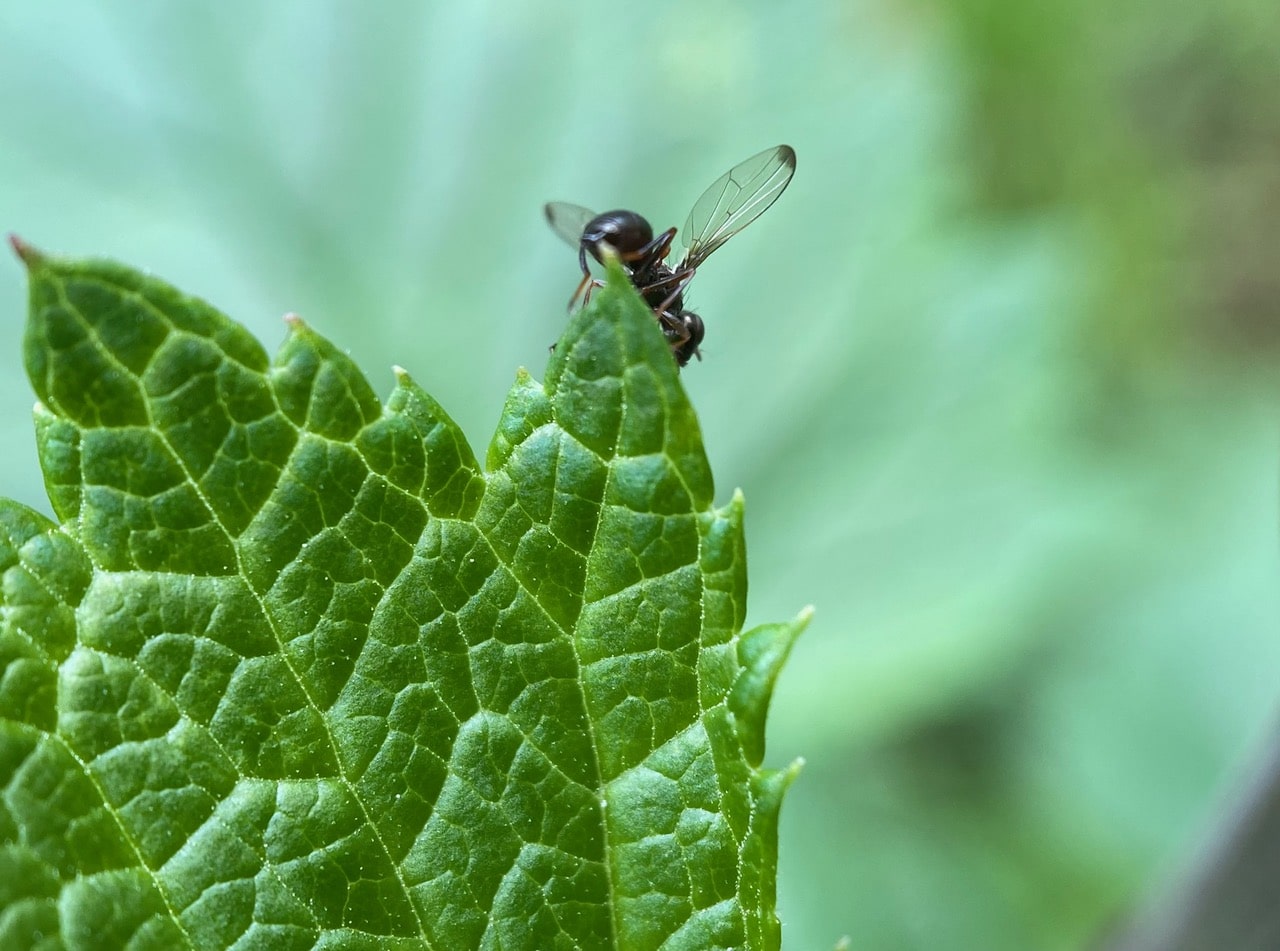
If it weren’t for its wing-waving behavior, I would’ve easily missed this small insect on a Bee Plant leaf. As it moves around, it is slowly waving its wings that are surprisingly unmarked. Is it signaling to another fly? Sure enough, there’s a similar fly on an adjacent leaf!
Closing in, I realize that it is a Picture-winged Fly, most likely in the genus Curranops (family Ulidiidae). It has this oversized spongeing mouthpart that it extrudes while feeding.
Picture-winged flies belong to the family Ulidiidae. They are among the more common, ornate, and entertaining of all Diptera, thanks to their lovely wing patterns and adorable courtship behaviors. Most have some kind of pattern of spots, bars, or lines on the wings, and at least a few have metallic bodies. Many can often be found on certain plants, dung, logs, wooden fences, or the trunks of trees. These locations serve as food sources, basking sites, or display sites for courtship. Most species of Picture-winged flies are herbivorous or detritivorous.
As the fly disappears over the edge of the leaf, I notice that its wings are actually marked – a faint dark spot on the tip of each wing.
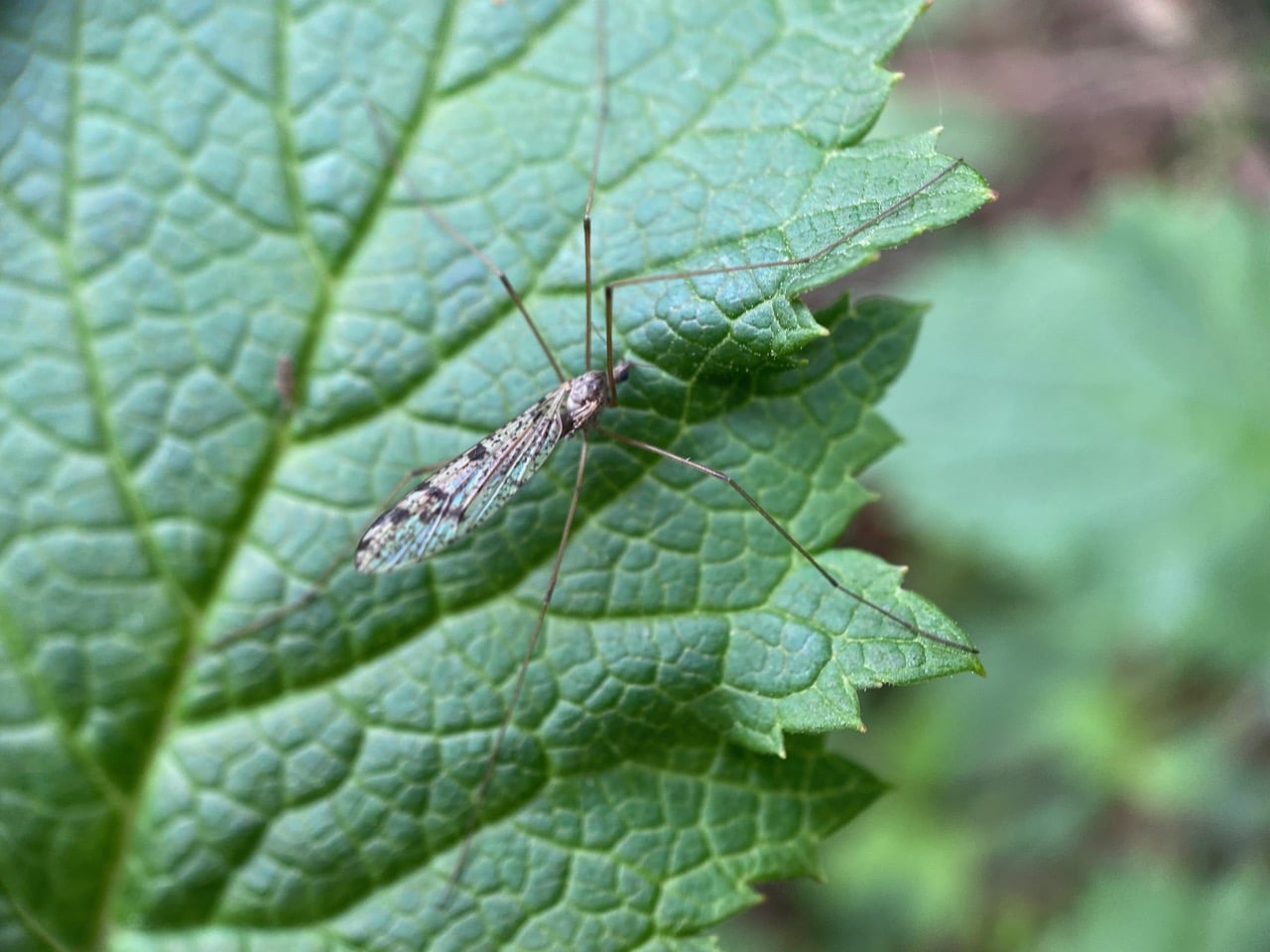
A small Crane Fly is resting motionless on a Bee Plant leaf. It has been identified as Phyllolabis myriosticta (family Limoniidae).
Related to the Large Crane Flies (family Tipulidae), the Limoniids are medium or small-sized, rarely large. They can usually be distinguished by the way the wings are held at rest. Limoniids usually fold the wings over the back of the body, whereas other crane flies usually hold them out at right angles. Limoniid larvae are mostly aquatic or semi-aquatic. The various species have evolved to feed on different food sources, such as decaying plant matter and fungi. Some are predatory. Limoniids occupy a wide range of habitats: in soil rich in humus, in swamps and marshes, in leaf litter, and in wet spots in woods.
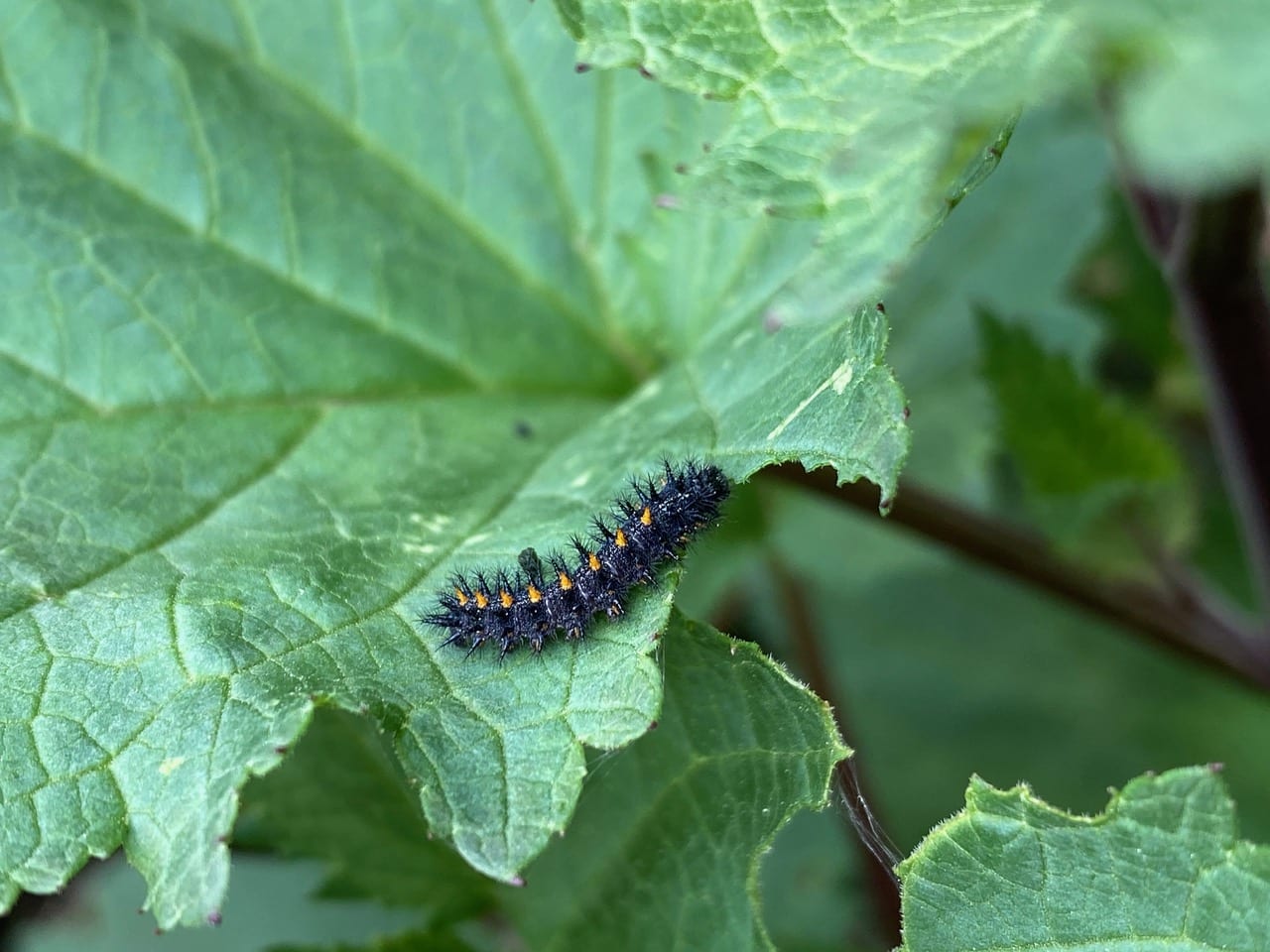
A small caterpillar of the Variable Checkerspot butterfly is feeding on the edge of a Bee Plant leaf. Wow, I have never seen these so early in the year! With all the rains and winds we have been experiencing, I wonder how the caterpillar managed not to be swept off the foliage.
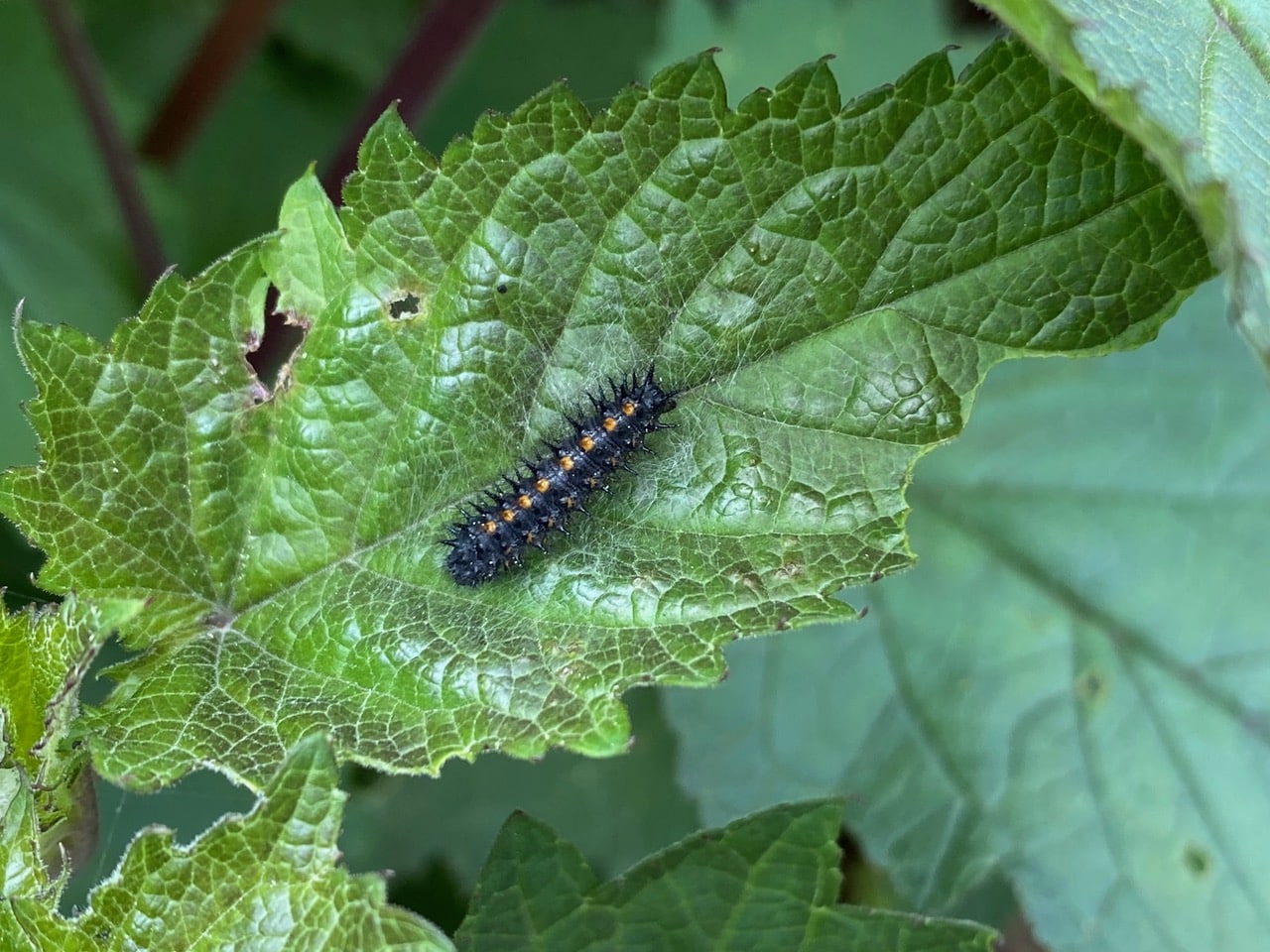
Here’s another caterpillar on the same plant. Looking at the magnified photo, I realize that the caterpillar has attached itself to a bed of silk it has laid down on the leaf.
The Variable Checkerspot, Euphydryas chalcedona (family Nymphalidae) is found across western North America. The butterfly occupies a wide range of habitats, including sagebrush flats, desert hills, prairies, open forests and alpine tundra. Males perch or patrol around larval host plants to encounter females. Eggs are laid in large groups on underside of leaves of host plants. Host plants include California Bee Plant, Scrophularia californica, and Sticky Monkeyflower, Diplacus aurantiacus. These plants provide the caterpillars with iridoid glycoside, a chemical that imparts unpalatable taste to birds, protecting the caterpillars from predators. Larvae feed in large, loose groups on the host plants. Individuals overwinter (enter diapause or hibernation) as third or fourth instar larvae in sheltered sites under bark or dead branches, in hollow stems and in rock crevices. Pupation begins in early to mid April and the adult flight season begins between mid-April and May and continues into June. The adults feed exclusively on nectar, and have a life span of about 15 days.
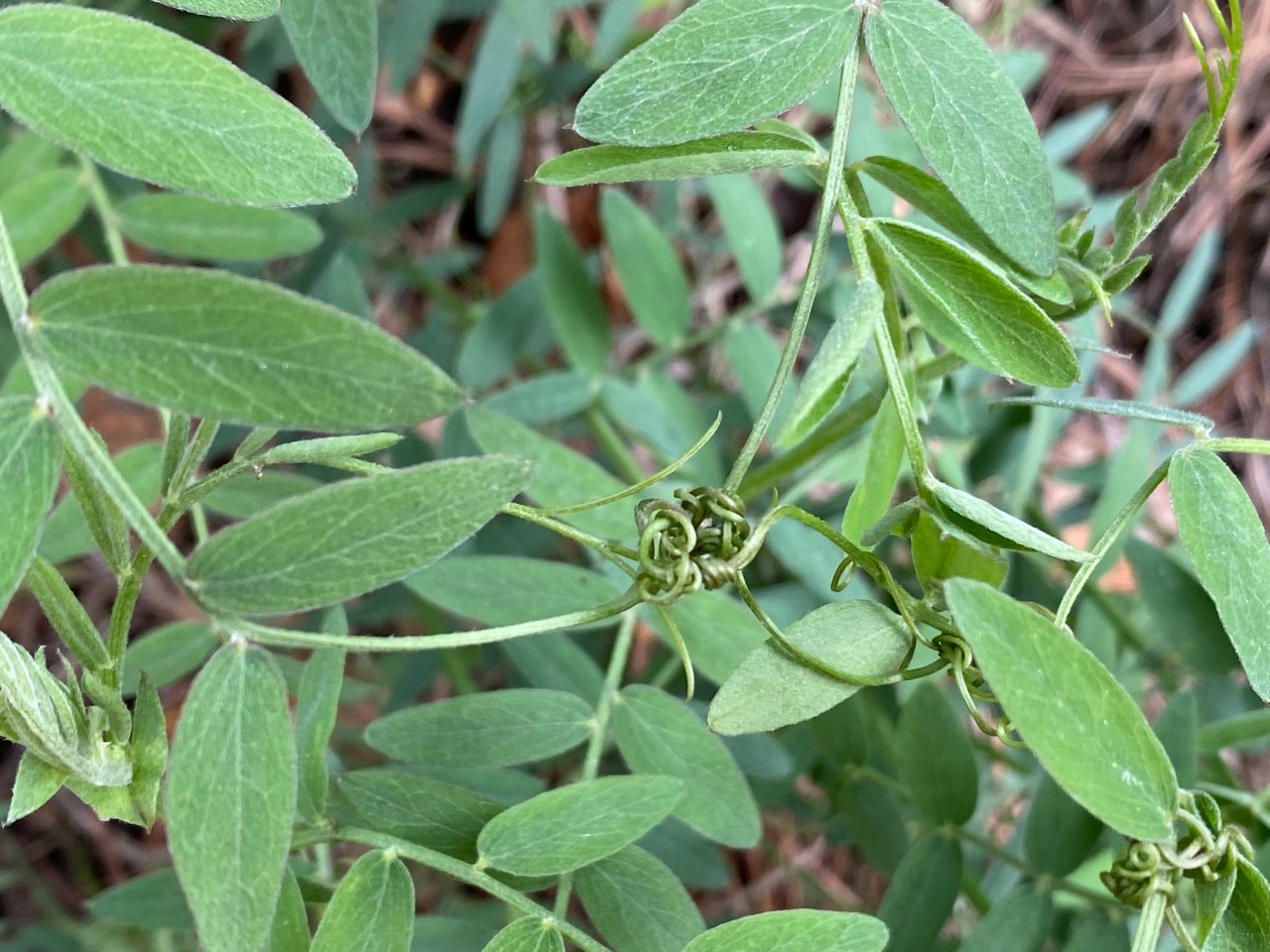
A healthy patch of an unidentified pea plant has sprouted on the trail bank. Typical in the members of the family Fabaceae, the leaves are compound. Most of the lower leaflets are normal and expanded. The terminal leaflets are modified into tendrils that twine around any supporting structure to help the plant climb towards sunlight. I have to smile when I see several of these tendrils have converged to form a tight knot.
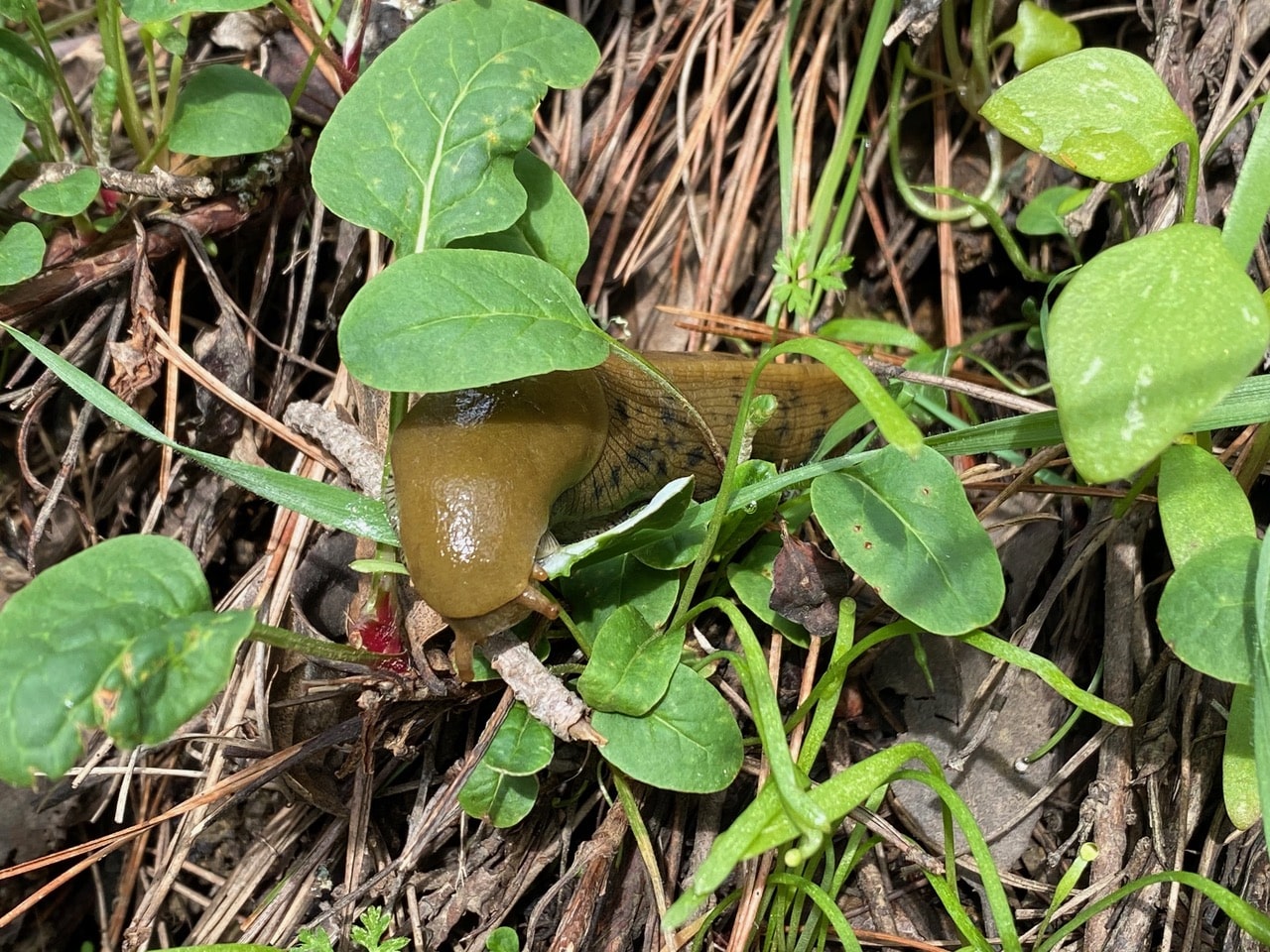
On the trail bank, a Banana Slug is feeding on what appears to be the new leaves of a Buckwheat – Yum!
Below the two pairs of tentacles, the slug’s mouth contains the radula (Latin for scraper), a vaguely tongue-like ribbon covered with rows of tiny, replaceable backward-pointing teeth, which scrape food into the esophagus. To eat, the slug extends it odontophore, which supports the radula. Banana slugs eat pretty much anything, mostly living, dead or decaying plant matter, lichens, mushrooms, as well as animal droppings and carrion.
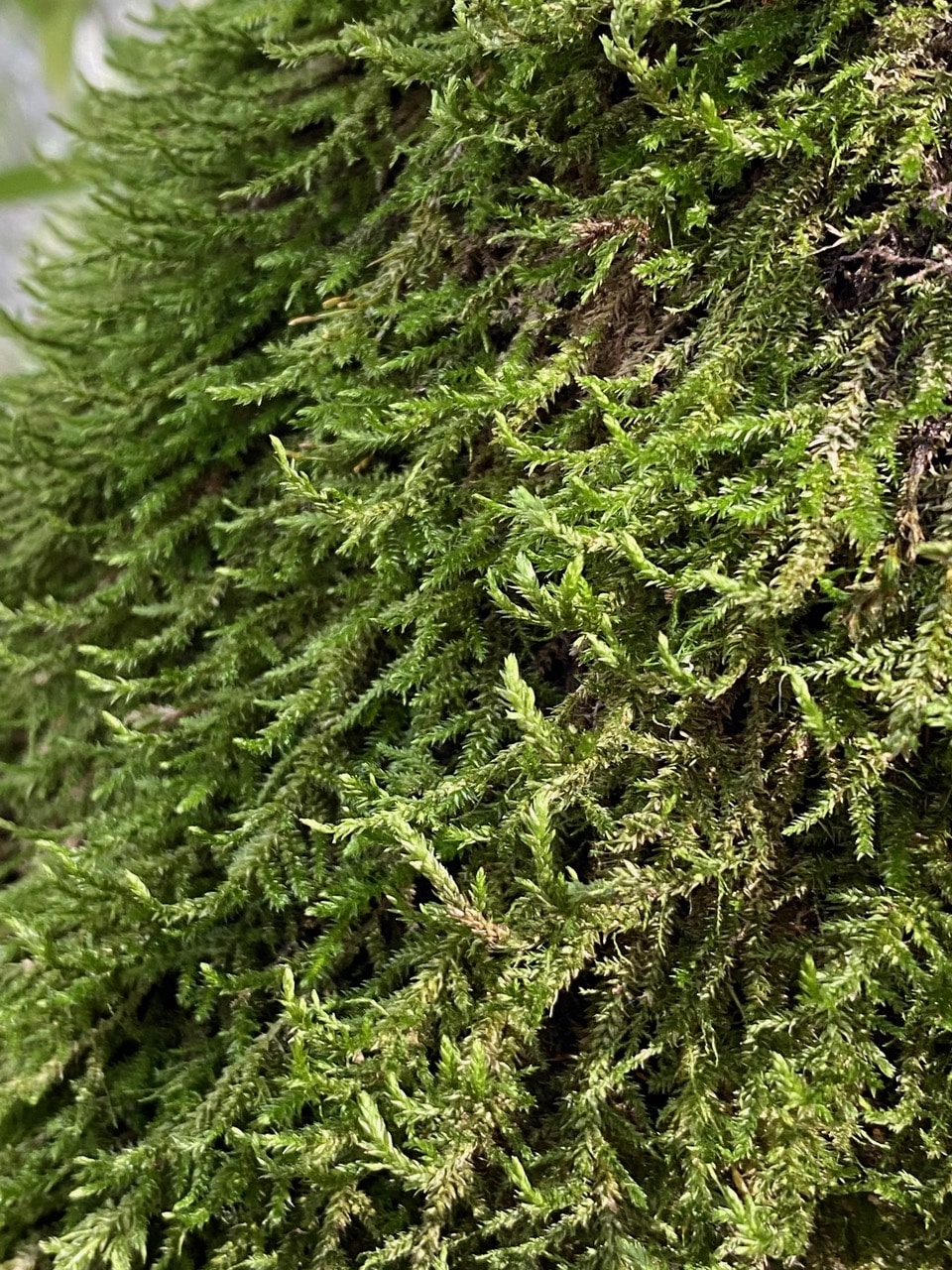
A thick carpet of the large moss, Alsia californica has blanketed the lower trunk of a Bay Tree. The tips of this moss tend to curl upwards as the moss dries, in contrast to the similar moss we have talked about, Dendroalsia whose tree-shaped leaves curl downwards like poodle fur when they dry up.
Alsia californica is an important component of the moss flora of coastal western North America. In California, the species extends primarily from Los Angeles to Del Norte counties. It usually grows in coastal habitats, quickly diminishing with distance from the coast and penetrating inland only in canyon riparian microhabitats.
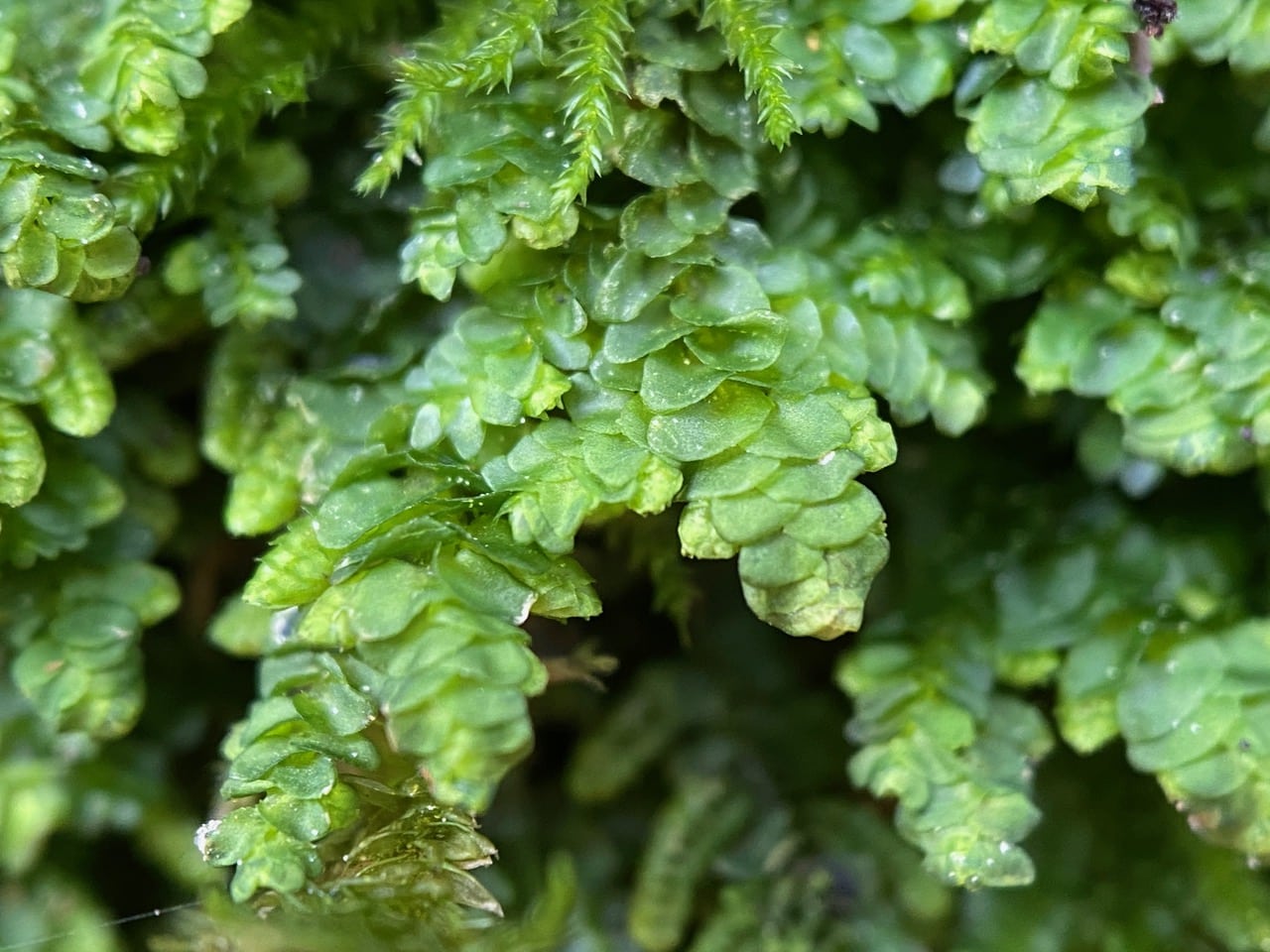
Right below the Alsia moss, I spot a small patch of a different bryophyte – Leafy Liverworts! Liverworts come in two very distinct forms: leafy and thalloid. Leafy liverworts are obviously, leafy, and look very much like the mosses. They are most easily distinguished from the mosses by their leaf arrangement.
The gametophytes of Leafy Liverworts always have two lateral rows of leaves, and sometimes a row of leaves on the underside, while the leaves in mosses are spirally arranged. Like the mosses, liverwort leaves are only one cell layer thick. The stem of leafy liverworts is usually green. Unlike the mosses, the liverworts do not have any specialized tissues for internal water or nutrient conduction in the stem.
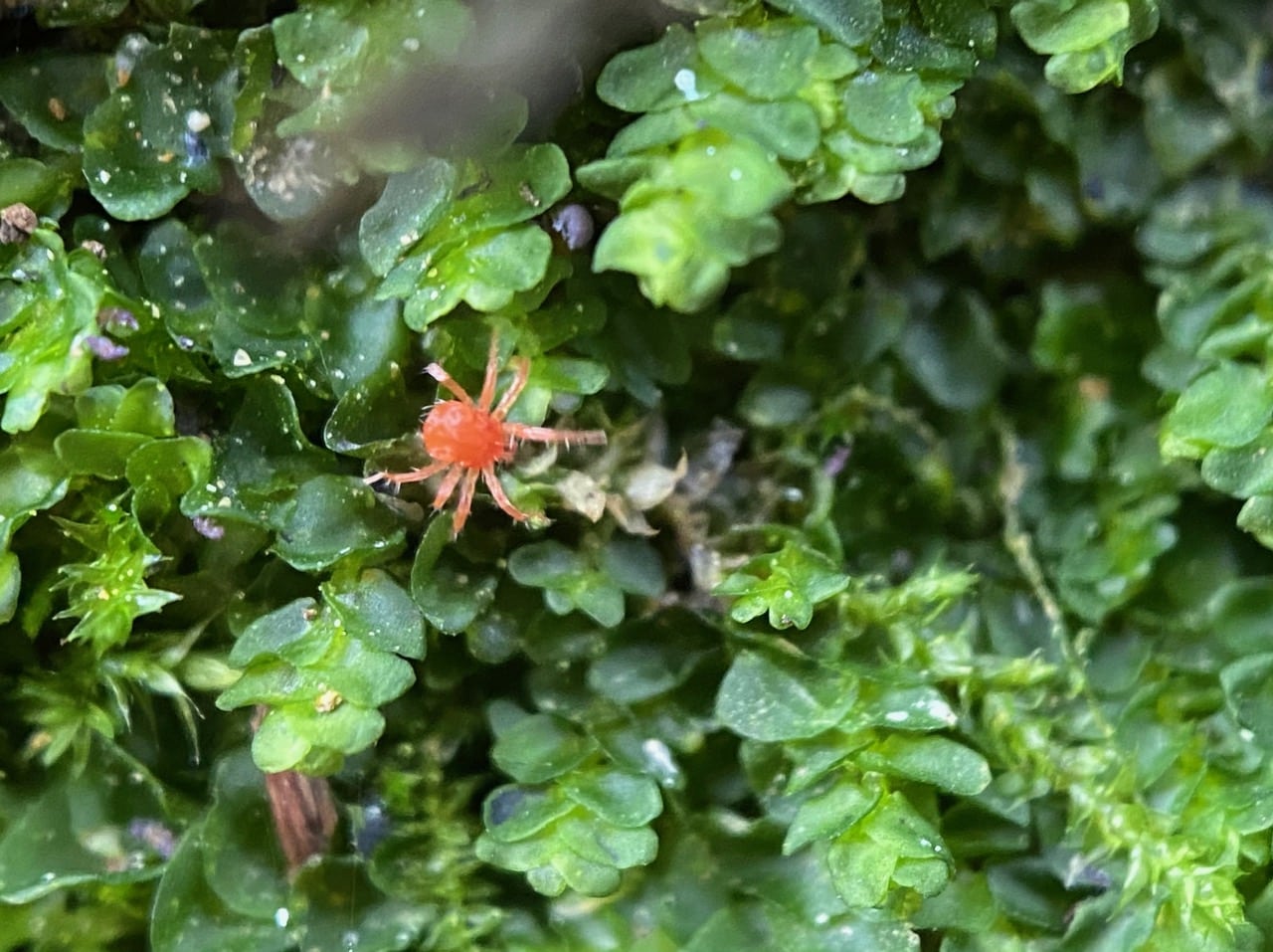
While photographing the liverwort, I spot a red mite running haphazardly among the greenery.
It is a Whirligig Mite, Anystis sp. (family Anystidae). Anystis are predatory mites that prey on spider mites, aphids, leafhoppers, psyllid, thrips, and other small arthropods. They occur in trees, shrubs, and woody vines. Anystis are 1-1.5mm long, larger than most mite species. Adults are orange or red. The legs are covered with numerous, fine, short hairs. The distinct mouthparts project forward from the head. Adults’ overall shape is broadly rounded at the rear and more narrow in front. Nymphs and adults have 4 pairs of legs. The long legs appear to arise from a single point. This close spacing of the basal segments allows the mite’s common behavior of twirling around, which is the source of the name whirligig mites. The mites are highly mobile and move rapidly over plant surfaces. Adults live about 2-3 weeks. During this time, they consume about 40 spider mites or 6 leafhopper nymphs per day or their equivalent. Not a “chewer”, a mite punctures its prey and sucks out the juices. The Whirligig Mites are used as biological pest control agents in orchards. Only females are known in some populations and they reproduce parthenogenetically (without mating).