

Pollinator Post 3/6/23 (2)

To return faster to Siesta Gate, I get on the paved road at the EBMUD water tank. Loud buzzing of bees can be heard from the big Rosemary bush at the gate.
Native to the Mediterranean region Salvia rosemarinus (family Lamiaceae), commonly known as Rosemary, is a shrub with fragrant, evergreen, needle-like leaves, and lavender flowers with bilateral symmetry. Rosemary arrived in the Americas with early European settlers in the beginning of the 17th century, and has established itself as a popular garden plant with medicinal and culinary uses.
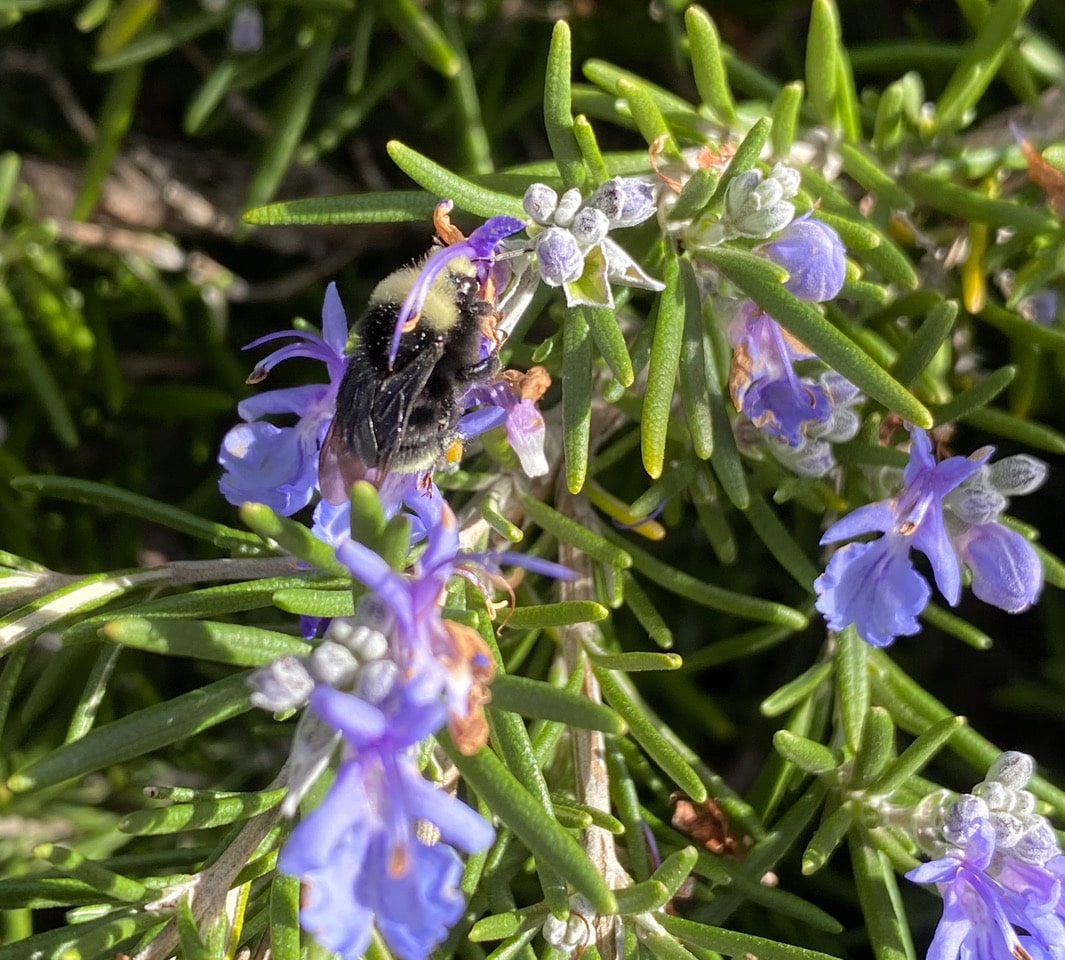
I am thrilled to find a Yellow-faced Bumble Bee, Bombus vosnesenskii foraging among the fragrant flowers. Given the opportunity, our native bees are not opposed to using exotic food sources!
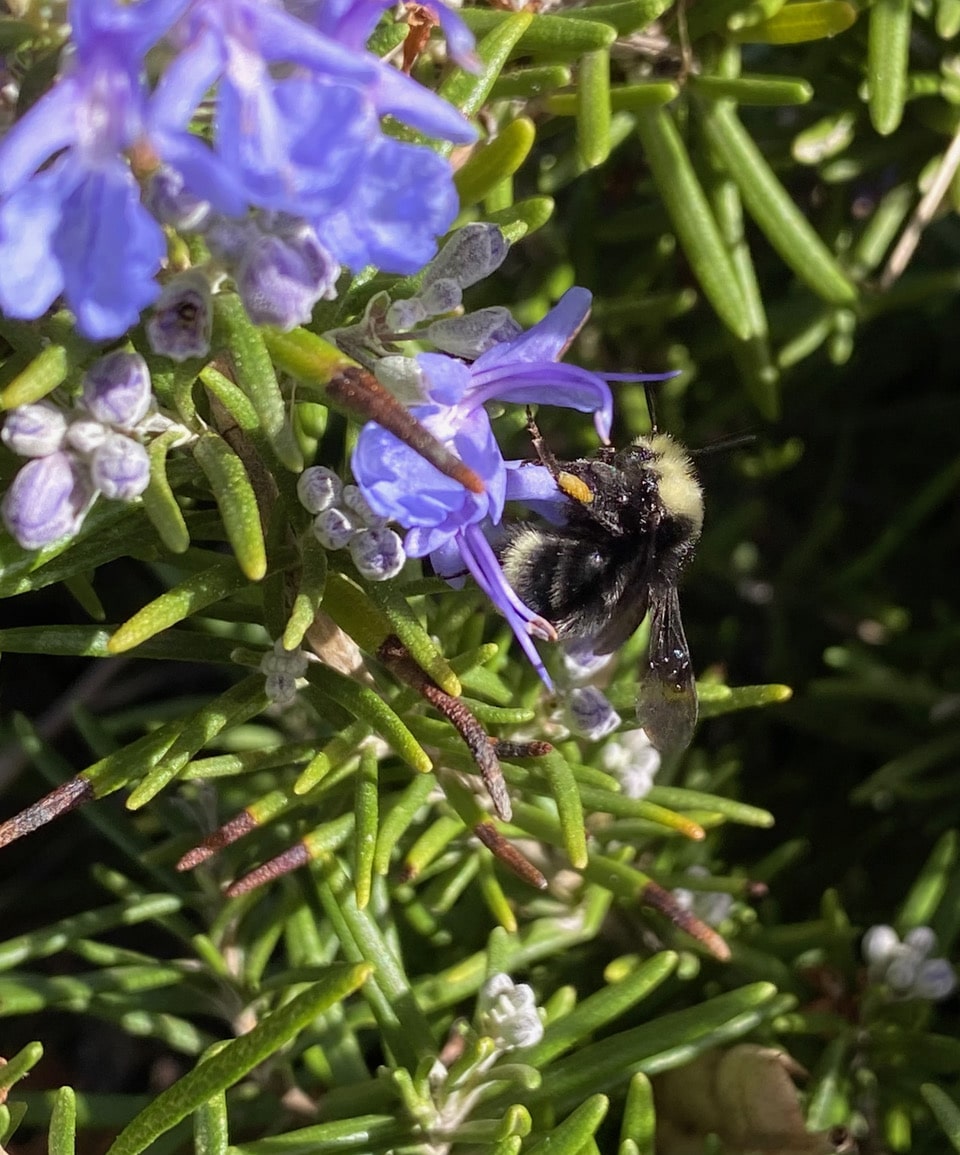
The bee has a tiny bit of pollen in her pollen basket.
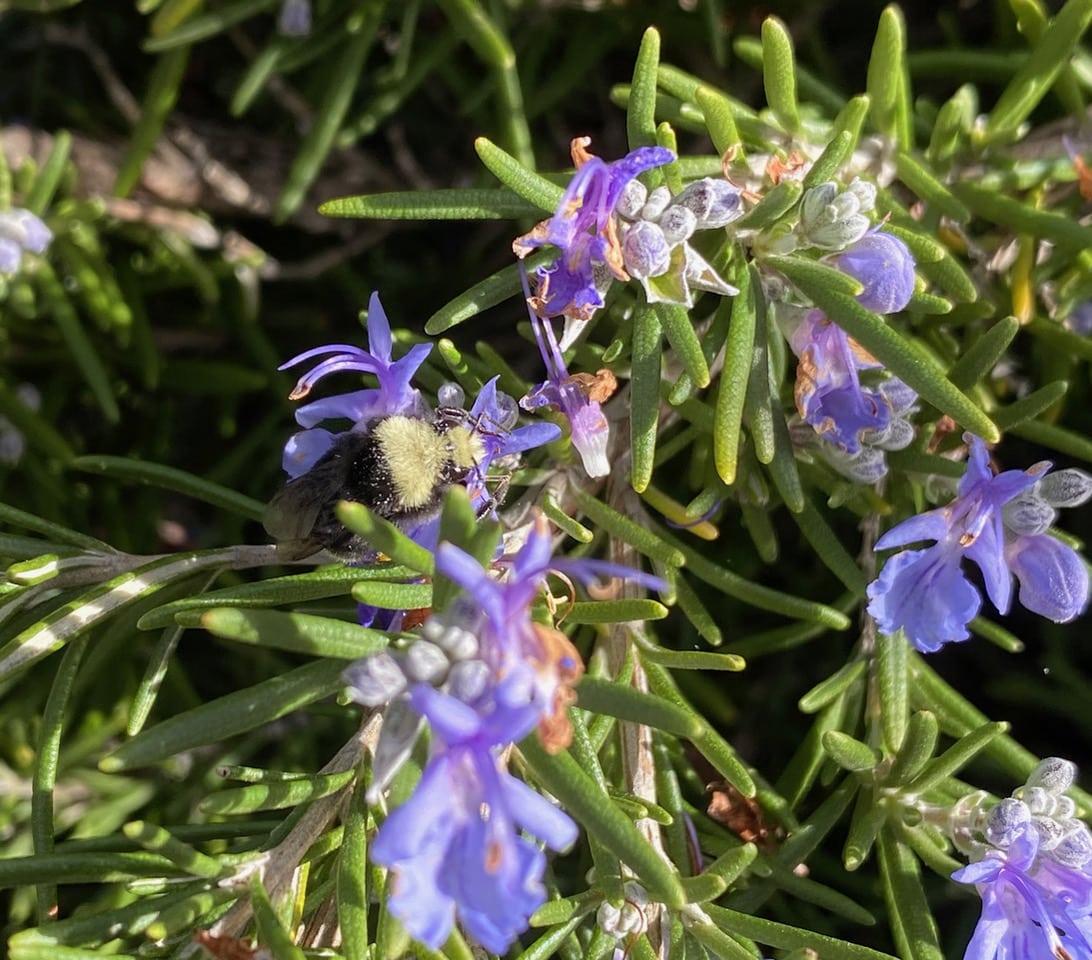
The bee’s thorax is dusted with pollen!
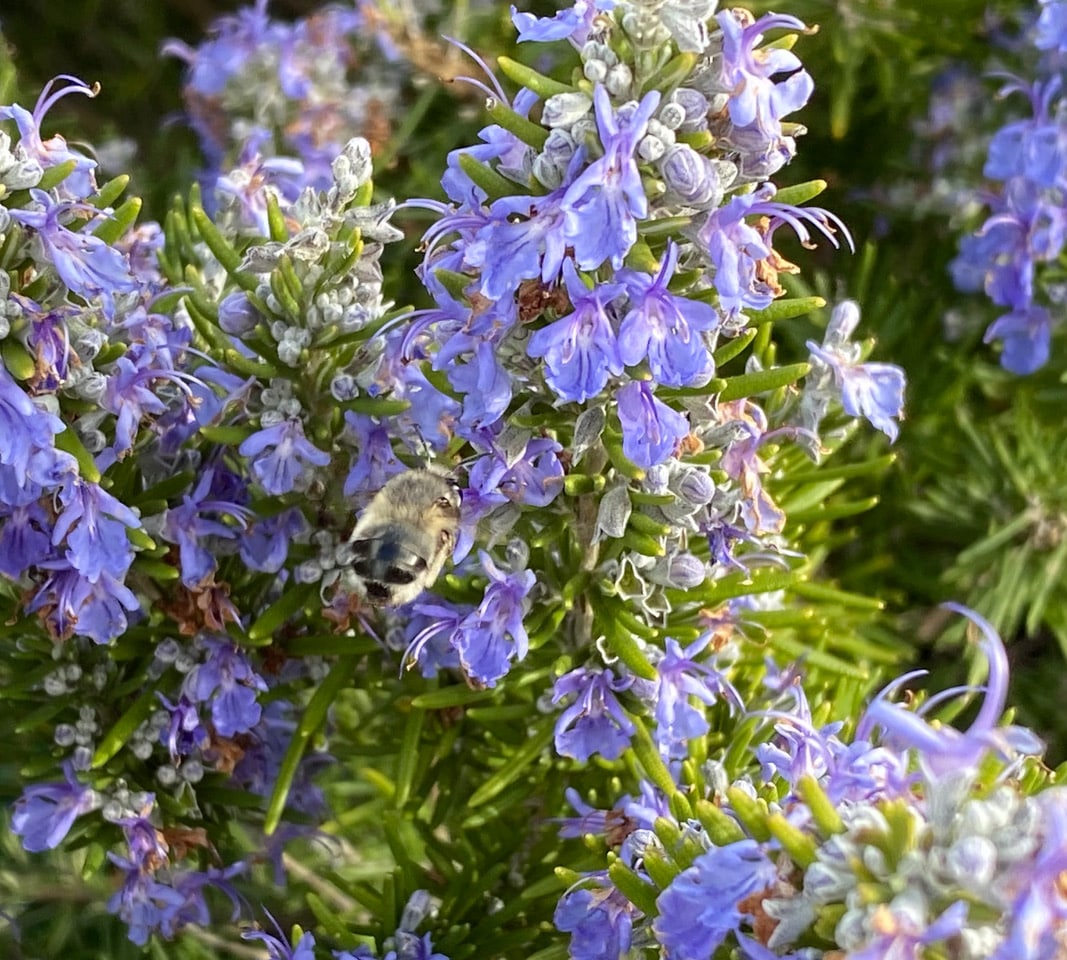
With a loud buzz, another bee, about the same size as the bumble bee and just as stout-bodied and furry arrives on the scene. It is a Digger Bee, in the tribe Anthophorini (family Apidae).
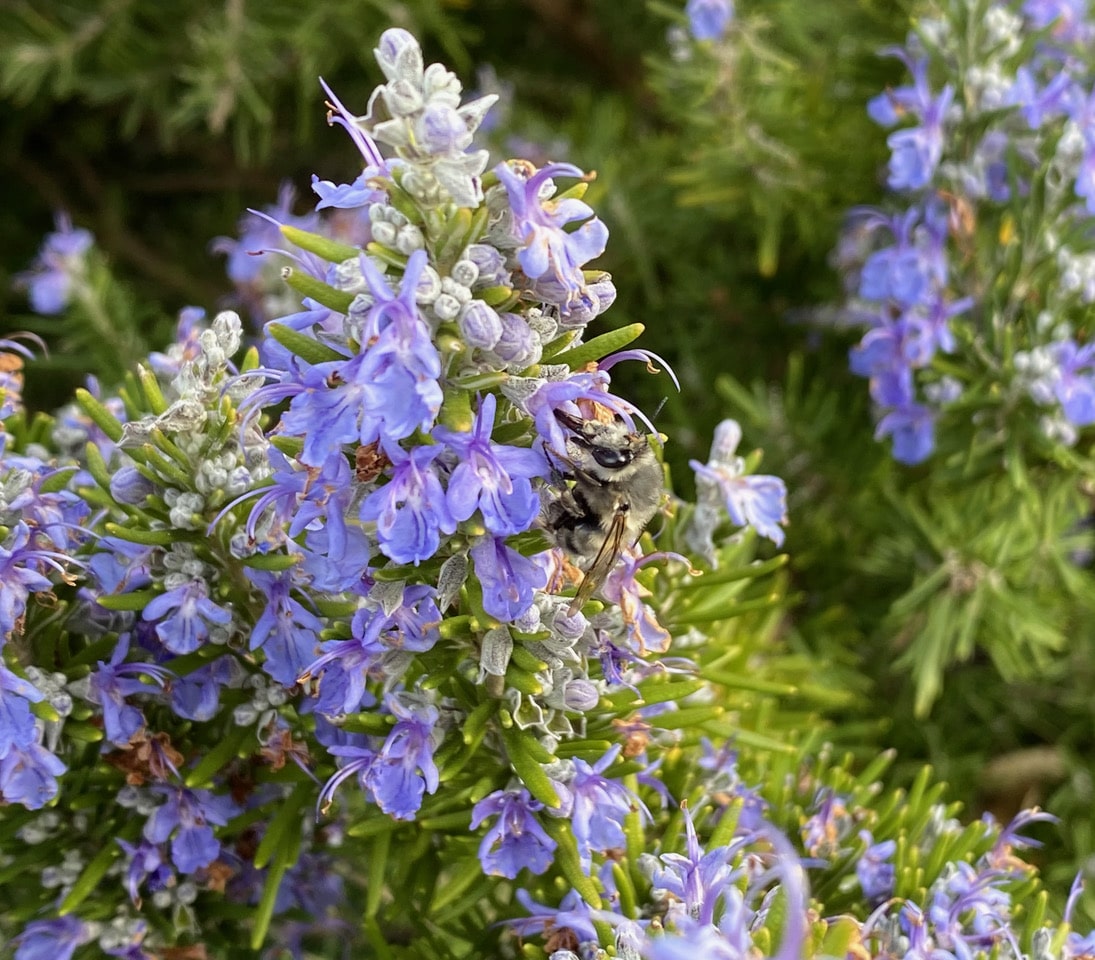
Its tongue extended into the corolla, the Digger Bee seems only interested in taking nectar.
All Digger Bee species are solitary, though many nest in large aggregations in the soil. The larvae develop in cells with waterproof linings. They are generally large, robust, hairy bees, with visibly protruding faces, and the apical portion of the wings are studded with microscopic papillae. The abdomen is often banded. The wings often appear disproportionately short compared to other bees. Their “buzz” is often a high-pitched whine, as they hover and feed on flowers. Males commonly have pale white or yellow facial markings.
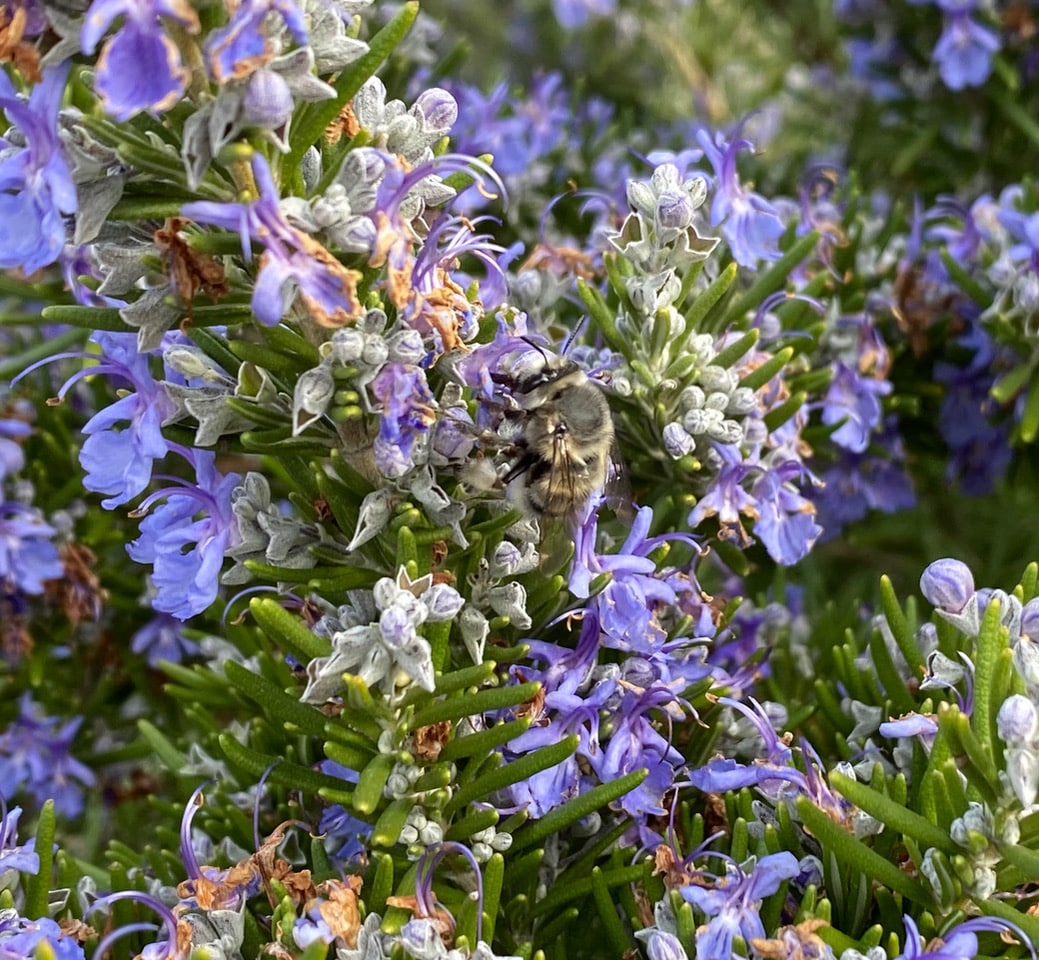
 The Digger Bee backs off into the air, its tongue still extended.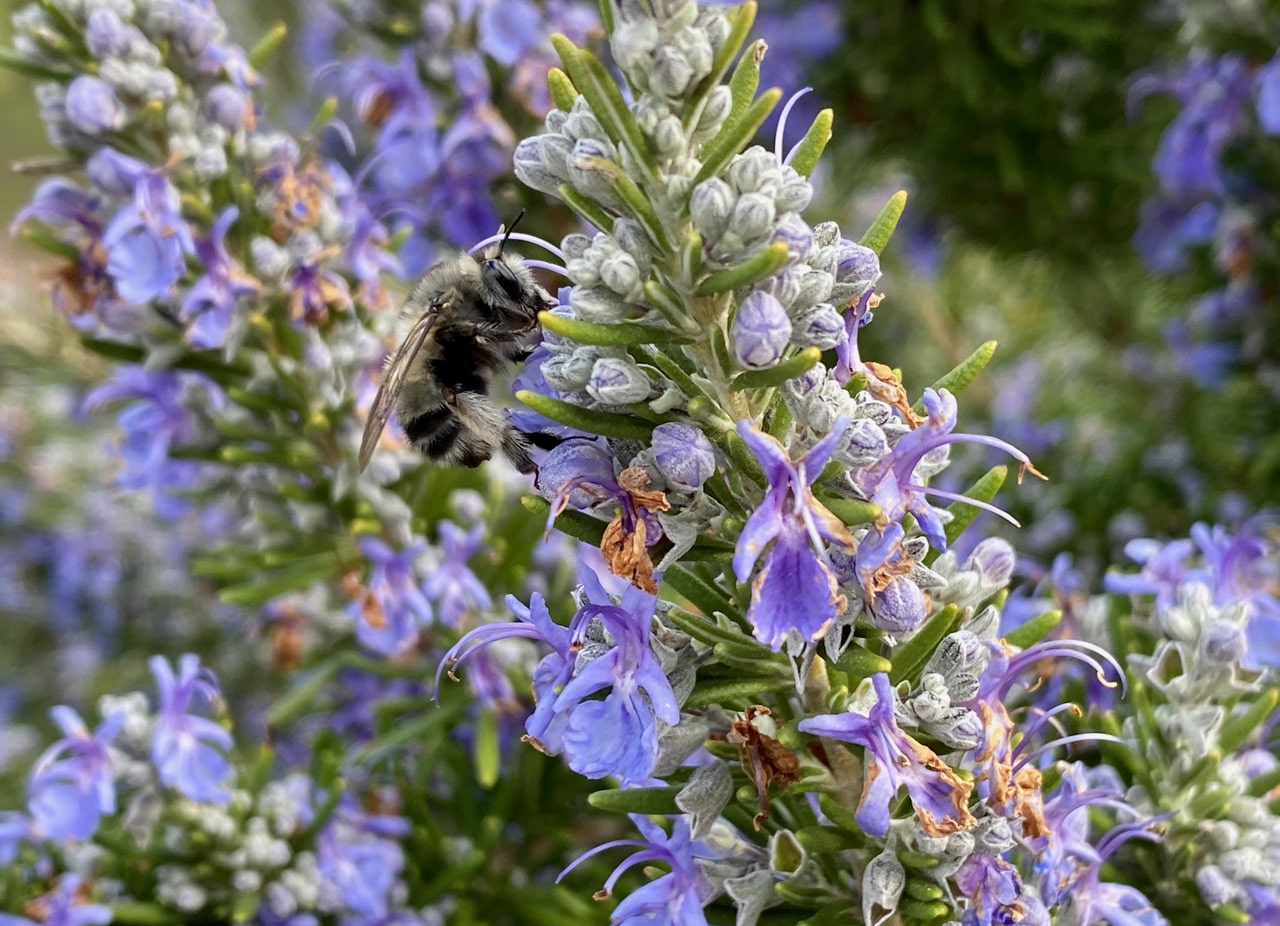
I think it is a female. Note the pale hairs on the scopa (special pollen collecting hairs) on her hind leg. Male bees do not have scopae, and they do not collect pollen.
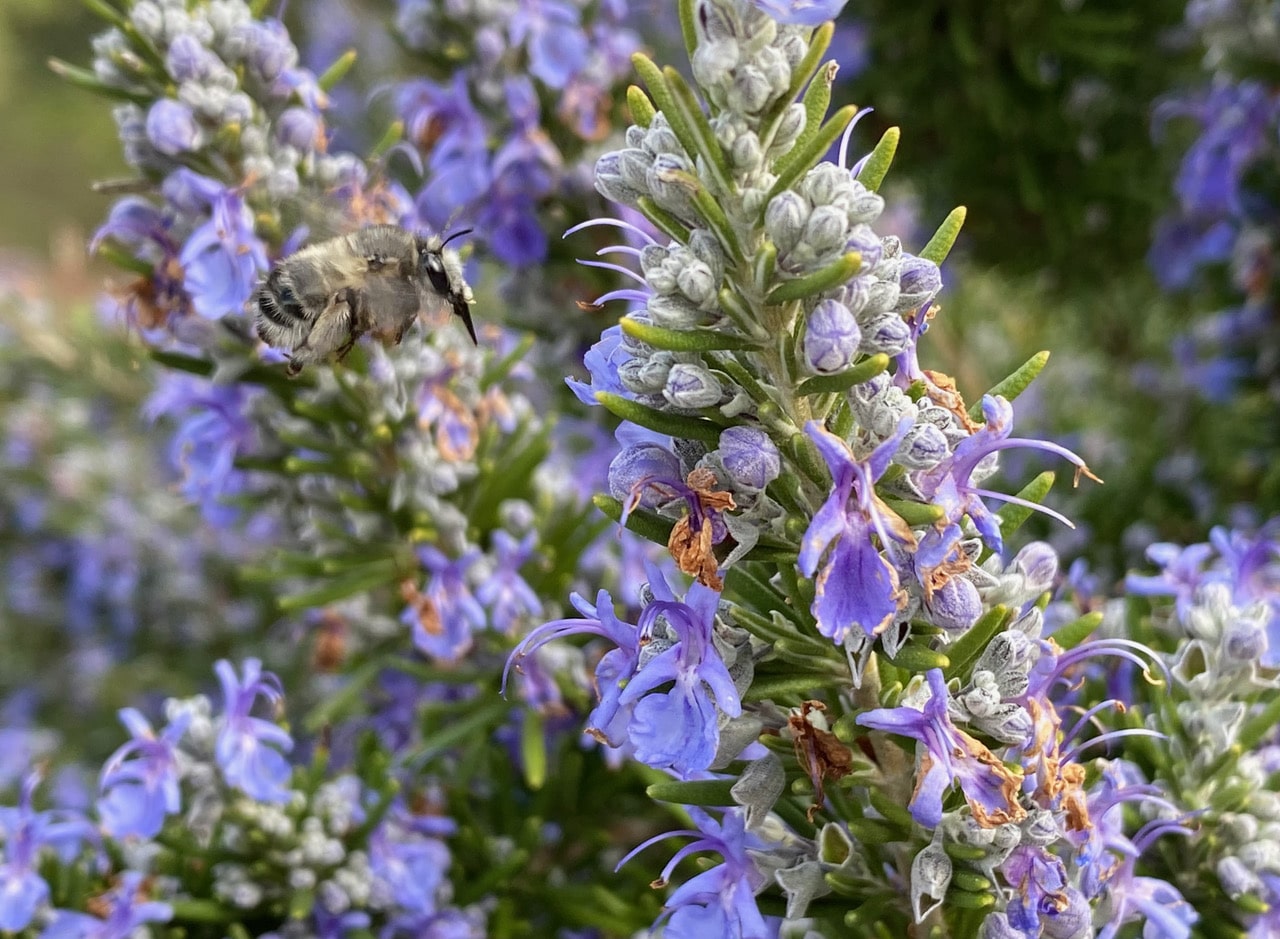
Here’s another look at the scopa again as the bee is air borne. Her scopa is empty, so she hasn’t been collecting pollen. It is so difficult to track insects in this maddeningly busy background of flowers.
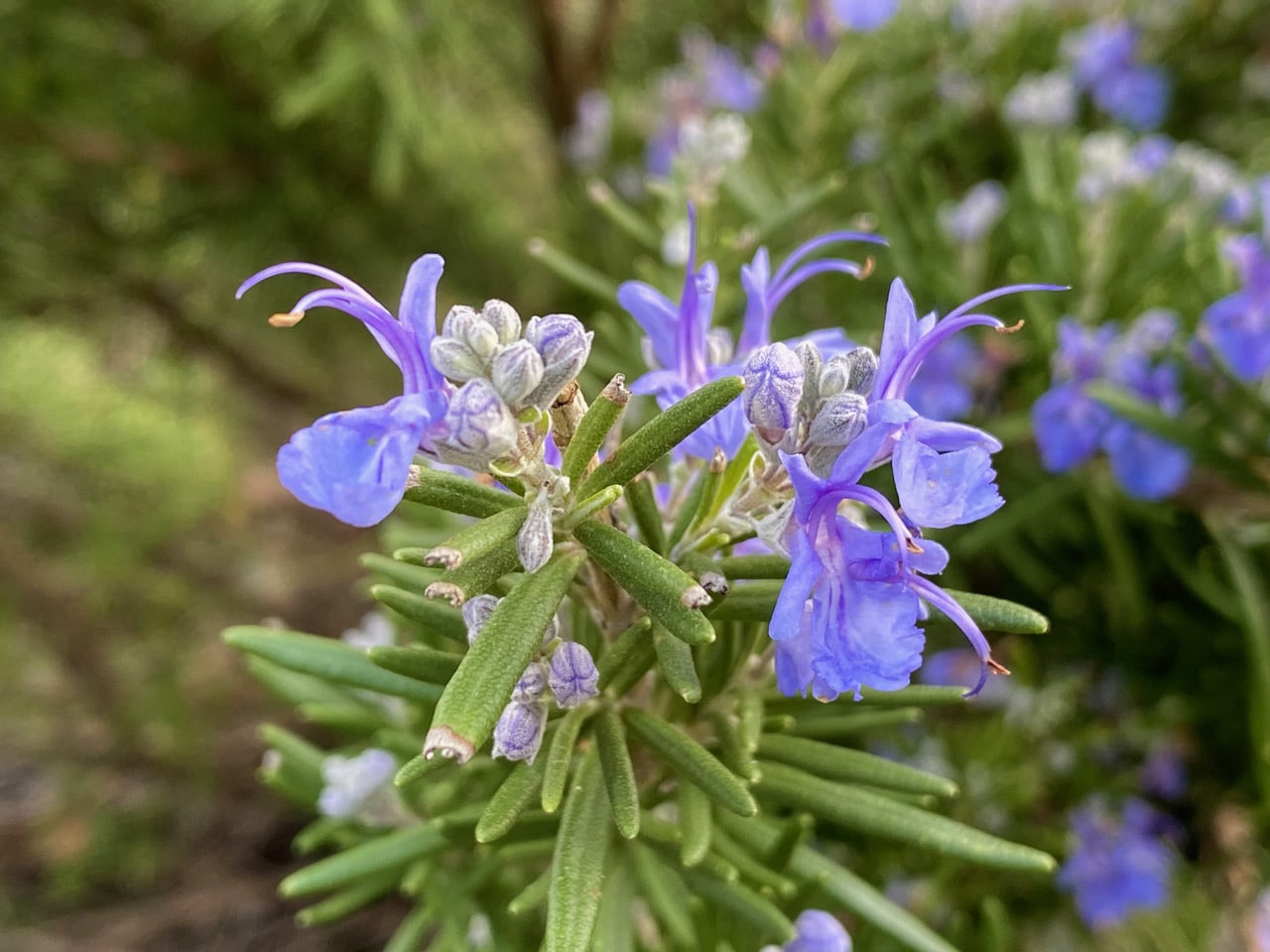
To appreciate how Salvia is pollinated, we need to know the structure of the flower. It is complicated, because Salvia has a fascinating and unique pollination biology!
Salvia is the largest genus of plants in the sage family Lamiaceae. The flowers are mostly adapted for pollination by bees. The corolla is two-lipped. Upper lip forms a hood-like structure, while the lower lip, sometimes marked with nectar guides, serves as a landing platform for insects. There are two stamens, each containing one pair of anther cells. The topmost anther lobe is fertile and produces pollen whereas the lower lobe (hidden in the base of the flower) is sterile. The connective pivots on a hinge with the filament. Together the two sterile lobes form a shield. The Salvia flowers are protandrous, the male parts maturing before the female parts. salvia-half-flower.jpg 940×688 pixels

The old world Salvia flowers employ a staminal-lever pollination mechanism. When a bee forces its way to the nectar at the base of the floral tube (corolla) it pushes the shield forwards, causing the connective to pivot, swinging the fertile anther lobe downwards to dab pollen on the insect’s back. In older flowers, it is the style that moves downwards to pick up pollen from the back of the bee.
(Be sure to watch this video. Don’t mind the foreign language, the video is self-explanatory.)
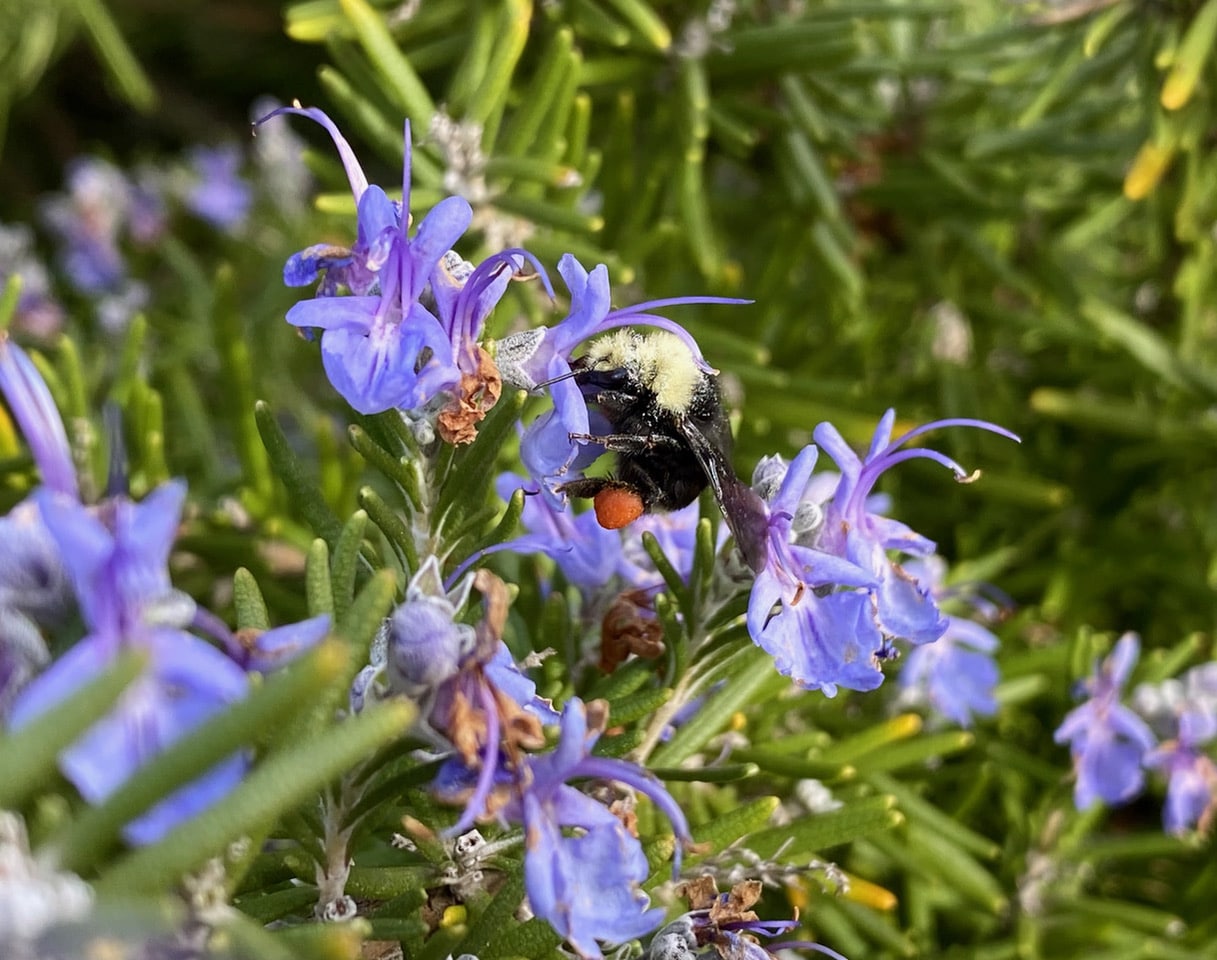
Just as I am about to leave, another Yellow-faced Bumble Bee arrives. Note how pollen is dusted on her back as she reaches into the corolla for nectar.
What is the source of the bright orange pollen on her pollen baskets? It is definitely not the Rosemary, as its flowers produce a beige pollen. It dawns on me that the bee has probably been collecting pollen from the Silverleaf Lupines nearby. The bee is visiting the Rosemary for nectar.
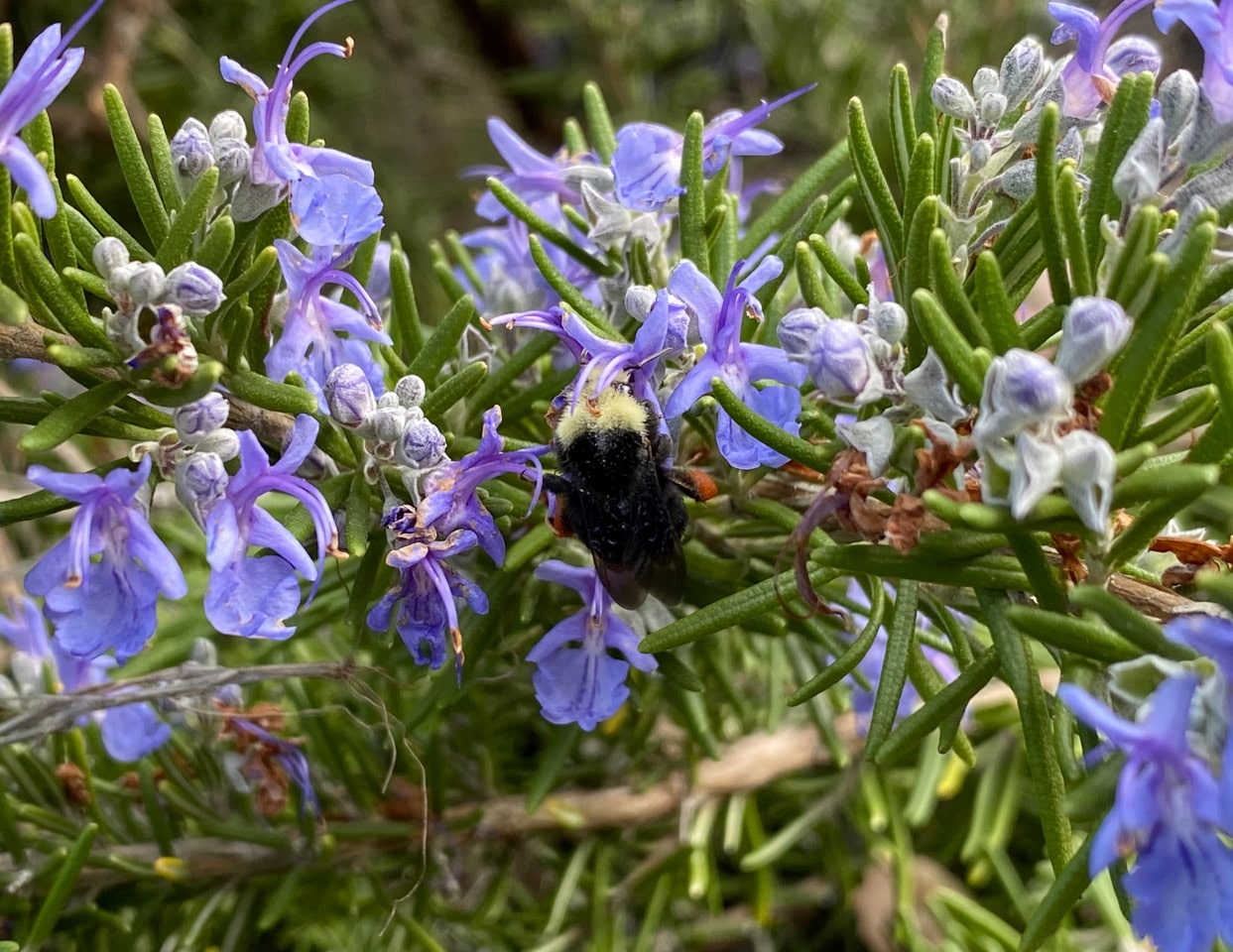
With every young flower she visits, the bee is dabbed with pollen from the anthers…


As the pollen-laden bee probes an older flower for nectar, the long, arching style is lowered to make contact with her back, picking up pollen that’s there. Pollination accomplished!
It is interesting (and rather disappointing) that while the staminal lever mechanism works beautifully in most European Salvia species found in gardens, it does not seem to work in our native Salvia. I have tested all the local species I encountered, and couldn’t get any to move their reproductive parts. If you find a native Salvia that has a functional staminal lever mechanism, I would love to hear from you!