

Pollinator Post 3/5/25

When the sun finally peeks through the overcast sky this afternoon, Fred and I decide to go for our walk at Crab Cove, Alameda.
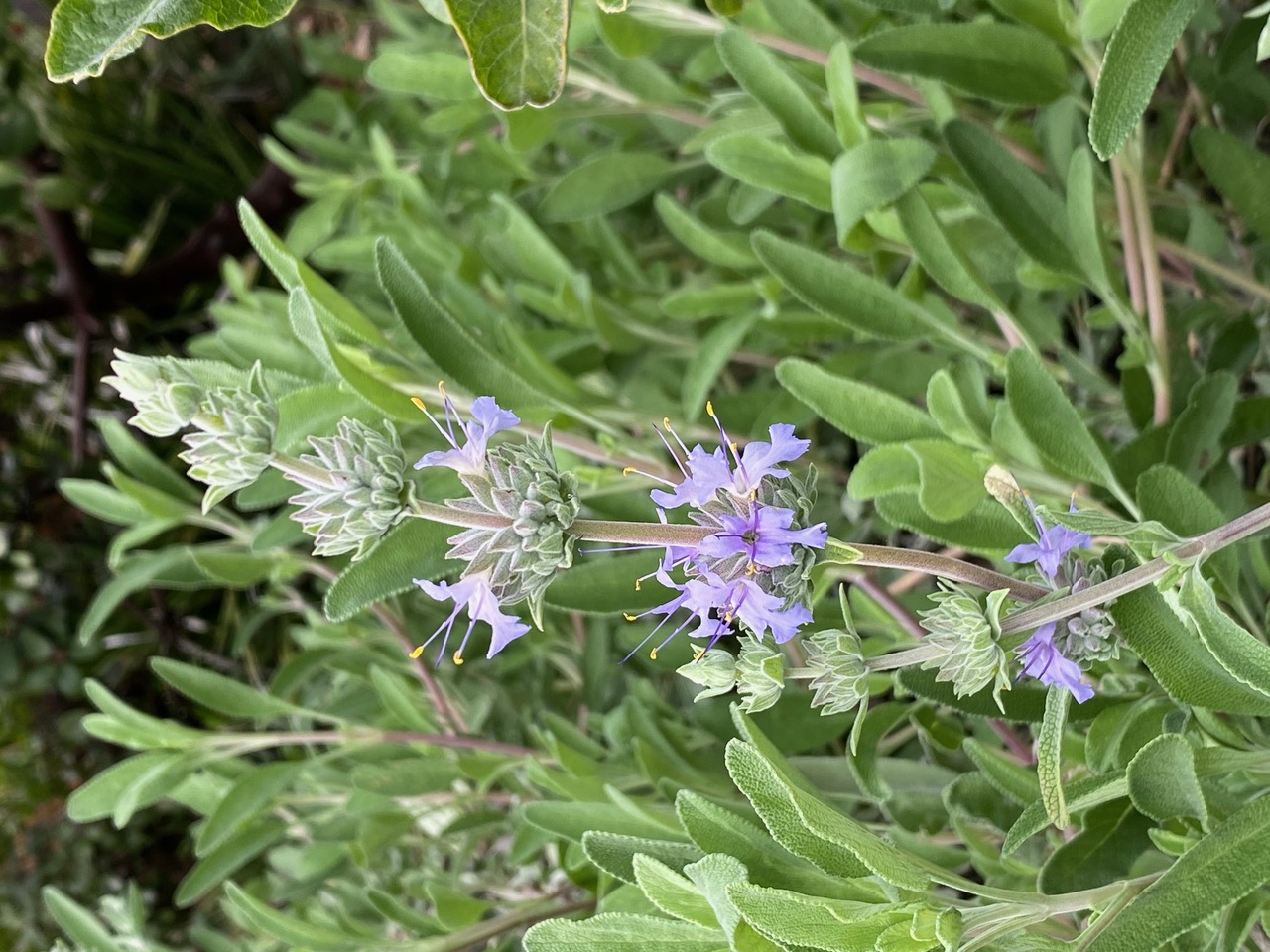
I check the native plants around the visitor center. A Sage, Salvia sp. has started to bloom. Not sure what species, but the plants are no more than 2 feet tall, a ground cover. The flowers are a light lavender color, borne in whorls along a long stalk.


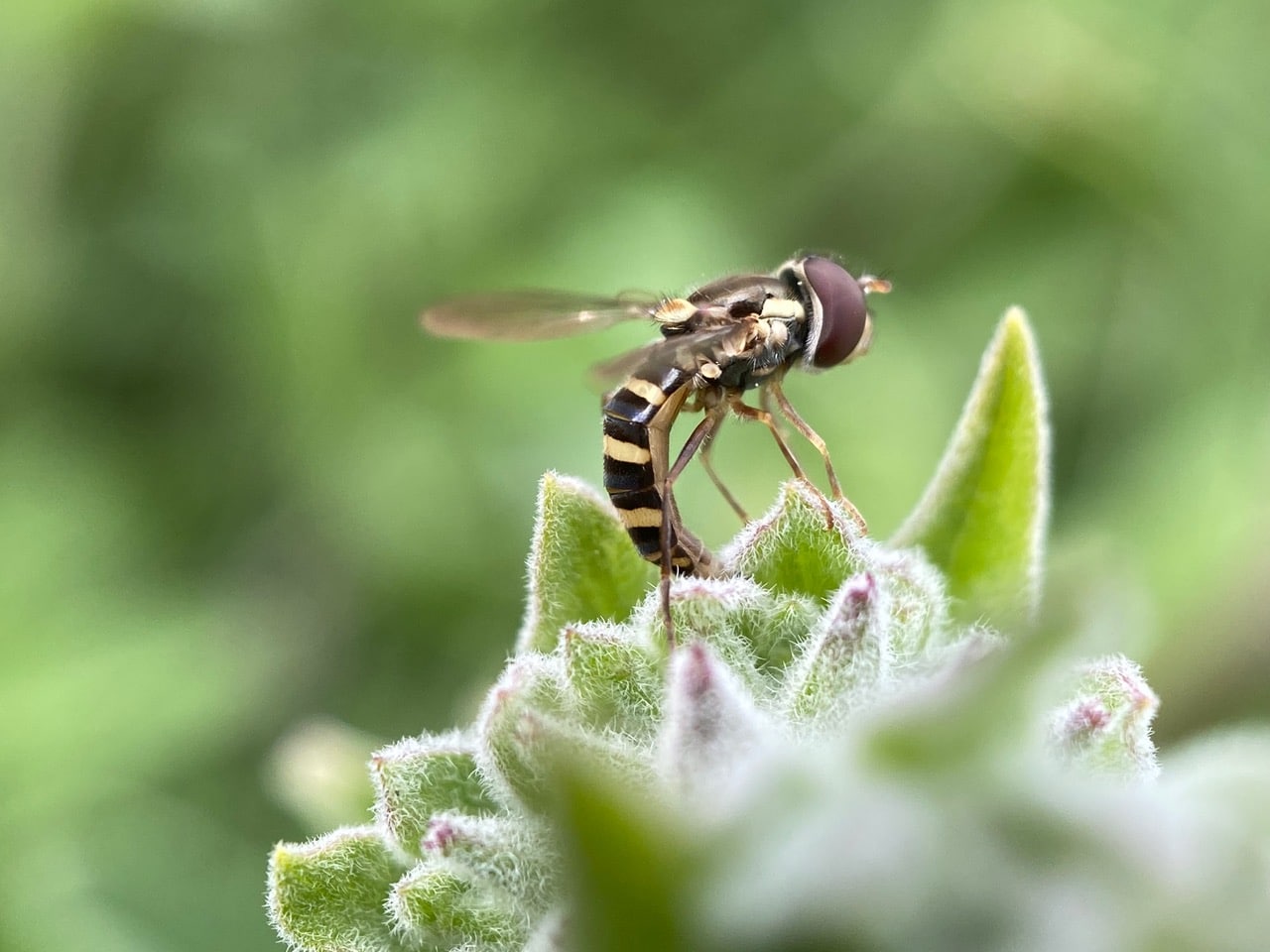


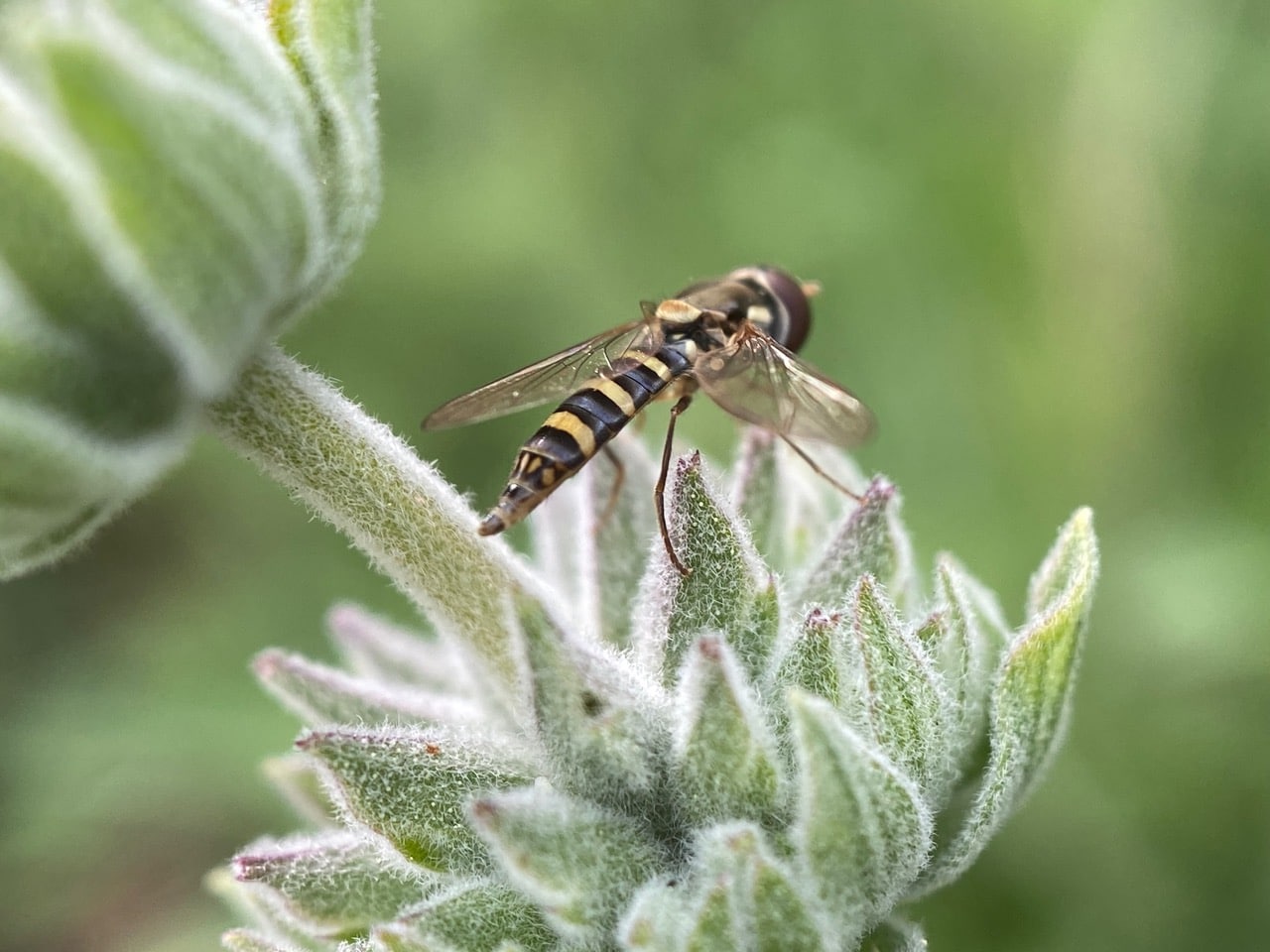


Perhaps it’s too cold – no insects are visiting the flowers.
Her abdomen curled forward, a female hover fly is laying an egg on a bract of a terminal flower bud. Hover fly females usually deposit their eggs singly.
Unless I get to see the tip of her abdomen, I can’t be sure which species she is. Many hover flies with aphidophagous (aphid eating) larvae lay eggs on leaves and stems near aphid colonies or other larval food sources. There are no aphids on this sage as far as I can see. Hmmm…
As I watch her, the hover fly stops to lay eggs on several Salvia plants, always inserting her abdomen between the young flower buds. Ah, when she lifts up her abdomen this time, I catch sight of the tip of her abdomen. See those four yellow diamond-shaped marks near the tip? The fly is a Diamond Spottail, Fazia micrura (family Syrphidae).
The Diamond Spottail, Fazia micrura occurs in western North America, from British Columbia south to California and Texas; and Mexico. The slender, elongate fly measures 6-7 mm. The adult and larva feed on pollen. Females lay eggs on flowers. Larvae are often encountered in the field chewing through the calyx and corolla of unopened flower buds. They are known to feed on pollen in the anthers. Usually only one larva is found in each flower. This larval diet is rather unusual for hoverflies, most of which consist of aphids on plants or decomposing matter in aquatic environments, depending on the species.
There she goes again, tirelessly laying eggs on a cold, breezy winter afternoon. I am impressed by her single-minded determination – she never once stops to feed at the flowers as I watch her.
Before she flies off, the female stretches out her abdomen as if to reset her ovipositor. Again, we get to see the four diamonds on her abdomen for which her species is named.
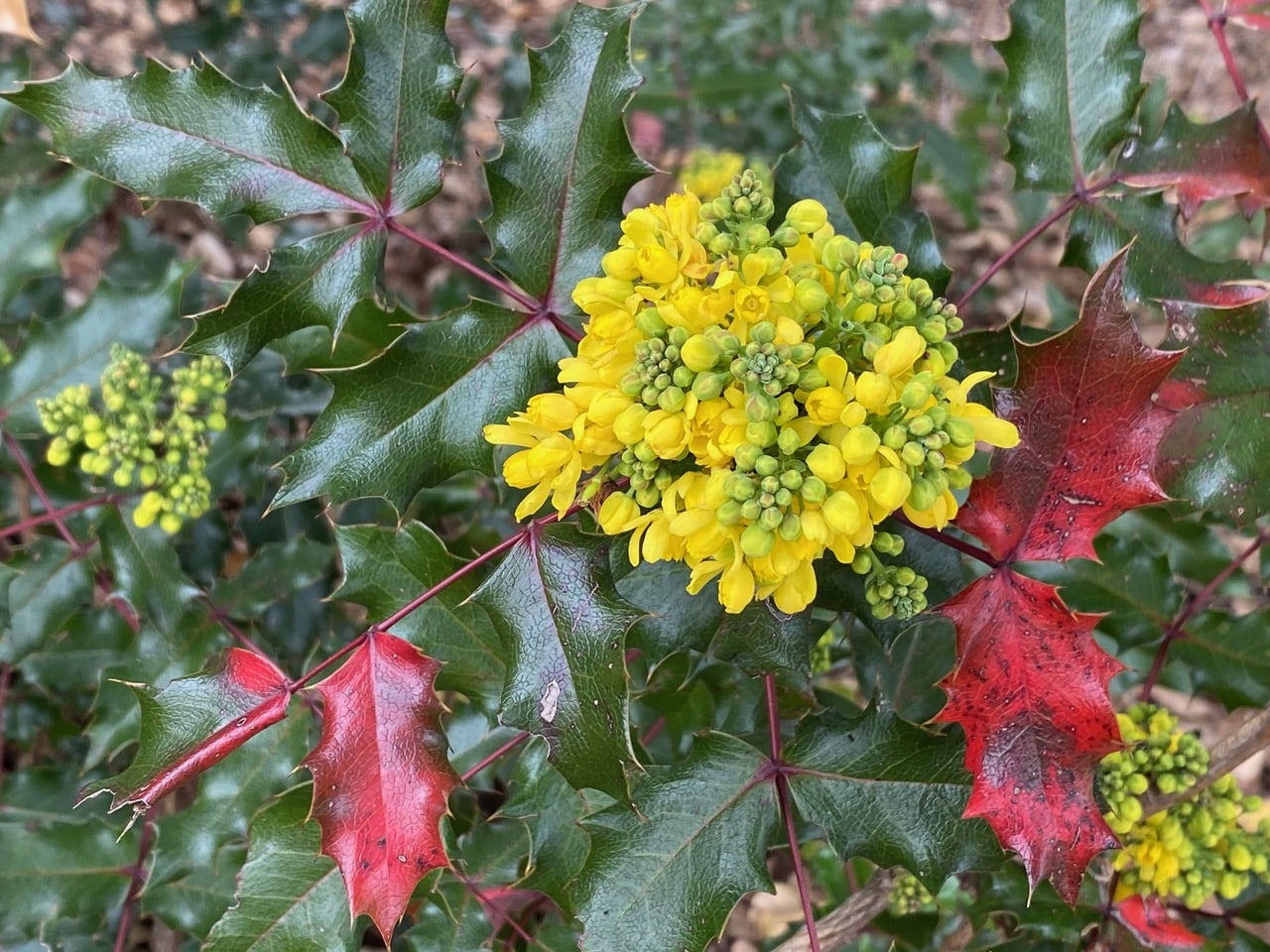
At the back of the visitor center, a small stand of Oregon Grape, Mahonia aquifolium (family Berberidaceae) has started to bloom. Bright yellow, tightly clustered flowers lends a colorful contrast to the occasional red leaves. These colorful leaves are actually young leaves from this year, not senescent leaves from last fall.
The presence of anthocyanins gives Mahonia leaves a reddish or purplish hue, depending on the variety and environment. Anthocyanins are plant pigments that give red, blue, and purple colors to leaves and fruits. Anthocyanins primarily act as a “sunscreen” by absorbing excess blue and ultraviolet light, protecting the leaf tissue from oxidative stress and photo-damage, particularly under high light conditions. The concentration of anthocyanin in Mahonia leaves can vary depending on the season, with higher levels often observed in young leaves or during autumn when the leaves are changing color.
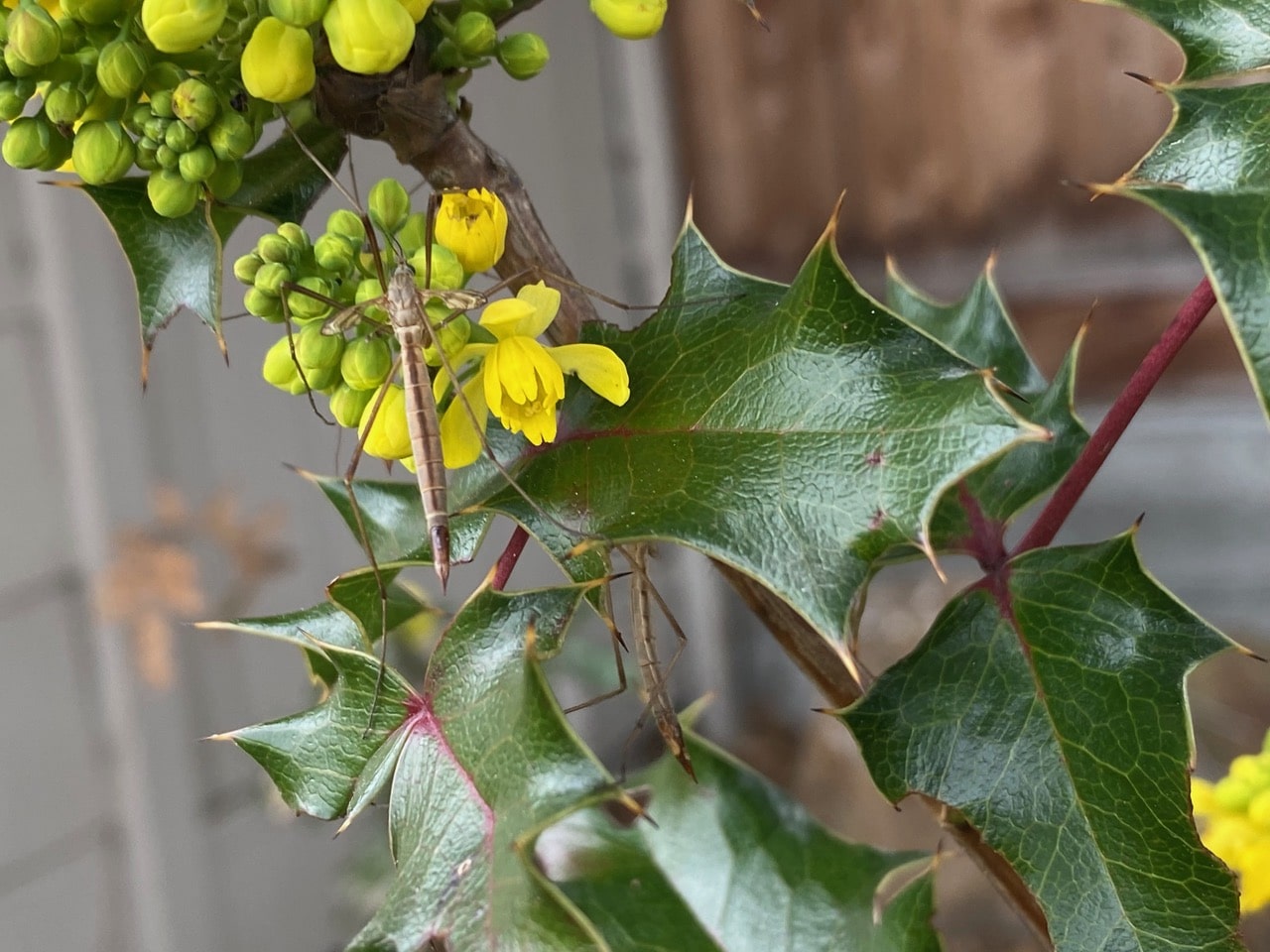
Suddenly I sense movements among the Mahonia foliage. Numerous large crane flies are scrambling up the plant clumsily on their long legs. Do you see the two flies in this view? iNaturalist has helped identify the insects as Common Crane Flies, Tipula sp. (family Tipulidae).
Crane flies resemble oversized mosquitos. They typically have a slender body and long, stilt-like legs that are deciduous, easily coming off the body. They occur in moist, temperate environments such as vegetation near lakes and streams. Adults generally do not feed, but some species consume nectar and pollen. Larval habitats include all kinds of freshwater, semiaquatic environments. They generally feed on decaying plant matter and microbes associated with decomposition. Their activity is important in the soil ecosystem, as they process organic material and increase microbial activity. Larvae and adult crane flies are also valuable prey items for many animals, such as insects, spiders, fish, amphibians, birds, and mammals.
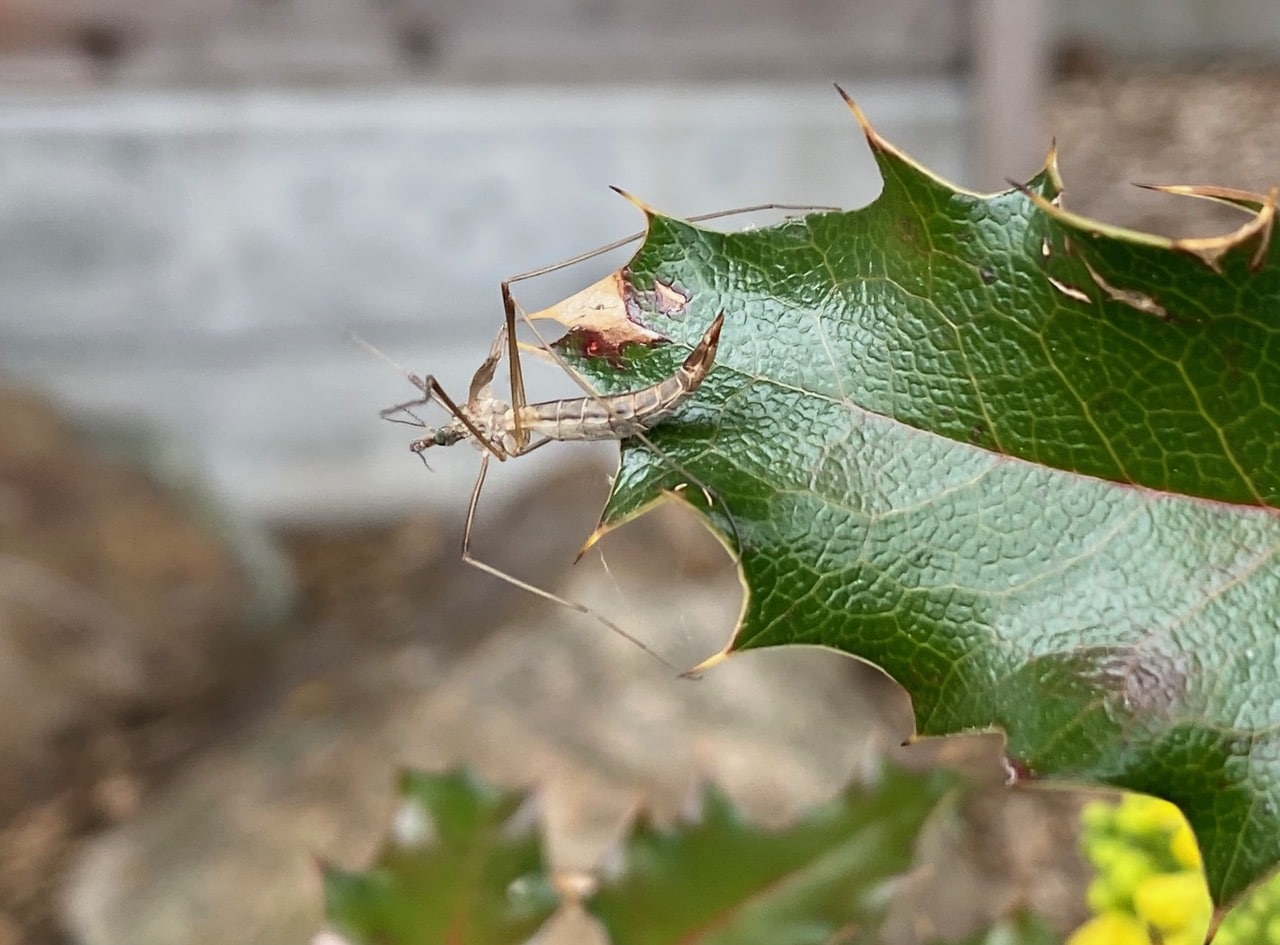
One crane fly has made its way to the edge of a leaf.
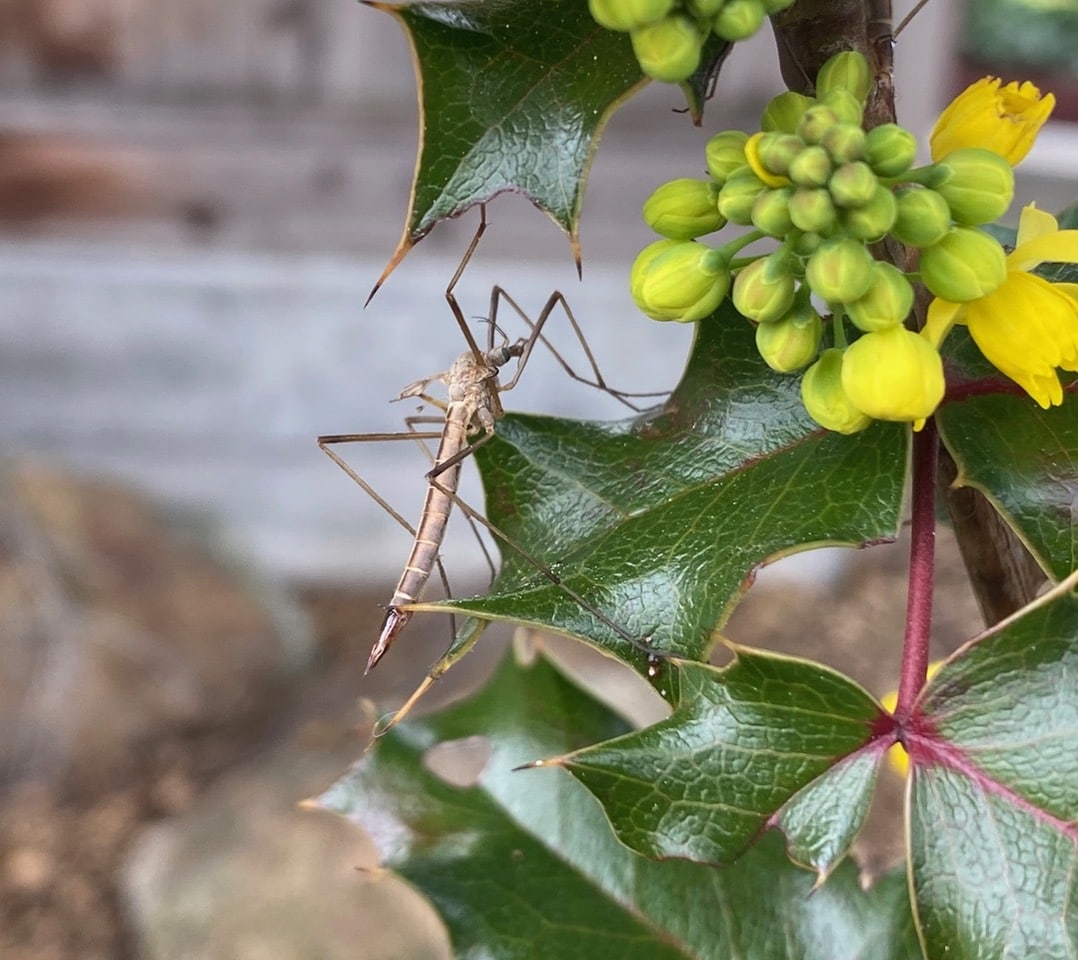
Seemingly exhausted, this crane fly has come to rest on a bronze-colored leaf. It’s interesting that all the crane flies I see here are females. Female crane flies have thicker abdomens, which have a pointed tip for egg-laying. Males have pincer-like claspers at the tip of the abdomen.
I am surprised that these crane flies are so cooperative in allowing me take their pictures without flying away as most crane flies are wont to do. It suddenly occurs on me that these flies might be wingless.
Closer examination reveals tiny, shriveled wings. Surely the flies are not all deformed mutants? I sent an inquiry to a crane fly enthusiast on iNaturalist, and learned that some crane fly species have females with reduced wings. These “subapterous females” cannot fly. I subsequently found a paper online titled “The Evolution of Wing Reduction in Crane Flies”. The ecological and geographical distribution of crane flies with reduced wings suggests that low temperature has been important in influencing reduction. In some winter crane flies, females with reduced wings also lose the associated flight muscles. The resulting space allows these females to produce more eggs. It therefore appears that these flies have gained some evolutionary advantage from wing loss.
The Range Crane Fly, Tipula simplex (family Tipulidae) has a known California distribution from Santa Cruz County north to Colusa County and east to Mariposa County. The suitable habitat appears to be the unirrigated pastures of the Central Valley. The larvae of the species feed on plant roots, decaying matter and old cow manure. The adult females are essentially wingless, with wings greatly reduced. The adults emerge in late winter or early spring. Mating occurs almost immediately, and eggs are laid in the soil. The larvae play a role in nutrient cycling by breaking down decaying organic matter in the soil. High concentrations of larvae in some years, however, can destroy forage, denude hills, and adversely affect watershed ecosystems.
I wonder if the flightless female crane flies at Crab Cove have climbed up the shrub en masse to broadcast their availability to prospective mates? Are they releasing pheromones from a height to summon the males?