

Pollinator Post 3/4/26
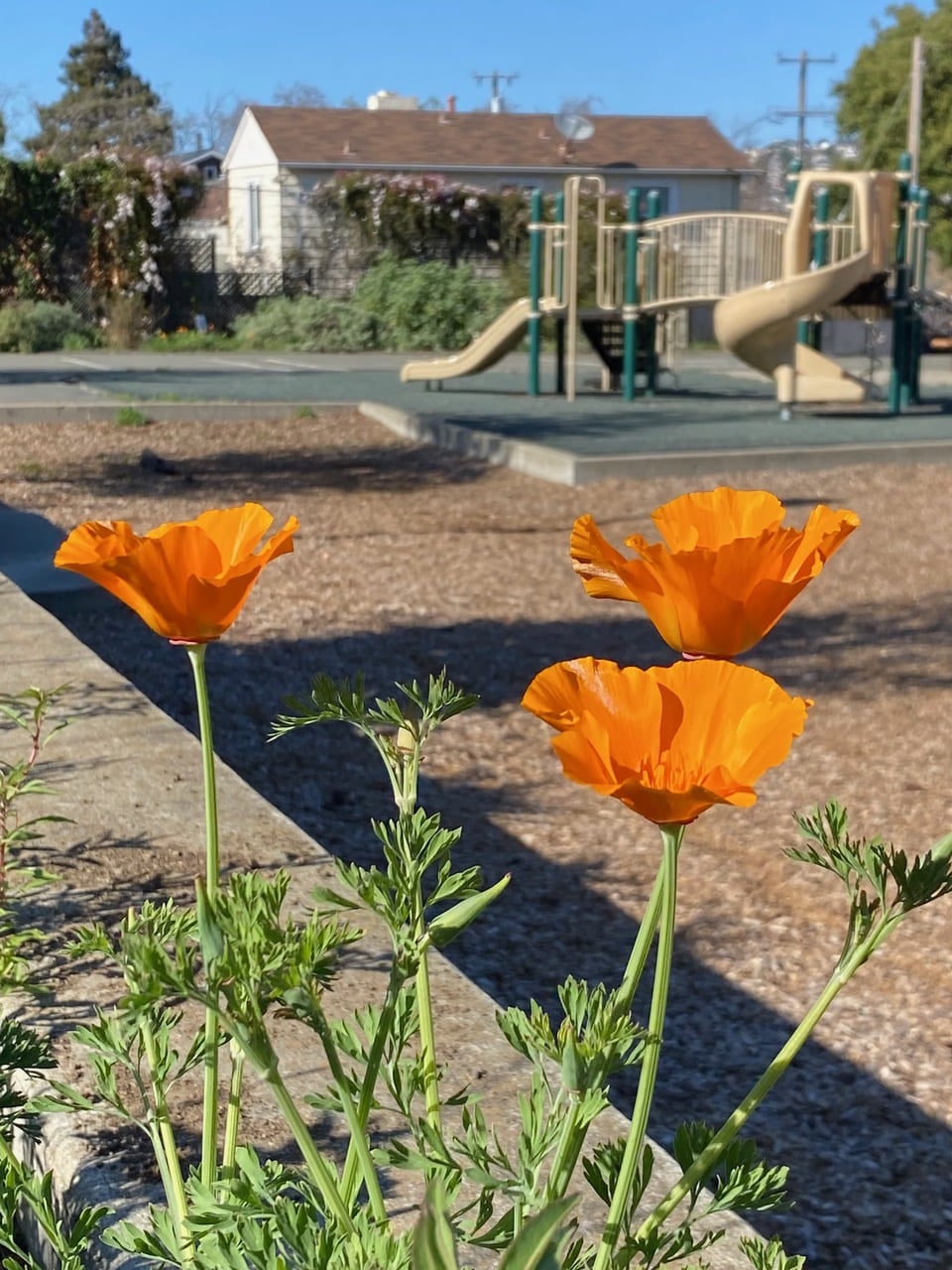
I am excited to visit Mendocino Park this afternoon. It is a 0.4 acre suburban park in the hills of Richmond, consisting of a children’s playground and picnic area bordered by wide strips of plantings. The native garden is tended by dedicated volunteers from the neighborhood.
California Poppies, Eschscholzia californica grace the flower bed along the edge of the park’s playground.
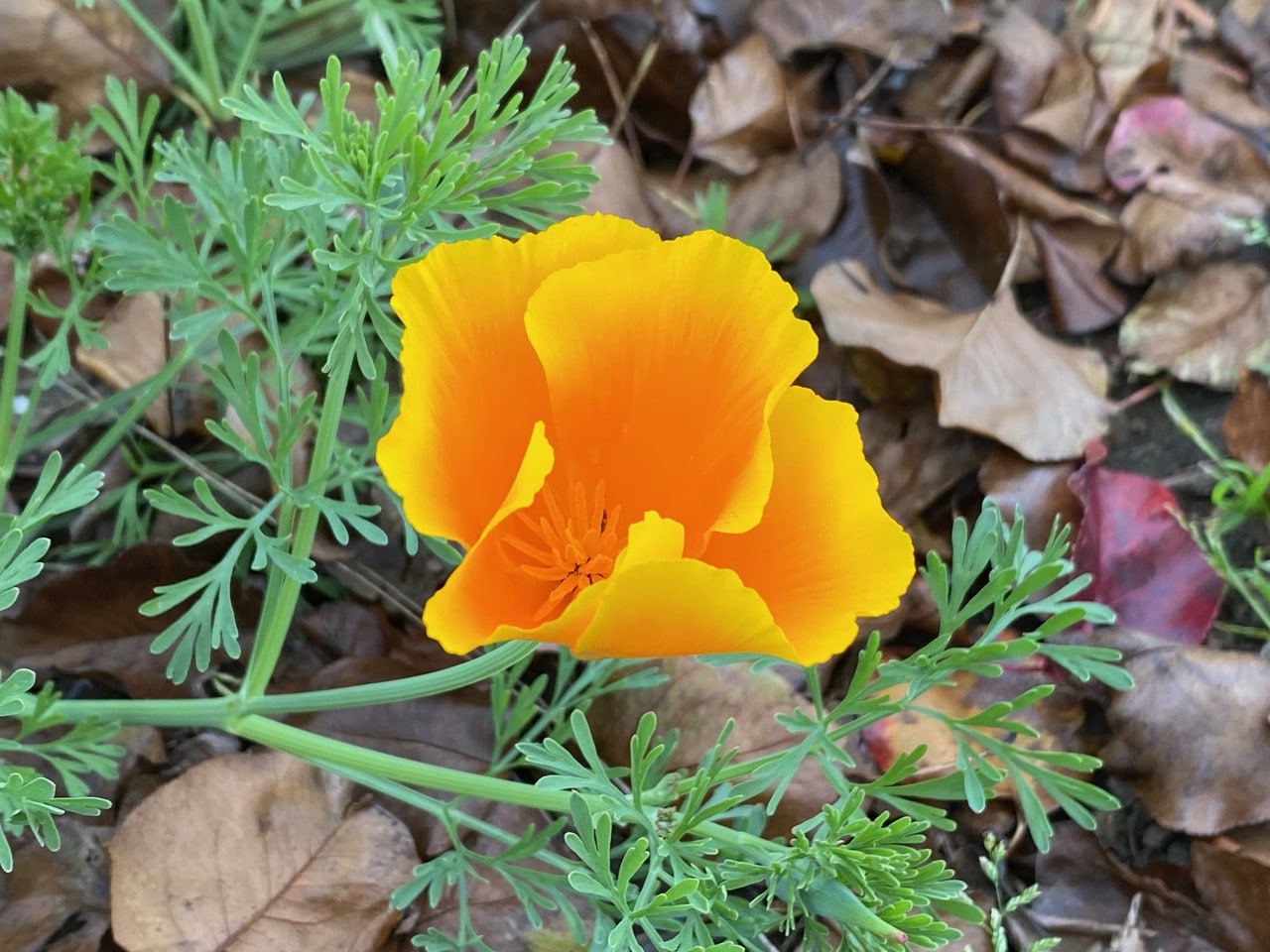
Mendocino Park also boasts another subspecies, the low-growing Coastal California Poppy, Eschscholzia californica ssp. maritima with lovely two-tone flowers.
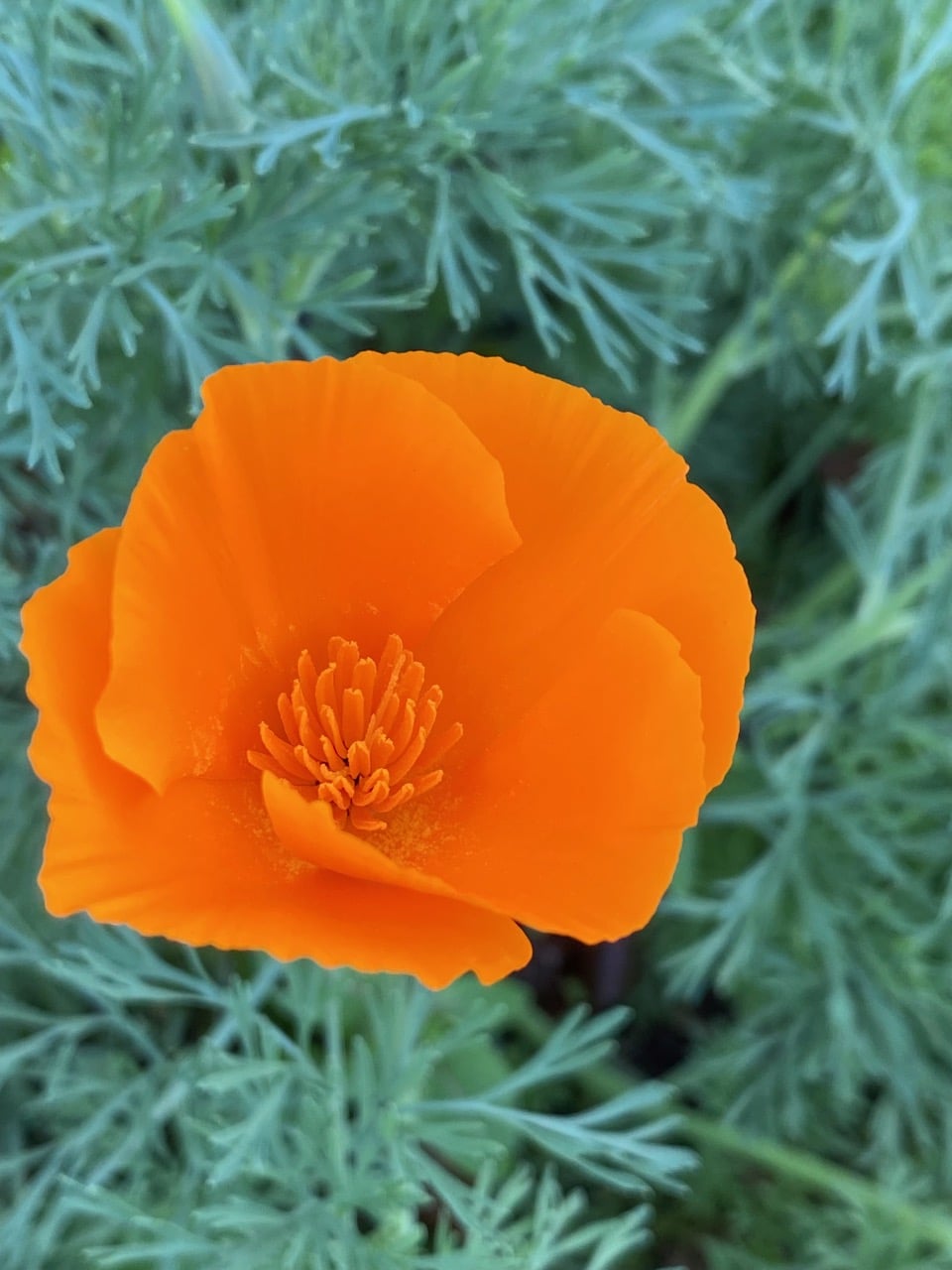
California Poppy, Eschscholzia californica and many other poppy species do not produce nectar. Instead, they are highly valued by pollinators, particularly bees, for their abundant, high-protein pollen. They rely on bright colors to attract pollinators, offering a rich pollen reward rather than nectar. There are numerous stamens, usually 20 or more. The yellow-orange filaments often have a dark purplish band just above midpoint; to the unaided eye, they look like tiny beetles at the center of the flower. There is one pistil with a superior ovary. The small ovary is green but it is difficult to see within the crowd of anthers. There is an inconspicuous style and two to four linear stigmas.
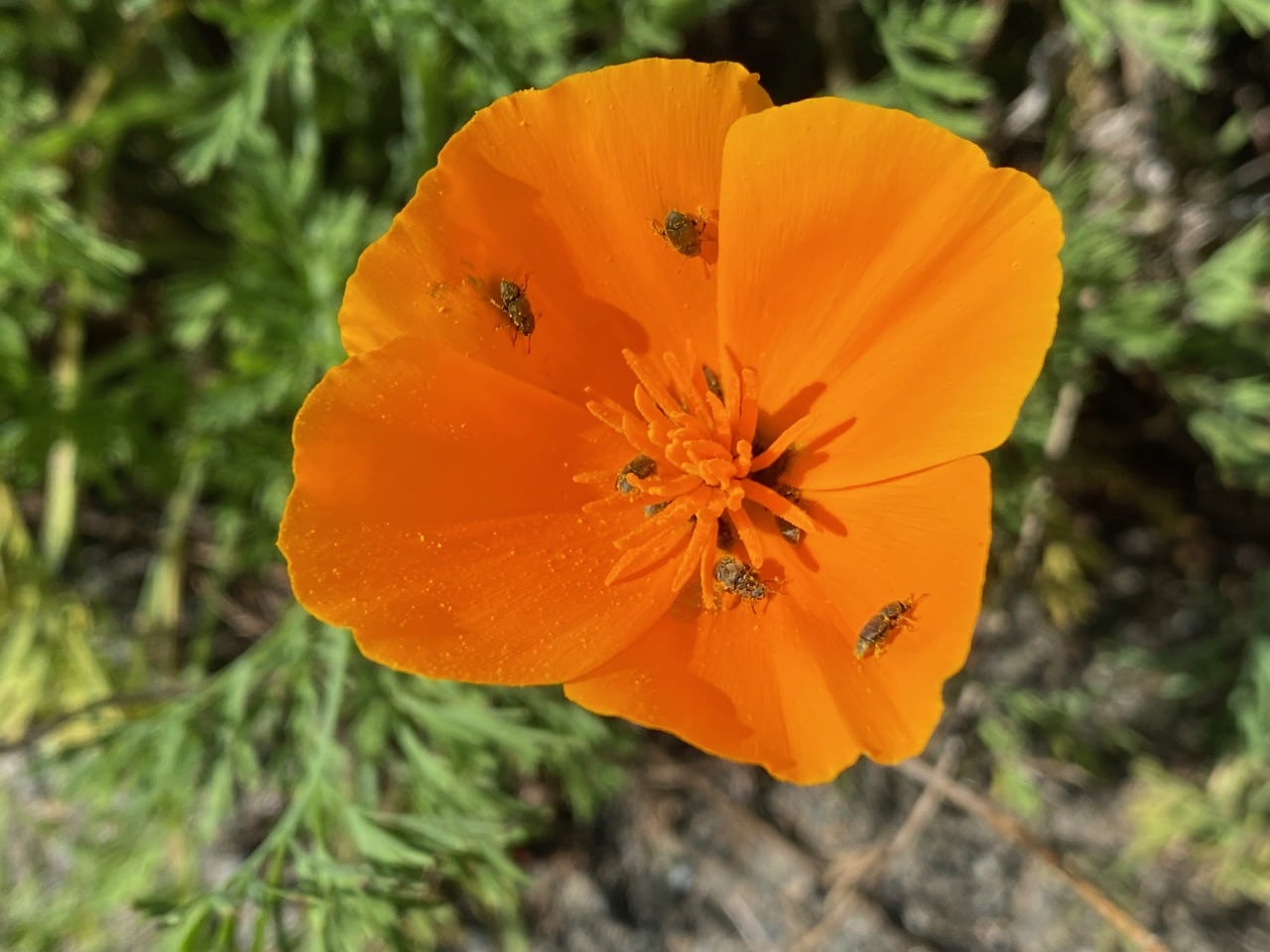
This California Poppy flower has been invaded by a party of Poppy Loving Beetles, Amartus tinctus (family Kateretidae of Short-winged Flower Beetles). Covered with pollen the small beetles are feeding on the pollen from the anthers in the center of the flower, scattering pollen everywhere.
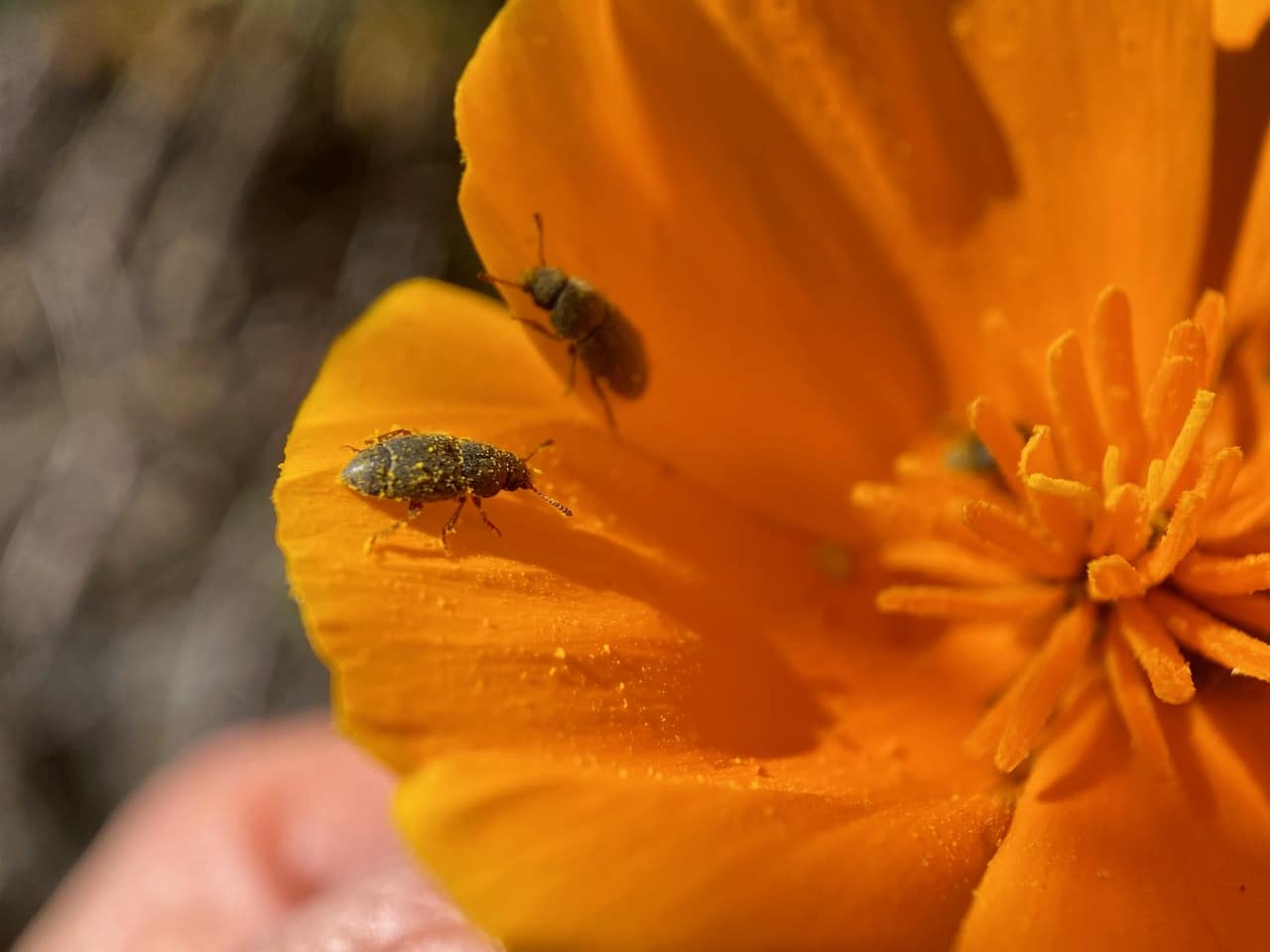
The Poppy Loving Beetle, Amartus tinctus is a species of Short-winged Flower Beetle in the family Kateretidae, characterized by its small size and association with flowering plants, particularly California Poppies. The adults feed on pollen and nectar, inadvertently aiding in pollination. The species is native to the western United States (including California, Oregon, and Arizona), Mexico, and Central America. The species is commonly found in habitats with abundant wildflowers where it contributes to the ecosystem as a minor but effective pollinator. Adults are typically shiny black or dark-colored, measuring 3-4.5 mm in length, with shortened elytra that do not fully cover the abdomen. The short wings limit their flight capabilities, leading to a more localized distribution. Larvae develop within flowers, particularly of Calfornia Poppy, where they feed on pollen or seeds. Pupation occurs in the soil, leaf litter, or occasionally on the host plant. While this beetle exhibits a strong association with California Poppy, it also occurs in mixed wildflower meadows, contributing to its role as a generalist pollinator.

This pair of beetles have separated from the group to mate on the margin of the flower.
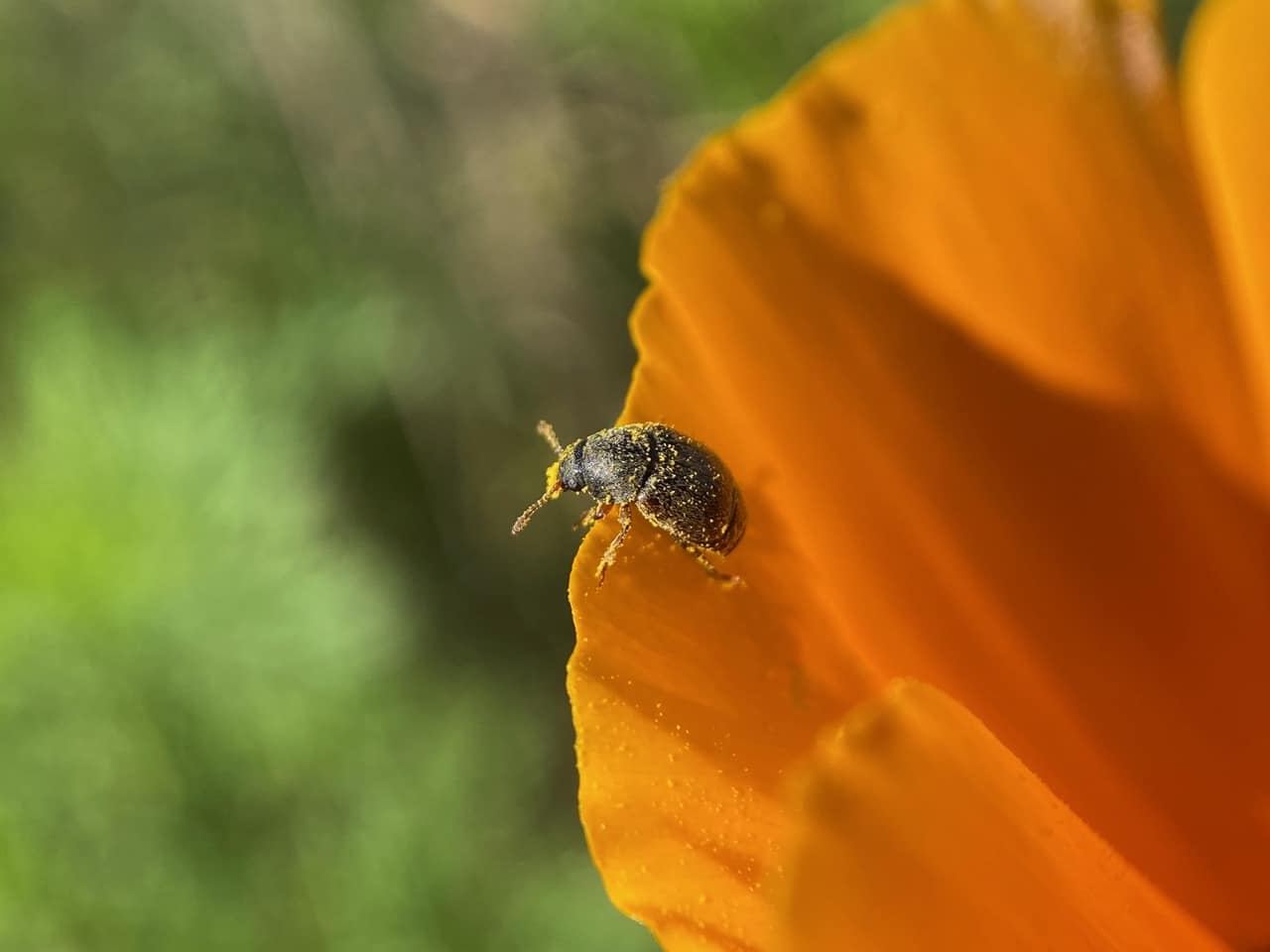
I have never seen a clean Poppy Loving Beetle. They are always covered with pollen!
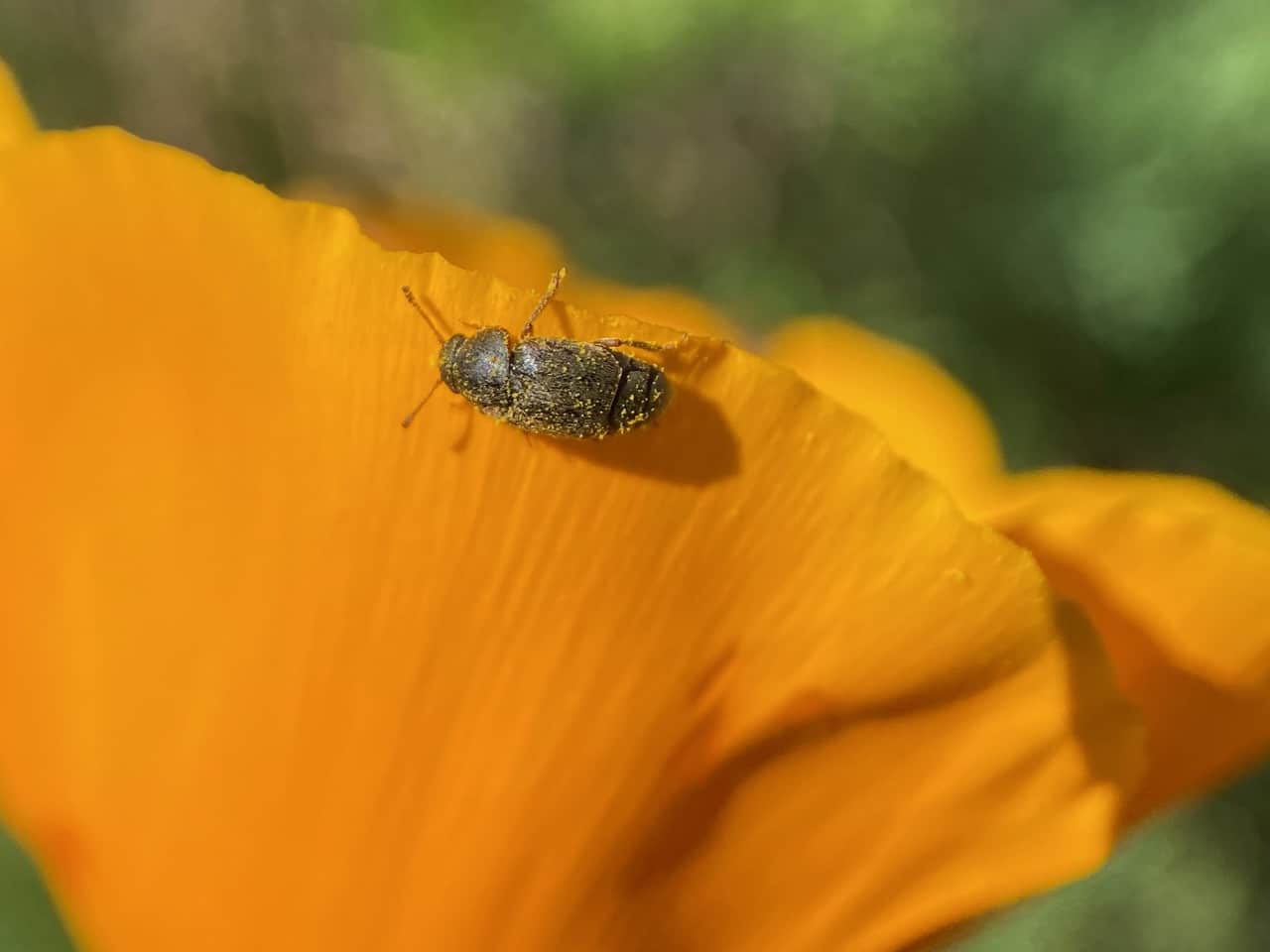
This one has crawled out of the flower. Note the short elytra that don’t fully cover the abdomen.
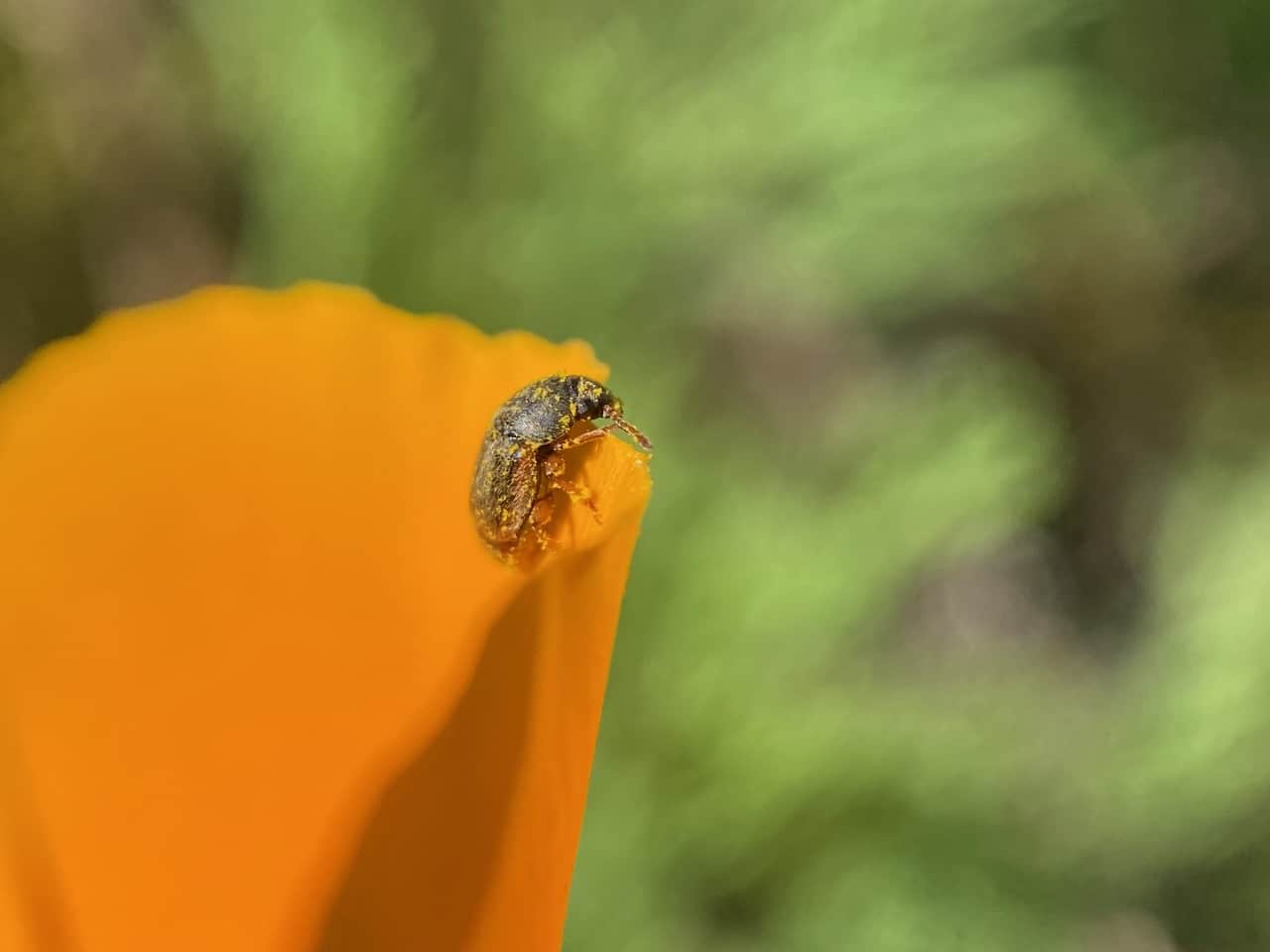
After feeding, the beetles usually crawl up the petals of the flower to groom themselves before flying away.
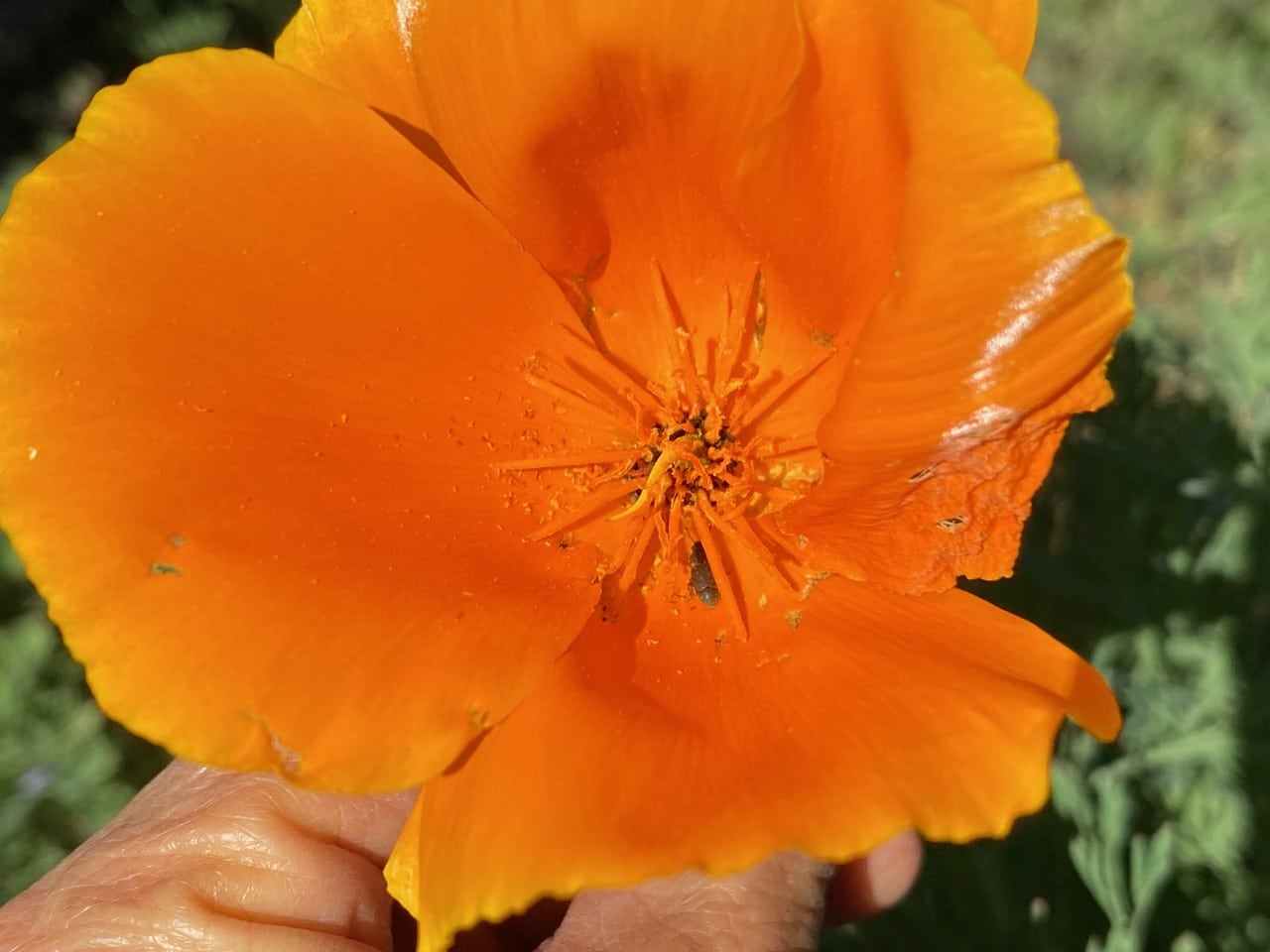
The party’s over in this poppy flower, with only one beetle left behind. All the anthers have been stripped of pollen. Orange-colored frass (insect poop) litter the bottom of the corolla. Despite the devastation, the beetles have left the cream-colored stigma intact. California Poppy is highly resilient and can withstand beetle activity. It can still produce seeds even if beetles have consumed most of the pollen. The beetles often assist with pollination before consuming the pollen, and if the plant is established, it will typically continue to produce viable seed pods throughout the season allowing for prolific self-seeding.
Beetles are among the first insects to visit flowers and they remain essential pollinators today. They are especially important pollinators of ancient species such as magnolias and spicebush. The beetles eat their way through petals and other floral parts. They often mate and defecate within flowers, generally making a mess. This behavior has earned them the nickname of “mess and soil” pollinators.
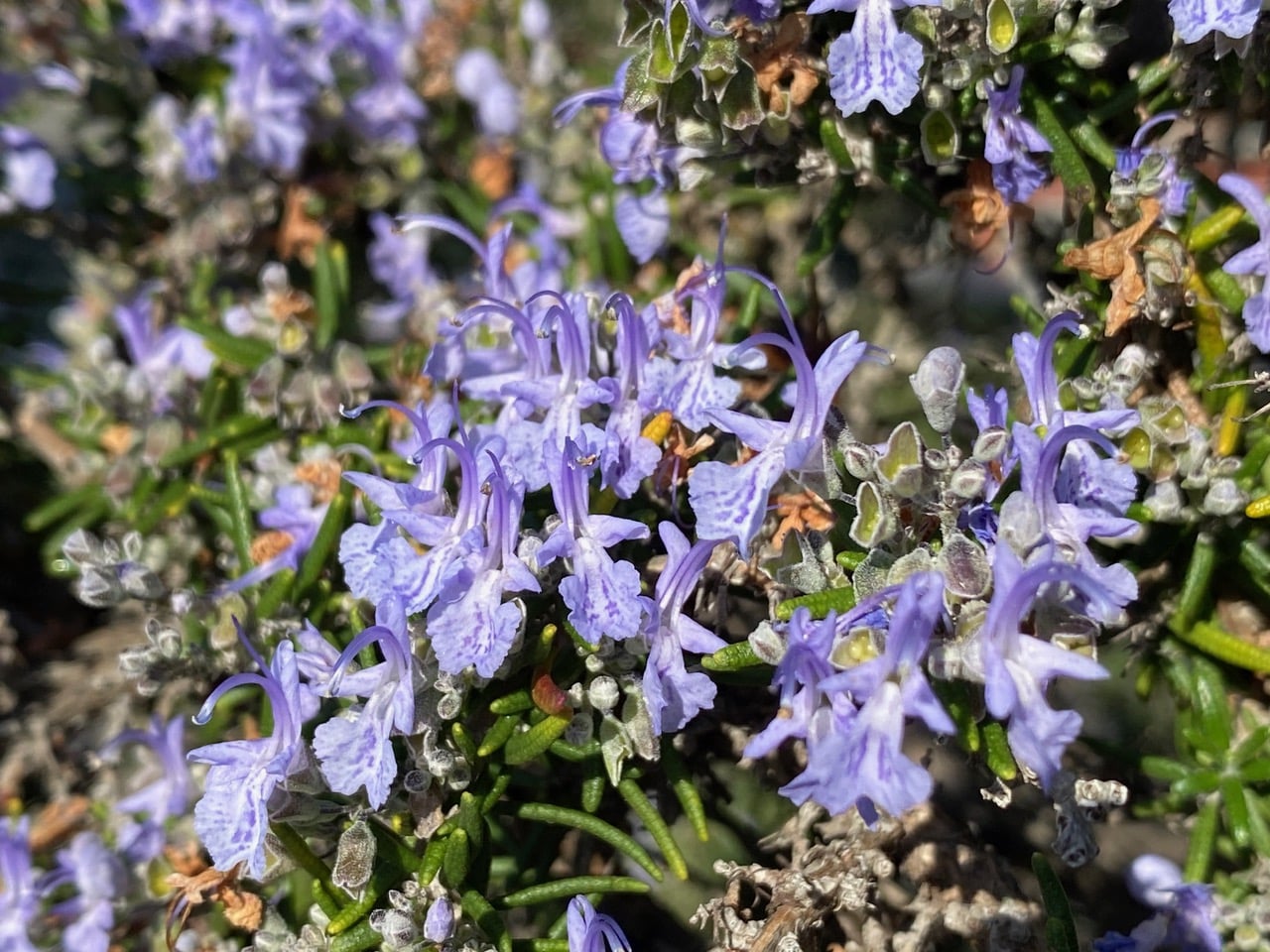
At the front of the garden, the original Rosemary bushes, Salvia rosmarinus (family Lamiaceae) are in glorious bloom. Although the plant is not native, the bees (both native and non-native) are intensely attracted to the flowers – a good source of both nectar and pollen.
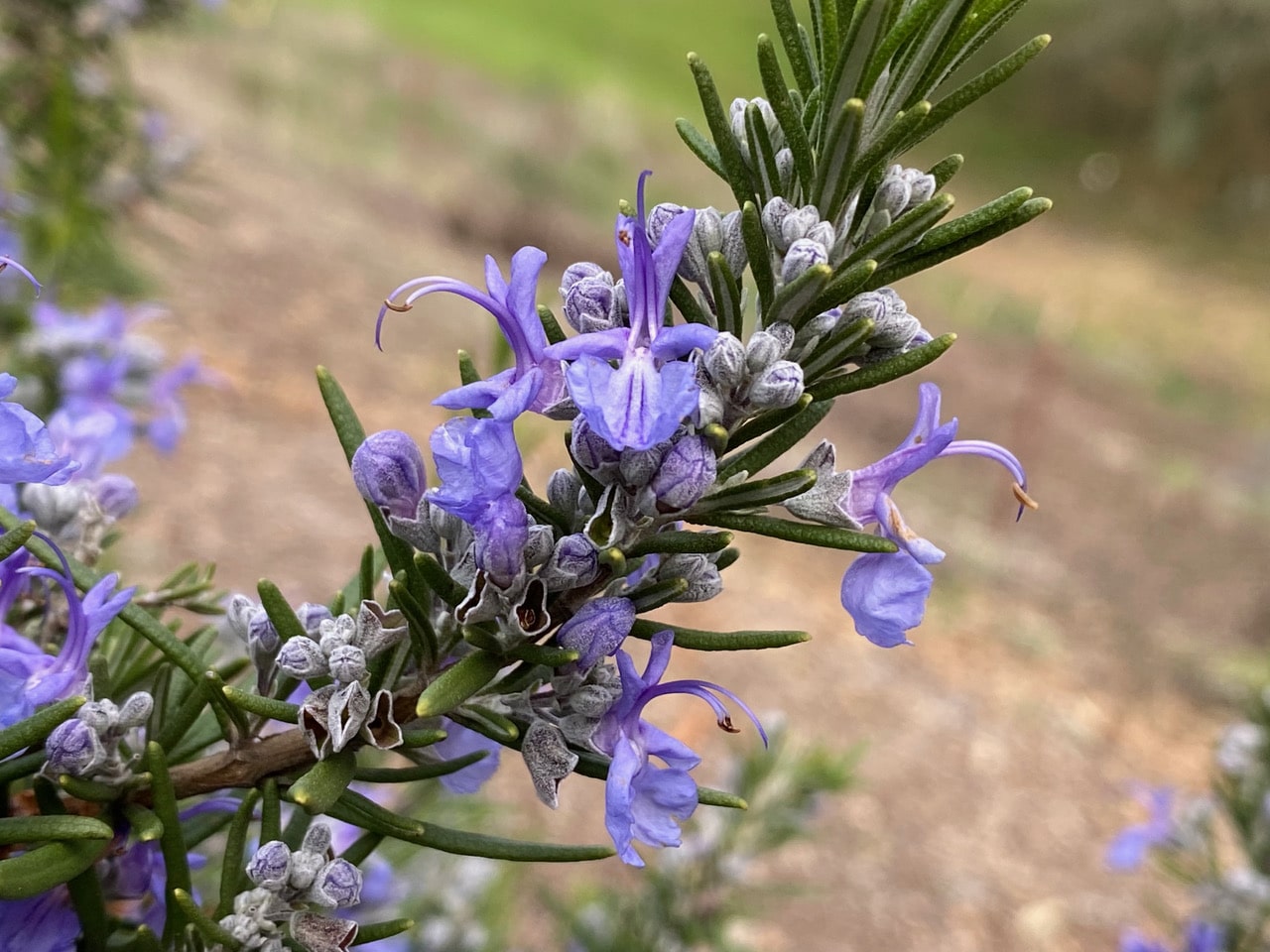
I am re-posting a photo taken on 2/15/24 at Skyline Gardens, Berkeley. It is hard to get a good picture of the Rosemary flower that shows it from all angles.
Sage (genus Salvia) flowers are characterized by a bilateral two-lipped structure. The corolla has an upper, hood-like lip and a three-lobed lower lip. The lower lip serves as a landing platform for bees, while the upper lip protects the reproductive parts. Salvia has two fertile stamens that act as a lever. As a bee probes for nectar at the base of the flower with its tongue, the stamen lever pivots to deposit pollen on the insect’s back. This unique pollination mechanism in Salvia is termed a “staminal lever mechanism”.
The flower is bisexual and protandrous, i.e. the male parts mature earlier than the female parts. When a pollinator probes the back of a male-phase flower in search of nectar, a see-saw contraption tilts the pair of pollen-filled (male) anthers down to deposit their load on the back of the insect. When the insect next visits a female-phase flower, the protruding mature stigma will be the first part of the flower to touch the pollinator and will receive the pollen from the previous flower.
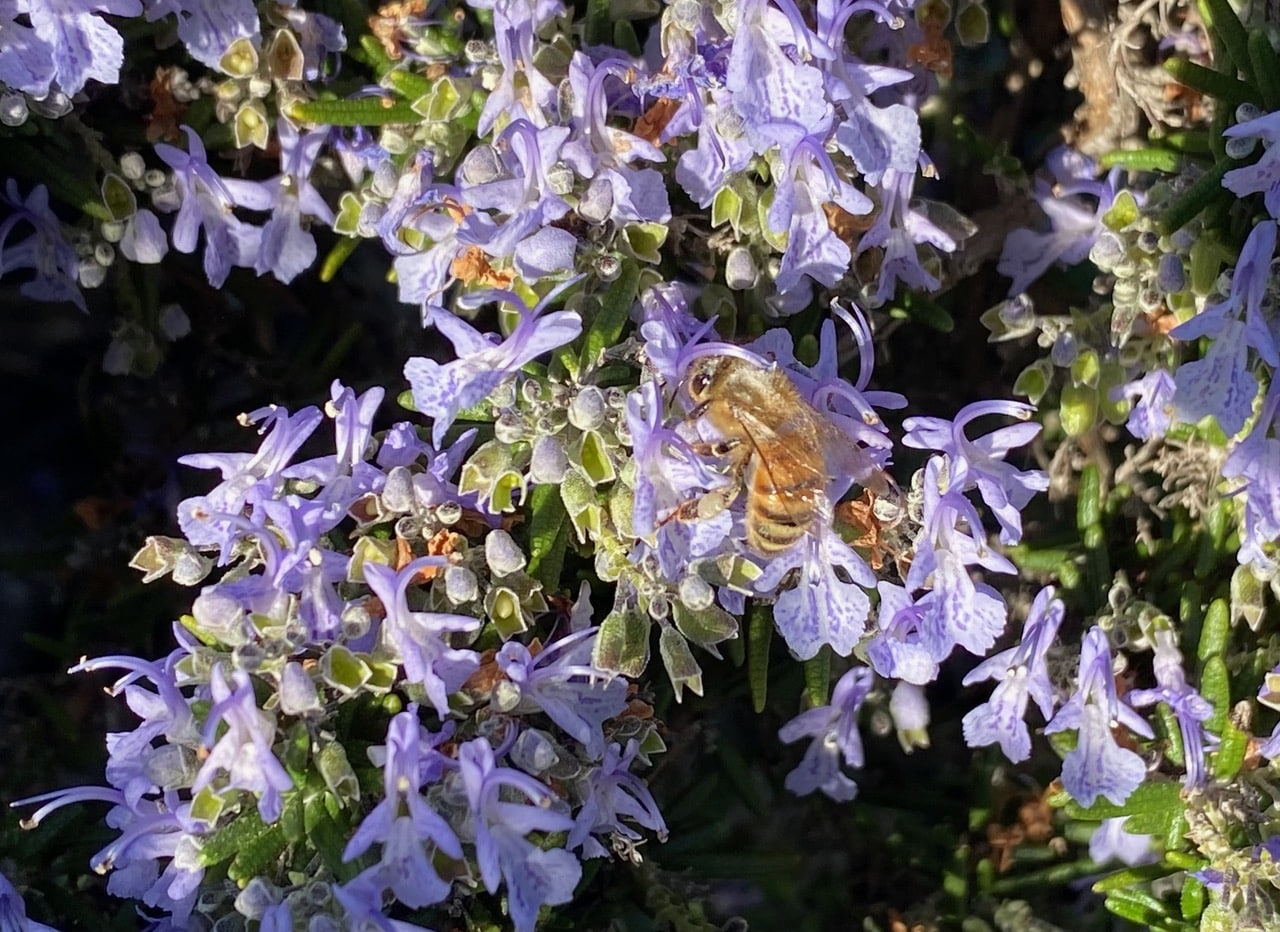
As the Honey Bee, Apis mellifera (family Apidae) probes the depths of the Rosemary Sage flower for nectar, the arching stamen is lowered onto the bee’s back, dabbing it with pollen. Almost every bee buzzing around the Rosemary bushes wears a coat of cream-colored pollen on her thorax.
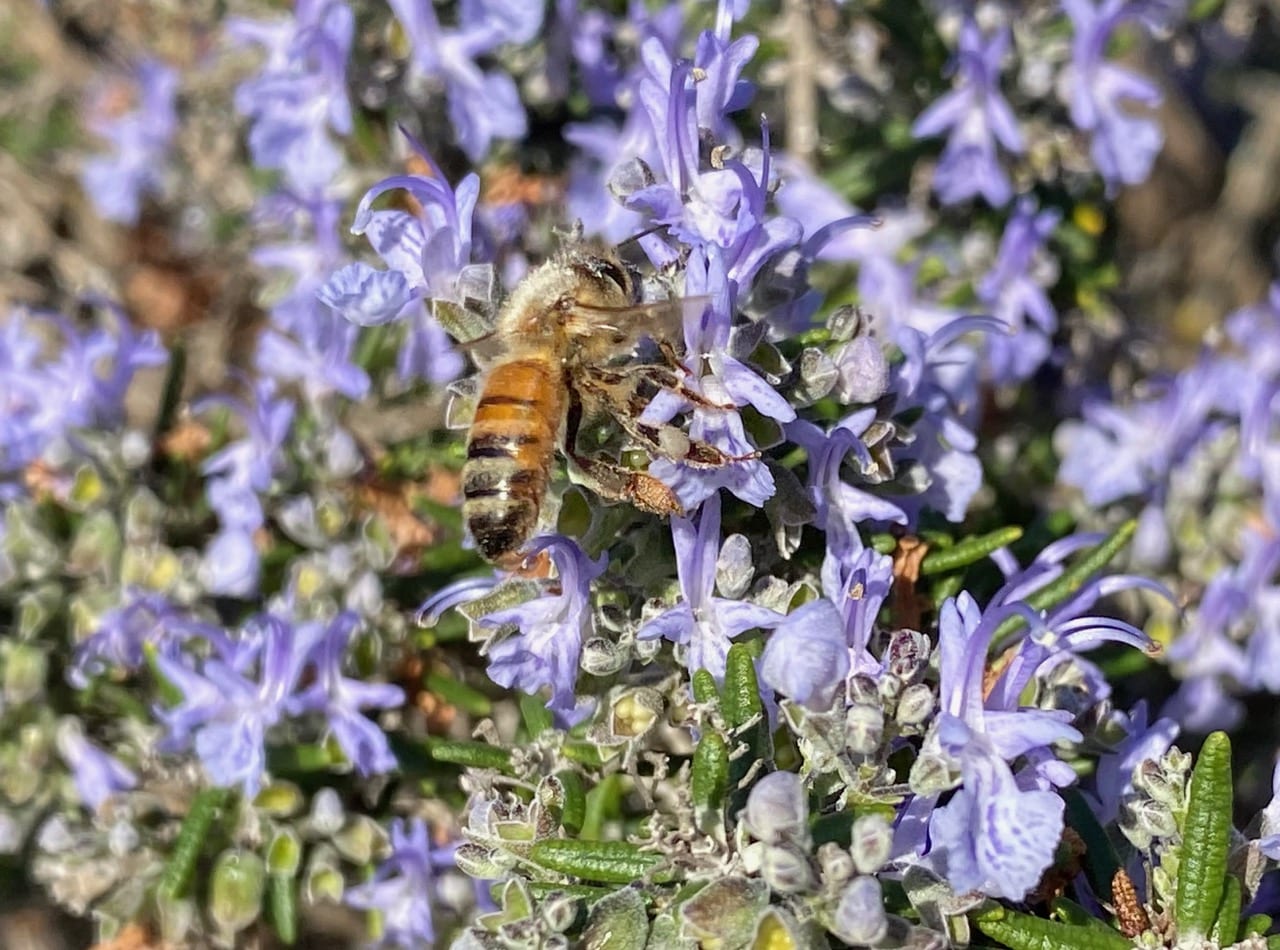
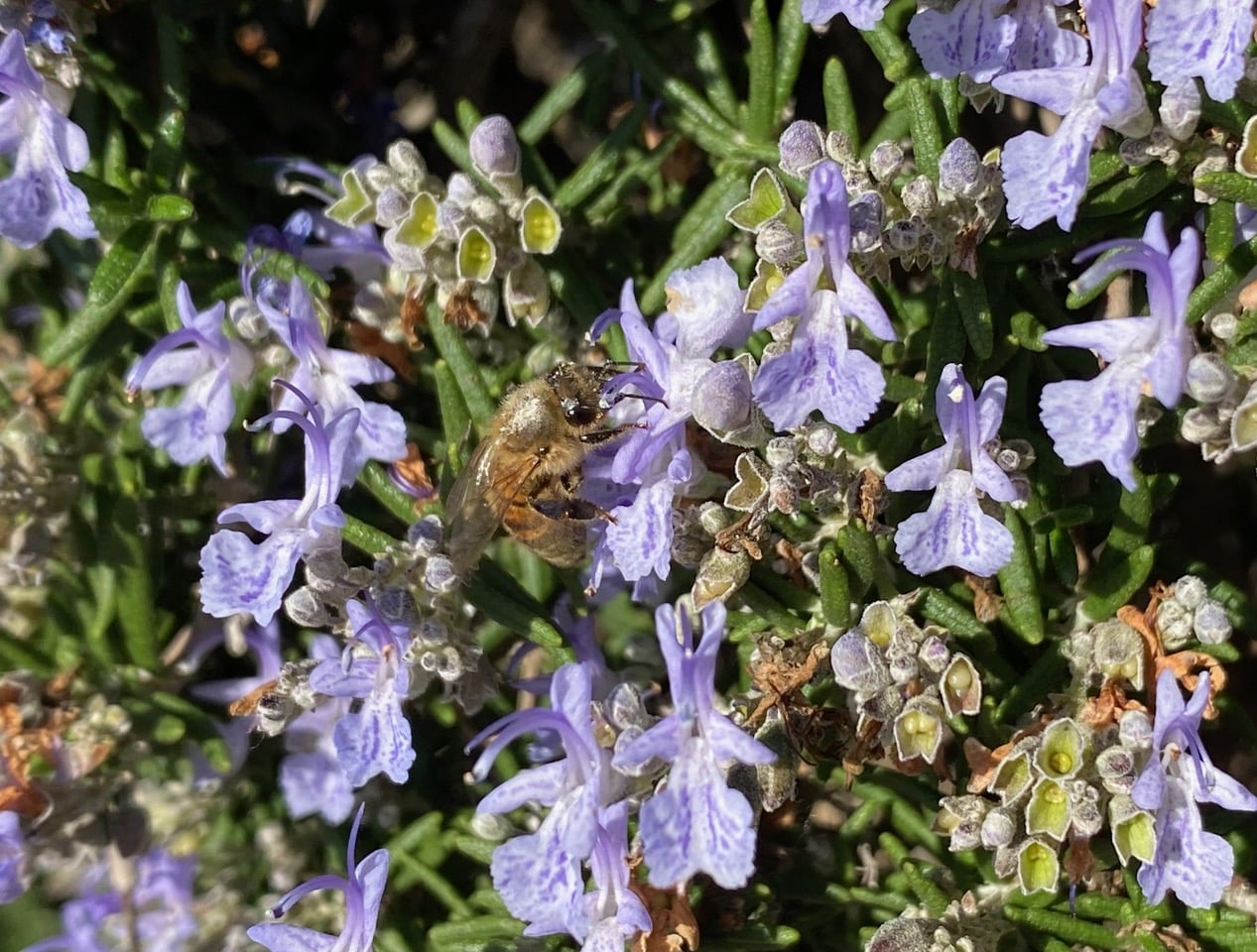
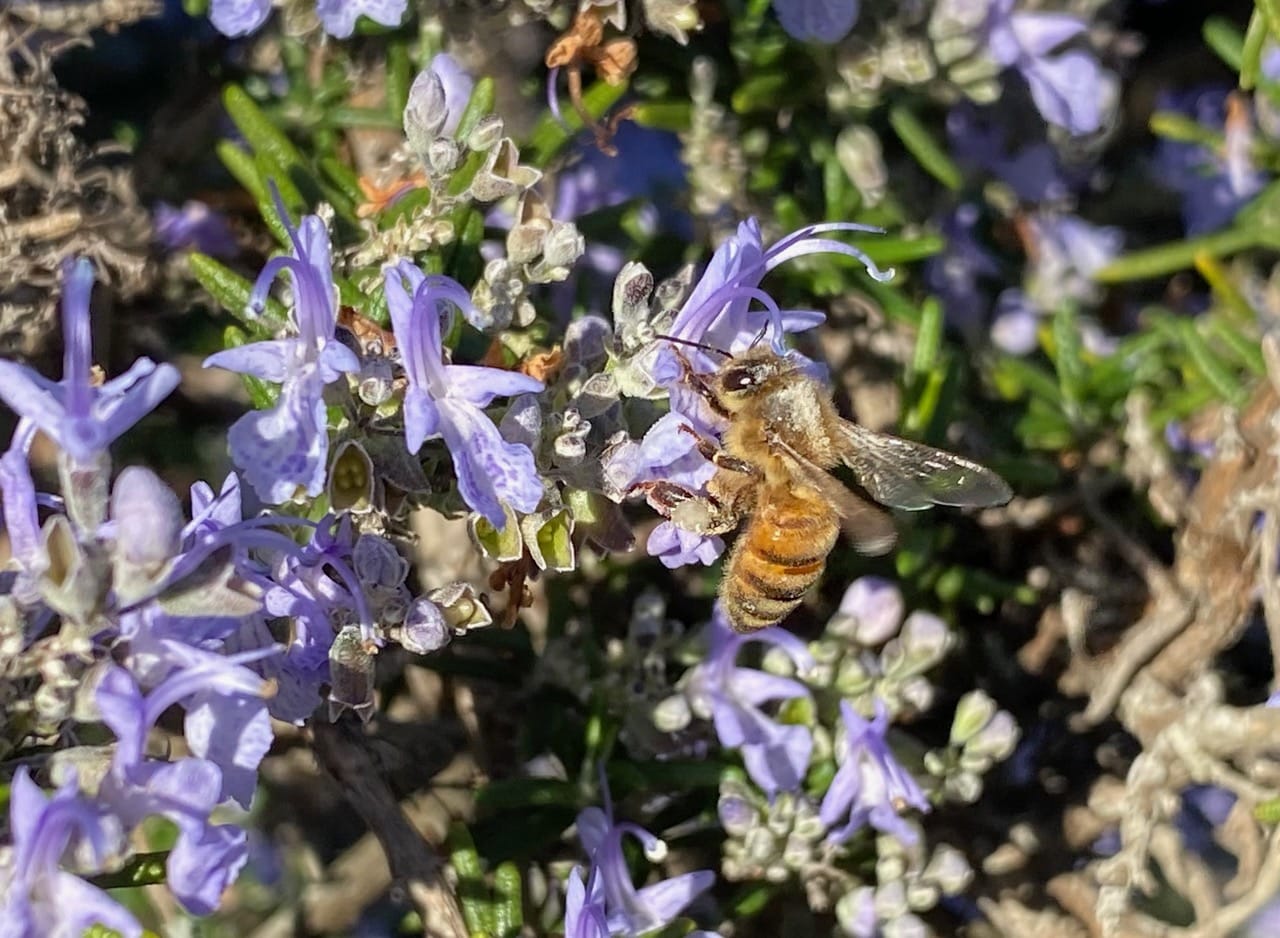
Note the bit of cream-colored pollen in the pollen basket on the Honey Bee’s hind leg. She has groomed the pollen that was deposited on her back into the corbiculae (pollen baskets) for transport back to the hive. But there’s always a central strip on her thorax that she cannot reach, and it is located where the remaining pollen is likely to be picked up by the mature stigma of subsequent Rosemary flowers she visits. It is a perfectly choreographed dance of pollination that has co-evolved between the Honey Bees and Rosemary Sage in their native Europe. You can see this amazing behavior in most of the non-native Salvias. The staminal lever mechanism can be activated by probing with a very fine stick or pin. I find it rather disappointing that none of our native Salvias has a functional staminal lever mechanism. New World Salvia species have evolved away from bee pollination (melittophily) towards bird pollination (ornithophily). To accommodate hummingbird beaks rather than bee bodies, the lever mechanism is lost, with the stamens often becoming stiff or fused and exposed.
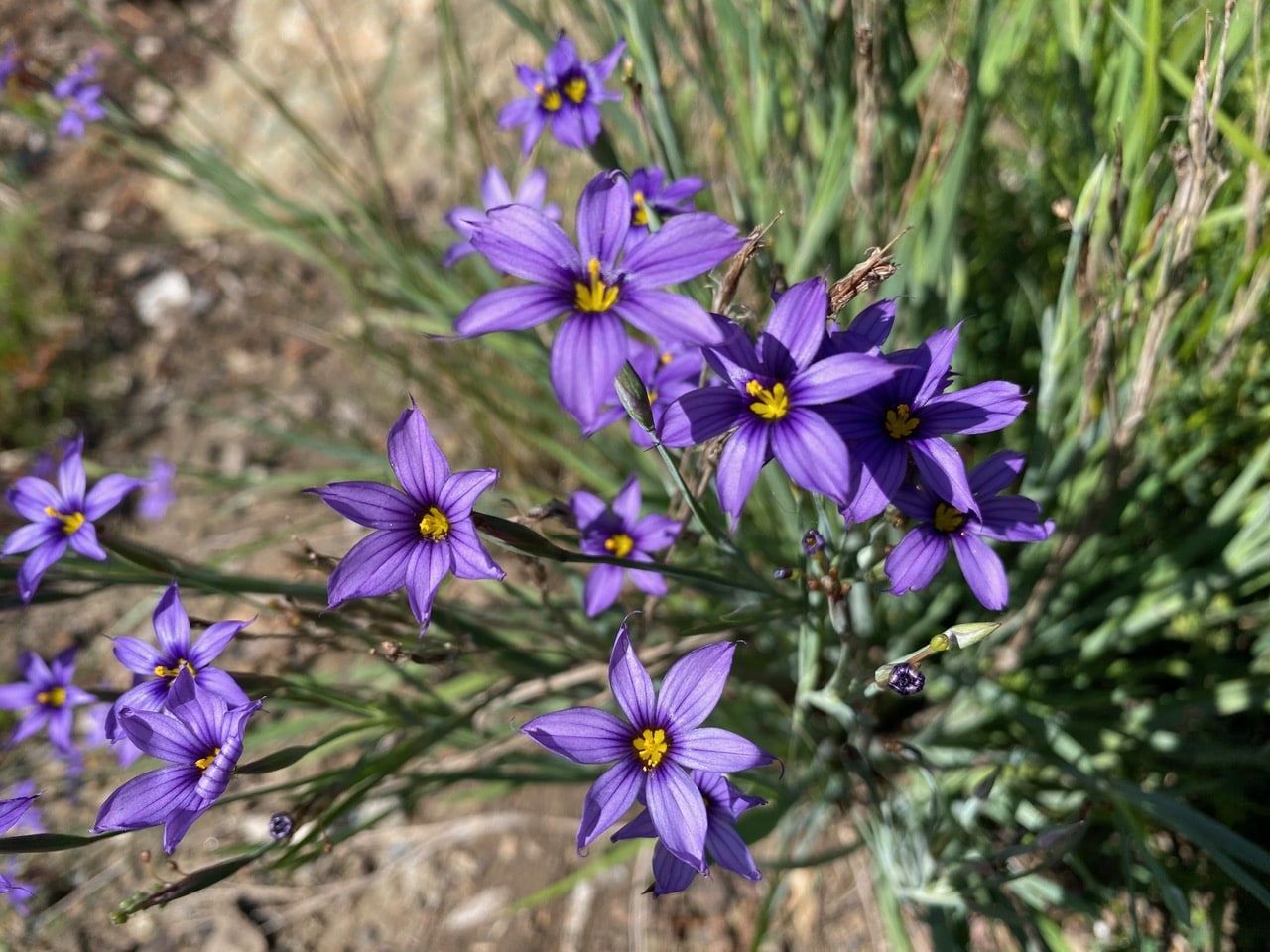
Western Blue-eyed Grass, Sisyrinchium bellum is blooming gloriously.
Blue-eyed Grass, Sysyrinchium bellum is not a grass but an iris, native to California, western Oregon and northwestern Mexico. The perennial herb has a flower with 3 sepals and 3 petals that look alike (together called tepals) and that form a shallow saucer around the stamens and pistil. At the base of each blue petal is a bright yellow, fringed shape; together these form a yellow spot at the center of the flower. Dark blue lines converge on the yellow center, serving as nectar guides for pollinators. The flower is highly conspicuous to bees as they have maximum visual acuity for blue and yellow in the color spectrum. I have seen bees of all sizes visit the Blue-eyed Grass, from bumble bees to the smallest sweat bees. The flowers are also visited by many hover flies.
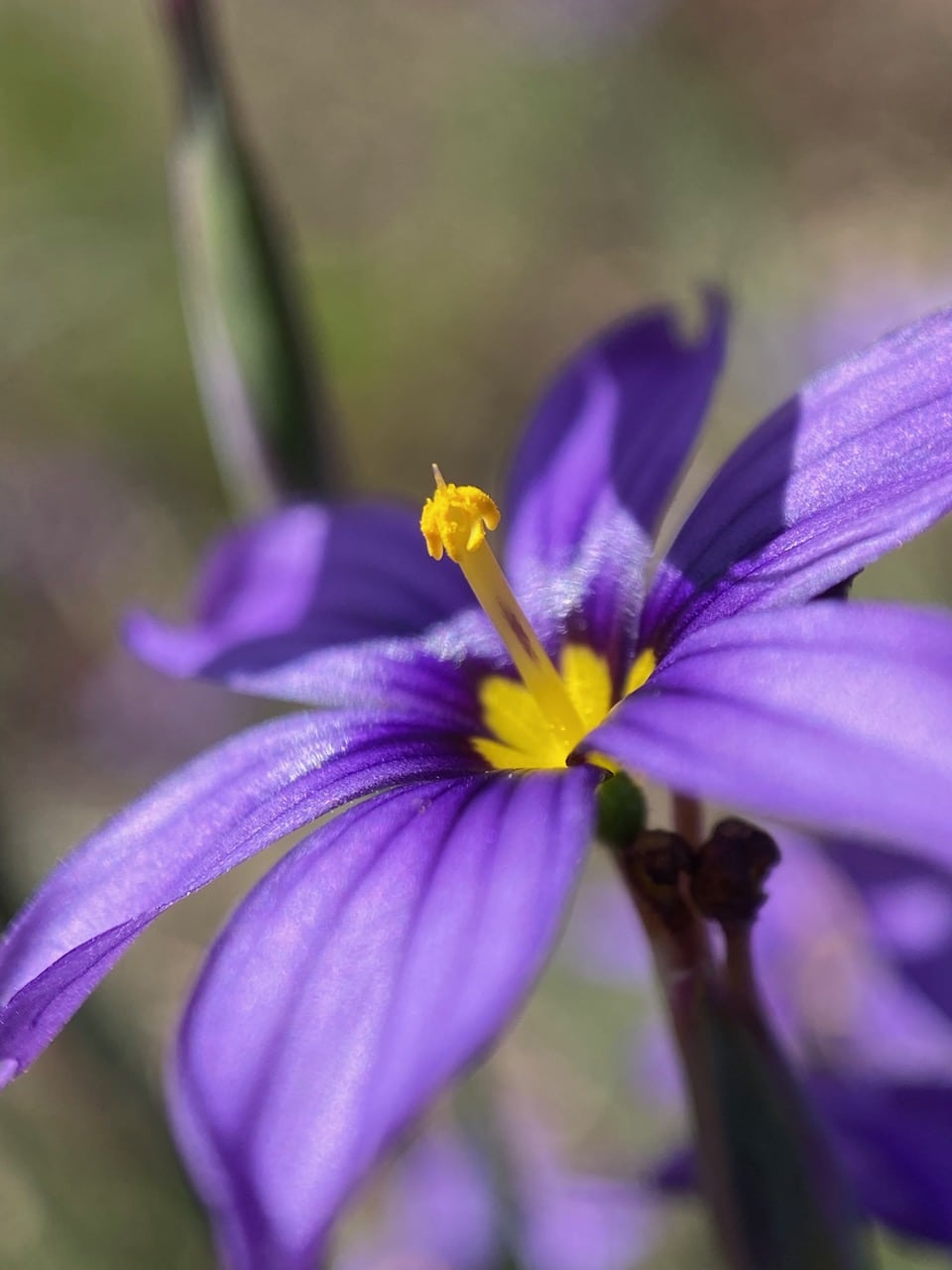
Close-up showing the reproductive structures of the Blue-eyed Grass.
There are three stamens, their filaments fused into a column around the pistil; the 6 anthers form a bright yellow scalloped umbrella on top. There is one pistil with an inferior, three-chambered ovary. The style is largely concealed by the filament column but can sometimes be seen as a tiny spire projecting from the top of the anther ring. The anthers release pollen before the style lengthens and protrudes. This is a case of protandry, whereby male parts of a flower matures before the female parts. The temporal separation of the sexes helps prevent self-pollination.
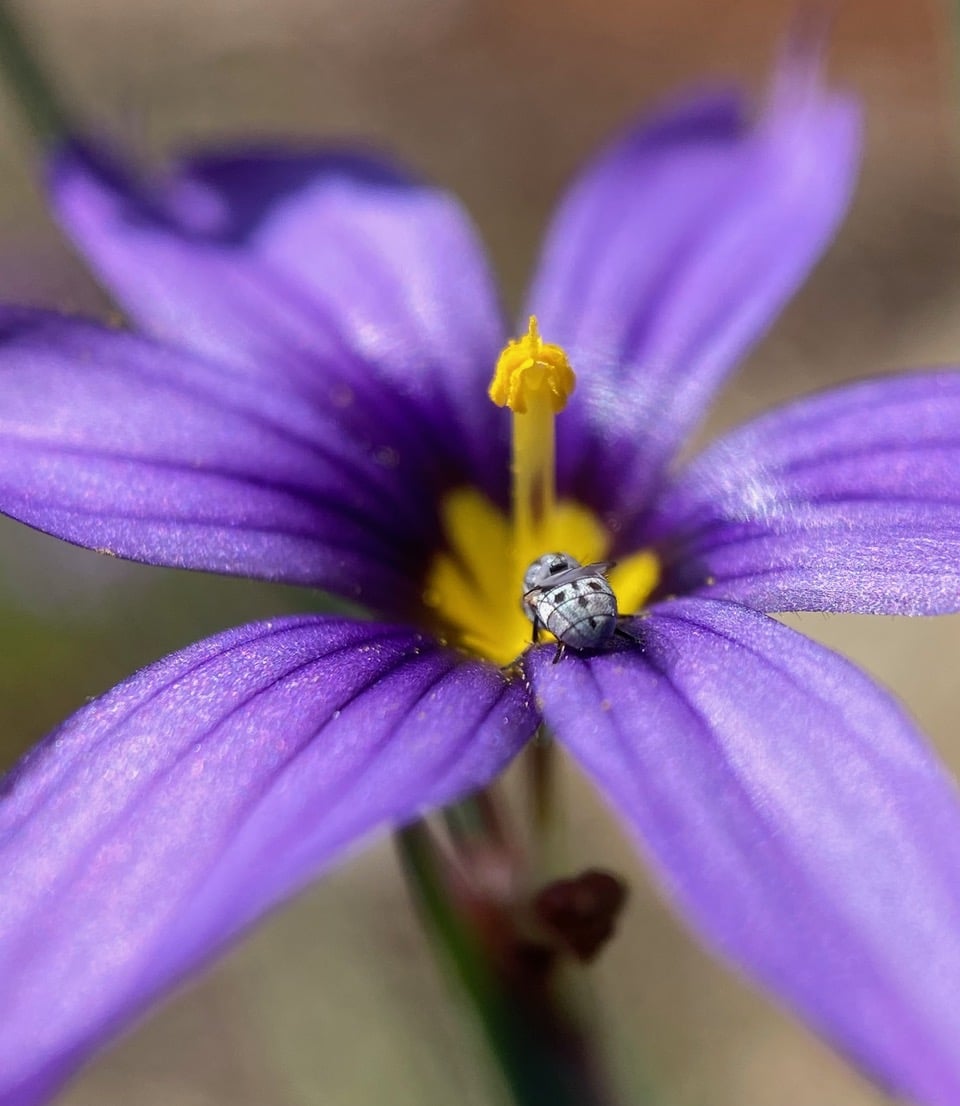
Wait, there’s a tiny insect on this flower of Blue-eyed Grass !
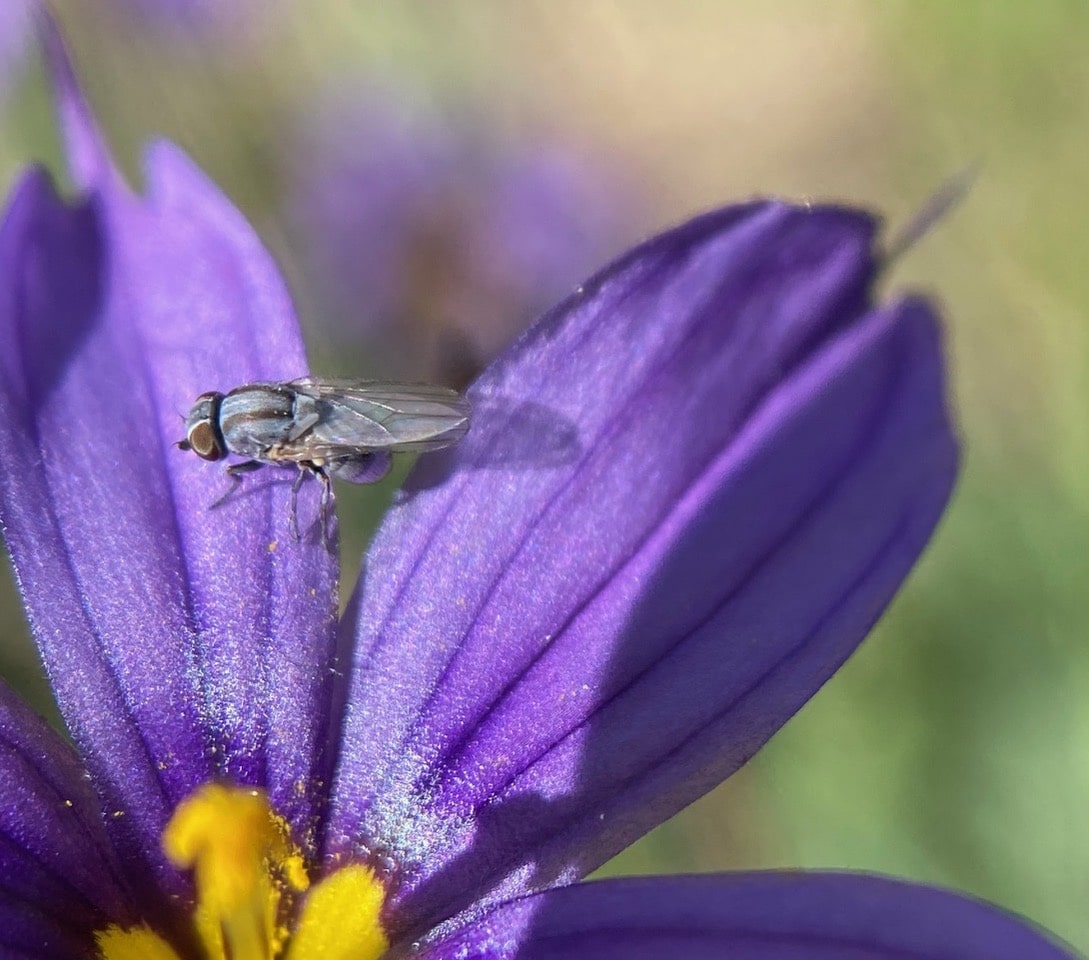
As the insect moves around, I realize that it is a fly.
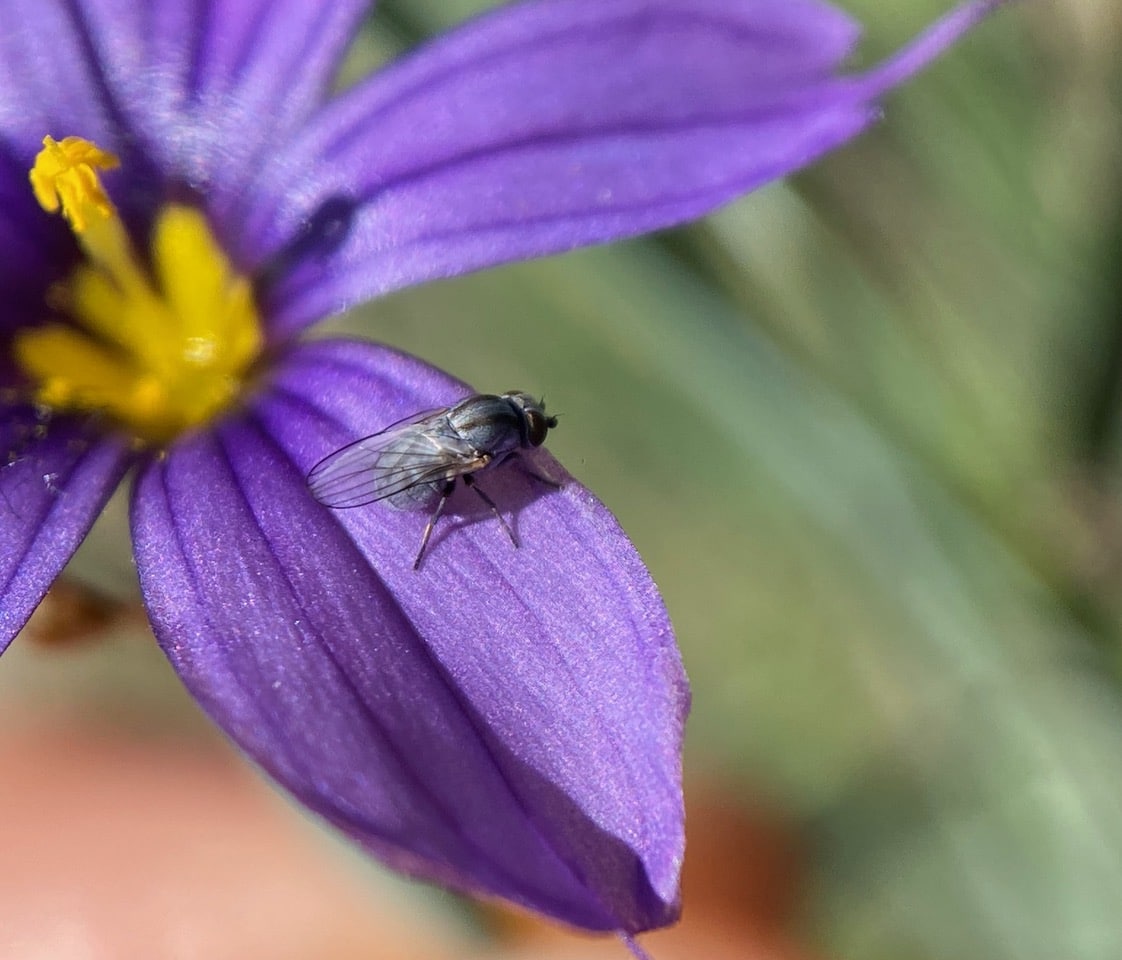
It’s a chubby little fly with a hunched posture. iNaturalist has helped identify it as an Aphid Fly, Leucopis sp.(family Chamaemyiidae).
The Chamaemyiidae are a small family of acalyptrate flies with less than 200 species described worldwide. Members of the genus Leucopis (aphid flies) are very small, measuring approximately 2-4 mm in length. These grayish flies often have black abdominal spots. The larvae are active and predatory and are often used for biological control of aphids, scale insect, mealybugs, and similar pests. The predatory maggots, about 3 mm long and yellowish, are often found within colonies of their prey, moving slowly with a wrinkled appearance and distinct, two-stalked breathing tubes (spiracles) at their rear.
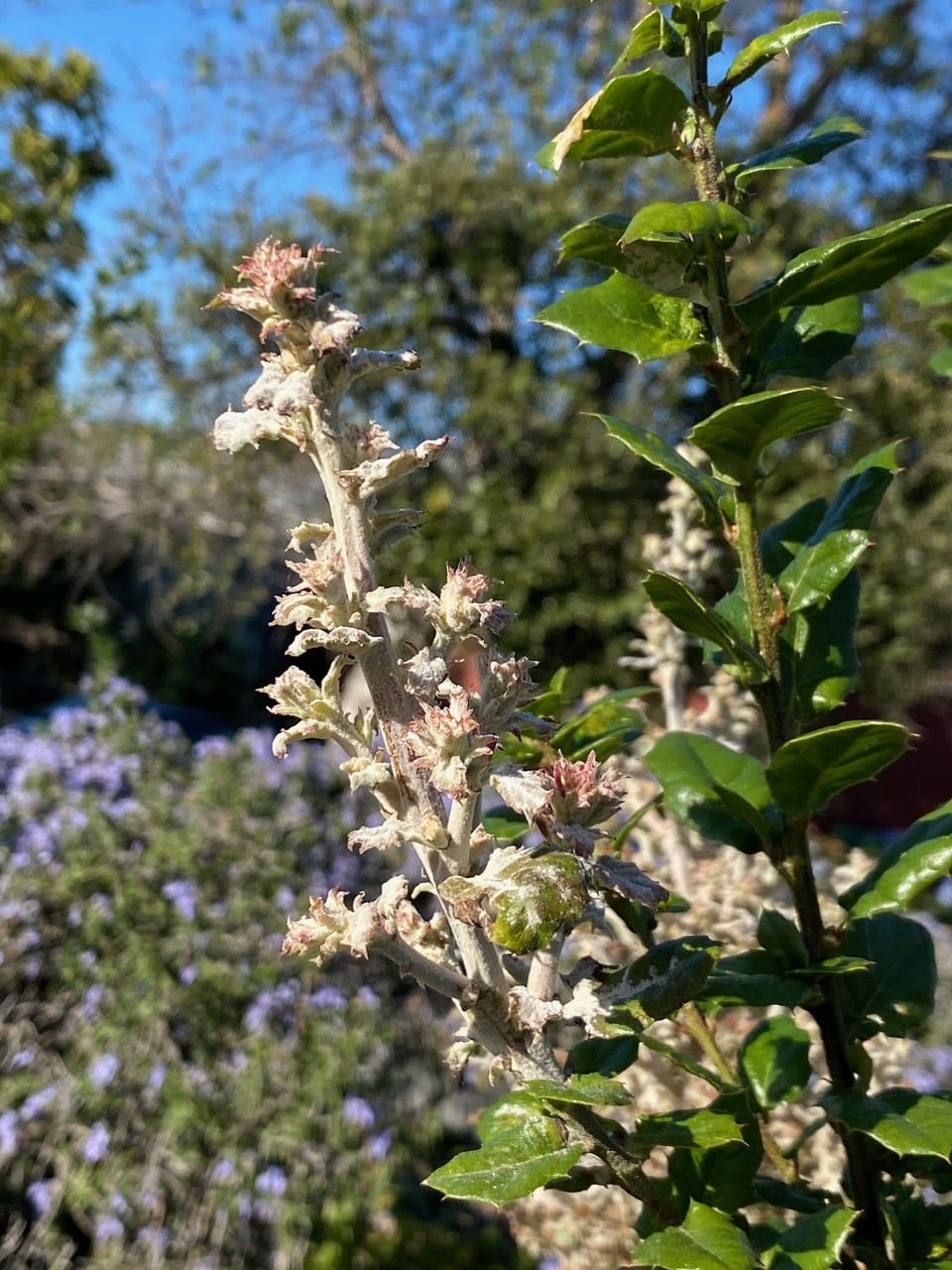
This young Coast Live Oak, Quercus agrifolia has sent out shoots that are ghostly white with very small leaves. What is happening here?
Live Oak Witch’s Broom Fungus, primarily caused by the powdery mildew Cystotheca lanestris (family Erysiphaceae) produces dense, stunted clusters of twigs on oaks in the Western United States. This fungal infection often results from cool, moist spring conditions, causing deformed, crowded, and sometimes discolored growth on branches. The fungus is fairly host-specific and only infects species in the genus Quercus, notably Coast Live Oak, Interior Live Oak, and Canyon Live Oak. High humidity and fog often drive the growth of this fungus. While generally not fatal, it can weaken the tree, reduce growth, and detract from its appearance. To manage the spread, prune the affected branches at least 6-12 inches below the infected growth.
Live Oak Witches’ Broom Fungus (Cystotheca lanestris) · iNaturalist
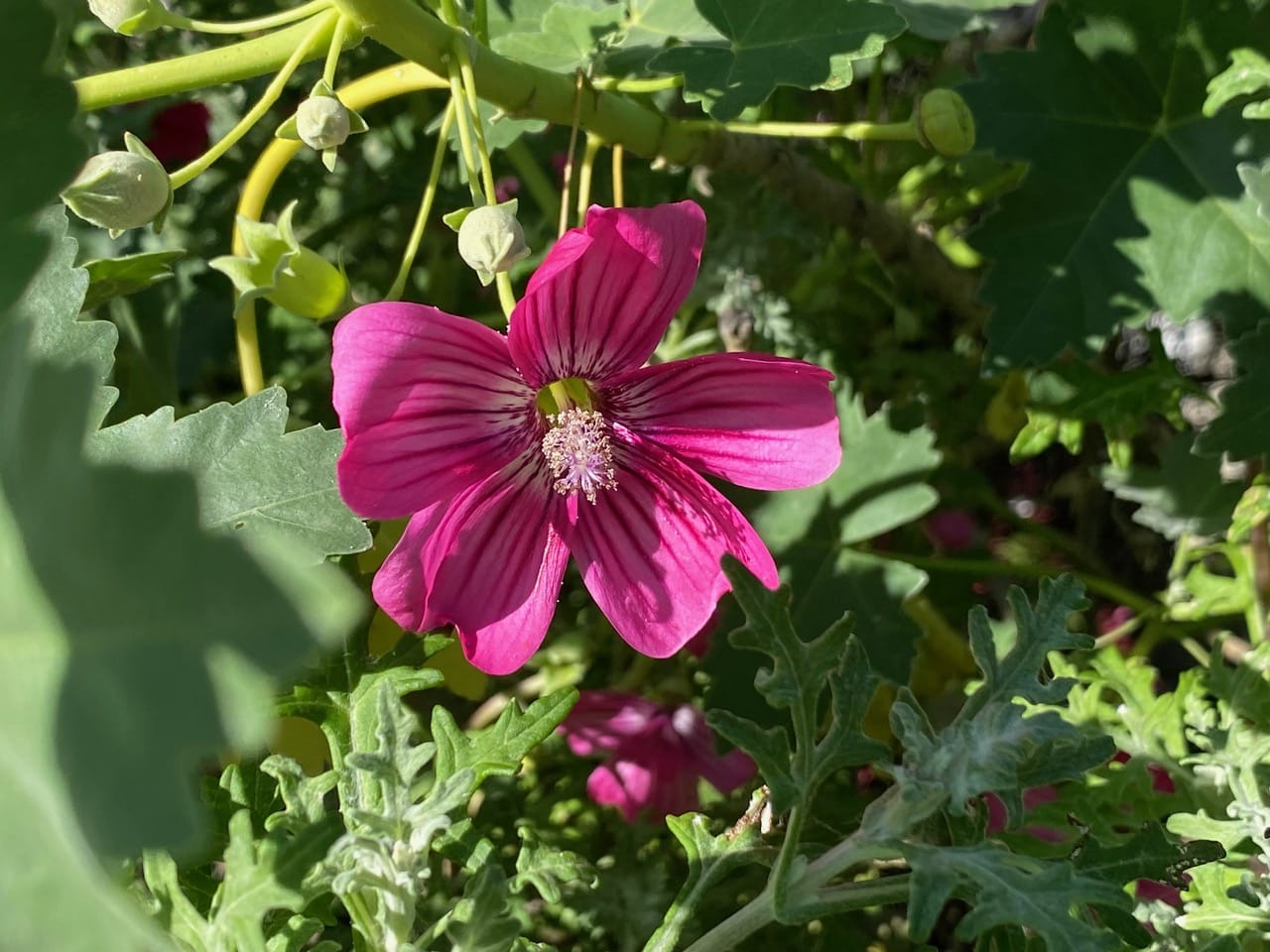
The Island Mallow, Malva assurgentiflora has started to bloom, displaying eye-catching flowers with prominent nectar guides on bright pink petals. Somehow they are not attracting any pollinators today.
Nectar guides are visual patterns, lines, or spots on flower petals that act as runways or maps, directing pollinators like bees, butterflies, and birds to the flower’s nectar and reproductive parts. Many nectar guides appear as ultraviolet (UV) colors, not visible to human eyes, but highly visible to insects. Nectar guides improve pollination efficiency by reducing the time pollinators spend searching for nectar, allowing them to rapidly locate the center of the flower. Nectar guides benefit plants by increasing the likelihood of successful pollination, which in turn enhances their reproductive success.
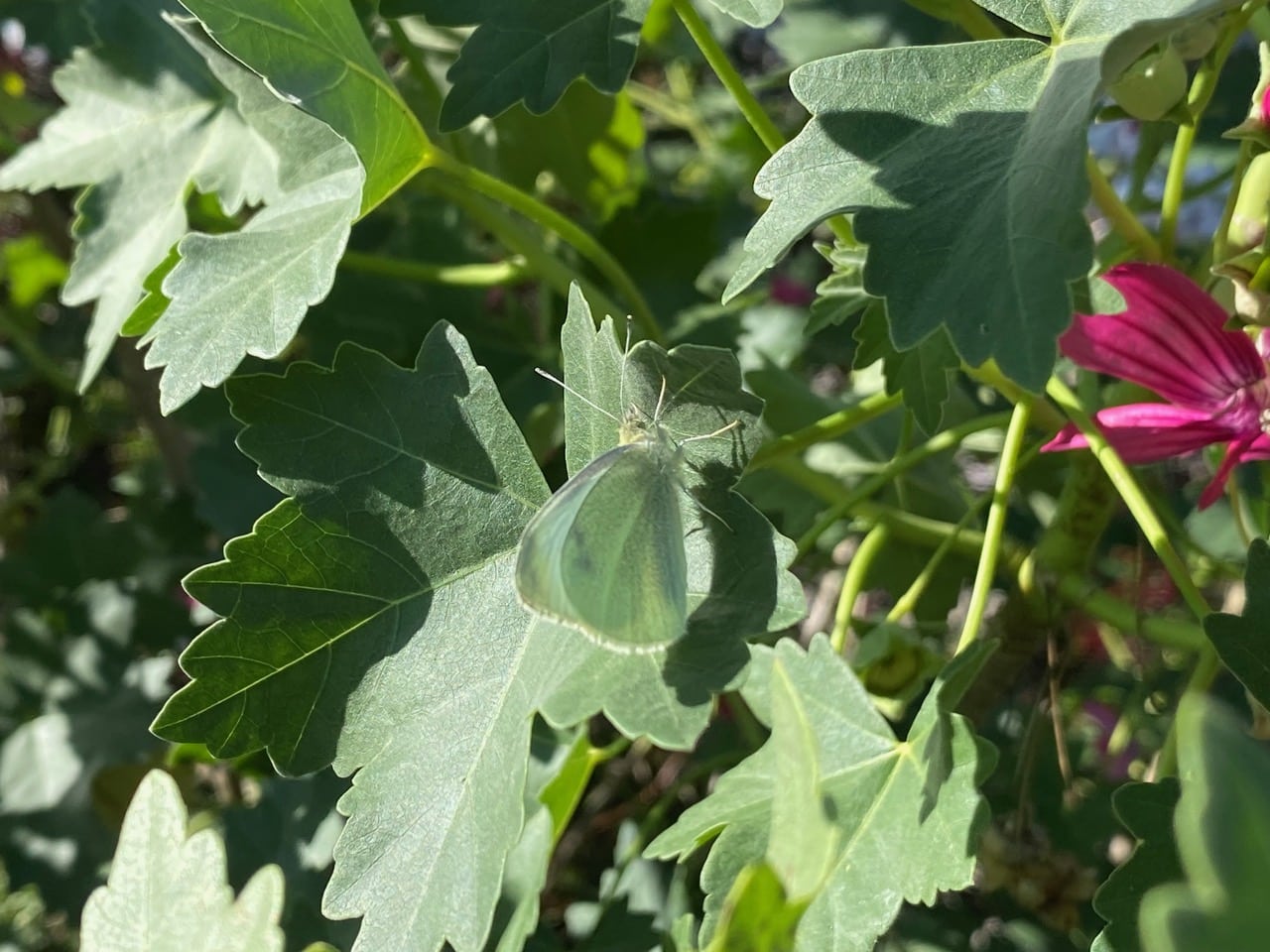
A Cabbage White butterfly flutters around the large shrub of Island Mallow for a long time, never going near the flowers. It lands several times, always on a leaf. What is it looking for? From where I am observing the butterfly, it disappears every time it lands; I have difficulty locating it because it blends perfectly into the foliage. I have never observed this before – the white butterfly appearing green when it lands on the leaves and closes its wings. It is mirroring the colors around it. When I return to the same spot half an hour later, the butterfly is still there on the same leaf. I think it has settled in for the night. It was probably searching for a safe spot where it can rest invisible to potential predators? The Cabbage White is known to have distinct yellow or greenish-yellow scales on the undersides of their wings, particularly on the hindwings, which are often speckled with black. Are these underwing scales playing tricks with my eyes?

Do you see the butterfly?
The Cabbage White, Pieris rapae (family Pieridae) was introduced to the US along with European cabbage imports in the 1860’5. The caterpillars feed on plants in the mustard or Brassicaceae family, and occasionally some in the caper family. The butterflies have a darkened, yellowish underside of the hind wings, which enables them to heat up quickly in the sun. The butterfly’s white wings reflect ultraviolet light, which we can’t see but the butterflies can. To our eyes the butterflies seem plain and drab, but to each other, females are a gentle lavender and males shine with a deep royal purple. Brighter males are more attractive to females as the color’s strength reflects the amount of protein the males consumed as caterpillars.