

Pollinator Post 3/31/24 (2)

A small Crane Fly dances unsteadily in front of me, then lands on a Bee Plant leaf. It is a Limoniid Crane Fly.
Related to the Large Crane Flies (family Tipulidae), the Limoniids are medium or small-sized, rarely large. They can usually be distinguished by the way the wings are held at rest. Limoniids usually fold the wings over the back of the body, whereas other crane flies usually hold them out at right angles. Limoniid larvae are mostly aquatic or semi-aquatic. The various species have evolved to feed on different food sources, such as decaying plant matter and fungi. Some are predatory. Limoniids occupy a wide range of habitats: in soil rich in humus, in swamps and marshes, in leaf litter, and in wet spots in woods.
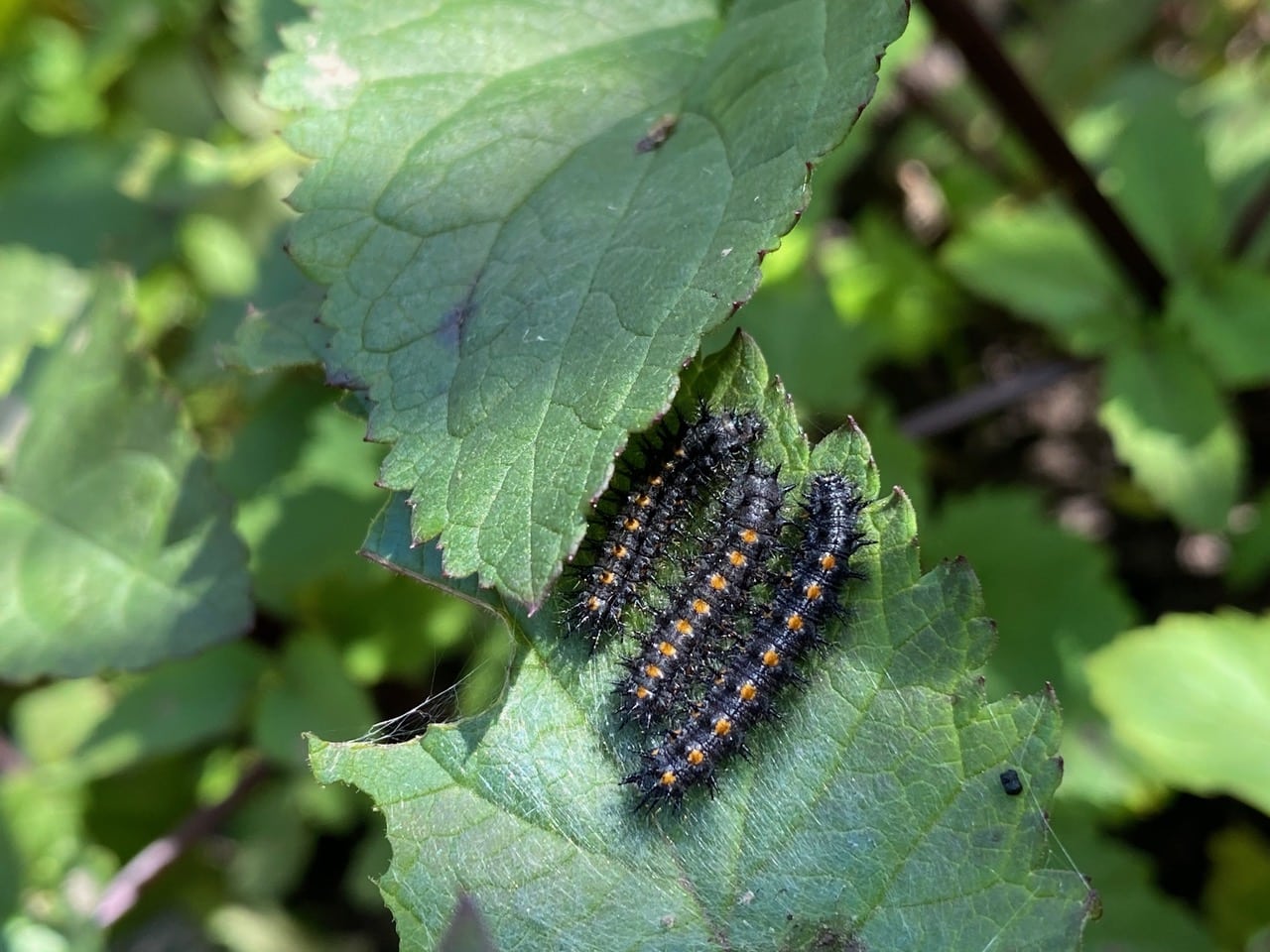
Why are these Variable Checkerspot caterpillars lying side-by-side on the leaf California Bee Plant?

Strangely, a Variable Checkerspot caterpillar is resting on a silk pad it has woven over the inflorescence of the American Wintercress, Barbarea orthoceras. It has not eaten any of the plant, as there’s no feeding damage. Has the caterpillar fallen on the plant by accident? Can it find its way back to the Bee Plant, its favorite food plant?

After foraging on the flowers of American Wintercress, a male Western Calligrapher, Toxomerus occidentalis comes to rest in the sunlight on a Bee Plant leaf. Sexual dimorphism is extreme in the species – the males have a much slimmer abdomen, and lacks the colorful pattern on their abdomen.
Toxomerus is a very large genus of Hover Flies. They are found in North and South America. The majority of species are only 6-9 mm in length. They are notable for their mimicry of stinging Hymenoptera to avoid predators. Their unique abdominal patterns are diagnostic at the species level within the genus. Most larvae feed on soft bodied insects, such as aphids; a few feed on pollen. Adults feed on the pollen of a wide range of flowers. A female can lay up to hundreds of eggs at a time and will place them where prey or pollen food sources are readily available. They can be found in a wide variety of habitats, often in dense ground cover.
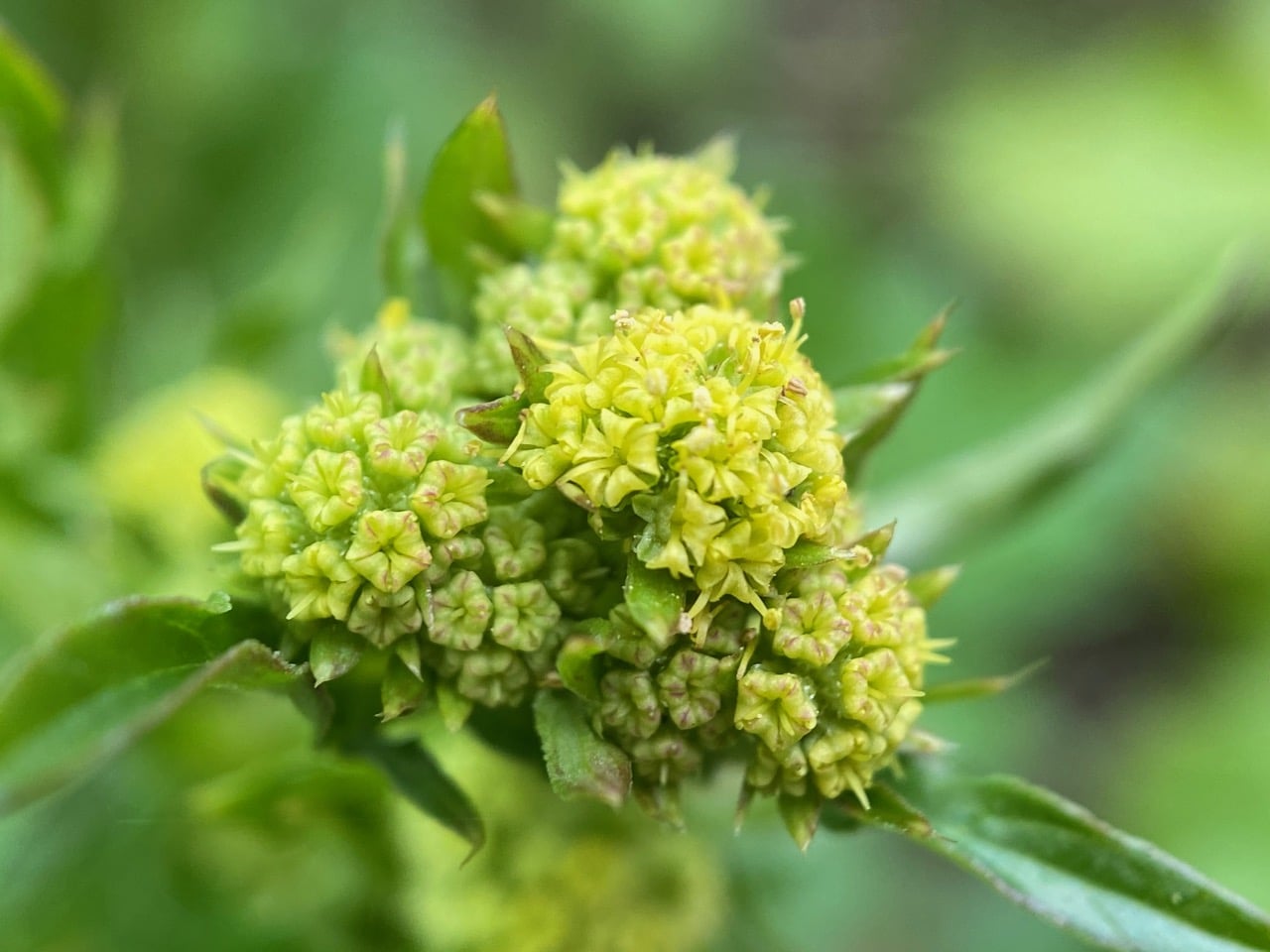
Although the Pacific Sanicle, Sanicula crassicaulis looks somewhat scraggly and chlorotic this year, the plants are blooming reasonably well. The tiny yellow flowers are borne in small compact, rounded clusters. About half of the flowers are bisexual, the rest male, but the two types are difficult to distinguish without magnification. The flowers are radially symmetrical with five petals. The tips of the petals curl inward, never unfurling fully. There are five pale yellow stamens that curl inward before maturity and extend well beyond the petals when mature. Gathering pollen should be easy for insects because of the fully exserted anthers.
I am on a specific mission today – to observe the tiny black Weevils on the flowers of Pacific Sanicle. On 3/28 I photographed a tiny black Weevil ovipositing into the flowers of Pacific Sanicle about to go to seed. From my observations of the weevils last spring, I know that they are intimately associated with the plant. When found on the flowers, the weevils were always covered with pollen. The weevils also mated on the flowers, and seemed to spend all their life on the flowers. They don’t seem to fly, dropping from the flowers when threatened. I have never seen them on any neighboring plants. If they are prevalent and specific to the Pacific Sanicle, might they not be the primary pollinator for the plant? Although often overlooked, Sanicula crassicaulis is one of the most common plants at Skyline Gardens.
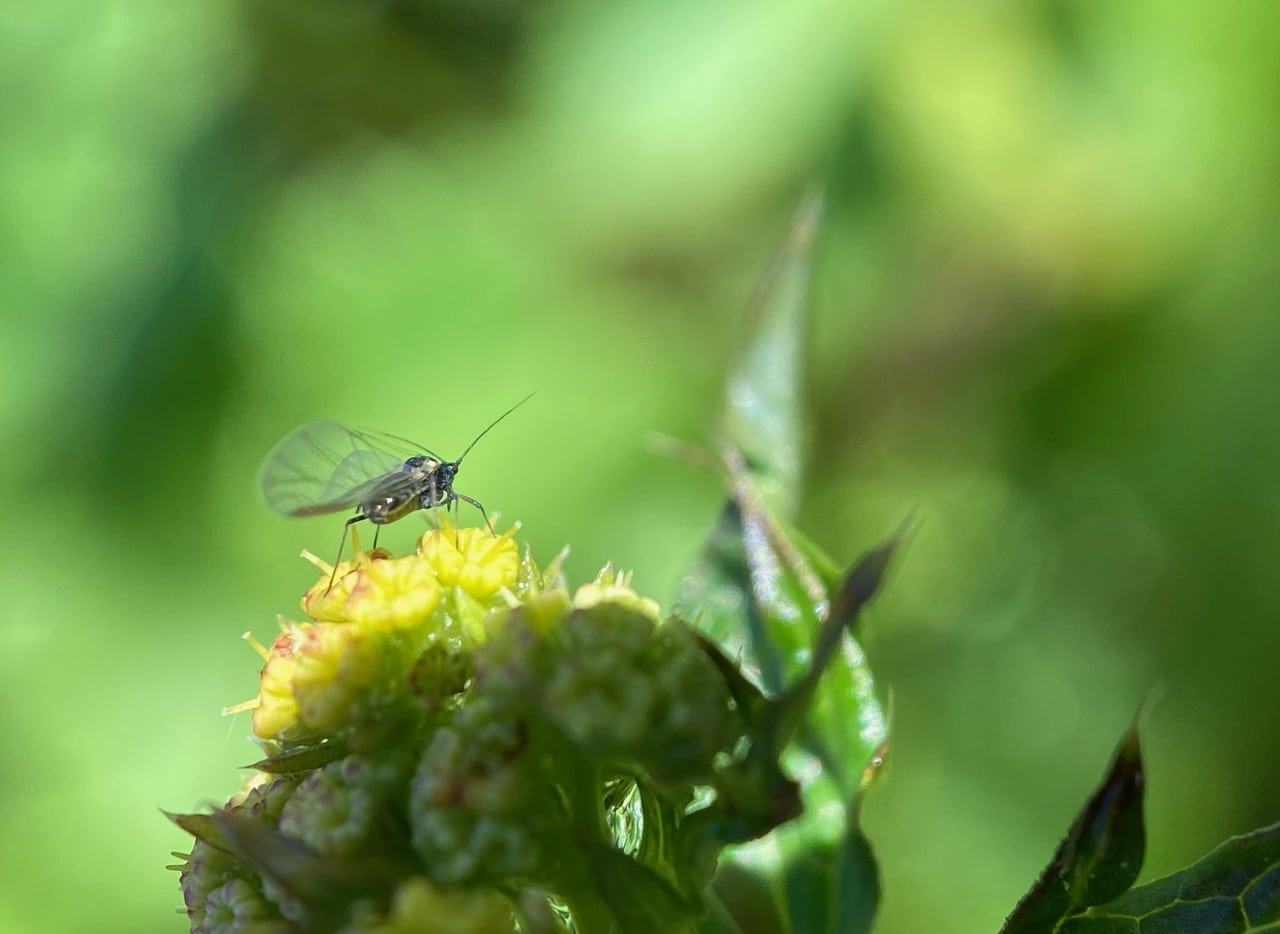
While on the look out for weevils on the Pacific Sanicle flowers, I spot this winged aphid instead. It’s rather surprising to see winged aphids when I have hardly seen any regular wingless ones this year.
Generally adult aphids are wingless, but most species also occur in winged forms, especially when populations are high or during spring and fall. The ability to produce winged individuals provides the aphids with a way to disperse to other plants when the quality of the food source deteriorates, or when predation pressure is high.

An Argentine Ant is foraging on a cluster of Pacific Sanicle flowers that are offering pollen.
The Argentine Ant, Linepithema humile (family Formicidae) is native to Northern Argentina, but it has been inadvertently introduced by humans to many countries, and is now an established invasive species in many Mediterranean climate areas worldwide. The success of the species can be attributed to their lack of aggression between the colonies. There is no apparent antagonism between separate colonies of its own kind, resulting in “super-colonies” that extend across hundreds or thousands of kilometers in different parts of the their range. Genetic, behavioral, and chemical analyses show that introduced Argentine Ants on separate continents actually represent a single global supercolony.
The Argentine Ants are ranked among the world’s worst invasive animal species. In its introduced range, the Argentine ant often displaces most or all native ants and can threaten native invertebrates and even small vertebrates that are not accustomed to defending against the aggressive ants. This can, in turn, imperil other species in the ecosystem, such as native plants that depend on native ants for seed dispersal, or lizards that depend on native ants for food.

Some of the Pacific Sanicle are already developing their trademark fruits with hooked bristles. The paired styles are still visible extending from the swelling ovaries in the calyces.

The hooked bristles on the developing fruits are more visible on this cluster.
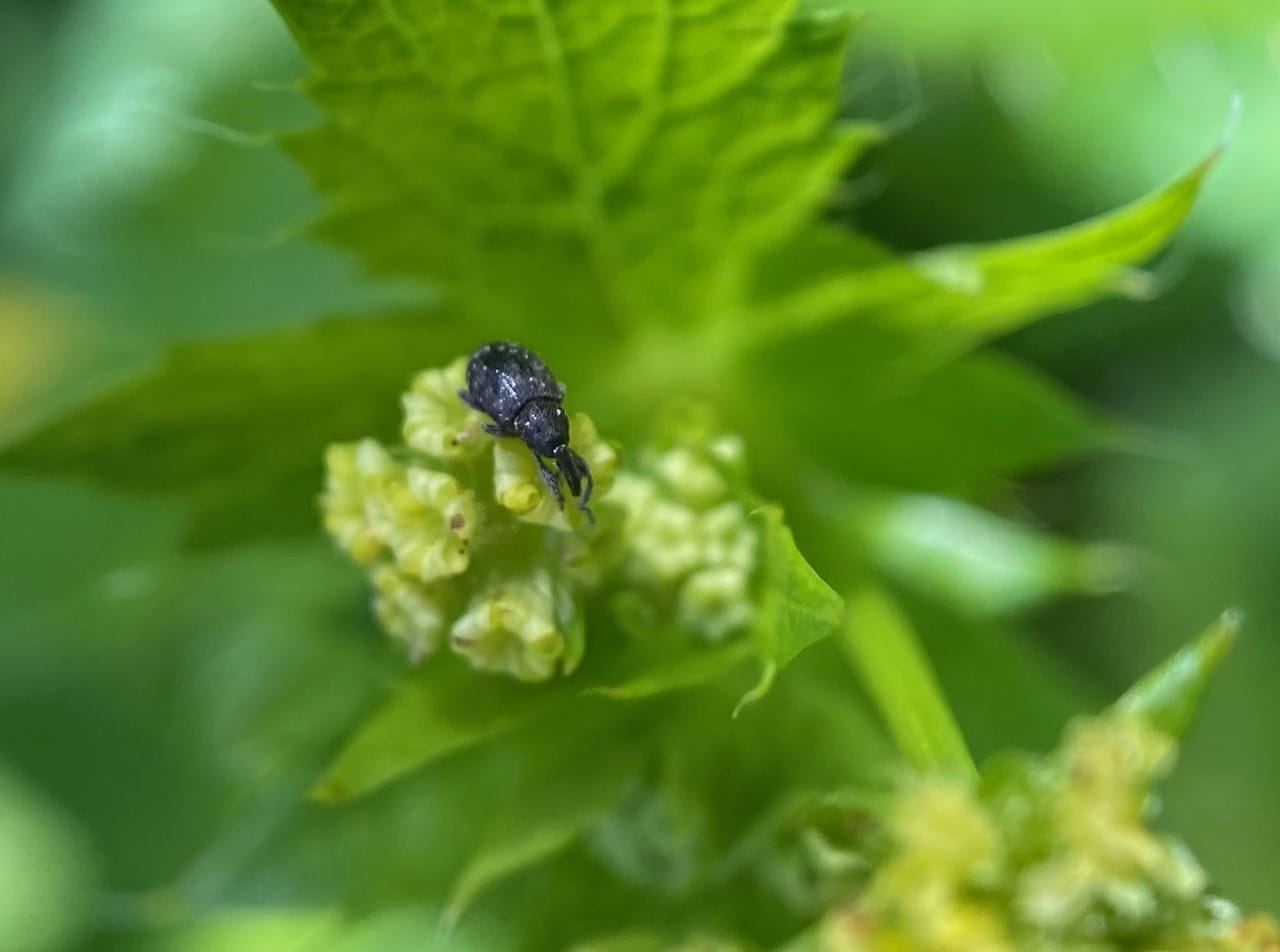
Hey, here’s a Weevil on a fresh cluster of Pacific Sanicle flowers. Note the pollen grains on its body.
Weevils, family Curculionidae, are also called snout beetles. Curculionidae is one of the largest beetle families (about 40,000 species). Most weevils have long, distinctly elbowed antennae that may fold into special grooves on the snout. The snout is used not only for penetration and feeding but also for boring holes in which to lay eggs. The mouthparts are quite small and located at the end of the rostrum (snout), designed for chewing. Many weevils have no wings, while others are excellent fliers. Most are less than 6 mm in length. The majority of weevils feed exclusively on plants. The fleshy, legless larvae of most species feed only on a certain part of a plant – i.e., the flower head, seeds, fleshy fruits, stems, or roots. Many larvae feed either on a single plant species or on closely related ones. Adult weevils tend to be less specialized in their feeding habits. The family includes some very destructive agricultural pests.

Then I spot a Weevil standing over a cluster of fading flowers, with the tip of its abdomen inserted into a flower. She is laying eggs!
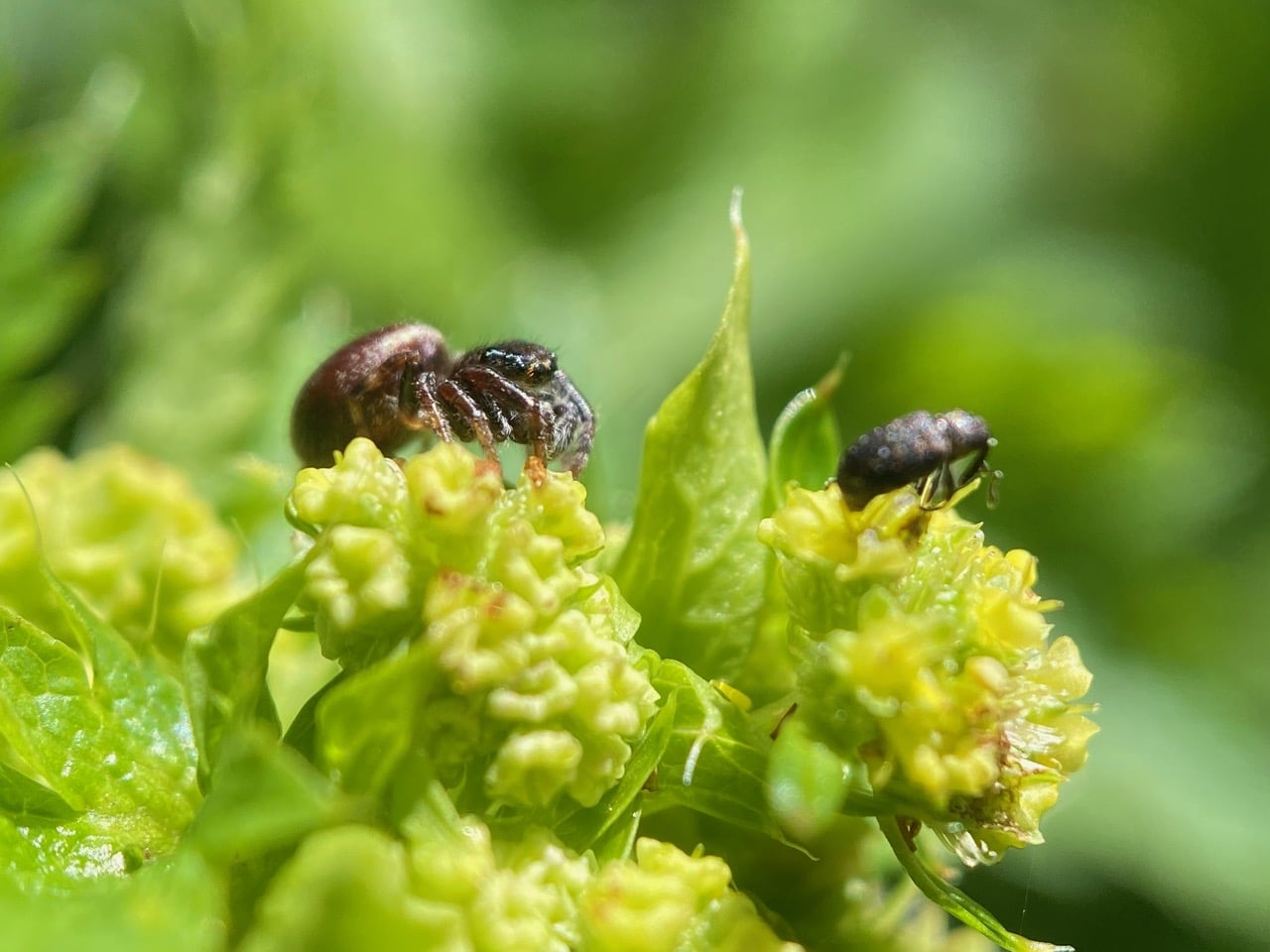
Just then, I am suddenly aware of a Jumping Spider (family Salticide) right behind the weevil, its eyes locked on the potential prey. I freeze in anticipation.
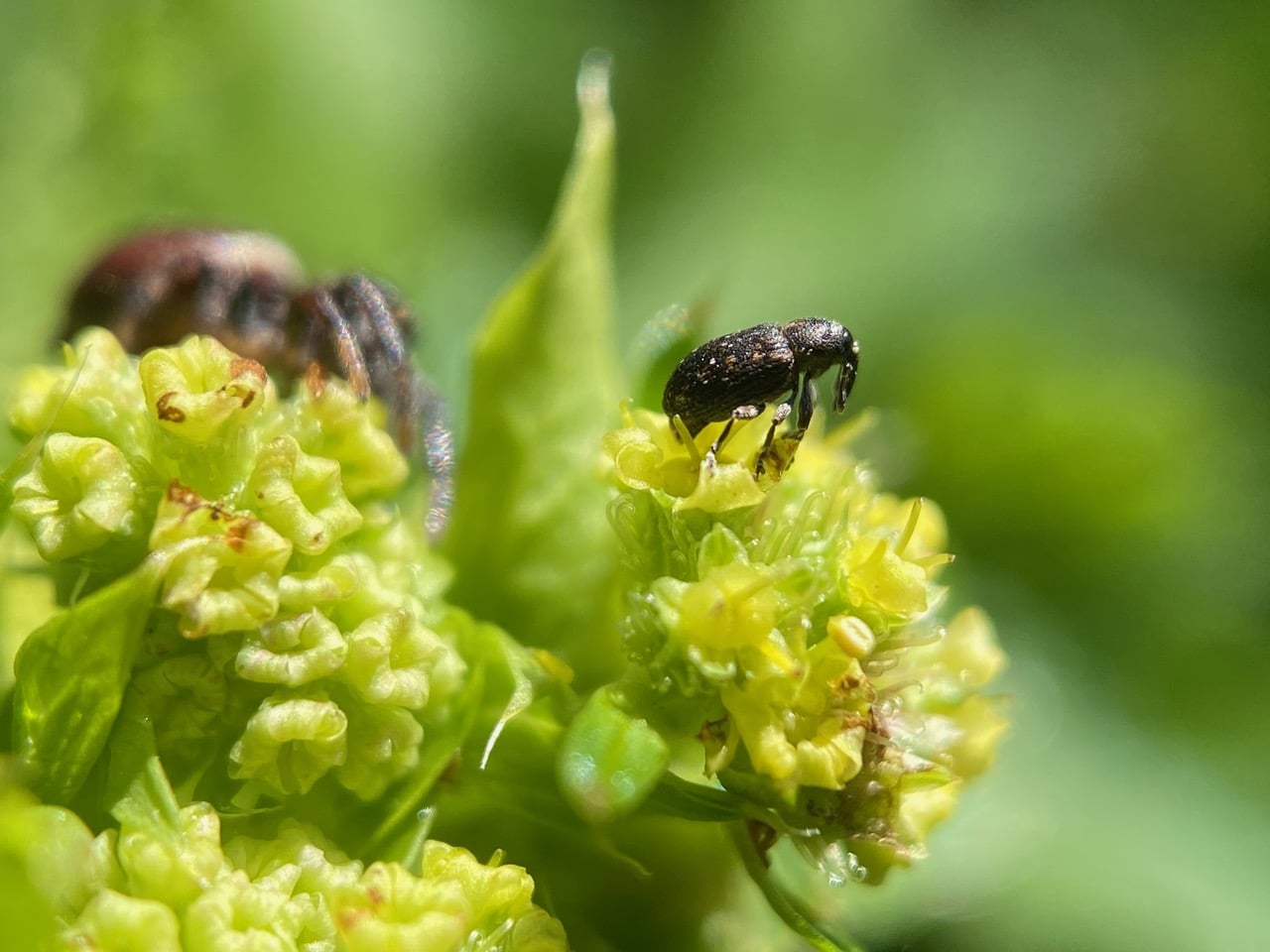
The spider makes a half-hearted leap short of the weevil, then quickly scoots away. I heave a sigh of relief! Was the spider aware of my presence, and did it abort its hunt because of me? Anyway, I’m glad mama Weevil is safe.
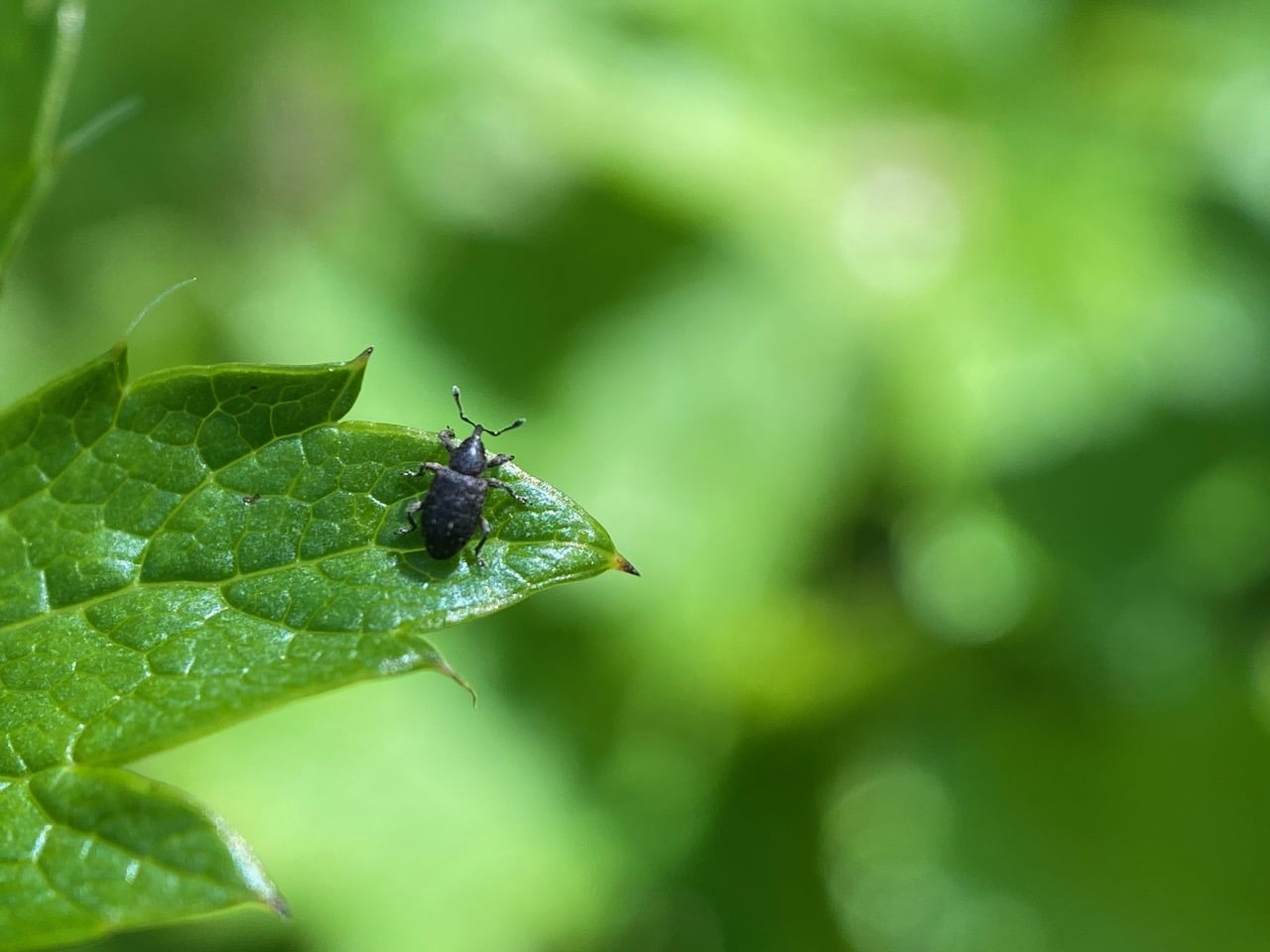
I have never seen the weevils on the leaf of Pacific Sanicle, but here’s one.
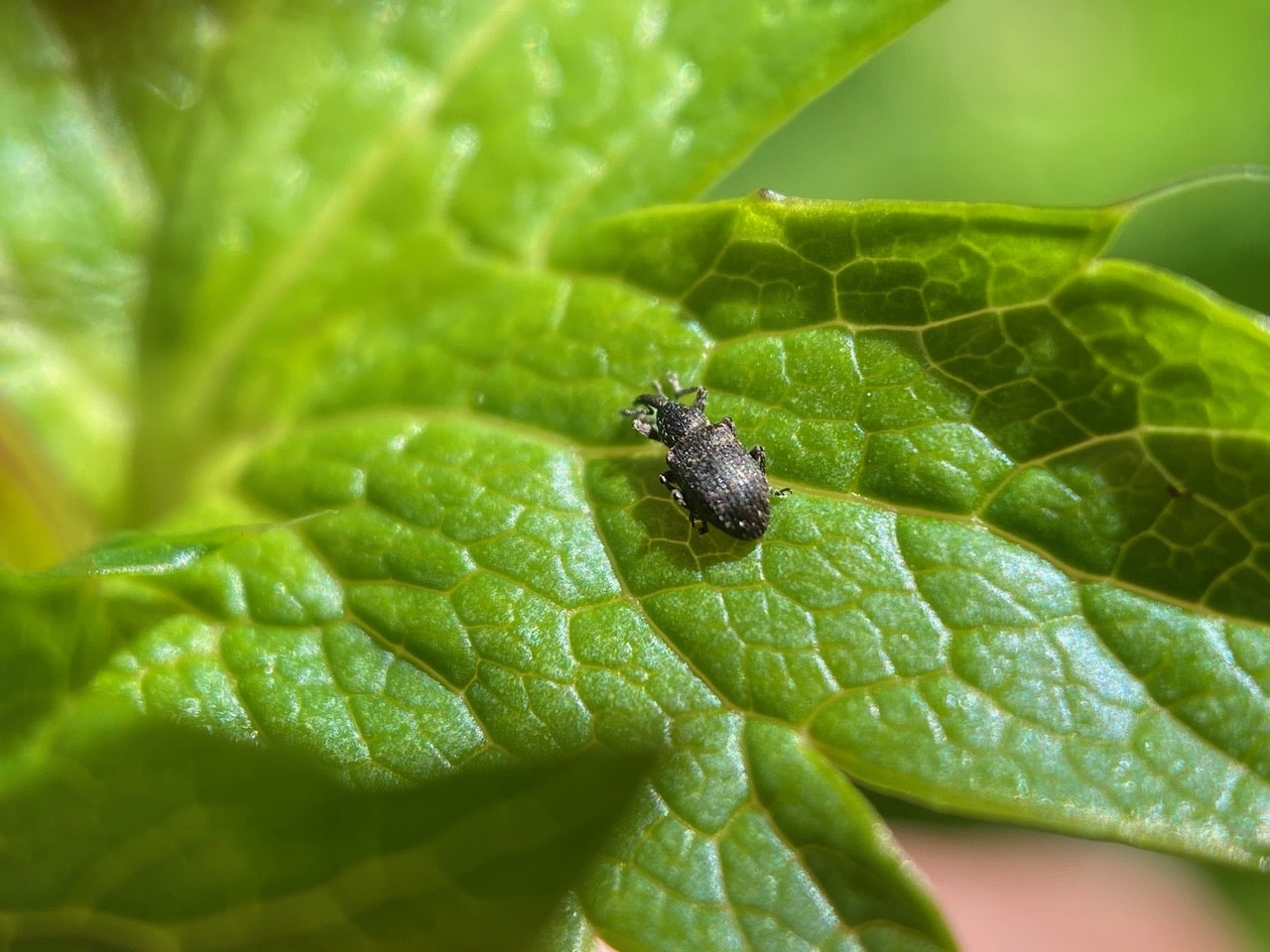
Close up of the weevil on the leaf.
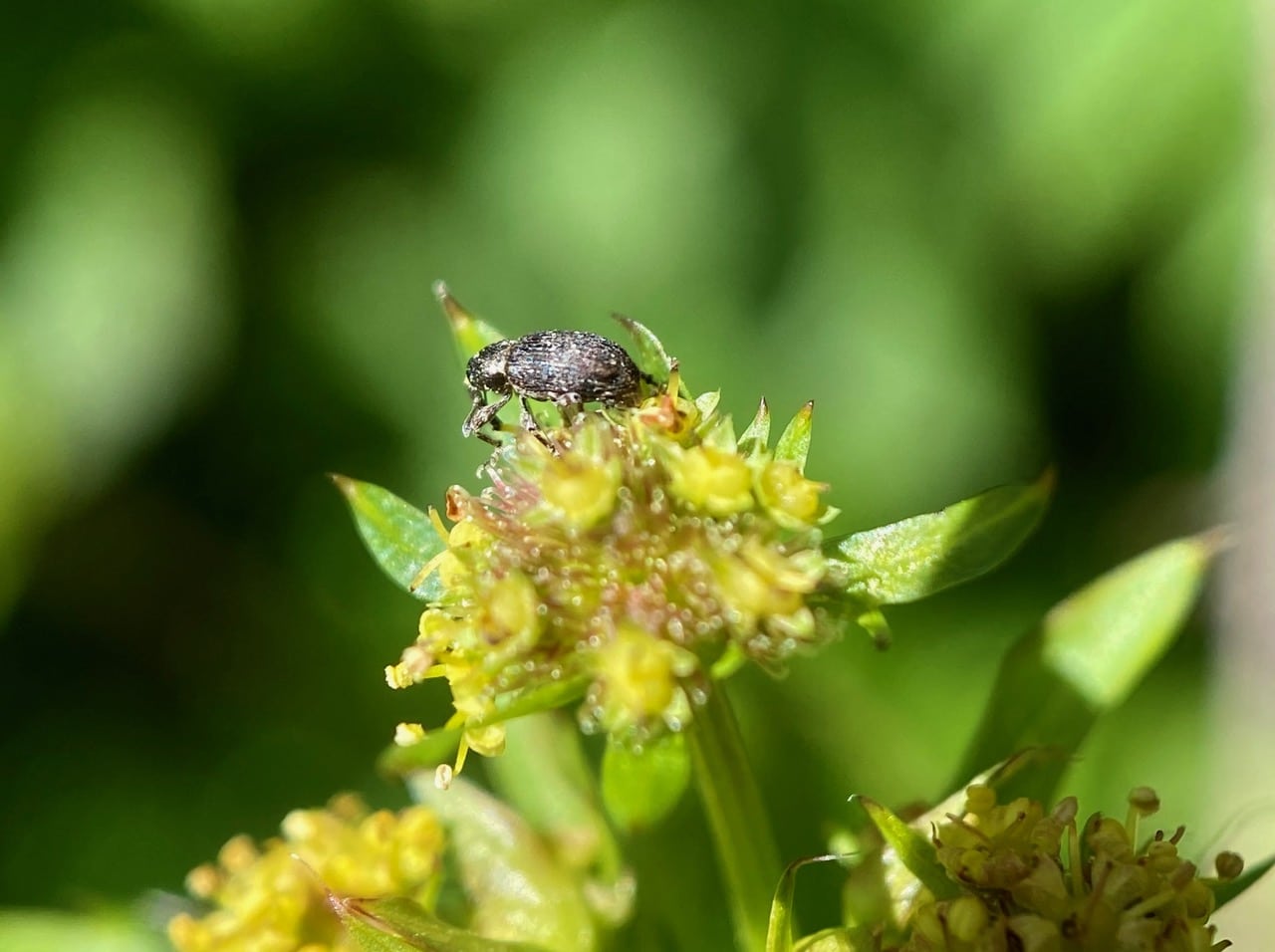
Ooh, here’s another Weevil in an egg laying position! She has inserted the tip of her abdomen into a cluster of senescing Pacific Sanicle flowers that are already going to seed. Her young will have plenty of seeds to feed on.
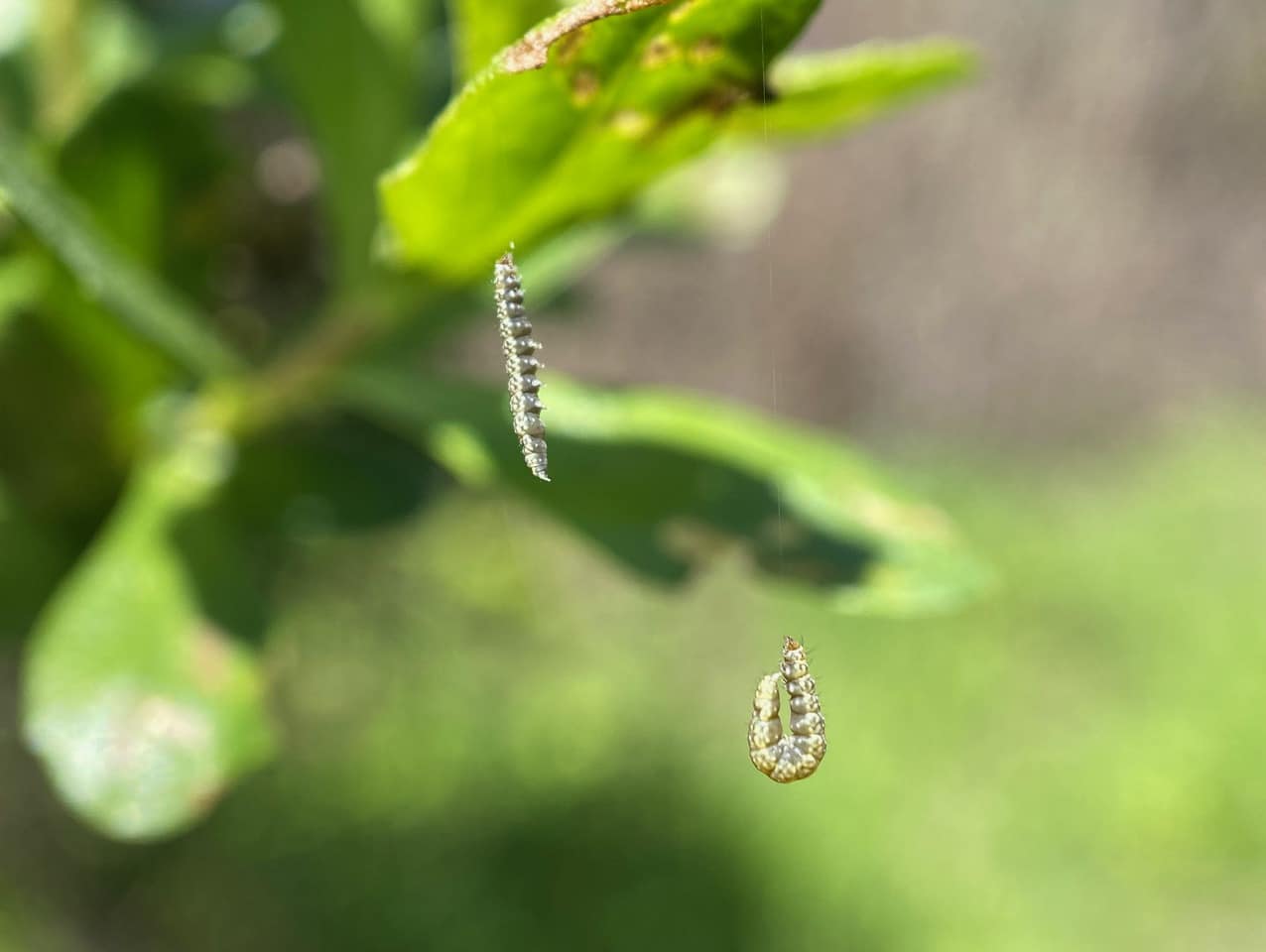
A hiker in a hurry rush past me on Skyline Trail, brushing against some plants along the way. In her wake I find many tiny caterpillars dangling in mid-air from the Coyote Brush on the side of the trail.
Caterpillars of both moths and butterflies are able to produce silk. Like spiders, they produce silk through a spinneret. This tube-like structure is located on the lower lip of the caterpillar’s mouth. Silk is generated as a liquid in modified salivary glands and secreted through the spinneret. As it makes contact with air, it solidifies into a silk strand. Silk is one of the strongest natural fibers – pound for pound, silk outperforms steel in tensile strength.
Many kinds of caterpillars use a single strand of silk as a “safety line” to anchor themselves to the plant on which they feed. When disturbed, they “spit and jump”, dropping down and hanging from the silk line. When the danger has passed, the caterpillar draws the silk back in and makes its way back to the leaf to resume feeding.
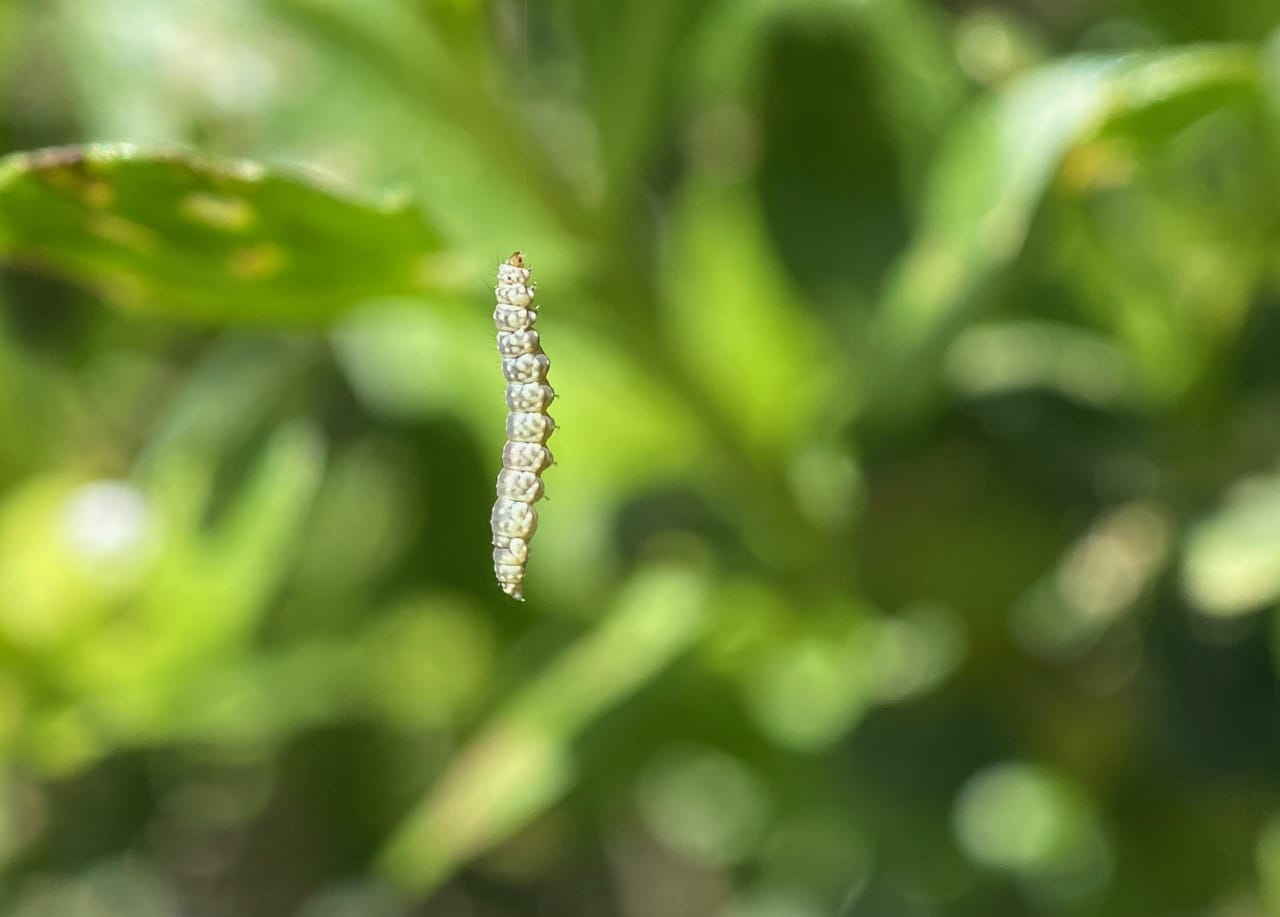
Close-up of one of the dangling caterpillars. The adult is probably a kind of moth. Coyote Brush, Baccharis pilularis is host to a diversity of small moths.
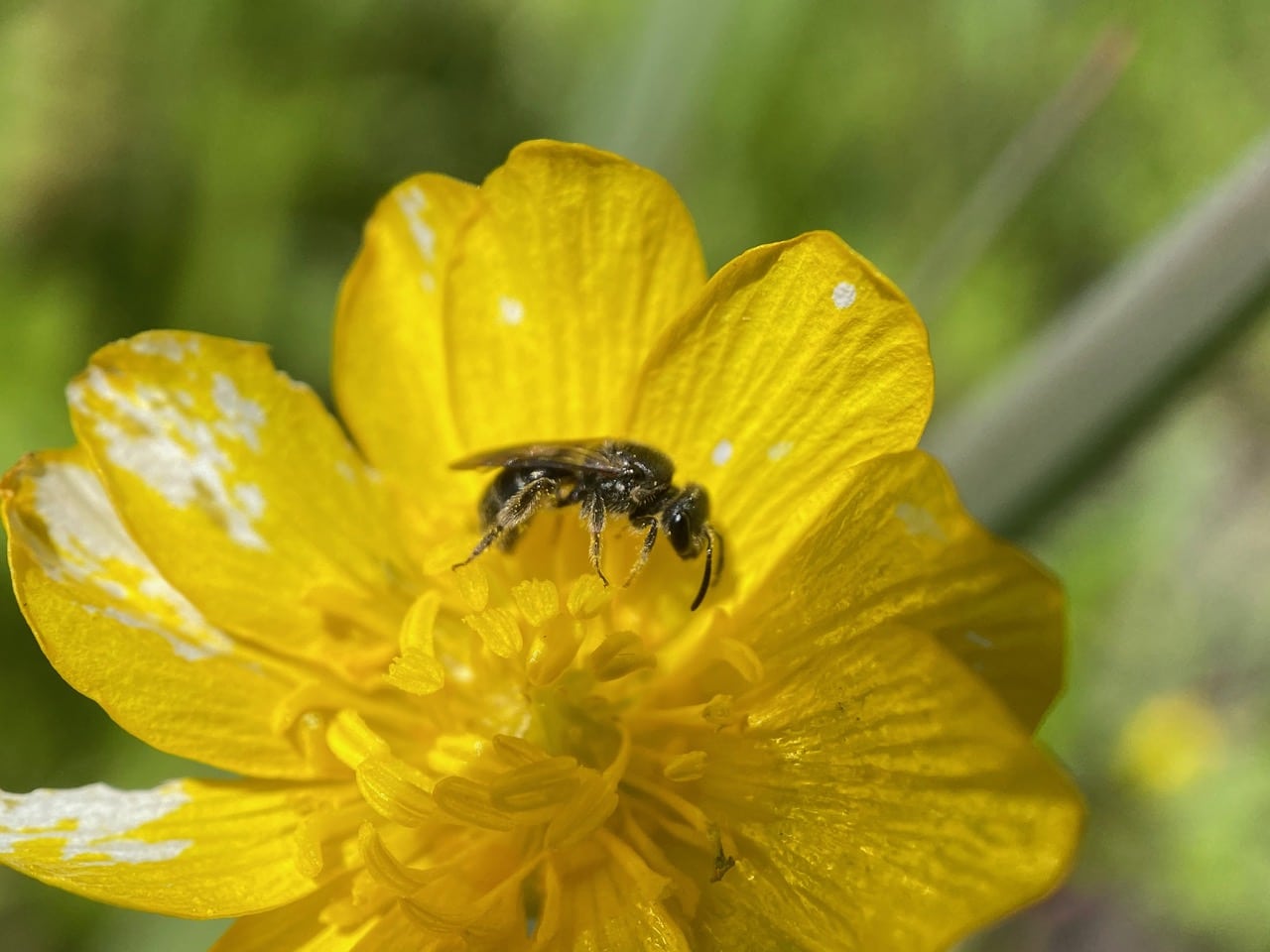 Passing the small patch of California Buttercups on the way out, I find a different species of bee on a flower.
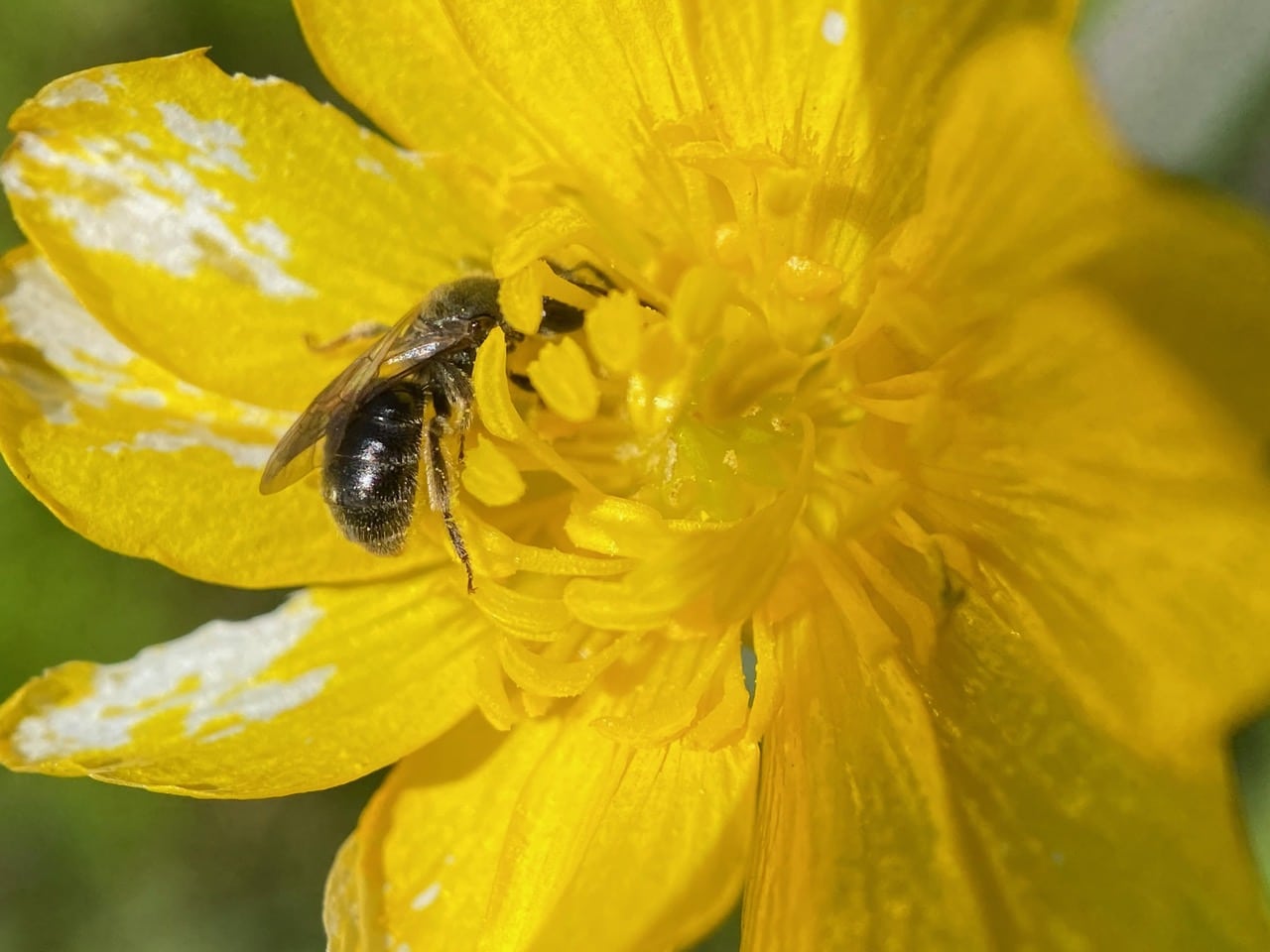
A Sweat Bee (family Halictidae)?