

Pollinator Post 3/31/24 (1)
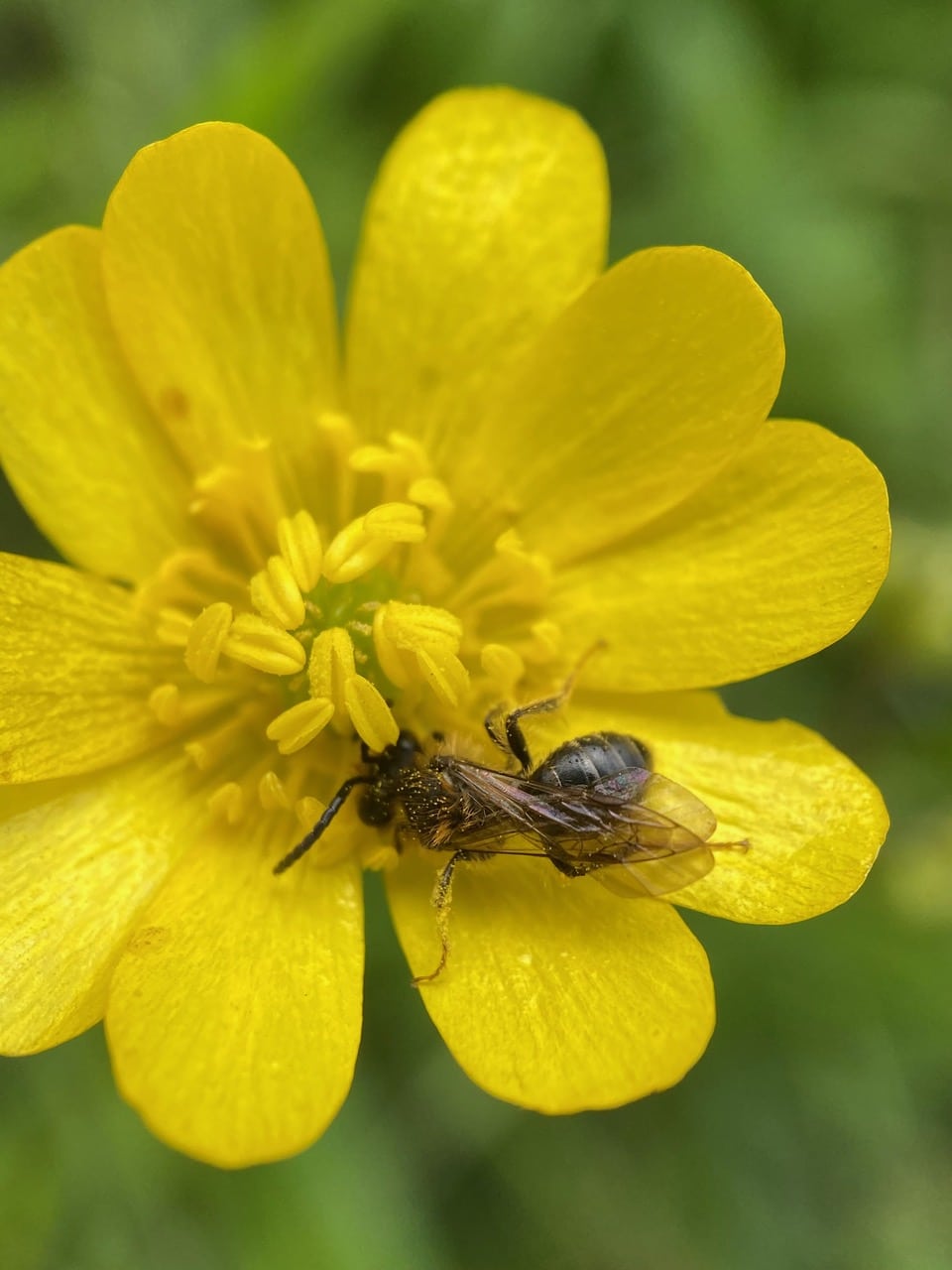
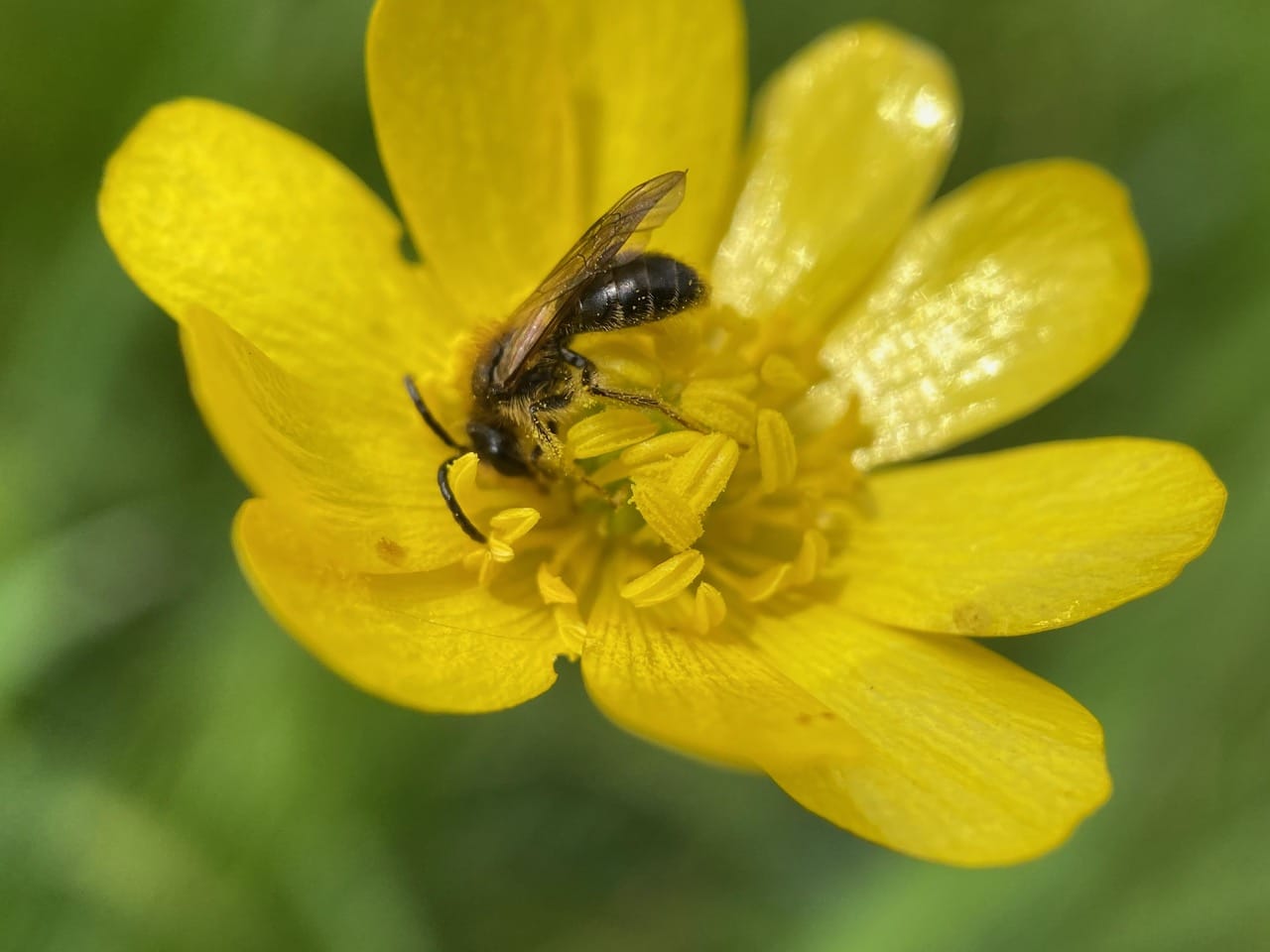
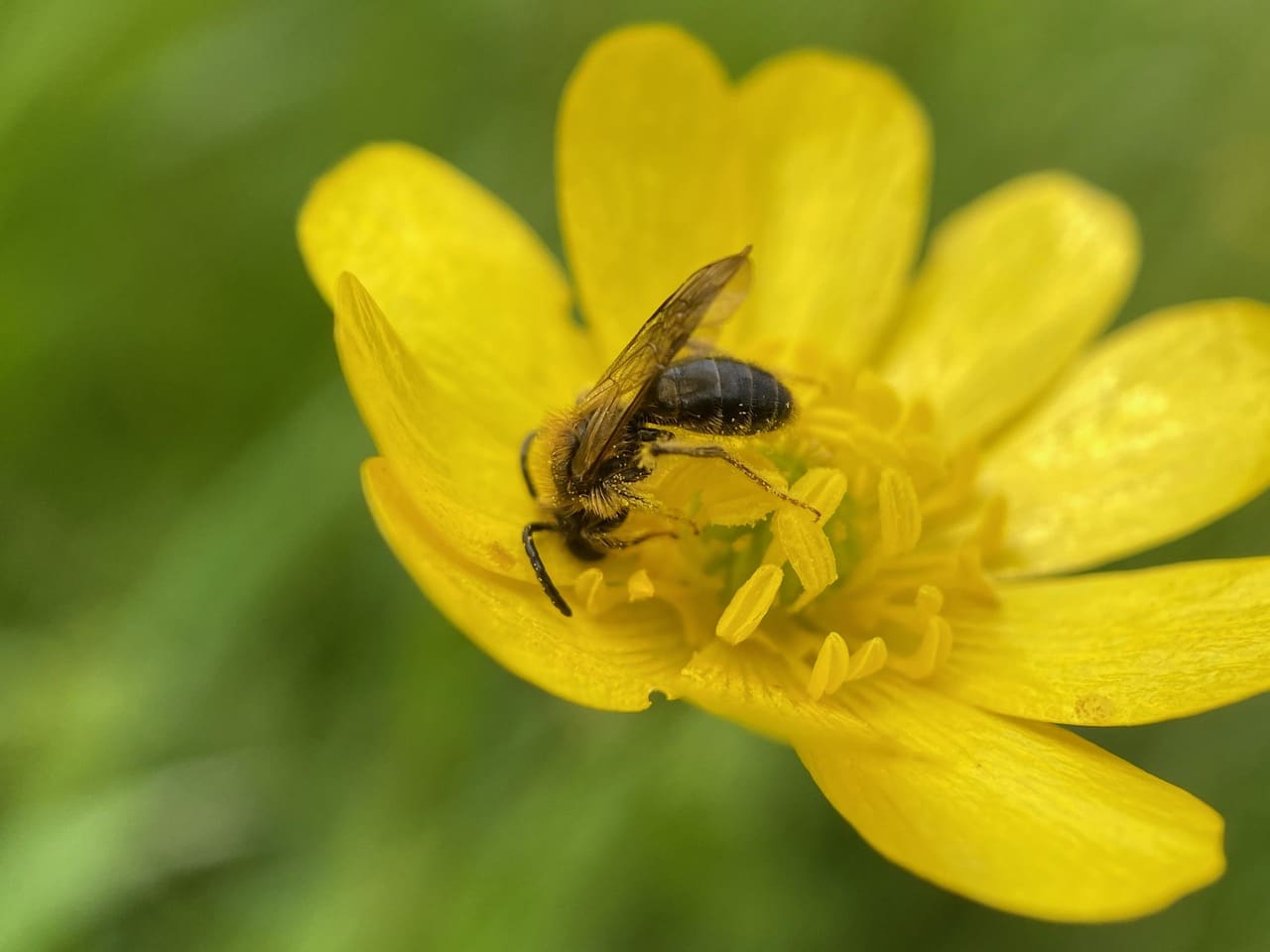
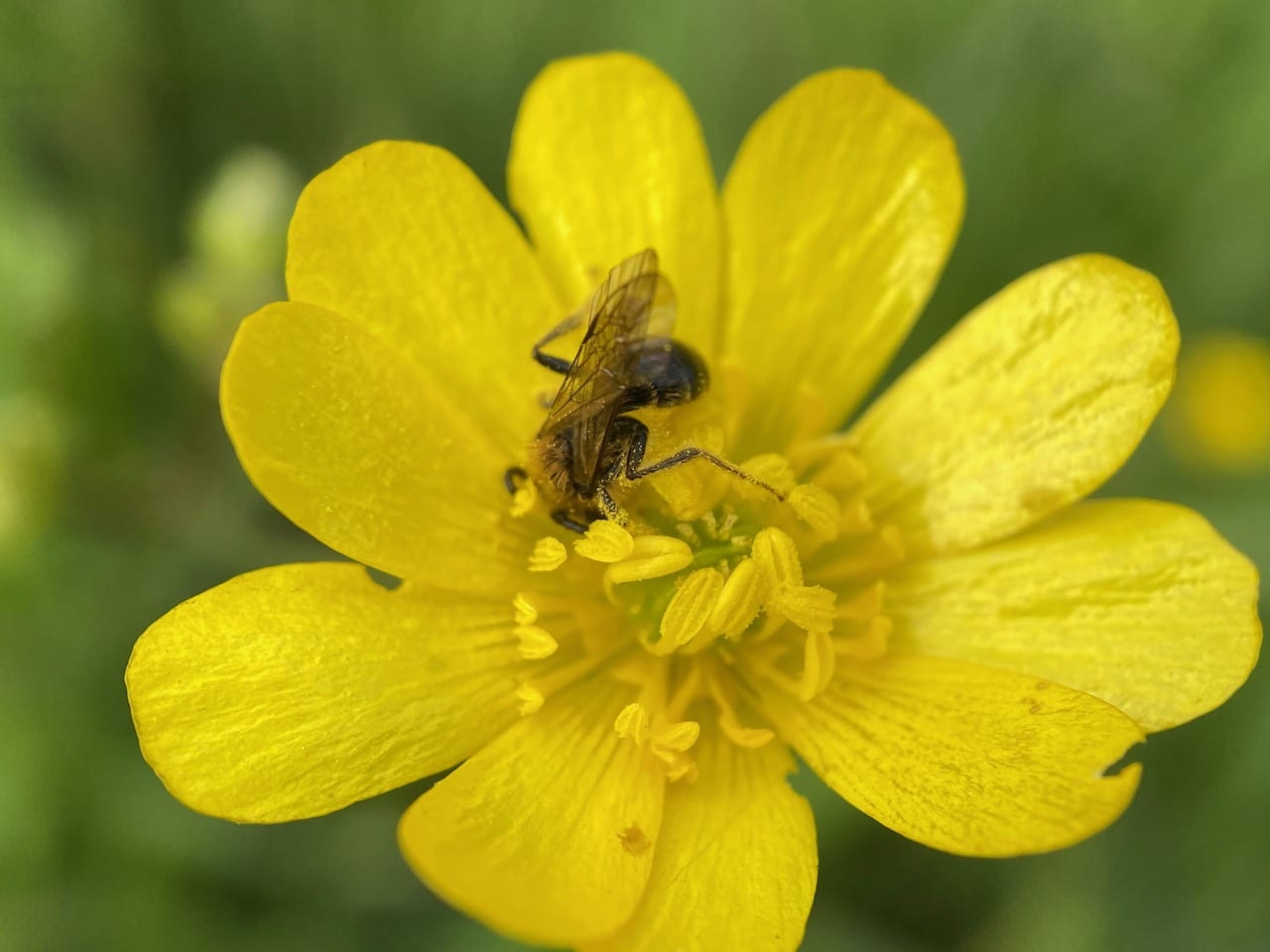
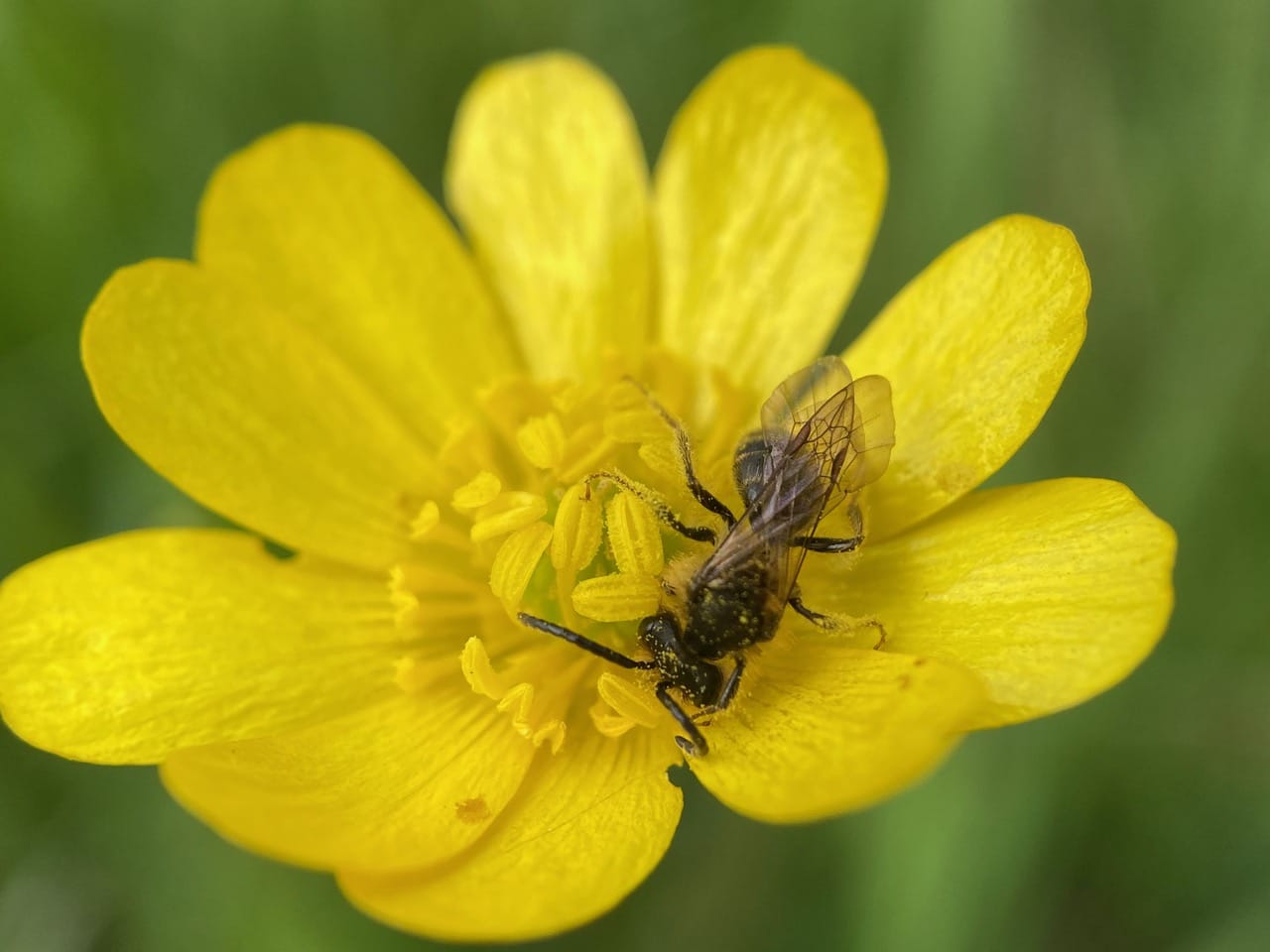
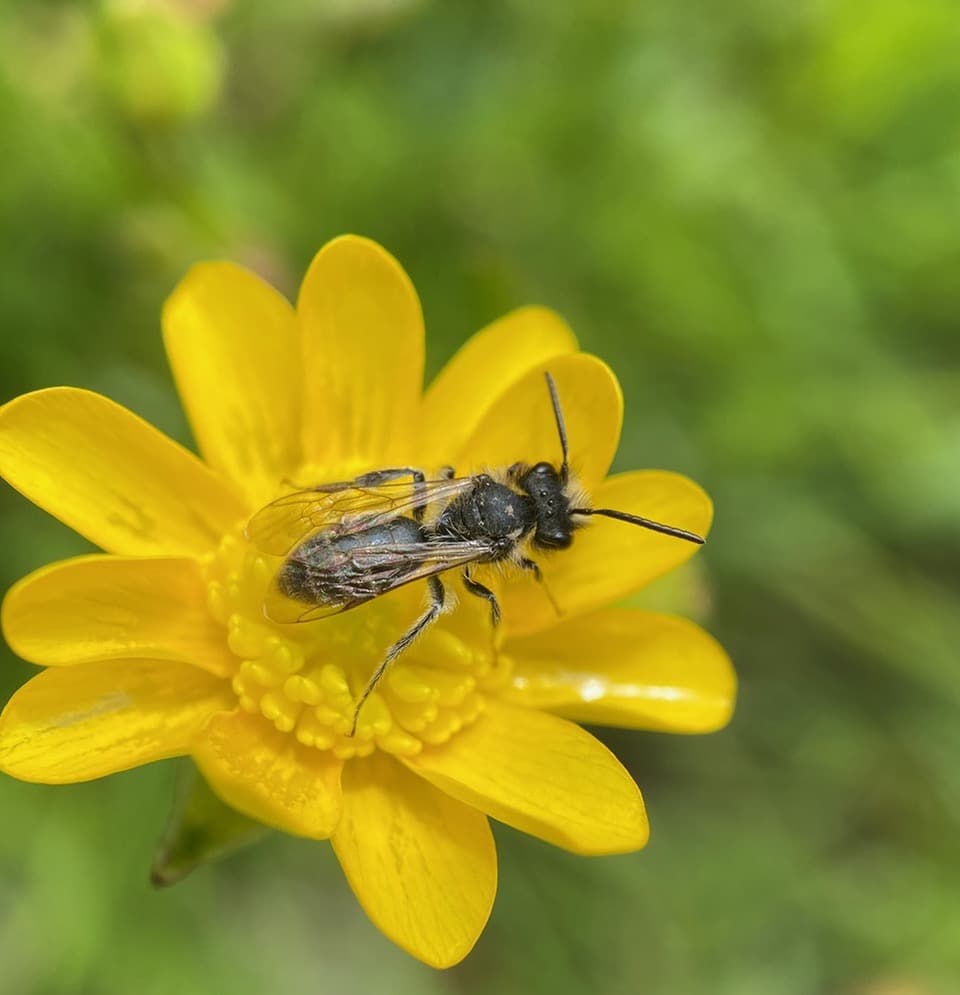
I approach the Steam Train entrance to the Skyline Gardens this morning with excitement and trepidation. The skies are still overcast, and the temperature low – I hope I get to see the male Mining Bee, Andrena sp. (family Andrenidae) on the California Buttercup flower, Ranunculus californicus before he wakes up. I am curious if the bee indeed sleeps on the flower through the night. So far, I have only seen him bed down in the late afternoon.
I am not disappointed. The bee is still on a buttercup flower, motionless. Just about a minute later, while I ready my camera, he stirs and moves around slowly. Light is still rather low, and I can only hope that photography with natural light is feasible.

Good morning, Sleepy Head!





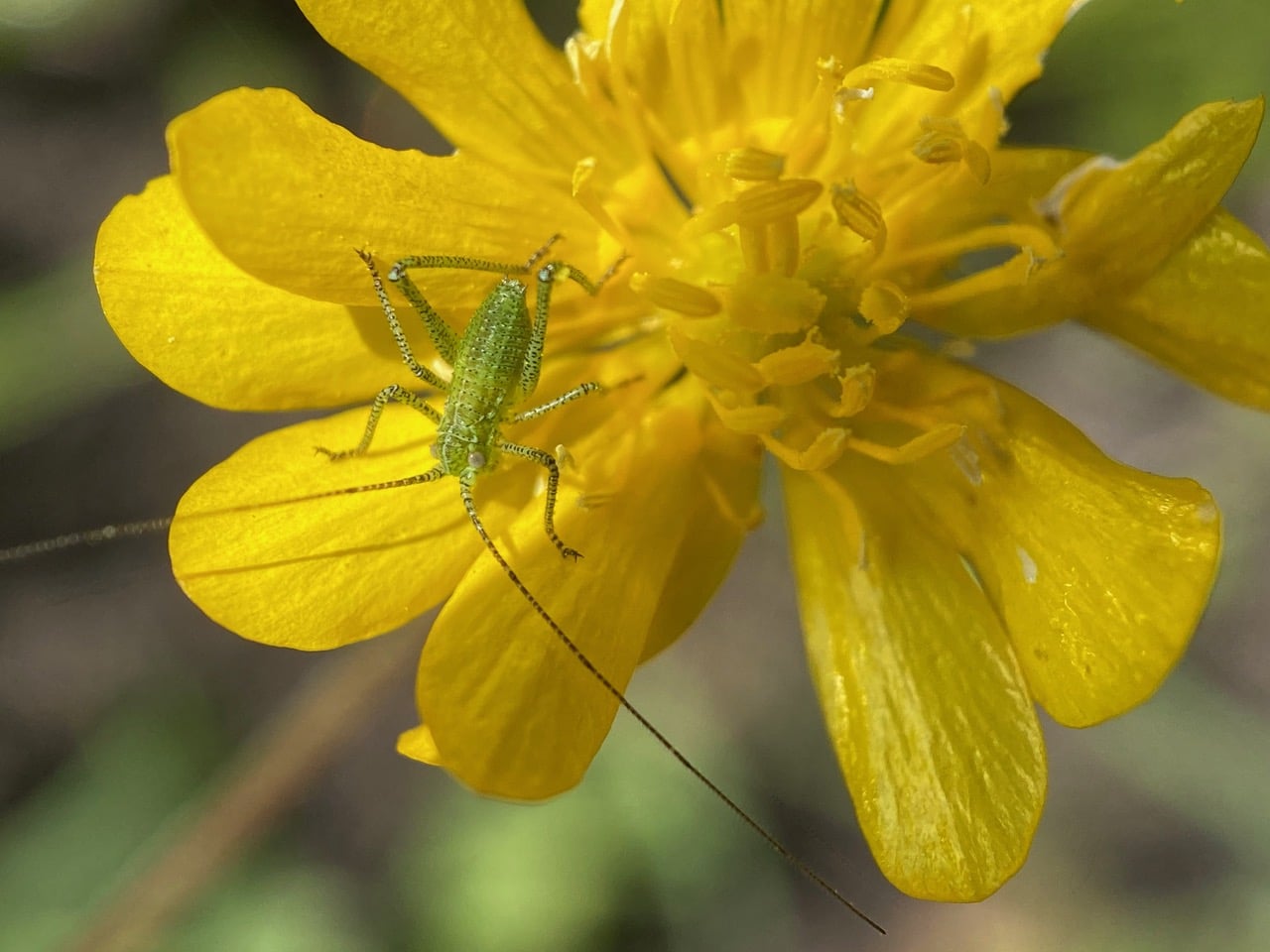 Now I know who has been chewing on the petals of the California Buttercups in this patch – a small Katydid nymph!


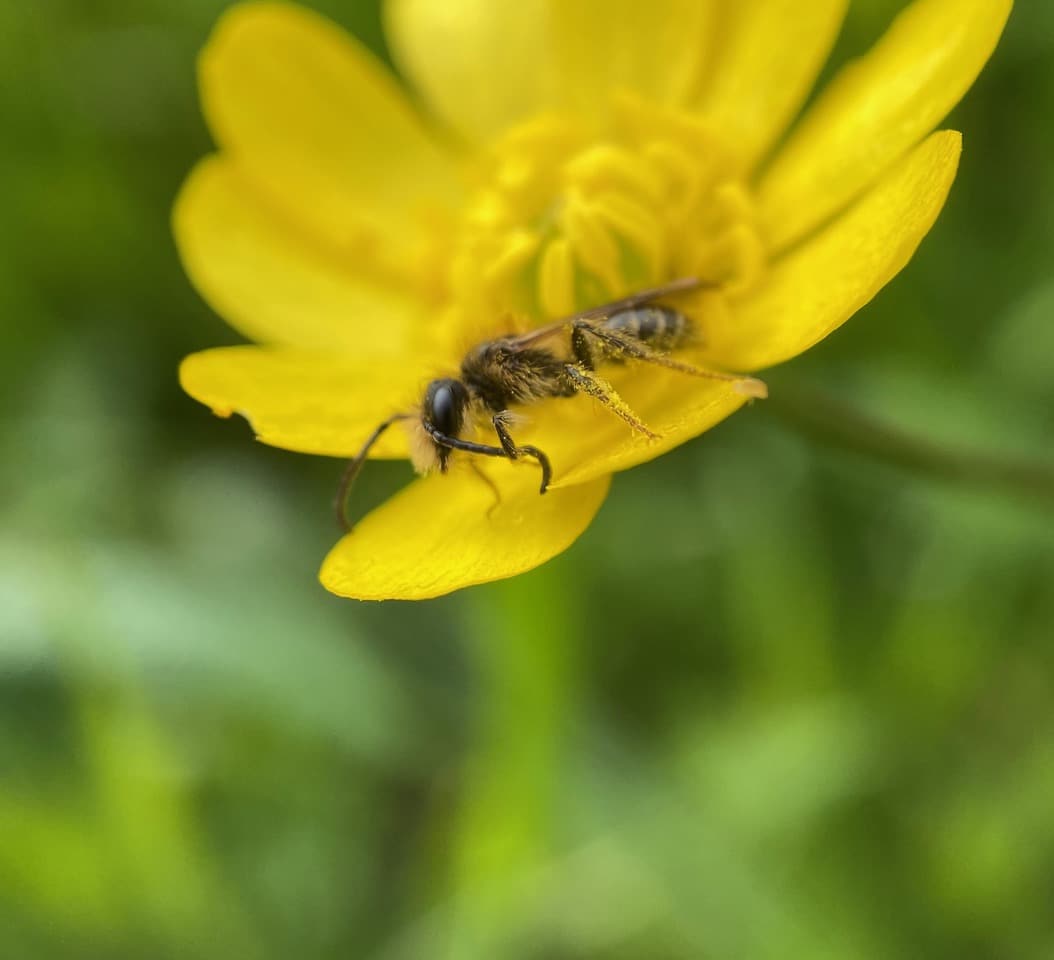
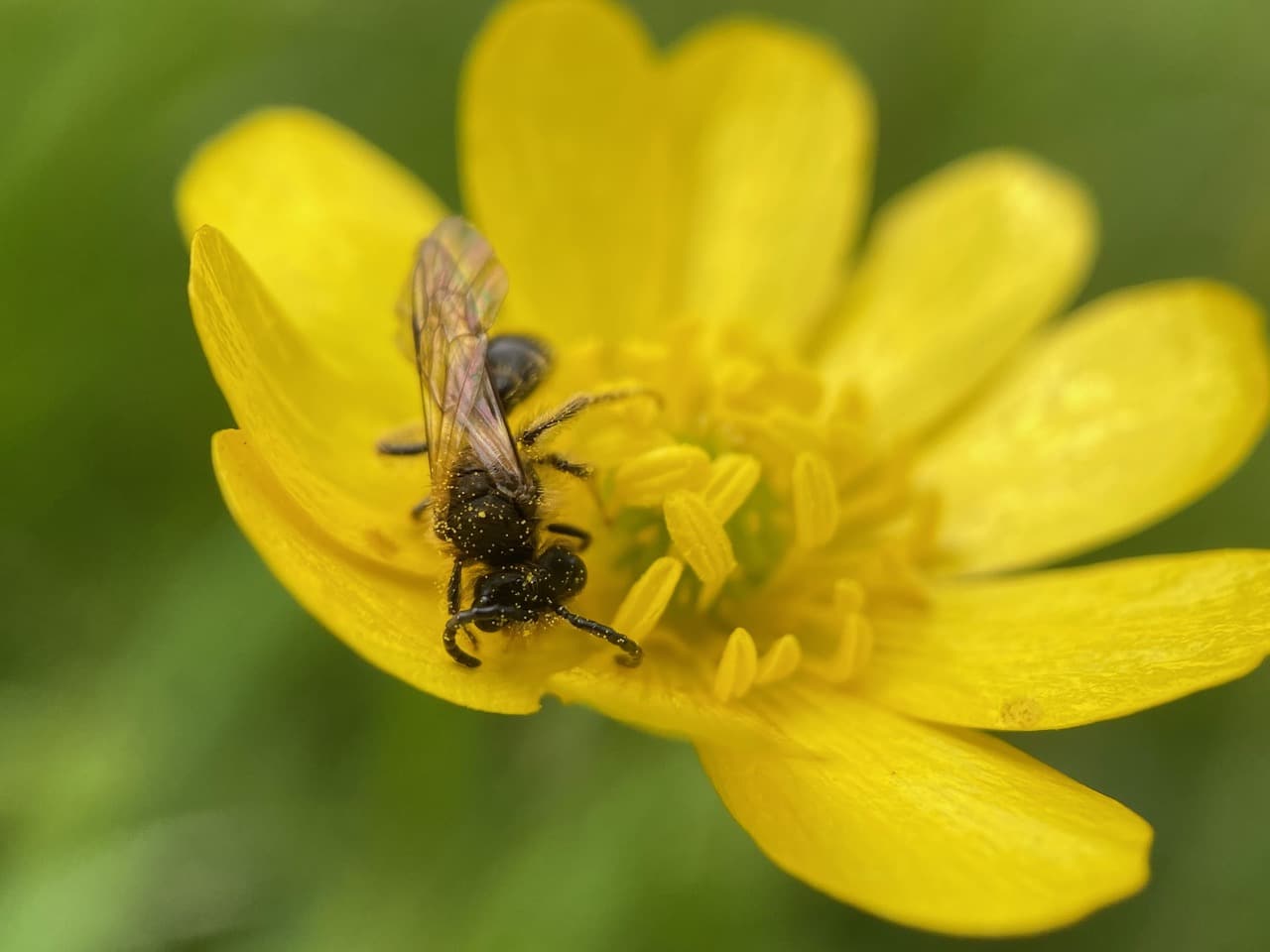
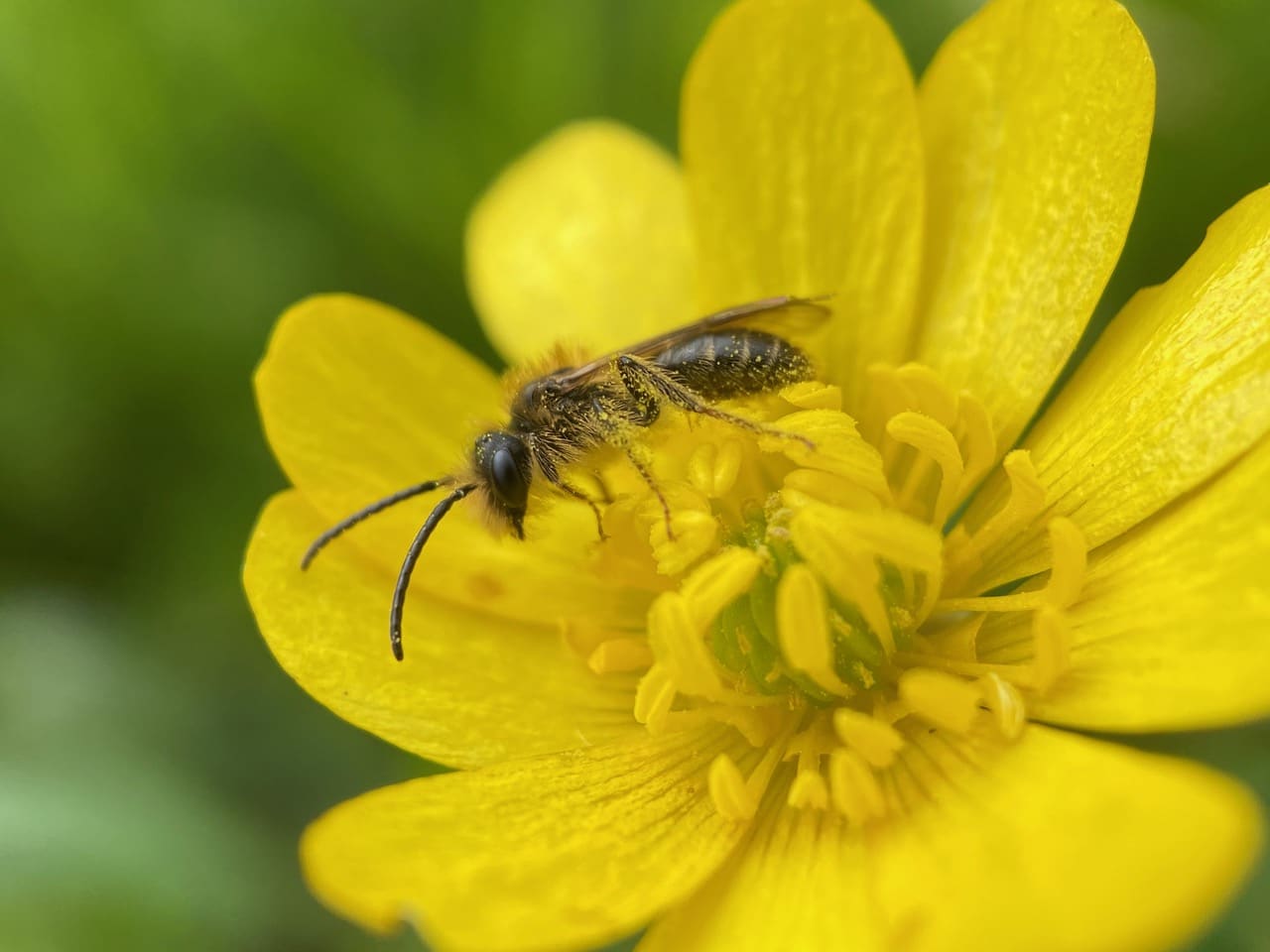
The bee proceeds to groom itself. He starts by cleaning his long antennae. This is one of my favorite bee behaviors to watch, so I start to video record this and the subsequent feeding sequence.
All bees have an antenna cleaner on each of their two forelegs. The antenna cleaners consists of two parts: a notch in the basitarsus, which is fitted with stiff hairs, and a corresponding spur on the tibia. To clean its antenna, the bee raises its foreleg over its antenna and then flexes it tarsus. The action allows the spur to close the notch, forming a ring around the antenna. The bee pulls each antenna through the bristles to clean it of debris such as pollen or dust which might interfere with the many sensory organs within the antenna. A bee’s antennae serve numerous functions: smell, taste, perceive humidity and temperature, feel, monitor gravity and flight speed and even detect sound waves to help guide the bee in its daily activities.
In morning grooming, the bee usually gives priority to the antennae, then the face and mouthparts. The abdomen gets the attention last – the bee uses its hind legs to brush its abdomen and sometimes its wings. The sequence is consistent across species – I have observed this in Bumble Bees and the male Summer Longhorn Bees waking up on flowers in the early morning.
Cleaning his mouthparts thoroughly with his front legs.
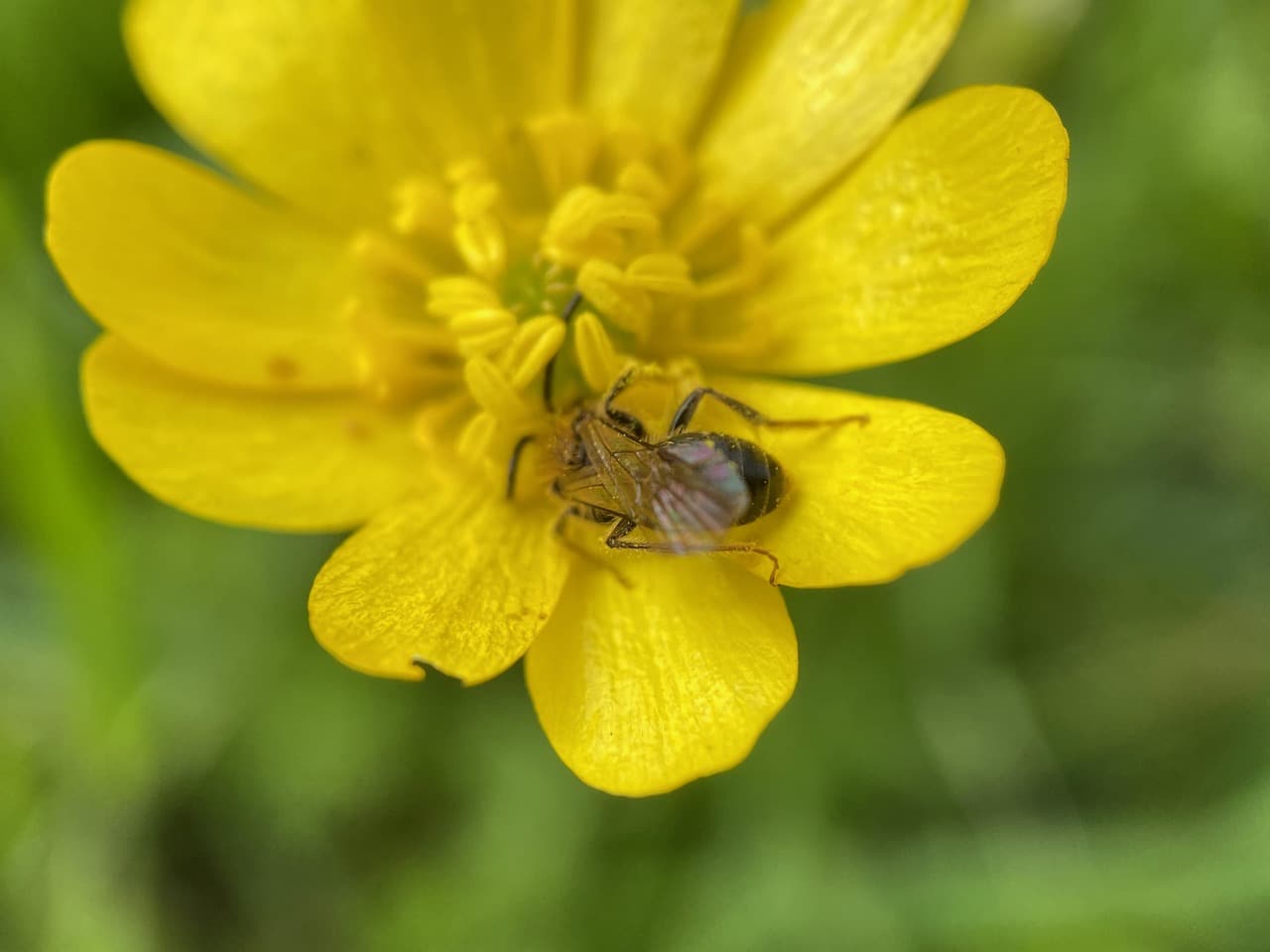
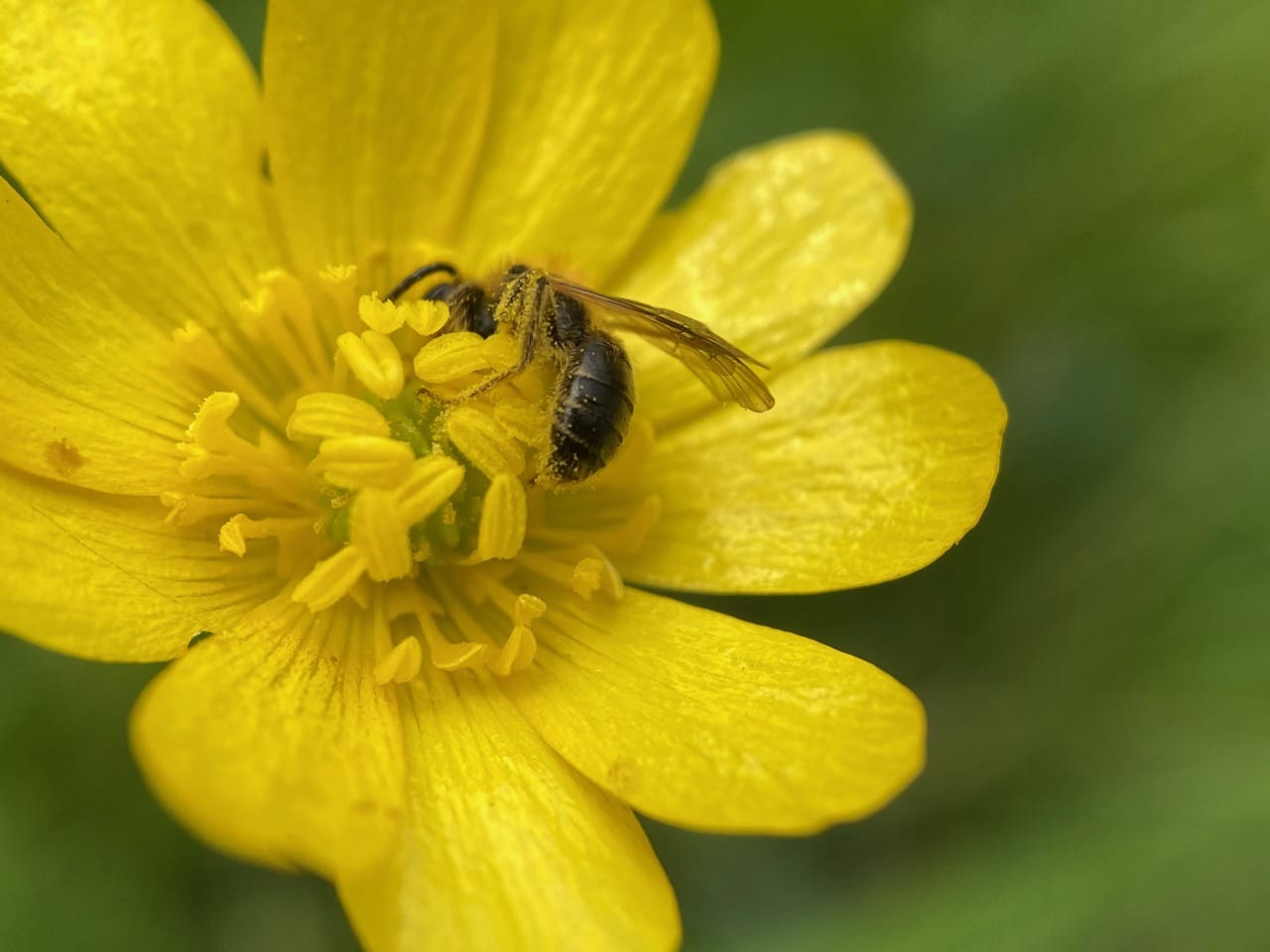
Wasting no time, the bee immediately starts to feed. It turns its head under the stamens to seek nectar at the base of the flower, one petal at a time, circling the perimeter of the flower.
Unlike most flowers that have a pool of nectar in a single nectary, the buttercup dispenses her sweet treats discreetly in little pockets at the base of each petal, ensuring that the visiting pollinator would probe meticulously and thoroughly around the flower, and get covered with her sticky pollen.
And so the little bee makes his way slowly around the flower.
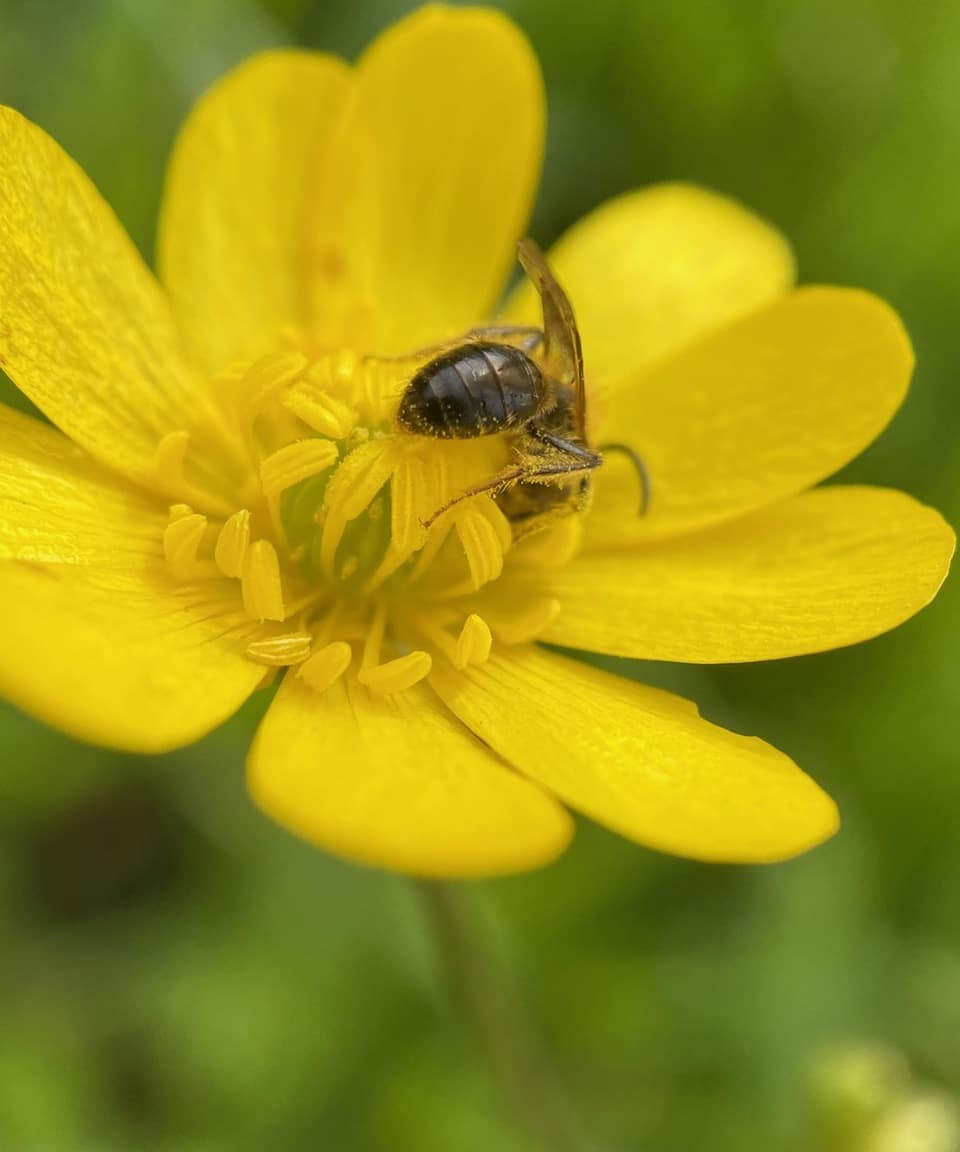
Bees in the family Andrenidae, commonly called miner bees or mining bees, are solitary ground-nesters. Andrenids are fairly small bees, usually dark-colored, and often banded. They are identified by the dense bristles (scopae) at the bases of the legs and the shin-like sections (tibias) of the legs, as well as by certain creases and grooves on the face and head and by unique wing venation. Many Andrenids resemble wasps – slender with long abdomen.
Most andrenids are specialist pollinators whose life cycle is timed to correspond precisely to the blooming of specific flowers. Because of this, andrenids are some of the first bees to emerge in spring, and many are active in March and April, as they visit early spring wildflowers.
Why are the male bees sleeping out in the open at night? Male solitary bees do not construct nests, nor do they gather pollen to provision for the young. They do not have a “home” to go back to at the end of the day, but sleep out at night, usually on flowers or other vegetation, in aggregations in some species.
It is convenient for the male bees to sleep on their favorite forage plant, as the they can meet the females and mate with them when they come foraging. On top of that, they can have breakfast in bed! The Buttercup flower is the male Mining Bees’ B&B.
Male bees usually have longer antennae than the females, and they do not have the special pollen collecting hairs on their hind legs. They tend to be slimmer in build as well. However, in foraging for nectar, they do get covered with pollen, and can serve as effective pollinators.
So hungry for nectar, the bee makes its way around the flower three times as I watch, occasionally stopping briefly to clean pollen off its face.
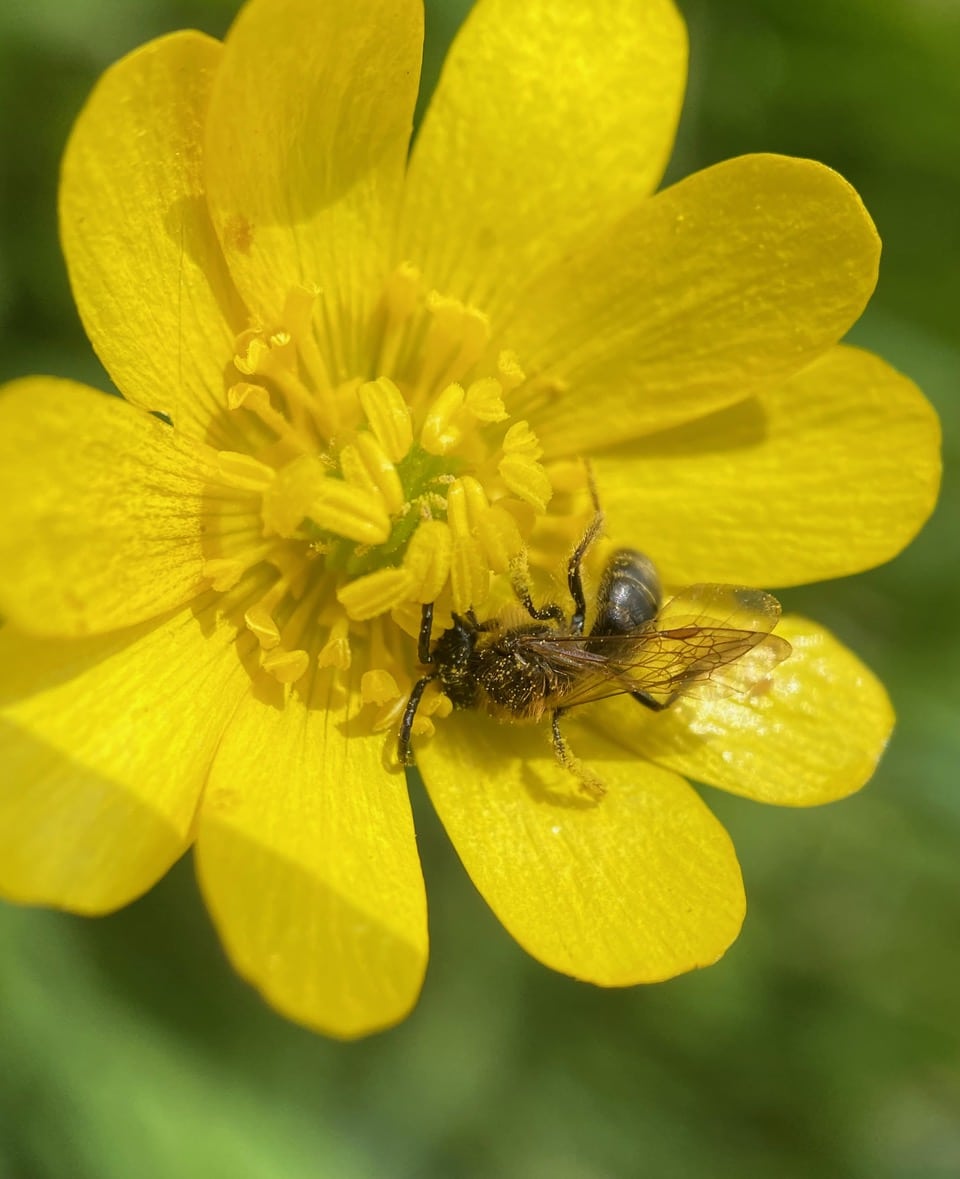
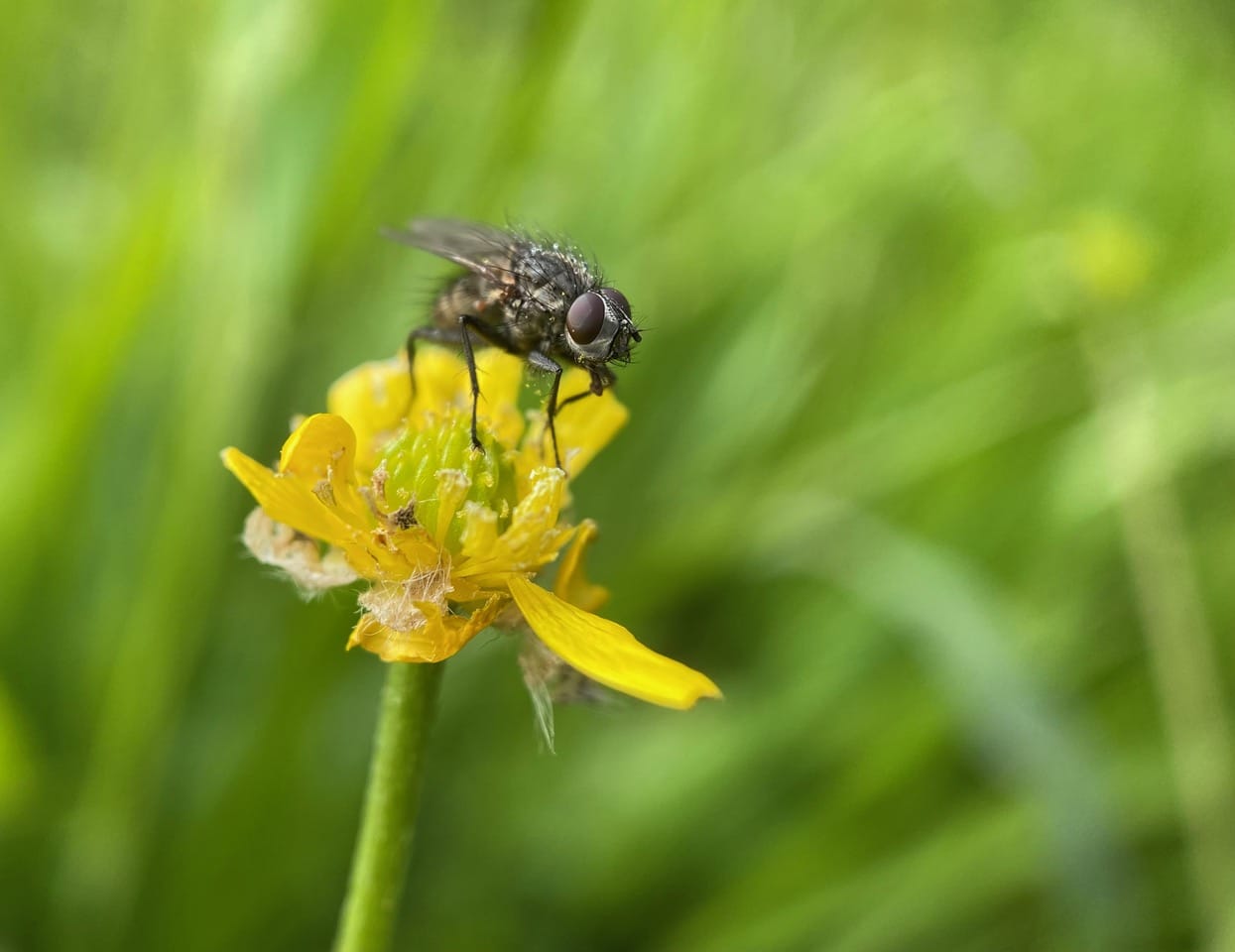
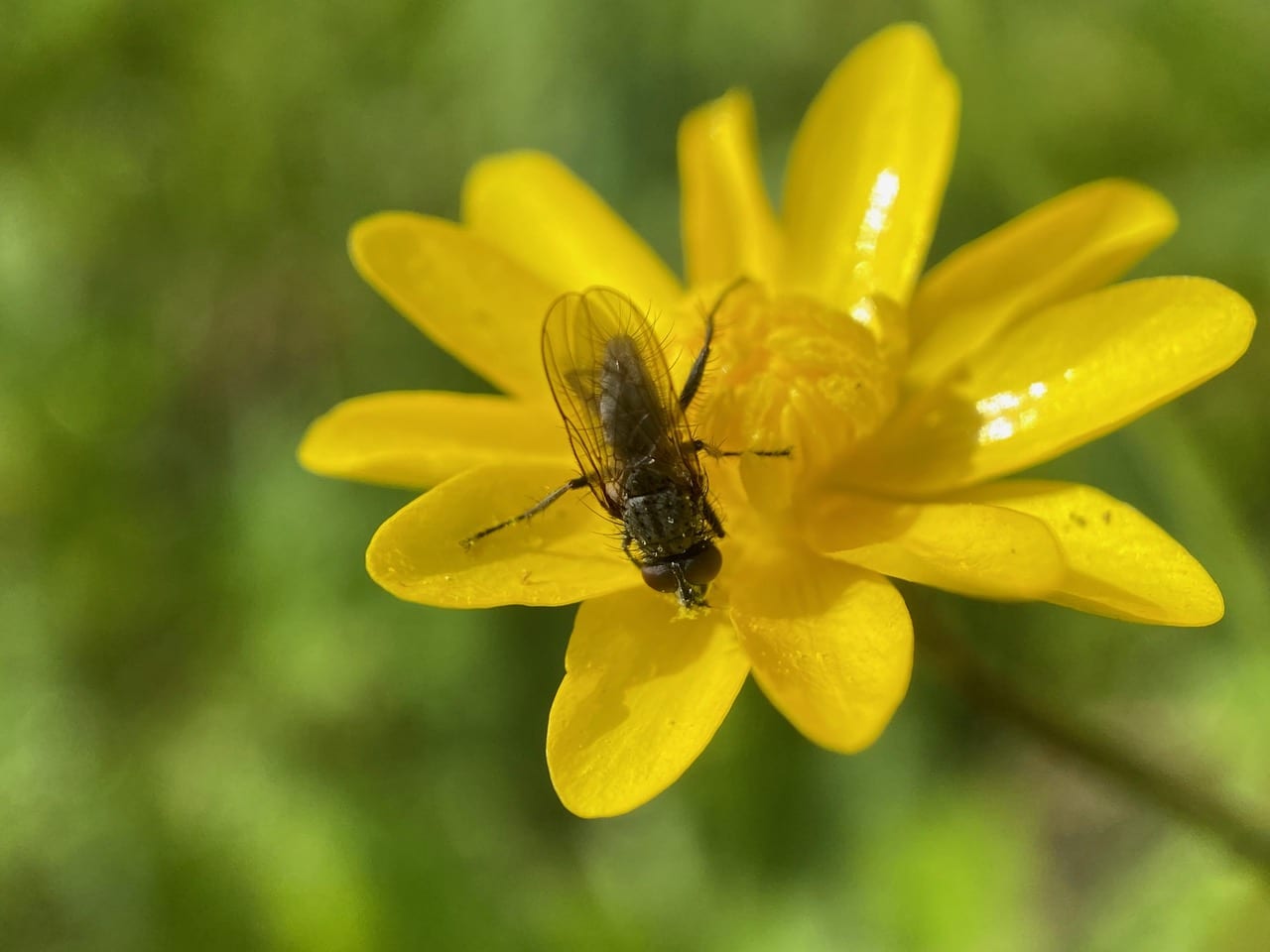
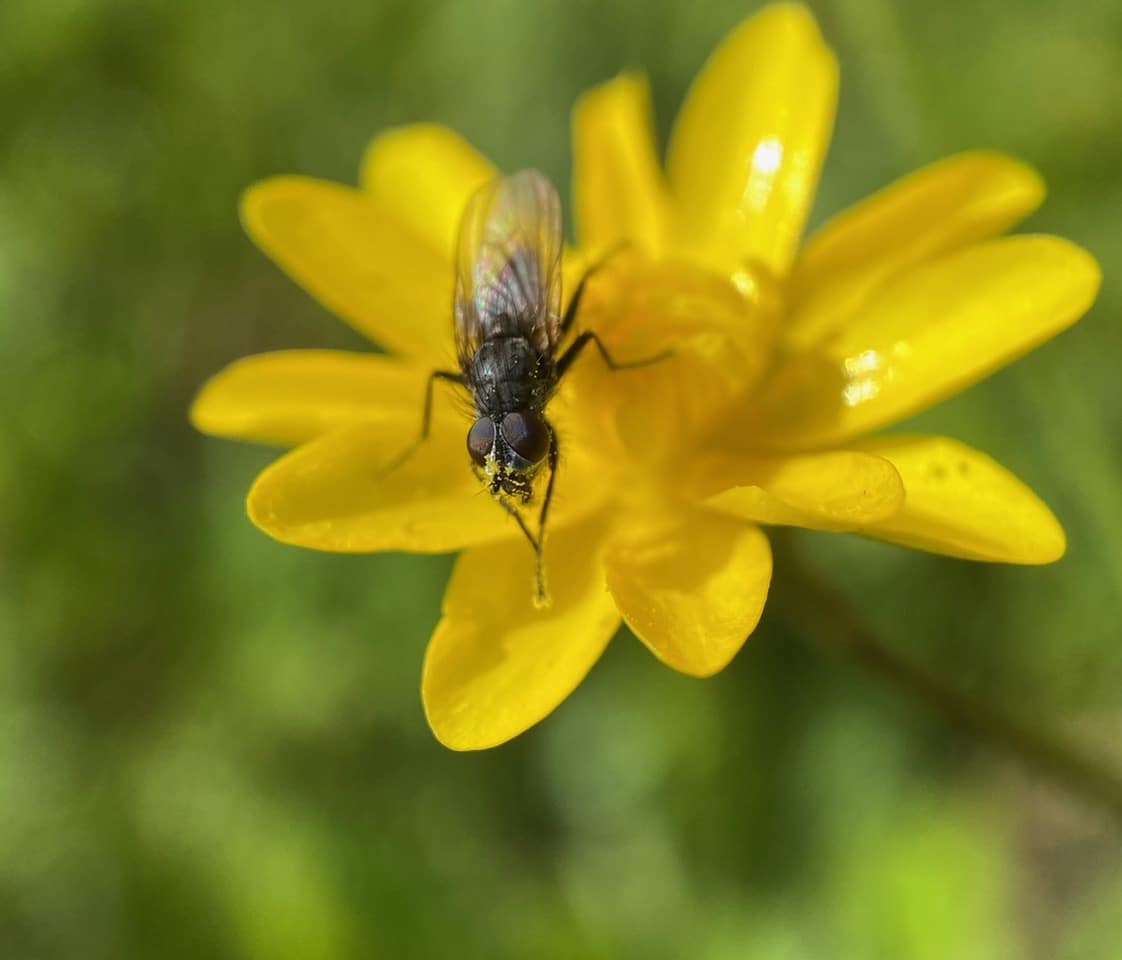
While the Mining Bee takes his sweet time with his breakfast, I turn my attention to the bigger patch of Buttercups across the trail. A Root Maggot Fly (family Anthomyiidae) is perched on a flower that has lost almost all its petals to some herbivorous insect. The Anthomyiid flies are the most common insects on the Buttercups lately.
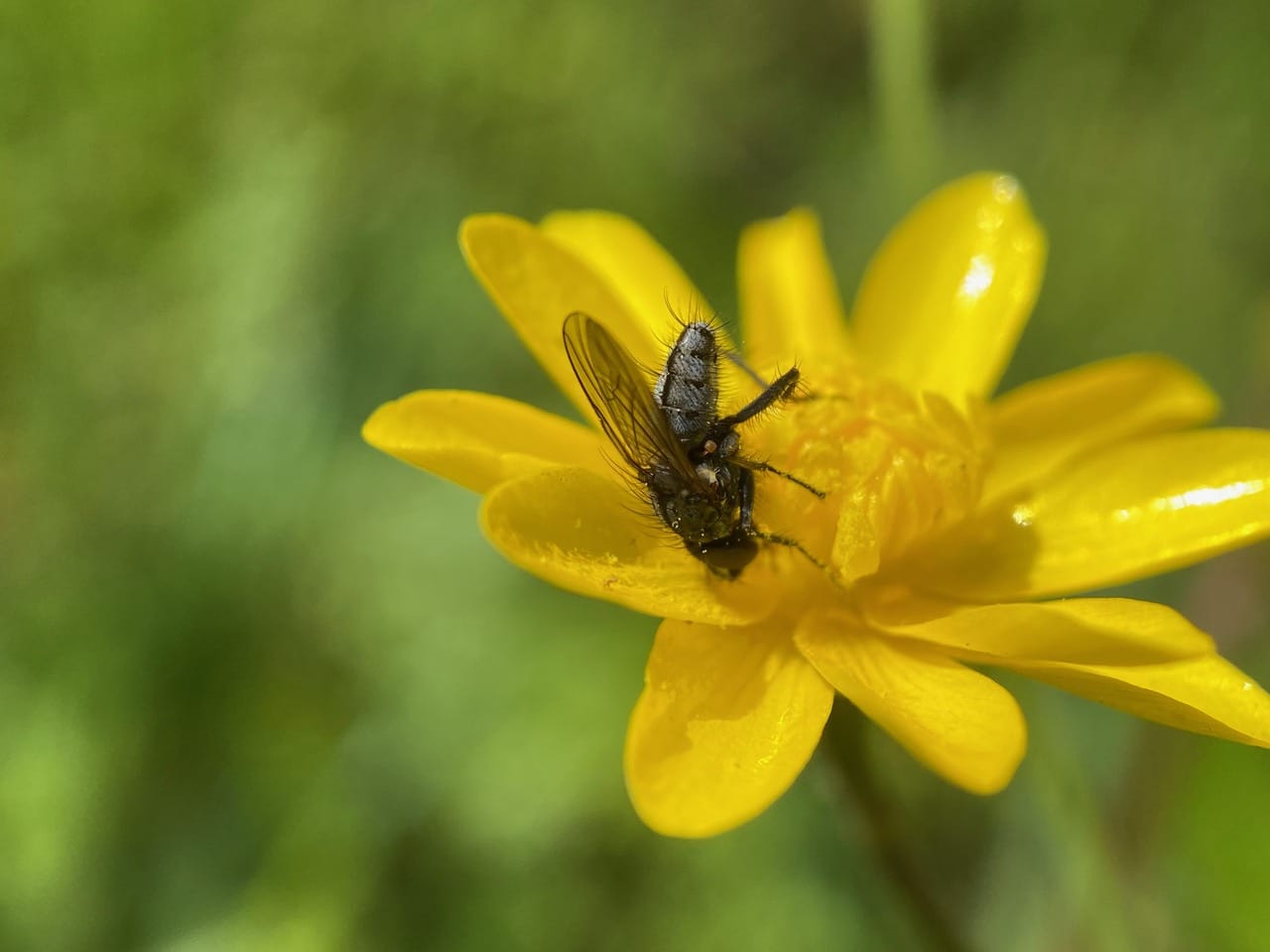
The fly lands on a fresh flower and right away heads for the nectaries at the base of the petals.
Members of the family Anthomyiidae are commonly called Root-maggot Flies. They are small to medium-size flies that resemble house flies but are somewhat more slender. They are usually dull gray or black and silver in color. The larvae typically feed in stems and roots of plants. Many are considered crop pests, and may attack root crops such as onions or rutabagas. Other species may feed on decaying matter, on feces, or are predators of other insects. Adult flies are important pollinators, usually feeding on nectar and pollen.
The fly emerges, its face mired with sticky pollen from the Buttercup flower it has just sampled.
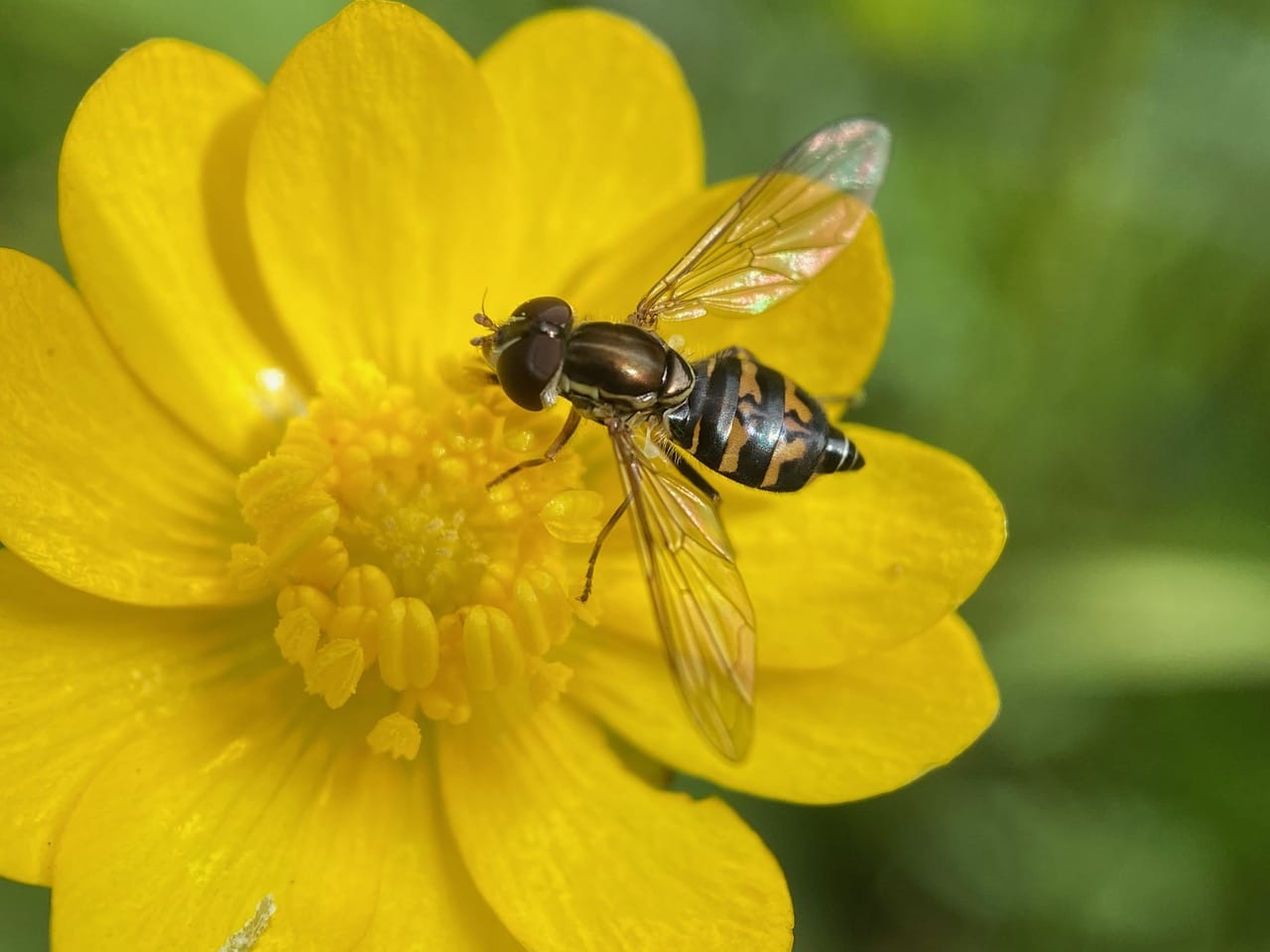
A female Western Calligrapher, Toxomerus occidentalis (family Syrphidae) is feeding on pollen of California Buttercup.
Toxomerus is a very large genus of Hover Flies found in North and South America. The majority of species are only 6-9 mm in length. They are notable for their mimicry of stinging Hymenoptera to avoid predators. Their unique abdominal patterns are diagnostic at the species level within the genus. Most larvae feed on soft bodied insects, such as aphids; a few feed on pollen. Adults feed on the pollen of a wide range of flowers. A female can lay up to hundreds of eggs at a time and will place them where prey or pollen food sources are readily available. They can be found in a wide variety of habitats, often in dense ground cover.
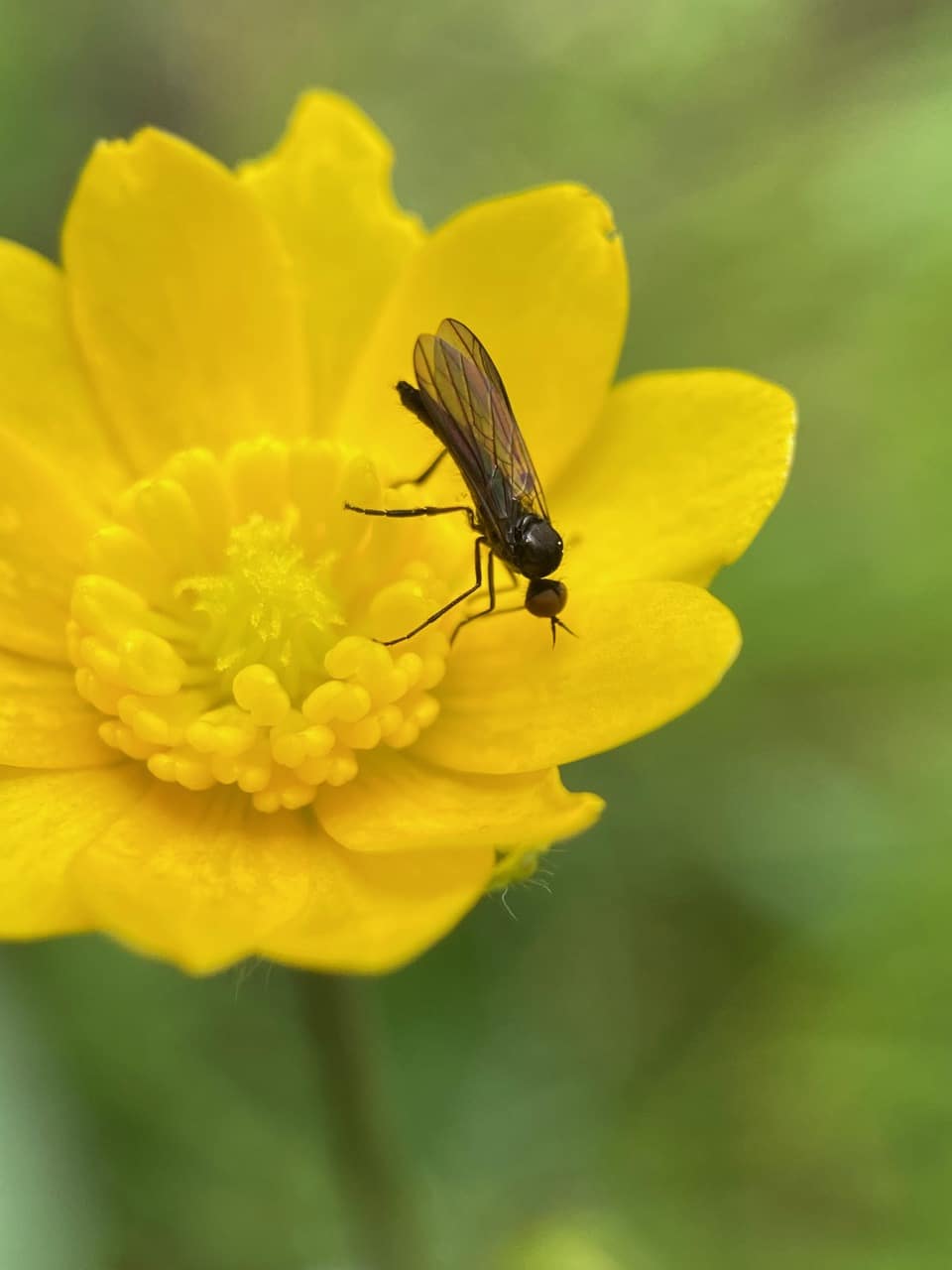
A Balloon or Dance Fly (family Empididae) is foraging on a fresh buttercup flower.
Members of the family Empididae are sometimes called Dance Flies. They get these names from the habit of males of some species to gather in large groups and dance up and down in the air in the hopes of attracting females. They are predominantly predatory and they are often found hunting for small insects on and under vegetation in shady areas. Both genders may also drink nectar. Male dance flies give their sweeties a nuptial gift to eat while they mate. The gift is thought to enable her to complete the development of her eggs. Males may wrap their gifts in balloons of silk or spit.
Now I know who has been chewing on the petals of the California Buttercups in this patch – a small Katydid nymph!The nymph is an immature California Chaparral Katydid, Platylyra californica (family Tettigoniidae). It is a common but seldom seen California katydid, inhabiting native chaparral vegetation throughout the state.
Insects in the family Tettigoniidae are commonly called katydids or bush crickets. They are primarily nocturnal in habit with strident mating calls. Many species exhibit mimicry and camouflage, commonly with shapes and colors resembling leaves. The diet of most katydids includes leaves, flowers, bark, and seeds, but many species are predatory, feeding on other insects, snails, or even small vertebrates such as snakes and lizards. Some are considered agricultural pests.
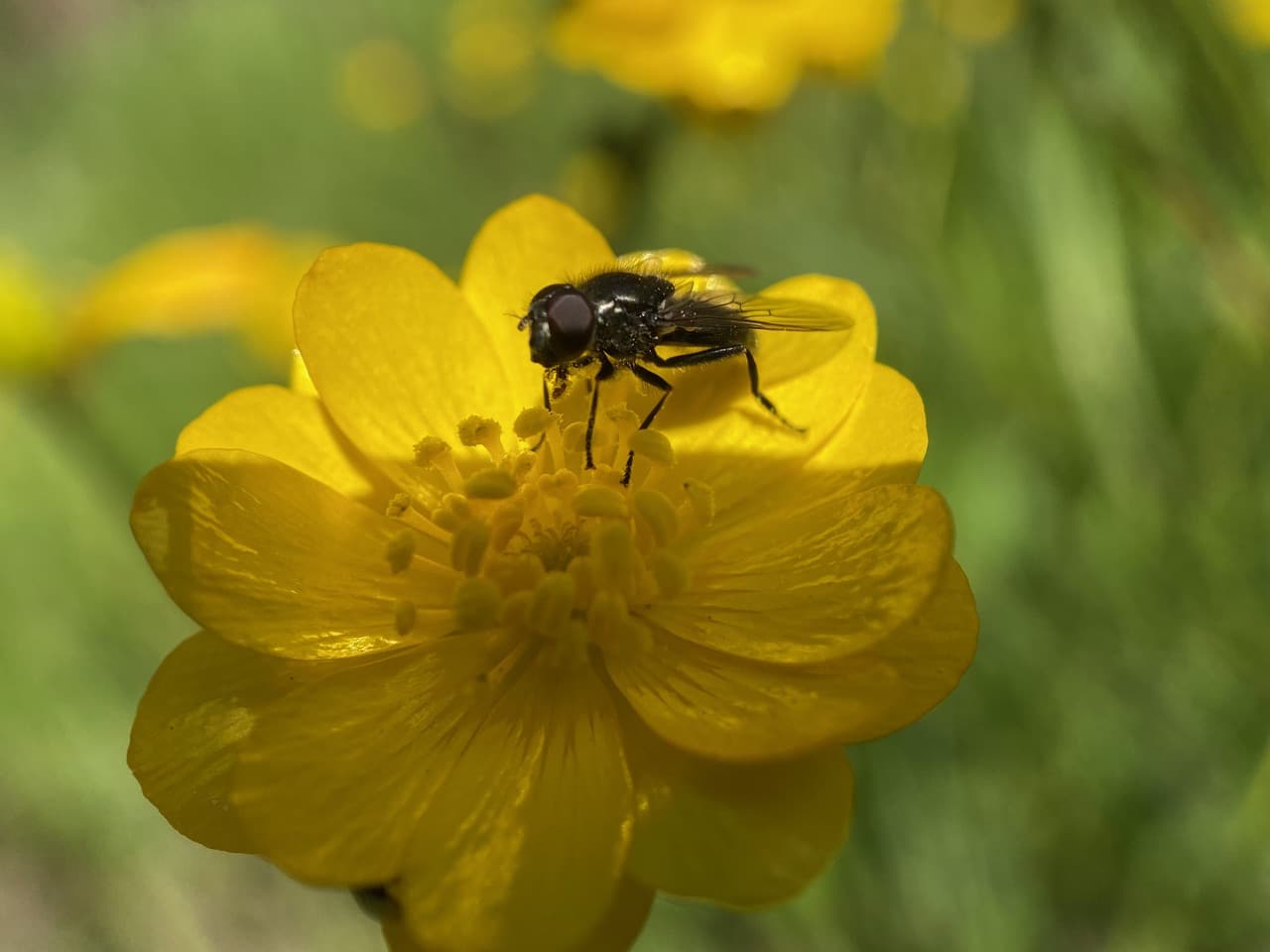
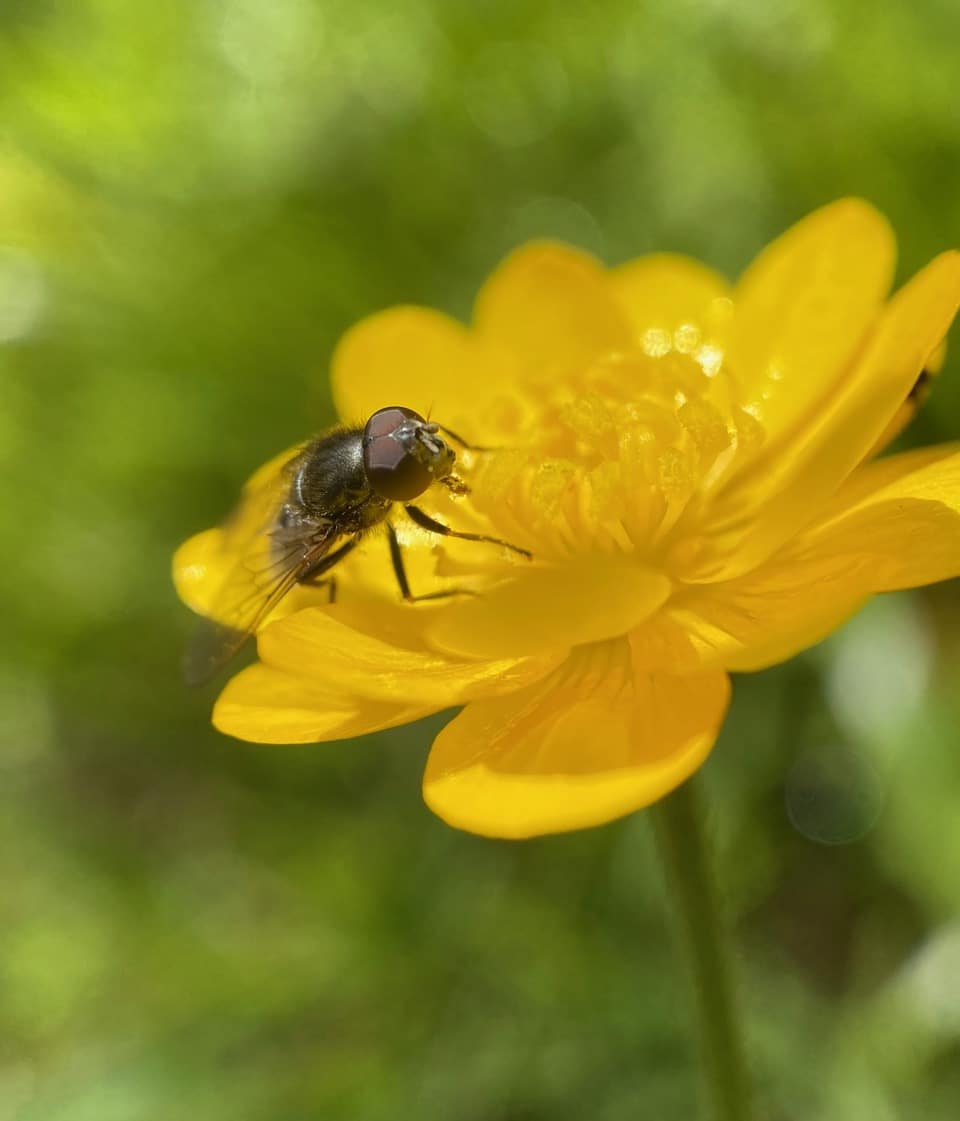
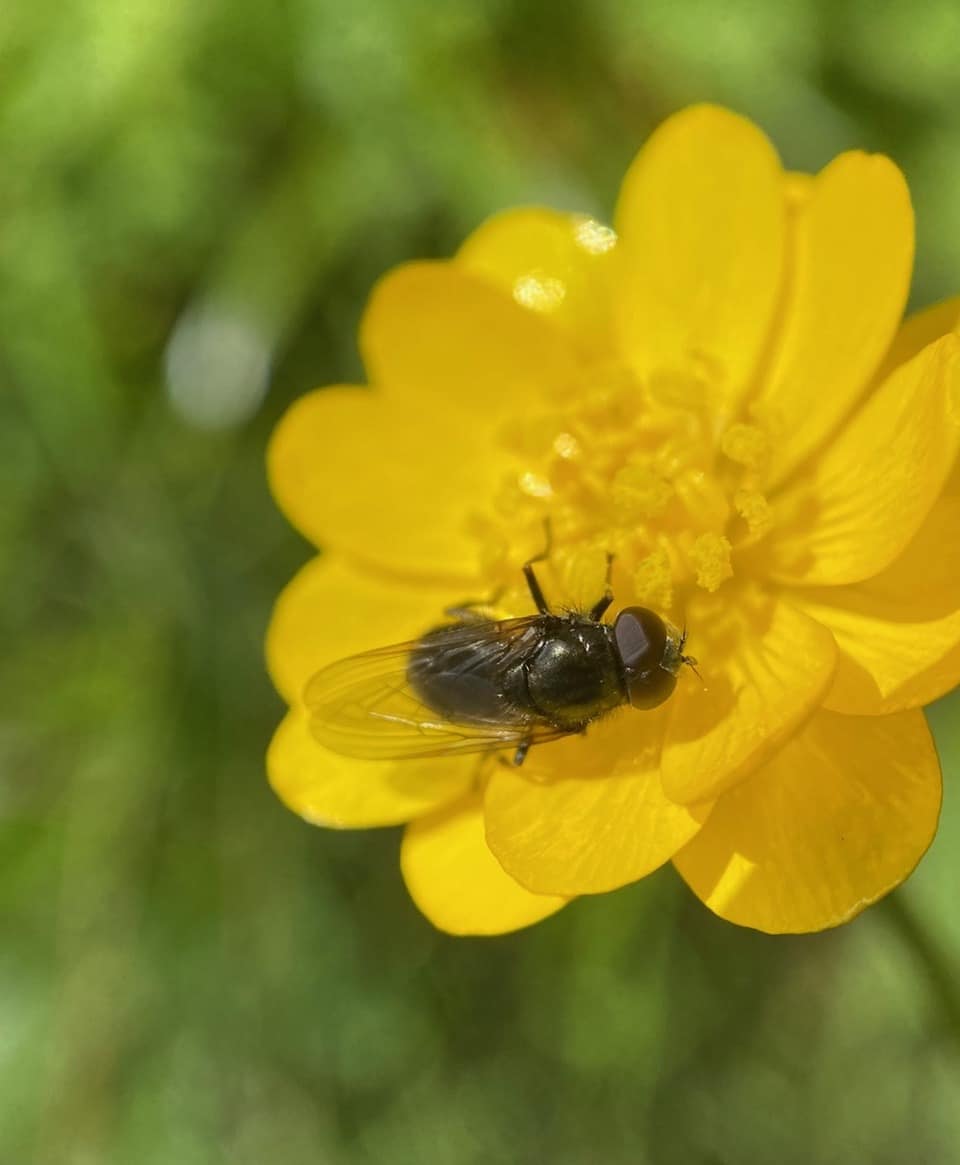
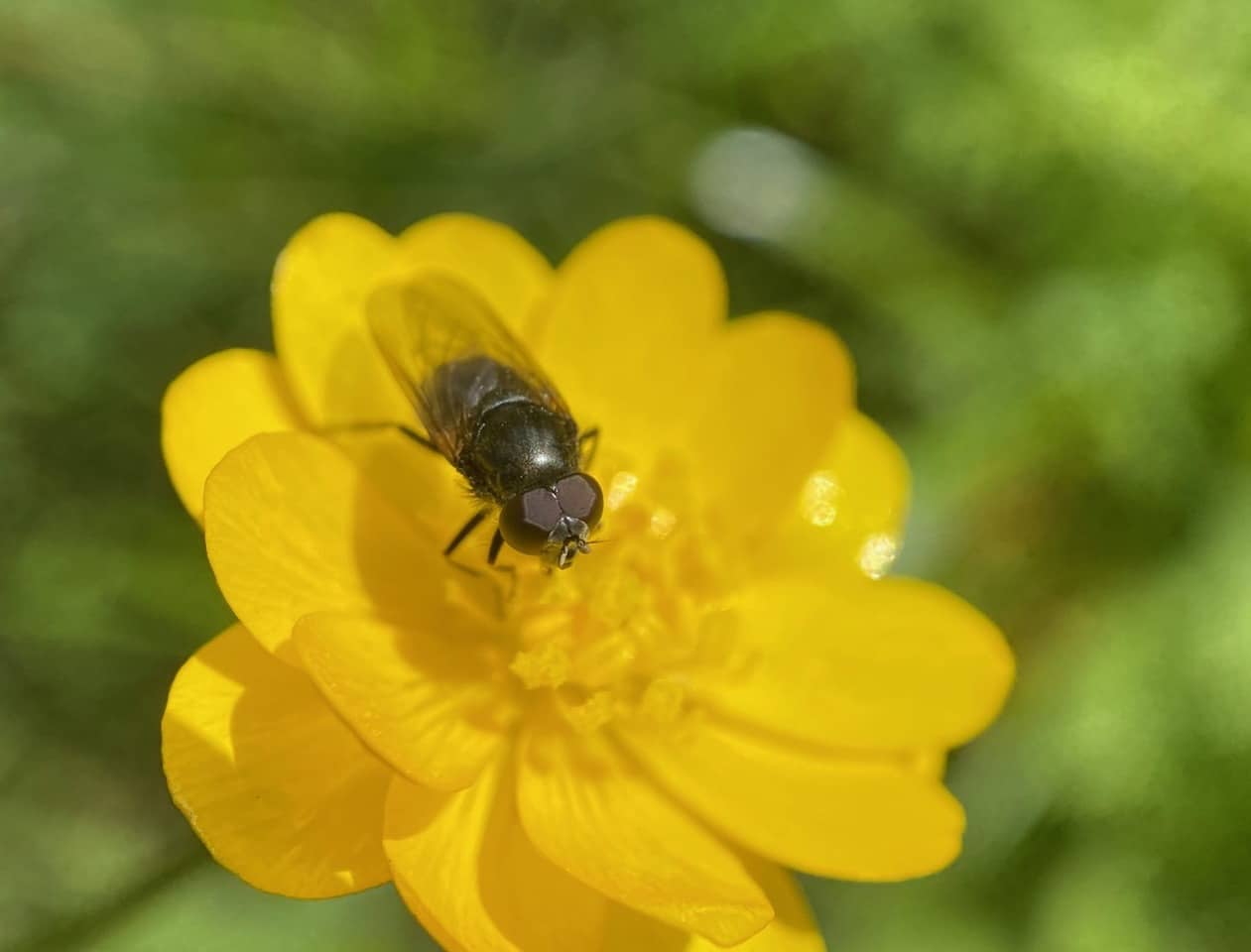
A dusky fly with a metallic sheen shows up for pollen.
The Blacklet, Cheilosia sp. (family Syrphidae) is an unusual hoverfly. It is not a bee/wasp mimic and does not wear the black-and-yellow costume of most Syrphids. What’s more, Blacklets tend to hold their wings folded over their abdomen, instead of spread out at an angle, fighter-jet style. Although it is one of the most species diverse genera of Syrphidae, its biology is little understood. Where known, the larvae of Cheilosia species feed in the stems of plants or in fungi.
This Blacklet is a male, as its eyes are holoptic, meeting along a central line on top of the head. This is a convenient feature that helps distinguish the sexes in the hoverflies.
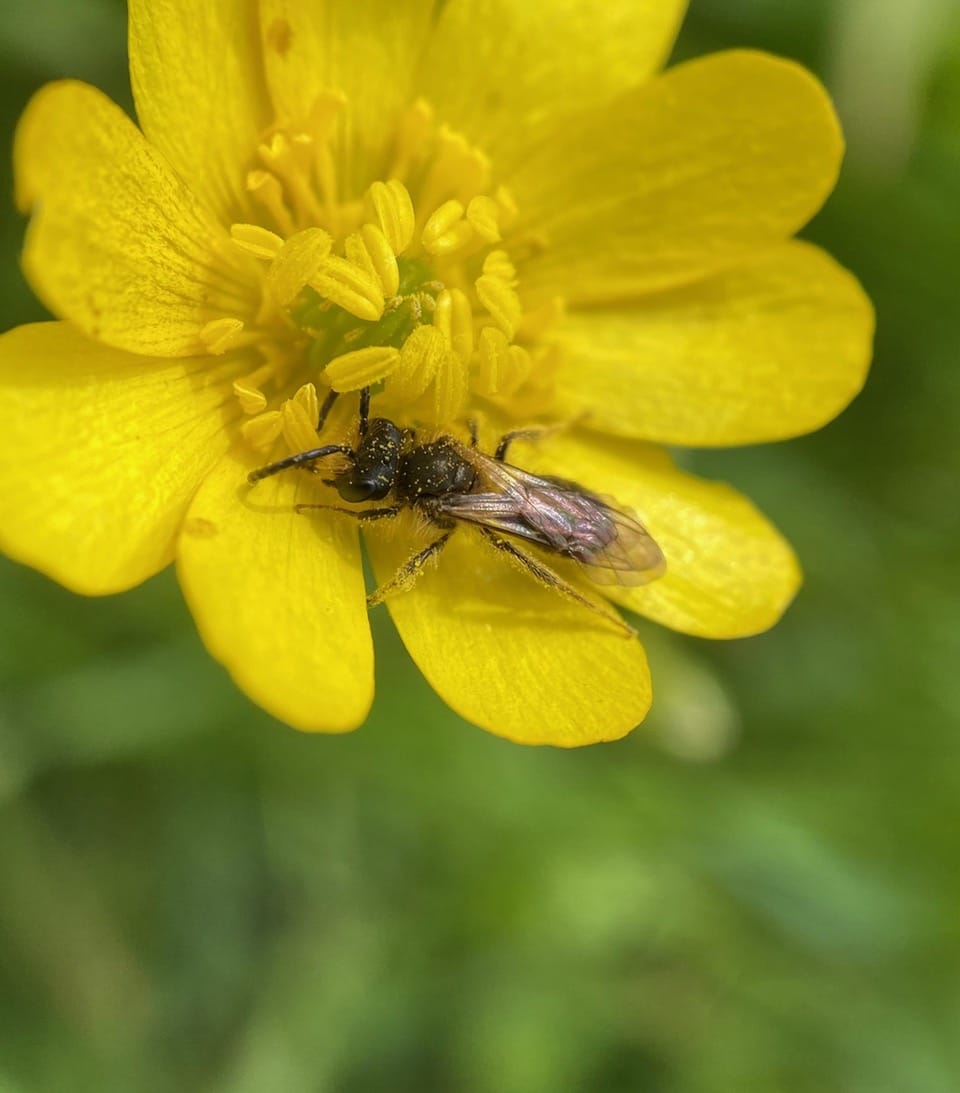
A few Hybotid Dance Flies (family Hybotidae) are foraging on a badly chewed flower. Modest and common as the buttercups are, they are an important plant in our ecosystem, feeding a myriad of insects at many levels. Some chew on the petals, some take nectar and/or pollen, some hunt for prey among the flowers. The flowers even serve as night time roost for some native bees. What’s not to love about Buttercups?
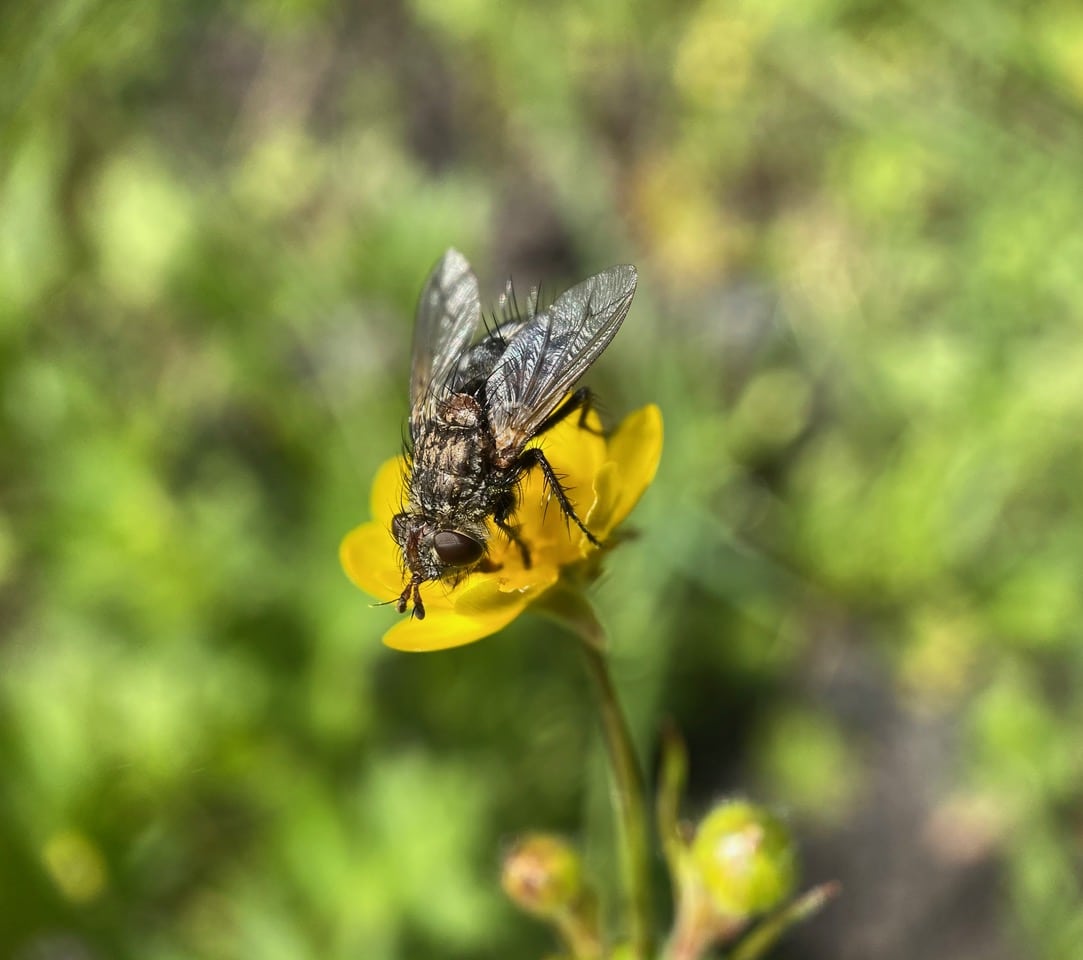
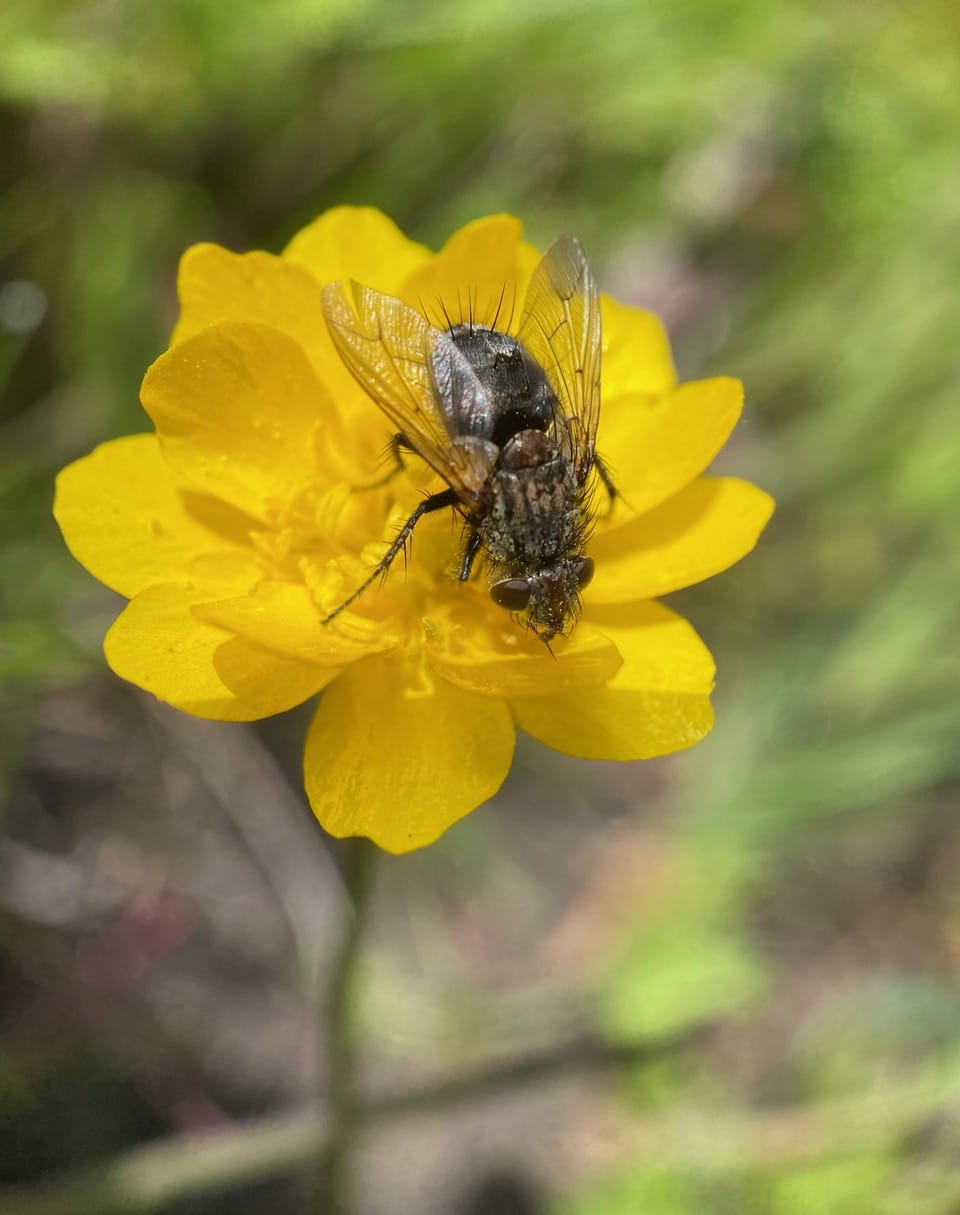
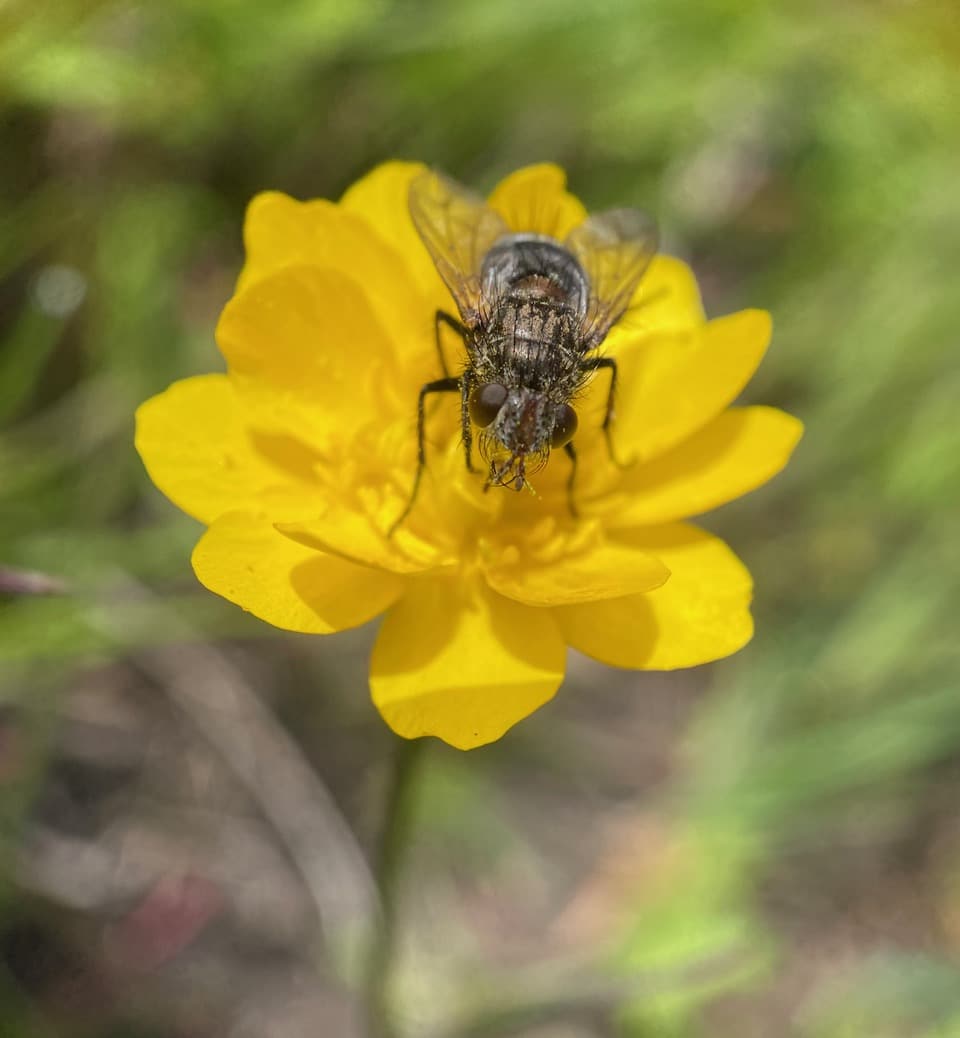
A bristly, robust fly lands on a Buttercup flower. It is a Bristle Fly (family Tachinidae)!
The family Tachinidae is by far the largest and most important group of parasitoid flies. All species are parasitic in the larval stage. Most adults have distinct abdominal bristles, hence the common name. Adults feed on liquids such as nectar and honeydew. They can be found resting on foliage, feeding at flowers or searching for hosts.
Most tachinids attack caterpillars, adult and larval beetles, true bugs, grasshoppers, and other insects. Females lay eggs in or on the host. Tachinid larvae live as internal parasites, consuming their hosts’ less essential tissues first and not finishing off the vital organs until they are ready to pupate. The larvae leave the host and pupate on the ground. Tachinids are very important in natural control of many pests, and many have been used in biological control programs.
Face of the Tachinid fly.
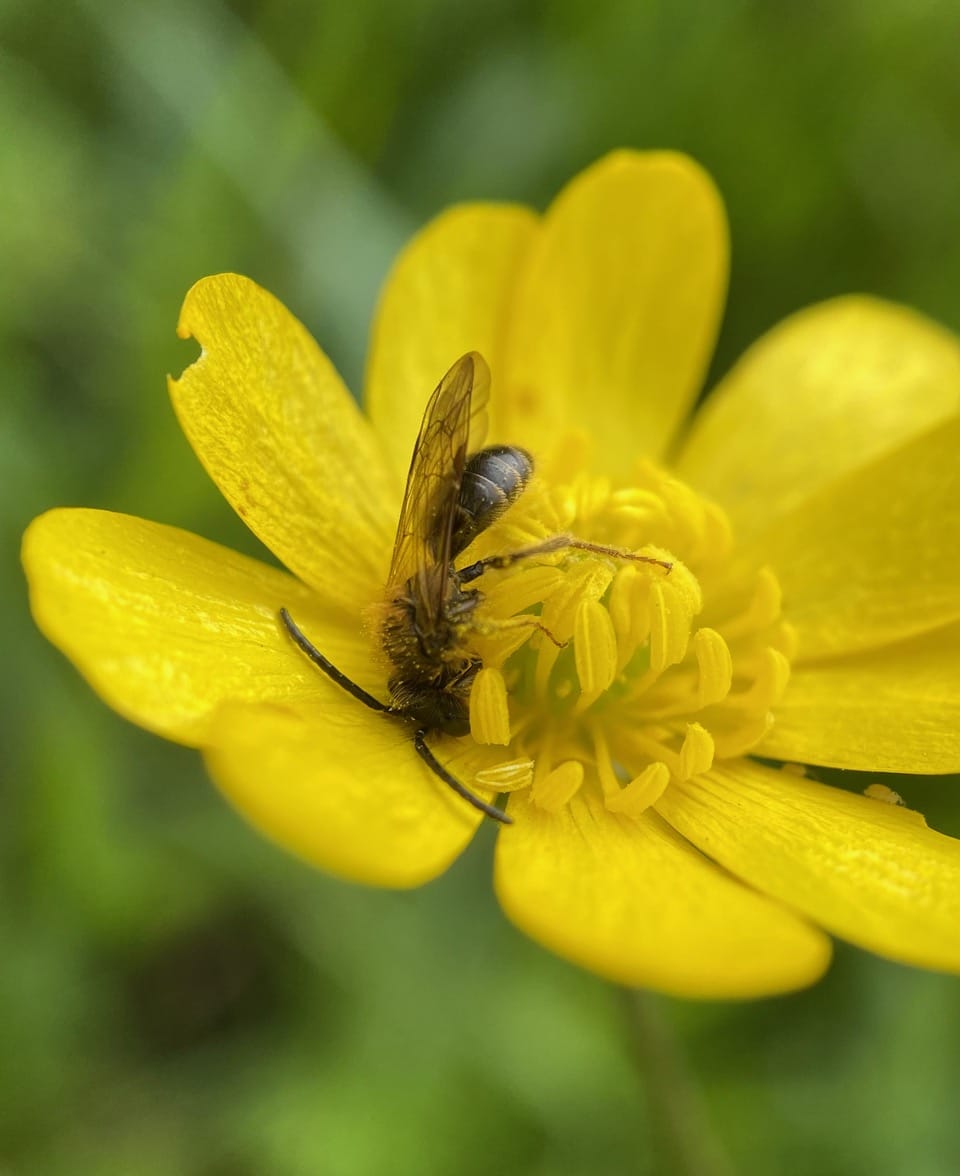
Hey, here’s another male Andrena on a buttercup flower. He is not the same individual I have been photographing, as Sleepy Head is still feeding on his own flower.