

Pollinator Post 3/28/24 (2)

Probably overlooked by most visitors to the garden, another inconspicuous plant is blooming with small yellow flowers along Skyline Trail. It is the American Wintercress, Barbarea orthoceras (family Brassicaceae). The perennial herb is native to North America, including much of Canada and western United States. The specific epithet refers to the fruit that is a straight, narrow silique up to 5 cm long.

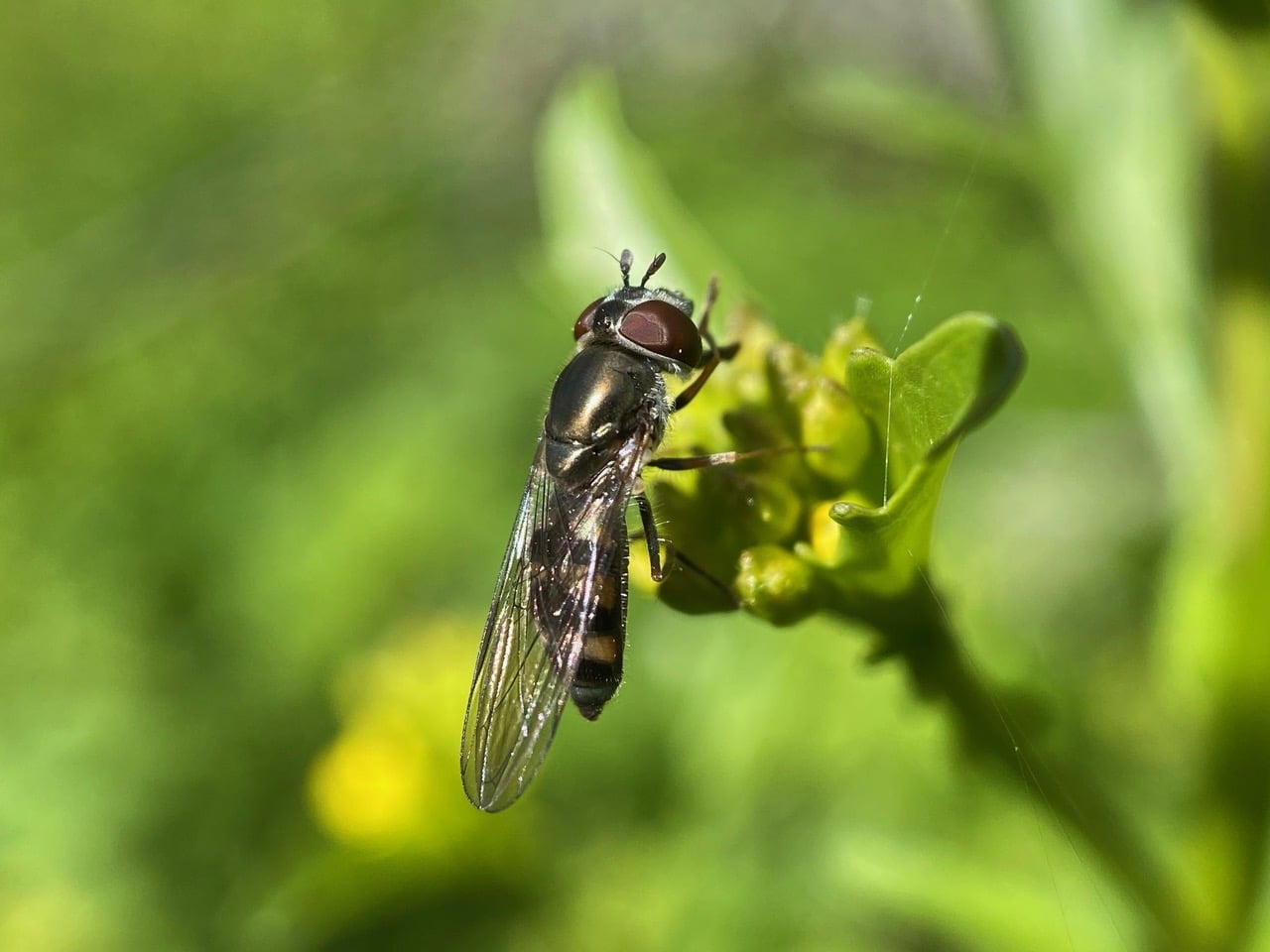 A female Sedgesitter, Platycheirus sp. (family Syrphidae) lands on a cluster of flower buds of American Wintercress. How can I tell it is female? The eyes of hoverflies are a convenient way to tell the sexes apart – the male’s eyes are holoptic, meeting along a central line on top of the head, while the female’s eyes are set apart.
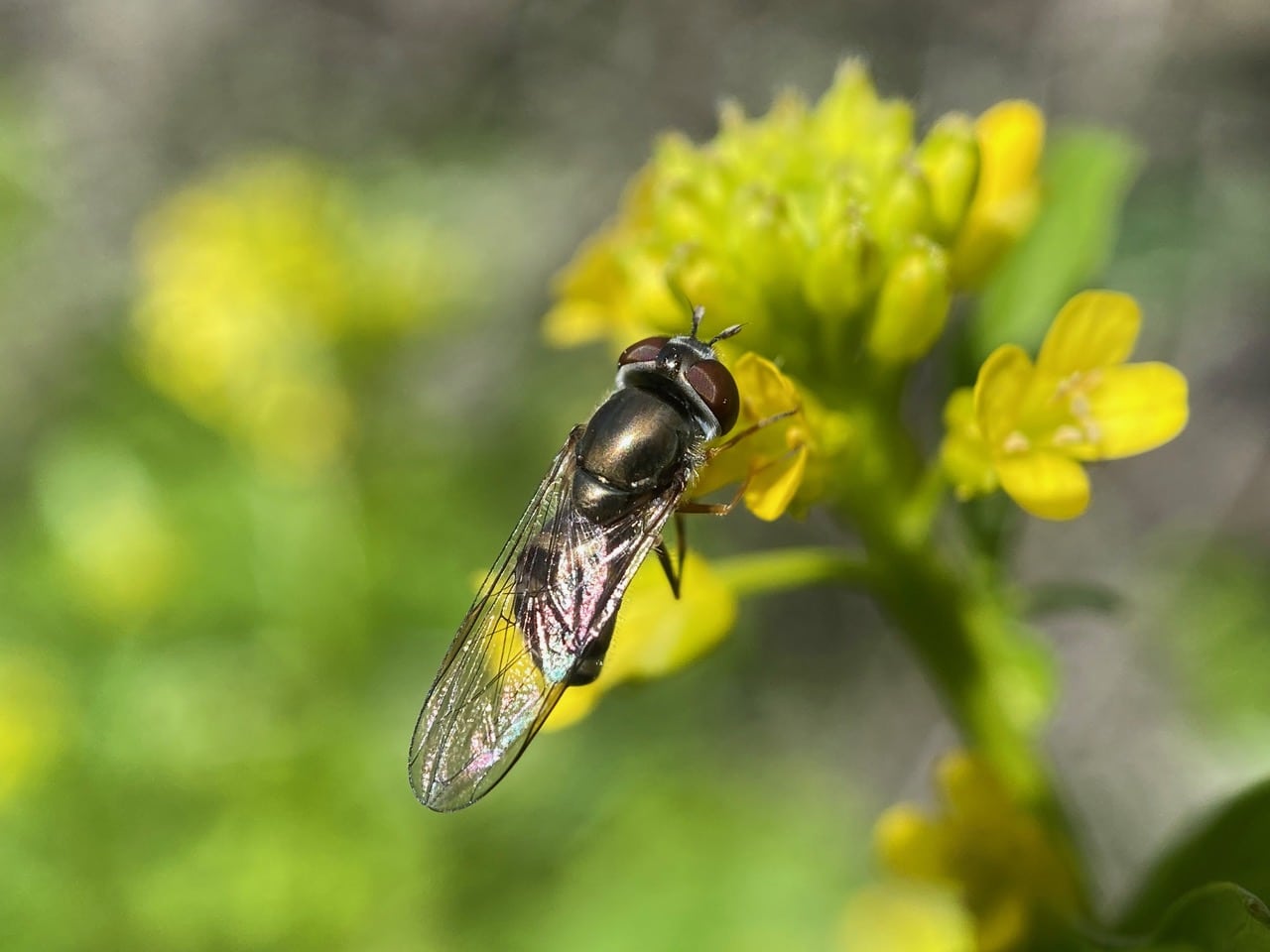
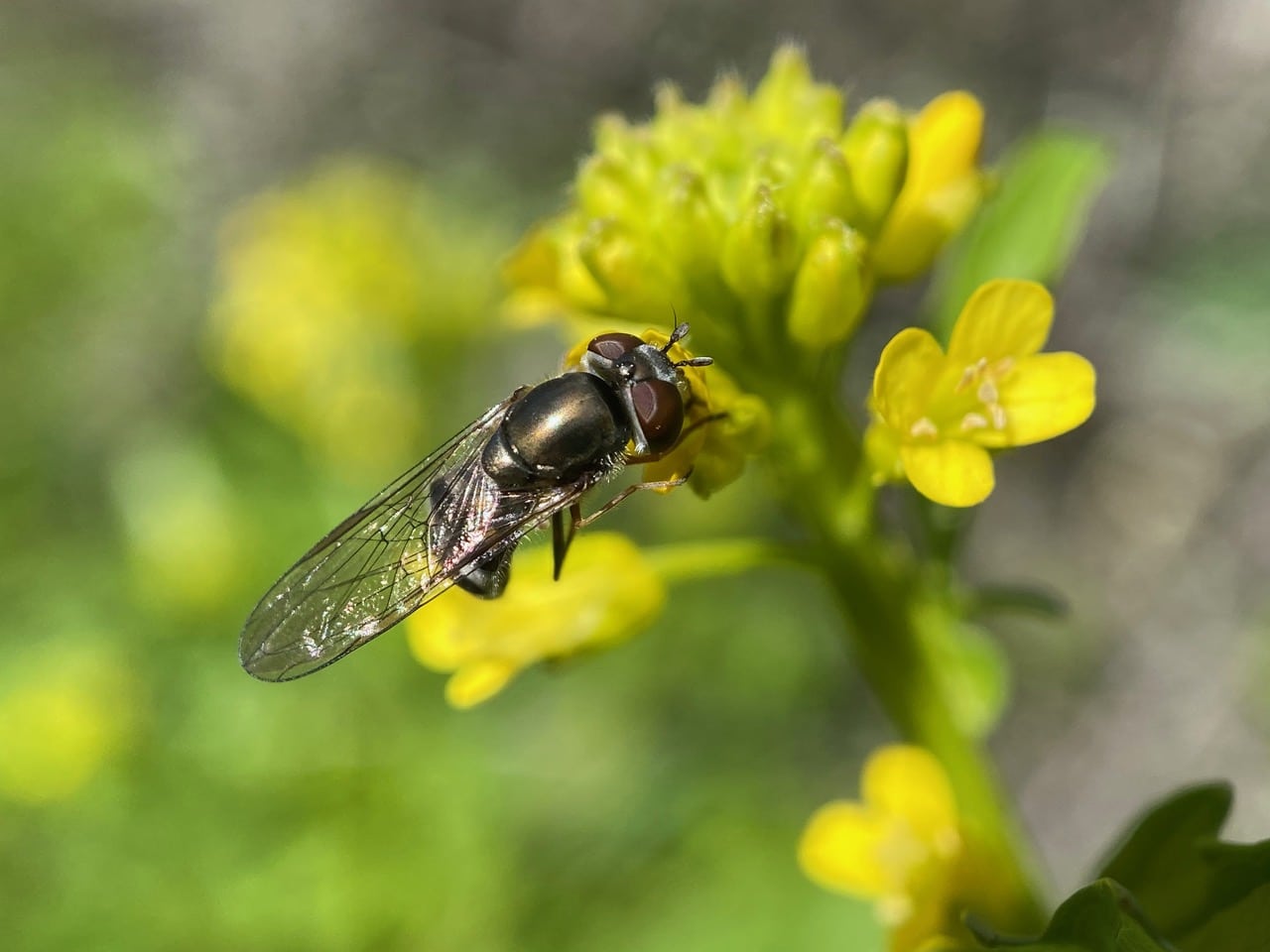





The flower cluster is a spike of bright yellow flowers at the stem tip. Typical of the mustard family (Brassicaceae) the flowers have four petals in a cross-type arrangement. There are six stamens of unequal lengths, four long and two short. The calyx encloses the base of the corolla that is fused into a cup.
A female Sedgesitter, Platycheirus sp. (family Syrphidae) lands on a cluster of flower buds of American Wintercress. How can I tell it is female? The eyes of hoverflies are a convenient way to tell the sexes apart – the male’s eyes are holoptic, meeting along a central line on top of the head, while the female’s eyes are set apart. The Sedgesitters are generally slow and deliberate in their feeding habits, and will stay still for a long time, much to a photographer’s delight. Depending on the lighting conditions, the fly can be quite photogenic, its dusky, metallic sheen lighting up beautifully in just the right angles.
Platycheirus is found in grass and herb vegetation. Adults of many species feed on pollen of wind-pollinated plants, such as Salix, Plantago, Poaceae, Cyperaceae, but they visit other flowers also. Many stay active during cold and rainy weather. Larvae feed on aphids.
Ooh, what is this Variable Checkerspot caterpillar doing on an American Wintercress? It has woven some silk on the terminal buds. Is it going to settle down and feed on them? Another plant species to add to the caterpillar’s long list of host plants!
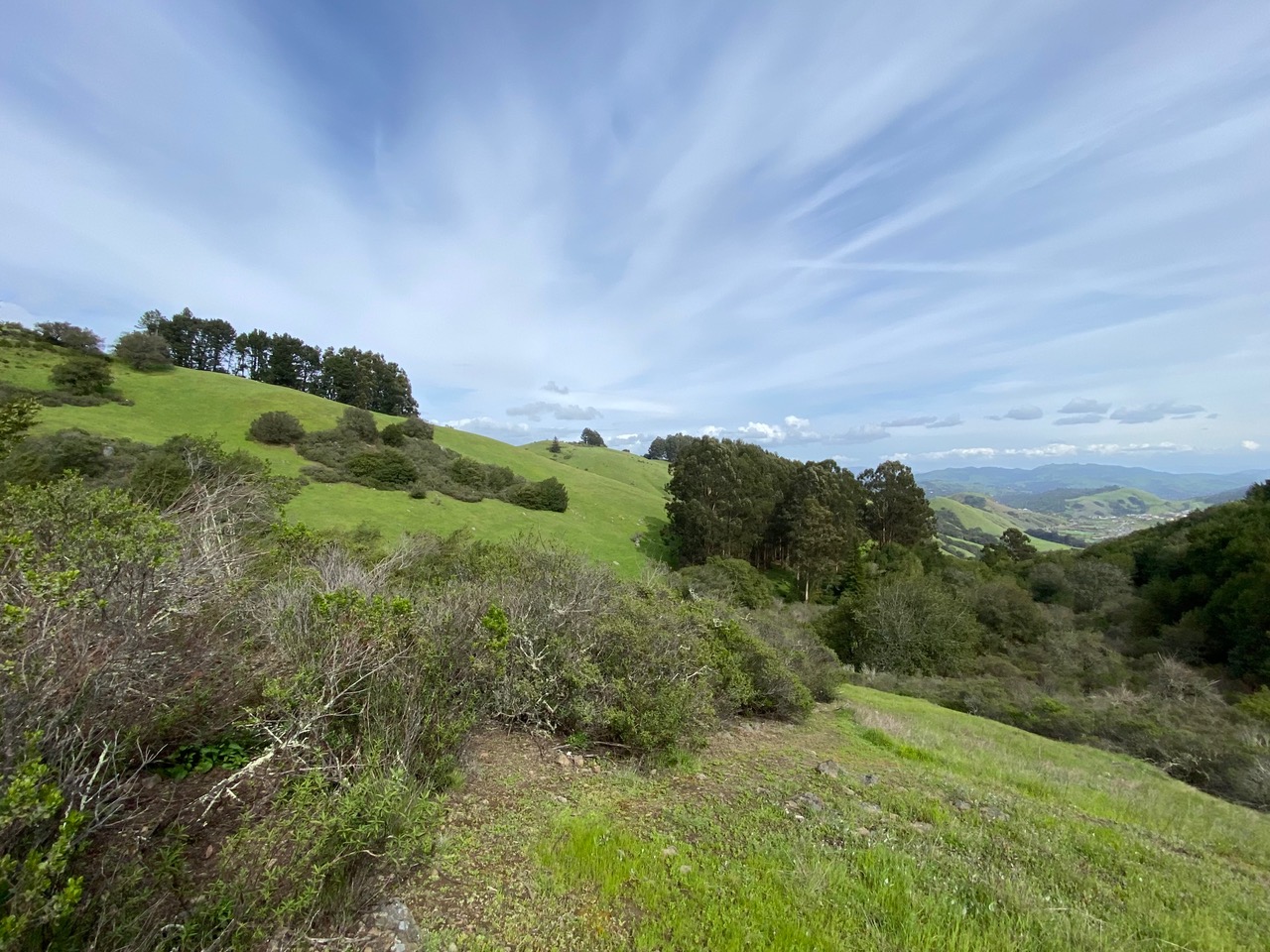
View from the bench at Siesta Nose. What strange starburst clouds! Why do they seem to radiate from a single point?
The rocky hill behind the bench is dotted with the blue-purple flowers of Blue Dicks, Dipterostemon capitatus. Where are the pollinators? Perhaps it’s too cold and cloudy?
Hey, there are insects on the Blue Dicks, though not what you might expect. These are the Hybotid Dance Flies (family Hybotidae). It seems you can find them everywhere there’s pollen. Why is there so little known about these pervasive insects?
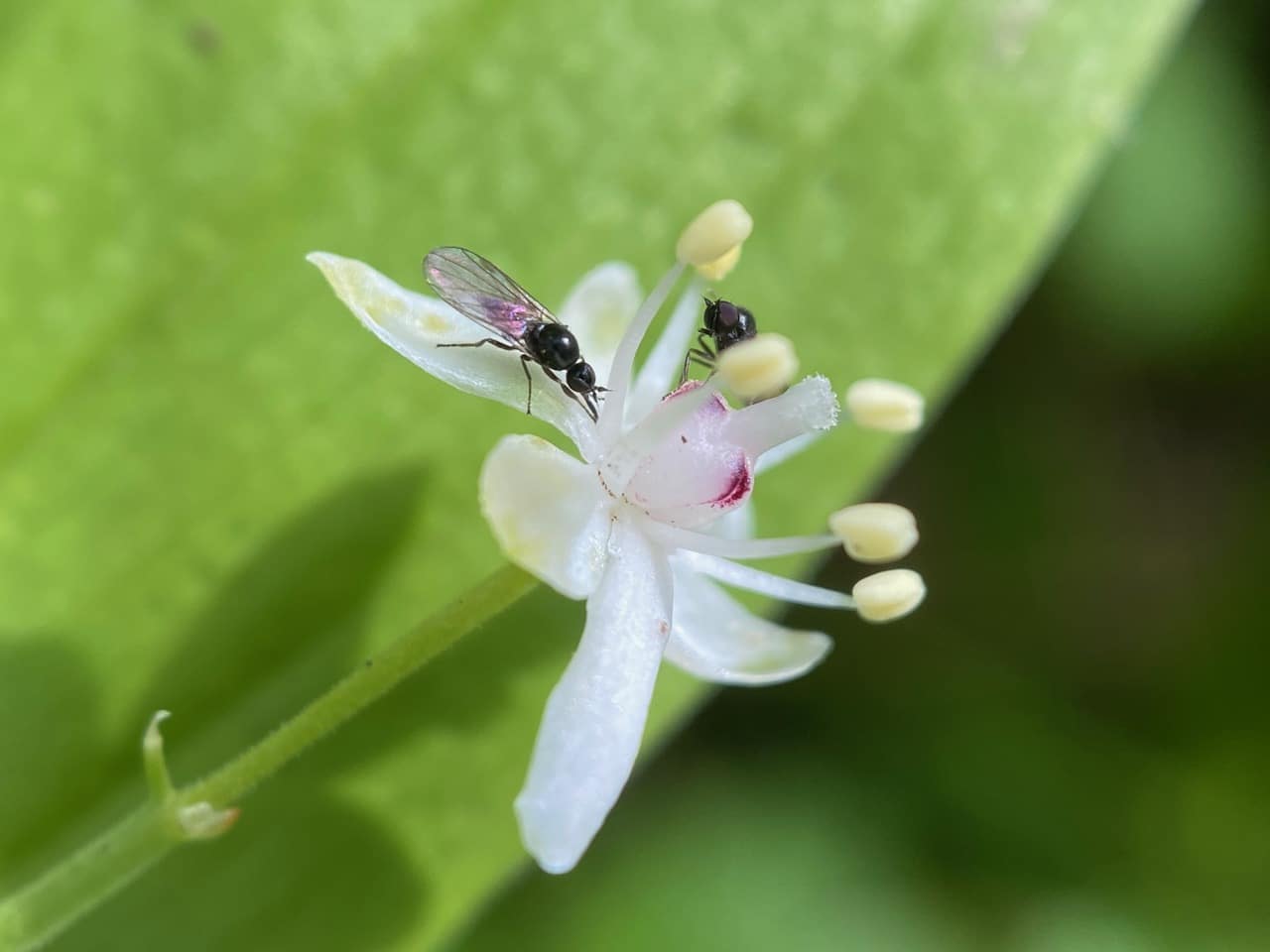
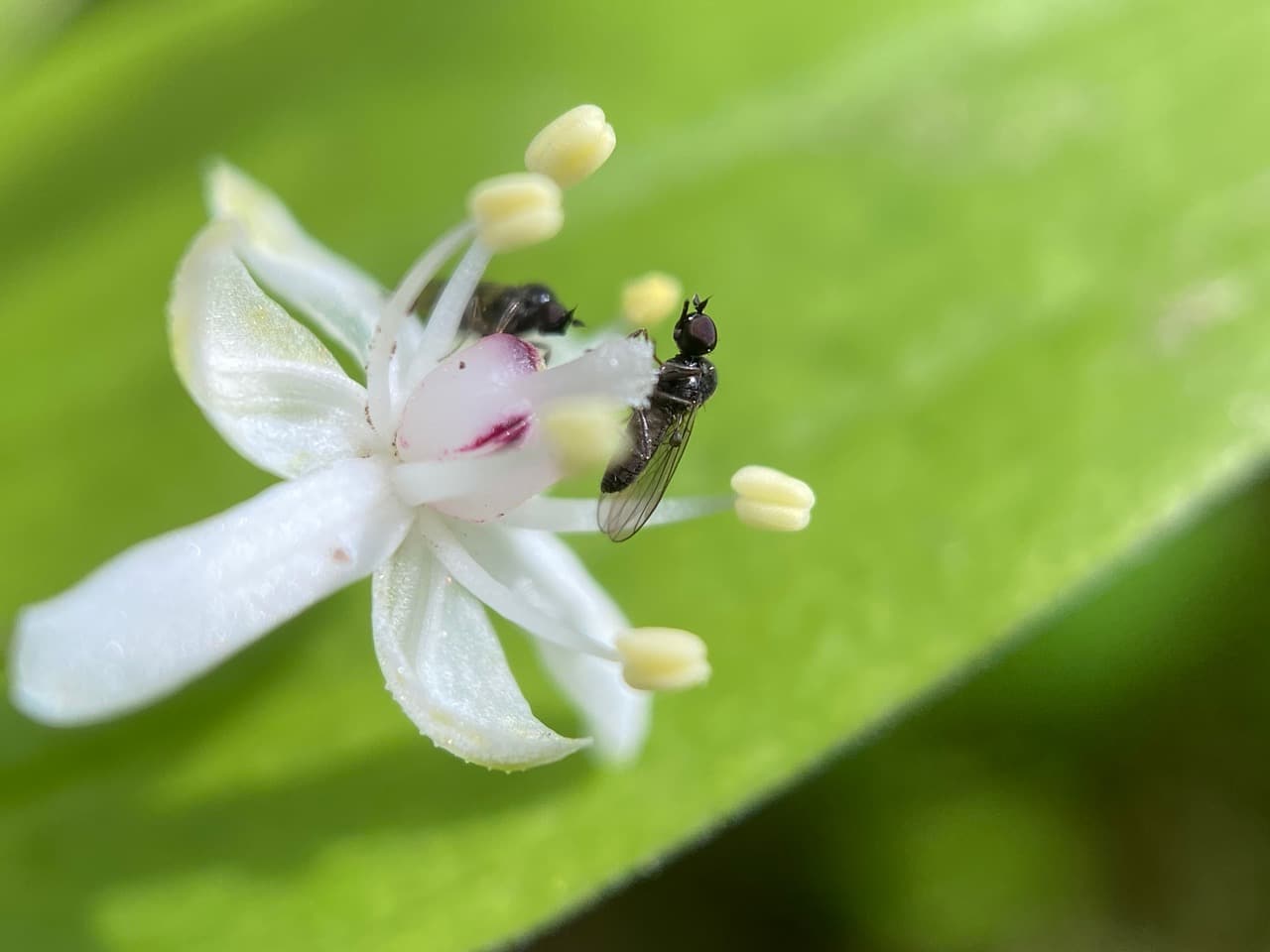
Winding my way back through the woodland section of the trail, I find the Hybotid Dance Flies again, on the tiny flowers of the Star-flowered Lily-of-the-valley, Maianthemum stellatum. The flies seem to be sexually dimorphic – the male (on the right) with bigger head totally covered by its eyes.
Close-up of the male Hybotid Dance Fly perched on the stigma of the flower.
With the exception of one, the anthers appear immature, not yet releasing pollen. The flower is probably protogynous, the female parts maturing before the male parts. The temporal separation of the sexes ensures that the flower does not self-pollinate.
A male Non-biting Midge (family Chironomidae) poses on a leaf of the Star-flowered Lily-of-the-Valley. I am thrilled to get a good look at his famous plumose antennae.
The Chironomidae is a large and diverse family of flies, with over 20,000 species known world-wide. Adult midges are small, most measuring 1-10 mm long, with narrow bodies and long legs. They resemble mosquitos, but do not bite. Males have long, feathery (plumose) antennae. Adults are short-lived. They feed on fly droppings, nectar, pollen, honeydew, and various sugar-rich materials. Larvae are mostly aquatic or semi-aquatic; most occur in freshwater habitats, a few occur in decaying matter, under bark, in moist ground, or tree holes. Larvae are mostly scavengers/detritivores. Collectively, they play a vital role in freshwater ecosystems as primary consumers. They harvest an enormous amount of energy from detritus and are important food items for fish, amphibians, birds, and predatory insects such as dragonflies and dance flies. Adult Chironomids can be pests when they emerge in large numbers, forming mating swarms over water or road surfaces.

Back at the patch of California Buttercup, Ranunculus californicus, things are rather quiet. No insects are flying. After all, the sun is no longer shining, and it is getting cold. I look into each flower hopefully anyway. There, on a flower, I spot the familiar sight of a dark insect wedged between the stamens and the petals. It is a male Mining Bee, Andrena sp. (family Andrenidae) lying motionless, just like the one I saw a week ago on this very same plant. It has bedded down for the night!
Like the sunflowers, buttercup flowers are heliotropic, tracking the movement of the sun across the sky through the day. Because of the optical properties of the petals, the flower warms up quickly when hit by sunlight. The little Adrena will be well taken care of by his floral partner, and he will be one of the first to wake up and fly in the morning when the sun shines. Nite-nite, sweet boy!