

Pollinator Post 3/28/24 (1)

As rain is in the forecast for the next couple of days, I feel the urgency to check for insect activities at Skyline Gardens before being house-bound again. It is cold, cloudy, and a little breezy when I arrive at the Steam Train Gate in the early afternoon.
At the Steam Train entrance, a Tick hangs out on the banner of a Silverleaf Lupine flower, Lupinus albifrons. This is a well-used path for visitors, hence an excellent ambush for a tick in search for its next blood meal.
Ticks pick a place to wait by identifying well-used paths, resting on the tips of grasses and shrubs. They find their hosts by detecting animals’ breath and body odors, or by sensing body heat, moisture, and vibrations. Some species can even recognize a shadow.

As I approach the small patch of blooming California Buttercups, Ranunculus californicus, I spot three similar insects perched on adjacent buttercup flowers. They don’t seem to be moving. Curious, I approach with the camera, being careful not to cast shadows on them. Two of the insects fly away, but I manage to snap a picture of the last one before it too flees. It looks like the male Mining Bee, Andrena sp. (family Andrenidae) that I photographed here on 3/21/24. Wow, this must be the bees’ favorite haunt! Is the species specific to the buttercups?
Bees in the family Andrenidae, commonly called miner bees or mining bees, are solitary ground-nesters. Andrenids are fairly small bees, usually dark-colored, and often banded. They are identified by the dense bristles (scopae) at the bases of the legs and the shin-like sections (tibias) of the legs, as well as by certain creases and grooves on the face and head and by unique wing venation. Many Andrenids resemble wasps – slender with long abdomen.
Most andrenids are specialist pollinators whose life cycle is timed to correspond precisely to the blooming of specific flowers. Because of this, andrenids are some of the first bees to emerge in spring, and many are active in March and April, as they visit early spring wildflowers.
 A few other insects are foraging on the buttercup flowers. Its body covered with scattered pollen, a Root Maggot Fly, family Anthomyiidae, is probing the bases of the petals for nectar.
 Antho- is a prefix derived from the Greek anthos for “flower”. So why aren’t these flies called flower flies instead of the dreadful common name they have been given? The name flower flies are sometimes used for members of the hoverfly family, Syrphidae.
Members of the family Anthomyiidae are commonly called Root-maggot Flies. They are small to medium-size flies that resemble house flies but are somewhat more slender. They are usually dull gray or black and silver in color. The larvae typically feed in stems and roots of plants. Many are considered crop pests, and may attack root crops such as onions or rutabagas. Other species may feed on decaying matter, on feces, or are predators of other insects. Adult flies are important pollinators, usually feeding on nectar and pollen.
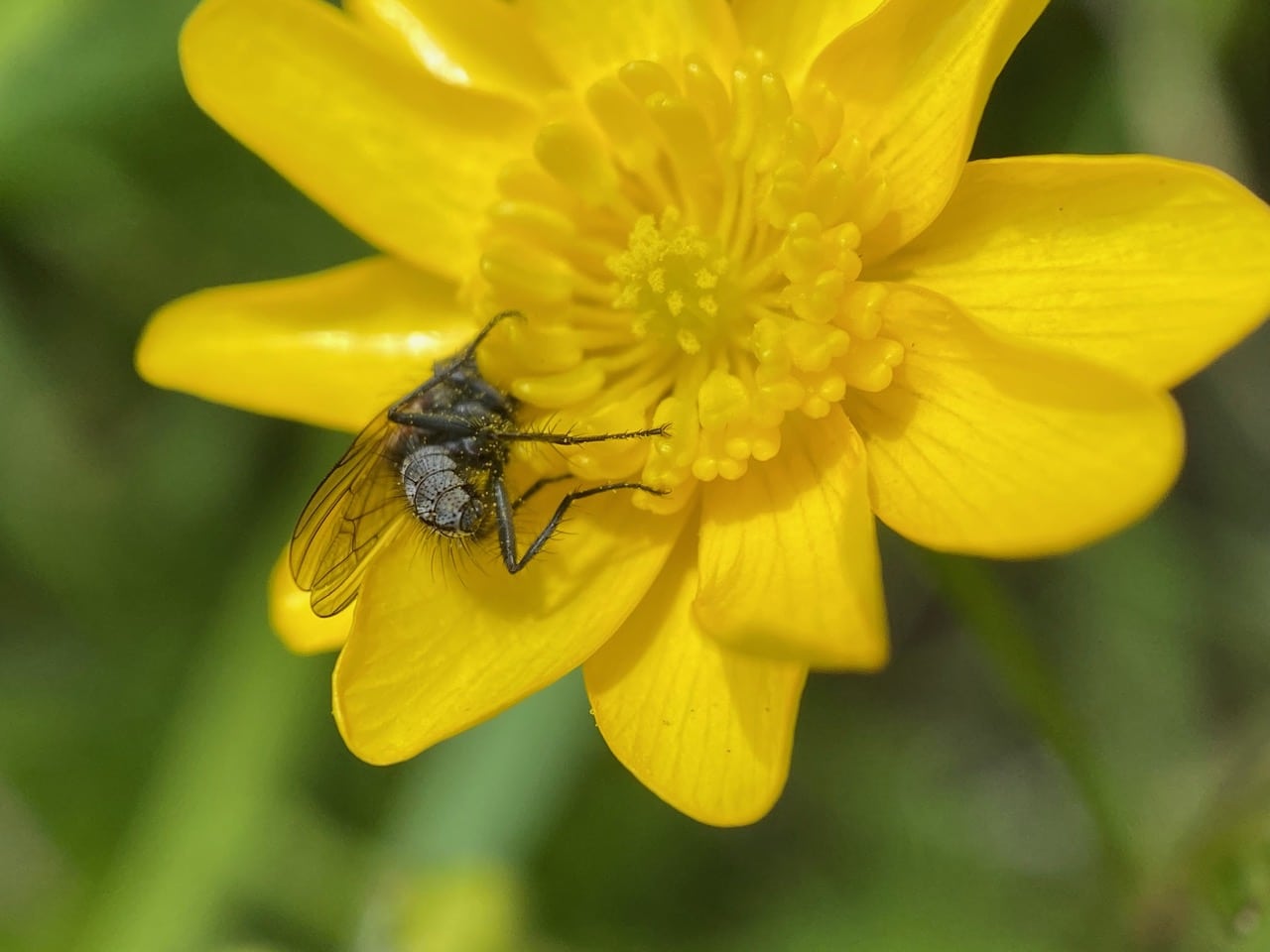
It is fun to watch insects seek nectar on the buttercup flower. Often they make a full circle around the perimeter of the flower, sometimes lying on their sides, probing the base of the petals one at a time.
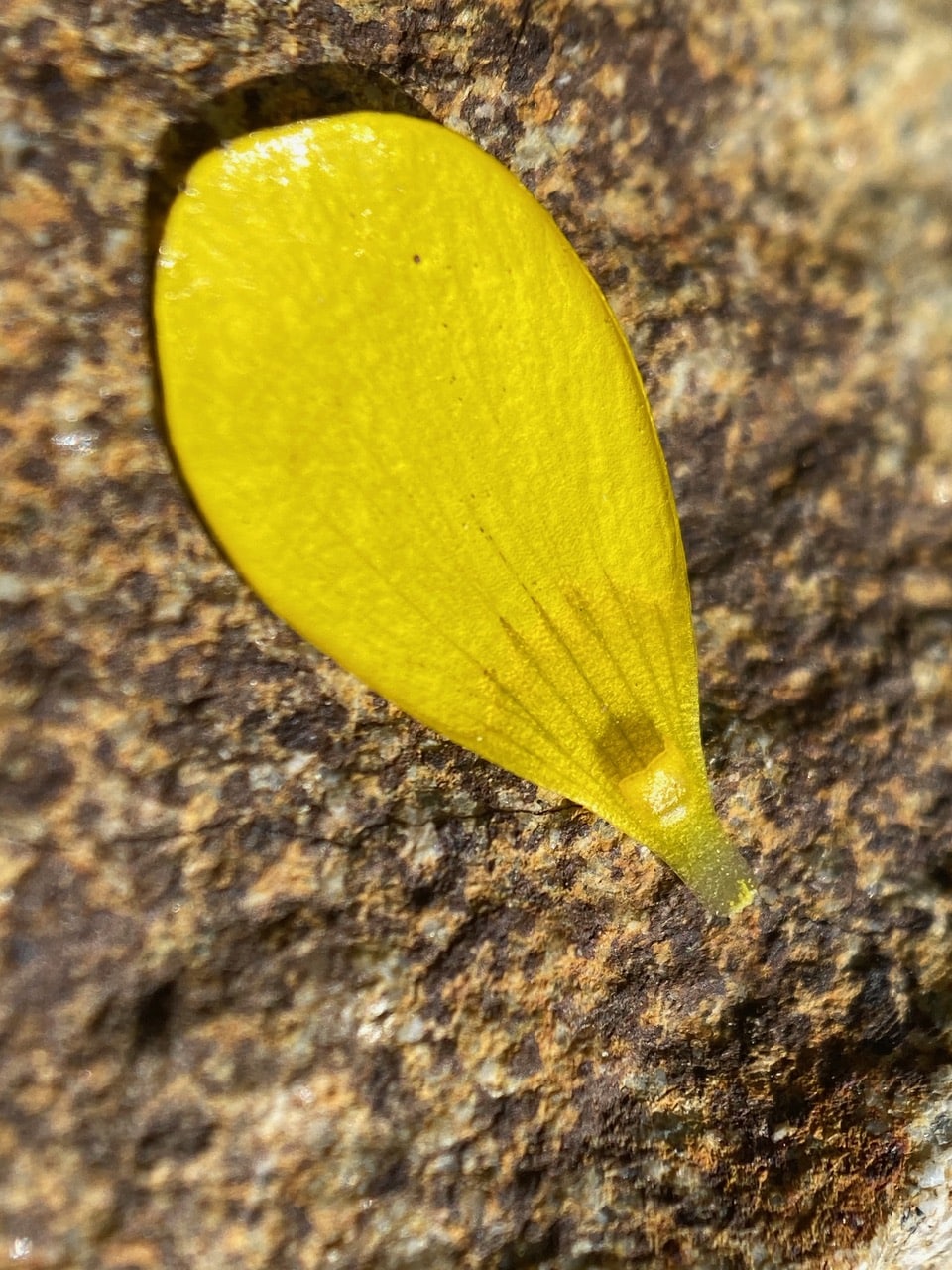
Photo from 4/2/21
I pick a petal from a fresh buttercup flower and look for the nectariferous spot – it is a cup-like scale that holds the nectar at the base of each petal, usually hidden under the stamens. Unlike most flowers that have a pool of nectar in a single nectary, the buttercup dispenses her sweet treats discreetly in these pockets, ensuring that the visiting pollinator would probe meticulously and thoroughly around the flower, and get covered with her sticky pollen. Note the faint, greenish nectar guides, lines on the petal that direct the pollinator to the sweet reward.
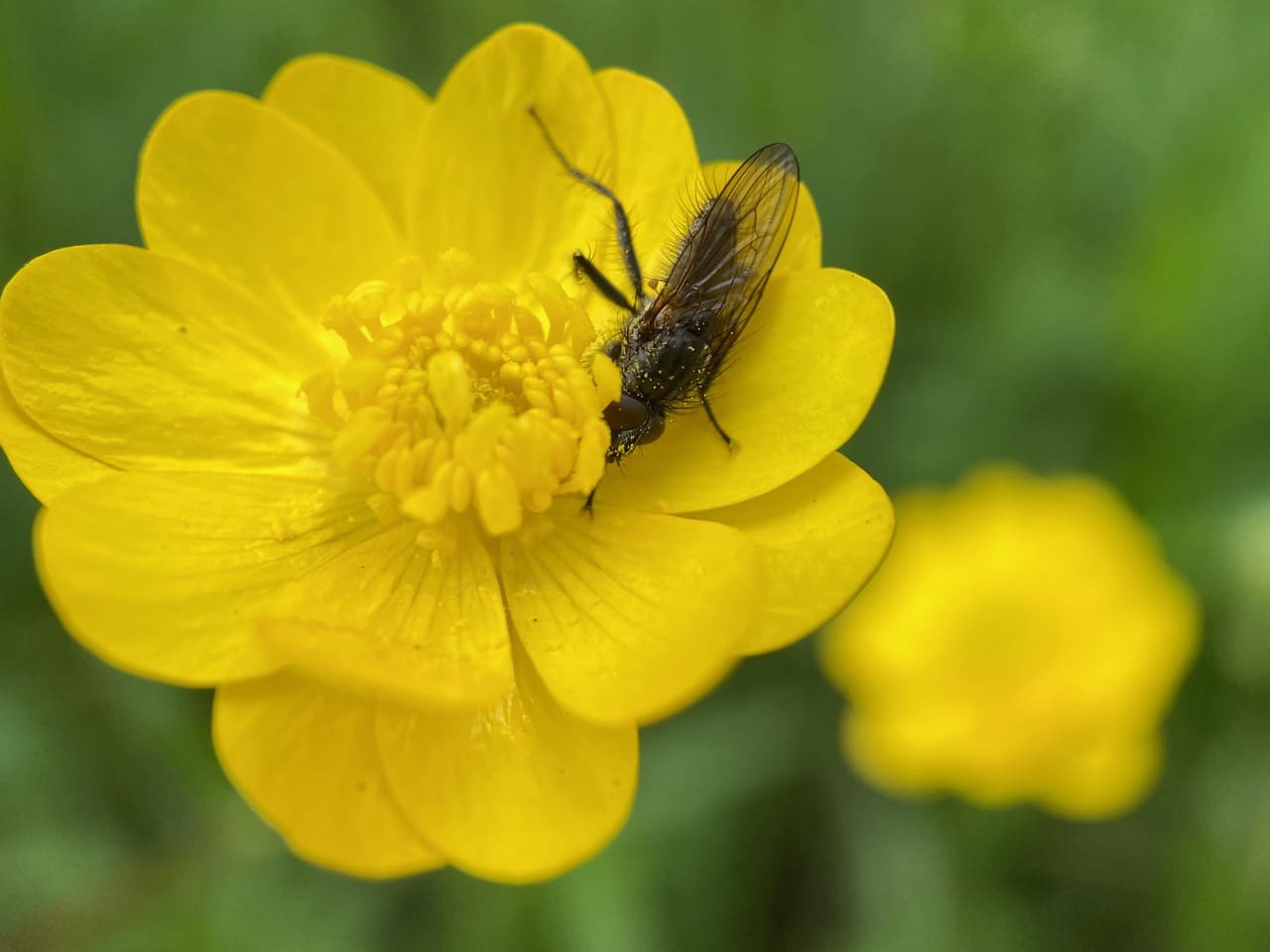
Yet another Root Maggot Fly (family Anthomyiidae) probing for nectar on a California Buttercup flower.

A male Western Calligrapher, Toxomerus occidentalis (family Syrphidae) lands on a California buttercup flower. He has a slender abdomen, and his large eyes are holoptic, meeting along a central line on top of his head.




 Although the Pacific Sanicle, Sanicula crassicaulis looks somewhat scraggly this year, the plants are blooming reasonably well. The tiny yellow flowers are borne in small compact, rounded clusters. About half of the flowers are bisexual, the rest male, but the two types are difficult to distinguish without magnification. The flowers are radially symmetrical with five petals. The tips of the petals curl inward, never unfurling fully. There are five pale yellow stamens that curl inward before maturity and extend well beyond the petals when mature. Gathering pollen should be easy for insects because of the fully exserted anthers.


 With its proboscis extended, the fly is feeding on nectar.


Another male Western Calligrapher is feeding on pollen on a buttercup flower. Note his distinctly bowed hind femur. The genus name Toxomerus comes from Greek toxon for ‘bow’ and meron for ’thigh’, referring to the bow-shaped hind femur. Colors vary with overall temperature during pupation: higher temperatures produce more yellow, while lower temperatures produce adults with darker markings. Adults visit flowers for nectar and pollen. Larvae feed on aphids and other soft-bodied insects.
A female Western Calligrapher, Toxomerus occidentalis (family Syrphidae) is feeding on pollen of a California Buttercup flower. Her abdomen is much broader than the male’s, and usually decorated with these distinctive markings.
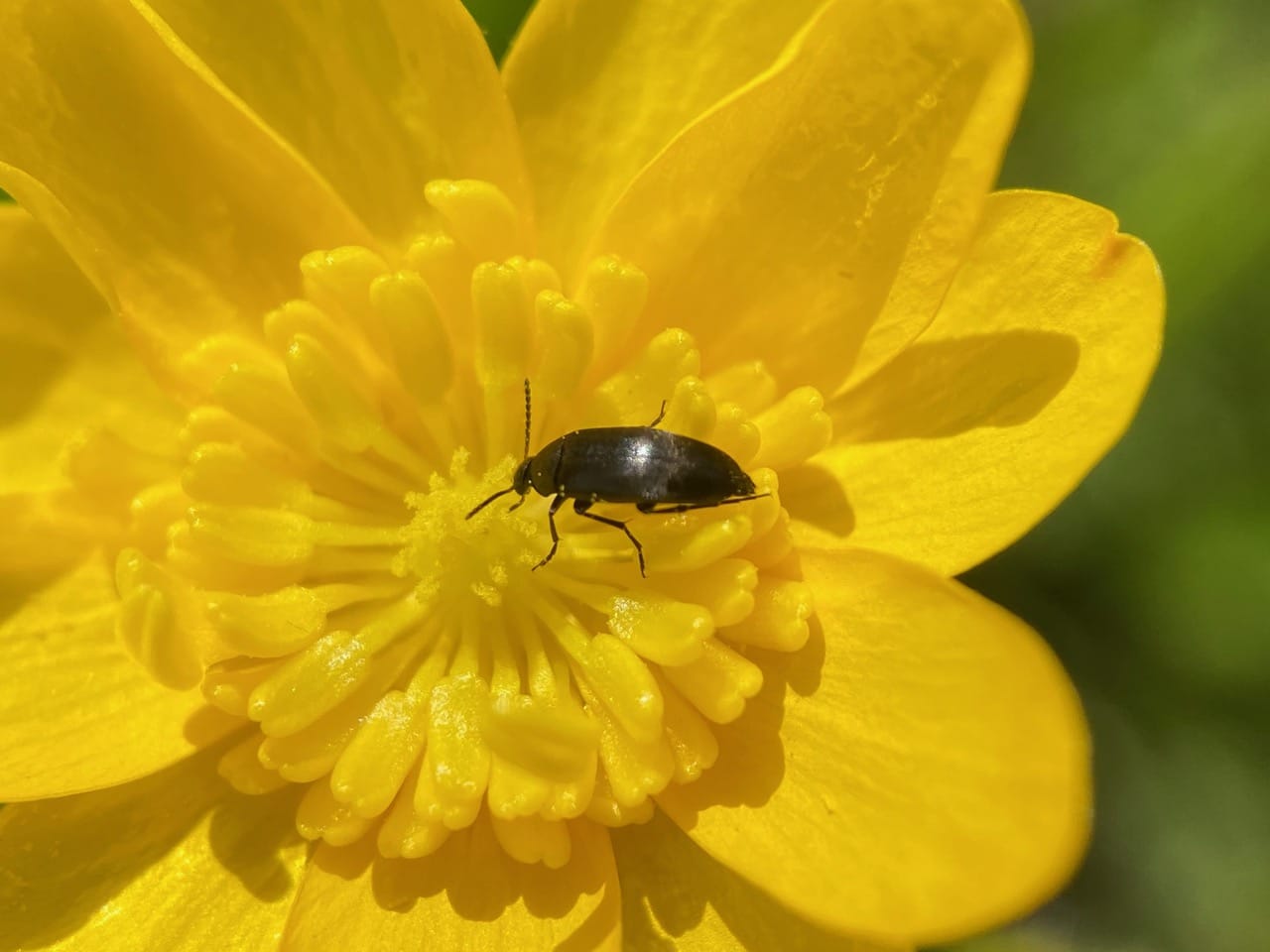
A False Flower Beetle, Anaspis sp. (family Scraptiidae) is foraging on a buttercup flower.
The family Scraptiidae is a small group of Tenebrionoid beetles sometimes call False Flower Beetles. Anaspis atrata is commonly found in western North America. The adults feed on pollen, and are found on flowers, sometimes in large numbers. The larvae are typically found under the bark of dead trees, or among decaying wood or are associated with various fungal fruiting bodies.
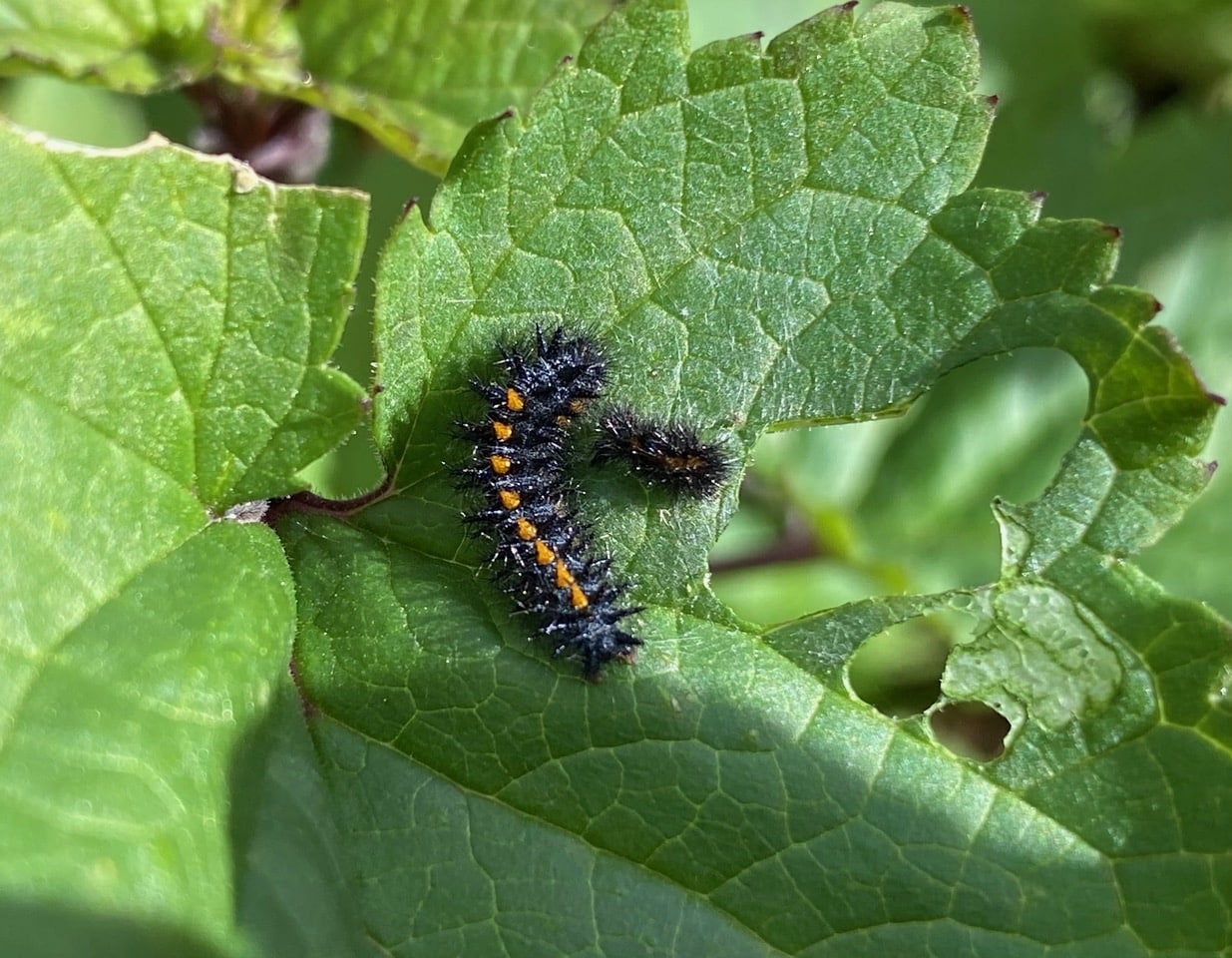
The Variable Checkerspot caterpillars along Skyline Trail are growing big. Most exceed an inch now. They boldly make their presence known on their food plant, the California Bee Plant, Scrophularia californica, spinning silken webbings on the leaves on which they rest and feed.
Here’s a freshly molted caterpillar resting next to its exuvium (shed exoskeleton). Look at those big holes it has chewed on the leaf!
Two minute pale green bugs leap off a leaf of Bee Plant as I close in with the camera. One remains and tries to run instead. From its elongate shape, the neat row of tiny spines along its hind legs, and the absence of wings, I gather that it is a Leafhopper nymph.
Leafhopper is the common name given to true bugs in the family Cicadellidae. The bugs are plant feeders that suck plant sap from grass, shrubs, or trees. Their hind legs are modified for jumping, and are covered with hairs that facilitate the spreading of a secretion over their bodies that act as a water repellent and carrier of pheromones. They undergo partial metamorphosis, and have various host associations, varying from very generalized to very specific.
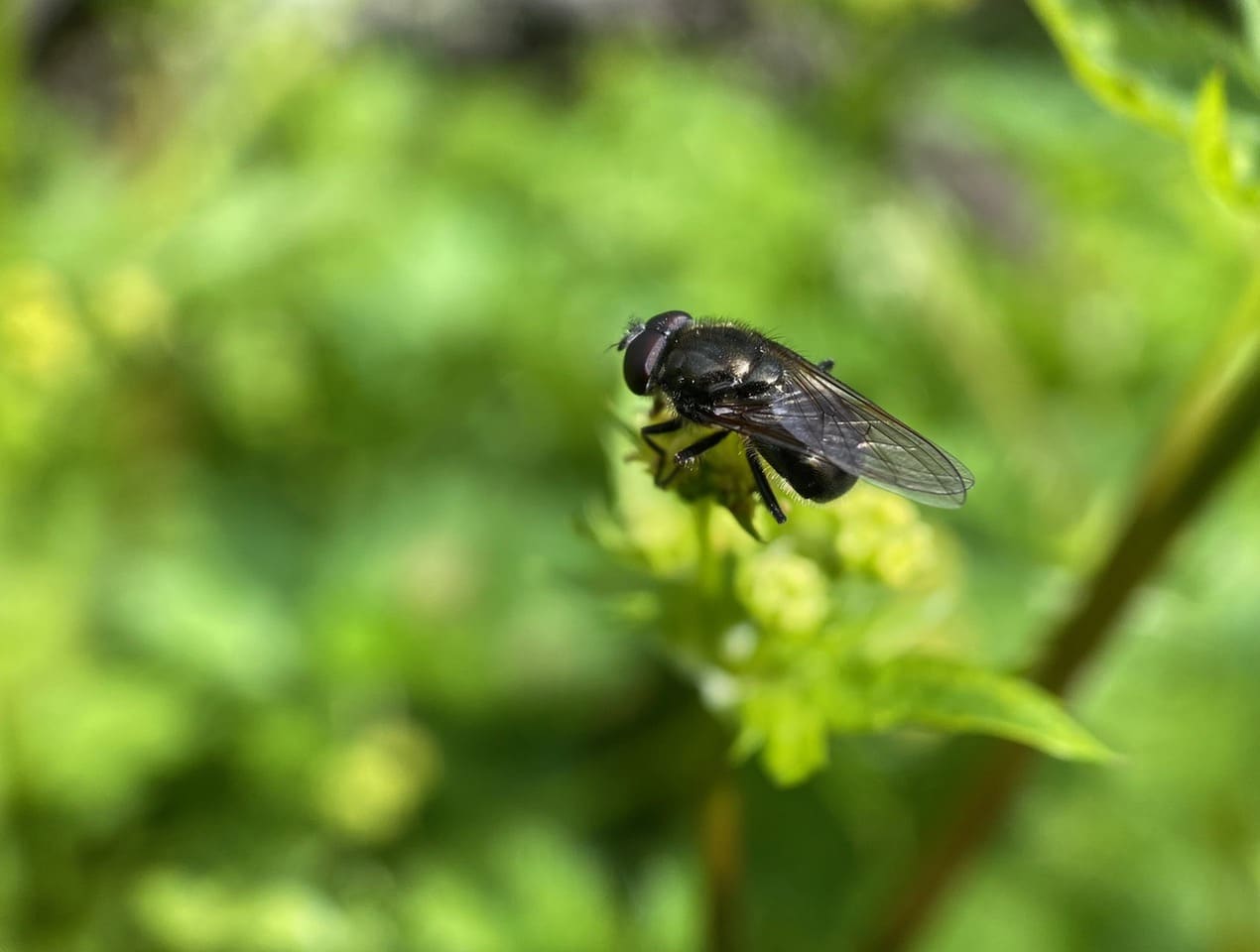
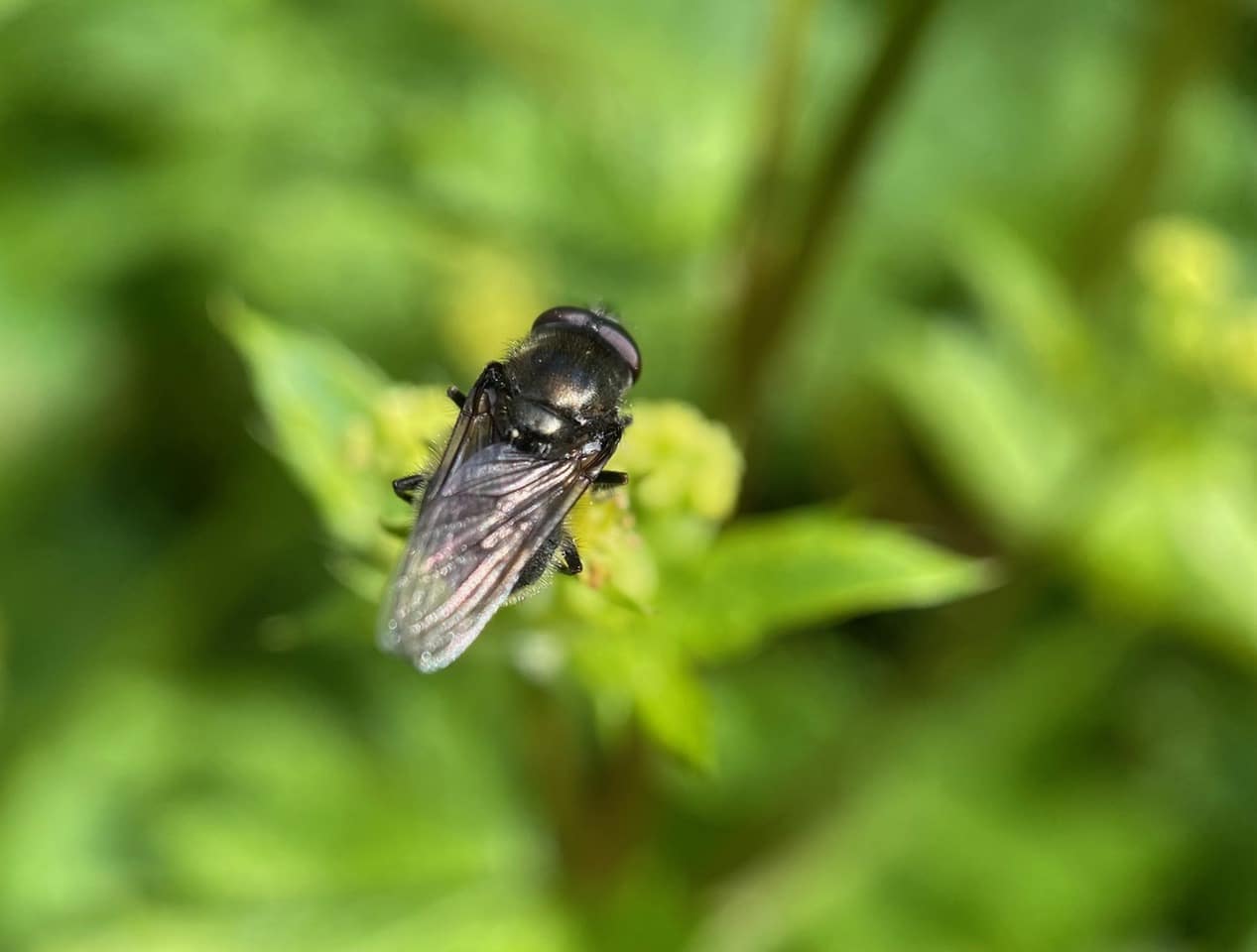
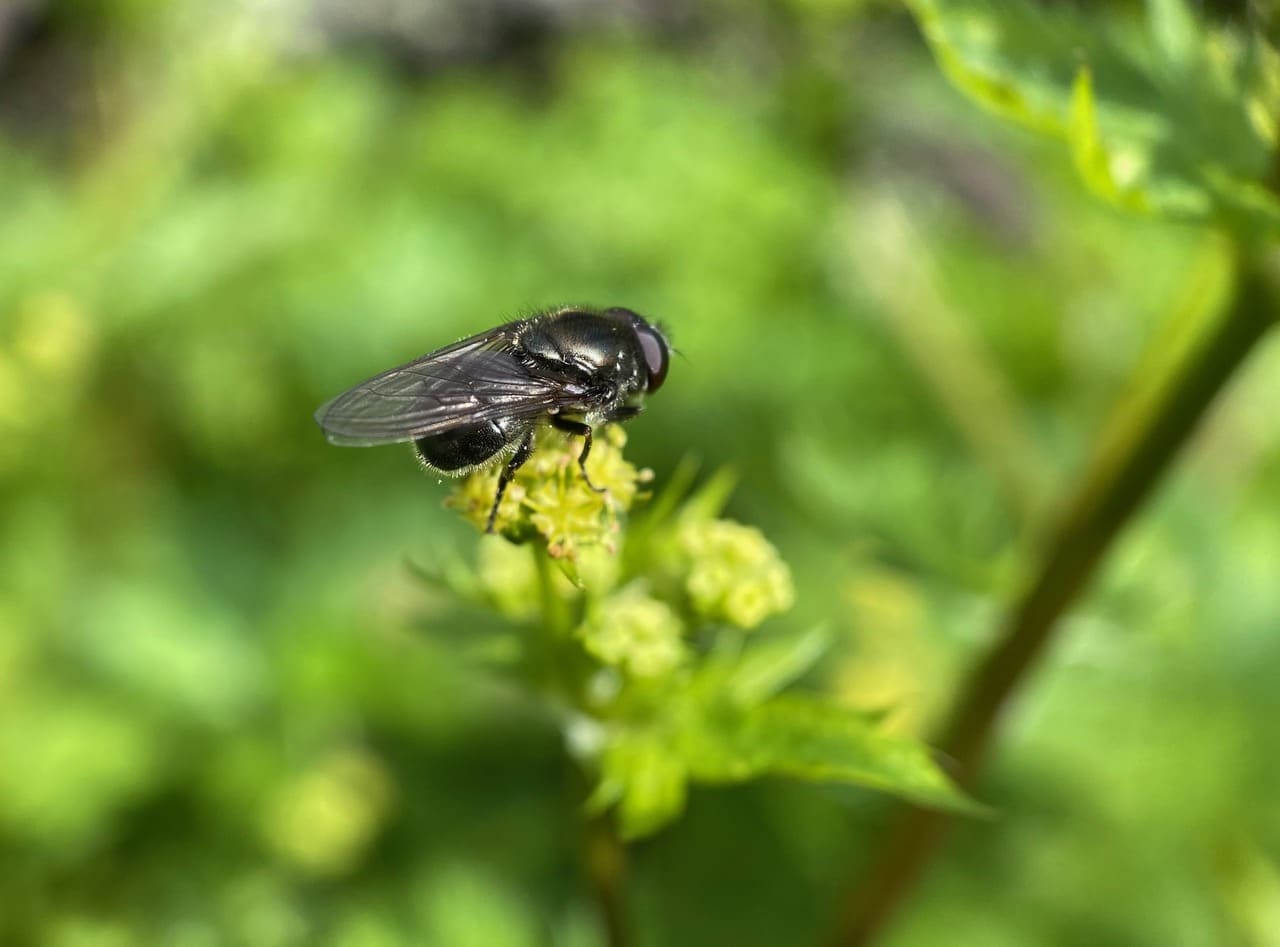
Although the Pacific Sanicle, Sanicula crassicaulis looks somewhat scraggly this year, the plants are blooming reasonably well. The tiny yellow flowers are borne in small compact, rounded clusters. About half of the flowers are bisexual, the rest male, but the two types are difficult to distinguish without magnification. The flowers are radially symmetrical with five petals. The tips of the petals curl inward, never unfurling fully. There are five pale yellow stamens that curl inward before maturity and extend well beyond the petals when mature. Gathering pollen should be easy for insects because of the fully exserted anthers. A glossy black fly has landed on a cluster of flowers on a Pacific Sanicle.
There seems to be little color or markings on the fly. Just plain black!
It is an unusual hoverfly that eschews the yellow-and-black color scheme of most Syrpids – the Blacklet, Cheilosia sp. (family Syrphidae).
Blacklets tend to hold their wings folded over their wings, instead of spread out at an angle, fighter-jet style. Although it is one of the most species diverse genera of Syrphidae, its biology is little understood. Where known, the larvae of Cheilosia species feed in the stems of plants or in fungi.
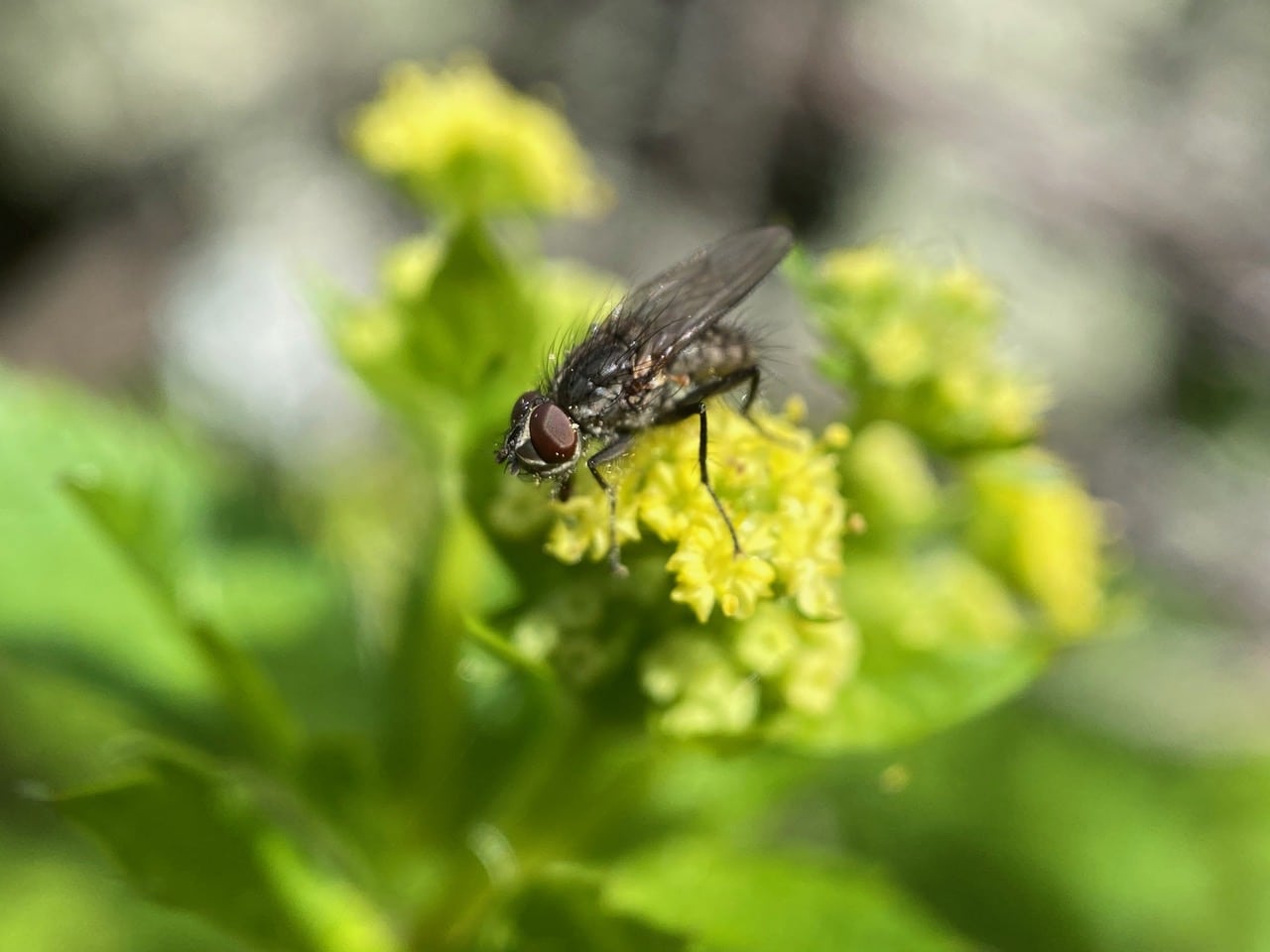
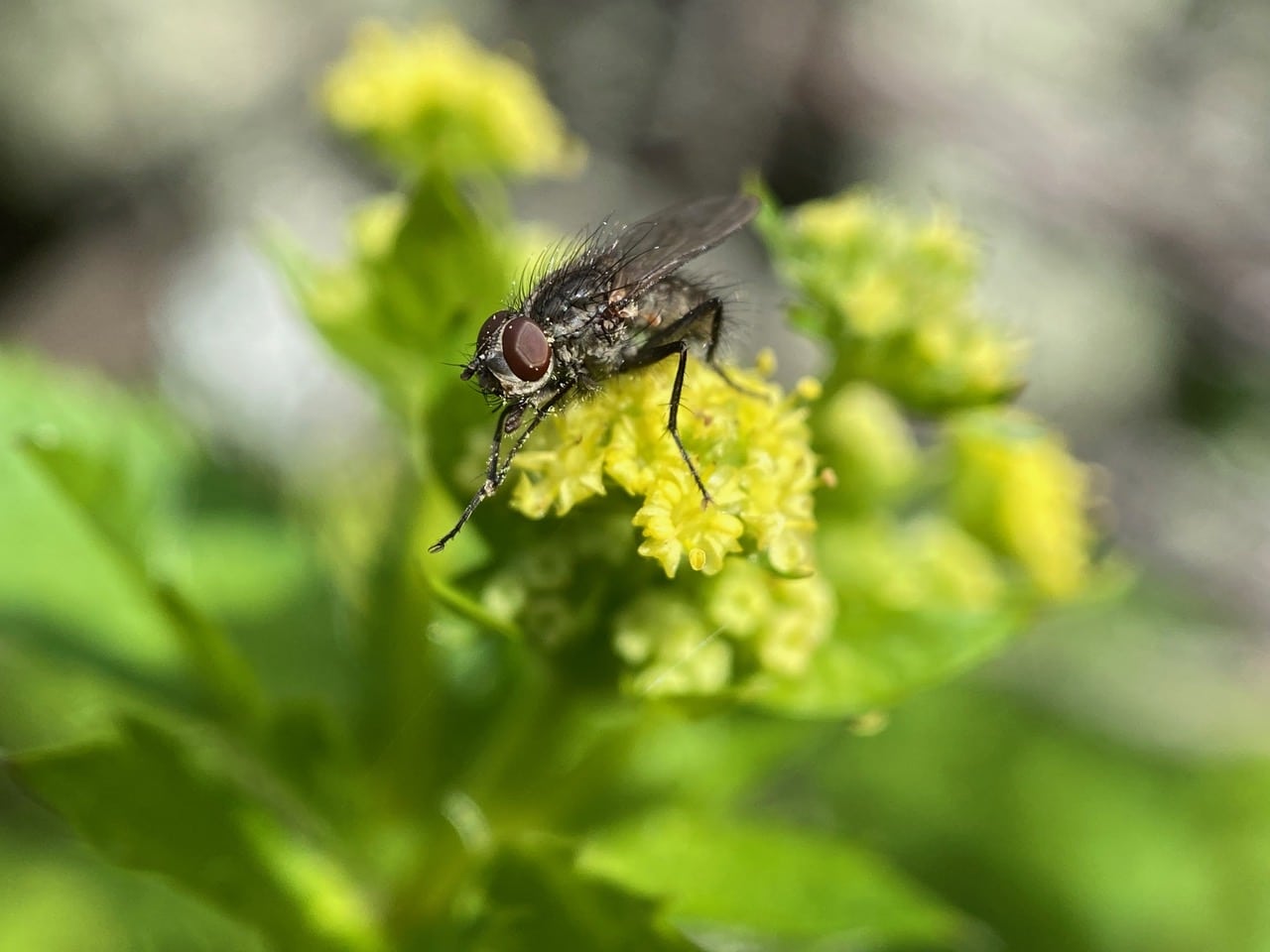
Here’s a different fly on the flowers of Pacific Sanicle, Sanicula crassicaulis. It is a Root Maggot Fly (family Anthomyiidae).
With its proboscis extended, the fly is feeding on nectar. The Root Maggot Flies (family Anthomyiidae) are small to medium-size flies that resemble house flies but are somewhat more slender. They are usually dull gray or black and silver in color. The larvae typically feed in stems and roots of plants. Many are considered crop pests, and may attack root crops such as onions or rutabagas. Other species may feed on decaying matter, on feces, or are predators of other insects. Adult flies are important pollinators, usually feeding on nectar and pollen.
Covered with scattered pollen, the fly grooms itself with its front legs before flying off. It is easy to see why these hairy flies are good pollinators.
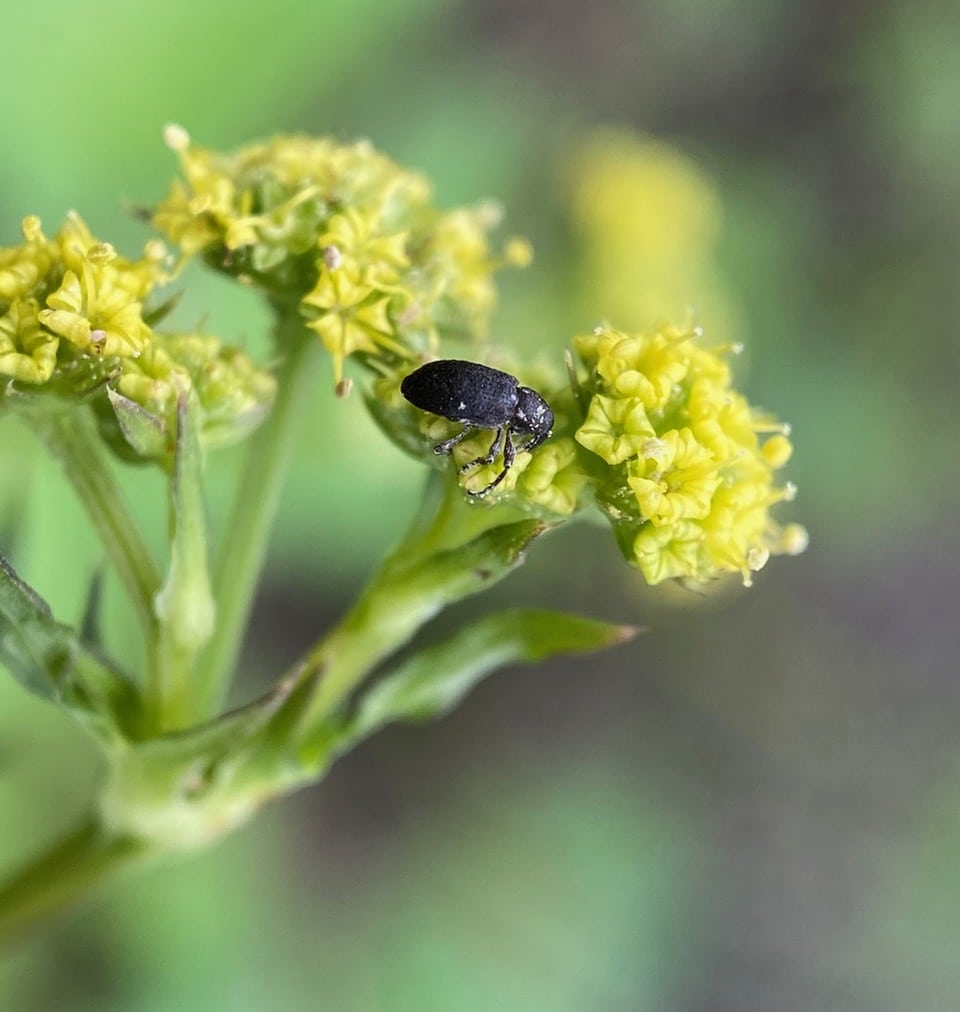
Ooh, a tiny black Weevil on the inflorescence of Pacific Sanicle, its snout partially buried among the flowers. I have been anticipating these weevils, so common on the Sanical through the bloom season last year, always covered with pollen. I have never seen them fly, and wonder if they are flightless. They tend to drop to the ground when approached by my camera. iNaturalist has not been successful in identifying this beetle beyond the family Curculionidae (Weevils).
What is this Weevil doing on a flower that is already going to seed? Note that the flowers in this cluster have lost their anthers, and the swollen ovaries are visible at the base of the styles. The flowers are unlikely to offer any nectar or pollen at this stage. Is the Weevil laying eggs? Do the larvae feed on the seeds of Pacific Sanicle?
Weevils, family Curculionidae, are also called snout beetles. Curculionidae is one of the largest beetle families (about 40,000 species). Most weevils have long, distinctly elbowed antennae that may fold into special grooves on the snout. The snout is used not only for penetration and feeding but also for boring holes in which to lay eggs. The mouthparts are quite small and located at the end of the rostrum (snout), designed for chewing. Many weevils have no wings, while others are excellent fliers. Most are less than 6 mm in length. The majority of weevils feed exclusively on plants. The fleshy, legless larvae of most species feed only on a certain part of a plant – i.e., the flower head, seeds, fleshy fruits, stems, or roots. Many larvae feed either on a single plant species or on closely related ones. Adult weevils tend to be less specialized in their feeding habits. The family includes some very destructive agricultural pests.
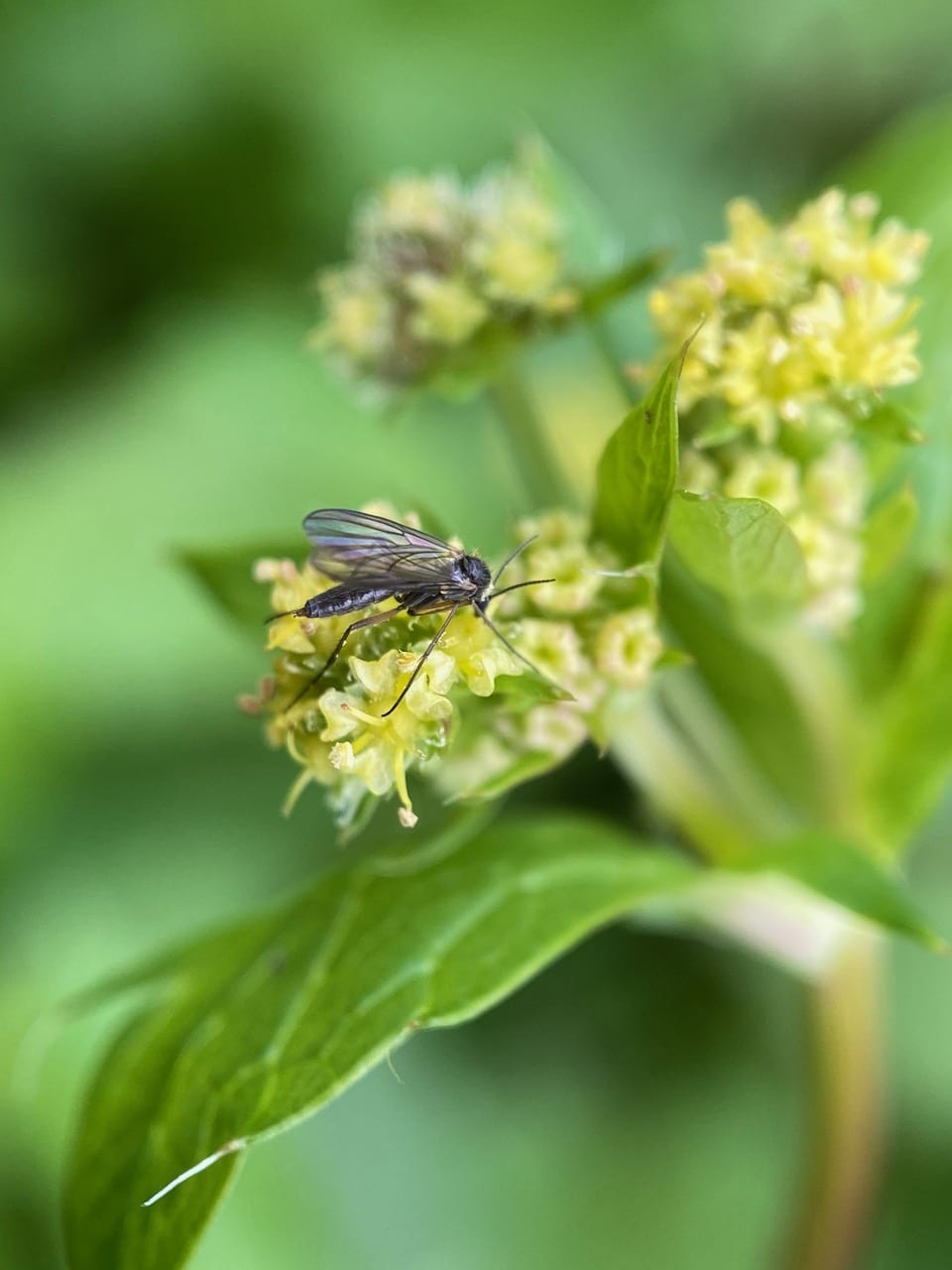
A gnat lands on a cluster of Pacific Sanicle flowers, Sanicula crassicaulis. It belongs to the superfamily Sciaroidea that includes the Fungus Gnats and Gall Midges.
As nematoceran flies, sciaroid adults generally have long segmented antennae, while their larvae have a well-developed head and mouthparts. Most fungus gnats live in forests with their larvae occurring in fungi, dead wood and soil. The larvae of Mycetophilids form plant galls.
Yikes, a nymphal tick is questing on the tip of a Pacific Sanicle leaf!
As we have seen earlier, ticks like to wait in ambush along well-used paths, resting on the tips of vegetation. Ticks can’t fly or jump, but many species wait in a search position known as “questing”. Holding onto leaves or grass by their third and fourth pair of legs, they hold the first pair of legs outstretched, waiting to climb on to a passing host. When a host brushes the spot where the tick is waiting, it quickly climbs aboard.
Capable of transmitting various diseases through their bite, ticks are a nuisance to those of us who spend time in the wilds. Surely they must serve a larger ecological role that eludes us? What good are tick?
The tiny blood-sucking parasites benefit the ecosystem in which they live by serving as food for other species such as reptiles, amphibians, and birds. Many Woodland animals feed on them, including wild turkeys and western fence lizards.
By transmitting diseases to their hosts, ticks contribute to their major evolutionary role of controlling the populations of various animals all around the globe. The diseases ticks transmit help weed out sick and infirm individuals in the host populations, giving more space and opportunities for younger and healthier animals to thrive, keeping host populations within the carrying capacity of the land. Like it or not, ticks are a leading participant in the natural selection process of a number of animal species. They are even used as an indicator of an ecosystem’s overall health and stability.