

Pollinator Post 3/26/26/ (3)
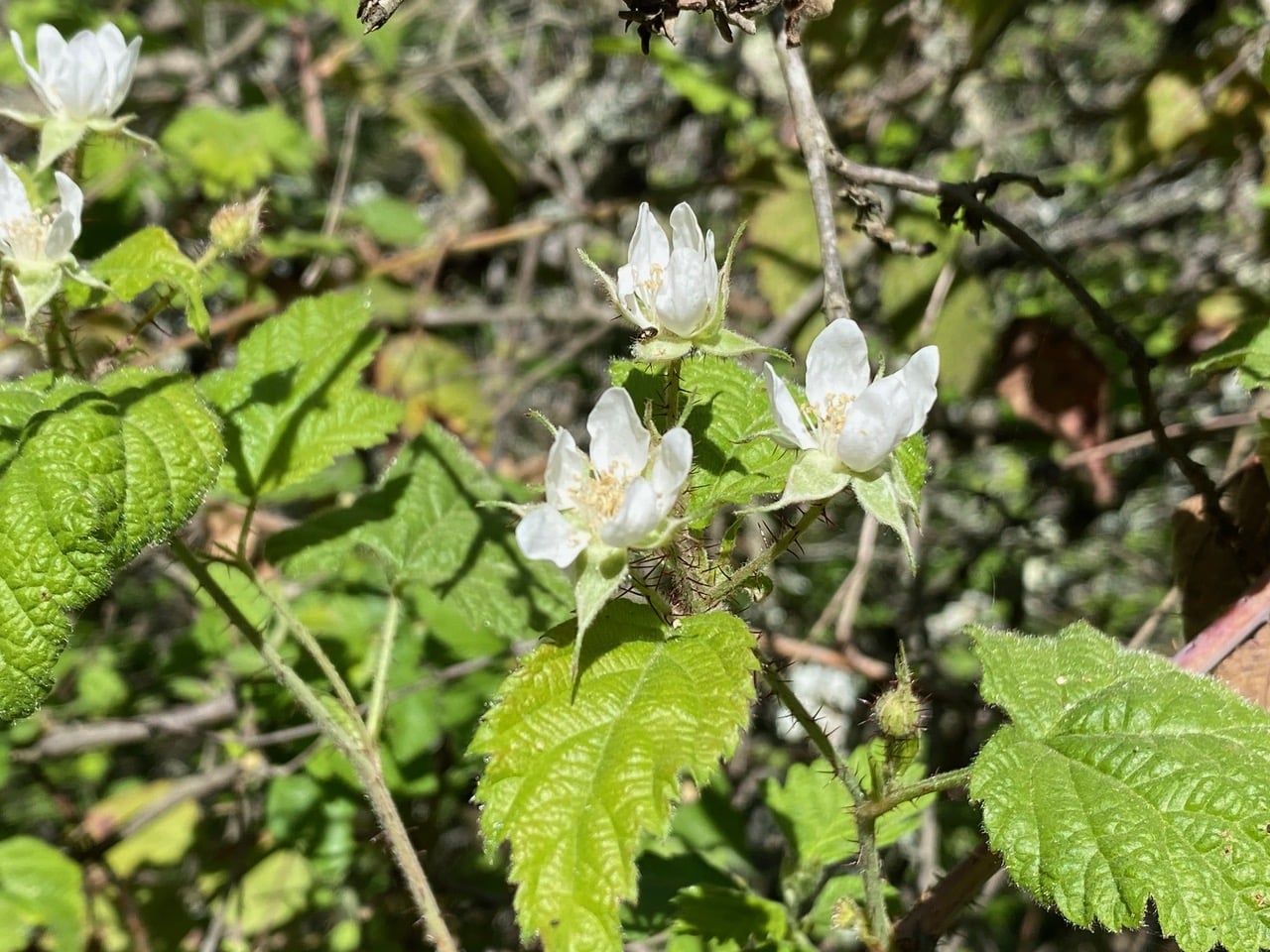
California Blackberry, Rubus ursinus is blooming well along the side of West Ridge Trail. This plant appears to be male, as its flowers have numerous stamens. California Blackberry is dioecious, with male and female flowers borne on separate plants. While both sexes produce nectar, only the male flowers offer pollen to visiting pollinators. However, male flowers do not have ovaries and will not yield any berries.

Barely a glint to the naked eye, a Bronze Leaf Beetle, Diachus auratus (family Chrysomelidae) crawls out of a flower of California Blackberry, its elytra covered in pollen grains.
The Bronze Leaf Beetle, Diacus auratus (family Chrysomelidae) is a small, shiny, “bullet-shaped” beetle that feeds on the leaves, flowers, and fruits of plants, particularly berry crops such as strawberries, raspberies, and blackberries. It is a species of case-bearing leaf beetle in the subfamily Cryptocephalina, known for larvae that create cases out of feces and debris. The species is widespread in North America, as well as parts of Central and South America, Australia, and Asia. Adults, 1-2 mm, are found on many unrelated plants, especially plants in bloom. The larvae live underground and feed on the roots of plants, specifically grass and clover. As she lays her eggs, the female covers each one with a layer of excrement. After the larvae hatch, they retain this covering (case) as camouflage and add to it throughout their larval life. When disturbed, the larvae pull in their head and legs; because their color and shape resemble caterpillar droppings they are ignored by predators. Eventually the larva seals the case to pupate inside, before emerging as an adult. Some species are myrmecophiles, living near or even inside ant nests.
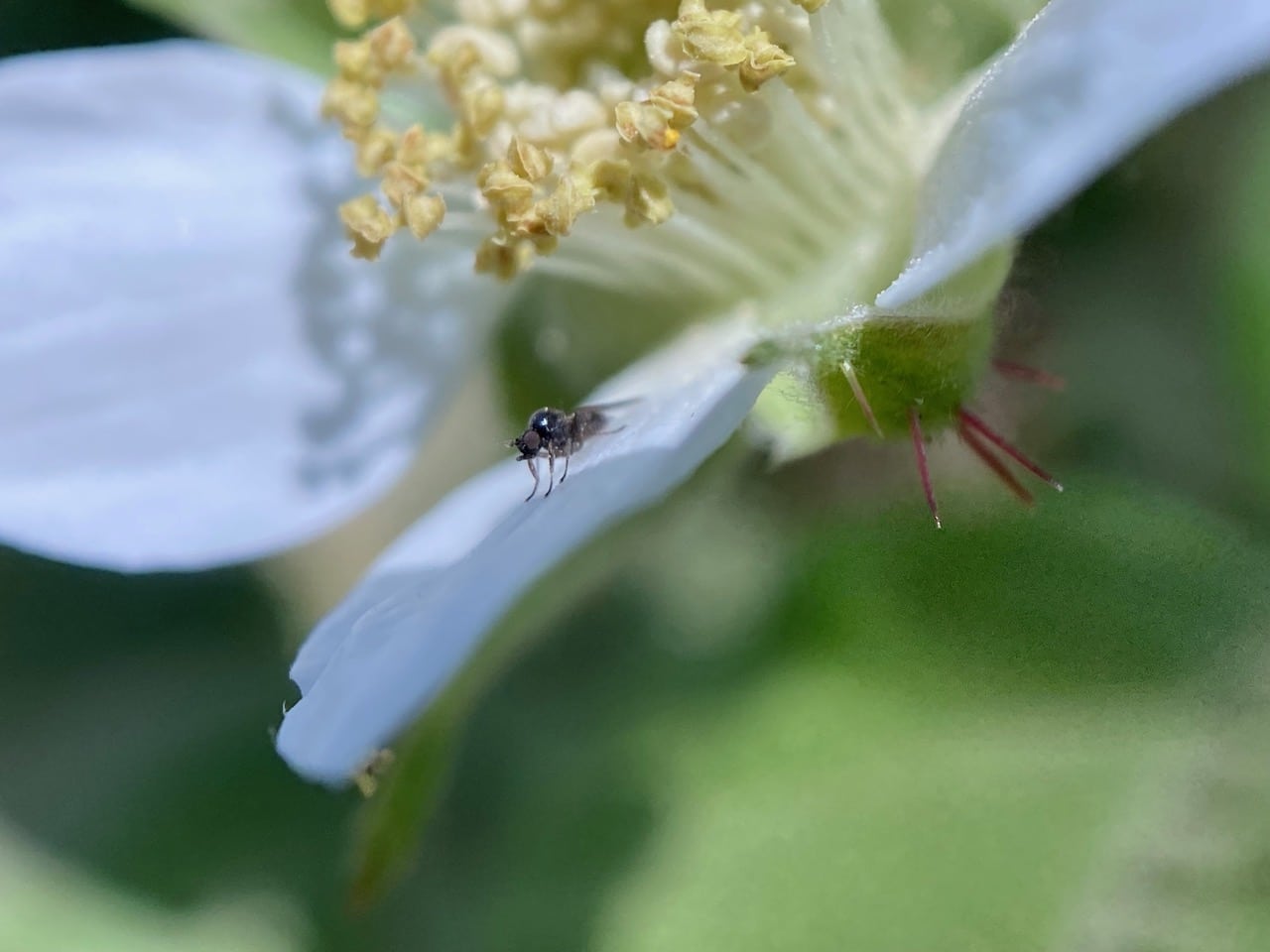
A tiny Hybotid Dance Fly, Anthalia sp. (family Hybotidae) is perched on a petal of California Blackberry. Note the spent anthers of this male flower.
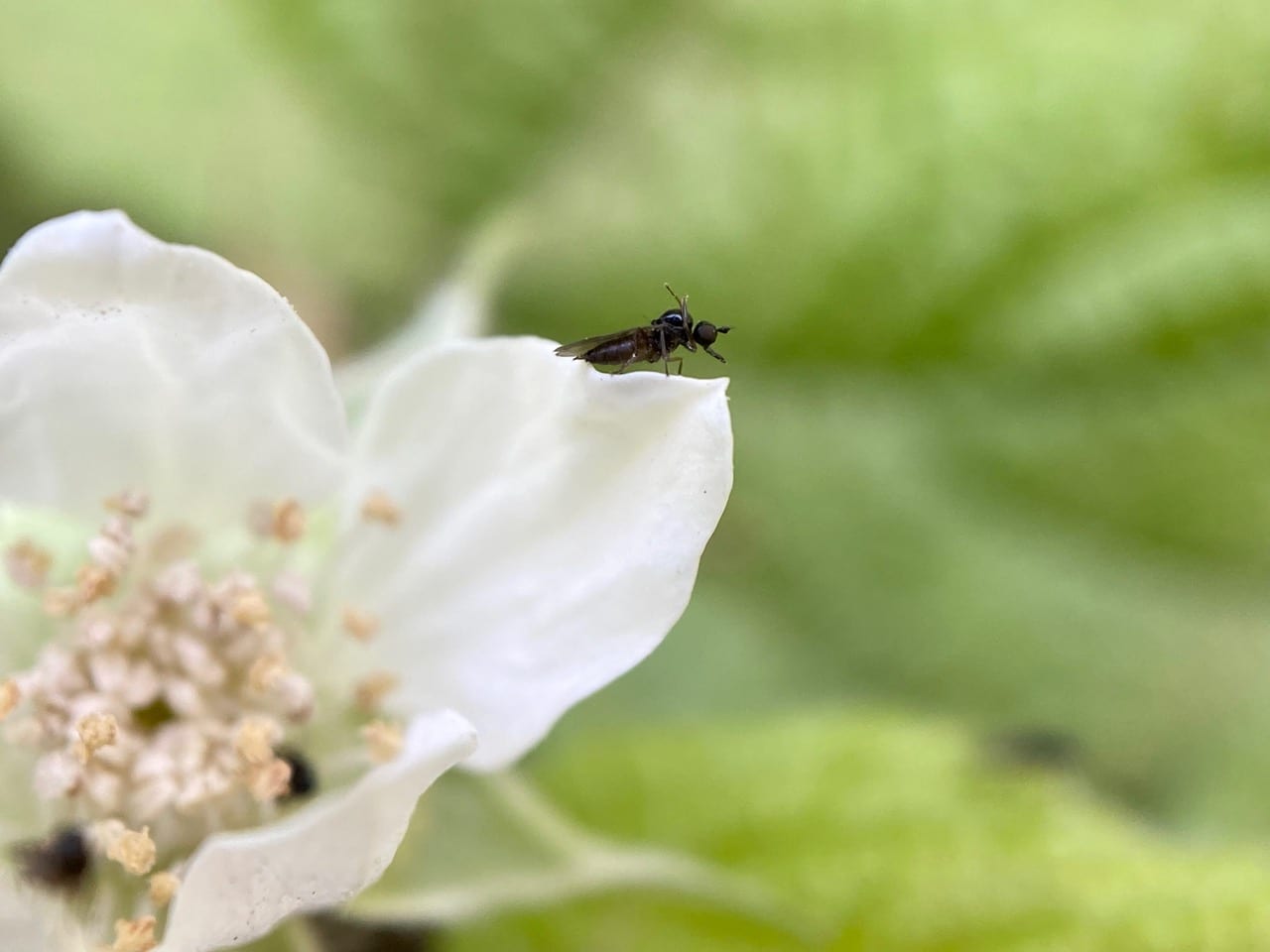
Another Hybotid Dance Fly, Anthalia sp. (family Hybotidae) is perched on the tip of a blackberry petal, grooming itself.
The Hybotid Dance Flies belong to the superfamily Empidoidea and were formerly included in the Empididae as a subfamily. Empididae generally have a thick beak pointing down, while Hybotidae have a thinner beak, or a thick beak pointing forwards or diagonally. Some crucial wing venation further distinguishes the two families. Precious little is known about the life cycle and biology of Hybotids because they are not considered of economic consequence. Some Hybotids, such as the genus Anthalia are known to eat pollen. I have seen Hybotids visit flowers for nectar and pollen, notably on Soap Plant, Miner’s Lettuce, California Saxifrage, Wild Geranium, Hound’s Tongue and Buttercups, and I believe they may contribute significantly to the pollination of these small wildflowers.
Why the name “dance fly”? This is derived from the mating swarms of males of many species. They gather in clouds over prominent objects, each individual seeming to bounce or “dance” in mid-air. Many other flies do this, notably midges, but the Empidids and the Hybotids got the moniker.
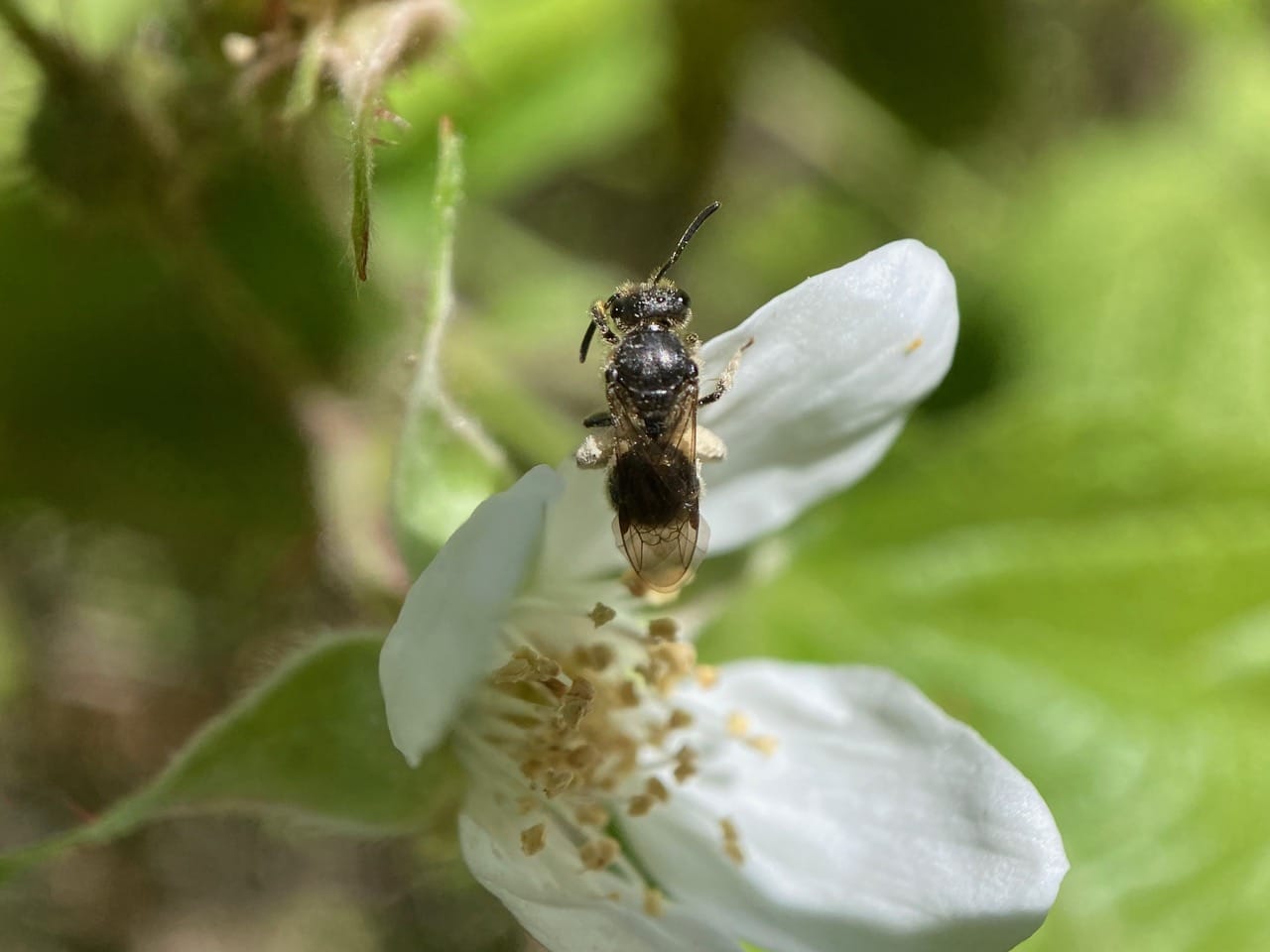
Perched on a blackberry petal, a tiny black bee is cleaning its antennae. It appears to be a Mining Bee in the family Andrenidae. The pollen in the female’s scopae (on her hind legs) seems to be clumped, not loose grains. I think she might belong to the genus Panurginus.
Panurginus is a genus of very small solitary mining bees (typically 5-8 mm) belonging to the family Andrenidae. The bees are generally black, often shiny, with sparse hair. These bees are found in the Northern Hemisphere, common across the United States and Canada, particularly in the West. They are known for nesting in the ground and having two submarginal cells in their forewings.
Female Panurginus bees are specialized to moisten their pollen loads by adding nectar (and sometimes oil) during the collection process, creating a more compact, malleable load that is packed around their hind tibiae. Due to this behavior, pollen loads can appear “wetted” or moist. The scopal hairs on the hind legs used for transport are often relatively short and sparse because the moistened, packed pollen does not require long hairs to stay in place. Back at the nest, the females use the collected pollen and nectar mixtures to create food balls for their larvae.
All bees have an antenna cleaner on each of their two forelegs. The antenna cleaners consists of two parts: a notch in the basitarsus, which is fitted with stiff hairs, and a corresponding spur on the tibia. To clean its antenna, the bee raises its foreleg over its antenna and then flexes it tarsus. The action allows the spur to close the notch, forming a ring around the antenna. The bee pulls each antenna through the bristles to clean it of debris such as pollen or dust which might interfere with the many sensory organs within the antenna. A bee’s antennae serve numerous functions: smell, taste, perceive humidity and temperature, feel, monitor gravity and flight speed and even detect sound waves to help guide the bee in its daily activities.
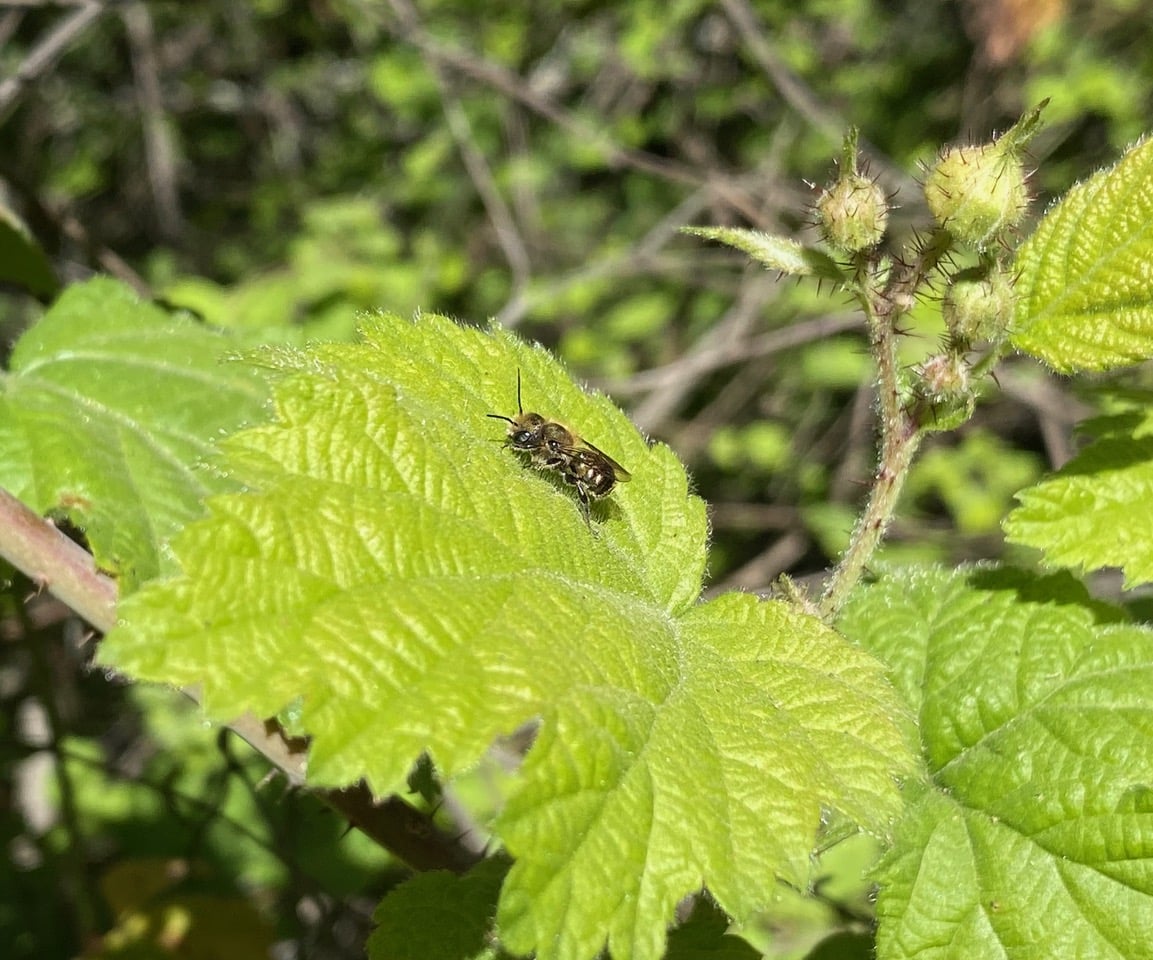
A compact, rounded, shiny little bee has landed on a Blackberry leaf. It appears to be a Mason Bee in the genus Osmia (family Megachilidae).
Mason Bee is a name commonly used for species of bees in the genus Osmia, of the family Megachilidae. Mason Bees are named for their habit of using mud or other “masonry” products in constructing their nests, which are made in naturally occurring gaps/cavities such as cracks in stones, hollow stems or holes in wood made by wood-boring insects. Osmia means ‘odor’, and refers to a faint lemony scent used by these bees to mark their nest entrances. Osmia species are frequently metallic green or blue. Females have black ventral scopae (special pollen collecting hairs) on the underside of their abdomen, which are difficult to see unless laden with pollen. Ventral abdominal scopae is a feature shared by all members of the Megachilidae family, which include the wool-carder bees (genus Anthidium), and leaf-cutter bees (genus Megachile).
Mason Bees are a solitary species and are non-aggressive. Every female is fertile and makes her own nest. Each nest cell is provisioned with pollen and contains one egg which will develop into a larva. The female creates a partition of mud between the nest cells. The process continues until she has filled the cavity. She plugs the entrance to the cavity, and then may seek another nest location. The larvae that hatch out consume their provisions and begin spinning a cocoon around itself and enters pupal stage. Adults mature in fall or winter, hibernating inside its cocoon.
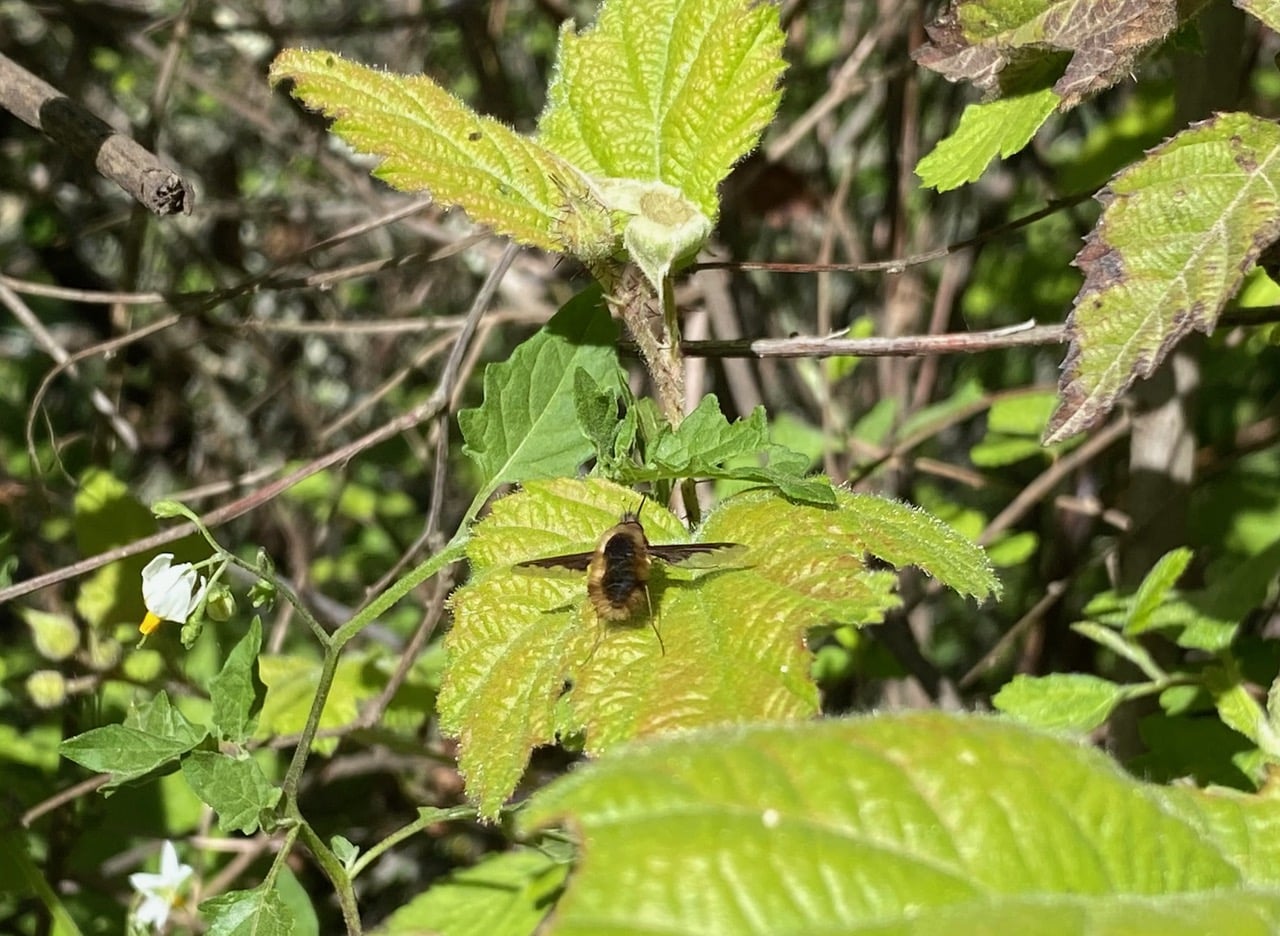
A Greater Bee Fly, Bombylius major (family Bombyliidae) is settling down on a blackberry leaf.
Bombylius major, commonly known as the Greater Bee Fly is a parasitic bee mimic fly in the family Bombyliidae. It derives its name from its close resemblance to bumble bees. Its flight is quite distinctive – hovering in place to feed, and darting between locations. The species has long skinny legs and a long rigid proboscis held in front of the head. Bombylius major is easily distinguished from the other local species of Bombylius for having wings with dark leading edge, hyaline trailing edge with sharp dividing border. This feature is visible even as the fly is hovering. Adults visit flowers for nectar (and sometimes pollen) from a wide variety of plant families, excelling at small tubular flowers, and are considered good generalist pollinators. Often the pollen is transferred between flowers on the fly’s proboscis.
The bee fly larvae, however, have a sinister side. They are parasitoids of ground-nesting bees and wasps, including the brood of digger bees in the family Andrenidae. Egg deposition takes place by the female hovering above the entrance of a host nest, and throwing down her eggs using a flicking movement. The larvae then make their way into the host nest or attach themselves to the bees to be carried into the nest. There the fly larvae feed on the food provisions, as well as the young solitary bees.
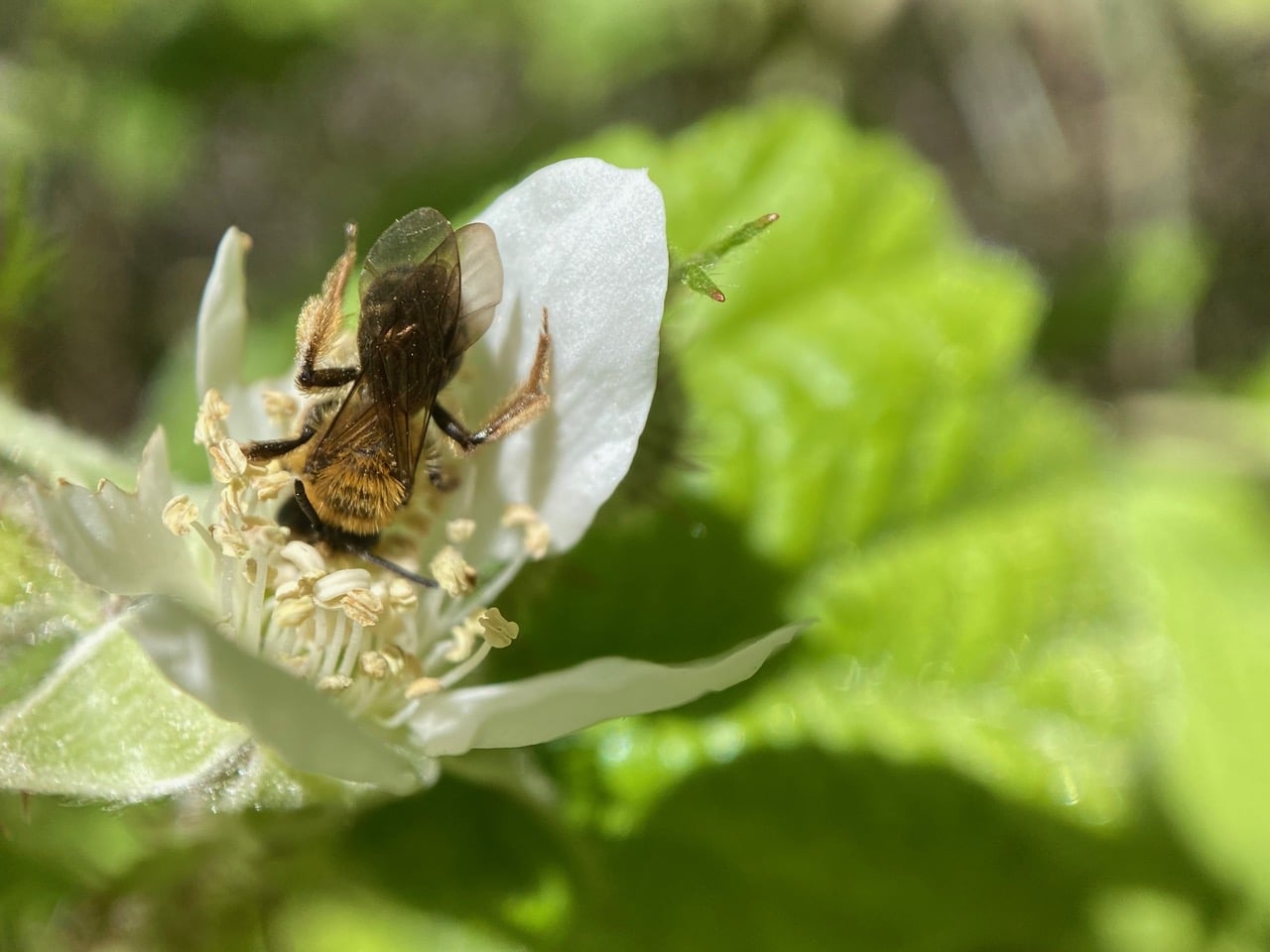
A large Mining Bee (family Andrenidae) with coarse golden hairs on its thorax is foraging on a male California Blackberry flower.
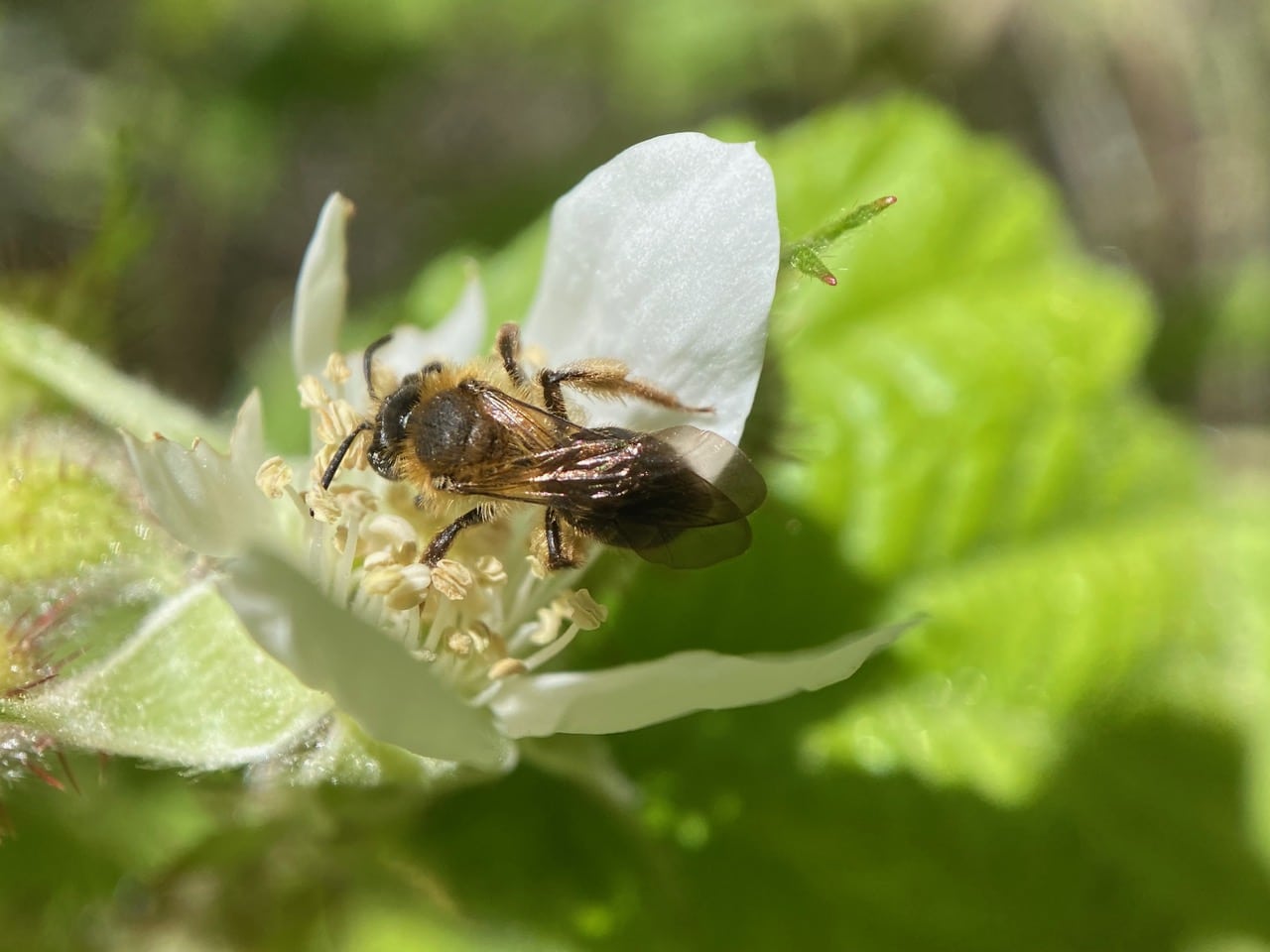
Bees in the family Andrenidae, commonly called miner bees or mining bees, are solitary ground-nesters. Andrenids are fairly small bees, usually dark-colored, and often banded. They are identified by the dense bristles (scopae) at the bases of the legs and the shin-like sections (tibias) of the legs, as well as by certain creases and grooves on the face and head and by unique wing venation. Many Andrenids resemble wasps – slender with long abdomen.
Most andrenids are specialist pollinators whose life cycle is timed to correspond precisely to the blooming of specific flowers. Because of this, andrenids are some of the first bees to emerge in spring, and many are active in March and April, as they visit early spring wildflowers.
All Andrena species share a distinctive facial characteristic: facial depressions called fovea resting alongside the sutures under each antenna. The foveae are covered with hairs that are sometimes described as looking like “sideways eyebrows”. Another distinguishing Andrena trait is that females appear as if they carry pollen under their “armpits”. This is because they have propodeal corbiculae in the space between their thorax and abdomen.
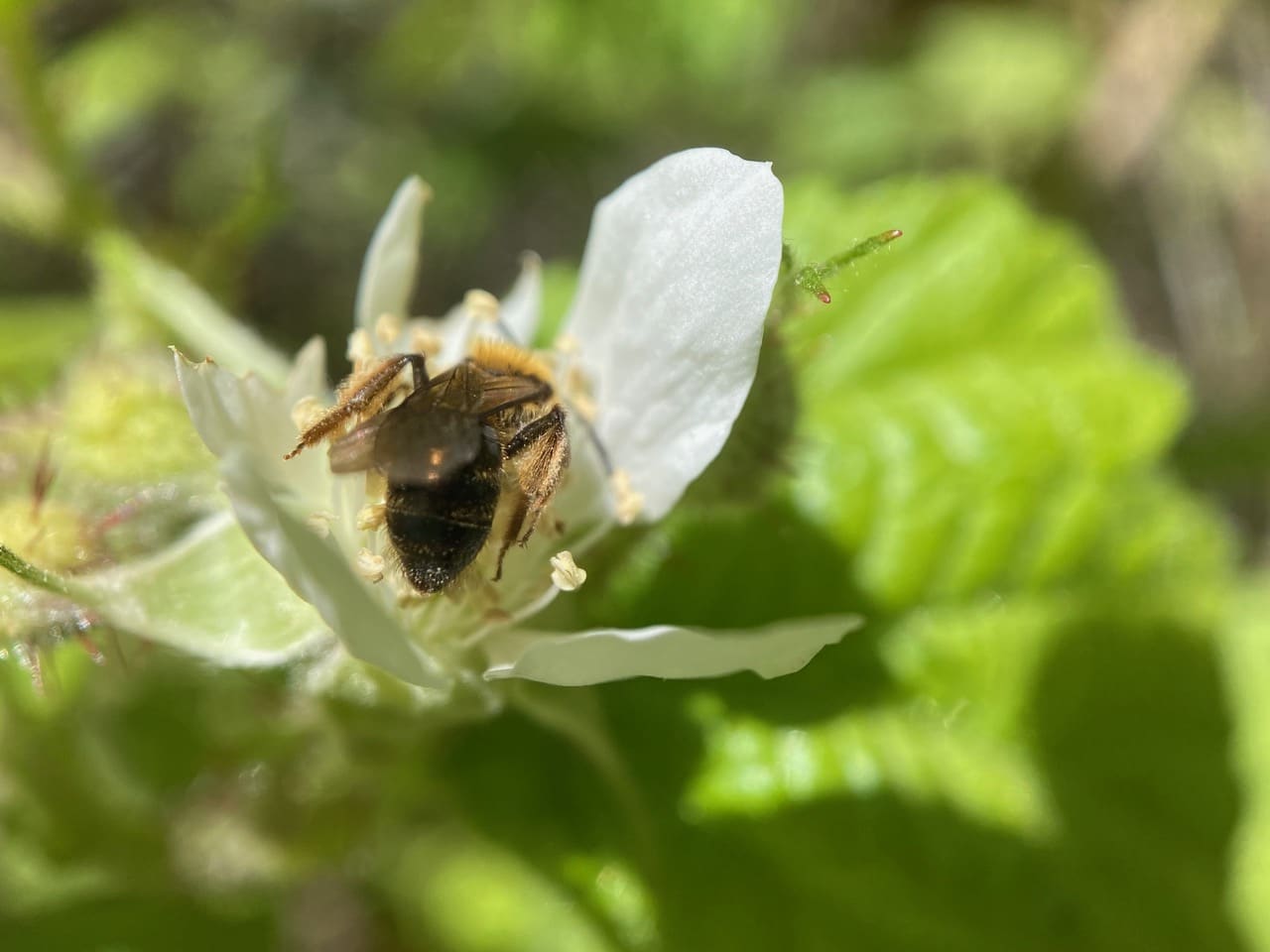
Note the long golden hairs on the scopae on the hind legs of this female Andrena.

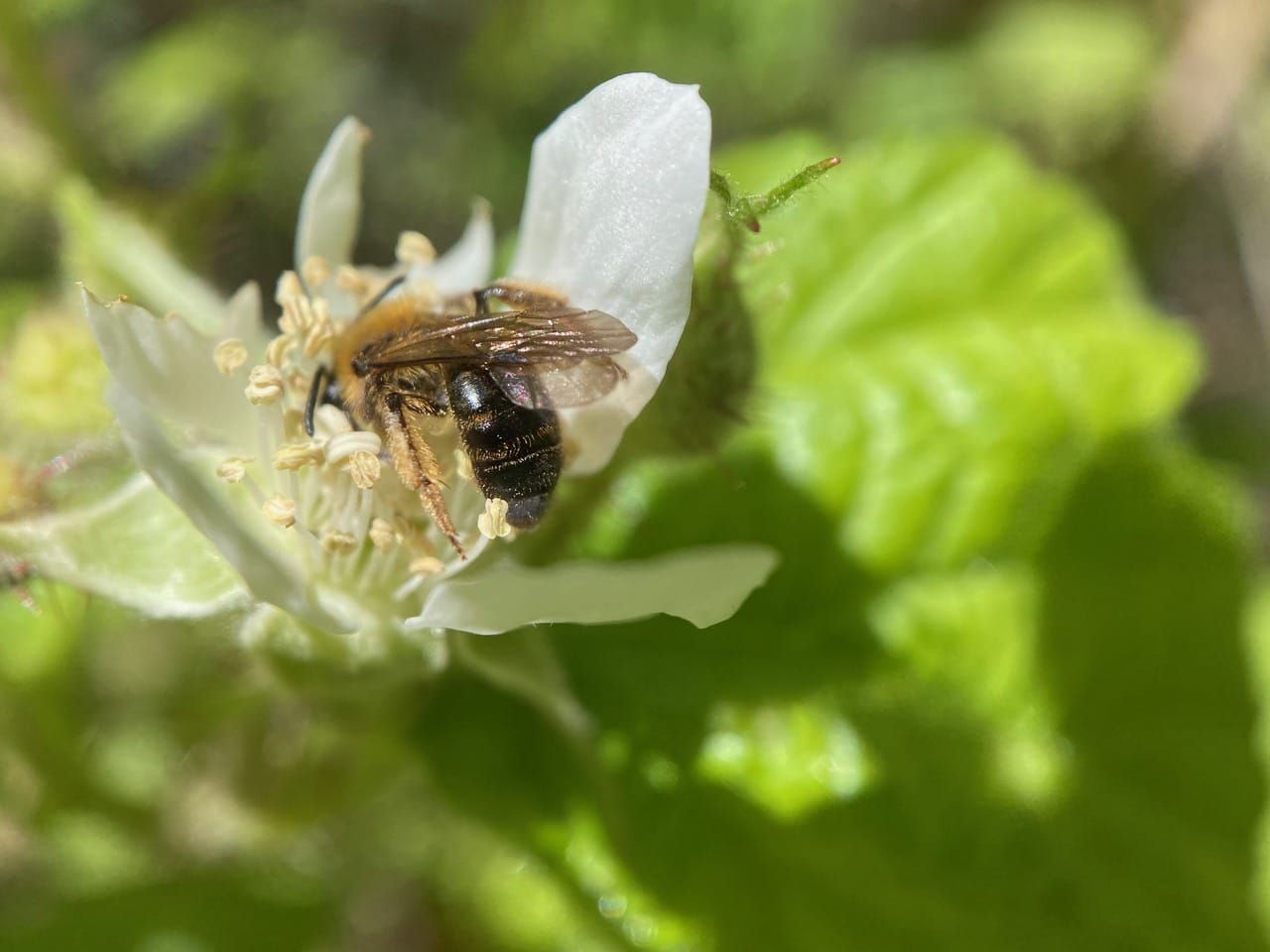
The bee’s scopae do not seem to be gathering pollen. Perhaps she’s only going for the nectar?


I watch as the same Andrena female fly to another blackberry flower.
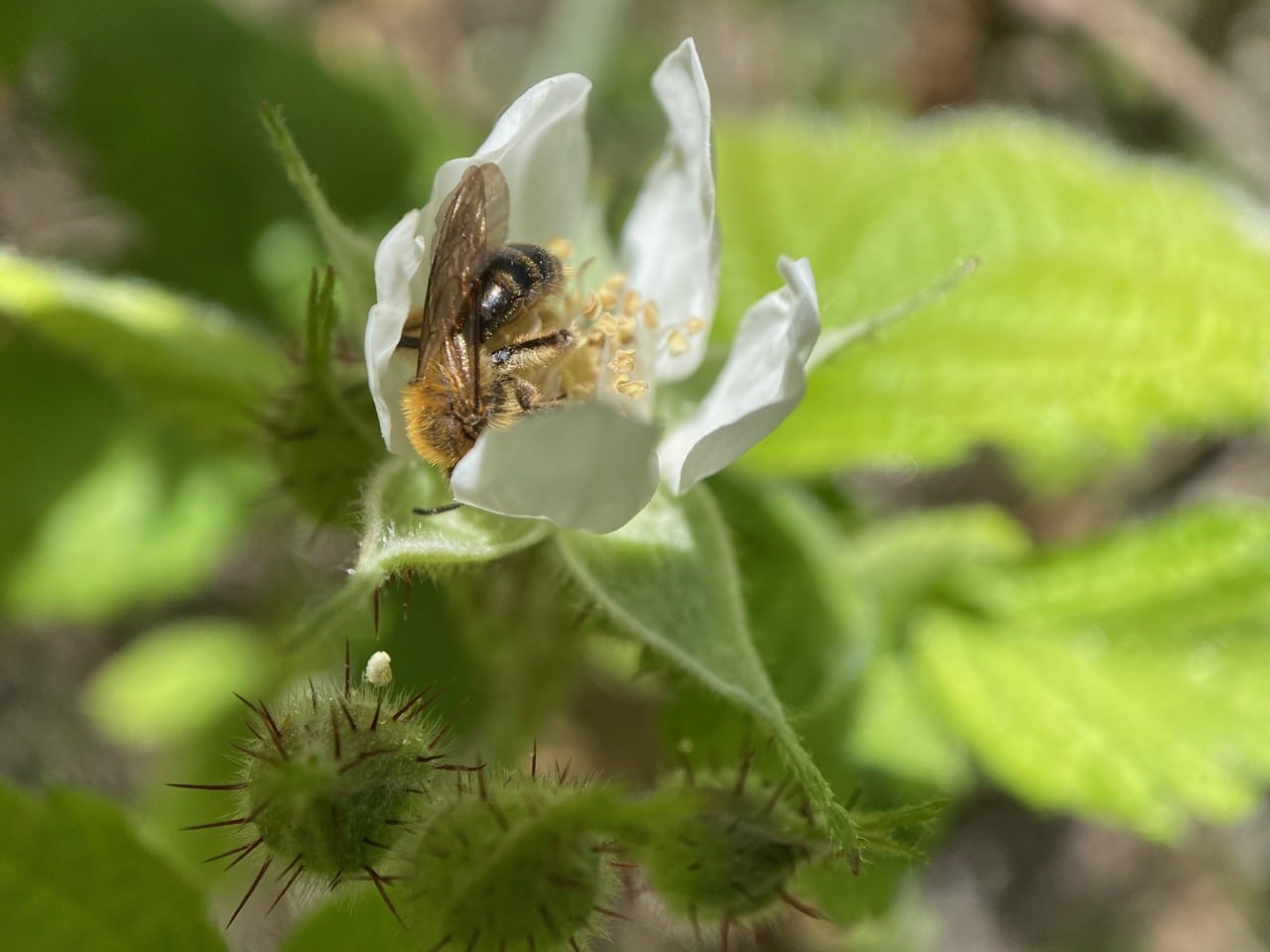
After diving down (probably for nectar at the base of the flower)….
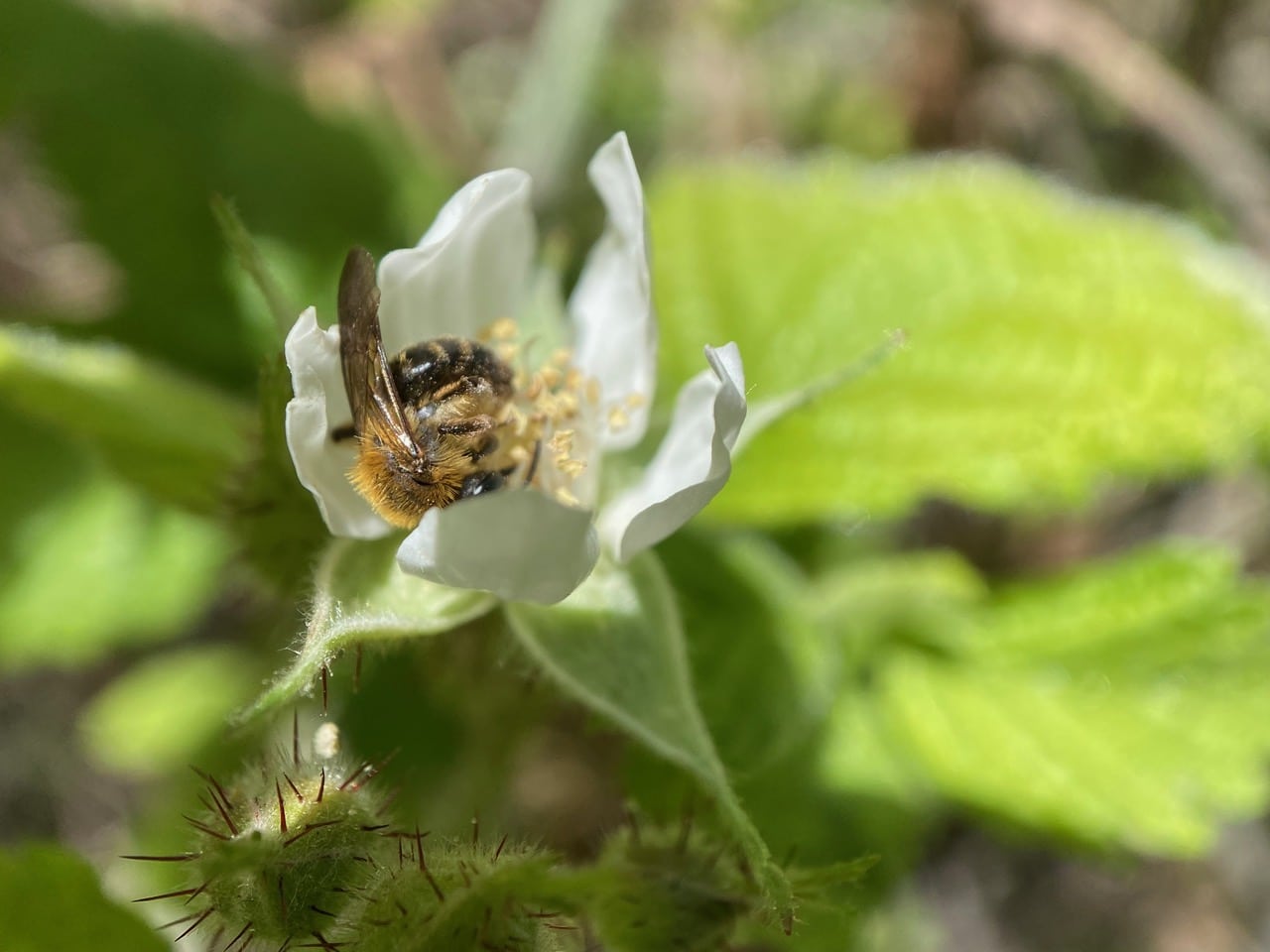
The Mining Bee begins to seriously collect pollen. She embraces several anthers, agitating with her legs to release the pollen ….
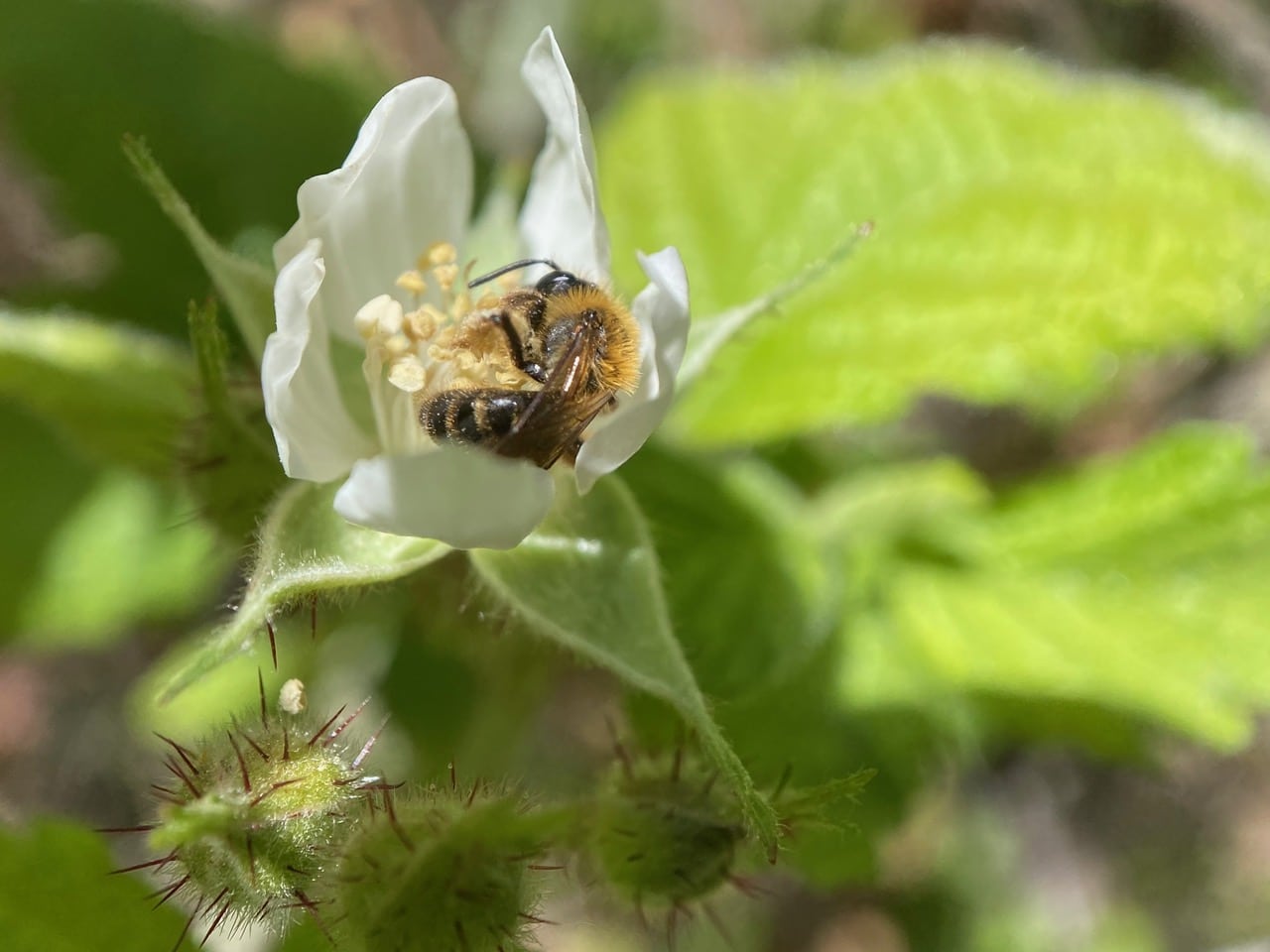
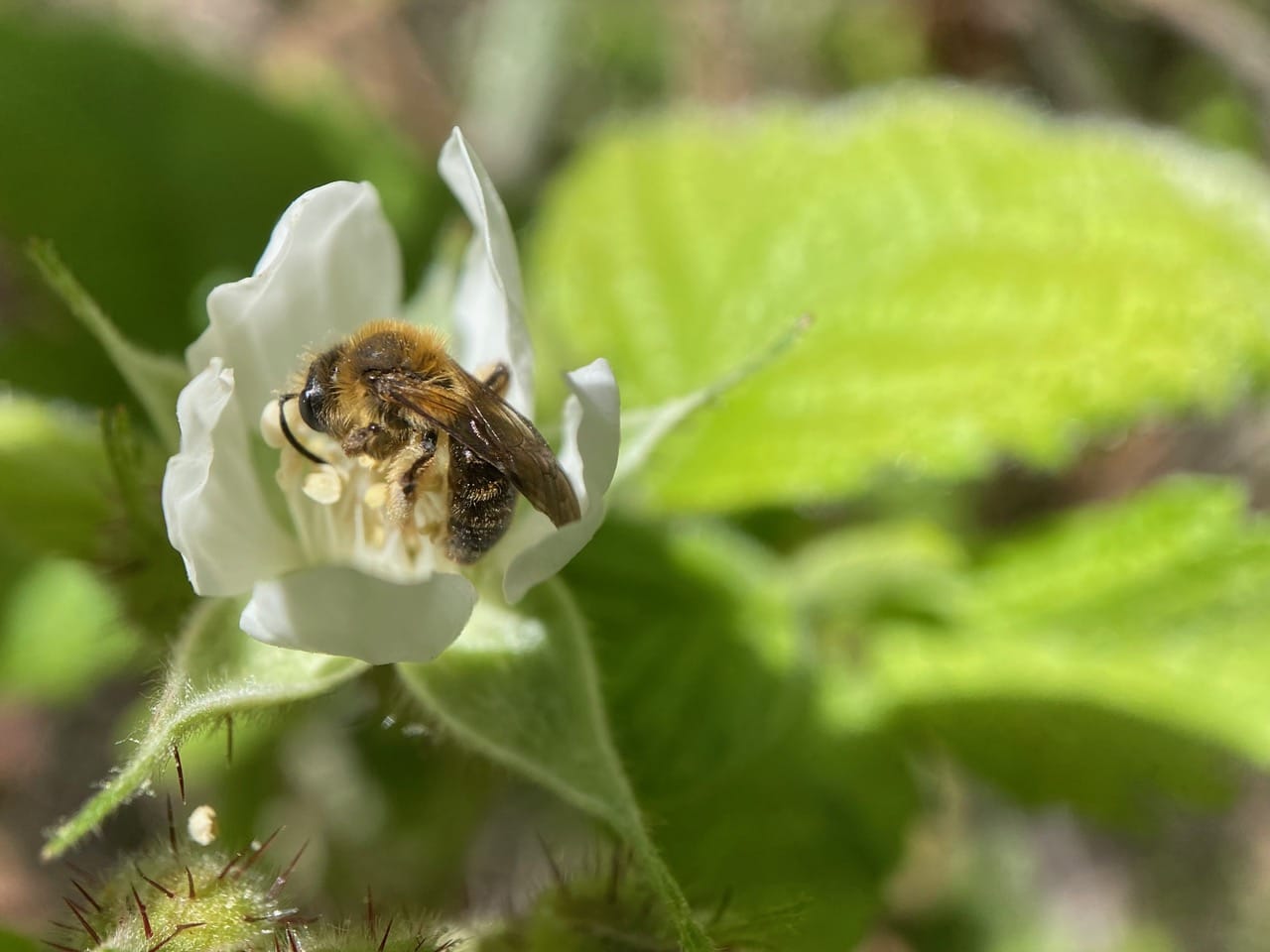
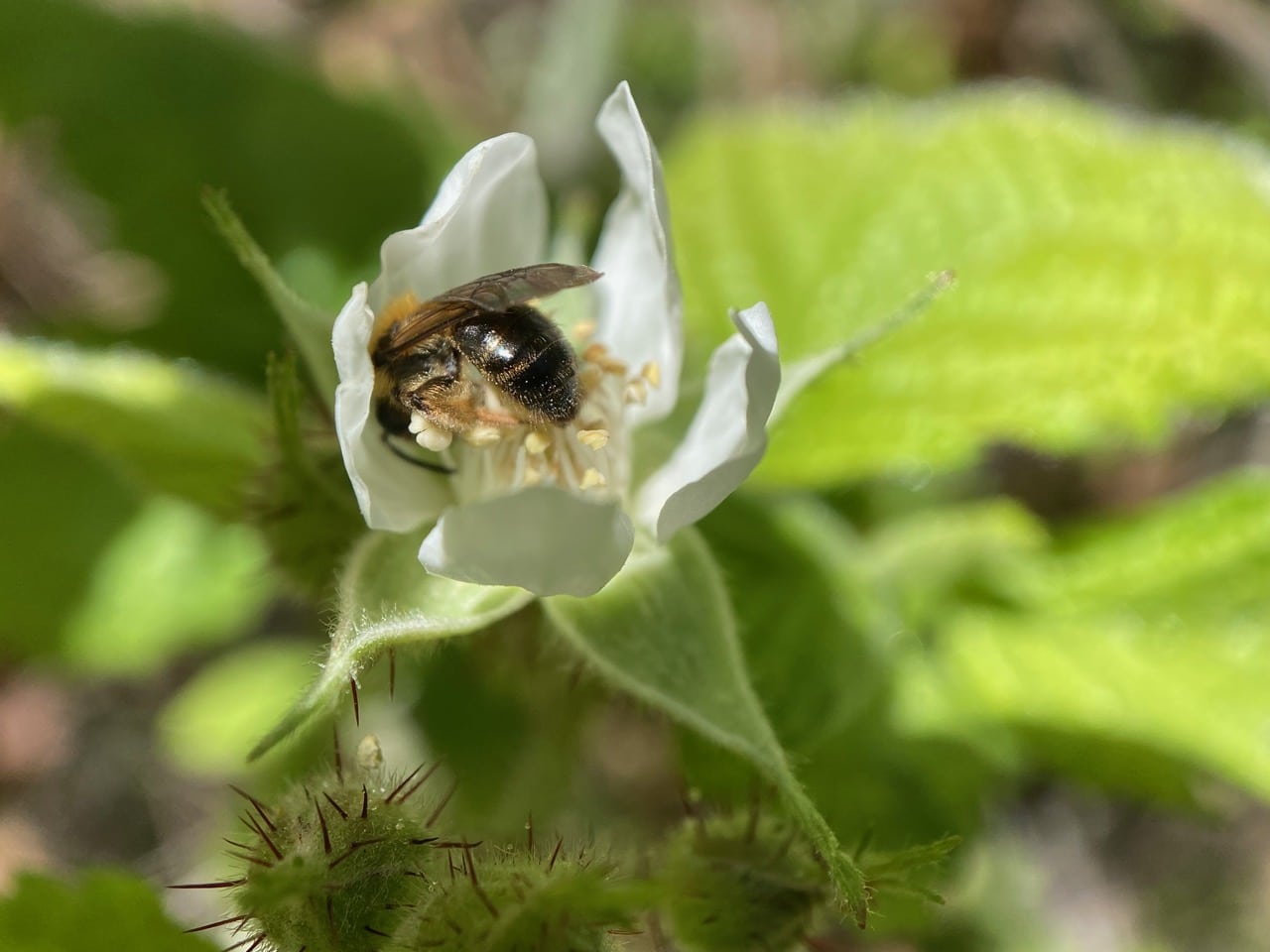
The bee does a rolling motion over the anthers.
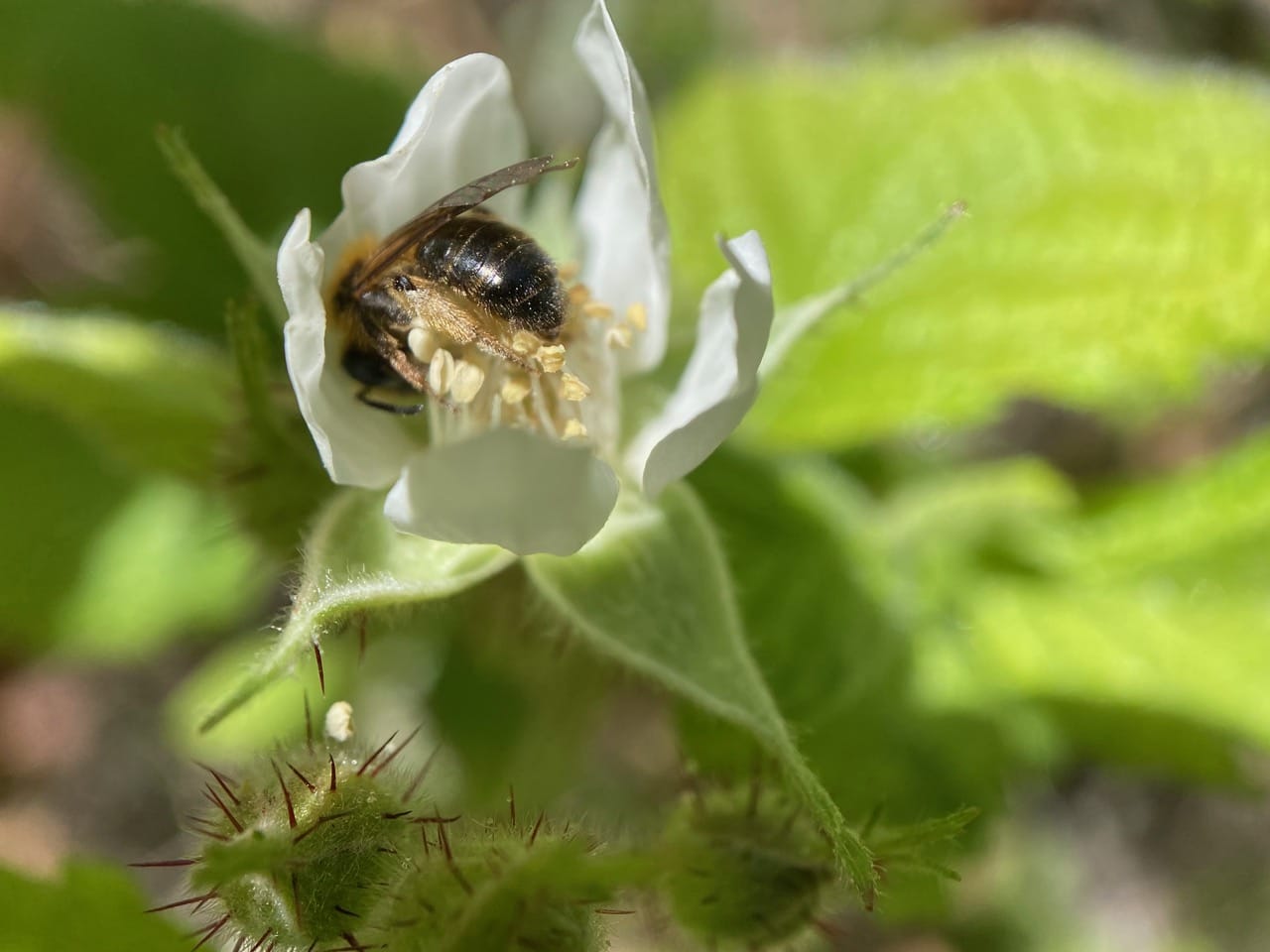
Pollen is accumulating on the bee’s scopa.
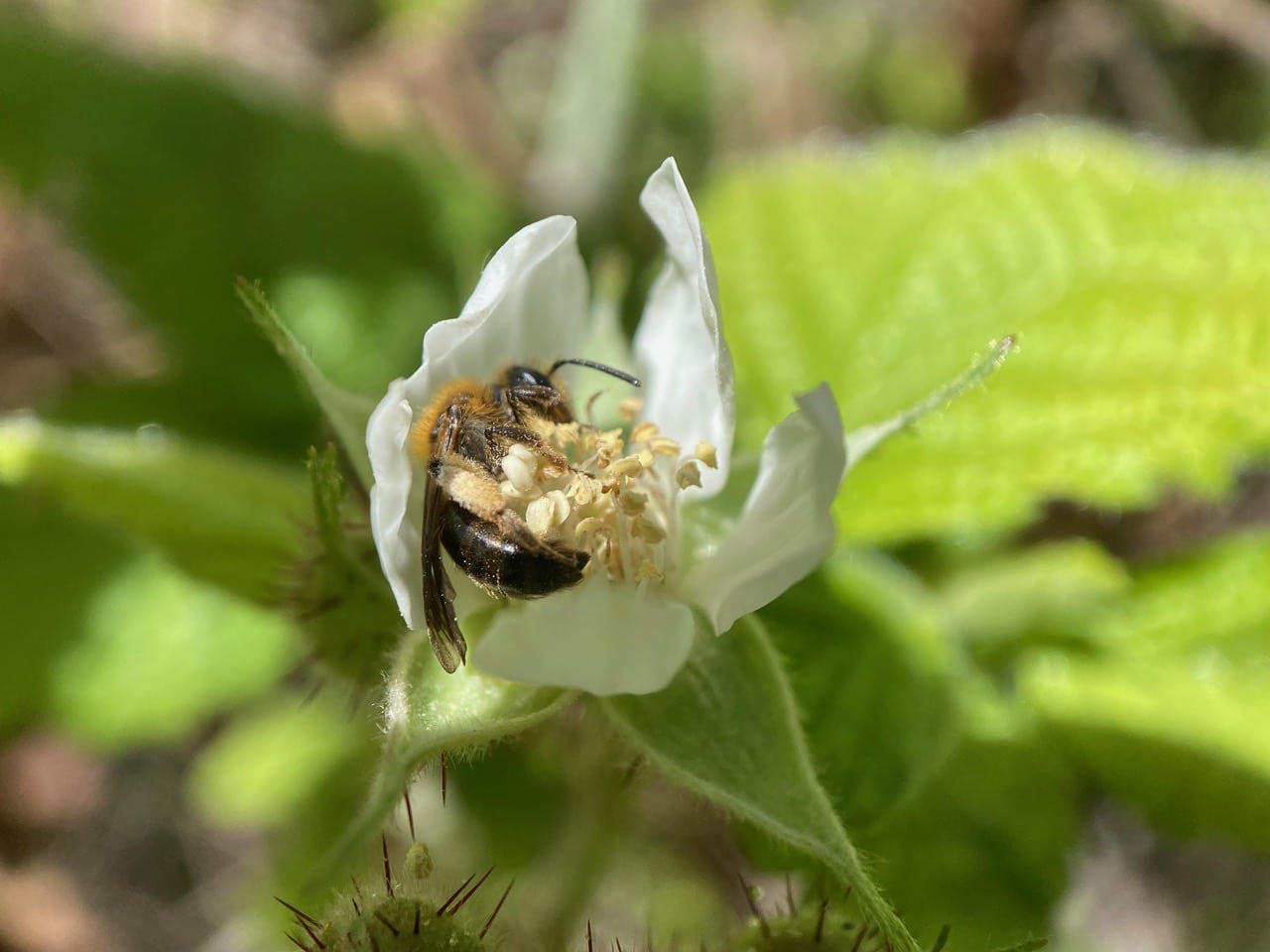
The Andrena is packing pollen into her scopa with her middle leg, while continuously scraping the anthers with her forelegs. It’s a full-body workout!
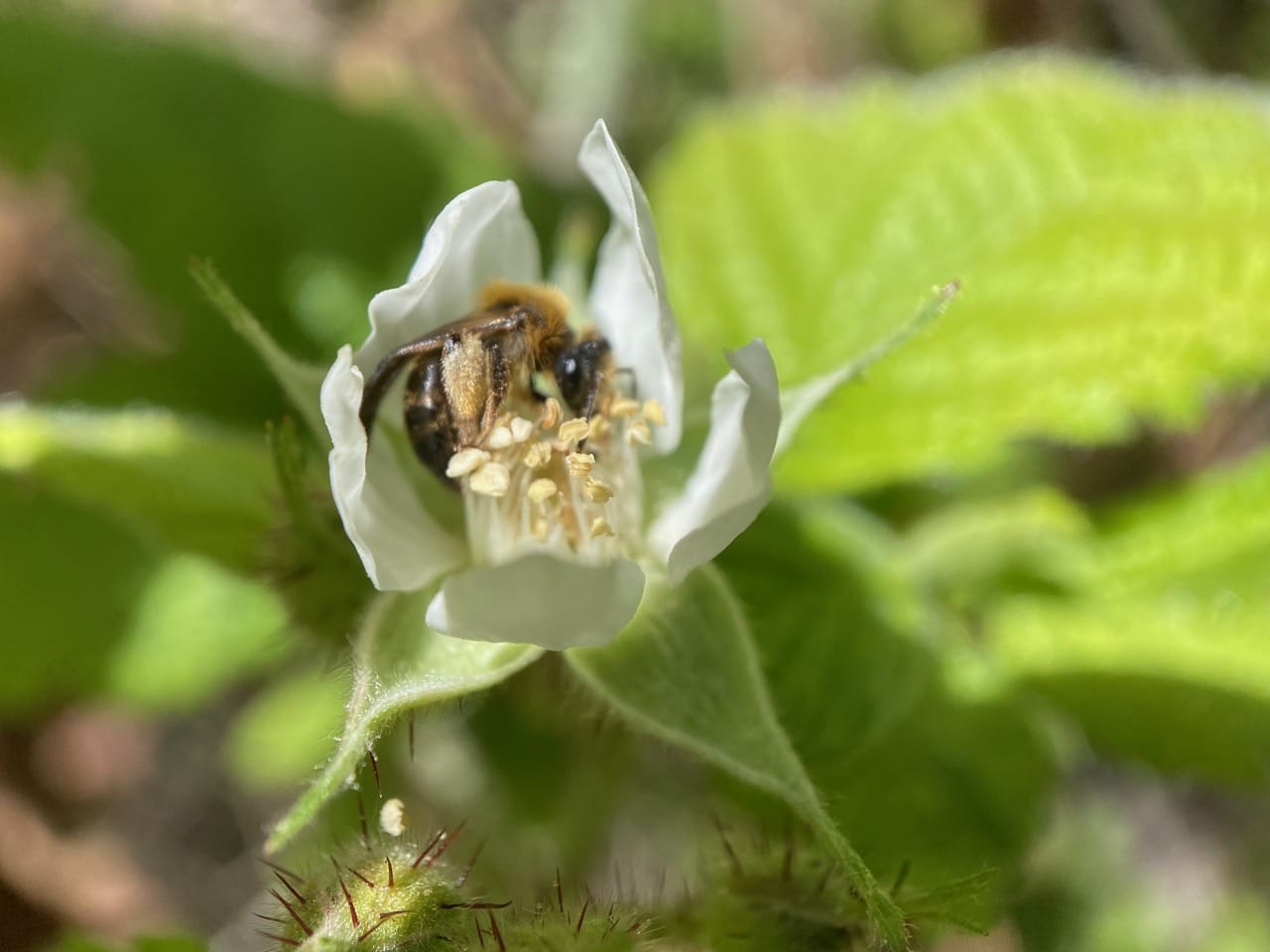
There’s now a sizable pollen load in her scopa. Note that some of the flower’s anthers are still unopened. Bees also use their mandibles to help release pollen from the anthers.
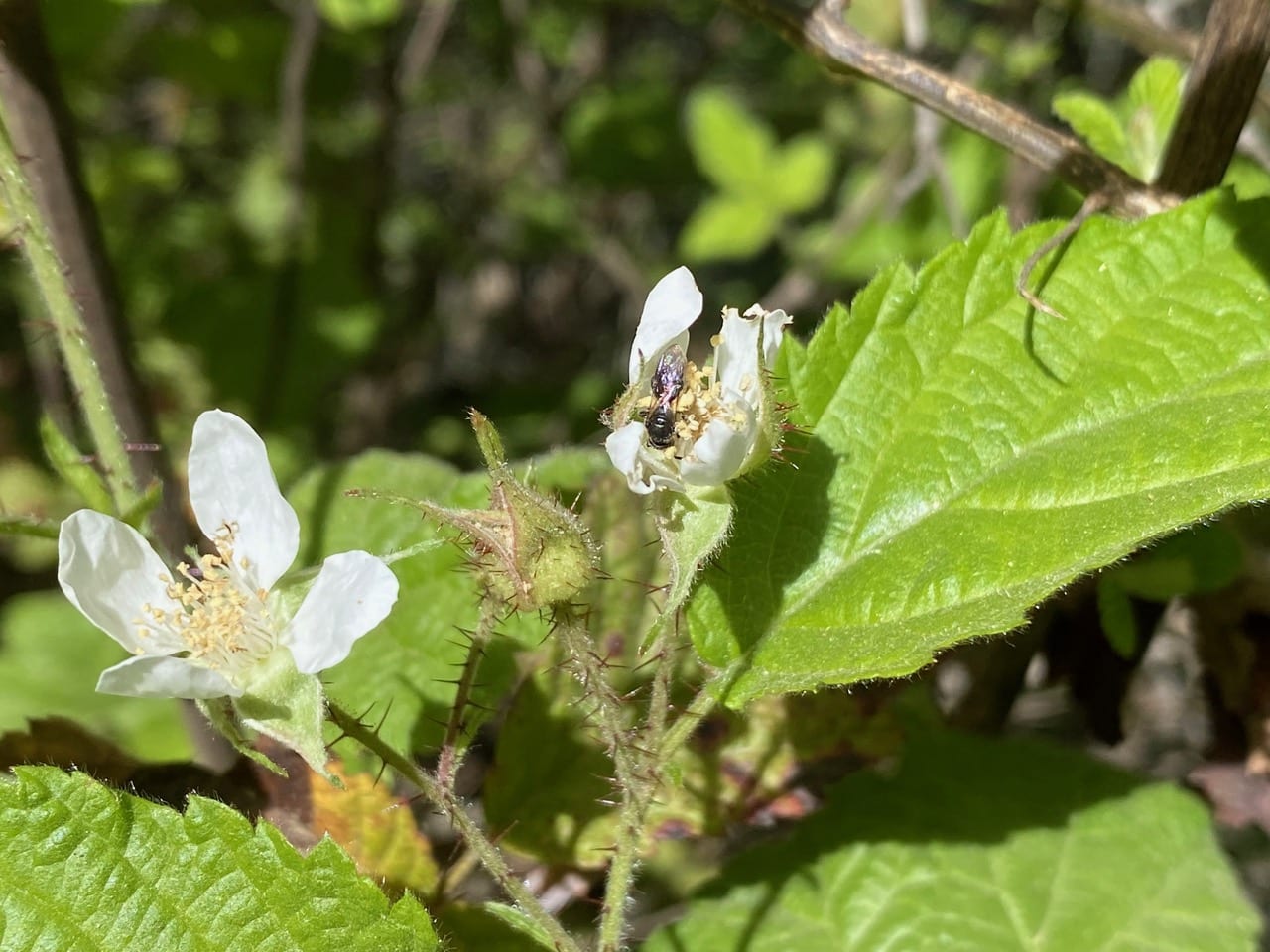
Ooh, there’s a very small dark bee working the anthers of another California Blackberry flower.

A small bee has landed on a Blackberry flower.
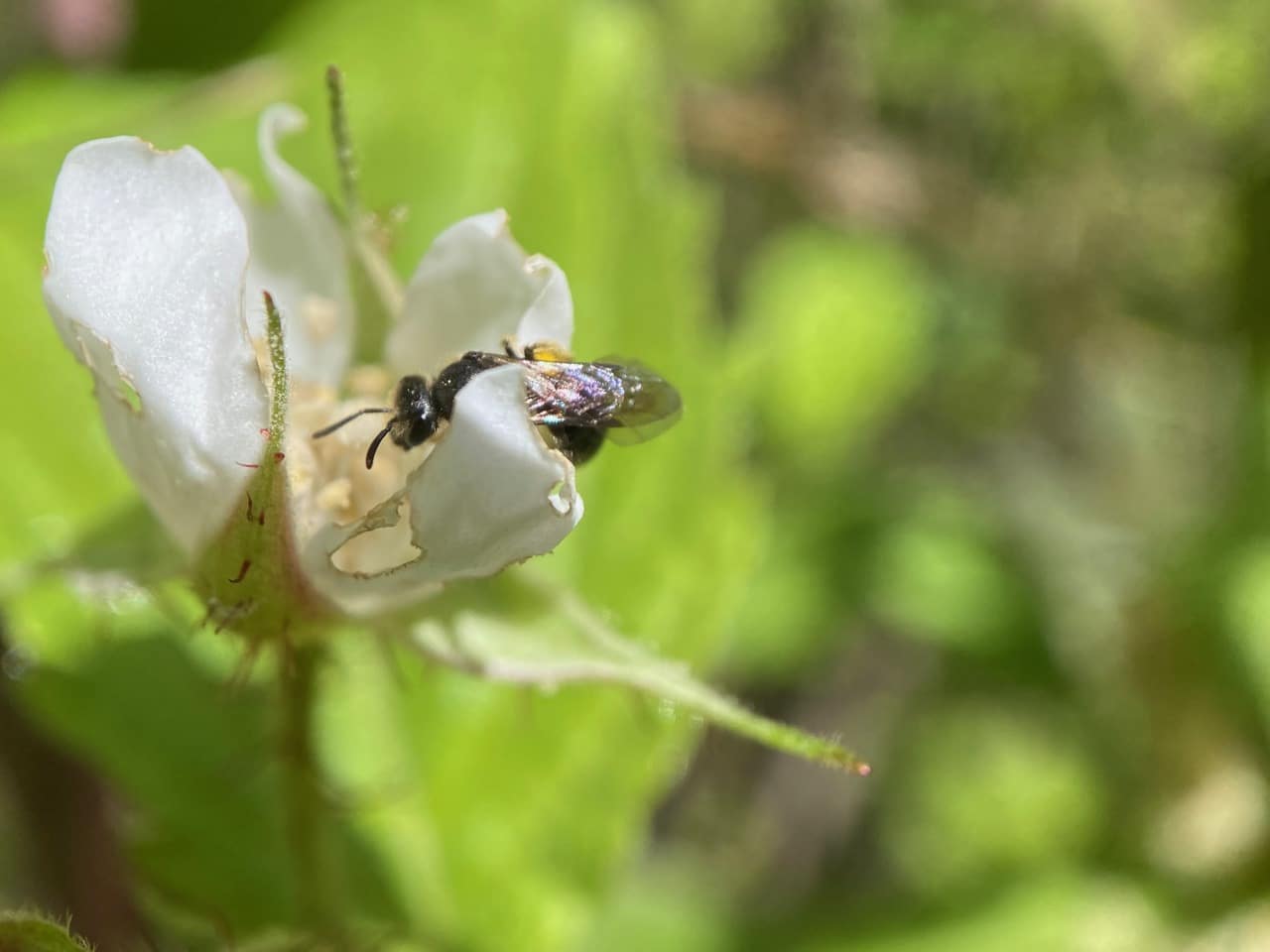
There’s yellow pollen in her scopae that she’s collected from a different flower.

The bee is checking the quality of this flower’s anthers.
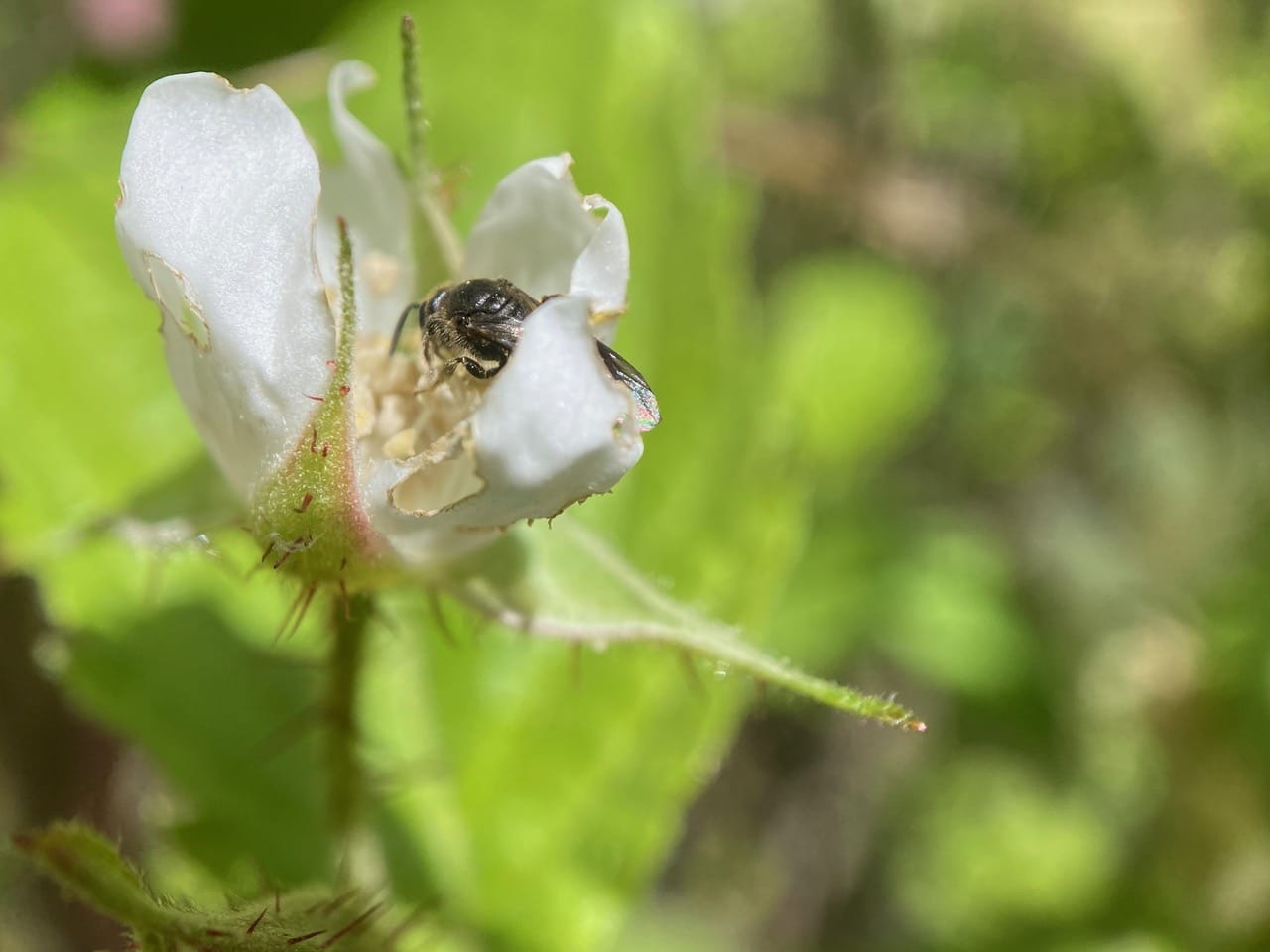
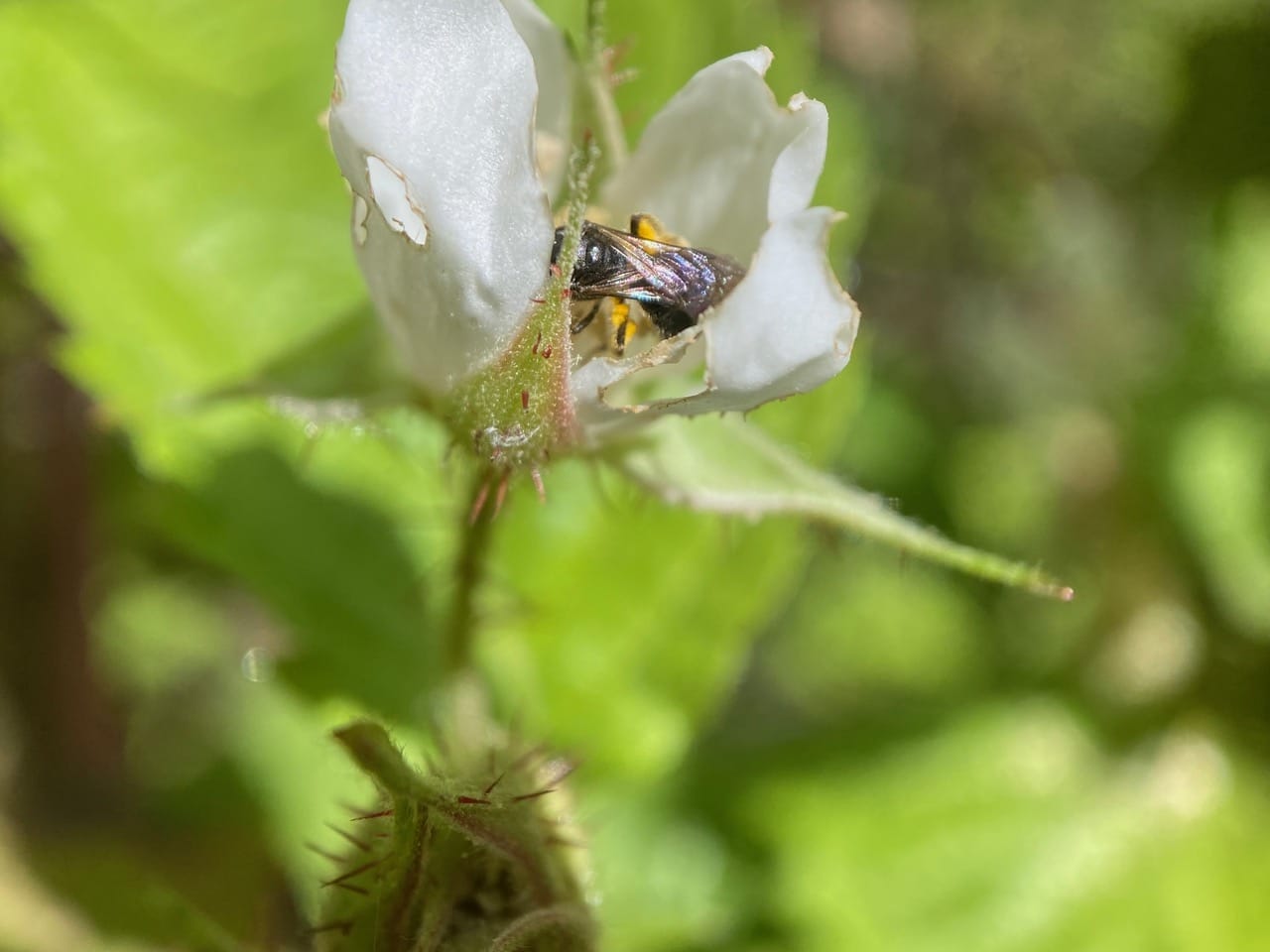
She’s decided to enter the blackberry flower to collect pollen. iNaturalist has helped identify the bee as a Sweat Bee, Lasioglossum sp. (family Halictidae).
Lasioglossum species are found worldwide, and they constitute the largest bee genus. The subgenus Dialictus are the most likely to be seen in the U.S., with over 300 species of these tiny metallic bees. The majority of Lasioglossum are generalists. Because they are so abundant throughout the flowering season, the bees are often important pollinators. Their sheer numbers are enough to achieve excellent pollination of many wild flowers, especially of plants in the Asteraceae, which have shallow floral tubes that are easily accessed by these minute bees.
Lasioglossum are closely related to the genera Halictus and Agapostemon. These genera are commonly called “sweat bees” because of their attraction to human sweat, which they drink for its salt content. Lasioglossum are dusky black to brown slender bees with bands of hair on their abdomen. Female Sweat Bees (family Halictidae) carry pollen in the scopae on their entire hind legs and underside of their abdomen.
Lasioglossum exhibit a range of social behaviors; the genus includes solitary, communal, semi social, primitively eusocial, and even parasitic species. Almost all Lasioglossum in the U.S. nest in the ground. Generally these nests are built in the spring by fertilized females (called foundresses) that spent the winter in hibernation. In social species, the foundresses behave much like the queen bumble bees – they lay the first batch of eggs that develop into the first generation of female workers. The nest grows with each additional generation of bees. Later broods may consist of both males and females. They mate, and at the end of the season the fertilized females hibernate til the following spring, repeating the life cycle of the colony.