

Pollinator Post 3/26/26 (2)

A pale female Conical Trashline Orbweaver, Cyclosa conica (family Araneidae) is resting head-down in the center of her orb web. The bundles of wrapped prey carcasses on her trashline are a meager display – she has not fed well today. While the large orbweaver spiders (family Araneidae) have all but disappeared from the vegetation along the trail over the last couple of years, the small species seem to be holding their own. The Trashline Orbweavers (genus Cyclosa) have become the most commonly encountered orbweavers these days.
Cyclosa, also called Trashline Orbweavers, is a genus of orb-weaver spiders (family Araneidae). The tiny spider (5-7.5 mm) is easily recognized by its web decoration; the spider strings together the dead bodies of insect prey and other debris and hangs them in a vertical line through the middle of its web. The decoration, which sometimes includes egg cases as well, probably serves to camouflage the spider. Cyclosa creates its webs mostly during times of complete darkness. The females occupy the web hub (center) to sit-and-wait for prey. The spider can ensnare prey at nearly any time of day, and it only leaves its spot to replace the web prior to sunrise.

Small, black Stink Bugs, Cosmopepla uhleri (family Pentatomidae) crowd the terminal young leaves of a Bee Plant, Scrophularia californica.
Cosmopepla uhleri is a stink bug native to the western regions of the United States, including California and Oregon. It is black with an orange transhumeral band that has black spots. The bug uses Bee Plant, Scrophularia californica as a host.
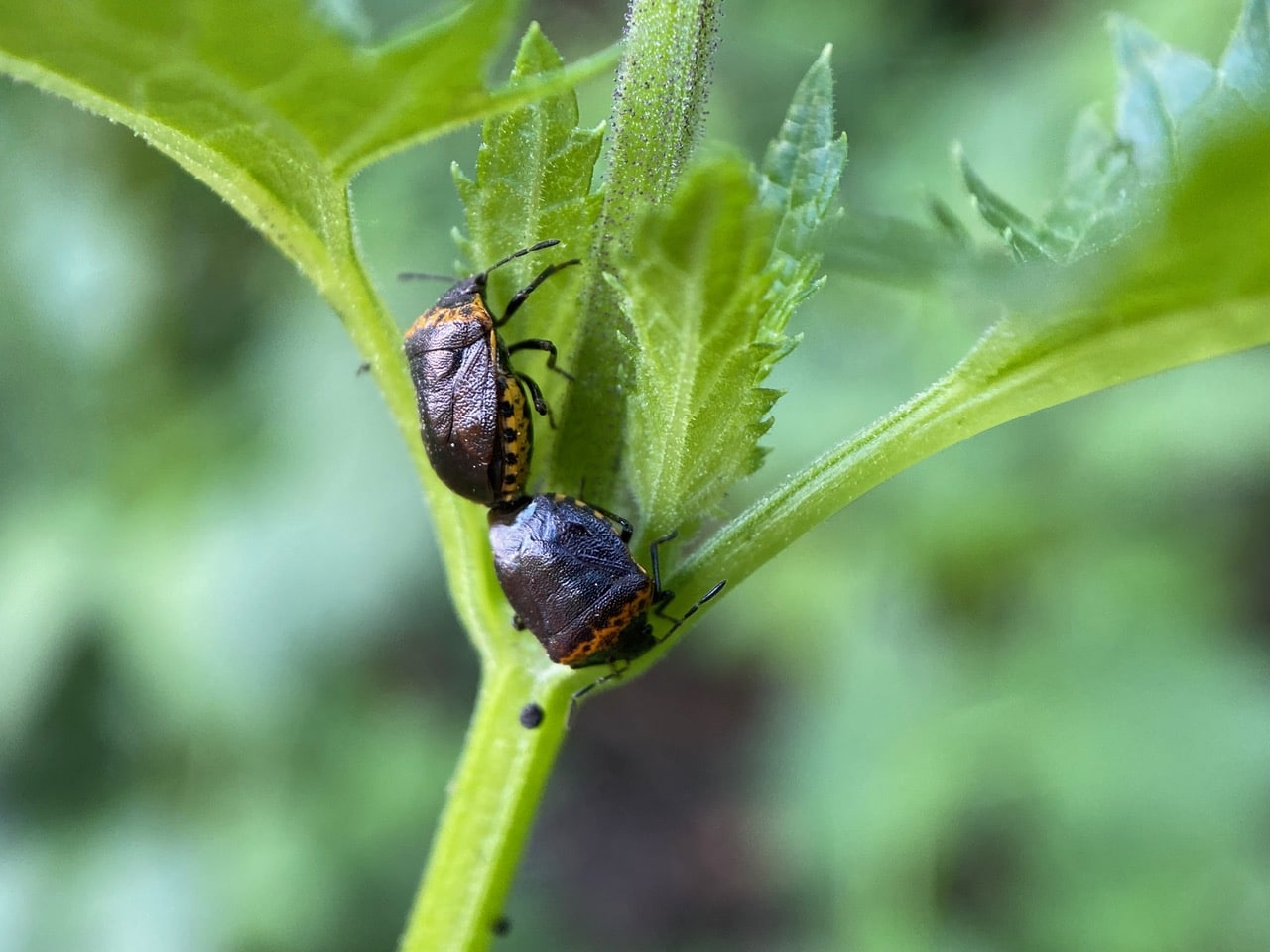
A pair of Stink Bugs, Cosmopepla uhleri (family Pentatomidae) is mating at a leaf axil of Bee Plant, Scrophularia californica.
Pentatomidae is a family of insects belonging to the order Hemiptera or “true bugs”. As hemipterans, the pentatomids have piercing-sucking mouthparts, and most are phytophagous, including several species that are severe pests on agricultural crops. Stink Bugs feed on plant fluids by inserting their needlelike mouthparts into stems, leaves or seed pods. While feeding, they inject materials into the plant to aid in digestion and sap removal. Penetration by the mouthparts can cause physical damage, much like stabbing the plant with a fine needle.
All Pentatomids have 5-segmented antennae (hence their family name, Penta – five and tomos – section.) They generally have a large triangular scutellum in the center of the back. The adult is generally shield-shaped when viewed from above. The common name of Stink Bug refers to their ability to release a pungent defensive spray when threatened, disturbed, or crushed.

Wow, who has been chewing on the young leaves of the Beaked Hazelnut, Corylus cornuta?

After some searching, I find this small, dark caterpillar on the Hazelnut plant.

Here’ a close-up view of another caterpillar, its head buried in the shoot it is feeding on.
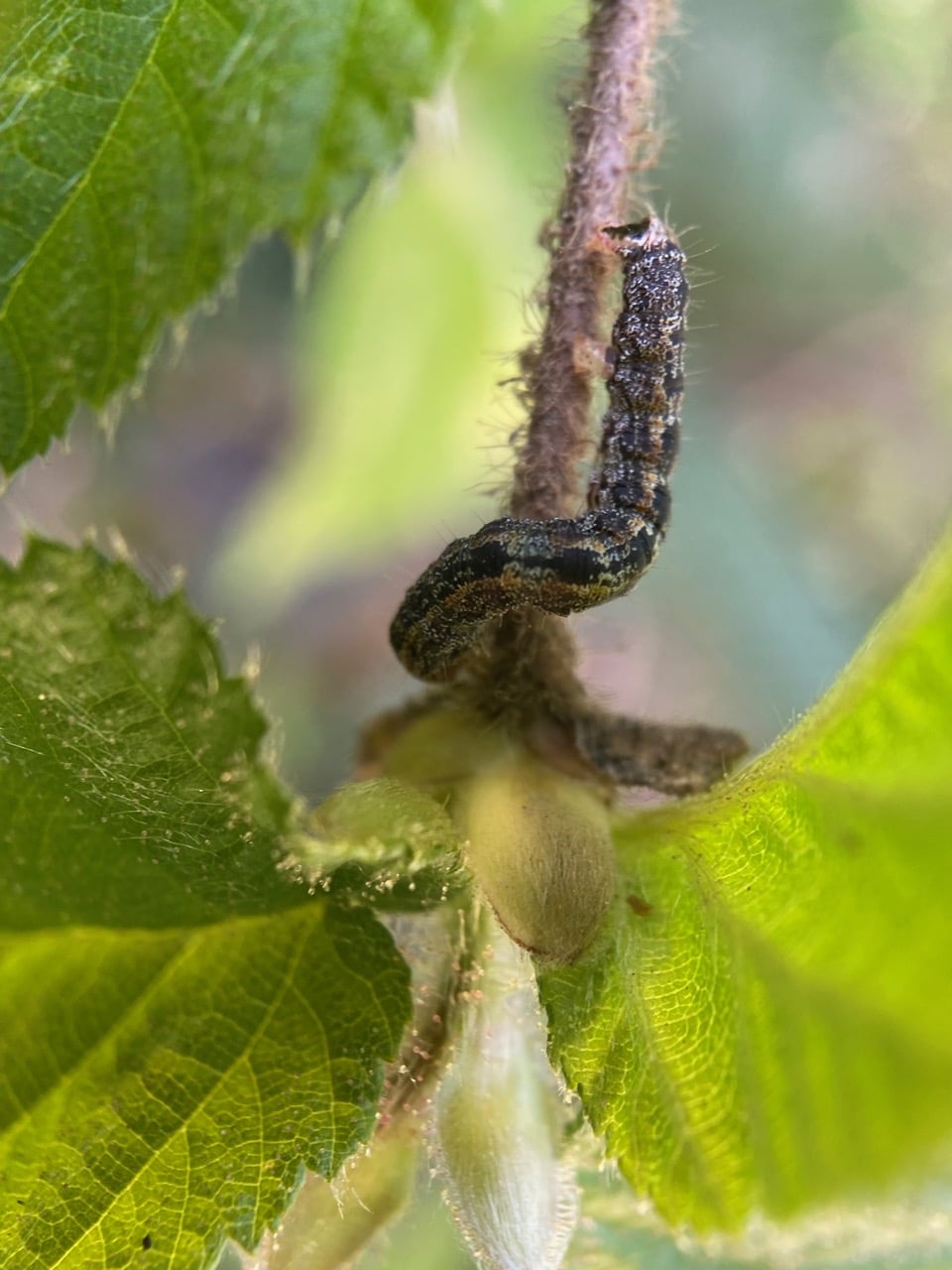
And another…

See that tiny caterpillar on the top leaf?
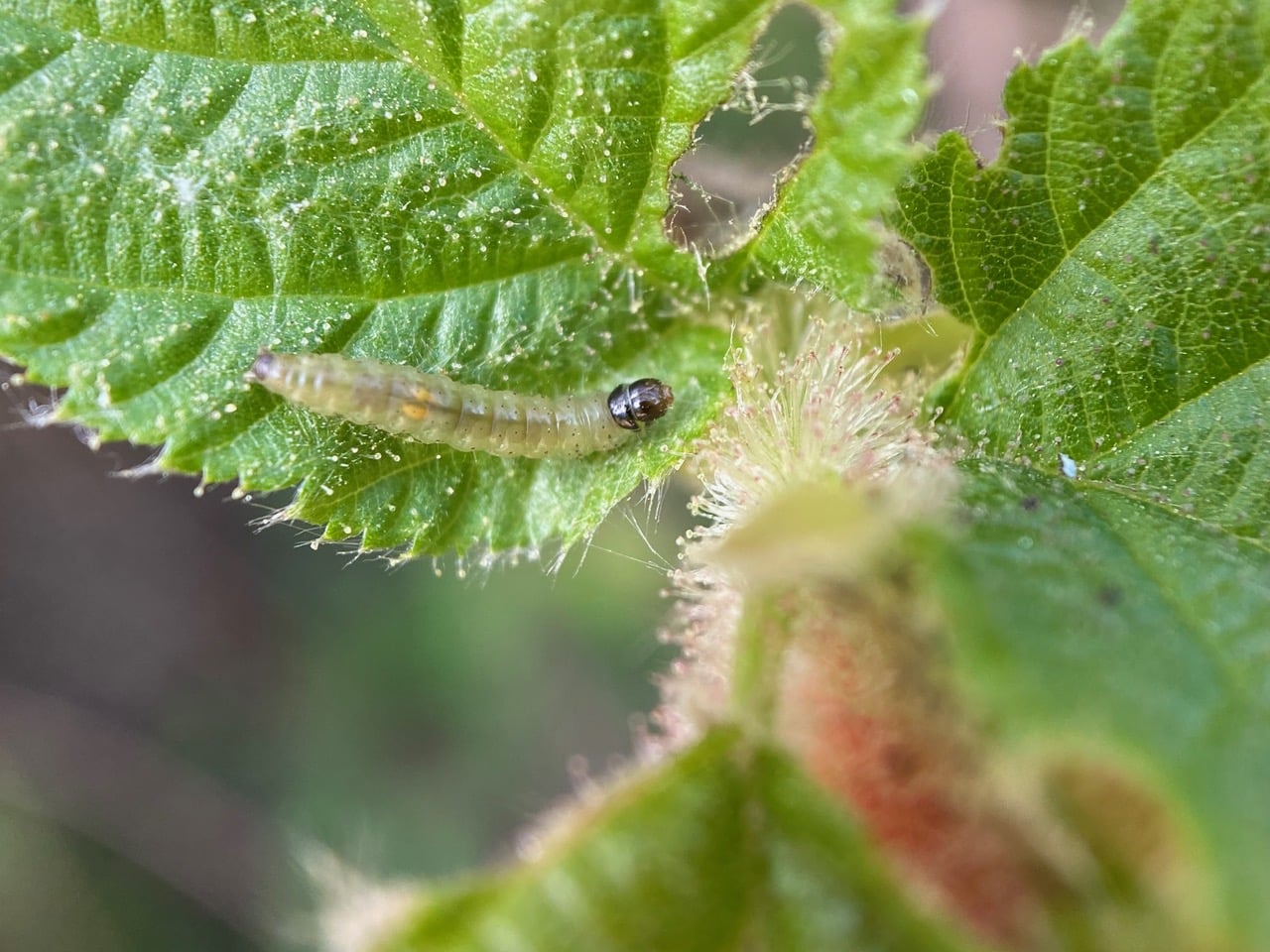
Close-up of the young caterpillar.
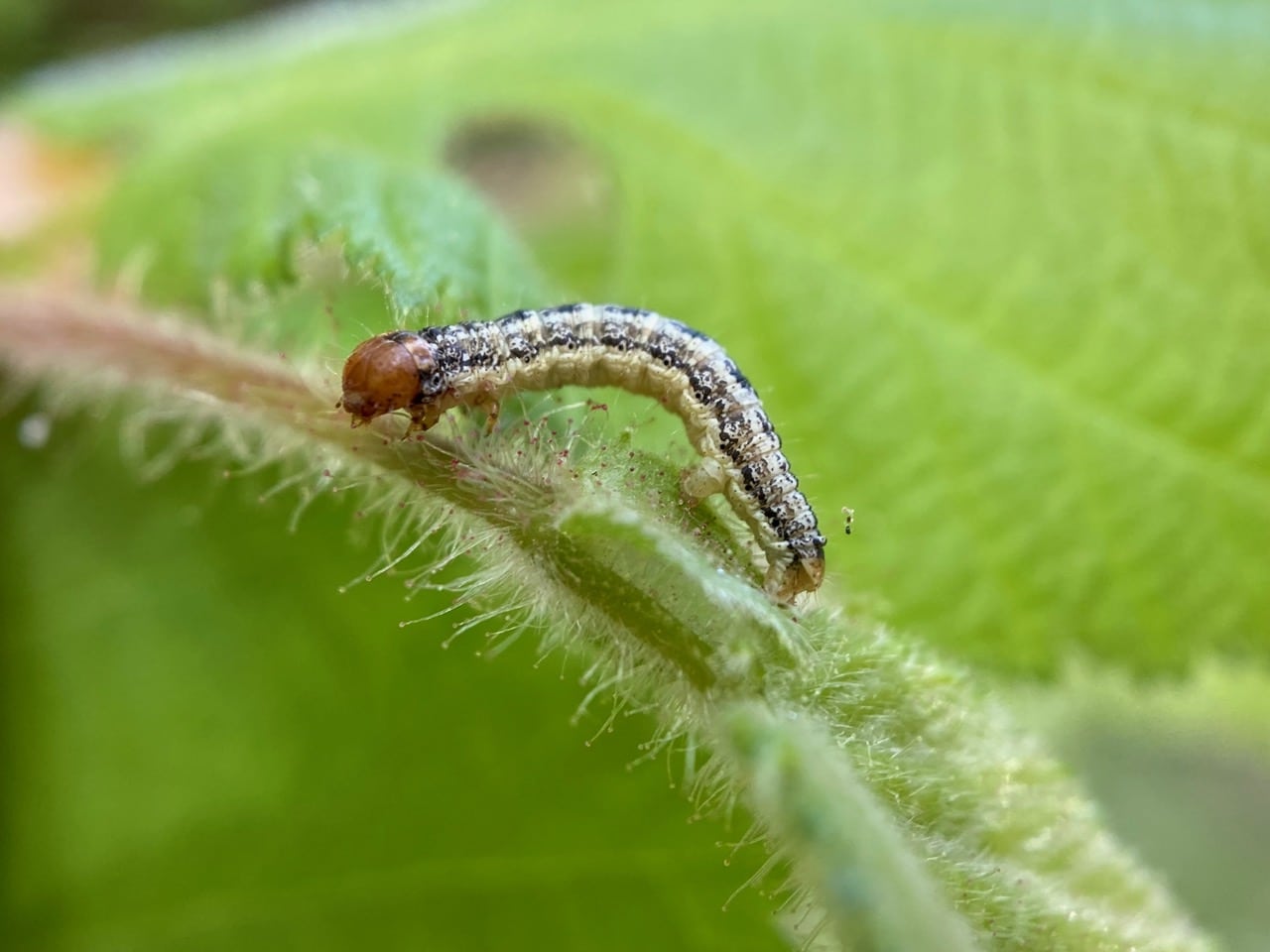
Here’s another caterpillar on Hazelnut. Note that it has only two pairs of prolegs near the rear. An Inchworm (family Geometridae)? I think these pictures represent various instars of the same moth caterpillar. Unfortunately, iNaturalist is unable to identify the insect for us.
Inchworms are also called loopers and measuring worms. The majority of the inchworms are the larvae of moths in the family Geometridae. The name comes from the Greek “geo” for earth and “metro” from measure, because the caterpillars seem to be measuring the surface on which they are walking.
All caterpillars have three pairs of jointed legs behind their heads. These legs are called true legs because they will become the six legs of the adult butterfly or moth. There are additional appendages, called prolegs, along their bodies. Prolegs are not true legs, they are just outgrowths of the body wall and will be lost at metamorphosis. They have little hooks on their soles to help the caterpillar walk and grip onto things.
Most caterpillars have five sets of prolegs, four in the middle of the body and one pair at the hind end. Inchworms have the normal six true legs but only two or three pairs of prolegs, all located at the tail end of the body, with none in the middle. When an inchworm walks, it moves its tail-end prolegs up behind its true legs, causing the center of its body to loop upward. Then it stretches its front end forward to take another step.

A small beetle with orange thorax is resting on a leaf of Coast Live Oak, Quercus agrifolia. iNaturalist has helped identify it as a Soldier Beetle in the tribe Silini (family Cantharidae).
The Soldier Beetles, family Cantharidae are relatively soft-bodied, straight-sided beetles. One of the first described species has a color pattern reminiscent of the red coats of early British soldiers, hence the common name. They are also known commonly as Leatherwings because of their soft elytra.
Soldier beetles often feed on both nectar and pollen as well as predating on other small insects. The larvae are often active, and feed on the ground, hunting snails and other small creatures. Adult beetles also contribute to pollination as they feed on nectar and pollen. Soldier beetles are generally considered beneficial insects by gardeners.

A yellow-and-black, wasp-like insect lands on a Poison Oak leaflet. Hey, it’s not a wasp, but a hover fly! iNaturalist has helped identify it as a Meadow Fly, Chrysotoxum sp. (family Syrphidae).
Hover flies (family Syrphidae) are harmless, beneficial insects that often exhibit Batesian mimicry, perfectly mimicking the yellow-and-black stripes, buzzing sound, a behavior of wasps or bees to evade predators. Despite their similar appearance, they are distinguishable by having only two wings (not four), large eyes that often meet in the middle, no stingers, and ability to hover in place.
The genus Chrysotoxum consists of wasp-mimicking species. The adults are distinguished by long antennae that are held erect, oval abdomen with yellow stripes, and yellow patterns on the thoracic pleurae (sides of the thorax). Unlike most hoverflies, the abdomen is not dorsoventrally flattened. The species of Chrysotoxum mainly occurs in the northern hemisphere. Larvae are specialized in preying upon root aphids associated with ant nests. Talk about a specialized niche!
Why are aphids found in ants’ nests?
Ants and aphids share a well-known mutualistic relationship. The aphids produce honeydew, a sugary food for the ants; in exchange, the ants care for and protect the aphids from predators and parasites. Some ants will “milk” the aphids to make them excrete the sugary substance. The ants stroke the aphids with their antennae, stimulating them to release the honeydew. Aphid-herding ants make sure the aphids are well-fed and safe. When the host plant is depleted of nutrients, the ants carry their aphids to a new food source. If predatory insects or parasites attempt to harm the aphids, the ants will defend them aggressively. Some species of ants continue to care for aphids during winter. The ants carry the aphids to their nest for the winter months, and transport them to a host plant to feed the following spring.
Meadow Flies (Genus Chrysotoxum) · iNaturalist
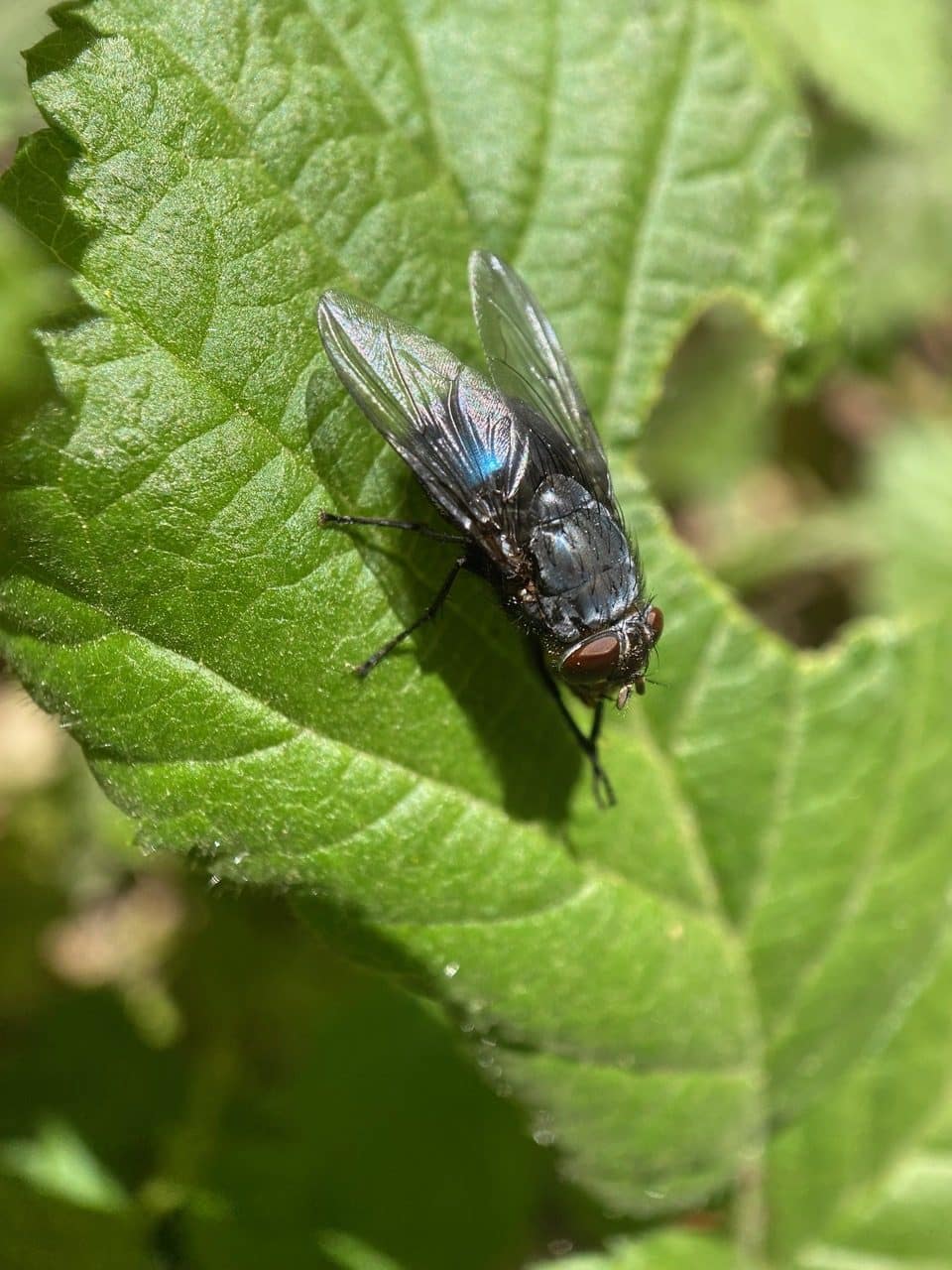
A Blue Blowfly, Calliphora vicina (family Calliphoridae) is grooming itself on a leaf in the sun.
The Calliphoridae are variously known as blow flies, carrion flies, greenbottles, and bluebottles. Adults are usually brilliant with metallic sheen, often with blue, green, or black thoraces and abdomens. There are three cross-grooves on the thorax; calypters are well developed. Females visit carrion both for proteins and egg laying. The larvae that hatch feed on dead or necrotic tissue, passing through three instars before pupation. After the third instar, the larva leaves the corpse and burrows into the ground to pupate. Adult blow flies are occasional pollinators, being attracted to flowers with strong odors resembling rotting meat. The flies use nectar as a source of carbohydrates to fuel flight.
The Blue Blowfly, Calliphora vicina is important in the field of forensic entomology; its life cycle has been extensively studied and the flies are used to estimate the time of a person’s death in criminal cases. The species is found throughout the U.S. in urban areas and are most abundant in early spring and fall.
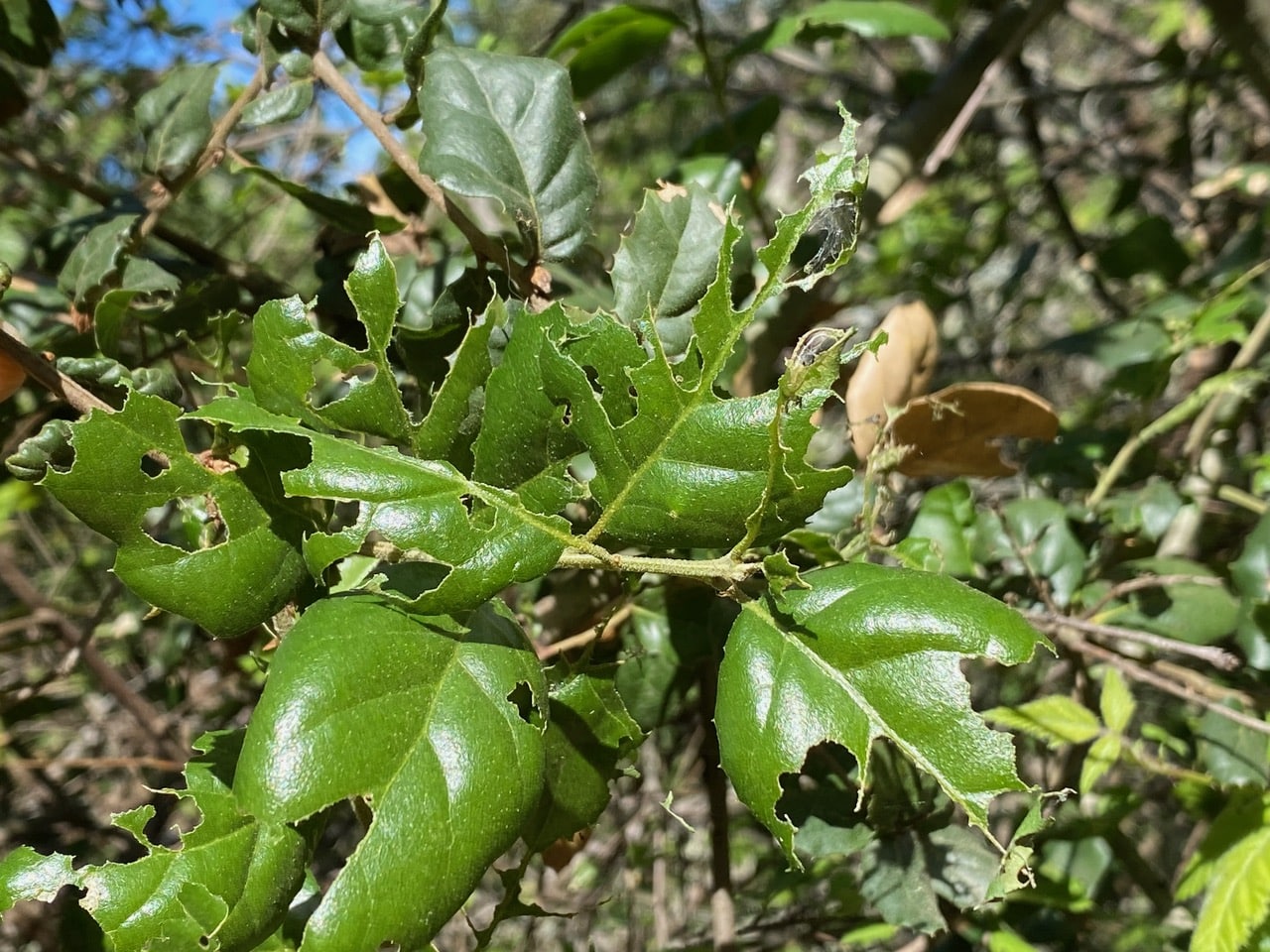
Who has been chewing the young leaves of this Coast Live Oak, Quercus agrifolia? The feeding damage is not typical of that rendered by the California Oak Moth caterpillars.
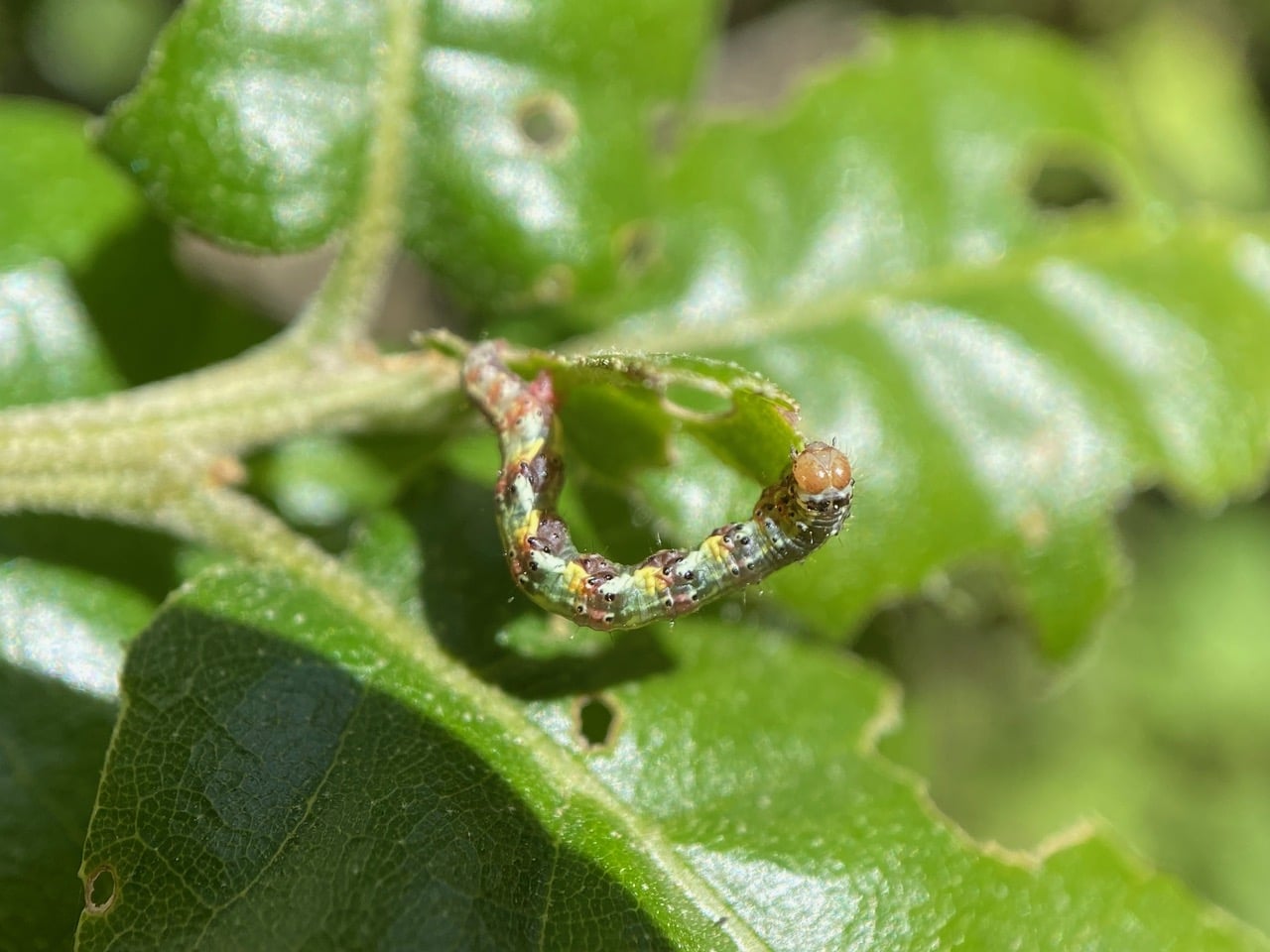
Ah, I think I have found the culprit – a little rainbow-hued caterpillar with a flesh-colored head capsule. It appears to be an Inchworm, as it doesn’t have any prolegs in the middle section of its body. Unfortunately iNaturalist is unable to provide an ID.
 As the season progresses, the flower stalk of the Miner’s Lettuce, Claytonia perfoliata lengthens to put on more flowers.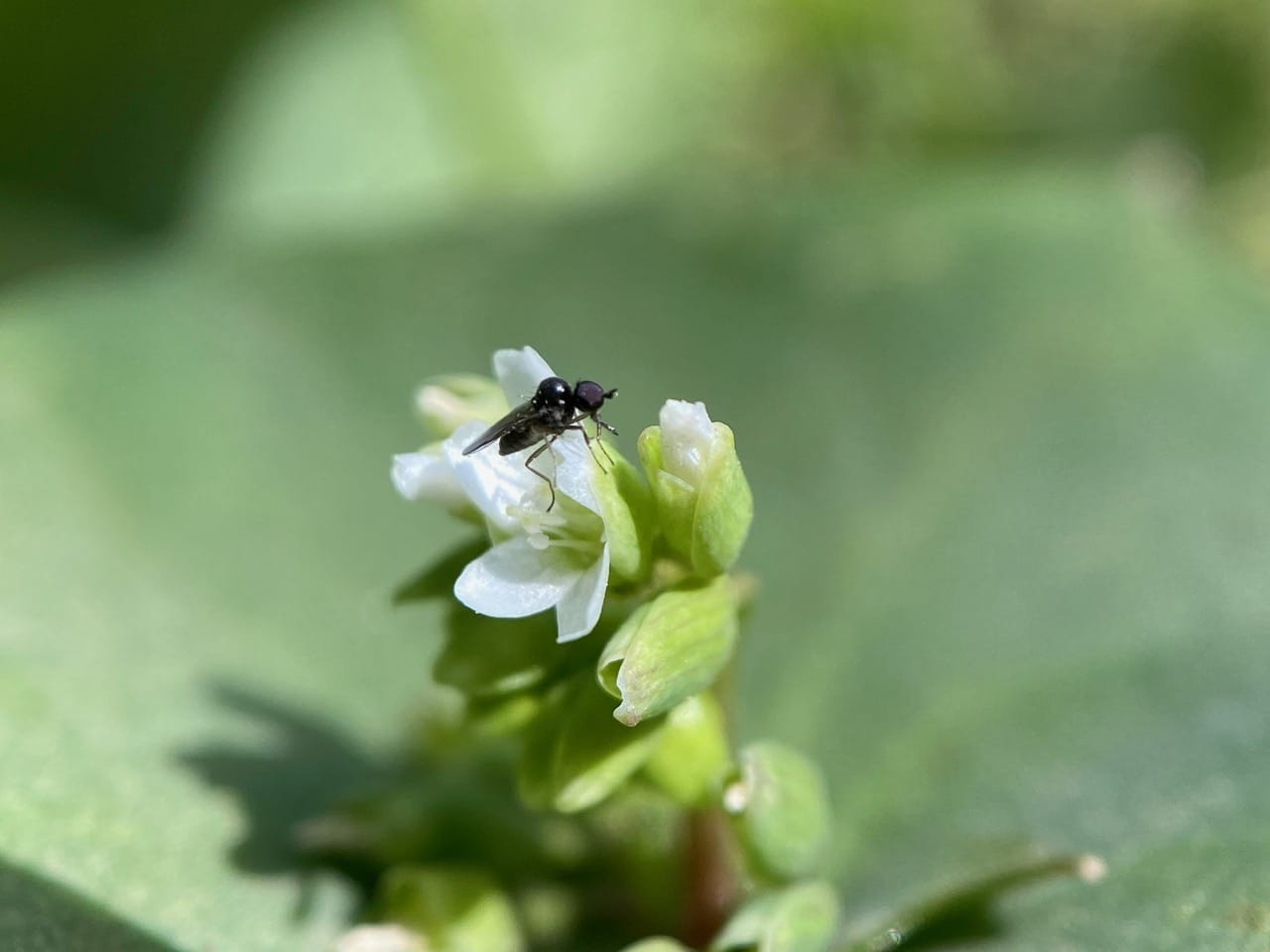
A Hybotid Dance Fly, Anthalia sp. (family Hybotidae) is cleaning its proboscis after feeding in a Miner’s Lettuce flower.
The small fly, under 3 mm long, is a member of the Typical Dance Flies or Hybotid Dance flies (family Hybotidae). These flies have compound eyes that seem to take up most of their spherical head. They belong to the superfamily Empidoidea and were formerly included in the Empididae as a subfamily. The mostly predatory Empididae generally have a thick beak pointing down, while Hybotidae have a thinner beak, or a thick beak pointing forwards or diagonally. Some crucial wing venation further distinguishes the two families. Precious little is known about the life cycle and biology of Hybotids because they are not considered of economic consequence. Since their forelegs are generally not raptorial, I wonder if they’re predaceous like the Empidids. I have seen the Hybotids visit flowers for nectar and pollen, notably on Soap Plant, Miner’s Lettuce, California Saxifrage, Wild Geranium, Woodland Strawberry, etc. and I believe they may be significant pollinators for these small flowers in the wild.
Why the name “dance fly”? During mating season, males gather in mating swarms over prominent objects, each individual seeming to bounce or “dance” in mid-air. Many other flies do this, notably midges, but Hybotids got the moniker. Hybotid larvae have either a carnivorous diet or feed on decaying organic matter in the soil, serving as decomposers/recyclers in the ecosystem.
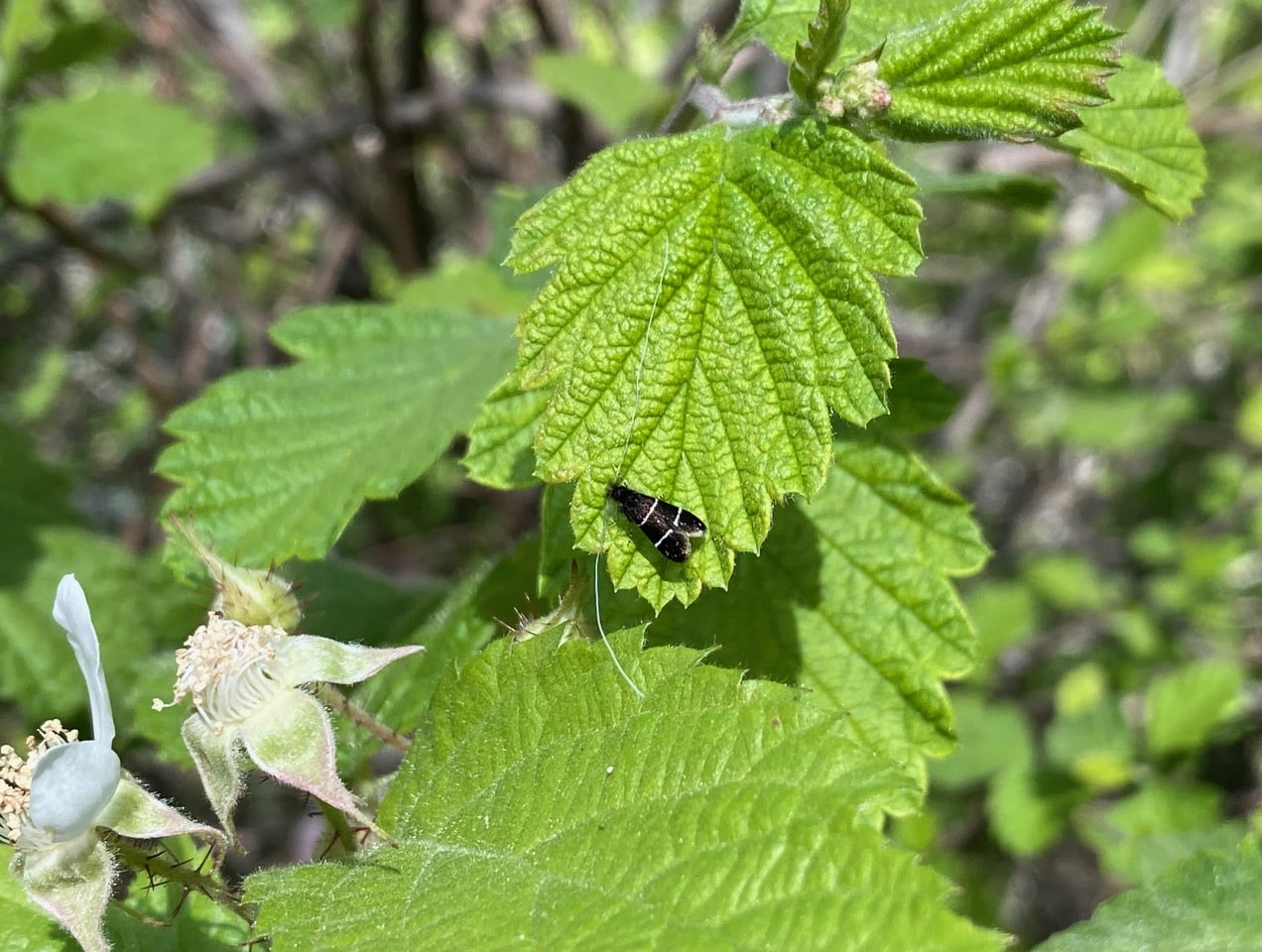
A small moth dances in a bobbing flight in front of me and lands on a leaf of Ocean Spray, Holodiscus discolor. It is an Ocean Spray Fairy Longhorn Moth, Adela septentrionella (family Adelidae). Note the length of its white antennae! Seeing the moth in March is a bit of a surprise for me – isn’t it a little early in the season for the moth to be flying? Over the years, I have come to this section of the West Ridge Trail in late May to observe the moth’s lekking behavior over the Ocean Spray bushes right before they burst into bloom.
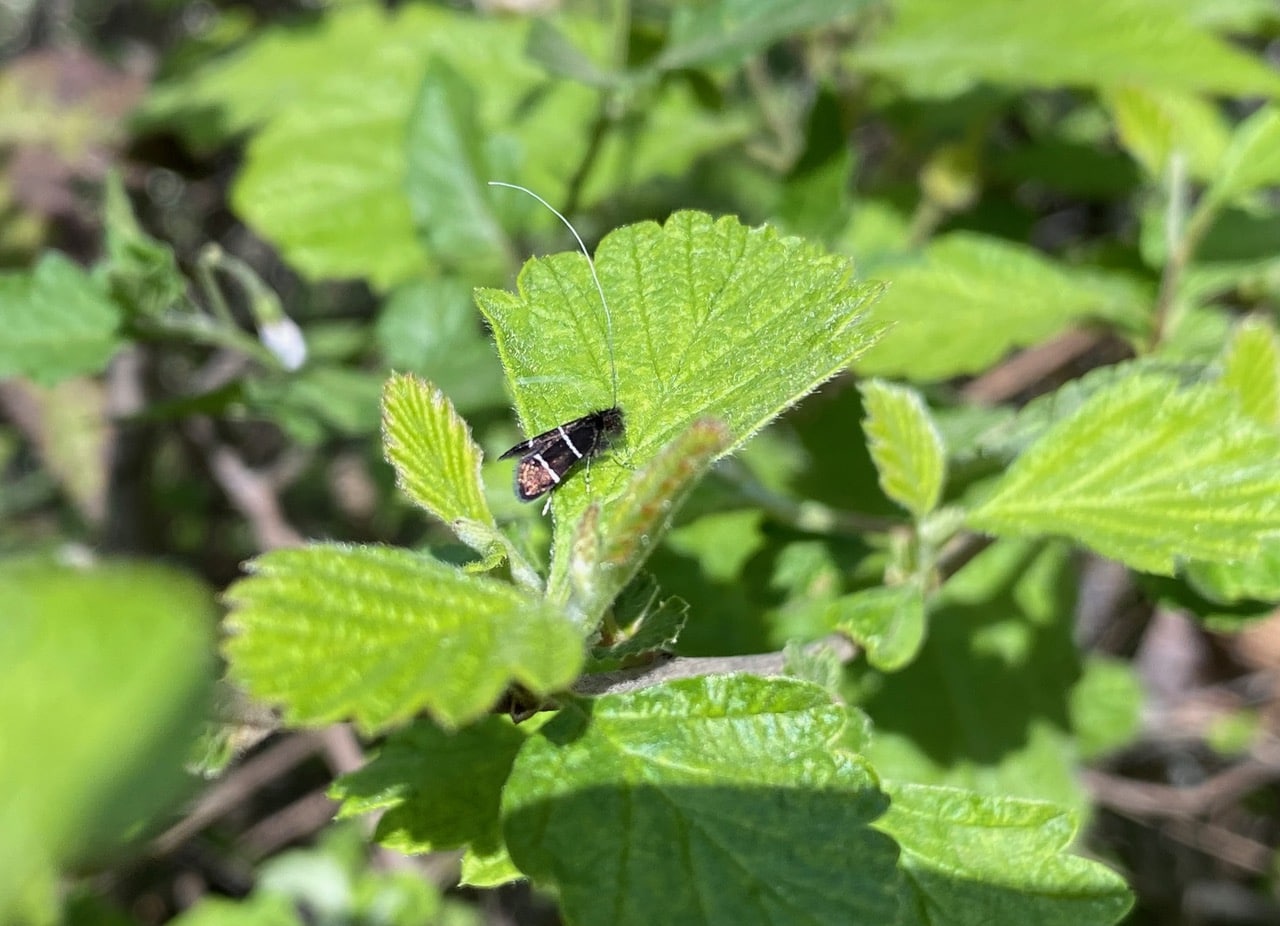
The Ocean Spray Fairy Longhorn Moth, Adela septentrionella is a day-active moth in the family Adelidae. It is widespread from southern British Columbia and north-western Idaho to southern California. The length of the forewings is 4.5-5.7 mm. The forewings are purplish-black with two incomplete thin white bands. The antennae of the males are at least twice as long as the wings. Adults are on wing from mid April to mid July. The larvae feed on buds of Ocean Spray, Holodiscus discolor. Full-grown larvae overwinter in cases on the ground. Pupation takes place in late March or April.
The most distinctive feature of the Ocean Spray Fairy Longhorn Moth is their lekking behavior. Males gather to perform courtship dances – bobbing flights above the branches of Ocean Spray about ready to burst into bloom, usually in late May in this park.

I look around all the Ocean Spray shrubs along the trail. Ah, some are indeed already bearing flower buds. Things are happening early this year, perhaps due to our warm winter? Will the Fairy Longhorn Moths lek earlier this year to coincide with the earlier blooming of their host plant?
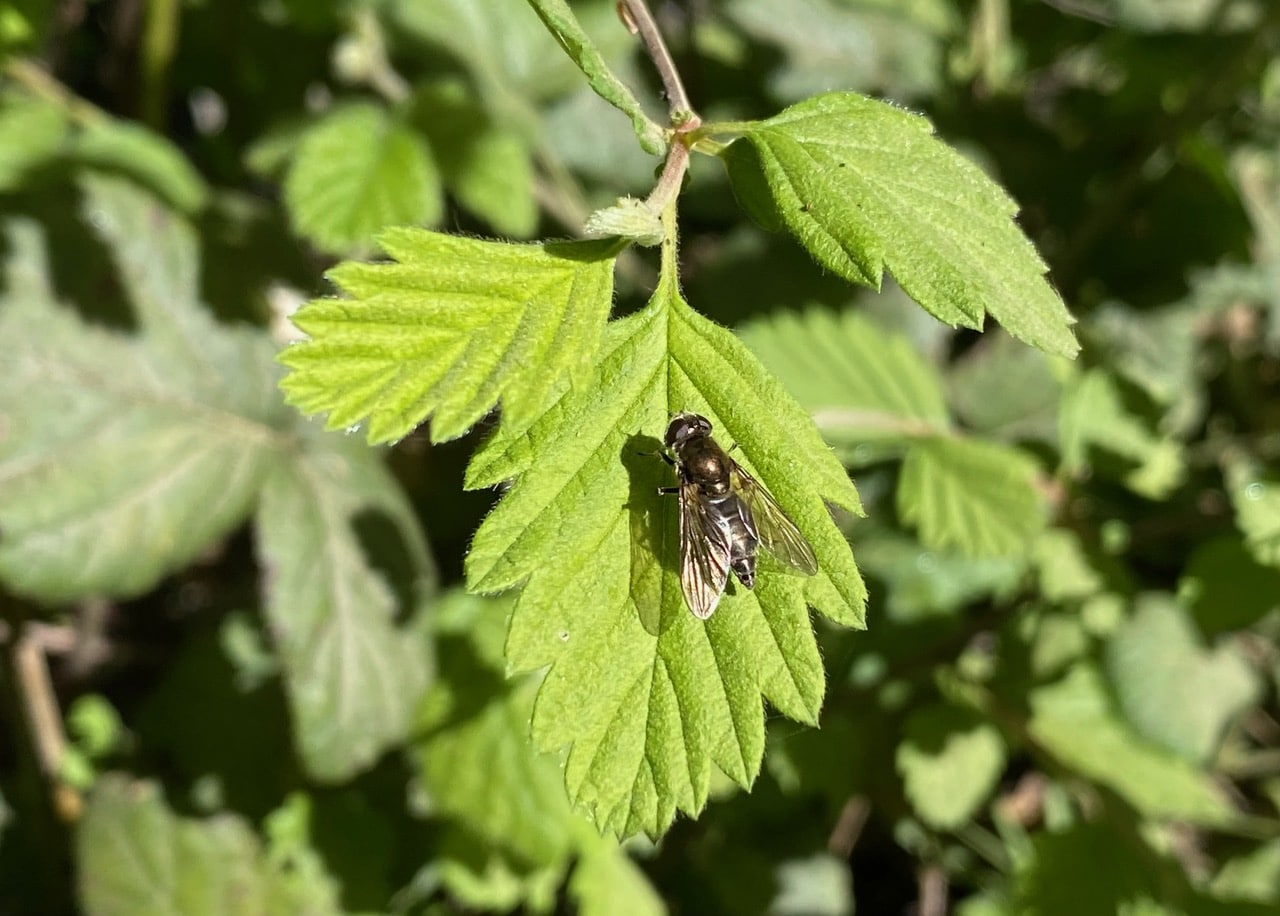
The shiny black fly perched on a leaf of Ocean Spray is a Blacklet, Cheilosia sp. (family Syrphidae).
Hover Flies, also called flower flies or Syrphid flies, make up the insect family Syrphidae. The adults of many species feed mainly on nectar and pollen, and are often seen hovering and nectaring at flowers. They are important pollinators of flowering plants in many ecosystems worldwide. The larvae feed on a wide range of foods. In many species, the larvae are insectivores and prey on aphids, thrips, and other plant-sucking insects. In other species, the larvae are saprotrophs, eating decaying plant and animal matter in the soil or in ponds and streams.
Many species of Hover Flies exhibit Batesian mimicry; they are brightly colored, with bands of yellow resembling the bees and wasps. The mimicry provides the fly with some measure of protection from potential predators, although the flies are harmless and lack a sting.
Cheilosia is a rather unusual hover fly. Most Cheilosia are black or largely un-colored, lacking the bright colors and patterns of many hover fly species. Although it is one of the most species diverse genera of Syrphidae, its biology is little understood. Where known, the larvae of Cheilosia species are phytophagous – they bore into and feed on plant tissues (stems, roots, leaves) or on fungi.

Close-up of the Blacklet, Cheilosia sp. (family Syrphidae).
Although the hover fly generally appears black, in bright light, its body reflects a metallic bronze sheen. It is covered with fine, short hairs, even on the eyes.

A female Diamond Spottail, Fazia micrura (family Syrphidae) is foraging on a cluster of flowers of Pacific Sanicle, Sanicula crassicaulis. Note the four yellow, diamond-shaped spots near the tip of its abdomen.
The Diamond Spottail, Fazia micrura occurs in western North America, from British Columbia south to California and Texas; and Mexico. The slender, elongate fly measures 6-7 mm. The adult and larva feed on pollen. Females lay eggs on flowers. Larvae are often encountered in the field chewing through the calyx and corolla of unopened flower buds. They are known to feed on pollen in the anthers. Usually only one larva is found in each flower. This larval diet is rather unusual for hover flies, most of which consist of aphids on plants or decomposing matter in aquatic environments, depending on the species.

It is easy to distinguish the genders in the hover flies (family Syrphidae). Males generally have holoptic eyes that meet on top of the head, while females’ eyes are dichoptic, set apart on the head.