

Pollinator Post 3/26/26 (1)
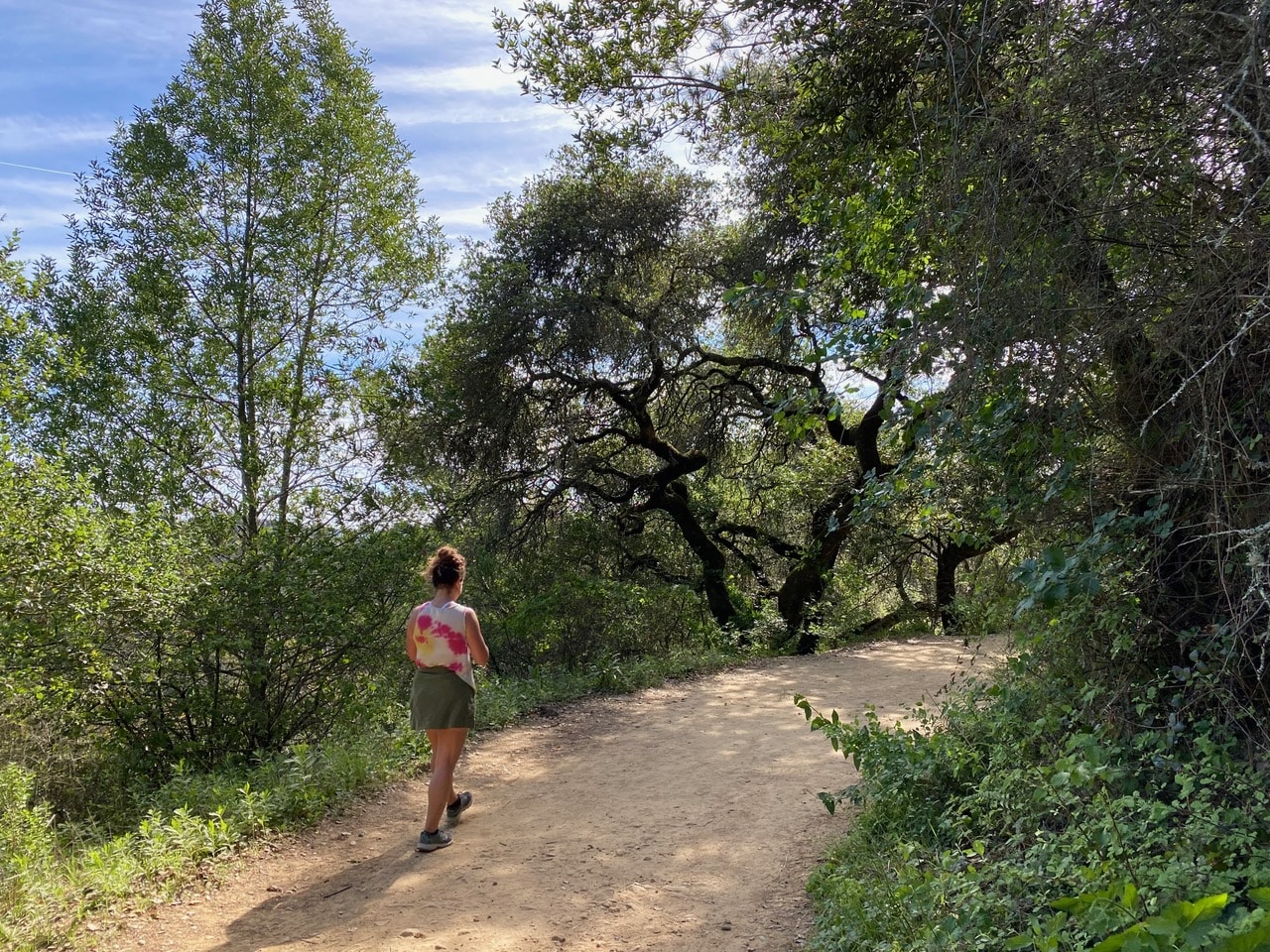
The day is forecast to be hot, with cleaner air in the higher elevations. The West Ridge Trail of the Reinhardt Redwood Regional Park seems like an appealing choice for my ramble today. Starting from Skyline Gate, I head south towards Waterloo Staging Area.
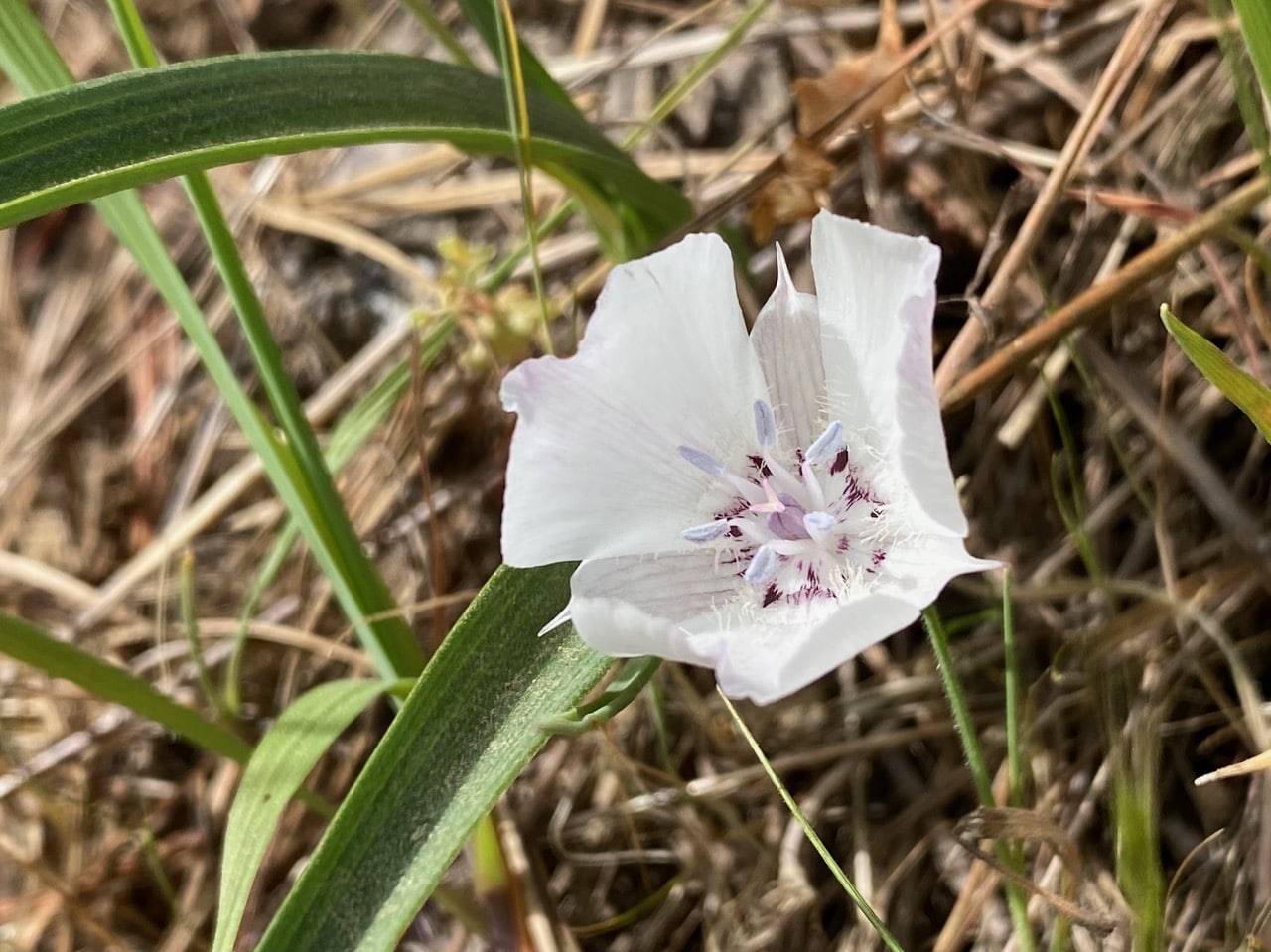
What a delight to see these diminutive, delicate mariposa lilies on the grassy slopes! It’s the Oakland Mariposa Lily, Calochortus umbellatus. The plant is a California endemic of limited distribution, listed as a rare and endangered species.
Mariposa lilies (Calochortus spp.) propagate in the wild primarily through seeds, which are scattered by wind from drying capsules in late summer. These perennials often require a cold, moist stratification period over winter before germinating in spring. They can also slowly propagate and create clusters via underground corms (bulbs). The species is primarily pollinated by native insects, including bees, beetles, and flies.
Nectar glands in Calochortus are specialized, often colorful structures located at the base of each petal. These glands are critical for attracting pollinators. The gland’s shape and appearance vary by species, appearing as pits, pads, or crescent shapes, often covered in hairs.

Two Hybotid Dance Flies, Anthalia sp. (family Hybotidae) are foraging inside a flower of the Oakland Mariposa Lily.
The small flies, under 3 mm long, are members of the Typical Dance Flies or Hybotid Dance flies (family Hybotidae). These flies have compound eyes that seem to take up most of their spherical head. They belong to the superfamily Empidoidea and were formerly included in the Empididae as a subfamily. The mostly predatory Empididae generally have a thick beak pointing down, while Hybotidae have a thinner beak, or a thick beak pointing forwards or diagonally. Some crucial wing venation further distinguishes the two families. Precious little is known about the life cycle and biology of Hybotids because they are not considered of economic consequence. Since their forelegs are generally not raptorial, I wonder if they’re predaceous like the Empidids. I have seen the Hybotids visit flowers for nectar and pollen, notably on Soap Plant, Miner’s Lettuce, California Saxifrage, Wild Geranium, Woodland Strawberry, etc. and I believe they may be significant pollinators for these small flowers in the wild.
Why the name “dance fly”? During mating season, males gather in mating swarms over prominent objects, each individual seeming to bounce or “dance” in mid-air. Many other flies do this, notably midges, but Hybotids got the moniker. Hybotid larvae have either a carnivorous diet or feed on decaying organic matter in the soil, serving as decomposers/recyclers in the ecosystem.
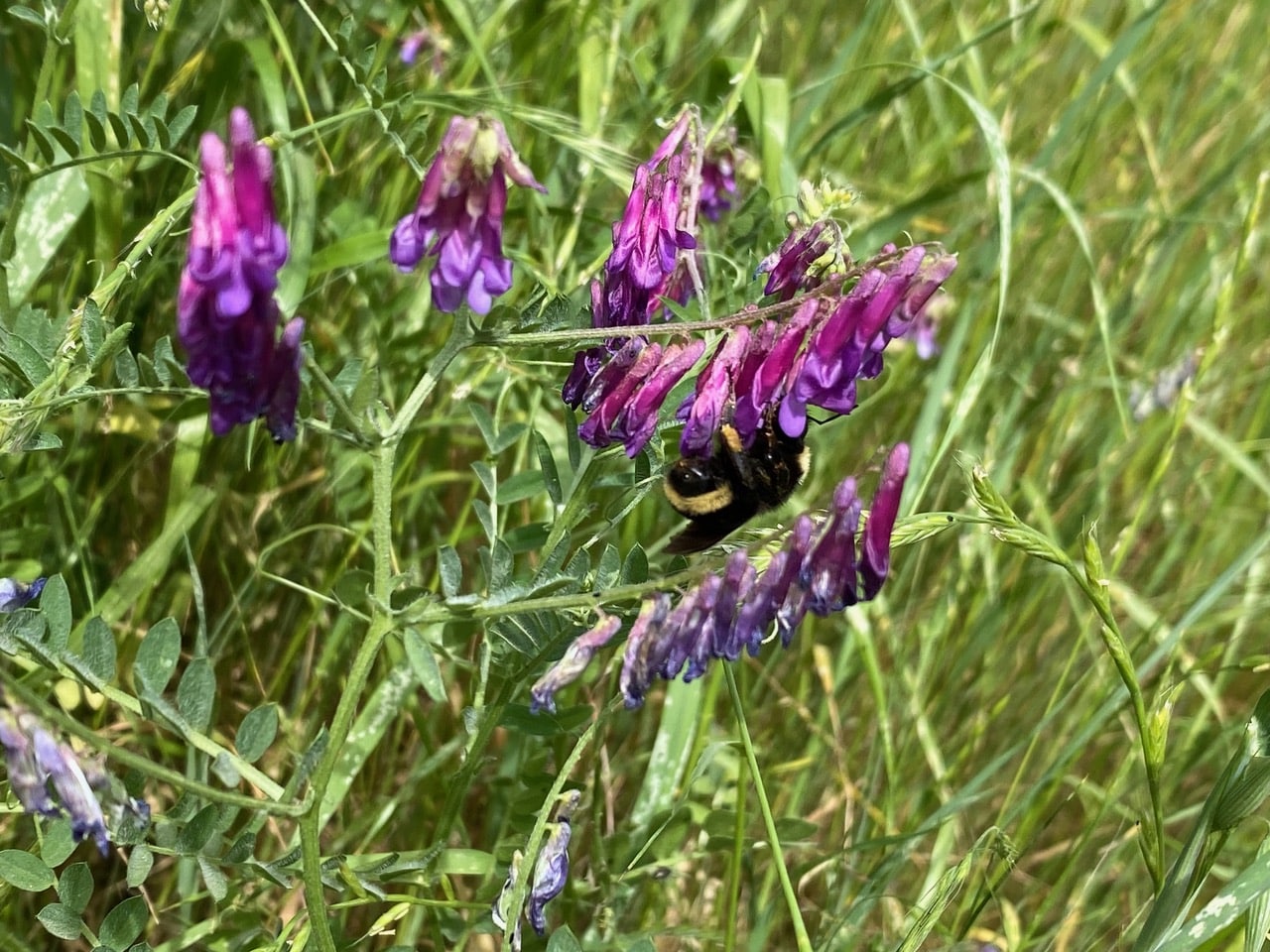
A large queen Yellow-faced Bumble Bee, subgenus Pyrobombus (genus Bombus, family Apidae) lands on an inflorescence of Winter Vetch, Vicia villosa to take nectar from the nodding flowers.
Hairy or Winter Vetch, Vicia villosa (family Fabaceae) is native to Europe and western Asia. Although non-native, it is widespread in the United States and is considered invasive by some states. The plant is widely used by organic growers in the US as a winter cover crop and in no-till farming, as it is both winter hardy and a prolific nitrogen fixer. It is also used in organic gardens as companion plants, as an alternative to rotating crops on small growing areas. The vetch provides both nitrogen and an instant mulch that preserves moisture and keeps weeds from sprouting. In wild landscapes it is observed that the vetch is a good pioneer plant in disturbed areas, preserving fertility of the soil for vegetation that follows in plant succession.
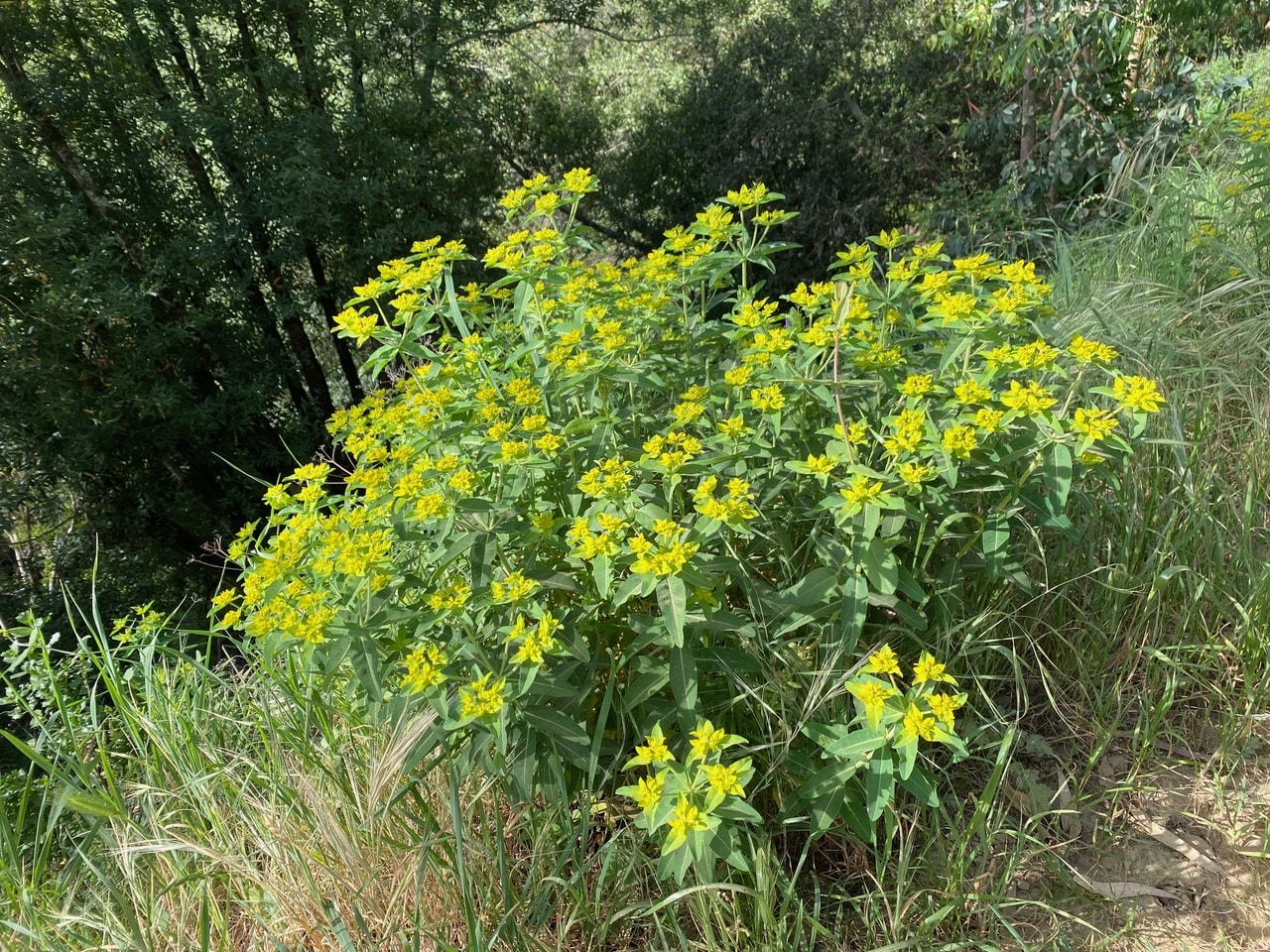
A robust Eggleaf Spurge, Euphorbia oblongata takes up a prominent spot along the trail. The plant is a highly invasive, rhizomatous perennial that crowds out native species. It thrives in disturbed areas, hillsides, and along stream banks, spreading via seeds that can remain viable for years. The plant is notoriously difficult to control. All spurges contain a milky, white sap that can cause severe skin and eye irritation. They generally feature yellowish-green flower bracts and green, oval (eggleaf) or linear (leafy) leaves.

A small dark fly has landed on a flower of Eggleaf Spurge. It is a Grizzled Woodlouse-Fly, Stevenia deceptoria (family Rhinophoridae).
The Woodlouse Flies (family Rhinophoridae) are somewhat related to the Tachinidae. The larvae are mostly parasitoids of woodlice (pill bugs), beetles, spiders and other arthropods, and occasionally snails. Adult female deposits the eggs near woodlice. The first instar larva attaches itself to a passing woodlouse and enters the body of the freshly molted host. The larva feeds on the hemolymph and organs of the host until pupation, leading to the death of the host. Adult fly emerges from the pupa from inside the empty exoskeleton of the host. Adult Woodlouse Flies primarily feed on nectar and plant juices.

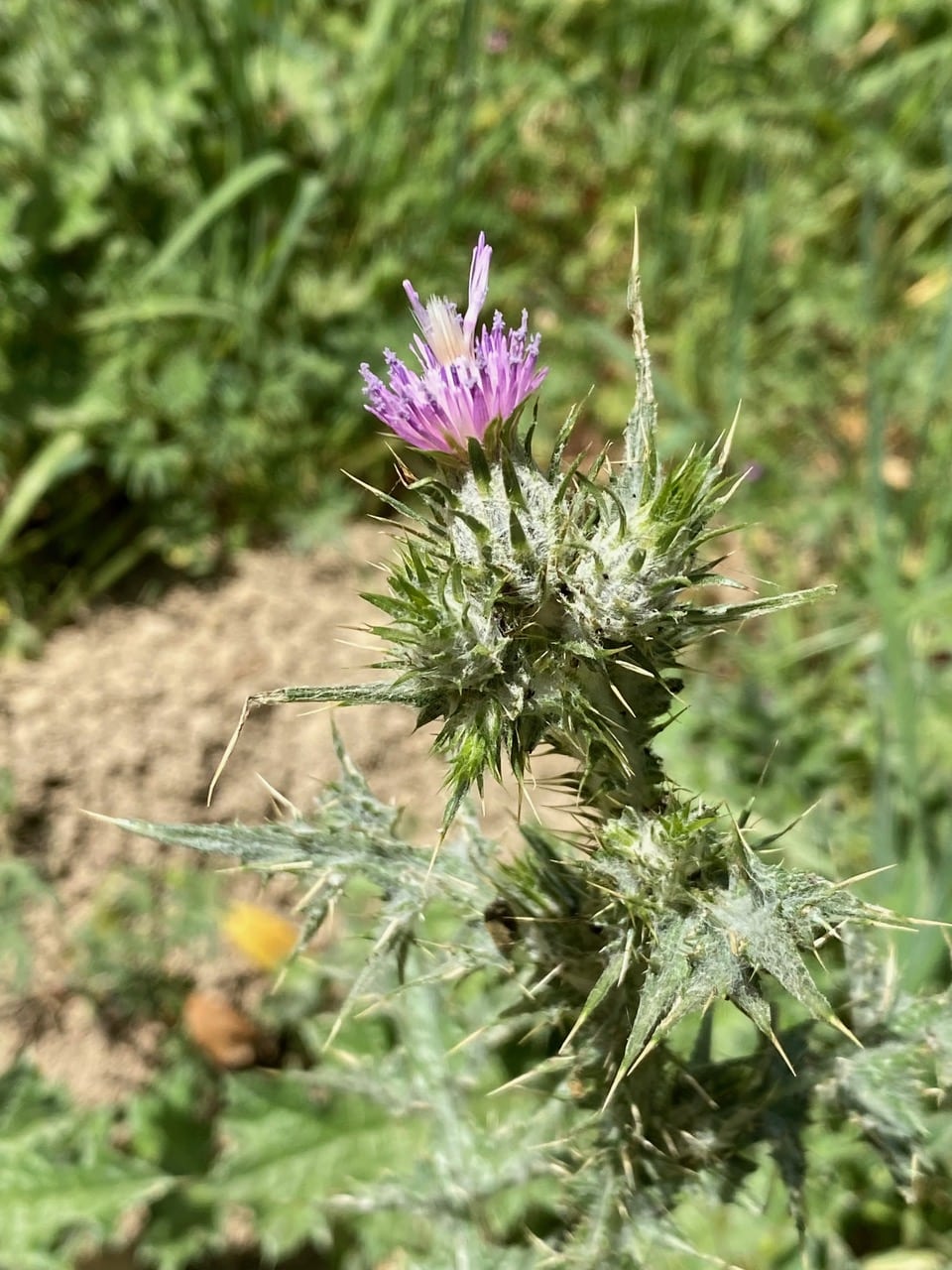
The park service has removed most of the invasive Italian Thistles along this section of the trail. The ones that remain are beginning to bloom.

Look, there’s a weevil on the stem of that Italian Thistle. I recognize it as the Nodding Thistle Receptacle Weevil, Rhinocyllus conicus (family Curculionidae).
The adult weevil is black and covered with a thin black and yellowish mottled coat of hairs. It is a short-snouted beetle up to 6 mm long. Eggs are laid on or near the bracts of the thistle flower head. The larvae burrow into the flower head and feed on the flower parts and developing seeds. Adults cause damage as well when they feed on the foliage.
The weevil is native to Eurasia and North Africa. Introduced to the United States for thistle biocontrol in 1969, it is now widely established in the country. The weevil is found to be very effective in reducing the spread of invasive thistles, including Italian thistles. However, the weevil will also readily attack native thistles in the genus Cirsium, in some cases contributing to population decline. For this reason this weevil is no longer used for thistle biocontrol.
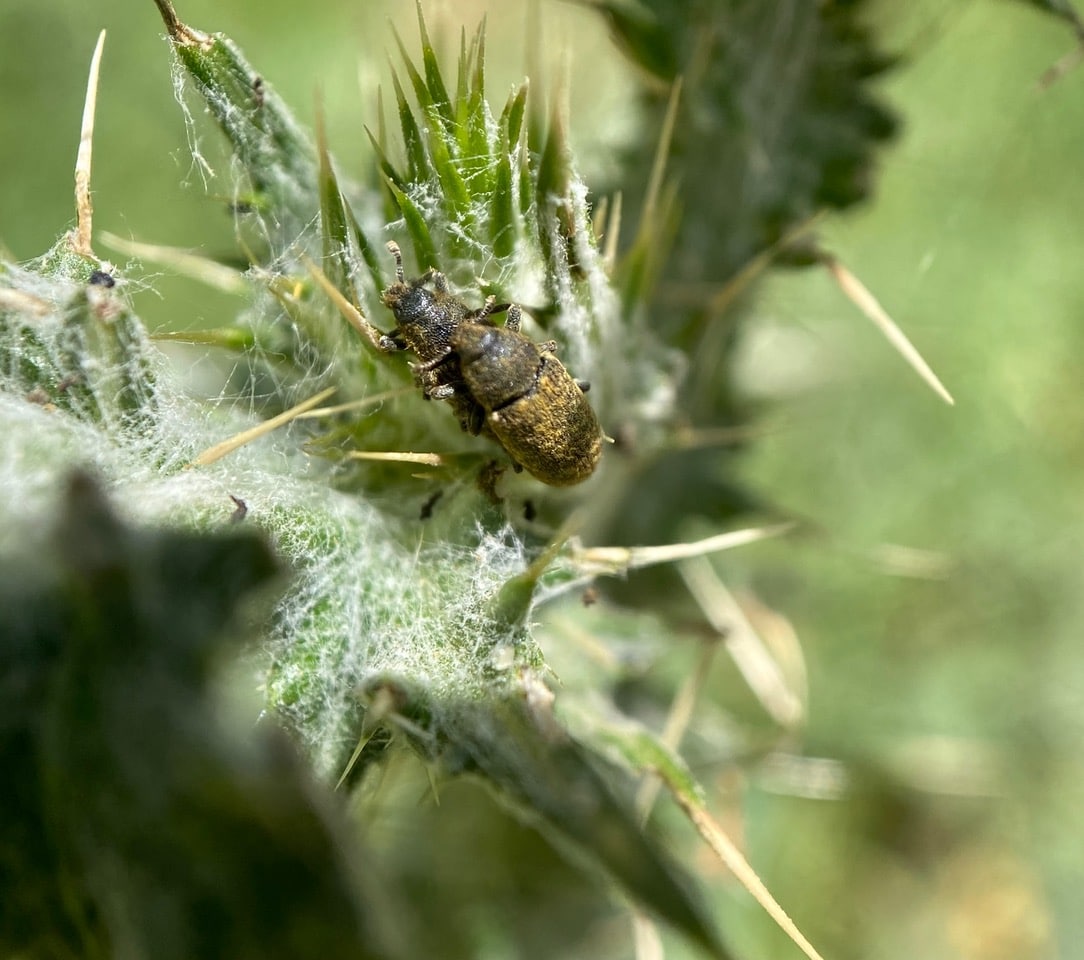
A pair of the weevils is mating on an immature thistle flowerhead. These are some of the most frustrating insects to photograph. One has to contend with their prickly habitat, and the weevils are extremely wary, dropping from the plant as soon as they feel threatened.
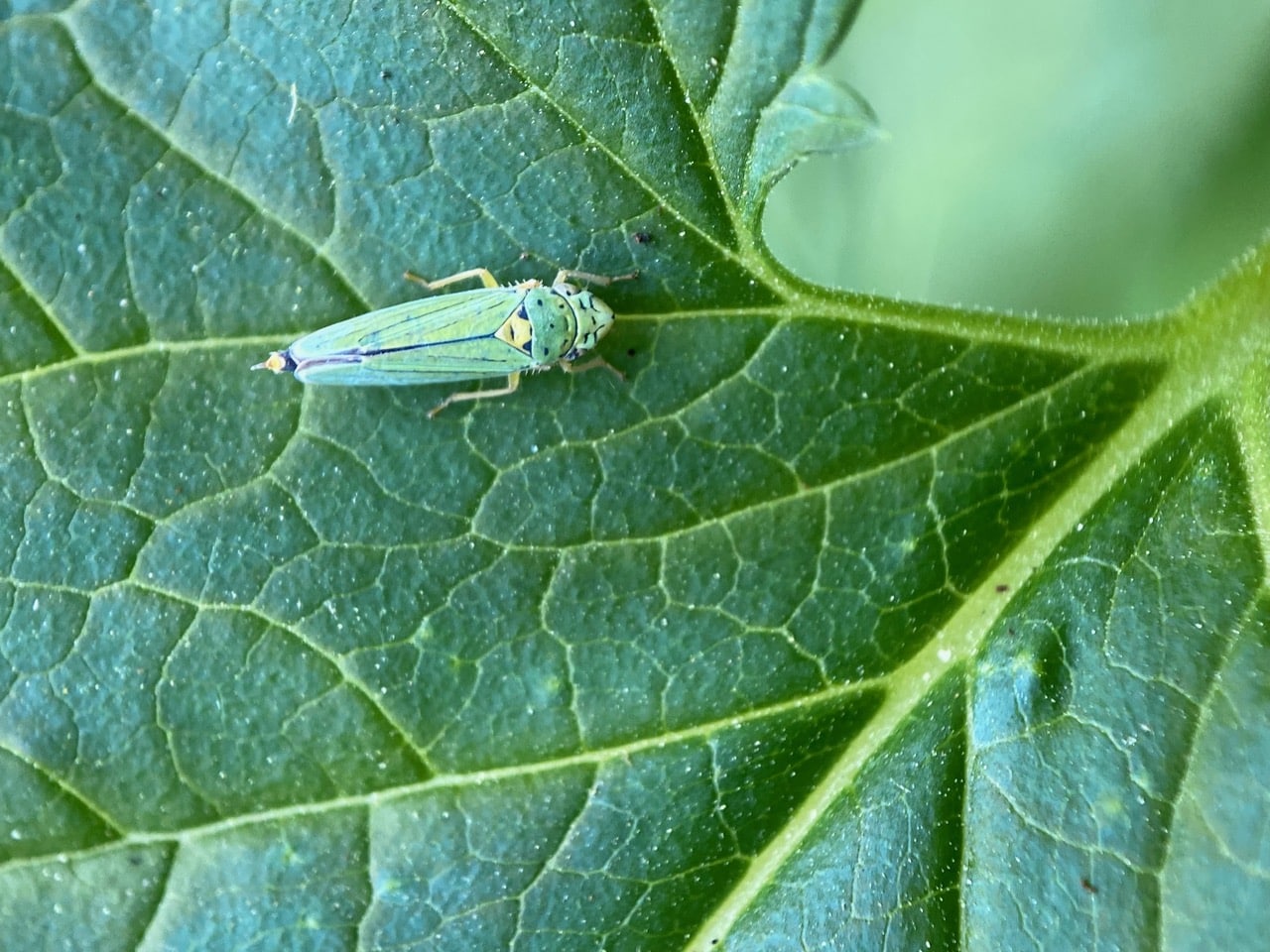
A Blue-green Sharpshooter, Graphocephala atropunctata (family Cicadellidae) is resting on a leaf of Bee Plant. Note the “butt flicker” contraption at the rear end of the bug.
The Blue-green Sharpshooter, Graphocephala atropunctata (family Cicadellidae) is a hemipteran bug endemic to California. It is about 0.4 in long with blue or bluish-green color on the upper surface while the head, prothorax, legs and underside are lighter and yellow-green. The leafhopper feeds on plant sap, specifically the xylem, using its piercing-sucking mouthparts. Adult blue-green sharpshooters are long-lived. Both nymphs and adults share the peculiar habit of running sideways. There is usually only a single generation per year. The females mature during their first winter and lay eggs the following spring. The bugs can be found in the vegetation alongside streams and rivers, in locations with abundant soil moisture and some shade. They can be found on the leaves of native as well as cultivated ornamental plants and crops. More than 150 plants have been recorded as hosts.
The Blue-green Sharpshooter is known to be a carrier of Pierce’s Disease, a disease infecting grape vine, among other crops of economic importance. As the bugs feed, they inject plants with a bacteria that causes the disease, blocking the flow of water and nutrients through the xylem.
Sharpshooter bugs eject waste, often 300 times their body weight daily, by using a specialized, hinged appendage called an anal stylus to catapult urine droplets. This “butt flicker” catapult accelerates droplets at 40 g, utilizing a physics principle called “super propulsion”, where the liquid travels faster than the stylus itself.
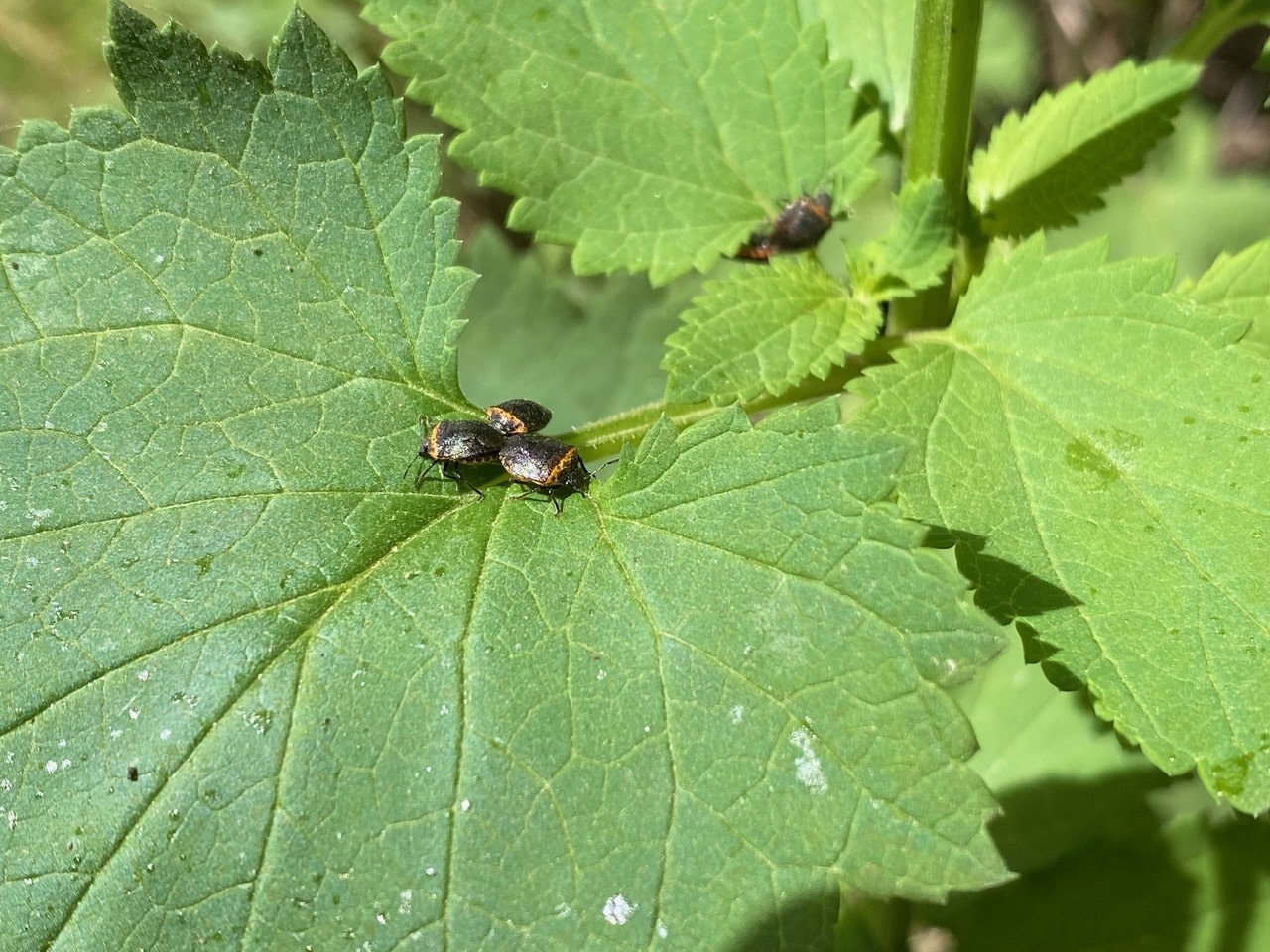
Small, shiny black stink bugs, Cosmopepla uhleri (family Pentatomidae) have gathered on the leaves of Bee Plant, Scrophularia californica.
Cosmopepla uhleri is a stink bug native to the western regions of the United States, including California and Oregon. It is black with an orange transhumeral band that has black spots. The bug uses Bee Plant, Scrophularia californica as a host.
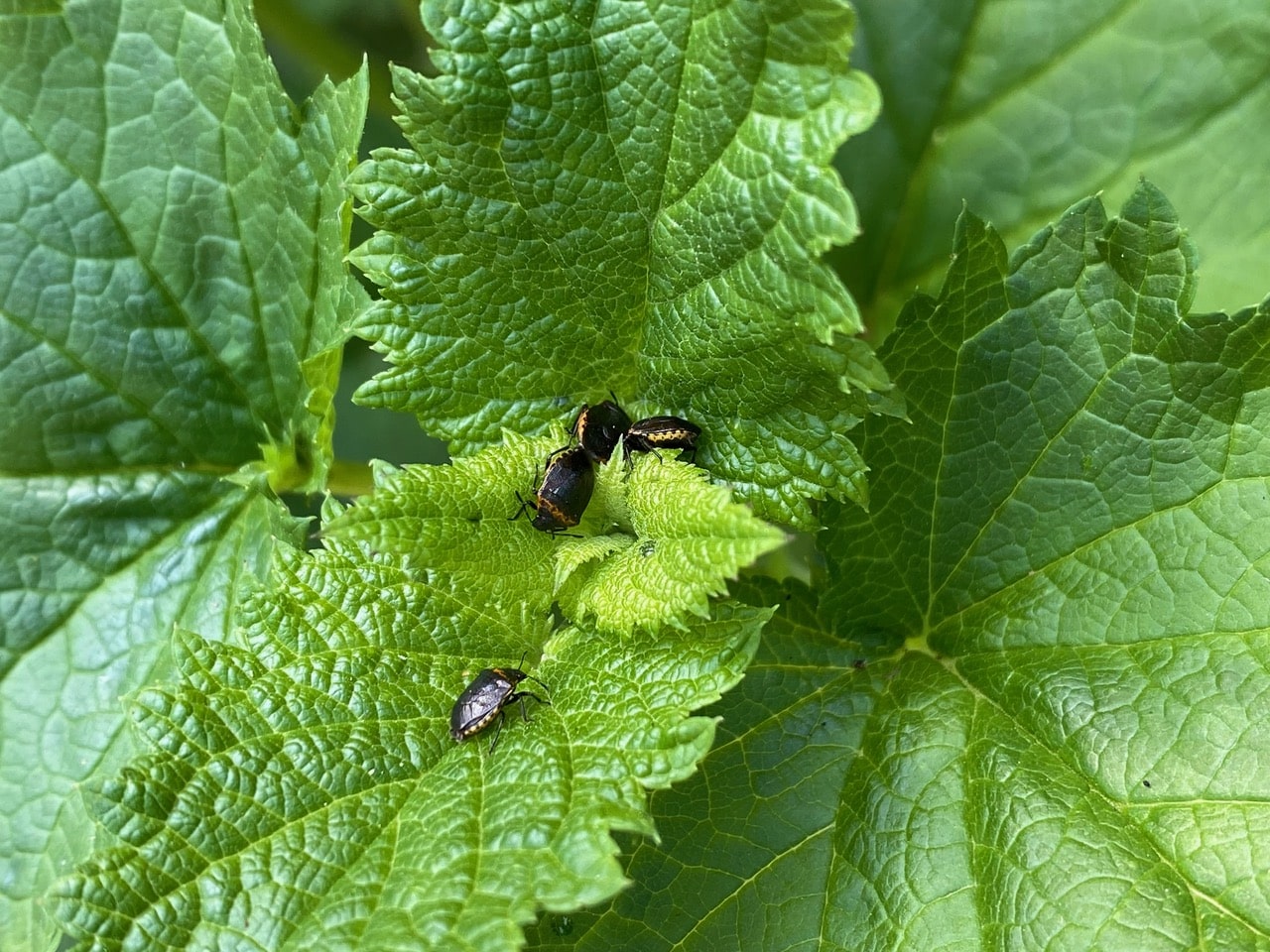
I have never seen such a high concentration of these stink bugs. They are mostly found on the tender terminal leaves.
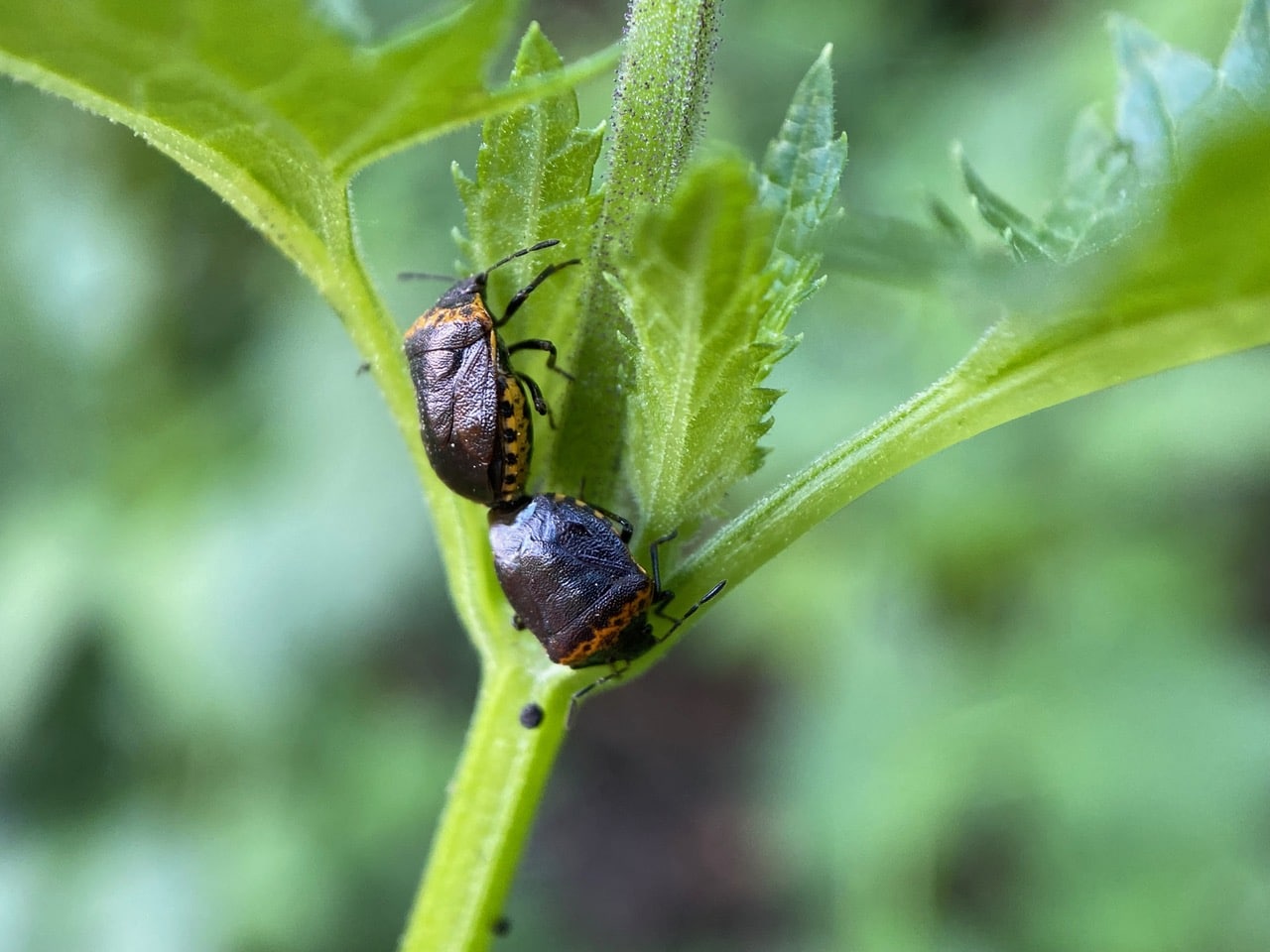
A pair of the Stink Bugs, Cosmopepla uhleri (family Pentatomidae) is mating on a leaf axil of Bee Plant.
Pentatomidae is a family of insects belonging to the order Hemiptera or “true bugs”. As hemipterans, the pentatomids have piercing-sucking mouthparts, and most are phytophagous, including several species that are severe pests on agricultural crops. Stink Bugs feed on plant fluids by inserting their needlelike mouthparts into stems, leaves or seed pods. While feeding, they inject materials into the plant to aid in digestion and sap removal. Penetration by the mouthparts can cause physical damage, much like stabbing the plant with a fine needle.
All Pentatomids have 5-segmented antennae (hence their family name, Penta – five and tomos – section.) They generally have a large triangular scutellum in the center of the back. The adult is generally shield-shaped when viewed from above. The common name of Stink Bug refers to their ability to release a pungent defensive spray when threatened, disturbed, or crushed.

This beautiful female Conical Trashline Orbweaver, Cyclosa conica (family Araneidae) has fed well – look at the prodigious prey carcasses she has strung up on the vertical trashline of her web. She is resting in the typical Cyclosa pose, head-down in the hub of her orb web, her front legs folded to hide her cephalothorax.
Cyclosa, also called Trashline Orbweavers, is a genus of orb-weaver spiders (family Araneidae). The tiny spider (5-7.5 mm) is easily recognized by its web decoration; the spider strings together the dead bodies of insect prey and other debris and hangs them in a vertical line through the middle of its web. The decoration, which sometimes includes egg cases as well, probably serves to camouflage the spider. Cyclosa creates its webs mostly during times of complete darkness. The females occupy the web hub (center) to sit-and-wait for prey. The spider can ensnare prey at nearly any time of day, and it only leaves its spot to replace the web prior to sunrise.
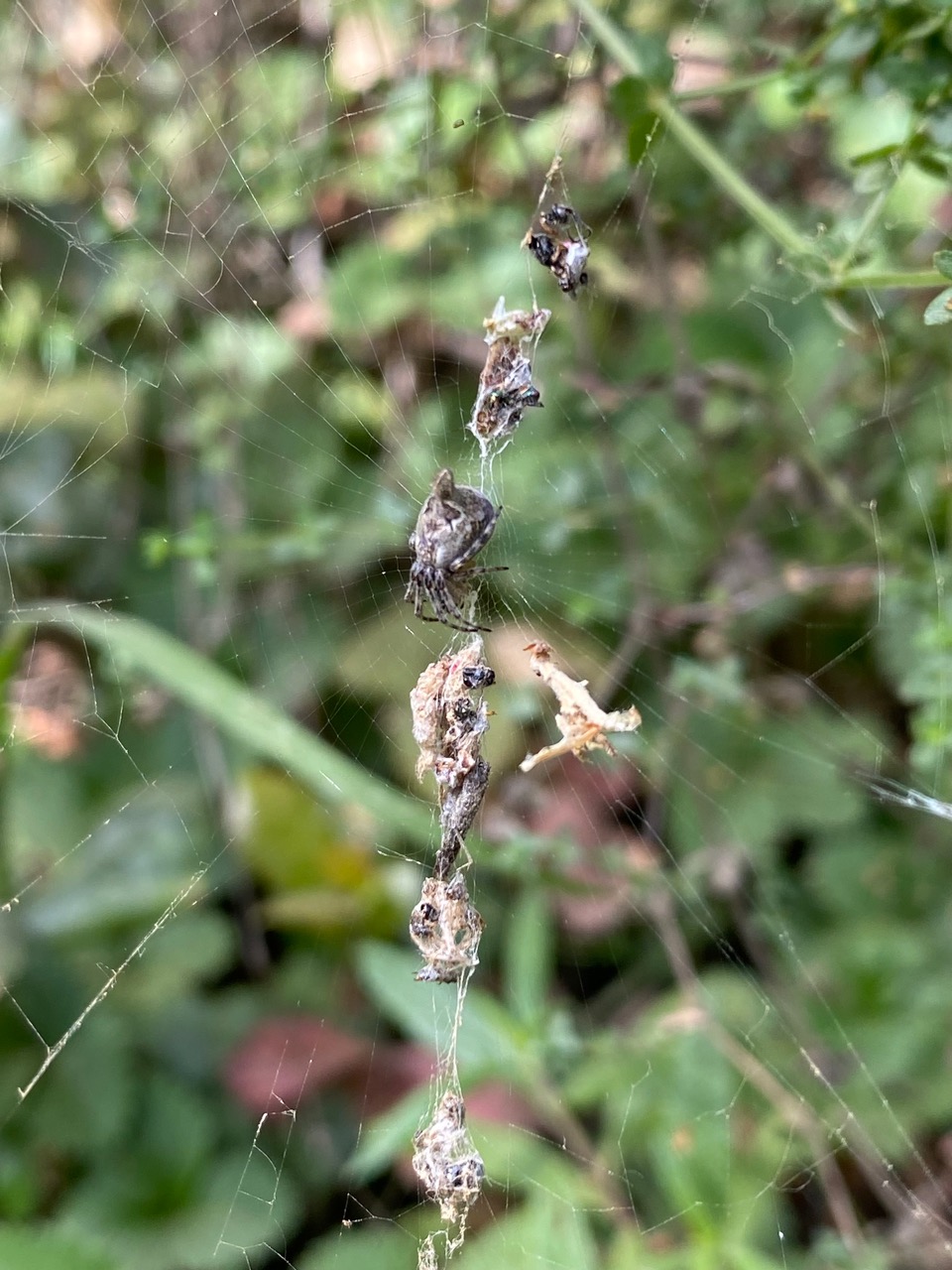
Just about 3 feet away, a darker neighbor has fared equally well, with several big bundles of prey items strung up on her trashline. Though well camouflaged among the trash, the spider can usually be found resting head-down in the center of the orb web.

A female Snakefly is perched on a blade of grass.
Snakeflies are a group of predatory insects comprising the order Raphidioptera. They are a relict group, having reached their apex of diversity during the Cretaceous before undergoing substantial decline. Adult Snakefly has a notably elongated thorax which, together with the mobile head, gives the group their common name of snakefly. The body is long and slender and the two pairs of long membranous wings are prominently veined. The head is long and flattened and heavily sclerotized. The mouthparts are strong and relatively unspecialized, being modified for biting. The large compound eyes are at the sides of the head. Females have a large and sturdy ovipositor which is used to deposit eggs into crevices or under bark. Snakeflies are holometabolous insects with four-stage life cycle consisting of eggs, larvae, pupae and adults. Both adults and larvae are predators of soft-bodied arthropods such as aphids and mites.
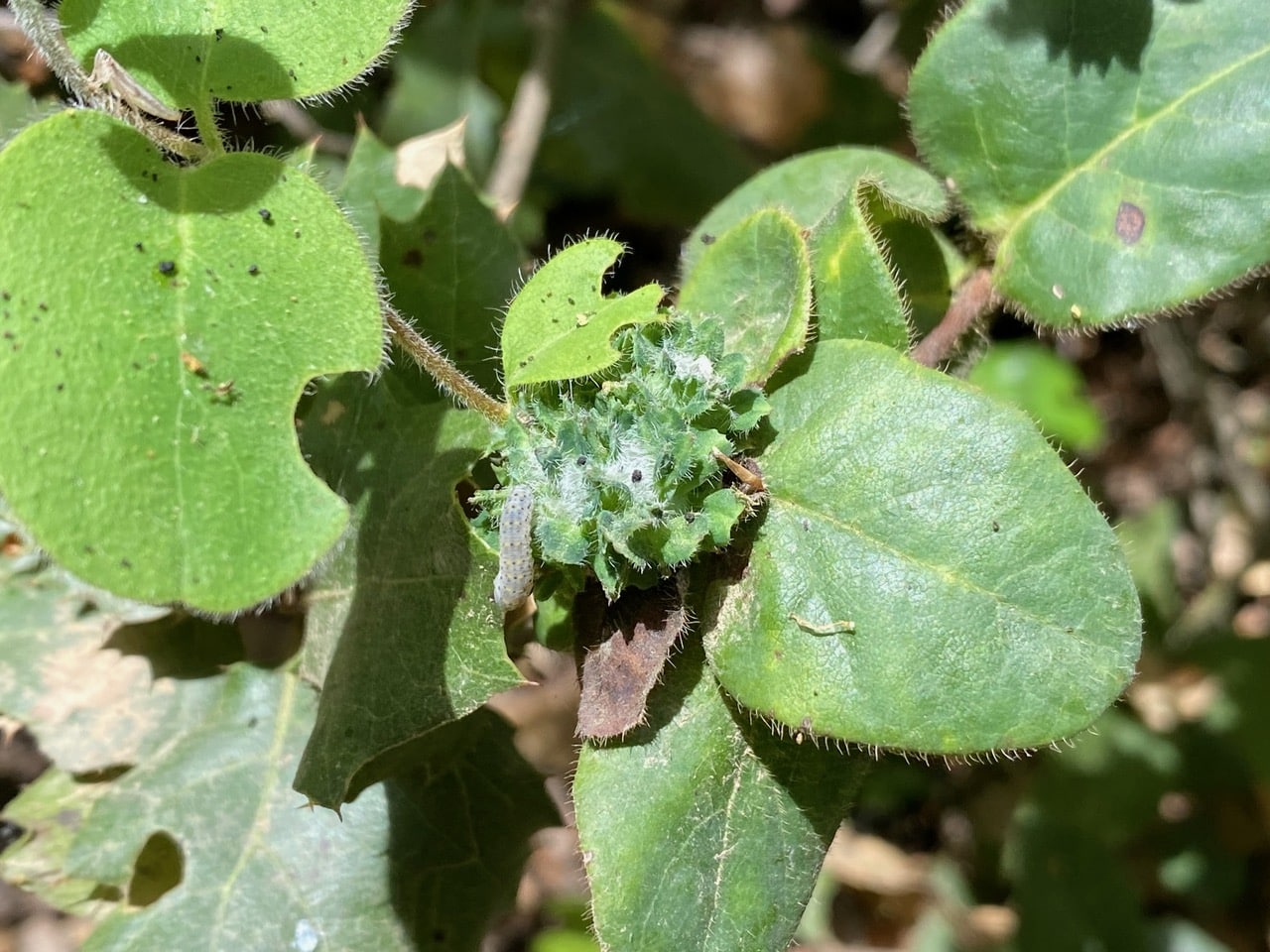
Look, a Cabbage-bud-gall on a vine of the Pink Honeysuckle, Lonicera hispidula. Is that a caterpillar on the gall?
The Cabbage-bud-gall Midge, Lonicerae russoi (family Cecidomyiidae) induces conical, leafy bud galls on honeysuckle. While these rosette galls can occur singly, they usually appear in congested clusters that can reach 3 cm across. Each gall has a dense arrangement of white hairs filling its center, marking the entrance to the larval chamber. The galls exposed to direct sun often turn wine red. The larvae feed and eventually pupate within the galls. Adults emerge in late February and March by pushing through the hairs.
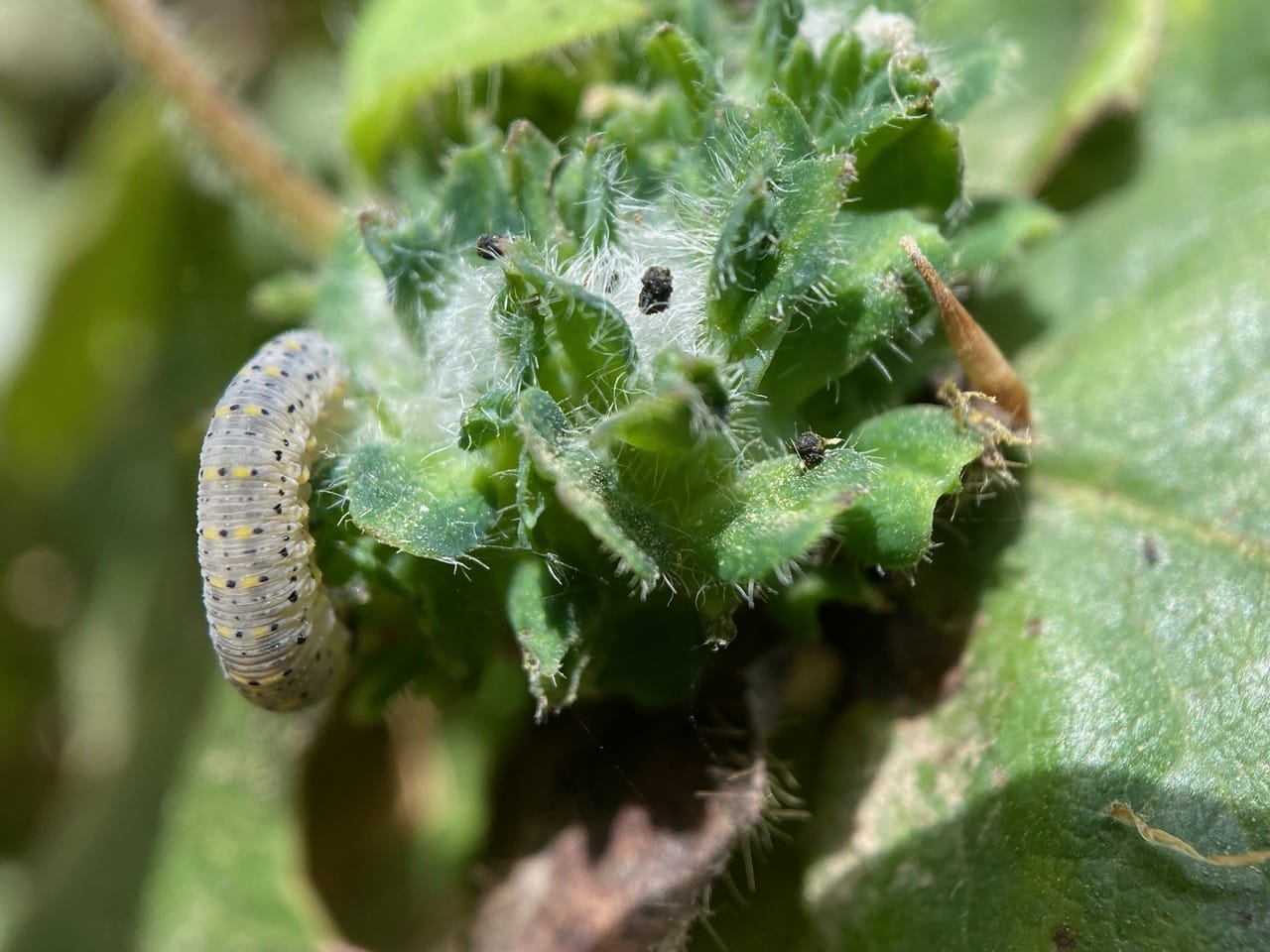
Surprise, iNaturalist has helped identify the critter as a larva of a Honeysuckle Sawfly, Abia americana (family Cimbicidae), not a Lepidopteran caterpillar.
Sawflies are part of the insect order, Hymenoptera, together with bees, wasps and ants. They are considered to be the most primitive group and form the sub-order Symphyta. They differ from the bees, wasps and ants in not having a narrow ‘waist’ and in their wing venation. The common name comes from the saw-like ovipositor that the females use to cut into plant tissues to lay their eggs. Larvae are caterpillar-like and can be distinguished from lepidopteran caterpillars in that all body segments following the three bearing true legs have a pair of fleshy prolegs. Like the lepidopteran caterpillars, sawfly larvae walk about and eat foliage. In many species, the larvae feed in groups.
Abia americana, known as the Honeysuckle Sawfly, is a small (9-12 mm), harmless, bee-like insect with a metallic, copper-sheened, or dark body. Found in western North America, it belongs to the Cimbicidae family. Larvae typically feed on honeysuckle and snowberry, while adults are found in similar regions.
To distinguish sawfly larvae from moth caterpillars, count their abdominal prolegs (fleshy leg-like projections). Sawfly larvae have six or more pairs of prolegs without hook-like claws (crochets), often on every abdominal segment. Moth or butterfly caterpillars have five or fewer pairs of prolegs, which always have tiny crochets.
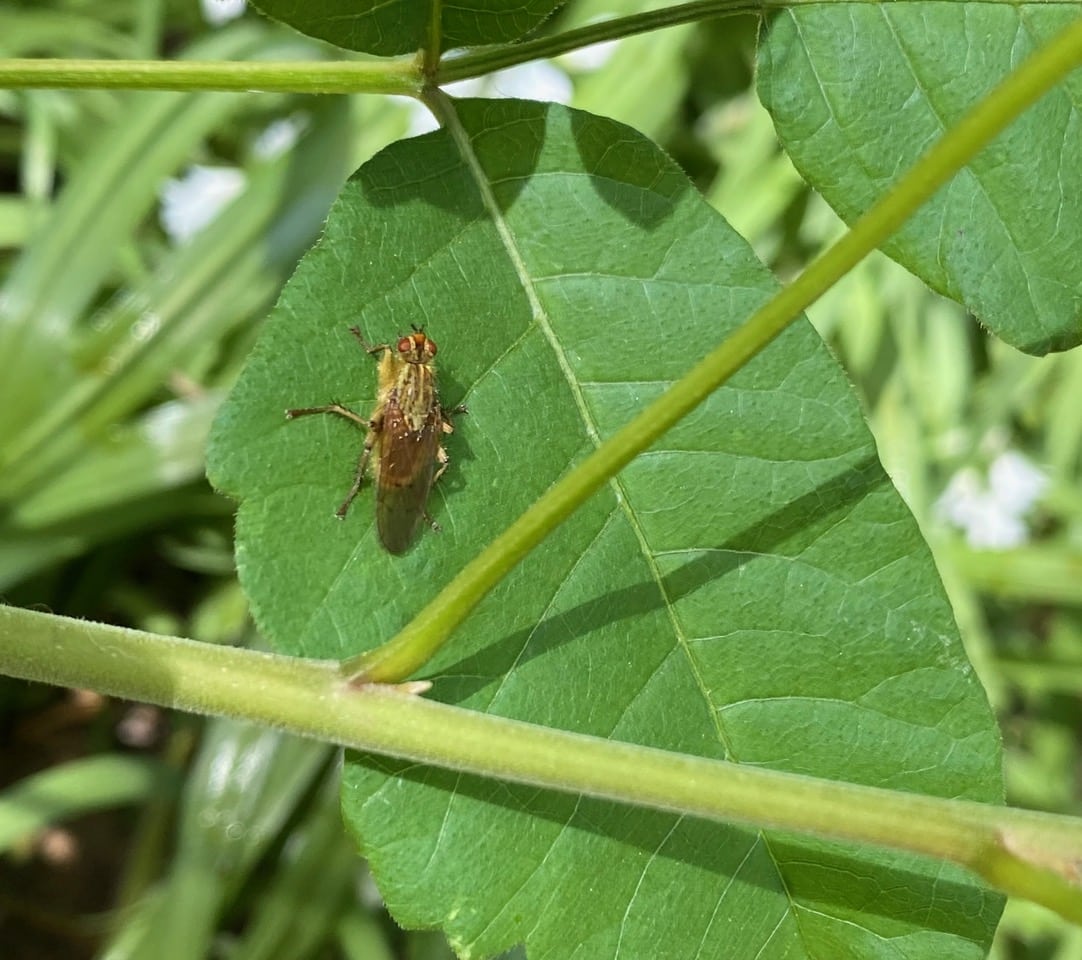
Resplendent in golden hairs, a Golden Dung Fly, Scathophaga stercoraria (family Scathophagidae) has landed on a leaflet of Poison Oak.
The Golden Dung Flies, Scathophaga stercoraria (family Scathophagidae) are small, spiny flies about 3/8 in. long. Males are a little larger than the females; females are not as golden and their front legs are not as fuzzy as the males’ are. As the common name suggests, the flies are commonly found on the droppings of large mammals, such as cattle, horses, sheep, deer, and wild boar. The Scathophaga are integral in the animal kingdom due to their role in the natural decomposition of dung in the fields.
The scientific name, Scathophaga stercoraria, says it all. Scatho from the Greek skatos meaning excrement, and phaga to eat, plus stercoraria from the Latin stercoris, meaning of dung, found in dung. The fly’s life is dung-centered. Adults locate dung by “scenting” it with their antennae and flying upwind to find it. Male and females meet there, mate there, lay eggs there, and take their meals there. They feed on other flies that are attracted to dung, and they also consume nectar (and in a pinch, each other). Larvae hatch in the manure’s warm, moist depths and consume both it and some other small insects they find in there.
Females spend most of their time foraging in vegetation and only visit dung pats to mate and oviposit on the dung surface. Males spend most of their time on the dung, waiting for females and feeding on other insects that visit the dung, such as blow flies. Fights often break out on the cow pat as males vie to mate with a female.

A hover fly larva is resting on a Dock leaf (Rumex sp.) riddled with leaf mines. Scattered around and on the larva are whitish aphid exuvia. iNaturalist has helped identify the larva as belonging to the White-bowed Smoothing, Scaeva affinis (family Syrphidae).
The White-bowed Smoothwing, Scaeva affinis is a hover fly found in western North America, but rare in the east. Adult flies visit flowers for nectar and pollen, and are good pollinators. Females lay eggs near aphid colonies on plants. The larvae feed voraciously on aphids, consuming over 500 aphids during its larval stages.
Scaeva affinis is considered a migratory species, known for large movements, especially along the North American coasts. (Wow, traveling pollination and pest control service!) Large-scale migrations, involving hundreds of thousands of individuals, have been observed, such as a major event in California in 2017. There were earlier reports of migration along the U.S. East Coast between 1915 snf 1926, but fewer recent documented instances compared to the West. More research is needed on the ecology and patterns of hover fly migrations.
White-bowed Smoothwing (Scaeva affinis) · iNaturalist