

Pollinator Post 3/26/25 (2)
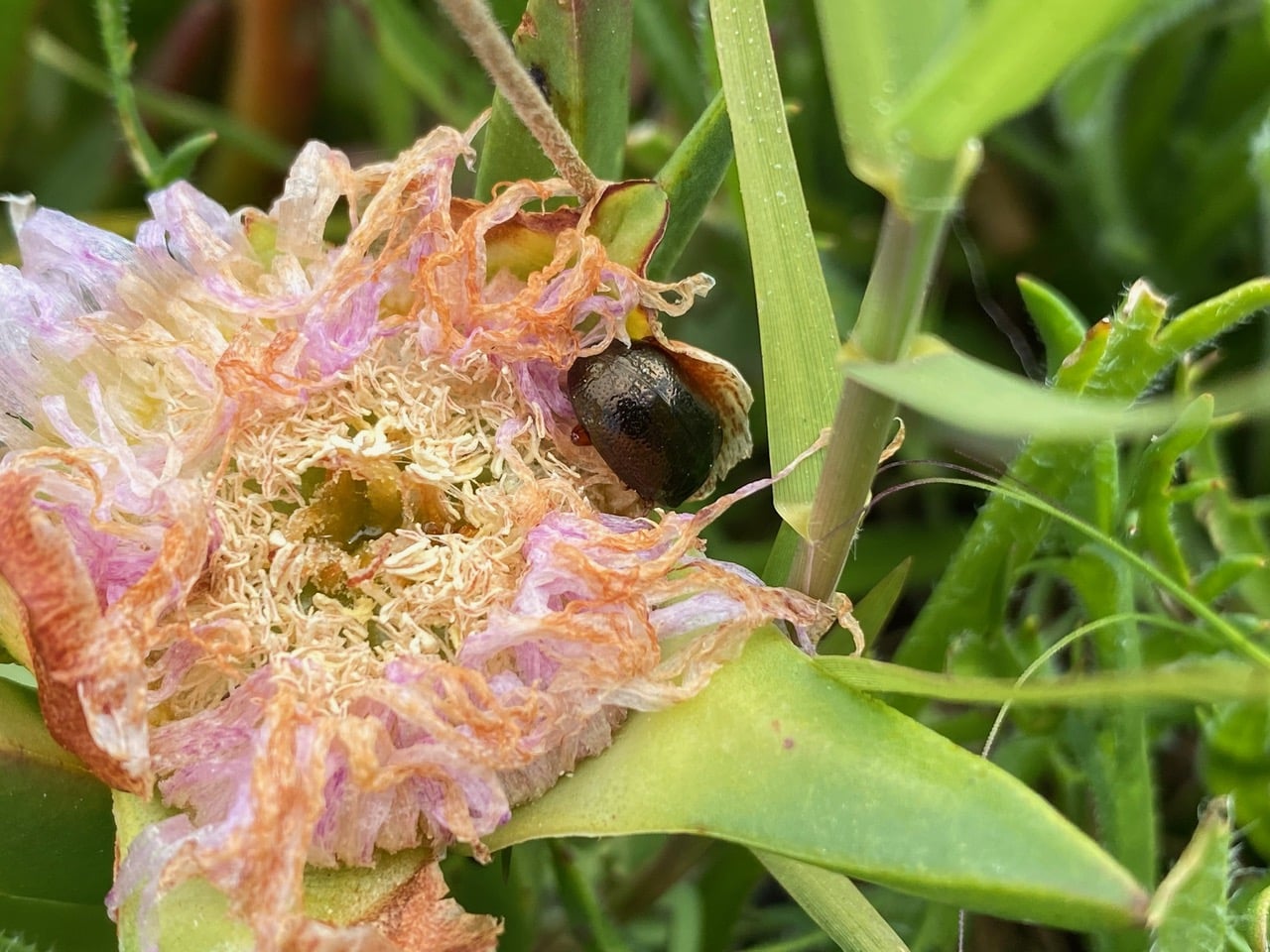
Hey, there’s a much bigger beetle on the withered Sea Fig flower. From its size, shiny pitted elytra and its inactive posture with retracted head, I recognize it right away as a Bronze Beetle, Chrysolina bankii (family Chrysomelidae).
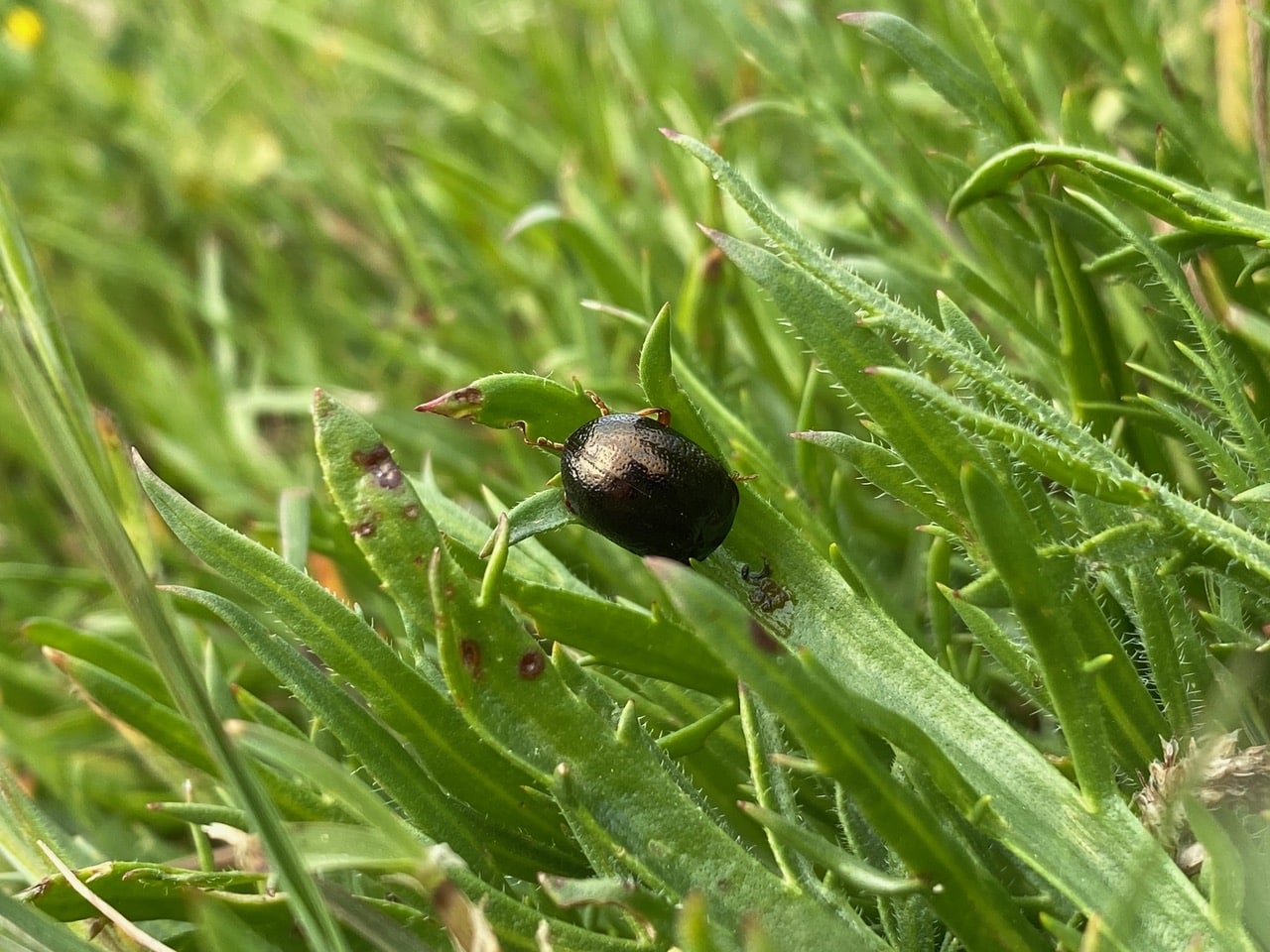
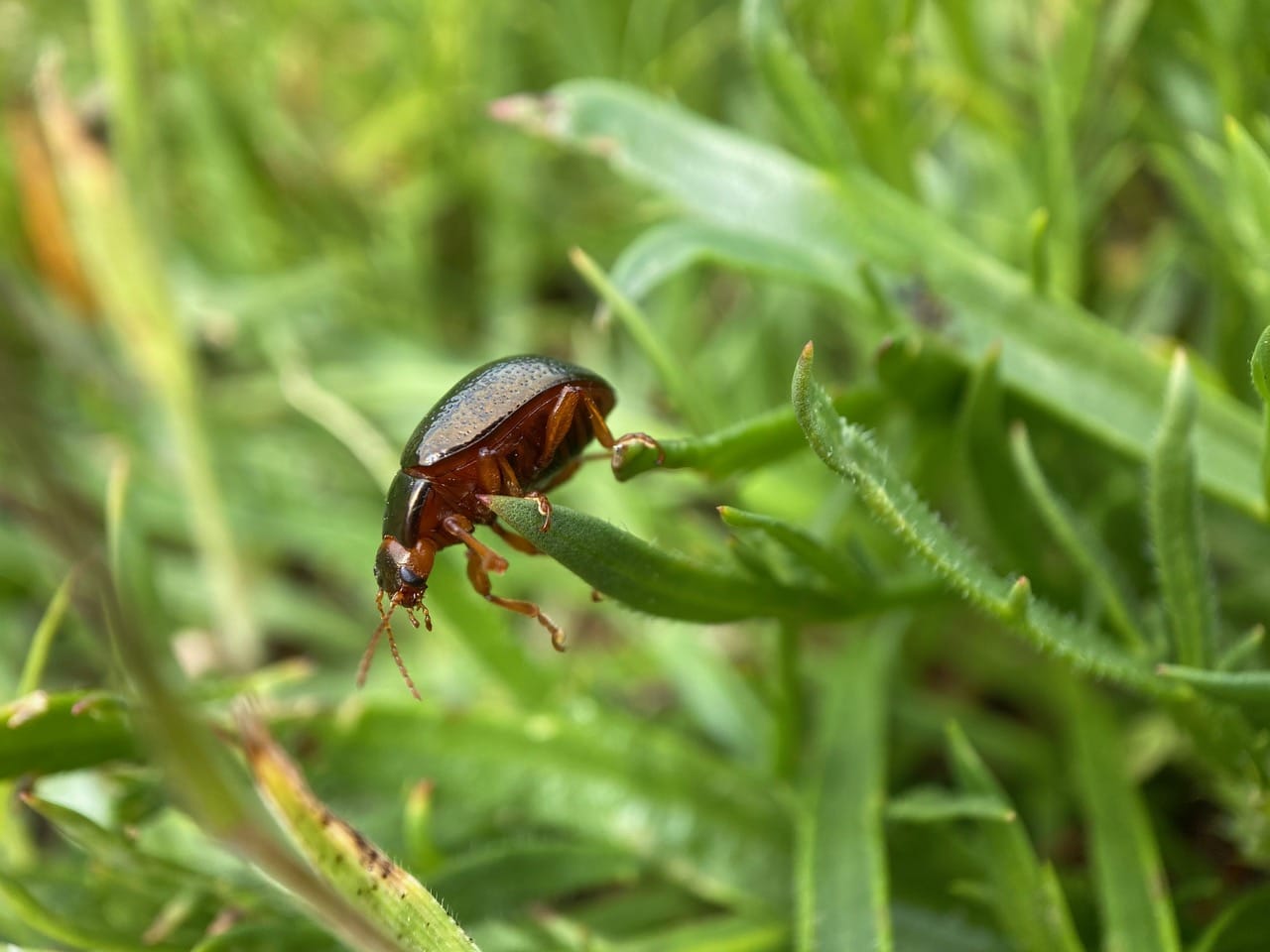
Here’s another Bronze Beetle, Chrysolina bankii (family Chrysomelidae) on a leaf of the non-native Buck’s Horn Plantain, Plantago coronopus.
Leaf Beetles in the family Chrysomelidae make up one of the largest and most commonly encountered beetles. They are all phytophagous – both adults and larvae feed on all sorts of plant tissues. All species of Chrysolina are phytophagous, feeding on specific food plants, and some of them have been used for biological control of weeds.
Chrysolina bankii is a species of leaf beetles native to the Mediterranean region of Europe. It has been introduced to the US, where its range is expanding. It is now established in several California counties in the Bay Area, where it does not appear to be a significant pest. Adult are 8.0-10.7 mm in length. They are metallic bronze in color, with orange-brown legs. Elytral punctures are sparse and random. The beetles feed on numerous types of leaves, especially those in Asteraceae and Lamiaceae. One of its known host plants, rosemary, is a widespread ornamental in California. In the UK, the beetles are known to feed on ribwort plantain, Plantago lanceolata.
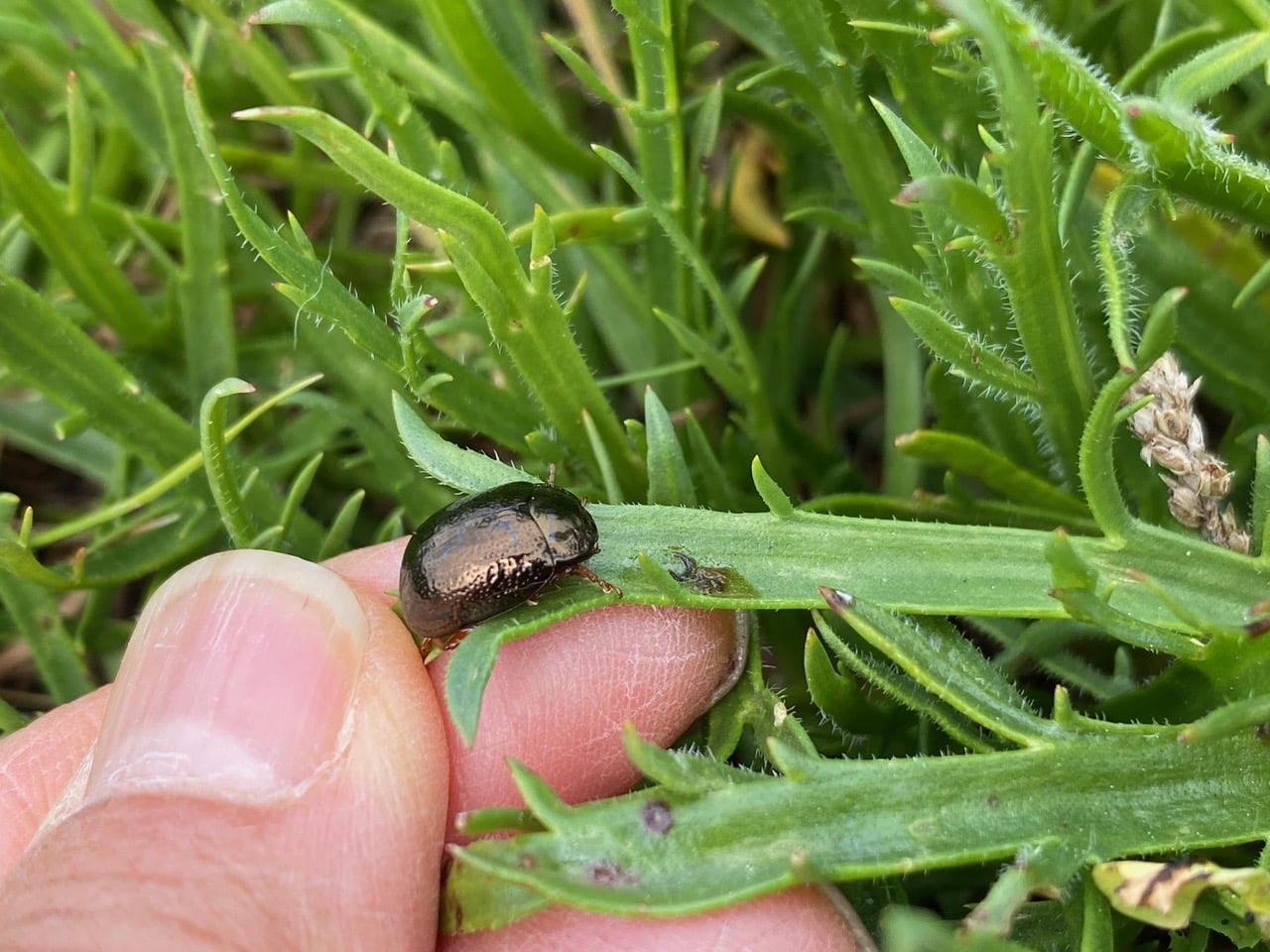
I bend back the plantain leaf to get a better look at the beetle.
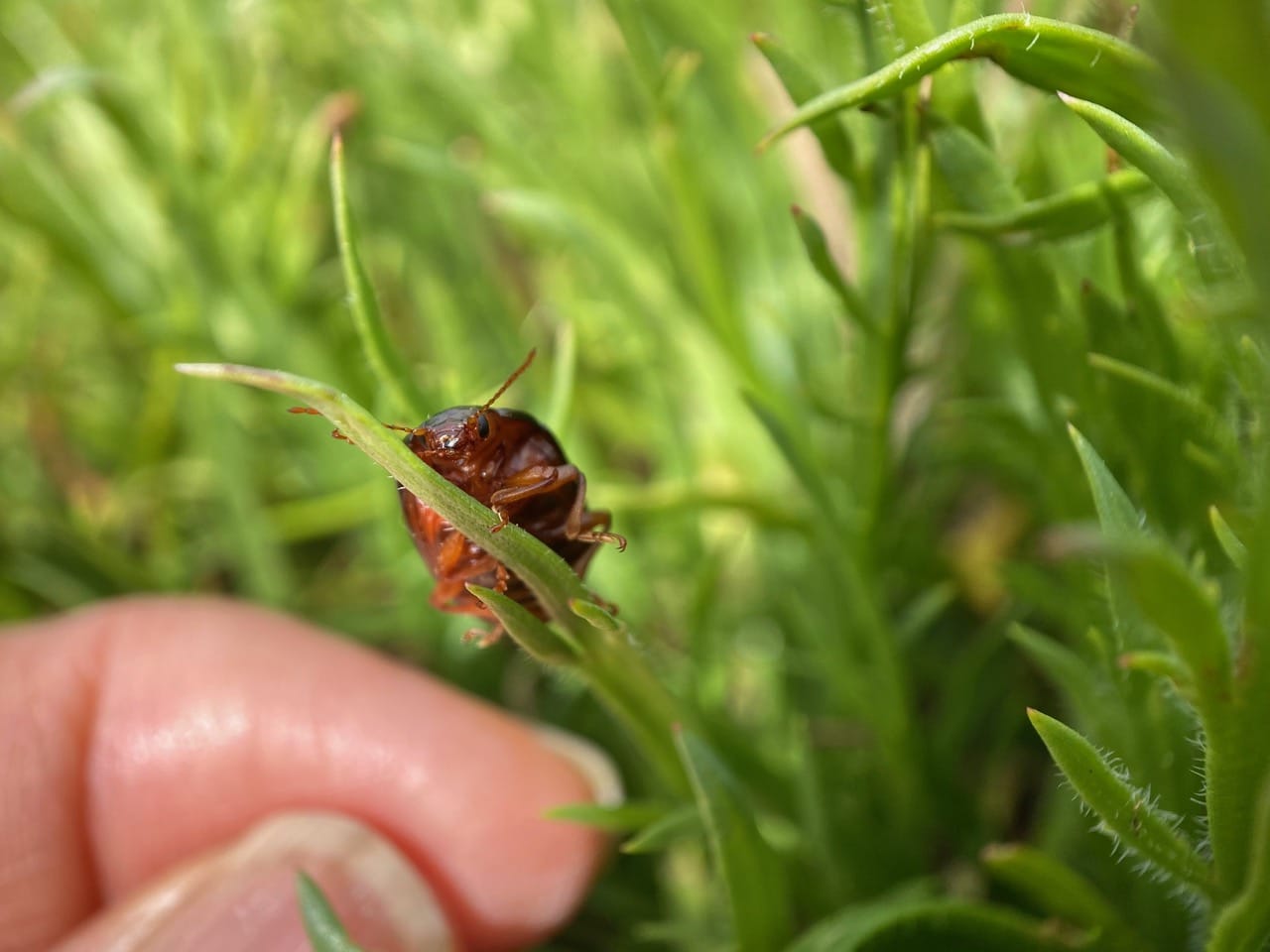
As I release the leaf, the beetle suddenly springs to life, much to my delight. These beetles are usually very sedentary, and one does not get to see the rest of their body other than the back. Note the reddish-brown legs and underside.

Ah, the head!


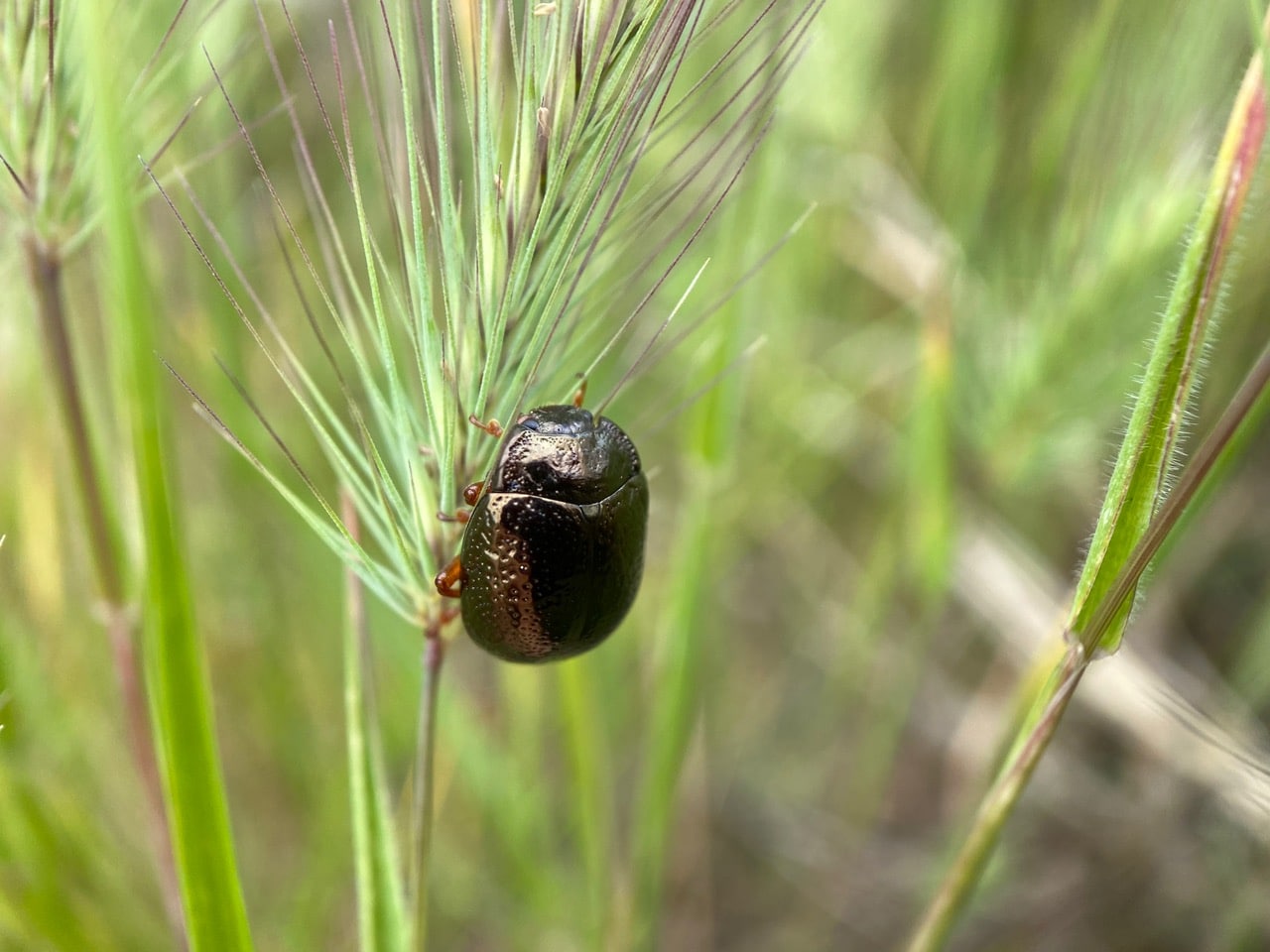
A Bronze Beetle is clinging to a foxtail grass, its head in a typical retracted position under its thorax. The beetles seem widespread on this stretch of the Alameda shoreline.
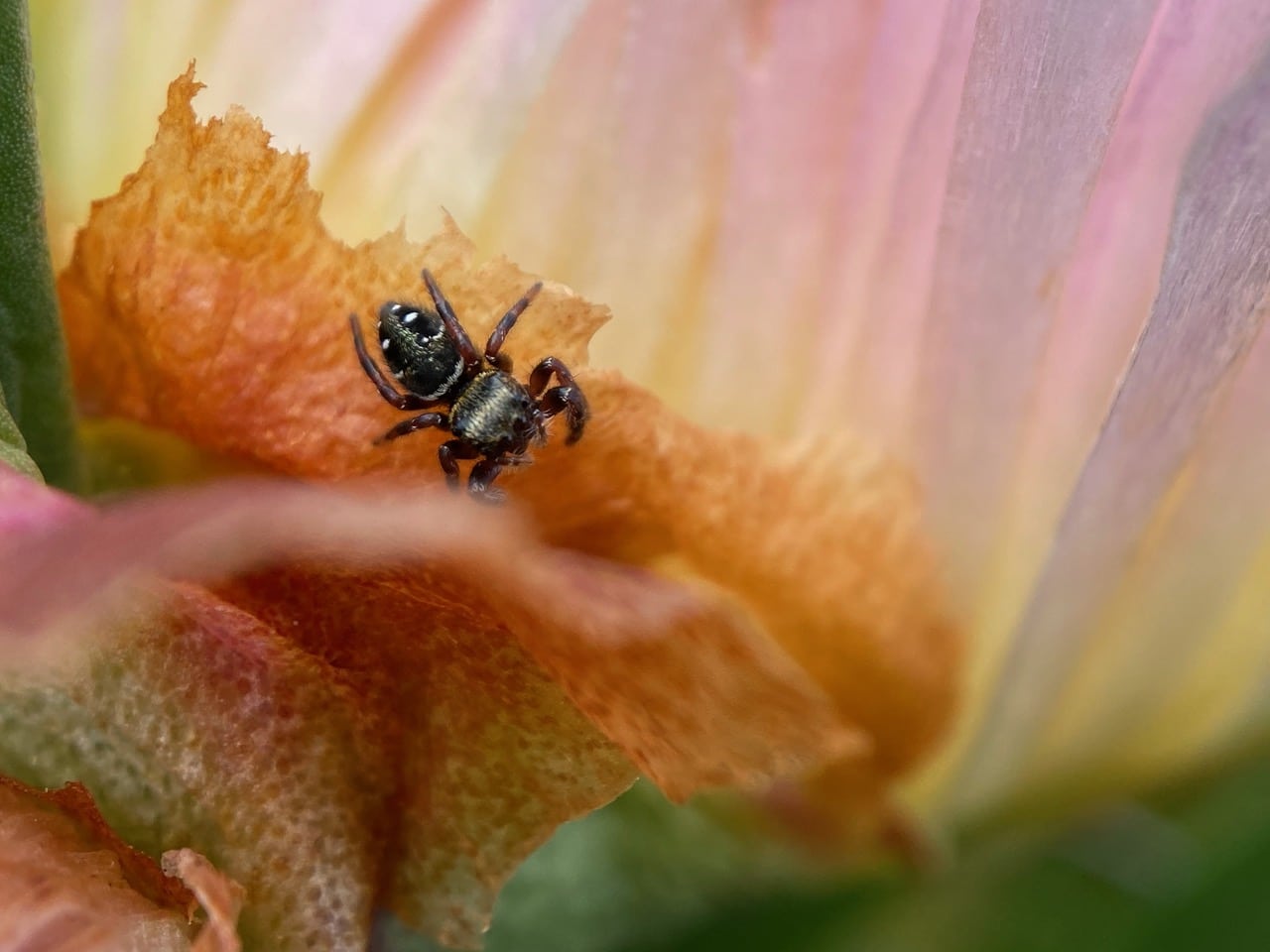
Ooh, another jumping spider on a withered Sea Fig flower. A jumping spider enthusiast on iNaturalist has helped identify it as the Brilliant Jumping Spider, Phidippus clarus (family Salticidae).
Jumping Spiders (family Salticidae) are free-roaming hunters. They do not weave a web to catch prey. They stalk, then pounce on their prey. Just before jumping, the spider fastens a safety line to the substrate. It can leap 10-20 times their body length to capture prey. Their movement is achieved by rapid changes in hydraulic pressure of the blood. Muscular contractions force fluids into the hind legs, which cause them to extend extremely quickly.
Phidippus clarus (family Salticidae) is found in old fields throughout most of the United States and southern Canada. It lives among flowers, often waiting upside down near the top of a plant, from which it can detect and pounce on a prey. Males compete for females using elaborate visual displays and abdominal vibrations on the substrate. Females construct silken nests in rolled up leaves in which they lay their eggs. The females guard the eggs and usually die a few days after the spiderlings leave the nests.
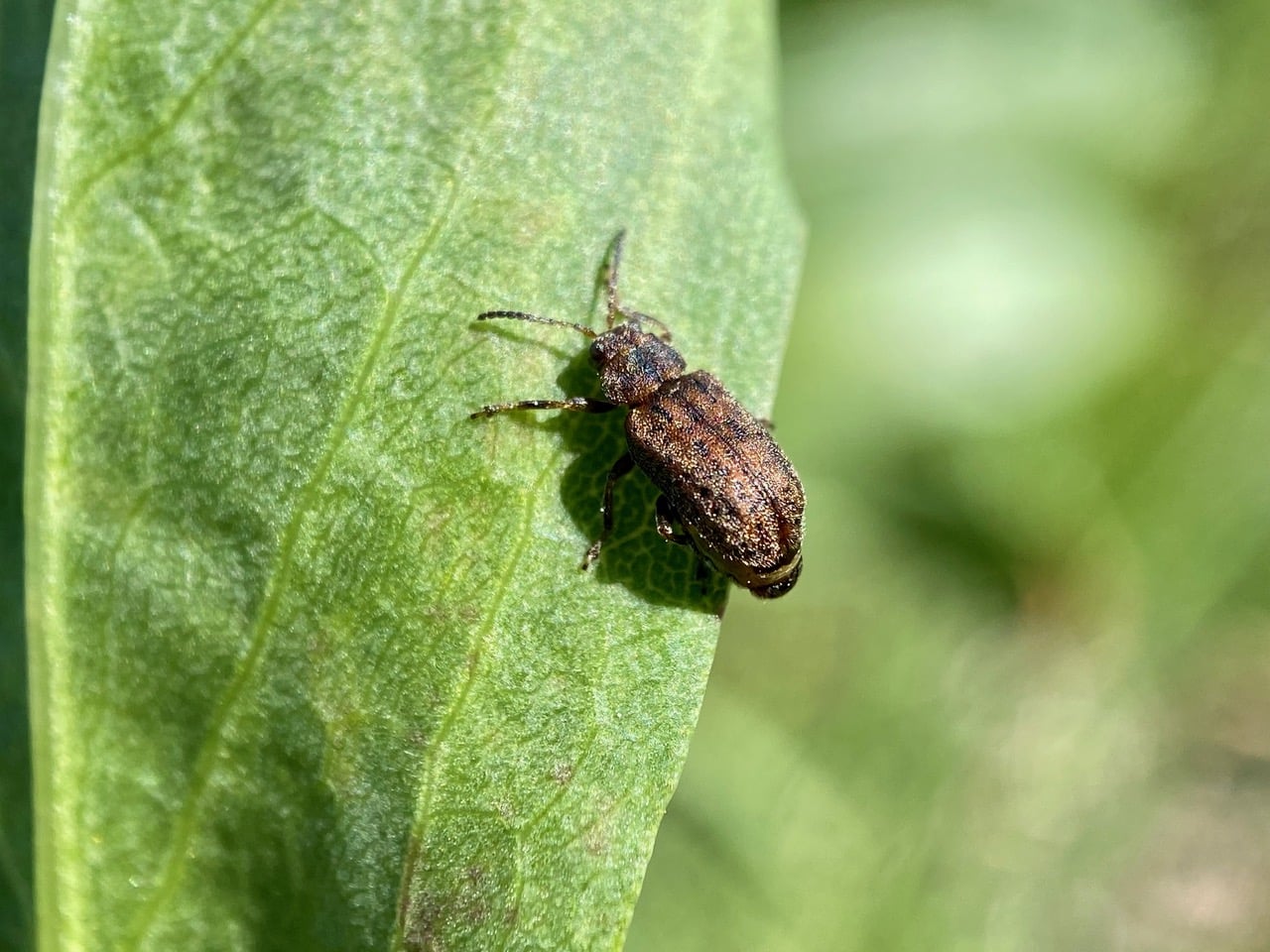
An unidentified beetle is perched on a Grindelia leaf.
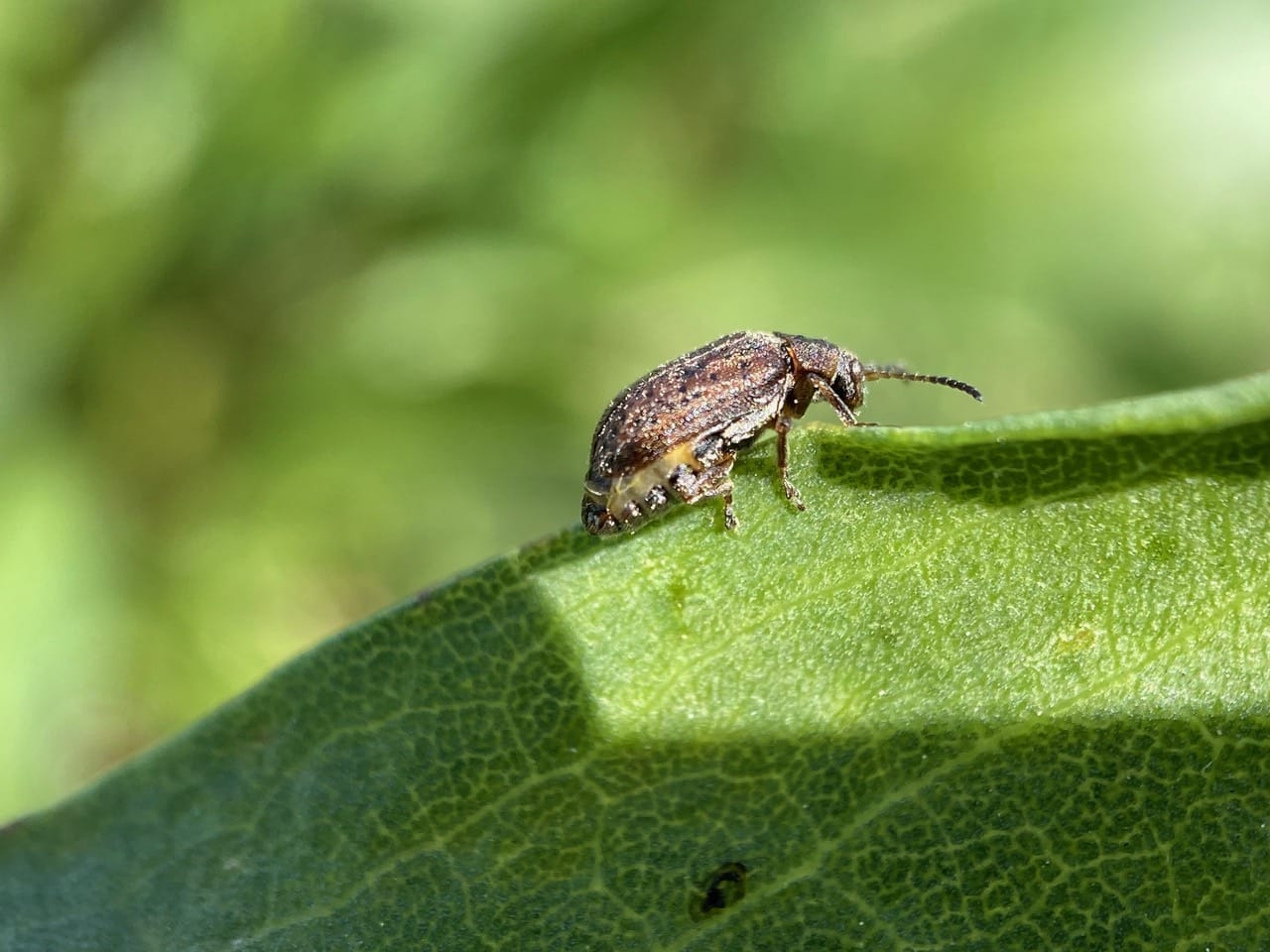
A gravid female with her swollen abdomen spilling out from under her elytra?
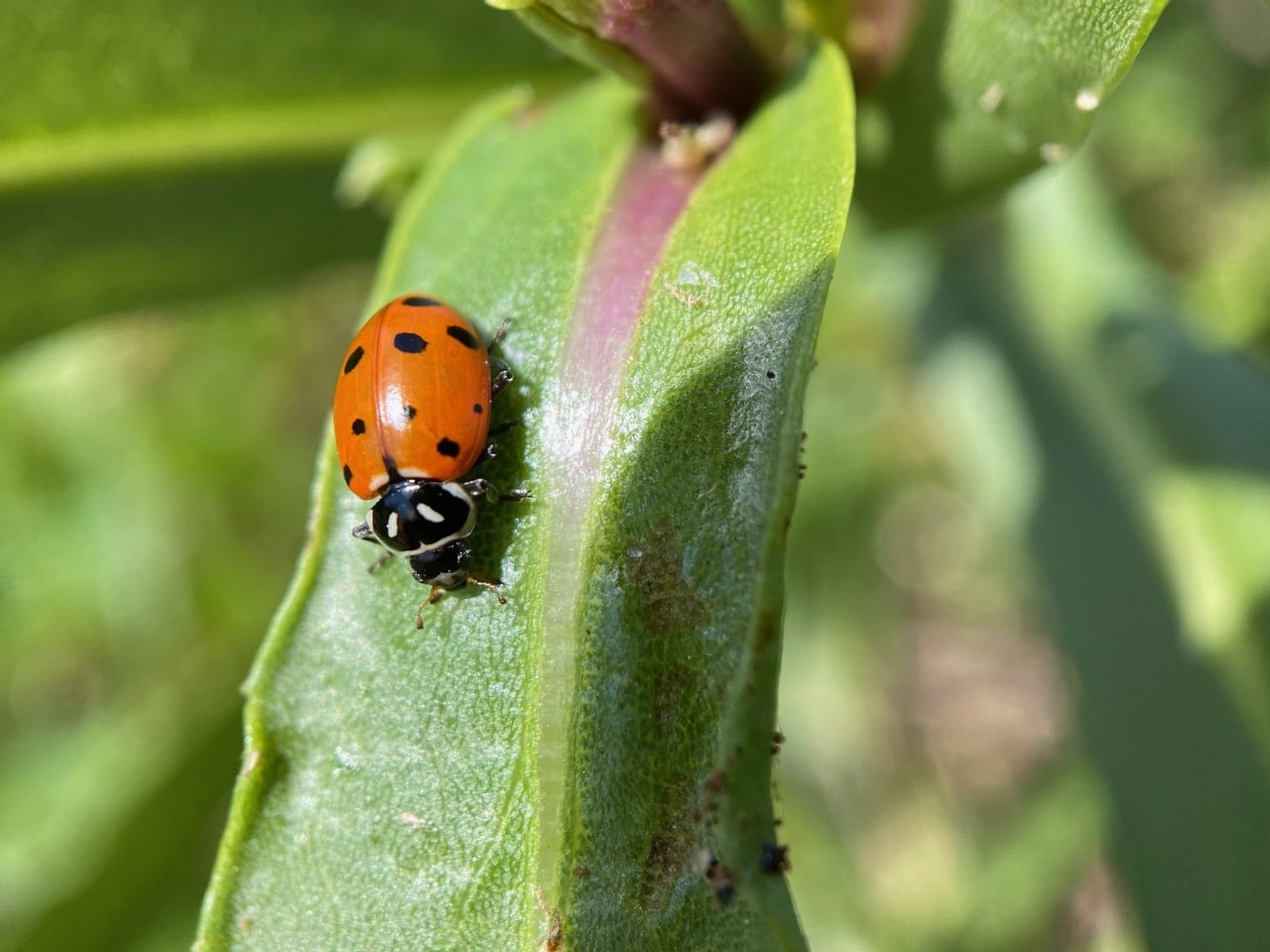
A Convergent Lady Beetle, Hippodamia convergens (family Coccinellidae) is hunting on a Grindelia leaf. Both adult and larval lady beetles are voracious predators of aphids, and other soft-bodied invertebrates.

A glint of iridescent green alerts me to the presence of a female Fine Striped Sweat Bee, Agapostemon subtilior (family Halictidae) rummaging among the stamens of a Sea Fig flower,
Carpobrotus edulis. A surprise – I always thought of these as summer bees!
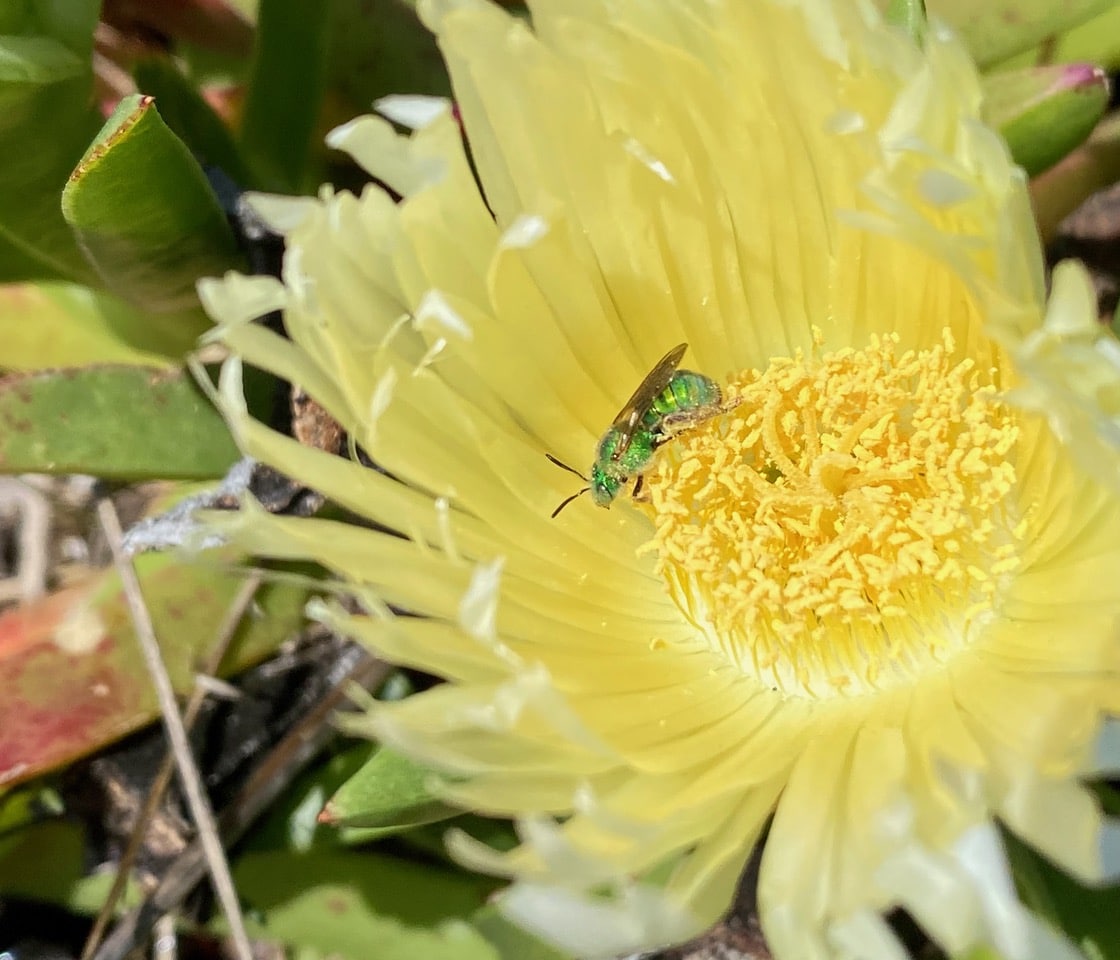
The common name seems to be a misnomer for the females of the species. Their body is entirely green with no stripes. It’s the males that have a distinctive black-and-yellow striped abdomen.
The genus Agapostemon is widespread and abundant throughout North America. They are most diverse and abundant in temperate regions and southwestern U.S. deserts. Agapostemon are commonly called “sweat bees” because they are closely related to, and resemble bees in the Halictus and Lasioglossum genera. Unlike those bees however, Agapostemon are not attracted to human sweat.
Agapostemon are brightly colored metallic green or blue bees measuring 7 to 14.5 mm long. Most species have a metallic green head and thorax, and black-and-yellow striped abdomen; some females are entirely bright green or blue. Females carry pollen on scopal hairs located on their hind legs. Agapostemon are ground-nesters and generalist foragers. Like other members of the family Halictidae, they are short-tongued and thus have difficulty extracting nectar from deep flowers. Males are often seen flying slowly around flowers looking for females. The bees favor flowers with high densities.
Agapostemon females dig deep vertical burrows in flat or sloping soil, or sometimes in banks. Most species are solitary, but some species nest communally. Up to two dozen females may share a single nest entrance, but each individual builds and provisions its own cluster of brood cells. Where a communal nest gallery shares a single entrance, one bee usually guards the hole, with only her head visible from above ground. Unlike other social bees, in communal bees there is no reproductive division of labor. In cool temperate regions, there is one generation per year, with females active in the early summer and males and pre-diapausing females active in the late summer. Only mated females survive the winter. This is probably because unmated females cannot enter diapause (insect version of hibernation).
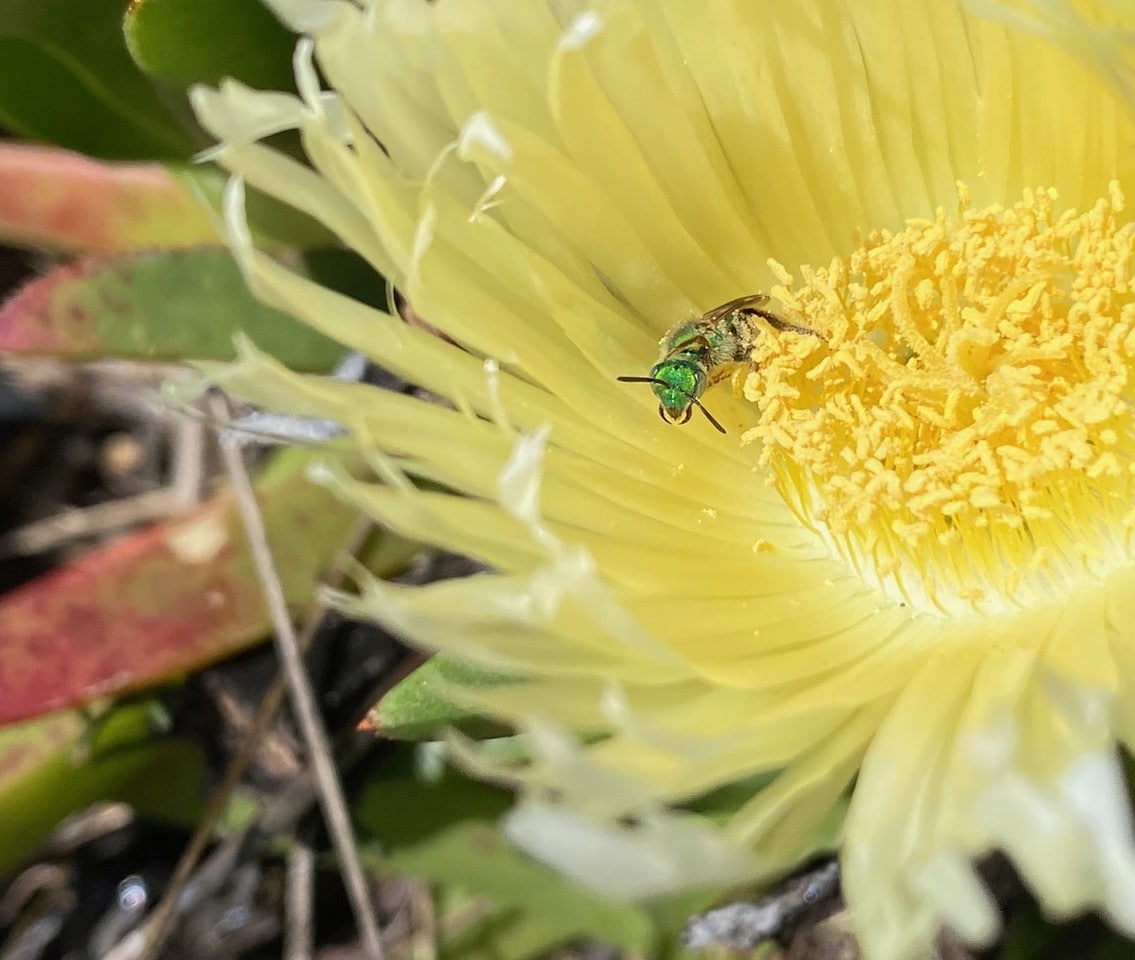
As she emerges from the center of the flower covered with loose pollen, the bee thoroughly grooms herself with her front legs.
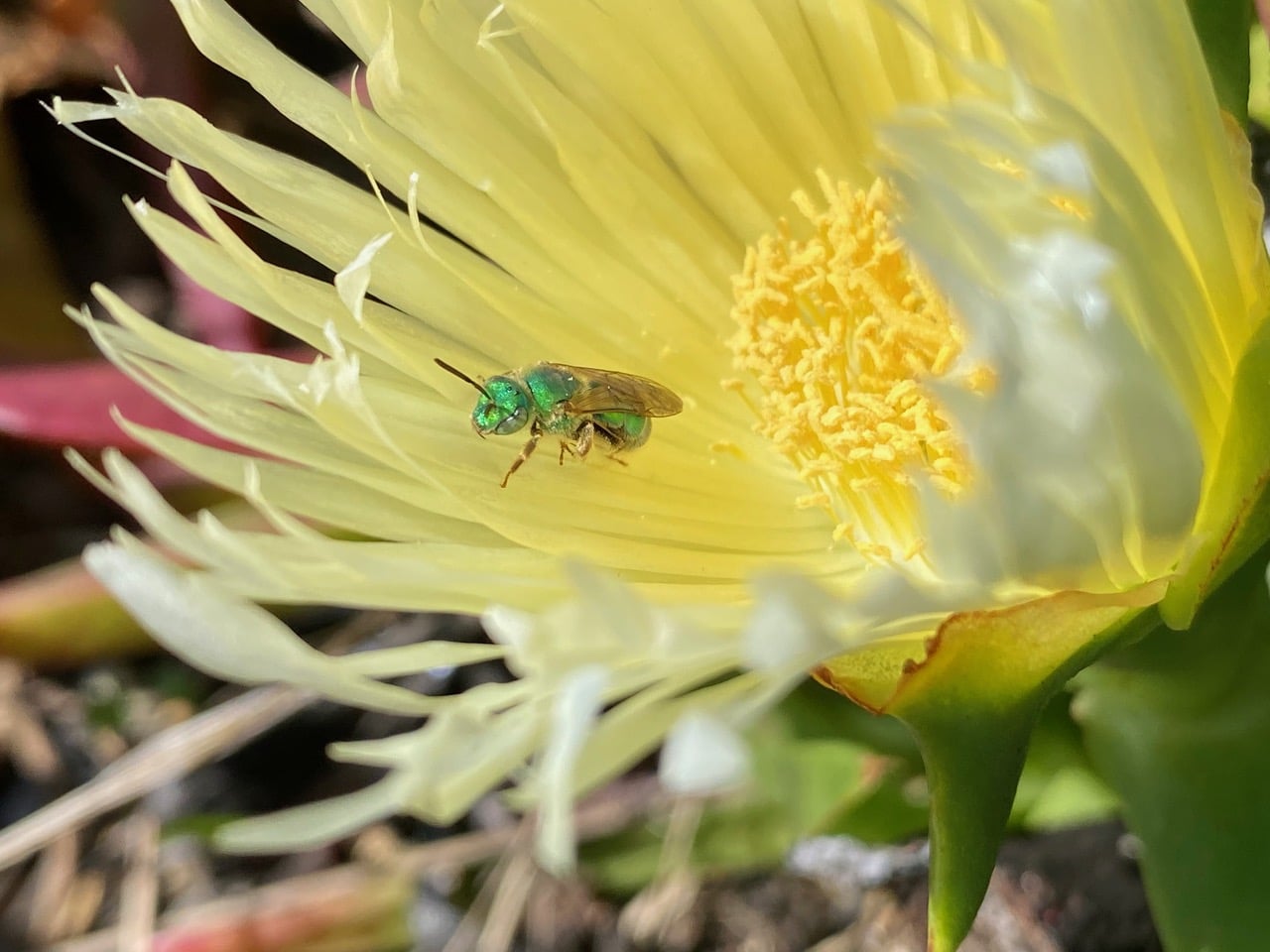
As the bee climbs up the petals to take flight, I see that her scopa is not filled with pollen. She was merely taking nectar, not collecting pollen from the flower.

A small, dusky hover fly is foraging on a flower of Bermuda Buttercup, Oxalis pes-caprae.

A close-up shows the gravid female hover fly feeding on pollen from the anthers of the flower. Although the pattern on her abdomen is not visible from this angle, I am certain she is a female Western Calligrapher, Toxomerus occidentalis (family Syrphidae).
Toxomerus is a very large genus of Hover Flies. They are found in North and South America. The majority of species are only 6-9 mm in length. They are notable for their mimicry of stinging Hymenoptera to avoid predators. Their unique abdominal patterns are diagnostic at the species level within the genus. Most larvae feed on soft bodied insects, such as aphids; a few feed on pollen. Adults feed on the pollen of a wide range of flowers. A female can lay up to hundreds of eggs at a time and will place them where prey or pollen food sources are readily available. They can be found in a wide variety of habitats, often in dense ground cover.
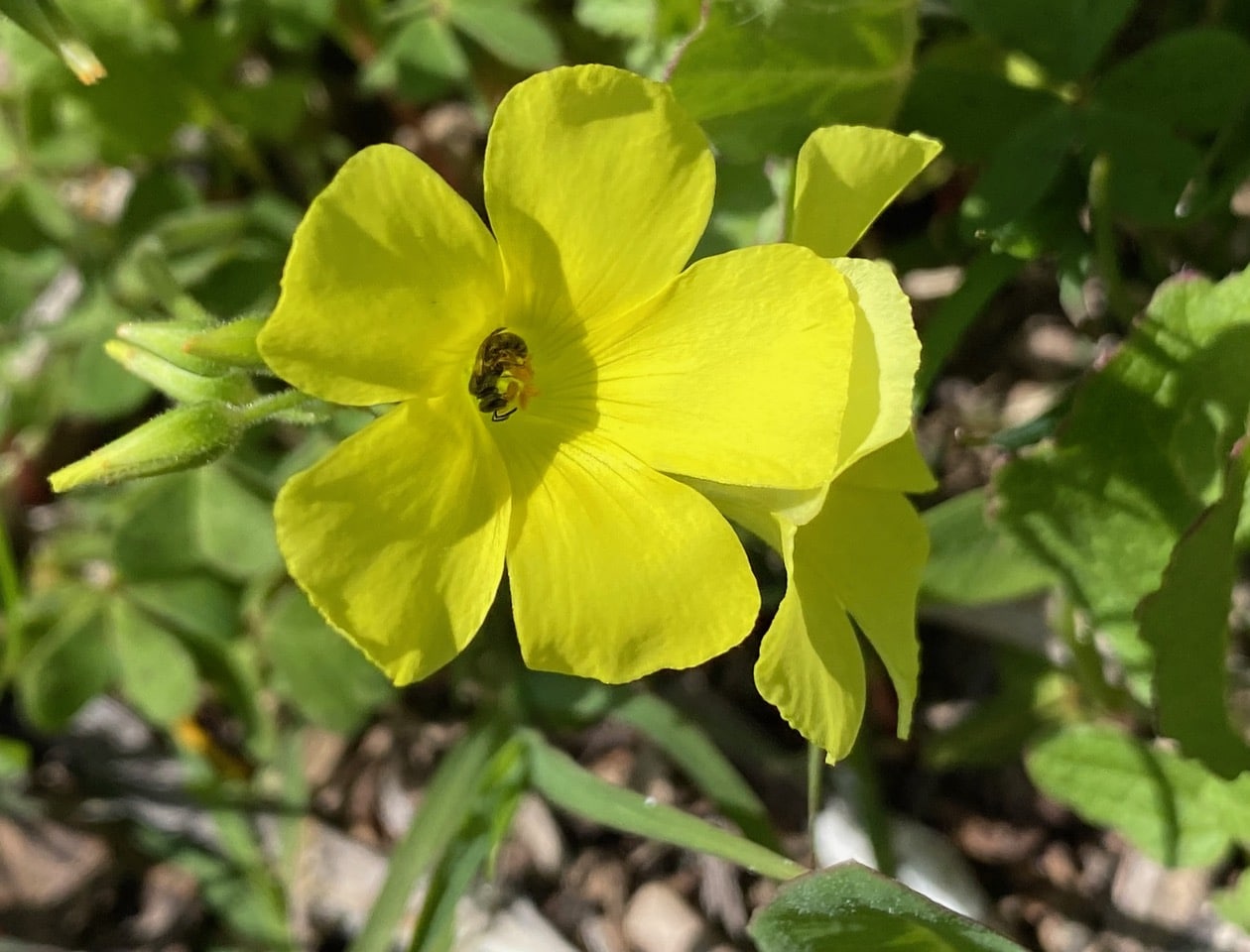
A tiny bee is collecting pollen in a Bermuda Buttercup flower.
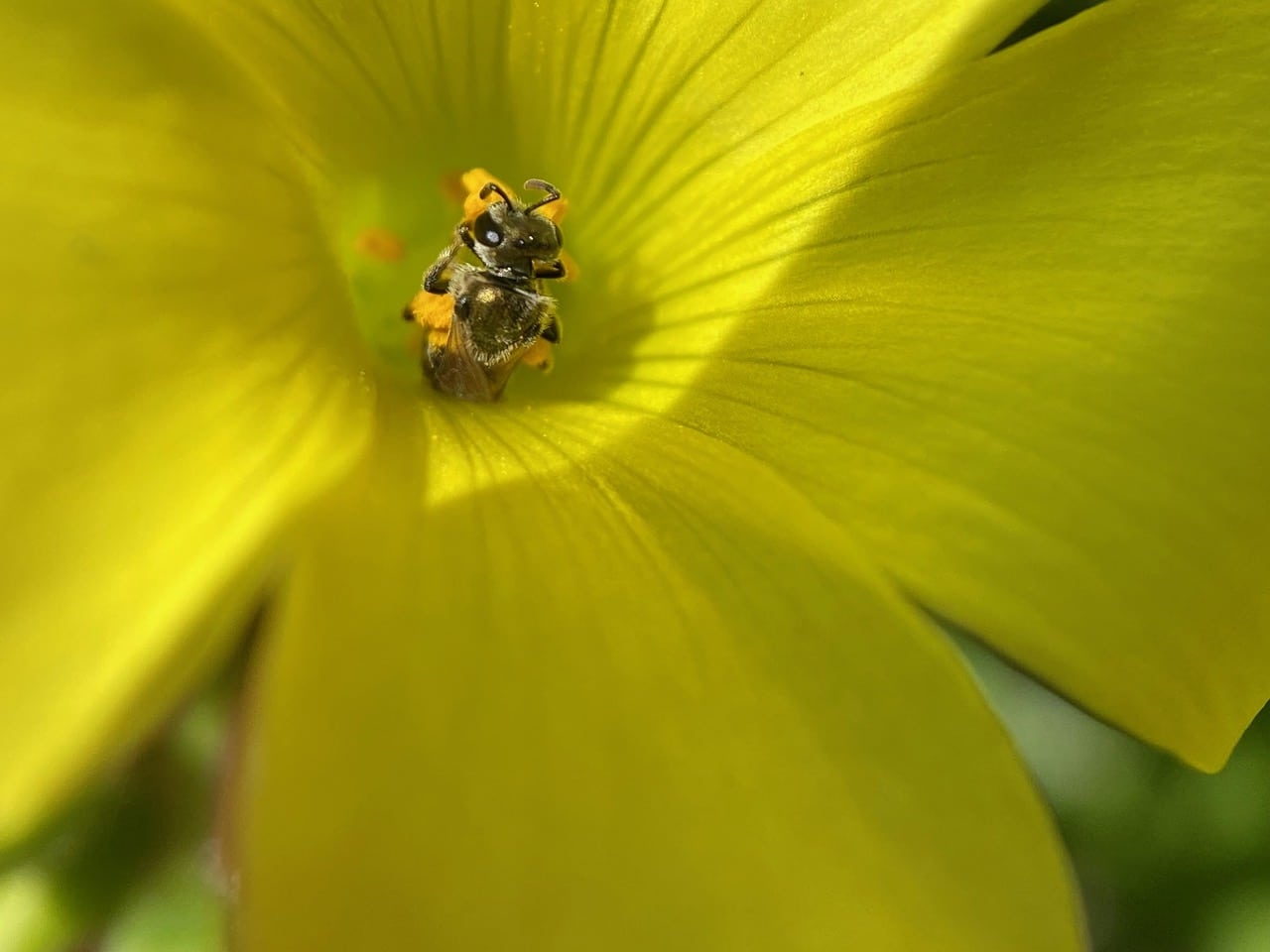
A close-up view shows a female Metallic Sweat Bee, Lasioglossum (Dialictus) sp. (family Halictidae) working the anthers of the flower. Any bigger and she won’t be able to fit in that space.
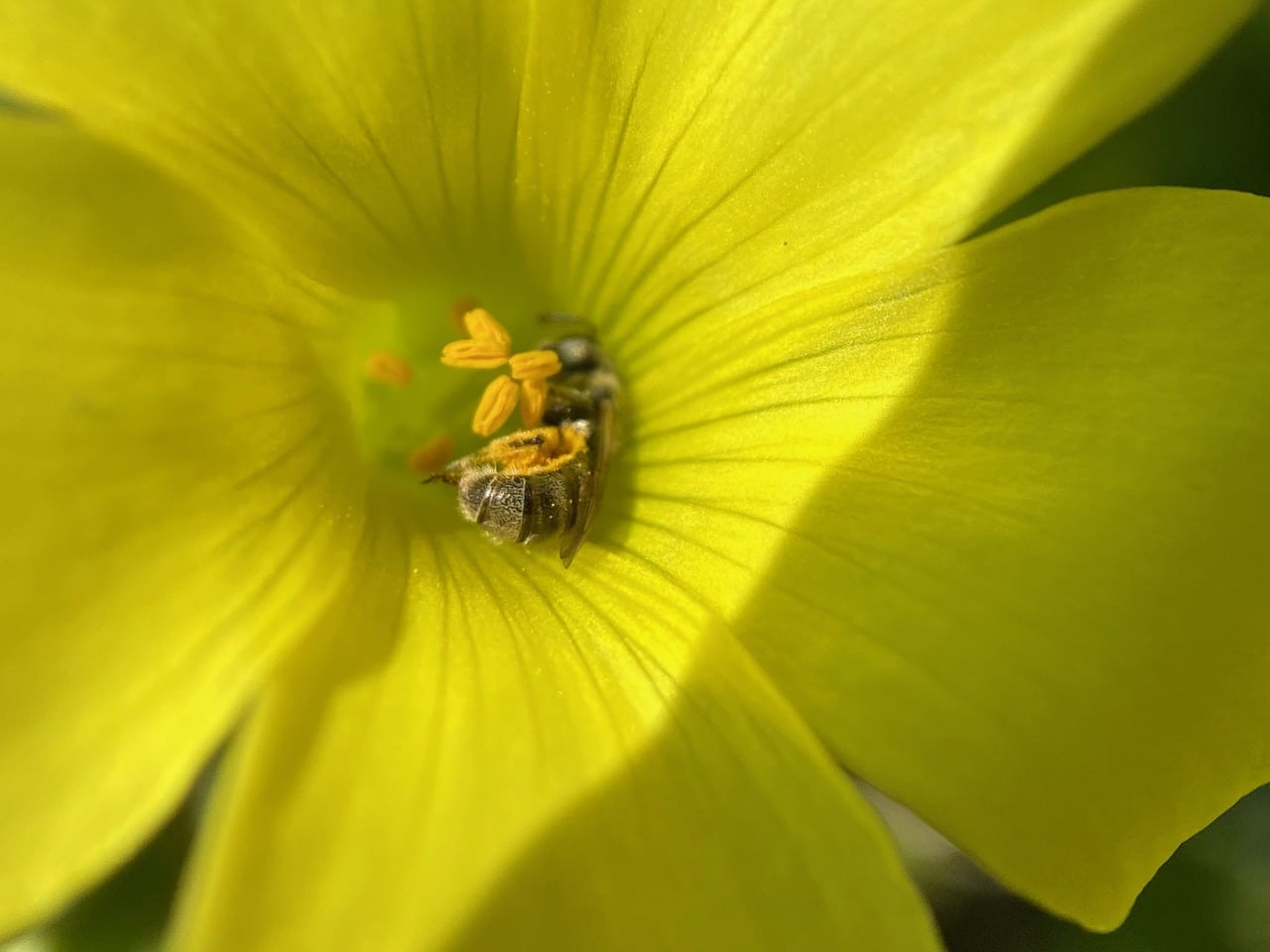
Lasioglossum species are found worldwide, and they constitute the largest bee genus. The subgenus Dialictus are the most likely to be seen in the U.S., with over 300 species of these tiny metallic bees. The majority of Lasioglossum are generalists. Because they are so abundant throughout the flowering season, the bees are often important pollinators. Their sheer numbers are enough to achieve excellent pollination of many wild flowers, especially of plants in the Asteraceae, which have shallow floral tubes that are easily accessed by these minute bees.
Lasioglossum are closely related to the genera Halictus and Agapostemon. These genera are commonly called “sweat bees” because of their attraction to human sweat, which they drink for its salt content. Lasioglossum are dusky black to brown slender bees with bands of hair on their abdomen. Female Sweat Bees (family Halictidae) carry pollen in the scopae on their entire hind legs and underside of their abdomen.
Lasioglossum exhibit a range of social behaviors; the genus includes solitary, communal, semi social, primitively eusocial, and even parasitic species. Almost all Lasioglossum in the U.S. nest in the ground. Generally these nests are built in the spring by fertilized females (called foundresses) that spent the winter in hibernation. In social species, the foundresses behave much like the queen bumble bees – they lay the first batch of eggs that develop into the first generation of female workers. The nest grows with each additional generation of bees. Later broods may consist of both males and females. They mate, and at the end of the season the fertilized females hibernate til the following spring, repeating the life cycle of the colony.
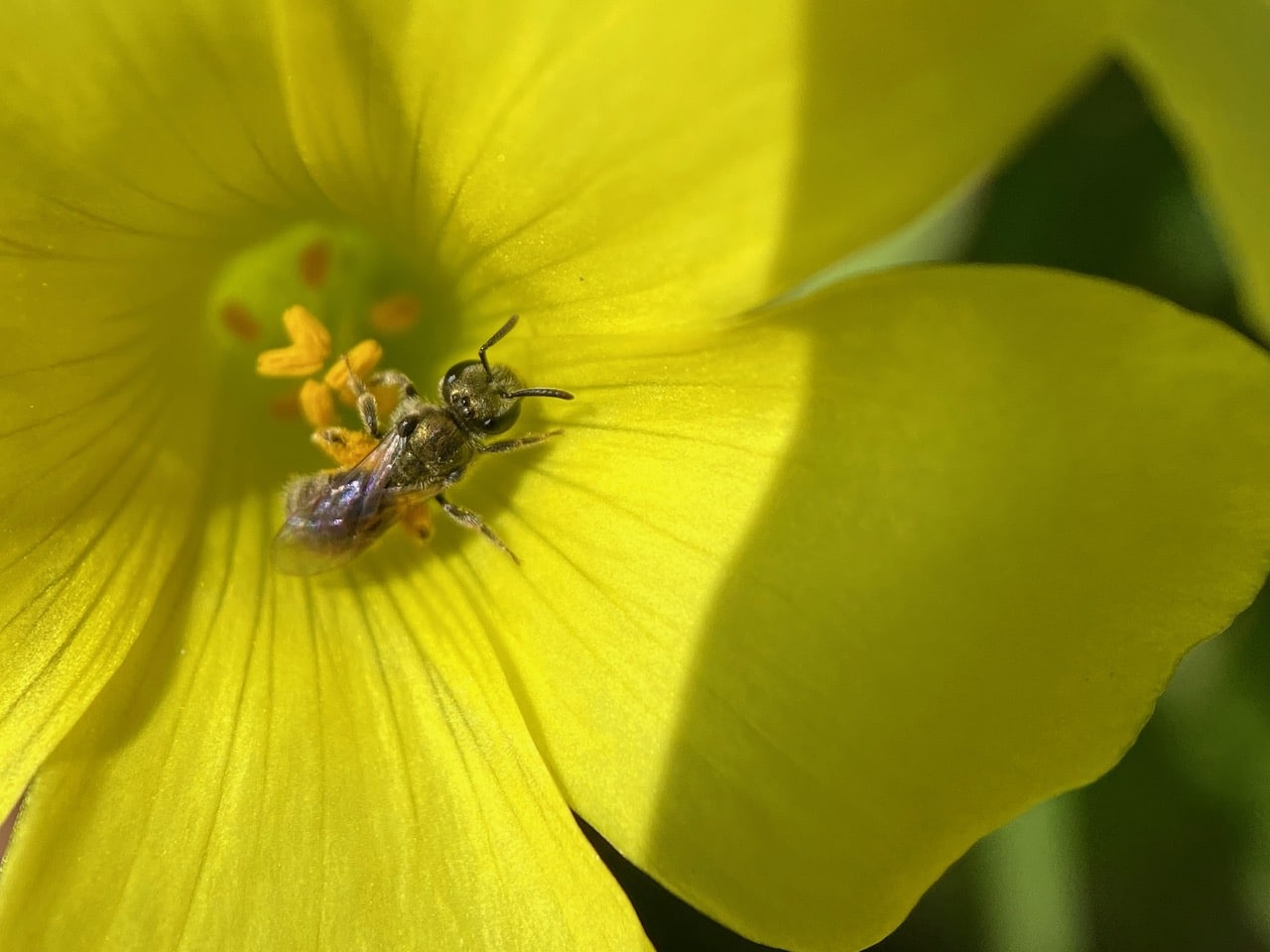
Dialictus is a subgenus of sweat bees belonging to the genus Lasioglossum. Most of the members of this subgenus have a metallic appearance. They are commonly found in the Northern Hemisphere and are found in abundance in North America. Members of this subgenus also have very diverse forms of social structure making them model organisms for studying the social behavior of bees.
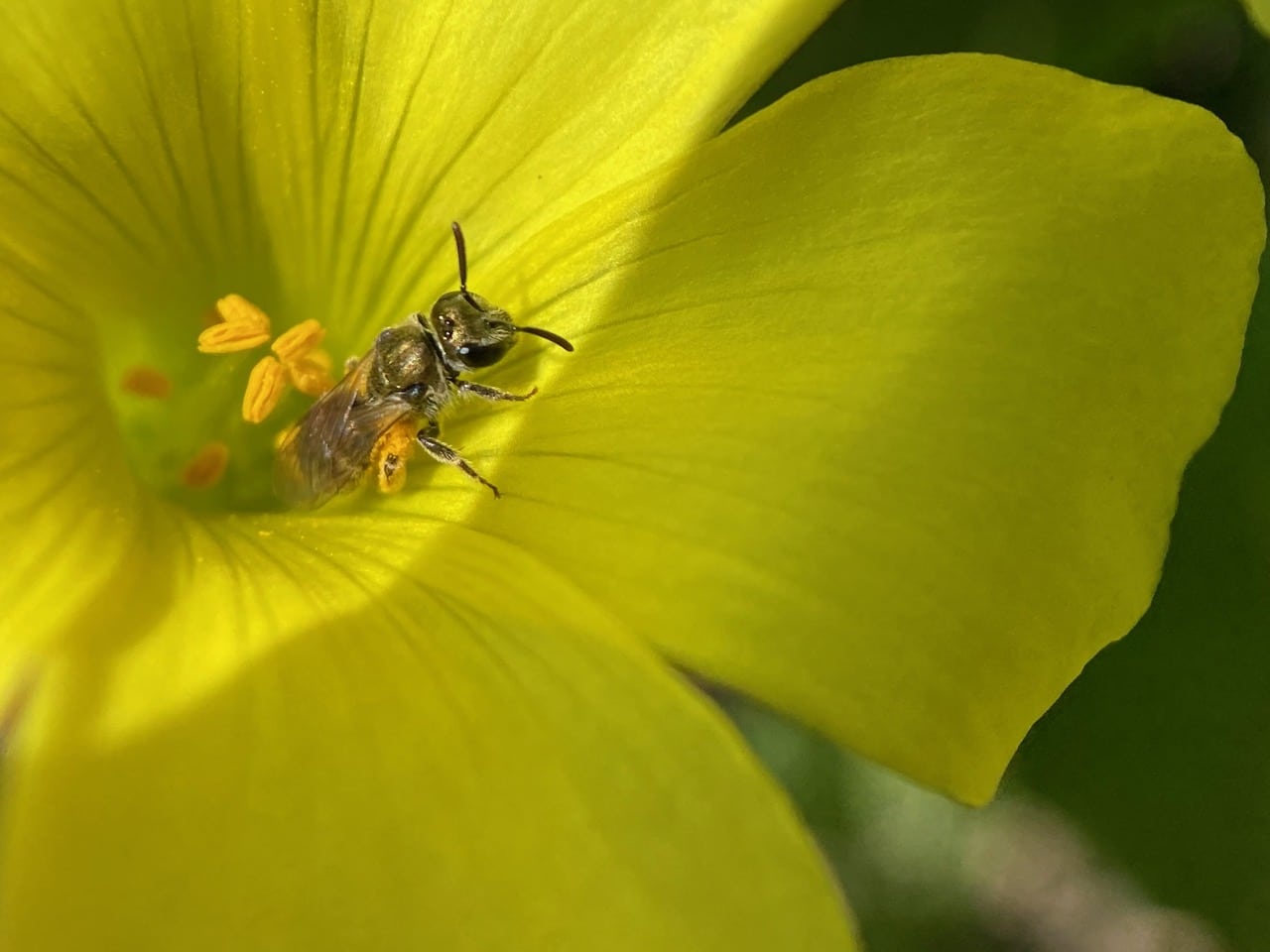
See those three shiny bumps on top of the bee’s head, arranged in a triangle? They are simple eyes or ocelli.
Ocelli (singular: ocellus) are simple eyes with a single lens. This type of eye does not form an image but acts as a photoreceptor, detecting changes in light intensity and direction. Many arthropods have these small photoreceptors. They are especially common in arthropods that fly, such as bees. Bees have three of them on the crown of their head between the large compound eyes. Experiments have shown that the ocelli help bees to navigate at flight speeds. The detection of the direction and intensity of sunlight aids in flight stabilization, orientation and navigation during flight. Ocelli work alongside compound eyes, with ocelli processing information related to fast changes in light intensity, while compound eyes handle slower, more detailed visual information.

Her pollen gathering completed, the bee cleans her antennae as she emerges from the floral tube.
All bees have an antenna cleaner on each of their two forelegs. The antenna cleaners consists of two parts: a notch in the basitarsus, which is fitted with stiff hairs, and a corresponding spur on the tibia. To clean its antenna, the bee raises its foreleg over its antenna and then flexes it tarsus. The action allows the spur to close the notch, forming a ring around the antenna. The bee pulls each antenna through the bristles to clean it of debris such as pollen or dust which might interfere with the many sensory organs within the antenna. A bee’s antennae serve numerous functions: smell, taste, perceive humidity and temperature, feel, monitor gravity and flight speed and even detect sound waves to help guide the bee in its daily activities.

Note where the bee is carrying the pollen she has gathered – in the scopa on her hind legs and on the underside of her abdomen.
Bees such as honey bees and bumble bees (family Apidae) carry the pollen they gather in their corbiculae, or ‘pollen baskets’. The corbicula is a shallow depression on the tibia of their hindleg surrounded by a fringe of long, curved setae (‘hairs’). These corbiculate bees moisten the pollen with regurgitated nectar and saliva while packing it into the corbiculae for transport back to the nest.
Other bees carry pollen attached to their scopa (Latin for ‘broom’), which is an area of dense, stiff hairs on the hind legs (typically in the families Andrenidae and Halictidae) or on the underside of the abdomen (mostly in the family Megachilidae). These non-corbiculate bees do not wet and compress the pollen, but instead take it away loosely held to the scopal hairs by electro-static attraction. Compared to pollen packed in corbiculae, pollen transported in the scopae are much easier to dislodge, resulting in more effective pollination and fertilization.

Lying flat against a broad green leaf, a Mason Wasp, Ancistrocerus bustamente (family Vespidae, subfamily Eumeninae) is basking on a broad green leaf. I have never had an easier time photographing this usually active little wasp.
Potter wasps (or mason wasps), the Eumeninae, are a cosmopolitan wasp group presently treated as a subfamily of Vespidae. Most eumenine species are black or brown, and commonly marked with strikingly contrasting patterns of yellow, white, orange, or red. Their wings are folded longitudinally at rest. Eumenine wasps are diverse in nest building. The Mason Wasps are species that generally nest in pre-existing cavities in wood, rock, or other substrate. Potter Wasps are the species that build free-standing nests out of mud, often with a spherical mud envelope. The most widely used building material is mud made of a mixture of soil and regurgitated water.
All known Eumenine species are predators, most of them solitary mass provisioners. When a cell is completed, the adult wasp typically collects beetle larvae, spiders, or caterpillars and, paralyzing them, places them in the cell to serve as food for a single wasp larva. As a normal rule, the adult wasp lays a single egg in the empty cell before provisioning it. The complete life cycle may last from a few weeks to more than a year from the egg until the adult emerges. Adult mason wasps feed on floral nectar.
The Mason Wasp, Ancistrocerus bustamente (family Vespidae, subfamily Eumeninae) is found in western North America and Mexico. The species frequents arid areas, and nests in pre-existing cavities (e.g. old borings in wood, hollow stems, rock crevices) and use mud for partitions between brood cells. The wasps have been known to nest in Sambucus (Elderberry) stems. The name of the genus means “hooked horn” for the back-curved last segments of the antennae characteristic of the males.