

Pollinator Post 3/26/25 (1)

Fred and I are glad to resume our walks at the Shoreline Park at Bay Farm Island this morning. It is chilly out, but thankfully sunny.
The park has taken on a different appearance since the last time I visited. Most of the colors are now provided by the ubiquitous Bermuda Buttercup, Oxalis pes-caprae.

The Perez’s Sea Lavender, Limonium perezii gracing a stretch of the shoreline is now back in bloom. I stop to watch for pollinators but saw none. Perhaps it is too cold and breezy.







I am glad to see that the Oregon Gumplant, Grindelia stricta along the shore is making a comeback after being battered by the severe winter storms
Hey, the Spittle Bug is back on the gumplant! The plant had a heavy infestation of a species in the family Clastopteridae through the summer and fall last year. I wonder if the same bugs have returned?
The foam mass is made by a nymph of a bug called the Froghopper. Like the adults, the nymphs use their piercing, sucking mouthparts to feed on plant juices. The nymph produces a cover of foamed-up plant sap reminiscent of saliva, hence the common name of spittlebug. Whereas most insects that feed on sap feed on the nutrient-rich fluid from the phloem, Cercopidae tap into the much more dilute sap flowing upward via the xylem. The large amount of excess water that must be excreted and the evolution of special breathing tubes allow the young spittlebug nymphs to grow in the relatively protective environment of the spittle. Symbiotic bacteria in the insects’ digestive system provides them with the essential amino acids that their diet lacks. The foam serves a number of purposes. It hides the nymph from the view of predators and parasites, and it insulates against heat and cold, and protects the delicate nymphs from desiccation. Moreover, the foam has an acrid taste that deters predators.
The adult Spittle Bug is sometimes called a Froghopper. The Froghopper is a “true bug” in the order Hemiptera. Froghoppers are champion jumpers among insects, out-performing even the fleas. The bug can leap the human equivalent of a skyscraper without a running start. It is the highest jumping insect proportional to body size. The muscles in its hind legs act like a “catapult” to release energy explosively.
A Convergent Lady Beetle, Hippodamia convergens (family Coccinellidae) is basking on a grindelia leaf.
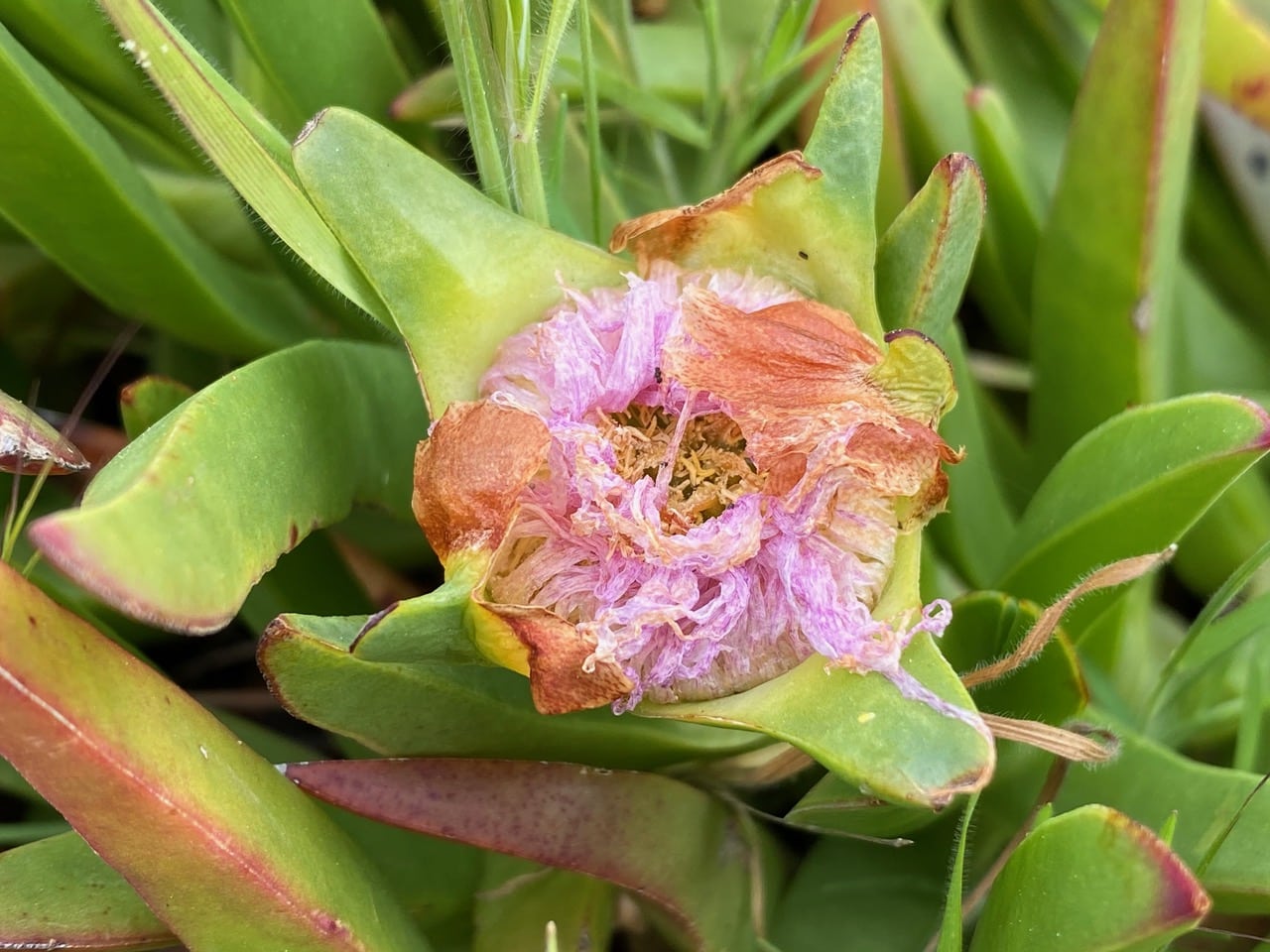
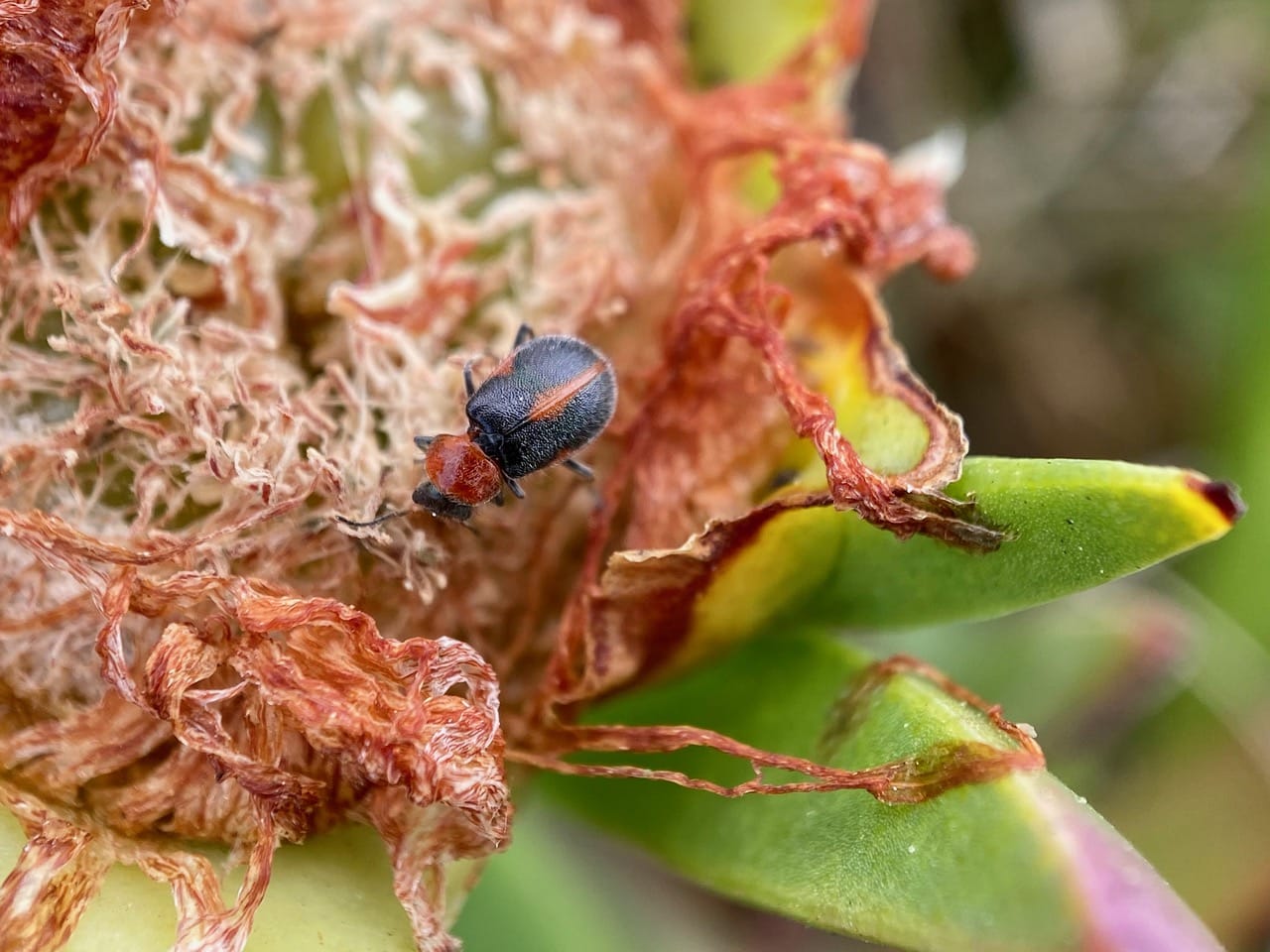
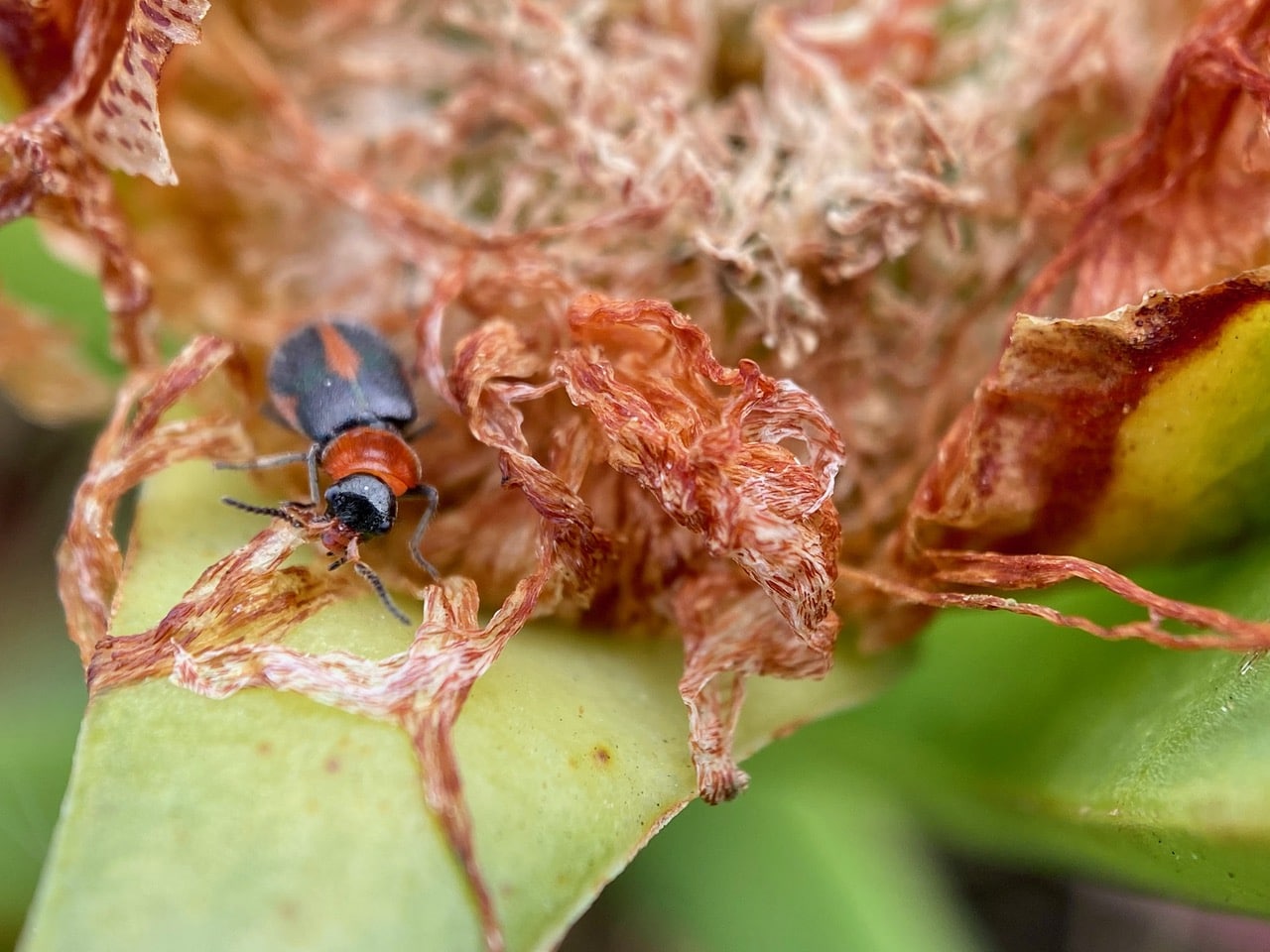
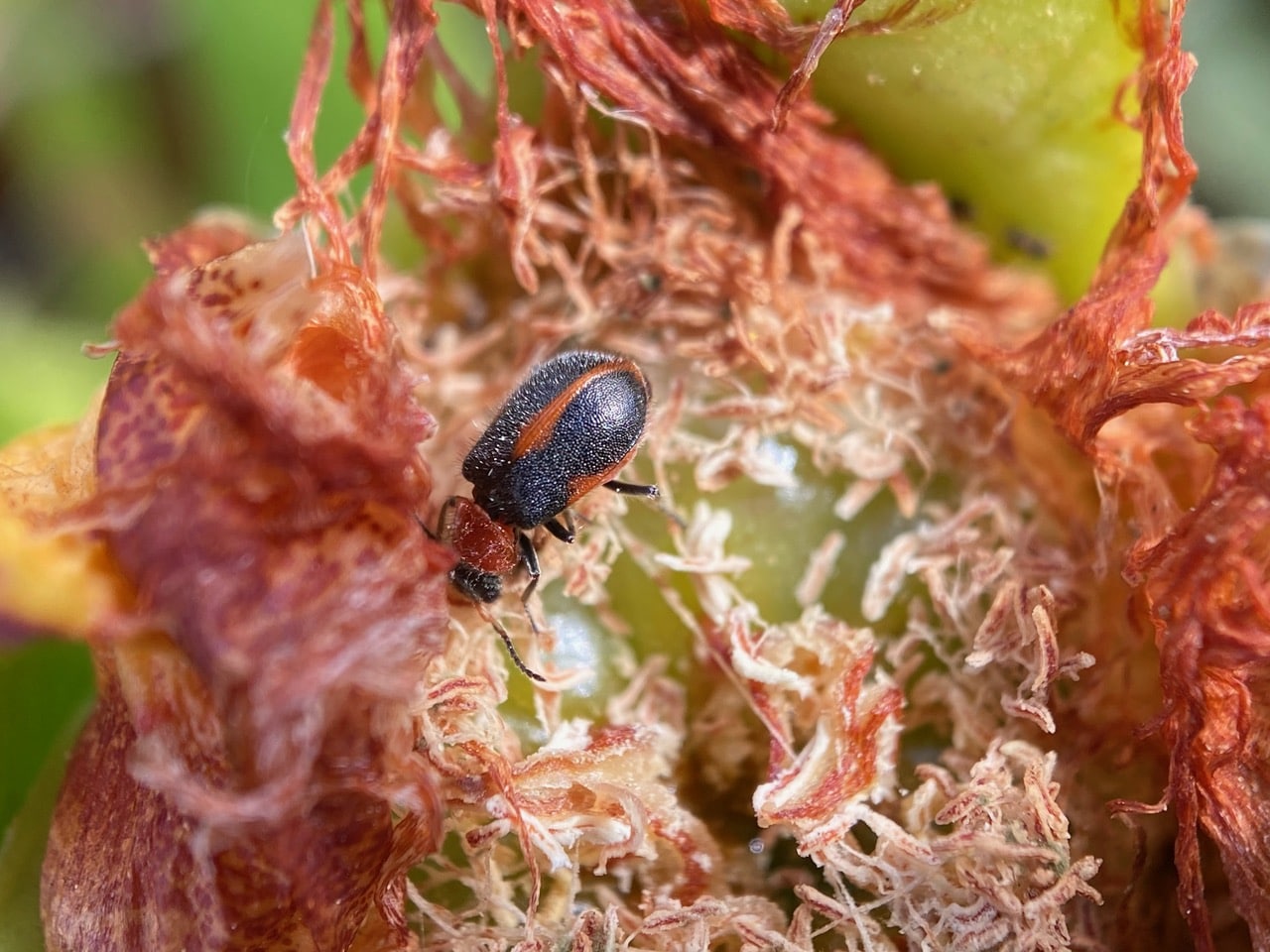
Hey, I think that is a Four-spotted Collops, Collops quadrimaculatus (family Melyridae) in the flower of Sea Fig, Carpobrotus edulis.
Members of the family Melyridae or Soft-winged Flower Beetles differ from most other beetles in that their bodies are not hard and shell-like. Collops are small beetles, 4-7 mm. They are important predators with a penchant for soft-bodied insects like whiteflies, small Lygus nymphs, aphids, mites, and lepidopteran eggs and caterpillars. Occasionally they graze on pollen and nectar resources too. Larvae are predaceous in the soil litter, but are rarely seen.
As I look for more beetles, I notice that there are many withered flowers among the succulent leaves.
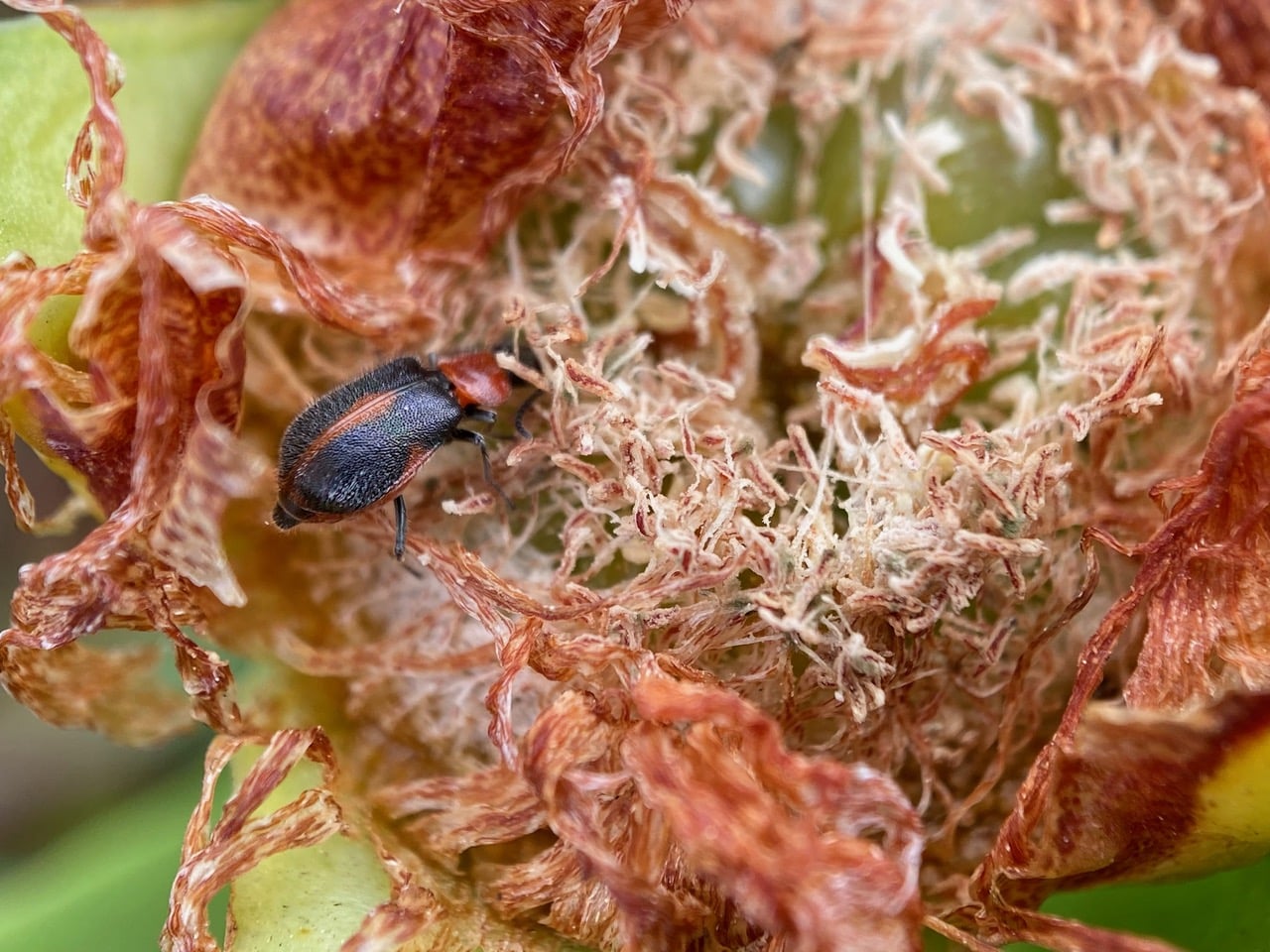
It is mainly among these withered flowers that I find the Collops beetles. They are probably hunting for prey.
The elytra of Collops are covered with fine hairs to which pollen can easily adhere. The beetles may serve as pollinators?
This one is obviously feeding on pollen from the fresh Sea Fig flower.
Ah, finally a male! See those knobby structures near the base of his antennae?
Male and female Collops can be distinguished by clearly visible knobby structures present on the base of the male’s antennae. The function of the enlarged basal antenomeres are not clearly understood. But here’s a description by an observer:
“I have watched a male approach a female and present his vibrating antennae for her inspection, touching them to her antennae and sweeping the knobs across her head and pronotum. It looked as if he was maybe releasing pheromones towards the chemoreceptors on her antennae…. which would make her receptive to his advances.”
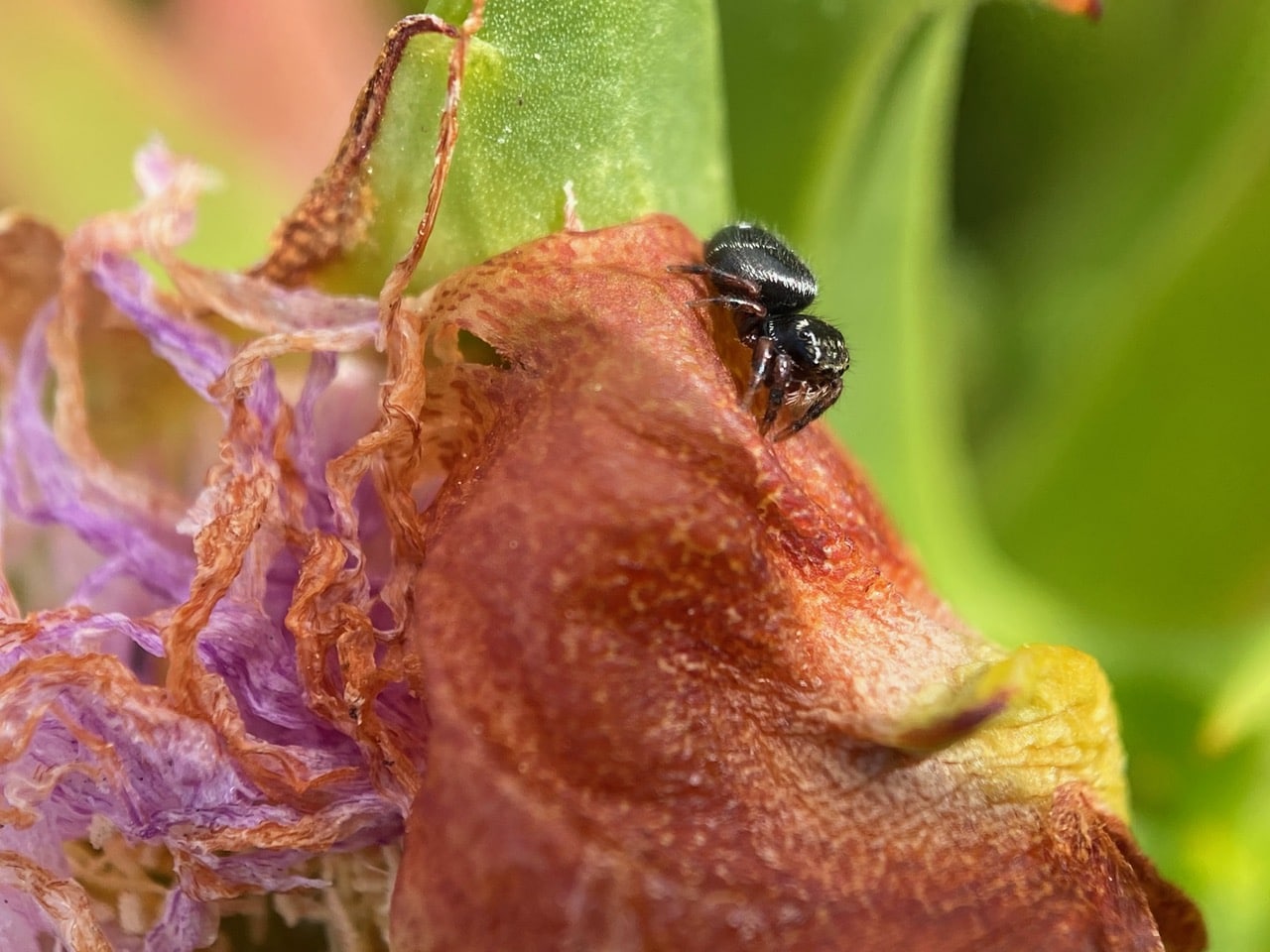
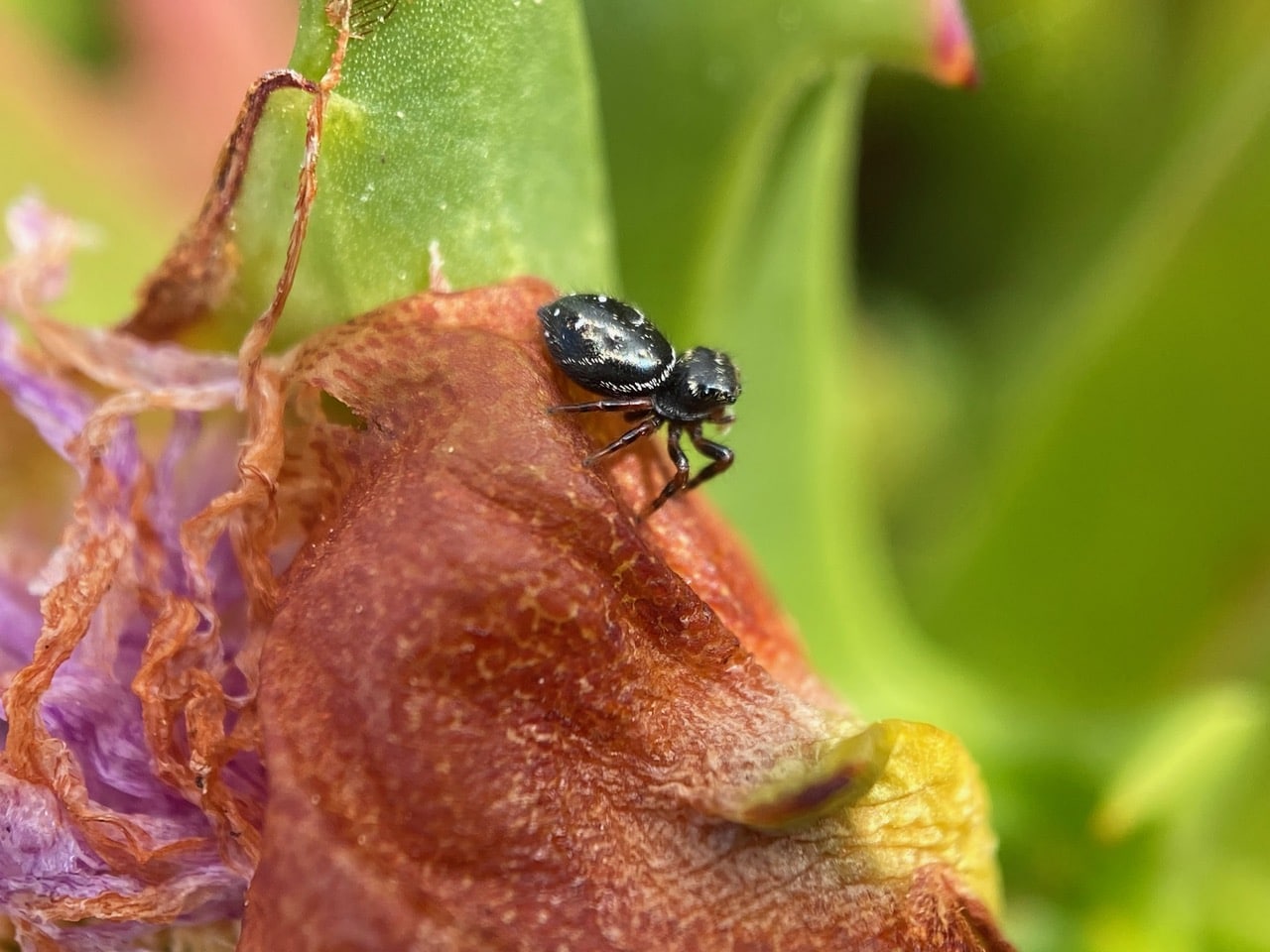
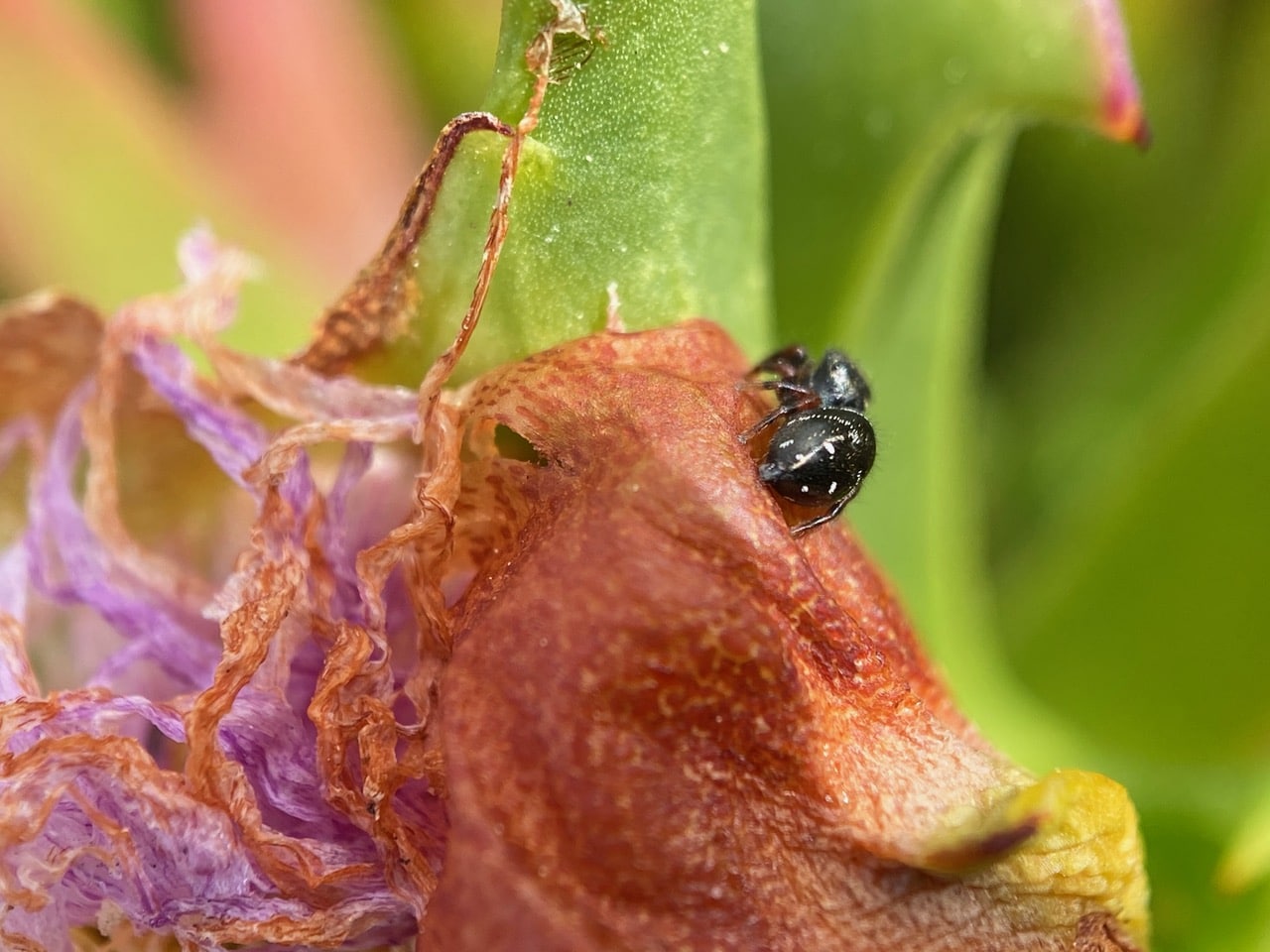
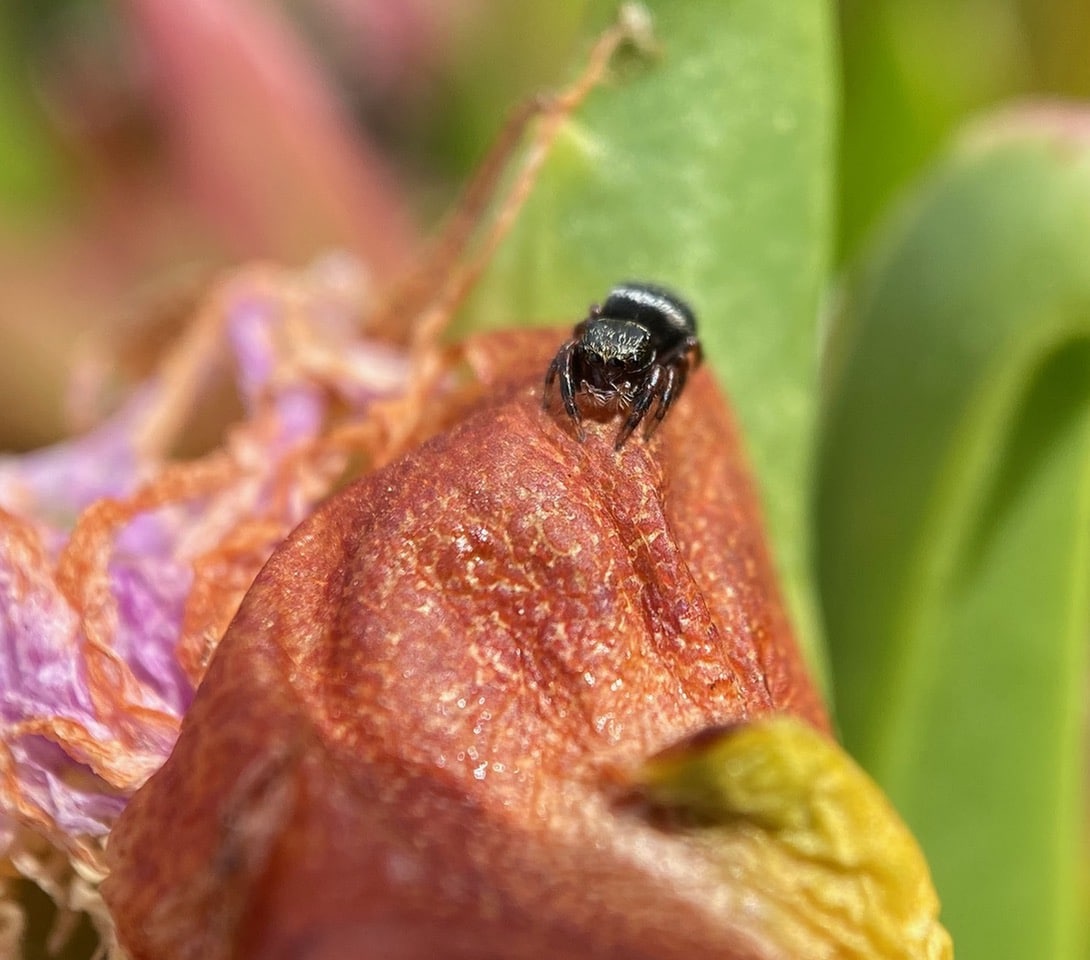
A tiny Jumping Spider (family Salticidae), probably a juvenile, is hunting on a withered Sea Fig flower, Carpobrotus edulis.
Jumping Spiders (family Salticidae) are free-roaming hunters. They do not weave a web to catch prey. They stalk, then pounce on their prey. Just before jumping, the spider fastens a safety line to the substrate. It can leap 10-20 times their body length to capture prey. Their movement is achieved by rapid changes in hydraulic pressure of the blood. Muscular contractions force fluids into the hind legs, which cause them to extend extremely quickly.
iNaturalist has helped identify the jumping spider as a member of the subtribe Dendryphantina. The subtribe occurs mainly in the New World. Females generally have paired spots on the abdomen, and the males often have enlarged chelicerae.
Jumping spiders have excellent vision, with among the highest acuities in invertebrates. The 8 eyes are grouped four on the face (the two big Anterior Median Eyes in the middle, and two smaller Anterior Lateral eyes to the side), and four on top of the carapace. The anterior median eyes provide high acuity but small field of view, while the other six eyes act like our peripheral vision, with lower resolution but broad field of view. Since all eight eyes are fixed in place and can’t pivot independently from the body like human eyes can, jumping spiders must turn to face whatever they want to see well. This includes moving their cephalothorax up and down, an endearing behavior.
