

Pollinator Post 3/26/24 (2)

On the way home from the Regional Parks Botanic Gardens, I pass the Skyline Gardens and decide to make a quick stop to check on the plants in bloom here, taking the paved road up the hill from Siesta Gate.
Most of the California Manroot, Marah fabacea are in full bloom now, but I find hardly any insect on them. An unidentified fly makes a sudden stop on a Marah leaf.
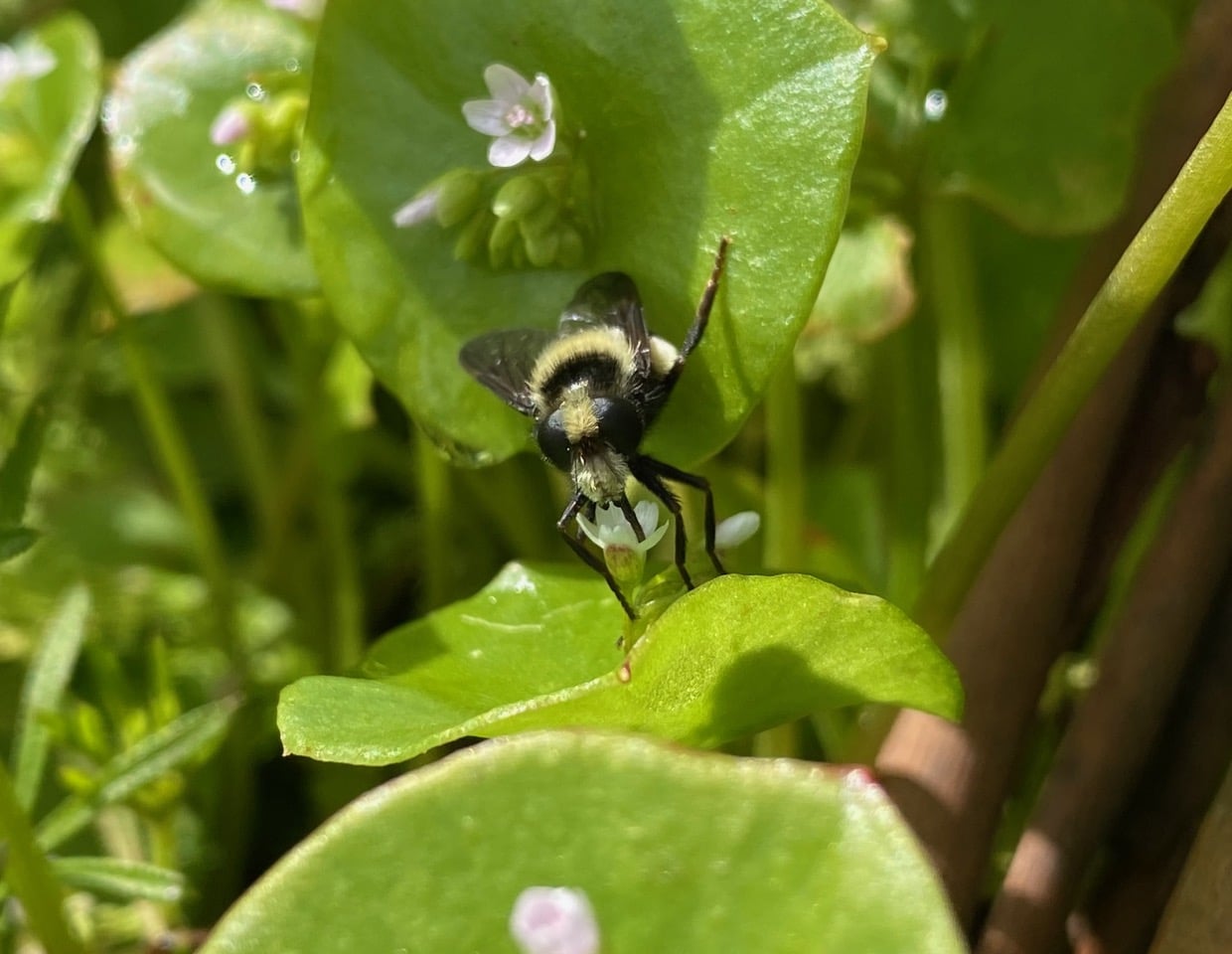
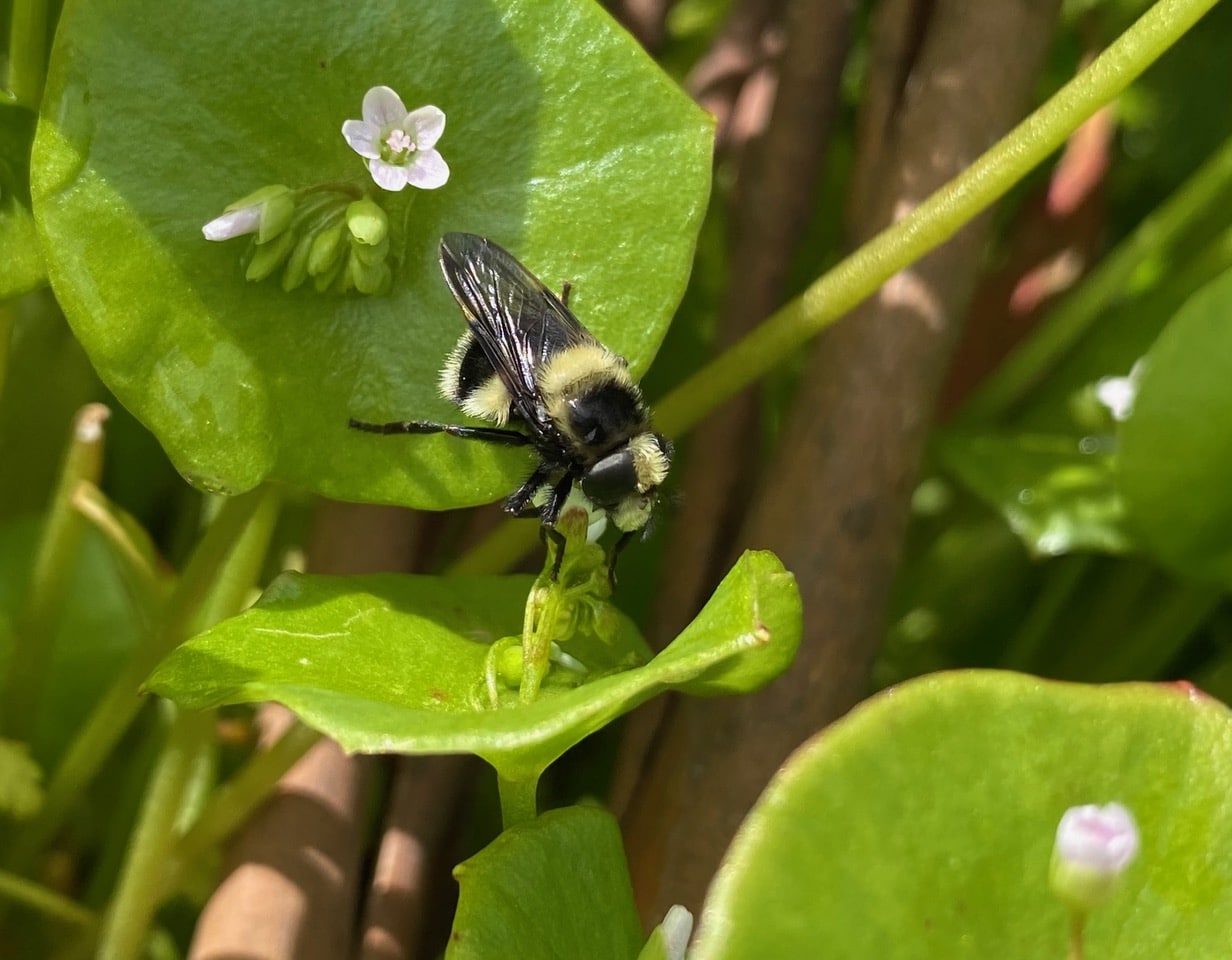
 Is that a Black-tailed Bumble Bee on the flowers of Miner’s Lettuce? My curiosity is piqued as I have never seen bumble bees visit these tiny flowers. Closing in on the insect, I realize that I have been roundly duped. Those big eyes are a dead give-away that it’s not a bee, but a fly. It is a Bumble Bee Hoverfly, an uncanny imposter!






 Hidden behind a large Silverleaf Lupine is a Woolly Mule’s Ears, Wyethia helenioides, blazing with large yellow flowerheads.

 Much to my delight, the male Fruit Fly proceeds to do a wing-waving display. Walking slowly on the ray petal, he extends each wing alternately, waving it in a figure-8 rotation. Many species of Tephritidae perform an elaborate courtship or territorial display using their picture wings like semaphores.
 At the end of his performance, he gives a final bow before flying off, hopefully to an adoring female who has been watching his dance.
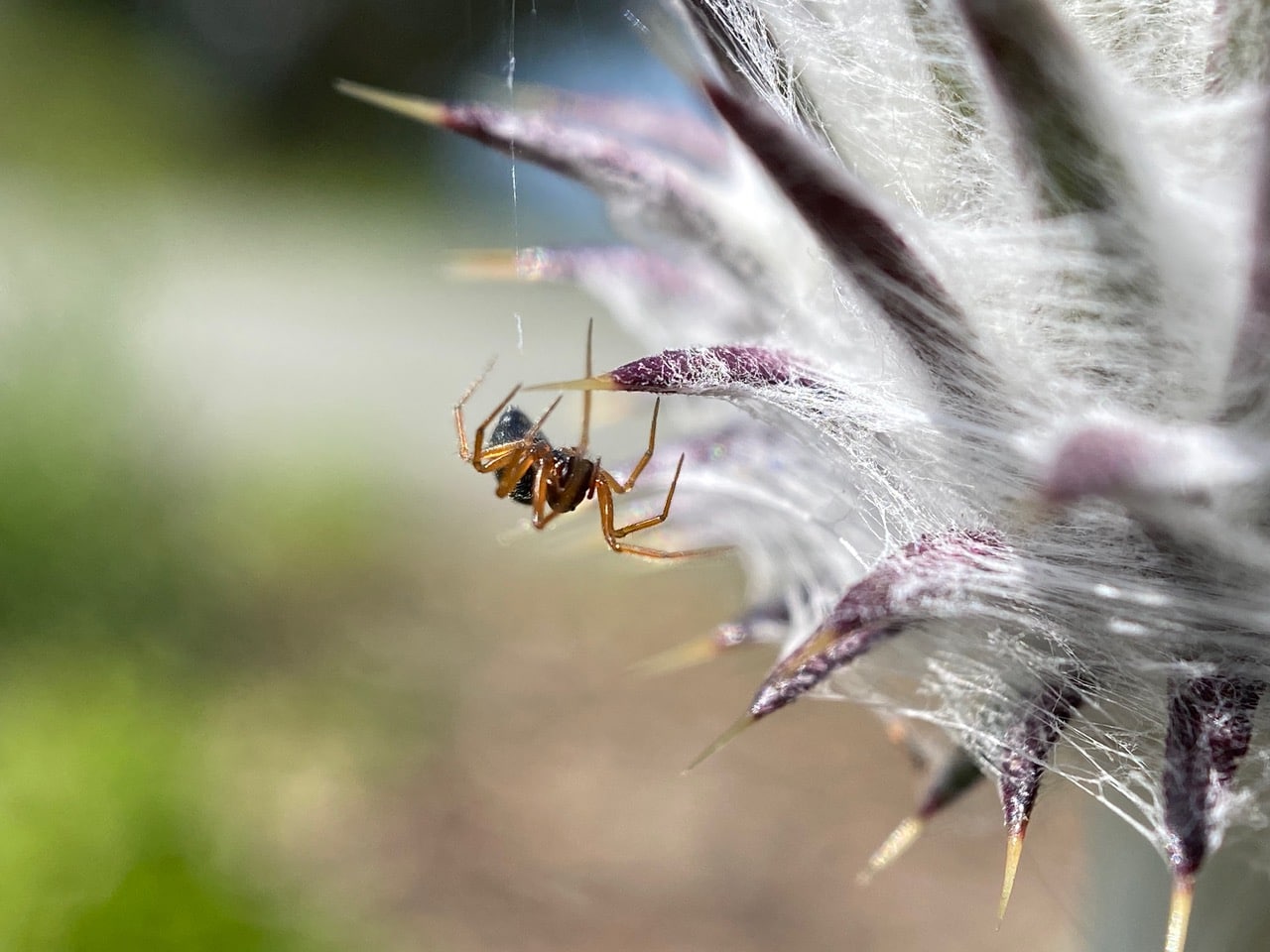
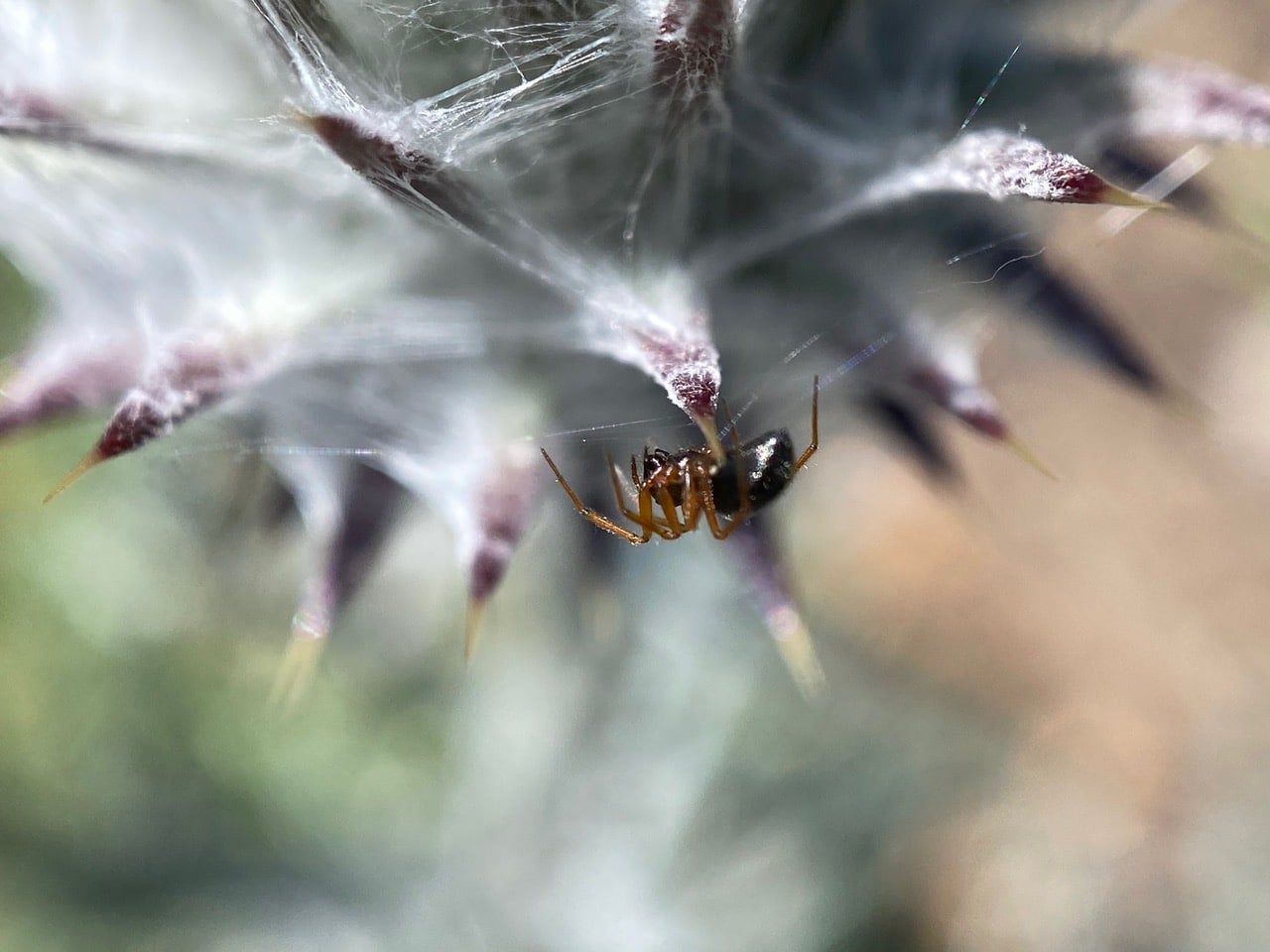 A movement on the flowerhead alerts me to the presence of a tiny black spider. It is moving around on the surface, seemingly adding its own silk threads between the sharp spines of the phyllaries.



Is that a Black-tailed Bumble Bee on the flowers of Miner’s Lettuce? My curiosity is piqued as I have never seen bumble bees visit these tiny flowers. Closing in on the insect, I realize that I have been roundly duped. Those big eyes are a dead give-away that it’s not a bee, but a fly. It is a Bumble Bee Hoverfly, an uncanny imposter!Unlike the real bees, the hoverfly is slow and deliberate in its foraging, allowing me to track its movements through the patch of Miner’s Lettuce. What a strange looking creature, with a long, hairy snout and plumose antennae.
The fly is a member of the Volucella bombylans Complex (family Syrphidae) which comprises numerous hover flies that are bumble bee mimics, also known as Bumble Bee Hoverflies. These flies look like a bumble bee with a furry black and yellow body, but they are given away by their heads, plumed antennae, large eyes and a single pair of wings. Fast fliers, the adults feed on nectar and pollen, with a preference for blue and yellow flowers. The females lay eggs in the nests of bumble bees and social wasps. The larvae live as scavengers on the bottom of the host’s nest, feeding on waste and dead host larvae. It is a rather unusual niche for a Syrphid larva.
The hoverfly flies from one Miner’s Lettuce leaf to the next, always aiming its proboscis into the tiny flowers.
When the leaves are close together, the fly simply clambers onto the next leaf, wasting little time.
Love that yellow mohawk hairdo between the eyes.
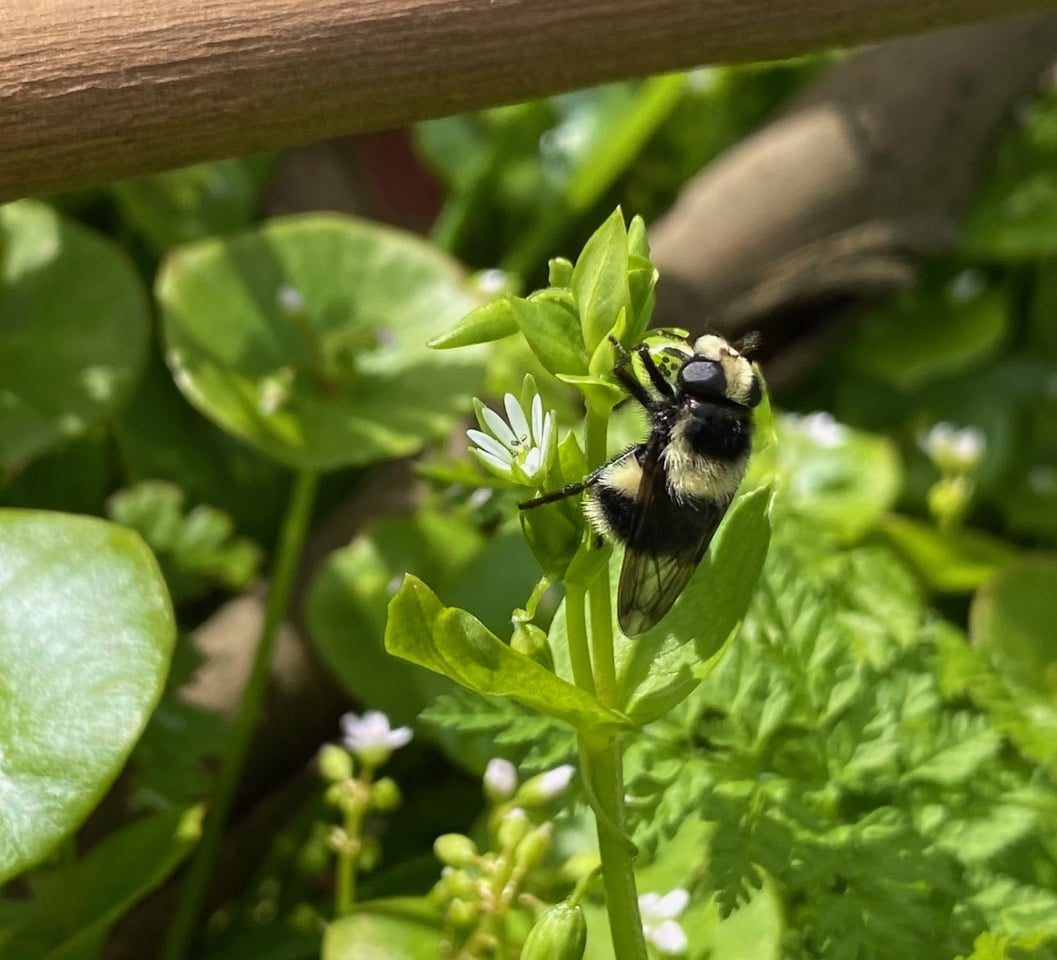
The fly next turns its attention to some fresh flowers of Chickweed, Stellaria media. I am astounded that the large fly, the size of a bumble bee is taking nectar from these tiny flowers. How much nectar can a Miner’s Lettuce or a Chickweed flower offer? It is obviously hard times for these pollinators. There’s simply not enough flowers to support them at the moment, and they are taking whatever is available to survive.
A male Snakefly, Agulla bicolor (family Raphidiidae) is perched on a blade of grass. I wonder how these predators are faring, with so few prey insects available.
Snakeflies are a group of predatory insects comprising the order Raphidioptera. They are a relict group, having reached their apex of diversity during the Cretaceous before undergoing substantial decline. Adult Snakefly has a notably elongated thorax which, together with the mobile head, gives the group their common name of snakefly. The body is long and slender and the two pairs of long membranous wings are prominently veined. The head is long and flattened and heavily sclerotized. The mouthparts are strong and relatively unspecialized, being modified for biting. The large compound eyes are at the sides of the head. Females have a large and sturdy ovipositor which is used to deposit eggs into crevices or under bark. Snakeflies are holometabolous insects with four-stage life cycle consisting of eggs, larvae, pupae and adults. Both adults and larvae are predators of soft-bodied arthropods such as aphids and mites.
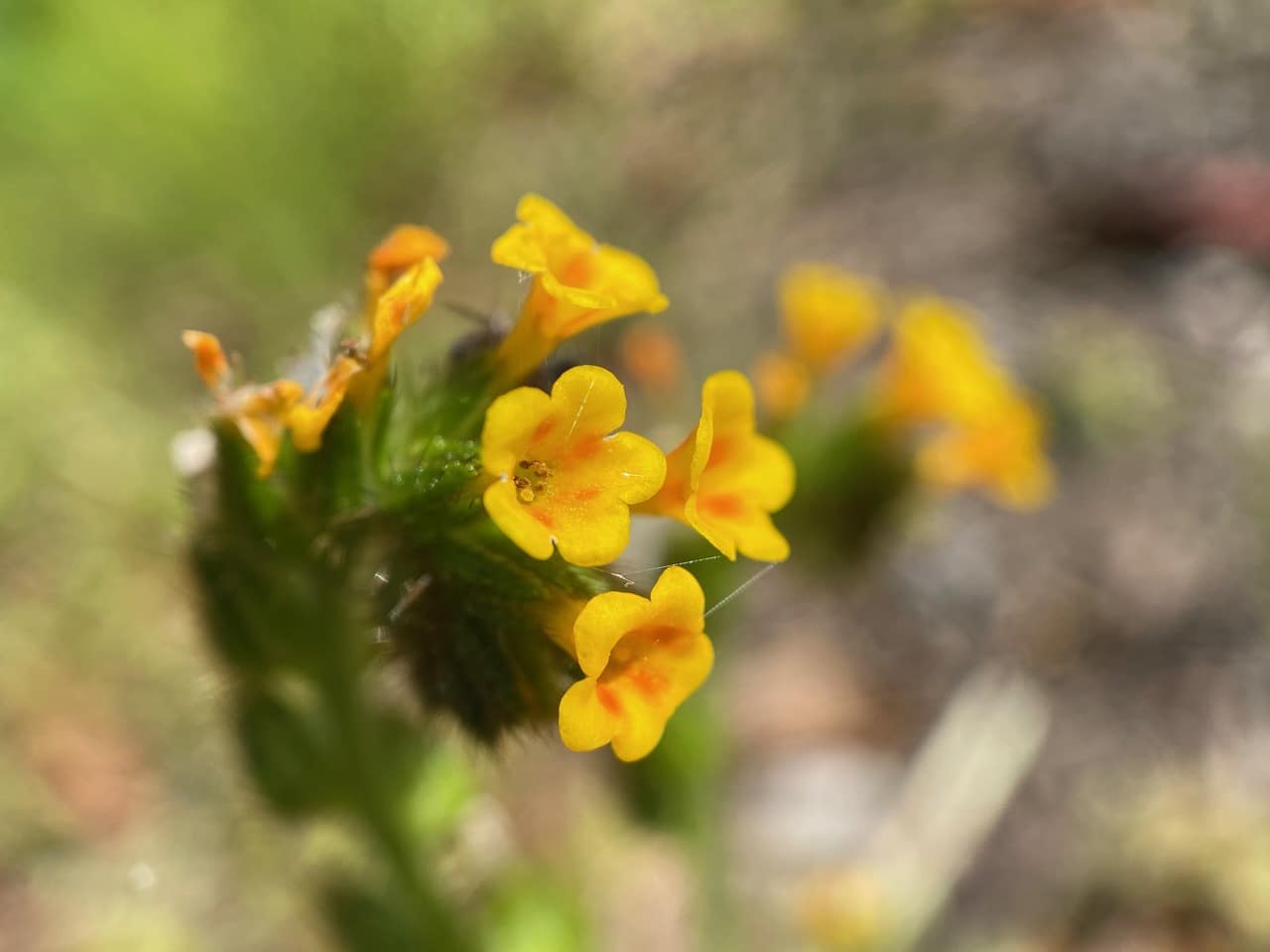
More Common or Coast Fiddleneck, Amsinckia intermedia (family Boraginaceae) have come into bloom now.
When I look closely at the Fiddleneck flowers, I find that nearly every flower head has been claimed by a spider. There’s a loose network of fine silk threads wrapped around each flower cluster. The traps are set, but where are the insects?
View from just south of the Radio Tower. What a beautiful day!
The blues of the Silverleaf Lupine and the yellows of the Fiddleneck flowers provide a juxtaposition of contrasting color palette. These two colors are the most attractive to the bees due to the sensitivity of their eyes to these wavelengths.
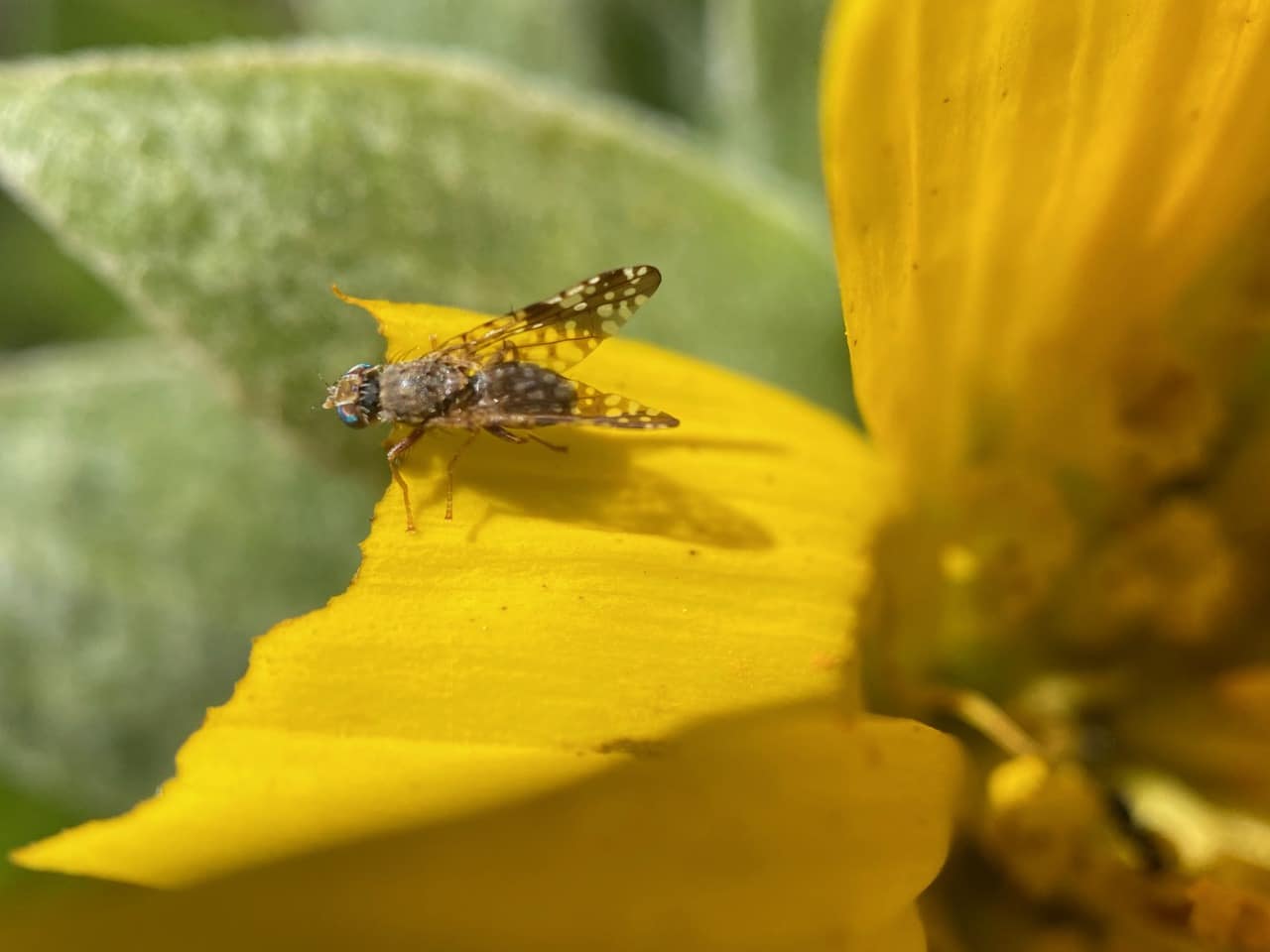
Hidden behind a large Silverleaf Lupine is a Woolly Mule’s Ears, Wyethia helenioides, blazing with large yellow flowerheads. A male Sunflower Seed Maggot Fly, Neotephritis finalis (family Tephritidae) is standing stock still on a ray petal of a Mule’s Ear flowerhead.
Commonly called Fruit Flies, Tephritids are small to medium-sized flies that are often colorful, and usually with picture wings. The larvae of almost all Tephritidae are phytophagous. Females deposit eggs in living, healthy plant tissues using their telescopic ovipositors. Here the larvae find their food upon emerging. The larvae develop in leaves, stems, flowers, seeds, fruits, and roots of the host plant, depending on the species. Adults are often found on the host plant and feeding on pollen, nectar, rotting plant debris, or honeydew. Tephritid flies are of major economic importance as they can cause damage to fruit and other plant crops. On the other hand, some Tephritids are used as agents of biological control of noxious weeds.
The Sunflower Seed Maggot is a sunflower specialist, found on over 20 species of Asteraceae. Larvae feed on immature seeds and pupate in flowerheads. The sexes are easy to tell apart – the females have a prominent oviscape on the tip of their abdomen, from which the telescopic ovipositor is extended when laying eggs.
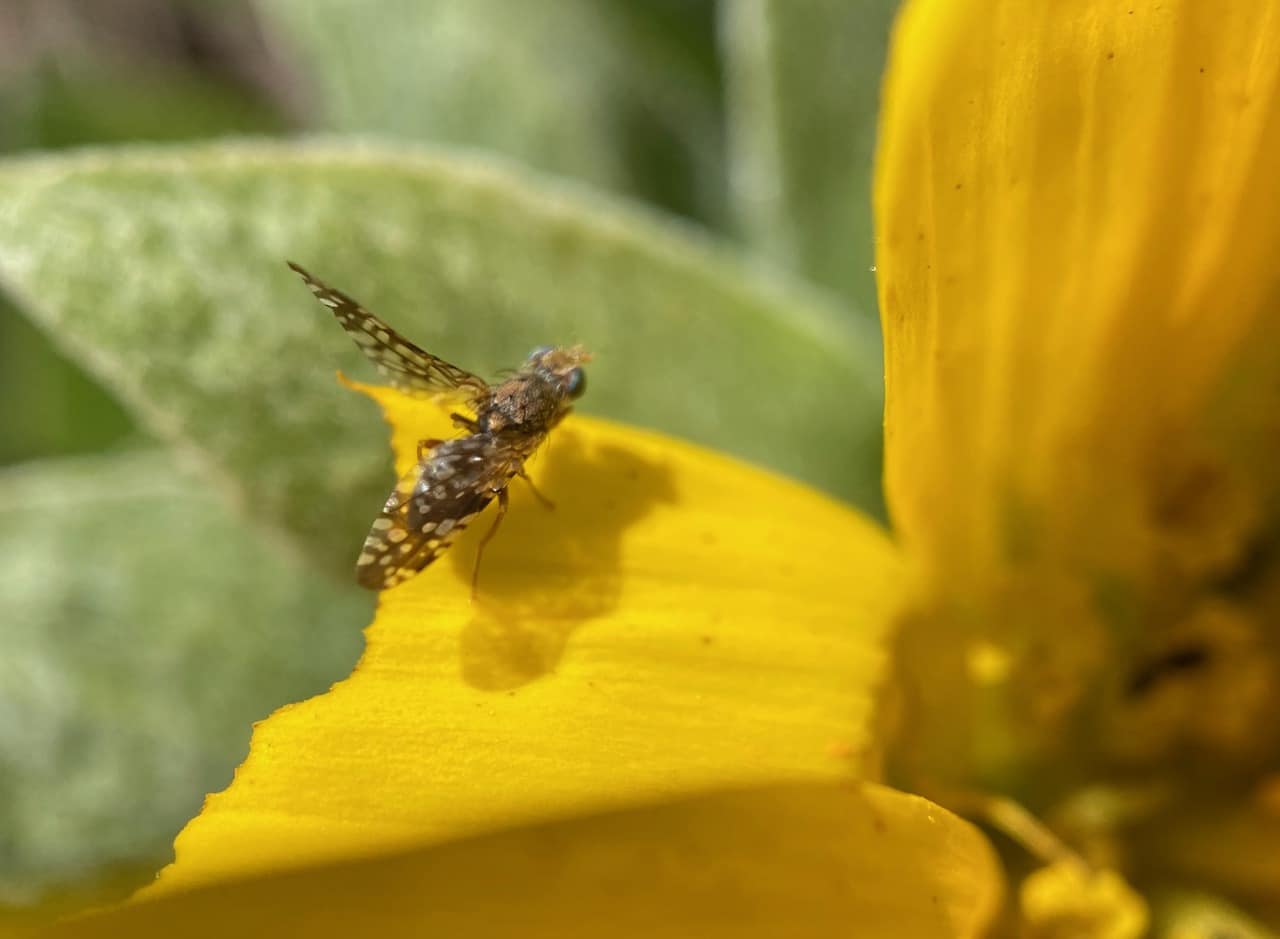
Much to my delight, the male Fruit Fly proceeds to do a wing-waving display. Walking slowly on the ray petal, he extends each wing alternately, waving it in a figure-8 rotation. Many species of Tephritidae perform an elaborate courtship or territorial display using their picture wings like semaphores. He turns around…
,,, and walking the other way, he waves his wings again, left then right, and so on.
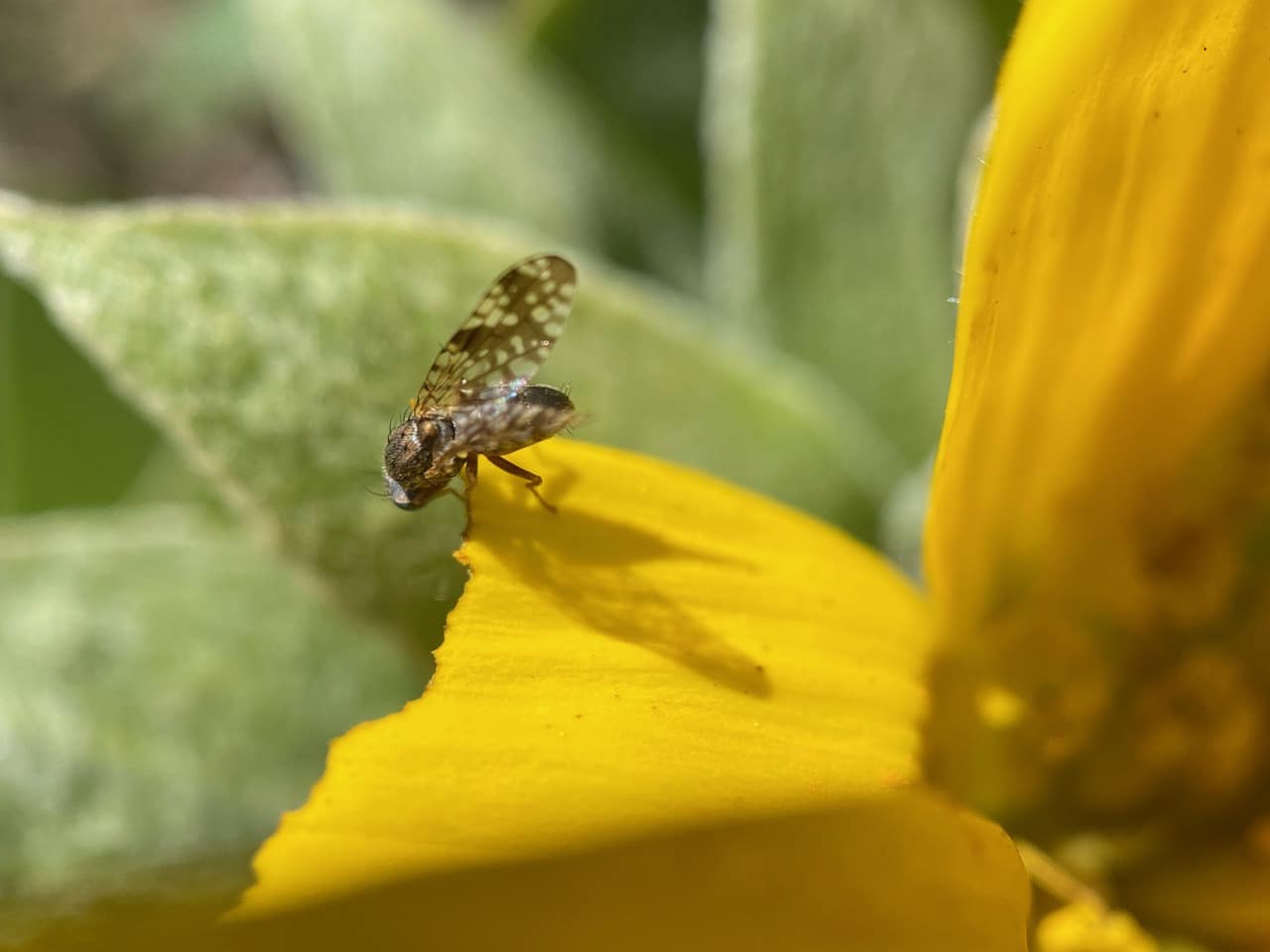
At the end of his performance, he gives a final bow before flying off, hopefully to an adoring female who has been watching his dance. Reaching the Cobweb Thistle, Cirsium occidentale, I check for ants and aphids on the plant. A few Odorous House Ants, Tapinoma sessile are moving around on the stems and the immature flowerheads, but there’s no sign of aphids. They must have been planted deep within the flowerhead, concealed by the cobwebby fibers.
The Odorous House Ant, Tapinoma sessile (subfamily Dolichoderinae, family Formicidae) is native to North America, ranging from southern Canada to northern Mexico. The species is found in a vast diversity of habitats, including within houses. The ants mainly feed on floral nectar and other sugary food. They also forage for honeydew produced by aphids and scale insects that they guard and tend.
Odorous House Ants are small ants, the workers measuring 2-3 mm. As in all members of the subfamily Dolichoderinae (odorous ants), this species does not possess a sting, instead relying on the chemical defense compounds produced from the anal gland. Such compounds are responsible for the smell given off by the ants when crushed or disturbed.
T. sessile colonies are polydomous (consist of multiple nests) and polygynous (contain multiple reproductive queens). The species practices seasonal polydomy – the colony overwinters in a single nest, and forms multiple nests during spring and summer when resources are more abundant and spread out.
The Odorous House Ants are rather docile, with little propensity for attack, preferring to use chemical secretions instead of biting. For this reason they are vulnerable to the invasion of the aggressive Argentine Ants, Linepithema humile.
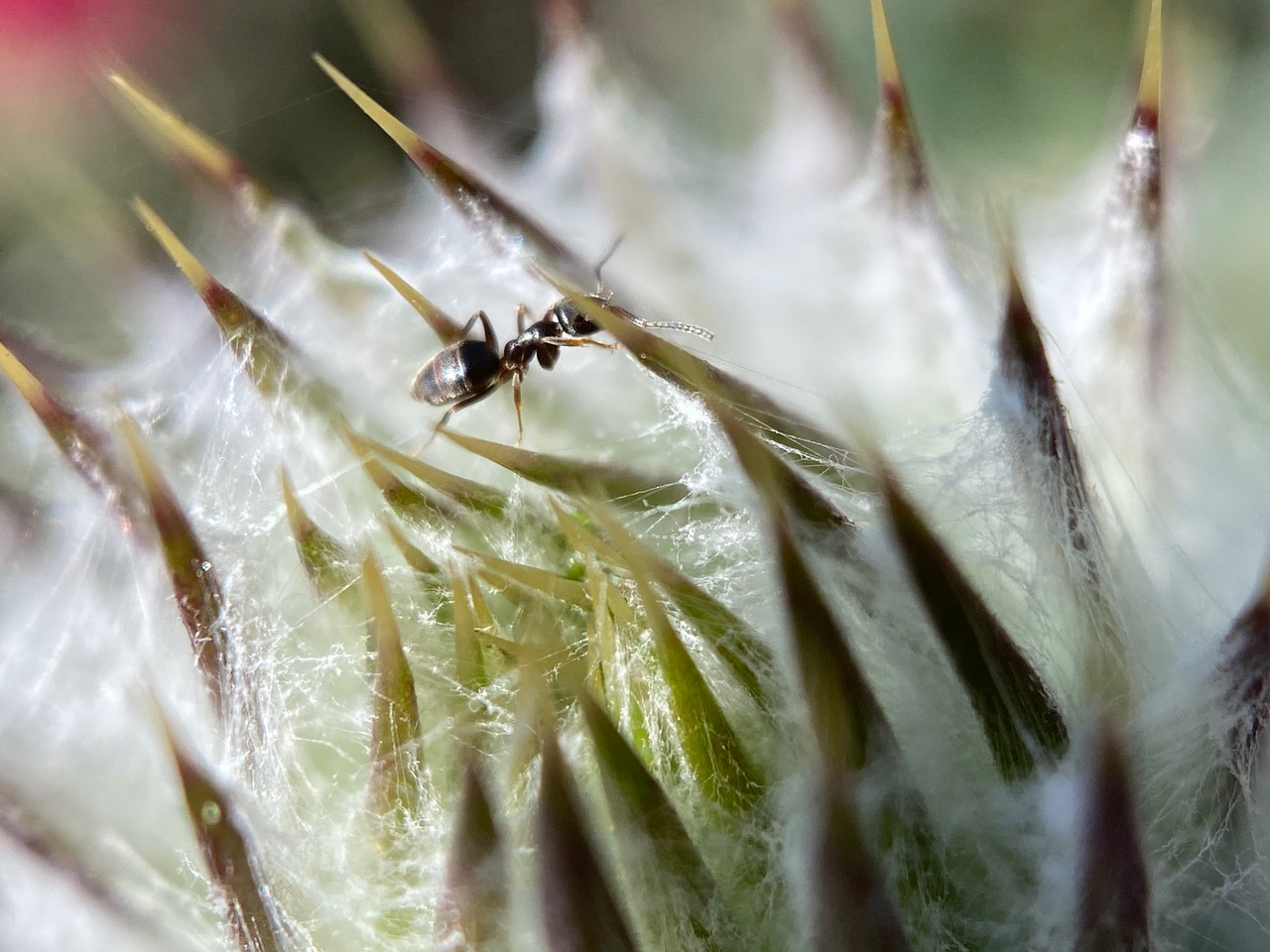
A movement on the flowerhead alerts me to the presence of a tiny black spider. It is moving around on the surface, seemingly adding its own silk threads between the sharp spines of the phyllaries. The spider has been identified by iNaturalist as a member of the family Linyphiidae, Sheetweb and Dwarf Weavers. There are two subfamilies: the true sheet weavers (Linyphiinae), and their tiny relatives the Dwarf Sheetweavers (Erigoninae). The web of these spiders form a flat or curved surface suspended from vegetation or over an opening on the ground. The spiders hang beneath the web and attack prey that wander or fall onto the web surface by biting directly through the silk webbing. Most species are tiny; some are among the smallest of spiders. A few of the common and larger species build distinctive webs for which they are named, for example, the “bowl-and-doily” spider, and the “filmy-dome” spider. Many of the dwarf sheet weavers aren’t known to build a web, but wander through the leaf litter on the ground in search of prey. Linyphiids are famous for dispersing by ballooning (flying by means of silk strands carried in a breeze), and these spiders are often responsible for the sheets of gossamer which sometimes coat fields and fences.
Its silk line glinting in the sun, the spider is suspended while in the process of constructing a web on the flowerhead. Its prey will never see the silken trap against this confusing background of webby plant fibers!
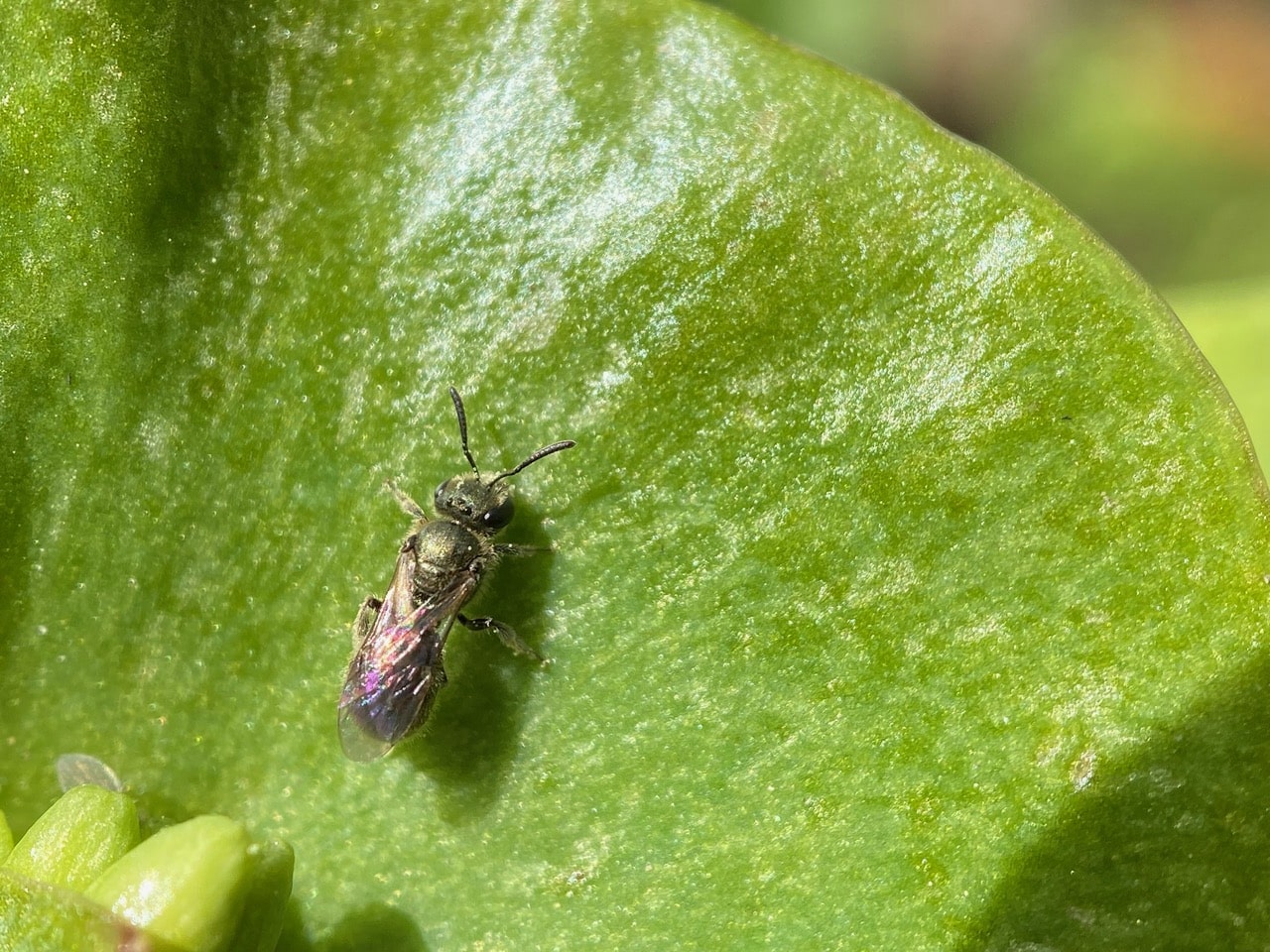
A tiny bee ascends a Miner’s Lettuce leaf after visiting the flowers. It is a Sweat Bee, Lasioglossum sp. (family Halictidae).
Lasioglossum species are found worldwide, and they constitute the largest bee genus. The subgenus Dialictus are the most likely to be seen in the U.S., with over 300 species of these tiny metallic bees. The majority of Lasioglossum are generalists. Because they are so abundant throughout the flowering season, the bees are often important pollinators. Their sheer numbers are enough to achieve excellent pollination of many wild flowers, especially of plants in the Asteraceae, which have shallow floral tubes that are easily accessed by these minute bees.
Lasioglossum are closely related to the genera Halictus and Agapostemon. These genera are commonly called “sweat bees” because of their attraction to human sweat, which they drink for its salt content. Lasioglossum are dusky black to brown slender bees with bands of hair on their abdomen. Female Sweat Bees (family Halictidae) carry pollen in the scopae on their entire hind legs and underside of their abdomen.
Lasioglossum exhibit a range of social behaviors; the genus includes solitary, communal, semi social, primitively eusocial, and even parasitic species. Almost all Lasioglossum in the U.S. nest in the ground. Generally these nests are built in the spring by fertilized females (called foundresses) that spent the winter in hibernation. In social species, the foundresses behave much like the queen Bumble Bees – they lay the first batch of eggs that develop into the first generation of female workers. The nest grows with each additional generation of bees. Later broods may consist of both males and females. They mate, and at the end of the season the fertilized females hibernate til the following spring, repeating the life cycle of the colony.
My camera captures this view of the bee’s abdomen as it lifts off the leaf. It has a metallic sheen and some sparse hairs. Probably in the subgenus Dialictus of metallic sweat bees.
Dialictus is a subgenus of sweat bees belonging to the genus Lasioglossum. Most of the members of this subgenus have a metallic appearance. They are commonly found in the Northern Hemisphere and are found in abundance in North America. Members of this subgenus also have very diverse forms of social structure making them model organisms for studying the social behavior of bees.
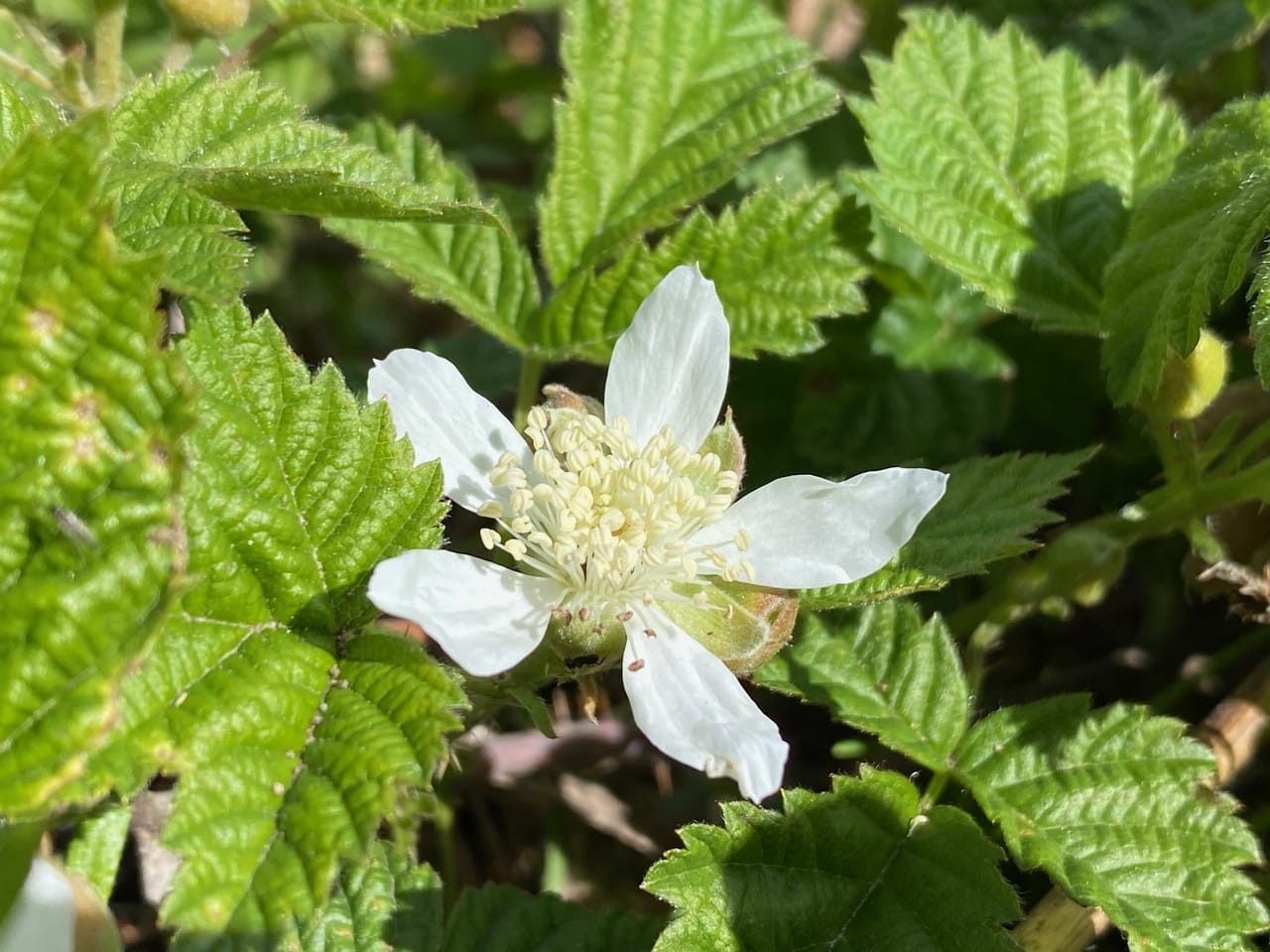
A flower has opened up on a male plant of the California Blackberry, Rubus ursinus. The plant is dioecious, with male and female flowers borne on separate plants. Male flowers have larger petals and a central cluster of numerous stamens. If you have a blackberry plant that never produces fruits, it’s probably a male.
This is a rather unusual female flower of California Blackberry, Rubus ursinus. It has more than the usual 5 petals, and the petals are unusually broad. Normally, compared to the males, female flowers have smaller petals and a central cluster of many pistils.