

Pollinator Post 3/25/26 (1)

A beautiful morning at Crab Cove.

As is my usual habit, I first walk around the visitor center to check on the native plantings around the building. Many plants are blooming nicely, but there doesn’t seem to be much insect activity. I stop by this Alumroot , Heuchera micrantha that is blooming profusely in partial shade.
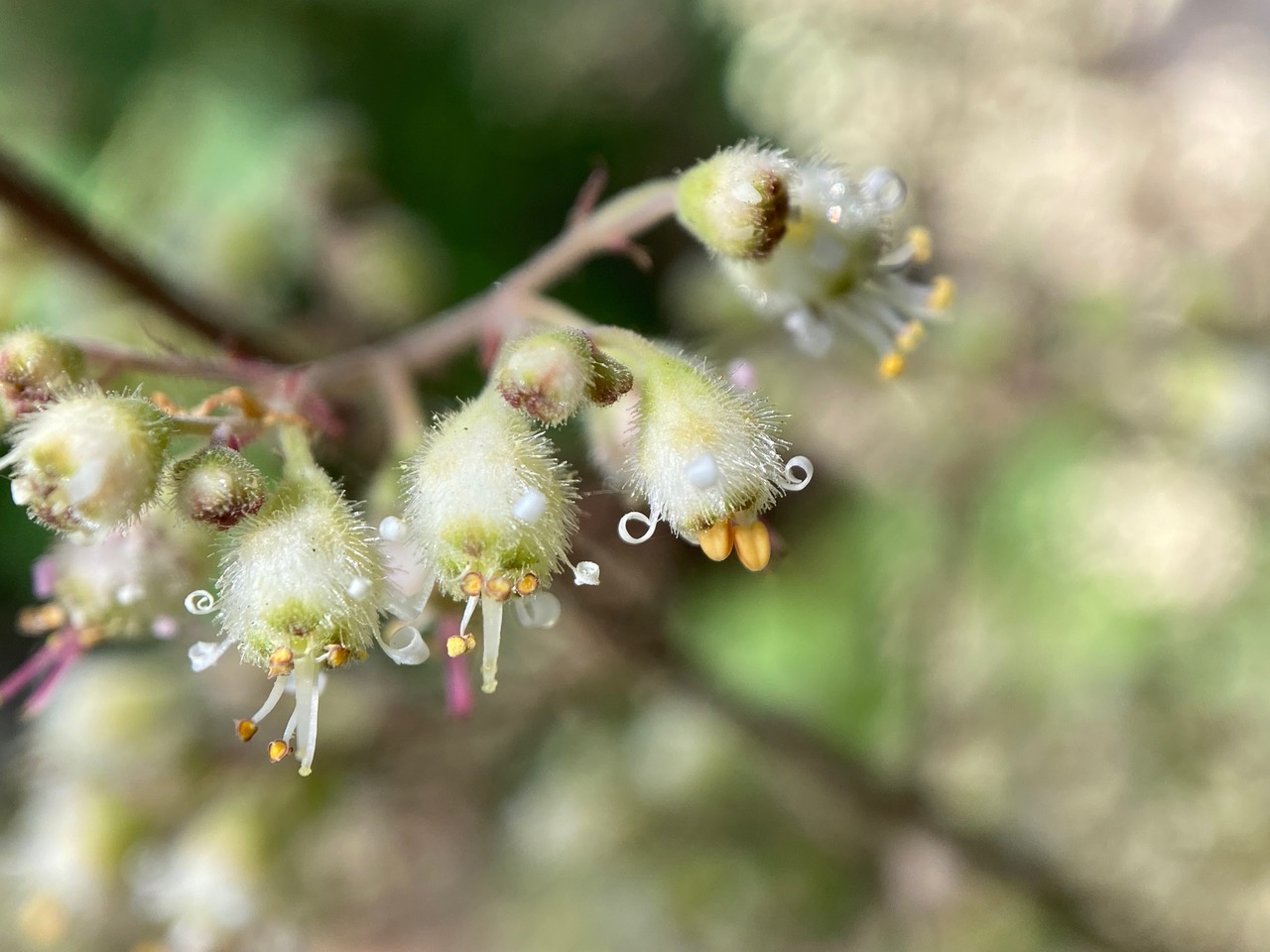
Close up, the charming flowers look like something conjured up by Dr. Seuss! The hairy flowers are bell-shaped, with five minute white petals appearing as curly straps rising between the fused calyx. Protruding from the flower are five stamens with large anthers, and a two-pronged style. Any insect that probes the flower for nectar would come away with lots of pollen as well.

A small hover fly has landed on a flower to feed on pollen from the anthers using its proboscis with an expanded tip.
Adult hover flies (family Syrphidae) have sponging mouthparts. They use these, known as labellum, to dab up liquid food sources like nectar, and honeydew. Like house flies, their mouthparts enable them to regurgitate digestive enzymes onto solid food (such as pollen) and then absorb the liquefied meal through their specialized labella.
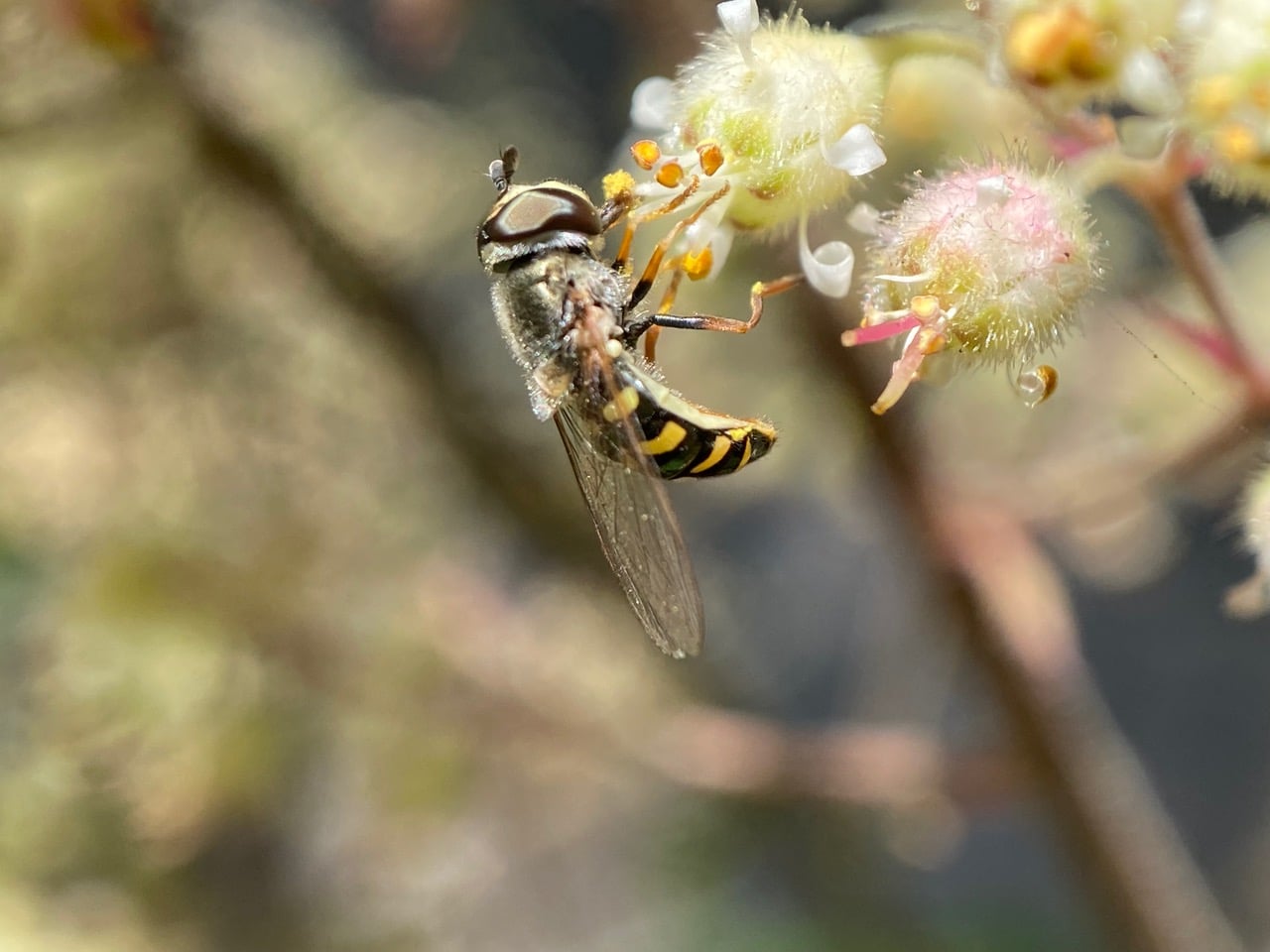
I strain to get a look at the fly’s abdomen. Ah, it is a Large-tailed Aphideater, Eupeodes volucris (family Syrphidae).
The Large-tailed Aphideater, Eupeodes volucris (family Syrphidae) is found in western North America, and is active March through November. The common name of the species refers to the distinctive “large tail” or projecting cylindrical abdomen of the males. As the rest of the common name implies, the larvae of the species are voracious predators of small plant-sucking insects such as aphids. Females seek out dense aphid colonies on plants to lay eggs among them. Adults visit flowers for nectar and pollen.

In the shade in front of the visitor center, a small wasp is holding on motionless to a leaf of Bush Monkeyflower, Diplacus aurantiacus. It’s unusual to see a wasp not in motion. Its wings are spread. Is it asleep, or dead? iNaturalist has helped identify the wasp as a Mason Wasp, Ancistrocerus bustamente (family Vespidae).
Potter wasps (or mason wasps), the Eumeninae, are a cosmopolitan wasp group presently treated as a subfamily of Vespidae. Most eumenine species are black or brown, and commonly marked with strikingly contrasting patterns of yellow, white, orange, or red. Their wings are folded longitudinally at rest. Eumenine wasps are diverse in nest building. The Mason Wasps are species that generally nest in pre-existing cavities in wood, rock, or other substrate. Potter Wasps are the species that build free-standing nests out of mud, often with a spherical mud envelope. The most widely used building material is mud made of a mixture of soil and regurgitated water.
All known Eumenine species are predators, most of them solitary mass provisioners. When a cell is completed, the adult wasp typically collects beetle larvae, spiders, or caterpillars and, paralyzing them, places them in the cell to serve as food for a single wasp larva. As a normal rule, the adult wasp lays a single egg in the empty cell before provisioning it. The complete life cycle may last from a few weeks to more than a year from the egg until the adult emerges. Adult mason wasps feed on floral nectar.
The Mason Wasp, Ancistrocerus bustamente (family Vespidae, subfamily Eumeninae) is found in western North America and Mexico. The species frequents arid areas, and nests in pre-existing cavities (e.g. old borings in wood, hollow stems, rock crevices) and use mud for partitions between brood cells. The wasps have been known to nest in Sambucus (Elderberry) stems. The name of the genus means “hooked horn” for the back-curved last segments of the antennae characteristic of the males.

Gee, I have completely missed the blooming of this Coast Live Oak, Quercus agrifolia this year! The male catkins now hang parched and dry from the branches.
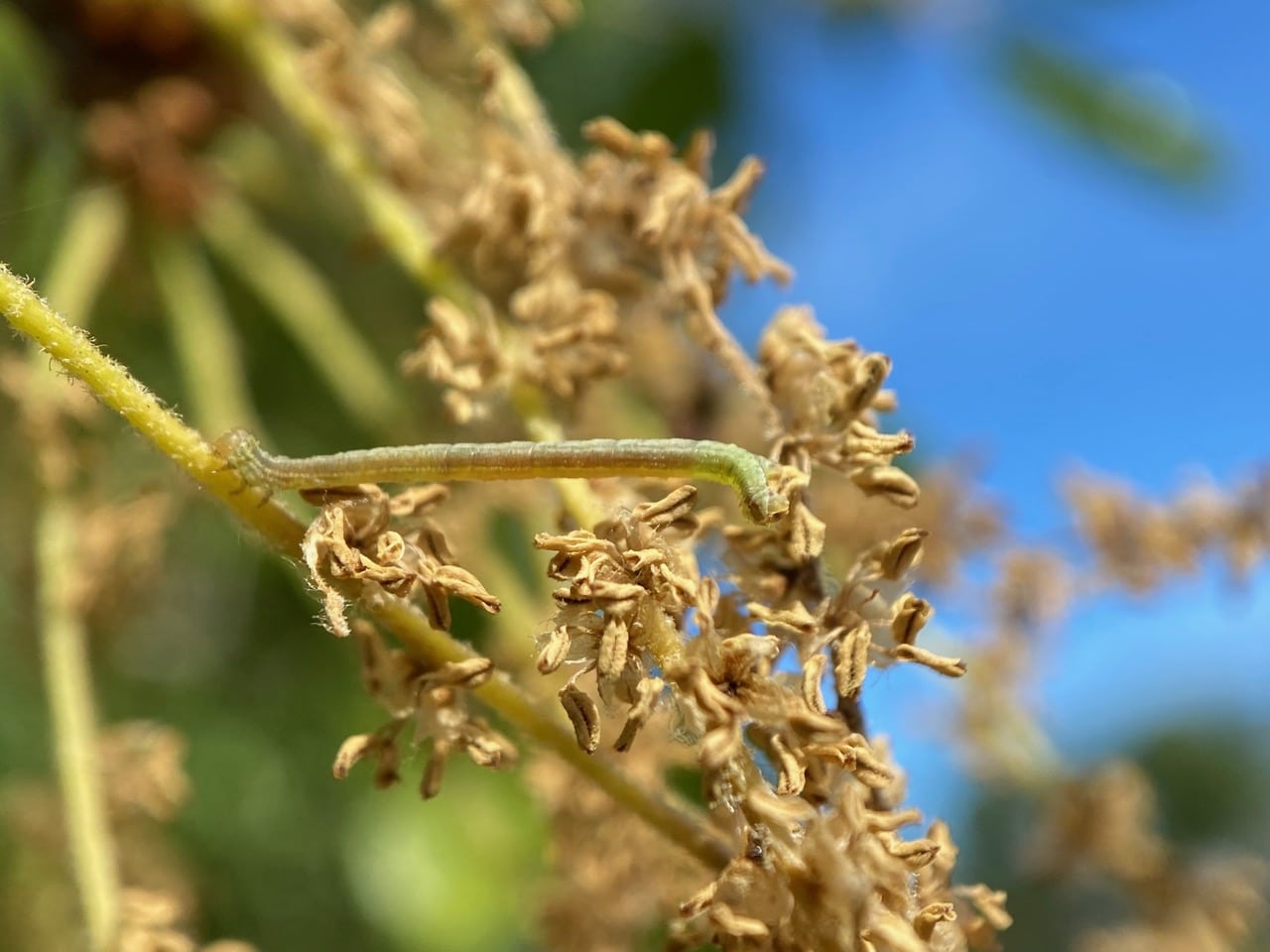
Wait, the catkins are not completely lifeless! Do you see the Inchworm masquerading as a stalk among the dried flowers? How does it manage to match the colors so well?
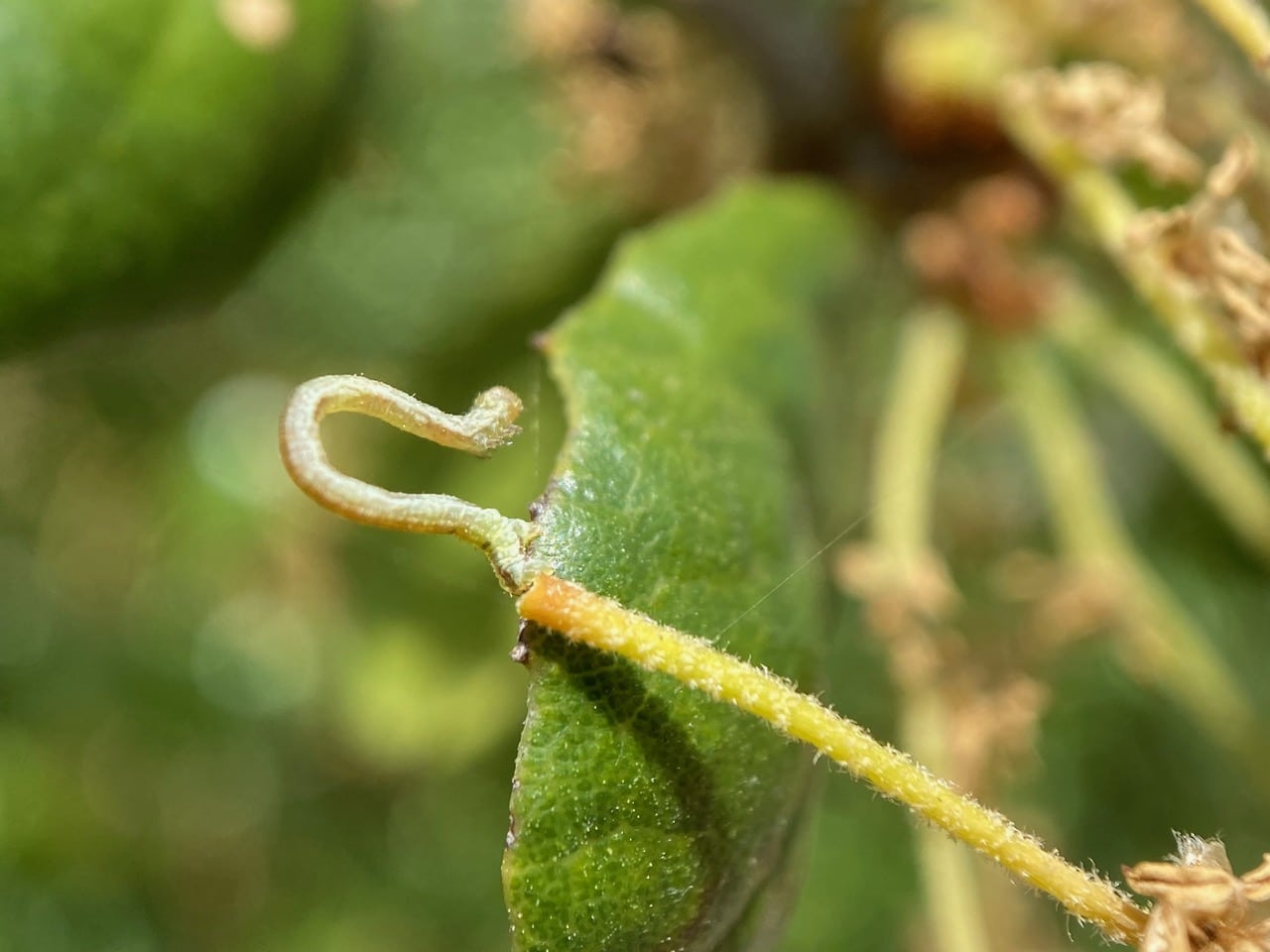
I watch as the caterpillar “inches” its way to a leaf.
Inchworms are also called loopers and measuring worms. The majority of the inchworms are the larvae of moths in the family Geometridae. The name comes from the Greek “geo” for earth and “metro” from measure, because the caterpillars seem to be measuring the surface on which they are walking.
All caterpillars have three pairs of jointed legs behind their heads. These legs are called true legs because they will become the six legs of the adult butterfly or moth. There are additional appendages, called prolegs, along their bodies. Prolegs are not true legs, they are just outgrowths of the body wall and will be lost at metamorphosis. They have little hooks on their soles to help the caterpillar walk and grip onto things.
Most caterpillars have five sets of prolegs, four in the middle of the body and one pair at the hind end. Inchworms have the normal six true legs but only two or three pairs of prolegs, all located at the tail end of the body, with none in the middle. When an inchworm walks, it moves its tail-end prolegs up behind its true legs, causing the center of its body to loop upward. Then it stretches its front end forward to take another step.

A Seven-spotted Lady Beetle, Coccinella septempunctata (family Coccinellidae) is resting on the terminal flower buds of a Cleveland Sage, Salvia clevelandii. Gone are all the aphids I found here on 3/9/26, with a single Seven-spotted Lady Beetle and a lady beetle larvae feeding on them. Did the lady beetles clean them all up?
Native to Europe, the Seven-spotted Lady Beetle, Coccinella septempunctata (family Coccinellidae) has been repeatedly introduced to North America as a biological control agent to reduce aphid numbers. It has since spread to many states, where it has outcompeted some native species, including the Coccinella. The Seven-spotted Ladybeetles are large; adults may reach a body length of 0.5 in. Their distinctive spots and conspicuous colors warn of their toxicity, making them unappealing to predators. When threatened, the beetles can secrete a fluid from joints in their legs which gives them a foul taste.

The Coastal Bush Lupine, Lupinus arboreus is in peak bloom, yet the large patch is eerily quiet. Where are the bumble bees?
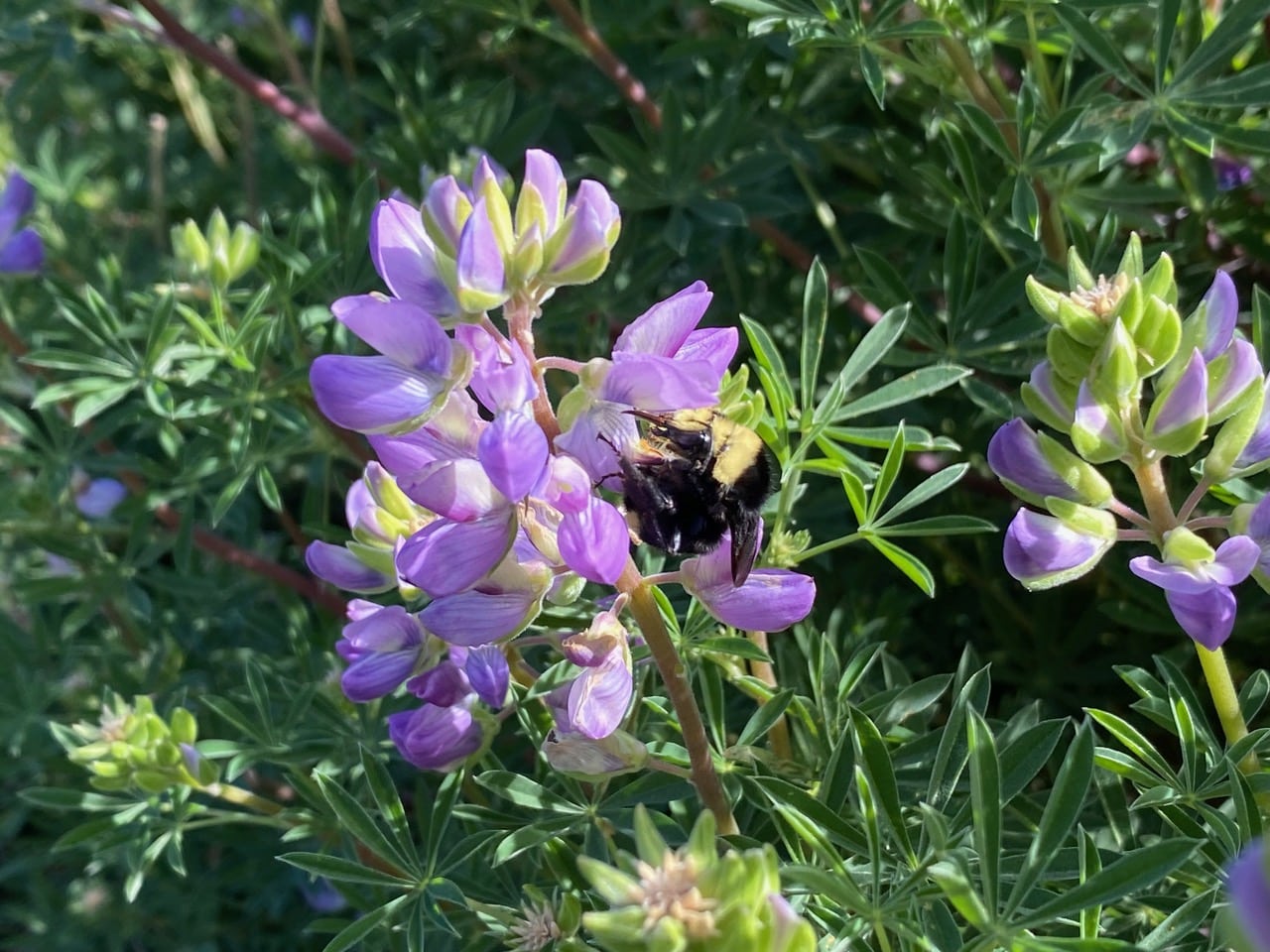
Just when catastrophic thoughts begin to cloud my mind, a large queen Yellow-faced Bumble Bee, subgenus Pyrobombus (genus Bombus, family Apidae) lands on a lupine flower near me and proceeds to take nectar. Note that her tongue is directed at the back of the flower where the nectar guides converge, showing where the nectar is stored. The bee does not seem to have collected any pollen, as lupine produces a bright orange pollen that are very visible in a bee’s pollen baskets.
Bumble bees are principal pollinators of lupine flowers, using their weight to “trip” the flower’s piston-like mechanism to release pollen. As the bee lands on the lower wing petals they press the keel, forcing reproductive structures (anthers and style) to dab or pick up pollen from the bee. Bumble bees efficiently collect this protein-rich pollen into their pollen baskets on their hind legs before returning to their hive.
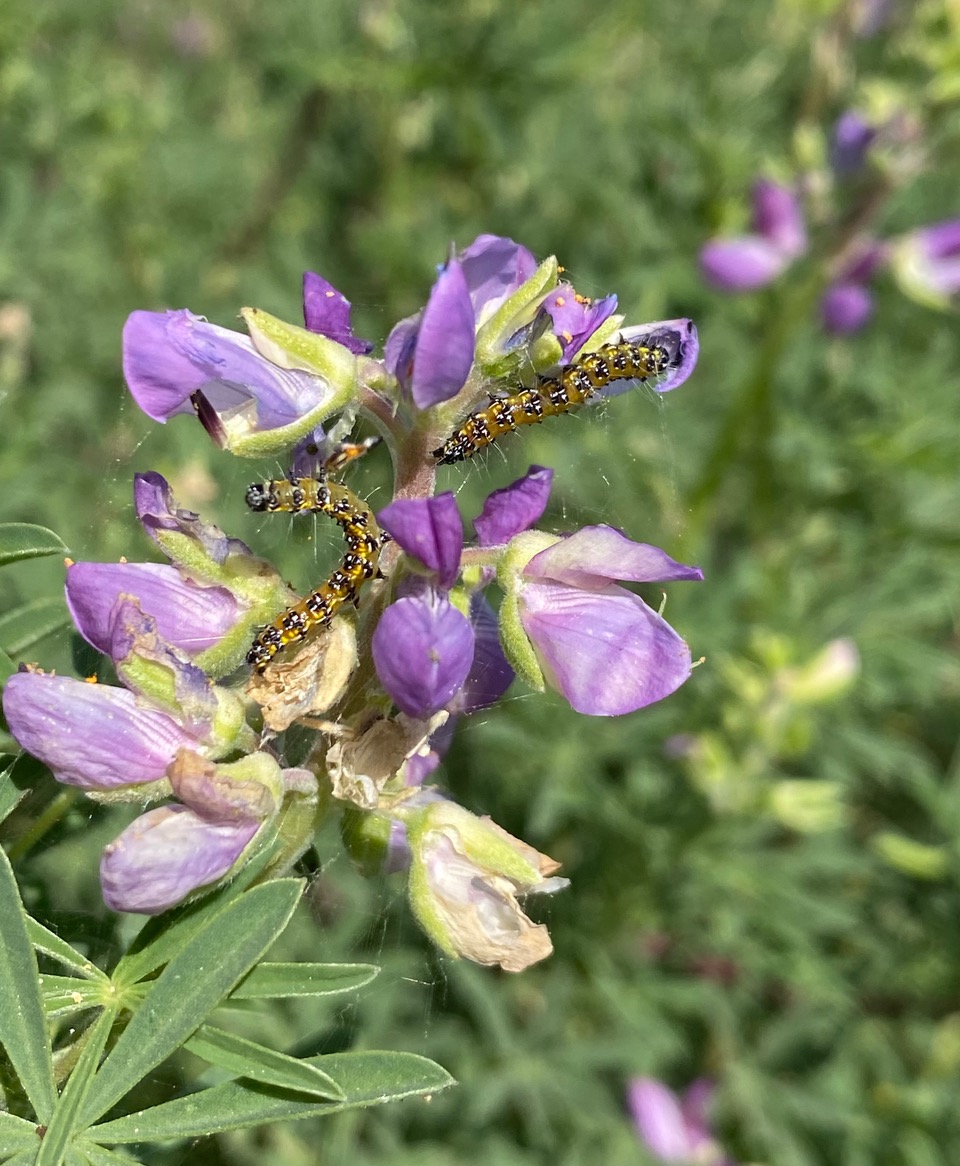
I spot two caterpillars on a spike of lupine flowers, and immediately recognize them as Genista Broom Moth caterpillars, Uresiphita reversalis. The one on the left is busy weaving a loose matrix of silk around itself, while the other is feeding on a lupine flower bud.
The Genista Broom Moth, Uresiphita reversals is a moth in the family Crambidae. The species is probably native to Mexico before spreading north into the U.S. and the Caribbean, establishing in the San Francisco Bay Area by 1980. The adult moths have a wingspan of 27-34 mm. They are on wing year round in multiple generations per year. The larvae feed on Acacia, Lonicera, Baptisia, Genista, Lupinus species, as well as “other pea family shrubs”. Genista is an Old World genus for “broom” in the pea family Fabaceae.

Here’s another one, laying waste to a lupine flower. I look around for more caterpillars but find none. Apparently not a serious infestation. Hopefully there are sufficient checks and balances (such as predators and parasites) in the ecosystem to help keep the numbers of the caterpillars under control.
The bright colors of older Genista Broom Moth caterpillars are aposematic, or warning, coloration that signals to predators that they are toxic and unpalatable. These caterpillars accumulate toxic alkaloids from their host plants, such as lupines and brooms, and their vibrant yellow and black markings serve as a clear warning to deter birds, lizards, and other potential predators from attacking them.
While these caterpillars might be considered pests in gardens, they are useful biological pest control for a number of invasive plants in the wild that belong to the pea family, notably the brooms. They are helping to check the invasion of French and Scotch brooms that cover extensive hillsides and displace the native chaparral vegetation of California.
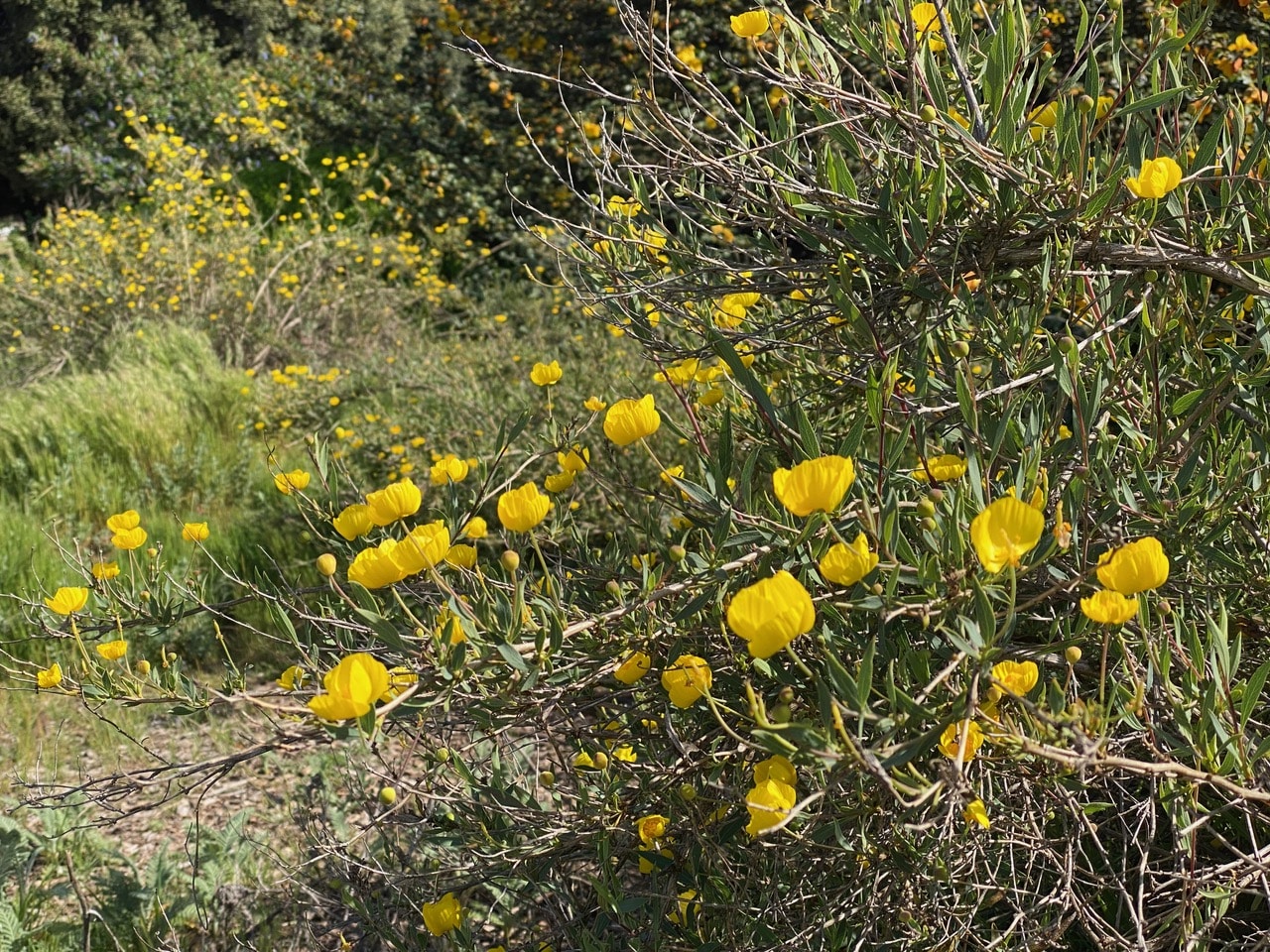
The Bush Poppy, Dendromecon rigida is blooming gloriously, but there’s not a single insect visitor!
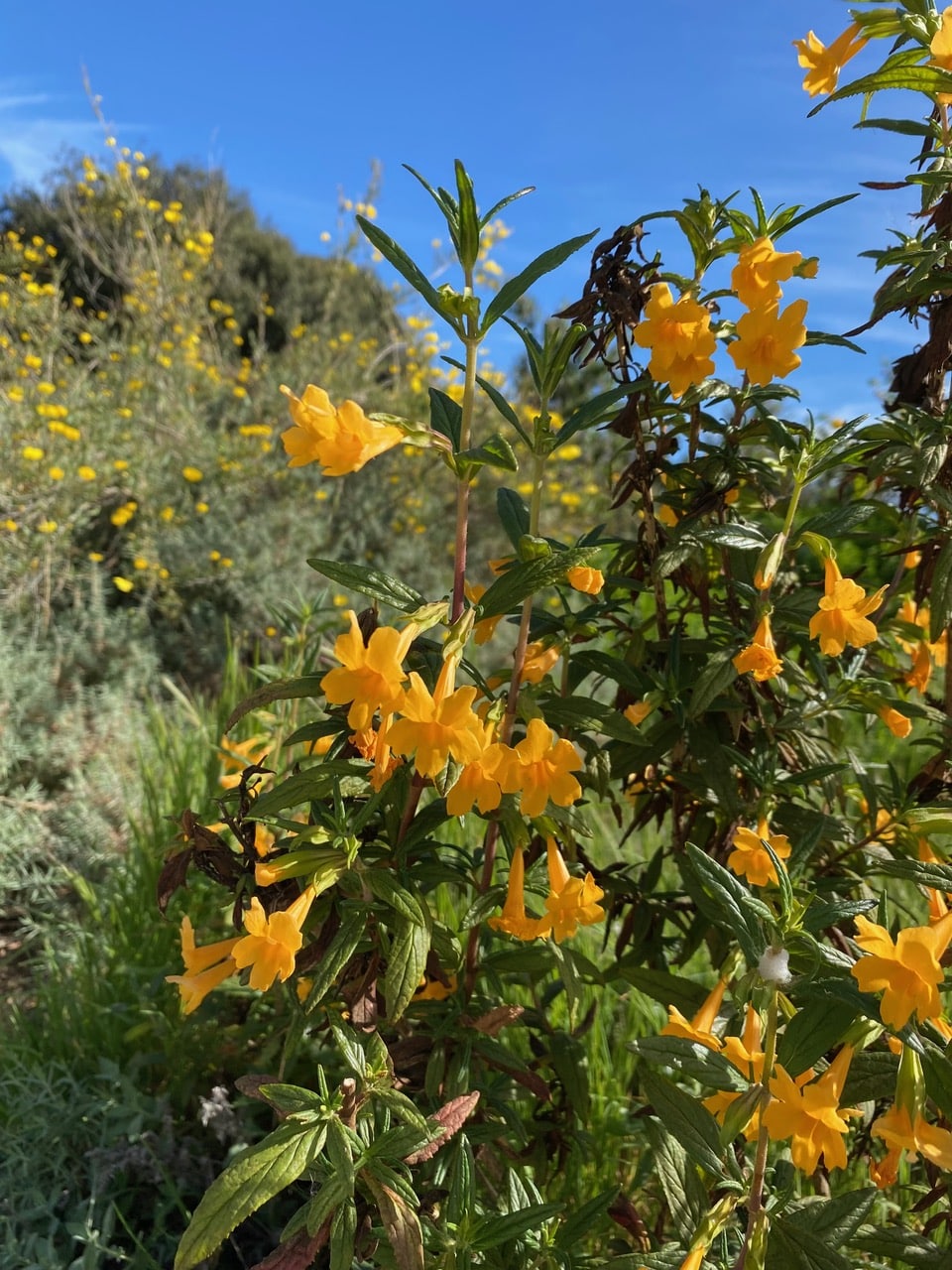
The situation is similar with the Bush Monkeyflower, Diplacus aurantiacus. I scan every flower for the little bees that usually pollinate these flowers, or the little bugs that live in them, but all is quiet. Is this Silent Spring for insects?
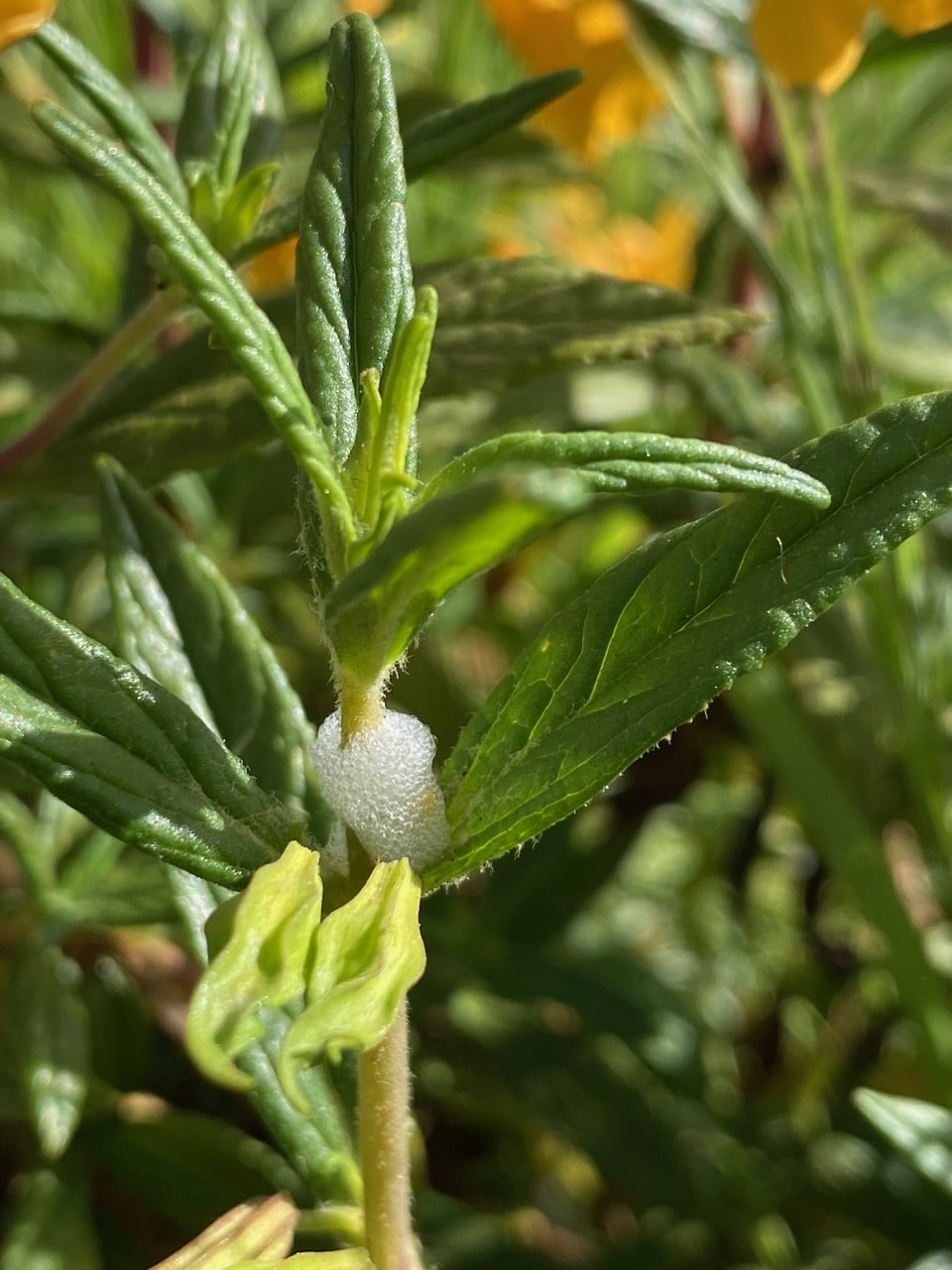
Ah, I am happy to finally find insect life on the Bush Monkeyflower – in the white foamy mass.
Spittlebugs, also known as Froghoppers belong to the superfamily Cercopoidea within the order Hemiptera (true bugs). While sometimes generally referred to as the family Cercopidae, they are scientifically divided into several families, primarily Aphrophoridae (common spittlebugs), Cercopidae (froghopper), and Clastopteridae.
Why the common name of “spittlebug”? The nymphs (immatures) of these bugs create foam masses on plants in which they live and feed. Like the adults, the nymphs use their piercing, sucking mouthparts to feed on plant juices. The nymph produces a cover of foamed-up plant sap reminiscent of saliva, hence the common name of spittlebug. Whereas most insects that feed on sap feed on the nutrient-rich fluid from the phloem, Spittlebugs tap into the much more dilute sap flowing upward via the xylem. The large amount of excess water that must be excreted and the evolution of special breathing tubes allow the young spittlebug nymphs to grow in the relatively protective environment of the spittle. Symbiotic bacteria in the insects’ digestive system provides them with the essential amino acids that their diet lacks. The foam serves a number of purposes. It hides the nymph from the view of predators and parasites, and it insulates against heat and cold, and protects the delicate nymphs from desiccation. Moreover, the foam has an acrid taste that deters predators.
Unlike their young, adult spittlebugs (also known as Froghoppers) are efficient flyers and hoppers, feeding on diverse plant species. They pierce plant stems to feed on xylem. To get enough nutrients, they consume massive quantities of sap, drinking up to 280 times their body weight daily, resulting in high waste excretion. Froghoppers can cause damage by distorting plant leaves and causing shoot tips to die back.

The various Ceanothus flowers are fading, replaced by luscious little berries. The bee activities around the Ceanothus bushes have subsided significantly.
Ceanothus fruits are small, dry, three-lobed, or three-chambered capsules, often described as triangular, sticky, or slight horned when mature. These capsules contain tiny, shiny brown seeds that are often ejected explosively to disperse them. The fruits are generally not a primary food source for wildlife, but the seeds are often harvested and stored by ants.