

Pollinator Post 3/25/25 (2)

In the native plant garden at Crab Cove, the Flannel Bush, Fremontodendron californicum is blooming profusely, and yet there’s hardly any insect activity.
The quarterly journal of the California Native Plant Society (CNPS) Fremontia was named after this plant. It is unusual in that it belongs in the Sterculiaceae, a plant family more commonly found in the tropical regions of the world. The leaves are covered with soft fuzz, giving rise to the common name of the plant. The tough and leathery leaves are divided into three characteristic lobes.
The large and attractive flowers of Flannel Bush are surprising in that it has no petals. The five showy yellow petal-like parts are actually sepals. The lower portions of the stamen filaments are fused into a tube, from which arise a single style in the middle.
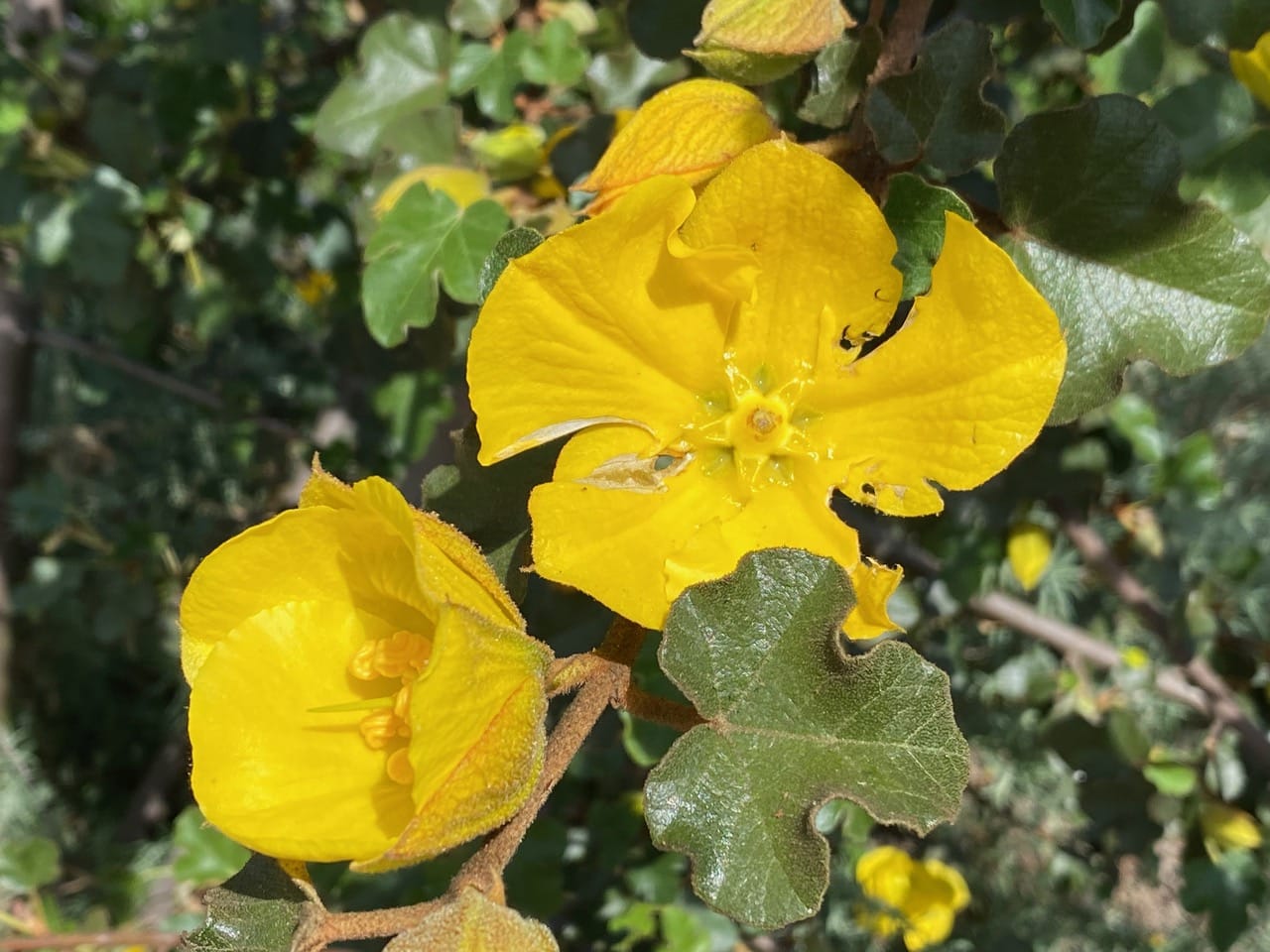
What happened to that flower? The petals are damaged and the reproductive parts are all but missing!
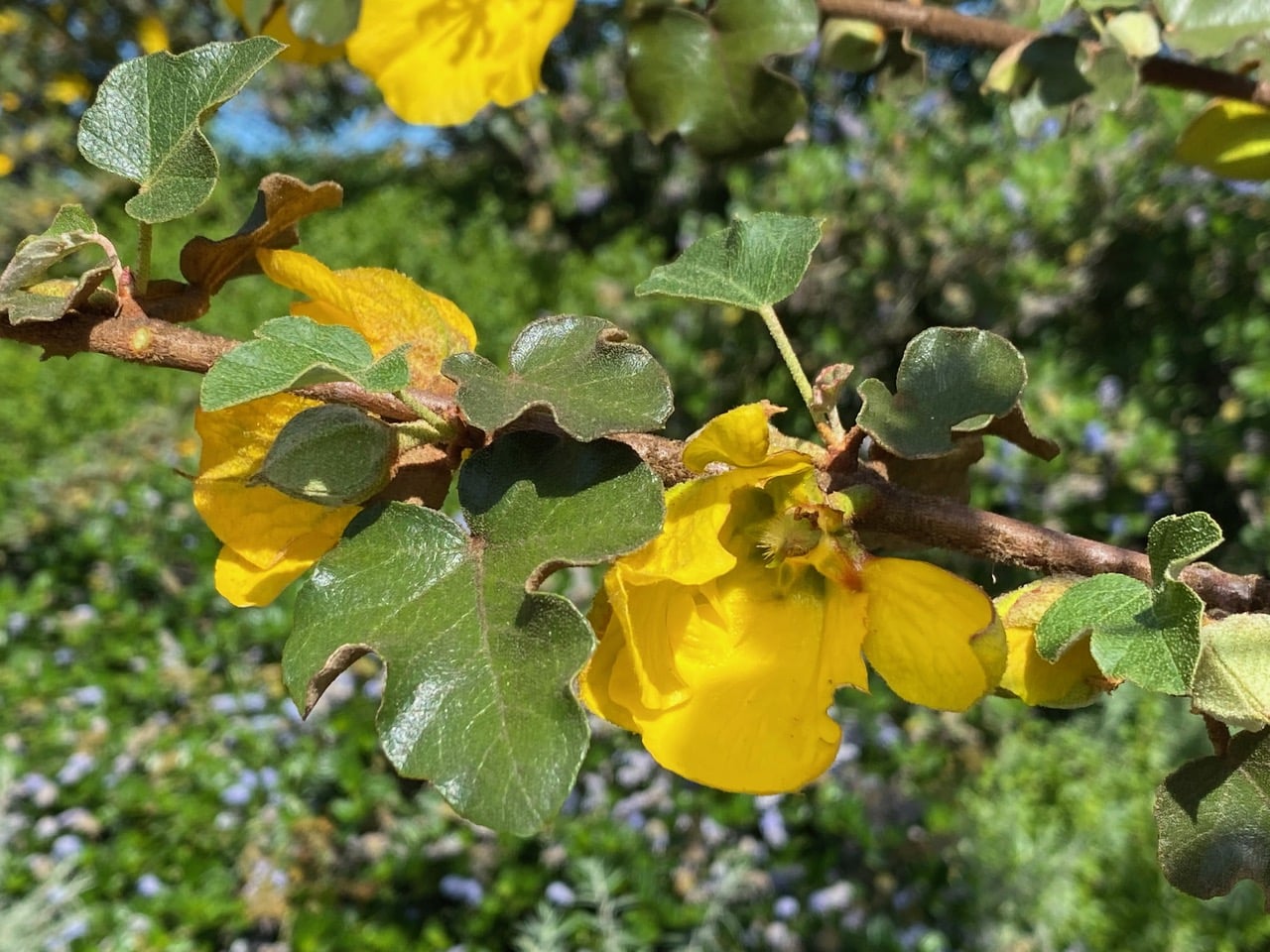
Same with this Flannel Bush flower. I think the Ground Squirrels might be responsible for these damages. I often see them climb up the lower branches to feed on the flowers.
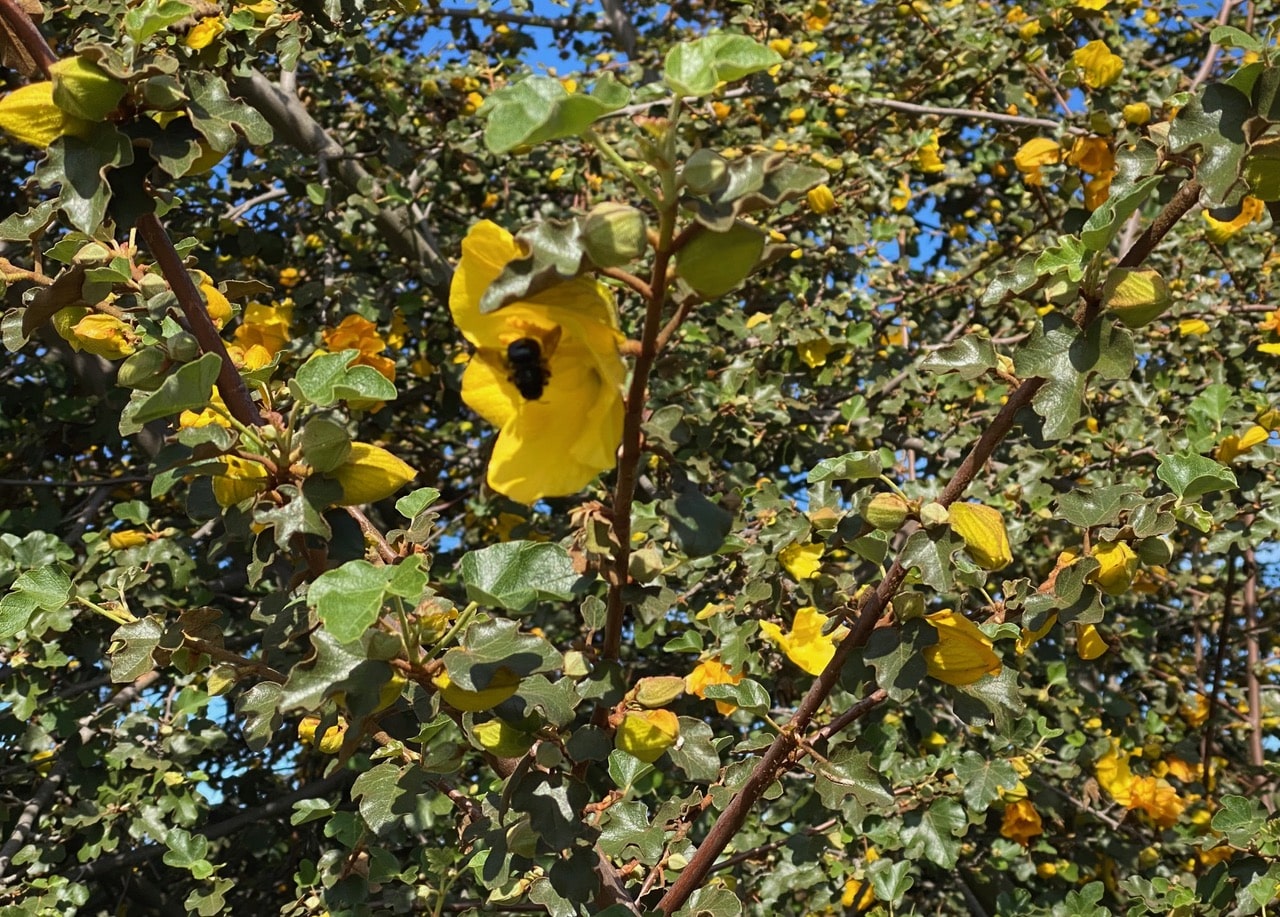
An all-black Carpenter Bee, Xylocopa sp. (family Apidae) zips past me and lands high on a flower on a tall branch to collect pollen. Other than this bee, I don’t see any other visiting the Flannel Bush.
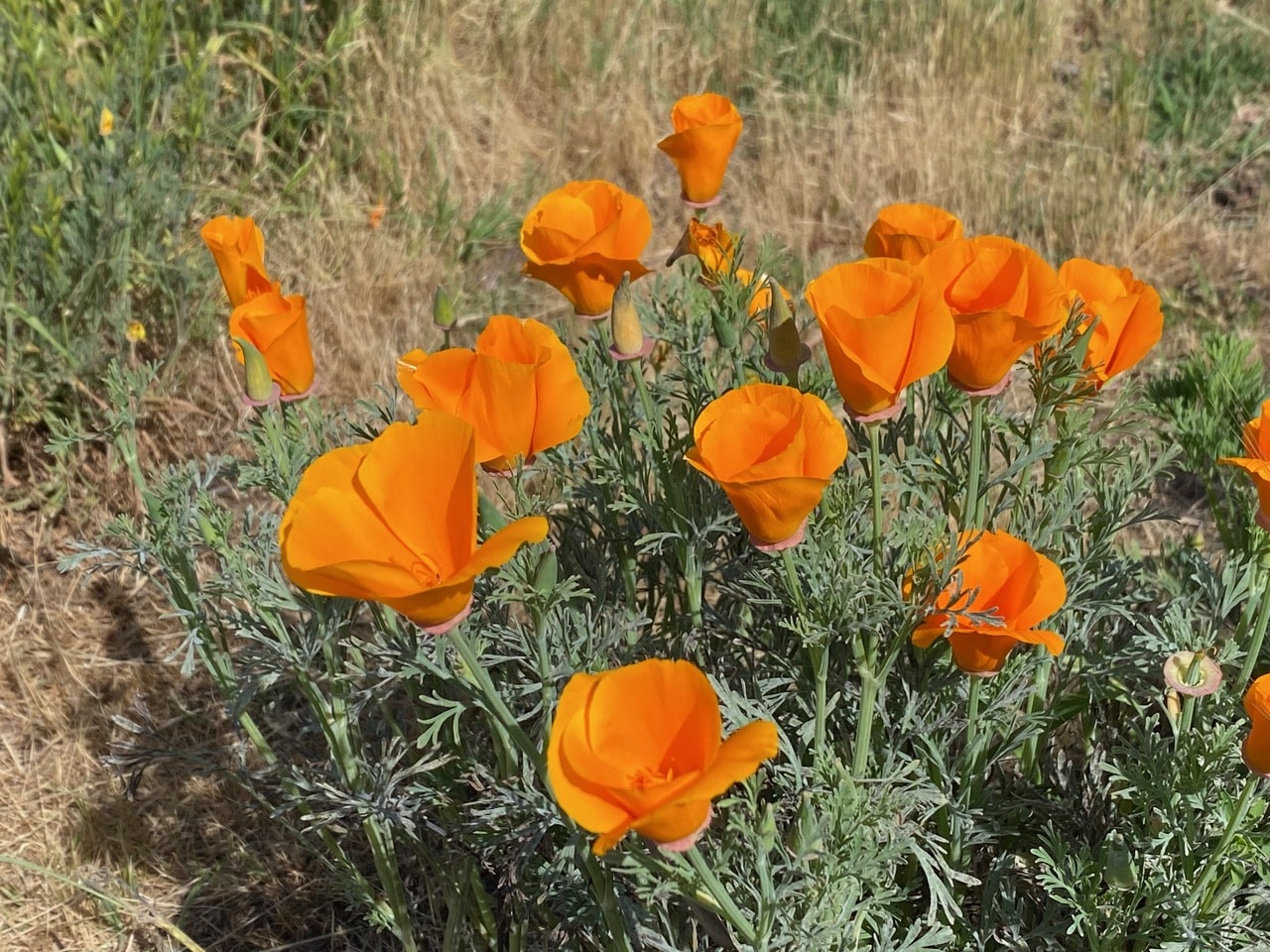
I spot a large patch of California Poppy, Eschscholzia californica blooming gloriously across the road at the Otis entrance to the park, and wonder if I should go there. It’s already 11:20 am and getting hot, and I’m supposed to meet up with Fred in 10 minutes at the other end of the park.
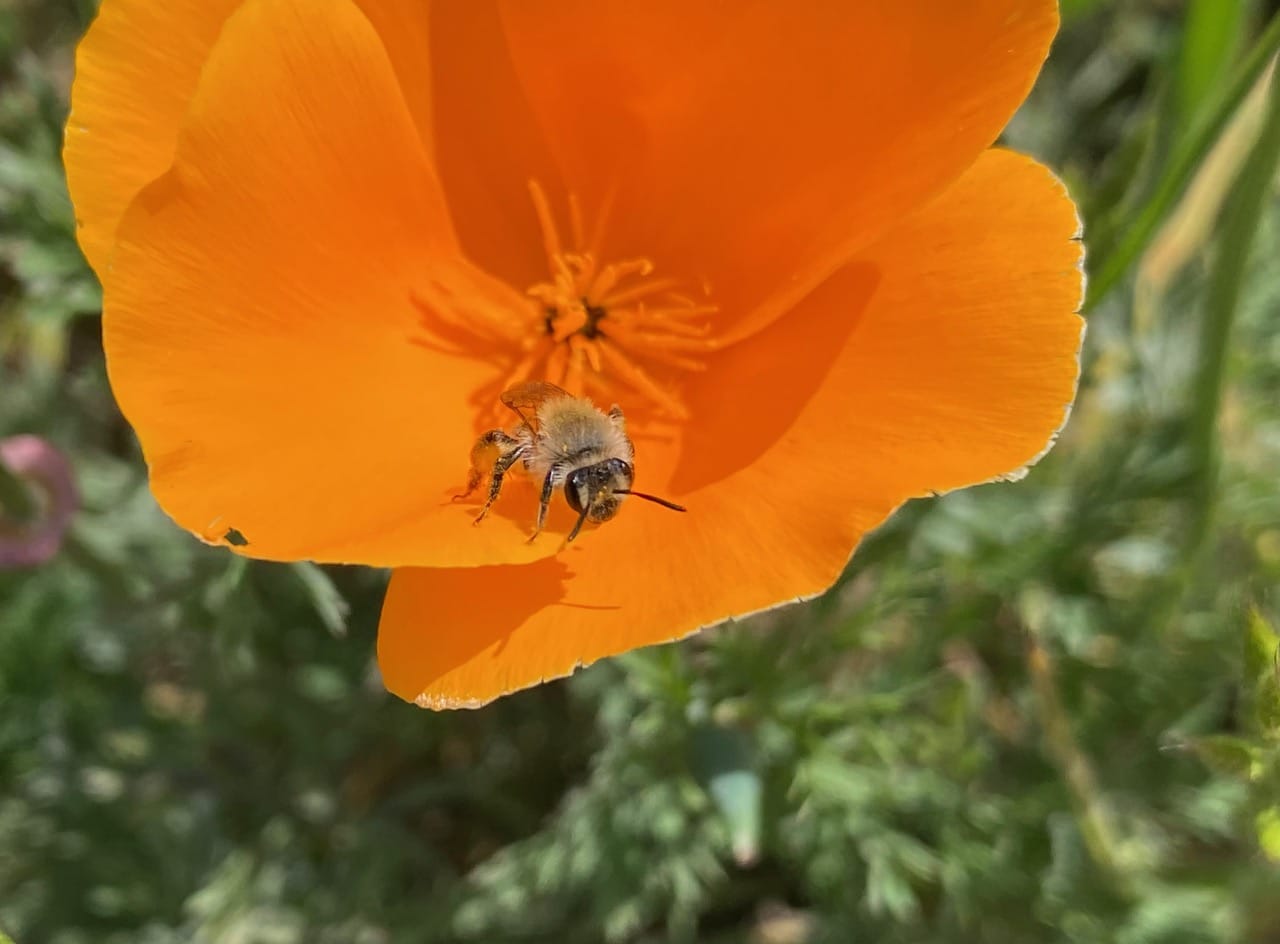
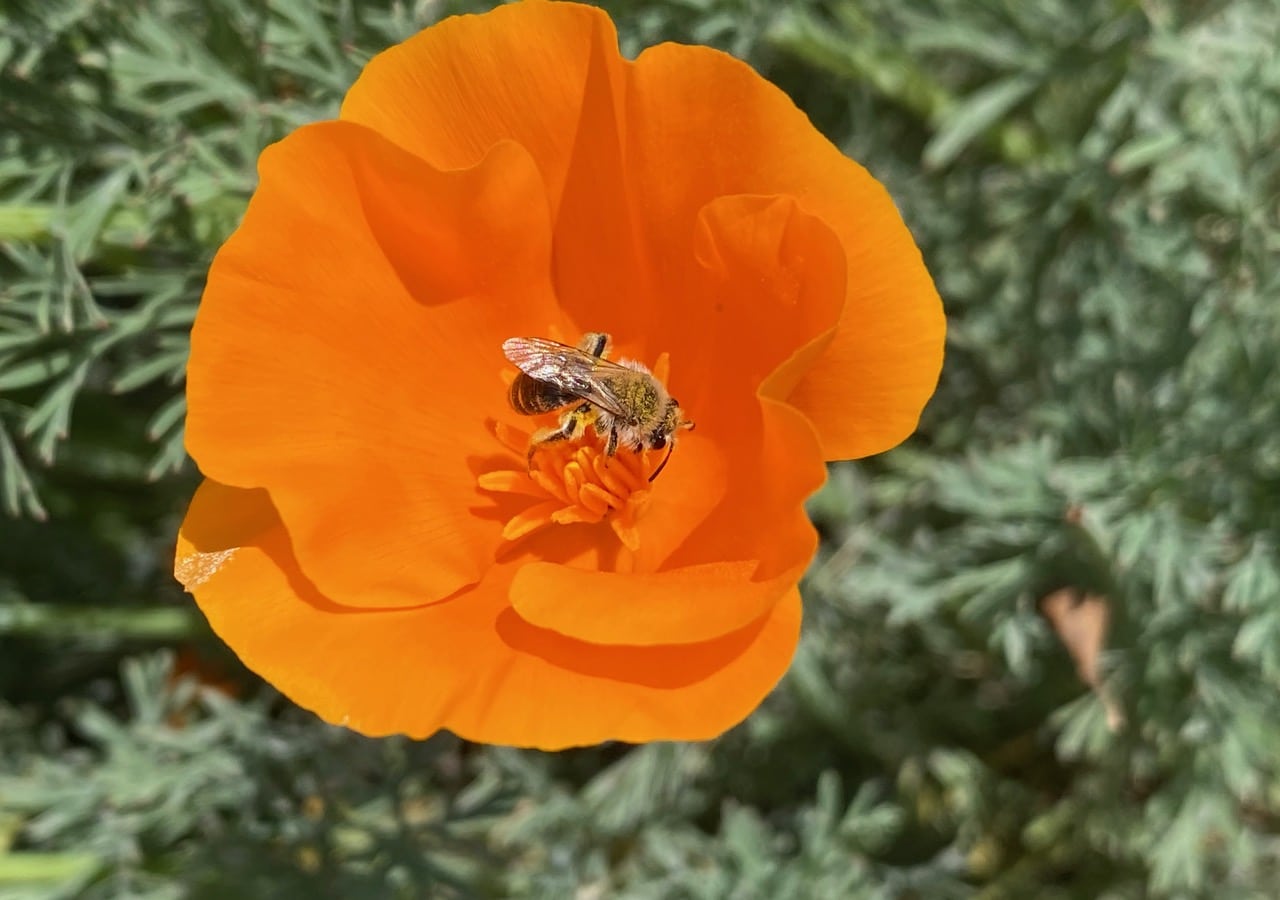
I’m so glad that I did cross the road to check on the California Poppies – because this is where all the insect action is! I am thrilled to find a little bee crawling out of a flower. Note the rows of pale hairs on the inner margin of her compound eyes – her facial fovea. She’s a Mining Bee, Andrena sp. (family Andrenidae).
Facial fovea are usually present in female Andrena , and are often used to differentiate Andrena from other genera, particularly in field identification. Facial foveae are shallow, band-like depressions or grooves located along the inner margins of the compound eyes, typically covered in short, dense, velvety hairs. They look like “eyebrows”, often appearing as distinct pale bands, especially in well-lit photos. Research has shown that these foveae are linked to specialized secretory glands, which are believed to be used in intra-nest communication, particularly when two bees meet within the nest.
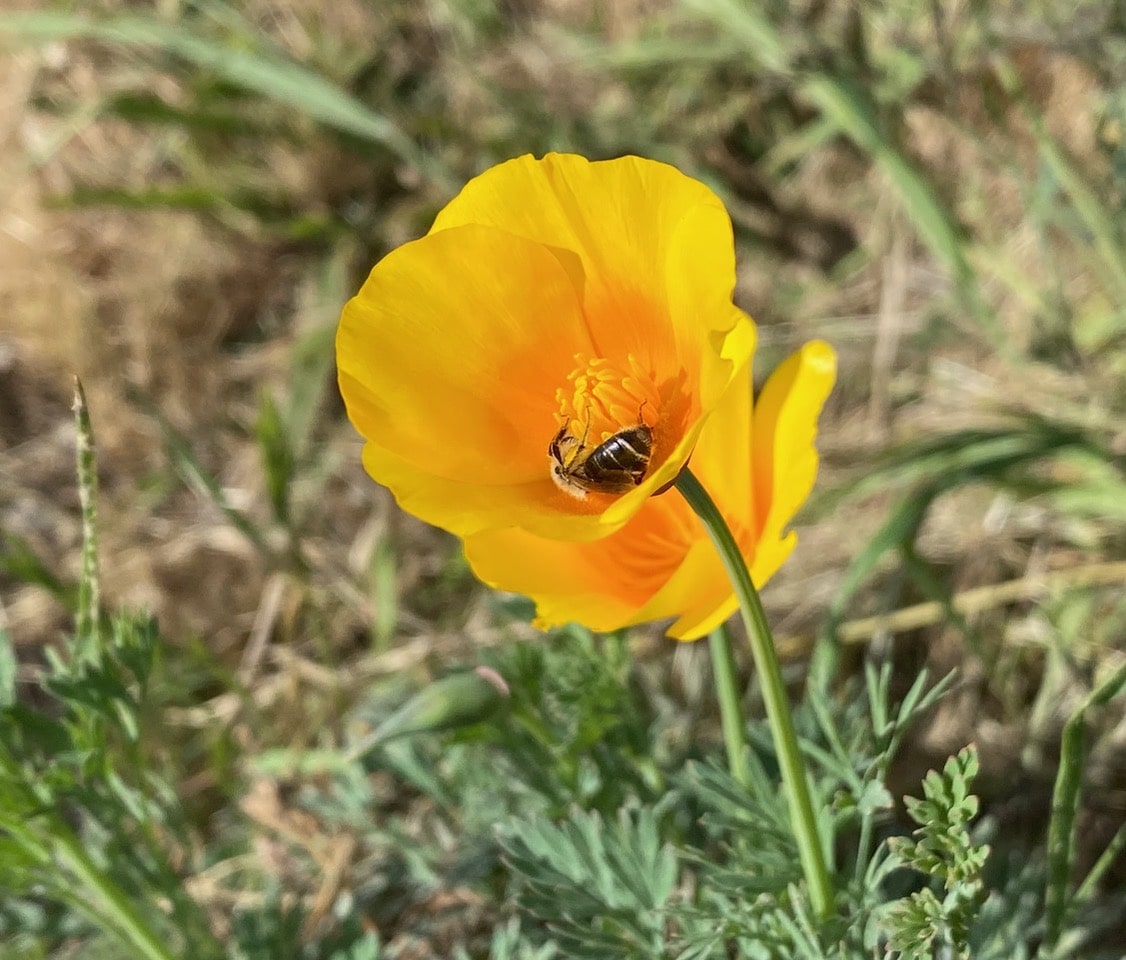
Dozens of these Mining Bees are working this large patch of California Poppy. They are not shy bees. Most are females so focused on their task that they seem oblivious to my presence.
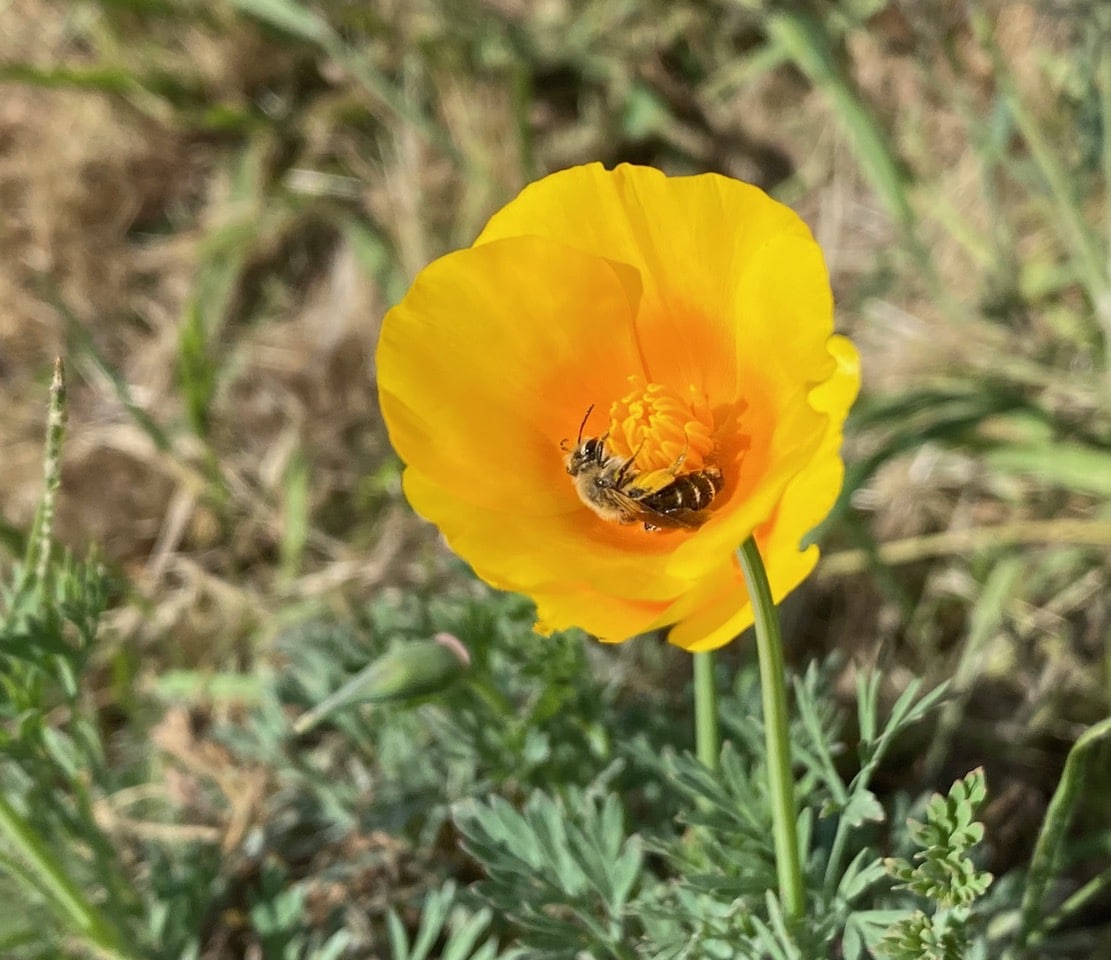
This two-toned flower belongs to the subspecies of California Poppy, Eschscholzia californica ssp. maritima (Coastal California Poppy). The low-growing perennial variant features distinctive two-tone, golden-yellow flowers with deep orange centers and striking, finely cut, blue-gray foliage that creates a dense mat, usually only 4- inches tall.
California Poppy, Eschscholzia californica does not produce nectar. But the flower rewards its pollinators with generous amounts of pollen held in elongate anthers with short filaments, offered in an easily accessible, open, bowl-shaped corolla.


Bees in the family Andrenidae, commonly called miner bees or mining bees, are solitary ground-nesters. Andrenids are fairly small bees, usually dark-colored, and often banded. They are identified by the dense bristles (scopae) at the bases of the legs and the shin-like sections (tibias) of the legs, as well as by certain creases and grooves on the face and head and by unique wing venation. Many Andrenids resemble wasps – slender with long abdomen.
Most andrenids are specialist pollinators whose life cycle is timed to correspond precisely to the blooming of specific flowers. Because of this, andrenids are some of the first bees to emerge in spring, and many are active in March and April, as they visit early spring wildflowers.
All Andrena species share a distinctive facial characteristic: facial depressions called fovea resting alongside the sutures under each antenna. The foveae are covered with hairs that are sometimes described as looking like “sideways eyebrows”. Another distinguishing Andrena trait is that females appear as if they carry pollen under their “armpits”. This is because they have propodeal corbiculae in the space between their thorax and abdomen.
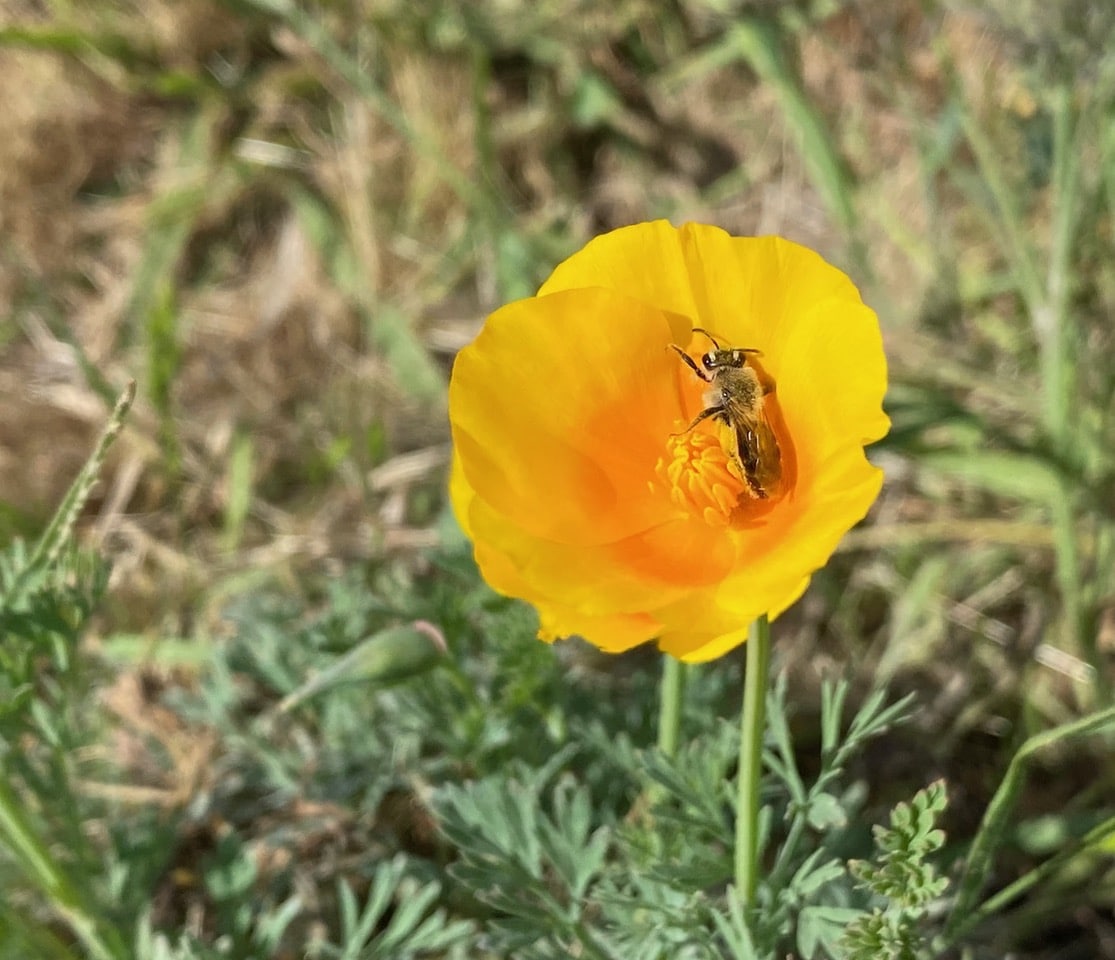
The bee’s facial fovea is highlighted as “sideways eyebrows” in this particular angle. When one wishes to ascertain that a bee is an Andrena, this is the crucial feature to look for.

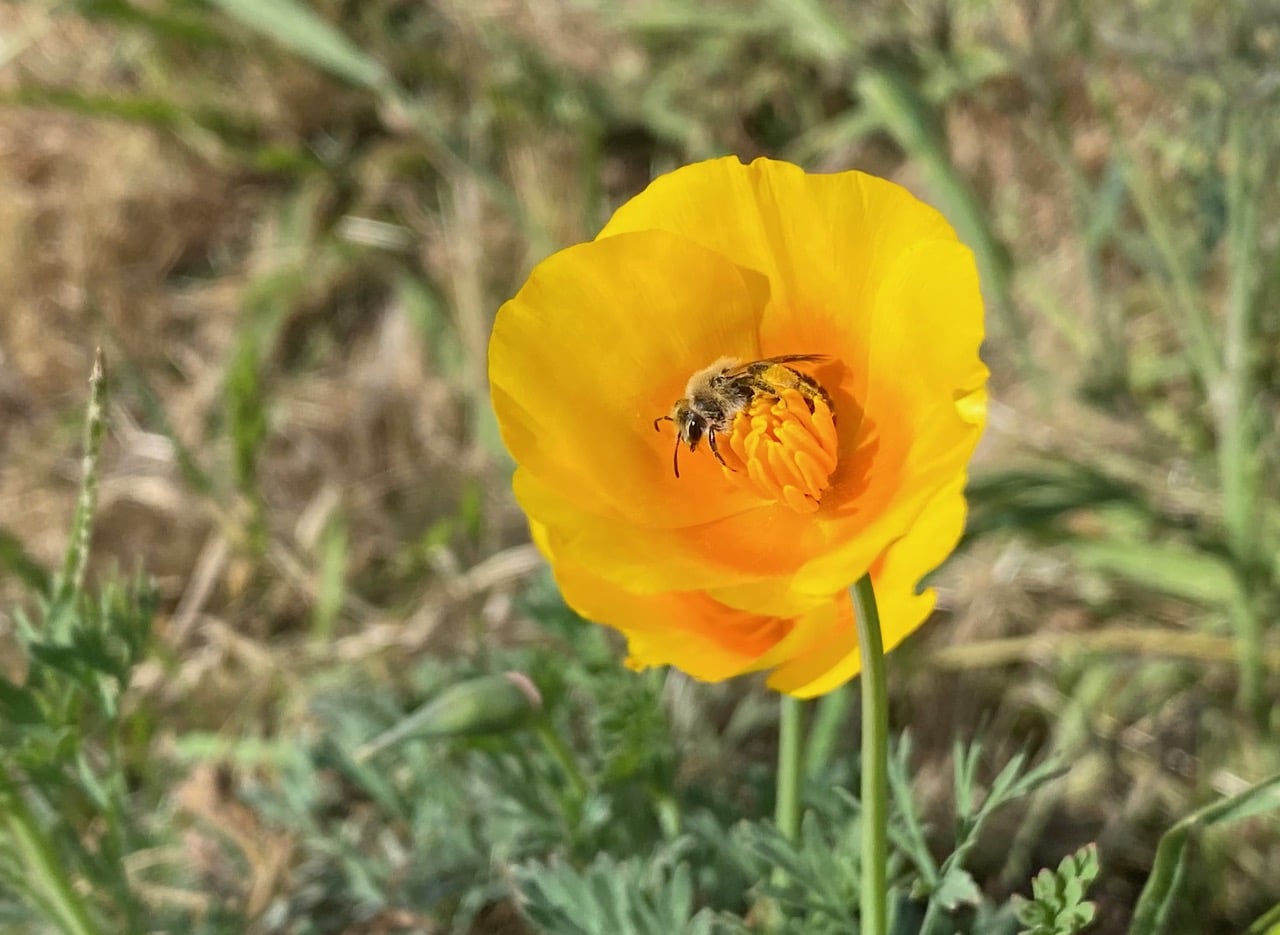
The California Poppy often uses self-pollination, but also relies on insects for cross-pollination to enhance genetic diversity. The species is a pollinator generalist, attractive to a large number of different insects such native bees, beetles, and flies. To help increase their visibility to these pollinators, California Poppy flowers have a large central spot that absorbs ultra-violet (UV) radiation while reflecting the longer wavelengths. Ultraviolet light is not visible to humans. Insects, however, can see the UV pattern, which appears as a dark spot in the center of the flower that contrasts sharply with the UV-reflecting petals around it, guiding the insect to the pollen.
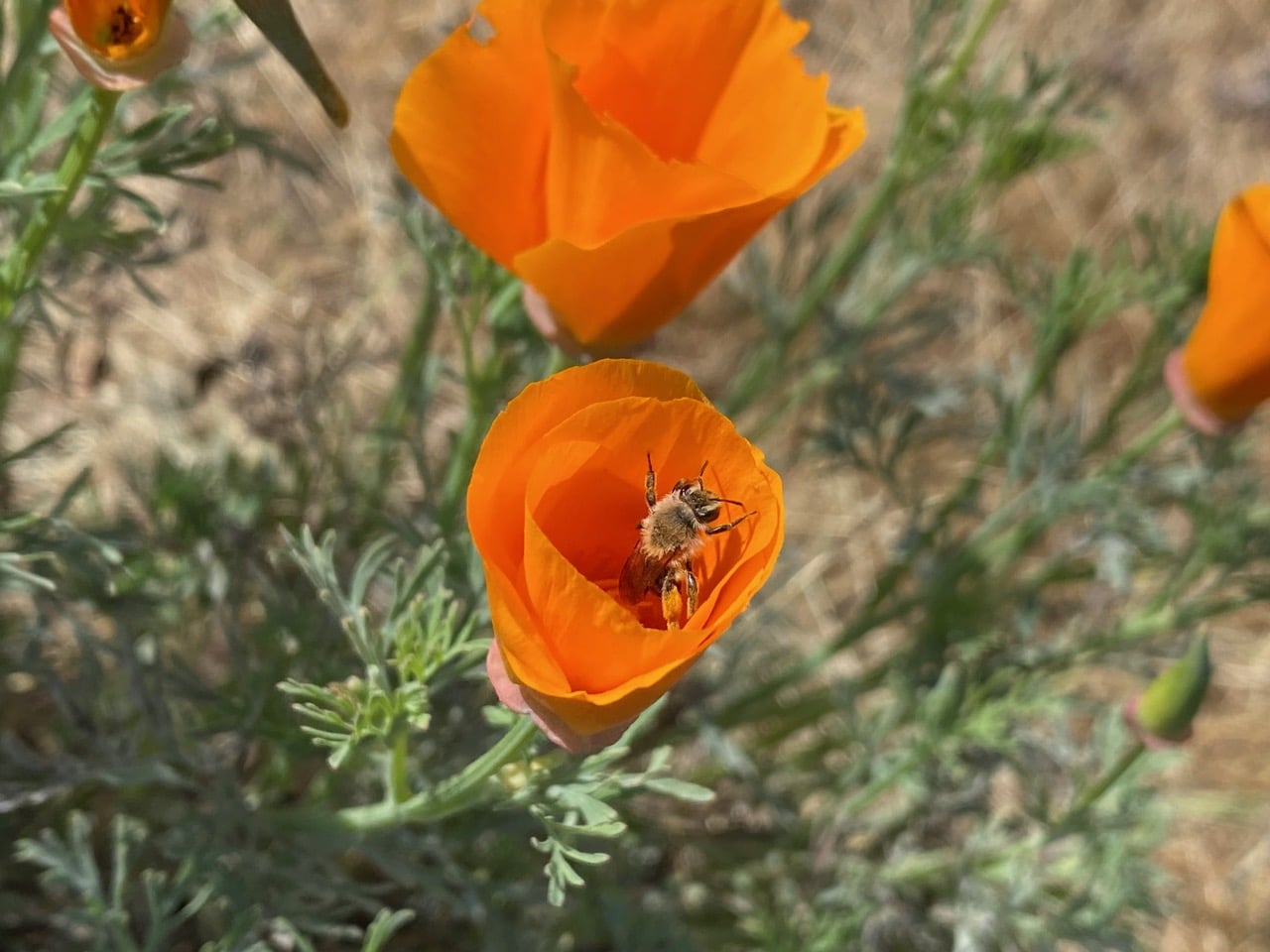
Although it’s a tight fit in these freshly opened flowers, the bees seem to prefer them. First dips to fresh pollen!
Poppy flowers close at night or during cold, cloudy, or rainy weather to protect the pollen, a process known as photonasty. The flowers are highly responsive to light and heat, opening in the morning and closing in the afternoon over the course of their 2-4 day life, before the petals senesce (wilt and drop). Once the petals fall off (senesce), the green capsule remaining in the center continues to grow, developing seeds. While each individual flower has a short lifespan of 2-4 days, the plant itself blooms over a long season (often February to Septembers) as new flowers replace older ones.

On to the next poppy!

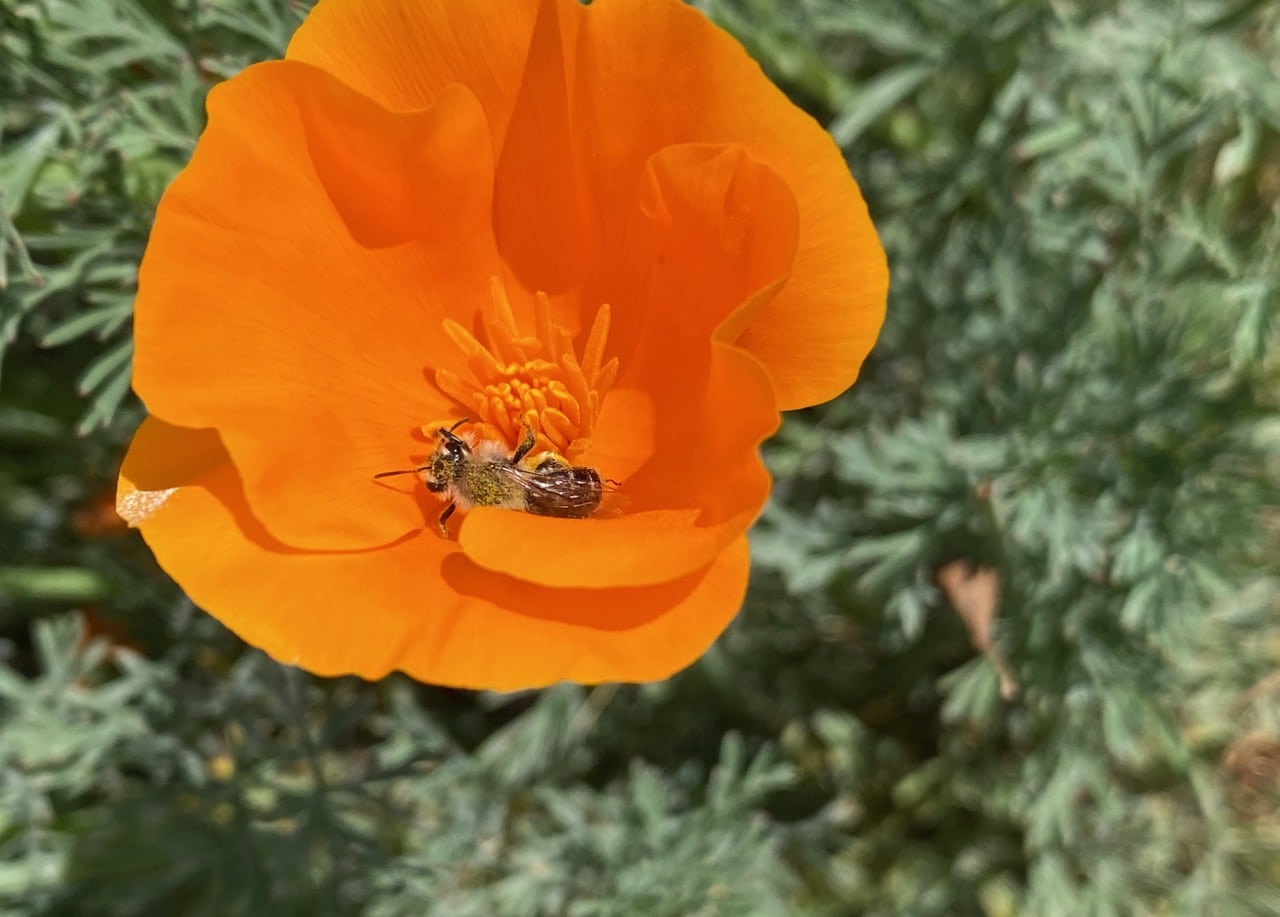
A quick swipe of the right antennae to clean off the pollen.
All bees have an antenna cleaner on each of their two forelegs. The antenna cleaners consists of two parts: a notch in the basitarsus, which is fitted with stiff hairs, and a corresponding spur on the tibia. To clean its antenna, the bee raises its foreleg over its antenna and then flexes it tarsus. The action allows the spur to close the notch, forming a ring around the antenna. The bee pulls each antenna through the bristles to clean it of debris such as pollen or dust which might interfere with the many sensory organs within the antenna. A bee’s antennae serve numerous functions: smell, taste, perceive humidity and temperature, feel, monitor gravity and flight speed and even detect sound waves to help guide the bee in its daily activities.
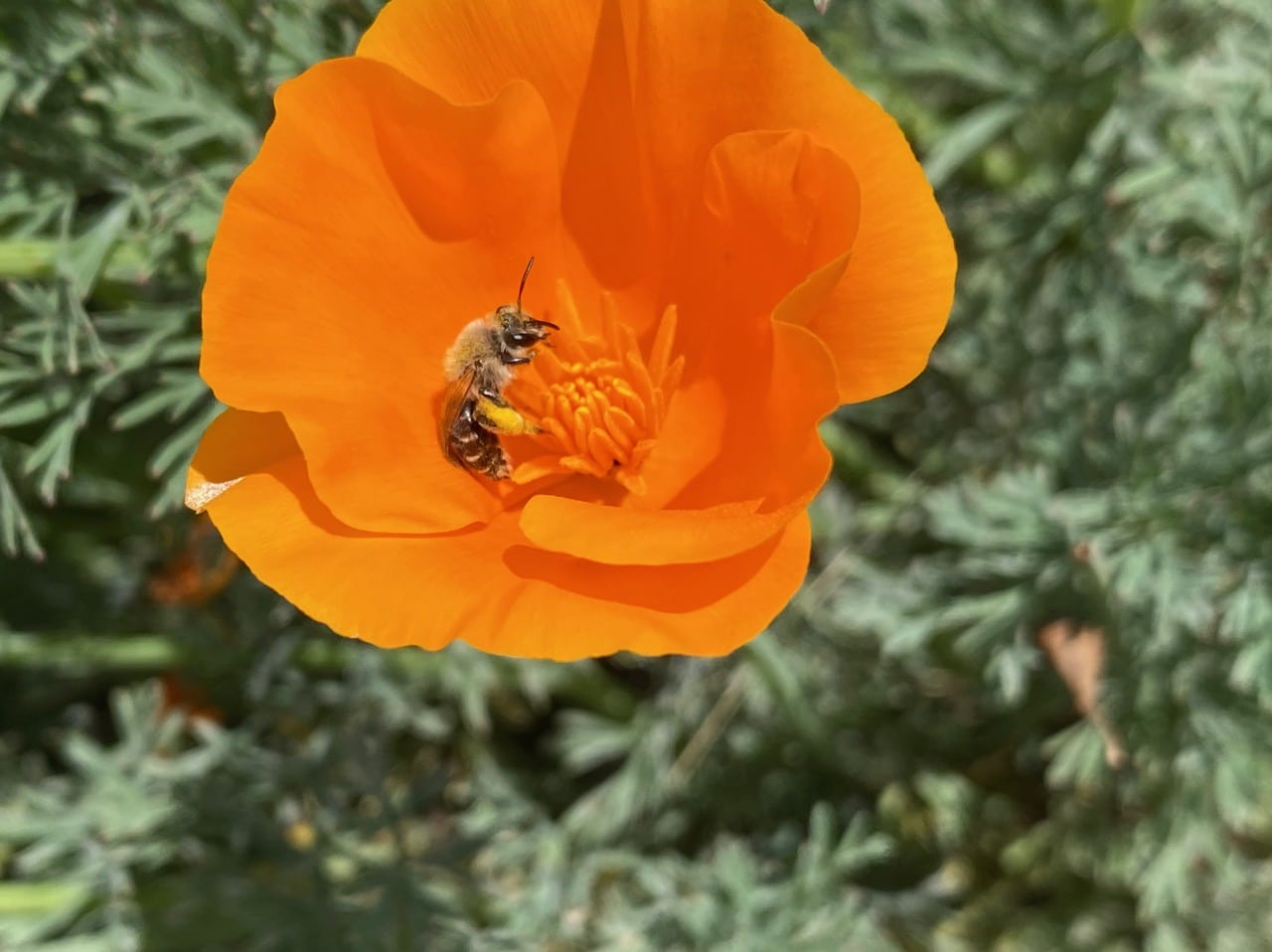
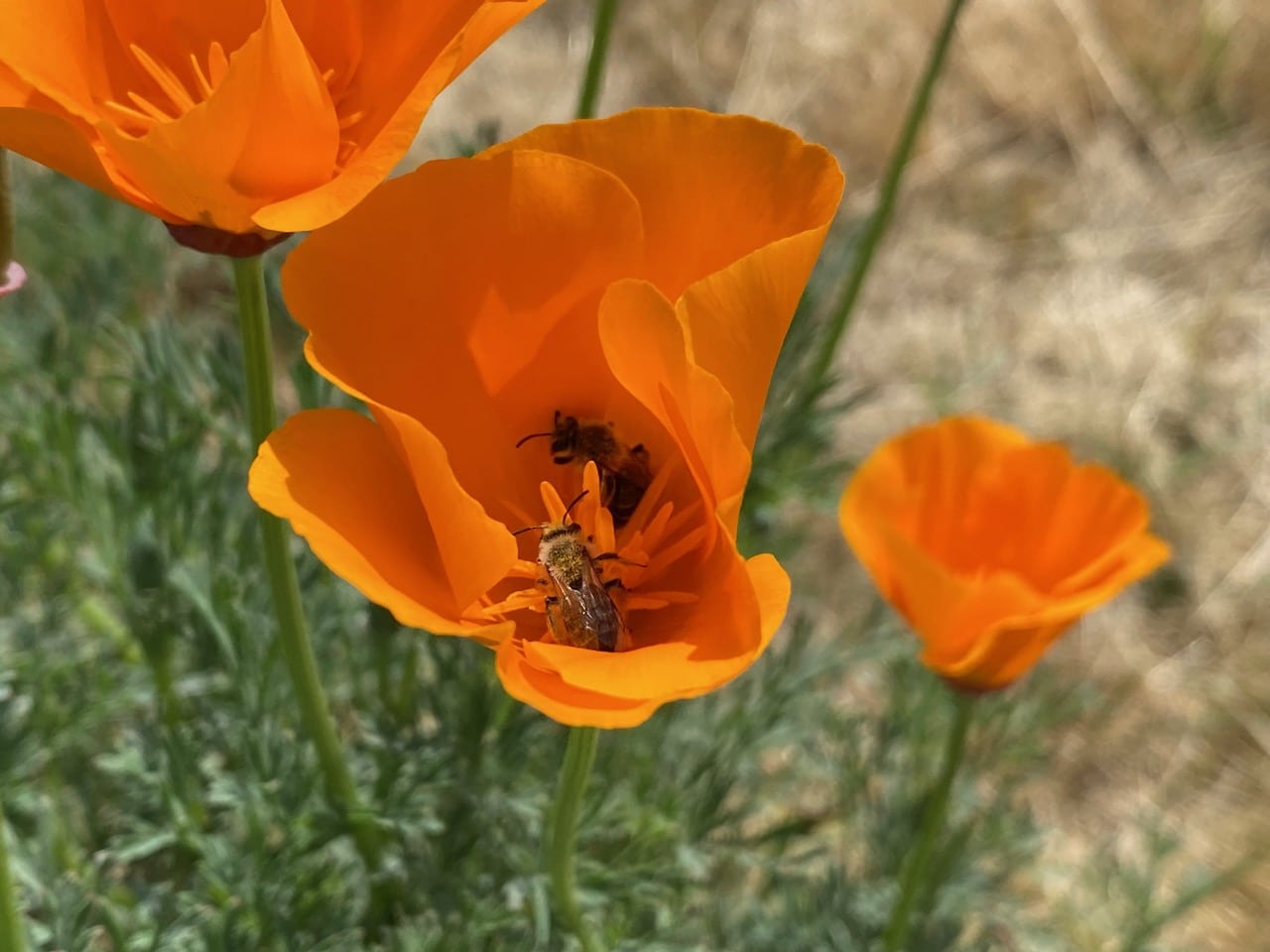
There are so many of these mining bees on the poppies sometimes I find two or three in the same flower!

Whoa, what happened to these flowers? Their petals are shredded. Did some beetles come munching through this patch? It’s interesting that the reproductive structures of the flowers have been left intact.
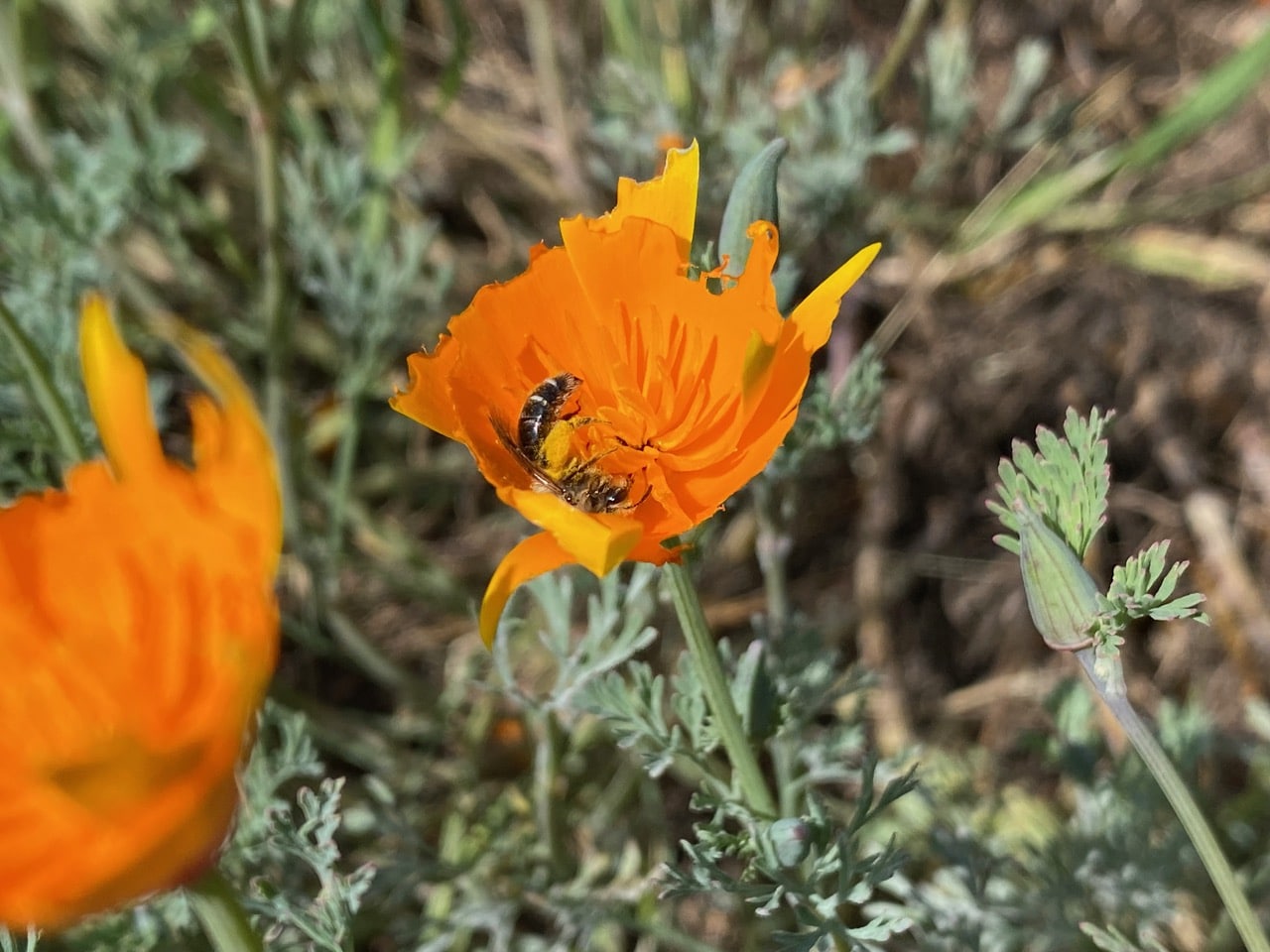
Shredded petals not withstanding, the Andrena females visit the damaged flowers just the same, collecting whatever pollen is left behind. The shortened petals actually give me a better view of the bee’s foraging behavior.
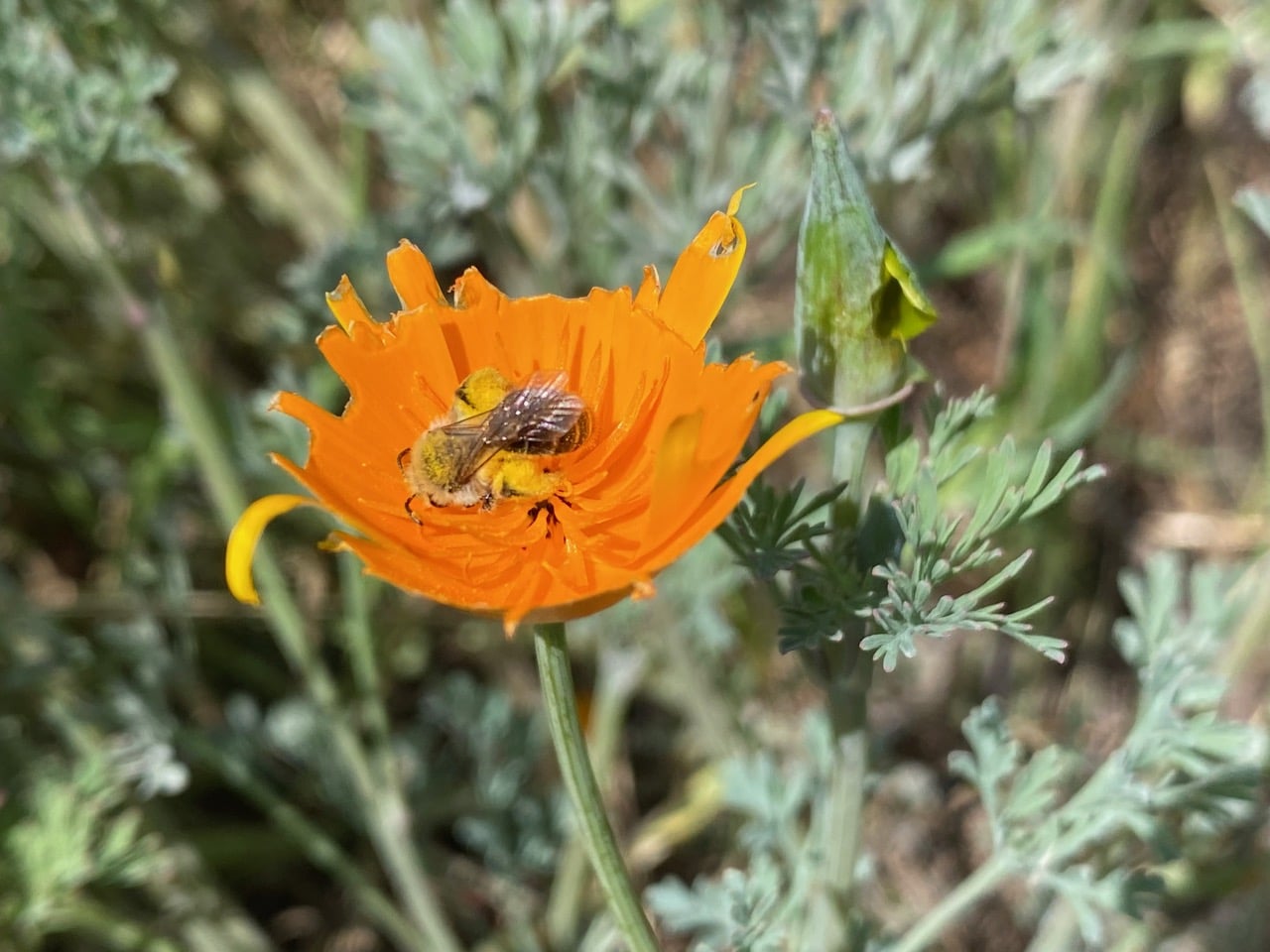
This hardworking Andrena is so loaded with pollen she’s literally bulging on the sides. Note that there’s pollen packed in the area between her thorax and abdomen as well as on her hind legs.
Like many female solitary bees, female Andrena mining bees possess scopae on their hind legs (dense, long scopal hairs for collecting pollen). In addition she also has specialized structures called propodeal corbiculae (“saddle bags”). The long, dense hairs on the sides and back of the propodeum (the first abdominal segment attached to the thorax) acts as a “pollen basket”, often referred to as propodeal corbiculae. These hairy areas, combined with the pollen they collect, often make the bees look like they have pollen packed in their “armpits”. While many female bees from other taxa have leg scopae, female Andrena are characterized by having both the leg scopae and propodeal corbiculae.

Here’s another glimpse of the full propodeal corbicula, in the area between the thorax and abdomen.
It’s such a joy to watch these bees on the poppy flowers – I can stay here all day! Before I have to leave, I record the bees’ foraging behavior on video: