

Pollinator Post 3/25/23 (1)
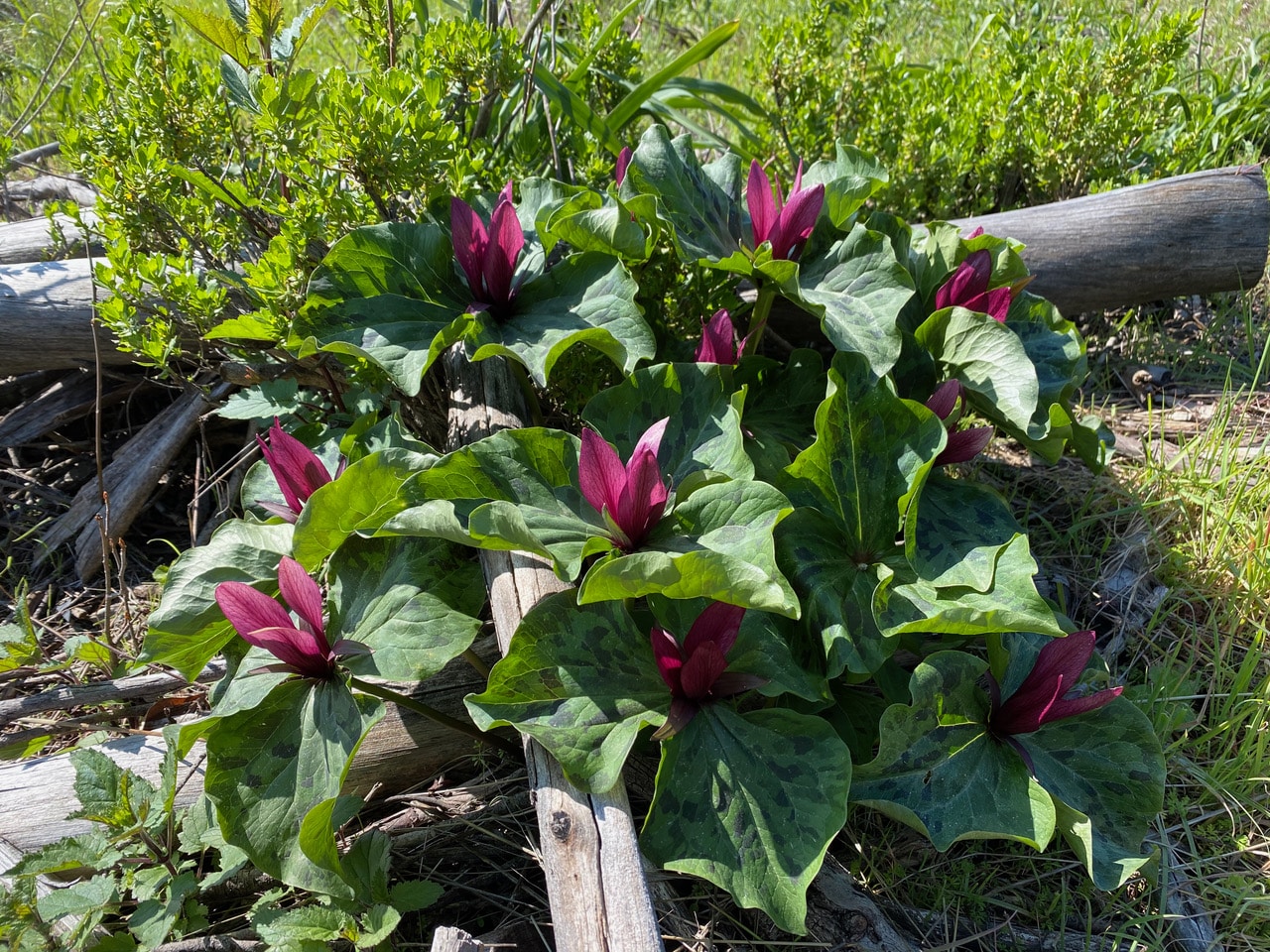
It must be Trilium time! Best to explore the Skyline Gardens from the Stream Train entrance.
A prolific patch of the Giant Trillium, Trillium chloropetalum greets me near the entrance. Interestingly the plants occupy a log pile in full sun, rather unusual for the shade-loving Trilliums.
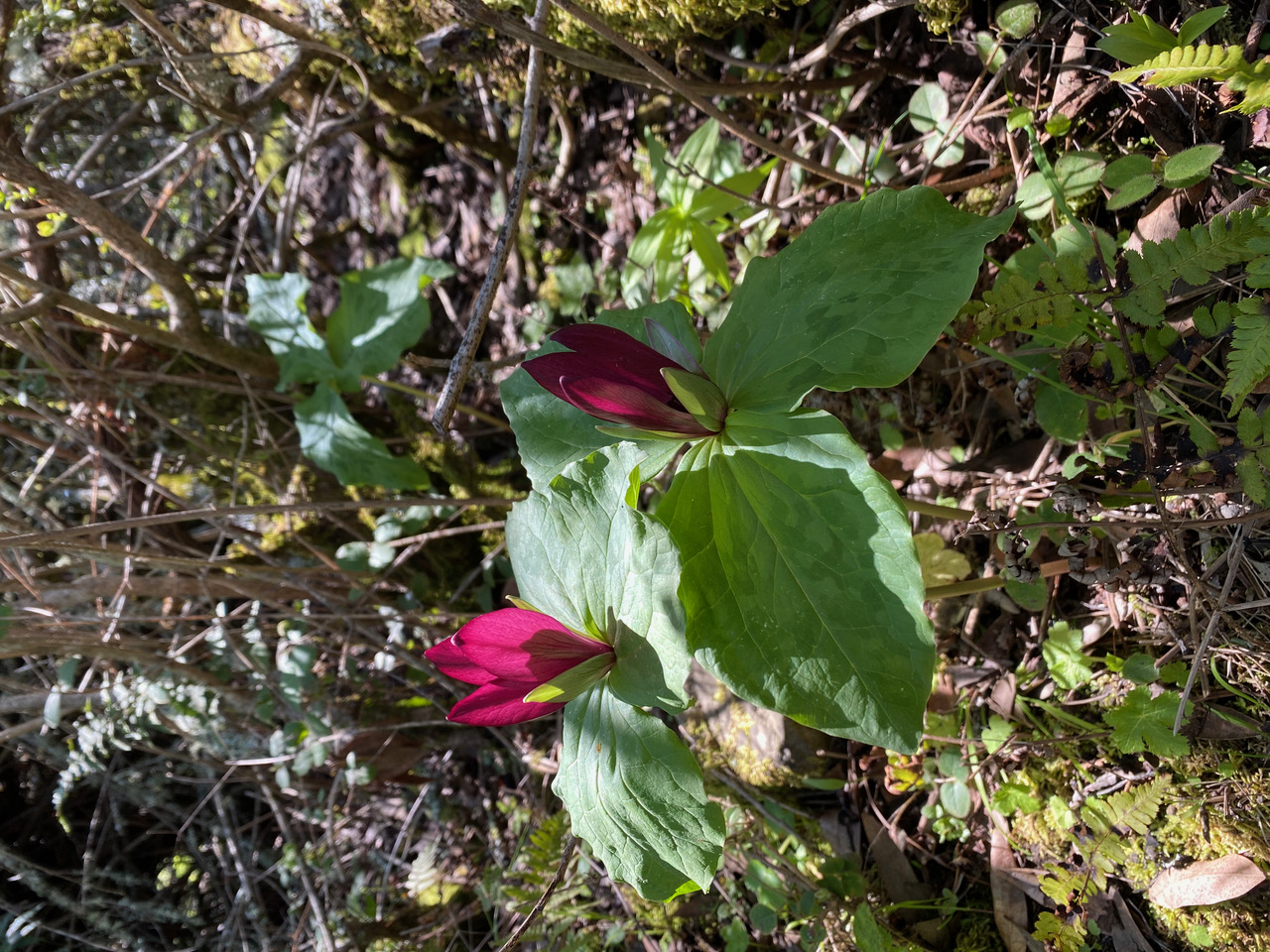
Along the section of Skyline Trail that winds through a woodland, Giant Trilliums dot the landscape in dappled shade. Starting with a single stalk, this clump-forming trillium can eventually bear several 12-24 in. stems. The ultimate minimalist, Trilliums take three-part symmetry to the extreme, hence the genus name. Leaves, in whorls of three are often mottled in dark blotches. Large, showy, solitary, three-parted flowers rise directly out of the leaves. This trillium is considered “not commercially viable” as it takes as long as 5 years to produce plants of flowering size.

Color varies from dark purplish red….
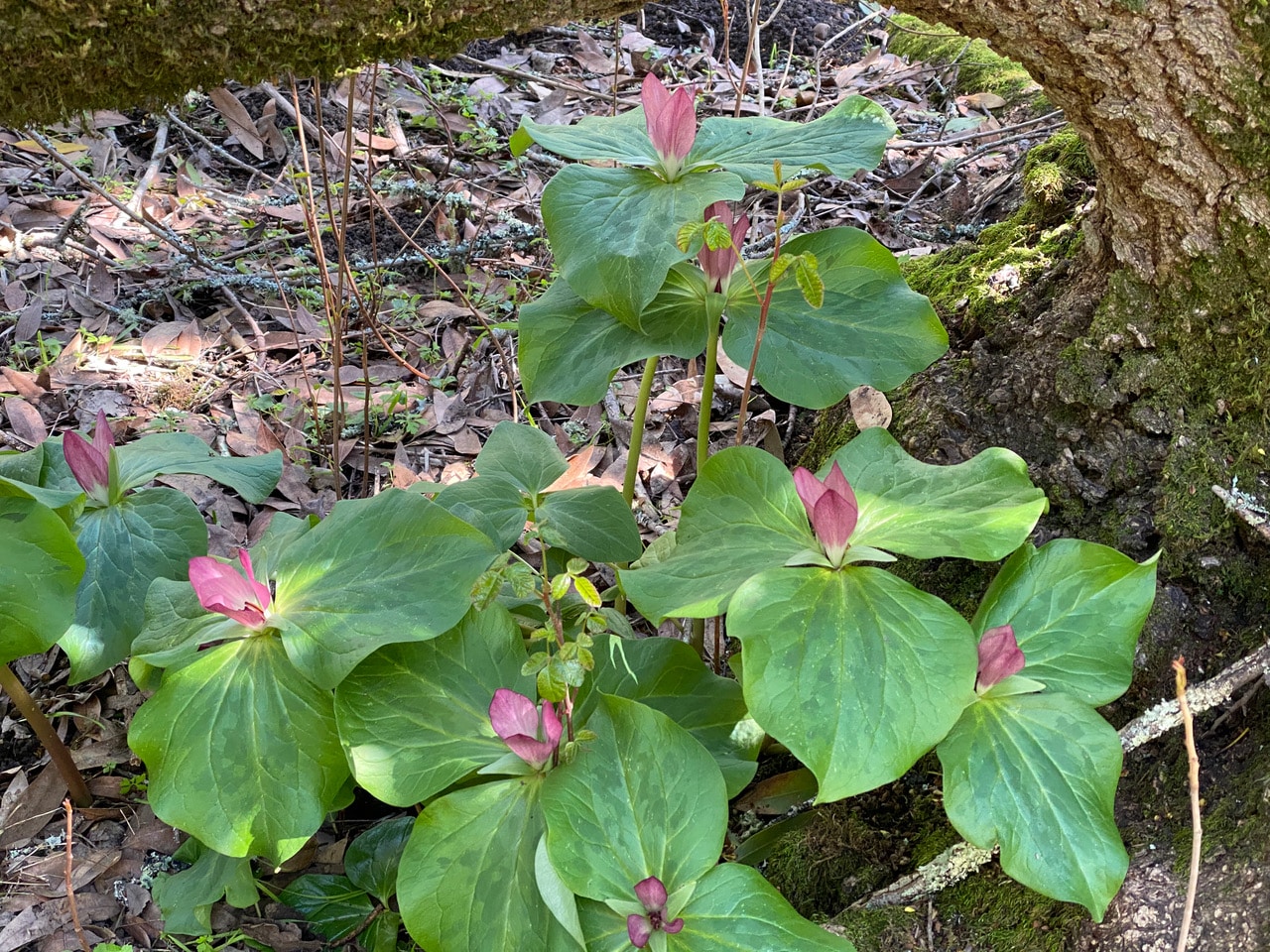
… through pale pink.
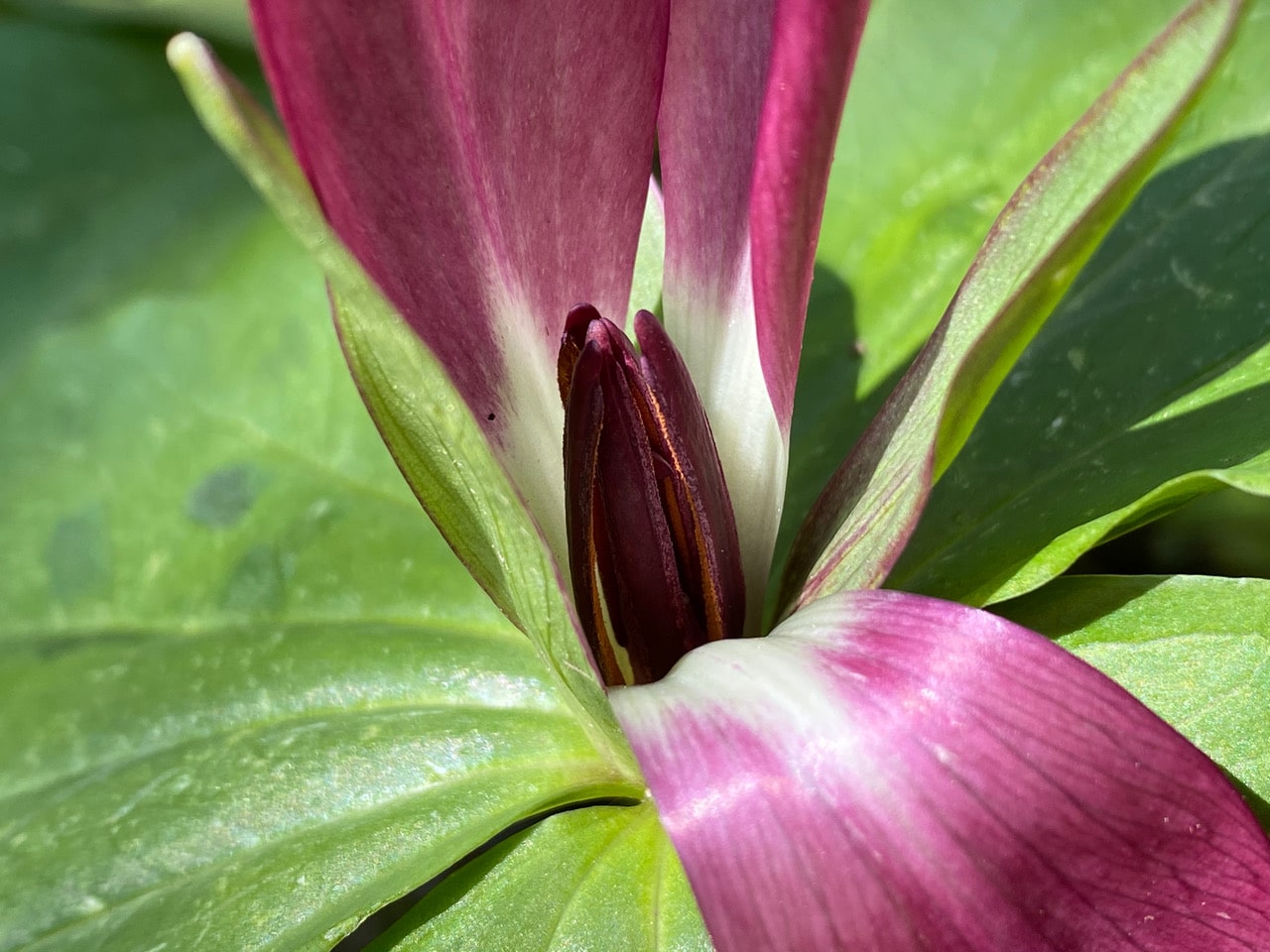
I part a petal for a peek at the trillium’s reproductive parts. Long, sturdy stamens stand erect surrounding the pistil in the center.
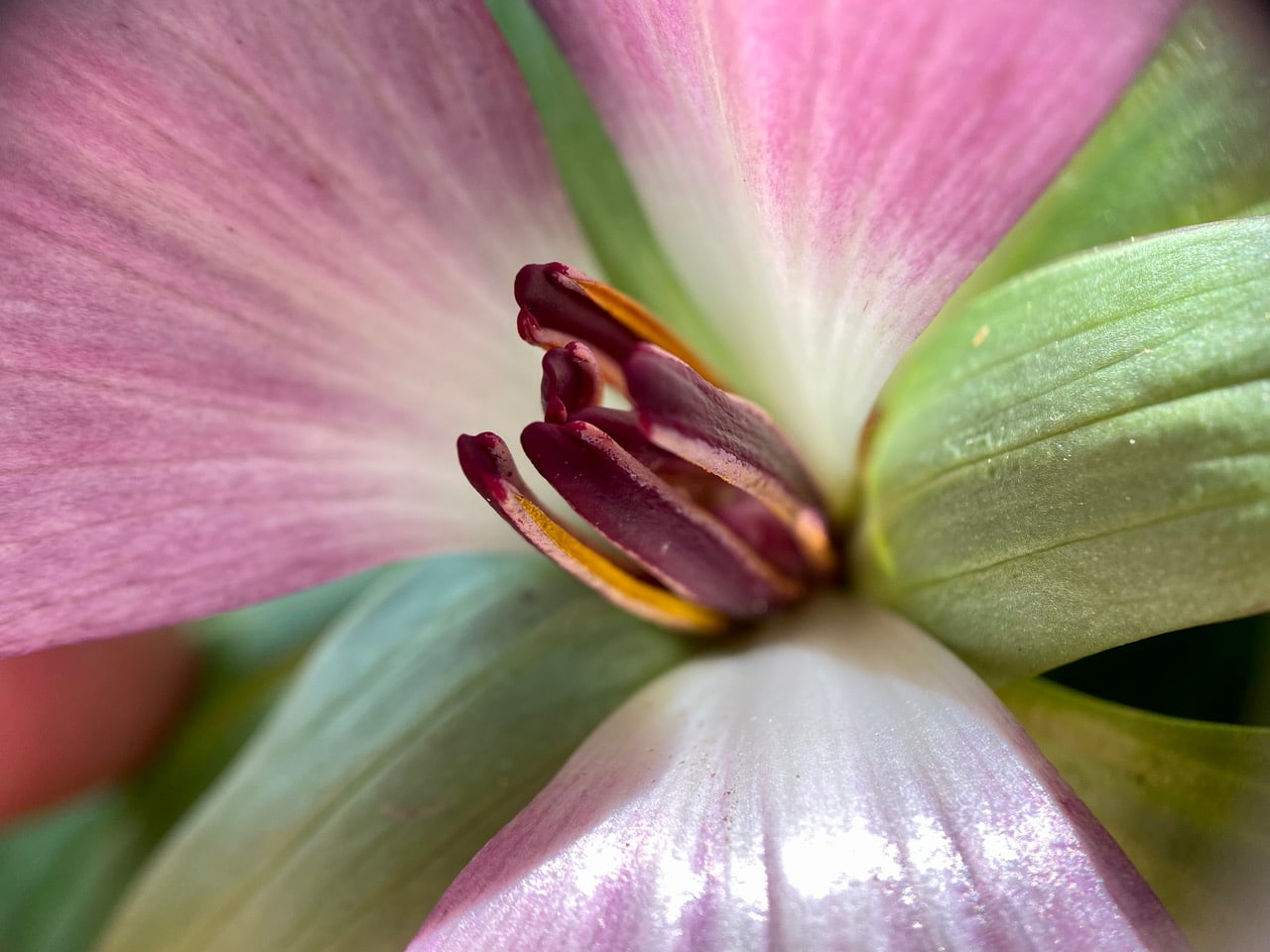
As the flower matures, the anthers separate, revealing a strip of pollen along the edges of each anther.
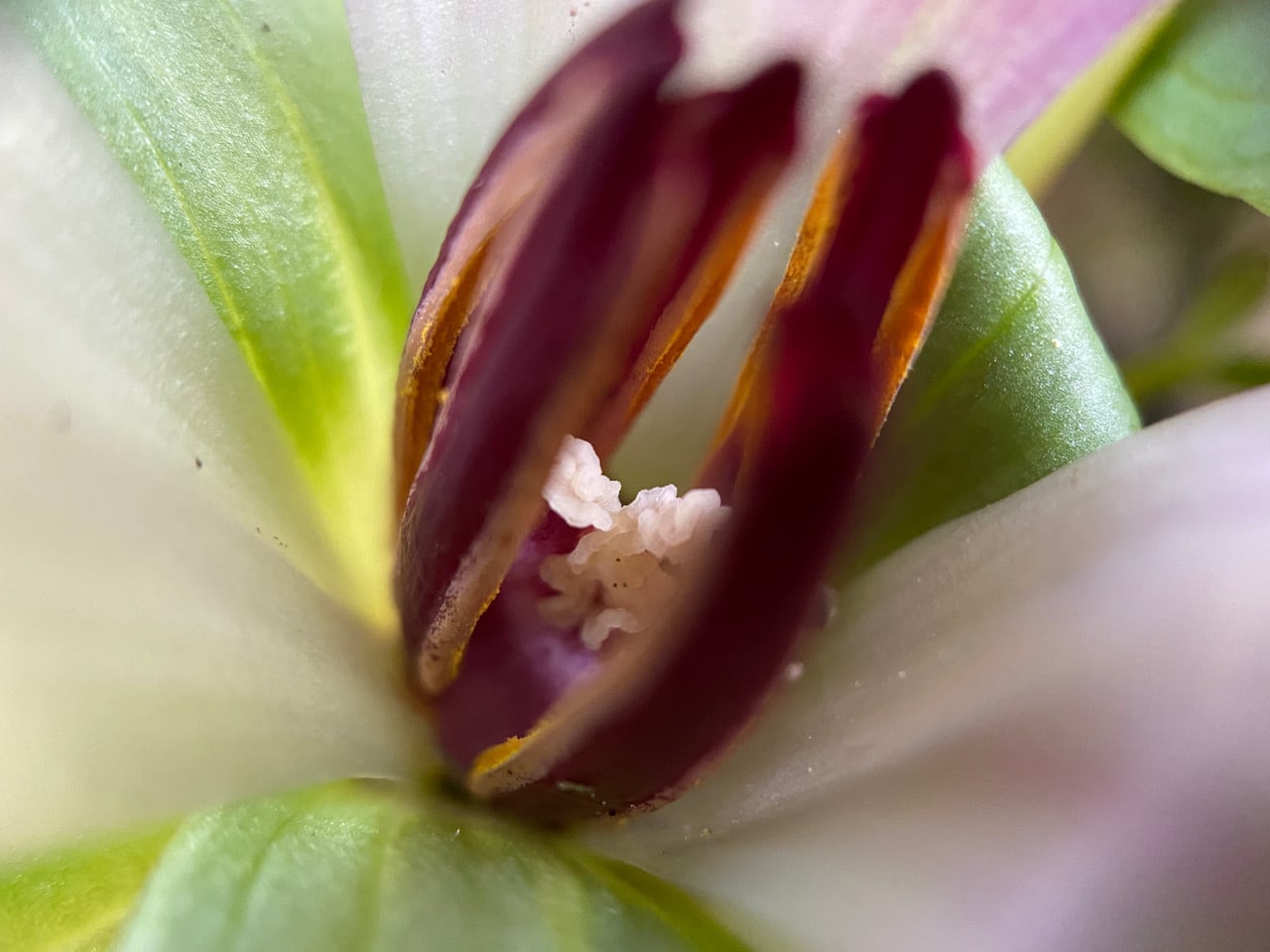
Within the protective cage formed by the six anthers lies a white, convoluted, and wrinkled pistil. I have never seen an insect visit these magnificent flowers. It would be exciting to find out how the flowers are pollinated.

I pause to check on the female Osoberry, Oemleria cerasiformis. The petals are fading, but fruit development has not progressed at all.
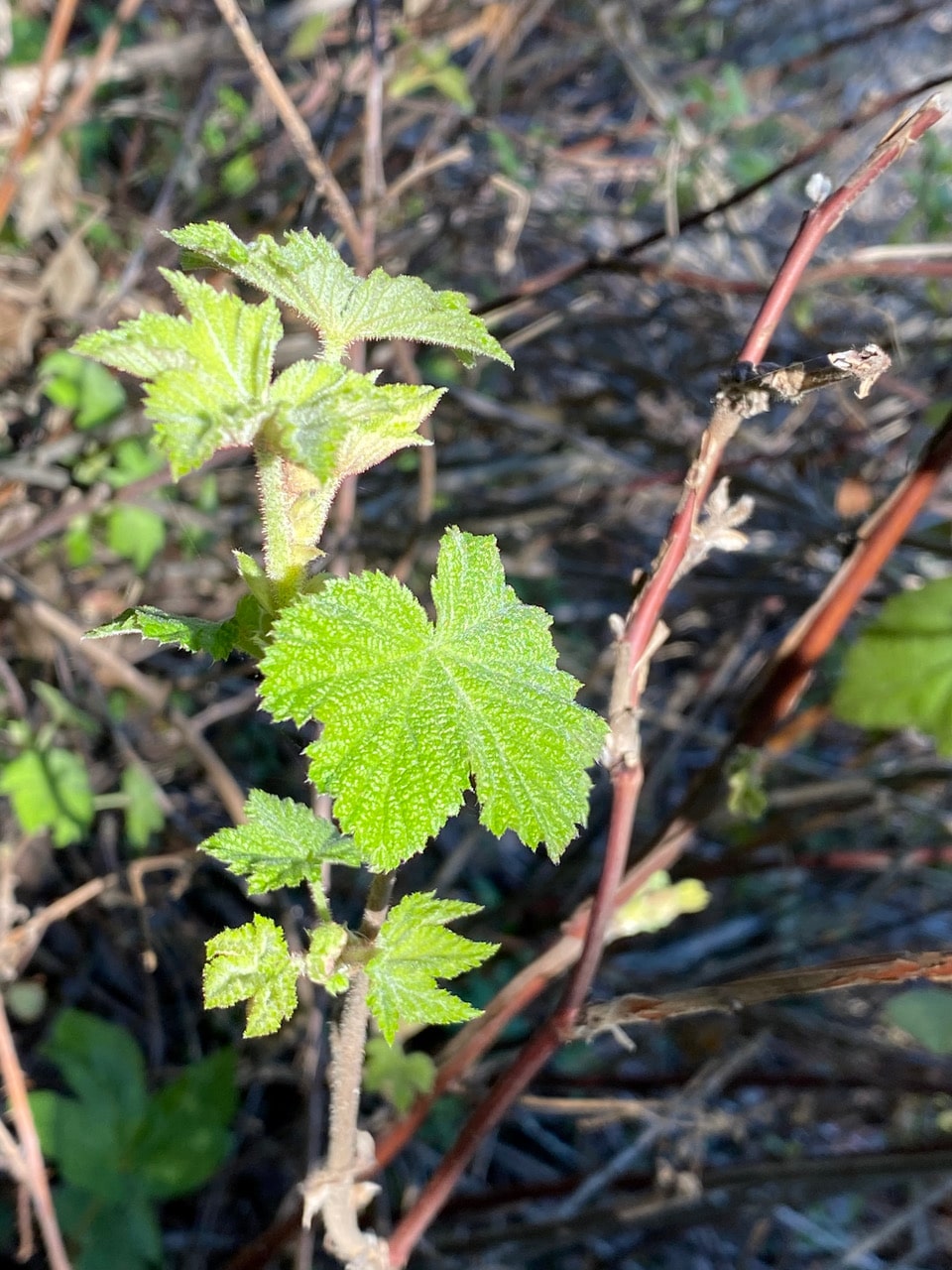
The Thimbleberry, Rubus parviflorus along the trail is leafing out beautifully from its bare branches.

I scramble down the slope at Siesta Nose to take pictures of some blooming Blue Dicks, Dipterostemon capitatus.
Blue Dicks are perennials from an underground corm (a modified stem) that produces a few grass-like leaves. Flowers are borne in dense, almost spherical heads at the ens of long, leafless, purplish stems. The flower head consists of six to many flowers of differing ages. Sepals and petals are indistinguishable, together called tepals. Each flower consists of six tepals, fused at the base and opening into a short bell shape.
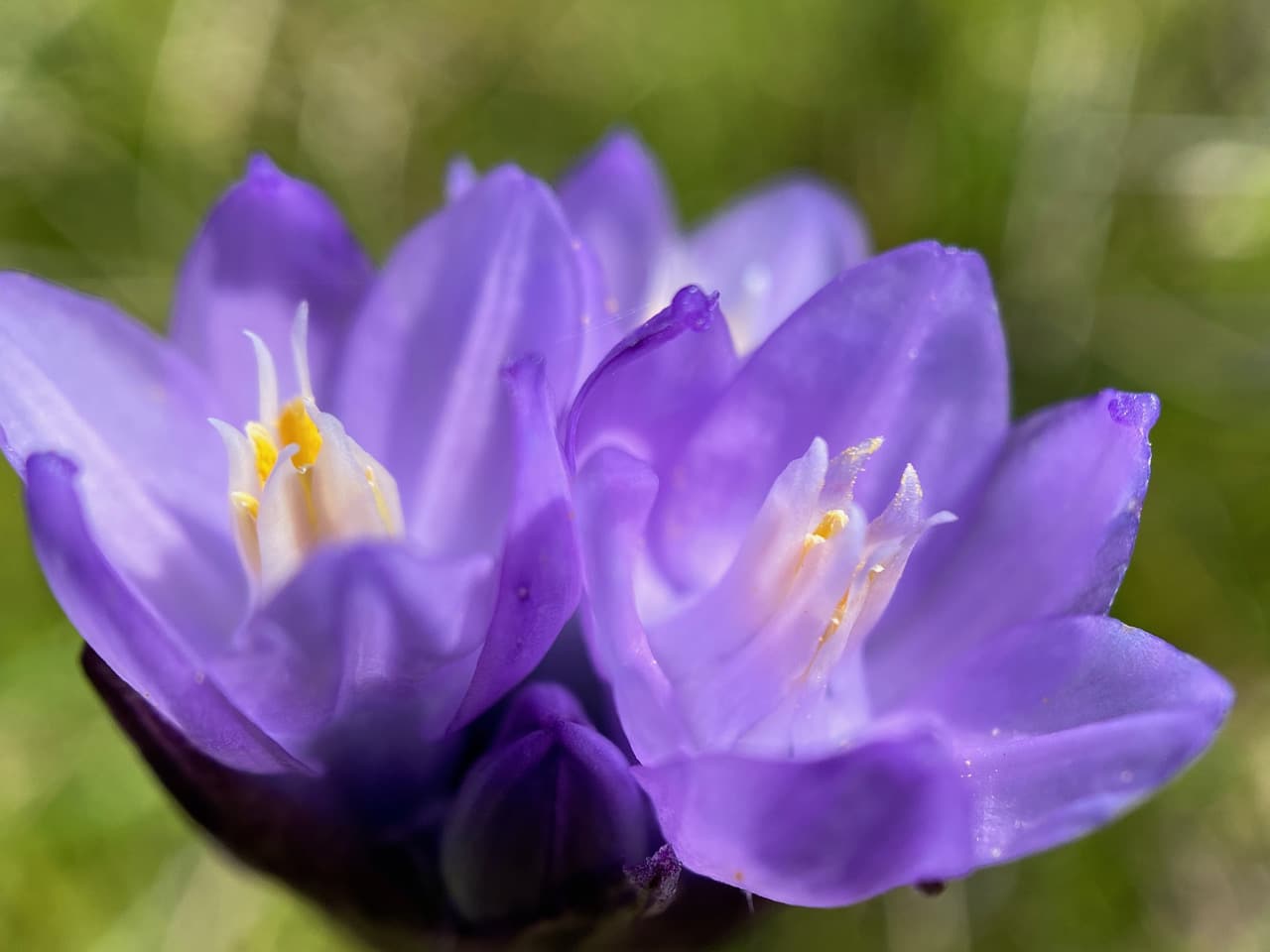
There are six stamens in two series of unequal sizes. The inner, shorter stamens each produce a pair of whitish appendages that form a small but conspicuous notched wall around all stamens.

The anthers are bright yellow and produce sticky yellow pollen. The inconspicuous pistil is just shorter than the anthers and consists of a three-chambered superior green ovary, a three-sided style and a three-crested stigma.
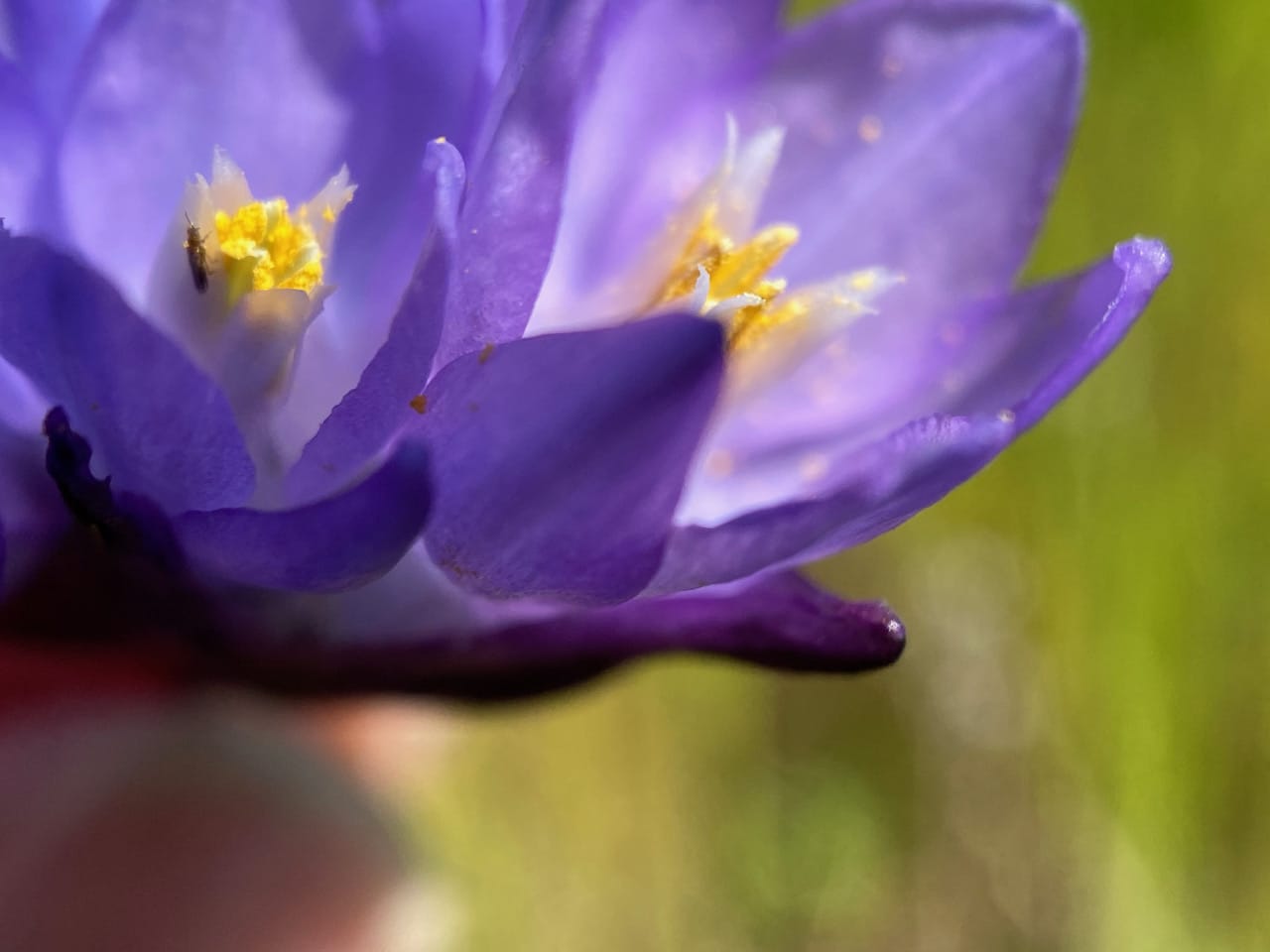
As I tilt the flower head for better light, many tiny insects appear from the stamens and crawl away. Thrips!

Thrips (order Thysanoptera) are minute (mostly 1 mm long or less), slender insects with fringed wings and unique asymmetrical mouthparts. They feed mostly on plants by puncturing and sucking up the contents, although a few are predators. Some flower-feeding thrips pollinate the flowers they are feeding on, and some scientists believe that they may have been among the first insects to evolve a pollinating relationship with their host plants. A genus is notable for being the specialist pollinator of cycads. Thrips are likewise the primary pollinators of heathers in the family Ericaceae, and play a significant role in the pollination of pointleaf manzanita. Electron microscopy has shown thrips carrying pollen grains adhering to their backs, and their fringed wings are perfectly capable of allowing them to fly from plant to plant.
BTW, there’s no such thing as a “thrip”. It’s always “thrips”, singular or plural!
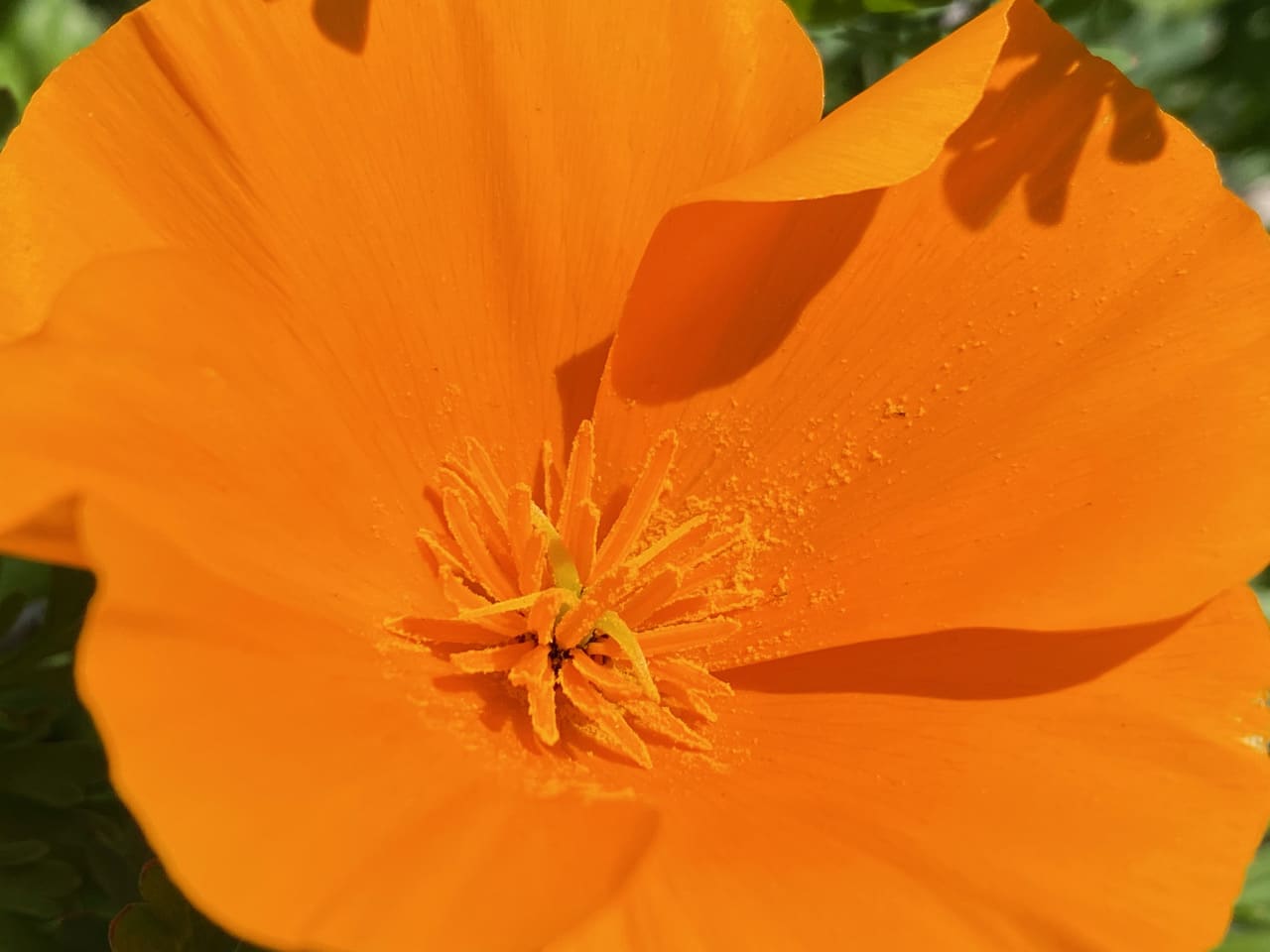
Back at the Steam Train entrance I stop to admire the California Poppies, Eschscholzia californica. These sun-loving plants have had little opportunity to open their flowers during our rainy weather and overcast skies.
There are numerous stamens, usually 20 or more. The long anthers are yellow-orange and clustered in the center, and are the most conspicuous part of the simple, 4-petal, open-faced flower. There is a pistil consisting of a yellow 4-lobed style above a small green ovary in the center of the flower. Poppy flowers do not produce nectar, but the abundance of pollen attract a variety of pollinators, especially bees. While the whole flower appears orange to us in visible light, California Poppy anthers fluoresce bright blue in UV light. These will be obvious to bees whose vision is optimized in the UV spectrum. The flowers guide the bees to the pollen rewards.

Someone has been munching on this California Poppy, demolishing a couple of petals, and exposing the filaments at the base of the flower. The yellow-orange filaments have a dark purplish band just above the midpoint. To the unaided eye, they appear like tiny beetles at the flower center. The anthers are orange and are generally longer than the filaments.
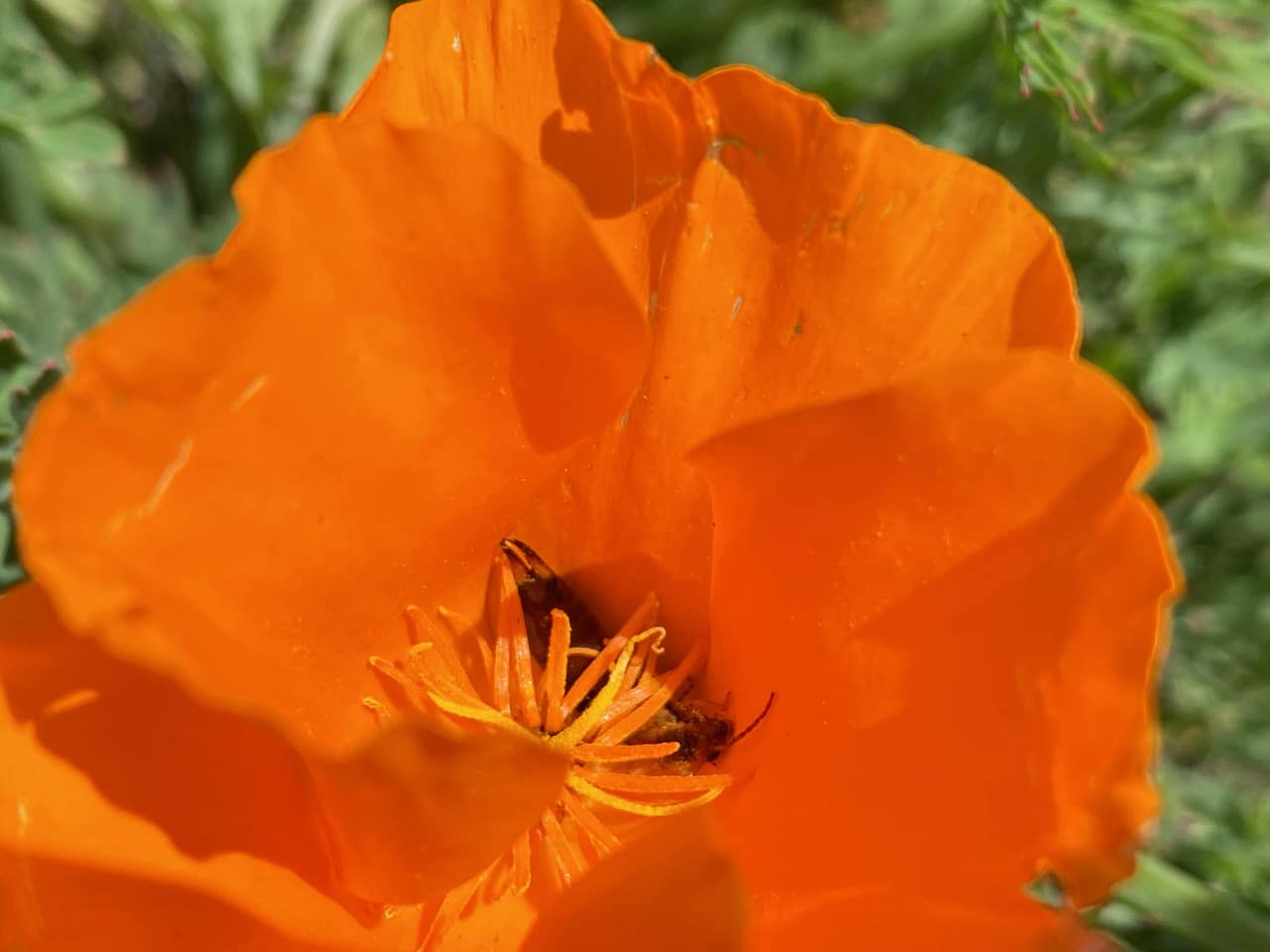
Hey, someone is hiding under the anthers of this poppy flower! Judging from the pair of cerci at its rear end, I surmise that it is an Earwig.
Earwigs are insects in the very small order of Dermaptera. They are easily recognized by their characteristic cerci, a pair of forceps-like pincers on their abdomen, and membranous wings folded underneath short, rarely used forewings, hence the scientific order name, “skin wings”. Earwigs are mostly nocturnal and often hide in small, moist crevices during the day. They are mostly scavengers, but some are omnivorous or predatory. The abdomen of the earwig is flexible and muscular. It is capable of maneuvering as well as opening and closing the forceps. The forceps function to hold prey, and in copulation.

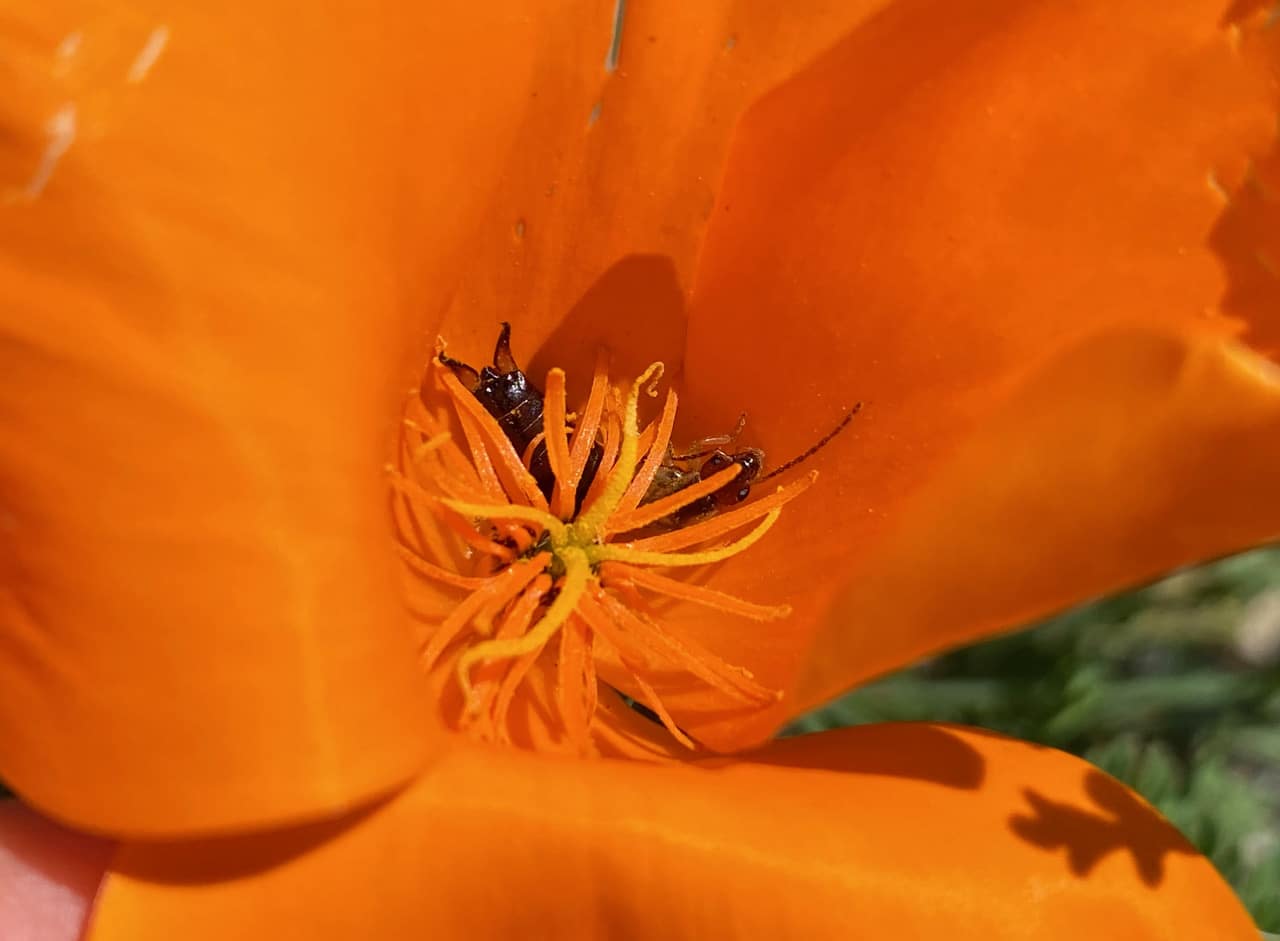
I pull back a petal to get a better look at the Earwig. It is a female, as evidenced by the small size of its cerci. Alarmed, the insect parts its cerci in readiness to defend itself.