

Pollinator Post 3/24/25 (2)
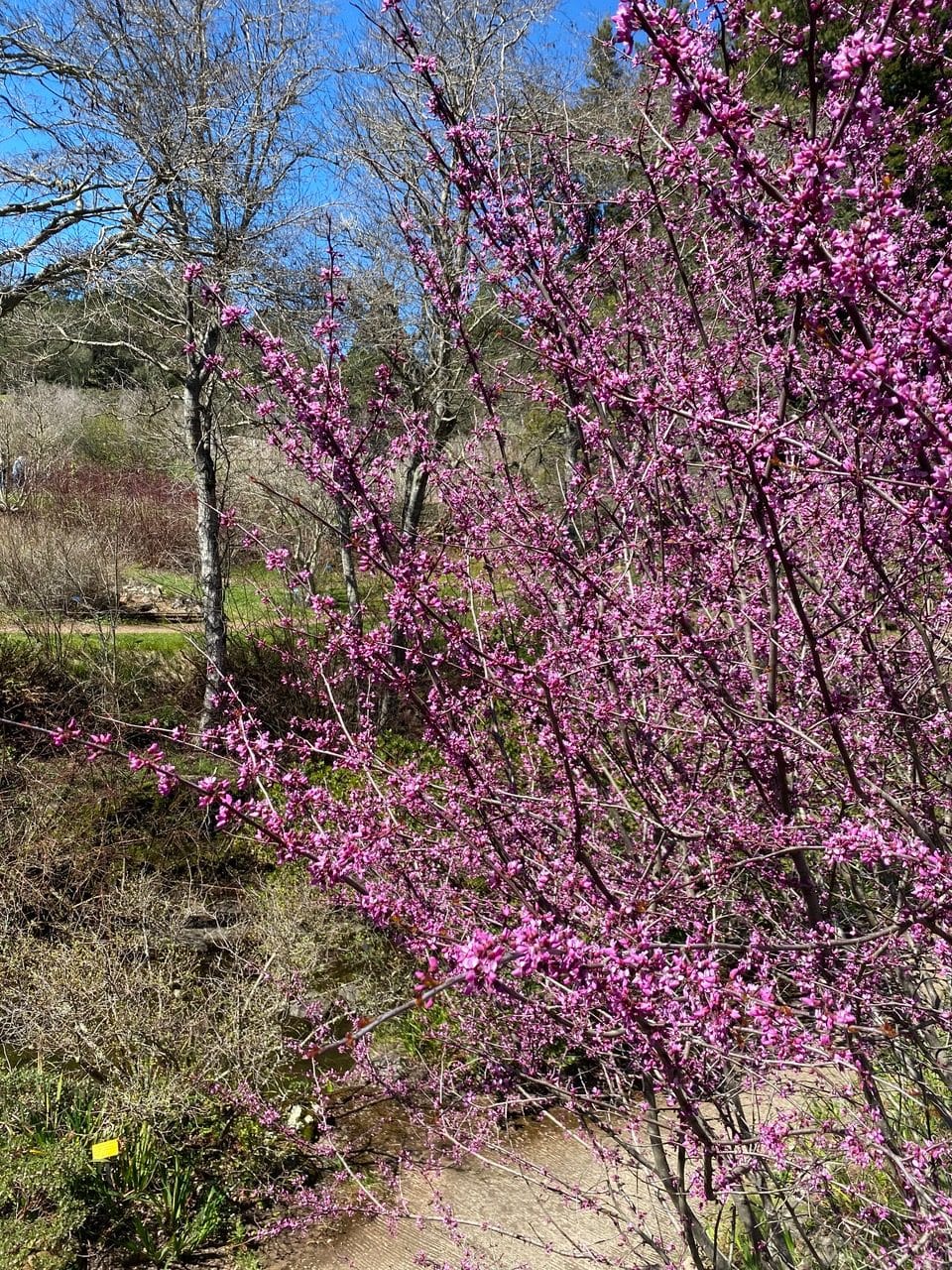
I hesitate to post these pictures, and apologize for their poor quality. It’s almost noon when I approach the Western Redbud in the garden. Temperature has reached an unseasonable 80 F, and my overheated camera is malfunctioning – it either does not work at all, or takes very dim pictures when it does. I have to take long breaks between photos. This has happened several times in the summer last year, but I haven’t anticipated the problem today.
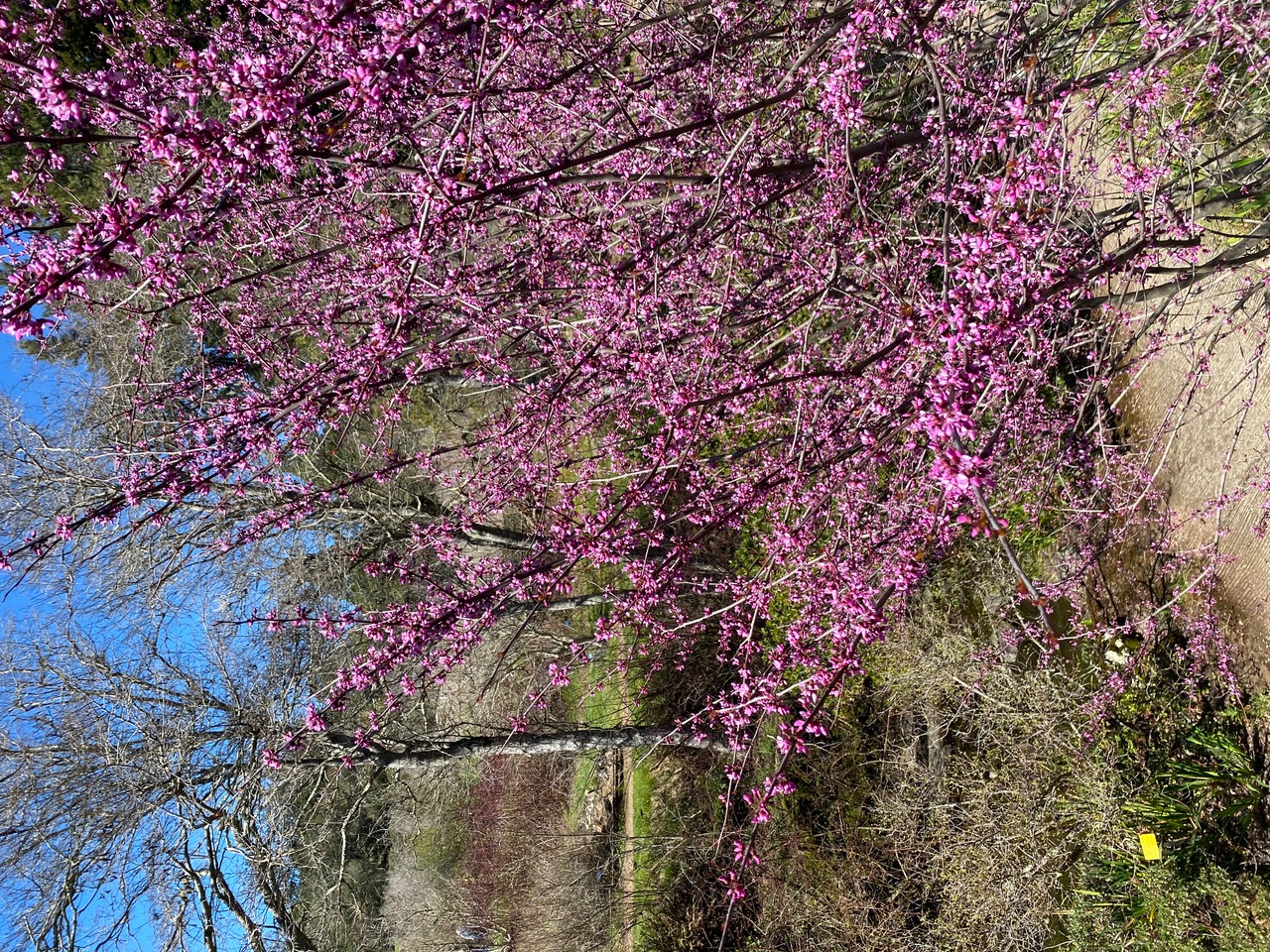
The gloriously blooming Western Redbud, Cercis occidentalis is abuzz with bees! I position myself on the upper trail next to the large shrub where I can look right into the branches.
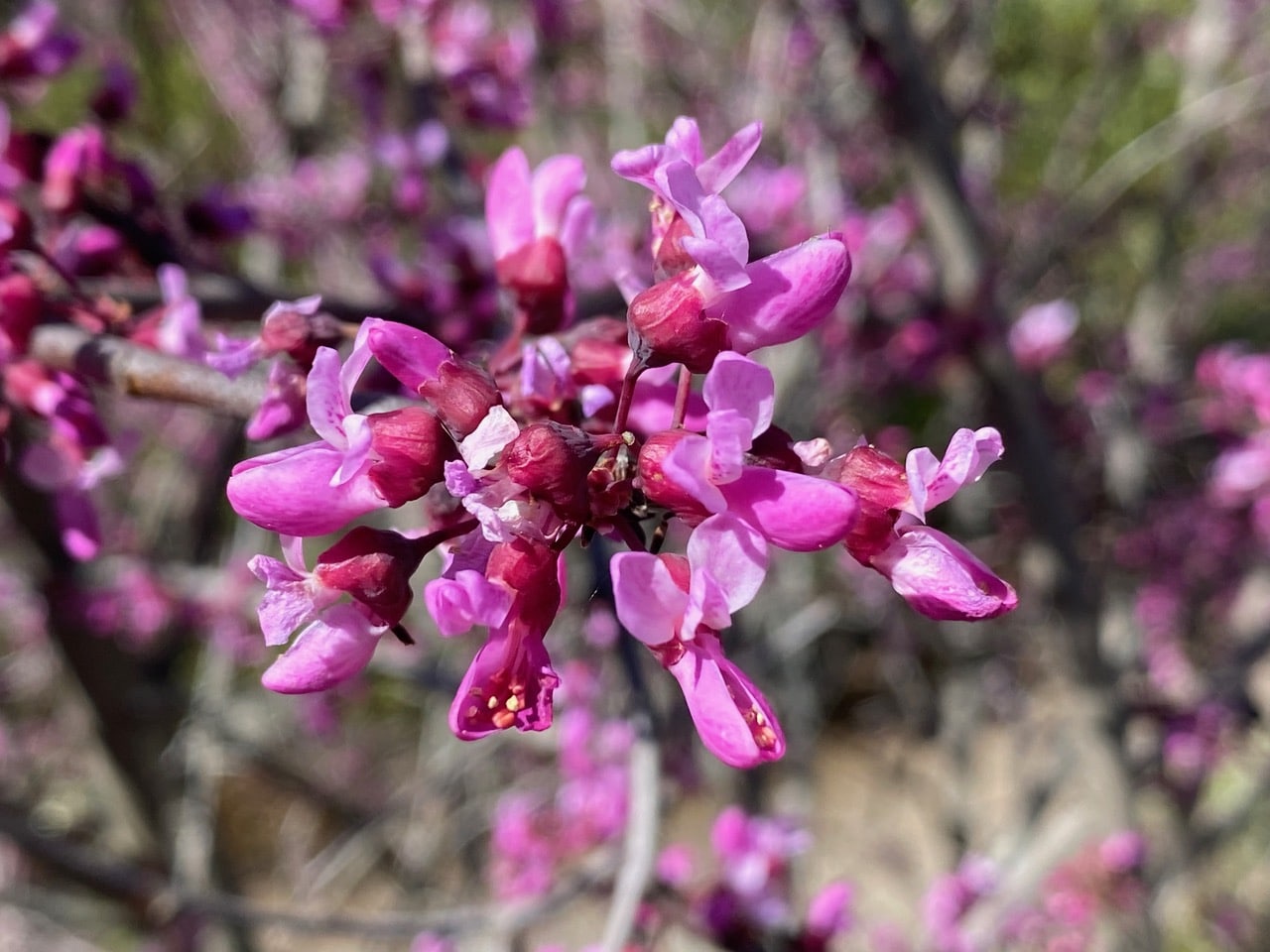
The Western Redbud, Cercis occidentalis (family Fabaceae) is a small deciduous tree or shrub in the foothills and mountains of California below 4,500 ft. In spring, masses of brilliant pink flowers appear in clusters along the bare branches before the leaves. The flowers are an important nectar and pollen source for native bees. They also attract hummingbirds and butterflies.
The flowers are bilaterally symmetrical. The five sepals are fused. There are five petals – the banner, and two wings standing upright, and two keel petals that are free, not fused. The dark pink dots and dashes on the banner serve as nectar guides for pollinators. The keel petals below come together to form a loose enclosure for the reproductive structures (10 stamens and a single pistil). The horizontal surface of the keel petals provides a landing platform for pollinators. Nectar and pollen are easily accessible for large and medium-sized bees with reasonably long tongues.
Later in spring, as the Western Redbud leafs out, one may encounter a different kind of bee activity. Unlike many other members of the pea family Fabaceae that have compound leaves, the leaves of redbud are simple, rounded, and heart-shaped. They are a favorite choice of female leaf-cutter bees to use as construction material. The bees cut round pieces from the leaves and carry them back to the nest to fashion nest cells within previously constructed tunnels.

The largest of the bees buzzing around the Redbud are the Foothill Carpenter Bee, Xylocopa tabaniformis ssp.orpifex (family Apidae). This is a male with tan-colored hairs on his thorax and milky blue eyes. It is about the size of a large bumble bee. One can easily distinguish a carpenter bee from a bumble bee by its glossy abdomen that has little hair. Females of the species are a bit larger and are all black.
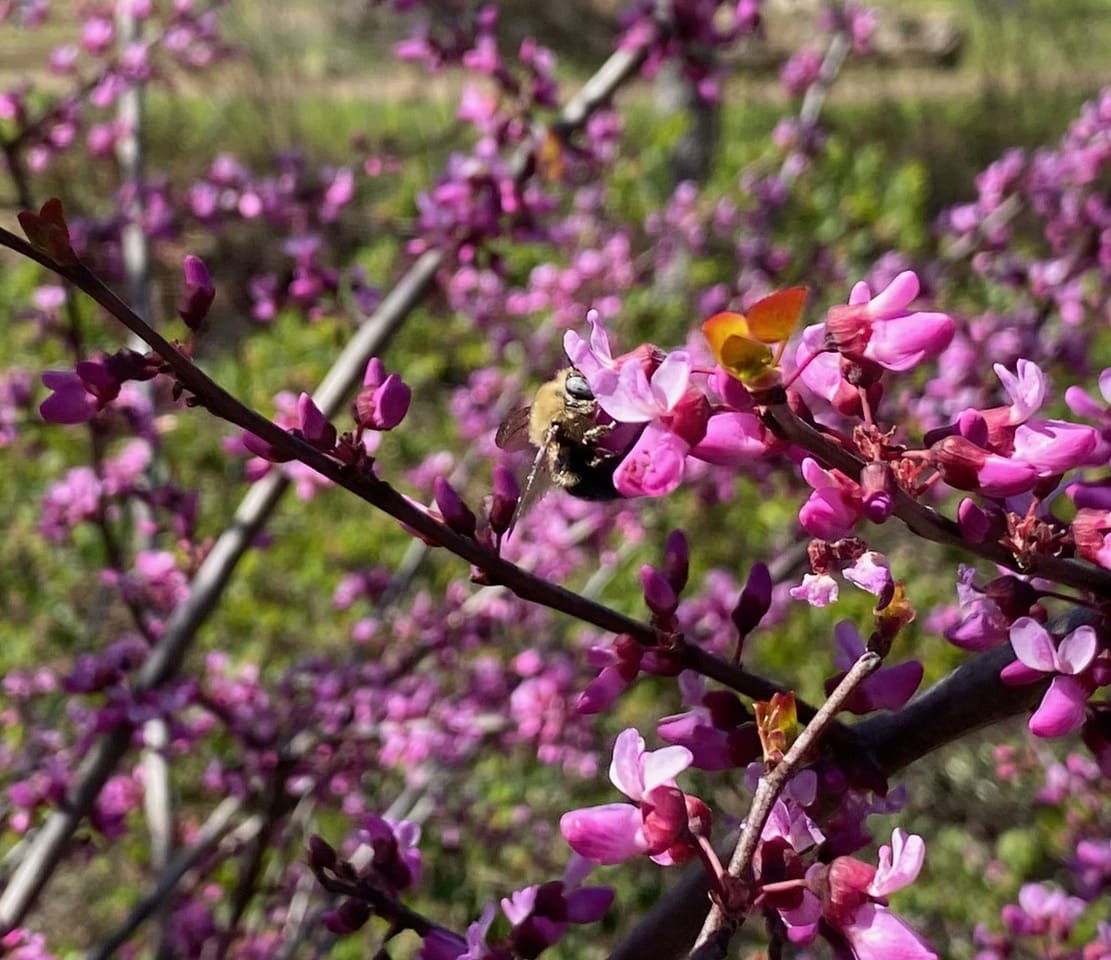
Carpenter bees are large, shiny, and stout bodied, with sparse hair. Females are mostly black, while males often have some yellow hairs. The common name “carpenter bee” derives from their nesting behavior; nearly all species burrow into hard plant material such as dead wood or timber. The bees vibrate their bodies as they rasp their mandibles against hard wood, each nest having a single entrance which may have many adjacent tunnels. The entrance is often a perfectly circular hole about 0.6 in. in diameter on the underside of a beam, bench, or tree limb. Carpenter bees do not eat wood. They discard the bits of wood, or reuse particles to build partitions between brood cells. The tunnel functions as a nursery for brood and storage for the pollen/nectar on which the brood subsists.
Stop! Thief! Carpenter Bees are Notorious Nectar Robbers | Deep Look – YouTube
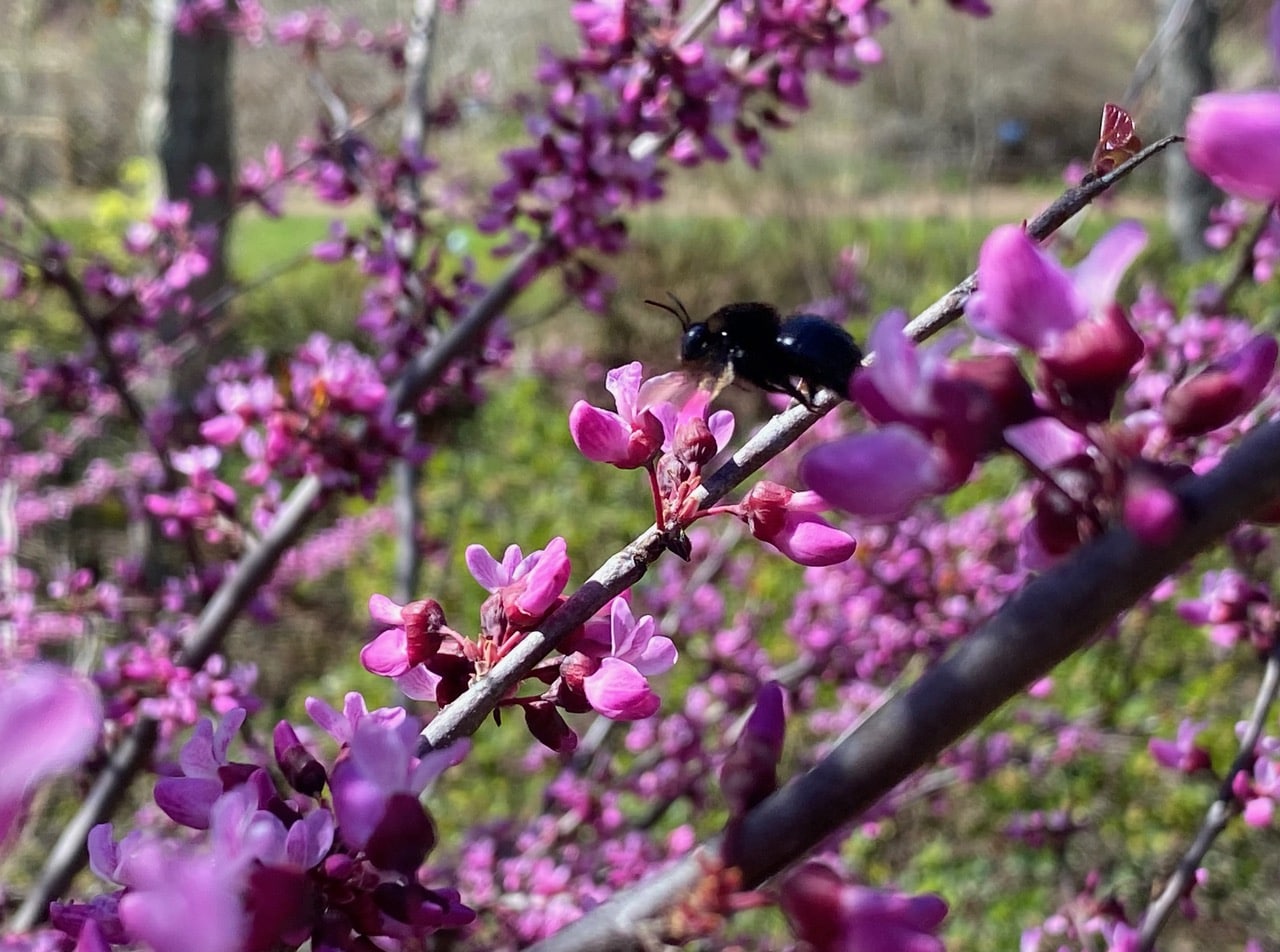
Here’s a female Foothill Carpenter Bee, Xylocopa tabaniformis ssp. orpifex (family Apidae). She is all black, and slightly larger than the males. It is the females that excavate the nest, using their strong and serrated mandibles. They use the resulting sawdust to form partitions between the brood cells and to plug the nest entrance.
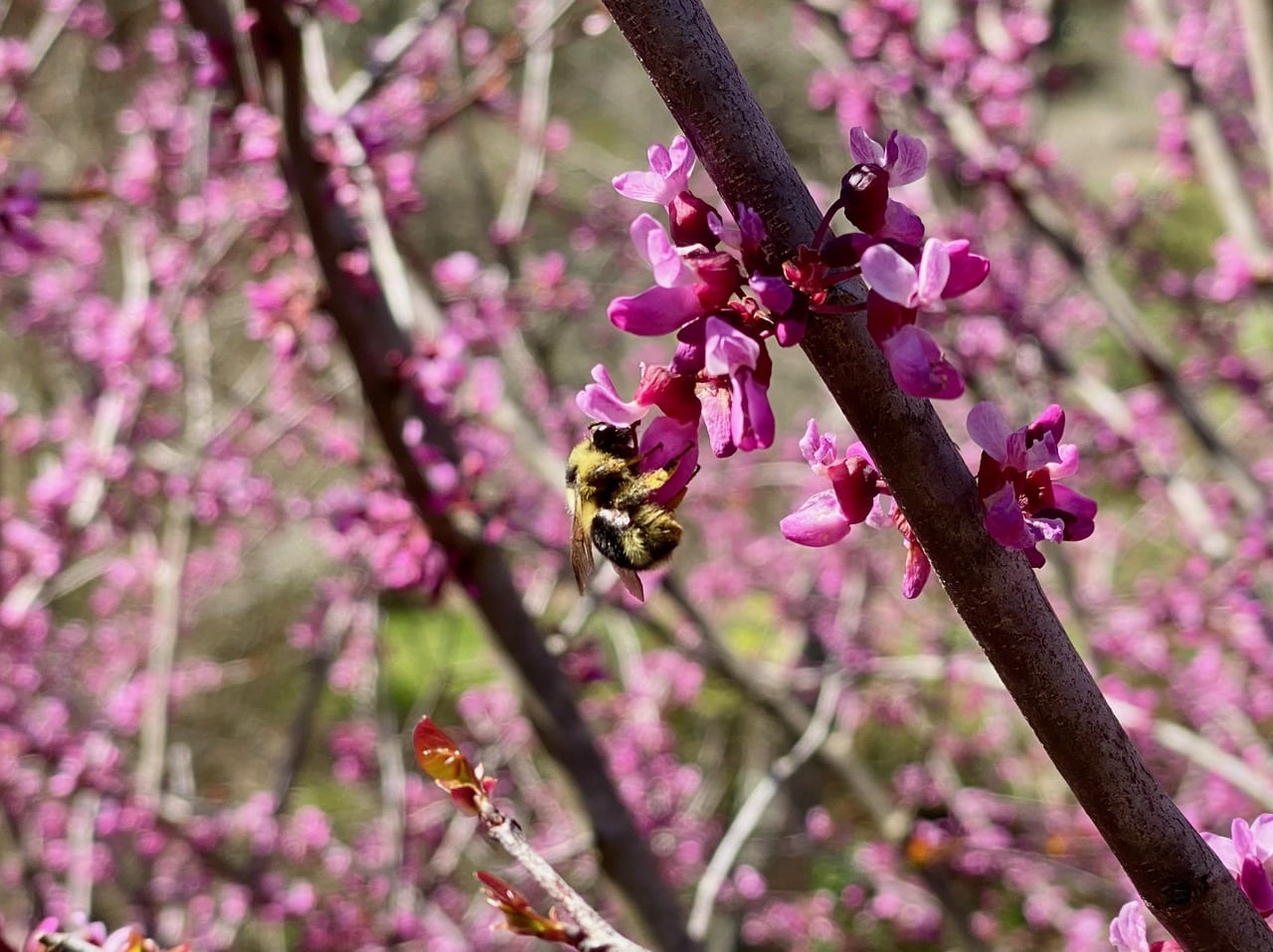
Two species of bumble bees are foraging on the Redbud flowers – the Yellow-faced (subgenus Pyrobombus), and the Black-tailed (Bombus melanopygus, Family Apidae) pictured here.
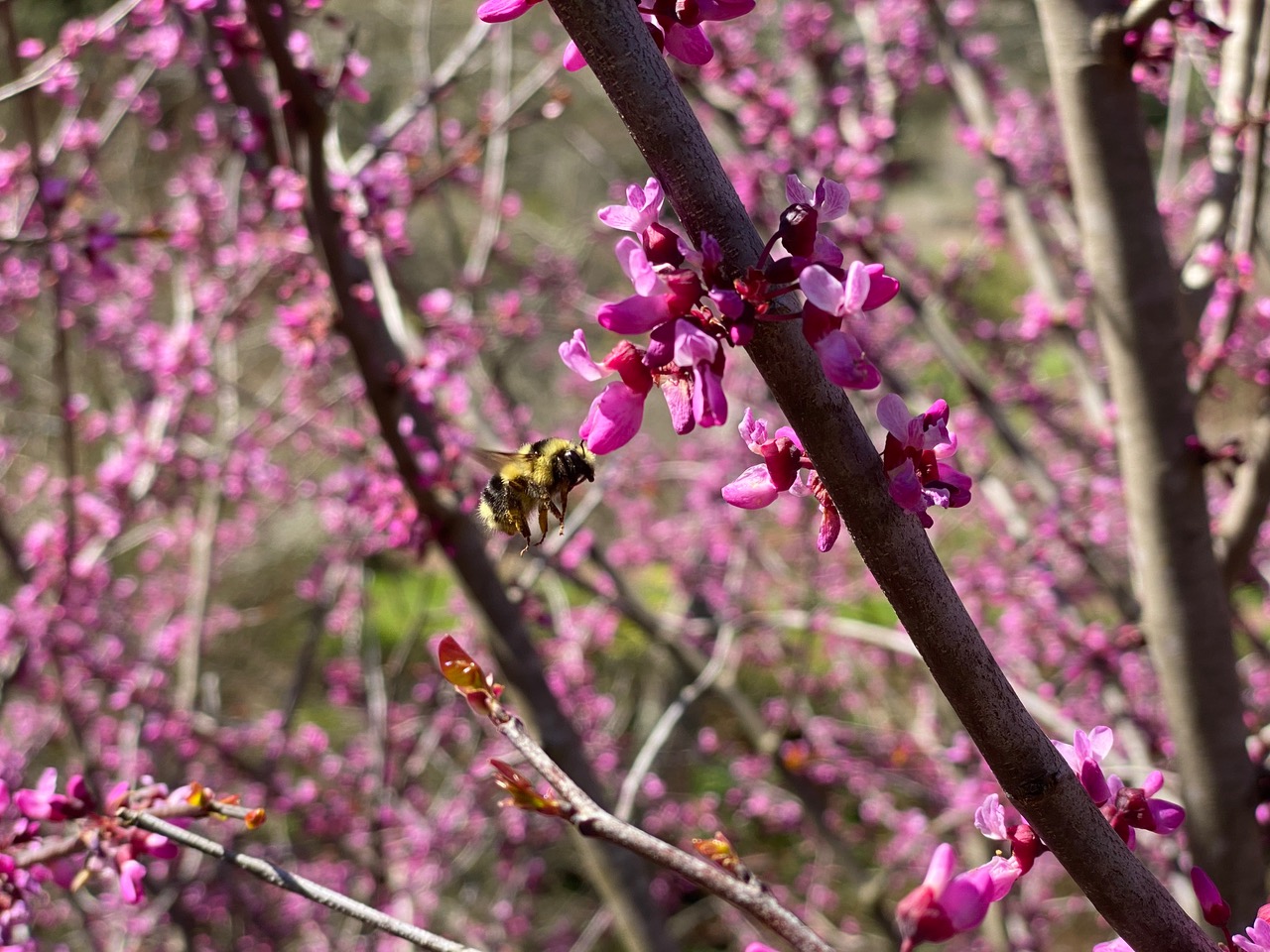
Bombus melanopygus is a species of bumble bee native to western North America, widely distributed from the Pacific to the Rocky Mountains, and from Alaska to Baja California. The species is found in various habitats, including agricultural and urban areas. The bees feed on many types of plants, including manzanitas, Ceanothus, golden bushes, wild buckwheats, lupines, penstemons, rhododendrons, willows, sages, and clovers. They nest underground or aboveground in structures.

A female Pacific Digger Bee, Anthophora pacifica (family Apidae) bounces off a Redbud flower after taking nectar. It is easy to tell that she is female as she is carrying pollen on her hind legs.
As their name implies, the Digger Bees nest in the ground, sometimes in huge aggregations. These fast and noisy flyers buzz around flowers, appearing to “hop” from flower to flower while foraging. The chubby, furry Digger Bees resemble the bumble bees in many ways, but are a lot noisier. They are a fearless, rowdy lot – fun to watch but a challenge to photograph. Male digger bees of many species have white or yellow integuments on their faces. Females have shaggy hairs on their back legs, used to carry pollen. Female Anthophora are capable of buzz pollination – i.e. they vibrate their wing muscles to shake pollen from the anthers of some flowers. Digger bees are generalist pollinators that visit an impressively wide range of plants. They are exceptionally effective pollinators and play an important role in maintaining wildflower diversity, in part because their long tongues allow them to pollinate deep-throated and tubular blossoms inaccessible to other bees.

Although smaller and not as robust as the other bees, the Honey Bees, Apis mellifera (family Apidae) are capable of accessing the floral resources of Redbuds. They are avid foragers on the shrub. There is another species of bee worth mentioning here – the Spring Long-horned Bees, Eucera sp. (family Apidae). I see a couple of males on the flowers but fail to get a picture of them.
Grab your close-focus binoculars and go watch bees on the Western Redbud while it is in bloom!