

Pollinator Post 3/24/24 (2)

Leaving the garden, I take a leisurely walk along Bridgeview Trail.





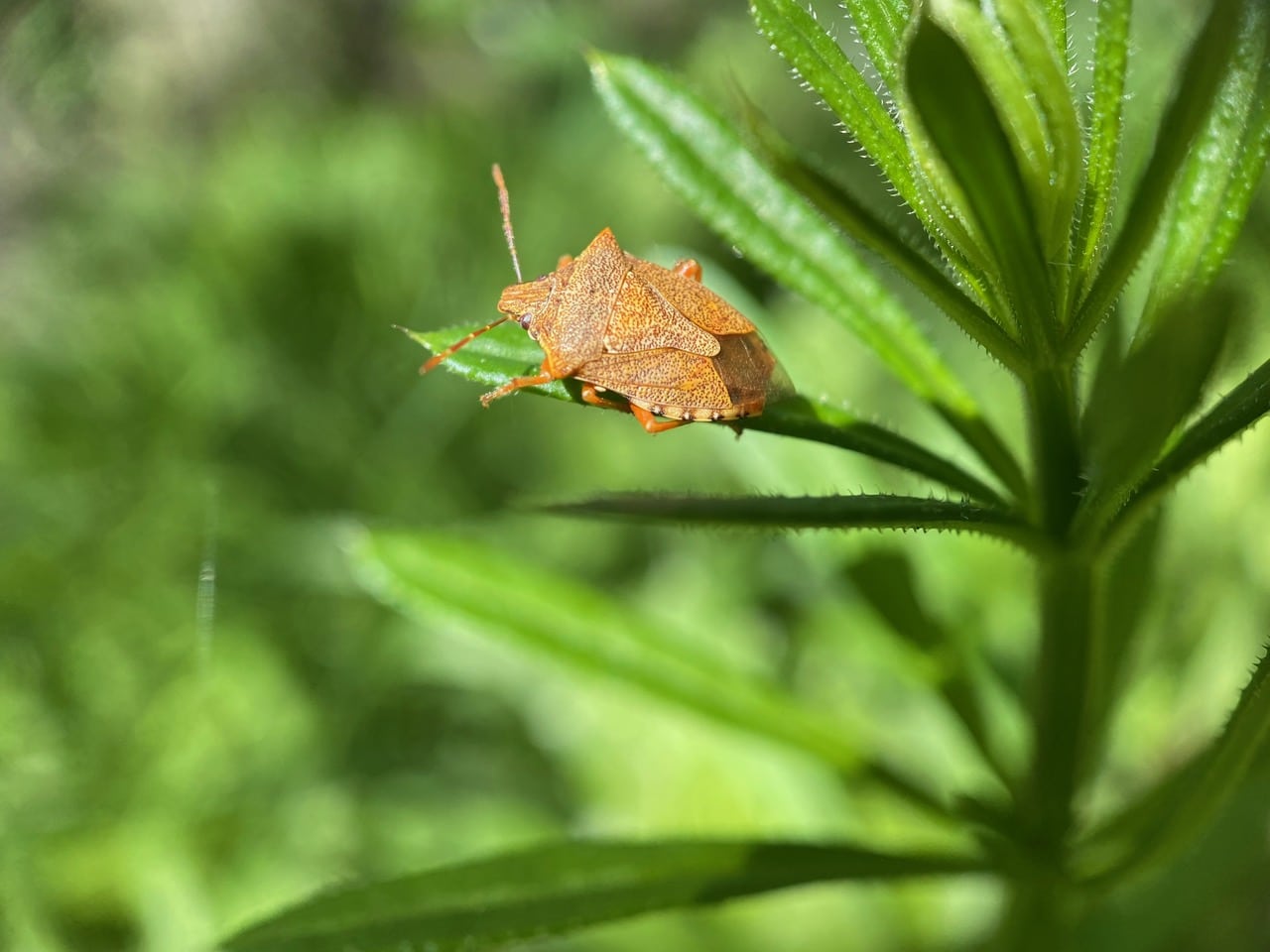
A Spined Soldier Bug is resting in a sunlit spot on a leaf of Bedstraw.
The Spined Soldier Bug, Podisus maculiventris (family Pentatomidae) is a common Stink Bug throughout the United States, ranging from Mexico to Canada. The adult has a prominent spine on each “shoulder”. They are found in a variety of habitats including woodlands, near streams and agricultural lands. Both adults and nymphs are generalist predators with a broad appetite, reportedly attacking 90 insect species, especially larval forms of Lepidoptera (butterflies and moths) and Coleoptera (beetles). Many of these prey insects are important economic pests. Both adult and nymphal Spined Soldier Bugs have long, pointed beaks with which they stab their prey and which they keep folded under their bodies when not feeding. When prey is scarce, the bug may feed on plant juices, but this does not cause significant damage to the plants.
Each female lays several hundred gray, cream, or gold barrel-shaped eggs in tight clusters of 20-30 on leaves and twigs. The nymphs initially cluster around the hatched eggs, then disperse to feed. There may be 2-3 generations per year. The species has been extensively studied as potential biological pest control agents. The bug eggs are sold commercially for use in crop fields and green houses.
A Snakefly, Agulla bicolor (family Raphidiidae) is lurking in the weedy grasses.
Snakeflies are a group of predatory insects comprising the order Raphidioptera. They are a relict group, having reached their apex of diversity during the Cretaceous before undergoing substantial decline. Adult Snakefly has a notably elongated thorax which, together with the mobile head, gives the group their common name of snakefly. The body is long and slender and the two pairs of long membranous wings are prominently veined. The head is long and flattened and heavily sclerotized. The mouthparts are strong and relatively unspecialized, being modified for biting. The large compound eyes are at the sides of the head. Females have a large and sturdy ovipositor which is used to deposit eggs into crevices or under bark. Snakeflies are holometabolous insects with four-stage life cycle consisting of eggs, larvae, pupae and adults. Both adults and larvae are predators of soft-bodied arthropods such as aphids and mites.
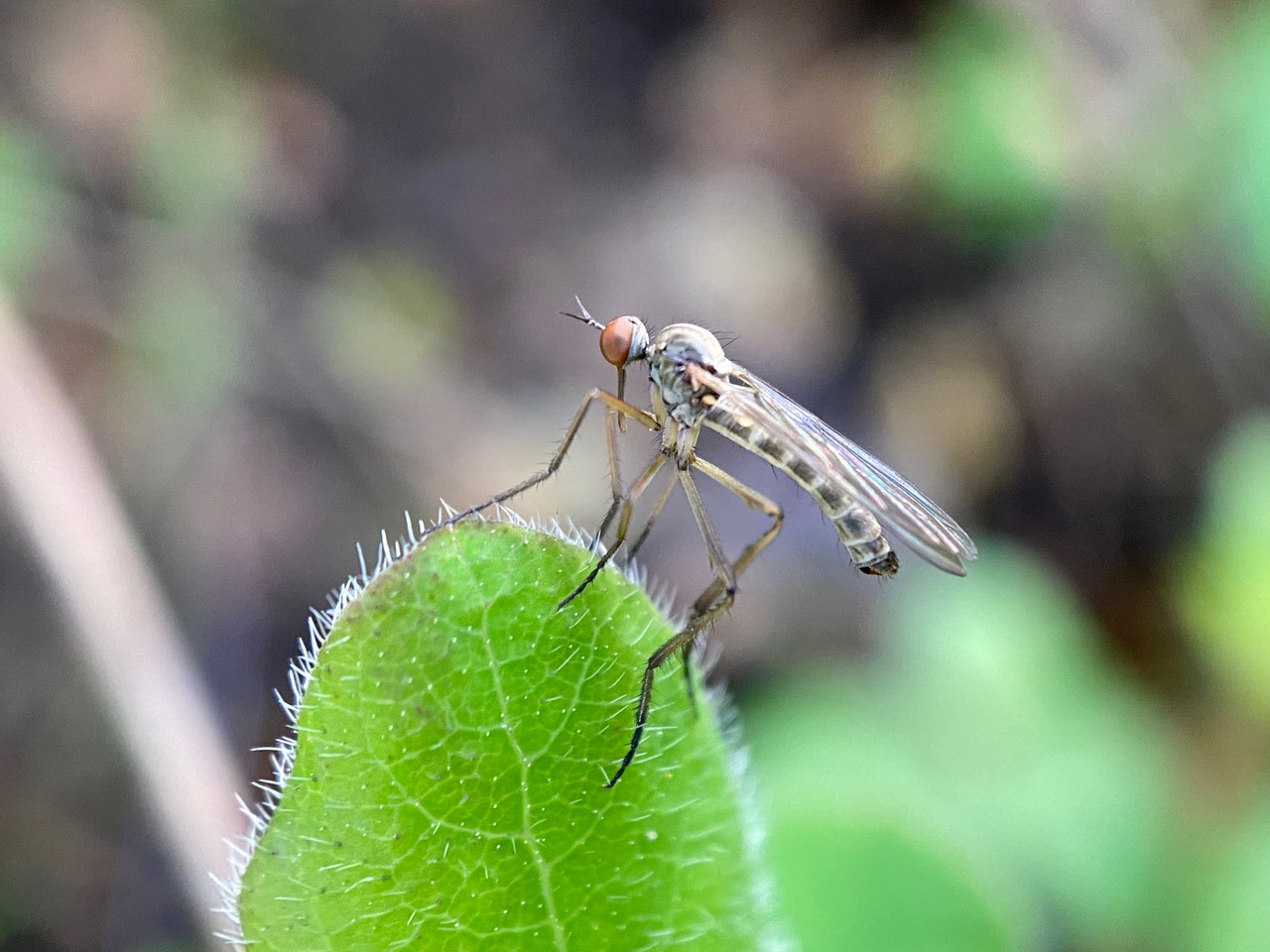
A Balloon Fly, Hilara sp. (family Empididae) is perched on a California Honeysuckle leaf.
Dance Flies, in the family Empididae, get their name from the habit of males of some species to gather in large groups and dance up and down in the air in the hopes of attracting females. They are predominantly predatory and they are often found hunting for small insects on and under vegetation in shady areas. Both genders may also drink nectar. Male dance flies give their sweeties a nuptial gift to eat while they mate. The gift is thought to enable her to complete the development of her eggs. Males may wrap their gifts in balloons of silk or spit, hence the other common name of Balloon Fly.
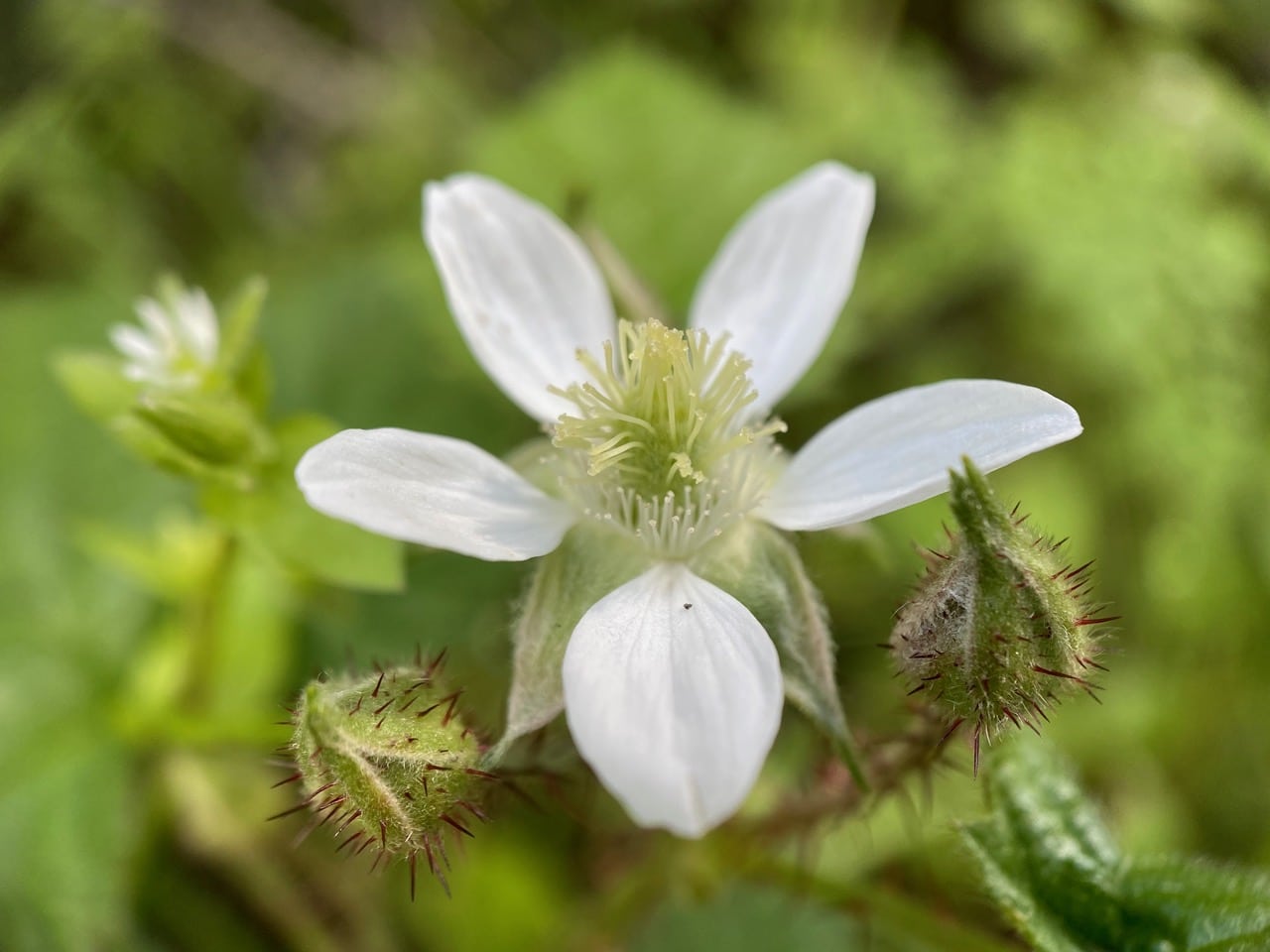
A female California Blackberry, Rubus ursinus has started to bloom. The species is dioecious, with male and female flowers borne on separate plants. Female flowers (as shown here) have smaller petals and a central cluster of many pistils. Male flowers have larger petals and a central cluster of many stamens. It takes close examination to distinguish the sexes.
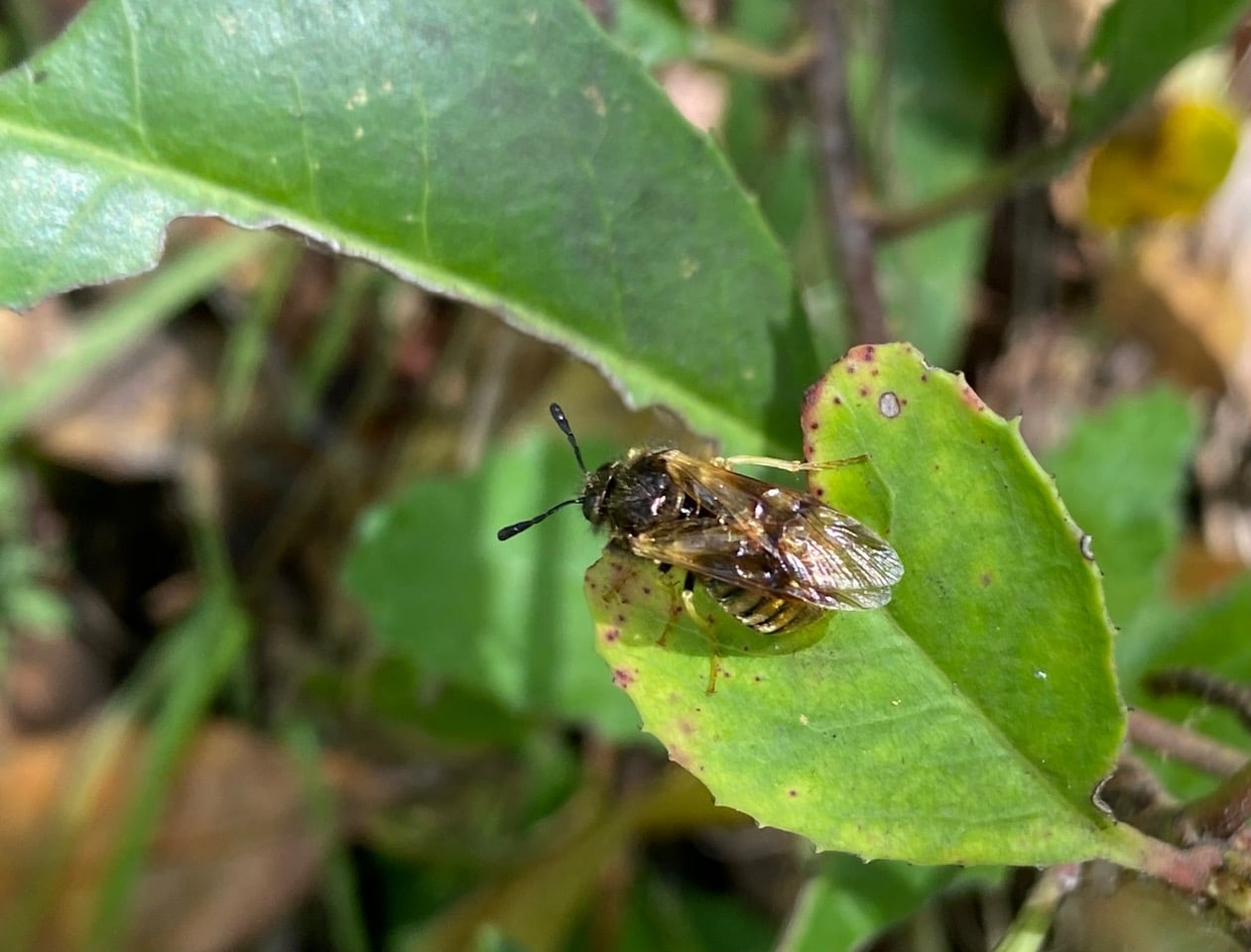
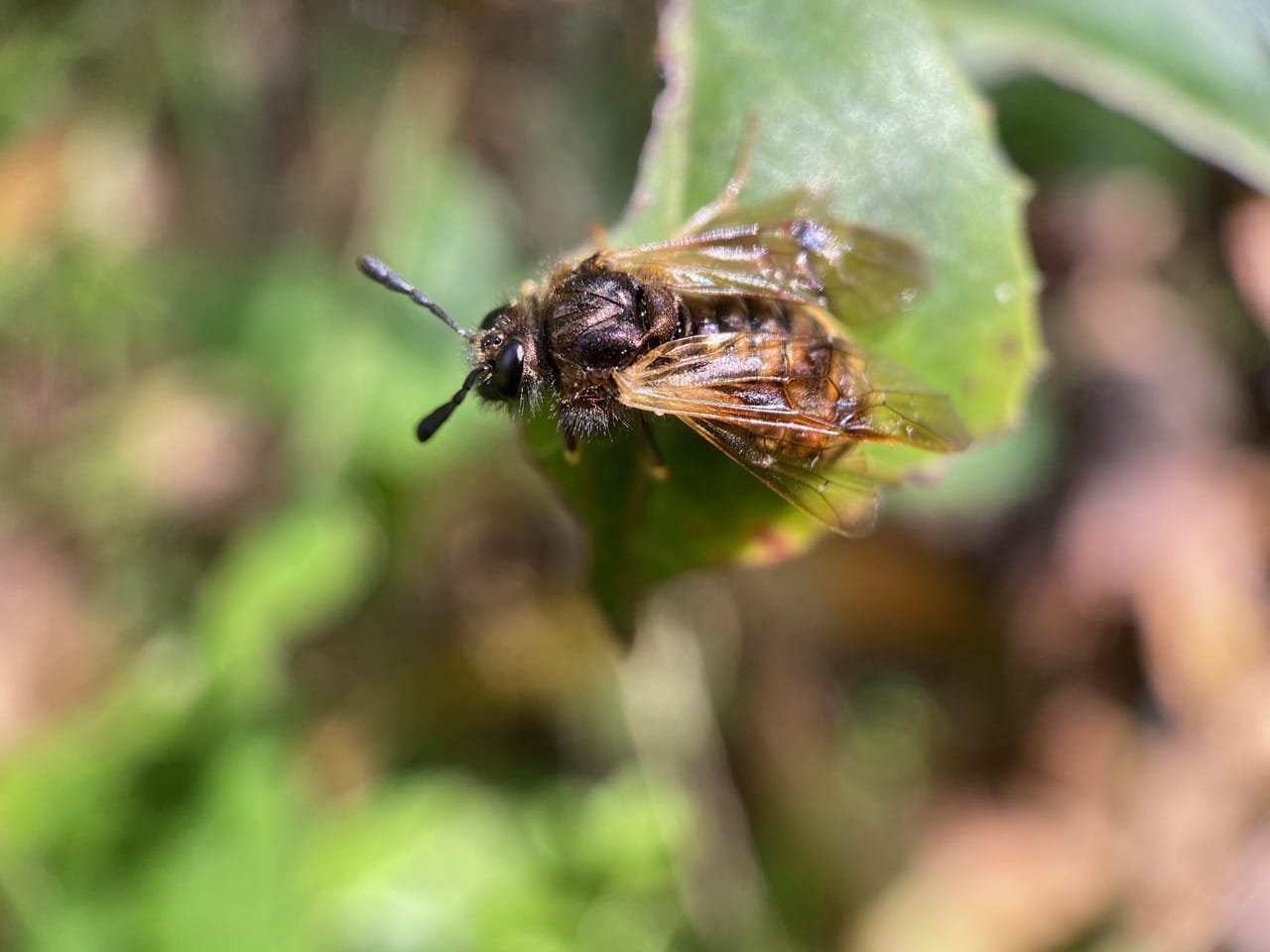
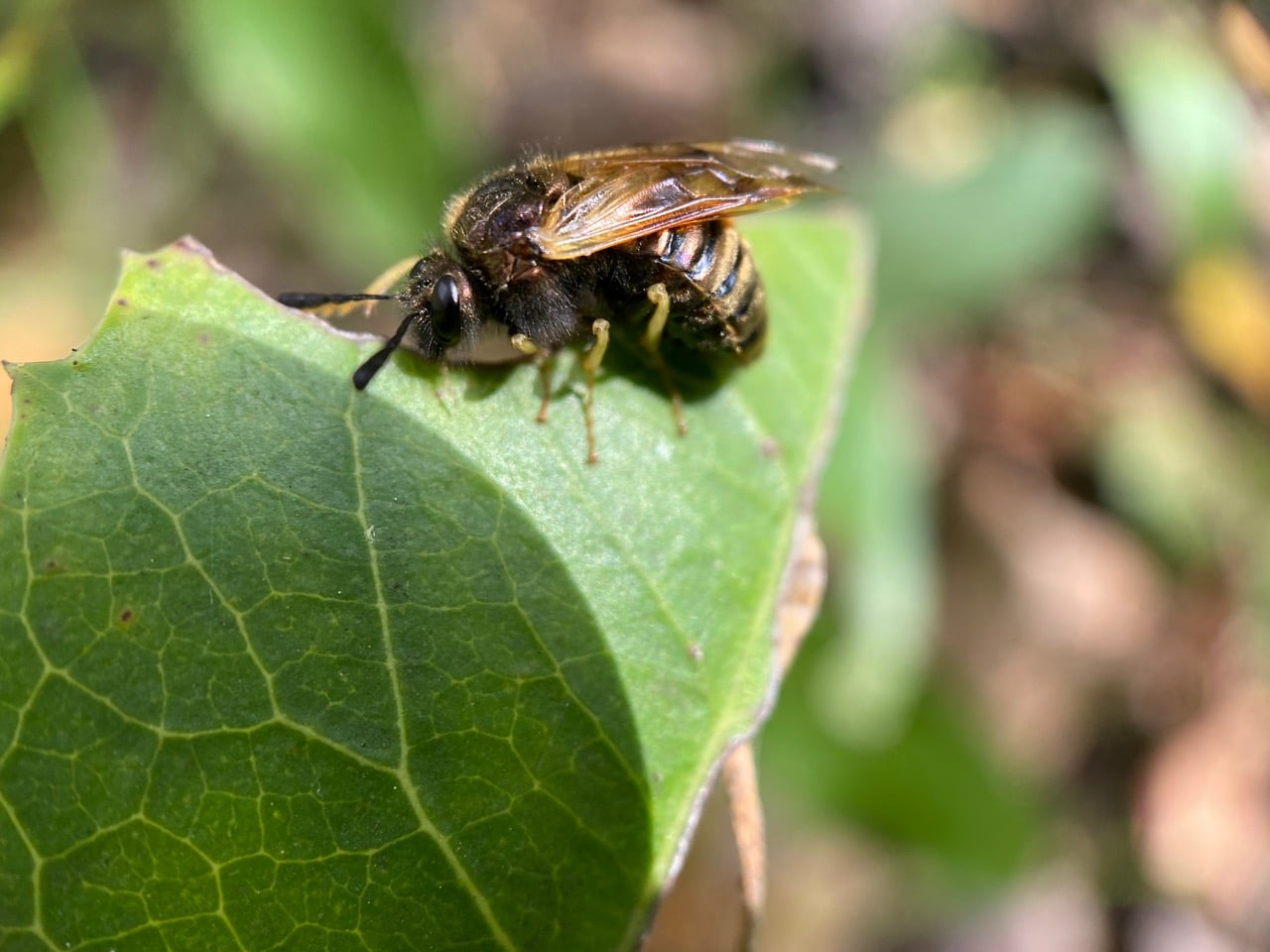
Who is this insect lurking on a Toyon leaf? It is about the size and shape of a bumble bee, but what’s with those clubbed antennae? The insect is glossy black with metallic gold bands on its abdomen. I can’t even place it in any taxonomic group I can come up with!
Determined to have the insect identified, I take a series of pictures from all possible angles as the insect moves around. At least it is very cooperative, and slow in its movements. It seems to have its head down most of the time, as if searching for a lost contact lens.
I am confounded by those antennae!
Those gold bands on its abdomen are actually made of short reflective hairs.
iNaturalist comes up very quickly with an ID – the insect is a Clubhorn Sawfly, Abia americana (family Cimbicidae). Wow, a second Sawfly today, in a different family!
Cimbicidae, the Clubhorn Sawfly, is a family of sawflies in the order Hymenoptera. The family is relatively uncommon and little-studied in North America. However, their large size and metallic reflections make these sawflies somewhat conspicuous. The family is distinctive in having antennae with prominent apical clubs or knobs. The adults of some species can exceed 3 cm in length, and are among the heaviest of all Hymenoptera. Adults are robust, resembling bumble bees. As with all sawflies, the base of abdomen broadly joined to thorax (no wasp waist).
The female Abia oviposits into a leaf margin in pairs or small clusters. Larvae typically feed on foliage of trees and shrubs. The young larvae feed gregariously and often skeletonize the leaves. Older larvae feed individually. The larvae are relatively large and remarkably caterpillar-like, and are usually found curled on the underside of leaves. At maturity, the larva drops to the ground, and builds a cocoon in the leaf litter. They overwinter in these cocoons. The adult is active during the day. Females have been observed feeding on flowers of Apiaceae, particularly Cow Parsnip.
Abia americana is the only member of the genus in western North America.