

Pollinator Post 3/22/25 (2)
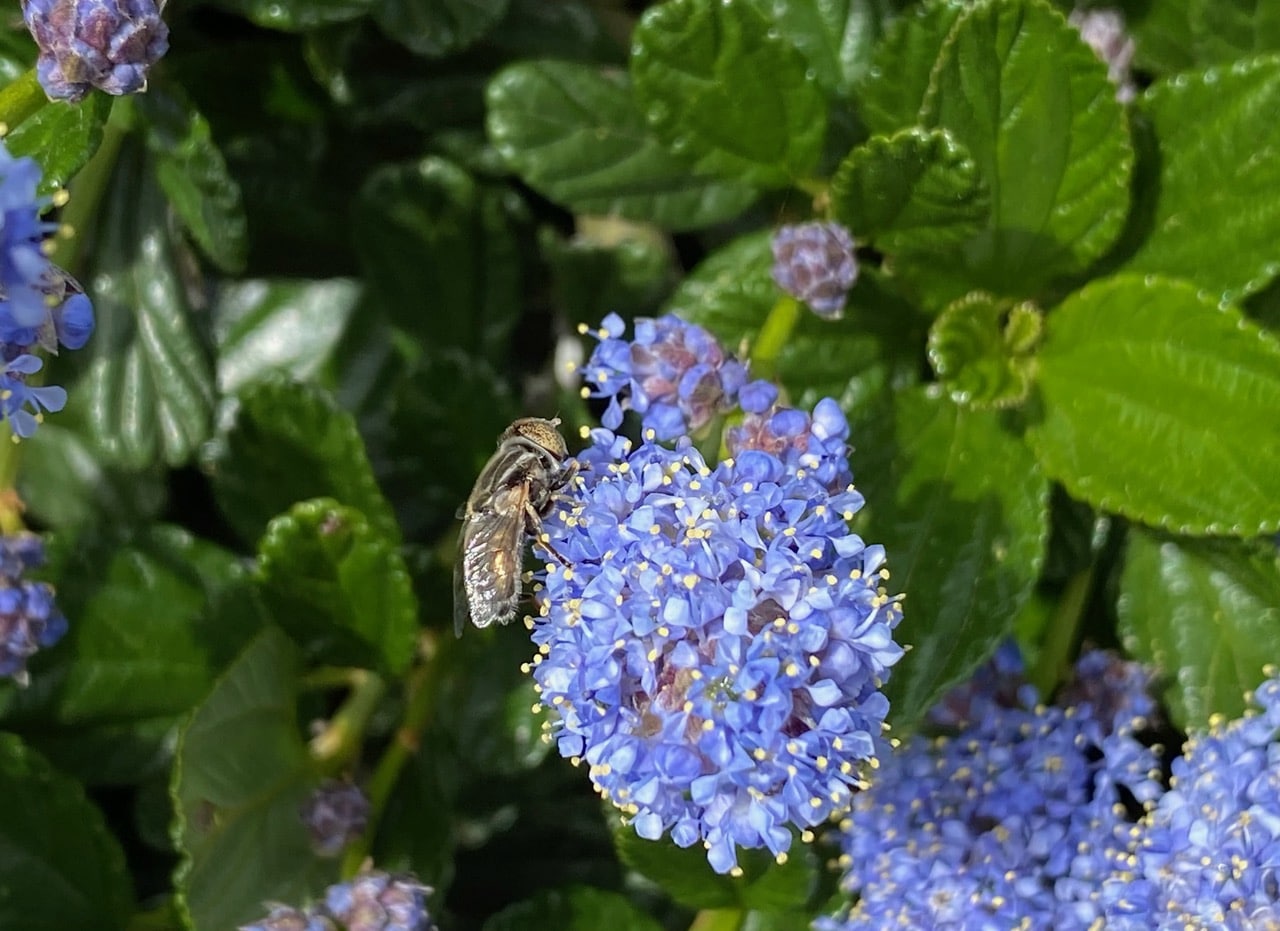
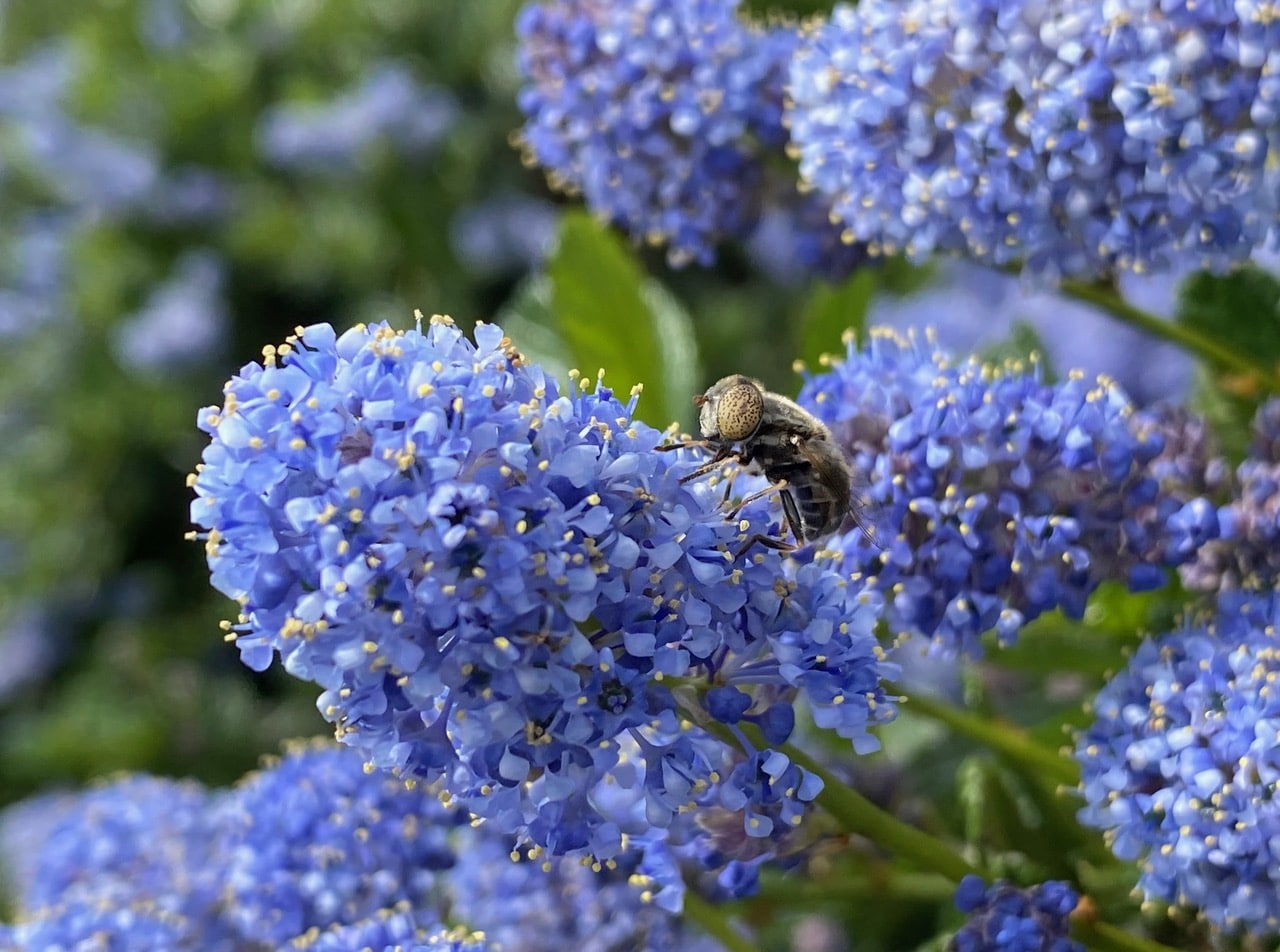
Ooh, I think that’s another Common Lagoon Fly, Eristalis aeneus (family Syrphidae)! In this light the hover fly appears black and shiny.
The Common Lagoon Fly, Eristalis aeneus (family Syrphidae) is native to Europe, and widespread throughout Europe and the United States. It draws its common name from its habitat of lagoons, ponds, slow-moving rivers, streams and irrigation ditches. The larvae are commonly found along shorelines in rock pools containing large amounts of decaying seaweed. They develop in brackish as well as a variety of freshwater habitats. The adults fly very fast and low over ground vegetation, and feed on yellow composites and white umbellifers. The flight period is April to October, and the fly overwinters as an adult.

It is a rather atypical hover fly. Note that unlike most hoverflies that hold their wings out at an angle, fighterjet-style, the Lagoon Fly holds its perfectly clear wings straight along the side of its abdomen.
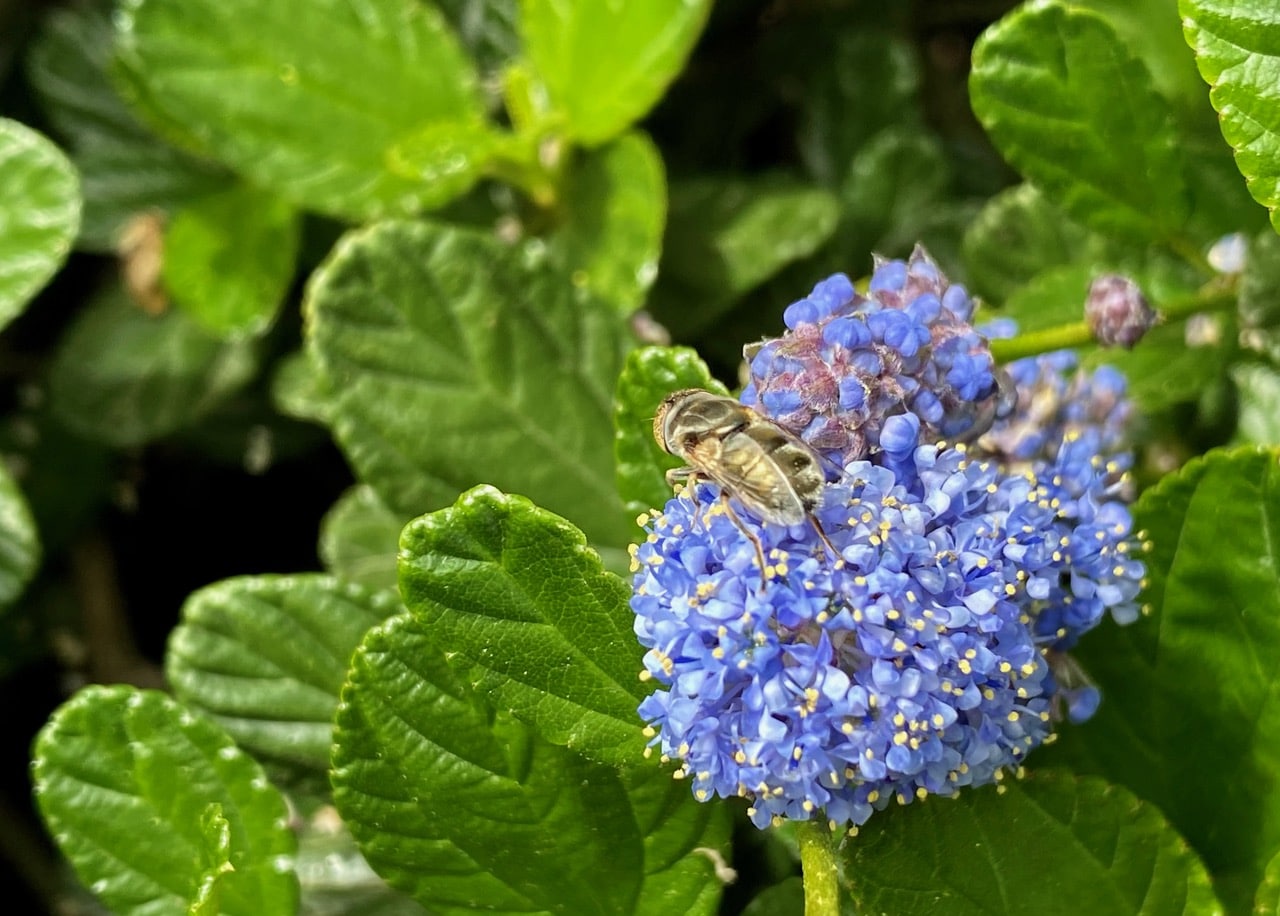
Being in the genus Eristalis, together with the Drone Flies, the Common Lagoon Fly’s larvae are probably rat-tailed maggots that develop in aquatic or semi-aquatic habitats.
Rat-tailed maggots have a siphon on their rear end that acts like a snorkel, helping them breathe under water. The siphon can be several times the length of the larva’s body; it is a long, telescopic three-segmented respiratory tube. The larvae are saprophagous, feeding on bacteria in stagnant water rich in decomposing organic matter. It is not surprising that these flies are rather common in Alameda, given its location on the bay and its many natural and man-made lagoons.
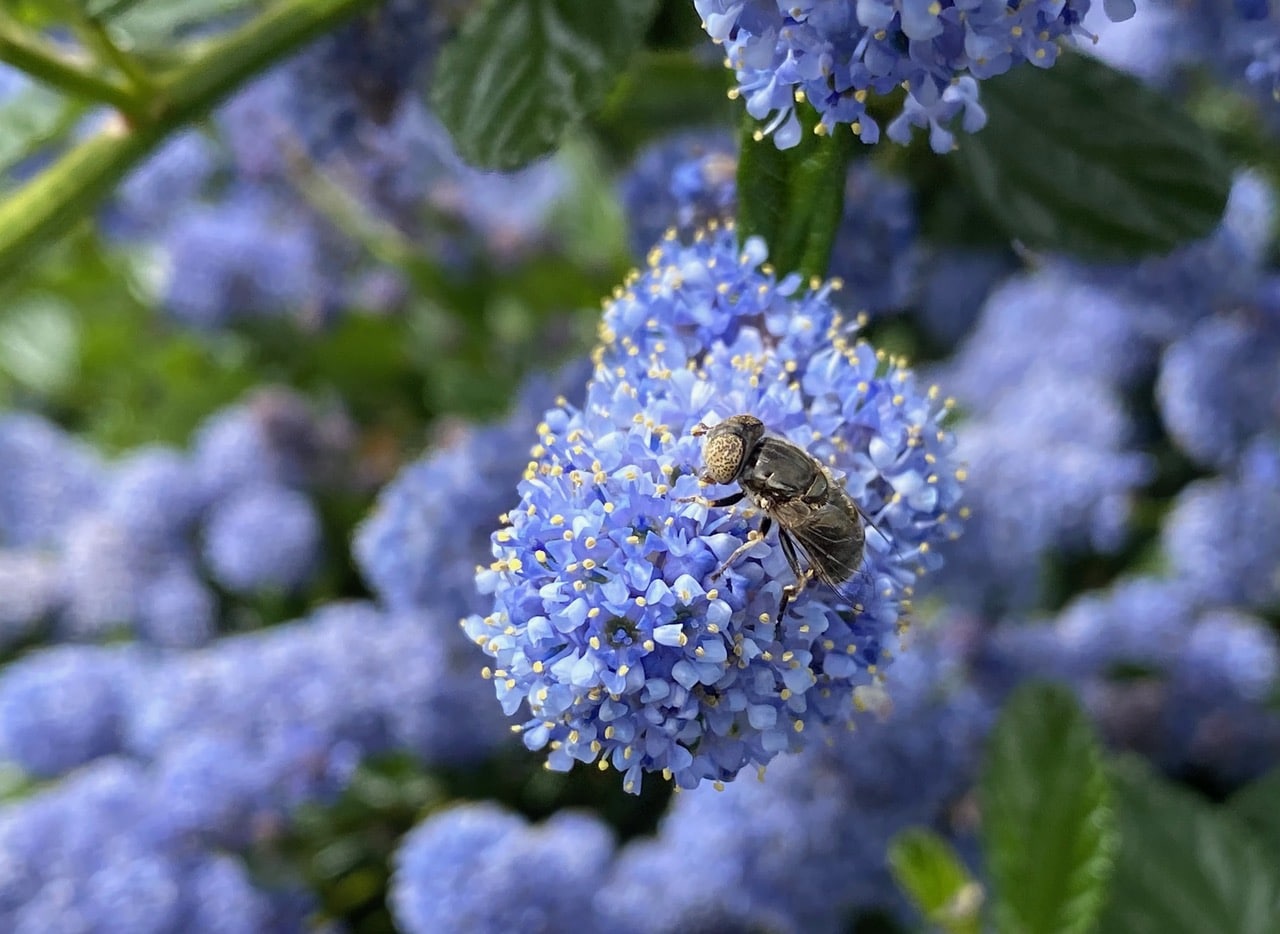
Here’s a view of the unusual spotted eyes. There is nothing in the literature that I can find concerning the reason for this feature. Is it an adaptation for reducing glare, given the watery habitat of the fly?
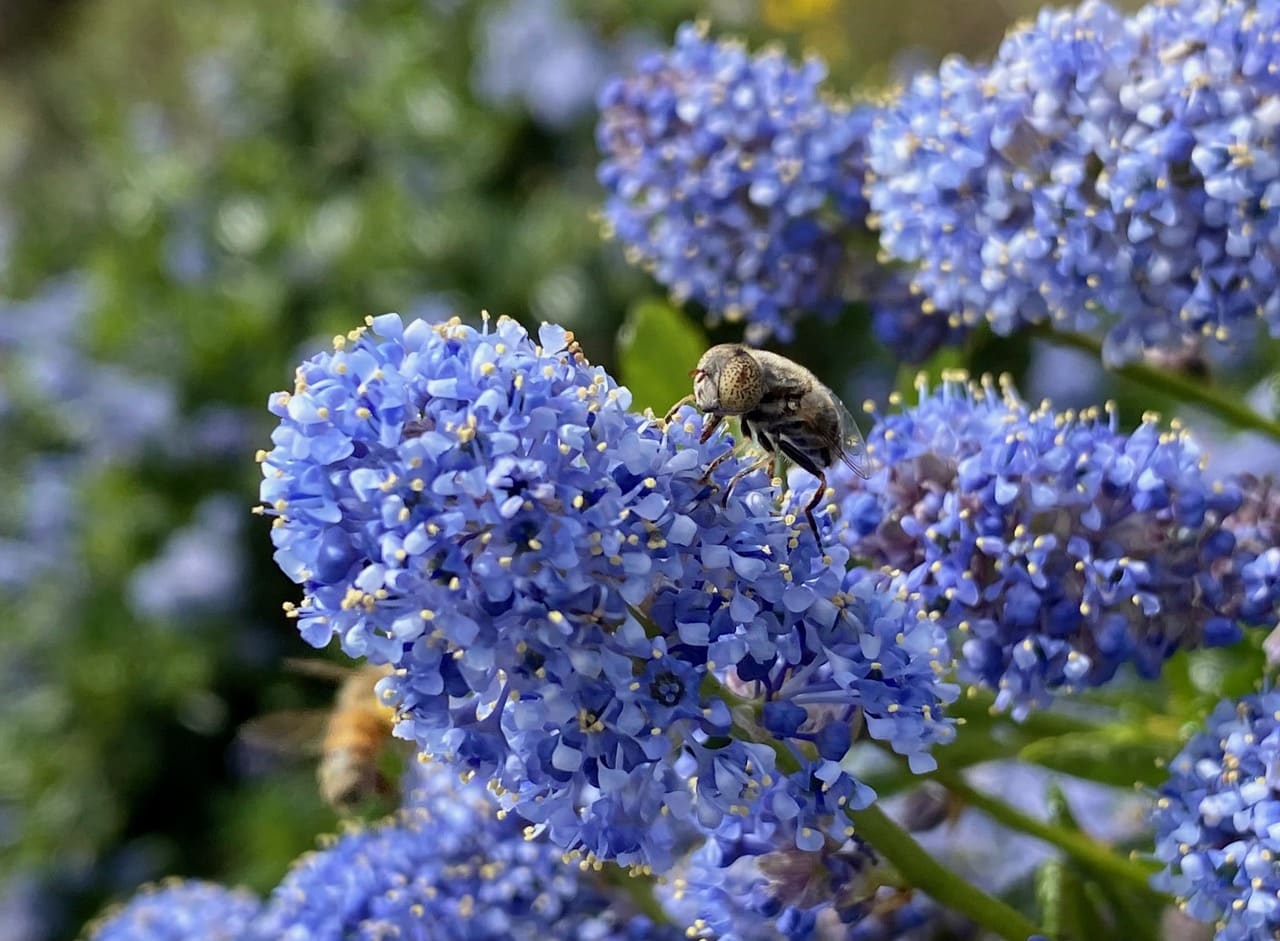
To the list of yellow composites and white umbellifers that the adult lagoon flies feed on, we can now add blue Ceanothus!
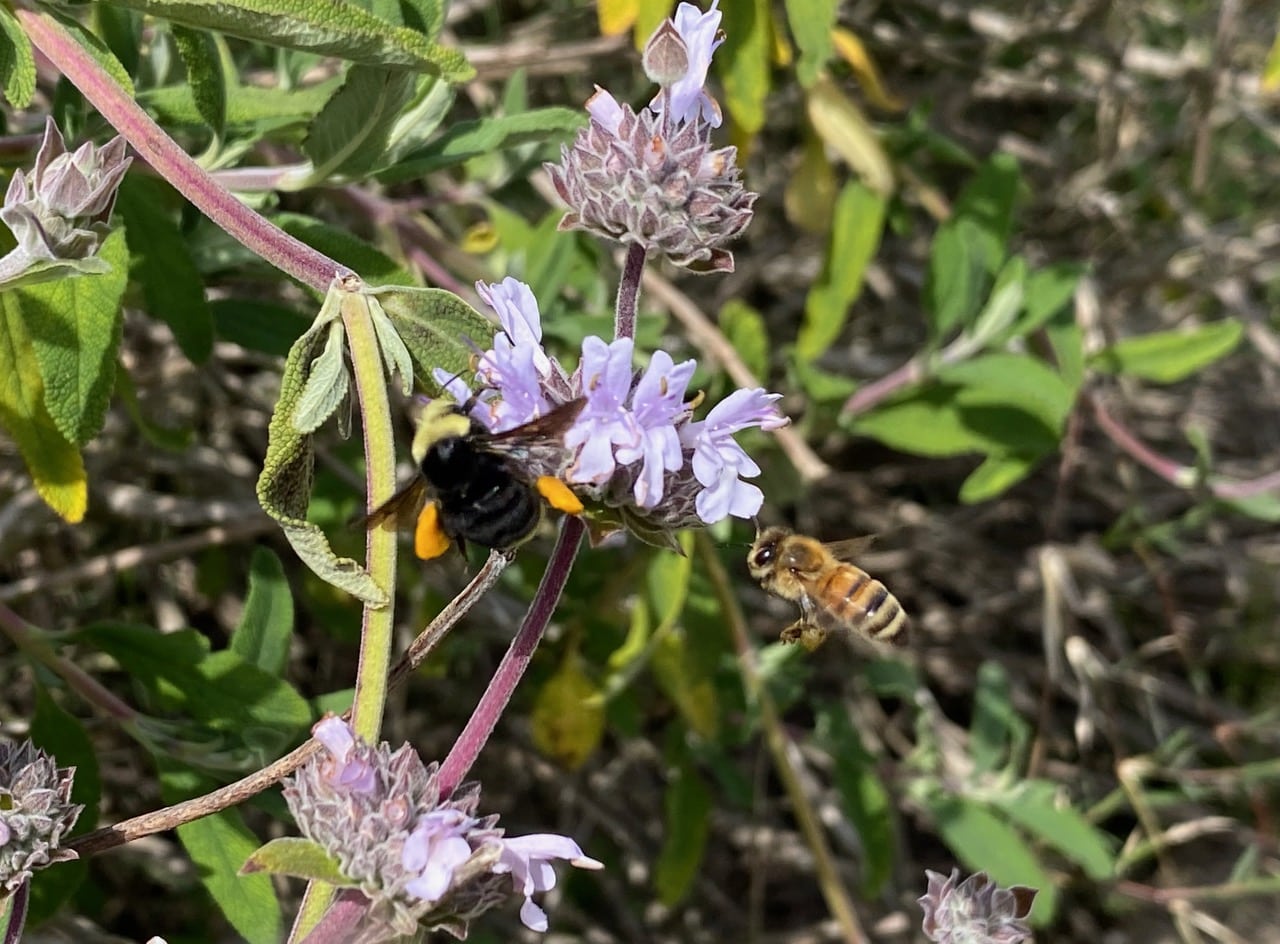
There is more insect activity around the Black Sage, Salvia mellifera now. Bumble bees (Bombus ) abound, but also some Honey Bees, Apis mellifera (family Apidae). Note that the Black Sage and the Honey Bees share the same specific epithet of “mellifera”, meaning “honey-bearing” in Greek.
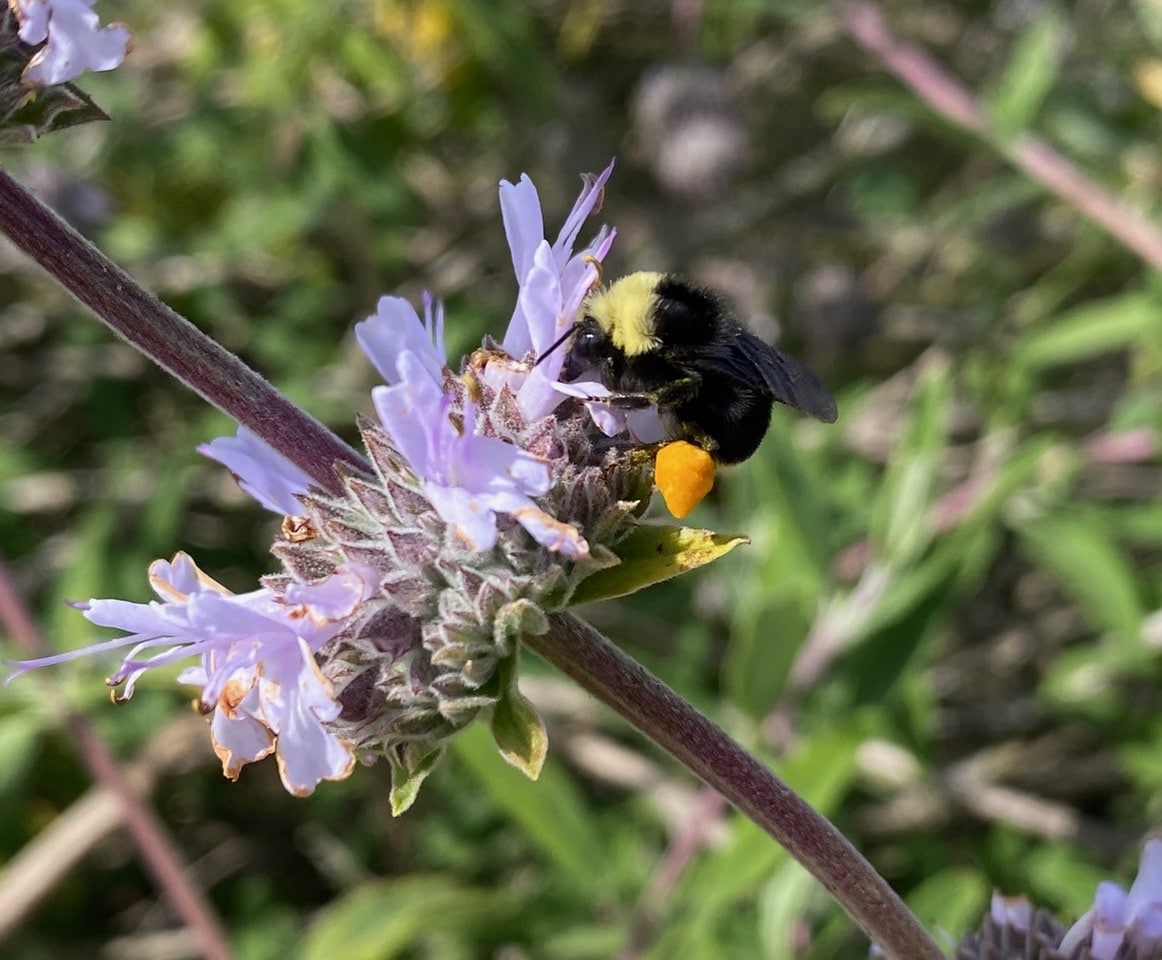


Wow, check out the size of the pollen load on this Yellow-faced Bumble Bee, subgenus Pyrobombus (genus Bombus, family Apidae)! The orange pollen is probably not collected from the sage flowers; these have cream-colored pollen. Bumble bees are well-known generalist foragers. The bee might have been gathering pollen from California Poppy nearby, and is now taking nectar from the Black Sage.
Top view of the same bee. Note that the pollen loads in her pollen baskets (or corbiculae) don’t look as impressive from this angle, as they are packed flat against the tibia.
The pollen collecting apparatus in Apidae bees, which include honey bees and bumble bees, is commonly called a “pollen basket” or corbicula. This region is located on the tibia of the hind legs and consists of hairs surrounding a concave region. After the bee visits a flower, she begins to groom herself and brushes the pollen down toward her hind legs and packs the pollen into her pollen basket. A little nectar mixed with the pollen keeps it all together like putty, and the stiff hairs surrounding the pollen basket hold it in place. Remarkably bees are able to fly while carrying up to a third of their body weight in pollen.
.jpg)
Her tongue extended, the Yellow-faced Bumble Bee is aiming to take nectar from the base of a Black Sage flower, Salvia mellifera. Note that in this position, the pair of stamens on the flower are perfectly situated to dab pollen onto her forehead, right at the base of her antennae. Note the bi-lobed style that sticks straight out above the stamens. When the bee next visits another Black Sage flower in a later, female stage of development, the pollen on her head may be picked up by the style that has bent down. Such is the genius of Salvia for ensuring cross-pollination!
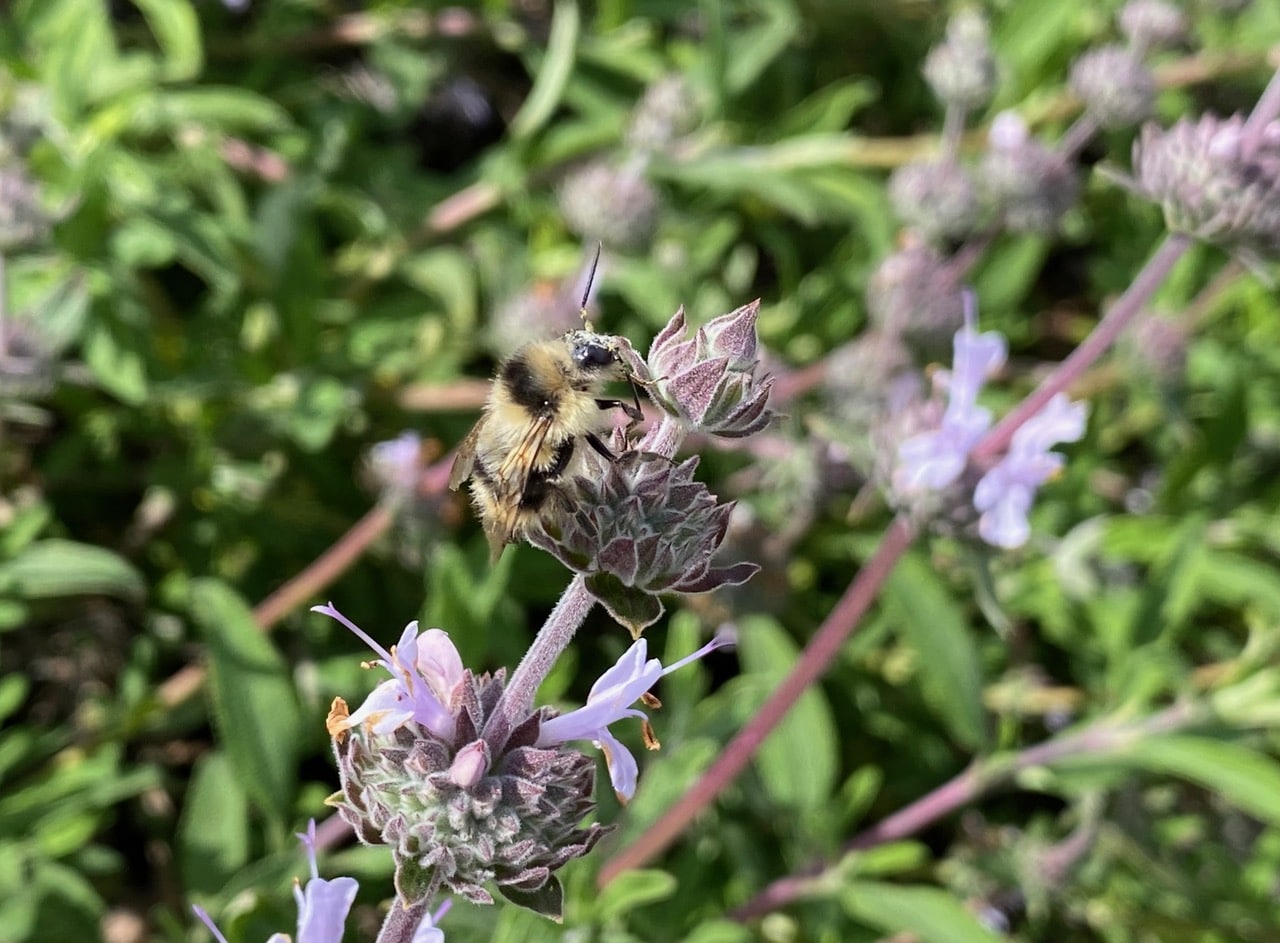
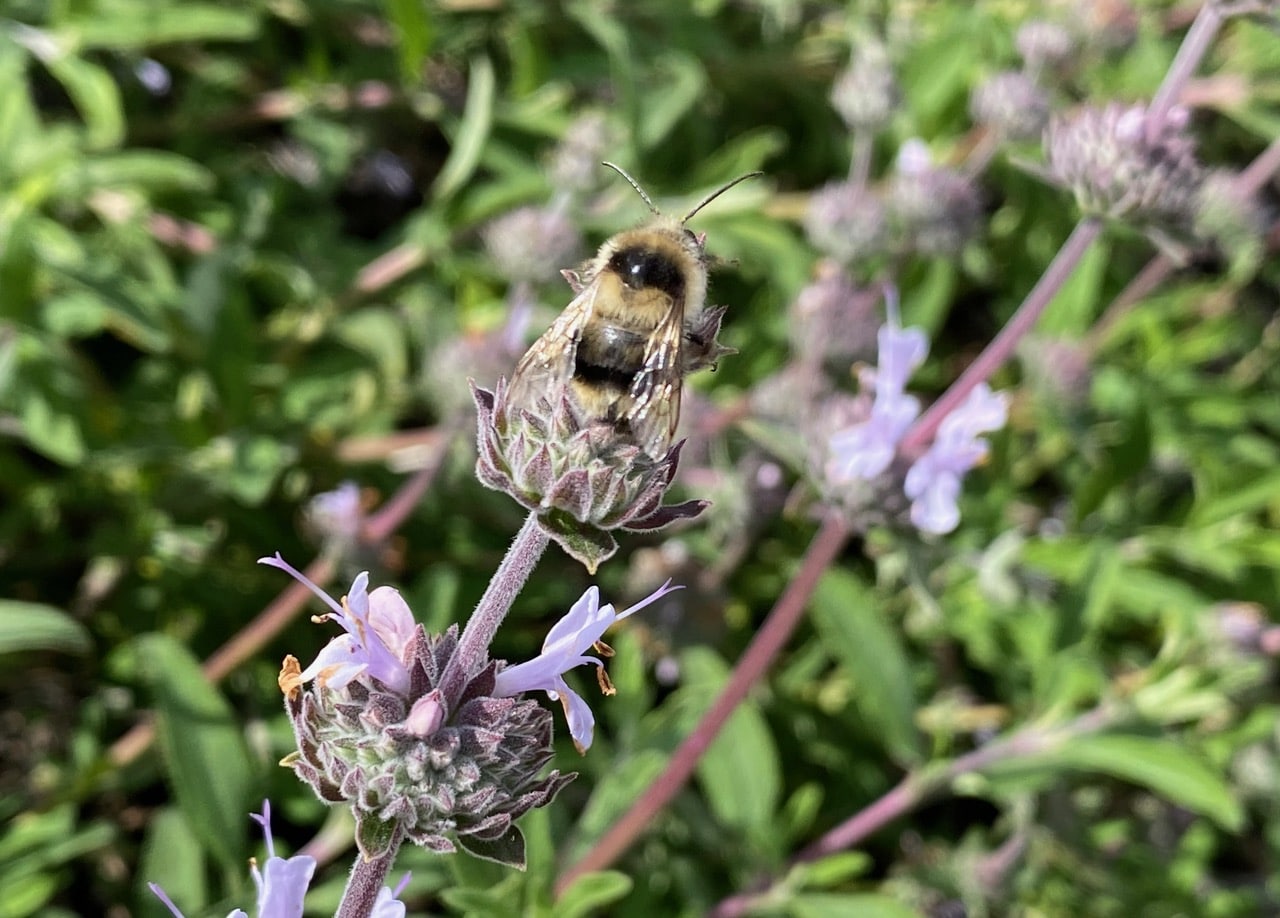
Perched on a whorl of Black Sage flower buds near the top of the spike, a chunky bumble bee is cleaning its antennae meticulously. Note where the cream-colored pollen has been deposited on the bee – on its forehead at the base of its antennae! It has been taking nectar from the sage flowers.
All bees have an antenna cleaner on each of their two forelegs. The antenna cleaners consists of two parts: a notch in the basitarsus, which is fitted with stiff hairs, and a corresponding spur on the tibia. To clean its antenna, the bee raises its foreleg over its antenna and then flexes it tarsus. The action allows the spur to close the notch, forming a ring around the antenna. The bee pulls each antenna through the bristles to clean it of debris such as pollen or dust which might interfere with the many sensory organs within the antenna. A bee’s antennae serve numerous functions: smell, taste, perceive humidity and temperature, feel, monitor gravity and flight speed and even detect sound waves to help guide the bee in its daily activities.
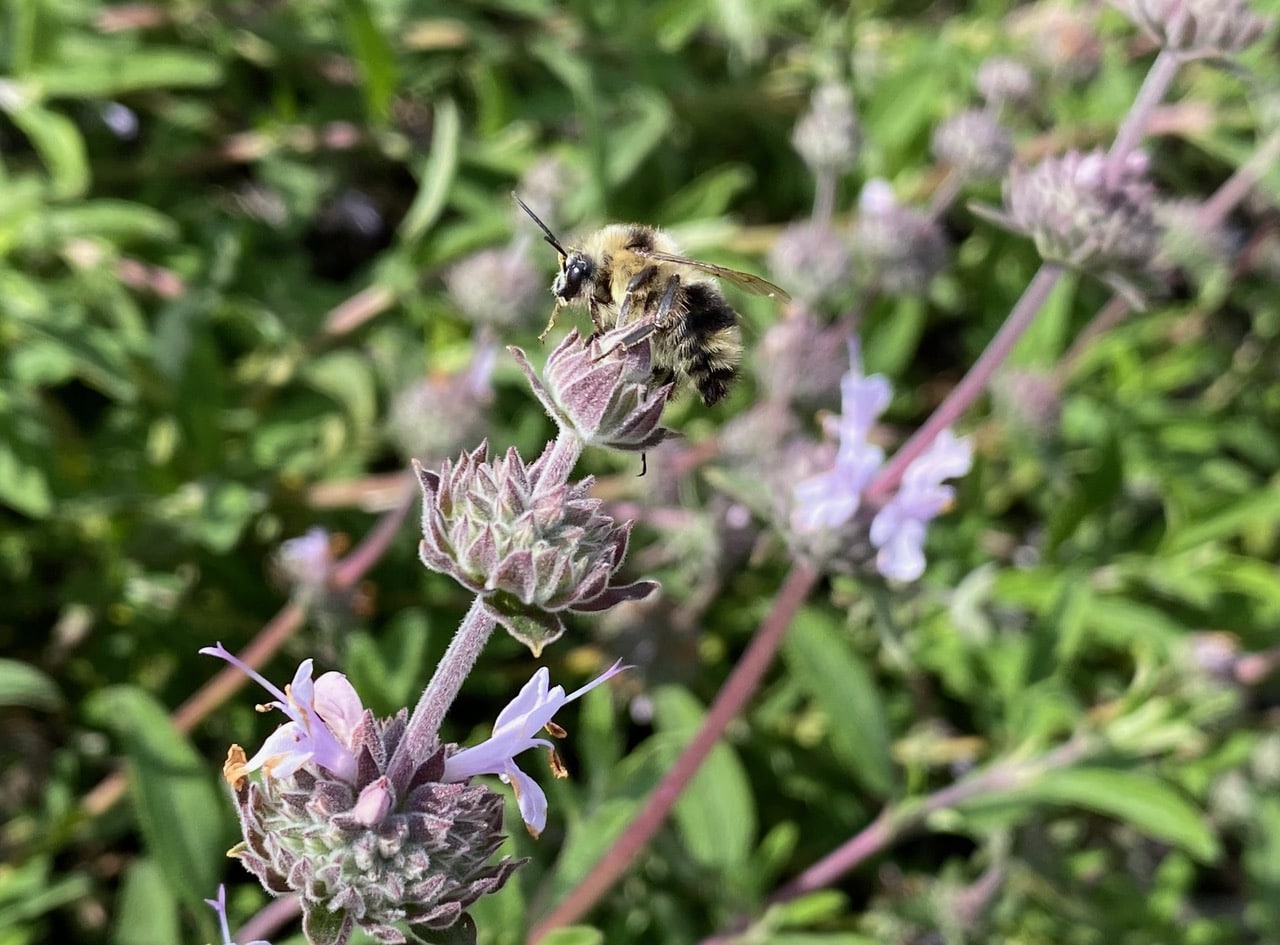
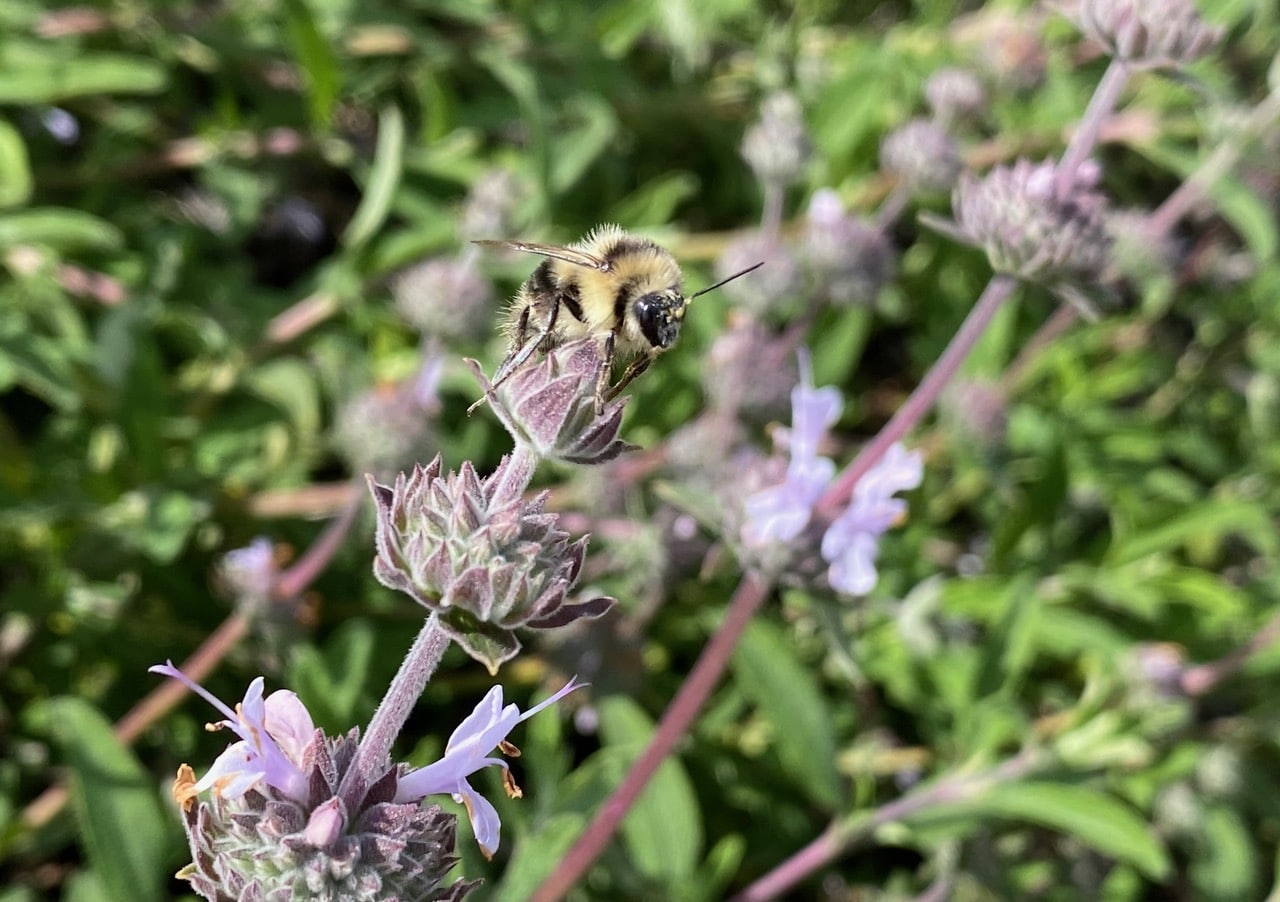
Although the black-and-yellow banding pattern on the bee is suggestive of a Black-tailed Bumble Bee, Bombus melanopygus (family Apidae), the bee looks a little different than a regular worker or a queen. And the antennae are long. A male? Wow, isn’t this rather early for a bumble bee colony to be producing drones (male bees)? Drones generally do not do any work. Their sole mission in life is to mate with a queen. Drones are usually produced late in the season (late summer or fall) together with new queens. The reproductives fly on nuptial flights to meet and mate with those of other nearby colonies. The males do not live long after inseminating the queens, but the mated queens will hibernate through the winter to establish new colonies the following year.
Side view of the Black-tailed Bumble Bee (Identity confirmed by a couple of bee experts on iNaturalist). Its head is dwarfed by its chunky body. Note that it lacks a corbicula on its hind tibia. Male bees do not intentionally collect pollen, and they do not have the anatomy for the job.
Here is the bumble bee before taking flight, still with pollen stuck to the base of its antennae.
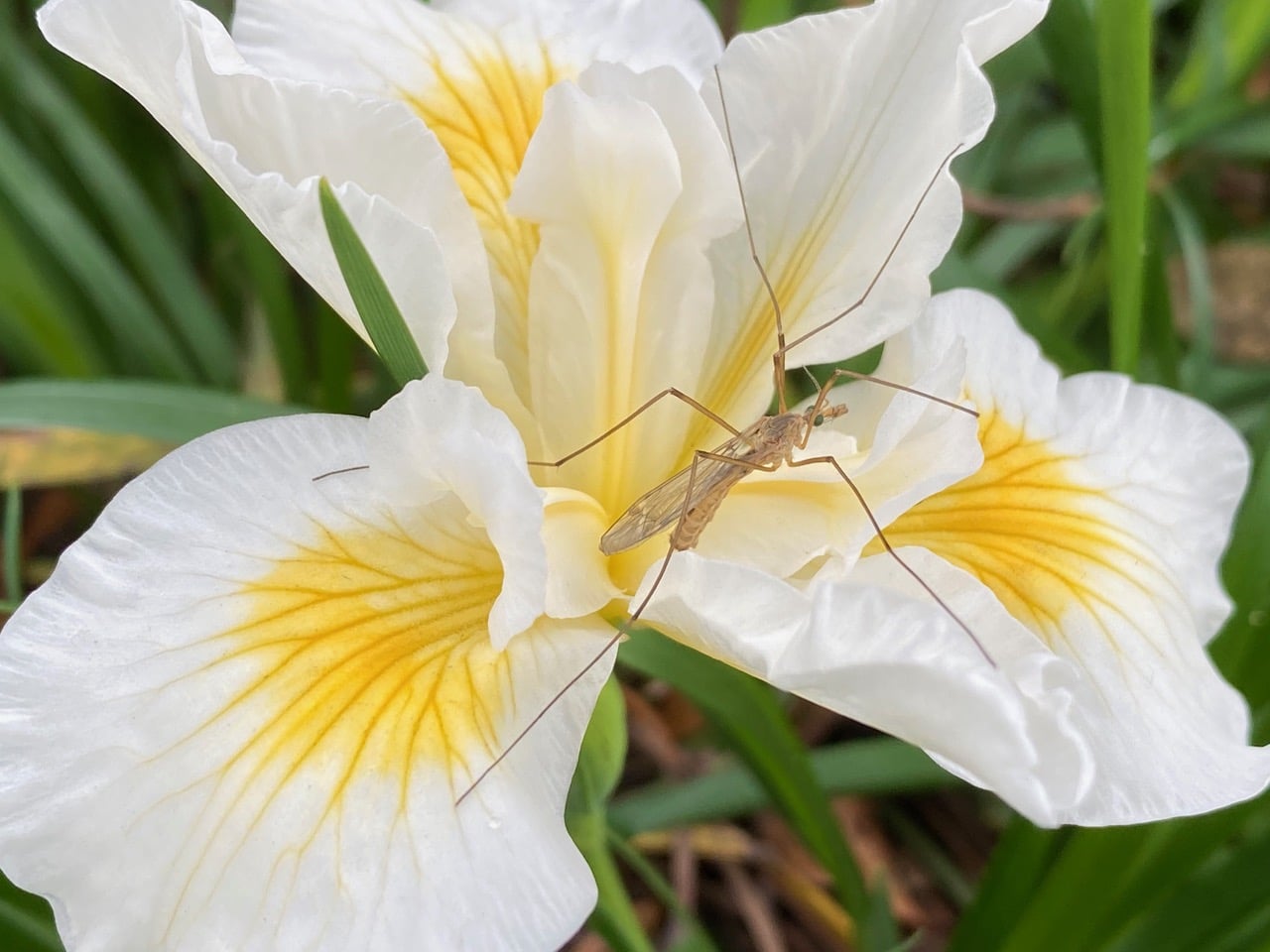
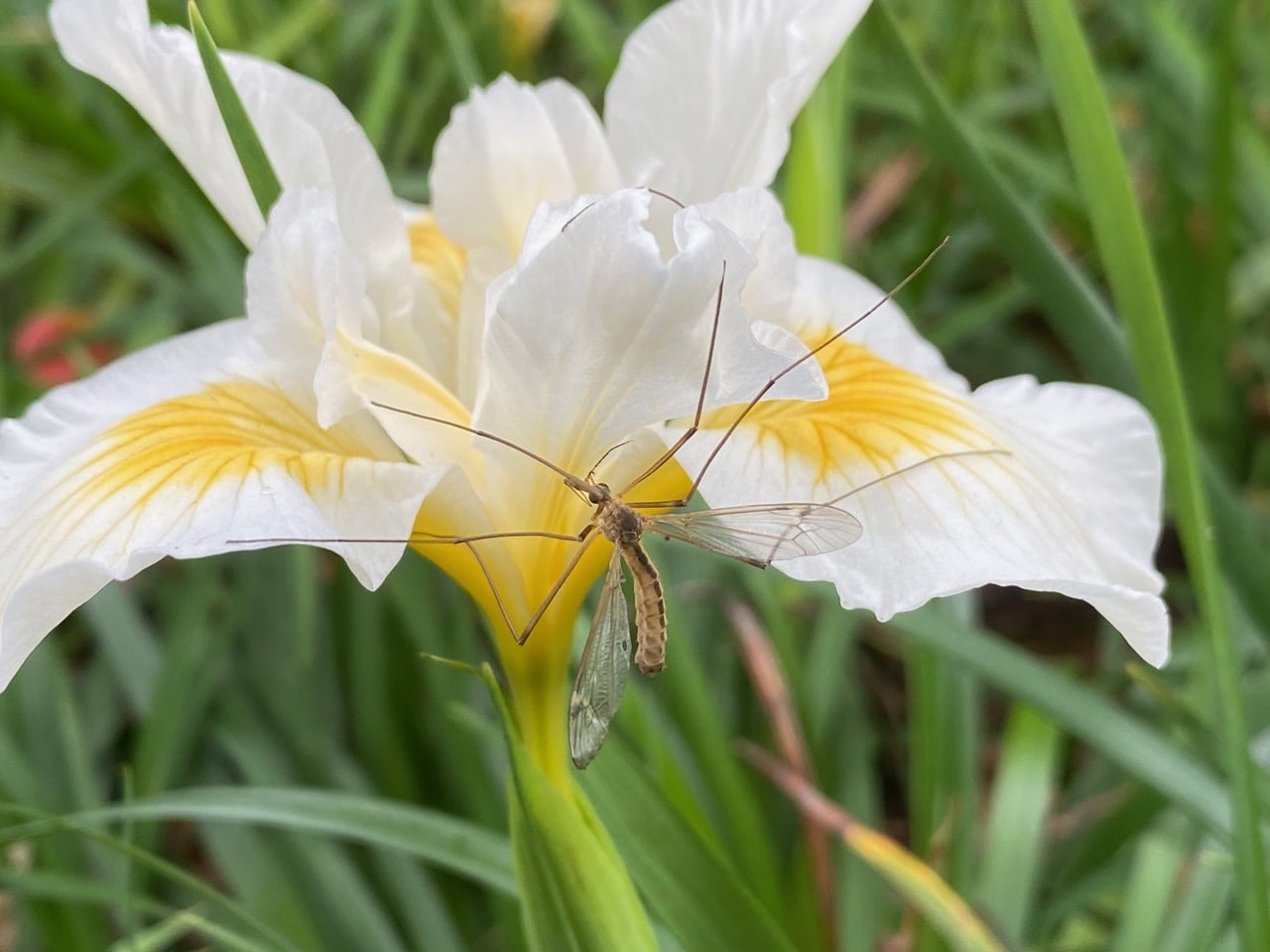
In front of the visitor center, a Common Crane Fly, Tipula sp. (family Tipulidae) is posing atop an ornamental Iris flower.
Tipula is a very large fly in the family Tipulidae (crane flies). The members of this genus are sometimes collectively called Common Crane Flies. They occur worldwide. Like all crane flies, Tipula species have long bodies and long legs, somewhat resembling large mosquitos. Adults generally have a body length of 25-20 mm. They are usually brown with clear or brownish wings. They feed on nectar and are active throughout the year. Tipula larvae, also known as “leather jackets” are tough-skinned, worm-like, legless maggots that live in moist soil, especially in areas with high organic matter, like lawns and pastures. They feed on roots, crowns, and sometimes leaves of grass plants, potentially causing damage to lawns and turf. Their activity is important in the soil ecosystem, as they process organic material and increase microbial activity. Larvae and adult crane flies are also valuable prey items for many animals, such as insects, spiders, fish, amphibians, birds, and mammals.
Sensing my approach, the fly scrambles clumsily down to hide under a petal. I wonder why it doesn’t fly away instead. Note its blunt abdominal tip. Females have a rounder abdomen with a pointed tip and ovipositor for laying eggs.