

Pollinator Post 3/22/24
I have a slow start, but manage to get to the Regional Parks Botanic Gardens in late morning.
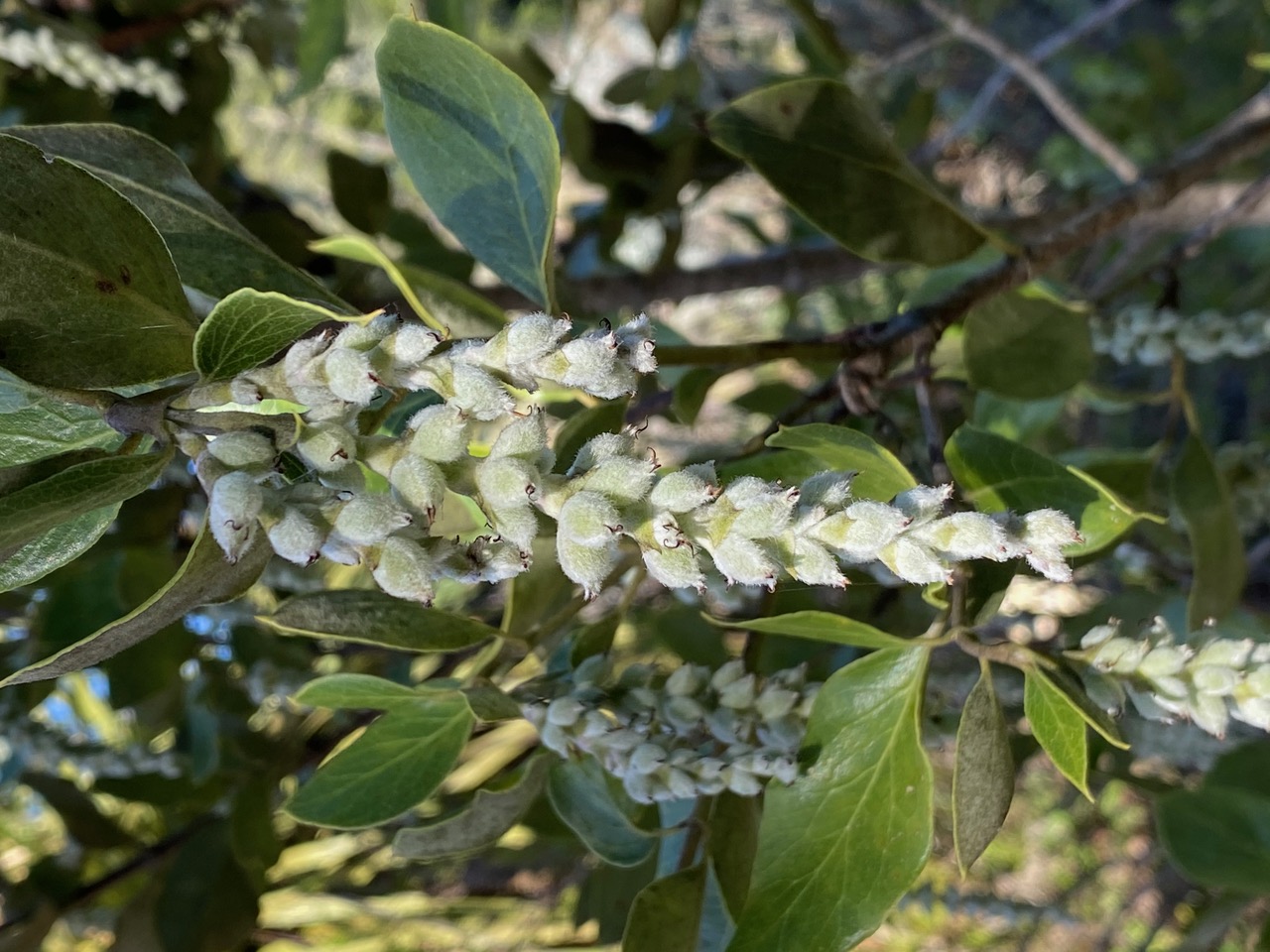
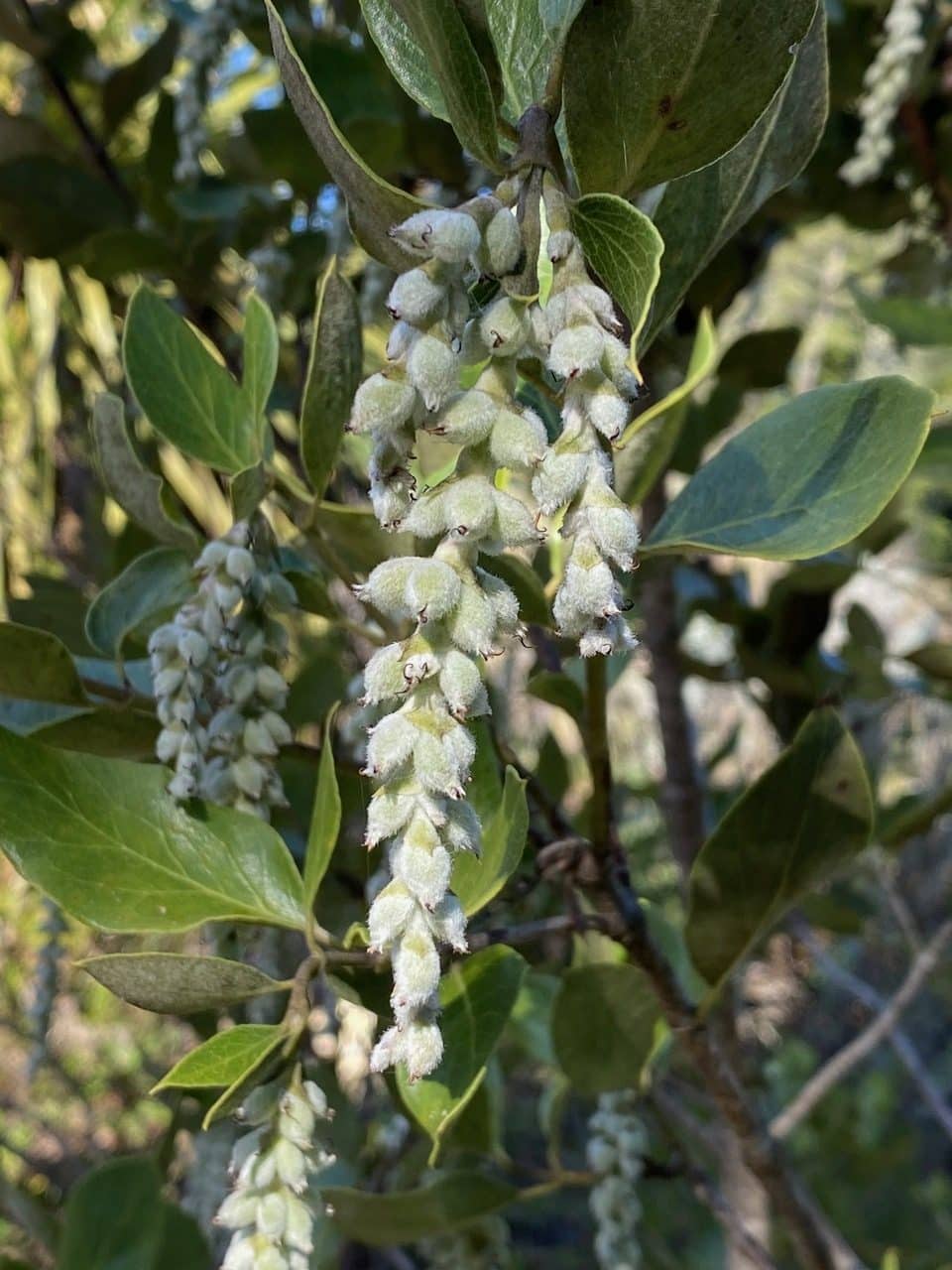
While all the male catkins of Silk Tassel, Garrya elliptica have all but withered in the garden, the females are coming into their own, with swelling fruits along their shorter catkins.


An insect hiding among the berries of a female Silk Tassel is enjoying a bit of morning sun. Wow, I have never seen such a colorful Stink Bug!
iNaturalist has identified it as the Green Burgundy Stink Bug, Banasa dimidiata (family Pentatomidae). The common name describes the bug well! Native to North America, the species is found on a wide variety of trees and shrubs, often on berries. The specific epithet dimidiata, meaning ‘divided in half’, refers to the pronotal pattern, half green and half burgundy across the width.
Pentatomidae is a family of insects belonging to the order Hemiptera or “true bugs”. As hemipterans, the pentatomids have piercing-sucking mouthparts, and most are phytophagous, including several species that are severe pests on agricultural crops. Stink Bugs feed on plant fluids by inserting their needlelike mouthparts into stems, leaves or seed pods. While feeding, they inject materials into the plant to aid in digestion and sap removal. Penetration by the mouthparts can cause physical damage, much like stabbing the plant with a fine needle.
All Pentatomids have 5-segmented antennae (hence their family name, Penta – five and tomos – section.) They generally have a large triangular scutellum in the center of the back. The adult is generally shield-shaped when viewed from above. The common name of Stink Bug refers to their ability to release a pungent defensive spray when threatened, disturbed, or crushed.
The male Osoberry, Oemleria cerasiformis in front of the visitor center is in peak bloom. Each cluster of flowers has been claimed by a spider that has covered it with a fine, loose, almost invisible network of silk. An ant can be seen foraging among the flowers.











A Common Pollen Beetle, Brassicogethes aeneus (family Nitidulidae) is lurking on a flower of another male plant.
The species is found in Europe, Northern Asia and North America. Adults are 2-3 mm long, black with a hint of metallic green, and have knobbed antennae. It is a known pest of oilseed rape. It is unclear whether the beetles contribute to the pollination of the crop. The female beetle lays its eggs in the flower buds of the host-plant and the larvae develop within the flowers. Both adults and larvae feed on the pollen and nectar in the flowers.
Taking an unfamiliar path through the garden, I am pleasantly surprised to be met by this beautiful scene – the Western Redbud, Cercis occidentalis is in full bloom! The deciduous shrub is Calfornia’s answer to the Cherry Blossoms, its beautiful pink flowers appearing on bare branches in early spring. The two plants actually belong to different families – the Cherry to the rose family, and the Redbud to the pea family, Fabaceae.
Up close, the flowers of Redbud have the gestalt of the classic pea flower. And yet I detect something different – the flower parts do not exactly correspond to those of the Lupine flowers more familiar to me. A short Jepson Herbarium video on the species quickly dispels my confusion.
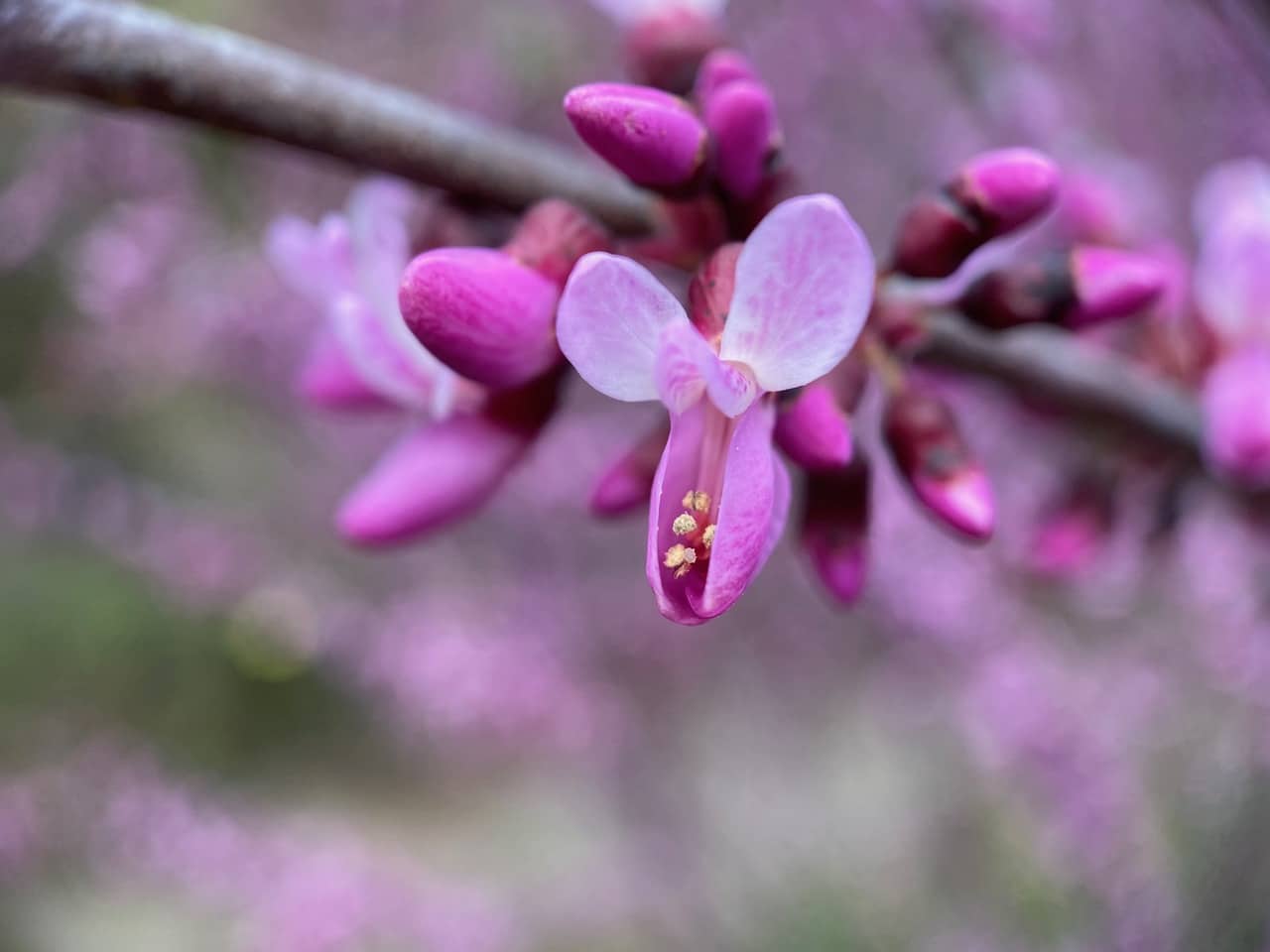
The Redbud flower is bilaterally symmetrical. The 5 sepals are fused into an oddly shaped calyx. There are 5 petals – the banner, 2 wings, and 2 keel petals that are free, not fused. The single banner is the petal that sticks up vertically in the center, flanked by the ear-like wings. The pair of keel petals at the bottom loosely enclose the reproductive structures inside.
Looking at the floral structure, it is easy to see that accessing pollen from Redbud should be relatively easy, compared to the Lupine flowers. Unlike the arrangement in lupine, the reproductive structures of the Redbud are not doubly enclosed in the keel and the wings. All an insect has to do is land on the keel petals. If it’s heavy enough, its heft should part the keel petals, letting the reproductive parts to come in contact with the underside of the insect.
Close-up of a Redbud flower that has been “tripped” by a bee – the keel petals are parted, exposing the 10 stamens and single style inside. Easy peasy!
Wow, such a profusion of flowers! How does one focus on a pollinator in this sea of pink?
Here’s a Black-tailed Bumble Bee, Bombus melanopygus (family Apidae) visiting a Redbud flower.
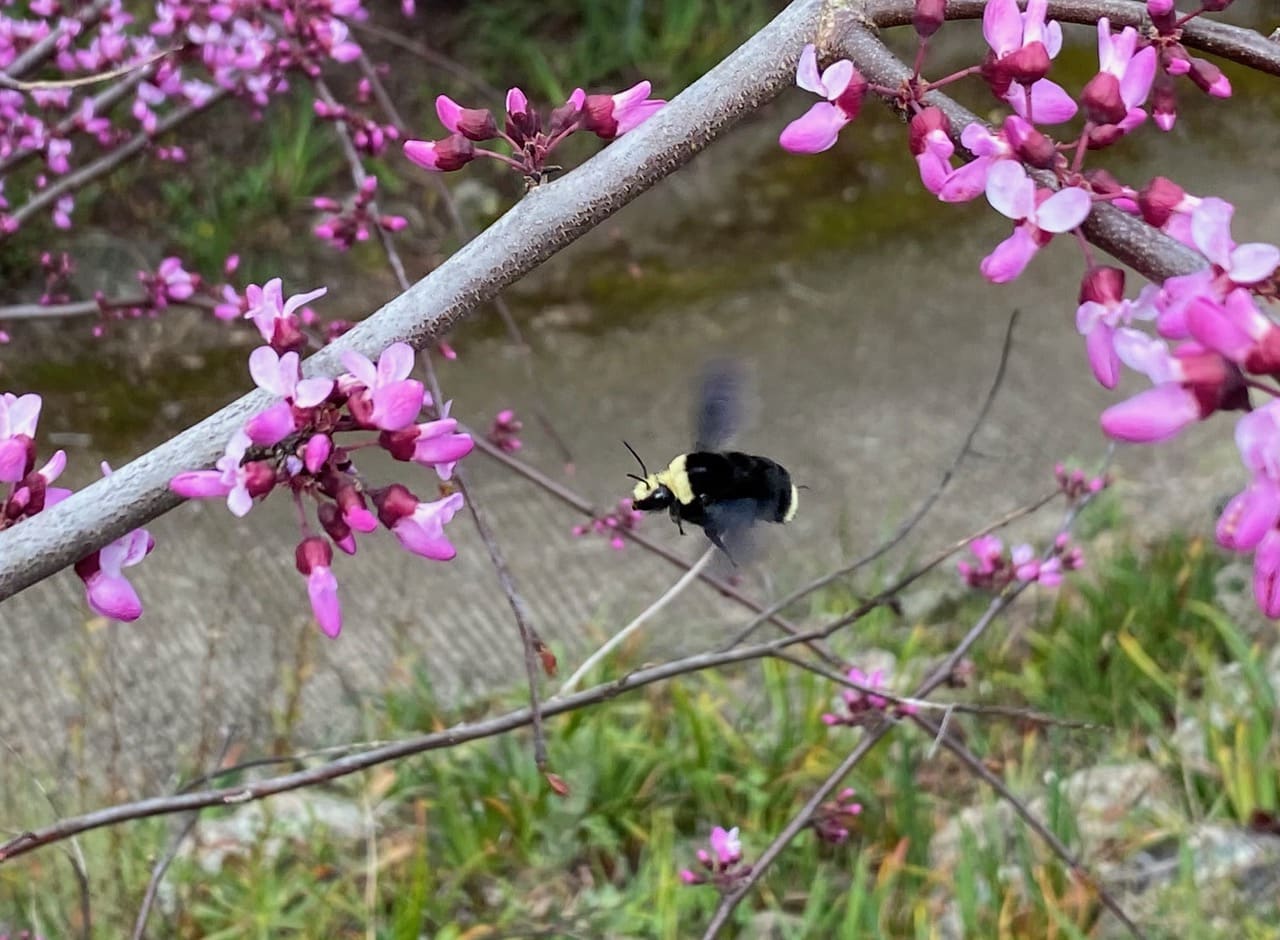
A large queen Yellow-faced Bumble Bee, Bombus vosnesenskii (family Apidae) is circling the Redbud shrub buzzing excitedly. She lands several time on the flowers, but I fail to get any photos. Faster still and impossible to photograph are the Carpenter Bees. I spot both males and females visiting the flowers. Their action is so quick it looks as if the bees are simply bouncing off the flowers.
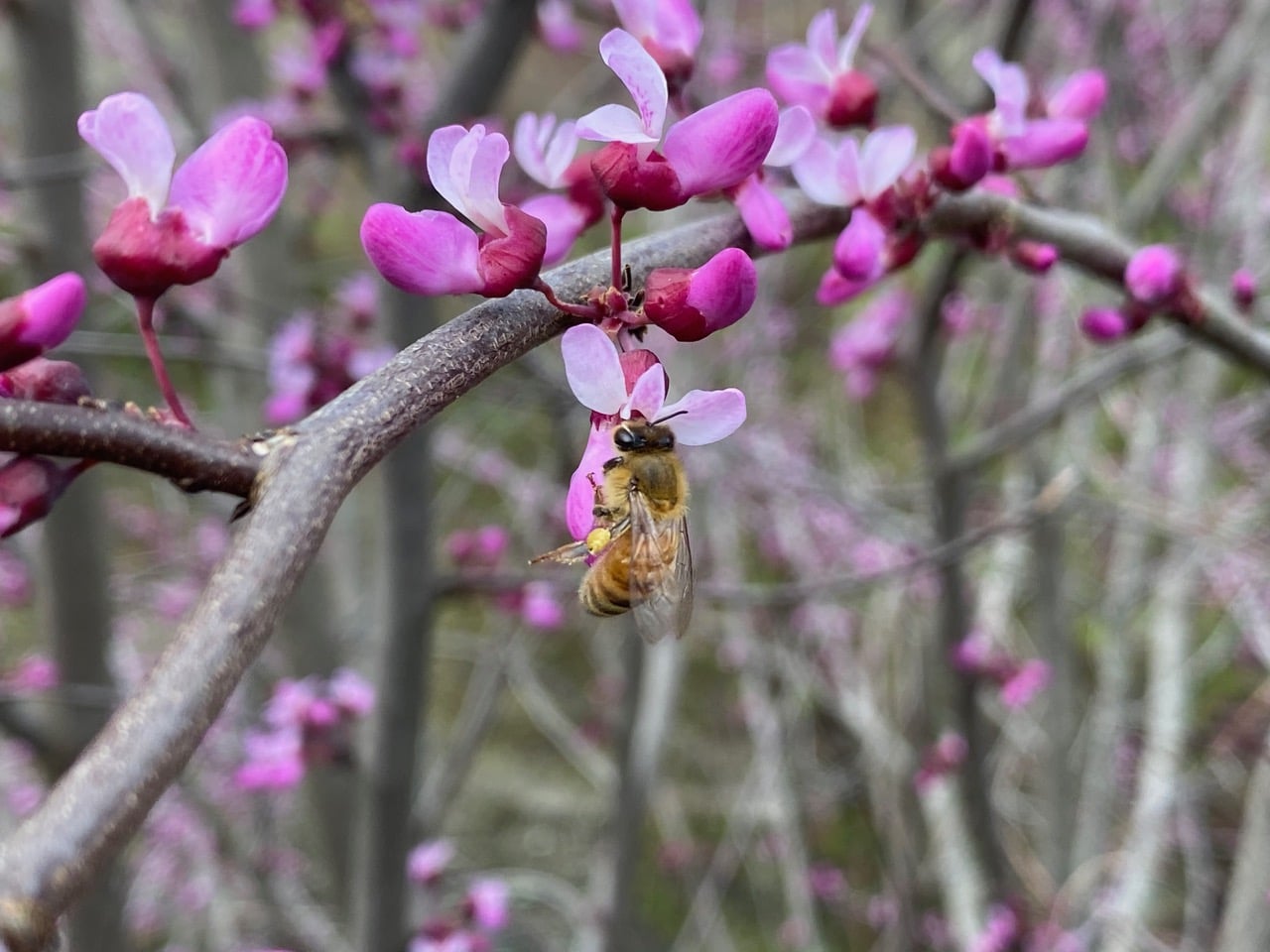
A Honey Bee, Apis mellifera (family Apidae) lands on a flower close to me, and sticks her tongue into the base of the flower for nectar. She has a bit of pollen on her pollen basket.
Next, the Honey Bee turns her attention to the keels in search for pollen. Hanging vertically, she struggles to pry the keel petals apart, using her jaws.
Ah, success!
The bee next lands on a Redbud flower lying horizontally on a branch, and sticks her tongue in for nectar. Her weight is enough to part the keel petals against the branch. See the vertically oriented yellow anthers touching the underside of the bee’s thorax? What a sweet deal – nectar and pollen at the same time!
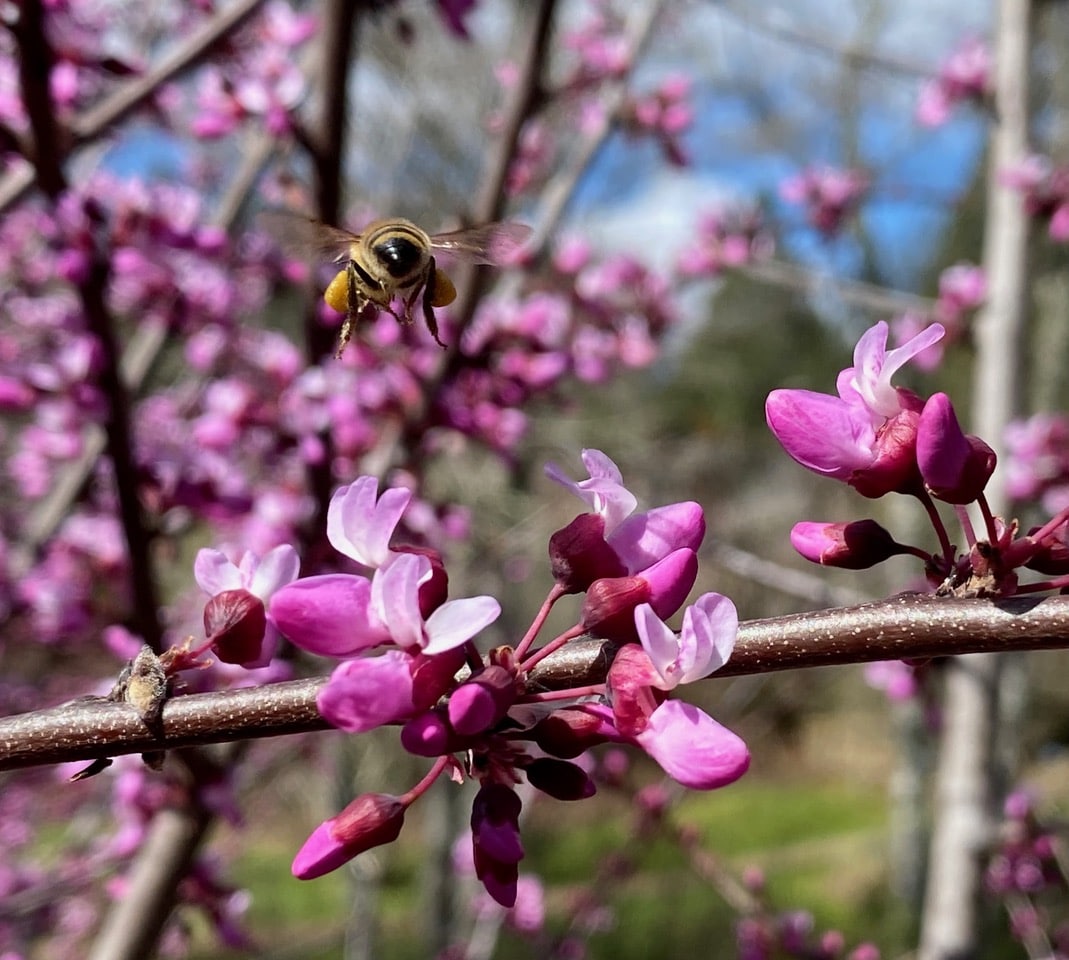
A happy Honey Bee flies away with a full load of pollen in her pollen baskets.
Just a few steps further, there’s a carpet of Sonoma Sage, Salvia sonomensis (family Lamiaceae) on the slope below the visitor center. The low-growing sage is in full bloom! Many Honey Bees, Apis mellifera are stopping for nectar.
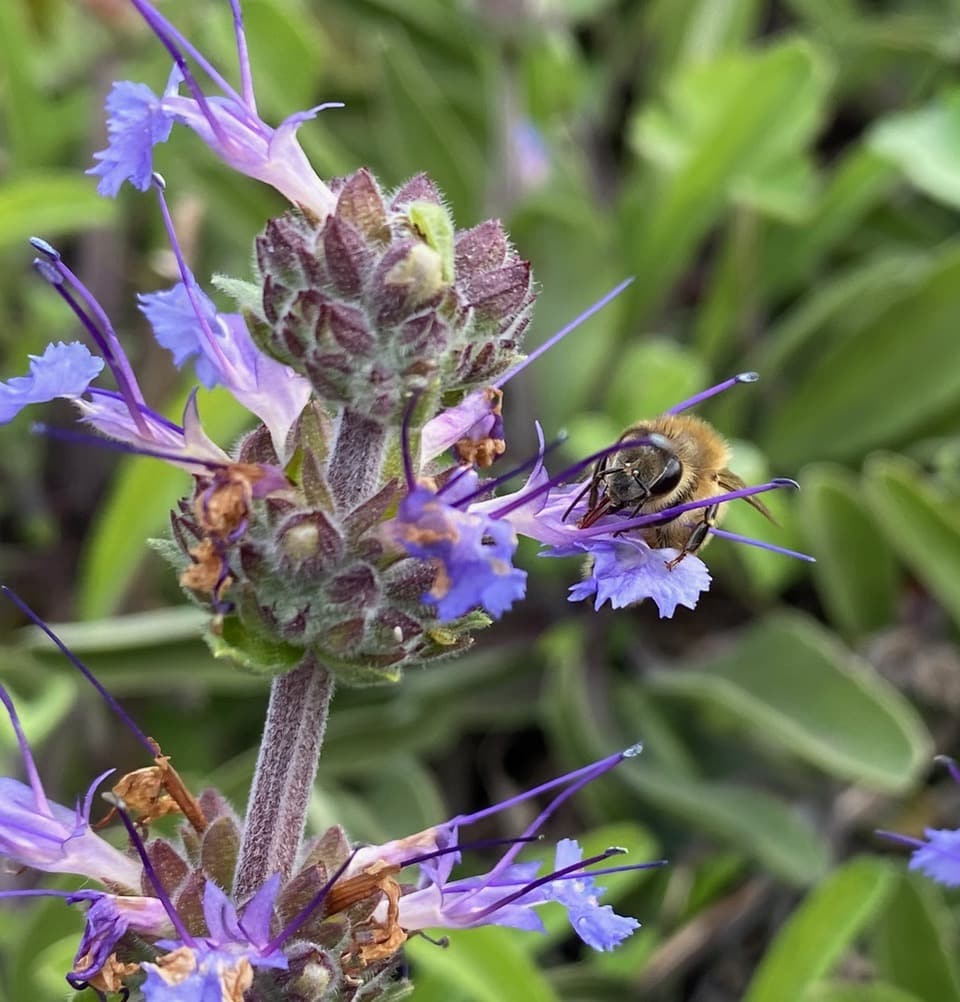
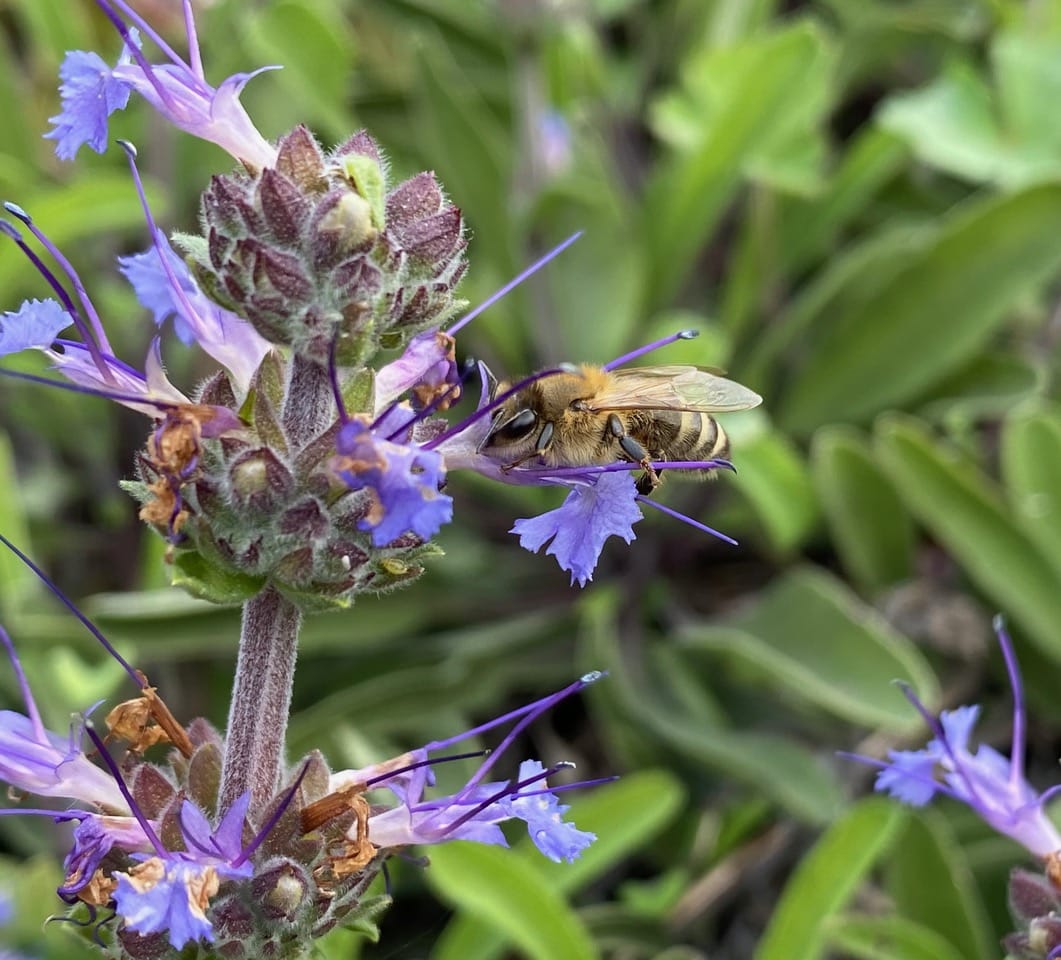
Plants in the genus Salvia are generally perennial and aromatic. The flowers are usually tubular with two lips and only two stamens and are borne in terminal inflorescences. The upper lip of S. sonomensis is much reduced, and does not form a hood. The elongate, horizontal lower lip has fringed and ruffled edges, adding to the flower’s charm. The two stamens are very long, protruding straight out with little curvature. The lower lip provides a landing platform for the bee, but when the bee probes for nectar in the back of the flower, I do not see any movement of the stamens to dab pollen on the bee’s back. Unlike most European species of Salvia, Sonoma Sage does not have a functional staminal lever mechanism for enhancing pollination. I have observed this in all our native Salvias, much to my disappointment.
Earlier we have talked in some detail about the staminal lever mechanism in Rosemary, Salvia rosmarinus and how the adaptation enhances pollination by bees. You may review that in Pollinator Post 2/15/24 (1).
The reproductive parts of S. sonomensis totally miss the visiting Honey Bee. Free nectar without providing pollination service.
Again, no movement of the stamens when the honey bee probes for nectar. Bees might not be the primary pollinators for these flowers. What then? Butterflies, maybe? The long and splayed reproductive parts can better make contact with the large wings of a butterfly.
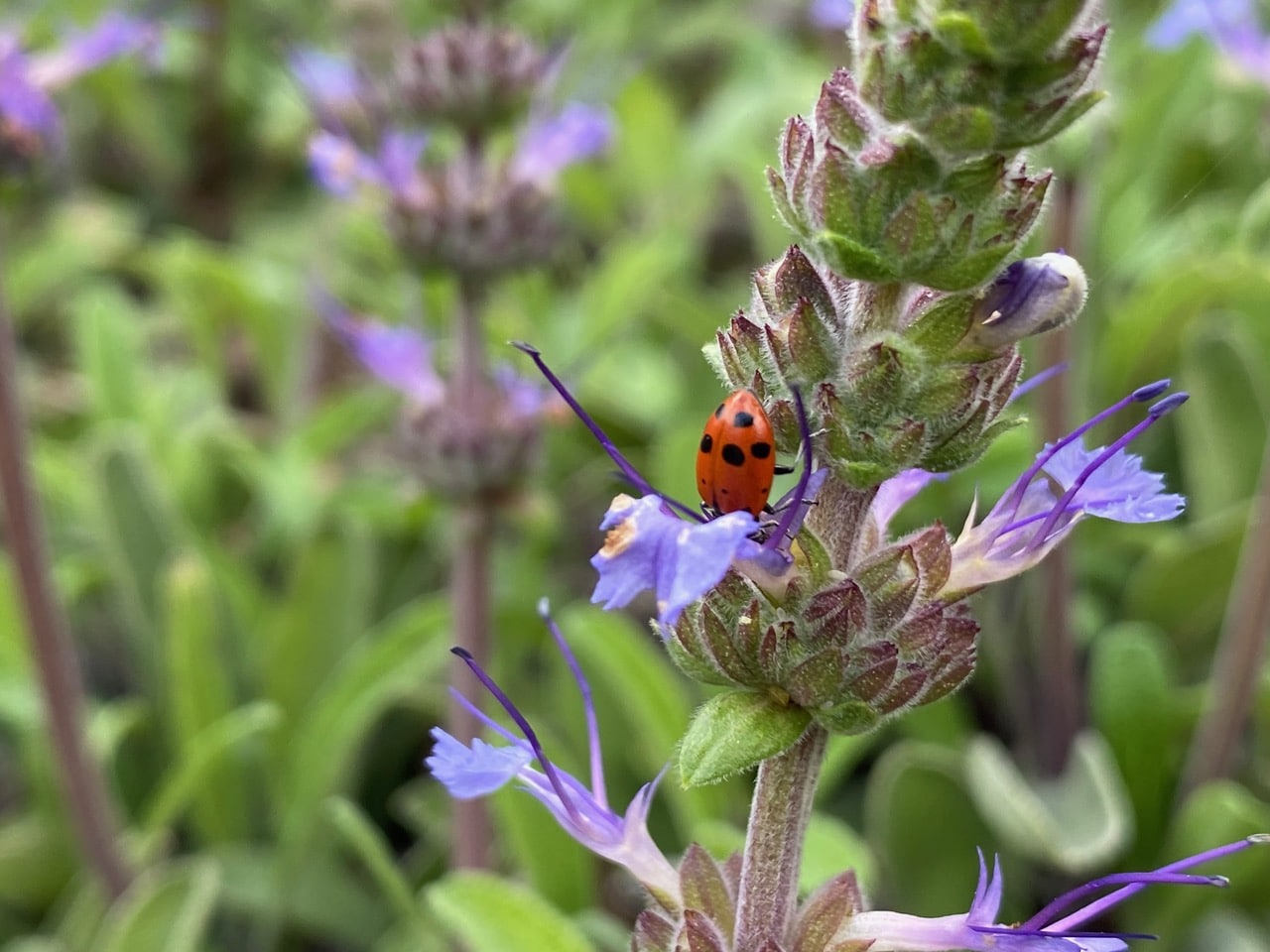
I watch as a Convergent Lady Beetle, Hippodamia convergens climbs slowly up the spike of flowers. Is it looking for prey?
Nectar?
The Convergent Lady Beetle, Hippodamia convergens (family Coccinellidae) is among the most common lady beetle species throughout North America. Both adults and larvae feed voraciously on aphids, scales, thrips, and other soft-bodied insects. The beetles may also feed on pollen and nectar from flowers when prey is scarce.
A tiny Inchworm has planted itself among the flower buds of Sonoma Sage.
Inchworms are also called loopers and measuring worms. They majority of the inchworms are the larvae of moths in the family Geometridae. The name comes from the Greek “geo” for earth and “metro” from measure, because the caterpillars seem to be measuring the surface on which they are walking.
All caterpillars have three pairs of jointed legs behind their heads. These legs are called true legs because they will become the six legs of the adult butterfly or moth. There are additional appendages, called prolegs, along their bodies. Prolegs are not true legs, they are just outgrowths of the body wall and will be lost at metamorphosis. They have little hooks on their soles to help the caterpillar walk and grip onto things.
Most caterpillars have five sets of prolegs, four in the middle of the body and one pair at the hind end. Inchworms have the normal six true legs but only two or three pairs of prolegs, all located at the tail end of the body, with none in the middle. When an inchworm walks, it moves its tail-end prolegs up behind its true legs, causing the center of its body to loop upward. Then it stretches its front end forward to take another step.
A movement in the sage foliage alerts me to a female March Fly, Bibio xanthopus (family Bibionidae) struggling up a leaf. Her body is bent, and the tips of her wings are not fully expanded. She strokes the wings repeatedly with her hind legs as if trying to stretch them out. Has the fly just emerged from her cocoon? Welcome to the world, Bibio!
March Flies (family Bibionidae) generally live in wooded areas and are often found on flowers – adults of some species feed on nectar, pollen, and honeydew, while adults of other species don’t feed at all; and in either case, they are very short-lived. They are considered important pollinators in orchards. They are also important food for other insects and spiders. The larvae feed en masse on rotting organic materials like leaves, wood, compost, and rich soil.
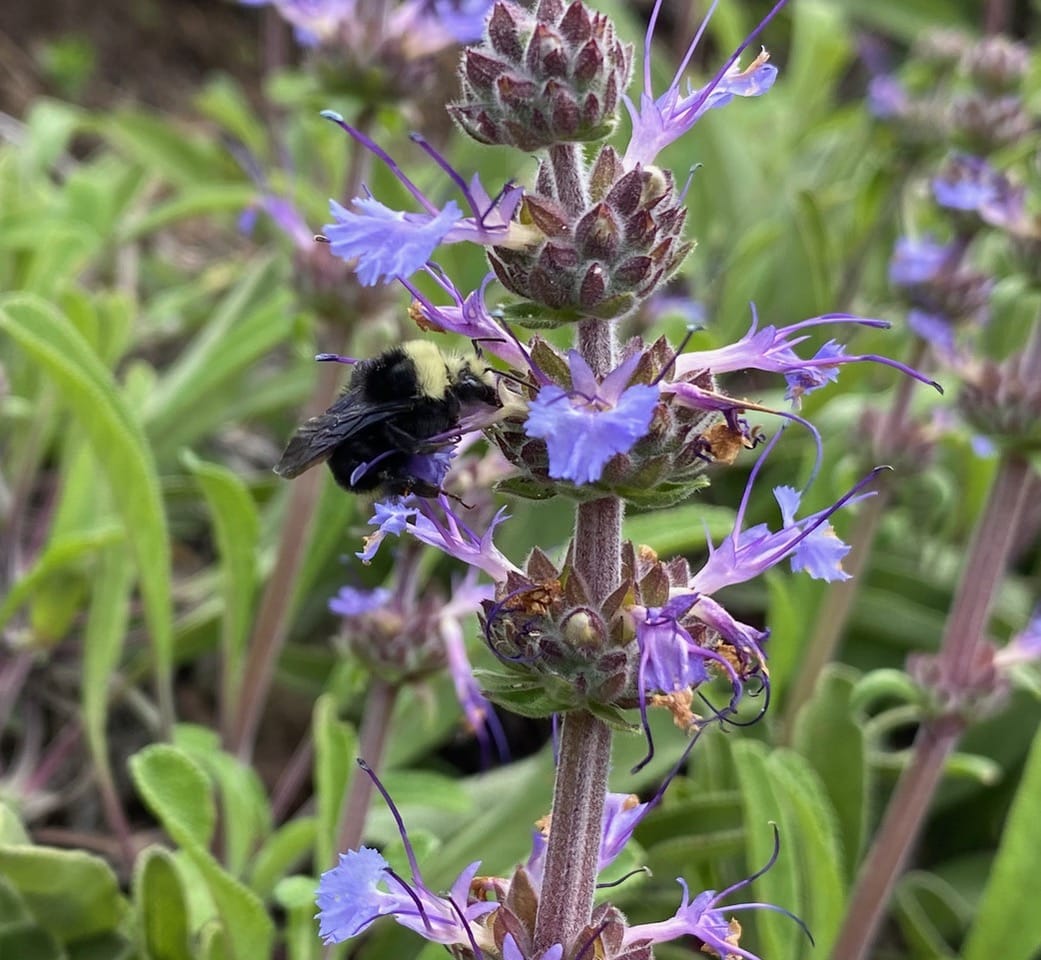
A large Yellow-faced Bumble Bee, Bombus vosnesenskii (family Apidae) lands on a sage flower. The lower lip of the flower does not fully support her weight, but she manages to stick her tongue in for nectar. Just as in the case of the Honey Bee, the tips of the stamens of the flower does not make contact with the bee. Free lunch for the queen!
As I watch the bumble bee’s awkward movements on the Salvia flower, I recall seeing a White-lined Sphinx Moth, Hyles lineata (family Sphingidae) visit this very patch of flowers early one morning many years ago. Hovering with ease from one flower to the next, it extended its long proboscis into the throat of the flowers without even having to land. I bet its wings must’ve touched the stamens and picked up pollen from them. The moth would be a better candidate for pollinator of this plant than any of the bees.
Maybe the New World Salvias have lost the staminal lever mechanism because we have the sphinx moth to pollinate the flowers! Hyles lineata is a New World species. Plants evolve and adapt to what pollinators are available. Perhaps pollination by moths is much more prevalent than we are aware, because we are not out and about at night to see them?